INTRODUCTION
Gastropods of the family Vermetidae are characterized by the production of eggs contained in egg capsules which are brooded by the female freely in the mantle cavity (Morton, Reference Morton1965; Hadfield et al., Reference Hadfield, Kay, Gillete and Lloyd1972; Hughes, Reference Hughes1979; Miloslavich & Penchaszadeh, Reference Miloslavich and Penchaszadeh1992) or attached to the internal side of the shell (Morton, Reference Morton1951, Reference Morton1965; Hadfield et al., Reference Hadfield, Kay, Gillete and Lloyd1972; Hughes & Lewis, Reference Hughes and Lewis1974; Bandel, Reference Bandel1975, Reference Bandel1976; Hughes, Reference Hughes1979). The spawn is composed of several individual egg capsules, spherical or elongated with a fragile membrane, their size and number depending on the species. Also, the production of eggs (1 to 400 eggs per capsule), egg diameter (100 to 480 µm), hatching mode (veliger larva or crawling juvenile) and the presence of nurse eggs are species specific (see Miloslavich & Penchaszadeh, Reference Miloslavich and Penchaszadeh1992 for a review of some reproductive traits in Vermetidae). Most of the literature dealing with reproductive aspects in Vermetidae is focused then in describing egg capsules, embryos, and hatching modes, and studies on the gametogenesis are very rare. With few exceptions (Hodgson & Eckelbarger, Reference Hodgson and Eckelbarger2000), who studied the oogenesis in six species of patellid limpets from South Africa, gametogenic studies in gastropods are mostly limited to commercial species such as the Buccinum undatum Linnaeus, 1758 from east Canada (Martel et al., Reference Martel, Larrivée, Klein and Himmelman1986a, Reference Martel, Larrivée, Klein and Himmelmanb; Gendron, Reference Gendron1992; Himmelman & Hamel, Reference Himmelman and Hamel1993), Zidona dufresnei (Donovan, 1823) from Argentina (Giménez & Penchaszadeh, Reference Giménez and Penchaszadeh2002, Reference Giménez and Penchaszadeh2003), or to imposex indicators such as Reishia (Thais) clavigera (Kuster, 1858) from the west coast of Korea (Lee, Reference Lee1999) and Nassarius reticulatus Linnaeus, 1758 from the north-west of Portugal (Barroso & Moreira, Reference Barroso and Moreira1998). In vermetids, the annual reproductive cycle has been studied in Vermetus triquetrus Bivona, 1832, Dendropoma petraeum (Monterosato, 1848) and Serpulorbis arenaria Linnaeus, 1767, three species from the coast of Spain (Calvo et al., Reference Calvo, Templado and Penchaszadeh1998; Calvo, Reference Calvo1999; Calvo & Templado, Reference Calvo and Templado2004a, Reference Calvo and Templadob). Strathmann & Strathmann (Reference Strathmann and Strathmann2006) discussed the importance of the reproductive mode of a Hawaiian vermetid gastropod in achieving a high potential for invasion and establishment following maritime transport or natural rafting, and predicts a widespread distribution and invasion to warm waters.
Eualetes tulipa Chenu, 1843, was originally described as Vermetus tulipa by Chenu (Reference Chenu1842–1853), however, no locality was specified for this material. Keen (Reference Keen1971) renamed this species as Eualetes tulipa and reported it for Panama Bay in the Pacific Ocean. Another report in the Panama area is at the Veraguas Province (Vega & González, Reference Vega and González2002). In Hawaii, E. tulipa has been reported as a nonindigenous, introduced species in 32 localities including Kane‘ohe Bay, Hilo Harbor, O'ahu Waikiki and O'ahu Honolulu, mainly attached to artificial substrates such as concrete pilings and walls, metal and wood substrates but also in natural environments such as reefs and mangrove roots (Coles & Eldredge, Reference Coles and Eldredge2002; Coles et al., Reference Coles, DeFelice and Eldredge2002; Schluker, Reference Schluker2003; Ray, Reference Ray2005; database from the Bishop Museum, Hawaii). Specimens are large (about 5 cm in shell length) and tend to be solitary rather than colonial.
In the Venezuelan Caribbean, this species has been observed since at least 1986 (reported as Vermetus sp.) colonizing only on artificial substrates (Miloslavich & Penchaszadeh, Reference Miloslavich and Penchaszadeh1992). Inventories of marine species in the Caribbean are far from being complete and Venezuela is not an exception. This lack of knowledge has the consequence that sometimes, when a new report is made on a species, it is difficult to accurately validate its status either as endemic or as introduced. The most complete local mollusc guide of the southern Caribbean is that of Díaz & Puyana (Reference Díaz and Puyana1994) which reports 5 species of Vermetidae belonging to the genera Serpulorbis, Petaloconchus and Dendropoma. For Venezuela, Tello (Reference Tello1975) reports 12 vermetid species within the genera Petaloconchus, Serpulorbis and Siphonium, which are mostly taxonomically out-dated names and none of which is E. tulipa or any of its synonyms. The problem of vermetid taxonomy is particularly complicated (Keen, Reference Keen1961; Bieler, Reference Bieler1996), and few genera are defined by valid autopomorphic characters (Gould, Reference Gould1994). Schiaparelli et al. (Reference Schiaparelli, Albertelli and Cattaneo-Vietti2006) when discussing the use of vermetid reef formations as sea level indicators stated that the complex taxonomy of this family has on occasions led researchers to mix different species, even belonging to different genera under a single name. With the development of recent molecular techniques, the confused vermetid taxonomy may be closer to a solution. In this aspect, Calvo et al. (Reference Calvo, Templado, Oliverio and Machordom2009) using mitochondrial genes cytochrome c oxidase subunit I (COI) and 16S rRNA (16S) sequences of Dendropoma petraeum from 18 different localities in the Mediterranean, discovered that there are at least 4 different cryptic species in what they called the Dendropoma petraeum complex. These genetic differences were also supported with reproductive information about intracapsular larval development and protoconch morphology. Reproductive studies on E. tulipa in the southern Caribbean point out that this species reproduces throughout the year. Females brood up to 54 egg capsules containing about 290 eggs each, of which around 190 develop to a veliger larva that settles within 24 hours of hatching (Miloslavich & Penchaszadeh, Reference Miloslavich and Penchaszadeh1992).
Dendropoma corrodens D'Orbigny, 1842, is also a tropical species, originally described as Vermetus corrodens by D'Orbigny (Reference D'Orbigny1841) from material collected in Cuba and Martinique. This species is known in Cuba, east Florida, Bermuda, the Caribbean coasts of Colombia and Venezuela, and mid-Atlantic islands (Oliver, Reference Oliver1975; Miloslavich & Penchaszadeh, Reference Miloslavich and Penchaszadeh1992; Díaz & Puyana, Reference Díaz and Puyana1994). Specimens are small (about 1 cm) and live in colonies, encrusted to coral substrates. Females brood up to 8 egg capsules containing about 8 eggs of which 6 to 7 develop to a crawling juvenile that settles very close to the female (Miloslavich & Penchaszadeh, Reference Miloslavich and Penchaszadeh1992).
The objective of this work is to study the annual reproductive cycle of E. tulipa and D. corrodens, their size at sexual maturity and gametogenesis, as well as the relationship between female size and fecundity. We will also estimate the density and area covered by populations of both species in their localities, and since E. tulipa has been reported as an invasive species, we will follow population density in time.
MATERIALS AND METHODS
Site description and population estimation
Specimens of E. tulipa (Figure 1) are found attached to the walls of the intake-cooling channel of the powerplant Planta Centro, in the central-west coast of Venezuela (10°30′6″N 68°9′36″W) Estado Carabobo. The channel is approximately 500 m long with a depth of 2 to 5 m, however, the zone that was accessible for our research consisted of the first 100 m. The channel has two parallel metal walls separated by a distance of 40 m. These walls are structured in columns of about 30–35 cm in width, being one column projected to the front (35 cm) and one column projected to the back (30 cm) with a 35 cm escalated space between both. Due to the functioning of the power plant, the channel has a constant flow of water from the sea to the engines that varies in speed depending on how many chimneys are working. The speed of the current in the channel varies between 0.13 and 0.23 m/second (Miloslavich, Reference Miloslavich1987) and the amount of suspended organic matter varies between 1.7 and 21.8 mg/l (Miloslavich & Penchaszadeh, Reference Miloslavich and Penchaszadeh1992). In 1986, all adult specimens from a total of 25 columns (5% of the total area) were counted up from the surface to the bottom (5 m). In 2006 and 2009, the same recount was made down to 3 m deep since the deeper two metres of the channel had been filled with fine sediment.
Adult individual of Eualetes tulipa after being extracted from the wall of the power plant channel at 0.5 m depth. Tube aperture is ~1 cm in diameter, and the shell is covered by epifauna.

Specimens of D. corrodens colonize coralline rocks at Punta Mayorquina (10°53′45N 68°13′48″W), Morrocoy National Park, Estado Falcón, Venezuela, at a maximum of 1 m depth. The area has a mixture of coralline rocks, patches of the seagrass Thalassia testudinum and small colonies of the coral Siderastrea siderea. Water conditions at this locality are more oligotrophic and the amount of suspended organic matter varies between 0.2 and 7.5 mg/l (Miloslavich & Penchaszadeh, Reference Miloslavich and Penchaszadeh1992). The total area colonized by D. corrodens was determined by bathymetry using as a reference the sea level at the coast and during high tide. The total number of juveniles (newly fixed to the rock) and adult specimens (embedded in the substrate) was counted in a total of 36 randomly selected rocks.
Gametogenesis
To study the gametogenic cycle of both species, between 10 and 14 adult specimens of E. tulipa were collected monthly from January to December 1986 from the walls of the channel, between 0 and 1 m depth. Coral rocks colonized by D. corrodens were collected from January to December 1986 at Punta Mayorquina at a maximum of 0.6 m depth.
The animals were extracted from the shell, left in Petri dishes with seawater until relaxation and measured. The soft body of the animal has a cylinder shape and the gonad can be distinguished from the digestive gland by its colour. In both species, female gonads are yellow, while male gonads are orange. The digestive gland is dark brown. We measured total length and diameter of the soft body (BL and BD) and of the gonad (GL and GD). The gonadosomatic index (GSI) was calculated by the relationship between total body–gonad volume with the following equation: GSI (volume) = (GV/BV) × 100.
The volume of the gonad (GV) was calculated as the volume of a cylinder:
GV = (Π × GD/2)2 × GL, in which GD = gonad diameter and GL = gonad length. The body volume (BV) was calculated similarly as: BV = (Π × BD/2)2 × BL, in which BD = body diameter.
The total number of egg capsules brooded by each female was counted and the relationship between this number and female size, gonad size and GSI was determined.
After measuring the gonads, they were fixed in formalin (8% in seawater) for histological procedures using standard paraffin techniques and haematoxylin–eosin staining. Histological sections were observed and the diameter of the spermatogonium, oocytes and yolk granules was measured. Observations of live and preserved material were done with a ZEISS dissecting microscope and ZEISS microscope; measurements were taken with an ocular micrometer. Results are reported as mean±standard deviation.
Voucher adult material of E. tulipa (entire individuals fixed in formalin and preserved in ethanol) is deposited in the American Museum of Natural History, New York (catalogue number 232098).
RESULTS
Population density
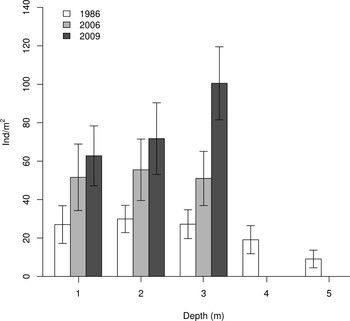
In 1986, adults of E. tulipa were distributed along the depth gradient, however, a significant difference between the first 3 m (mean: 28.1±8.2 ind/m2, range: 10.4 to 48.9 ind/m2) and the last 2 m (mean: 14 ind/m2, range: 3.0 to 35.5 ind/m2) was found (Kruskal–Wallis, P < 0.001 followed by Scheffé multiple comparisons). In 2006 and 2009, again no significant differences (P < 0.001) in density were found between the first 3 m. In 2006, the mean density was 52.7±15.6 ind/m2 (range: 22.1 to 100 ind/m2) and in 2009, the mean density was 71.6±20.6 ind/m2 (range: 46.2 to 121.5 ind/m2) (Figure 2). The last two deeper metres were no longer present since the bottom of the channel in this sector had been filled up with naturally deposited fine sediments. The total area covered by E. tulipa was at least 1000 m2, but if the presence of adults was to be confirmed in the more restricted zones of the channel, the total area of colonization by this species could be at present of up to 3000 m2 (2 walls of 500 m in length each with 3 m in depth).
Density of Eualetes tulipa at Plantacentro in 1986, 2006 and 2009. Bars represent mean density, vertical bars represent standard deviation.

The total area covered by substrate colonized by D. corrodens was 706 m2 at a depth of between 0.3 and 0.6 m during high tide. The mean density was 13,000 ind/m2 of which 46.2% were adults and 53.5% were recently fixed juveniles.
Gonadosomatic index
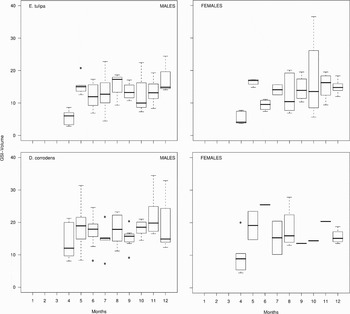
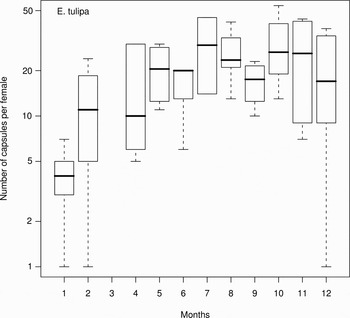
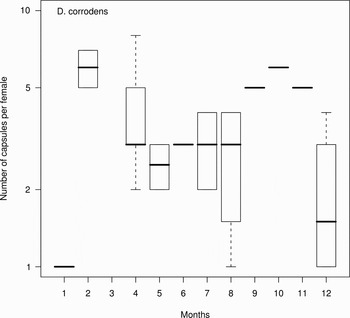
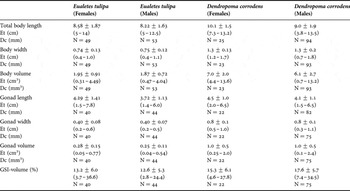
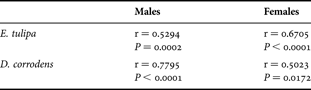
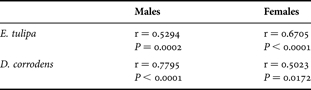
Brooding females of E. tulipa measured between 5.0 and 14.0 cm in total body length and between 0.4 and 1 cm in width, each female brooded between 1 and 54 egg capsules at different developmental stages (19.3±13.3, N = 49). The gonad represented about 47% and 44% of the total length of the female and male body respectively, while it represented about 13% of the total body volume of both sexes (Table 1). Brooding females of D. corrodens measured between 7.0 and 13.0 mm in total body length and between 1.2 and 1.7 mm in width, each female brooded between 1 and 8 egg capsules, also at different developmental stages (3.4±1.9, N = 25). The gonad represented about 45% and 46% of the total length of the female and male body respectively, while it represented about 15% and 18% of the total body volume of both sexes (Table 1). Gonad volume of both females and males was correlated to total body volume for both species (Table 2). No significant differences were found in the GSI-volume throughout the year at a monthly basis (Figure 3). The gonad size is significantly related to body size for both species and sexes (r > 0.5 and P < 0.01). No significant linear correlation was observed between female size, gonad size or GSI with the number of capsules brooded per female (Pearson correlation r < 0.2 and P > 0.05 for all cases). The number of egg capsules brooded per females is very variable (Figures 4 & 5), however, a significant quadratic relationship between the log transformed number of capsules and female body volume was obtained for E. tulipa (R2 = 0.40, P < 0.00001), indicating that females with a body volume of 1.25–3.25 cm3 (within a range of 6–10 cm in body length) are those that have the highest number of egg capsules (around 25 capsules/female). Females larger than 14 cm had a lower fecundity, and they brooded around 12 capsules/female (Figure 6).
Gonadosomatic index-volume for females and males of Eualetes tulipa and Dendropoma corrodens throughout the year at a monthly basis.

Number of capsules brooded per female of Eualetes tulipa throughout the year at a monthly basis.

Number of capsules brooded per female of Dendropoma corrodens throughout the year at a monthly basis.

Quadratic relationship between the number of capsules brooded per female (log transformed) and female size (body volume) for E. tulipa (R2 = 0.3917, P < 0.0001).

Body and gonad size of mature females and males of Eualetes tulipa (Et) and Dendropoma corrodens (Dc) (values represent mean±standard deviation, numbers in parentheses represent minimal and maximal values, and N is the number of observations).

Correlations between gonad volume and total body volume in males and females of Eualetes tulipa and Dendropoma corrodens.
Histological sections of the gonads
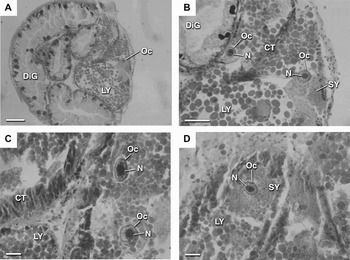
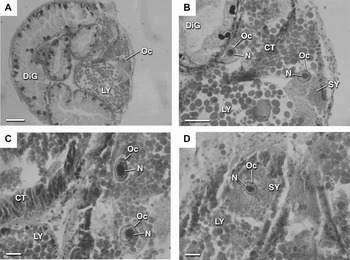
Gonad sections of males and females of both species showed that several gametogenesis stages are simultaneous within the same gonad (Figures 7 & 8). This pattern was observed throughout the year, showing no annual cycle with particular periods of gonad maturation or resting.
Histological section of the female gonads of Dendropoma corrodens (A and B), and Eualetes tulipa (C and D). CT, connective tissue; DiG, digestive gland; LY, large yolk; N, nucleus; Oc, oocyte; SY, small yolk. Scale bars: (A) 200 µm, (B) 100 µm, (C) and (D) 30 µm.
Histological section of the male gonads of Dendropoma corrodens (A and B), and Eualetes tulipa (C and D). Ca, cavity after sperm shed; DiG, digestive gland; Sg, spermatogonia; Sp, spermatozoans. Scale bar: 30 µm.

In the females of both species, germ cells, oogoniums and primary oocytes were observed simultaneously throughout the year. Yolk granules were abundant in female gonads of both species. In E. tulipa, the mean diameter of these granules was 8.1±2.2 µm (range: 2.5–15.0, N = 151) and the oocyte diameter before vitellogenesis (without the yolk granules) was 28.0±11.1 µm (range: 12.5–75 µm, N = 64). The yolk granules that surrounded the oocytes peripherally measured 4.4±0.9 µm (range: 2–7 µm, N = 106); these peripheral oocytes are also significantly smaller than the rest (Mann–Whitney U, P < 0.001). In D. corrodens, the mean diameter of yolk granules was 8.1±2.2 µm (range: 2.5–12.5, N = 150) and the oocyte diameter without the yolk granules was 49.3±10.6 µm (range: 25–75 µm, N = 21). The yolk granules that surrounded the oocytes peripherally measured 4.0±0.9 µm (range: 2–6 µm, N = 35); these peripheral oocytes are significantly smaller than the rest (Mann–Whitney U, P < 0.001). After vitellogenesis is completed, the eggs of E. tulipa measured 240±14 µm in diameter, while the eggs of D. corrodens measured 276±25 µm in diameter.
In the males of both species, the spermatogonium, primary and secondary spermatocytes, spermatids and sperm cells were also observed within one gonad and throughout the year. The diameter of the spermatogonia of D. corrodens varied between 4 and 6 µm (4.9±0.37, N = 105), and between 4 and 7 µm (4.8±0.5, N = 91) for E. tulipa.
DISCUSSION
The high density of individuals of both species found at the two sites is clear evidence of the reproductive success of both species. Eualetes tulipa, assumed to be restricted to the tropical Pacific near Panama bay, has been observed in Hawaii since 1972 where they are found mostly in harbours or embayments (Coles & Eldredge, 2002). In Venezuela, besides the population at the Planta Centro power plant channel (built in the 1940s), two more populations have been detected, also on artificial substrates. The first is at the old El Palito refinery dock (built in the 1950s) and the second is on the remains of the vessel ‘Sesostris’, a ship sunk since World War II at Isla Larga. Both sites are also located on the central coast of Venezuela and have the singularity, as does the power plant channel, that the access to the public is restricted, therefore, the vermetid populations live practically undisturbed by humans. The fact that E. tulipa is probably an invasive species is supported by all the recent literature confirming its presence in previously uncolonized habitats (Coles et al., Reference Coles, DeFelice and Eldredge2002; Coles & Eldredge, Reference Coles and Eldredge2002; Schluker, Reference Schluker2003; Ray, Reference Ray2005). We observed that the population in the power plant has more than duplicated in the last 20 years, which not only indicates reproductive success but also the ability to compete for space with the rest of the fouling community composed mainly by sponges, hydrozoans, barnacles, anemones, bryozoans and tunicates (Losada et al., Reference Losada, Martín, Feragotto and Alamo1988). Also, an increase in the biomass of E. tulipa, an epifaunal suspension feeding species (it extends mucous threads to collect suspended organic matter), could be related to an increase in organic suspended matter, or to nutrient supply (Birkeland, Reference Birkeland and Taylor1977, Reference Birkeland and Birkeland1987), which has been reported in several localities along the Venezuelan coast mostly due to human activities including discharges of untreated wastewater and sediments from both upstream and coastal sources (Penchaszadeh et al., Reference Penchaszadeh, León, Alvarez, Bone, Castellano, Castillo, Díaz, García, Lemus, Losada, Martín, Miloslavich, Paredes, Pérez, Sebastiani, Stecconi, Roa, Villamizar and Sheppard2000). Chlorophyll concentration maps can be used as a proxy for water enrichment and the algorithms for chlorophyll determination are known to be affected by coloured dissolved organic mater CDOM (Odriozola et al., Reference Odriozola, Varela, Hu, Astor, Lorenzoni and Müller-Karger2007). In coastal zones, rivers usually supply large amounts of dissolved matter, which serve as a nutrient source for the ocean. In the last years, such supply of sediments and dissolved elements from watersheds has increased due to deforestation, erosion, and coastal development, activities that have increased significantly in the area in the last years (Chollet & Bone, Reference Chollet and Bone2007). The measure over the time of both CDOM and photosynthetic pigment concentration provides a synoptic evidence of water enrichment and therefore, food availability for suspension feeders. Temporal changes in the chlorophyll-a (Chla) concentration for the last ten years (calculated from Sea-viewing Wide Field-of-view Sensor or SeaWiFS images; Figure 9) evidenced elevated Chla concentration product of several high precipitations events (e.g. 1999, documented by Chollet & Bone, Reference Chollet and Bone2007), that represent high inputs of nutrients and CDOM from the Tocuyo and Aroa Rivers. However, since late 2002, the general tendency of the anomalies became positive and the variability larger, suggesting unusually high river inputs for the area. Ramírez-Llodra (Reference Ramírez-Llodra2002) discussed the importance of food availability before and during gametogenesis for several invertebrate groups, mostly crustaceans, polychaetes, bivalves, and echinoderms. Since the reproductive capability of a species is determined by phylogenetic, morphological and physiological aspects, the gametogenic pattern of a species will not be altered by an increase in food supply, however, it can increase the number of eggs produced or improve their quality (Jaeckle, Reference Jaeckle and McEdward1995; Ramírez-Llodra, 2002).
Chlorophyl-a (Chla) surface concentration anomalies calculated from Sea-viewing Wide Field-of-view Sensor (SeaWiFS) images in the region of Golfo Triste from 1997–2007. The observation window covered the Golfo Triste region, including the main river plumes (10.4–10.9N 67.8–68.5W), from where monthly average time series of Chla surface concentration anomalies were extracted from SeaWiFS images. The images and data were acquired using the GES–DISC Interactive Online Visualization ANd aNalysis Infrastructure (Giovanni) as part of the NASA Goddard Earth Sciences (GES) Data and Information Services Center (DISC).

No seasonal pattern was evident in the reproductive cycle of E. tulipa and D. corrodens, neither for males nor females. Both species reproduce throughout the year and the microscopic observation of the gonads showed that all stages of gametogenesis are simultaneous within the same animal. This gonadic activity supports the results of Miloslavich & Penchaszadeh (Reference Miloslavich and Penchaszadeh1992) who found females brooding egg capsules all year long. They also indicate that these species have a continuous spawning, which is confirmed by the fact that within the same female, egg capsules at different stages of development were found. Females brooding capsules with embryos at different stages of development has also been reported in V. triquetrus, in D. petraeum and in Serpulorbis arenarius, however, in these species, a clear seasonal reproductive time was observed, so the egg production during this season must be continuous and egg capsules were probably deposited over a long period (Calvo et al., Reference Calvo, Templado and Penchaszadeh1998; Calvo & Templado, Reference Calvo and Templado2004a, Reference Calvo and Templadob). Several papers have reported that fecundity in marine gastropod species, measured as egg capsule and juvenile production, increases with female size (Ramírez-Llodra, Reference Ramírez-Llodra2002). Perron (Reference Perron1983) reported an age-specific fecundity increase with female size for Conus pennaeus Born, 1778 in Hawaii; Miloslavich & Dufresne (Reference Miloslavich and Dufresne1994) reported for Buccinum cyaneum Bruguière, 1792 from the Saguenay fjord in Canada, that egg capsules deposited by larger females contained more eggs and embryos than those of smaller females; Miloslavich et al. (Reference Miloslavich, Penchaszadeh and Klein2003) reported that female size determined fecundity in terms of juvenile production for two species of Crepidula in the southern Caribbean, either by increasing the number of hatchlings per female at larger female sizes (C. aplysioides Reeve, 1859) or by producing larger capsules with more hatchlings (C. navicula Morch, 1877). Harding et al. (Reference Harding, Mann and Kiduff2007) reported for the invasive Rapana venosa Valenciennes, 1846 that whelk fecundity increased with female size (from 123 embryos/capsule in females measuring 45 mm to 3673 embryos/capsule in females measuring 163 mm). Such difference in the number of eggs per capsule was due to the fact that larger females produced much larger egg capsules (7 mm and 30–33 mm in capsule height for small and large whelks respectively). An interesting fact of our results was that females brood more capsules as they get larger, but seem to reach an optimal reproductive size, in which the number of brooded capsules is maximal, and then, at larger sizes, fecundity decreases. Ramírez-Llodra (Reference Ramírez-Llodra2002) reviewed the relationship between fecundity and female size and age in decapod crustaceans, polychaetes, bivalves, and in some colonial groups such as corals. In bivalves, the growth rate increases in the first years and then declines, while the production of gametes increases throughout their lifetime. As a certain shell size is attained, the energy is allocated from growth to reproduction, being the inner volume of the shell the limit for gamete production. Since vermetids brood the egg capsules either in the mantle cavity or attached to the internal walls of the shells, it can be expected that, as in bivalves, female and shell size will constrain the number of egg capsules that may be brooded at the same time. Despite that a decline in the reproductive capacity of older individuals is expected in any population, this has not been clearly reported in the literature for gastropods. Fertility reduction in mature and/or larger individuals has been reported in populations affected either by imposex due to tributyltin (TBT) pollution (Oehlman et al., Reference Oehlmann, Fioroni, Stroben and Market1996; Ramón & Amor, Reference Ramón and Amor2002), or to parasitic castration due to gonadal infection mostly by trematodes (Tetrault et al., Reference Tetrault, Himmelman and Measures2000). In our study we did not determine the relationship between female size and offspring size. Following the offspring definition of Marshall & Keough (Reference Marshall and Keough2008), for E. tulipa and D. corrodens, offspring size would be equivalent to hatching size as this is the stage in which the ‘propagule’ becomes independent from maternal nutrition. These authors state that within a range of species, larger mothers produce larger offspring, however, they also discuss that this might not reflect reality as the percentage of species where no relationships has been observed is probably underestimated, and many species have not been studied at all. In Calyptreids for instance, Chaparro et al. (Reference Chaparro, Oyarzun, Vergara and Thompson1999) reported for Crepidula dilatata Lamarck, 1822, a positive correlation between female size and offspring size, while Miloslavich et al. (Reference Miloslavich, Penchaszadeh and Klein2003) reported no correlation between these same parameters for C. aplysioides and C. navicula, indicating that even at the family level, no generalizations can be made.
The histological study of the gonads of E. tulipa and D. corrodens confirm that both species are dioceious as reported by Miloslavich & Penchaszadeh (Reference Miloslavich and Penchaszadeh1992), since we never found specimens with male and female gonads simultaneously. Heller (Reference Heller1993) reviewed that about 99% of the prosobranch gastropods are diocieous, however, Calvo & Templado (Reference Calvo and Templado2004b) presented evidence that Serpulorbis arenaria, a Mediterranean vermetid, is a sequential hermaphrodite with alternating sexuality. This is evidenced by a clearly male biased ratio (small individuals were males, while the largest were either males or females), and to the presence of a few males with a pallial slit and egg capsules, a character linked to females, indicating that they had been females before. As mentioned earlier, studies in gastropod gametogenesis and particulary in vermetids are very scarce, so reports of hermaphroditic species, either simultaneous or protandric could be very underestimated.
ACKNOWLEDGEMENTS
We wish to thank Dr R. Bieler of the Field Museum of Natural History, Chicago, for helping us with the identification of the species. We acknowledge G. Sánchez, for his help with the histological procedure, Iny Guzmán for laboratory assistance, and J.L. García, Artis Publishers for his help with the photographs. Elizabeth Huck, Vicente Kortnik, Carolina Peralta, Vanessa Weinberger, Rebecka Oscarsson and Daniel Simonsson provided invaluable field support. We also acknowledge engineers Otto Battista and René Latucci from the Dirección de Seguridad Industrial y Mantenimiento of Planta Centro for allowing us access to the Powerplant channel. This work was supported by the Decanato de Investigación y Desarrollo, Universidad Simón Bolívar, by the Instituto de Tecnología y Ciencias Marinas (INTECMAR—Universidad Simón Bolívar) and by a FONACIT grant to Patricia Miloslavich (S1-2001-000764).