





Anorexia nervosa is a mental illness characterised by food restriction leading to a significantly low body weight, by fear of weight gain and a disturbed body image. 1 Medical, psychological and dietetic support for people with anorexia nervosa is offered in different treatment settings, such as general practitioners; community mental health teams; out-patient, daycare and in-patient eating disorder services; as well as general physical or mental health hospitals. Reference Himmerich, Keeler, Tchanturia and Treasure2 There is debate on how to best measure treatment outcome and success. In anorexia nervosa research, particularly in pharmacological trials, body mass index (BMI) is often used as main outcome, Reference Himmerich, Lewis, Conti, Mutwalli, Karwautz and Sjögren3 despite patients and researchers alike calling for additional outcome parameters capturing general and eating disorder-specific psychopathology and quality of life. Reference Wise4
In the 1990s, the Royal College of Psychiatrists developed the Health of the Nation Outcome Scales (HoNOS) at the request of the Department of Health, with the aim of measuring the health and social functioning of people with mental illness. Reference Wing, Beevor, Curtis, Park, Hadden and Burns5,6 The HoNOS provides information on agitated behaviour, self-injury, problem drinking and drug use, cognitive problems, physical illness, hallucinations, depressed mood, relationship problems, daily living problems, problems with living conditions and occupational problems. 6 The HoNOS scales do not include a specific measure for eating disorders; instead, they assess broader problems commonly experienced by both patients with anorexia nervosa and other mental health conditions. Although the HoNOS is the most widely used clinical outcome tool by psychiatric services in England, Reference Macdonald and Elphick7 there has been no scientific publication describing HoNOS outcomes in people with anorexia nervosa in England. An Australian study with 42 female patients evaluated a day service programme for anorexia nervosa and found a reduction in the HoNOS score over 6 months. Reference Green, Melvin, Newman, Jones, Taffe and Gordon8 However, no study using the HoNOS in in-patients has been published so far.
Recent research has shown that investigating inflammatory processes in people with anorexia nervosa might offer insights into its underlying pathophysiology, which could lead to the development of novel therapeutic interventions such as microbiome-based Reference Marano, Rossi, Sfratta, Acanfora, Anesini and Traversi9 or pharmacological treatments like ketamine Reference Keeler, Treasure, Juruena, Kan and Himmerich10 and cytokine blockers. Reference Patsalos, Dalton and Himmerich11 Immunological research in anorexia nervosa might help to better assess the risk of developing comorbid autoimmune and inflammatory diseases in the future. Reference Sirufo, Magnanimi, Ginaldi and De Martinis12 and thus help to reduce the disease’s health burden and high mortality. Reference Himmerich, Hotopf, Shetty, Schmidt, Treasure and Hayes13
C-reactive protein (CRP) is a key inflammatory parameter widely used in clinical practice. It responds rapidly to inflammation and tissue damage. Reference Pepys and Hirschfield14 In many diseases, circulating CRP values reflect ongoing inflammation more accurately than other parameters of the acute-phase response. Reference Pepys and Hirschfield14 Compared with leukocyte count, CRP has a greater correlation with disease severity and higher sensitivity in other conditions, such as in odontogenic infections. Reference Bali, Sharma, Ghanghas, Gupta, Tiwari and Singh15 A recent systematic review and meta-analysis based on 11 cross-sectional studies found that CRP levels are low in patients with anorexia nervosa compared with healthy controls. Reference Xu, Mutwalli, Haslam, Keeler, Treasure and Himmerich16 These findings are in line with previous meta-analyses in patients with anorexia nervosa. Reference Solmi, Veronese, Favaro, Santonastaso, Manzato and Sergi17,Reference Wu, Watson, Del Re, Finch, Hardin and Dumain18 Low CRP levels in anorexia nervosa are potentially caused by weight loss and malfunction of the liver where CRP is produced. Reference Walsh, Blalock and Mehler19 It has been speculated that the reduced CRP levels in patients with anorexia nervosa might increase risk for developing bacterial infections or autoimmune diseases, and clinicians might fail to notice an inflammatory process or an infection. Reference Xu, Mutwalli, Haslam, Keeler, Treasure and Himmerich16
Anorexia nervosa has been reported by epidemiological studies to be frequently accompanied by other mental health disorders, such as mood, anxiety and personality disorders, Reference Marucci, Ragione, De Iaco, Mococci, Vicini and Guastamacchia20 and anorexia nervosa has additionally been found to share pathogenetic mechanisms with schizophrenia on a genetic level. Reference Lu, Ploner, Birgegård, Adan, Alfredsson and Ando21 These comorbid disorders have also been found to be associated with inflammatory changes. Reference Himmerich, Patsalos, Lichtblau, Ibrahim and Dalton22–Reference Lv, Guo, Guo and He26 Symptoms of anorexia nervosa that might also be associated with inflammatory aberrations include excessive physical activity; low mood; Reference Marucci, Ragione, De Iaco, Mococci, Vicini and Guastamacchia20 the so-called ‘anorexic voice’ which might be interpreted as an anorexia nervosa-related auditory hallucination; Reference Pugh and Waller27 or self-injury, Reference Juli, Juli, Juli and Juli28 which can be an indication of a personality disorder, 1 but can also occur independently. Reference Turner, Dixon-Gordon, Austin, Rodriguez, Zachary Rosenthal and Chapman29 Inflammatory parameters such as cytokine levels have been reported to be associated with agitation, Reference Hjell, Szabo, Mørch-Johnsen, Holst, Tesli and Bell30 low mood Reference Schmidt, Lichtblau, Minkwitz, Chittka, Thormann and Kirkby31 and auditory hallucinations Reference Li, Yang, Liang, Li, Zhou and Xiao32 in people with other severe mental disorders. However, we are not aware of any studies having explored associations between these symptoms and CRP in anorexia nervosa. Additionally, weight loss in anorexia nervosa can result in a variety of physical health problems, including gastrointestinal symptoms, endocrine and metabolic disorders, cardiovascular problems, osteoporosis, pain and skin problems, Reference Himmerich, Kan, Au and Treasure33 which, in turn, may influence laboratory parameters, including inflammatory markers such as CRP. Reference Himmerich and Treasure34 In general, CRP concentrations tend to be higher in older adults. Chronic conditions, such as smoking, diabetes and insomnia, can also elevate CRP levels. Reference Singh, Goyal and Patel35
The aim of this study was to investigate changes in HoNOS scores, BMI and CRP concentrations in in-patients with anorexia nervosa from admission to discharge. Additionally, we sought to explore associations between HoNOS scores, BMI and CRP levels.
Data were extracted from the Clinical Record Interactive Search (CRIS) database to obtain data on HoNOS scores, BMI, CRP levels and comorbid clinical diagnoses. The CRIS database has been established by the South London and Maudsley NHS Foundation Trust (SLaM). Reference Perera, Broadbent, Callard, Chang, Downs and Dutta36 It provides anonymised data from the electronic clinical records system, capturing routinely assessed information such as the HoNOS, parameters from clinical examinations such as BMI, and laboratory parameters such as CRP levels. We hypothesised that HoNOS scores would decrease and BMI would increase during in-patient treatment alongside nutritional recovery. Additionally, we aimed to explore potential associations between HoNOS, BMI, CRP levels and clinical symptoms and diagnoses.
Method
Data source
We used anonymous patients’ data extracted from the CRIS system. Reference Perera, Broadbent, Callard, Chang, Downs and Dutta36 The CRIS source data are approved by the Oxfordshire Research Ethics Committee C (reference 23/SC/0257), and this study was approved by the CRIS Oversight Committee (reference 23-044; approval date: 15 June 2023). We followed the Reporting of Studies Conducted using Observational Routinely Collected Health Data guidelines Reference Benchimol, Smeeth, Guttmann, Harron, Moher and Petersen37 to report this study (Supplementary Material).
Participants
Included in this study were patients admitted to the in-patient ward of the Eating Disorder Unit at SLaM, from 2006 to 2023, who were above 18 years of age on the date of admission, with discharge dates available, who had, at any point, a diagnosis of an eating disorder coded as F50 or a specific diagnosis coded as anorexia nervosa F50.0 according to the ICD-10. 38 We further selected underweight patients only for analysis, with a BMI <18.5 kg/m2 at admission. If a patient was admitted to the in-patient unit several times between 2006 and 2023, we used data from the latest admission only.
Measures
The HoNOS is a 12-item measure used to assess a patient’s clinical problems and psychosocial functioning. Reference Wing, Beevor, Curtis, Park, Hadden and Burns5 At SLaM, it is rated by nurses. Each item is rated on a five-point Likert scale and is completed by clinicians at National Health Service (NHS) mental health Trusts at admission and discharge. A HoNOS total score was derived by taking the sum of the 12 items.
BMI was extracted within 2 weeks of admission and discharge, respectively. The ethnicity variable included 14 subcategories; however, given that most patients were of White ethnicity (Table 1), it was converted to a binary variable indicating White or Black, Asian and minority ethnicity. CRP levels were taken from the measurements closest to, and within 2 weeks of, the admission and discharge dates. The majority of CRP data were coded as ‘<2.0 mg/L’, and only a small proportion were coded as exact values. Given this, we created a binary variable indicating whether the CRP level was ≥2.0 mg/L (coded as 1) or not (coded as 0). Mental health diagnoses were made and inserted into the clinical database by specialised psychiatrists only. For this study, we captured whether patients had a diagnosis of depressive disorders (ICD-10 codes F30, F31 or F32), anxiety disorders (ICD-10 codes F40 or F41), personality disorders (ICD-10 codes F60–F69) or psychotic disorders (ICD-10 codes F20–F29), before or on the admission date. In this study, smoking status meant whether patients smoked within 1 year before the admission date, and use of antidepressants and antipsychotics was documented according to whether patients mentioned taking these medications within a year before admission.
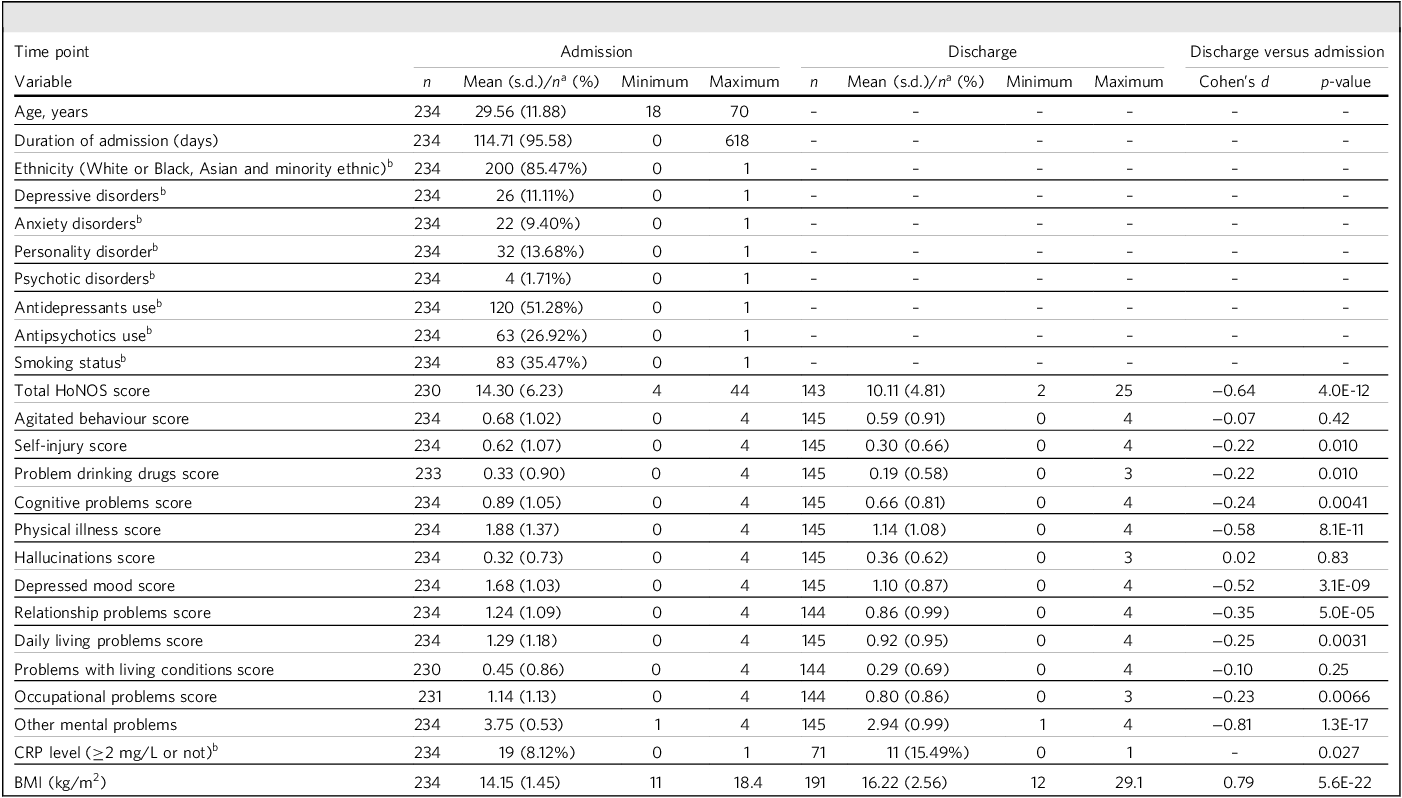
Summary of sample characteristics and changes in HoNOS scores, BMI and CRP levels from admission to discharge

Table 1 Long description
The table presents data on various variables measured at admission and discharge, including age, duration of admission, ethnicity, mental health diagnoses, medication use, smoking status, HoNOS scores, CRP levels, and BMI. It includes columns for the number of observations, mean values, standard deviations, percentages, minimum and maximum values, and statistical comparisons between admission and discharge. The table has 234 rows for most variables, with some variations. Key variables include age, duration of admission, ethnicity, depressive disorders, anxiety disorders, personality disorder, psychotic disorders, antidepressants use, antipsychotics use, smoking status, total HoNOS score, and various sub-scores of HoNOS. The table also includes BMI and CRP levels. Statistical comparisons are made using Cohen’s d and p-values.
The comparison between discharge and admission is conducted with a paired t-test for continuous variables and McNemar’s chi-squared test for binary CRP levels (McNemar’s χ 2 = 4.9, p = 0.027). HoNOS, Health of the Nation Outcome Scales; BMI, body mass index; CRP, C-reactive protein.
a. Number of positive cases (those coded as 1) for a binary variable.
b. Binary variables.
Statistical analysis
We investigated HoNOS scores, BMI and CRP levels, and their changes between admission and discharge. Paired t-tests were used to compare the continuous variables of HoNOS and BMI, and a McNemar’s chi-squared test was used to compare the binary CRP levels between discharge and admission. Next, we calculated statistical associations between CRP levels and sample characteristics (nine variables) at admission. Given that age and BMI values did not follow the normal distribution (ps < 0.05 in Shapiro–Wilk normality tests), non-parametric Mann–Whitney U-tests were used to examine their differences between patients with CRP ≥ 2 and <2 mg/L. The other seven variables were binary categorical variables, including ethnicity; diagnoses of depressive disorders, anxiety disorders or personality disorders; smoking status and use of antidepressants or antipsychotics. Each of these variables was used as a dependent variable in a logistic regression model to test their associations with CRP levels at admission. The Bonferroni-corrected significance threshold for these nine tests was 0.0056 (= 0.05/9).
We used multiple linear regression to examine the association between the HoNOS total score (as a dependent variable) and CRP levels (as an independent variable), both assessed at admission. Control variables included ethnicity, age, BMI, smoking status at admission and use of antidepressants and antipsychotics. Co-occurring mental health diagnoses were not involved as control variables because they would be highly corrected with the dependent variable (HoNOS scores). If a significant association was found, we further tested whether each of the 12 HoNOS items was significantly associated with CRP levels at admission, controlling for the same variables listed above. The Bonferroni-corrected significance threshold for these 12 tests was 0.0042 (= 0.05/12).
We further conducted longitudinal analyses to test whether the CRP level at admission was a significant predictor of clinical outcomes, which were the BMI and HoNOS total score at discharge. Participants lost at follow-up were excluded from analysis, representing a complete-case analysis. BMI and HoNOS total scores at admission were controlled for. The other control variables included diagnoses of depressive, anxiety, and personality disorders; ethnicity; age; smoking status at admission and use of antidepressants and antipsychotics. These control variables were selected because we aimed to examine whether the CRP level at admission could explain additional variance in the clinical outcomes above and beyond these variables (including mental health diagnoses) at admission. All the statistical analyses were conducted by using the R statistical software (version 4.3.2, The R Foundation, Vienna, Austria, www.r-project.org) on Windows 11.
Results
Sample characteristics
A total of 512 patients with an eating disorder diagnosis were identified from the CRIS database. We selected female patients whose BMI was <18.5 kg/m2 at admission, and had no missingness in the variables of interest, including age, ethnicity, CRP levels and HoNOS scores (Fig. 1). One patient was excluded because their BMI was an outlier and likely incorrect (BMI = 4.7 kg/m2). A final sample of 234 female patients were thus included in the analysed sample at point of admission. This sample had a mean age of 29.56 (range 18–70) years, a mean BMI of 14.15 kg/m2 (s.d. = 1.45) and a mean total HoNOS score of 14.30 (s.d. = 6.23); 19 patients (8%) had a CRP level ≥ 2 mg/L at admission (Table 1). For the longitudinal analysis, we excluded patients whose BMI data were missing (n = 26) or outliers (BMI > 30 kg/m2, n = 17) at discharge. We excluded BMI > 30 kg/m2 at discharge because this high level of BMI was very unusual for patients with anorexia nervosa, and therefore we suspected potential errors in data logging. Of this sample, 187 patients had BMI measures, and 141 patients had HoNOS scores at discharge. See Fig. 1 and Table 1 for more details.
Study flow chart for patient selection. BMI, body mass index; CRP, C-reactive protein; HoNOS, Health of the Nation Outcome Scales.

We conducted an attrition analysis by using logistic regression to assess whether the HoNOS, BMI and CRP measures at admission were significantly associated with data missingness at discharge. A higher HoNOS subscore for problems with living conditions was significantly associated with missingness of this subscore at discharge (odds ratio 1.38, p = 0.041). The other associations were not significant (ps > 0.05).
Changes in clinical measures from admission to discharge
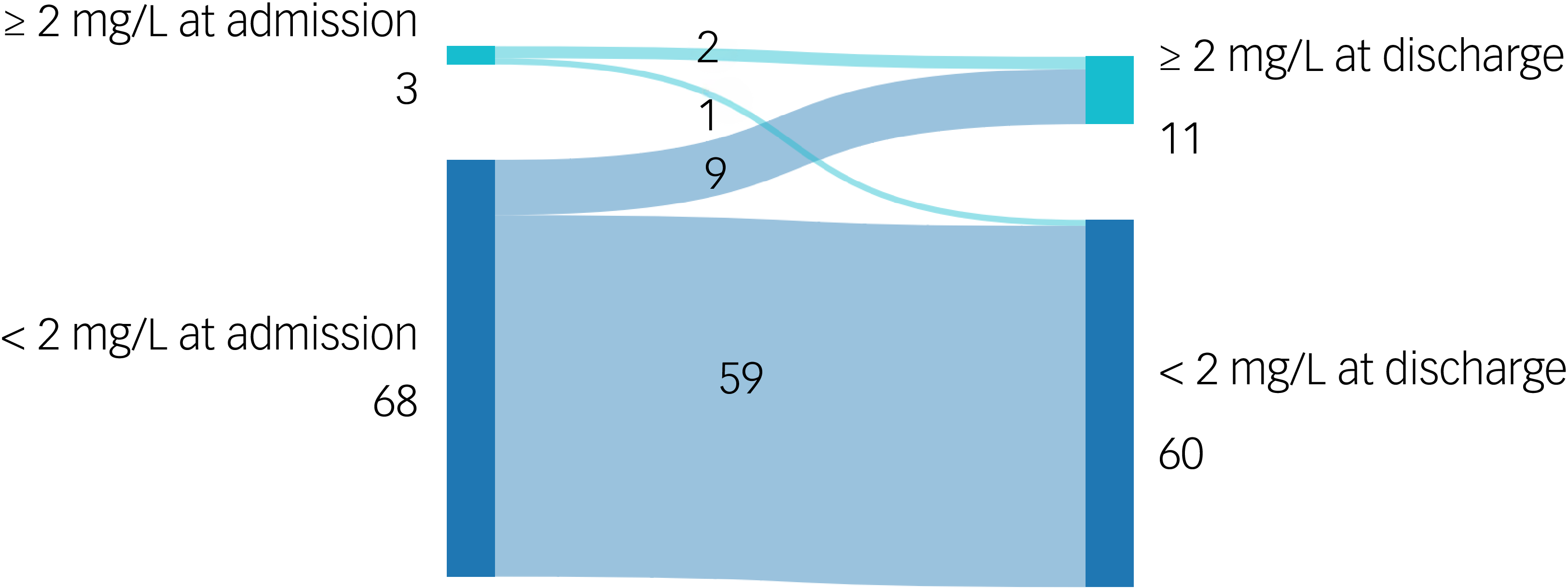
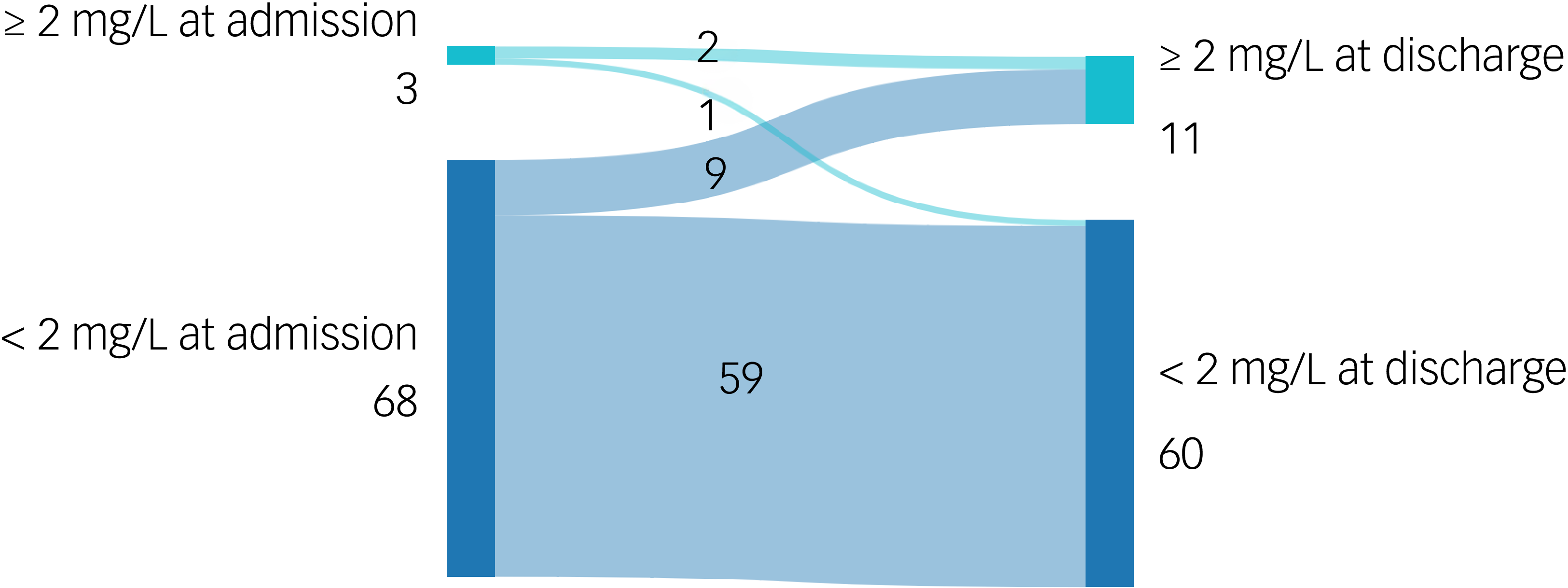
Looking at CRP data alone and regardless of the availability of the other variables, CRP measures were available for 71 patients at both admission and discharge. Among these, 68 (96%) patients had CRP levels <2 mg/L at admission. The CRP level remained <2 mg/L for 59 (87%) patients at discharge, and increased to ≥2 mg/L at discharge for nine (13%) patients. Only three patients had high CRP levels ≥2 mg/L at admission. Among them, the CRP level remained ≥2 mg/L for two patients and decreased to <2 mg/L for one patient (Fig. 2). The very low number of patients (n = 3) with CRP levels ≥2 mg/L introduced a high risk of bias and made it unreliable to estimate the CRP decrease from admission to discharge. Therefore, statistical tests were not conducted on this longitudinal CRP data.
Change in the numbers of patients with C-reactive protein levels ≥2 or <2 mg/L from admission to discharge. See text for details. This diagram was created with SankeyMATIC (https://sankeymatic.com/).
There was a significant increase in BMI (Cohen’s d = 0.79, p = 5.6E-22) and a significant decrease in total HoNOS scores (Cohen’s d = −0.64, p = 4.0E-12), demonstrating medium-to-large effect sizes (Table 1). Looking at the 12 HoNOS subscores separately, significant decreases were observed in cognitive problems (Cohen’s d = −0.22, p = 0.0041), depressed mood (Cohen’s d = −0.52, p = 3.1E-09), relationship problems (Cohen’s d = −0.35, p = 5.0E-05) and daily living problems (Cohen’s d = −0.25, p = 0.0031), which survived Bonferroni correction for 12 tests (p < 0.0042).
CRP association with sample characteristics at admission
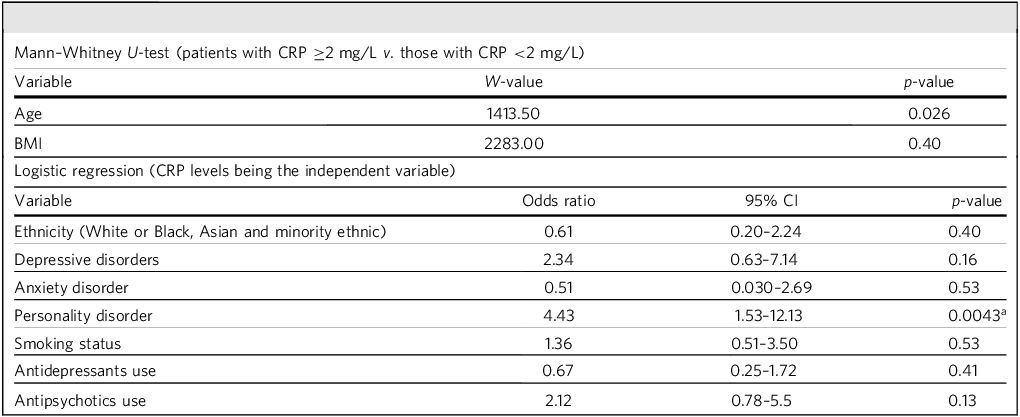
We tested the associations between CRPs levels with nine characteristics at admission (Table 2). There was a significant association between having a personality disorder and higher CRP levels (odds ratio 4.43, 95% CI 1.53–12.13, p = 0.0043), which survived the Bonferroni correction. The other associations did not survive the Bonferroni correction.
CRP associations with sample characteristics at admission
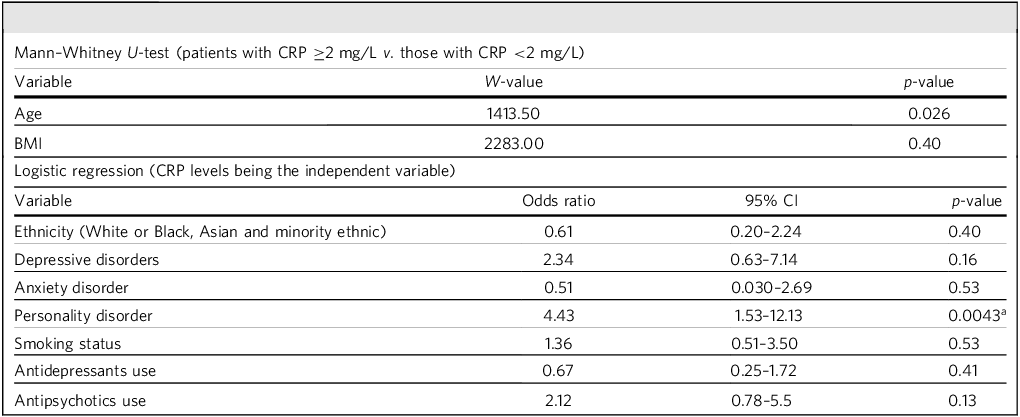
Table 2 Long description
A table comparing the associations between CRP levels and various characteristics at admission. The table has two main sections: Mann-Whitney U-test and Logistic regression. The Mann-Whitney U-test section has two rows and three columns. The variables are Age and BMI. The W-value for Age is 1413.50 with a p-value of 0.026. The W-value for BMI is 2283.00 with a p-value of 0.40. The Logistic regression section has eight rows and four columns. The variables are Ethnicity, Depressive disorders, Anxiety disorder, Personality disorder, Smoking status, Antidepressants use, and Antipsychotics use. The odds ratios, 95% confidence intervals, and p-values are provided for each variable. Notable findings include a significant association between having a personality disorder and higher CRP levels with an odds ratio of 4.43, a 95% confidence interval of 1.53-12.13, and a p-value of 0.0043.
CRP, C-reactive protein; BMI, body mass index.
a p-value survived the Bonferroni correction for nine tests.
Cross-sectional associations between CRP levels and HoNOS scores
CRP levels were significantly associated with total HoNOS score at admission (β = 3.69, s.e. = 1.59, t = 2.32, p = 0.021). Compared with patients with CRP levels <2 mg/L, those with CRP levels ≥2 mg/L scored 3.69 points higher in HoNOS total score, after adjustment for ethnicity, age, BMI, smoking status at admission and use of antidepressants and antipsychotics. However, the association between CRP levels and HoNOS total scores was not significant at discharge (β = −2.69, s.e. = 2.51, t = −1.07, p = 0.29).
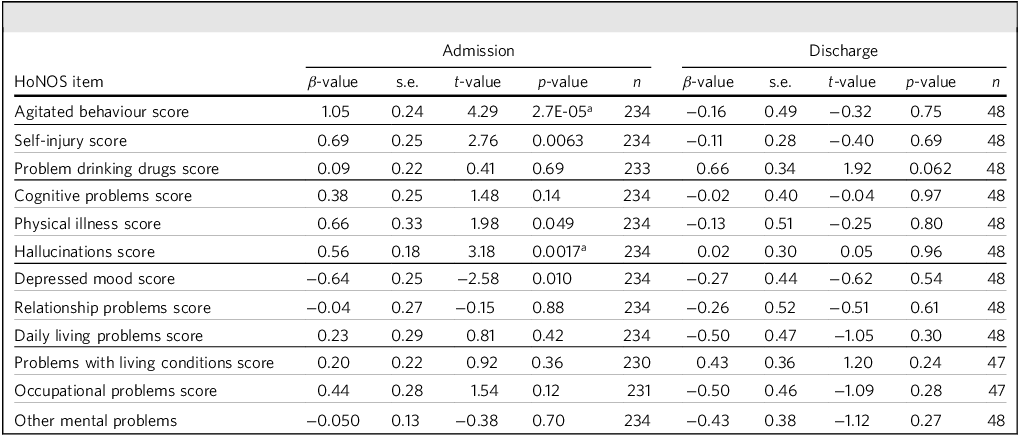
Further investigations of the association between CRP levels and each of the 12 HoNOS items at admission revealed significant positive associations with the agitated behaviour score (β = 1.05, s.e. = 0.24, t = 4.29, p = 2.7E-05) and hallucinations score (β = 0.56, s.e. = 0.18, t = 3.18, p = 0.0017), which survived the Bonferroni correction for 12 tests. The association with self-injury score (β = 0.69, s.e. = 0.25, t = 2.76, p = 0.0063) did not survive the Bonferroni correction. As a sensitivity analysis, we re-examined the association between the hallucinations score and CRP levels after removing patients with psychotic disorders (n = 4). The association remained significant (β = 0.45, s.e. = 0.18, t = 2.51, p = 0.013). At discharge, HoNOS items were not significantly associated with CRP levels (ps > 0.05) (Table 3).
Cross-sectional associations between CRP levels (< v. ≥2 mg/L) and each HoNOS item at admission and discharge
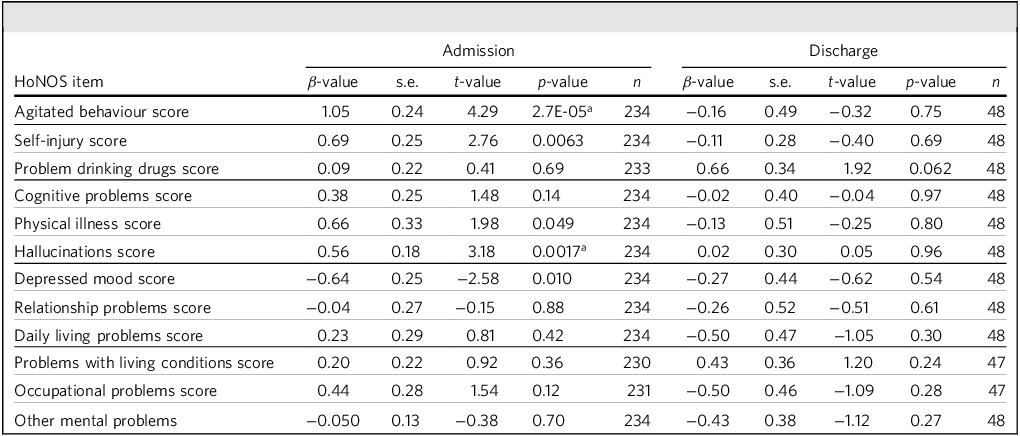
Table 3 Long description
The table presents data on the associations between CRP levels and various HoNOS items at admission and discharge. It has 12 rows and 10 columns. The columns are labeled as follows: HoNOS item, Admission β-value, Admission s.e., Admission t-value, Admission p-value, Admission n, Discharge β-value, Discharge s.e., Discharge t-value, Discharge p-value, and Discharge n. The rows list different HoNOS items such as Agitated behaviour score, Self-injury score, Problem drinking drugs score, Cognitive problems score, Physical illness score, Hallucinations score, Depressed mood score, Relationship problems score, Daily living problems score, Problems with living conditions score, Occupational problems score, and Other mental problems. Each row provides values for the β-value, standard error (s.e.), t-value, p-value, and sample size (n) at admission and discharge. Notable trends include significant associations at admission for Agitated behaviour score, Self-injury score, and Hallucinations score, while no significant associations are observed at discharge.
Control variables included ethnicity, age, body mass index, use of antidepressants and antipsychotics, and smoking status at admission. n indicates sample size. β-values are unstandardised. CRP, C-reactive protein; HoNOS, Health of the Nation Outcome Scales.
a p-value survived Bonferroni correction for 12 tests.
CRP levels at admission predicting clinical outcomes at discharge
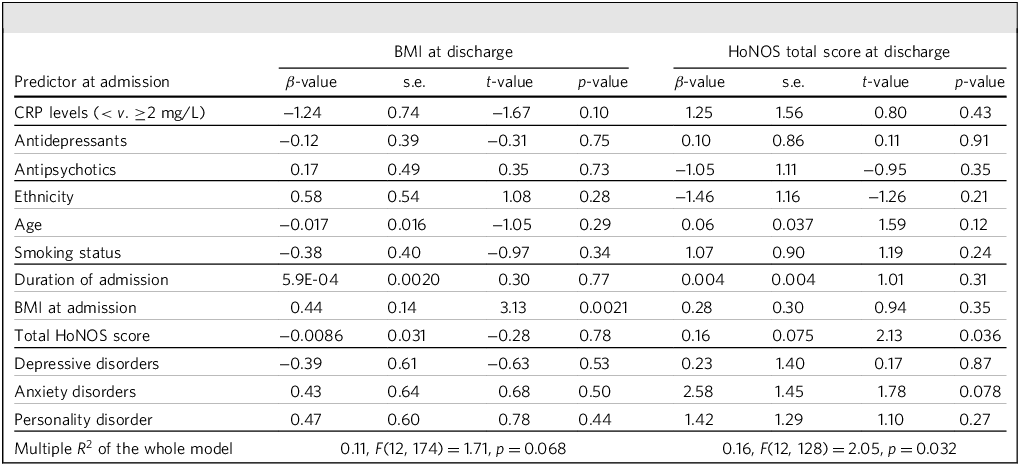
When predicting the BMI at discharge through multiple linear regression, the predictors at admission together explained 11% of variance in the outcome (R 2 = 0.11, F(12, 174) = 1.71, p = 0.068) (Table 4). The only significant predictor was BMI at admission, which was positively associated with BMI at discharge (β = 0.44, s.e. = 0.14, t = 3.13, p = 0.0021). The CRP level at admission was not a significant predictor (β = −1.24, s.e. = 0.74, t = −1.67, p = 0.10). Similarly, all of the predictors at admission together explained 16% of variance in the total HoNOS score at discharge (R 2 = 0.16, F(12, 128) = 2.05, p = 0.032) (Table 4). The only significant predictor was the total HoNOS score at admission (β = 0.16, s.e. = 0.075, t = 2.13, p = 0.036). The contribution of CRP level at admission was not significant (β = 1.25, s.e. = 1.56, t = 0.80, p = 0.43).
Multiple regression analysis predicting clinical outcomes at discharge with predictors at admission
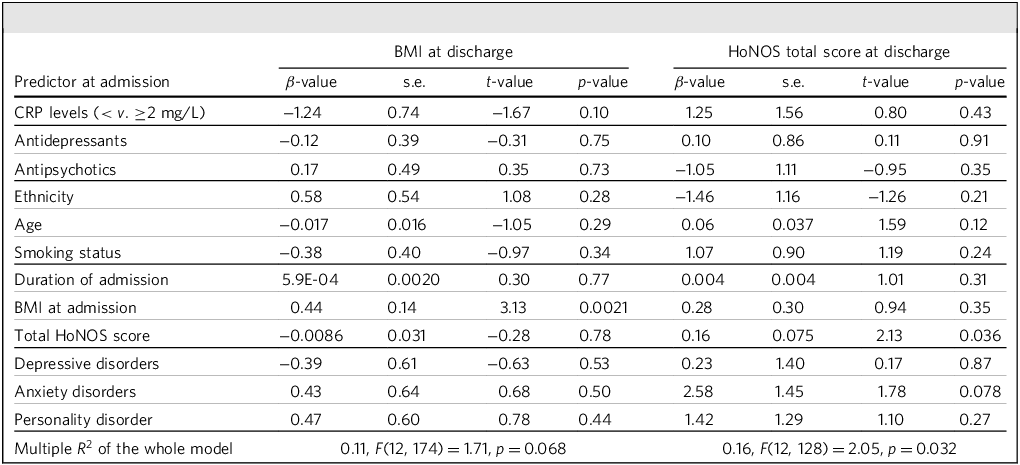
Table 4 Long description
The table presents data on predictors at admission and their impact on BMI and HoNOS total score at discharge. It has 14 rows and 10 columns. The columns are labeled as follows: Predictor at admission, BMI at discharge beta-value, BMI at discharge s.e., BMI at discharge t-value, BMI at discharge p-value, HoNOS total score at discharge beta-value, HoNOS total score at discharge s.e., HoNOS total score at discharge t-value, and HoNOS total score at discharge p-value. The predictors include CRP levels, antidepressants, antipsychotics, ethnicity, age, smoking status, duration of admission, BMI at admission, total HoNOS score, depressive disorders, anxiety disorders, personality disorder, and multiple R squared of the whole model. Each row lists the beta-value, standard error, t-value, and p-value for each predictor’s impact on BMI at discharge and HoNOS total score at discharge. Notable trends include BMI at admission being a significant predictor for BMI at discharge and the total HoNOS score at admission being a significant predictor for the HoNOS total score at discharge.
β-values are unstandardised. BMI, body mass index; HoNOS, Health of the Nation Outcome Scales; CRP, C-reactive protein.
We subsequently ran sensitivity analyses whereby patients with BMI>30 kg/m2 at discharge were excluded. CRP levels at admission was still not a significant predictor of BMI (β = −1.17, s.e. = 1.85, t = −0.63, p = 0.53) or total HoNOS score at discharge (β = 0.96, s.e. = 1.39, t = 0.69, p = 0.49). HoNOS score at admission was still found to be the main driver of HoNOS score at discharge (β = 0.17, s.e. = 0.075, t = 2.24, p = 0.027). However, BMI at admission was not a significant predictor of BMI at discharge (β = 0.56, s.e. = 0.36, t = 1.54, p = 0.13), which was likely because of the influence of BMI outliers at discharge.
Discussion
Main findings
From admission to discharge, patients showed a significant decrease in the HoNOS total score (mean score from approximately 14 to 10) and a significant increase in BMI (mean value from 14.15 to 16.22 kg/m2). To our knowledge, this is the first study investigating changes in HoNOS scores in people with anorexia nervosa during in-patient treatment. These HoNOS scores are comparable to patients with other severe mental illnesses. For example, they are nominally higher than patients with schizophrenia in an early psychosis intervention service, Reference Taylor, Orucu, Nandha and Cella39 but lower than in patients with chronic schizophrenia. Reference Egger, Vetter, Weniger, Vandeleur, Seifritz and Müller40
Regarding potential associations between CRP levels and clinical characteristics, the main findings of this study were the associations with agitation, hallucinations and a personality disorder diagnosis on admission. Overactive, aggressive, disruptive and agitated behaviour count towards the score of the agitation item of the HoNOS. Reference Harris, Tapp, Arnautovska, Coombs, Dickson and James41 Overactive behaviour is a typical symptom in people with anorexia nervosa. 1,Reference Hebebrand, Plieger, Milos, Peters, Hinney and Antel42 Thus, the observation of frequent physical activity might have led to a higher HoNOS agitation score. Extreme physical activity can lead to subclinical injuries, physical overstress and consequently, an inflammatory response. The uncontrollable urge to exercise should not exclusively be seen as a means to burn calories and lose weight; it may also be a biologically driven mechanism as a consequence of self-starvation, low fat mass and low leptin levels, which can induce the urge for physical activity. Reference Hebebrand, Plieger, Milos, Peters, Hinney and Antel42 According to an evolutionary hypothesis of anorexia nervosa, this is an adaptive mechanism to seek new hunting and gathering grounds to increase the chance of finding food. Reference Hebebrand, Plieger, Milos, Peters, Hinney and Antel42 Starvation leads to a decrease in fatty tissue when the body begins to utilise stored energy. As leptin is produced in fatty tissue, leptin levels decrease during starvation, which, in turn, may induce increased activity. Leptin is also a potent modulator of the immune system, Reference Matarese, Moschos and Mantzoros43 and might therefore influence CRP levels as well as behaviour. However, as leptin levels were not available in the CRIS database, the potential influence of leptin on CRP levels in patients with anorexia nervosa remains to be verified in future studies.
We would like to mention that, in general, a higher score of agitated behaviour can be associated with a variety of psychiatric conditions, such as comorbid personality disorders; catatonic, manic or depressive syndromes; disturbances of consciousness or delirium; suicidality; delusions or hallucinations; anxiety or panic; alcohol and/or drug use or withdrawal; and dementia. Reference Garriga, Pacchiarotti, Kasper, Zeller, Allen and Vázquez44
Increased CRP levels have been reported to be linked to acoustic hallucinations and to psychiatric disorders where acoustic hallucinations are typical symptoms, such as schizophrenia. Reference Miller, Culpepper and Rapaport45,Reference Khandaker, Stochl, Zammit, Lewis, Dantzer and Jones46 The anorexic voice is a frequent acoustic experience in people with anorexia nervosa, which might be interpreted as a hallucination. However, it is unclear to what extent the anorexic voice was reflected in the HoNOS score. It remains to be investigated whether CRP levels are specifically associated with the presence of the anorexic voice. To achieve this, more targeted instruments such as the Experience of an Anorexic Voice Questionnaire Reference Hampshire, Tierney, Varese, Haddock, Saeidi and Fox47 and the Believes About Voices Questionnaire Reference Chadwick, Lees and Birchwood48 should be used in future studies.
Because of the low number of patients with CRP levels ≥2 mg/L at admission and discharge, we could not draw reliable conclusions on how CRP levels change during treatment. Our findings are limited to the number of people with CRP levels higher or lower than the 2 mg/L cut-off. Admittedly, this cut-off is clinically used as a screening indicator of an inflammatory disease rather than being a cut-off related to CRP concentration improvement after weight recovery. Previous research has shown that individuals with anorexia nervosa tend to have lower baseline CRP levels, potentially because of malnutrition. Reference Xu, Mutwalli, Haslam, Keeler, Treasure and Himmerich16 In this study, the cut-off of 2 mg/L may not be optimal for detecting inflammation or an infectious disease in undernourished patients. A lower CRP threshold should be considered in patients with anorexia nervosa, to avoid a delay in detecting inflammatory or infectious diseases.
In conclusion, the current study indicates that in-patient treatment for anorexia nervosa not only leads to weight gain, but also leads to improvement in relevant physical and mental health-related domains as measured by the HoNOS. The associations between CRP levels and agitation, hallucinations and personality disorder hint towards potential involvement of inflammatory processes in these clinical conditions.
Additional findings
Age, self-injurious behaviour, depressed mood and the physical illness score on admission showed nominally significant associations (ps < 0.05) with CRP levels, but did not survive Bonferroni correction. It should be taken into account that not all self-injuries might have been noticed by the HoNOS rater, because they are often hidden when applied to the belly, the thighs or the groin area. CRP levels have previously been found to be associated with non-suicidal self-injury Reference Chen, Lin, Gong, Yu, Guo and Liu49,Reference Kindler, Koenig, Lerch, van der Venne, Resch and Kaess50 and suicidal behaviour Reference Fatemian, Moslemi, Hosseini and Moshfeghinia51,Reference Neupane, Daray, Ballard, Galfalvy, Itzhaky and Segev52 in other groups of psychiatric patients. The elevation of CRP levels could be an inflammatory response to the injury, but the elevation of CRP levels might also be a sign of an inflammatory response that can lead to alterations in brain function. Reference Himmerich, Patsalos, Lichtblau, Ibrahim and Dalton22,Reference Himmerich, Berthold-Losleben and Pollmächer23 At discharge, however, this association of self-injury was not present anymore, which might have been a positive outcome of the psychological treatment and the improved wound care under in-patient conditions, or a result of the limited sample size at discharge. Overall, despite the considerations regarding statistical significance and causality, it may be justified to recommend increased clinical attention to potential borderline personality disorder, suicidality and self-injury if a patient with anorexia nervosa shows higher CRP levels than usually expected in this patient group.
Limitations
Our study has several limitations. The main limitation is that we did not have an age-matched control group of healthy female patients. The patients involved in the analysis were female only and were mostly of White ethnicity. It remains to be tested whether the findings are generalisable to male patients and other ethnicities.
Although we found significant associations between CRP levels and agitation, hallucinations and personality disorders, the current study does not allow for conclusions regarding the directionality or causality of these relationships. In some cases, the ICD-10 diagnoses recorded in CRIS database did not specify eating disorder subtypes. In this study, we included patients with a generic ICD-10 diagnosis of any eating disorder (F50) who also presented a significantly low body weight. This sample may involve different eating disorder subtypes, including anorexia nervosa, bulimia nervosa and avoidant restrictive food intake disorder (ARFID). However, the likelihood of involving patients with ARFID in our sample is low because specific treatment for ARFID has only recently been introduced at SLaM’s adult in-patient eating disorders service.
This study did not take co-occurring somatic complications into account. A recent meta-analysis found that people with anorexia nervosa have significantly lower CRP levels than healthy people, potentially because of self-starvation and a lack of nutrients, which could limit the production of CRP in the liver. Reference Xu, Mutwalli, Haslam, Keeler, Treasure and Himmerich16 Patients with anorexia nervosa might be at risk for bacterial infections or autoimmune diseases because of their comparably low CRP levels, Reference Xu, Mutwalli, Haslam, Keeler, Treasure and Himmerich16 but this has not been systematically investigated. Only few studies and case reports have been published. Reference Brown, Bartrop, Beumont and Birmingham53,Reference Birmingham, Hodgson, Fung, Brown, Wakefield and Bartrop54
Although we found significant associations between CRP levels and agitated behaviours and hallucinations scores at admission, these associations were not significant on discharge, which could be related to limited sample size on discharge, resulting in insufficient statistical power.
About the authors
Zuo Zhang is an Assistant Professor at the Institute for Mental Health, School of Psychology, University of Birmingham, UK and at the Social, Genetic and Developmental Psychiatry Centre (SGDP), Institute of Psychiatry, Psychology and Neuroscience, King’s College London, UK. Can Xu is a PhD student at the Centre for Research in Eating and Weight Disorders (CREW), Department of Psychological Medicine, Institute of Psychiatry, Psychology and Neuroscience, King’s College London, UK. Risha Govind is a Senior Clinical Informatician and member of the Clinical Record Interactive Search (CRIS) Team at South London and Maudsley NHS Foundation Trust, London, UK. Johanna Louise Keeler is a Postdoctoral Research Associate at CREW, Department of Psychological Medicine, Institute of Psychiatry, Psychology and Neuroscience, King’s College London, UK and in the Department of Child and Adolescent Psychiatry, Psychosomatics and Psychotherapy, LVR University Hospital Essen, University of Duisburg-Essen, Germany. Robert Stewart is Professor of Psychiatric Epidemiology and Clinical Informatics in the Department of Psychological Medicine, Institute of Psychiatry, Psychology and Neuroscience, King’s College London, UK and Deputy Lead of the Informatics Theme at South London and Maudsley NHS Foundation Trust, London, UK. Janet Treasure is Professor of Adult Psychiatry at CREW, Department of Psychological Medicine, Institute of Psychiatry, Psychology and Neuroscience, King’s College London, UK and South London and Maudsley NHS Foundation Trust, London, UK. Hubertus Himmerich is a Clinical Reader in Eating Disorders at CREW, Department of Psychological Medicine, Institute of Psychiatry, Psychology and Neuroscience, King’s College London, UK and South London and Maudsley NHS Foundation Trust, London, UK.
Supplementary material
The supplementary material is available online at https://doi.org/10.1192/bjb.2026.10270
Data availability
Data are owned by a third party, Maudsley Biomedical Research Centre (BRC) CRIS Tool, which provides access to anonymised data derived from SLaM electronic medical records. These data can only be accessed by permitted individuals from within a secure firewall (i.e. the data cannot be sent elsewhere), in the same manner as the authors. For more information, please contact: cris.administrator@slam.nhs.uk.
Author contributions
Z.Z., C.X., R.G., J.L.K., R.S., J.T. and H.H. contributed to study conceptualisation, methodology, investigation, funding acquisition and reviewing and editing the manuscript. Z.Z., R.G. and R.S. contributed to data curation and software. Z.Z., R.G., R.S. and H.H. contributed to study validation and resources. Z.Z. and R.G. conducted the formal analysis. Z.Z., C.X. and H.H. contributed to study visualisation and writing the original draft of the manuscript. R.G., J.L.K., J.T. and H.H. supervised the study. R.S. and H.H. conducted project administration. All authors have read and agreed to the published version of the manuscript.
Funding
H.H., R.S. and J.T. receive salary support from the National Institute for Health and Care Research (NIHR) Maudsley Biomedical Research Centre at the South London and Maudsley NHS Foundation Trust and King’s College London. R.S. is additionally part-funded by the NIHR Applied Research Collaboration South London (NIHR ARC South London) at King’s College Hospital NHS Foundation Trust; UK Research and Innovation (UKRI) Medical Research Council through the DATAMIND HDR UK Mental Health Data Hub (grant MR/W014386); the UK Prevention Research Partnership (Violence, Health and Society; grant MR-VO49879/1), an initiative funded by UKRI, the Department of Health and Social Care (England) and the UK devolved administrations, and leading health research charities. Z.Z. was supported by a fellowship from the Medical Research Foundation (grant MRF-058-0014-F-ZHAN-C0866). This paper represents independent research part-funded by the NIHR Maudsley Biomedical Research Centre at South London and Maudsley NHS Foundation Trust and King’s College London. The views expressed are those of the author(s) and not necessarily those of the NIHR or the Department of Health and Social Care.
Declaration of interest
H.H., J.L.K. and J.T. report funding from the UK Medical Research Council for a double-blinded, randomised controlled feasibility trial to test oral ketamine in people with anorexia nervosa and depression; the trial started in 2025. H.H. is the principal investigator of a phase 2 clinical trial investigating the efficacy and safety of investigational COMP360 psilocybin treatment in anorexia nervosa. R.S. declares research support in the past 3 years from GSK and Takeda. Z.Z., C.X. and R.G. have no conflicts of interest to declare.
Ethical standards
The CRIS source data are approved by the Oxfordshire Research Ethics Committee C (23/SC/0257), and this study was approved by the CRIS Oversight Committee (23-044). Patient consent was waived in accordance with the Oxfordshire Research Ethics Committee C and CRIS Oversight Committee approval.



 Open access


eLetters
No eLetters have been published for this article.