INTRODUCTION
The European sea bass Dicentrarchus labrax (Linnaeus, 1758) (Moronidae) is a demersal species of high commercial and recreational value in north-east Atlantic waters and in the Mediterranean. Dicentrarchus labrax inhabits estuaries, lagoons, coastal waters and occasionally rivers (Smith, Reference Smith, Quero, Hureau, Karrer, Post and Saldanha1990; Kottelat & Freyhof, Reference Kottelat and Freyhof2007), and is found from Senegal to Norway, including the Mediterranean and the Black Sea (Smith, Reference Smith, Quero, Hureau, Karrer, Post and Saldanha1990; FAO, 2013; Froese & Pauly, Reference Froese and Pauly2013). Larvae develop in continental shelf waters and then migrate to sheltered coastal or estuarine areas where juveniles spend the next few years of life (Holden & Williams, Reference Holden and Williams1974; Kelley, Reference Kelley1988; Pickett & Pawson, Reference Pickett and Pawson1994). Estuaries are important nursery areas for D. labrax due to their high productivity and favourable environmental conditions for juvenile growth (Boeuf & Lasserre, Reference Boeuf and Lasserre1978; Costa & Bruxelas, Reference Costa and Bruxelas1989).
The biology and ecology of D. labrax have been extensively studied in several Atlantic coastal areas and the Mediterranean, especially in the UK (e.g. Kennedy & Fitzmaurice, Reference Kennedy and Fitzmaurice1972; Holden & Williams, Reference Holden and Williams1974; Claridge & Potter, Reference Claridge and Potter1983; Aprahamian & Barr, Reference Aprahamian and Barr1985; Kelley, Reference Kelley1988, Reference Kelley2002; Pickett & Pawson, Reference Pickett and Pawson1994; Henderson & Corps, Reference Henderson and Corps1997), French coast (Lam Hoai, Reference Lam Hoai1970; Stequert, Reference Stequert1972; Barnabé, Reference Barnabé1976, Reference Barnabé1978; Fritsch, Reference Fritsch2005; Dufour et al., Reference Dufour, Cantou and Lecomte2009) and Portuguese coast (Costa & Bruxelas, Reference Costa and Bruxelas1989; Cabral & Costa, Reference Cabral and Costa2001; Martinho et al., Reference Martinho, Leitão, Neto, Cabral, Lagardère and Pardal2008; Vasconcelos et al., Reference Vasconcelos, Reis-Santos, Fonseca, Ruano, Tanner, Costa and Cabral2009; Vinagre et al., Reference Vinagre, Ferreira, Matos, Costa and Cabral2009, Reference Vinagre, Narciso, Cabral, Costa and Rosa2012c). Contrasting results regarding recruitment, growth and condition of D. labrax in these areas illustrate the importance of population- and area-specific research to understand the effects of biotic and environmental variables on the population dynamics of this species across its distributional range. In Dutch waters, D. labrax abundance has shown a continuous increase from the mid-1980s to mid-2000s, both in the coastal zone as well as in estuarine areas (Tulp et al., Reference Tulp, Bolle and Rijnsdorp2008). However, information regarding its population structure and dynamics in these areas is scarce and limited to reports (Kroon, Reference Kroon2007; Bierman et al., Reference Bierman, Van Overzee, Van der Hammen and Quirijns2010).
We report here on the growth, feeding ecology and abundance of D. labrax in the western Dutch Wadden Sea. The Dutch Wadden Sea is part of an international wetland ecosystem that has been designated as a UNESCO World Heritage Site in 2009. With 4700 km2 of intertidal flats it is one of the world's largest intertidal systems. The western Dutch Wadden Sea is recognized as an important nursery and feeding ground for several fish species (Zijlstra, Reference Zijlstra1972; Bergman et al., Reference Bergman, Van der Veer and Zijlstra1988, Reference Bergman, Van der Veer, Stam and Zuidema1989; Van der Veer et al., Reference Van der Veer, Bergman, Dapper and Witte1991, Reference Van der Veer, Dapper and Witte2001) and serves as a breeding and wintering area for millions of migratory birds (Reise et al., Reference Reise, Baptist, Burbridge, Dankers, Fischer, Flemming, Oost and Smit2010). Given the recent colonization of the western Dutch Wadden Sea by D. labrax (Tulp et al., Reference Tulp, Bolle and Rijnsdorp2008), the need arose to study the position of this species in the local food web to gain a better understanding of its present role in the Wadden Sea ecosystem. Since growth and feeding are two important aspects influencing population dynamics, an integrative approach combining information from multiple sources dealing with long-term abundance patterns, growth rates, sex-specific size and age distribution, stomach content and stable isotope analysis was used. In addition, in order to understand the fluctuations in D. labrax abundance in the area over the course of time, the effect of a number of abiotic (salinity, temperature) and biotic (prey abundance) variables was examined using available time-series.
MATERIALS AND METHODS
Data acquisition
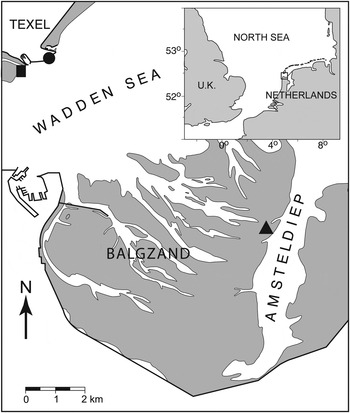
Data used by this study are from two sources: the NIOZ fyke net programme and the beach seine surveys carried out in the western Dutch Wadden Sea (Figure 1). The NIOZ fyke net programme started in 1960 and consists of a passive fishing kom-fyke net with a stretched mesh-size of 20 mm near the southern point of Texel, at the entrance of the Dutch Wadden Sea which is deployed annually. This trap is a combination of a pound net and a fyke with a 200 m leader running from above high water into the subtidal where two end chambers collect the fish. The tidal range is between 1–2 m depending on tidal phase and weather conditions. Fishing is usually undertaken from April to June, interrupted in summer because of jellyfish and weed clogging, and then restarted in September until the end of October. In winter, when ice forms, the fyke is removed. Until 1995, the fyke was emptied every Monday to Friday morning. From 1995 onwards the fyke was emptied every day. Occasionally, when catches are low, the net was emptied every other morning. All fyke net catches were sorted immediately, identified to species and counted. Between 1970 and 1978, fyke catches were measured irregularly, with a frequency of less than once a week. From 1979 onwards, all fish caught were measured to the nearest cm total length (TL). Since 2005, catch sub-samples were analysed in more detail including sex, reproductive stage, diet and age. In 2011, fish samples were also collected for stable isotope analysis. The validity of data from a single fish trap for the study of long-term trends in fish populations relies on the assumption that, on average, a constant fraction of the study populations is sampled. This assumption was validated for most species by comparing contemporaneous trends in a number of traps in the study area (Van der Veer et al., Reference Van der Veer, Witte, Beumkes, Dapper, Jongejan and Van der Meer1992; Van der Meer et al., Reference Van der Meer, Witte and Van der Veer1995).
Sampling areas in the Western Dutch Wadden Sea. Location of the NIOZ fyke net (■) near the southern tip of Texel, tidal gullies where beach seine hauls (▴) were performed and, the jetty used for measuring water temperatures (▲).

Beach seine surveys were carried out in 2010 and 2011 to collect information on young-of-the-year D. labrax. Sampling was done around low water in the Amsteldiep tidal gully surrounding the Balgzand intertidal (Figure 1). At each sampling date four hauls were made from the low water mark to a depth of about 1.2 m and covering a surface area of about 60 m2. All fish collected were sorted immediately, counted and measured.
Age and growth
Annual growth increments on D. labrax otoliths collected from 2005 onwards were identified and counted in order to estimate individual age. The sagittal otolith pair was removed, cleaned and either the left or right otolith was chosen for analysis depending on the clarity of the increment pattern. The selected otolith was submerged in a black vat filled with water with the sulcus facing down, and observed under a stereomicroscope using reflective light. Annual rings (annuli) were identified as the combination of opaque (indicating spring/summer growth) and translucide (indicating autumn/winter growth) bands alternating around a central nucleus. Counts were made by two readers and whenever the age obtained from two readings differed, the otolith was re-examined by both readers to make a final decision. In cases of disagreement, the otolith was excluded from further analyses. The transition between age groups was set as the 1st of January.
Growth curves were fitted to length-at-age data with the Von Bertalanffy growth model (VBGM) using the traditional version of the model developed by Von Bertalanffy with modifications by Beverton (Reference Beverton1954) and Beverton & Holt (Reference Beverton and Holt1957) (Cailliet et al., Reference Cailliet, Smith, Mollet and Goldman2006):
 $${L_t} = {L_\infty } \times \lpar 1 - {e^{ - K \times \lpar t - {t_0}\rpar }}\rpar $$
whereby L ∞ is the estimated maximum total length (cm), K is the growth rate constant (y−1), t is age (y), t 0 is the age at length zero and L t is the observed length at age t.
Growth was examined separately for females, males and all individuals together (including both sexes and immature specimens). In all specimens the gonad was inspected and, if possible, sex was determined. For analysis of sex-specific growth differences in model parameters, different models were compared. Sex-specific models (i.e. separate parameter estimates for males and females) were compared with models with one parameter in common (either L ∞ or K were the same for both sexes) and with a common model (same parameter estimates for both groups). All growth models were fitted using the R package version 3.1.0 programming environment (R Core Team, 2014), with parameters estimated using nonlinear least-squares (nls). An attempt to iteratively estimate all parameters was done resulting in a very large L ∞ (214 cm) which was unrealistic according to reports on maximum length (Pickett & Pawson, Reference Pickett and Pawson1994; Freitas et al., Reference Freitas, Cardoso, Lika, Peck, Campos, Kooijman and Van der Veer2010). Therefore, t 0 was fixed to day 59 (0.16 years), corresponding to a birth date of 1st of March based on the spawning season of D. labrax described for the UK (Thompson & Harrop, Reference Thompson and Harrop1987; Jennings & Pawson, Reference Jennings and Pawson1992; Pawson & Pickett, Reference Pawson and Pickett1996). For each growth model, the parameters, their corresponding standard error (SE) and the lower and upper limits of the 95% confidence intervals and 95% prediction intervals were estimated. Model goodness of fit, comparison and selection were based on the Akaike information criterion (AIC), with the best model defined as the one having the lowest AIC value (Katsanevakis, Reference Katsanevakis2006).
Comparison of growth parameters of the Von Bertalanffy curve with those described for other D. labrax populations were performed using the growth performance index Φ (Φ = log10K + 2 × log10 L ∞) described by Pauly & Munro (Reference Pauly and Munro1984).
Feeding ecology
Feeding patterns were studied based on stomach content and stable isotope analyses. For diet analyses, a subset of the fish collected in the fyke net (from 2005 to 2011) and in the beach seine surveys was used. Stomachs were removed and each prey item was identified to the lowest possible taxon, counted and measured for total length (TL). No adjustment of prey TL due to partial digestion was performed. For subsequent analyses, prey taxa were pooled into higher taxonomic groups, as well as unidentified or digested material.
The relative importance of each prey item in D. labrax diet was assessed using standard indices including the numerical index (NI), calculated as the percentage of the number of individuals of a prey category divided by the total number of individuals of all prey items combined, and the occurrence index (OI) estimated as the percentage of each prey item in all non-empty stomachs (Hyslop, Reference Hyslop1980). Diet composition in terms of weight was not assessed due to a lack of systematic weighting of each prey item. To evaluate ontogenetic changes in the diet composition of D. labrax, dietary indices were calculated in relation to fish length grouped in 5 cm size classes.
Predator–prey relationships were further examined for the most abundant prey using quantile regression. To assess the relationship between minimum, median and maximum prey size consumed with D. labrax length, regressions on the 5, 50 and 95% quantiles were performed (Scharf et al., Reference Scharf, Juanes and Rountree2000). The analysis was implemented in R using the ‘quantreg’ package (Koenker, Reference Koenker2013).
For nitrogen stable isotope analysis (SIA), tissue samples from both fyke and beach seines catches were collected in 2011. Fifty individuals covering the entire size range captured (4–53 cm TL) were selected and, from each fish, a portion of the white dorsal muscle tissue was removed, cleaned of bones and scales, and freeze-dried in a glass vial for more than 48 h. Dried samples were then ground with a mortar and pestle to a fine and uniform powder. Aliquots of homogenized tissue (between 0.4–0.8 mg dry sample) were weighed to the nearest 0.001 mg and packed in tin cups in preparation for SIA. Isotopic ratios were measured in duplicates using a Flash 2000 elemental analyser (EA) coupled to a DeltaV Advantage-irmMS (Thermo Scientific). Stable isotope ratios were expressed in the δ unit notation in units per millilitre according to:
 $$\delta^{15}{\rm N} \lpar \permil \rpar = \lsqb \lpar {R_{{\rm sample}}}{\rm /}{R_{{\rm standard}}}\rpar - 1\rsqb \times 1000 $$
where R sample and R standard are the ratios of heavy to light isotopes (15N/14N) of sample or standard, respectively. δ15N is reported relative to atmospheric N2. The analytical precision for δ15N based on repeated measurements of a laboratory standard (acetanilide) was ±0.26‰ (n = 60). In order to test for ontogenetic variability in isotopic composition, Gaussian linear and additive models were applied using D. labrax length as an explanatory variable. Statistical tests were performed in R with a significance threshold fixed at 5%.
Annual trends in abundance
Daily catches of the NIOZ fyke were used to calculate the total numbers of D. labrax caught per year during spring (April–June) and autumn (September–October). Generalized additive modelling (GAM) (Hastie & Tibshirani, Reference Hastie and Tibshirani1990; Faraway, Reference Faraway2006; Zuur et al., Reference Zuur, Ieno and Smith2007) was used to describe the temporal trends in abundance and to compare between seasons (spring and autumn). Poisson GAMs were fitted to the abundance data using the mgcv (Wood, Reference Wood2006) package in R. A quasi-Poisson error structure was employed to account for overdispersion (c.f. McCullagh & Nelder, Reference McCullagh and Nelder1989), as the dataset comprised a large number of observations with very low abundances.
Two models were compared, whereby the explanatory variables considered were season (nominal) and year (fitted as a smoother):
 $$\eqalign {&{\rm Abundance}_i = \alpha + {\rm offset} \lpar {\rm LogF}_i\rpar + f \lpar {\rm year}_i\rpar \cr & \quad + {\rm factor} \lpar {\rm season}_i\rpar + \varepsilon _i} $$
 $$\eqalign{& {\rm Abundance}_i = \alpha + {\rm offset} \lpar {\rm LogF}_i\rpar + f_1 \lpar {\rm year}_i\rpar + f_2 \lpar {\rm year}_i\rpar \cr & \quad \times {\rm factor} \lpar {\rm season}_{{\rm autumn}\comma i}\rpar + {\rm factor} \lpar {\rm season}_i\rpar + \varepsilon_i} $$
where α is an intercept, f is the smoothing function and ε i is the residual. Model (3) assumes that both seasons have the same abundance-year relationship, i.e. one smoothing curve is used for both seasons. In model (4), the first smoother (f 1 (year i )) represents the overall year effect in both seasons while the second smoother (f 2 (year i )) represents the deviation in autumn from the overall abundance-year relationship. To adjust for differences in fishing effort between years and seasons, the natural log-transformed number of days fished (LogF i ) was used as an offset variable. Because in 1967 no fishing was done in autumn, this year was excluded from the analysis. The smooth functions were constructed as penalized (thin plate) regression splines, with automatic selection of the effective degrees of freedom during the fitting process (Wood, Reference Wood2006). The effects of temporal autocorrelation were investigated by analysing the residual autocorrelation function (ACF). No temporal autocorrelation was detected in any of the models. An F-test (Wood, Reference Wood2006) was applied to compare the two models.
Abiotic and biotic variables
Time series of abiotic and biotic variables were used to examine whether D. labrax abundance was related to changes in environmental variables and food availability. Daily water temperature and salinity were obtained from a long-term monitoring program at the NIOZ sampling jetty, located in the vicinity (<1 km) of the NIOZ fyke (Van Aken, Reference Van Aken2003). From the daily temperature and salinity measurements, an index for winter and summer was calculated respectively as the mean of December, January and February, and the mean of July and August (Supplementary Material Figure S1). Indices of spring and autumn abundance of the main preys of D. labrax (based on diet analysis) were determined as described above for the NIOZ fyke net catches (Supplementary Material Figure S2).
The influence of temperature, salinity and prey abundance on D. labrax spring and autumn abundances, from 1961–2011, was analysed with generalized additive modelling, similarly as described above. The general model structure for each season was:
 $${\rm Abundanc}{{\rm e}_i}{\rm\,=\alpha+offset}\, {\rm \lpar Log}{{\rm F}_i}\rpar +\sum\limits_k {{\,f_k}\lpar {Z_k}_i \rpar }+{{\rm \varepsilon }_i}$$
where f k are smooth functions of the explanatory variables, and Z ki is the value of the explanatory variable k per observation i. Analysis for D. labrax spring abundances considered seawater temperature and salinity from the previous winter and the previous summer, and prey abundance in spring. Analysis for D. labrax autumn abundances considered seawater temperature and salinity from the summer and the previous winter, and prey abundance in autumn. Correlations between explanatory variables (collinearity) were assessed by multiple pair-wise scatter plots (pairplots). A forward selection procedure was used (following Zuur et al., Reference Zuur, Ieno, Walker, Saveliev and Smith2009), whereby the starting point was a GAM with only one explanatory variable, which was fitted x times depending on the number of different variables (e.g. six times for spring abundances). Different models were compared in terms of the generalized cross-validation (GCV) scores (Wood, Reference Wood2006). The model with the lowest GCV was then used in a next GAM with two explanatory variables, by adding each of the remaining variables to the model (resulting in e.g. five models with two variables for spring). This selection procedure was continued until a combination was found which resulted in higher GCV than the previous (simpler) model, resulting on the selection of the simpler model. Because for spring the number of smoothers in the final model used more degrees of freedom than the number of observations, the basis dimension parameter k was set to 6 for all smoothers in the model. The effects of temporal autocorrelation were investigated as described above whereby no autocorrelation was detected in any of the selected models.
RESULTS
Age and growth
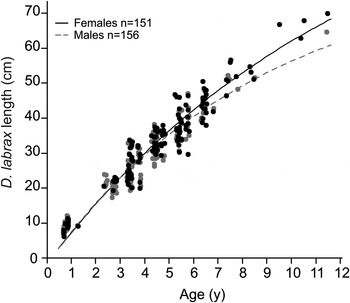
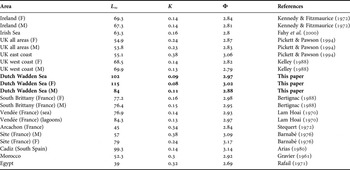
In total, 335 individuals ranging from 3.6 to 70 cm TL were aged by otolith analysis. The maximum age found was 11 years. Results showed that L ∞ and K differed significantly between sexes (the model with the lowest AIC was the general model). Females had a significantly higher L ∞ (d.f. = 149; L ∞ = 114.6 cm, 95% C.I.: 95.1–146.6 cm) and a lower K (0.08 y−1, 95% C.I.: 0.06–0.10 y−1) than males (d.f. = 154; L ∞ = 83.5 cm, 95% C.I.: 70.8–101.8 cm; K = 0.11 y−1, 95% C.I.: 0.09–0.14 y−1) (Figure 2). For comparison with published literature, VBGM parameters were also estimated considering all individuals (males, females, immature and non-identified specimens) which resulted in: L ∞ = 102.4 cm (95% C.I.: 90.6–121.3 cm) and K = 0.09 y−1 (95% C.I.: 0.07–0.11 y−1) (d.f. = 333). The calculated growth performance index Φ was 3.02 for females, 2.88 for males and 2.97 considering all individuals. The largest size caught in the long-term data series was 85 cm (in 1999) but unfortunately no otoliths were retrieved from this animal.
Estimated Von Bertalanffy growth curves for females (back symbols and full line) and males (grey symbols and dashed line).

Feeding ecology
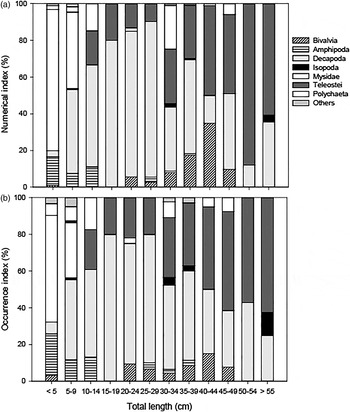
In total, 408 stomachs were analysed from individuals ranging from 2.5 to 70 cm TL. Of all stomachs inspected, 138 (about 34%) were empty. The D. labrax diet consisted of 32 prey item types belonging to seven major taxonomic groups, as well as unidentified materials (Figure 3, Supplementary Material Table S1). Decapods were the dominant prey, according to both numerical and occurrence indices, with values of 42 and 59%, respectively. Within this group, the brown shrimp Crangon crangon (Linnaeus, 1758) was by far the most important prey (NI = 37%, OI = 49%; Supplementary Material Table S1). Fish (Teleostei) and mysids (Mysidae) were the second and third most important prey groups with similar numerical contributions to the diet although fish occurred more frequently (Figure 3). Of the nine fish species found, herring Clupea harengus (Linnaeus, 1758) was the most common (NI = 14%, OI = 17%; Supplementary Material Table S1).
Size variation in diet composition of D. labrax according to (a) numerical and (b) occurrence indices. Occurrence index values were rescaled to sum 100% across all prey items.

Size-related differences in diet were observed and similar patterns were found irrespective of the index considered. The diet of small juvenile D. labrax (<10 cm) was dominated by mysids, but this group was practically absent in larger fish. From this size onwards, the contribution of decapods, mainly C. crangon, increased reaching 85% of the numerical diet composition in 25–29 cm TL D. labrax, thereafter slightly decreasing but still present in about 50% of the stomachs of all larger size classes (Figure 3). The degree of piscivory increased with size. In fish longer than 50 cm TL, plaice Pleuronectes platessa (Linnaeus, 1758) was also an important prey (NI: 24–32%, OI: 29–33%).
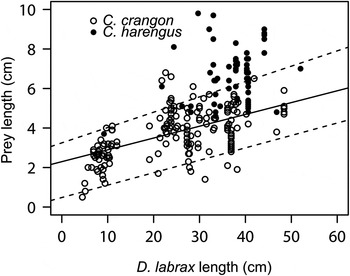
Figure 4 shows the predation of D. labrax on C. crangon and C. harengus according to size for all stomachs examined. As D. labrax increased in size, larger C. crangon were preyed upon as indicated by a significant positive relationship between predator and prey sizes (Pearson correlation, n = 186, r = 0.58, P < 0.001). Minimum, median and maximum prey size increased significantly with increasing D. labrax length (slope and intercepts of 5; 50; 95% quantile regressions: 0.06 and 0.48; 0.06 and 2.04; 0.08 and 3.25, respectively; P < 0.05). No significant difference was found between the slopes of the 5 and 95% quantiles indicating that both the minimum and maximum C. crangon sizes consumed increased at a same rate with predator length. In the case of C. harengus, 4–10 cm fish were eaten but no relationship between predator and prey length was found over the range of sizes examined.
Relationship between prey length and D. labrax total length. For C. crangon the quantile regression lines are shown. Solid line: median prey length (50% quantile), dashed lines: minimum (5% quantile) and maximum (95% quantile) prey length. Each symbol represents a single prey eaten by D. labrax.

The trophic position of D. labrax was assessed with δ15N individual signatures. Values ranged from 12.6 to 19.8‰ with an average of 16.5‰ (±1.1‰). Values of δ15N increased significantly with body size (ANOVA; F 1,45 = 30.15; r 2 = 0.40; P < 0.001) indicating higher trophic levels for larger D. labrax, consistent with the progressive increase in piscivory observed in the diet (Supplementary Material Figure S3).
Annual trends in abundance
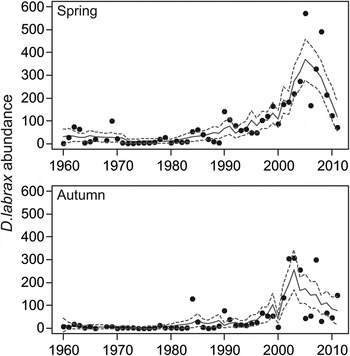
Abundances of D. labrax in spring and autumn are presented in Figure 5, together with model predictions. Maximum abundance in spring was observed in 2005 although high abundances were also observed in 1990, 1999 and from 2001 to 2009. In autumn, highest numbers were caught in 2003 with peaks in 1984, 2001–2004, 2007 and 2011. Minimum spring abundance occurred in 1960 (one individual caught) while in several years (1966, 1970, 1974–1976, 1982 and 1987) no individuals were caught in autumn.
Dicentrarchus labrax abundance in spring and autumn (total numbers of fish caught per season) in the western Dutch Wadden Sea. Full lines are GAM model predictions and dashed lines represent 95% confidence intervals.

Generalized additive modelling revealed that abundances did not differ significantly between seasons (ANOVA; model (3): F 1,94 = 0.07, P = 0.79; model (4): F 1,88 = 0.22, P = 0.64). The overall year effect (represented by the same smoother for both seasons) indicated that there was a significant year effect (ANOVA; model (3): F 6,94 = 11.49, P < 0.001; model (4): F 7,88 = 8.56, P < 0.001) on the abundance of D. labrax. However, the yearly pattern of abundance was not significantly different between seasons (i.e. the abundance-year pattern in autumn did not significantly differ from the overall pattern in model (4): ANOVA, F 7,88 = 0.63, P = 0.72). Overall, D. labrax abundances showed an increasing trend, although a decrease was observed from 2007 onwards (Figure 5). Comparison of models (3) and (4) found no significant differences (ANOVA, F 7,88 = 1.93, P = 0.10), confirming that abundance-year patterns were not different between seasons.
Abiotic and biotic variables
Based on diet analysis, the spring and autumn abundance of brown shrimp C. crangon and herring C. harengus were selected as biotic explanatory variables in the D. labrax abundance model. For C. harengus, a selection of size classes potentially relevant as prey was made based on the size spectrum found in the examined stomachs (up to 10 cm). In the case of C. crangon, all size classes present in fyke catches were included in the analyses.
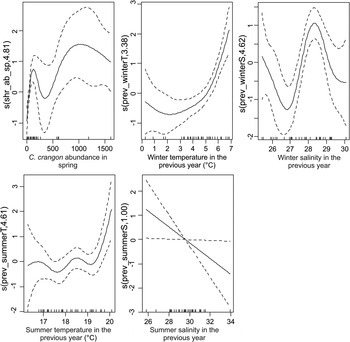
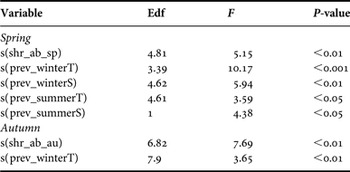
Initial exploratory data analysis on the explanatory variables influencing D. labrax abundances in spring and autumn revealed no strong collinearity between the selected explanatory variables (r < 0.51 for spring and r < 0.58 for autumn). The final model for spring included the effects of C. crangon spring abundance, temperature in the previous winter and previous summer, and salinity in the previous winter and previous summer (Supplementary Material Table S2). This model explained 88% of the deviance (adjusted r 2 = 0.87). Spring abundance showed a marked relationship with seawater temperature and salinity in the previous winter and with shrimp abundance in spring (Figure 6, Table 1). Dicentrarchus labrax spring abundance showed an overall increase with C. crangon spring abundance. The shape of the smooth function showing a decrease in D. labrax abundance between 150 and 400 C. crangon in spring followed by an increase is probably due to the fact that very high abundances of C. crangon were found in a few years. Winter mean temperatures above 2°C led to an increase in D. labrax spring abundance and a peak in D. labrax abundance was seen at winter salinities around 28.5. Dicentrarchus labrax spring abundance was also associated with seawater temperature and salinity in the previous summer. The relationship between D. labrax spring abundance and temperature in the previous summer yielded a wiggly curve showing a general increase in D. labrax abundance with increasing temperature. A negative linear relationship was found between D. labrax spring abundance and salinity.
Partial plots showing smoothers, with 95% confidence limits, fitted to (partial) effects of the predictor variables retained in the final model of spring abundance of D. labrax in the western Dutch Wadden Sea. Tick marks in the x-axis represent samples.

GAM results for the selected spring and autumn D. labrax abundance models along with their estimated degrees of freedom (Edf), F-statistics and P-values.

shr_ab_sp: C. crangon abundance in spring; prev_winterT: winter temperature in the previous year; prev_winterS: winter salinity in the previous year; prev_summerT: summer temperature in the previous year; prev_summerS: summer salinity in the previous year; shr_ab_au: C. crangon abundance in autumn.
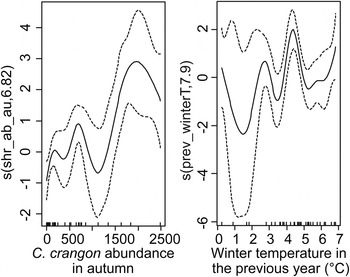
The final model for autumn included the effects of C. crangon abundance in autumn and temperature in the previous winter (Supplementary Material Table S2). This model explained 79% of the deviance (adjusted r 2 = 0.82). Autumn abundance was associated with temperature in the previous winter (Figure 7, Table 1), whereby highest autumn abundances occurred at winter temperatures above 4.5°C. Dicentrarchus labrax autumn abundance was also positively associated with high autumn C. crangon abundance.
Partial plots showing smoothers, with 95% confidence limits, fitted to (partial) effects of the predictor variables retained in the final model of autumn abundance of D. labrax in the western Dutch Wadden Sea. Tick marks in the x-axis represent samples.

DISCUSSION
Population structure
The D. labrax population in the western Dutch Wadden Sea is dominated by juveniles older than 1 year and by adults, although in autumn 0-group juveniles are also an important part of the population. Most individuals caught belonged to age classes 3 to 5 years old, comprising a size range between 20 and 45 cm. Although reproduction data has not been analysed in the present study, reports of size at first maturity from UK waters (Pawson et al., Reference Pawson, Kupschus and Pickett2007) suggest that this size class mostly corresponds to immature individuals. In the UK, D. labrax remain in coastal and estuarine nursery habitats until about 36 cm in length (Pawson et al., Reference Pawson, Kelley and Pickett1987; Pickett et al., Reference Pickett, Kelley and Pawson2004), after which adolescent or mature fish either stay at inshore feeding areas or migrate offshore to pre-spawning and spawning grounds (Pawson et al., Reference Pawson, Kelley and Pickett1987). It thus seems that the western Dutch Wadden Sea supports juvenile D. labrax growth and the presence of 0-group suggests that the area acts as a nursery for this species. The fact that only two 1-year-old animals were sampled is likely a sampling artefact, due to the large mesh size of the fyke net combined with avoidance of the beach seine. Future sampling should focus on early juvenile stages (0- and I-group). These are sensitive to environmental conditions (Person-Le Ruyet et al., Reference Person-Le Ruyet, Mahé, Le Bayon and Le Delliou2004; Vinagre et al., Reference Vinagre, Madeira, Narciso, Cabral and Diniz2012a, Reference Vinagre, Madeira, Narciso, Cabral and Dinizb, Reference Vinagre, Narciso, Cabral, Costa and Rosac) and could therefore give a better indication of changes in the nursery function of this area for the species.
The estimated L ∞ values in this study were in line with predictions for the species using bioenergetics modelling (103 cm for females and 87 cm for males; Freitas et al., Reference Freitas, Cardoso, Lika, Peck, Campos, Kooijman and Van der Veer2010) and were not far from the maximum observed size in the area of 85 cm (this study). Estimated L ∞ values were higher than the ones reported for populations from other areas (Table 2). The estimated K value was, on the other hand, lower than described in previous studies but this was expected as the two parameters are inversely related (Pauly, Reference Pauly1984). The index of growth performance Φ resulted in a relatively high value (2.97), larger than the ones reported for British and Irish coasts and similar to the one described in more southern Atlantic areas, such as south Brittany and the Bay of Biscay (Table 2). Since no recent data on growth of D. labrax are available from other areas it is not possible to assess whether conditions for growth in the western Dutch Wadden Sea are better than in other areas or whether growth conditions have generally improved over the last decades.
Von Bertalanffy growth parameters L ∞ and K, and the growth performance index (Φ) for D. labrax data from different locations (adapted from Pickett & Pawson, Reference Pickett and Pawson1994). F refers to females and M to males; data from this paper are in bold.

The role of D. labrax in the system
As in other areas, D. labrax diet in the western Wadden Sea is largely composed of crustaceans. Dicentrarchus labrax has been described as an opportunistic feeder, adapting its diet to the most available food sources (Pickett & Pawson, Reference Pickett and Pawson1994; Laffaille et al., Reference Laffaille, Lefeuvre and Feunteun2000). Such flexible feeding behaviour has been observed in other areas (Arias, Reference Arias1980; Cabral & Costa, Reference Cabral and Costa2001; Martinho et al., Reference Martinho, Leitão, Neto, Cabral, Lagardère and Pardal2008). The high dominance of shrimp C. crangon in the diet of juvenile D. labrax may also be related to its general high abundance and all-year around availability as C. crangon is a major component of the mobile epibenthic fauna of the western Wadden Sea tidal flats (Kuipers & Dapper, Reference Kuipers and Dapper1984; Beukema, Reference Beukema1992). The same opportunistic feeding strategy probably explains the dominance of small herring in D. labrax diet, as the Wadden Sea is well known as a nursery and feeding ground for C. harengus (I. Tulp, personal communication).
Adult D. labrax are placed high in the food chain due to their piscivorous diet (Pasquaud et al., Reference Pasquaud, Pillet, David, Sautour and Elie2010; Spitz et al., Reference Spitz, Chouvelon, Cardinaud, Kostecki and Lorance2013). An increase in piscivory with D. labrax size observed in the Wadden Sea has been reported in other wild populations (Barnes et al., Reference Barnes, Jennings, Polunin and Lancaster2008; Pasquaud et al., Reference Pasquaud, Elie, Jeantet, Billy, Martinez and Girardin2008) emphasizing the need to consider fish size when evaluating function and trophic position in the food web (Pasquaud et al., Reference Pasquaud, Pillet, David, Sautour and Elie2010).
In many fish species, the larger the predator, the larger the size spectrum of prey consumed (Keast & Webb, Reference Keast and Webb1966; Juanes & Conover, Reference Juanes and Conover1994) which seems to be related to anatomical changes in predation mechanisms as well as increased swimming capabilities and better visual acuity (Keast & Webb, Reference Keast and Webb1966; Webb, Reference Webb1976; Beamish, Reference Beamish, Hoar and Randall1978). Such a relationship was found for C. crangon prey where the size of shrimps consumed increased linearly with D. labrax length. However, contrary to the widespread pattern of asymmetrical predator size–prey size relationships observed in many fish species (Scharf et al., Reference Scharf, Juanes and Rountree2000), both maximum and minimum prey sizes increased in parallel for larger D. labrax. This indicates a constant niche breadth, consistent with the traditional foraging theory according to which predators should maximize their net energetic return by selecting the largest available prey (Schoener, Reference Schoener1971; Stephens & Krebs, Reference Stephens and Krebs1986). From the prey viewpoint, these results indicate that a large part of the C. crangon population in the Dutch Wadden Sea is vulnerable to D. labrax predation. Fish predation has been identified as the main factor affecting autumn recruitment of the C. crangon population in the region (Campos et al., Reference Campos, Bio, Cardoso, Dapper, Witte and Van der Veer2010) but the specific impact of D. labrax was not assessed.
Long-term trends in abundance
Over the last 50 years, an overall increasing trend in D. labrax in the western Dutch Wadden Sea was found especially from 1990 until 2007, however there were large between-year fluctuations. A similar increasing trend in abundance has been observed along the Dutch coast and in the Western Scheldt estuary in the south (Tulp et al., Reference Tulp, Bolle and Rijnsdorp2008). Water temperature is a critical factor determining abundance and distribution of fish species, including D. labrax, in estuaries (Marshall & Elliott, Reference Marshall and Elliott1998; Power et al., Reference Power, Attrill and Thomas2000; Cabral & Costa, Reference Cabral and Costa2001; Attrill & Power, Reference Attrill and Power2002; Henderson et al., Reference Henderson, Seaby and Somes2011; Pasquaud et al., Reference Pasquaud, Béguer, Larsen, Chaalali, Cabral and Lobry2012). The increase in mean annual temperature observed since the 1980s in the western Dutch Wadden Sea, as well as along the whole Dutch coastal zone (Van Aken, Reference Van Aken2008a, Reference Van Aken2010), suggests that temperatures for growth of D. labrax may be more favourable in recent years than in the past. During the last decade, mean summer water temperature in the western Dutch Wadden Sea was around 18°C, and in some months even reached 21°C (Van Aken, Reference Van Aken2008a; H. van Aken, personal communication), which are optimal for growth of juvenile D. labrax (Barnabé, Reference Barnabé1990; Vinagre et al., Reference Vinagre, Madeira, Narciso, Cabral and Diniz2012b).
Dicentrarchus labrax spring abundances were usually highest when temperatures in the previous year were around or above the average of the whole dataset (4°C in winter and 18°C in summer). A positive relationship was indeed observed between spring abundance and summer and winter temperatures in the previous year. In south-west Britain, higher year-classes occurred in warmer years, whereby spring and summer temperature appeared to determine the winter survival of 0-group D. labrax and the number of I-group observed the next spring (Henderson & Corps, Reference Henderson and Corps1997). Autumn abundances in the western Dutch Wadden Sea also showed a strong relationship with temperature in the previous winter. Higher winter temperatures are known to lead to higher recruitment success the following year (Holmes & Henderson, Reference Holmes and Henderson1990) and to improve survival of larvae and juvenile D. labrax during their first winter (Kelley, Reference Kelley1988; Pawson, Reference Pawson1992).
Salinity is also an important factor structuring estuarine fish communities (e.g. Marshall & Elliott, Reference Marshall and Elliott1998; Drake et al., Reference Drake, Arias, Baldo, Cuesta, Rodríguez, Sobrino, Silva-García, García-González and Fernández-Delgado2002; Costa et al., Reference Costa, Vasconcelos, Costa and Cabral2007; Henderson et al., Reference Henderson, Seaby and Somes2011; Pasquaud et al., Reference Pasquaud, Béguer, Larsen, Chaalali, Cabral and Lobry2012), as a result of different physiological tolerance and habitat preference of species and life stages. Salinity in the previous summer and winter was seen to influence D. labrax spring abundance with highest abundance at a salinity of about 28. This is consistent with evidence from laboratory experiments where this species showed consistently better growth at an intermediate salinity of about 26 compared with higher or lower salinities (Johnson & Katavic, Reference Johnson and Katavic1986). From 1861 to 2003, annual mean salinity decreased in the Dutch Wadden Sea, mainly due to changes in rainfall, river flow and engineering works on inland rivers (Van Aken, Reference Van Aken2008b). This suggests that, in addition to more favourable temperatures, also salinity may have become more optimal for growth of D. labrax.
A recent decreasing trend (since 2007) in D. labrax abundance has been observed in the Dutch Wadden Sea. Such a trend has also been reported for the Bristol Channel, contemporary with a decline in average temperatures (Henderson & Bird, Reference Henderson and Bird2010). In the Dutch Wadden Sea, a decrease in temperature has not been observed yet but mean annual salinity has increased since the early 2000s (H. van Aken, personal communication), although the available time series is presently too short to see a clear trend. Moreover, our modelling results suggest that long-term fluctuations in D. labrax abundance are also affected by C. crangon abundance, as observed for other areas (Kelley, Reference Kelley1987; Costa & Bruxelas, Reference Costa and Bruxelas1989). A decreasing trend in the stock size of C. crangon has also been observed after 2000 (Campos et al., Reference Campos, Bio, Cardoso, Dapper, Witte and Van der Veer2010; this study), suggesting that a combination of decrease in prey availability and changing environmental conditions may be responsible for the recent declining trend in D. labrax abundance. In addition, other factors such as wind speed and direction, depth and cannibalism (Henderson & Corps, Reference Henderson and Corps1997; Cabral & Costa, Reference Cabral and Costa2001; Martinho et al., Reference Martinho, Dolbeth, Viegas, Teixeira, Cabral and Pardal2009; Pasquaud et al., Reference Pasquaud, Béguer, Larsen, Chaalali, Cabral and Lobry2012) have also been proposed to explain variability in D. labrax year-to-year recruitment and abundance.
CONCLUSIONS
This study shows that the western Dutch Wadden Sea has become an important area for D. labrax. It is unclear how the D. labrax population will develop in the near future and how this will impact their epibenthic and nektonic prey. Ocean warming seems to be the reason for the northerly extension in distribution of several fish species, including D. labrax (Brander et al., Reference Brander, Blom, Borges, Erzini, Henderson, MacKenzie, Mendes, Santos and Toresen2003; Rose, Reference Rose2005; ICES, 2012). However, the consistent use of coastal and estuarine areas depends on the quality of local feeding and nursery grounds. Climate variability is known to affect fish recruitment, spawning and feeding distributions (Beaugrand et al., Reference Beaugrand, Brander, Lindley, Souissi and Reid2003; Ottersen et al., Reference Ottersen, Alheit, Drinkwater, Friedland, Hagen, Stenseth, Stenseth, Ottersen, Hurrell and Belgrano2004; Rose, Reference Rose2005). Warmer winter temperatures are thought to have lengthened the residence time of D. labrax in summer feeding areas and caused D. labrax to spawn further away from their main spawning areas (Pawson & Pickett, Reference Pawson and Pickett1996; Pawson et al., Reference Pawson, Kupschus and Pickett2007). A warming climate could prolong the residence time of juvenile D. labrax in the Dutch Wadden Sea and/or provide suitable overwintering conditions causing higher abundance of adults in autumn and winter. In addition, climate variability is also expected to affect individual prey species with impacts on predator–prey interactions and on the food web (Freitas et al., Reference Freitas, Campos, Fonds and Van der Veer2007). A long-term increase in the western Dutch Wadden Sea C. crangon population has been observed (Campos et al., Reference Campos, Bio, Cardoso, Dapper, Witte and Van der Veer2010; Tulp et al., Reference Tulp, Bolle, Meesters and Vries2012), which seems to have positively affected food availability for D. labrax. Dynamics of both prey and predator populations have changed in recent years (Campos et al., Reference Campos, Bio, Cardoso, Dapper, Witte and Van der Veer2010; this study) but analysing cross-correlations requires longer time series for sound conclusions. Combined with variations in the extent of prospective fisheries, the future of the D. labrax population in the Dutch Wadden Sea remains largely unknown. However, continued monitoring is an important tool to understand and anticipate D. labrax responses to further environmental changes.
ACKNOWLEDGMENTS
The authors thank Peter Henderson for providing valuable comments on an earlier version of the manuscript.
FINANCIAL SUPPORT
This study was partly supported by the Netherlands Organization for Scientific Research (NWO) via Project 839.08.241 of the National program Sea and Coastal Research (ZKO). J. Cardoso and V. Freitas were partly funded by Fundação para a Ciência e a Tecnologia (FCT, Portugal) and Fundo Social Europeu (POPH/FSE) (grant nos. SFRH/BPD/34773/2007 and SFRH/BPD/75858/2011, respectively). The stable isotope analysis was carried out within the framework of the Waddensleutels project (http://www.waddensleutels.nl/) and supported by the Waddenfonds.
Supplementary materials and methods
The supplementary material for this article can be found at http://www.journals.cambridge.org/MBI