




No CrossRef data available.
Length perception and production of normal subjects in proximal versus distal peripersonal space
Published online by Cambridge University Press: 01 October 2004
Abstract
We investigated whether the perception or production of a given line length in normal subjects varies according to where in peripersonal space the line is perceived or produced. We also investigated the influence of the direction of movement used to make the line. In Experiment 1, blindfolded normal subjects were asked to estimate distances while the examiner moved the subject's hand in proximal (medial) or distal (lateral) space, moving centripetally or centrifugally. The subjects showed a spatial effect, perceiving the same length as shorter in proximal space than distal space. This result could be related to either a proximal spatial attentional bias or an anisometric representation of spatial distances. In Experiment 2, we attempted to dissociate these hypotheses by studying blindfolded normal subjects, who were requested to produce horizontal lines of a given length (100 or 200 mm) in proximal versus distal peripersonal space using centripetal or centrifugal movements. Centrifugal movements in proximal space were the longest; centrifugal movements in distal space were the shortest; in between were the proximal centripetal and distal centripetal movements which did not differ from each other. These results suggest that in peripersonal space the perception of length in normal subjects is most consistent with anisometric mental representation where the size of mental representations of length units decreases as a function of the distance from the subject's midsagittal plane. Length production, however, may depend on an interaction of the anisometric mental representation and the premotor/intentional factors. (JINS, 2004, 10, 913–919.)
Keywords
Information
- Type
- BRIEF COMMUNICATION
- Information
- Journal of the International Neuropsychological Society , Volume 10 , Issue 6 , October 2004 , pp. 913 - 919
- Copyright
- © 2004 The International Neuropsychological Society
INTRODUCTION
Estimation of distance (length perception) is an important skill that might be altered by neurological diseases. For example, when patients with left sided neglect, from right hemisphere lesions, are requested to find the midpoint of a horizontal line (the intersection of the coronal and transverse planes), they either underestimate the left side of the line or overestimate the right side of the line and make their bisection mark to the right of the actual midline.
Studies of patients with neglect (Harvey et al., 1995) and psychophysical studies of normal subjects (Harvey et al., 1995; Milner et al., 1992) suggest that levels of attention may influence magnitude estimates (attention–magnitude hypothesis), such that attended portions of a line appear to have a relatively increased magnitude and unattended portions have a reduced magnitude. Thus, the right sided bias seen in patients with left sided hemispatial neglect might be related to inattention to the left side of the line or an attentional bias to the right side of the line or both (Heilman et al., 1993).
Only a few studies have investigated normal subjects' magnitude estimates of objects as a function of their spatial location. Using horizontal lines, investigators have found that overall in both the visual and tactile mode normal subjects bisect lines to the left of the center (Bowers & Heilman, 1980; Jewell & McCourt, 2000). However, with vertical (intersection of the midsagittal and coronal planes) and radial lines (intersection of the midsagittal and transverse planes) normal subjects make visual bisections that are distal to the midline and tactile bisections that are proximal to the actual midline (Chewning et al., 1998; Kashmere & Kirk, 1997; Shelton et al., 1990). Thus, in normal subjects different cognitive processes may be involved in visual versus tactile bisections. In addition, length perception might also be influenced by the object spatial location. Our study is focused on the length perception in tactile modality as a function of spatial location.
Prior studies that investigated tactile bisection tasks in radial axis indirectly suggest that length perception of normal subjects can be different in terms of proximal versus distal peripersonal space (Chewning et al., 1998; Halligan & Marshall, 1993; Mennemeier et al., 1992; Shelton et al., 1990). More specifically, these studies found that when bisecting radially oriented rods in tactile modality normal subjects put the midpoint towards their own body. A study, using a tactile maze, also found that normal subjects were less attentive to distal than proximal space (Beschin et al., 1996).
These studies suggest that greater attentional resources are devoted to the proximal than distal peripersonal space and according to the attention–magnitude hypothesis the length of equally sized line segments in proximal space will be perceived as longer than equal segments perceived in distal space. This hypothesis, however, has not been directly studied. Thus, the aim of the first experiment (Experiment 1) was to learn whether the perception of a given line length in blindfolded normal subjects varies according to where in peripersonal space the line is perceived (spatial effect).
EXPERIMENT 1: LENGTH PERCEPTION
Experiment 1 was conducted in normal subjects to investigate whether the length perception of a line segment will vary according to where in relation to the subject's body the stimuli are perceived. We also wanted to learn if the direction of passive movement influenced estimates of magnitude. In order to exclude motor factors, subjects were asked to relax their arms and fingers and to allow the examiner to move the subject's index finger centripetally or centrifugally in proximal (medial) and distal (lateral) space and then to estimate and report the distance that had been moved.
Methods
Research participants
Subjects were 33 healthy volunteers (18 men with a mean age of 27.33 ± 2.62 years, range, 23–30) without previous neurological or psychiatric diseases. Their mean educational level was 15.39 ± 0.82 years. All were right-handed assessed by Edinburgh Handedness Inventory (Oldfield, 1971). Informed consent was obtained from each subject and the study was approved by the Institutional Review Board of the hospital.
Experimental apparatus
The blindfolded subject was seated in front of a table. As depicted in Figure 1, a horizontal line was drawn on the table. This line was placed 250 mm anterior to the subject's sternum. The midpoint (MP) of this line was aligned with the midsagittal plane of each subject's body. The maximum lateral reach of the tip of the subject's right index finger when the arm was fully extended in the coronal plane was defined as Rmax. R1 was defined as the point on this line that is 300 mm to the right of the MP. R2 and R3 were defined respectively as the points on the line that are 400 mm and 100 mm medial to the Rmax. Lmax, L1, L2, and L3 were similarly defined, but Lmax was determined by the left forelimb and L1, L2, and L3 were in body-centered left hemispace.

Illustration of the space and direction where given lengths were perceived (Experiment 1) or produced (Experiment 2). : Closed circle and arrow respectively represent the starting point and the direction of passive movement (Experiment 1) or active movement (Experiment 2). Rmax and Lmax respectively represent maximum lateral reach of right index finger and left index finger. MP: midpoint. See text for R1, R2, R3, L1, L2, and L3.
Experimental procedure
In one-half of the trials the right forelimb was passively moved and in the other half of the trials the left was moved. Prior to movement, the subject was asked to relax their upper limb and the subject's index finger was moved by the examiner along the edge of a ruler placed on the horizontal line (described above) at a speed of about 8 cm/s. The same examiner was used for all subjects. There were six different linear movements: 10, 14, 18, 22, 26, and 30 cm. After the right or left index finger was moved, the subject was asked to report the perceived distance of the movement to the closest centimeter. The subject's right hand was moved in right hemispace and their left hand in left hemispace. In right or left proximal peripersonal space, the starting point of outward (centrifugal, or abductive) passive movements were at MP and the starting point of inward (centripetal, or adductive) movements were at R1 or L1 (300 mm to the right or left of MP). In distal peripersonal space, the starting point of outward movements was at R2 or L2 (400 mm medial to Rmax or Lmax) and the starting point of inward movement was at R3 or L3 (100 mm medial to Rmax or Lmax).
Thus, the independent variables were hand (left vs. right), space (proximal vs. distal), and direction of passive movement (inward vs. outward). These independent variables created eight different experimental conditions. For each of these conditions, there were six trials: one trial for each of the six distances described above. There were also two practice trials before the experiment started. The total of 48 experimental trials were given in one block with no rest period. The order of the 48 trials was randomized for each subject. During the experiment, the subject was not given any feedback about the accuracy of their performance. It took about 20 min for each subject to complete these 48 trials. The statistical significance was set at p < .05 and adopted the Bonferroni correction for multiple comparison (alpha = .05).
Results
Maximum lateral reach of subjects' index finger (Rmax and Lmax)
The mean distance, for all subjects, from MP to Rmax was 732.1 ± 40.1 mm and from MP to Lmax was 746.1 ± 31.5 mm. These distances were not significantly different. The distances between MP and both Rmax and Lmax were greater in men than women (Rmax–men = 746.7 ± 42.6 mm vs. Rmax–women = 714.7 ± 29.7 mm, t(31) = 2.453, p < .05; Lmax–men = 758.1 ± 26.5 mm vs. Lmax women = 731.7 ± 31.7 mm, t(31) = 2.604, p < .05).
Length perception
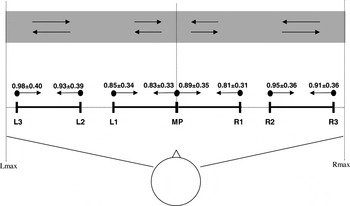
Lengths perceived by the subjects were divided by the real length and were expressed as a ratio. In each condition, the data from the trials that used six different lengths were averaged. Means and standard deviations of the length perception ratios are presented in Figure 2.

Results of length perception, expressed as ratio (perceived length/given length). Arrows in shaded area represent a schematic illustration of length perception results.
Using a General Linear Model, we analyzed the effect of the following variables: direction (inward, outward), space (proximal, distal) and hand (right, left) on the length perception. Main effects of hand and direction were not significant but the main effect of space was significant [F(1,32) = 41.538, p < .001]: the ratios of perceived length in proximal space (0.84 ± 0.33) were shorter than those (0.95 ± 0.37) in distal space. Of the possible interactions, only the interaction between Hand × Direction was significant [F(1,32) = 16.617, p < .001]. Subject judged passive movements as larger when the right hand was passively abducted than when adducted (t(65) = 3.413, p < .01). There was also a reverse but weaker tendency for the left hand (t(65) = 2.007, p = .098): subject judged passive movements as larger when the left hand was passively adducted than when abducted. Hence, overall, independent of hand, when passive movements were rightward the perceived distance was greater than when passive movements were leftward (t(131) = 3.824, p < .001). When the data from the left and the right hands were pooled, a one sample t test revealed that overall, independent of condition, subjects underestimated the length of their movement. Specifically, in proximal conditions subjects' perceived lengths were significantly shorter than real lengths (inward: 0.83 ± 0.32, t(65) = −4.315, p < .001; outward: 0.86 ± 0.34, t(65) = −3.381, p < .01). In distal conditions, the underestimates were not significant (inward: 0.95 ± 0.37, t(65) = −1.102, p = .275; outward: 0.94 ± 0.37, t(65) = −1.286, p = .203).
Discussion
Our subjects underestimated passive movements in proximal peripersonal space more than they underestimated passive movements perceived in distal peripersonal space. According to the attention–magnitude hypothesis, this finding suggests that normal subjects, contrary to our expectation, attend more to the stimuli presented in distal than proximal space. Passive movements away from the body tended to be perceived greater than the equally sized passive movements toward the body, although the findings for the left hand did not reach the significance. This finding is also consistent with the attentional bias toward the distal space.
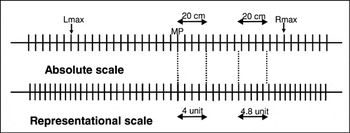
Alternatively, there might be a representational anisometry such that the proximal or medial representations of length units are expanded but the distal or lateral representations are accurate (Figure 3). Thus, in proximal space, when a subject's hand is moved a fixed distance, the subject compares this movement to this internal ruler that has expanded length representation and underestimates the length of the movement, but in distal the length representation are accurate and the space the subjects' estimates are accurate. Experiment 2 will further explore and attempt to differentiate between the attentional and representational hypotheses.

An anisometric mental representational model that may account for underestimation of given lengths in proximal space in normal subjects. For instance, 20 cm will be recognized as 4 units in proximal space while the same length will be recognized as 4.8 units. Because the length with the same units is recognized as the same distance regardless of spatial location, the same length will be perceived shorter in proximal space (4 units) than in distal space (4.8 units). MP, Lmax, and Rmax: see the legend for Figure 1.
In addition, overall, independent of hand, the length estimates after rightward movements (0.92 ± 0.36) were greater than estimates after leftward movements (0.87 ± 0.35), suggesting that right handed people might pay more attention to the rightward than the leftward movements. In the second experiment we will also test this hypothesis.
EXPERIMENT 2: LENGTH PRODUCTION
In Experiment 1, we found that virtual lines presented in proximal space through the tactile modality were perceived as shorter than their actual length and also shorter than virtual lines presented in distal space. As mentioned above, these misperceptions might be related to attentional or representational factors such that normal people are either relatively less attentive to these proximal than distal stimuli or that the length representations in proximal space are enlarged when compared to those of distal space.
Experiment 2 was conducted to distinguish between these two possibilities. When a subject's task is to draw a line of a given length they must translate their distance representations into a motor program. If they have a representational anisometry such that the medial representation of length units are enlarged when compared to the more lateral representations, they should draw lines that are longer in proximal medial space than those drawn in lateral space. In contrast, if there is an attentional anisometry, subjects might be less attentive to medial representations of length units. Because decreased attention is associated with a reduction of magnitude, representations of length units would be reduced in size and thus the lines drawn in medial space should be smaller than the lines in lateral space.
Methods
Research participants
Thirty healthy, right-handed volunteers without a history of neurological or psychiatric diseases participated in Experiment 2. There were 12 men and 18 women with a mean age of 28.5 ± 3.8 years (range: 22–35). Their mean educational level was 16.1 ± 1.57 years. Age, sex ratio, and education level of subjects in Experiment 2 did not differ from those in Experiment 1.
Experimental procedure
The same apparatus used in Experiment 1 was also used in Experiment 2. The subjects were requested to produce 100 mm or 200 mm lines along the horizontal line described in the apparatus section of Experiment 1. To commence, the examiner placed the subject's index finger at the starting point and asked the subject to move a given distance along the edge of a ruler placed on the horizontal line in a direction specified by the examiner. The subjects' right hand produced the lines in right hemispace and their left hand in left hemispace. In proximal peripersonal space, the starting point of outward movements was MP and the starting point of inward movements was at R1 or L1 (300 mm lateral to MP). In distal peripersonal space, the starting point of outward movements was at R2 or L2 (400 mm medial to Lmax or Rmax) and the starting point of inward movements was at R3 or L3 (100 mm medial to the Lmax or Rmax). Thus, independent variables were hand (left vs. right), space (proximal vs. distal), direction (inward vs. outward) and length (100 mm vs. 200 mm), creating 16 different conditions.
Each subject performed two trials for each condition and completed a total of 32 trials. We divided the 32 trials into two blocks and each block consisted of 16 trials (one trial for the 16 conditions). The test conditions were presented in a random order. There was no resting period between the blocks and it took about 20 min for each subject to complete the whole experiment.
In a pilot study, some subjects used a strategy where they made a small line segment and subsequently made multiple fragmented movements rather than a smooth single movement. Therefore, prior to the experimental study, the subjects were instructed not to use such a strategy. During the experiment, subjects were not given any feedback about the accuracy of their productions. The statistical significance was also set at p < .05 and adopted the Bonferroni correction for multiple comparisons (alpha = .05).
Results
Maximum lateral reach of subjects' index finger (Rmax and Lmax)
Distance from MP to Rmax and Lmax in all subjects were 728.5 ± 49.4 mm and 719.2 ± 33.8 mm, respectively, which did not differ. Distance from MP to Rmax in men was significantly longer than that of women (776.6 ± 35.1 vs. 702.8 ± 34.4 mm; t(28) = 4.872, p < .001) but no difference was noted in distance from MP to Lmax (735.6 ± 43.4 mm vs. 710.5 ± 24.8 mm.
Length production
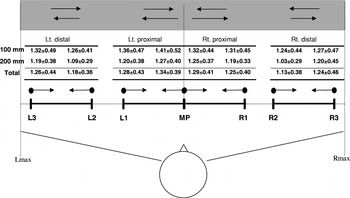
The lengths of the movement produced by subjects were divided by the target length (100 or 200 mm) and were expressed as the ratio between movement length/target length. Means and standard deviations of these ratios are presented in Figure 4. To learn if there were any main effects or interactions, we analyzed the effect of the following independent variables on the subjects' length production by using General Linear Models: direction (inward, outward); space (proximal, distal); length of target (100 mm, 200 mm); and hand (right, left). The effects of hand (right, left) and direction (inward, outward) were not significant but the main effects of space [F(1,29) = 20.923, p < .001] and length [F(1,29) = 22.264, p < .001] were significant. Of the possible interactions the only significant interaction was between Direction × Space [F(1,29) = 19.458, p < .001]. Independent of condition, when subjects were producing 100 mm lines their length ratio (1.31 ± 0.46) was greater than when they were attempting to produce 200 mm lines (1.18 ± 0.37). In regard to space when making outward movements in distal space, the lengths of movement for both the 100 mm (1.27 ± 0.45) and 200 mm (1.13 ± 0.36) targets were smaller than the movements in proximal space [1.35 ± 0.47 for 100 mm and 1.23 ± 0.37 for 200 mm; t(59) = −3.424, p < .001 for 100 mm; t = −8.529, p < .001 for 200 mm]. There were no significant differences, however, in distal versus proximal space when subjects were making inward movements.

Results of length production, expressed as ratio (produced length/given length). Arrows in shaded area represent a schematic illustration of length production results.
Multiple comparisons with the Bonferroni correction among the four conditions (inward and outward movements in proximal and distal spaces) showed that the distal outward movements were shorter than other movements (vs. proximal outward: t(119) = −7.622, p < .001; vs. proximal inward: t(119) = −5.697, p < .001; vs. distal inward: t(119) = −4.102, p < .001). Proximal outward movements were longer than distal inward movements (t(119) = 2.876, p < .05); the same trend was noted with proximal inward movements, although it fell just short of significance (t(119) = 2.672, p = .054). No difference, however, was noted between proximal inward and distal inward movements. In summary, as depicted in the shaded area in Figure 4, outward movements in proximal space were the longest while outward movements in distal space were the smallest; proximal inward and distal inward movements were between and these two conditions did not differ.
In each of the following eight conditions: hand (right, left); direction (abduction, adduction); space (proximal, distal); and length (100 mm, 200 mm), the length of subjects' movements were compared with target lengths by one-sample t tests. When the data from the right and left hand production were combined, subjects produced longer movements than they had been directed to move (all ps < .001) in all conditions but in one (distal, outward of 200 mm) in which subjects were accurate.
Independent of hand, spatial location and line size, rightward movements (1.24 ± 0.42) did not differ from leftward movements (1.25 ± 0.42; t(239) = −0.728, p = .467).
GENERAL DISCUSSION
In Experiment 1 we asked normal subjects to estimate distances, while the examiner moved the subject's left or right hand in proximal or distal peripersonal spaces, moving centripetally or centrifugally. The subjects incorrectly thought that the distances their forelimbs were moved in proximal space was shorter than those in distal space.
In Experiment 1 the subject's hand was moved passively, thus the incorrect perception can not be related to efferent factors, but can be related to either perceptual/attentional factors such that the perceived movement length in proximal (medial) peripersonal space was underestimated when compared to perceived movement in distal (lateral) peripersonal space. Alternatively, these results may be related to representational anisometry, similar to the right–left anisometry proposed by Bisiach et al. (1999) to account for the line bisection errors observed in patients with hemispatial neglect. A proximal–distal form of representational anisometry may explain our results. If the attention-perceptual hypothesis is correct, subjects would not only be expected to estimate medial lines as smaller than lateral lines, but also to produce medial lines that are smaller than lateral lines. Our results, however, suggest that the metric representations of proximal–medial space are relatively larger (hypermetric) than those of distal–lateral peripersonal space. Thus, when normal subjects compared a perceived line segment presented in proximal space to this expanded internal ruler, they underestimated the magnitude of the proximal line segment. In contrast when producing lines in proximal space, using this expanded internal ruler as a guide, they produced larger lines than they did in distal space, where the internal ruler is more accurate.
This asymmetric length production between distal and proximal, however, was only significant for outward movements, not for inward movements. This inward versus outward asymmetry cannot be explained by the representational hypothesis because this mental representational model should not be direction specific. Thus, some other factors might have altered the subjects' performance. Normal subjects may have an intentional bias such that they make longer movements when moving centripetally than centrifugally. This hypothesis would explain our observation of longer movements occurring in distal space when making inward movements. However, the observation that centripetal or adductive movements in proximal space are not larger than abductive movements is inconsistent with this hypothesis. The arms are attached to the shoulders which are at the division of proximal and distal space as defined in this paper. If we define abductive movements as those that bring the hand away from this shoulder-based sagittal plane and adductive movement as those that bring the hand toward this plane, then it would appear that overall shoulder-based adductive movements (proximal outward and distal inward, 1.28±0.44) are larger than shoulder-based abductive movements (proximal inward and distal outward, 1.21 ± 0.40; t = 4.409, p = .001).
Blindfolded normal subjects have a proximal bias on tactile radial bisection and a distal bias with visual bisection of radial lines (Barrett et al., 2002; Chewning et al., 1998; Kashmere & Kirk, 1997; Shelton et al., 1990). These differences between the visual and tactile modalities suggest that spatial–length representations might be modality specific or that there might be different cognitive–attentional influences (e.g., body-centered vs. retinotopic) on these types of bisection tasks (Chewning et al., 1998).
Although we had no a priori hypothesis about directional perception, we found in Experiment 1 that our right-handed subjects' perception of a given distance was larger with the rightward than the leftward passive movements. We suspected that these right-handed subjects might be more attentive to rightward than the leftward movements of their hand, and this directionally asymmetric attention might have influenced estimates of magnitude. In Experiment 2, subjects had to draw lines and thus, had to also estimate magnitude (length). Although we did not find right–left asymmetry in Experiment 2, drawing lines is a “top-down” process, but judging distance based on afferent (proprioceptive) information is a “bottom-up” process and the influence of attentional factors on magnitude estimates might be more robust with bottom-up than top-down process. Alternatively, this asymmetry might be related to the directional scanning bias associated with reading habit (Chokron & Imbert, 1993). Further research, however, will have to be performed to test this post-hoc hypothesis.
This rightward directional perceptual asymmetry might also help account for another phenomenon that has been repeatedly reported when the line bisection task is given to normal subjects. Using a tactile line bisection test with normal right-handed subjects, Bowers and Heilman (1980) noted that these subjects overall bisected the line toward the left of center. They called this phenomenon pseudoneglect. Pseudoneglect has also been reported in the visual domain (Jewell & McCourt, 2000), but unfortunately the phenomenon has not been fully explained. When exploring a line, a subject must make rightward and leftward explorations and it has been reported that bisection errors of normal subjects is strongly influenced by the direction of final full search before they make their bisection mark (Baek et al., 2002). Thus, if their last full exploration is rightward their representation of the line will be enlarged and when they half this representation their mark will be too far to the left. However, if their last full exploration is in the other direction (to the left) their percept of the line will be shrunken and when they half this the pseudoneglect will be decreased or absent. This hypothesis is consistent with the results of a tactile bisection study (Baek et al., 2002) that pseudoneglect was greater with the final left-to-right full search than with the right-to-left search and may be consistent even with visual bisection studies that scanning or movement from the left resulted in greater pseudoneglect than the scanning or movement from the right (Brodie & Pettigrew, 1996; MacLeod & Turnbull, 1999).
ACKNOWLEDGMENTS
This study was supported by a grant of the Korea Health 21 R&D Project, Ministry of Health & Welfare, Republic of Korea (02-PJ1-PG3-21301-0016).
References
REFERENCES
Baek, M.J.,
Lee, B.H.,
Kwon, J.C.,
Park, J.M.,
Kang, S.J.,
Chin, J.,
Heilman, K.M., &
Na, D.L.
(2002).
Influence of final research direction on tactile line bisection in
normal subjects.
Neurology,
58,
1833–1838Google Scholar
Barrett, A.M.,
Crosson, J.B.,
Crucian, G.P., &
Heilman, K.M.
(2002).
Far bias on the radial line bisection task: Measuring
perceptual-attentional and motor-intentional bias in normal
subjects.
Cortex,
38,
769–778.CrossRefGoogle Scholar
Beschin, N.,
Cazzani, M.,
Cubelli, R.,
Della Sala, S., &
Spinazzola, L.
(1996).
Ignoring left and far: An investigation of tactile neglect.
Neuropsychologia,
34,
41–49.Google Scholar
Bisiach, E.,
Neppi-Modona, M.,
Genero, R., &
Pepi, R.
(1999).
Anisometry of space representation in unilateral neglect: Empirical
test of a former hypothesis.
Consciousness and cognition,
8,
577–584.Google Scholar
Bowers, D. &
Heilman, K.M.
(1980).
Pseudoneglect: Effects of hemispace on a tactile line bisection
task.
Neuropsychologia,
18,
491–498.Google Scholar
Brodie, E.E. &
Pettigrew, L.E.L.
(1996).
Is left always right? Directional deviation in visual line
bisection as a function of hand and initial scanning direction.
Neuropsychologia,
34,
467–470.Google Scholar
Chewning, J.,
Adair, J.C.,
Heilman, E.B., &
Heilman, K.M.
(1998).
Attentional bias in normal subjects performing visual and tactile
radial line bisections.
Neuropsychologia,
36,
1097–1101.Google Scholar
Chokron, S. &
Imbert, M.
(1993).
Influence of reading habits on line bisection.
Brain Research. Cognitive Brain Research,
1,
219–222.Google Scholar
Halligan, P.W. &
Marshall, J.C.
(1993).
The bisection of horizontal and radial lines: A case study of
normal controls and ten patients with left visuospatial neglect.
International Journal of Neuroscience,
70,
149–167.Google Scholar
Harvey, M.,
Milner, A.D., &
Roberts, R.C.
(1995).
An investigation of hemispatial neglect using the landmark task.
Brain and Cognition,
27,
59–78.Google Scholar
Heilman, K.M.,
Watson, R.T., &
Valenstein, E.
(1993).
Neglect and related disorders. In
K.M. Heilman &
E. Valenstein (Eds.),
Clinical neuropsychology
(3rd ed., pp.
279–336).
New York:
Oxford University Press.
Jewell, G. &
McCourt, M.E.
(2000).
Pseudoneglect: A review and meta-analysis of performance factors in
line bisection tasks.
Neuropsychologia,
38,
93–110.Google Scholar
Kashmere, J.L. &
Kirk, A.
(1997).
The complex interaction of normal biases in line bisection.
Neurology,
49,
887–889.Google Scholar
MacLeod, M.S. &
Turnbull, O.H.
(1999).
Motor and perceptual factors in pseudoneglect.
Neuropsychologia,
37,
707–713.Google Scholar
Mennemeier, M.,
Wertman, E., &
Heilman, K.M.
(1992).
Neglect of near peripersonal space: Evidence for multidirectional
attentional systems in humans.
Brain,
115,
37–50.Google Scholar
Milner, A.D.,
Brechmann, M., &
Pagliarini, L.
(1992).
To halve and to halve not: An analysis of line bisection judgments
in normal subjects.
Neuropsychologia,
30,
515–526.Google Scholar
Oldfield, R.C.
(1971).
The assessment and analysis of handedness: The Edinburgh inventory.
Neuropsychologia,
9,
97–113.Google Scholar
Shelton, P.A.,
Bowers, D., &
Heilman, K.M.
(1990).
Peripersonal and vertical neglect.
Brain,
113,
191–205.Google Scholar
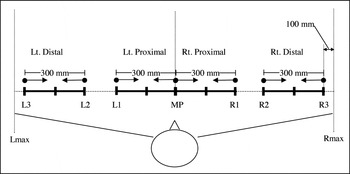
Illustration of the space and direction where given lengths were perceived (Experiment 1) or produced (Experiment 2). : Closed circle and arrow respectively represent the starting point and the direction of passive movement (Experiment 1) or active movement (Experiment 2). Rmax and Lmax respectively represent maximum lateral reach of right index finger and left index finger. MP: midpoint. See text for R1, R2, R3, L1, L2, and L3.
Results of length perception, expressed as ratio (perceived length/given length). Arrows in shaded area represent a schematic illustration of length perception results.
An anisometric mental representational model that may account for underestimation of given lengths in proximal space in normal subjects. For instance, 20 cm will be recognized as 4 units in proximal space while the same length will be recognized as 4.8 units. Because the length with the same units is recognized as the same distance regardless of spatial location, the same length will be perceived shorter in proximal space (4 units) than in distal space (4.8 units). MP, Lmax, and Rmax: see the legend for Figure 1.
Results of length production, expressed as ratio (produced length/given length). Arrows in shaded area represent a schematic illustration of length production results.
 You have
Access
- 3
- Cited by