Did September 11 fundamentally change world politics?1
The final draft of this paper was written in April during the beginning of the war in Iraq.
The global rift over the United States invasion of Iraq hinges on this question. The United States' “war on terrorism” presumes that new threats from terrorist groups and weapons of mass destruction have transformed the international system. Advocates of military intervention in Iraq argue that this fundamentally changed world justifies more aggressive, even preemptive policies. Critics of the United States invasion of Iraq, however, argue that existing collective security rules are still applicable even after the events of September 11. They prefer an international system where the use of force is justified only by explicit Security Council authorization or traditional standards of self-defense, neither of which applies to the U.S. intervention in Iraq. Healing this rift within the international community will require eventual agreement about the extent to which September 11 changed the rules of global security.
I argue that September 11 did not fundamentally change world politics. Using a rule-oriented constructivist approach, I argue that the dominant trend of the post-cold war world is the gradual institutionalization of global collective security rules. As in earlier struggles to punish states violating human rights rules, the international community is now struggling to punish both states and ruthless nonstate actors that violate terrorism and weapons proliferation rules. The pre-September 11 debate about intervening in Yugoslavia over human rights abuses in Kosovo is stunningly similar to the post-September 11 debates about the use of military force in Iraq. This analysis suggests that September 11 did not fundamentally change the rules governing global security; instead, it exacerbated already existing tensions about the appropriate implementation of fledgling collective security rules.
To analyze the Kosovo debate I use an interpretive method called dialogical analysis (Duffy, Frederking, and Tucker 1998; Frederking 2000). Dialogical analysis builds on approaches that take the constitutive nature of language seriously, including Wittgenstein's (1968) latter philosophy of language, Habermas' (1984, 1987) notion of communicative rationality, and the speech act theories of Austin (1962) and Searle (1969). Dialogical analysis models a linguistic conception of social interaction capable of illustrating constructivist arguments. It assumes the existence of constitutive social rules and communicatively rational agents constructing those social rules through the performance of speech acts. The development of interpretive methods like dialogical analysis is important if we are to move beyond epistemological debates between advocates of Science and advocates of Anti-Science. Interpretive methods capable of yielding theoretical and practical insights can show both the positivist defenders of Science and the postmodern defenders of Anti-Science that one can accept the philosophical critiques of positivism and still engage in rigorous, replicable empirical research in the pursuit of knowledge.
I build on Onuf's rule-oriented constructivism to offer a tentative rule-oriented constructivist theory of global security. Onuf (1989) argues that agents are embedded in “social arrangements” of intersubjective rules. I posit four social arrangements constituting the security structures of world politics: war, rivalry, collective security, and security communities. The dominant post-cold war trend is movement away from cold war rivalry rules and (slowly) toward collective security rules. This trend is complicated because some rules in these social arrangements overlap. For example, the use of force is acceptable in war, rivalry, and collective security arrangements. How others interpret the use of force will depend on a dialogic consensus about which social arrangement governs the interaction. If others interpret force to invoke rules of war, then they will dismiss claims that collective security rules apply. I argue that a rule-oriented constructivist emphasis on language and rules shows the debates over Kosovo and Iraq to have tremendous similarities, casting doubt on arguments that September 11 fundamentally changed world politics.
CONSTRUCTIVISM
Constructivism2
emerged in the 1990s as international relations scholars realized that the dominant approaches of neorealism and neoliberalism could not explain transformative events like the end of the cold war. Constructivism asserts the existence of social structures—including norms, beliefs, and identities—constituting world politics. All constructivists in some way assert the importance of what Searle calls “social facts”: facts that exist because all the relevant actors agree they exist. Social facts like sovereignty, property, human rights, and collective security are for constructivists the stuff of world politics, and human agency constructs those social facts (
Berger and Luckmann 1966;
Searle 1995).
Within international relations, constructivism resembles English school arguments that the state system is embedded in a larger society in which states agree to certain rules and institutions (e.g., Bull 1977). However, leading constructivists cite many influences. Wendt (1999) cites Mead's symbolic interactionism and Bhaskar's scientific realism. Onuf (1989) cites Wittgenstein's latter philosophy of language, Giddens's structurationism, Habermas' theory of communicative action, and Searle's speech act theory. Campbell (1992) cites the postmodern arguments of Foucault and Derrida. Ruggie (1998) cites Durkheim's studies of the collective conscience and Weber's methods of verstehen. All emphasize the constitutive nature of language. Language not only represents the world but in many ways creates the world by making action possible. Language is not a neutral medium through which we study the world; language is itself action. Constructivism is thus part of the postpositivist “sociological turn” (Guzzini 2000) or “linguistic turn” (Palan 2000) in the social sciences.
Constructivists assert three common ontological positions (Finnemore and Sikkink 2001; Kubalkova 2001; Wendt 1999). First, social factors primarily influence human interaction. Constructivism opposes materialist ontology asserting material structures, like the balance of power in neorealism or markets in neoliberalism. Constructivists argue that material structures have meaning for human agents only within the context of social rules. For example, a state's military capability has different meanings depending on whether it belongs to an ally or an enemy. Second, social structures help constitute the interests and identities of purposive actors. Constructivism opposes individualist ontologies that explain social outcomes as the aggregate result of individual decisions. Human agency is enmeshed in a web of social rules that both constitute and regulate agency. Third, agents and structures construct each other. Rules make agents and agents make rules. The (social) world is made by people, who in turn are made by that (social) world.
Most categorizations of constructivist arguments are epistemological. For example, Hopf (1998) distinguishes between conventional and critical constructivists. Conventional constructivists adhere to standard positivist causal theorizing, using norms and ideas as independent variables that cause action (Katzenstein 1996; Wendt 1999). Critical constructivists, however, reject positivist epistemology and methods and the possibility of objective knowledge (Campbell 1992). Their goal is to demystify the discursive practices that constitute social rules in order to foster change.
Many constructivists do not consider themselves in either of these camps. Adler (1997) and Ruggie (1998) argue that constructivism offers an important middle ground between positivism and postmodernism. Indeed, Onuf (2002, 126) introduced constructivism to international relations to stake out such a middle ground:
This third way holds that ontology is the key…. Constructivism challenges the positivist view that language serves only to represent the world as it is. Language also serves a constitutive function. By speaking, we make the world what it is …. Nevertheless, constructivism is not postmodern because it accepts, as a practical matter, the Enlightenment belief in the possibility of shared knowledge about the world we live in.
Many constructivists work within this middle ground, using a wide variety of methods to analyze the social world (Fierke 2001). Crawford (2002) uses linguistic methods similar to the dialogical analysis presented here to analyze the ethical arguments challenging colonialism. Hopf (2002) uses a phenomenological approach of inductively analyzing texts to recover identities influencing Soviet and Russian foreign policy. Mattern (2001) analyzes “friendship” narrative strategies in the Western security community. Fierke (2000) conceptualizes social interaction as a dialogue to analyze the interaction between Iraq and the United Nations (UN) in the 1990s. Doty (1993) uses a “discursive practices” approach to analyze U.S. counterinsurgency policy in the Philippines. Others not explicitly within constructivism also build such methods, including conversation analysis (Fetzer 2000) and event data analysis (Duffy 1994). Dialogical analysis, the method used in this article, is also intended to be within this middle ground.
Another way to categorize constructivism is to focus on ontology, emphasizing the type of social rule—beliefs, norms, or identities—constructivists argue influences world politics. Beliefs, norms, and identities are all types of rules that constitute the social structure of world politics. This categorization is consistent with Habermas' arguments (discussed in more detail below) for the existence of three fundamental validity claims: truth, appropriateness, and sincerity. Each type of constructivist argument emphasizes one of those fundamental validity claims. Beliefs are social rules that primarily make truth claims about the world. To criticize a belief is to say that it is untrue. Norms are social rules that primarily make appropriateness claims about relationships. To criticize a norm is to say that it is inappropriate. Identities are social rules that primarily make sincerity claims about agents. To criticize a conveyed identity is to say that it is insincere.
One type of constructivist argument emphasizes truth validity claims by studying the importance of beliefs, or ideas, in world politics. Beliefs are shared understandings of the world. For example, Adler (1992) argues that “epistemic communities” create shared interpretations that frame and structure human practices. Bukovansky (2001) analyzes how the ideas championed by the American and French revolutions influence world politics. Other examples include how economic ideas influence economic policy making (Jacobsen 1995) and Third World development policies (Sikkink 1991).
A second type of constructivist argument emphasizes the appropriateness validity claim by studying the importance of norms in world politics. Norms are shared understandings of appropriate action. Norms guide action and make action possible, enabling agents to criticize assertions and justify actions. Finnemore (1996) argues that states often follow a “logic of appropriateness” and adhere to existing norms. Kratochwil (1989) demonstrated how norms arise in rationalist environments to enable and guide action. Keck and Sikkink (1998) and Risse, Ropp, and Sikkink (1999) show the conditions under which “transnational advocacy networks” diffuse human rights and environmental norms and influence domestic institutional changes. Other examples include the role of norms in the collapse of the cold war (Kratochwil and Koslowski 1994) and sanctions against South Africa (Klotz 1995).
A third type of constructivist argument emphasizes the sincerity validity claim by studying the importance of identity in world politics. Identities tell agents who they are and who others are; they enable agents to make the actions of themselves and others intelligible. Constructivists argue that interests stem from a particular, constructed representation of the relationship between self and other. Wendt (1995) argues that 500 British nuclear weapons are less threatening to the United States than five North Korean nuclear weapons. A social concept of structure explains this, but a material concept of structure cannot. Other examples include the role of a liberal democratic identity in the North Atlantic Treaty Organization (Risse-Kappen 1997), the role of Arab nationalism in Middle East alliances (Barnett 1995), and the role of a friendship identity during the Suez Canal Crisis (Mattern 2001).
Many constructivists focus on the interconnections among ideas, norms, and/or identities. For example, Price and Tannewald (1996) argue that the reproduction of norms is inseparable from the construction of identity: “Civilized” states adhere to chemical and nuclear weapons norms because only “barbaric” states violate those norms. Crawford (2002) explicitly analyzes all three validity claims in her analysis of how ethical argumentation influenced decolonization. Weldes (1999) also analyzes all three validity claims and how they influenced U.S. national interests in the Cuban Missile Crisis. Viewed through Habermas, constructivists illustrate how agents conveying validity claims of truth, appropriateness, and sincerity construct the rules governing world politics.
The rule-oriented constructivist approach presented here also includes all three constructivist arguments. Social arrangements include all three types of rules: beliefs, norms, and identities. Global security arrangements include beliefs about the world (e.g., the nature of security), norms about social relationships (e.g., the appropriateness of the use of force), and identities about self and other (e.g., enemy, rival, citizen, or friend). Finally, dialogical analysis illustrates these three arguments by analyzing the validity claims and counterclaims of the speech acts performed by communicatively rational agents.
RULE-ORIENTED CONSTRUCTIVISM
Rule-oriented constructivists make two fundamental claims (Kubalkova 2001; Onuf 1989, 1998). First, social arrangements, or stable patterns of rules, make up the structures of world politics. Social arrangements are constitutive (they tell us what is possible) and regulative (they tell us what to do). World politics is a complex set of interdependent and overlapping social arrangements. Rules constitute and regulate all aspects of world politics—even “anarchy” is a constitutive social arrangement. Rules make it possible for agents to act: They tell us how the world works, They tell us who we are and who others are, they tell us which social goals are appropriate, and they tell us what we should do. Rules, like language, are not reducible to the meanings that individuals attach to them; they exist in the shared meanings of their users and are reproduced through their practices (Guzzini 2000). And, as Onuf (1989) argues, rules create rule by inherently providing more benefits and privileges to some more than others.
Beliefs, norms, and identities are types of social rules that constitute and regulate world politics. For example, beliefs about whether security is based on military capability or political relationships help constitute the range of possible arms control practices and influence particular arms control negotiations (Frederking 2000). Norms about the appropriateness of weapons of mass destruction help constitute the range of possible war-fighting and deterrence practices and influence particular war and deterrence policies (Price and Tannewald 1996). Identities about racial superiority help constitute the range of possible colonial practices and influence particular decolonization policies and even humanitarian interventions (Crawford 2002). For rule-oriented constructivists these rules explain world politics.
Onuf's concept of rules is based on Wittgenstein's (1968) critique of the mirror theory of language, which holds that language is meaningful to the extent that it accurately represents the real world. Wittgenstein argued that the meaning of a term is connected to its use in speech, not whether it corresponds exactly to things in the real world. Meaning resides in the everyday use of language as a “form of life”; that is, by context and/or convention. Shared background knowledge is necessary to interpret language. Wittgenstein argues that learning a language is like learning the rules of a game; they help you “go on” by acting in ways that make sense given the rules of the game. For example, the rules of chess enable one to participate in or to interpret a chess game. This also applies to the rules of global security. Hollis and Smith (1991, 179) put Wittgenstein's position this way: “Social action can occur only when there is a rule followed, thus identifying what is going on” (my emphasis). The task for rule-oriented constructivists, then, is to explicate a range of social arrangements and show how the rules within these social arrangements make action intelligible.
The second rule-oriented constructivist claim is that communicatively rational agents use speech acts to construct social rules. This claim builds on both speech act theory and Habermas' notion of communicative rationality. Speech act theory begins with Austin's (1962) demonstration that many verbal statements constitute social action. For example, saying “I do” in a marriage ceremony is a meaningful social act because it invokes social rules of the institution of marriage. Speech act theory argues that language is action; speech acts (promising, declaring, apologizing, etc.) are both plentiful and central to social life. Searle (1995) argues that a touchdown creates six points and a promise creates an obligation because both are “social facts” based on the constitutive rules of football and promising. Onuf uses speech act theory to build his rule-oriented constructivism. Kubalkova (2001, 64) argues,
Onuf's most important contribution to constructivism is his systematic effort to show that rules derive from, work like, and depend on speech acts, and that language and rules together (they can never be separated) are the medium through which agents and structures may be said to constitute each other…. To study international relations, or any other aspect of human existence, is to study language and rules. (my emphasis)
Onuf uses three types of speech acts to analyze world politics: assertions, directives, and commitments. These speech acts invoke and/or challenge social rules that have the form of speech acts. For example, assertion rules convey knowledge about the world. Liberalism, neoclassical economics, and neorealism, for example, all include assertions about world politics. Repeated and unchallenged assertions like “democratic governments do not go to war with one another,” “free trade maximizes economic efficiency,” and “unipolar systems are less stable than bipolar systems” both enable and justify democratization policies, trade agreements, and arms shipments. Directive rules tell us what we must or should do and often include consequences for disregarding them. Examples of speech acts invoking directive rules include the use of force, trade sanctions, and International Monetary Fund structural adjustment programs. Commitment rules are promises to act in a particular way. Examples of speech acts invoking commitment rules are treaties, contracts, and international trade.
Habermas' notion of communicative rationality builds on speech act theory. Habermas argues that communicatively rational agents perform speech acts, convey validity claims, interpret and evaluate the claims of others, and act on the basis of mutually recognized validity claims. Rationality refers to linguistic competence; a rational act effectively conveys validity claims and invokes social rules so that others correctly interpret the speech act. This dialogic process of agents conveying and evaluating the validity claims of each other's speech acts constructs and reconstructs social rules. Rule-oriented constructivists rely on Habermas because only communicatively rational actors can achieve the interpretive accomplishments ascribed to them by constructivist arguments.
Habermas argues that communicatively rational speech acts convey implicit validity claims of truth, appropriateness, and sincerity.3
A fourth validity claim of speech acts studied by linguists, but less useful for dialogic analysis, is “grammaticality.”
Consider the three types of speech acts emphasized by Onuf. An assertion (X) conveys a truth claim (X is true), an appropriateness claim (It is right that I assert X), and a sincerity claim (I believe X is true). A directive (You must do X) conveys a truth claim (You can do X), an appropriateness claim (It is right that I direct you to do X), and a sincerity claim (I want you to do X). And a commitment (I promise to do X) conveys a truth claim (I can do X), an appropriateness claim (It is right that I promise to do X), and a sincerity claim (I want to do X). Others may accept or challenge the validity claims on the basis of reasons, requiring a “moment of insight” to justify the claim that goes beyond strategic rationality. All competent speakers intuitively know how to test claims and judge whether certain claims are warranted. The binding force of language comes from others' ability to say “yes” or “no” to the validity claims. When actors agree to the validity claims of a speech act, the binding effect of language motivates them to coordinate subsequent actions with the speaker.
4 Rule-oriented constructivism does not assume that Habermas' notion of communicative action within an ideal speech situation characterizes world politics. For Habermas, communicative action is action oriented toward mutual understanding and coordinated by a consensus on all validity claims. Risse (2000) analyzes whether Habermas' conditions for communicative action (lack of power relations, noncoerced consensus, etc.) resemble interactions in world politics. I do not assert the existence of communicative action in this sense. The Kosovo debate does not illustrate communicative action; the claims about whether intervention is consistent with existing security rules are constantly disputed. What is important, though, is that the agents invoke collective security rules to justify their acts. Their action is meaningful only within the context of (albeit disputed) collective security rules.
Focusing on the validity claims of speech acts enables constructivists to analyze the process through which speech acts construct and/or challenge social rules. When one performs a speech act and conveys the three validity claims, another can either accept all three claims or challenge one (or all) of the claims. For example, suppose that a teacher asserts the following to her class: “The United States Civil War occurred in the 1900s.” The class may not challenge the speech act and add it to their notes(!). Or the class could challenge the sincerity claim: The teacher wanted to see if they were paying attention. Or the class could challenge the truth claim: The Civil War was not fought in the 1900s. Or the class could challenge the appropriateness claim: Teachers should not lie to their students. In each case the students construct and/or challenge the rules of the student–teacher social arrangement.
The same possibilities structure political interaction. Suppose that one country directs another to destroy its weapons of mass destruction within six months. The other country could accept the validity claims and comply, challenge the sincerity claim (you want a pretext to invade), challenge the normative rightness claim (it is not appropriate for you to determine our military capabilities), or challenge the truth claim (we cannot completely disarm within six months). This view of agency puts language at the heart of social life by emphasizing argumentation, a search for reasoned consensus, and the constitutive effects of an argumentative consensus on agents.
Using speech act theory and communicative rationality to inform a conception of social interaction enables analysts to treat physical, nonverbal acts as if they were speech acts. Of course, something unspoken is not literally a speech act. However, nonverbal acts are often communicatively rational—they make validity claims and invoke and/or challenge social rules—and are thus analyzable as speech acts. The use of force is an extremely important example of such a nonverbal, yet communicatively rational, act. How communicatively rational agents justify and interpret the use of force is central to the ongoing construction of global security rules. As the analysis below shows, how the world interpreted the NATO bombing campaign in Kosovo is central to that interaction, as is how the world interprets the use of force in Iraq. Treating nonverbal but communicative acts as speech acts makes a wide variety of social interaction amenable to dialogical analysis.
For example, during the cold war the superpowers understood each other's missile deployments to invoke the deterrence rules constituting the cold war rivalry (Frederking 2000). Missile deployments are intelligible only if they operated as speech acts within a particular social arrangement. Missile deployments do not necessarily invoke deterrence rules; they could, for example, alter the strategic balance or expand a sphere of influence. Indeed, the superpowers criticized all missile deployments interpreted to invoke these latter rules. A missile deployment is understood as a deterrent only when all agree that a certain set of linguistically constructed rules govern their interaction. In this way speech acts, both verbal and nonverbal, are constitutive elements of social reality, and linguistically constructed rules provide meaning to both verbal and nonverbal speech acts.
Rule-oriented constructivism takes the constitutive nature of language and communicative agency seriously. Rule-oriented constructivists analyze the shared context that makes social action possible and meaningful. We make sense of action when there is coherence between the actions of agents (speech acts) and the meaning of their situation (existing social rules). Interpretive approaches like dialogical analysis explain in terms of intelligibility, not “expectability” (Dessler 1999). To explain an act is to specify the rule(s) an agent is following. Rule-oriented constructivism does not assume, as positivist causal arguments do, that language is a mirror and we compare our statements about the world with the world to see whether they correspond. As Kratochwil and Ruggie (1986) argue, in constructivist ontology language constitutes social interactions, while in positivist epistemology language is independent of social interactions. Constructivists who espouse positivism ignore the epistemological implications of their ontological arguments (Kratochwil 2000).
A RULE-ORIENTED CONSTRUCTIVIST THEORY OF GLOBAL SECURITY
Constructivism is an ontology asserting the existence of social rules; it cannot tell us the content of those rules. This is an empirical question, and constructivists must demonstrate that their theoretical assertions about social rules cohere with the speech acts of real-world agents. This section is a first cut at a rule-oriented constructivist theory of global security. Many important social arrangements also constituting world politics—capitalism, globalization, postcolonialism, international law, and so on—fall outside the scope of this theory but are amenable to a rule-oriented constructivist analysis. The influence of other social arrangements (e.g., the position of Russia in the international economy, domestic politics) in the dispute over Kosovo also falls outside the scope of this analysis.
Wars, rivalries, collective security, and security communities are the “form of life” (Wittgenstein) or “lifeworld” (Habermas) or “social facts” (Searle) of global security. These social arrangements constitute global security in the way that the rules of chess constitute chess; participants use them to “go on” and act in intelligible ways. Sometimes one social arrangement is more institutionalized than the others; sometimes the social arrangements are contested and fluid; and sometimes social arrangements are more institutionalized in different geographic areas (e.g., war in the Middle East, rivalry in South Asia, security community in Europe). The operation of overlapping social arrangements constituting global security is similar to Fierke's (n.d.) argument that opposing “logics” may coexist within a historical context. What constitutes rational action depends on which logic is governing the particular interaction.
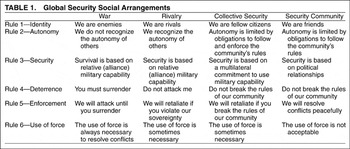
A first cut at stating ideal-typical rules in these social arrangements is in Table 1. Each social arrangement has six fundamental rules that constitute and regulate action: (1) identity, (2) autonomy, (3) the nature of security, (4) deterrence, (5) enforcement, and (6) the use of force. The identity rule establishes agent identities as enemies, rivals, citizens, or friends. The autonomy rule establishes the extent to which the autonomy of both state and nonstate agents is either threatened by others or limited by mutual obligations. The security rule establishes the belief that security is acquired by either relative military capability or friendly political relationships. The deterrence rule establishes a dominant normative expectation either to recognize the autonomy of others or to follow the rules of the community. The enforcement rule establishes the ultimate method of resolving conflict. The use of force rule establishes the extent to which force is required to resolve conflict. Variations of these rules constitute the ideal-typical social arrangements of war, rivalry, collective security and security communities.
These rules are not intended to be a priori assertions of social reality. They comprise a tentative rule-oriented constructivist theory of global security. They may not cohere with future empirical research and have to be abandoned. But they are a recognizable, plausible place to start. The contents of the rules are culled from major scholars of international politics, including Alker's (1996, 370) work on security systems, Onuf's (1989) “mutual insecurity system,” Schelling's (1960) theories of deterrence and arms agreements, and Deutsch's (1957) work on security communities. Wendt's (1999) three cultures of world politics—Hobbesian war, Lockean rivalry, and Kantian security communities—heavily influence these rules. Wendt's characterization of Kantian culture, however, includes both collective security (in which the use of force is acceptable) and security communities (in which the use of force is not acceptable). I argue that this distinction warrants separate social arrangements; moreover, as I argue below, this distinction is essential to understand the construction of post-cold war collective security.
In war, agents identify each other as enemies (rule 1), perhaps even an enemy that threatens their existence. Agents do not recognize the autonomy of others or perhaps even the right of others to exist (rule 2). Survival demands a military capability greater than one's immediate enemies (rule 3) because the military capabilities of others are interpreted as a threat to one's existence. The directive rule in war is to surrender (rule 4), supported by the commitment to attack until the other does surrender (rule 5). Because others are enemies with the military capability to threaten one's existence, the use of force is considered inevitable, necessary, and appropriate (rule 6). War orients agents to act with great mistrust and hostility towards others, including interactions like traditional nation-state warfare, Israeli–Palestinian relations, imperialism, and (perhaps) the ongoing “war” on terrorism.
In rivalries, agents identify each other as rivals (rule 1). They attempt to increase their security through joining alliances (rule 3) and performing classic deterrence threats (rules 4 and 5). Agents do recognize the autonomy of others (rule 2), but the rivalry constituting the system sometimes leads to violence to settle disputes (rule 6). War is thus an accepted but limited practice to end an attempt by any state to dominate world politics. Rivalry orients agents to act with mistrust and caution toward others, including interactions like power balancing, alliance systems, security dilemmas, arms races, and spheres of influence regimes. The cold war was a prototypical rivalry social arrangement.
In collective security arrangements, agents identify each other as citizens (rule 1) who are obliged to uphold agreed-upon rules of behavior (rule 2) and act collectively to punish those who do not uphold those rules (rule 3). There is no presumption that actors will universally agree to the directive rules (rule 4); an enforcement mechanism that includes military force is thus needed to punish any transgressors of the rules (rule 5). A collective security arrangement may enforce only the rule of state sovereignty, or it could enforce rules regarding weapons proliferation, terrorism, human rights, and so on. The use of force is considered to be sometimes necessary and acceptable to enforce community rules (rule 6). Collective security orients agents to act with a sense of duty to generate rules of peaceful behavior and punish those who break the rules. Through the explosion of multilateral treaties, Security Council resolutions, UN peacekeeping missions, and nongovernmental organizations, agents have been slowly institutionalizing a global collective security arrangement in the post-cold war world.
In security communities, agents identify each other as friends committed to the peaceful resolution of conflict (rule 1). Agents in security communities have a strong consensus about the obligation to follow the rules of their community (rule 2), and they engage in peaceful, multilateral decision making to ensure security through political relationships (rule 3). The directive rule to follow the rules of community does exist in security communities (rule 4), but enforcement does not include the possibility of force (rules 5 and 6). Given the lower level of threat in these social arrangements, security often refers to alternative security issues like the environment and the economy (Adler and Barnett 1998, Deutsch 1957). Security communities orient agents to act with great trust and “we-ness” toward others, as in the relations between members of the European Union.
The first three rules—regarding the nature of identity, autonomy, and security in the world—are distinct across social arrangements. These rules constitute the core differences among the social arrangements. Agents establish which social arrangement is governing their interaction through speech acts implicitly conveying the validity of these rules. In war, agents are enemies that do not recognize the autonomy of others and must survive by acquiring greater relative military capability. In rivalries, agents are rivals that recognize autonomy but act to ensure security by acquiring, unilaterally or through alliances, greater relative military capability. In collective security arrangements, agents are citizens whose sovereignty is limited by obligations to follow community rules and to use multilateral military force to ensure compliance with those rules. In security communities, agents are friends whose sovereignty is limited by obligations to peacefully follow the rules of the community.
However, rules 4–6—regarding deterrence, enforcement, and the use of force—overlap across social arrangements, and this overlap can lead to conflict between agents over the applicable social arrangement. For example, rule 4 is identical in collective security arrangements and security communities (“Do not break the rules of our community”). Rule 5 is similar—though not identical—in collective security arrangements and rivalries. In rivalries, the only agreed-upon rule of the community is state sovereignty, and alliance mechanisms enforce that rule. Collective security arrangements represent an alternative mechanism to enforce agreed-upon rules that often extend beyond state sovereignty to include human rights, etc. Most importantly, rule 6 justifies the use of force in war, collective security arrangements, and rivalries. The use of force in and of itself does not tell agents whether war, rivalry, or collective security rules govern their interaction; agents must justify and interpret which rules the use of force invokes at any particular time. Conflicts may develop if agents dispute which rules the use of force invokes. I argue that this overlap in the use of force rule helps explain the disputes over Kosovo and Iraq.
DIALOGICAL ANALYSIS
Dialogical analysis posits the existence of social rules, communicatively rational agents, and the argumentation of validity claims. It is one method to illustrate constructivist arguments about the role of norms, beliefs, and identity in world politics. Dialogical analysis is an interpretive approach, explaining action by specifying the rules agents follow; that is, by showing the coherence between speech acts and rules within a particular social arrangement. Dialogical analysis proceeds in four steps (Duffy, Frederking, and Tucker 1998; Frederking 2000). First, one specifies the background knowledge necessary to understand the interaction. Second, one accumulates explicit speech acts that conveyed meaning during the interaction. Third, one conducts a pragmatic analysis of the speech acts, deriving the implicitly conveyed propositions during the interaction. Fourth, one constructs a formal argument analysis from the inventory of pragmatic propositions to isolate consensual and disputed claims during the interaction.
The analyst first specifies background knowledge, most importantly a set of rules governing the interaction. These rules are the theory asserted by the analyst; dialogical analysis is a methodological tool to provide empirical evidence for the existence of these rules. The social arrangements of war, rivalry, collective security, and security communities asserted in the section above are the background knowledge for the dialogic analysis of the veto power dispute over Kosovo. Other background knowledge used to support interpretive inferences is also in the narrative below.
The analyst next accumulates explicit speech acts during the interaction, including nonverbal acts that convey meaning, justifying the speech acts chosen with defensible selection criteria. The speech acts in the analysis are not, in the statistical sense, a random sample of all possible speech acts during the interaction. This step often requires a reconstruction of the dialogue from public sources. No algorithmic coding rules exist to transform textual data into analyzable speech acts. Perhaps such rules are even impossible to develop. The analyst simply generates the most relevant speech acts with the same interpretive ability of all communicatively rational agents.
The bulk of dialogical analysis is the pragmatic analysis. Pragmatics is the field of linguistics that relates the meaning of language to the context of its use. In the pragmatic analysis, one specifies the implicit propositions conveyed by speech acts given the context of the interaction.5
Pragmatically conveyed propositions include reflexive intentions, implicatures, presuppositions, and logical entailments. For reasons of space, the analysis presented here includes only implicatures. See Duffy, Frederking, and Tucker (1998) and Frederking (2000) for a discussion of how to generate a full-fledged pragmatic analysis.
Speakers convey and hearers infer more than uttered sentences; they make pragmatic inferences that enable them to understand one another and coordinate action. For example,
Grice (1957) argues that speakers use rational principles of conversation in all exchanges, including the following maxims.
6 Future work on this method will explore whether these maxims apply to all political rhetoric. More generally constructivists must deal with rationalist critics who emphasize “cheap talk” and realist critics who emphasize “uncertainty” as reasons not to rely on a linguistic conception of social interaction.
(1)
The maxim of quality—Do not say what you believe to be false, and do not say anything for which you lack adequate evidence. (2)
The maxim of quantity—Make your contribution as informative as is required for the current purposes of the exchange. (3)
The maxim of relevance—Make your contributions relevant. (4)
The maxim of manner—Avoid obscurity, avoid ambiguity, be brief and be orderly. Actors infer
conversational implicatures, or the implicit contents of speech acts, by assuming that speakers adhere to these maxims.
The propositions generated by the pragmatic analysis convey validity claims of truth, appropriateness, and sincerity. When one agrees to a speech act, one concedes all three validity claims. When one disputes a speech act, one disputes (at least) one of these claims. As the interaction continues, the pragmatic analysis specifies all validity claims and counterclaims. For example, consider the following exchange between the United States and Afghanistan.
United States: Extradite the responsible parties immediately.
Afghanistan: We will try them under Islamic law.
The pragmatic analysis specifies truth, appropriateness, and sincerity claims conveyed by the speech acts. The United States directive toward Afghanistan conveys implicit claims of sincerity (The United States sincerely directs Afghanistan to extradite the responsible parties), normative rightness (It is appropriate that the United States direct Afghanistan to extradite the responsible parties), and truth (It is true that Afghanistan can extradite the responsible parties). The directive is coherent with collective security rules: The United States is directing Afghanistan to follow the community's rules against terrorism.
When Afghanistan refuses the directive, it disputes the United States' appropriateness claim and thus rejects the applicability of collective security rules. Instead, its claims of sincerity (Afghanistan sincerely intends to try them under Islamic law), appropriateness (It is appropriate that Afghanistan try them under Islamic law), and truth (It is true that Afghanistan can try them under Islamic law) are most coherent within a rivalry social arrangement. Afghanistan invokes the stronger sovereignty norms coherent in rivalries rather than the more limited sovereignty coherent with obligations to enforce collective security rules. Different understandings about which social arrangement is relevant generate the competing propositions in this dispute. Dialogical analysis is particularly appropriate to illustrate conflicts such as this in which agents invoke different social arrangements to justify their action.
The final step is an argument analysis that isolates and formalizes the disputed propositions and thus disputed social rules generated in the pragmatic analysis. The argument analysis extends Alker's (1988) approach in his dialectical analysis of the Melian Dialogue, which in turn builds on Rescher's (1977) model of argumentation. In Rescher's model, a proponent defends and an opponent challenges the truth of a thesis, and the argumentative stance is oriented toward winning the debate. In the argument analysis, agents instead negotiate the truth, appropriateness, and sincerity claims of speech acts, and the communicative stance is oriented toward constructing a valid social arrangement. Each claim in the argument analysis specifies (at least) one proposition in the pragmatic analysis. When one challenges the validity claim of another, the pragmatic analysis shows the dispute as contradictory propositions. When and if one “cancels” an earlier claim and ends a pragmatic dispute, the analyst updates the set of contested validity claims. Dialogical analysis can thus account for the changing construction of social rules both within and across social arrangements.
Constructivists can use dialogical analysis to illustrate their arguments about the importance of beliefs, norms, and identities in world politics. In the above example, constructivists interested in beliefs would focus on disputed truth claims about whether security is based on military capability or political commitments. Constructivists interested in norms would focus on the disputed appropriateness claims about whether Afghanistan is obligated to follow the rules of the international community. Constructivists interested in identity would focus on the disputed sincerity claims about whether the United States and Afghanistan are citizens or rivals. Dialogical analysis illustrates constructivist ontology by showing how communicatively rational agents convey validity claims that construct and/or challenge social rules.
Dialogical analysis takes the linguistic turn seriously. It is based on linguistics, and language (like the world) is ambiguous. Other analysts could use this method to analyze the Kosovo debate and assert different global security rules, select different speech acts, infer different pragmatic propositions, and reach contradictory conclusions. But dialogical analysis is rigorous enough that such disputes are transparent and explicit: We can then argue about the greater coherence of competing theory (background knowledge) and evidence (speech acts and pragmatic propositions). Dialogical analysis is deductive, is capable of replication, and relies on logic and empirical evidence for its conclusions. It is consistent with the notion that a community of interpreters can agree to the most coherent explanation and that those explanations can help us “go on” in that world and act in intelligible ways.
INTERPRETING KOSOVO: A DIALOGICAL ANALYSIS OF THE VETO POWER DISPUTE
Background Knowledge
The background knowledge for this analysis is the four ideal-typical global security social arrangements discussed above and more particularly a slow transition from a cold war rivalry arrangement to a post-cold war collective security arrangement. Many indicators of “global governance”—such as multilateral treaties, international organizations, Security Council resolutions, UN peacekeeping operations, nongovernmental organizations, and diffusion of human rights norms—have dramatically increased in number since the end of the cold war. Within this context, the international community has struggled to agree on the appropriate implementation of the fledgling collective security rules: Under what conditions should the international community use force to punish those who violate the rules?
When widespread evidence arose of human rights abuses by Serbs against Albanian Muslims in the Serbian province of Kosovo, many in the West advocated the punishment of Milosevic and the Serbs for violating the human rights rules of the international community. Russia and China, however, promised to veto any Security Council resolution that authorized the use of force. The dispute between the veto powers was whether the collective security rules emerging since the end of the cold war, together with emerging rules obligating states to limit human rights abuses, were sufficient to authorize NATO action. Critics of the use of force on the right (Waller, Drezov, and Gokay 2001), critics on the left (Chomsky 1999), and supporters (Daalder and O'Hanlon 2000) all recognized the precedent-setting implications of Kosovo on the post-cold war construction of global security rules.
Speech Acts
The six speech acts in the analysis, as well as the narrative information in this section, are reconstructed from accounts of the dispute in the New York Times. The speech acts below were included because they represent official positions (all were conveyed by either the president or the top diplomat in each country) and focus on the relevant issue of how to implement collective security rules appropriately.
- United States: If Yugoslavia continues to violate the human rights of the Kosovo Albanians, NATO will use military force against Yugoslavia.7
Myers, Steven Lee, and Steven Erlanger, “U.S. Is Stepping Up Military Threats Against the Serbs,” New York Times, 7 October 1998, sec. A1.
- Russia/China: The Security Council has not authorized the use of force.8
Bohlen, Celestine, “Russia Vows to Block the UN from Backing Attack on Serbs,” New York Times, 7 October 1998, sec. A10.
- United States: Humanitarian concerns justify NATO use of force.9
- Russia/China: Any NATO use of force would threaten international order.10
Gordon, Michael, “Conflict in the Balkans: Russian Anger Tempered by the Need for Cash,” New York Times, 25 March 1999, sec. A1.
- United States: NATO initiates a bombing campaign in Yugoslavia.
- Russia/China: NATO is engaging in unprovoked aggression against a sovereign state.11
Eckholm, Eric, “Conflict in the Balkans: Bombing May Have Hardened China's Line,” New York Times, 18 May 1999, sec. A11.
The United States asserted speech act 1 when violence between Serbs and Kosovo Albanians escalated in early 1998. In September the Security Council demanded that Yugoslavia withdraw security forces from Kosovo, enable monitors to return to Kosovo, facilitate the return of refugees, and begin political negotiations with the Albanian Muslims. Russia voted for both resolutions but argued that there was no explicit authorization of the use of force and that further Security Council action was needed to authorize the use of force. China abstained on both resolutions, arguing that Kosovo was an internal matter and Yugoslavia was acting within its legitimate rights. Russia and China abstained on a third resolution in October 1998 endorsing the Holbrooke cease-fire agreement, arguing that they did not consider Resolution 1203 sufficient to authorize the use of force (speech act 2).
When Serb abuses in Kosovo increased in March 1999, the United States (speech act 3) argued that the overwhelming humanitarian crisis justified intervention even without explicit Security Council authorization. Clinton (1999) asserted a “moral imperative” for NATO to end the atrocities, arguing that “if the world community has the power to stop it, we ought to stop genocide and ethnic cleansing.” Albright (1999) argued that human rights violations are not domestic matters but legitimate concerns of the international community; NATO has the right to defend the stability of Europe. State sovereignty in the post-cold war world is limited because “legitimate” states ensure basic human rights. States that perpetrate ethnic cleansing, thus, forfeit their right to territorial integrity.
Russia and China continued to criticize NATO policy (speech act 4). Yeltsin argued that NATO action would “destabilize the situation in the Balkans with unforeseeable consequences for all of Europe.” Both argued that invoking a humanitarian crisis to justify unilateral armed intervention violated the UN charter. Nevertheless, NATO commenced the bombing campaign (speech act 5), which Russia and China denounced (speech act 6). Russian Foreign Minister Igor Ivan said, “Russia is deeply outraged by NATO's military action against sovereign Yugoslavia, an action that is nothing short of undisguised aggression…. Only the UN Security Council has the right to decide (if) the use of force should be taken to maintain or restore international peace and security…. The true aims are obvious. To impose on the world the political, military, and economic dictate of the United States.”
Pragmatic Analysis
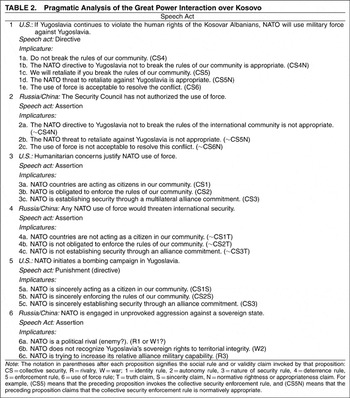
The pragmatic analysis generates all implicitly conveyed propositions during the interaction. These contextual propositions convey truth, appropriateness, and sincerity claims that invoke and/or challenge existing social rules. The pragmatic analysis specifies how each speech act conveyed validity claims and invoked social rules. Communicatively rational actors convey many implicit propositions during an interaction, and many are consensual and/or irrelevant to the specific issue of how to implement collective security rules. For reasons of space, then, the pragmatic analysis in Table 2 includes only the disputed propositions conveyed during the interaction.12
Readers should refer to
Table 2 throughout the discussion in this section.
The pragmatic analysis shows that throughout the interaction the United States invoked collective security rules, and Russia and China disputed the validity of those collective security rules. Within this overall pattern, however, each exchange in the interaction generated a set of escalated disputes. In speech acts 1 and 2, Russia and China disputed the appropriateness of United States-invoked collective security deterrence, enforcement, and use of force rules. Here all veto powers justified their speech acts with collective security rules, arguing that the other is inappropriately interpreting those rules. In speech acts 3 and 4, Russia and China disputed the truth of United States-invoked collective security identity, autonomy, and the nature of security rules. Here Russia and China began to dispute whether the United States would be actually invoking collective security rules with a use of force. And in speech acts 5 and 6, Russia and China disputed the sincerity of United States-invoked collective security identity, autonomy, and the nature of security rules. Here Russia and China argued that the United States indeed invoked war and/or rivalry rules with its use of force. By the end of the interaction, the veto powers had different understandings of which social arrangement governed their interaction. I discuss each exchange in turn.
In speech acts 1 and 2 the veto powers disagreed about whether the U.S. directive to Yugoslavia appropriately invoked collective security rules. With its directive to Yugoslavia in speech act 1, the United States invoked the collective security deterrence rule with proposition 1a; it invoked the collective security enforcement rule with proposition 1c; and it invoked the collective security use of force rule with proposition 1e. With their assertion that the Security Council did not authorize the use of force in speech act 2, Russia and China disputed the appropriateness of the United States invoking collective security rules to justify its directive to Yugoslavia. They disputed the appropriateness of the United States invoking the collective security deterrence rule with proposition 2a; they disputed the appropriateness of the United States invoking the collective security enforcement rule with proposition 2b; and they disputed the appropriateness of the United States invoking the collective security use of force rule with proposition 2c.
In this first exchange, the veto powers understood collective security rules to govern their interaction; all invoked collective security rules to justify their acts. However, Russia and China argued that the United States and NATO were not following those rules properly. One could interpret the Russian and Chinese criticism as intended to thwart the development of an emerging human rights norm that would justify humanitarian intervention given internal problems with Chechnya and Tibet (Carpenter 2000). While China did have these concerns, Russia had previously supported Security Council action regarding human rights. Of the 32 Security Council resolutions regarding Somalia, Haiti, Rwanda, and East Timor, Russia voted yes 31 times and abstained only once (Heinze and Borer 2002). Given this context, I interpret the criticism to stem from Russia's insistence that the collective security rules required a legal process based on Security Council action. Russia was preserving its role in world politics by asserting the primacy of the Security Council, not challenging the validity of an emerging human rights norm.
In speech acts 3 and 4 the veto powers deepened their dispute about whether NATO policy appropriately implements collective security rules. The U.S. assertion in speech act 3 conveyed a substantive, moral conception of collective security. NATO intervention was both legally and morally justified because it intended to avert humanitarian disaster and was consistent with Security Council Resolutions 1199 and 1203. Within the context of collective security, it argued for a rule enabling regional enforcement without explicit Security Council authorization. With these arguments, the United States invoked the collective security identity rule with proposition 3a; it invokes the collective security autonomy rule with proposition 3b; and it invokes the collective security nature of security rule with proposition 3c.
Russia and China countered the United States' moral and substantive conception of collective security with a procedural conception of collective security in speech act 4. Any use of force without Security Council authorization, they argued, threatened international peace and security. With this assertion, they challenged U.S. truth claims that NATO was acting as a citizen in the international community (proposition 4a), that NATO was enforcing the rules of the international community (proposition 4b), and that NATO was attempting to establish security through a multilateral commitment to use military capability (proposition 4c). Here the veto powers disputed truth claims about collective security rules 1–3; note that rules 1–3 are the core rules that differentiate the four global security social arrangements. With this exchange, then, Russia and China disputed that NATO policy invoked collective security rules. They began to suggest that perhaps the NATO use of force invoked a different social arrangement.
In speech acts 5 and 6 the conflict between the veto powers escalated dramatically. I treat the NATO bombing campaign as speech act 5. Within the context of the earlier interaction, the use of force defended the United States truth claims conveyed in speech act 3: NATO was indeed a citizen in our community (proposition 5a); NATO was indeed enforcing the rules of the community (proposition 5b); and NATO was indeed establishing security through an alliance commitment (proposition 5c). With speech act 6, Russia and China disputed the sincerity of U.S. claims that the NATO use of force invoked collective security rules. Instead they argued that NATO use of force is actually unprovoked aggression, invoking the rivalry (and perhaps war?) identity rule in proposition 6a, the war autonomy rule that NATO was violating Yugoslav sovereignty in proposition 6b, and the rivalry nature of security rule that NATO was trying to increase its relative alliance military capability.
With this exchange the veto powers completely disagreed about which social arrangement governed their interaction. While the United States continued to invoke collective security rules, Russia and China argued that it was trying to create a “NATO-centered Europe.” They were no longer criticizing NATO for inappropriately implementing collective security rules; they now charged NATO with blatantly invoking rivalry and perhaps even war rules. For example, Russia charged the United States with violating the UN Charter, and China claimed that the United States was using pretexts like human rights to begin a new form of colonialism as part of a global strategy for world hegemony.
Consistent with rivalry rules, Russia and China responded to the NATO use of force in Kosovo by attempting to increase their relative military capability. Russia sent a reconnaissance ship into the Mediterranean, revised its military doctrine to reinvigorate nuclear weapons capability, signed joint defense initiatives with Belarus and others, held war games in the Balkans, expelled NATO representatives from Moscow, suspended cooperation in the Partnership for Peace program, withdrew its mission and students from Brussels and NATO countries, and weakened communication between Russian and NATO forces in Bosnia. The Duma postponed ratification of the START II agreement (the December 1998 bombing in Iraq also caused a postponement of that vote). Although Russia never violated UN sanctions and sent direct military aid to Yugoslavia, the Duma voted 279 to 30 to send military aid and advisers. China suspended military ties with the United States and all negotiations with the United States over human rights issues. In June 1999, Russia and China announced that they would foster a “strategic partnership” to offset the global dominance of the United States. All of these responses invoked rivalry rules, particularly the rule that security is based on relative alliance military capability.
Argument Analysis
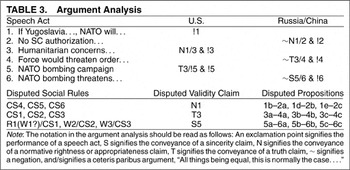
The argument analysis in Table 3 isolates and formalizes the disputes generated by the pragmatic analysis. It lists three sets of interconnected disputes discussed in the above section: disputed social rules, disputed validity claims, and disputed propositions. In speech acts 1 and 2, Russia and China contested the appropriateness of NATO's directive to Yugoslavia. Here the veto powers disagreed about how to implement the collective security rules regarding deterrence, enforcement, and the use of force. In speech acts 3 and 4, Russia and China disputed the truth of U.S. claims that NATO was enforcing collective security rules. Here the veto powers disagreed about the core rules of each social arrangement: the identity, sovereignty, and nature of security rules. In speech acts 5 and 6, Russia and China disputed NATO's sincerity that it was enforcing collective security. Here the agents disputed which social arrangement governed the interaction, with the United States citing collective security rules and Russia/China claiming that the United States is actually invoking rivalry and perhaps even war rules.
The overlap in rules between the social arrangements fueled this conflict. Specifically, the use of force rule—“the use of force is often necessary and acceptable to resolve conflicts”—holds in collective security arrangements, rivalry, and war. NATO's use of force was consistent with both U.S. justifications that NATO was invoking collective security rules and Russian and Chinese criticisms that NATO was invoking rivalry and/or rules. For the United States, NATO use of force was the appropriate way to enforce community rules regarding human rights. For Russia and China, NATO use of force was at least an attempt to dominate a global rivalry and at most an act of war consistent with imperialism. Both were rational interpretations from within the social arrangements each claimed were operative.
If interpretive methods explain action by specifying the rule(s) agents follow, then the dialogical analysis of the veto power conflict over Kosovo enables one to explain U.S. acts by specifying the collective security rules its speech acts invoked. Similarly, one can explain Russian and Chinese acts by specifying the rivalry and war rules their speech acts invoked. Finally, one can explain the entire conflict by specifying the difference and the overlap between the social arrangements.
Kosovo and Iraq
The debates about the use of force in Kosovo and Iraq do not seem similar on the surface. Kosovo was about human rights abuses and Iraq was about nonproliferation. But at the pragmatic level of the rules constituting global security, there are many stunning similarities. The three-stage Kosovo interaction occurred again regarding intervention in Iraq. First, there was a dispute about how to implement collective security given noncompliance with community rules: The United States (and Britain) advocated the use of force, and Russia and China (and France) advocated continued weapons inspections. Second, there was further debate about whether the use of force would actually invoke collective security rules: The United States and Britain argued that they would enforce the Security Council resolutions and disarm Iraq if the UN was unwilling to do so, with Russia, China, and France arguing that any use of force without Security Council authorization would violate international law and undermine international peace and security. Finally, there was a more fundamental disagreement about which social arrangement governed the interaction: The United States began the war in Iraq, and Russia, China, and France contended that the use of force deliberately invoked war rules because the United States never sincerely wanted a UN-centered enforcement of community rules.
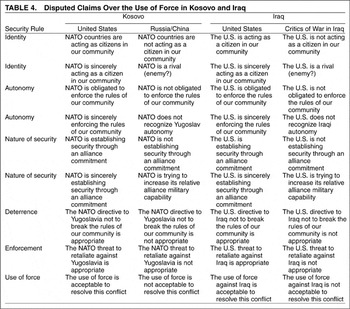
The similarities between the two interactions also extend to the more detailed disputes. Table 4 lists both the disputed propositions generated by the pragmatic analysis of the Kosovo dispute and the restated propositions replacing “NATO” with “U.S.” and “Yugoslavia” with “Iraq.” The latter disputes reasonably characterize not only the global debate about the war in Iraq, but also the argumentative tasks facing the United States if it continues to widen its war on terrorism. The overall coherence of these disputed propositions regarding war in Iraq strongly suggests that the events of September 11 did not fundamentally change world politics. Instead, September 11 exacerbated already existing tensions prominently illustrated in the Kosovo interaction.
The reason for the similarities is the overlapping nature of the social arrangements constituting global security rules, particularly the use of force rule that exists in war, rivalry, and collective security arrangements. The United States was (again) trying to convince the international community that its use of force invokes collective security rules. Many in the international community were (again) interpreting the use of force to invoke war rules. Wittgenstein argues that the meaning of a term is defined by its use, by how speakers understand and use the term. In the post-cold war construction of collective security, the meaning of the use of force is defined by how agents understand the act. How will the international community interpret the use of force? Does it invoke collective security rules or war rules? In both the Kosovo and the Iraq debates, both sides asserted the validity of collective security rules but differed on whether U.S. use of force actually invoked those rules.
CONCLUSION
This paper makes three main contributions. First, it contributes to the constructivist research program by offering a tentative rule-oriented constructivist theory of global security asserting the existence of war, rivalry, collective security, and security community social arrangements. Second, it adds dialogical analysis to the growing toolkit of interpretive methods, using it to study the veto power debate over Kosovo. Third, it contributes to the policy debates about U.S. foreign policy after September 11, suggesting that preemption policies are premised on a flawed assumption that the events of September 11 fundamentally changed world politics. These three contributions are consistent with the tasks of rule-oriented constructivism: (1) assert the existence of social arrangements, (2) show how these rules make action intelligible, and (3) help agents “go on” in the world.
Within the context of constructivism, the rule-oriented theory of global security offered here modifies Wendt's argument for “three cultures” of world politics. Conceptualizing global security as constituted by four overlapping sets of social arrangements is necessary to understand the dominant security trends since the end of the cold war: movement away from the cold war rivalry and the gradual institutionalization of collective security rules. Wendt's Kantian culture includes both collective security and security communities, which are differentiated by (among other rules) the necessity and acceptability of the use of force. As the analysis above shows, however, the crux of the debates over Kosovo and Iraq is how the international community interprets the use of force in the post-cold war world. While the use of force is central to collective security, it is not conceivable in security communities. Wendt's Kantian culture hides this important distinction and thus cannot account for the argument presented here. Wendt's suggestions that world politics may be slowly moving toward a Kantian culture ignore the autonomy of collective security arrangements as an intermediate step in that process.
Dialogical analysis helps make the speech acts constructing post-cold war security intelligible by showing those acts to be logically consistent with the social rules—beliefs, norms, and identities—constituting global security structures. Dialogical analysis is one interpretive method capable of illustrating constructivist arguments because it adequately captures the social ontology of constructivism. It analyzes social interaction as a dialogue between communicatively rational actors who assert validity claims and evaluate others' validity claims. Through this interaction, linguistically competent agents challenge and/or perpetuate the rules constituting world politics. It does not assert causal explanations; instead, it explains action by specifying the (both regulative and constitutive) rule(s) that agents follow. It attempts to offer constructivists a nonrationalist, nonpositivist approach to analyze social interaction.
Finally, rule-oriented constructivism and dialogical analysis help provide practical insight into issues of global security. The analysis presented here casts doubt on justifications that a new post-9/11 world necessitates more aggressive, unilateral, and even preemptive U.S. policies. Instead, the war on terrorism is embedded within a larger post-cold war construction of global security rules. Tensions about the appropriate implementation of collective security rules to punish the global criminals who violate international rules existed before and after September 11. That the United States is now a direct victim of criminal acts does not change this larger context; instead it exacerbates already existing tensions because the United States is now that much more determined to enforce community rules against terrorism and nonproliferation.
This analysis suggests two broad trajectories for future global security rules. One possibility is that the international community will minimize these tensions, strengthen the post-cold war construction of collective security rules, and continue the “war” on terrorism through cooperative multilateral action. The other possibility is that U.S. use of force in Iraq, together with other likely uses of force in its “war” on terrorism, will break down the post-cold war construction of collective security rules and institutionalize some form of a war social arrangement.
The Bush administration is split about which direction it prefers. Of course, many in the administration are critical of “global governance” and prefer to weaken collective security rules because those rules limit the flexibility of U.S. foreign policy. Indeed, the Bush administration challenged emerging collective security rules in many ways prior to September 11 (e.g., rejection of the Anti-Ballistic Missile Treaty, the Kyoto Protocol, and the International Criminal Court). Constantly declaring a “war” on terrorism and using force in Iraq without Security Council authorization, at least on the surface, also weaken collective security rules and invoke a war social arrangement. Many in the administration continue to assert that September 11 fundamentally changed world politics, that the normal rules of collective security are no longer applicable, that a war social arrangement now governs global security, and that this new social arrangement justifies preemptive U.S. policies.
However, a terrorist event, even a horrific one, cannot automatically change the rules of global security. Even U.S. foreign policy, although tremendously important, cannot unilaterally construct a war social arrangement through declarations of a “war on terrorism” or even by invading Iraq. Social rules are constantly negotiated and mediated through the actions of many agents. Whether future global security rules are constituted by collective security rules or by war rules is always being negotiated and renegotiated. The analysis presented here suggests that the post-cold war rules governing global security remain strikingly similar after September 11. As in Kosovo, the United States sought Security Council authorization prior to intervention in Iraq. And as in Kosovo, the veto powers struggled with which rule violations should trigger multilateral intervention and how to appropriately implement collective security rules. The international community clearly prefers collective security rules over a unilateral U.S. war on terrorism.
The United States must consider this underlying context in which it is fighting its war on terrorism and how others will interpret its use of force. Continuing to claim that September 11 fundamentally changed world politics and advocating unilateralism may eventually convince others that global security is indeed constituted by rules of war. Such a world would only discourage many from cooperating with the United States in other areas of the war on terrorism. The United States is more likely to be successful in its war on terrorism by embracing rather than ignoring the emerging collective security norms and institutions.






Comments
No Comments have been published for this article.