In the last months of World War I, Private James M. Cain was an army courier, running messages through the trenches and across the wastelands of the Western Front. The future author of Double Indemnity and The Postman Always Rings Twice had an extensive knowledge of the front lines. Yet Cain wrote very little about these experiences during his long and prolific career, and never discussed the war in any of his eighteen novels.Footnote 1
Private Al Dubin worked an artillery gun in the fall of 1918. He saw a friend killed and was himself wounded by poison gas shortly before the Armistice. The lyricist for the Depression-era hits “We're in the Money” and “42nd Street” referred to the war in just a handful of the hundreds of songs he wrote in his lifetime. Dubin completed one of these songs during the Argonne offensive. It celebrated the heroism of his division: “They Didn't Think We'd Do It, but We Did.”Footnote 2
James M. Cain (1892–1977) and Al Dubin (1891–1945) are seldom mentioned in discussions of World War I, while studies of their work rarely describe their wartime service as having a significant impact on their careers. This lack of recognition of the two men as veterans is due not only to the fact that they commented little about what they witnessed, but also, as will be argued, because their works do not reflect the still-dominant literary or intellectual mode of representing World War I.
In short, the theme of disillusionment figures little, if at all, in their work. Cain and Dubin never viewed or portrayed their experiences as part of a larger, collective loss of innocence, unlike many postwar American writers – Hemingway, Dos Passos, cummings, among others – whose works have shaped popular and academic perceptions of the Great War through to the present day.Footnote 3 Unlike their Lost Generation peers, Cain and Dubin did not echo the work of such European veterans/authors as Erich Maria Remarque and Robert Graves. They did not present the conflict as a tragic and murderous sham, forced upon an unwilling public by an older “custodial” generation and its sentimental culture.Footnote 4
Over the past decade, a wave of literary criticism has challenged the preeminence of the theme of disillusionment for understanding American culture during the war era, in ways that resonate with my sense of the significance of Cain and Dubin's experiences.Footnote 5 This new work has not only reconceived Hemingway et al.’s response to the conflict, but also expanded our understanding of the period's “war writers” to include women, African Americans, and several forgotten authors who were combat veterans.Footnote 6 Meanwhile, studies of other postwar cultural forms, such as monuments, commemorations, and the publications of veterans’ organizations, have examined how the memories of wartime experience were both diverse and contested.Footnote 7 In this research, the so-called Lost Generation's novels appear as only one type of representation of the war among many. Perhaps most significantly, scholars who have proposed broad reinterpretations of the era have not identified the theme of disillusionment as especially central or illuminating.Footnote 8 These studies do not characterize any particular group of writers as spokespersons on the impact of the war.
My focus here on the military and artistic careers of James M. Cain and Al Dubin seeks to build upon this new scholarship, adding a still overlooked cultural arena to the expanding canon of significant postwar artists. The two men experienced the Great War as common doughboys, giving them a distinct perspective on the conflict. They did not volunteer to fight, nor did they serve as ambulance drivers with the Allied armies as did Hemingway, Dos Passos, and cummings.Footnote 9 Cain and Dubin were drafted and served exclusively with other draftees. They never rose above the rank of private, and spent most of their time in training and in reserve. Both men witnessed the devastation of the Western Front and came under enemy fire, but like many combat veterans, they rarely discussed their experiences, either in public or in private.
After the war, Cain and Dubin worked exclusively within the mass-culture industries of popular music, fiction, and film, areas of artistic production that the new revisionist interpretations of the war have not yet fully explored. Through the 1920s the noir novelist and pop songwriter were moderately successful, though largely unknown to the general public. It was not until the Great Depression that the characters and situations of their works became widely recognized, offering a perspective on life during hard times that did not invoke a sense of institutional or cultural betrayal. Significantly, it was a perspective embraced by an immense popular audience.
When considering the mass-entertainment markets that employed Cain and Dubin, it is critical to note that unlike Europe, the US witnessed none of the physical devastation of the war, and its armed forces fought only briefly and suffered only a small fraction of the losses of the major belligerents. The comparative political stability, complacency, and prosperity of the American 1920s also stood in stark contrast to recovering Europe.Footnote 10 This is not to say that Cain, Dubin, and the broader American public did not develop a cynical attitude toward Woodrow Wilson's “war to end all wars” in the Jazz Age that followed. But their cynicism was tempered both by the pride of the veterans in their wartime service and in the broader public's continued identification, sham or no sham, with the country and its institutions. In other words, most Americans did not go so far as the writers of the Lost Generation (many of whom became expatriates, after all), in attacking the culture, economy, and politics that sent the nation “over there” in the first place.Footnote 11
Understanding Cain and Dubin's engagement with these attitudes, and with the market and audiences of the interwar years, will help us to build upon the still mainly literary focus of current studies of the war's impact. To highlight the differences of this perspective, three main questions will be asked of the artists’ lives and work in America's pop-culture industries. First, how did Cain and Dubin's military experiences shape their views on the war? Both fought in the US Army's most deadly offensive on the Western Front. But just as important, both men were able to employ their true talents while still in uniform. After the Armistice, Cain edited his division's newspaper, while Dubin wrote songs for an army entertainment troupe.
Second, how did the two artists hone their skills during the 1920s? Cain worked as a reporter and columnist while publishing short fiction in H. L. Mencken's American Mercury, while Dubin wrote dozens of Tin Pan Alley songs and show tunes. These years, amounting to something of an advanced apprenticeship, defined not only their distinctive styles but also how they viewed their culture industries. When the new technology of talking motion pictures drew them to Hollywood, both men were keen analysts of the popular tastes and profit-making systems they were paid to satisfy.
Last, what did Cain and Dubin offer to mass audiences during the Great Depression, and how did this work reflect their experiences as veterans? In 1933 Cain wrote The Postman Always Rings Twice, while Dubin provided the lyrics for the Hollywood hits 42nd Street and Gold Diggers of 1933. With these works, each artist helped to create an important new genre in US popular culture: Cain the noir novel, Dubin the backstage musical.
The purpose of this article is not to identify one group of veterans as more authentic or worthy of study than another, but to complicate our understanding of the impact of World War I on American culture, both “high” and “low.”Footnote 12 The most influential figures of the Lost Generation considered themselves writers of serious fiction and provided a European-influenced representation of the war as a defining moment in their lives and in the consciousness of the Western world. Cain and Dubin, in stark contrast, worked within and for the mass market, and wartime service was only one important experience among many others influencing their writing. The two drafted men did not feel the same visceral need to attack the war and the society and culture that had pushed it for so long, despite the tremendous human cost. As Al Dubin once explained to his daughter, “Sure, you talk about the funny things and you laugh a lot so you won't have to think about the pain of how [the war] really was … if you did it would be too hard to just go on getting up every day and working.”Footnote 13 For Cain and Dubin, “over there” was also a tragedy and a sham, but the value they found in the experience was their ability to meet its many challenges and survive it. As will be argued here, this knowing, veteran's attitude informed the characters populating their fiction and songs and resonated strongly with mass audiences in the Depression era.
Before they were sent off to war, Cain and Dubin shared a good deal in common. Both came from well-educated, upper-middle-class families and had already embarked on their future careers. Though unmarried, they were in their mid-twenties and had lived on their own for several years before being drafted, unlike most of the writers of the Lost Generation, who volunteered for wartime service in their late teens or straight out of college.
Cain was born and raised in Annapolis, Maryland. His father was a Yale graduate and the president of a small college, while his mother was a professional opera singer before marrying. The family lived comfortably throughout “Jamie's” upbringing. As Cain recalls, “Never once, in our house, was there so much as a hint that life was hard, that work was the lot of all, that night was coming.” A gifted student, he graduated from college with a degree in literature when he was just eighteen. He trained briefly as an opera singer and worked for a government agency before deciding – while sitting on a park bench near the White House one afternoon – to become a writer. “There must have been something gnawing at me from the inside,” he remembered. “But it was no clarion call.”Footnote 14
To make a living Cain taught English at a prep school and at his father's college while writing short stories (none of which were published) and earning a master's degree in British and American literature. Later he credited his years of teaching grammar and rhetoric as critical in the development of his writing style. “When you learn how to punctuate,” he once told his students, “you'll be free to be yourselves. Instead of being in a straitjacket of what can be put between commas with a period at the end, you can write as freely as you talk, and know that you can set it up so it reads.” These skills enabled Cain to become a full-time writer, getting his first newspaper job in 1917. He was drafted the following year, while working as a reporter for the Baltimore Sun. Cain was twenty-five years old.Footnote 15
Al Dubin's upbringing was just as comfortable and as cultured as Cain's, even though his background was very different. Dubin was an immigrant and his parents were Russian Jews. His father was a physician and his mother a research chemist. Both had fled Russia to pursue their education and careers in Switzerland. Their first child, Alexander, was born in Zurich in 1891, and the family immigrated to the United States when he was six years old. His parents were active in the Ethical Culture movement and committed to social and racial equality. Settling in Philadelphia, their home became a center of anti-tsarist politics, where Dubin met many Russian activists, including Maxim Gorky.Footnote 16
While his parents had dreams of young “Alick” becoming a surgeon, Dubin was drawn to the entertainment industry at an early age. He skipped school to see vaudeville shows and started writing material for performers when he was only fourteen. He left home for good to work full-time as a Tin Pan Alley lyricist, writing dozens of songs for sheet music and shows. Like Cain, he was inducted into the army in 1918. On his draft registration card he listed his occupation as “Writer of Lyrics.” He too was twenty-five years old.Footnote 17
When the United States entered the war in April 1917, its standing army ranked among the smallest of the world's industrialized nations. For the first time in its history, the country had to rely heavily on a national military draft rather than volunteering, and the Selective Service Act passed by Congress quickly examined and conscripted millions of young men. The training of the draftees who were sent to France was very brief, and most of the American Expeditionary Force saw combat only in the last three months of the war. While more than 24 million men registered for the draft, less than two million served overseas and fewer than half of these soldiers served in combatant roles. Cain and Dubin themselves were not deployed on the Western Front until the summer of 1918.Footnote 18
Like most Americans, James M. Cain had been against US intervention in the war prior to 1917. At times he expressed an open sympathy for Germany and argued that the European Allies were mainly interested in expanding their colonial empires. Cain obeyed federal law, however, and appeared when called by his local draft board. He was rejected in his first call-up when a doctor detected the beginnings of a tubercular condition in his lungs. Yet Cain's feelings about the war changed once the United States became a belligerent, and he attempted unsuccessfully to enlist in other branches of the service. When called up again in June 1918 he persuaded his draft board to accept him.Footnote 19
Cain was then assigned to a National Army unit that had been created from scratch. The 79th Division was composed of 27,000 conscripts from Maryland and Pennsylvania and had been training since the previous fall. Coming so late to the division, Cain received very little training. He knew only how to march and salute in the three weeks before he and the rest of the division sailed for France. Yet even in these first days of service, Cain developed a way of carrying himself that would persist through the war and in many ways the rest of his life. His basic approach to military life was to game the system, mainly to avoid physically demanding and monotonous work with as much good-natured cynicism as possible.Footnote 20
In his unpublished memoirs, Cain cites many examples of manipulating the army mentality, the most important being the story of how he became a military courier. Soon after being drafted, he was asked if he could speak fluent French and ride a horse well. Seeing a chance for better work than serving in a labor battalion, he claimed that he excelled at both, which was not at all true. The assignment would undoubtedly take him to the front lines. Yet Cain explained to a friend, with a resigned shrug (and a voice that would become typical of his future noir narrators): “What the hell. France is where the war is.”Footnote 21
Like most of the American Expeditionary Force (AEF), Cain's division did not enter the trenches until September 1918, less than two months before the end of the war. Cain served both in a “quiet” sector and in the Meuse-Argonne campaign, the US component of the Hundred Days Offensive that drove Germany out of France and ended the conflict. His division suffered heavy losses: 3,400 men were killed and wounded, or nearly one in eight of the division's 27,000 members. The Americans used essentially the same wasteful tactics as the British, French, and Germans had during the previous four years of fighting, with artillery bombardments followed by infantry assaults across “no-man's-land.” The US commanders learned little from the grim experience of their allies and adversaries.Footnote 22
Cain himself endured these weeks of combat as a frontline observer and liaison between command posts. For a private first class, these duties gave him an unusually high level of understanding of the Western Front. As a courier, Cain carried messages from the division's headquarters to forward positions on the battlefield, going on foot or by horse or motorcycle as necessity demanded. As an observer, he spent many hours scanning the lines within full view of the enemy. When the Armistice ended the war on the “eleventh hour or the eleventh day of the eleventh month,” Cain was at the division's headquarters, where he saw his commanding general mark the historic moment with a pocket watch.Footnote 23
Cain's experience on the Western Front might seem limited, especially in comparison to the long, punishing years of trench fighting endured by European writers like Erich Maria Remarque and Wilfred Owen. It should be noted, however, that none of the American authors who have been most commonly identified with the postwar literature of disillusionment were combatants, a fact of their service they shared with most Americans in uniform during the war. Ernest Hemingway, for example, whose A Farewell to Arms arguably did more to establish the theme of disillusionment than any other single American work, was a volunteer ambulance driver on the Italian Front. Only eighteen years old, Hemingway spent less than a week near the fighting before being severely wounded, and based his portrayal of the battle of Caporetto on events that occurred the year before he came to Europe. Hemingway sought romantic adventure and masculine experience in the war and embraced a decidedly European perspective on its carnage, which he used to powerful effect in his postwar fiction.Footnote 24 Recently scholars David Gandal and Jennifer Keene have argued, however, that Hemingway's greatest source of motivation to write about the war was his embarrassment over his non-combatant status.Footnote 25 In any case, the racism and violence experienced by African American soldiers during the war era, as David A. Davis has discussed in his study of the fiction of Claude McKay, Walter White, and Victor Daly, certainly qualifies the depth of the Lost Generation's disenchantment.Footnote 26
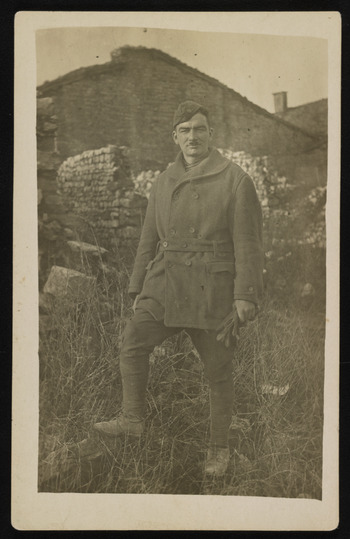
Private James M. Cain served as a courier and observer on the Western Front. Photo courtesy of the Library of Congress.

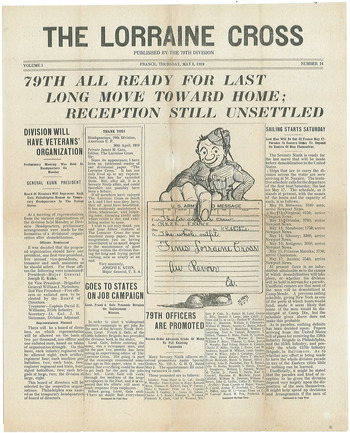
After the Armistice, and while still overseas, James M. Cain edited his army division’s newspaper, the Lorraine Cross. In 1929, he published his only fiction about the war, the short stories “The Taking of Montfaucon” and “It Breathed.” Photograph courtesy of the author.

Al Dubin, for his part, did not go overseas for adventure or to prove his manhood. How the young songwriter felt about the war before he was drafted is not entirely clear, since he did not write a memoir and little of his personal correspondence has survived. It is clear, however, that he did not volunteer to fight, nor did he protest the war or attempt to evade the Selective Service laws. More is known about the views of his father, who opposed the war on moral and philosophical grounds. Most likely Dubin and his parents, like millions of other American Jews, did applaud one major outcome of the fighting: the collapse of the tsarist regime in Russia. As an immigrant, Dubin may also have been stirred by the constant barrage of calls for loyalty and patriotism that confronted all Americans regardless of their origins.Footnote 27
The only writings of Dubin's that have survived from this period are two patriotic songs that appeared before he was drafted. Though hastily produced as novelty tunes, his lyrics reflect an important shift in attitude as the American war effort escalated. The first song, “Your Country Needs You Now,”Footnote 28 came out on the eve of the first-ever Selective Service registration day on 5 June 1917 and mimics George M. Cohan's “Over There”:
With instructions to be played at a “martial tempo,” the song has the singular, unreflective purpose of inspiring men to enlist. A reviewer for the New York Clipper praised it, distinguishing the tune from the “hundreds of manuscripts of so-called patriotic songs” whose “inability to soar above the dead level of unoriginality is almost pathetic.”Footnote 29 The paper reported that recruiters were already using the song to attract potential volunteers.
Dubin's other patriotic tune, however, appearing a few months later, presented a more somber attitude. Now that the men were in uniform and about to be sent overseas, Dubin chose a sentimental approach to appeal to the public. His “Dream of a Soldier Boy” describes a doughboy at the front who wishes for peace.Footnote 30 The soldier's “dream” is Wilsonian in its aims – “All the nations were kind to each other / Ev'ry law was a golden rule.” It also reflects the desires of loved ones back home:
Dubin stresses the duty of every soldier to serve: “He's in the fight till each wrong is made right.” But the song's most powerful image, expressed in the last verse, is clearly pacifist: “And God turned the trenches to gardens again, / That's the dream of the soldier.” Echoing the biblical phrase of turning swords into ploughshares, Dubin captured the conflicted feelings of the American public. The war by this time was no longer a matter of abstract principles and slogans, but a real threat to loved ones overseas.Footnote 31
Regardless of Dubin's personal feelings, his induction into the army, at least on paper, was typical of millions of other US conscripts. Like Cain, he was taken in a late draft call in the spring of 1918. He was then sent to Camp Upton, a brand-new training center on Long Island and assigned to the 77th Division, whose 27,000 drafted men from New York reflected the city's ethnic diversity, with the glaring exception of African Americans, who had to serve in segregated units during the war. The 77th took the Statue of Liberty as its symbol, and approximately seven thousand of its members were Jewish. Along with Dubin in camp was an even more famous songwriter, Irving Berlin, who remained stateside during the war.Footnote 32
In uniform less than a month before being shipped off to France, Dubin's real training began overseas. Though he joked to his daughter that he knew only how to salute and load a howitzer, for two months his artillery unit drilled intensively, learning how to handle high-explosive shells, transport heavy guns with (or without) teams of draft horses, and sight and fire the weapons in difficult conditions. Dubin experienced only this new, mechanized system of warfare. Having a specific function among the several men working each gun, his tasks resembled the repetitive movements of an industrial assembly line, completely devoid of any romantic ideas of war. Dubin did not have a wider conception of the battlefield like Cain. Often situated miles from the front, his battery killed and obliterated a faceless enemy, and risked the same form of anonymous destruction themselves.Footnote 33
The young songwriter did, however, suffer physical wounds and the violence and psychological extremes of combat. During a poison gas attack, Dubin felt claustrophobic in his gas mask. He panicked, ripping the mask off. According to his daughter, “For the rest of his life, he fought a yearly bout with pneumonia and frequently coughed up blood … ‘It's nothing,’ he would say, ‘just a little beet juice.’” Dubin also saw a friend killed in an explosion. In the only recorded description of the violence he witnessed, he shared how he felt at the time to his daughter. “I wasn't frightened, not at all. I didn't want to run away or hide.” Dubin then expressed the exhaustion and weary ambivalence of all soldiers on the Western Front, regardless of nationality. “I didn't feel sad, just empty, standing there in the lousy mud. I kept thinking I would gladly get blown to bits if I could just have a hot bath first. At that moment, I really didn't even give a damn who won or lost the war.”Footnote 34
Yet even in these traumatic conditions, Dubin found himself comforted by his music. One night while on sentry duty, he heard someone approaching. “Wondering if it was friend or foe, I was soon assured it was a friend, for I heard him whistling a song that I had written some few years previously.” It was a transcendent moment for Dubin. “In fact all over France I heard various songs of mine whistled during and immediately after the war which somehow gave me more pleasure than you can imagine.” These moments allowed him to connect to a larger musical community beyond the harsh reality of the Western Front. As will be seen throughout the rest of his career, Dubin's musical world, with its humor and street-smart sentimentalism, stood in stark contrast to the difficult realities of his own life.Footnote 35
Though the Armistice ended the war in November 1918, the AEF remained in Europe until the following spring, waiting for troop transports to take the soldiers home. This period of continued military discipline and monotonous barracks life lasted anywhere from six to eight months, and seemed both pointless and endless to the two million American doughboys still in France.Footnote 36 For Cain and Dubin, however, the opposite was true. The peacetime AEF finally recognized their true talents, as Cain was put in charge of his division's newspaper and Dubin wrote songs for an army theatrical group. Though minor in relation to their later careers, this work marked another crucial distinction between them and their Lost Generation contemporaries. While still in uniform, Cain and Dubin had to entertain and satisfy audiences who were rank-and-file soldiers like themselves.
Cain was in fact serving a heavy sentence of k.p. duty when he was chosen to become the editor in chief of the Lorraine Cross, the newspaper for the 79th Division. He quickly turned the paper into one of the best soldiers’ publications in France, giving it the look and feel of a big-city daily.Footnote 37 Cain searched the division's records to find men who had been typesetters and pressmen in civilian life and became a top-notch “scrounger,” obtaining, often illegally, newsprint, press equipment, and delivery trucks.Footnote 38 The Lorraine Cross, a four-page weekly, provided its audience of over 27,000 soldiers with humor columns and cartoons, articles on camp activities, and, most importantly, any news on when the division might return home. The paper was a huge success, giving voice to the complaints and anxiety of the men while staying within the limits of military approval. In fact, the commander of the 79th wrote to Cain thanking him for helping to maintain “good feeling within the division during the long and trying period of waiting.” Cain framed the general's letter and the last issue of the Lorraine Cross and displayed these items in his home the rest of his life.Footnote 39
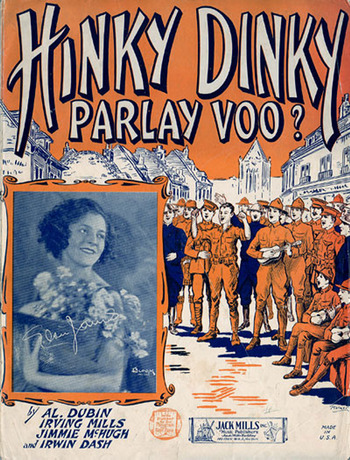
Private Al Dubin served in the artillery before being assigned to an entertainment unit that toured bases and hospitals after the Armistice. In 1924 he wrote the lyrics to “Whatever Has Become of Hinky Dinky Parlay Voo?”, a novelty song that captured the nostalgia among many American veterans for their time in uniform. Photograph courtesy of the author.

He also served as a publicist and historian for the 79th, work that highlighted the extensive knowledge he had gained from being a frontline courier. In June 1919, he wrote a long feature article for the New York Times that covered the division's engagements.Footnote 40 The piece captured both the pyrrhic assault-and-retreat of trench warfare and Cain's emerging, crisp writing style. His knowledge of the front grew even more detailed when he served as his unit's historian. Long before the publication of The Postman Always Rings Twice, his first book was a thirty-six-page history of his headquarters troop, one of the scores of organizational histories that appeared after the war. All of the 150 men who served in the unit received a commemorative copy, published after their return to the States. Cain dedicated the book “to the memory of those busy days when we all worked together.”Footnote 41
Al Dubin, meanwhile, found perhaps an even better match for his skills in postwar France. Just before the Armistice, Dubin was plucked from the ranks to write songs for the Argonne Players, a theatrical group created to entertain the men of the 77th Division. It was the first all-soldier unit of its kind in the AEF, and drew from the division's rich pool of drafted New York talent.Footnote 42 Along with Dubin were other actors, comedians, and musicians who had worked not only in vaudeville and on Broadway, but also with the city's symphonies and opera companies. Loaded with talent, the troupe included a theatrical agent, a prop manager, and a set designer, all professionals in peacetime who went on to have important careers after the war. The Players quickly put together a revue of sketches and musical numbers, which they performed in field hospitals, “ruined cathedrals,” and captured German bunkers. The revue was so successful it was selected to perform for the delegations at Versailles. Woodrow Wilson and French President Raymond Poincaré among several other major figures of the war watched the troupe run through its full routine, including the Yiddish-inspired play Oi General!.Footnote 43
Whatever the audience, the show always climaxed with a Dubin song that the 77th Division embraced as its anthem, “They Didn't Think We'd Do It, but We Did.”Footnote 44 The song captures the men's pride in their victories in the Argonne Forest. It also expresses the adversarial relationship they felt toward not only the Germans, but also the regular US Army, which questioned whether the draftees’ immigrant origins made them unfit for combat: “They didn't think we'd do it, but we did, / The pale faced rookies that they used to kid.” Dubin employed the streetwise vernacular and slightly off-color language that would characterize his best-selling hits of the Great Depression. Like Cain, he carefully skirted the boundaries of military censorship to give the men what they wanted: “When Jerry fell in the Argonne wood / He got merry Hell and got it dog-gone good.” Patricia Dubin Maguire recalls that years later her father was still very proud of the song, “which received wide acclaim from the men with whom he served.”Footnote 45
When Cain and Dubin arrived back in the United States in the summer of 1919, they immediately returned to their former jobs. Cain was rehired by the Baltimore Sun as an assistant copy desk editor, while Dubin went back to writing lyrics for the same Tin Pan Alley firm that published his songs before the war. During the Jazz Age, neither man became an expatriate, nor did they become household names. Their lives were marked by hard work and a steady progression within their respective culture industries, not a dramatic break with the past. Despite their fair share of personal and professional setbacks, each writer spent these years developing a distinctive voice and perspective that would have its greatest impact in the popular culture of the Depression era.
Cain underwent a journalistic and literary “apprenticeship” during the 1920s that has few equals in the history of American letters. He worked closely with two of the most important public intellectuals of the time, H. L. Mencken and Walter Lippmann, who were demanding editors as well as respected friends. Mencken, “the sage of Baltimore,” was the city desk editor of the Sun while Cain was emerging as one of the paper's talented young reporters. When Mencken launched his tremendously influential American Mercury magazine in 1924, he made Cain a frequent contributor, and the young war veteran wrote more than twenty feature articles and short stories for the magazine. It was Mencken's letter of introduction that put Cain in contact with Walter Lippmann, then in charge of the editorial page of the New York World. Moving to New York, Cain wrote hundreds of human-interest editorials, sometimes four in a single day, for what was widely considered the best staff of writers and columnists in the country. When the World folded in 1930, Cain's reputation was so established that he was hired as the managing editor of the New Yorker, under the direction of the magazine's legendary founder (and Great War veteran) Harold Ross.Footnote 46
In each of these experiences, Cain was drawn to the stylistic brilliance of each publication's writing just as much as to the intellectual luster of their staff and contributors.Footnote 47 The highly celebrated literary scene of Jazz Age New York, meanwhile, interested Cain very little. He avoided the Algonquin Round Table and the other writers’ circles, “vicious” or otherwise, even though he knew most of the groups’ major figures, like Dorothy Parker, Heywood Broun, and James Thurber. Much of this was due to his personality – Cain was not a socializer. But he also found the groups’ meetings to be mainly performative and rather shallow. Of specific interest to this study, Cain did befriend one of the scene's most active members, the World’s book reviewer, Laurence Stallings, who had been severely wounded in the war.Footnote 48 In 1924, Stallings published Plumes, a largely autobiographical novel of his frontline experience, and cowrote with Maxwell Anderson the play What Price Glory?, a story of wartime disillusionment that was tremendously successful in the mid-1920s. Significantly, Cain did not care for the play, however, and felt that Stallings should have followed his strengths as an intellectual and an aspiring novelist, rather than devote himself to theater and what became in Cain's eyes “a prodigious career of self-illusion.”Footnote 49
It was toward the end of these remarkable years that Cain wrote about his own experiences as a soldier in the World War. He published two largely autobiographical short stories in 1929. It would be the only time he would make reference to his wartime service in his entire literary career. The first story, “The Taking of Montfaucon,” appeared in the American Mercury and recalls Cain's own difficulties while delivering a message at the height of the Meuse–Argonne offensive.Footnote 50 The narrator, like Cain himself, starts out on his mission with high hopes of winning a medal, but takes a wrong turn and gets completely lost.
Though certainly not a glorification of war, “Montfaucon” is also not a tale of disillusionment, and differs from the works of writers like Stallings and Hemingway in several ways. Though told in the first person, Cain chose not to use his own educated and grammatically trained voice. Instead the narrator speaks in a rural or working-class vernacular that resembles the speech of the farmers and factory workers from Maryland with whom Cain served. The story's backdrop, meanwhile, is a victory, the capture of one of the most prized fortifications on the Western Front. The narrator's tone is self-deprecating and wryly humorous, not self-righteous and angry, and the officers, including two generals, appear as decent and above all weary and exhausted human beings, rather than callous authoritarians or buffoons. Perhaps most importantly, there is no moral or burning message to Cain's story, other than that the soldier must go on doing the best he can with the orders and circumstances he is given. As the narrator concludes: “it ain't no use blubbering over how things might be if only they was a little different.”Footnote 51 In terms of realistic content and perspective, the story shares much in common with the popular, but largely forgotten, war fiction written by the American combat veterans Lawence Nason and Thomas Boyd.Footnote 52
In “The Taking of Montfaucon,” Cain displays his great skill as a reporter, conveying a range of objects and sensations that the soldiers knew well. Cain drew on his own experiences to make the desolation of the Western Front seem both exhausting and haunting:
What we was walking over was all shell holes and barbed wire, and you was always slipping down and busting your shin, and then all them dead horses and things was laying around, and you didn't never see one till you had your foot in it, and then it made you sick. And dead men. The first one we seen was in a trench, kind of laying up against the side what was on a slant. And he was sighting down his gun just like he was getting ready to pull the trigger, and when you come to him you opened your mouth to beg his pardon for bothering him. And then you didn't.
If this level of description did not already establish the account's credibility, the narrator declares his authority as a witness in the baldest of terms. In a striking performative moment, he vents his irritation with a popular myth of the Great War:
When you hear somebody talk about doughboys singing when they're going to fight, you can tell him he's a damn liar and say I said so. Doughboys when they're going up in the lines they look straight in front of them and they swaller every third step and they don't say nothing.
The Infantry Journal, an important forum for military analysis during the interwar years, agreed. Its editors claimed that Cain's story “has never been excelled as an accurate description of conditions in the war.” This was a distinction Hemingway never received, but it pleased Cain a great deal.Footnote 53
Cain's second story about the war appeared in the World’s Sunday edition a few months later in November 1929.Footnote 54 A much shorter piece, “It Breathed” describes Cain's other main responsibility while in France, serving as an observer on the front lines. The story could almost be a sequel to “The Taking of Montfaucon,” since the tone, level of description, and narrator's speech and attitude toward the army are essentially the same. Cain's soldier–narrator has a similar performative moment, again with the purpose of correcting popular perceptions of the war. “A whole lot of people,” he states, “they got the idea that on a battle front it's a hell of a lot of noise going on all the time … But from two o'clock in the morning on to dawn it ain't nothing so still as a battle front.”Footnote 55
Yet “It Breathed” offers its own battleground myth or soldier's “legend,” as the narrator discovers that the Western Front is actually a living, breathing entity. In the story, two doughboys are isolated from the rest of their unit. They have to man an observation post round the clock in shifts while caring for a dying soldier who is barely conscious. The story's narrator is at first exasperated with the other observer, who insists that at night he can hear the devastated landscape “breathe.” But when the narrator takes his turn that evening he hears it too. “Maybe you think I'm lying, but I tell you it give kind of a sigh and then went right quiet again.”Footnote 56 He learns later that the stricken soldier had died in the night, and that the battlefield “sigh” took place at precisely the same moment as the doughboy's last breath. In contrast to “The Taking of Montfaucon,” the story ends with no parting thought or commentary from the narrator. Like the scene of desolation and destruction in which it occurs, this strange phenomenon cannot be explained.
While the 1920s were a transformative period in Cain's life, he also encountered many setbacks. On a personal level, he went through a bitter divorce, struggled financially, and had to be hospitalized for extended stays for both tuberculosis and typhoid fever. Professionally, his first attempt at a major novel failed (Cain destroyed all of what he wrote), as did his first play. His first book, Our Government (1930), a collection of stories that appeared in the American Mercury, sold so poorly that it did not cover his publisher's advance of five hundred dollars. Disgusted with his role at the New Yorker, Cain resigned after working there only nine months, and signed a contract with Paramount Pictures to write screenplays. While he felt the move to Hollywood probably saved him from a breakdown, Cain by no means saw it as a step up in his career. Ironically, on the eve of his breakthrough success as a novelist, he doubted his ability to produce anything of quality, regardless of the literary form or medium.Footnote 57
Al Dubin also lived and worked in New York City for most of the 1920s. But his career did not consist, as did Cain's, of clearly defined stages of upward, professional development. Through most of the Jazz Age, Dubin wrote essentially the same type of popular but forgettable songs as he did before the war. The challenges he encountered, however, were perhaps even more demanding than those faced by Cain, as the music industry he worked for transformed itself dramatically in response to the rise of first radio and then talking motion pictures. During these dynamic years, Dubin's real training focussed on knowing his industry and his public extremely well. This education enabled him to make the transition from sheet-music writer to Hollywood lyricist with remarkable success, unlike most of his Tin Pan Alley contemporaries.
When Dubin returned to Manhattan in 1919, he picked up right where he left off, writing hundreds of romantic, sentimental, and novelty tunes at a frenetic pace. He worked mainly for two firms, the publishing giants M. Witmark & Sons and Mills Music, Inc., and his writing method varied according to the demands of his publisher or show producer. He wrote lyrics sometimes before and sometimes after the music was composed, and sometimes at the same time. Though Dubin shared song credits with more than a dozen different writers during the 1920s, he collaborated most with the notable pop composers Sammy Fain, Jimmy McHugh, and Joe Burke. Love songs made up the bulk of Dubin's offerings, and the titles said it all. “Sundown Brings Memories of You” (1921) was fairly typical. For the sentimental market, he wrote ballads like “My Mother's Evening Prayer” (1920) as well as several novelty songs each year, including “You're Always Breaking Something, Now You're Breaking My Heart” (1919).Footnote 58
Although Dubin's writing process remained basically the same through the 1920s, his songs reflect the era's great shift from sheet music performed at home by amateur pianists to dance and “production” numbers heard and enjoyed by nonmusicians. According to his daughter, until Dubin moved to Hollywood he considered his main consumers to be “females between the ages of fifteen and twenty-five” who purchased and played his sheet music.Footnote 59 By the mid-1920s, however, the type of sentimental “parlor” song that had been a mainstay of the Progressive Era had declined dramatically, while dance tunes incorporating jazz rhythms had taken over. Also disappearing were the dialect or ethnic-humor songs that Dubin wrote in considerable quantity before the war. The subjects and genres of his material narrowed as he wrote for larger and larger audiences, whether they heard his songs in Broadway theaters, on the radio, or, by the end of the decade, in movie theaters. Gone were the days when the lyricist scrambled to write and “plug” songs for a range of different markets, one tune at a time, with a different collaborator for each number.Footnote 60
In 1928, the year before he went to Hollywood, Dubin wrote a small “insider's” book on how to write popular songs. The Art of Song Writing provides the clearest expression of his feelings about the music industry and about himself as an artist.Footnote 61 Dubin was fundamentally a populist in his tastes. “To write popular songs successfully,” he urged, “we must strive not to please our own vanities, not to appeal to a few so-called ‘highbrows,’ not to entertain a certain class or clan of people, but on the contrary, our aim must be to please them all, or, as many as we can.”Footnote 62 Dubin was also a hardnosed pragmatist. Despite the “art” suggested in the book's title, he does not give the slightest sense that he or any other pop songwriter is a fine artist. “As in any other profession,” he pointedly declares, “a songwriter who has business ability is more likely to earn money than another who has writing ability but no business acumen … The songwriter must be a salesman.” Less than a third of the fifty-three-page book is devoted to actual songwriting; to developing an idea and creating lyrics and a melody. Dubin focusses most of his discussion on what is needed to “sell” a potential hit to a long list of contacts, ranging from local choral directors and radio station owners, to publishers, arrangers, and record company people. Dubin's keen sense of marketing is evident in the book's very first chapter, where he boils down all of popular music into eight categories. Number seven on his list are “Patriotic Songs,” whose “words usually deal with war subjects, stories of historical interest, or are written about some particular patriot or patriots.”Footnote 63
Dubin wrote three songs about the Great War that fit in this category, the first of which was a comedy number, “What Has Become of ‘Hinky Dinky Parlay Voo’?” (1924).Footnote 64 Written six years after the war, Dubin's lyrics capture the growing sense of nostalgia felt by many doughboy veterans like himself. The subject of the song is actually another tune, a popular piece of wartime doggerel improvised by American soldiers to the melody of “Mademoiselle from Armentières.” There were an infinite number of racy variations, most completely unprintable. Dubin uses the veterans’ memory of that song to tap into their common experiences and strong sense of camaraderie while overseas. “What has become of all the happy times you knew?” the lyrics ask, with no sense of disillusionment or a collective loss of innocence. On the contrary, the song tells us, “You can forget the shock of the shells / But never forget the mademoiselles.” Perhaps even more striking, the song's last stanza insists that anyone can sing along, as Dubin expands his audience to include all listeners, whether they served on the Western Front or not: “If you've never been over there it makes no difference, don't you see? / You can sing the melody in the best society.” For Dubin and most American veterans, these feelings of nostalgia were not sacred, much less politicized, and could be shared by all. On this level, the pop songwriter could appeal to the widest possible market, just like with any other potential hit tune. Dubin's lyrics and the emotions they evoked among AEF veterans provide an important contrast to both the postwar lobbying efforts of the American Legion and Disabled American Veterans organizations, as described by historian John Kinder, and the “single master plot” of fiction that appeared in American Legion publications, as identified by literary scholar Steven Trout.Footnote 65
Dubin's next song about the war, however, evoked memories the soldiers were more reluctant to share. “My Dream of the Big Parade” (1926) was the first song Dubin wrote for a motion picture, in this case King Vidor's antiwar epic The Big Parade, which was the highest-grossing film of the silent era.Footnote 66 Dubin's song appeared independently of the movie, as a tie-in for the sheet music and record markets, and did not refer to the movie's plot or characters. But like the film (screenwritten by Laurence Stallings), Dubin's ballad provides a broad overview of American involvement in the war, from the early days of patriotic fervor to the solemn return of the survivors and wounded. Most dramatically, the song switches midway to spoken verse, and is most vivid when describing the fighting on the Western Front:
These lines, like the Vidor film they accompanied, appear at first to provide an American version of Remarque's All Quiet on the Western Front. But the song (if not the film) is not an indictment of the larger politics and culture that pushed the war so fervently, as Dubin focusses here on the act of commemoration rather than that of political agitation.Footnote 67 In the most somber and melancholic terms, his song imagines a “Big Parade” made up of the dead and the wounded, followed by their families and loved ones.
The maudlin quality of Dubin's commemoration was precisely the kind of sentimentalism that John Dos Passos detested most. In perhaps the most trenchant passage in his U.S.A. trilogy, Dos Passos bitterly portrayed the inaugural ceremonies of the Tomb of the Unknown Soldier, the most sacred of all commemorations of US involvement in the Great War.Footnote 68
Dubin did not promote that message at all, as highlighted in the last of his Jazz Age songs about the war, the love ballad “Memories of France” (1928).Footnote 69 The song's protagonist is a doughboy veteran remembering the French girl he left behind. The closing refrain, set in a cemetery in France, is repeated twice for dramatic effect:
On the song's sheet-music cover, Dubin provided his own example of a performative moment. Dedicating the song “to our pals in the American Legion,” he identified himself by the unit in which he served with the signature: “Al Dubin, 305th F. A. 77th Division.” The Tin Pan Alley songwriter left little doubt as to his primary audience and allegiances. His work reflected the demands of the market, not the more incisive commentaries of other writers and visual artists of the period. Significantly, it was the popular-music industry that allowed Dubin's sentimental themes and veteran's voice to be expressed and broadcast throughout the country.
An incident in Dubin's personal life suggests perhaps even more than his songs his distance from Lost Generation attitudes. Soon after returning from France, he married Helen McClay, a Broadway performer, and the relationship was rocky from the start. In 1923, Helen claimed that Dubin had left her and their children repeatedly during their brief marriage. The latest separation lasted several months, when Dubin disappeared without a trace, only to resurface claiming that he had suffered aphasia as a result of shell shock during the war. The songwriter explained further that he came to his senses only after hearing one of his songs played in the streets of Cape Town, South Africa, having sailed on a “tramp schooner” to get there. The story was completely ridiculous. Dubin's wife discovered he'd been living just outside New York the entire time, and immediately demanded child support and a legal separation. Apparently Dubin had no ethical issues with portraying himself as a shell-shocked, “lost” veteran to get out of a jam.Footnote 70
By 1932, both Cain and Dubin were living in southern California and working under contract for major Hollywood studios. The two former doughboys made their breakthroughs during the depths of the Great Depression, not the Roaring Twenties, and it was in the entirely commercial atmosphere of Hollywood, not the expatriate community of Paris, where they enjoyed their greatest creativity and influence.
At first, Cain fared even worse in California than he had in New York. He worked on five unsuccessful screenplays before Paramount fired him, then signed a contract with Columbia Pictures only to be fired six weeks later. These experiences, however, brought Cain into contact with a new community of writers, professionals like himself whose collaborative attitude toward work helped Cain to overcome his longtime preoccupation with writing the Great American Novel. As important, Cain fell in love with the Golden State, where he found inspiration and material for a whole new range of settings, characters, and voices for his fiction. In 1933 he began to write the first drafts of The Postman Always Rings Twice, working closely with Vincent Lawrence, one of the era's best writers of screen dialogue.Footnote 71
Cain signaled his new sense of purpose in a short essay, “Camera Obscura” (1933), which reviewed the dilemma of Hollywood writers who have (or who once had) higher literary aspirations.Footnote 72 He begins with the familiar lament of the artist suffering under the dictatorship of the bottom line:
Imagination is free or it is not free, and [in Hollywood] it is not free. It serves the medium, instead of the medium serving it, and once that is felt, that is the end of pride, of joy in getting things down on paper, of having them appear in front of your eyes.Footnote 73
But Cain does not leave his screenwriter colleagues in complete despair. “Well, there are worse trades than confecting entertainment,” he continues, “and if you realize clearly that you are at work on entertainment, something that lives tonight and tomorrow is forgotten, then the suspicion that you are a prostitute of the arts loses much of its sting.”Footnote 74 Cain concludes with what could be read as a statement of personal liberation, not from the film industry, but from the high standards he'd placed on his own efforts to write fiction over the past decade.
For my part, when I go to a movie, I am entertained best if it is unabashedly a movie, and not a piece of dull hoke posing as something else … I think that is the way most of the customers feel, and I think it shows the way to a proper sphere for moving pictures. In other words, it is better to shoot at a balloon and hit a balloon than to shoot at a star and hit a cornfield.
The same could now be said of his new approach to writing fiction.
The result was The Postman Always Rings Twice (1934), which helped to establish a new genre in fiction and eventually film, as Cain's lean, cinematic prose provided arguably the first noir film script, even though in novelette form. The story was based on a well-known East Coast murder case, but Cain moved the setting to California and cast a wandering West Coast “roughneck” as the narrator. The book was an immediate smash success, which Cain repeated through the rest of the Depression years with Double Indemnity (1936), Serenade (1937), Money and the Woman (1938) and Mildred Pierce (1941). Though he was often grouped with Dashiell Hammett and Raymond Chandler, two other World War veterans, Cain denied any influence or contact with them: “I belong to no school, hard-boiled or otherwise.”Footnote 75 The basic elements of his stories were in fact very distinct from both Hammett's and Chandler's. In Cain, the main characters were not detectives and the plots did not involve a mystery, other than perhaps the uncertainty (and tension) over whether the male and female protagonists could place their trust in each other. But the critical components of noir are there – the foreboding atmosphere, the alluring femme fatale, and the underlying existentialism of the characters’ thoughts and actions.Footnote 76 In these works, but in Postman especially, Cain was able to combine his commitment to stylistic precision and innovativeness with a brutally non-sentimental exploration of human relationships.
Al Dubin, meanwhile, was busy helping to develop a new genre of his own – the backstage musical comedy. In contrast to Cain, Dubin did not move to Hollywood voluntarily. He was under contract with M. Witmark & Sons when the publisher was purchased by Warner Brothers in 1929. Dubin and the rest of Tin Pan Alley were now in high demand due to the sensation caused by The Jazz Singer.Footnote 77 When he arrived at the Warners studio lot, he was shocked by the production schedule expected of him. But Dubin was ready for the challenge, unlike many of his colleagues, and churned out as many as a dozen songs every two weeks for a constant stream of movie musicals. His first years were fairly successful, with an occasional hit like “Tip-Toe through the Tulips.” It was when the studio paired him with composer Harry Warren in 1932 that Dubin struck gold.Footnote 78 Warren, an Italian American from Brooklyn, was also a war veteran, and the two men worked wonderfully together. Their greatest successes were the hit musicals of 1933: 42nd Street and The Gold Diggers of 1933. Their song “We're in the Money” became an anthem of the Depression era, and in 1936 the pair won an Academy Award for “Lullaby of Broadway.”Footnote 79
Al Dubin (standing in photo) later collaborated with composer and fellow veteran Harry Warren to write the Depression Era hits “We’re in the Money,” and “42nd Street.” Photograph courtesy of Harry Warren Entertainment.

Amid this tremendous success, Dubin wrote two songs referring to the Great War (in contrast to Cain, who never discussed the war again in his fiction). The first song, the bluesy “Remember My Forgotten Man,” provided the finale to The Gold Diggers of 1933 and was heard and seen by millions.Footnote 80 Dubin's lyrics were both topical and political, openly attacking Herbert Hoover's suppression of the Bonus Army marchers:
The legendary Busby Berkeley, who was also a World War veteran, provided the memorable choreography, with troops marching off to war transformed into wounded men and finally into beggars shuffling through a breadline.
Despite its biting commentary, the song was a complete anomaly compared to the rest of the Dubin songbook. Significantly, it was the Depression and the veterans’ poverty, not the Great War in itself that compelled Dubin's (and Warren's and Berkeley's) sole attempt at making a political statement. Soon after, Dubin wrote another comedy number about the doughboys’ experience as well as a tribute to the Marines.Footnote 81 As Philip Furia has observed, when the lyricist and Harry Warren went their separate ways in 1938, Dubin “reverted to his sentimental style – almost immediately.”Footnote 82 He never wrote another political song again.
While the new genres that Cain and Dubin helped to create were both fresh and bold to 1930s audiences, their innovativeness alone does not explain their incredible popularity. One could argue that the protagonists of these works, and especially the savvy, experienced attitude they bring to difficult situations, resonated with readers and moviegoers the most. These characters are all veterans in the sense that they have already endured experiences that have hardened them and sharpened their awareness of their situations. Personal transformation does not provide the dramatic center of Cain's and Dubin's narratives; the audience is never presented with a coming-of-age or loss-of-innocence storyline. The fictional men and women of each noir novel and backstage musical possess an a priori knowledge that gives them the confidence and skill to work (and try to beat) the system.
The ability to see through sham defines all of these characters, whether they are planning a murder or auditioning for a chorus line. Cain immediately establishes his characters’ street smarts in his Depression-era novels. One of his techniques is to have the narrator describe, very analytically, the main setting of each story. The opening to The Postman Always Rings Twice, for example, is spoken by a veteran not of the war, but of a hard life on the road: “They threw me off the hay truck about noon.” Frank Chambers then gives his first impression of the setting for the rest of the novel:
It was nothing but a roadside sandwich joint, like a million others in California. There was a lunchroom part, and over that a house part … and off to the side a filling station, and out back a half dozen shacks that they called an auto court. I blew in there in a hurry and began looking down the road.
Double Indemnity opens in a similar manner, when Walter Huff describes the Nirdlingers’ home:
All I saw was a living room like every other living room in California, maybe a little more expensive than some, but nothing that any department store wouldn't deliver on one truck, lay out in the morning, and have the credit O.K. ready the same afternoon.Footnote 83
The confidence that Cain's protagonists have in their ability to size up a situation is in fact a major cause of their downfall.Footnote 84 Huff and Chambers take on the challenge of beating the law and, more importantly, the insurance companies; John Howard Sharp (Serenade) fights to maintain his independence in the entertainment industry; branch manager Dave Bennett (Money and the Woman) tries to outsmart his bank; and Mildred Pierce feels she can manage the men in her life to secure the love of her daughter Veda. Unfortunately for all five, their opponents – whether fraud investigators, scheming composers, cheating husbands, or, in the case of Veda, a demon child – also possess great skills, and ultimately drive the protagonists to, respectively, suicide, execution by hanging, murder, public exposure, and complete financial ruin.
The fact that his characters meet sordid ends does not mean that Cain is deep down a Puritan, Victorian, or Progressive Era moralist, pronouncing final judgment on his protagonists’ sins. Far from it. Frank Chambers, Walter Huff, and Mildred Pierce do beat the system, but they are brought down by the people whose trust they need most. For Cain, of greatest interest are the tensions involved in a relationship as it develops during the planning, committing, and aftermath of a crime. As he explained in a letter outlining his early thoughts about Postman, the male and female protagonists find that a murder “can be a love story too, but then wake up to discover that once they've pulled the thing off, no two people can share this terrible secret and live on the same earth. They turn against each other.” The people they are closest to, not institutions, the law, or religious commandments, are the reason for their downfall. Anticipating Sartre's No Exit by a decade, Cain's existentialist tale does not pronounce judgment on his characters. Nor does he lecture or scold his readers, a welcome relief to a Depression-wracked nation.
While Al Dubin endowed his characters with similar street smarts, they do not commit felonies, and the outcomes are of course much happier. Dubin's chorus girls, directors, songwriters, and sugar daddies are also veterans – they all know their way around the tough, competitive world of the Depression-era theater industry. Although the thirty-three movie musicals Dubin and Warren worked on abound with streetwise examples, the most famous occurs in the opening scene of Gold Diggers of 1933. Ginger Rogers and company are singing “We're in the Money” (wearing skimpy costumes made of silver dollars) when they are suddenly interrupted by a deputy sheriff and his men. When someone asks what all the excitement is about, Rogers quips, “It means they've closed the show, dumbbell.” She knows they are all out of work, and immediately starts to look for another job.
One of the most evocative portraits of a Dubin character appears in the lyrics for “She's a Latin from Manhattan” (1935).Footnote 85 The comedy song opens with an exotic feel typical of the era's Latin music craze. A smitten man narrates, “Fate sent her to me, over the sea from Spain, ahhh / She's the one in a million for me.” The singer wonders if she is “from Havana or Madrid,” but realizes he's seen “the kid” somewhere before. The music then changes to an upbeat show tune.
Susie is passing as a Latina to get a good job. She knows exactly what she needs to do, and the audience can't help but admire her plucky attitude toward a phony and exploitative work situation. Her perspective, expressed by so many Dubin/Warren characters, spoke directly to millions of working and unemployed people in the 1930s, men and women who knew the value of a good job and steady paycheck perhaps better than any generation of Americans, before or since. “She's a Latin from Manhattan,” the song concludes, “Señorita Donahue.”
By the mid-1930s, Dubin and Cain were themselves experienced veterans of their industries. Their critical, yet pragmatic, attitude toward the entertainment world finally had its payoff, as now they too were able to work the system. For them there was never any real alternative to the market, and this is where they went their Lost Generation peers one better in serving the interwar public. Like most Americans during the Depression, Cain and Dubin could not become expatriates or be escapist about their livelihoods. This was the most important source of their appeal: they provided ways of critiquing, complaining about, and sometimes even succeeding within the system, rather than stepping outside it. Their characters are smart, but not omniscient; independent, but not beyond the help of friends and lovers; aware of the faults and hypocrisy of their society, and sometimes able to carve meaningful lives out of its constraints.
After the Depression, neither Cain nor Dubin ever attained the same level of creative energy or critical acclaim of their earlier careers. Cain did benefit financially from the movie versions of Double Indemnity (1944), Mildred Pierce (1945), and The Postman Always Rings Twice (1946). But these films only further cemented his reputation as a “tough guy writer,” a label he hated. He would write thirteen more novels, including two historical epics set during the Civil War. Though most of these were not successful with critics or the public, Cain did live to see a major reappraisal of his work and continued to write fiction and newspaper items until his death in 1977 at the age of eighty-five.Footnote 86
Al Dubin's career, meanwhile, declined rapidly after he stopped collaborating with Harry Warren in 1938. The salary Dubin earned in Hollywood enabled him to indulge heavily in many vices: excessive eating and drinking, gambling, and sex with prostitutes, while the pressure to produce hit songs led to drug use and ultimately an addiction to morphine.Footnote 87 He became morbidly obese in the last decade of his life, weighing over three hundred pounds. On 8 February 1945 Dubin collapsed on a New York City street and died in a hospital three days later. The cause of death was an unintentional overdose of barbiturates, complicated by pneumonia.
Unlike Cain, Dubin rarely expressed concern over his place in relation to the cultural divide between “high” and “low” forms in music, with one critical exception: his attitude toward Cole Porter. Dubin resented his far more celebrated rival for both class and aesthetic reasons. “I could have written nothing but sophisticated lyrics too, if I had been a millionaire's son like Porter,” Dubin once complained. “He wasn't writing songs for a living, but for a hobby. And Cole Porter didn't have to please Warner Brothers!”Footnote 88 Still, those close to him believed that Dubin, who idolized Edgar Allan Poe as a kindred spirit, would not have had it any other way. He could not conceive of a career and lifestyle any less intense or self-destructive.Footnote 89
As described in these pages, James M. Cain and Al Dubin did not view or represent their combat duty in France as the defining moment of their lives, either in private or in their published writings. For them, the Western Front provided one among many formative experiences, in careers that were marked more by hard work and continuity than by dramatic change and self-reflection. The two artists shared this in common not only with other doughboy veterans, but also with most Americans of the era. The Great War opened the minds of their generation to a skepticism of idealistic rhetoric and chest-thumping moralism, while the Great Depression impressed upon them a profound understanding of privation and need. Cain and Dubin addressed both of these facts of early twentieth-century life in their work, and in the 1930s found a vast audience ready to embrace them. They offered no solutions or indictments, but something far more valuable to their audiences: the perspective and voice of a common veteran trying to adapt and survive in the toughest of peacetime circumstances.
They were not alone. Scores of other World War veterans would make their mark on American popular culture during the interwar years, including Frank Capra, Jack Benny, Humphrey Bogart, Dashiell Hammett, Busby Berkeley, Thomas Hart Benton, Preston Sturges, and Raymond Chandler. Most did not serve on the Western Front like Cain and Dubin, but they also did not view their experience in uniform as an emotionally scarring or sacred point of cultural and political reference. Struggling through the 1920s to learn their crafts, these artists worked in the most accessible forms of art and entertainment, and in the process helped to create the Depression era's screwball comedies, gangster films, hard-boiled fiction, WPA murals, and backstage musicals. Their mass-culture contributions, no less than the Lost Generation's fiction, should also be identified as the product of veterans and an important legacy of the Great War.