INTRODUCTION
The combination of a short growing period and long days sets certain limitations on cereal cropping in high northern latitudes. In particular, the management practices and timing are critical as well as physiological adaptation and phenology of cultivars. Therefore, the aim has been to grow early-maturing crops forming only one to two spikes, since tiller grains usually decrease the quality of the crop and lead to delayed harvest, further increasing the production risks (Mäkelä et al. Reference Mäkelä, Muurinen and Peltonen-Sainio2008). In most cases, tiller grain yield is less than that of the main shoot, but its relative contribution varies widely depending on the prevailing conditions (Rawson Reference Rawson1971). In Mediterranean conditions typically suffering terminal drought, selection for low-tillering wheat lines has resulted in more stable yield. Water-soluble carbohydrates (WSC) are accumulated in the stem instead of tillers and partitioned at later stages to grains of fewer spikes/plant (Dreccer et al. Reference Dreccer, van Herwaarden and Chapman2009; Rattey et al. Reference Rattey, Shorter, Chapman, Dreccer and van Herwaarden2009).
In northern conditions, tiller grains mature later than the main shoot grains and are smaller (Peltonen-Sainio et al. Reference Peltonen-Sainio, Jauhiainen, Rajala and Muurinen2009), causing problems not only in harvesting but also in industrial processing. Thus, the seeding density recommendations for cereals in northernmost latitudes are 450–700 plants/m2, depending on soil type, species, cultivar, fertilization and purpose of use, in order to restrict tiller formation (Peltonen-Sainio & Peltonen Reference Peltonen-Sainio and Peltonen1997b).
At high latitudes, cool conditions with long days typically suppress tiller formation (Peltonen-Sainio et al. Reference Peltonen-Sainio, Jauhiainen, Rajala and Muurinen2009), even though these conditions are especially favourable to the survival of coleoptile tillers (Rawson Reference Rawson1971). Tillers also increase the competitive ability of crops against weeds by increasing soil surface coverage and shading smaller weeds (reviewed in Mäkelä et al. Reference Mäkelä, Muurinen and Peltonen-Sainio2008). Coleoptile tillers significantly increase leaf area, dry matter and growth rate of cereal crops (Rebetzke et al. Reference Rebetzke, López-Castañeda, Botwright Acuna, Condon and Richards2008). Coleoptile tillers are formed from the coleoptile node and emerge simultaneously with the second and third main stem leaves and before first main stem tillers (Rebetzke et al. Reference Rebetzke, López-Castañeda, Botwright Acuna, Condon and Richards2008). Thus, the spike of a coleoptile tiller would mature almost in synchrony with the main stem spike. Nevertheless, Rawson (Reference Rawson1971) concluded that coleoptile tillers are even lower yielding than main stem tillers. Nevertheless, Naylor et al. (Reference Naylor, Stokes and Matthews1998) investigated 10 and 12 winter barley varieties grown at two sites in northern Scotland in 1983/84 and 1984/85 and showed that grain yield per plant was significantly correlated with biomass per plant despite there being no correlation with any individual yield component. Importantly, biomass per shoot was significantly correlated with grain yield per shoot. Treatments to increase shoot uniformity (the mass of individual tillers relative to that of the main stem) generally increased biomass per shoot and grain yield per shoot. Their re-examination of data in the literature confirmed that both biomass and grain yield were associated on per plant and per shoot basis. This reinforces the argument for the use of uniculm types.
In uniculm barley (Hordeum vulgare L.) and wheat (Triticum aestivum L. emend Thell.), tiller formation is either completely or mostly inhibited. In wheat, the tiller inhibition gene (tin) restricts tiller formation and affects carbohydrate partitioning (Duggan et al. Reference Duggan, Richards and van Herwaarden2005). The tin gene increases leaf area ratio, stem carbohydrate storage capacity and remobilization towards spikes. Thus, the yield of tin wheat is comparable to that of its near-isogenic pair in eastern Australian conditions (Duggan et al. Reference Duggan, Richards and van Herwaarden2005). In barley, high grain yields are associated with increased stem dry weight and thus, carbohydrate reserves after anthesis (Daniels et al. Reference Daniels, Alcock and Scarisbrick1982). Stem carbohydrate reserves formed before anthesis also buffer against environmental stresses during grain filling in barley (Austin et al. Reference Austin, Morgan, Ford and Blackwell1980). Moreover, uniculm barley lines have shown higher plasticity in the number of grains and grain weight than their near-isogenic tillering lines, so uniculm barley lines could have potential for breeding more stable and higher yields in short growing seasons (Donald Reference Donald1979). It is also suggested that cereals having high stem reserves may be less sensitive to yield losses caused by diseases (Gaunt & Wright Reference Gaunt and Wright1992). Furthermore, Balkema-Boomstra & Mastebroek (Reference Balkema-Boomstra and Mastebroek1993) stated that the performance enhancement of uniculm over tillering six-row barley lines was greater in marginal growing conditions, such as high-latitude agricultural areas, than in high-yielding conditions.
The aim of the present investigation was to distinguish the differences in the yield formation of conventional tillering and uniculm barley lines when grown under northern long-day conditions.
MATERIALS AND METHODS
Plant material and experimental design
Field experiments were conducted in 1999–2001 at the Suitia Experimental Farm of the University of Helsinki (60°11′N, 24°12′E, 19 m asl). Plant material consisted of two barley (H. vulgare L.) cultivars commonly grown in Finland, cvar Pokko (six-row) and cvar Saana (two-row) and two pairs of near-isogenic (six-row) barley lines differing in tillering type. The pairs were cvars Kindred and Uniculm Kindred, and cvars Morex and Uniculm Morex. Uniculm Kindred has the gene uc 2, resulting in uniculm phenotype and uniculm Morex is a progeny of the cross between uniculm Kindred and Morex carrying the uc 2 gene (Dofing Reference Dofing1996). Seeds of the near-isogenic pairs were obtained from Dr S. Dofing, USA.
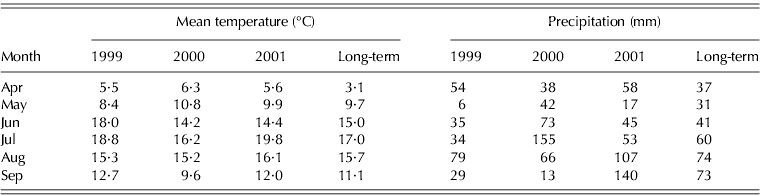
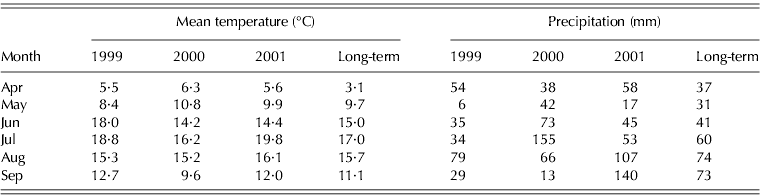
Plots were sown on 18 May 1999, 10 May 2000 and 9 May 2001. Seeding density was 500 viable seeds/m2. Plots were fertilized with 80 kg N/ha (Pellon Y3, N-P-K:20-3-9, Kemira Grow-How Oyj, Finland). Fertilizer was applied to the seed-bed at the time of sowing. Weeds were controlled with Express 75DF (tribenuron methylene 750 g/kg, DuPont Crop Protection) every year at the 4-leaf stage. No other plant protection was used. The plots were irrigated (30 mm in total) at the beginning of the 1999 growing season, but no irrigation was needed in 2000 and 2001. The experiments were conducted in a randomized complete block design with four replicates. The six genotypes were randomly assigned as the plots of 6·25 m2 (5×1·25 m) in 1999 and 10 m2 (8×1·25 m) in 2000 and 2001. The growing season 1999 was somewhat drier than average (Table 1), especially in May and July.
Monthly mean temperatures and precipitation for growing seasons 1999–2001 and the long-term means from 1971 to 1990 at Siuntio, Finland
Sampling and growth parameters
Plant samples were collected once a week in 1999 and 2000, but once every two weeks in 2001. Sampling was started at the 4-leaf stage, and samples (ten plants/plot) were collected randomly from ground level and used for analysis of leaf area formation, biomass accumulation, content of WSCs at anthesis and at maturity and starch after yellow ripening. Each sample was divided into main stem and tillers. The main stem was further divided into spike, leaf laminae, dead leaves (>0·5 of the area senesced), leaf sheaths, nodes and the rest of the stem. Tillers were separated into primary and secondary tillers, the numbers recorded, and further divided into fractions similarly to the main stems. After fractioning, all samples were frozen in liquid N2, stored at −80°C and lyophilized (Dura-Dry, FTS-Systems Inc., USA). Dry samples were weighed and ground (IKA A10, IKA Labortechnik, Germany). Ground samples were stored at −80°C until further analysis. Plant and head number/m2, date of heading and maturity and estimated proportion of lodging were recorded.
WSCs and starch
WSC content was determined using the Anthrone method (Yemm & Willis Reference Yemm and Willis1954). The assay was modified as follows: 10 mg of ground sample was extracted three times in 0·5 ml of 0·8 (w/v) ethanol. In each extraction, the sample was incubated for 30 min; the first incubation was at 70°C and the subsequent two incubations were at room temperature. From the extract, two subsamples of 0·25 ml were taken and 1·25 ml of Anthrone reagent was added. The mixture was boiled for 10 min and cooled to room temperature. The absorbance was measured at 630 nm with a spectrophotometer (Shimadzu UV-160 A UV-Visible recording spectrophotometer, Shimadzu Scientific Instruments Inc., Kyoto, Japan). The concentration of WSC in different plant parts was calculated from the calibration curve based on the absorbance of standard glucose solutions. The starch content in grains was analysed according to Volenec et al. (Reference Volenec, Boyce and Hendershot1991).
Statistics
Statistical analysis of data obtained was performed with SPSS 15.0 (SPSS Inc., Chicago, Illinois, USA). Accession means were compared using the Tukey test. Before the analyses, accordance of the data with the assumption of equality of group variances and the normality assumption of errors were checked. Regression was used to analyse the mutual trait changes.
RESULTS
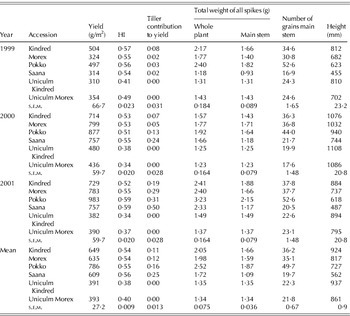
Harvested grain yield (P⩽0·001) and harvest index (HI) (P=0·002) was significantly different between growing seasons (Table 2). Significant differences in yield also existed between accessions (P⩽0·001), and the year×accession interaction (P=0·004) was significant. Uniculm lines Kindred and Morex had relatively stable yields across years. Six-row barley cvar Pokko was among the two best-yielding cultivars every year. HI was low in uniculm Kindred and Morex, whereas the HI of the other cultivars (Morex, Kindred, Pokko and Saana) did not vary markedly (Table 2). Tiller contribution to yield in 2000 and 2001 was, as expected, highest in two-row barley cvar Saana (Table 2). In 1999, the dry weather conditions resulted in very low numbers of surviving tillers and thus very low tiller contribution to yield from any of the tillering accessions. Spike weight of the whole plant as well as main stem was significantly different between growing seasons (P⩽0·001) and accessions (P⩽0·001, Table 2). Main stem spike weight was, as expected, lowest in the two-row cvar Saana. The highest values of main stem and whole plant spike weight were observed in cvar Pokko along with either cvar Kindred or cvar Morex. The number of grains was highest every year in cvar Pokko, whereas cvar Saana and the uniculm lines had similar grain number (Table 2). Six-row cvar Kindred and uniculm Kindred were the tallest accessions, whereas two-row cvar Saana was c. 300 mm shorter than the other, six-row, accessions.
Means of yield and yield components of uniculm and tillering barley accessions in 1999–2001 in Finland

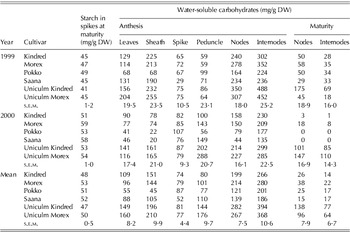
WSC content of different plant parts (leaves, leaf sheaths, nodes, internodes, spikes and peduncle) as well as spike-starch content varied between growing seasons and cultivars (Table 3). In 1999, the lowest starch content was measured in uniculm Kindred and highest in cvar Pokko, whereas in 2000, the highest starch content was measured in cvar Morex and lowest in cvar Kindred (Table 3). In 1999 and 2000, the highest WSC content of different plants parts at anthesis was in the uniculm lines, except for peduncle in 1999 and spike in 2000, where cvar Pokko had the highest values (Table 3). In 2000, at maturity, the highest WSC content was measured in uniculm barleys and the lowest in cvars Pokko and Saana. In 1999, at maturity, the lowest WSC content of nodes was measured in cvar Saana and internodes in uniculm Morex (Table 3).
Starch content in spikes at maturity and WSC content in different plant parts at anthesis and maturity in uniculm and tillering barley accessions in 1999–2000 in Finland

DW, dry weight.
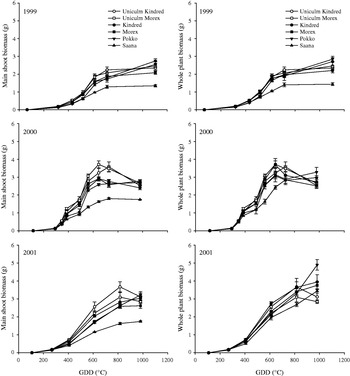
Whole plant biomass varied significantly between years (P⩽0·001) and cultivars (P⩽0·001, Fig. 1). Differences between cultivars became significant at anthesis stage and remained until maturity. In 1999, cvar Saana had lowest whole plant and main shoot biomass. In cvars Pokko and Saana, tillers contributed markedly to total dry mass, except in 1999, when hardly any tillers were formed (Figs 1 and 2).
Whole plant biomass accumulation of six spring barley accessions over the growing season in Finland in 1999–2001. Data shown are means±s.e.d. GDD, growing degree days, base temperature +5°C.

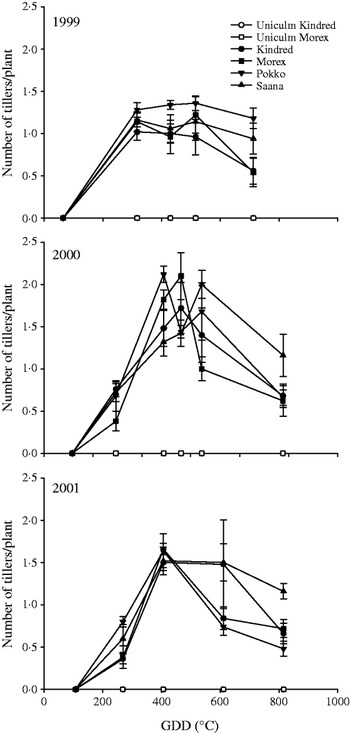
Number of tillers per plant in six spring barley accessions over the growing season in Finland in 1999–2001. Data shown are means±s.e.d. GDD, growing degree days, base temperature +5°C.

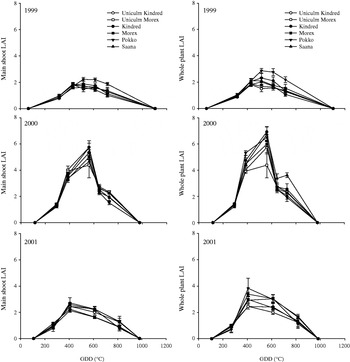
Annual variation in leaf area index (LAI) was significant (P⩽0·001, Fig. 3). The differences in LAI of main shoot were minor between accessions, although in 1999 cvar Pokko had significantly higher LAI than other accessions after anthesis. Tiller contribution to LAI was marked, especially in 2000 and 2001 after anthesis (Fig. 3). In 1999, cvars Saana and Pokko produced of the most surviving tillers, even though the number was rather low (Fig. 2). In 2000 and 2001, the number of tillers varied throughout the growing season, but cvar Saana had most surviving tillers in both years. Uniculm lines did not produce any tillers in any of the growing seasons.
Whole plant and main shoot LAI of six spring barley accessions over the growing season in Finland in 1999–2001. Data shown are means±s.e.d. GDD, growing degree days, base temperature +5°C.

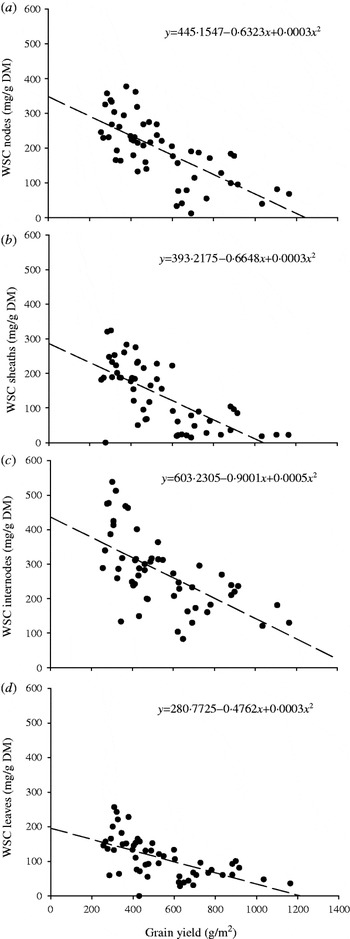
Harvested grain yield correlated negatively with the WSC concentration (measured at anthesis) of internodes (r=–0·681, P⩽0·001), nodes (r=–0·696, P⩽0·001), leaf sheaths (r=–0·684, P⩽0·001) and leaf blades (r=–0·596, P⩽0·001) (Fig. 4), whereas no correlation with WSC content was significant at maturity (data not shown) when all data were pooled.
Linear regression of harvested yield and WSC content at anthesis in (a) nodes, (b) leaf sheaths, (c) internodes and (d) leaves in six spring barley accessions in Finland in 1999–2001.

DISCUSSION
Uniculm Kindred and uniculm Morex yielded on average 30% less than their near isogenic counterparts and 50% less than the locally adapted Finnish cvar Pokko (Table 2). The locally adapted cvars Pokko and Saana reached anthesis every year c. 3–5 days later than the uniculm lines and their conventional tillering counterparts, even though all accessions reached maturity at the same time. Thus, the local accessions had longer vegetative stage, whereas the grain filling period was longer in uniculm lines and their conventional tillering counterparts. Aravinda Kumar et al. (Reference Aravinda Kumar, Azam-Ali, Snape, Weightman and Foulkes2011) showed that wheat lines differing by up to 9 days in flowering did not differ in yield. The lower grain yield was also reflected in 30% lower HI of the uniculm lines in comparison with their conventional tillering counterparts. Peltonen-Sainio et al. (Reference Peltonen-Sainio, Muurinen, Rajala and Jauhiainen2008) observed that HI of spring barley cultivars is rather stable and associated with grain yield and earliness in six-row barley. The conventional tillering accessions had higher spike weight than uniculms, which explains the observed difference in HI. Uniculm lines were able to accumulate more biomass after anthesis during the grain filling phase, whether the whole plant or main biomass was examined (Fig. 1). Acreche & Slafer (Reference Acreche and Slafer2009) showed that low HI in wheat grown under Mediterranean conditions resulted from reduced resource partitioning into grains. Even though the crop was able to assimilate carbohydrates and nitrogen, those were not remobilized into grains (Acreche & Slafer Reference Acreche and Slafer2009). Selection of fewer tillers in wheat has increased stem-stored carbohydrates and resulted in increased partitioning of assimilates into filling grains under terminal drought (Duggan et al. Reference Duggan, Richards and van Herwaarden2005; Dreccer et al. Reference Dreccer, van Herwaarden and Chapman2009; Rattey et al. Reference Rattey, Shorter, Chapman, Dreccer and van Herwaarden2009). The difference in HI was not related to canopy height, since the uniculm six-row lines were in the same height class as the conventional tillering six-row cultivars (Table 2), unlike those in a previous study, where the uniculm lines were c. 110 mm taller than their isogenic counterparts (Dofing & Karlsson Reference Dofing and Karlsson1993). It has been suggested that the root system of uniculm barleys is smaller than that of conventional isolines, and this would result in limited water and nutrient uptake ability (D. D. Stuthman, personal communication).
Even though the contribution of tillers to yield, especially in two-row barley, was significant (P⩽0·001), it was lower (Table 2) than the 0·64 reported in an earlier study by Peltonen-Sainio et al. (Reference Peltonen-Sainio, Jauhiainen, Rajala and Muurinen2009). This lower tiller contribution was probably due to limited water availability (Table 1) that could have caused the observed loss of tillers at early developmental stages (Fig. 2). The spring drought typical of northern regions inhibits early tillering, but the following mid-season rainfall promotes late tillering after anthesis (Peltonen-Sainio & Peltonen Reference Peltonen-Sainio and Peltonen1997a). When the drought is prolonged, tiller maturing is from several days up to weeks later than that of the main stem, leading to difficulties in grain harvesting, drying, storage and utilization (Kivisaari & Elonen Reference Kivisaari and Elonen1974).
The higher-yield stability of the uniculm lines in comparison with the conventional tillering accessions (Table 2) was in contrast to earlier results (McDonald Reference McDonald1990; Balkema-Boomstra & Mastebroek Reference Balkema-Boomstra and Mastebroek1993; Dofing & Knight Reference Dofing and Knight1994), but attributable to different environmental conditions, such as the high latitude and early season drought. Grain yield of uniculm lines varied less than 30% annually, whereas yield of conventional tillering accessions varied 50% annually. Yield variation cannot be completely explained by tiller contribution. McDonald (Reference McDonald1990) observed that the uniculm barley lines had greater potential sink capacity than tillering ones, as more kernels were set, but grain weight remained low due to sensitivity to environmental factors. Furthermore, uniculm barleys have limited ability to compensate for yield components and utilize favourable growing conditions (Dofing & Knight Reference Dofing and Knight1994). The most important yield component determining the grain yield in uniculm barleys is spikes/m2, with kernels/spike and kernel weight having only weak effects on grain yield (Dofing & Knight Reference Dofing and Knight1994).
Daniels et al. (Reference Daniels, Alcock and Scarisbrick1982) observed that an increase in stem dry weight after anthesis was associated with high yield in barley. Uniculm Kindred and Morex were able to accumulate slightly more main-shoot biomass than the other cultivars after anthesis, especially in 2000 and 2001, but failed to produce significantly higher yields. The culm diameter, although not measured, was also apparently greater in the uniculm lines than in the tillering ones, suggesting large potential WSC reserves. Uniculm barleys have been shown to have greater potential sink capacity than conventional tillering ones (McDonald Reference McDonald1990). According to McDonald (Reference McDonald1990), high yield is unlikely to be achieved in uniculm barley, since the supply of assimilates is not high enough to support the grain filling. Indeed, uniculm barley lines had large WSC reserves in stems, leaves and leaf sheaths; however, they were unable to utilize these in grain filling and the reserves remained large at maturity (Table 3). This suggests that the assimilate supply was high enough to support the sink, but there were other factors limiting the yield formation. Further support of low utilization of reserves was obtained with correlation analysis, suggesting that higher yields were obtained without decrease in the dry weight of vegetative plant parts (Fig. 4). In wheat, lines selected for high WSC have lower number of tillers (Dreccer et al. Reference Dreccer, van Herwaarden and Chapman2009). This in turn affects the assimilate partitioning within the plant leading to higher partitioning of carbon to stem WSC instead of structural parts (Rattey et al. Reference Rattey, Shorter, Chapman, Dreccer and van Herwaarden2009). The negative correlation between WSC and grain yield observed could at least partly be explained by the high rate of lodging of all cultivars other than Saana, which might have further altered the carbon partitioning. On the other hand, the LAI of whole plant was higher in conventional tillering cultivars, even though LAI of main stem was nearly similar in all accessions studied (Fig. 3). The increase of photosynthesising leaf area by tillers in conventional cultivars could have played a marked role in supplying the carbohydrates for early-stage grain filling, and thus resulting in higher yield, as suggested earlier by Peltonen-Sainio & Peltonen (Reference Peltonen-Sainio and Peltonen1997a, Reference Peltonen-Sainio and Peltonenb). González et al. (Reference González, Bermejo and Gimeno2010) have also stated that barley lines that are able to maintain photosynthesis under drought conditions generally yield better.
Even though the grain yield of uniculm barleys was stable, it was little more than half that of the conventional barley cultivars. This was not entirely due to missing spike-bearing tillers. It was also linked to lower grain number and spike weight and perhaps weaker ability to transport carbohydrates to spikes. Thus, it can be concluded that uniculm growth habit as such does not seem to provide potential gains in barley production in the northern latitudes.
This work was funded by the University of Helsinki's Research Grants. We would like to thank Markku Tykkyläinen, Aira Vainiola, Lilia Sarelainen and Pauli Tiitinen for their kind assistance. Dr F. L. Stoddard and Professor Pirjo Peltonen-Sainio are acknowledged for critically reading the manuscript.