

PUNISHMENT AS A MESSAGE
Citizens (whose conduct is regulated by legal rules) and legal officials (who apply those rules) share some common understanding of the relevant law—this appears to be a requirement of the law being public and providing citizens with fair notice. This assumption is particularly essential in the context of criminal law. If criminal law is primarily understood as a means of condemning certain types of conduct, as many criminal theorists posit, then both legal officials and society at large should be able to identify the types of conduct that are to be condemned. In this article, we argue that the assumption of an accord between legal officials and citizens might be inadequate in many areas of substantive criminal law and, particularly, in the context of so-called proxy crimes—criminal offenses that are introduced as a means of targeting other, hard-to-prove but morally egregious, conduct. To back up this assumption, we conducted an experimental study on sentencing attitudes of laypeople and legal professionals, providing evidence that these attitudes diverge in a normatively problematic way. Laypeople tend to perceive charges at face value, interpreting criminal statutes as condemning discrete types of conduct, whereas legal professionals are more likely to see certain kinds of criminal offenses (such as proxy crimes) as mere vehicles with which to prosecute individuals targeted for some other reason.
Such dissonance is unwelcome for a number of reasons, first of which are the general requirements of fair notice (Robinson Reference Robinson2005) and the ideal of the rule of law (Pałka et al. Reference Pałka Przemysław, Janik and Próchnicki2023). Here, however, we focus on how such dissonance is incompatible, specifically, with some important perspectives on criminal law. For one, some major theories of criminal law (such as the expressive and communicative theories of punishment) see legal punishment primarily as a message of condemnation and censure sent to the offender and to society at large (for a comprehensive overview, see Glasgow Reference Glasgow2015). To serve this purpose, such a message should precisely communicate the object of the punishment in order for the offender (and, analogically, society at large) to know what they are being condemned for and for what they are expected to feel remorse (Harel and Porat Reference Harel and Porat2009). However, if the sender of the message (that is, legal officials) understands it differently from the recipients (the accused and society at large), then legal punishment might fail to serve its fundamental function. Footnote 1 In the following article, we shall compare the sentencing attitudes of laypeople and legal professionals to assess the risk of such a problematic mismatch.
PROXY CRIMES
The ever-expanding scope of substantive criminal law results in a situation in which many modern criminal statutes criminalize conduct that would not belong to the traditional core of criminal law (Fletcher Reference Fletcher1978, 755–80) and whose wrongfulness might be not intuitively easy to perceive (Green Reference Green1997). In this study, we focus on a specific type of such offenses: proxy crimes. Although the term “proxy crimes” is defined in the literature in more than one way (Alexander and Ferzan Reference Alexander and Kessler Ferzan2018), in this article we follow scholars who understand proxy crimes as “offenses that criminalize conduct … that is only marginally, if at all, wrongful” but is “assumed to be either related to, or correlated with, some other wrongdoing” (Bystranowski and Mungan Reference Bystranowski and Mungan2022; see also Bentham Reference Bentham1931; Moore Reference Moore1993). In other words, a proxy crime criminalizes an otherwise harmless behavior that stands in for (thus “proxy”) a type of wrongdoing (the primary wrongdoing), Footnote 2 which might be hard to observe directly or to prove before court. Footnote 3 Unlike the primary offense, finding evidence for a proxy crime is often easy. For instance, the offense of possession of burglary tools was created not because the society finds the mere possession of such tools wrongful itself but rather to make it easier to convict burglars whose guilt of committing burglaries might be hard to prove. Therefore, the rationale of introducing a proxy crime into the legal system is typically evidentiary: the lawmaker decides to criminalize behavior that tends to co-occur with the target mischief to deal with the types of crime where meeting the beyond-reasonable-doubt standard may be problematic.
It is not surprising that many legal systems introduce these types of offenses given that evidentiary concerns are often problematic in the context of typical, everyday criminal proceedings. However, as the general principle of criminal procedure, the quality of evidence should determine only the decision on guilt. If the defendant has been found guilty, the decision on the punishment they are to receive should not be influenced by the legal decision maker’s perception of the quality of the incriminating evidence (as they have found that the presented evidence already meets the legally required threshold of standard of proof). Footnote 4
Therefore, introducing proxy crimes into the legal system may be seen as a tool for calibrating the severity of the punishment in accordance with the quality of the evidence, as argued by Doron Teichman (Reference Teichman2017, Reference Teichman2023). As proxy crimes should be (and, in fact, typically are) punishable with a more lenient penalty than the primary offense, they allow punishing defendants who were engaging in highly suspicious behavior with an appropriately discounted severity of punishment. Thus, the introduction of proxy crimes potentially facilitates the socially optimal level of deterrence—a feature desirable from the point of view of consequentialist approaches to (criminal) law, such as law and economics (Kaplow Reference Kaplow2012).
Things become more complicated when we look at retributivist (or, more generally, nonconsequentialist) approaches to criminal law—those approaches that do not see criminal punishment as a tool for achieving socially desirable consequences but as a just response to past wrongdoing. One can think of many retributivist arguments against proxy crimes as such. However, any retributivist analysis of proxy crimes should begin by determining what the actual object of punishment of proxy crimes is.
An object of punishment is the wrong for which the punishment is imposed. The belief that punishment (or any other kind of condemnation), by definition, must be imposed for something, for some past mischief—or rather, the belief that punishment necessarily, by virtue of its logical structure, must have its object—is widespread. It is an especially common belief among scholars favoring retributive (or, more generally, backward-looking) approaches to justifying legal punishment, who take the existence of the object of punishment as a definitional feature of the concept of punishment (Hart Reference Hart2008). For nonconsequentialist theorists, even if the state is allowed to impose harsh treatment not as a reaction to an individual’s past mischief but as a way to achieve some future consequentialist goals (for example, deterring future wrongdoers or incapacitating the dangerous), this harsh treatment cannot (analytically) be called “punishment” (Mendlow Reference Mendlow2018).
Given the above, how do we find the object of punishment for a specific criminal offense? Is it sufficient to focus on the conduct denoted by the formal definition of this offense? Not really, as the formal definitions of offenses might be composed both of true objects of punishment and of mere conditions of liability. Antony Duff (Reference Duff2002) was the first to argue that, unlike objects of punishment, conditions of liability are something that must be satisfied to impose punishment but that cannot possibly be something for which the punishment is imposed. Conditions of liability would often follow on from the criminal law’s general part. For example, it is a condition for imposing punishment for any offense that the offender is not mentally disordered in a way that undermines their responsibility for committing a given offense. However, we cannot say that not being mentally disordered is something the offender is punished for.
Gabriel Mendlow (Reference Mendlow2019) indicates that conditions of liability might also be elements of a particular offense’s definition: thus, how the criminal code defines a given offense does not determine this offense’s object of punishment, as the definition might merely stipulate the respective conditions of liability. As Mendlow argues, the identification of an offense’s proper object of punishment—especially when it is distinct from the elements of this offense’s formal definition—is important for three reasons. It is essential to know, first, whether the object of punishment constitutes a transgression that the law can subject to condemnation, second, what condemnation is proportionate to the object of condemnation, and third, whether the object of punishment constitutes a transgression for which the offender can be held accountable under the circumstances.
The normative analysis of proxy crimes from the retributivist perspective largely depends on where one sees their true object of punishment: Is it the primary wrongdoing they stand in for or rather the proxy conduct in terms of which they are defined? The reason behind their introduction and the way they operate in practice suggests the former: when we convict an offender of a proxy crime, we seem to be punishing them for their alleged primary wrongdoing. Although this interpretation appears faithful to the actual role played by proxy crimes in the legal system, it also creates a number of normative problems from the retributivist perspective, starting with an increased risk of punishing the innocent through the possible failure of criminal law to accurately convey its condemnatory message. Footnote 5
However, this is not the only possibility. One can argue that proxy conduct explicitly criminalized by a proxy crime is its true object of punishment: either because this conduct is wrongful as such or because it is wrongful in a way that is derivative of the primary wrongdoing. Footnote 6 If that was the case, proxy crimes would be normatively less problematic at the expense, however, of a looser nexus between the normative analysis and the real-life role of those offenses.
In this article, we seek to check where people intuitively find this object of punishment, trying to empirically answer the following question: what exactly is the perceived object of punishment in the case of proxy crimes? One can argue that proxy offenses somehow conceal the punishable conduct: rather than being punished for the given conduct, the defendant is being punished for the suspicion of engaging in a serious felony. Moreover, the range of potential punishment allows the judge to distinguish between cases in which the suspicion of primary offense is serious and cases that are most likely false-positive. Here, the degree of wrongfulness of the proxy crime may be understood not as in a typical offense, where it refers to the degree of harm that the crime caused, but rather as the degree of suspicion of the primary offense that has not been proven beyond a reasonable doubt.
CURRENT STUDY
Motivation for the Study
Following what we have said so far, the object of punishment can play a dual role in the criminal trial. First, having engaged in conduct that is considered the object of punishment of a given offense might work in practice as a necessary condition for convicting the defendant of this offense even if the formal conditions of liability are satisfied. Footnote 7 Second, the wrongfulness of the conduct that is the object of punishment might be the main factor determining the severity of the punishment (as the imposed penalty should be a proportionate response to this conduct). Specifically, if the true object of punishment constitutes a more serious type of wrongdoing than the conduct described by the offense’s formal definition, then it is the characteristics of that true object that might determine the severity of punishment imposed on the offender. This substitution of the object of punishment may be problematic from the legal viewpoint—it seems that the punishment should be primarily meted in proportion to the seriousness of an act described in the criminal statute along with sentencing goals rather than depend on factual issues that constitute an unproven suspicion of some other crime.
Thus, legal decision makers’ implicit beliefs about the true object of punishment might be expected to influence their decisions regarding both whether to convict a given defendant and how severe a punishment this defendant deserves, provided they are found guilty. Let us present this assumption in the context of proxy crimes. If a given person has engaged in conduct denoted by a proxy crime’s definition (and assuming all other relevant conditions of liability are satisfied), this person might still avoid conviction if the legal decision maker believes that this person has not necessarily engaged in the primary wrongdoing. In other words, even though the primary wrongdoing is not referred to in a proxy crime’s definition, it might still operate as the true object of punishment, this way determining the actual scope of criminal liability.
Now, as for the severity of punishment, compare two situations: one in which a given proxy offender has been convicted of a proxy crime and one in which—under the same evidence—they have been convicted of the corresponding primary wrongdoing. One might expect that the penalty imposed for the proxy crime would be much more lenient (as a proxy crime denotes conduct that, by definition, is not particularly wrongful, if at all). However, a legal decision maker who takes the primary wrongdoing as the object of punishment of the proxy crime might be expected to impose comparable punishment in both cases because the true object of punishment remains the same, independently of different offenses with which the defendant has been formally charged.
All of this assumes that a legal decision maker takes the primary wrongdoing to be the object of punishment imposed for committing a proxy crime. We hypothesize that individuals possessing some legal expertise—and thus those more likely to be aware that proxy crimes serve primarily an evidentiary function—indeed reason in this way. However, there is a possible alternative object of punishment: proxy conduct—that is, the conduct denoted by a proxy crime’s formal definition. If we consider it the true object of punishment, it would be something that both justifies the imposition of punishment and determines its severity. We hypothesize that laypeople are relatively more likely to think along these lines. Ordinary people are quite likely to intuitively think like “legalistic retributivists”—that is, to deem the mere violation of a criminal statute as justifying the imposition of punishment (Mabbott Reference Mabbott and Harry1969; Markel Reference Markel2012) as well as quite likely to consider some kind of behavior morally wrongful simply because it has been criminalized (Buell Reference Buell, Dubber and Hörnle2014). Footnote 8 So, in other words, we hypothesize that laypeople might naively believe in the criminal law’s official story (that proxy crimes refer directly to some wrongful behavior), whereas legal experts might be more pragmatic (or even cynical), tacitly agreeing that when we convict somebody of a proxy crime, we still impose punishment for the primary wrongdoing.
Empirical Research on Attitudes Toward Evidence, Guilt, and Sentencing
To our knowledge, to date there have been next to no empirical studies focusing on proxy crimes (cf. Bystranowski and Hannikainen Reference Bystranowski and Hannikainen2023) or, more generally, on the perception of the object of punishment in the context of criminal proceedings. However, our study continues experimental lines of research on a few topics in criminal law theory.
First, there is experimental literature on how the severity of legal punishment might depend on the characteristics of the evidence presented: its probative value (Keijser and Koppen Reference de Keijser and van Koppen2007, Enescu Reference Enescu2013) or its type (for example, circumstantial versus direct; see Enescu and Kuhn Reference Enescu and Kuhn2012; Zamir, Ritov, and Teichman Reference Zamir, Ritov and Teichman2014; Zamir, Harlev, and Ritov Reference Zamir, Harlev and Ritov2017; Pearson et al. Reference Pearson, Law, Skene, Beskind, Neil Vidmar, Ball, McKell Carter and Pate Skene2018; Teichman, Ritov, and Zamir Reference Teichman, Ritov and Zamirforthcoming). Perhaps the most prominent line of research was related to jury decision making and examined the so-called severity–leniency hypothesis. The assumption is that the graver the penalty the defendant faces, the less likely the jury are to convict (effectively interpreting the beyond-a-reasonable-doubt standard in a stricter way; see Vidmar Reference Vidmar1972; Kerr Reference Kerr1978; Kaplan and Krupa Reference Kaplan and Krupa1986; Freedman et al. Reference Freedman, Krismer, MacDonald and Cunningham1994; Teitcher and Scurich Reference Teitcher and Scurich2017).
Second, a number of studies examined punitive attitudes and perceived sentencing goals. As suggested by experimental data, laypeople faced with concrete criminal cases on which to decide generally tend to prefer the retributive perspective (“just deserts” approach) over deterrence goals (Darley, Carlsmith, and Robinson Reference Darley, Carlsmith and Robinson2000; Carlsmith, Darley, and Robinson Reference Carlsmith, Darley and Robinson2002; Rucker et al. Reference Rucker, Polifroni, Tetlock and Scott2004; cf. Kłusek Reference Kłusek2023). In addition, imposing punishment that is seen as adequate seems to improve the social position of the victim, whereas failing to punish the offender diminishes it, in accordance with claims posited by some expressive theories of criminal law (Bilz Reference Bilz2016). Such attitudes on the expressive-retributivist role of criminal punishment are intuitive even for children (Bregant, Shaw, and Kinzler Reference Bregant, Shaw and Kinzler2016).
Last but not least, the two studies most relevant to ours considered adding another act committed by the defendant when determining guilt on the main charges. Jordan Wylie and Ana Gantman (Reference Wylie and Gantman2023) investigated persecution for legal rules that are frequently broken but usually not enforced, and that are not perceived as grave violations (they called these “phantom rules”), as opposed to most typical legal rules as well as noncodified social norms. Another study (Koch and Devine Reference Koch and Devine1999) focused on the definition of reasonable doubt and provided the participants with the opportunity to convict for the lesser crime of the same type (voluntary manslaughter as opposed to murder).
Experimental Design
Following these assumptions, our study experimentally examines how people see the true object of punishment of proxy crimes. Rather than asking our participants about their attitudes toward criminal offenses, we infer such attitudes from participants’ reactions to hypothetical cases. To this effect, we employ a between-subject design and present our participants with vignettes—short descriptions of criminal cases—asking them to decide, among other things, on whether to convict the defendant and, if they have chosen to do so, on the severity of punishment. Footnote 9 We manipulate both the evidence presented (whether it hints at a high likelihood that the defendant has engaged in the primary wrongdoing or not) and the discrete offense with which the prosecutor has charged the defendant.
The design involves three conditions. The middle condition (and our reference level throughout the analysis of the results) of Proxy + Suspicion refers to a situation in which an individual is suspected of some primary offense but the prosecutor has doubts about whether the gathered evidence will suffice for securing a conviction and ultimately decides to charge the defendants with a proxy crime. The Primary condition presents the same facts, but the difference is that the prosecutor decides to charge the defendant with the primary offense after all. In the Mere Proxy condition, the available evidence suggests only that the defendant has engaged in the proxy conduct but there is no hint that they are suspected of the primary offense while being charged with a proxy crime. The prosecutor charges the defendant with the proxy crime in this condition. In other words, when comparing Proxy + Suspicion with Primary, we have the same evidence but different formal charges. When comparing Proxy + Suspicion with Mere Proxy, we have the same formal charges but different evidence.
Table 1 displays the experimental design. Participants were randomly assigned to one condition in each of two employed scenarios (both written in Polish): Bribery and Attempted Homicide. Footnote 10 For all conditions, the participants were told that the prosecutor requested the same punishment (prison terms of three and five years, respectively). Footnote 11
Experimental Design

The participants completed the survey using Qualtrics online software. Each participant was presented with both scenarios, presented in a randomized order. After reading each scenario, the participant was asked several questions related to it, including three comprehension checks. Failure to answer any of the three control questions correctly resulted in the exclusion of the participant’s answers to this scenario. Apart from these control questions, the participants were reminded of the high evidentiary standard in a criminal trial and were asked the following: whether the defendant should be convicted (yes/no), assessment of the probability (percentage) that the defendant did what they have been charged with, assessment of the probability (percentage) that the defendant committed the respective proxy crime (Primary) or primary offense (Proxy + Suspicion and Mere Proxy), and the punitive intent they feel toward people committing the deeds described in the scenario abstractly (9-point Likert-type scale). If they answered “yes” to the question about guilt, they received another set of questions: moral outrage caused by the defendant’s act (9-point Likert-type scale), how severe a punishment the defendant should receive (9-point Likert-type scale), and what punishment the court should impose on the defendant (prison term, measured in months). Footnote 12 Moreover, they were asked if Polish is their native language as well as a set of demographic questions including age, gender, whether they are law students or graduates, and, if so, what their legal profession is and what experience they have of working in a law-related profession.
Participants
The participants were asked to complete an unpaid online questionnaire. Two convenience samples (one sample with legal experience and one without it, with approximately two hundred people in each) were recruited through social media posts and snowball sampling. Footnote 13 A total of 426 Polish speakers volunteered, 235 of whom were women, 183 of whom were men, 4 of whom identified as other and 4 of whom preferred not to declare their gender. The mean age was 29.63 years (SD = 10.41, min = 18, max = 72). No legal experience was declared by 218 participants, whereas 208 people declared some degree of legal expertise. Of these, 56 were law students (mean year of study 2.48, median 3). Among law graduates (152 participants), 111 declared having professional experience as attorneys or attorney trainees, 5 as judges or judicial trainees, 14 as prosecutors or prosecutor trainees, and 18 as academic teachers in law, and 21 had worked in other professions related to law. The average experience among legal professionals was 9.43 years (SD = 8.69), whereas 11 of the law graduates declared that they had not worked in any legal professions.
Because of a failure to correctly answer the control question, the responses of 65 participants had to be removed for the Bribery scenario and those of 56 subjects had to be removed for the Attempted Homicide scenario.
Hypotheses
Hypothesis 1
People are more likely to find the defendant guilty in the Proxy + Suspicion condition than in either of the other conditions. Footnote 14
This hypothesis consists of two components. First, we expect that people are more likely to convict when the defendant is charged with a proxy crime instead of the corresponding primary offense given the same, potentially inconclusive, evidence of the primary wrongdoing is provided. This would mean that, even when facing the same facts, people are sensitive to what formal charges have been issued against the defendant. This would also mean that people implicitly understand and accept the main function of proxy crimes: to make it easier to convict the defendant when the collected evidence might fail to prove the primary wrongdoing beyond a reasonable doubt.
Second, we expect that people are more likely to convict the defendant, assuming they have been charged with a proxy crime, when the available evidence hints at a high likelihood of the primary wrongdoing, as opposed to evidence that merely proves that the defendant has engaged in the proxy conduct. This part of the hypothesis assumes that people understand the primary wrongdoing as the object of punishment of proxy crimes, and when no strong indication of the primary wrongdoing is given, they are less likely to convict even though the formal conditions of liability for the proxy crime are satisfied.
Hypothesis 2
People who have convicted the defendant will impose a more severe penalty in the Proxy + Suspicion condition than in the Mere Proxy condition and, possibly, a milder penalty in the Proxy + Suspicion condition than in the Primary condition.
Even people who find the defendant guilty of a proxy crime in the absence of any specific evidence of the primary wrongdoing should be expected to discount this fact when deciding on the severity of punishment: engaging in mere proxy conduct deserves a milder punishment. Things are more complicated when it comes to comparing the punishment imposed on the person convicted of a proxy crime as opposed to the primary offense, assuming the same evidence. As we said before, if the decision maker thinks that the primary wrongdoing is the object of punishment in both cases, then they might be expected to issue identical (or, at least, very similar) penalties. However, there are two arguments in favor of the thesis that the punishment imposed for the proxy crime will be less severe. First, we still expect that some people will interpret proxy conduct as the true object of punishment and proxy conduct obviously deserves a milder punishment than the primary wrongdoing. Second, let us remember that, in our design, in each condition participants who are asked to decide on punishment are not exactly randomly selected; they are subjects who first chose to convict the defendant. There are reasons to believe that participants who chose to convict in the Proxy + Suspicion condition on average find the probability that the defendant has engaged in the primary wrongdoing to be lower than do those in the Primary condition (simply because the group in the former condition consists of participants who would have convicted the defendant of the primary offense plus some who would not, because the evidence is too weak in their opinion). Then, we might expect that those participants whose assessment of the probability of primary wrongdoing is significantly lower than 1 would discount this uncertainty by decreasing the punishment, even when they take the primary wrongdoing to be the object of punishment after all. Footnote 15 This would present a problem, as, from the viewpoint of sentencing, the doubts concerning the evidence of the defendant’s guilt presented should not affect the degree of punishment. For these reasons, we expect to find a difference in the severity of punishment between the Proxy + Suspicion and Primary conditions.
Hypothesis 3
People possessing some legal expertise demonstrate a stronger effect from manipulations to the conviction decision.
We expect legal experts to have a better implicit understanding of how proxy crimes operate in a legal system. Thus, they will be more sensitive than laypeople to the change of formal charges from the primary offense to the proxy crime. Second, as they are expected to be more likely to take the primary wrongdoing as the true object of punishment of a proxy crime, the difference in conviction rates between the Mere Proxy and Proxy + Suspicion conditions should also be higher in their case.
Hypothesis 4
People possessing some legal expertise exhibit a stronger effect of the Mere Proxy condition and a weaker effect of the Primary condition on the severity of punishment.
Legal experts should be better aware that proxy conduct as such is not particularly punishment worthy, if at all, in the absence of a suspicion of the primary wrongdoing. Thus, the difference in punishment between the Mere Proxy and Proxy + Suspicion conditions should be greater in their case. The opposite is expected when comparing the Proxy + Suspicion and Primary conditions: because legal experts are likely to take the object of punishment to be the same under both conditions, the difference in punishment should be less marked than in the case of laypeople.
RESULTS
Figure 1 shows the results for predicted conviction rate.
Predicted Conviction Rate (entire sample). p < .10; *p < .05; **p < .01; ***p < .001.

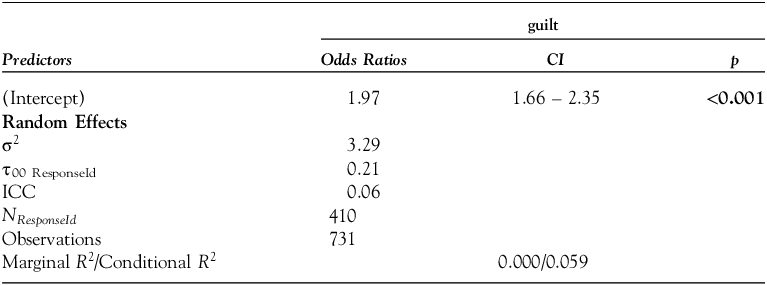
To test the hypotheses regarding the likelihood of conviction, we conducted mixed-effects logistic regressions with the participant’s id as a crossed random effect, Footnote 16 using the lme4 package in R version 3.5.1. Overall, Footnote 17 the tendency to convict the defendant varied across our three conditions, χ2(2) = 233.39, p < .001. Compared with the Proxy + Suspicion condition (ⓨ = .9), the subjects were significantly less likely to convict the defendant in the Primary condition (ⓨ = .27, OR = 0.04, z = −8.46, p < .001). The difference with the Mere Proxy condition also went in the predicted direction but was not statistically significant (ⓨ = .85, OR = 0.61, z = −1.72, p = .085). Thus, while tested on our full sample (including both laypeople and legal experts), Hypothesis 1 found only partial support.
However, the picture becomes more nuanced when we conduct the same analysis separately on lay and expert subjects. Figure 2 shows that results for predicted conviction rate for the lay and expert subjects. For the lay sample, the effect of the Primary condition remains significant (z = −5.535, p < .001), whereas the effect of the Mere Proxy condition, even if in the predicted direction, is small and nonsignificant (z = −0.64, p = .52). For the expert sample, however, the effect of the Mere Proxy condition is noticeable and significant (z = −1.97, p = .049) and the effect of the Primary condition is greater than elsewhere (z = −8.63, p < .001). These findings provide preliminary support for Hypothesis 3: legal expertise indeed seems to increase the effect of the condition on the conviction rate.
Predicted Conviction Rate for the Lay (a) and Expert (b) Subjects. p < .10; *p < .05; **p < .01; ***p < .001.

Furthermore, if Hypothesis 3 is true, we should observe an interaction between the condition and the level of expertise (lay versus legal expert). And this is indeed what we found, Footnote 18 as adding the respective interaction term to our main model significantly increased the fit: χ2(1) = 12.1, p < .001. In contrast, adding the main effect of the level of expertise to the model did not increase the fit, χ2(2) = 0.03, p = .98, meaning that legal experts do not exhibit any systematic difference in their tendency to convict the defendant independently of the condition. Footnote 19
To summarize the discussion regarding the conviction rate, the analysis conducted on the mixed sample provides only partial support for Hypothesis 1, as only the effect of the Primary condition (that is, of changing the formal charges) is significant. However, Hypothesis 1 is fully confirmed among legal professionals. Moreover, the results of model comparison demonstrate that legal expertise indeed increases the effects of conditions, thus confirming Hypothesis 3.
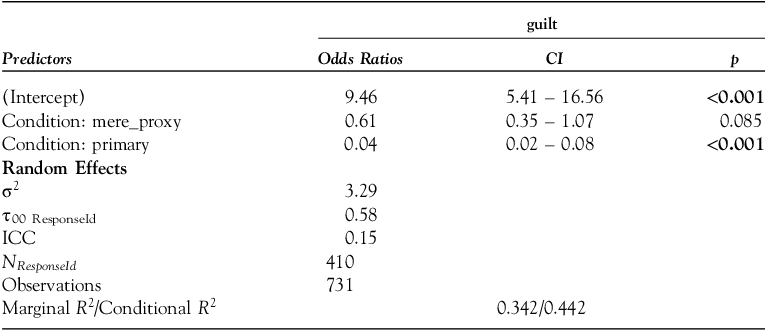
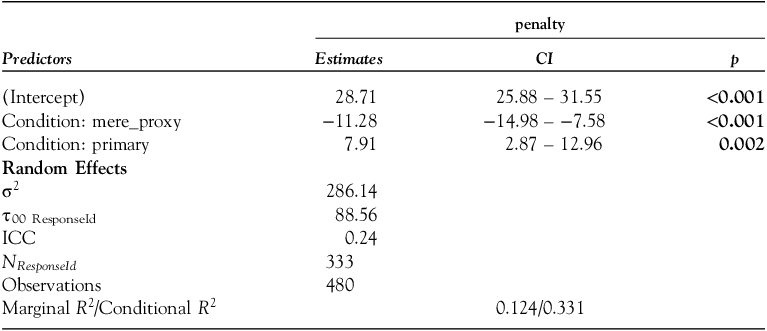
To test the hypotheses regarding the severity of punishment, we conducted mixed-effects linear regressions with the participant’s id as a crossed random effect, Footnote 20 using the lme4 package. Figure 3 shows the results for predicted mean punishment per condition. Overall, the mean punishment varied across our three conditions, Footnote 21 χ2(2) = 53.85, p < .001. Compared with the Proxy + Suspicion condition (M = 28.71 months), the subjects were significantly more lenient in the Mere Proxy condition, M = 17.43 months, t(447) = −5.97, p < .001, and significantly harsher in the Primary condition, M = 36.62 months, t(455) = 3.08, p = .002. As both differences went in the predicted direction, the analysis conducted on the full sample (including both laypeople and legal experts) provided Hypothesis 2 with full support.
Predicted Mean Punishment per Condition. p < .10; *p < .05; **p < .01; ***p < .001.

The comparison of the Proxy + Suspicion and Primary conditions may seem unsurprising; after all, surely people distinguish between convicting someone for a more serious crime, such as attempted murder or bribery. However, the vignette explicitly mentioned that in this condition the prosecutor does not want to pursue the more serious charge for pragmatic evidentiary reasons—in other words, rather than focusing on applying an adequate charge, the prosecutor wanted to secure a conviction. Therefore, some people may see through the real punitive intent of the prosecutor, which would be to apply a punishment similar to that for attempted murder.
Second, the only difference between the two was the formal assessment of the deed by the prosecutor. This means that the same action of the defendant was to be evaluated much more harshly only because of formal reasons. This could be a case of the framing effect—an act is evaluated differently when it is portrayed with different legal labels. On the other hand, the prosecutor’s (that is, the legal expert’s) labeling of an act as legally graver may steer the moral evaluation of the act. Yet, it may not be obvious in cases where the normative difference between the two labels is not so striking, such as attempted murder and illegal gun possession.
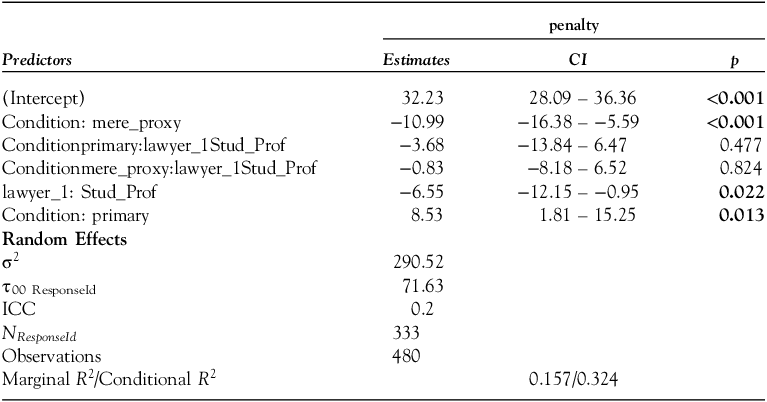
Returning to the main analyses, the results were different after we conducted the same analysis separately on lay and expert subjects (Figure 4). For the lay sample, both effects remain significant and in the predicted direction—Primary: t(233) = 2.19, p < .001; Mere Proxy: t(234) = −3.55, p < .001. But for the expert sample, the same is true only with respect to the effect of the Mere Proxy condition, which is noticeably greater than in the lay sample, t(203) = −5.4, p < .001, whereas the effect of the Primary condition virtually disappears, t(214) = 1.37, p = .17. Both observations regarding the expert sample are consistent with Hypothesis 4. However, Hypothesis 4 was ultimately tested by checking whether the addition of the interaction term (between the condition and the level of expertise) improved the model fit. To our surprise, Footnote 22 we did not observe any effect, χ2(2) = 0.51, p = .77. In contrast, adding the main effect of expertise significantly improved the model, χ2(1) = 16.28, p < .001, meaning that laypeople overall imposed harsher punishment. Footnote 23
Predicted Mean Punishment per Condition for the Lay (a) and Expert (b) Subjects. p < .10; *p < .05; **p < .01; ***p < .001.

To summarize, Hypothesis 2 is supported both in the general sample and among lay subjects. The pattern in which our expert subjects imposed punishment was consistent with Hypothesis 4. However, the results of the model fit comparisons failed to deliver conclusive results regarding this effect of expertise.
DISCUSSION AND FUTURE STUDIES
When encountering some potential evidentiary hurdles related to the putative primary offense, prosecutors are likely to strategically charge the defendant with an easier-to-prove offense. This seems to be the main reason why there are proxy crimes in the first place. The most noticeable result we obtained shows that both laypeople and legal experts intuitively understand and support this role of proxy crimes. Having been told that the prosecutor gave up on pressing the charges of the primary offense and chose the proxy crime instead, both groups were overwhelmingly more likely to find the defendant guilty, even though the available evidence remained the same.
Despite this important parallel in lay and expert intuitions, when we come to the main question of this article, where to look for the proxy crimes’ object of punishment, those intuitions apparently diverge. Laypeople seem more likely to believe that proxy conduct is the main object of punishment of proxy crimes. If this is the case, some normative implications follow. As we have said, any retributivist analysis of proxy crimes should begin with identifying where the object of punishment lies. However, if one claims that this endeavor should, at least to some extent, track normative intuitions, it is unclear whose normative intuitions those should be: those of laypeople or those of legal experts (see Tobia Reference Tobia2023). Moreover, in our experiment, laypeople were generally more punitive than professionals; this result seems to track a general trend in mock sentencing (see, for example, Keijser, Koppen, and Elffers Reference de Keijser, van Koppen and Elffers2007).
Criminal law scholars have long claimed that criminal law’s legitimacy (and, subsequently, its potential to secure voluntary compliance) depends on the extent to which it remains consistent with popular intuitions about what is just (Robinson and Darley Reference Robinson and Darley1995). However, the dynamics present in this context might be quite different from what has been traditionally assumed. Laypeople might find the existence of some criminal offenses legitimate because they believe that those offenses directly refer to some punishment-worthy conduct. But this might be untrue from the perspective of legal officials, for whom the same offenses are just tools facilitating going after the real wrongdoing. Whether we should accept such a situation, in which the general public accepts some features of the criminal law system only because they hold some “false” beliefs about it, is a tricky normative question.
An even more troubling issue arises for supporters of the communicative theory of criminal law, who claim that the main function of the criminal law system is to effectively convey the message of condemnation for certain types of acts. A disagreement between legal officials and the general public results in a situation where the former might send one message and the latter receive a completely different one. For instance, if an alleged drug dealer is convicted of possession of 30 g of cocaine, then the message the legal system would like to send is that dealing drugs is condemned but what the general public might understand is that possessing 30 g of cocaine is what is deemed worthy of condemnation.
The results of our study also point out other issues for further research. When it came to sentencing, the severity of the punishment imposed by the participants was dependent on evidentiary concerns, none of which appear normatively relevant. It may indeed seem that certain irrelevant factual doubts turn out to be a factor in sentencing (cf. Keijser and Koppen Reference de Keijser and van Koppen2007).
Future empirical studies should seek to examine whether the pattern of pragmatic punishment in sentencing decisions is replicated in other types of offenses where determining the perceived object of punishment is problematic. This category is quite broad, and it includes the aforementioned phenomena such as relevant conduct sentences (see fn4) and pretextual prosecution (see fn3) as well as different forms of inchoate offenses (for a study on criminal attempts, see Skoczeń Reference Skoczeń2023).
LIMITATIONS
One pattern present in our results regarding the likelihood of conviction is likely to attract some criticism: although the effect of the Primary condition is overwhelming, leading the majority of subjects to change their minds, the effect of the Mere Proxy condition, even among expert subjects, is rather small. It leads to, roughly, a nine-percentage-point smaller likelihood of conviction. This modest difference, however, might just be a result of our rather extreme context. First, our expert sample was recruited from the population of Polish lawyers, which operates in a legal system known for its formalism (Bystranowski et al. Reference Bystranowski, Bartosz Janik, Struchiner, Almeida and Hannikainen2021b). Because of this, they might have been particularly unlikely to let the defendant off the hook if the formal definition of a given offense was satisfied. Second, the offenses that we chose to employ in our scenarios, even if they are proxy crimes, tend to be quite indiscriminately enforced in the Polish legal system. The failure to truthfully disclose assets is commonly viewed as highly indicative of corruption, and charges are typically pressed even when no further hint of a specific act of bribery is present. The illegal possession of firearms is also highly suspicious in Poland, where the rate of private possession of firearms is low even by the already-low European standards. Thus, any act of such possession might be considered as already indicating some other criminal activity. Therefore, both offenses are likely to be enforced even when there is a lack of further evidence of the primary wrongdoing. This all indicates that if, even in such adversarial conditions, we managed to observe a significant effect of the Mere Proxy condition on the conviction rate (among the expert subjects), the same effect is probably greater among other populations of legal experts and in the context of proxy crimes that are more selectively enforced.
CONCLUSIONS
This article has experimentally approached the issue of proxy crimes (offenses criminalizing behavior that does not seem wrongful per se but that stands in for another, harder-to-prove wrongdoing). Here, we have found evidence that people tend to find the defendant guilty of a proxy crime more frequently when there is an indication of the primary wrongdoing than in situations where the defendant is charged with a primary offense based on the same evidence and when charged with a proxy crime without the suspicion of the primary offense. Moreover, our research suggests that there is a discrepancy between the approach to the object of punishment in the perception of laypeople and legal experts, which has direct implications for sentencing decisions.
Although the reported study is a contribution to the growing literature on proxy crimes, we believe that our results have much broader ramifications: for the general theory of criminal law or, even more generally, for sociolegal studies. The observed mismatch between laypeople and legal experts is problematic for any theory of criminal law but particularly for those that assume that the main function of criminal law is expressive or, in other words, that legal punishment is a message, which should be understood by legal officials and citizens in a similar manner. Such a situation highlights an important problem: should our criminal justice system reflect the intuitions of society, or the smaller, specialized community of legal professionals?
Appendix 1
Model 0
Model 1
Model 1 (lay subjects)

Model 1 (expert subjects)

Model 2

Model 3

Appendix 2
Model 0

Model 1
Model 1 (lay subjects)

Model 1 (expert subjects)

Model 2

Model 3
Appendix 3
Bribery

Attempted Homicide



