




No CrossRef data available.
Article contents
Lexical universals of kinship and social cognition
Published online by Cambridge University Press: 17 December 2010
Abstract
Jones recognizes the existence of “primitives of conceptual structures,” out of which “local representations of kinship are constructed.” NSM semantics has identified these primitives through a cross-linguistic search for lexical universals (“NSM” stands for Natural Semantic Metalanguage and also for the corresponding linguistic theory). These empirical universals provide, I argue, a better bridge between cognitive anthropology and evolutionary psychology than the abstract constructs of OT, with dubious claim to conceptual reality.
Information
- Type
- Open Peer Commentary
- Information
- Copyright
- Copyright © Cambridge University Press 2010
References
Burling, R. (1964) Cognition and componential analysis: God's truth or hocus-pocus?
American Anthropologist. 66(1):20–28.CrossRefGoogle Scholar
D'Andrade, R. (1995) The development of cognitive anthropology. Cambridge University Press.CrossRefGoogle Scholar
Fogelson, R. (2001) Schneider confronts componential analyses. In: The cultural analysis of kinship: The legacy of David M. Schneider, ed. Feinberg, R. & Ottenheimer, M., pp. 33–45. University of Illinois Press.Google Scholar
Geertz, C. (1976) “From the native's point of view”: On the nature of anthropological understanding. In: Meaning in anthropology, ed. Basso, K. & Selby, H. A., pp. 221–37. University of New Mexico.Google Scholar
Goddard, C. (2010) Semantic molecules and semantic complexity (with special reference to “environmental” molecules)
Review of Cognitive Linguistics
8(1):123–55.Google Scholar
Goddard, C. & Wierzbicka, A., ed. (2002) Meaning and universal grammar: Theory and empirical findings. John Benjamins.Google Scholar
Goddard, C. & Wierzbicka, A. (forthcoming) Men, women and children: The semantics of basic social categories.Google Scholar
Jones, D. (2004) The universal psychology of kinship: Evidence from language. Trends in Cognitive Sciences
8(5):211–15.CrossRefGoogle ScholarPubMed
Kronenfeld, D. B. (2001) Introduction: The uses of formal analysis re cognitive and social issues. Anthropological Theory
1(2):147–72.Google Scholar
Leaf, M. J. (2006) Experimental-formal analysis of kinship. Ethnology
45(4):305–30.CrossRefGoogle Scholar
Lucy, J. A. (1997) The linguistics of |at“colour.” In: Colour categories in thought and language, ed. Hardin, C. L. & Maffi, L., pp. 320–46. Cambridge University Press.CrossRefGoogle Scholar
NSM Homepage: www.une.edu.au/bcss/linguistics/nsm/Bibliographical details.Google Scholar
Shapiro, W. (2008) What human kinship is primarily about: Toward a critique of the new kinship studies. Social Anthropology
16:137–53.CrossRefGoogle Scholar
Shore, B. (1996) Culture in mind: Cognition, culture and the problem of meaning. Oxford University Press.CrossRefGoogle Scholar
Sousa, P. (2003) The fall of kinship: Towards an epidemiological explanation. Journal of Cognition and Culture
3(4):265–303.CrossRefGoogle Scholar
Wallace, A. F. C. & Atkins, J. (1969) The meaning of kinship terms. In: Cognitive anthropology, ed. Tyler, S., pp. 345–69. Holt, Rinehart and Winston.Google Scholar
Wierzbicka, A. (1992) Semantics, culture, and cognition: Universal human concepts in culture-specific configurations. Oxford University Press.CrossRefGoogle Scholar
Wierzbicka, A. (1996) Semantics: Primes and universals. Oxford University Press.CrossRefGoogle Scholar
Wierzbicka, A. (2010) Experience, evidence, and sense: The hidden cultural legacy of English. Oxford University Press.CrossRefGoogle Scholar
Wierzbicka, A. (forthcoming) Seven universals of kinship: Overcoming the Eurocentrism of kinship semantics through seven universal semantic molecules.Google Scholar
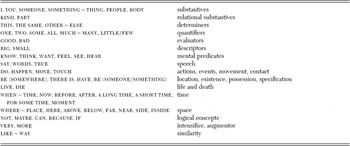
Table 1. Universal semantic primes (English exponents), grouped into related categories
A decade ago anthropologist Raymond Fogelson (Reference Fogelson, Feinberg and Ottenheimer2001, p. 41) wrote: “The study of kinship, which played such a prominent role in the development of anthropological theory, now seems to be a dead topic…. Only time will tell whether the subject will be revived, reincarnated, or reinvented….” (See also Sousa Reference Sousa2003 on “The fall of kinship”).
It is to Jones' great credit that he is trying to revive this subject, which is central to the understanding of social life and social cognition. I also appreciate Jones' defence of the inherent link between “kinship” and “genealogy” (or “reproduction”) and his recognition of the existence of “primitives of conceptual structure,” out of which “local representations of kinship” are constructed (Fig. 1 of the target article).
On the other hand, I see as a weakness of Jones' account its dependence on a particular formal theory (OT) and its lack of attention to the question of metalanguage. The “constraints” approach depends on metaterms like “matrikin,” “generation,” “sex,” and “cousin,” which don't have equivalents in the languages of the people concerned and so have dubious claim to conceptual reality.
As I see it, the fundamental facts are that all languages have words for “mother” and “father”, and in all probability “wife” and “husband”, and that in all languages kinship systems are built on the bedrock of these four concepts. This fact is often obscured by the polysemy of the words in question (Wierzbicka Reference Wierzbicka1992; Shapiro Reference Shapiro2008), but Jones acknowledged it in earlier work (Jones Reference Jones2004). In the target article, however, the focus is so much on theory that the empirically established lexical universals of kinship seem to disappear from view.
Jones' approach to kinship, which is wedded to OT, is vulnerable to the criticism that D'Andrade (Reference D'Andrade1995, p. 30) directed at componential analysis of kinship as it was practised in the 1960s: “This type of analysis seems specialized, arcane, and formalistic.” The charge of ethnocentrism aimed at traditional anthropological analyses of kinship by, for example, Wallace and Atkins (Reference Wallace, Atkins and Tyler1969, p. 364) applies as well. More recently, Leaf (Reference Leaf2006, p. 306) noted: “The kin types were symbolized by one or two letters so as to seem abstract and schematic, but in the end the ideas they represented were only those of the American kinship system, M or Mo for Mother, F or Fa for Father…B for Brother, Si or Z for sister…sometimes with added qualifiers for age and the like.”
Jones doesn't use symbols like M, F, B and S, but in his comparison of English and Seneca he, too, relies on kin types taken from English, such as parent, sibling, child and cousin – concepts for which there are no words in Seneca itself. Analysing Seneca kinship terminology through such terms means, I think, imposing on it a perspective alien to it.
For my part, I contend that an adequate, non-Anglocentric framework for the comparison of kinship systems can be based on empirically discovered lexical and conceptual universals, beginning with “mother,” “father,” “husband” and “wife.” In addition, such a culture-neutral analytical framework can build on the set of empirically discovered “semantic primes,” like “people,” “do,” “happen,” “body,” “before,” and 60 or so others, which, evidence suggests, can be found as words, or distinct word meanings, in all languages. (See Table 1.)
Universal semantic primes (English exponents), grouped into related categories
Note. Primes exist as the meanings of lexical units (not at the level of lexemes). Exponents of primes may be words, bound morphemes, or phrasemes. They can be formally complex. They can have combinatorial variants or “allolexes” (indicated with ~). Each prime has well-specified syntactic (combinatorial) properties.
According to the findings of NSM-based investigations (Goddard Reference Goddard2008; Goddard & Wierzbicka Reference Goddard and Wierzbicka2002; Wierzbicka Reference Wierzbicka1996; Reference Wierzbicka2006; Reference Wierzbicka2010 and many other references listed under the bibliographical links at http://www.une.edu.au/bcss/linguistics/nsm/), there are two sets of universal concepts: a few dozen indefinable semantic primes (“atoms of meaning”), and a smaller set of “semantic molecules” – concepts that are complex and can be defined in terms of primes but which function as units in the construction of culturally variable compound ideas. (In addition, there are many molecules that are language-specific.)
The four lexical pivots of kinship – “mother,” “father,” “wife” and “husband” – belong to the second set (Wierzbicka, forthcoming). Other semantic molecules which, evidence suggests, are universal and which are highly relevant to kinship, are the three mainstays of social cognition: “men,” “women,” and “children” (Goddard Reference Goddard2010; Goddard & Wierzbicka, forthcoming).
Concepts lexicalised in all languages allow us to bring hypothesized conceptual structures into the orbit of recognizable human ways of speaking; they give us an empirically grounded analytical framework that overcomes both the “technicism” of kinship algebras, old and new, and the Anglocentrism of descriptions based on language-particular English kin types.
Jones proposes rules and constraints that may make sense from the point of view of OT theorists but which are anything but “experience-near” or psychologically real. How such rules could be learned by ordinary speakers, and how they can be verified by researchers, is far from clear. It is also far from clear how formalization in terms of OT can provide a window onto “how people think about kinship” (as envisaged in Jones Reference Jones2004, p. 211).
In the end, one can't help feeling that the old key questions of “psychological reality” (Burling 1967), “the native's point of view” (Geertz Reference Geertz, Basso and Selby1976), and “the insider's understanding” (Shore Reference Shore1996) have vanished from view in the target article, amid concerns about “faithfulness constraints,” “scales limiting allowed permutations in constraint ranking,” “markedness scales,” and other similarly abstract and theory-dependent analytical constructs. As Kronenfeld (Reference Kronenfeld2001, p. 158) notes: “The formal analysis that best represents the regularities of the terminology may not necessarily be best at representing the cognitive operations by which native speakers navigate the system.”
The “seven faithfulness constraints” Jones proposes depend on English concepts such as “parent” and “sibling,” “sex,” “generation” and “age,” which have no equivalents in most languages of the world. By contrast, the seven building-blocks of kinship and social cognition recognized in the NSM theory – “mother,” “father,” “wife,” “husband,” “men,” “women” and “children” – are, evidence suggests, lexical universals, experience-near and empirically verifiable. If in our portrayal of local systems of kinship we rely on such universals (as it is done in NSM-based analyses), we can capture generalizations about the structure of such systems by recognizing recurrent semantic components and recurrent kin name extensions both with and across languages and cultures. Why not start building bridges between cognitive anthropology and evolutionary psychology on these empirical, culture-neutral, and theory-independent human universals?