INTRODUCTION
More ink than ever before has been put to paper to describe research that attempts to elucidate the role of spirituality and religion in health related quality of life (HRQL) and well-being, particularly among people living with cancer. A 600% increase in published articles with keywords “spirituality and health” and a 27% increase in published articles with keywords “religion and health” were witnessed in the decade of 1995–2005 (Stefanek et al., Reference Stefanek, McDonald and Hess2005; Visser et al., Reference Visser, Garssen and Vingerhoets2009). This increase in attention to spirituality and religion is because of the recognition given to the importance of spirituality and religion in patient care. Issues related to spirituality and religion are included in national and international palliative care standards (NCP Clinical Practice Guidelines for Quality Palliative Care SENCP, 2009; World Health Organization, 2004); patients have identified attention to their spiritual and religious concerns as a need (Balboni et al., Reference Balboni, Vanderwerker and Block2007); and it has become clear that spiritual and religious well-being affects not only HRQL (Balboni et al., Reference Balboni, Vanderwerker and Block2007), but also, outcomes (Fitchett et al., Reference Fitchett, Rybarczyk and DeMarco1999, Reference Fitchett, Murphy and Kim2004; Pargament et al., Reference Pargament, Koenig and Tarakeshwar2004; Phelps et al., Reference Phelps, Maciejewski and Nilsson2009). This importance highlights the need for clarity about what is being referred to when researchers use the terms “spirituality” and “religion,” as a lack of clarity was recently mentioned in the literature (Breitbart, Reference Breitbart2007; Nelson-Becker et al., Reference Nelson-Becker, Nakashima and Canada2007; Surbone & Baider, Reference Surbone and Baider2010; Salander, Reference Salander2006). Clarity about what is being referred to may allow researchers to identify interventions that promote the sorts of spiritual experiences that lead to higher HRQL.
DEFINITIONS OF “RELIGION” AND “SPIRITUALITY” IN CURRENT USE
Researchers often separate “spirituality” and “religion” into distinct concepts. The difference between the concepts, as this separatist thinking goes, is that “religion” is defined as a set of beliefs and practices associated with a religious tradition (Hill & Pargament, Reference Hill and Pargament2003). “Spirituality,” on the other hand, is defined by its focus on making meaning (Reed, Reference Reed1992; Koenig, Reference Koenig2008; Pulchalski et al., 2009). Therefore, for example, Koenig (Reference Koenig2008) defines “religion” as:
A system of beliefs and practices observed by a community, supported by rituals that acknowledge, worship, communicate with, or approach the Sacred, the Divine, God (in Western cultures), or Ultimate Truth, Reality, or nirvana (in Eastern cultures) (p. 11).
And Puchalski et al. (Reference Puchalski, Ferrell and Virani2009) define ‘spirituality’ as:
The aspect of humanity that refers to the way individuals seek and express meaning and purpose and the way they experience their connectedness to the moment, to self, to others, to nature, and to the significant or sacred (p. 887).
These definitions, and the separatist thinking that undergirds them, suffer from two philosophical problems. One problem is that these definitions fail to take into account just what a concept is. The other problem is that whatever the terms “religion” and “spirituality” refer to, they do not refer to any specific objects. The way to confront these problems is to abandon the separatist thinking. “Spirituality” and “religion” refer to the same concept. This concept, however, is different from the concept of “religions.” Before these two problems can be described and resolved, it must be firmly established exactly what a concept is.
THE DEFINITION OF A CONCEPT
In his fin de siècle book on how to define the concept of number, The Foundations of Arithmetic, the philosopher and mathematician Gottlob Frege instructs his readers “never to lose sight of the difference between concept and object” (Frege, Reference Frege1980, p. x). Later in a short piece, “On Concept and Object,” he clarifies this difference. One rough-and-ready way to distinguish a concept from an object, Frege suggests, is that “the singular definite article always indicates an object, whereas the indefinite article accompanies a concept-word” (Frege, Reference Frege1951, p. 171). For example, “the city of Berlin” refers to an object, and “a city” refers to a concept-word. Another way to tell the difference between a concept and an object is that “a concept,” Frege says, “is the reference of a predicate,” whereas an object “can never be the whole reference of a predicate” (Frege, Reference Frege1951, p. 173). Therefore the concept of city is defined by its predicates (i.e., attributes) that refer to it: a populous place, for example. Berlin is a populous place; but, insofar as objects cannot be the entire reference of a predicate, it can be said that Los Angeles is a populous place, too.
Whereas objects cannot be the complete reference of a predicate, they are, however, categorized under concepts. When we then speak of the city of Berlin, we do not speak of a concept, but rather, of an object that is categorized under the concept “city.” Los Angeles is categorized under that concept, as well. An easy way to summarize Frege's distinction between concept and object is that an object behaves as a subject, and a concept behaves as a predicate.
PROBLEMS WITH DEFINITIONS OF “RELIGION” AND “SPIRITUALITY”
The difficulty in defining the terms “religion” and “spirituality” is that there is no predicate that uniquely applies to them that can be given. In an eloquent passage at the beginning of his 1901 Gifford Lectures on Natural Theology, the American physician–philosopher–psychologist William James convincingly argues that there is “no one specific and essential kind of religious object” (James, Reference James1982, p. 28). Some may say that a certain existential fear and trembling is a unique religious object that can be categorized under and refers, in part, to the concept of religion. James explains, however, that what we are tempted to call “religious fear” is just ordinary human fear: it is “the common quaking of the human breast” (James, Reference James1982, p. 27). James saw over a hundred years ago that mistaking human emotions for religious objects causes us to veer our definitions either to the side of the personal, which keeps humanity in view (as the definition of “spirituality” by Puchalski et al. [2009] does) or to the side of the institutional (as the definition of “religion” by Koenig [2008] does).
If there are no religious objects, how do we define these concepts in a way that steers a path between the Scylla of too human and the Charybdis of too institutional?
James's definition of “religion” is close to the definition of “spirituality” offered by Puchalski et al. (Reference Puchalski, Ferrell and Virani2009). Religion, he writes, is “the feelings, acts, and experiences of individual men in their solitude, so far as they apprehend themselves to stand in relation to whatever they may consider the divine” (James, Reference James1982, p 32). Unlike Puchalski et al., however, James does not focus on or begin with some aspect of humanity; and unlike Koenig (Reference Koenig2008) he does not focus on or begin with a system. James's focus, instead, is on immediate experience — the immediate experiences of people as they stand in relation to the divine, a relation, he says, that may be “moral, physical, or ritual” (James, Reference James1982, p. 31). Whereas he leaves open just what the divine is, he does not disown the term “religion”; instead, he suggests that “religion” applies to these immediate experiences of people. James puts this in briefer but broader scope: “Religion, whatever it is, is a man's total reaction upon life” (James, Reference James1982, p. 35).
Following James, whatever we mean by the terms “religion” and “spirituality,” we mean something different from actual religions. The concept of “Religions,” which I will hereafter capitalize for clarity's sake, is a different concept from “religion.” Under the concept of “Religions” numerous objects are categorized, namely, all the different religious traditions we can name: the Christian, the Islamic, the Jewish, the Hindu, and the Sikh religious traditions, among others; and even these objects can serve as second-order concepts under which many different objects would be categorized, such as different sects or denominations within them. The concept of “Religions,” in other words, has a predicate that refers to it: the collocation of all the objects categorized under it, which are, as we saw in the last sentence, preceded by the definite article. However, under the concept of “religion” (lowercase and no “s”), no single object is categorized.
How, then, are we to define the concept of “religion” if we cannot study a collection of objects, a collection that, should there be one, when seen as a whole, would supply the predicate that refers to the concept?
We must look to James's idea of immediate experience.
JAMES'S DEFINITION OF THE CONCEPT OF “RELIGION”
The concept of “religion,” to James, is the set of a person's immediate reactions to life. These reactions to life, these immediate experiences, are “prominent and easy to notice,” James writes, in that they are “one-sided, exaggerated, and intense” (James, Reference James1982, p. 45). James identified two such reactions. One, which he called healthy-mindedness, derives from the temperamental ability to encourage optimism. The immediate experiences of healty-minded people experiences of acceptance, of “surrender and sacrifice” (p. 51). “Sick souls,” on the other hand, recognize the world's evils as the surest path to reliable meaning. Their immediate experiences are tense experiences. Sick souls, however, can become healthy-minded. By admitting “some amount of dependence on sheer mercy” and by practicing “some amount of renunciation, great or small,” sick souls can “save [their] souls alive” (p. 51). The function of James's concept of “religion” is to move people from the immediate experiences that a sick soul would have to the immediate experiences that a healthy-minded person would have.
A hint at the definition of the concept of “religion” has now come into view. Whereas the concept has no objects that are categorized under it, it does have this sine qua non: the ability to transform people from unhealthy-mindedness to healthy-mindedness. When this sine qua non is applied to research on religion and spirituality in HRQL and well-being among people living with cancer, the muddle of confusing the concept of “religion” with the concept of “Religions” comes into clear focus.
CONFUSING THE CONCEPT OF “RELIGION” WITH THE CONCEPT OF “RELIGIONS”
Researchers often make the mistake of conflating the concept-words “spirituality” and “religion” with the concept-word “Religions.” Consider the muddle, for example, in the following sentences:
A variety of concepts, ranging from faith and meaning to religious beliefs and well-being, are reflected in measures of spirituality … However, these measures are broad, abstract indices of religiousness, and specifics of a spirituality that may be applicable to highly religious persons are ignored (Hamilton et al., Reference Hamilton, Crandell and Carter2010).
That which is specific to a particular system — the practices that derive from it, the beliefs central it, the community that comprises it — all belong and are particular to it. How individual religious groups engage their religious system during difficult times, such as cancer treatment, as Hamilton et al. studied in the religious system of Christian African-American cancer survivors, is a matter for the study of that particular system. The results of the study, even if to evaluate the reliability and validity of a new measure of the support Christian African-American cancer survivors receive from their religious system, can only be descriptive — of the specific object they studied: Christian African-Americans who reside in a certain geographical region, a specific object that is categorized under the concept of “Religions.”
This description is not to be disparaged. It tells us how people with advanced cancer in that particular religious system rely on the system and the community of people that are part of it. However, because it is the description of an object, it can only describe in part the concept of “Religions”; for, following Frege (1951), whatever we predicate about objects are incomplete references to the concept they are categorized under.
Misidentifying research on an object that is categorized under the concept of “Religions” as research on the concept of “religion” causes some researchers to posit claims about the concept of “religion,” when in fact that is not what they studied. Consider the work of Phelps et al. (Reference Phelps, Maciejewski and Nilsson2009), who used the Brief RCOPE, a measure of religious coping (Pargament et al., Reference Pargament, Koenig and Perez2000), to describe the relationship of life-prolonging end-of-life care with the way people with advanced cancer use their religious system to cope. Phelps et al. concluded from their study that “positive religious coping in patients with advanced cancer is associated with receipt of intensive life-prolonging medical care near death” (p. 1140). This finding is important, for, as Phelps et al. say, the mechanism for this association needs to be found. It will not be found, however, in the study of the concept of “religion.” Rather, it will be found in the study of particular religious systems. Indeed, Phelps et al. studied objects that are categorized under the concept of “Religions.” For inasmuch as they found that “positive religious coping was significantly associated with being black or Hispanic (p < 0.001) … [being] younger, less educated, less likely to be insured, less likely to be married, and more likely to be recruited from the Texas sites” (p. 1143), they described the behavior of people with advanced cancer who situate themselves within specific religious systems. Of the 345 patients in the study cohort, 155 (45%) were from Texas, and 135 (36%) were African-American and Latino. According to the Pew Forum on Religion & Public Life's U.S. Religious Landscape Survey, 50% percent of all evangelical Protestant Christians in the United States reside in the South, as do 60% of all members of historically African-American Protestant churches (Pew Forum on Religion & Public Life, 2008). Fifty-six percent of all evangelical Protestant Christians have a high-school education or less, and 76% of all evangelical Protestant Christians in the United States earn < $74,999 per year (Pew Forum on Religion & Public Life, 2008). Whereas it is tempting to think of Latinos in the United States as a religiously monochromatic group, this is not true. According to the Pew Hispanic Center, 68% of Latinos identify themselves as Roman Catholic, but at the same time, 54% of all Latinos, regardless of which denomination they affiliate with, identify themselves as charismatic Christians. Consider, also, that the Jehovah's Witness denomination is 24% Latino (Pew Hispanic Center, 2007). Therefore, whereas 130 (38%) of the participants in Phelps et al. study identified as Catholic, this would include Latinos who may also identify as charismatic. Moreover, 113 (33%) of participants identified themselves as either Baptist or Protestant. If we roughly correlate the changing face of religious affiliation of the Latino Americans and the make-up and regional location of evangelical Protestant Christians in the United States with the finding of Phelps et al., we see that Phelps et al. described the behaviors of particular religious systems: evangelical and charismatic Christians. They did not supply any predicates to the concept of “religion”; they only described objects that are categorized under the concept of “Religions.”
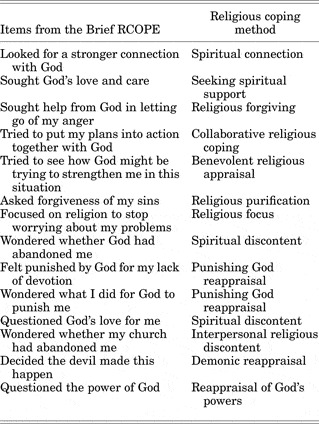
This is unsurprising. The Brief RCOPE (Table 1) uses language that selects for people who identify with a specific religious tradition in which an anthropomorphic view of the divine and the notion of church as the organized grouping of believers are tenets; the Brief RCOPE studies only those who belong to an object under the concept of “Religions.” More problematic, however, is that Koenig et al. (2000) suggest that some of the items on the Brief RCOPE assess spirituality. For example, Koenig et al. say that the item “Looked for a stronger connection with God” assesses “spiritual connection” and that “Sought God's love and care” assesses for “seeking spiritual support.” The theological formulation of both these items, however, does not assess for immediate experience, but rather, the mediated experience associated with belief in a traditional anthropomorphic view of the divine.
Brief RCOPE (Koenig et al., 2000)

Is the study of the role of the concept of “religion” in HRQL and well-being impossible? Is it the case that whatever researchers study they must study specific objects that are categorized under the concept of “Religions”? No; but the way forward is to arrive at a definition of the concept of “religion” and a way to measure it in people that neither veers too close to the personal nor conflates the concept of “religion” with the concept of “Religions.”
THE CONCEPT OF RELIGION/SPIRITUALITY AND HOW TO MEASURE IT
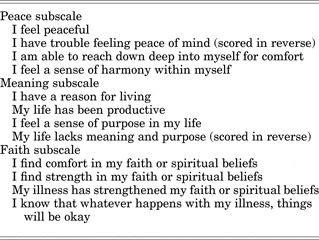
Perhaps what Hamilton et al. (Reference Hamilton, Crandell and Carter2010) were attempting to get at in the sentences quoted earlier in which they muddled concepts is James's notion that the function of religion is the transformation from a personal stance that focuses on that which is not good to a stance of acceptance, regardless the circumstances, and that it is this stance of acceptance that (what they call) “measures of spirituality” try to capture. If one looks at the questions of Functional Assessment of Chronic Illness Therapy – Spiritual Well-being Scale (FACIT-Sp) in Table 2, the overall impression is that the questionnaire attempts to determine whether respondents have a Jamesian attitude of acceptance amid the difficulties of the chronic illnesses they face. This impression stands in stark contrast with the theological formulations of the Brief RCOPE. Peterman et al., in the article in which they present the validation data for the FACIT-Sp (2002), state that the items included in the questionnaire emphasize a sense of meaning in life, harmony, peacefulness, and a sense of strength and comfort from one's faith. The FACIT-Sp has two subscales: the Meaning/Peace subscale and the Faith subscale. Peterman et al. (Reference Peterman, Fitchett and Brady2002) note that the Faith subscale has “a moderate to strong association with religion, whereas the other subscale (Peace/Meaning) is not significantly associated with existing religion measures” (p. 56). They suggest that this lack of association may be due to the Peace/Meaning subscale's ability to capture “a dimension of spirituality that overlaps with, or is enhanced by, religion” (p. 56). To the contrary, I suggest that the Faith subscale is associated with the concept of “Religions,” and, even as Peterman et al. suggest themselves, the Peace/Meaning subscale measures “a dimension that is more independent” (p. 56), which is what Hamilton et al. call “spirituality,” and what James calls the “religion of the healthy-minded person.”
Functional Assessment of Chronic Illness Therapy – Spiritual Well-being Scale (FACIT-Sp) (Canada et al., Reference Canada, Murphy and Fitchett2008)

That these two subscales of FACIT-Sp capture different concepts is supported by the work of Edmondson et al. (Reference Edmondson, Park and Blank2008), whose research showed that the Peace/Meaning subscale is “conceptually and statistically distinct from” the Faith subscale (p. 165). According to Edmondson et al., the HRQL found among those studied “was fully accounted for by” the Peace/Meaning subscale (p. 165). Similarly, for Salsman et al. (Reference Salsman, Yost and West2010), the Meaning/Peace subscale “emerged as a more robust predictor of HRQL when evaluated separately.” The reverse, however, was not true. Canada et al. (Reference Canada, Murphy and Fitchett2008), likewise, found that when the Peace/Meaning subscale was separated, Peace had a strong association with mental health and a non-association with physical health, and Meaning had modest associations with both mental and physical health, therefore supporting, they say, the notion that Peace captures a more affective component and Meaning a more cognitive dimension of the concept of “religion.” What is captured in the Peace/Meaning subscale of FACIT-Sp is not the concept of “Religions,” which, according to the findings of Edmondson et al., the Faith subscale of FACIT-Sp seems to measure. Then what does the Peace/Meaning subscale measure? Does it merely capture some existential, emotional quality, which Salander (Reference Salander2006) suggests? What concept, if any, do the predicates of the Peace/Meaning subscale of the FACIT-Sp refer to?
Before the work of Peterman et al. (Reference Peterman, Fitchett and Brady2002) and Edmondson et al. (Reference Edmondson, Park and Blank2008), Zinnbauer et al. (Reference Zinnbauer, Pargament and Cole1997) suggested that “religiousness,” which I call the concept of “Religions,” “and spirituality,” which I have heretofore called the concept of “religion,” “appear to describe different concepts,” although they are not, they say, “fully independent” (p. 561). It may be that they are not fully independent insofar as the objects of Religions are the codifications of the practices and beliefs that arose from people's immediate experiences. More recent than Zinnbauer et al. (Reference Zinnbauer, Pargament and Cole1997), however, is the work of Johnstone et al. (Reference Johnstone, Yoon and Franklin2009), who, when they differentiated statistically the so-called spiritual and religious factors of the Brief Multidimensional Measure of Religiousness/Spirituality (BMMRS), found that the BMMRS captured three domains: “(1) the emotional experiences individuals report related to their beliefs (i.e. spiritual experiences); (2) the behavioral practices associated with one's religious traditions …; and (3) the perceived support … from … congregations” (p. 155). Although Johnstone et al. (Reference Johnstone, Yoon and Franklin2009) are correct, following my Fregean–Jamesian argument, to identify spiritual experiences as distinct from the behavioral practices associated with Religions, one does not have to suppose that these spiritual experiences are related to beliefs, but rather, to reactions to life. The immediacy of the experience, eo ipso, means they precede belief.
The separateness of immediate (spiritual) experiences from beliefs can be seen in the work of Yanez et al. (Reference Yanez, Edmondson and Stanton2009). When Yanez et al. (Reference Yanez, Edmondson and Stanton2009) followed breast cancer survivors who had recently completed treatment, over a period of 6 months using the FACIT-Sp, they found that those who scored higher on the Meaning/Peace subscale had a decrease in depressive symptoms and an increase in vitality, whereas those who scored higher on the Faith subscale predicted a temporary increase in depressive symptoms, as well as a decrease in vitality at 6 months in the context of low Meaning/Peace. Yanez et al. go on to suggest that whatever the Meaning/Peace subscale captures, those who score high on it are those who are able to transcend the physical sequelae of cancer treatment. This coheres with the findings of Brady et al. (Reference Brady, Peterman and Fitchett1999) that the Meaning/Peace subscale of FACIT-Sp is the “best predictor of ‘contentment with QOL [quality of life],’ compared to other domains” (p. 423). Yanez et al. (Reference Yanez, Edmondson and Stanton2009) confirm this: 66.2% of women in their study who indicated both high levels of fatigue and high scores on the Meaning/Peace subscale also reported that they were able to enjoy life very much, compared to only 10.75% of those with high fatigue but low Meaning/Peace.
Park et al. (Reference Park, Edmondson and Hale-Smith2009) looked at the distinction between religion and Religions vis-à-vis health behaviors in 167 younger cancer patients (mean age 46.34 [SD = 6.29] years) with a variety of different primary sites of cancer. Park et al. measured religious struggle using the Spiritual Strain Scale, and spiritual experiences using the Daily Spiritual Experiences Scale (DSES). Religious struggle was associated with more frequent alcohol consumption and poorer adherence to medical advice and medication regimens, whereas spiritual experiences were positively related to the performance of important health behaviors. The worthiness of these findings nonetheless, the study by Park et al. is weakened by the DSES, which uses theological formulations (such as, “I feel God's love for me directly or through others”). Whereas the DSES may capture the immediacy of spiritual experience for those who believe in a god, it would exclude the immediate experiences of those who do not (including religious people, such as Buddhists). That by which we use to measure immediate experience must not exclude the immediate experiences of those who do not hold to belief in a god. This, again, is the muddle of not keeping the concept of “religion” separate from the concept of “Religions.”
Whatever we mean by “spirituality” and “religion,” we mean something distinct from “Religions.” What we mean by “spirituality” and “religion” is captured by the Peace/Meaning subscale of the FACIT-Sp: we mean the concept of “religion,” which I now call the concept of “religion/spirituality,” a concept under which no objects are categorized but the predicates of which are people's immediate experiences, their reactions to life.
IMPLICATIONS FOR RESEARCH AND PRACTICE
Keeping the concept of “religion/spirituality” distinct from the concept of “Religions” matters when it comes to the claims we make. Rather than claim that positive religious coping is associated with more aggressive end-of-life care, Phelps et al. (Reference Phelps, Maciejewski and Nilsson2009) should have claimed, through collecting and analyzing more specific religious demographics, that people who identified themselves as belonging to a particular religious tradition system used more aggressive end-of-life care. This more careful examination and more specific claim, by identifying the object of study, would have pointed the way for future research into the mechanism involved in this association.
More important, however, is that by keeping the concept of “religion/spirituality” separate from the concept of “Religions,” researchers can use measures such as the FACIT-Sp, along with detailed religious demographics, to explore differences and similarities among people from different religious systems. Hamilton et al. (Reference Hamilton, Crandell and Carter2010) are right to focus on the specific religious system they studied, in order to understand and tailor interventions for people within that system. Ando et al. (Reference Ando, Morita and Ahn2009) argue exactly this point in a study of cancer patients at the end of life in Japan, Korea, and the United States, concluding that “we can improve the spiritual well-being of terminally ill cancer patients by focusing on the primary concerns within each country” (p. 349). However, if Ando et al. had compared specific results from the Peace/Meaning subscale of the FACIT-Sp across different religious systems, not countries, insights into the immediate experiences of people with cancer at the end of life might have been yielded. Along the same lines, if Hamilton et al. had included a measure of the concept of “religion/spirituality,” these data would be available to compare with other religious systems in order to find what we might, if we had the data, come to understand as universal immediate experiences.
Understanding the relationship between Religions and religion/spirituality, if any, is important work — especially when looking for immediate experiences that may transcend, and therefore be universal across, the concept of “Religions.” Yet by keeping the concepts of “religion/spirituality” and “Religions” distinct and thereby focusing on identifying universal immediate experiences, researchers may be able to arrive at interventions that promote healthy-minded immediate experiences at the time of diagnosis.
By clarifying that the concept of “religion/spirituality” is a unique concept with no objects that are categorized under it, objects from which, if, per impossibile, they existed, we could discern its attributes, we are freed from the attraction of conflating it with the concept of “Religions,” under which objects are categorized. Being thus freed, we see that the concept of “religion/spirituality” is defined as the immediate experiences of people as they react to life. This definition of “religion/spirituality” opens up possibilities for exploring the immediate experiences of people with cancer, possibilities that include comparing these immediate experiences across the breadth of the objects that are categorized under the concept of “Religions,” and possibilities that include interventions to assist sick souls to deliberately adopt “a healthy-minded attitude,” which James says, “has proven possible to many who never supposed they had it in them” (p. 95).
ACKNOWLEDGMENTS
I thank William Breitbart (Reference Breitbart2007) for the Wittgensteinian argument that gave this article life. I also thank Tish Knob, Ph.D., R.N. and Ruth McCorkle, Ph.D., R.N., for helpful suggestions when this article was in germinal phase.