Introduction
In recent years, there has been a trend towards organ preservation therapy for locally advanced laryngeal cancer because of the functional and cosmetic implications of surgery.Reference Moyer, Wolf and Bradford1 Concurrent chemoradiotherapy for locally advanced laryngeal cancer has been shown to improve locoregional disease control and to reduce the need for total laryngectomy.Reference Forastiere, Zhang, Weber, Maor, Goepfert and Pajak2, Reference Weber, Berkey, Forastiere, Cooper, Maor and Goepfert3 In the Newcastle upon Tyne Hospitals NHS Foundation Trust, we reduced our rates of total laryngectomy for stage 3 tumours by 72 per cent between 2005 and 2010. A study on the long-term results of radiation therapy reported a laryngectomy rate of 18 per cent in the concurrent chemoradiotherapy cohort and those patients needed salvage surgery for persistent or recurrent disease.Reference Forastiere, Zhang, Weber, Maor, Goepfert and Pajak2
However, salvage laryngectomy for locally advanced laryngeal cancer following chemoradiotherapy is associated with a higher risk of complications compared with primary laryngectomy; for instance the reported rates of pharyngocutaneous fistula are 30 per cent and 15 per cent respectively.Reference Ganly, Patel, Matsuo, Singh, Kraus and Boyle4, Reference Sewnaik, Keereweer, Al-Mamgani, Baatenburg de Jong, Wieringa and Meeuwis5 Pharyngocutaneous fistula is of particular interest as the salivary leaks can prolong hospital stay and adversely affect functional recovery.Reference Makitie, Irish and Gullane6–Reference Paydarfar and Birkmeyer8 Pharyngocutaneous fistulas that occur following salvage total laryngectomy after failure of chemoradiation are also more likely to need surgical reconstruction.Reference Cavalot, Gervasio, Nazionale, Albera, Bussi and Staffieri7, Reference Paydarfar and Birkmeyer8
Free tissue or pedicled flap reconstruction are commonly used to repair pharyngeal defects when insufficient mucosa is available for primary closure. These tissue reconstruction techniques are also often used to repair post-operative pharyngocutaneous fistulas that are not amenable to conservative management or primary closure.Reference McLean, Nicholas, Duggal, Chen, Grist and Losken9 Recent studies have, however, shown the benefits of routine soft tissue flaps for reconstruction in salvage total laryngectomy. Such flaps introduce vascularised tissue into the operative area and can potentially prevent pharyngocutaneous fistulas, thus reducing complications and hospital stay.Reference Withrow, Rosenthal, Gourin, Peters, Magnuson and Terris10, Reference Patel and Keni11
It is our observation during salvage laryngectomy that, despite adequate pharyngeal mucosal preservation following laryngectomy, the pharyngeal mucosa can retract significantly. Primary closure of the mucosa in this scenario can lead to a tight neopharynx, especially near the site where the pharynx meets the oesophagus, a feature that may account for the poor functional achievement seen in salvage laryngectomy.Reference Oozeer, Owen, Perez, Jones, Welch and Paleri12
In recent practice, we have used free tissue transfer to augment the pharyngeal circumference of the neopharynx following salvage total laryngectomy, even in patients who have sufficient pharyngeal mucosa for primary closure. This technique was offered to all patients for whom we had the agreement of the multidisciplinary team. The final decision was made with the informed consent of the patient. This paper reports a comparison of the pharyngocutaneous fistula rates in our soft tissue flap reconstructed patients versus those who underwent primary closure (the procedures were performed in the same surgical unit during the same period).
Materials and methods
We retrospectively assessed the notes of all patients who had undergone a salvage total laryngectomy between 2000 and 2010 at Freeman Hospital, Newcastle upon Tyne, UK. We assessed, in a binary fashion, the ‘presence’ or ‘absence’ of a pharyngocutaneous fistula, by reviewing the post-operative medical documentation and electronic clinic letters. We also noted any other co-morbid factors that may have contributed to fistula formation. Comparison was made between the reconstructive (pedicled or free) flap closure group and the primary closure (control) group.
Analysis was performed using the Statistical Package for the Social Sciences software, version 19.0.0.1 (SPSS, Chicago, Illinois, USA). Fisher's exact test or the chi-square test were used, and significance was taken as p < 0.05.
Results
Over the 10-year period, 53 salvage total laryngectomy procedures were performed within our unit. Forty-five of the patients who underwent this procedure had sufficient post-operative notes to be included in the analysis. There were significant gaps in the clinical notes from the post-operative period for the remaining patients as a result of the conversion of notes to electronic format (an archiving process).
Of the 45 patients included, 7 had flap reconstruction of the neopharynx and 38 underwent primary closure. In the flap reconstruction group, three patients had reconstruction using a radial forearm flap, two using an anterolateral thigh flap and two using a pectoralis major myofascial flap. In all cases, the additional tissue was used to augment the circumference of the neopharynx.
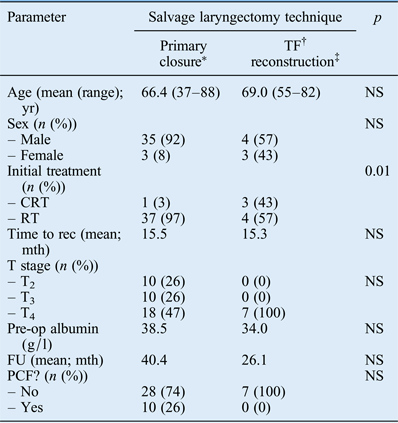
There was no incidence of pharyngocutaneous fistula in the flap reconstruction closure group (0 per cent); however, there were 10 cases of fistula in the primary closure (control) group (26 per cent) (p = 0.124).
When we examined various potentially confounding variables that may have contributed to the fistula rates, we found that the two groups were comparable. There were no statistically significant differences in age, gender, time from initial treatment to recurrence, tumour stage or pre-operative blood albumin level. Significantly more patients in the flap reconstruction group received initial chemoradiotherapy treatment, rather than radiotherapy alone (Table I).
Patient demographic and clinical data

*n = 38. †Pedicle or free. ‡n = 7. TF = tissue flap; yr = years; NS = not significant; CRT = chemoradiotherapy; RT = radiotherapy; rec = recurrence; mth = months; T = tumour; pre-op = pre-operative; FU = follow up; PCF = pharyngocutaneous fistula
Discussion
Currently, the practice of bringing fresh vascularised tissue to reconstruct the pharynx following salvage total laryngectomy is not routine. We present the first study from the UK on ‘prophylactic’ tissue transfer for the prevention of pharyngocutaneous fistula in salvage total laryngectomy.
In our series of patients, we found no pharyngocutaneous fistulas in the flap reconstruction group (0 per cent) compared with a 26 per cent rate in the primary closure group. Despite the trend towards fewer pharyngocutaneous fistulas in the flap reconstruction group, our results did not reach statistical significance because of the small sample size.
It was not possible to assess every variable that may have affected the incidence of pharyngocutaneous fistula. However, looking at our pre- and post-operative data, and from close inspection of the clinical notes of all the patients with pharyngocutaneous fistulas (in both cohorts), there were no obvious, identifiable confounding variables known to increase the risk of pharyngocutaneous fistula. The two groups were highly comparable. The only variation between the two groups was the higher proportion of patients in the flap reconstruction group who had concurrent chemoradiotherapy.
• Pharyngocutaneous fistula is often seen following salvage laryngectomy, especially if the larynx has received chemoradiation
• Flap reconstruction (free or pedicled) using fresh vascularised tissue from outside the radiation field can reduce complications
• In this study, tissue transfer following salvage laryngectomy was associated with a lower pharyngocutaneous fistula rate than primary closure of the neopharynx
Our findings are supported by some recent studies. Patel and Keni reported a pharyngocutaneous fistula rate of 0 per cent with pectoralis myofascial flap in salvage total laryngectomy (n = 10) versus 57 per cent with primary closure (n = 7).Reference Patel and Keni11 Another study reported a rate of 18 per cent with free tissue flap transfer (n = 17) versus 50 per cent with primary closure (n = 20).Reference Oozeer, Owen, Perez, Jones, Welch and Paleri12 Conversely, one study found no difference in the pharyngocutaneous fistula rates following salvage total laryngectomy between a free tissue flap group (n = 14) and a primary closure group (n = 27): 29 per cent and 30 per cent respectively.Reference Fung, Teknos, Vandenberg, Lyden, Bradford and Hogikyan13 However, in that study, patients who had free flaps to reconstruct the pharynx had no major wound complications (i.e. no surgical repair, no prolonged hospital stay and no deaths), while 15 per cent of the primary closure group did experience major wound complications. One of the largest patient series was presented in a study by Sinclair et al., who used a free flap technique to reconstruct 137 laryngectomy and pharyngectomy defects.Reference Sinclair, Rosenthal, McColloch, Magnuson, Desmond and Peters14 According to these authors, it was their use of vascularised free flaps for resections that helped to keep the rates of pharyngocutaneous fistula low (14 per cent), despite the vast majority in their series being salvage laryngectomies. Finally, a recent meta-analysis by Paleri et al., using pooled data from 7 papers and including a total of 255 patients, found that the risk of pharyngocutaneous fistula halved in patients who underwent flap reconstruction.Reference Paleri, Drinnan, van den Brekel, Hinni, Bradley and Wolf15 The relative risk was 0.5 (95 per cent confidence interval, 0.30 to 0.84); the primary closure group pharyngocutaneous fistula rate was 30.7 per cent versus the flap reconstruction pharyngocutaneous fistula rate of 16.5 per cent.
We believe that importing fresh vascularised tissue from outside the radiation field reduces the incidence of pharyngocutaneous fistula and therefore improves the operative outcomes. This greatly offsets the added time and resources necessary for reconstruction. We appreciate the additional morbidity conferred by the procedure; however, our low rates of pharyngocutaneous fistula support this strategy. In addition, there may be other advantages, such as less stricture formation, as seen by Withrow et al. Reference Withrow, Rosenthal, Gourin, Peters, Magnuson and Terris10 However, further prospective studies are needed to confirm this finding, and to assess the functional outcomes of tissue flap reconstruction in salvage total laryngectomy and patient quality of life.