In modern popular culture, it has become common for characters, stories, and worlds not only to exist in texts of a single medium (a film, a video game, a series of television episodes), but also to transcend the borders of such formats. We are routinely able to encounter the same fictional elements in different media. For illustration we need only consider multi-media franchises such as Star Trek, Star Wars, and the Marvel Comics Universe that operate across films, television, video games, comics, books, toys, and so on. Boundaries delineated by a given media format do not always hold fast or reflect the listener/viewer's media engagement.Footnote 1 The same audience will follow the franchise from medium to medium, bringing with them the legacy of their experiences from one to the other. Henry Jenkins, for instance, characterizes another media franchise, The Matrix, as ‘entertainment for the age of media convergence, integrating multiple texts to create a narrative so large that it cannot be contained within a single medium’.Footnote 2 Stories, characters and settings are transmedial when they cross borders between different media.Footnote 3 Cathlena Martin describes a transmedial phenomenon as one that ‘expands the text's scope, generating an additional primary text and expanding the boundaries of what we perceive as the narrative’.Footnote 4 In the words of Stephanie Glaser, transmediality is a useful critical perspective to ‘bring out, explore, and understand processes and the dynamic relations between media’.Footnote 5
Given that many of the media that host such franchises use music as a significant part of their aesthetic make-up (film, television, games, music albums, etc.), it behoves us to consider the role of music in such networks. How might music illuminate the relationship between constituent texts of a franchise, and act as an agent for articulating and constructing those connections? What part might music play in the media consumer's experience of a transmedial franchise?
In her research into the dynamics of transmedial franchises, Jessica Aldred notes that, ‘the boundaries between media forms . . . are rapidly disappearing, allowing consumers to enjoy the franchise in question as a seamless, immersive experience’.Footnote 6 Nevertheless, each medium comes with its own possibilities and conventions. The franchise of Beowulf (2007 film and game), Aldred argues, demonstrated a lack of consideration for such differences between media, which resulted in an unsatisfying outcome:
[A]lthough each text—and each version of Beowulf—seemed poised to make a unique contribution to the Beowulf storyworld, the franchise's insistent blurring of the distinctions between these characters and their digital worlds may have ultimately contributed to a problematic series of redundancies and excesses.Footnote 7
Here, we will consider how music links parts of a franchise, and yet can respect, explore, and respond to the differences between constituent media. While there are many high-profile candidates to serve as case studies for such an investigation, this article focuses on a rather lesser-known textual network, but one that is valuable since it emphasizes music. Here, we will explore a rock album adapted repeatedly into video games.
The study of video game music is developing rapidly, most notably through the scholarship of Karen Collins,Footnote 8 along with pioneering research by William Cheng, William Gibbons, Neil Lerner, Kiri Miller, and Roger Moseley, among others.Footnote 9 A transmedial perspective allows us to consider the role of game music in creating networks of meaning beyond its own medium.Footnote 10 Doing so recognizes the shared media culture(s) in which popular entertainment texts circulate. To begin the investigation, we start with the origin text of this case study – an album of music.
Jeff Wayne's Musical Version of The War of the Worlds: on record
One of the most significant musical memories of my childhood is that of listening repeatedly to Jeff Wayne's Musical Version of The War of the Worlds (1978). This double album, created in the wake of the progressive rock zeitgeist, uses songs and instrumental music in combination with spoken dialogue to tell the story of H. G. Wells's Martian invasion novel The War of the Worlds (1897). The album features well-known musicians and actors, including Richard Burton, Julie Covington, David Essex, and Phil Lynott of the band Thin Lizzy. While the record is presented as an auteur work by composer/producer Jeff Wayne,Footnote 11 the lyrics were written by Gary Osborne and the narration by Doreen Wayne. The record found great popularity, selling millions of copies.Footnote 12 Recent years have seen re-releases of the album and various incarnations of live performances, which have maintained the record's high-profile cultural presence, at least in the UK.
Wayne's album is a stylistic/generic hybrid. Though it is clearly conceived holistically, the label ‘concept album’ more readily invokes records with far less sonically explicit narratives and more nebulous subject matter (such as in Pet Sounds, Sgt Pepper's or Dark Side of the Moon). Ian Sapiro instead casts Wayne's album as a ‘rock non-opera’ and treats it as a British musical.Footnote 13 Neither is the album straightforward ‘rock’, fusing disco rhythms with orchestral strings, prog rock guitars and synthesizers. Its closest relatives include Rick Wakeman's Journey to the Centre of the Earth (1974) and The Myths and Legends of King Arthur (1975), which both involve narrators, orchestral instrumentation and a prog-influenced musical style. Perhaps this very genre liminality makes the album ripe for adaptation.
As a child, I would do more than simply listen to the record. I watched the hypnotic rotation of the vinyl disc, I read the liner notes (as best I could), and I studied the album cover and the large paintings in the booklet. Even in its initial format, the album is a multi-media artefact, encompassing the visual art as well as the sonic materials. Listening to the album, I would imagine how the images synchronized with the audio.
Though influenced by the visual art, my interpretation was primarily guided by the musical performance. From his voice, I imagined the fully realized character of Lynott's Parson Nathaniel. I understood the sorrow of a hopeless, derelict London from the mournful melody in ‘Dead London’. The triumphant fanfares that begin ‘Brave New World’ gave me hope for rebellion and I recoiled from the invasive Martian threat represented by the sudden con forza string figures that begin the album's music in ‘The Eve of War’. Of course, there is nothing exceptional about this kind of hermeneutic listening, particularly given the scaffold for such interpretation provided by the record's narrative structure, visual accompaniment, and verbal content. I would expect that most of the album's listeners engage with the record in a broadly similar fashion. But this is not the only format in which Wayne's music and his The War of the Worlds project can be encountered. Aside from the concerts and reworkings mentioned above, the album has also been used as the basis for several different video games.
Apart from games adapted directly from the Wells novel, or those that serve as ancillaries to films of the book, there have been three major video games directly based upon Jeff Wayne's Musical Version of The War of the Worlds.Footnote 14 These are: Jeff Wayne's Video Game Version of The War of the Worlds (1984) made by CRL for the Sinclair ZX Spectrum 48K; Jeff Wayne's The War of the Worlds (1998) created by Rage Software for Windows PC; and a game by the same title from Pixelogic, released in 1999 for the Sony PlayStation.Footnote 15
While games based on albums are hardly commonplace, The War of the Worlds games are not unique in this respect.Footnote 16 Nevertheless, this franchise is singular in the number and historical range of the adaptations. With its diversity of materials and focus on audio, Wayne's The War of the Worlds is useful for exploring the role of music in a transmedial franchise.
Jeff Wayne's Video Game Version of The War of the Worlds (1984): ZX Spectrum
The first game of the album was for the ZX Spectrum, a home computer that was first released in 1982. Though popular, the ZX Spectrum was not sonically advanced: as Kenneth McAlpine describes, ‘the speaker, which provided just a single channel of 1-bit playback across a 10-octave range, could only make “beep” sounds’.Footnote 17 Aside from exceptional examples, music for Spectrum games typically consisted of monophonic square-wave melodies. Despite this technological restriction, the Spectrum The War of the Worlds clearly replicates music from the album. Indeed, all the cues in the game take the form of short quotations of Wayne's music. These excerpts are sonically distinct and easily identifiable. The musical material serves an important role in how gamers play the game; this is made possible by intertextual transmedial musical meanings.
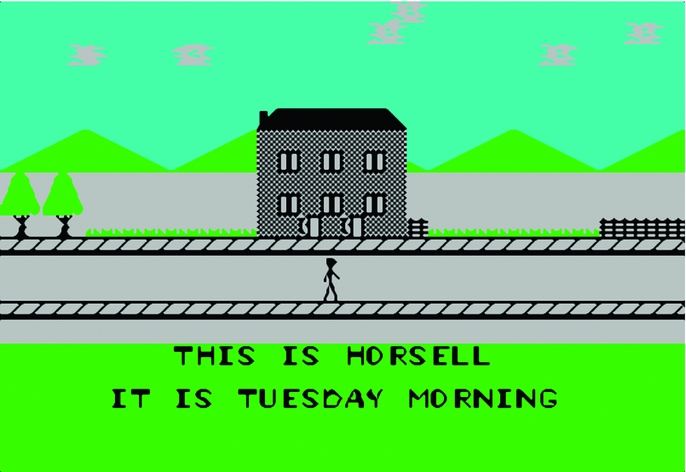
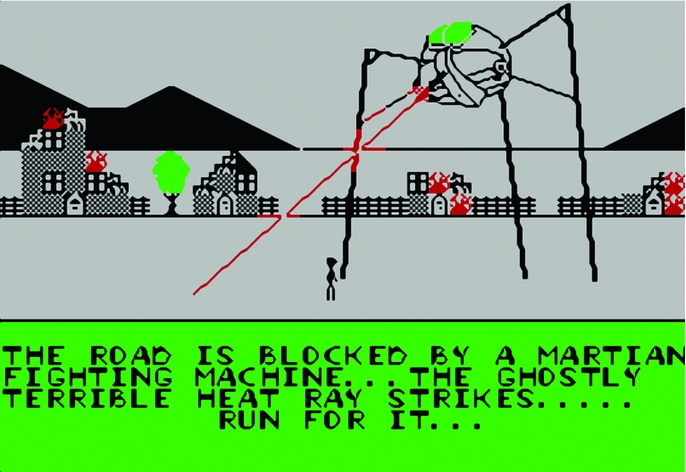
In The War of the Worlds game, the player controls The Journalist (the central character voiced by Richard Burton in the original album). The Journalist must navigate the maze-like streets of Surrey and Greater London, while collecting and consuming food and drink to survive (Figure 1). The Martian tripods sometimes ambush The Journalist, whereupon the player must direct the avatar to flee, lest the ‘heat ray’ incinerate the hero (Figure 2). Through exploring the roads, players discover the locations of key narrative events and musical episodes in the album, such as the harbour from which the narrator observes a naval battle (the album song ‘Thunder Child’) or the house in which he encounters Parson Nathaniel (‘Spirit of Man’). Time passes in the virtual world, and the game is set across six days beginning on Monday 14 August 1904.Footnote 18 By learning the geography of the virtual London, the player must visit the right location on the correct day to avoid death at the hands of the Martians. Upon reaching a location on the appropriate day, players are presented with on-screen text describing the scene at that site. From a set of options, they must choose The Journalist's next actions. To progress, the player must select the option that matches the events in the album.
The streets of Greater London in Jeff Wayne's Video Game Version of The War of the Worlds for the ZX Spectrum.

Martian tripod fires at The Journalist in Jeff Wayne's Video Game Version of The War of the Worlds for the ZX Spectrum.

Listening to win
The secret to understanding when each location should be visited relies upon the player's knowledge of the album. As the instructions for the game (printed in the cassette inlay) describe:
Each location must be visited in the correct sequence and on the right day in order to reach the Martian encampment on the seventh and so complete the game. To aid you the special locations to be visited are featured in their correct order in Jeff Wayne's Musical Version of ‘The War of the Worlds’. Musical phrases also from the recording will help you on your journey.
There is no explicit guidance in the game to indicate the order that the locations must be visited, and since Wayne's narrative sometimes departs from that of the novel, the only reliable source of information is the LP. The gamer familiar with the album knows that the encounter between the cannon artillery and the fighting machines at Weybridge must occur before The Journalist reaches his lover's deserted house, and that both happen prior to meeting Parson Nathanial, because of the order in which the musical episodes occur in the album.
Even with knowledge of the album's narrative, the issue remains just how the LP's chronologically ambiguous timeline maps onto the days in the game. The answer is supplied musically. While navigating the streets, the player can press a key to display the current date and time. This is accompanied by a short musical quotation from the album which hints at the location The Journalist should now visit. On Wednesday, for instance, when the goal is ‘Carrie's House’ (the house of The Journalist's lover), a motif from the introduction of ‘Forever Autumn’ sounds, the song in the album that begins when The Journalist reaches Carrie's house. Similarly, when players should direct their avatar to Weybridge, they hear the chromatic bass ostinato that is prominently featured during the introduction to the same sequence in the album. By listening to the motif, identifying it, and remembering the associative meaning and context of the musical fragment in the album, the player is given a hint as to the appropriate action they should undertake to win the game. These quotations also serve as rewards: as players successfully progress through the game, they are treated to hearing new excerpts of the album rendered in the Spectrum's tones.
The musical material from the album is given ludic significance in the game context, facilitated by the meanings created in the origin text and transferred across media. Without engaging with the LP's narrative and music, the game is reduced to trial and error. As one contemporary reviewer noted, ‘the only way to find out the order of places to visit is to buy the record’.Footnote 19 Since any mistake causes the whole game to restart, if the player does not have experience of the album to draw upon, the game is, in all practicality, unwinnable.
Later in the game, the musical hints become more ambiguous, and as a result, the game becomes more challenging – in the final days, the chromatic motif associated with Weybridge returns, even though it is not heard prominently during the corresponding section of the album. The game misleads and confuses players, given that they have been trained to divine information from the music. Not only are musical associations used by the game, but they are also subsequently misused, increasing the game's difficulty.
Since the game relies on the player's knowledge of the album, a gamer might need to revisit the record and listen differently to meet the game's challenges (perhaps by following the plot in detail at certain moments, or attempting to identify musical material). We can also recognize the commercial aspect of a product that so strongly encourages the ownership of another item from the same franchise.Footnote 20 Listening to music from Wayne's The War of the Worlds, both on record and in game, is part of how gamers play the Spectrum game.
Aesthetics of alienation
The Spectrum game has a sparse soundscape: most of the game occurs in musical silence. During play, cues are prompted only by the ‘check time’ command, or the player's success/failure. To use Collins's terminology, the music is primarily ‘interactive’, since it responds directly to player actions, providing a degree of musical agency to gamers, and creating a bond between game and player.Footnote 21 The game's musical silence, while undoubtedly a technological convenience, also projects a form of sonic isolation that is apt for the solitary journalist. When the musical excerpts stop, the sudden absence is striking. Michel Chion has described the phenomenon of musical silence in audio-visual contexts, noting that,
the impression of silence . . . does not simply come from an absence of noise . . . The simplest of cases consists in preceding it with a noise-filled sequence . . . It is the negative of sound we've heard beforehand or imagined; it is the product of a contrast.Footnote 22
Discussing another game with significant musical silence, Shadow of the Colossus, William Gibbons writes, ‘Faced with extended periods of musical silence . . . players can become acutely aware of their own solitude.’Footnote 23 He suggests that, as a result, ‘players create a strong bond’ with their avatar, and are given reflective space to consider their in-game actions.Footnote 24 He reports, ‘the music comes as a welcome relief from the extended diegetic silence . . . allowing me . . . to focus on the external threat rather than internal doubts’.Footnote 25 The same holds true in the Spectrum The War of the Worlds. The sonic strategy connects my experience of playing as The Journalist with the same character in the album. On the record, The Journalist increasingly despairs at his own isolation and lack of will to survive. When I am playing as this character, the silence accentuates the alienation of my lone figure; it makes me consider the powerful alien forces that lurk around every corner and the likelihood of my avatar's demise. Paradoxically, musical absence creates an affective mood entirely in keeping with the album.
Wayne's album does not follow the filmic trope of a dissonant, unconventional, or ambiguous harmonic musical language to portray alien threats, as in, for example, The Thing From Another World (1951), The War of the Worlds (1953), Little Shop of Horrors (1960), Planet of the Apes (1968), or Alien (1979). Rather, it is timbre that is the most obviously alien element of Wayne's soundscape. The synthesizers foreground their alterity as obviously artificial and unfamiliar. Common electronic instruments, such as the electric guitar, are treated to significant sonic manipulation to emphasize alien-ness in contrast with the acoustic instruments and human voices. Electronic timbres here evoke alien alterity, as in the tradition of The Day the Earth Stood Still (1951), The Thing From Another World, It Came from Outer Space (1953), and Forbidden Planet (1956). One recurring motif, a descending octave figure (Example 3, b. 1), sounds with portamento in a sonorous open timbre, approximating a Theremin: the quintessential signifier of alien invasion. While the Spectrum cannot replicate the album's instrumentation, its stark synthesized square waves still stand as electronic, artificial timbres, at least partly maintaining the technological alterity used in Wayne's music.
Winning and losing: recontextualizing musical material
Beyond music for the ‘time check’ command, the game also uses melodic excerpts from the album to serve as cues typically found in video games. This constitutes music for starting the game, along with ‘win’, ‘lose’, and ‘game over’ cues. These types of cues are commonly identified by composers as part of the musical grammar of video games.Footnote 26 As in the ‘time check’ quotations described earlier, these melodies draw upon sonic meanings forged in the album, which are used and reframed in terms of the gameplay. This process can be straightforward, such as aligning the start of the album with the start of the game: when the game has been successfully loaded, the player is greeted by the opening melody of ‘Eve of War’, the first music of the album. For the other cues (win, lose, game over), the relationship is based on different factors.
Upon escaping a Martian tripod that fires after my avatar (Figure 2), the fanfare figure that opens the album song ‘Brave New World’ celebrates, and confirms, my victory (Example 1). As the title implies, this song is an optimistic expression for a hopeful future in the face of the Martian invasion – apt for a moment of success in the game. If, however, my character succumbs to the Martian weapon, and I lose, I hear a chromatic motif associated in the album with the Martian ‘heat ray’ (the direct cause of my avatar's death, Example 2). After a brief pause, a ‘game over’ screen borrows another melodic fragment from the album, a descending octave sequence that is associated with Martian dominance (Example 3). As Zach Whalen writes, on the ‘lose’ music in Super Mario Bros. (1985):
The music is a coded message of failure . . . Considering an entire level as musical composition, ‘death’ or ‘success’ musical messages serve as cadences . . . In these ways, music works across a game's structure to encourage the user's continued play.Footnote 27
The fanfare motif from the album song ‘Brave New World’, which serves as a ‘win’ cue in the game. Example shows Spectrum version, sounding a major third higher than the album.

The ‘Heat Ray’ motif from the album song ‘Horsell Common and the Heat Ray’, heard after the narrator describes the heat ray, and which serves as a ‘lose’ cue in the game. Example shows the Spectrum version, which sounds at the same pitch as the album, but with an irregular metre: the album version is metrically aligned in a steady 4/4 metre.

The ‘Game Over’ cue, which features a descending motif associated with the Martian invasion (bb.1, 4). The album often sounds this motif in isolation, but other times with an intervening figure rendered in the game as bars 2–3. The pitch and rhythm is the same as the album version in these outer phrases but the middle phrase has been rhythmically and metrically altered from the album, where it is aligned to a steady 4/4 metre.

The cues in The War of the Worlds game serve the same function, by drawing on the musical meanings forged in the album and recontextualizing them in the game, which in turn bestows upon them game-specific connotations.
The musical connection opens the possibility of subsequently re-hearing the album in light of the game. The album ends with the suggestion that the Martians are planning another attack. Burton's narration finishes with the words,
It may be that across the immensity of space, [the Martians] have learned their lessons and even now await their opportunity. Perhaps the future belongs not to us, but to the Martians.
The following final track of the album is an ominous epilogue that depicts NASA losing contact with an expedition to Mars. This concluding music is saturated with the descending octave sequence shown in Example 3 that serves as a ‘game over’ cue. Re-hearing the album after the game, beyond the ambiguous ‘perhaps’ of Burton's narration, it can imply that this second invasion will be successful: Earth has ultimately lost the ‘War of the Worlds’. It is, for us humans, ‘game over’.
Transmedial dialogue through music
The War of the Worlds illustrates how video games can use music to bring other media texts to bear upon graphically (or otherwise) limited gameworlds. The music, narrative context and characterization of the album are invoked by the game through musical reference. The musical quotations are easily recognizable, even though the rhythms and tunings have been subtly changed in transition from album to game. This alteration is likely a by-product of programming the music by defining time and frequency in terms of computer processor cycles and Hertz.
Neil Lerner and William Gibbons have illuminated the long tradition of musical quotations in video games, which often take the form of fragments of well-known ‘art music’.Footnote 28 However, as Karen Collins notes, prior to the widespread use of acoustically recorded music in games, when pop songs were included in games, ‘In most cases, vocal melodies were replaced by another instrument, and the original song construction had to be altered considerably to fit the constraints of the technology.’Footnote 29 The War of the Worlds album is well suited to the demands of adaptation, since so much of the album is instrumental (thus not requiring vocal parts to be reassigned) and it includes repeated melodic phrases which can be easily excerpted without resulting in obvious structural alteration.Footnote 30
The monophonic melodies of the game call to mind the fully orchestrated songs, along with the story, characters, and artwork of the album. The simple visuals and audio of the game are enhanced by association, bringing to bear a detail of sound and sight from the album that the Spectrum could not deploy. The conduit, however, works both ways. When players are forced to engage with the record, the game is able to comment, in turn, back upon on the album.
Beyond localized reinterpretations (like the album's ‘game over’ ending discussed above), this dialogue may manifest more generally in terms of geography and chronology. While the album refers to real-world locations in London, and the stereo mixing of the album projects a sonic space, the virtual London created in the game is more explicitly defined and stable than the fluctuating spatial panning and mixing of the album.Footnote 31 Re-hearing the album after playing the game can situate the album's events in the spatial relations described by the game's universe. As media theorist Torben Grodal notes, gamers must normally ‘make mental maps of the game-space’ and engage in ‘explorative’ activity when playing the game.Footnote 32 This is especially true when the game, such as The War of the Worlds, uses navigating a maze as a central part of the ludic challenge. Kiri Miller and William Cheng have both shown how games can allow players to associate pre-existing music with particular places in virtual game spaces.Footnote 33 In The War of the Worlds, the listener familiar with both the game and the album can amalgamate the two modes of projected geography from the two media, fusing the sonic space of the album with the virtual space of the gameworld. Similarly, the album's ambiguous chronology is given precise definition in the game adaptation, and in which terms it might subsequently be understood.
It is part of the appeal of transmedial franchises that different media provide the opportunity to engage with familiar materials in new ways. In the Spectrum game, music from the album gains ludic significance, allowing new modes of interpreting and interacting with the music, both in-game and on record. Music is a significant part of the connection of the franchise components, facilitating the intertextual play of musical meanings that extend across media. Fourteen years later, the same kind of transmedial relationship was explored again, but with very different sonic and ludic results.
PC and PlayStation games of the 1990s
The twentieth anniversary of Wayne's The War of the Worlds prompted renewed activity surrounding the project. Aside from re-releases on CD and MiniDisc, two video games were published in quick succession. Both named Jeff Wayne's The War of the Worlds, one was for PC (December 1998), the other for the Sony PlayStation console (November 1999). In the intervening years since the Spectrum The War of the Worlds game, there had been an important technological innovation: with the rise of the CD-ROM format as the dominant gaming medium for PC and PlayStation, developers now had the option to easily include recorded music in games.Footnote 34 Rather than programming games with code for the computer to produce synthesized sound, designers could instead directly include substantial amounts of recorded music in the game, stored either as soundwave data or encoded on the disc in the same way as an audio CD.Footnote 35 It is these advances that would ultimately allow game series such as Grand Theft Auto (1997–2013) and Guitar Hero (2005–15) to include pre-existing recorded popular music as a significant part of their appeal and audio-visual aesthetic.Footnote 36 Designers for the 1998/99 The War of the Worlds games could have used this technology to simply import music from the original album directly into the game. Instead, however, the games transform the music as it moves between media, in the process, articulating the textual relationships and responding to media differences between the games and the album.
Jeff Wayne's The War of the Worlds (1998): PC
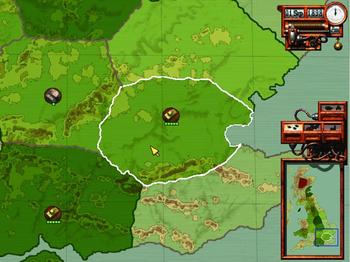
The PC The War of the Worlds is a strategy game. Much like board games such as Risk, the player directs military units on a battlefield to achieve given strategic objectives. In the game, players can choose to control the humans, defending against an invasion, or the Martians perpetuating it. The music the player hears depends on the side the gamer selects. There are two modes of play in the game – map view (Figure 3), used to direct military units across the United Kingdom, and the close-up battlefield view (Figure 4), in which the direct combat takes place. The central gameplay is framed by non-interactive videos (cutscenes) shown at the start and end of the game, as well as menus and win–lose screens that report on the player's achievement.
Map view in Jeff Wayne's The War of the Worlds for PC.

Battle view in Jeff Wayne's The War of the Worlds for PC.

Remixing the ‘War’
During gameplay, the music is streamed directly from the CD-ROM, encoded in the same way as an audio CD. Indeed, if the game disc is inserted into an audio CD player, music from the game can be played just like an album. Two cues play alternately in map view, and another two play in turn during battlefield view. This set of four cues is different, depending whether the player is commanding the humans or the Martians. In each case, the cues are electronic dance music remixes of songs from the album.
A remix, in Virgil Moorefield's definition, is a recording one that ‘takes a[nother] recording and re-orders its elements, often adding additional tracks’.Footnote 37 Here, each of the cues is a remix of a specific song from the album, recast as a dance music track. The style is similar to mid-1990s techno-influenced electronica by artists such as Orbital. Elements from an original song are sampled, looped, and filtered throughout the five-minute duration of each cue. To use Serge Lacasse's terminology of autosonic and allosonic quotation, in which the former represents the reuse of recorded material, and the latter the re-rending of pre-existing music, the citation here is autosonic.Footnote 38 Alongside this original musical material, new drum loops and synthesizer parts are added. Because each cue selects a different song as the source of the samples, and introduces the sonic elements in a similar order to the original track, these cues are heard as remixed album tracks, rather than new compositions that feature samples from the LP.
There are several possible motivations for remixing the music. The contemporary style of the remix mitigates the risk that 1970s music might sound unflatteringly old-fashioned or incongruous alongside the new game technology. Additionally, as Gibbons notes, ‘the relationship between electronica and the technological visualization of music is a longstanding one’,Footnote 39 and during the mid- to late 1990s, video games had established a particularly strong connection with electronic dance music culture. In the West, the PlayStation was promoted by placing consoles in nightclubs, and one of the launch titles for the console (in US/EU territories), the futuristic racing game Wipeout (1995), featured music by major electronica artists.Footnote 40 For contemporary players in 1998, electronica had distinct associations with modern video gaming.
The remixes in The War of the Worlds remove spoken and sung words from the songs. This change avoids potential sonic interference with the voices in the game that report important information to the player about the progress of the war. It is also possible that with a small selection of cues heard repeatedly by the player, obvious ear-catching lyrical content might accentuate the repetition of the music, increasing the risk of listener fatigue.Footnote 41 These issues relating to the age of the material, sonic interference, and repetition are practical concerns that stem from the reframed position of music in its new modern media context.
The change of musical genre reflects the relationship between the game and the album. Given that the album articulates the progression of its story through the songs, if these songs were to be inserted into the game unaltered and heard multiple times, the impression would be one of repeating the same sequence of narrative time. Such repetition would be mismatched when set alongside the continuing progression of fictional time in the game. The album's duration is 95 minutes, while a strategy game is expected to provide many hours of play time. If the main gameplay is to be continuously accompanied by the album's music, a degree of structural alteration will be necessary to avoid narrative-chronological dissonance.
Beyond the issue of wholesale repetition, the question of structure remains. The tracks of The War of the Worlds present a developing narrative – such as the Parson's increasing mania (‘Spirit of Man’), the sea battle at the harbour (‘Thunder Child’), or the sequence of events when The Journalist encounters the Martians at Weybridge (‘The Artilleryman and the Fighting Machine’). As Sapiro describes, ‘Wayne uses the musical material to maintain the narrative and guide the listener through the story . . . there are often long passages with no dialogue or lyrics in which music is the sole storytelling element.’Footnote 42 This kind of fixed linear narrative development would be ill-suited to accompanying gameplay where players are able to impact upon the outcome and progression of action. Interactive video games typically seek to emphasize player agency, so presenting the unaltered set sonic progression of Wayne's album is likely to be at odds with this agenda.
The demands of the game medium often encourage composers to produce units of music that are not governed by goal-oriented formal designs. Game composer Winifred Phillips reports, ‘[T]he integral philosophy of traditional music composition is in direct opposition to the demands of linear composition for games.’Footnote 43 Phillips describes five compositional techniques for writing game music that is designed to be heard repeatedly:
1. ‘Perpetual development’ (thematic material treated to continual development).
2. ‘Compositional dynamics’ (contrasting affects throughout the cue).
3. ‘Succession of variations’ (episodes of variation).
4. ‘Repeating figures’ (ostinatos).
5. ‘Slow textures’Footnote 44 (slow rate of gradual textual change).
While these features are not exclusive to any one musical genre, electronic dance music easily accommodates the properties. Both Philip Tagg and Stan Hawkins have noted that electronic dance music is, structurally, distinctly different from both Western art music and rock.Footnote 45 As Mark Butler summarizes, modern dance music typically involves loop-based structures founded upon textual and rhythmic change, enacting a gradually accumulative form through mutating and/or layered ostinatos.Footnote 46 Rick Snoman explains that, ‘Although dance music is heavily based on repetition, it retains interest building and releasing the groove. This is achieved by adding and removing sonic elements throughout and by gratuitous use of filters.’Footnote 47 There is a clear similarity between the descriptions of dance music and the game-appropriate methods of composition that Phillips advocates: both involve iterative processes based on repetition and utilize a primarily episodic form.
In the Spectrum game, music only sounds in immediate response to player commands or actions. The PC game's remix cues, however, sit as a sonic backdrop to play, and continue without reacting to the minutia of the player's progress. It has a degree of what Chion would characterize as ‘anempathy’. The music might be generally apt for the dramatic premise, but it ‘progress[es] in a steady, undaunted, and ineluctable manner’,Footnote 48 irrespective of the player's specific actions. This is partly a result of the decision to program the in-game electronica cues as high-quality audio encoded directly on the CD. As Aaron Marks explains, ‘This gives [players] great sound that never gets near the processor’,Footnote 49 but, in the words of Michael Sweet, ‘The streaming of game audio from the disk meant that the music had almost no interactive characteristics at all, except to stop and start the music.’Footnote 50 When Claudia Gorbman says of anempathetic music, ‘Music doesn't know, couldn't know’,Footnote 51 this is here manifest literally in the game programming, where there is no transfer of information from the progress of gameplay to the musical controls, until the win–lose outcome of battle. This is not uncommon in games: K. J. Donnelly notes that, ‘music can often appear indifferent to development in games’ and he argues that ‘the indifference of musical destiny [serves] as a reminder of the cold logic of the game's progress’.Footnote 52 The music for the PC The War of the Worlds invokes the narrative context and the brooding atmosphere of Wayne's album, importing it to the gameworld. The score, however, remains one-step removed from the specific actions of gameplay, preferring to accentuate the premise and general aesthetic style of the game.Footnote 53
As Wayne's original music moves from the album to this new environment, it is tailored to serve as continuous background music for gameplay. By excerpting distinctive sonic materials from The War of the Worlds songs, the music for the game can be refashioned into an alternative musical form that better matches the new interactive media context. Yet a clear sonic connection is maintained to the story, characters, and narrative conceit of the original album through the prominent samples.
Reframing the narrative
The transformation of Wayne's music into dance music is not the only adaptation that occurs in the game. A different approach to transmedial change is evident elsewhere, when the music serves other priorities.
Framing the main gameplay described above, non-interactive videos (cutscenes) introduce and conclude the game. These cutscenes, as is typical for games, are concerned with presenting a narrative context for the core gameplay. However, while the story and universe of Wayne's The War of the Worlds are to be invoked to form a background for play, the game must not remain too wedded to the established narrative. Instead, a middle-distance of connection between the stories of the album and game is articulated. This is motivated by two main factors – first, the plots of the game and album are slightly different, and second, as argued above, implying direct equivalence of the narrative progression of the game and album might diminish the impression of player agency.
In the PC game, the plot is rewritten: after unsuccessfully attacking London, the Martians begin a second offensive from Scotland, conquering southwards. With the exception of The Journalist, characters from the album are not depicted. Unaltered music from the album would sonically represent a conflicting narrative with characters who are absent, and imply the foregone conclusion of a human victory (dooming gamers playing as Martians to failure). Unlike the gameplay music, which aimed to obviate narrative progress, these videos establish the premise and require narrative momentum. Rather than dance remixes, the music is instead altered through interpolating allosonic citations of music from the album with newly written material, to articulate the divergent narrative of the game.
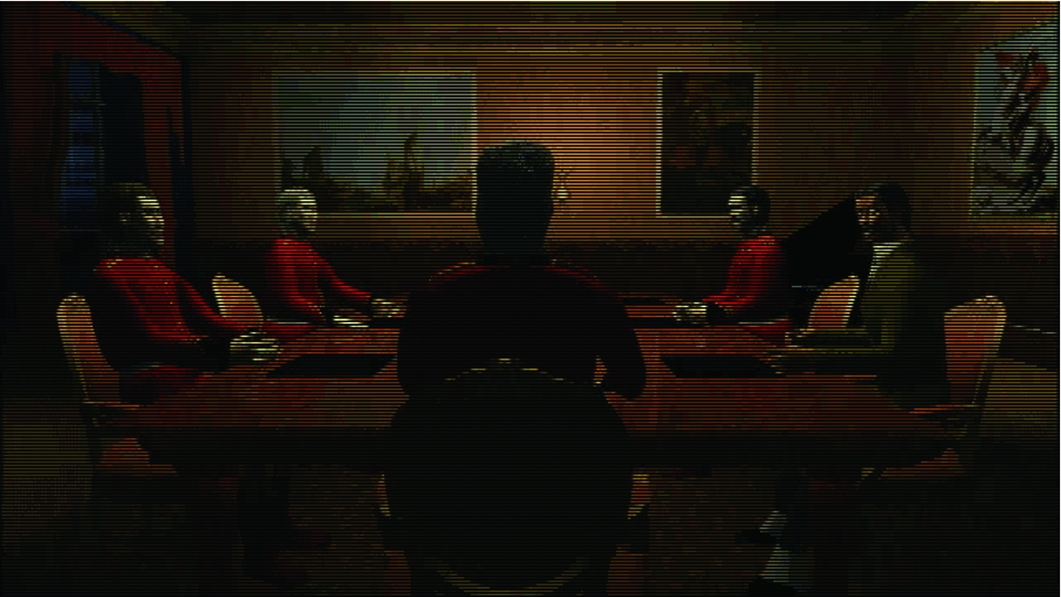
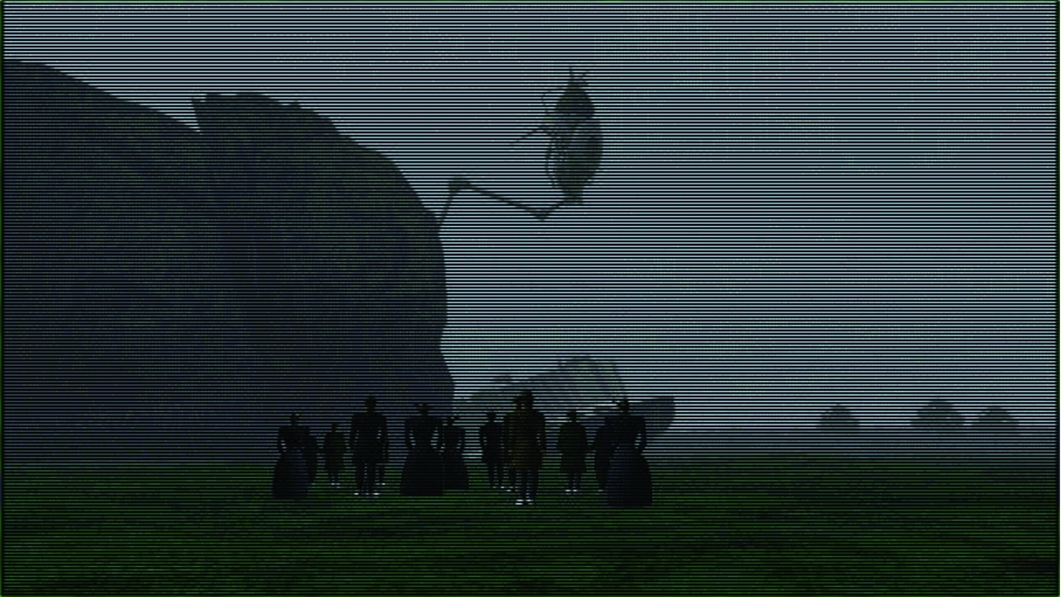
A clear illustration of the process is found in the opening cutscene when playing as the humans. In this clip, The Journalist reports his observations (using parts of Burton's narration from the album) to a room of military personnel (Figure 5). As he describes the events, they are shown to the player in flashback.
The Journalist (right) reports his eyewitness account to military leaders in the opening cutscene of the human game of Jeff Wayne's The War of the Worlds for PC.

The cue sets familiar materials from the album alongside new musical material, creating an amalgam that articulates the textual status of the PC game in relation to the original album narrative. Underscoring scenes of The Journalist speaking with the generals, the cue begins by borrowing the prowling chromatic bass guitar ostinato from the opening of ‘Horsell Common and the Heat Ray’, though now at a faster tempo and played by low strings. Over this familiar musical ostinato, we hear newly written martial music for snare drums and tutti brass interjections. The cue also borrows two other distinctive musical elements from ‘Horsell Common’: an ominous tremolo vibraphone part and a startling two-note portamento string gesture that either rises by a fourth or descends by a fifth. Though the military topic is new, for those who know the original album, the excerpts are recognizably familiar. Once, however, the flashback sequence begins, during which the Burton-voiced narrator reports about the initial Martian attacks, the music is entirely new and contains no clear quotation from the album. Over an arpeggiated accompaniment by a synthesized harp, sustained strings and horns provide a sonic foundation for Burton's narration. Soon, tubular bells and a choir are added. This section approaches a film score idiom, dissimilar to the rock/disco musical style of the album. When Burton's voice describes the Martians emerging from the ships (Figure 6), however, the album and game musically converge again. The game replicates music from the same moment in the album, though with the addition of the snare drum introduced at the start of the cue. It is not long before the game musically diverges once again, and the rest of the cue continues in much the same fashion – borrowing and manipulating material from the album, integrated into a composition that also includes music that is clearly original.
‘Suddenly, the lid fell off.’ Game and album musically re-converge in Jeff Wayne's The War of the Worlds for PC.

The music announces the game's connection to, and yet distinction from, the album. Familiar musical materials are set alongside new music, as the two texts are held at a middle-distance from one another: connected, yet not entirely equivalent.
Adapting music for the game medium
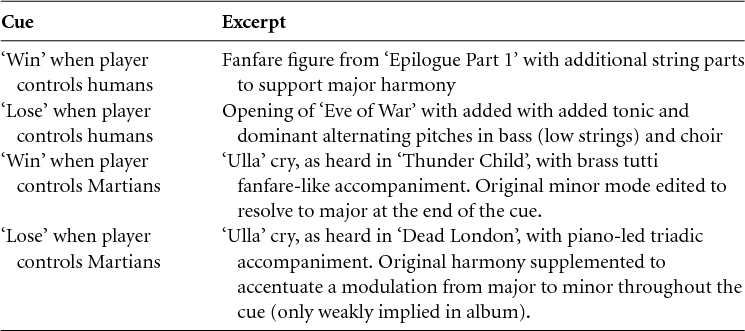
Like the Spectrum game, excerpts from the album are also used to serve as cues specifically demanded by the game medium – here, win music, lose music, and cues to cover the loading of the game. The win and lose cues are taken from moments in the narrative when the belligerent forces experience success or failure (Table 1). When playing as the humans, the win music is excerpted from the human victory at the end of the album (‘Epilogue Part 1’), while the lose music is associated with the initial Martian invasion (‘Eve of War’). For the Martian mode, the win music is from the moment that the Martians most obviously demonstrate their military power (‘Thunder Child’) and the lose music from when the Martians succumb to the bacteria that will ultimately best them (‘Dead London’). In these latter two cues, musical changes are made in order to adjust to the new narrative alignment of the game when the player controls the Martians. By altering the harmonic articulations of both excerpts from the human-championing album version, Martian dominance is made positive, their defeat negative. This reconfiguring of album music is necessary, especially for the Martian win cue, to reflect the interactive possibilities of the game: the original narrative perspective of the LP contradicts the game's ludic win–lose dynamic when gamers play as the Martians.
Win and lose cues in Jeff Wayne's The War of the Worlds for PC

The PC game includes music to cover the time while the player waits for the game to load. Michiel Kamp describes loading screens as ‘elevators’ between the options menus and the main gameplay.Footnote 54 Composer Stephen Baysted explains that the loading phase is when
all of the component elements necessary for gameplay are gathered together and compiled by the program. During [loading], the player has no control or possibility of interaction; they are simply spectating at this point. It is important to note that the duration of the [loading] phase is essentially indeterminate . . . This inter-platform indeterminacy has, of course, a significant impact on any musical strategy too.Footnote 55
Baysted reports that composers often use short looping cues to account for this indeterminacy of time, and to avoid using system resources otherwise required for loading the game.Footnote 56 In The War of the Worlds, this loading music is excerpted from the album. A different loading cue is used, depending on whether the gamer is playing as the Martians or humans, and it is chosen both for its associations with the appropriate species and for its ability to be looped easily. The human loading cue loops the percussion opening of the ‘Epilogue’, while the Martian loading cue repeats the end of the ‘Eve of War’, where the descending octave figure (see Example 3) is repeated over a heartbeat. The two cues exhibit three important qualities. First, both are heard at moments in the narrative where the respective forces achieve some kind of success (the defeat of the Martians by the humans, and the initial Martian invasion, respectively). Second, the excerpts represent a musical unit that is musically self-contained (for the humans, four bars, the Martians, seven bars). This arrangement allows the clips to repeat as much as necessary, until the game loads. Third, since both passages directly repeat in the album, the musical repetition in the game is not as conspicuous as it might be if material only heard once on the LP was used. Here, properties of the video game (the loading screen and its temporal indeterminacy) have guided the selection of appropriate moments from the album to be fit for purpose in this new media context.
Rehearing the album
Just as in the Spectrum example, when the PC game cites, develops, and recontextualizes Wayne's original music, this musical connection can influence interpretation of the original album. Justin Williams has explored how such sampling and reconfiguration allows for intertextual dialogue, and that ‘These musical “conversations” can therefore occur between the present and the past’.Footnote 57
To explore just one example of such potential reinterpretation, we can consider the opening cutscene of the Martian campaign (the counterpart to the human opening video described above). The cue uses musical materials from the latter half of the album, especially the song ‘The Red Weed (Part 1)’.
In the album, slow-tempo, mournful themes accompany The Journalist's observations of a conquered London, and his despair at the Martians’ apparent victory. A particularly prominent motif (Example 4) is heard in a whistle-like timbre that seems to connote The Journalist's hopelessness and isolation in the face of Martian dominance. It might even be his whistle we hear.
Whistling theme from ‘The Red Weed (Part 1)’. It sounds in the same key in both album and PC game.

The game, however, provides a different perspective on this theme. The cutscene depicts the Martians on their Red Planet, planning the invasion with all their military might. The ‘whistling’ theme sounds (along with other materials from the song), but here played in a quick tempo, as part of a bombastic cue that sounds like a pastiche of ‘Mars’ from Holst's Planets. Far from being associated with the humans, it is instead obviously connected with the Martians. Now, rehearing the album in the light of the game's association of the theme with the Martians, we gain another perspective. Unlike the powerful, assertive statement of Martian power in the invasion cutscene, it is meek and isolated. It appears now in the album, not as the desolate response of the humans, but an expression of the dying, weak Martians who, despite the impression of dominance, have already started to succumb to the earthly bacteria that will halt their invasion. This kind of reinterpretation testifies to the two-way communication in musical adaptation and citation that should not be understood simply in terms of ‘original’ and ‘derivative’.
Given that players do not have to consult the album to play the PC game effectively (unlike the Spectrum game), and the chronological distance between the album release and the game publication, it is clearly possible that at least some players would encounter the game before the album. For these players, the game has already informed their understanding of the album. From such a perspective, the album can be understood as just as much an adaptation of the game, as vice versa.
Throughout the PC game of The War of the Worlds, musical material is used to at once articulate connection with, yet distance from, the original Wayne album. The remixing and developmental musical processes are part of the way this textual relationship is communicated. As music moves from one medium to another, the music is excerpted and adapted to respond to the new context: in-game remixes alter musical structures, small motifs are selected to serve as winning and losing cues, and loading music is chosen by the necessity to have short, looping, and narratively appropriate cues. The revision of the album's plot, as well as the developers’ choice to allow players to control human or Martian forces, necessitated a degree of musical reworking to match the game's divergence from the fixed original story and perspective of the album.
This game adaptation of the album also, in turn, prompted a further album. According to Wayne, the remixing process for the PC game inspired a new record of electronica remixes of The War of the Worlds album, called ULLAdubULLA – The Remix Album (2000).Footnote 58 This record featured well-known dance music artists such as Apollo 440 and Todd Terry as well as some re-recorded versions of the remixes created for the game. The ULLAdubULLA record is a neat reversal of the original direction of transmedial transfer from album to game. The PC game remixes, however, also have another legacy, found in the PlayStation The War of the Worlds game of 1999.
Jeff Wayne's The War of the Worlds (1999): PlayStation
The PlayStation The War of the Worlds game uses many of the same materials as the PC game, including some of the music. Unlike the PC version, this is a vehicle-based shooting game. The player must command the humans, and, using a variety of military vehicles, traverse three-dimensional landscapes to shoot at invading Martian machines. The player controls one weapon at a time (Figure 7).
Gameplay in Jeff Wayne's The War of the Worlds for PlayStation.

The game uses the same opening cutscene from the human mode of the PC game (replicated with the music intact). The arguments made above concerning the narrative reframing of the game hold true for the PlayStation version. During the main gameplay, dance music cues from the PC game are heard. They serve the same function of adapting the musical structures to the gameplay context. The legacy of the music's use in a previous game, however, creates an additional interpretive frame. The two games could be understood as multiple compatible modes of engagement with the same scenario; this might be interpretively enriching for players, but it also has the potential for confusion.
Confusion on the battlefield
Whereas in the PC game, four ‘remix’ cues were associated with the humans, and four with the Martians, this game simply sounds seven of the total eight as a playlist, with no distinction between the two.Footnote 59 In the PlayStation game, the only option is to control the humans, so, for players familiar with the PC version, it might be incongruous to hear music that had accompanied commanding the Martians on PC. For these players, mismatched music is heard, though this specific connotation only registers for players with experience of the PC game.
A similar issue occurs with the win and lose cues for the PlayStation. Again, the music is taken from the PC version, but here, they have suffered in the transition, and are of very low audio fidelity. The sonically fuzzy cues are mixed unusually quietly. Surprisingly, the win and lose cues are the PC Martian win and lose: the ‘wrong’ side. Even if the player does not know the PC game, the signification in the cues remains incongruous: a Martian ‘Ulla’ exclamation with a brass fanfare still sounds like a celebration, but of Martian prowess, indicating human loss. Similarly, it seems curious that a wailing, pained Martian cry should accompany human defeat, when the Martians in the game have just achieved victory. The degree to which this might be recognized as odd is contingent on the player's past experience, whether they are familiar with the PC game, album, or neither. Even a newcomer to the franchise might find it counterintuitive to have an alien voice apparently celebrating human success, though the musical mismatching is less specifically out of place than when heard in light of the album and PC game.
The example of the PlayStation game illustrates that the player's previous experience of the franchise – whether or not they have encountered the original record or the PC game – has the potential to significantly affect their interpretation of the music. Any consideration of musical transmediality has to account not only for textual relationships, but also the order in which they are encountered (or not) by media consumers.
Conclusions: music in the transmedial franchise
Jeff Wayne's War of the Worlds might not have the fame or economic power of some transmedial franchises. Nevertheless, the audio-emphasizing nature of this franchise has provided a way to investigate some of the dynamics of music in a transmedial network. The games clearly highlight how music and its attendant meanings are drawn across media. The producers of the Spectrum game relied upon this possibility as part of the central play mechanic of the game – even in the relatively early years of video gaming (1984), players were expected to be able to listen between media. While the historical order of the creation of these texts might be clear (i.e. album created before game), and imply a simple unidirectional relationship from original to derivation, this does not necessarily reflect the listener/player's experience of the network. This model of ‘original’ to ‘derivative’ is found wanting in two senses: one, simply, the player might encounter the game before the album, and second, these subsequent ‘derivative’ games are able to reflect back upon the originating text, influencing the player's understanding of the album, such as in the reinterpretations of the album prompted by the ‘game over’ in the Spectrum game and the Martian opening in the PC game.
Literary scholars have begun to make similar arguments concerning textual relationships more generally. Jørgen Bruhn stresses that ‘[a]daptation . . . ought to be regarded as a two-way process’,Footnote 60 and advocates for a model that is ‘dialogic in Bakhtin's understanding of the word’.Footnote 61 Robert Stam and Linda Hutcheon argue that an approach based on examining the fidelity of relationships between texts in terms of ‘original-derivation’ is needlessly essentialist and inadequate; they instead argue for the simultaneous validity of the components of a textual network.Footnote 62 In The War of the Worlds franchise, despite chronological distance, the games and album are put into dialogue with each other, through the music, standing outside the fixed historical order of creation.
While serving as an agent for transmedial dialogue, music in The War of the Worlds is also a microcosm of the appeal of transmediality. As musical material is replicated, altered, and recontextualized over the network, music is part of the way we explore the relationships between the discrete texts, whether that be through intersecting and reframed narratives (PC), connecting virtual spaces and chronologies (Spectrum), or even recognizing contradictions and inconsistencies (PlayStation). As William Cheng has explored, video games provide sites for the negotiation of musical meaning.Footnote 63 By virtue of the possibilities of the medium, The War of the Worlds games also allow new ludic ways of engaging with the musical materials: as clues for solving a puzzle, as a reward for success, or as commiserating the player's failed efforts. We recognize that these musical materials are at once apparently moving across media, and yet are always defined, in terms of both their sonics and their meanings, by their context.
As players listen across media of the transmedial franchise, they trace a path through the network of texts. The order in which the texts are encountered by player/listeners influences the interpretations open to them: the musical excerpts in the Spectrum game will not be of any help to the player unfamiliar with the album, while the experience of the PC game has the potential to highlight the confused mismatching of music in the PlayStation version. The ‘direction of travel’ along these textual pathways need not, of course, match historical chronology. These networks reward viewer/player/listener engagement as our interpretations of known works have the potential to be revised and inflected by each subsequent encounter in the network.
Ruth Finnegan famously used the model of ‘pathways’ to describe local music-making activity in a large English town.Footnote 64 Finnegan's residents follow and create ‘musical pathways’ through their urban lives that include overlapping different musical activities, moving through ‘settings in which relationships could be forged, interests shared, and a continuity of meaning achieved’.Footnote 65 Just as musical engagement follows pathways in the physical world of music-making, so it applies as we explore the virtual worlds of media experiences. When the media consumer directs the encounters and explorations of a transmedial network, it can be understood as an ‘ergodic’ entity. This term, coined by Espan Aarseth as a fusion of the Greek words for ‘path’ and ‘work’, refers to texts that require non-trivial effort to engage with them.Footnote 66 Media consumers seek out different components of a franchise mega-text. The reward for this effort is the opportunity to engage with, and understand, the familiar stories/worlds/music in different ways.
Some media creators are explicitly concerned with the order that listeners/players should encounter music across a transmedia network. The soundtrack CD album of the video game The Legend of Zelda: Twilight Princess HD (2016) was included with special editions of the game. Beneath the list of tracks on the reverse of the CD case, a message is presented, surrounded by a sharp rectangular border and in a utilitarian sans-serif font which makes it look similar to a safety warning. The comment (in both English and French) reads, ‘This CD includes music that you cannot hear before completing the game. If this is your first time playing, we recommend you finish the game before listening to this CD.’ Clearly, the producers believe that one pathway of transmedial encounter is more rewarding than another, and that experiencing the music first in its game context is preferable to listening in isolation. As in The War of the Worlds, musical connections between different media are understood to significantly and specifically inflect the player/listener's experience, not just of one text, or one medium, but also across the connected franchise.
As relationships are forged between texts, they create networks of hypertextuality. Gérard Genette writes that, ‘The hypertext invites us to engage in a relational reading’,Footnote 67 and in the case of franchise networks, as Julie Sanders notes, ‘hypertexts often become “hyper-hyper-texts”, allusive not only to some founding original source, but also to other known reworkings of that text.’Footnote 68 In the transmedial franchise network, each of the individual components becomes a hypertext/paratext for the other. Steven E. Jones argues that, ‘For video games, paratext is integral to the experience of play’,Footnote 69 because the enacted moment of play necessarily engages with the rules and technological frames that surround the gameplay. Small wonder, then, that the paratextually hungry video game should be so well suited to the transmedial network, when it is primed to look beyond its own borders.
Since many of the core media of the modern franchise (film, television, games, audio recordings) include music as a matter of course, musical materials are able to operate across the franchise space, traversing the boundaries between media. As such, music can serve as connecting tissue for a franchise, creating and negotiating relationships between elements of the textual network. The music becomes an element of the way consumers can navigate the franchise. The example of Wayne's The War of the Worlds highlights this kind of musical involvement by players and listeners. In the case of the Spectrum game, transmedial listening occurs especially explicitly, but all the games use music to articulate interdependent textual relationships. In transmedial franchises, musical citation and development can bind together a network, drawing upon (and renegotiating) musical meanings beyond one text or medium. In adapting to the demands and possibilities of each medium, it both charts and guides the viewer/listener/player's own journey of franchise exploration. Music serves as a transmedial connection and listening to music becomes part of how audiences engage with these franchises.
The Martians of Wells's story fail in their invasion because of their inability to adapt to the ecology of the Earthly environment.Footnote 70 The twentieth-century musical invaders have learned the lesson from their nineteenth-century predecessors, adapting between contexts and media environments as the network spreads. This transmedial invasion, to which we submit willingly, is thankfully very rewarding.