Introduction
Reliable suicide mortality data are important for both the formulation of suicide prevention strategies and the measurement of their effectiveness (Department of Health, 2002; Gunnell et al. Reference Gunnell and Hawton2011). All ‘unnatural’ deaths in England and Wales are investigated by a coroner who gives a verdict on the cause of death based on the findings of their inquest into its cause. These verdicts include suicide, accident or misadventure, narrative, or an ‘open’ verdict where the cause of death was undetermined. Mortality data are forwarded by the coroner to the Office for National Statistics (ONS) where they are coded according to method of injury and intent, using the International Classification of Diseases (ICD) (Brock & Griffiths, Reference Brock and Griffiths2003).
There are approximately 110 coroners in England and Wales, each serving a defined geographical area (‘jurisdiction’). Coroners are independent judicial officers and must have either a legal or a medical qualification and at least 5 years post-qualification experience. The legal criteria that coroners use in determining a verdict of suicide (that the deceased had intended killing themselves ‘beyond reasonable doubt’) differs from that used by clinicians and researchers, whose criteria are usually based on the intention to self-harm and ‘on the balance of probability’ that the person intended to kill themselves (Cooper & Milroy, Reference Cooper and Milroy1995; O'Donnell & Farmer, Reference O'Donnell and Farmer1995). Studies in which coroners' decisions on verdicts have been investigated from a clinical perspective have reported that the majority of open verdicts are likely to be suicides (Linsley et al. Reference Linsley, Schapira and Kelly2001), although this issue has usually only been investigated in single geographical areas (e.g. Holding & Barraclough, Reference Holding and Barraclough1978; Dennis et al. Reference Dennis, Read, Andrews, Wakefield, Zafar and Kavi2001).
Omission of cases given an open verdict from official suicide statistics could lead to an underestimate of the extent and nature of suicide mortality, with important consequences for the formulation and monitoring of suicide prevention strategies. Indeed, analysis of secular trends in deaths given suicide or open verdicts by coroners indicates that there have been changes in the relative use of these verdicts over the period 1979 to 2001 (Pounder, Reference Pounder1992; Brock & Griffiths, Reference Brock and Griffiths2003). For this reason, official national suicide data in England now usually comprise both cases given a verdict of suicide and most cases assigned an open verdict. Such data have been used for more than 20 years by the Department of Health for monitoring initiatives such as its Health of the Nation Strategy (Department of Health, 1992) and the National Suicide Prevention Strategy for England (Department of Health, 2002).
A less studied aspect of potential inaccuracy in suicide death recording is the extent to which some deaths given accidental/misadventure verdicts may be considered to be suicides on clinical grounds. A few small studies based in single coroner's jurisdictions or investigating deaths by a specific method have found that a proportion of researcher-defined suicides receive accident/misadventure verdicts (Holding & Barraclough, Reference Holding and Barraclough1978; O'Donnell & Farmer, Reference O'Donnell and Farmer1995; Dennis et al. Reference Dennis, Read, Andrews, Wakefield, Zafar and Kavi2001; Bennewith et al. Reference Bennewith, Gunnell and Nowers2007). Furthermore, since 2001, an increasing number of deaths have been assigned a narrative verdict by coroners in England; these summarize the circumstances surrounding the death in several sentences, rather than as a short-form verdict such as ‘suicide’ or ‘accidental death’ (Cook & Hill, Reference Cook and Hill2011; Gunnell et al. Reference Gunnell and Hawton2011; Carroll et al. Reference Carroll, Hawton, Kapur, Bennewith and Gunnell2012). The ONS cause-of-death coders use the free text supplied by coroners for cases with a narrative verdict to assign an ICD code to the death. Some of these cases are included in ONS suicide data, but where the narrative verdict contains no indication of whether the fatal injury or toxic substance was self-administered or if there is no statement of suicidal intent, ONS coders follow ICD rules and classify such deaths as accidental (Cook & Hill, Reference Cook and Hill2011). In Australia, an increasing trend for the coding of possible suicides as accidents is thought to have distorted an apparent decrease in national suicides, although the degree of impact has been debated (de Leo et al. Reference de Leo, Dudley, Aebersold, Mendoza, Barnes, Harrison and Ranson2010; Page et al. Reference Page, Taylor and Martin2010).
If coroners' practice in reaching cause-of-death verdicts has changed over time and cases similar to those previously assigned suicide or open verdicts are now given accident, misadventure or narrative verdicts, this may have an impact on apparent trends in suicide, as such cases would not be included in national suicide statistics. Our aim in this study was to review coroners' records from 12 districts in England at three time points, 1990, 1998 and 2005, to determine the extent to which national suicide rates, and time trends in suicide, may be over- or underestimated when they are based on deaths included in official national suicide statistics.
Method
Our study was based on a sample of 12 of the 107 coroners' jurisdictions in England in 2005. These comprised the three jurisdictions where the collaborating research centres are based (the cities of Bristol, Oxford and Manchester) and a random sample of nine further jurisdictions within 90 minutes travel time of each of these three centres. Four of the study jurisidictions were predominantly urban, three predominantly rural and five mixed urban/rural. Coroners are known to differ in their use of verdicts for possible suicides. However, Ministry of Justice data (http://webarchive.nationalarchives.gov.uk/+/http://www.dca.gov.uk/statistics/cb2006full2.pdf) indicate that the relative proportions of suicide, accident/misadventure, open and other verdicts given by our sample of 12 coroners in 2005 were broadly similar to those in England as a whole in that year for verdicts of interest in our study, although the study coroners did give somewhat fewer suicide verdicts and more accident/misadventure verdicts [participating versus non-participating jurisdictions in 2005: suicide 14.3% v. 19.3%, open 13.5% v. 15.1%, other (mainly narrative): 9.6% v. 12.1% accident/misadventure 62.7% v. 53.5%].
We searched coroners' electronic databases, ledgers or inquest files (where databases or ledgers were unavailable) to identify all cases assigned a verdict of suicide, open, narrative or accident/misadventure where the death had occurred in 1990 (in 1991 for one jurisdiction where 1990 data were no longer available), 1998 or 2005. A 15-year period was selected based on the balance of wanting to study a long enough period to detect any major changes in the pattern of verdicts (with 1998 as the mid-point between these years) versus a concern that, if we investigated too long a period, some coroners' records may no longer have been available.
We abstracted data on all suicides and possible suicides assigned open, narrative or accident/misadventure verdicts. We excluded all deaths that occurred outside the UK and where the deceased was less than 10 years of age as suicide below that age is extremely rare. We also excluded deaths where the cause was clearly not suicide [e.g. industrial disease, post-surgery deaths, burns where the fire report indicated an accidental cause, falls that were not from a height (e.g. slips on pavements)] and other deaths where suicide was extremely unlikely or impossible to determine [e.g. decomposed bodies where, because of the state of the body, blood tests could not be carried out (or were negative) and there was no other evidence of self-harm]. Lastly, we excluded people given accident/misadventure verdicts where the cause of death was a vehicular accident or poisoning by only a drug of abuse (e.g. alcohol, heroin), as previous experience indicated that accidental deaths from these causes are difficult to distinguish from suicides. We did, however, include people given open verdicts who were involved in traffic accidents or died from drugs of abuse if there was any evidence in their records of current or past emotional distress.
After the exclusions listed above, all remaining deaths given open, accident/misadventure or narrative verdicts were defined as ‘possible suicides’. These deaths included approximately 50% of all open verdict deaths but less than 10% of accident/misadventure verdict deaths given by the 12 coroners over the study period. This exclusion of almost half of all open verdict deaths is consistent with the observation that many such deaths are not coded as ‘undetermined intent’ deaths by the ONS.
For all possible suicide cases assigned an open, narrative or accident/misadventure verdict, socio-economic and clinical data were abstracted from coroners' files. This information included: contact with psychiatric services, whether there had been a previous episode of self-harm, whether there had been a suicide note, and the level of medication and alcohol in post-mortem blood samples. Vignettes of up to 800 words, based on information recorded in coroners' inquest records and witness statements, were written for all possible suicide cases, describing in detail relevant history and the circumstances leading up to and surrounding the death.
Three clinical members of the research team (D.G., K.H. and N.K.), with considerable experience in suicide research, read the vignettes and other data recorded about the possible suicides, blind to year of death and the identity of coroner and verdict assigned. They then independently rated the likelihood of suicide as high, moderate, low or unclear. Where there was disagreement, each case was discussed and consensus decisions were reached on whether a case was a probable suicide or not. Cases rated as of high or moderate likelihood of suicide were included in our sample of researcher-defined suicides together with those given suicide verdicts by the coroner.
To investigate the relationship between researcher-defined suicides and ICD coding of the death by the ONS for use in national statistics, data on the number of suicides, undetermined deaths (ICD-9 E980–E989, ICD-10 Y10–Y34) and accident/misadventure deaths (where the cause of death, for example poisoning, jumping/falling or burning, was similar to that for the undetermined and suicide cases), during 1998 and 2005, were provided by the ONS for 11 of the 12 coroners' jurisdictions (these were unavailable for one jurisdiction).
Study power
Based on an estimated 400 suicides per year across the areas served by the 12 coroners with whom we had previous collaborative research links, we estimated that we would be able to detect (80% power; 5% level of statistical significance) a change in the proportion of missed suicides (researcher-defined suicides given accident/misadventure verdicts by coroners) from 10% to 4% (if this practice was decreasing) or from 10% to 17% (if the practice was growing) between 1990 and 2005. Differences of this size are large enough to have an impact on secular trends in suicide.
Data analysis
Analyses were carried out using Stata version 11.2 for Windows (StataCorp, 2009). Descriptive and logistic regression analyses were used to assess temporal change in the use of verdicts (suicide and open versus accident/misadventure) that might have led to an underestimate of suicides using official data. Descriptive data were also used to identify the proportion of researcher-defined suicides with an accident/misadventure verdict, by method, as a proportion of all cases using that method and coded as accidental by the ONS.
Results
Cases of possible suicide for rating according to likelihood of suicide
Across the three study years, 1296 coroner-defined suicides and 790 cases of possible suicide [518 (65.6%) assigned an open verdict, 240 (30.4%) a verdict of accident or misadventure and 32 (4.0%) a narrative verdict] were identified.
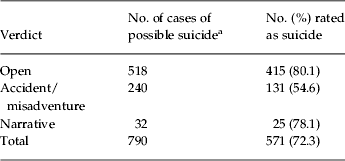
All 790 possible suicides were reviewed independently by D.G., K.H. and N.K., who agreed on the inclusion/exclusion of 632 (80.0%) cases without the need for discussion. The remaining 158 (20.0%) were reviewed again and discussed by all three raters at specially convened meetings. Following this review and consensus rating process, more than three-quarters of the possible suicides assigned an open (415/518, 80.1%) or narrative verdict (25/32, 78.1%) by the coroner were rated as suicide, as were about half (131/240, 54.6%) of those with an accident/misadventure verdict. Altogether, 571 (72.3%) of 790 possible suicides with a non-suicide verdict were rated as likely suicides (Table 1).
Cases of possible suicide rated as suicide (combined data for 1990/91, 1998 and 2005)
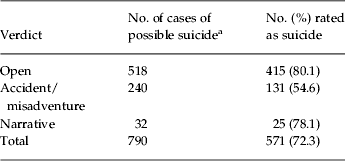
a The 1296 cases assigned a verdict of suicide were not rated according to likelhood of suicide and were assumed to be definite suicides.
Characteristics of researcher-defined suicides
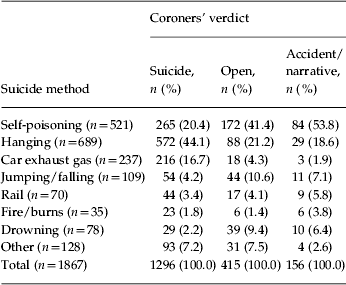
Subsequent analyses are based on the 1867 researcher-defined suicides: the 1296 (69.4%) cases assigned a verdict of suicide by coroners and 571 (30.6%) with a non-suicide verdict assessed as probable suicides by the research team. Three-quarters (1405/1867, 75.3%) of the suicides involved males. The median age was 41 years, with males (median age 40 years) slightly younger than females (median age 46 years). The most common methods used for suicide were hanging (689/1867, 37.0%) and self-poisoning (521/1867, 27.9%). Researcher-defined suicides by self-poisoning, drowning and jumping more often received open or accident/narrative verdicts from coroners than did cases of death from other methods (Table 2); such verdicts accounted for 256 (49.1%) of the 521 clinically defined self-poisoning suicides, 49 (62.8%) of 78 drowning and 55 (50.5%) of 109 jumping suicides whereas they only accounted for 18% of suicides using all other methods.
Methods used in researcher-defined suicides according to the verdict they received from the coroner (combined data for 1990/91, 1998 and 2005)

Temporal change in verdicts assigned by coroners to researcher-defined suicides
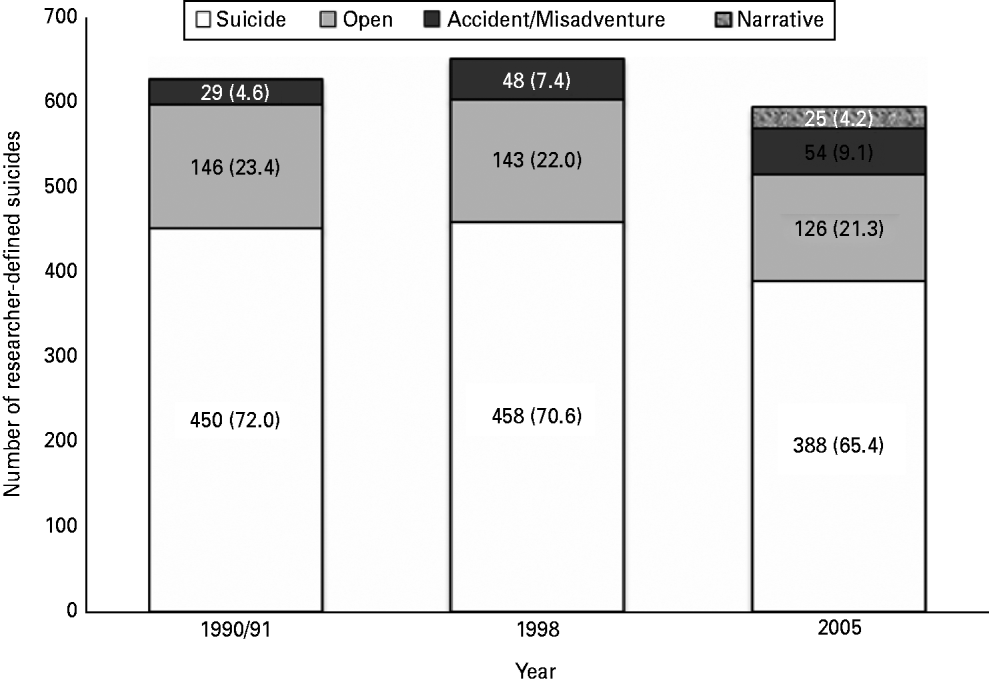
In keeping with national suicide statistics, the number of suicides rose between 1990 and 1998 then fell between 1998 and 2005 (Thomas & Gunnell, Reference Thomas and Gunnell2010). In 1990/91, 72.0% of researcher-defined suicides in our sample had been assigned a verdict of suicide by the coroner. By 2005, this had decreased to 65.4% (Fig. 1). There was also a slight decrease in researcher-defined suicides assigned an open verdict from 146/625 (23.4%) in 1990/91 to 126/593 (21.3%) in 2005. By contrast, the proportion of cases of researcher-defined suicides with a verdict of accident/misadventure nearly doubled between 1990 and 2005, from 4.6% (29/625) to 9.1% (54/593) (p trend < 0.01). Most of this rise was due to an increase in the number of researcher-defined suicides by self-poisoning that had been assigned an accident/misadventure verdict by coroners. In 1990/91, 12.3% (20/163) of cases of researcher-defined self-poisoning suicides had been assigned an accident/misadventure verdict by coroners, 13.5% (27/200) in 1998 and 22.2% (35/158) in 2005. Of note, 15 of the researcher-defined suicides that had been given an accident/misadventure verdict were deaths by hanging.
Number (%) of researcher-defined suicides (all methods) assigned each verdict for deaths in 1990/91, 1998, 2005 (note that no narrative verdicts were recorded in 1990/91 or 1998).
In 2005, 25 researcher-defined suicides received narrative verdicts; these further reduced the overall proportion of researcher-defined suicides receiving suicide or open verdicts in 2005 (86.7%) compared to 1990/91 (95.4%). However, some of these narrative verdicts will have been correctly identified as suicides by the ONS.
Temporal change in verdicts across coroners' jurisdictions
An examination of verdicts by coroners showed an increase in the use of the accident/misadventure verdict for researcher-defined suicides between 1990 and 2005 across nine of the 12 coroners' jurisdictions. The jurisdiction with the highest number of researcher-defined suicides with a verdict of accident/misadventure [24 (44.4%) of the 54 cases across all coroners] also had the highest increase in the use of that verdict: from 3.4% (4/117) in 1990 to 22.6% (24/106) in 2005. When a sensitivity analysis was carried out, excluding data from this coroner, the magnitude of the temporal increase in the use of the accident/misadventure verdict was diminished (1990/91: 25/508, 4.9%; 2005: 30/487; 6.2%; p trend = 0.3).
Method of death for cases assigned a verdict of accident/misadventure
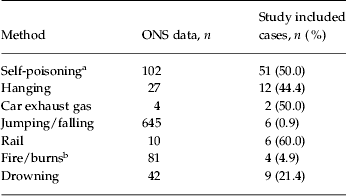
Using ONS data on the total number of accidental deaths by each method in the areas served by 11 of the study coroners, around half of all poisoning by medicines, rail, hanging and car exhaust gas deaths in 1998 and 2005 assigned an accident/misadventure verdict across these jurisdictions were judged to be suicides in our study (Table 3). These proportions are probably somewhat overestimated because data provided by coroners to the ONS do not always enable ONS coders to identify the method of death (and assign an ICD code). Such deaths will be included in non-specific categories by the ONS whereas our access to coroners' full records allowed us to accurately identify the method of death when this was given in the notes.
Overall numbers of ONS-recorded cause-specific accidental deaths in 11 of the study jurisdictions (1998 and 2005) and number (%) of researcher-defined (study included) suicides using these methods given accident/misadventure by the coroner
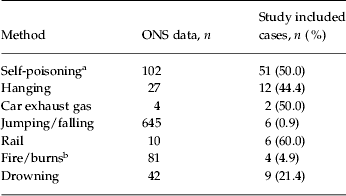
a ICD-9 E850.1 to E858.9; ICD-10 X40–41 and X43–44.
b Includes deaths by scalding and the respiratory effects of combustion.
Discussion
Main findings
The proportion of researcher-defined suicides that were assigned a suicide verdict by the 12 coroners decreased from 72.0% in 1990/91 to 65.4% in 2005. Similarly, the proportion of researcher-defined suicides receiving suicide and open verdicts (the categories used in official suicide rate estimates) also declined (from 95.4% to 86.7%). By contrast, researcher-defined suicides with a coroners' verdict of accident/misadventure nearly doubled over that period, from 4.6% to 9.1%. Narrative verdict cases rose from 0 in 1990/91 to 25 in 2005 (4.2% of researcher-defined suicides that year).
In the extreme scenario that all the cases of accidental and narrative verdict deaths thought by our clinical rating panel to be suicides (13.3% of researcher-defined suicides in 2005) had previously received suicide or open verdicts, suicide rates could have been underestimated by 8.7% in 2005 compared with 1990, when only 4.6% of researcher-defined suicides received an accident/misadventure verdict (narrative verdicts were very rarely used in the 1990s). This figure is likely to be an overestimate because a proportion of deaths given a narrative verdict will be correctly identified as suicide by the ONS if the coroner's description of the death makes it clear that the person intended to take their life (Cook & Hill, Reference Cook and Hill2011). However, the year-on-year growth in the use of narrative verdicts since 2005 (Cook & Hill, Reference Cook and Hill2011; Carroll et al. Reference Carroll, Hawton, Kapur, Bennewith and Gunnell2012) means that underestimation is likely to increase.
Even when the deaths for the coroner who had assigned the most accident/misadventure verdicts to cases judged clinically to be suicide were removed from the sample, the proportion of researcher-defined suicides given accident/misadventure verdicts was relatively high (6.2%) in 2005. These figures point not only to a possible overestimation of the reduction in suicides between 1990 and 2005 but also to an underestimation in the absolute rate of suicide. However, the underestimation of the overall national suicide rates (when these are based on suicide and undetermined deaths) by miscoding of some probable suicides as accidents is likely to be offset by the inclusion in the offical rate estimates of some open verdict (undetermined) deaths not thought to be suicides on clinical review (around 20% in our study, see Table 1).
The most frequent area of death misclassification was in relation to poisoning by medicines. Over a fifth of researcher-defined suicides by self-poisoning in 2005 would not have been included in national suicide statistics for these coroners. Surprisingly, even for a suicide method as seemingly unambiguous as hanging, 15 deaths by this method in our sample received verdicts of accidental death.
The difficulties that coroners face, and the variations in practice in deciding whether some cases are suicide or not, are reflected in the initial lack of consensus across the three clinical raters for about one-fifth of the cases examined in our study.
The fact that some of our researcher-defined suicides were given an accident/misadventure verdict by coroners is perhaps not surprising given the definitions of accidental death given in standard texts offering guidance to coroners. Dorries (Reference Dorries2004) includes the following definitions for accidental death: ‘an event over which there was no human control’, ‘an unintended act or omission’ or ‘a deliberate act that unintentionally leads to death’. Deaths currently often given open verdicts by coroners might equally be given accidental verdicts under the latter defintion, as intent may be unclear.
What is already known
Few UK studies have examined individual cases of possible suicide given accident/misadventure verdicts to assess the likelihood that these could be considered to be suicides by clinicians using the less exacting (clinical) definition of suicide based on ‘the balance of probability’ (O'Donnell & Farmer, Reference O'Donnell and Farmer1995; Dennis et al. Reference Dennis, Read, Andrews, Wakefield, Zafar and Kavi2001; Bennewith et al. Reference Bennewith, Gunnell and Nowers2007; Gosney & Hawton, Reference Gosney and Hawton2007). Previous studies focused on deaths within a single city or district in England, with two reporting deaths by a single method of suicide, one reporting deaths by jumping (Bennewith et al. Reference Bennewith, Gunnell and Nowers2007), and the other rail deaths (O'Donnell & Farmer, Reference O'Donnell and Farmer1995). In the study of suicide by jumping in a single coroner's jurisdiction, 20% of researcher-defined jumping suicides between 1994 and 2003 had been assigned a verdict of accident/misadventure (Bennewith et al. Reference Bennewith, Gunnell and Nowers2007). In the study of rail suicides, between 9% and 30% of cases of researcher-defined suicides across eight coroners' courts over a 5-year period had been assigned a verdict of accident/misadventure (O'Donnell & Farmer, Reference O'Donnell and Farmer1995). In one study in which all methods over a 6-year period (1988 to 1993) were investigated, only 17 out of 466 (3.6%) researcher-defined suicides had a verdict of accident/misadventure (Dennis et al. Reference Dennis, Read, Andrews, Wakefield, Zafar and Kavi2001). The other study focused on deaths among 8–18-year-olds: 23 deaths received suicide or open verdicts, and a further seven deaths (six by hanging) receiving accident verdicts were judged to be probable suicides (Gosney & Hawton, Reference Gosney and Hawton2007). An earlier study showed that there was little difference in the characteristics of cases assigned an open verdict, which would have been included in national suicide statistics, and those assigned an accident/misadventure verdict, which would not (Dennis et al. Reference Dennis, Read, Andrews, Wakefield, Zafar and Kavi2001). Further studies have compared suicide methods across cases assigned a suicide verdict and those assigned a non-suicide (open) verdict and found that self-poisoning and drowning deaths were less likely to have been assigned a suicide verdict than those by other, less ambiguous, methods such as hanging or firearms (Platt et al. Reference Platt, Backett and Kreitman1988; Neeleman & Wessely Reference Neeleman and Wessely1997; Linsley et al. Reference Linsley, Schapira and Kelly2001).
What this study adds
This is the largest UK study to investigate possible under-reporting of suicides. An improvement on previous studies is that we examined cases of possible suicide across 12 coroners' jurisdictions with differing catchment areas (urban, rural, mixed/urban rural) rather than those for a single jurisdiction or city. We were also able to assess whether specific types of accident/misadventure deaths contained a high proportion of clinically defined suicides and so should be considered for inclusion in official suicide statistics.
If the trend towards an increased use of accidental verdicts for researcher-defined suicides is real, there are several potential explanations for this rise. It is possible that there has simply been a change in coroners' practice over time, with coroners becoming less inclined to consider a death as suicide or a possible suicide (open verdict cases), perhaps through consideration of the impact of such verdicts on families. Changes to the terms of life insurance policies may also mean families prefer accidental verdicts to ensure the policy provides compensation, but we know of no evidence that this has occurred. Alternatively, any cuts to funding for the forensic investigation of deaths may mean that possible suicides have been less thoroughly investigated in recent years, making it more difficult for a coroner to rule out an accident. However, we found no evidence to support this explanation in our dataset; among the possible suicide deaths in 1990, 77% (27/35) had blood levels of medicines recorded, and in 2005 the equivalent figure was 83% (40/48).
Limitations
There are some limitations to this analysis. First, because of the time taken for coroners to complete their inquests and delays in the research team accessing the inquest files, the study assessed coroners' practices up to 6 years ago. Practices may have changed since then; one example of this is the growth in use of narrative verdicts (Carroll et al. Reference Carroll, Hawton, Kapur, Bennewith and Gunnell2012). Second, data for only about half of all open verdict cases and less than 10% of accidents were abstracted by the researchers; all cases where suicide was clearly not a possible cause of death or impossible to determine were excluded. Inevitably, some degree of judgement was used in making these decisions, but we were mindful to err on the side of inclusion, as indicated by the fact that only half (54.6%) of accident/misadventure verdict cases identified as possible suicide were rated as suicide. Third, although the coroners' jurisdictions studied comprised 10% of all coroners in England, the number of jurisdictions and variability in their size meant that a difference in practice (verdicts assigned) by a single coroner with a large jurisdiction could bias the assessment of a temporal increase in the use of the accident/misadventure verdict.
Conclusions
Between 1990/91 and 2005, the proportion of researcher-defined suicides that had been assigned a verdict of suicide by coroners decreased from 72.0% to 65.4%. This was largely due to an increasing trend in the use of the accident/misadventure verdict for cases of researcher-defined suicide, particularly for deaths involving poisoning. This misclassification might have led to a 9% overestimation in the reduction in suicide deaths between 1990 and 2005. Our finding that half of medicinal poisoning deaths that were assigned an accident/misadventure verdict by a coroner are probably suicides indicates that consideration should be given to the inclusion of such cases in national suicide statistics so that accurate national suicide data can be used for monitoring specific methods of suicide. The new post of Chief Coroner for England and Wales, commencing in Autumn 2012, provides a timely opportunity to improve the consistency of reporting of possible suicide deaths. Furthermore, joint initiatives by the Ministry of Justice, Coroners Society and ONS to improve suicide recording and coding may lead to improvements in some of the issues highlighted in this study. Nevertheless, a further review of this issue within the next 5–10 years is clearly warranted to ensure there has been no further deterioration.
Acknowledgements
Avon and Wiltshire Mental Health Partnership National Health Trust (NHS) Trust hosted the research programme. K.H. and D.G. are National Institute for Health Research (NIHR) Senior Investigators. K.H. is also supported by Oxford Health NHS Foundation Trust and N.K. by the Manchester Mental Health and Social Care Trust. The NIHR and Department of Health had no role in the study design, the collection, analysis and interpretation of data, the writing of the report, and the decision to submit the paper for publication.
We thank the coroners who allowed us access to their files, and their staff and Record Office staff who assisted us.
This article presents independent research commissioned by the NIHR under its Programme Grants for Applied Research scheme (RP-PG-0606-1247). The views expressed in this publication are those of the author(s) and not necessarily those of the NHS, the NIHR, the ONS or the Department of Health.
Declaration of Interest
None.