INTRODUCTION
Corridors of habitat between patches are often created or maintained to facilitate movement of organisms in fragmented habitats in hopes of reducing negative effects of demographic and genetic stochasticity in isolated populations (Fleishman et al. Reference FLEISHMAN, RAY, SJOGREN-GULVE, BOGGS and MURPHY2002, Ovaskainen & Hanski Reference OVASKAINEN and HANSKI2004). Benefits of corridors for birds have been debated because birds are considered a vagile group able to traverse wide spans of unsuitable habitat. Translocated individuals of some temperate forest bird species prefer to travel via forested routes back to their home territories, avoiding open habitats (Belisle et al. Reference BELISLE, DESROCHERS and FORTIN2001, Gobeil & Villard Reference GOBEIL and VILLARD2002) and are more likely to use corridors than deforested routes to move between forest patches (Castellon & Sieving Reference CASTELLON and SIEVING2006, St. Clair et al. Reference ST. CLAIR, BELISLE, DESROCHERS and HANNON1998).
In contrast with temperate species, many tropical forest birds are more sedentary and show greater reluctance to move across open areas in fragmented landscapes (Boscolo et al. Reference BOSCOLO, CANDIA-GALLARDO, AWADE and METZGER2008, Lees & Peres Reference LEES and PERES2009, Moore et al. Reference MOORE, ROBINSON, LOVETTE and ROBINSON2008), making corridors a potential useful conservation tool to reduce isolation of bird populations (Sekercioglu Reference SEKERCIOGLU2009, Stratford & Robinson Reference STRATFORD and ROBINSON2005). Studies of movement of tropical forest birds in fragmented landscapes (Awade & Metzger Reference AWADE and METZGER2008, Boscolo et al. Reference BOSCOLO, CANDIA-GALLARDO, AWADE and METZGER2008, Gillies & St. Clair Reference GILLIES and ST. CLAIR2008, Hadley & Betts Reference HADLEY and BETTS2009, Kennedy & Marra Reference KENNEDY and MARRA2010) have shown that forest-restricted species prefer to move along forested routes and avoid crossing open areas. In the only direct test of corridor use by birds in the tropics, Gillies & St. Clair (Reference GILLIES and ST. CLAIR2008) translocated and radio-tracked two bird species of dry forest in Costa Rica and found that a forest-specialist species was twice as likely to return after translocation if corridors were available. Return success and time of the forest-generalist species were not affected by corridors. Studies of gap-crossing abilities of tropical forest birds (Boscolo et al. Reference BOSCOLO, CANDIA-GALLARDO, AWADE and METZGER2008, Moore et al. Reference MOORE, ROBINSON, LOVETTE and ROBINSON2008) indicate that responses to gaps may vary by species and landscape. If this variability in response is also present in the use of corridors, then it would be informative to expand the currently available evidence to more habitat types and configurations and to include more species exhibiting a range of forest dependencies.
We used a translocation-and-recapture approach to examine effects of forested corridors on movement of birds in a landscape of fragmented, humid forests in tropical Mexico. We translocated birds between habitat patches in the presence and absence of corridors to test two main hypotheses: (1) forest corridors facilitate movement of forest birds, and (2) degree to which species are restricted to forest influences the use of forested corridors. We predicted that birds would be more likely to move (i.e. the proportion of birds returning would be higher) between patches connected by forest corridors than between unconnected patches. Using the degree of forest dependence as an indicator of the species’ willingness to cross forest gaps, we also predicted that, because forest-restricted species are less likely to cross forest gaps, corridors would have a strong positive effect on the proportion of returning individuals of the forest-restricted species.
METHODS
Study site
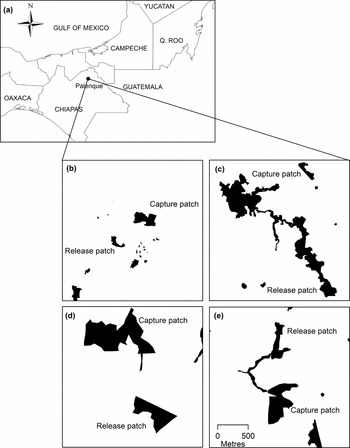
We conducted the study in Palenque National Park (PNP), Chiapas, Mexico (Figure 1; 17°27′51″–17°30′05″ N; 92°01′30″–92°04′42″ W). PNP covers an area of 1780 ha, about 630 ha of which are primary rain forest. The landscape surrounding PNP is composed primarily of cattle pastures, isolated forest fragments and riparian corridors. The average annual precipitation is 2.0 m and includes a drier season from January to April (monthly rainfall (mean ± SD) = 62 ± 18 mm) and a wetter season from May to December (240 ± 106 mm). The mean annual temperature is 26 °C (range = 22 °C–29 °C). These conditions classify PNP as tropical wet forest (Holdridge et al. Reference HOLDRIDGE, GRENKE, HATHAWAY, LIANG and TOSI1971). In primary forest, canopy height reaches 25–30 m (Diaz-Gallegos Reference DIAZ-GALLEGOS1996).
Field site location and examples of landscape sections used for translocation trials. Geographic location of the Palenque municipality in south-eastern Mexico (a). Two examples of unconnected sites showing capture, release and additional forest patches (in black) in the landscape section surrounded by the cattle pasture matrix (in white) (b, d). Two examples of connected sites showing the forest corridor connecting the capture and release patches (in black) surrounded by the cattle pasture matrix (c, e).

Translocation and effect of corridors
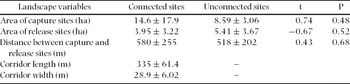
The effect of forest corridors on bird movement was investigated by using a translocation experiment with two treatments. In the unconnected treatment, birds were translocated between a pair of unconnected forest patches in close proximity to each other (Table 1) but completely surrounded by cattle pasture, and therefore not physically linked by a forested corridor. In the connected treatment, birds were translocated between a pair of forest patches that were also surrounded by cattle pasture with the exception of being physically connected to each other by a forested corridor.
Landscape variables (mean ± SD) of connected (forest corridor connecting capture and release patches) and unconnected sites (no physical connection between patches) used for translocation trials. Last two columns show results for comparison of means (t-test) of landscape variables between both types of treatment.

Using a combination of field surveys and spatial analysis of aerial photographs we selected 10 pairs of fragments (five pairs for trials with connected patches and five pairs for trials with unconnected patches). Patches in a pair included the nearest patch in the landscape and were surrounded by a homogeneous matrix of cattle pasture. The patches in the connected treatment lacked physical connections to other patches in the landscape (no other corridors connecting to other patches) (Figure 1). Corridors connecting focal patches were narrow (Table 1) riparian forest corridors with highly disturbed understorey. We kept area of capture and release patches, as well as distance between patches in a pair, relatively similar between treatments (Table 1) to reduce potential confounding effects of landscape variables on bird movement. Patch attributes were estimated using a digitized and orthocorrected aerial photograph (scale 1:20 000) of the Palenque municipality. We estimated the area covered by forest vegetation in each patch and distance between patches was defined as the Euclidean distance between the closest points of the two patches in each pair. All focal fragments were digitized from the photograph using ArcGIS 9.0 (ESRI, Redland, California, USA) and area and distances were estimated using the Spatial Analyst tool from ArcMap 9.3 (ESRI, Redland, California, USA) followed by corroboration in the field.
Bird capture and translocation
Bird captures and translocations were conducted from 17 June 2008 to 27 July 2008 and from 3 June 2009 to 25 July 2009. At each capture patch birds were caught using a series of up to 10 mist nets (12 × 2.5 m, 30-mm mesh size) separated by up to 100 m from each other and 50 m from the patch edge. Mist nets were spatially arranged according to patch shape in order to cover most of its area. Nets were operated daily from dawn (06h30) until 17h00. All birds captured were weighed, visually sexed (when possible) and marked with a combination of colour plastic rings to allow individual identification. After marking them, birds were placed in a soft cloth bag and inside a plastic cage for immediate transportation (usually within 20 min after removal from mist nets) to the release patch. Once in the release patch, birds were released unharmed in the middle of the patch. Only adult, healthy birds were translocated. Birds with visible signs of injury, moulting of flight feathers or low weight were not included in the study.
Mist nets were operated at the capture patch for seven consecutive days (3 d open, 1 d closed, 3 d open) to detect birds that returned from the release patch to the capture patch. On the fourth day nets remained closed to help reduce bird awareness of net position, thus increasing the probability of recaptures. Since birds translocated during the last three days of mist netting would have lower probability of being recaptured than those birds translocated during the first three days of mist netting, only birds translocated during the first three days of the trial were included in this study. Using capture–recapture information, we measured the proportion of birds recaptured in the capture patch after translocation. We also measured time to recapture, which we interpreted as a measure of the effect of the treatment (corridor presence) or species group (forest dependence) on bird movement.
The proportion of birds recaptured was also measured in control sites for the connected and unconnected treatments to control for possible site effects that may confound our interpretation of the effects of corridors on recaptures. During control trials we repeated the capture–recapture protocol described above for translocation trials with the difference that birds were not translocated after capture, but instead birds were released at the edge of the capture patch. Control trials were conducted in three of the same five capture sites used during translocation trials of each treatment. Protocols for capturing, handling and bird ringing followed Gaunt & Oring (Reference GAUNT and ORING1997) and were approved by University of Miami Institutional Animal Care and Use Committee (protocol number 06–041).
Species groups
To evaluate our hypothesis that degree of forest dependency influences the proportion of birds returning to capture sites and use of corridors, we categorized all individuals included in this study as either forest-restricted or forest-unrestricted based on a priori information on habitat associations in the region (Estrada & Coates-Estrada Reference ESTRADA and COATES-ESTRADA1997). Forest-restricted species were defined as those that were common inhabitants of mature forest, rare in degraded forest and absent in modified habitats such as tree plantations. Forest-unrestricted species were those present in mature and in degraded forest, second-growth forest and in tree plantations. Placement of species into these two categories matches that from other studies in Central America (Robinson et al. Reference ROBINSON, BRAWN and ROBINSON2000) and was largely confirmed by our subsequent species inventories of fragments in PNP (Ibarra-Macias Reference IBARRA-MACIAS2009). Species were assigned to a dietary guild based on Johns (Reference JOHNS1991) and Howell & Webb (Reference HOWELL and WEBB1995). Most species included in this study were insectivores (Appendix 1) and the proportion of species in each guild within both forest-dependency groups was similar.
Analysis of data
We compared area of capture site, area of release site and distance between pair of sites with a t-test to ensure that all sites used in the connected and unconnected treatments were similar. To test for correlations of the proportion of birds returning (all species pooled together and by species group) with landscape variables we performed a multiple regression analysis with backward elimination with area of capture site, area of release site and distance between sites as independent variables and proportion of birds returning per site as dependent variable. To investigate the possible effects of site on recapture probabilities, we compared the proportion of recaptures in the three connected controls versus the proportion of recaptures from the three unconnected controls.
To investigate the effect of corridors on bird movement, we used a Wilcoxon rank-sum test to compare proportions of recaptures (all species pooled together) from connected vs. unconnected sites to test the null hypothesis that recaptures were equal between both treatments. If corridors facilitate bird movement, birds are more likely to return to their capture patch (higher proportion of recaptured individuals) between connected sites than between unconnected sites.
To test the hypothesis that species group (forest-restricted vs. unrestricted) and the presence of a corridor interact to influence bird movement in this fragmented landscape, we repeated the previous analysis on each group separately. If corridors facilitate movements, and this effect is stronger for forest-restricted species, recaptures of forest-restricted species should be higher between connected patches than between unconnected patches. If movement of forest-unrestricted species is less affected by fragmentation, corridor effect on movement should be minimal so recaptures and time to recapture between connected and unconnected patches should be similar.
We used Cox regression to compare time to recapture among treatments and species groups. Cox regression compares survival curves (survival = time elapsed before occurrence of a terminal event) among treatment groups (Cox Reference COX1972). In this experiment, recapture of an individual in the capture site was treated as the terminal event, whereas no recapture by the end of the trial (170 h of accumulated mist netting time) was equivalent to survival. Survival analysis was appropriate because it allowed the use of censored cases (individuals that were not recaptured by the end of the trial). We used treatment and species group as predictor variables and model fitting was conducted using forward-stepwise likelihood-ratio estimation. All tests were conducted with SPSS 17.0 (SPSS Inc., Chicago, Illinois, USA).
RESULTS
Effects of landscape variables on the proportion of birds recaptured
Area of capture site, area of release site and distance between capture and release site were not significantly different between the connected and unconnected treatments (Table 1). None of the landscape variables entered models of linear regression of landscape variables on proportion of birds recaptured (all species pooled or proportion of recaptures for restricted and unrestricted species separately). This indicates that none of these landscape variables explains significant variation in the proportion of birds recaptured for either treatment or species group.
Effects of corridors on the proportion of birds recaptured after translocation
We translocated 75 and 73 individuals for connected and unconnected treatments, respectively, during the control trials and 75 and 109 individuals between connected and unconnected sites, respectively, during the experimental trials. In total, only 15% (50 individuals) were recaptured during this experiment.
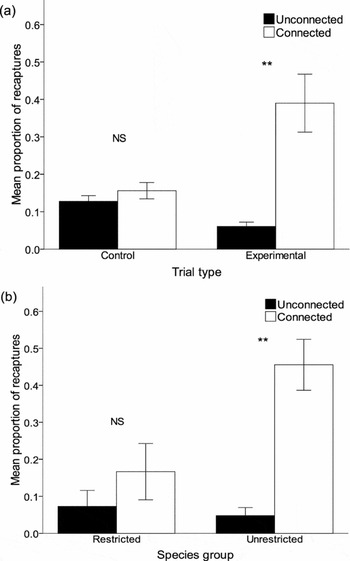
During experimental trials, the proportion of recaptures for individuals translocated between connected patches were significantly different from the proportion of recaptures of individuals translocated between unconnected patches (W = 15.0, P = 0.009). Corridors had a positive effect on the proportion of recaptures during experimental translocations. On average (all species pooled together), mean (±SD) proportion of recaptures in the connected treatment (0.39 ± 0.17) was six times greater than in the unconnected treatment (0.06 ± 0.03) (Figure 2). In the control trials, mean (±SD) proportion of recaptures in the connected sites (0.16 ± 0.038) was not statistically different from mean proportion of recaptures in the unconnected sites (0.13 ± 0.027) (Figure 2).
Effects of corridors and species characteristics on bird return after translocation. Mean proportion of recaptures (±1 SE) during control trials (birds translocated to the edges of the same forest patches in which they were captured whether those patches had a corridor connecting them to other patches or not), and mean proportion of recaptures during experimental trials (birds translocated to patches connected with the original capture patch by a corridor or translocated to patches unconnected with the original capture patches) (a). Mean proportion of recaptures (±1 SE) for forest-restricted birds (bird species common in mature forest and rarely found in modified habitats) and forest-unrestricted birds (species present in forest and also in modified habitats such as shaded plantations) in connected and unconnected experimental trials (b).

Effects of species group on the proportion of birds recaptured after translocation
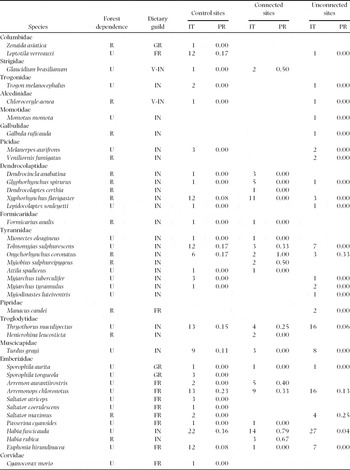
During experimental trials, forest-unrestricted species were represented by 137 individuals of 20 species, including Habia fuscicauda (n = 41), Arremonops chloronotus (n = 25), Thryothorus maculipectus (n = 20), Turdus grayi (n = 11), Tolmomyias sulphurescens (n = 10), Euphonia hirundinacea (n = 8) and Arremonops aurantiirostris (n = 5). The group of forest-restricted species was represented by 47 individuals of 14 species, including Xiphorhynchus flavigaster (n = 14), Glyphorhynchus spirurus (n = 6) and Onychorynchus coronatus (n = 5).
Restricted and unrestricted species responded in similar fashion to the presence of corridors. Proportion of recaptures was higher in the presence of corridors for both the restricted and unrestricted species. However, this difference was statistically significant only for the unrestricted-species group (W = 15.0, P = 0.009). Mean (±SD) proportion of recaptures of the unrestricted-species group in the connected treatment (0.46 ± 0.15) was nine times greater than in the unconnected treatment (0.05 ± 0.05) (Figure 2). In contrast, mean (±SD) proportion of recaptures of the restricted species group were only twice as high in the presence of corridors (0.17 ± 0.15) when compared with unconnected sites (0.07 ± 0.09) and this difference was not statistically significant (W = 15.0, P = 0.375). We applied parametric models (general linear model with a normal-log transformation log-link function) to formally explore a two-factor interaction (corridor treatment × species group). The results from the non-parametric test were qualitatively similar to the results of the parametric test (significant effect of treatment, but no significant effect of species group or a significant interaction of corridor treatment and species group). However, we choose to present results from the non-parametric analyses because these methods are more robust to violations of assumptions that might occur in a landscape study with small sample sizes such as our study.
Mean proportion of recaptures of the unrestricted-species group was dominated by the response of Habia fuscicauda. This species was highly mobile in the presence of corridors, where 79% of translocated individuals returned to the capture site when a corridor was available but only 4% of translocated individuals returned to the capture site in the absence of a corridor. Arremonops chloronotus and Thryothorus maculipectus also had higher proportion of recaptures in the presence of corridors (33% and 25%, respectively) when compared with recaptures in the absence of corridors (only 13% and 6%). In sharp contrast, the restricted species Xyphorhynchus flavigaster and Glyphorhynchus spirurus were never recaptured.
Effects of corridors and species group on return times
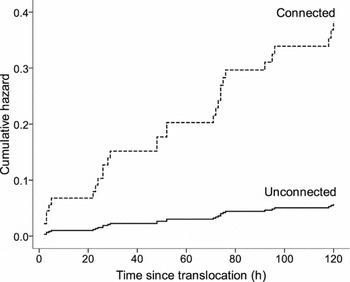
Treatment was the only significant factor (Wald = 18.9, P < 0.001) predicting time to recapture in the forward-stepwise Cox regression (model fit; χ2 = 22.8, P < 0.001). Mean (±SD) time to recapture was significantly longer for individuals translocated between unconnected patches (163 ± 28.4 h, Figure 3) than for individuals translocated between connected patches (132 ± 59.6 h) or in control trials (141 ± 62.7 h; overall F = 9.07, P < 0.001). Species group was not a significant predictor (Wald = 3.56, P = 0.06) of time to recapture. Mean (±SD) time to recapture for translocated individuals of the restricted group (151 ± 47.2 h) was statistically similar (W = 12 600, P = 0.84) to time to recapture of individuals of the unrestricted group (151 ± 46.2 h).
Hazard function showing likelihood of recapture as a function of time since translocation (h) for birds translocated between connected forest patches (broken line) and birds translocated between unconnected forest patches (continuous line), indicating the significant effect of the presence of a corridor on time to recapture in the forward-stepwise Cox regression. Birds were more likely to be recaptured in the original capture patch if a corridor connected the capture patch with the forest patch in which the bird was released.

DISCUSSION
As we predicted, when considering all species pooled together, corridors had a positive effect on the proportion of recaptured birds, indicating that they facilitated bird movement in our fragmented landscape. These findings are comparable to translocation studies in temperate forests where forest cover facilitated movement of forest birds (Belisle et al. Reference BELISLE, DESROCHERS and FORTIN2001, Boscolo et al. Reference BOSCOLO, CANDIA-GALLARDO, AWADE and METZGER2008). The prediction that the effects of corridors would be stronger for forest-restricted tropical species than for forest-unrestricted species was not supported by our data. Our results showed that corridors positively influenced the proportion of returns for both groups of birds. However, corridors had a stronger effect on proportion of returns only for unrestricted species, which had significantly higher proportion of recaptures in the connected treatment than in the unconnected treatment. In contrast, the presence of corridors had no significant effect on the proportion of recaptures of forest-restricted species. Corridors had a significant positive effect on return times for all species pooled together. This is in agreement with previous translocation studies (Belisle et al. Reference BELISLE, DESROCHERS and FORTIN2001) that found that forest cover reduces return time of homing birds suggesting that corridors may facilitate movement by providing travel routes for birds that are reluctant to cross forest gaps.
During a recent study in the same landscape used in this study and with some of the same species, Ibarra-Macias et al. (Reference IBARRA-MACIAS, ROBINSON and GAINES2011) used a dispersal challenge experiment to evaluate the effects of gaps on bird movement decisions. They found that gaps as narrow as 50 m may severely affect movement decisions of tropical forest birds. Forest-restricted species showed great reluctance to attempt trans-gap movements and gaps greater than 100 m wide severely affected their ability to navigate and successfully reach the nearest forest fragment. In contrast, forest-unrestricted species showed less reluctance to attempt movement across forest gaps and were able to navigate back to the nearest forest fragments, either directly across the open area or by using isolated trees or fencerows as stepping stones.
Although in the present study birds translocated between connected patches did not have to cross any gaps while using the corridors, species groups showed strong differences in their propensities to move. The positive effect of corridors on bird return was significant for forest-unrestricted species. The species for which we had the largest sample size, Habia fuscicauda, was highly mobile in the presence of corridors. It also was very mobile during the dispersal challenge experiments (Ibarra-Macias et al. Reference IBARRA-MACIAS, ROBINSON and GAINES2011). In contrast, forest-restricted species were rarely recaptured after translocation, even in the presence of corridors. Glyphorhynchus spirurus, for example, was never recaptured whether corridors were present or not. That species also showed the greatest reluctance to attempt trans-gap movements and exhibited the poorest navigational ability during dispersal challenge experiments (Ibarra-Macias et al. Reference IBARRA-MACIAS, ROBINSON and GAINES2011). Evidence from the translocation experiments supports the conclusion from the dispersal challenge experiments that forest-restricted species are more reluctant to move outside of forests.
When return times were compared between species groups, our data did not support the expectation that effects of corridors are stronger for restricted species. This result was unexpected given evidence from other studies that restricted species were less likely to cross open areas and more likely to use corridors as travel routes (Castellon & Sieving Reference CASTELLON and SIEVING2006, Shirley Reference SHIRLEY2006). Gillies & St. Clair (Reference GILLIES and ST. CLAIR2008), who gathered information on the travelling paths of translocated, radio-tagged individuals, found that return times of a forest generalist species were significantly shorter than those of a forest-specialist species. We did not have data on the exact routes used by birds to return to capture sites, but two possible reasons might explain why return times did not vary between species groups, regardless of the presence of corridors. First, unrestricted species tend to be more mobile and less restricted by open areas (Belisle Reference BELISLE2005, Ibarra-Macias et al. Reference IBARRA-MACIAS, ROBINSON and GAINES2011, Stratford & Robinson Reference STRATFORD and ROBINSON2005). This could allow individuals to explore the landscape before finding a suitable route to return to their original capture site (Gillies & St. Clair Reference GILLIES and ST. CLAIR2008), thus delaying the time to recapture. Second, species of the unrestricted group have been reported to use different types of vegetation in the landscape and are not restricted to mature forest, while forest-restricted species are especially restricted to forest patches (Estrada & Coates-Estrada Reference ESTRADA and COATES-ESTRADA1997, Graham & Blake Reference GRAHAM and BLAKE2001). In a heavily fragmented landscape, where forest patches are a limited resource but where shade plantations or secondary-growth patches are readily available, the flexibility of unrestricted species of using alternative habitats may allow them to find refuge in surrounding vegetation patches, using them as stepping stones during exploration, even if temporarily. Studies that follow routes used by translocated birds in real time, via some type of tracking technology, will be needed to understand exactly how birds move through fragmented landscapes.
In translocation studies that explored effects of landscape on bird return after translocation (Boscolo et al. Reference BOSCOLO, CANDIA-GALLARDO, AWADE and METZGER2008, Gillies & St. Clair Reference GILLIES and ST. CLAIR2008), distance between fragments was found to predict the proportion of return for forest birds. In our study, landscape variables (area of patches and distance between them) did not affect the proportion of recaptures. This is to be expected given the effort made to keep variation of landscape variables between treatments to a minimum. The homogeneity of landscape variables among trials, for both connected and unconnected treatments, increases the confidence that the results found were mainly determined by the presence or absence of corridors or the effects of species group.
Corridors may influence bird behaviour by providing forest cover that facilitates bird movement in an otherwise completely open landscape. Studies with tropical forest birds have shown that forest birds show reluctance to cross open areas (Moore et al. Reference MOORE, ROBINSON, LOVETTE and ROBINSON2008) and birds would use isolated trees as stopping points when crossing cattle pastures (Ibarra-Macias et al. Reference IBARRA-MACIAS, ROBINSON and GAINES2011). Higher predation risk and physiological stress associated with crossing open areas (Laurance & Gomez Reference LAURANCE and GOMEZ2005, Moore et al. Reference MOORE, ROBINSON, LOVETTE and ROBINSON2008, Zollner & Lima Reference ZOLLNER and LIMA2005) may be ameliorated by the use of forest or tree cover during movement. Studies have demonstrated that when given the choice of reaching a destination either by crossing in the open or by using a detour under forest cover, birds usually choose the detour option, although the latter can substantially increase the duration and distance that they must travel (Gillies & St. Clair Reference GILLIES and ST. CLAIR2008, Ibarra-Macias et al. Reference IBARRA-MACIAS, ROBINSON and GAINES2011, St. Clair Reference ST. CLAIR2003). Although limited in area, forested corridors provide this type of forest cover, increasing the chances that birds will move between patches when corridors are available.
The role of corridors as dispersal conduits for tropical forest birds requires further study. Translocation studies provide invaluable information on short-term, small-scale movements, more related to home-ranging behaviour (van Dyck & Baguette Reference VAN DYCK and BAGUETTE2005). Post-breeding dispersal movements could still allow access to fragments not linked by corridors if birds are willing or able to make longer flights between forest patches during those post-breeding periods. Although the degree to which movements during translocation experiments are similar to those that might occur during other types of natural dispersal remains unclear, findings from translocation experiments do appear to improve our understanding of how birds move around landscapes (Belisle & Desrochers Reference BELISLE and DESROCHERS2002, Zollner & Lima Reference ZOLLNER and LIMA2005).
Even though we found that corridors did influence some species and some aspects of movement, there is still much to learn about characteristics of corridors that will be best suited for use by tropical birds. For example, the widths, microclimates, vegetation density, and lengths of corridors that are best suited for promoting movements of forest birds all need to be evaluated. Clearly, some tropical forest bird species do use corridors to move between forest patches, but conservation biologists interested in managing aspects of corridors still need more information about which species will use which types of corridors. Our data add information from species of humid forests, but species of even more humid forests, especially those restricted to the dim understorey of primary forest, may be even less likely to use corridors unless conditions in those corridors mimic conditions inside mature forest. Further experiments and observational studies are needed in other tropical landscapes.
ACKNOWLEDGEMENTS
We thank D. Janos and W. Searcy for insightful comments. M. Chan, L. Acosta, J. Bastar and B. Sanchez provided valuable help in the field. This work was supported by University of Miami-Biology Department Kushland Award and a University of Miami-College of Arts and Sciences Dissertation Award. National Science Foundation grants 0408186 and 0422233 provided additional support. We thank Comision Nacional de Areas Naturales Protegidas and Instituto Nacional de Antropologia e Historia that gave permission to work in PNP.
List of species included in the translocation experiment, their forest dependence classification and dietary guild. The table presents the total number of individuals of each species translocated (IT) in the treatment and control sites as well as the proportion of birds that returned (PR) to their original capture site after translocation. Species names and systematic order follow AOU (2003). Assignment of species to a forest dependence group (R = forest-restricted species; U = forest-unrestricted species) follows Estrada & Coates-Estrada (Reference ESTRADA and COATES-ESTRADA1997) and Ibarra-Macias (Reference IBARRA-MACIAS2009). Dietary guild classification (GR = Granivore; FR = Frugivore; IN = Insectivore; V = Vertebrate) follows Johns (Reference JOHNS1991) and Howell & Webb (Reference HOWELL and WEBB1995).