Introduction
‘Population ageing’ or ‘demographic ageing’ is defined as the absolute and relative increase of the older compared to the younger population. This process is caused by both sharp declines in fertility rates below replacement level (i.e. an average number of about 2.1 children per woman) and decreasing mortality rates among the old and the oldest-old (more details can be found in e.g. Goldstein Reference Goldstein and Uhlenberg2009). Demographic projections reveal that population ageing is unavoidable in any population of the developed world (Powell Reference Powell2010). Only the extent of this process differs between the countries depending on their levels of fertility and mortality (see e.g. Golini Reference Golini2003; Lutz, Sanderson and Scherbov Reference Lutz, Sanderson and Scherbov2001, Reference Lutz, Sanderson and Scherbov2008). Moreover, the ageing of the population will go hand in hand with a decrease of total population sizes. These developments are generally referred to as ‘demographic change’ and are the demographic phenomena with currently the greatest interest from scientists, policy makers and the general public. Above all, the rise of people in higher and highest ages causes many consequences of immediate relevance for society (e.g. Bernard and Phillips Reference Bernard and Phillips2000; Harper Reference Harper2000). For instance, population ageing has an instantaneous impact on the demand for social and medical services and raises the requirements for health care and the capacity of social security systems. The rising share of older people forces the population in working ages to contribute more financial resources for pension funds, health and nursing care insurance.
Although already more than 70 years ago some scholars described the future scenario of an ageing population and warned of the unavoidable consequences (e.g. Burgdörfer Reference Burgdörfer1937; Siemens Reference Siemens1937), and despite the fact that these aspects have been analysed and discussed intensively in the international literature for many decades (e.g. Carver and Liddiard Reference Carver and Liddiard1978; White Riley and Foner Reference White Riley and Foner1968; White Riley, Johnson and Foner Reference White Riley, Johnson and Foner1972; White Riley, Riley and Johnson Reference White Riley, Riley and Johnson1969), the causes and consequences of the demographic change became a central aspect of political and public discussion only very recently in Germany. As a consequence, a number of German-speaking scientific books (e.g. Birg Reference Birg2005; Frevel Reference Frevel2004; Kaufmann Reference Kaufmann2005; Kohli and Künemund Reference Kohli and Künemund2005; Mai Reference Mai2003; Schimany Reference Schimany2003) and popular scientific monographs (e.g. Gronemeyer Reference Gronemeyer2005; Hondrich Reference Hondrich2007; Schirrmacher Reference Schirrmacher2004; Strange Reference Strange2006) have been published during the last few years. It is, in particular, the consequences of the structural population changes which are currently addressed and discussed by many disciplines all over the developed world. The different and often overlapping topics comprise the economic productivity of an ageing society in general (Börsch-Supan Reference Börsch-Supan2008; Feyrer Reference Feyrer2008; Malmberg, Lindh and Halvarsson Reference Malmberg, Lindh and Halvarsson2008) and of older people especially (Behrend and Frechichs Reference Behrend, Frechichs, Kruse and Mike2004; Nuñez Reference Nuñez2010; Skirbekk Reference Skirbekk2004; Van der Meer Reference Van der Meer2006), the functionality of the social security systems (Bongaarts Reference Bongaarts2004; Kronberger Reference Kronberger2005; Pollard Reference Pollard1995), consumer habits of the older and oldest-old population (Grafenhofer et al. Reference Grafenhofer, Jaag, Keuschnigg and Keuschnigg2007; Lebok and Döring Reference Lebok and Döring2005), medical and nursing care for older people (Comas-Herrera et al. Reference Comas-Herrera, Wittenberg, Costa-Font, Gori, Di Maio, Patxot, Pickard, Pozzi and Rothgang2006; Gaymu, Ekamper and Beets Reference Gaymu, Ekamper and Beets2007; Grundy and Henretta Reference Grundy and Henretta2006; Haberkern and Szydlik Reference Haberkern and Szydlik2010; Larsson, Thorslund and Kåreholt Reference Larsson, Thorslund and Kåreholt2006; Lutz and Scherbov Reference Lutz and Scherbov2005), intergenerational solidarity (Blüher Reference Blüher2003; Fux Reference Fux2003; Höpflinger Reference Höpflinger2009; Izuhara Reference Izuhara2002; Scharf Reference Scharf2001) and the role of older people in society (Abbott, Fisk and Forward Reference Abbott, Fisk and Forward2000; Backes Reference Backes, Kruse and Mike2004; Gray Reference Gray2009; Roloff Reference Roloff2004).
While the international scientific discussion of the consequences of the demographic change is led rather neutrally, the German-speaking discussion is characterised by an almost strict polarisation of positive and negative future scenarios. The discussion started with the arguments of pessimists who painted a dark picture of the economic and societal consequences of the numerical and structural changes of the population (e.g. Birg Reference Birg2005; Schirrmacher Reference Schirrmacher2004). These publications caused the emergence of an optimistic opposition propagating the chances and opportunities for individual and societal life in an ageing and shrinking population (e.g. Bruns, Bruns and Böhme Reference Bruns, Bruns and Böhme2007; Gronemeyer Reference Gronemeyer2005; Gross and Fagetti Reference Gross and Fagetti2008; Hondrich Reference Hondrich2007; Scherf Reference Scherf2006; Strange Reference Strange2006). Both sides agree that significant changes of individual lifestyles and societal structures are unavoidable in order to cope with the challenges of the demographic change, but they differ in the expected consequences of these changes. One central aspect in this discussion is the current pension system and how the decreasing working-age cohorts in the future could finance the increasing cohorts of retirees. While pessimists see mainly the problems arising from the unavoidable consequences of increasing working lifetime and rising taxes, postulating the end of a functioning society, the optimists develop scenarios that are advantageous for most individuals, involving stepwise reduction of the workload or a redistribution of working time over the lifecourse (Vaupel and Kistowski Reference Vaupel and Kistowski2008; Vaupel and Loichinger Reference Vaupel and Loichinger2006), while expecting that people have longer lives without severe disability supported by technological and medical developments (Christensen et al. Reference Christensen, Doblhammer, Rau and Vaupel2009).
Nevertheless, as the process of population ageing will accelerate in the near future and continue at least until the generation of ‘baby-boomers’ has disappeared, the economic and societal consequences will also increase. This study focuses on specific issues connected with the functioning of an aged society and the relation between younger and older generations. Some scholars report about indications of growing ‘ageism’, that is, hostility towards older people who are deemed to threaten the prosperity and quality of life of the younger generations (Carrigan and Szmigin Reference Carrigan and Szmigin2000; Hoffmann-Nowotny and Fux Reference Hoffmann-Nowotny and Fux1991; Minichiello, Browne and Kendig Reference Minichiello, Browne and Kendig2000). Such processes can be seen as indicators for declining intergenerational solidarity. Recently, Schoenmaeckers et al. (Reference Schoenmaeckers, Callens, Vanderleden, Vidovicová, Höhn, Avramov and Kotowska2008) studied the attitudes towards population ageing and older people in seven European countries. Using data from the second wave of the Population Policy Acceptance Study (PPAS 2), their analysis also differentiates between western and eastern Germany. They found that people tend to have a rather positive attitude towards older persons despite the fact that they see population ageing as a worrisome development. To get insight into the determinants of these attitudes, the authors created an ‘old-age perception index’ (OAP, more details below), which they analysed by regression modelling. They found a clear effect of age among western Germans – and, in fact, among all other populations – i.e. that younger individuals have a less positive attitude towards older people. Moreover, western Germans who had no children had a less positive attitude as well. All other covariates, including sex, marital status, education and employment, did not show any statistically significant impact on the OAP. However, regarding the effect of sex, western Germany was an exception because women had a statistically significant, more positive attitude towards older people than men in most other populations.
These results reflect the views of populations that have not yet felt the demographic changes. The perceptions thus probably emanate from political discussions and, above all, the pictures painted by scientists and non-scientists in public media. The latter are, however, based on hypotheses, assumptions and theoretical models about what individual and social life might look like in an aged population. In reality, most parameters affecting life in an ageing society are simply unknown. As Dannefer and Shura (Reference Dannefer, Shura and Uhlenberg2009) pointed out, ‘it cannot be predicted precisely how the changing conditions of the 21st century will affect the activities of elders, their social relations and their social definition and status’. It is therefore not clear whether the positive attitudes towards older people described in the study by Schoenmaeckers et al. (Reference Schoenmaeckers, Callens, Vanderleden, Vidovicová, Höhn, Avramov and Kotowska2008) will remain unchanged when population ageing has become a feature of people's daily lives. We collected indicators for answering this question in a specific subpopulation, i.e. the members of Catholic orders. In this group, the process of population ageing started earlier and is therefore much more advanced than in the general societies. The members of religious communities are an interesting group for studying the consequences of demographic ageing because they are already affected by them. Thus, nuns and monks know what life in an aged society really looks like. Therefore, we compare the western German PPAS 2 sample with a sample of 148 Sisters and Brothers from Bavaria (south-western Germany). Additionally, our study analyses whether the order members' experiences with the consequences of the demographic changes can be helpful for evaluating and designing appropriate policies to govern the transition from working life to retirement and for financing the pension system.
In the next section we describe the tremendous demographic changes in the monastic population in comparison to the German general population and summarise the possible reasons for the specific situation in religious communities. The following section addresses the study sample, the survey and the methods used for our analysis. Then we present the results of our comparative analysis of order members' and worldly society's experiences with population ageing and attitudes towards older people. Finally, we discuss these results in the context of the specific characteristics of Catholic order members and summarise the conclusions one can draw from our study.
Demographic changes in the monastic population
The numerical decline and ageing of the monastic population in western countries started in the middle of the 20th century when an increasing number of mainly younger members decided to leave the religious orders while the numbers of new entries decreased dramatically. These developments, as well as the search for their main driver, have continued until today. Many scholars assume a direct connection with the Second Vatican Council (‘Vatican II’) that was convened by Pope John XXIII in 1962 and continued by Pope Paul VI until its conclusion in 1965. The radical revisions of religious roles adopted by Vatican II reduced the rewards of religious life but retained the high costs of vocations including celibacy, obedience and poverty (Stark and Finke Reference Stark and Finke2000). The most important changes concerned the following traits of traditional order life, which were fully or partially abandoned: the superiority of the religious over the lay state, the focus on activity in an institutionalised framework, the routinisation of community life and canonical closure, common ritualised prayer and the primacy of the vow of obedience (a detailed description of the changes introduced by Vatican II can be found in Carey Reference Carey1997; Stark and Finke Reference Stark and Finke2000; Wittberg Reference Wittberg1994). For Turcotte (Reference Turcotte2001: 178), this development indicates that ‘[t]he loss of cohesion and of internal coherence, if not their social raison d’être itself, turned the vocations of religious teaching orders away towards other forms of commitment’. Moreover, as orders dispensed with their distinctive dress, the religious became unrecognisable and thus no longer the object of special treatment and respect in public (Stark and Finke Reference Stark and Finke2000). The fact that many of the traditionally contemplative orders still attract comparatively high numbers of new candidates is a strong indicator that the consequences of Vatican II might be the main cause for the decline in religious vocations (Carey Reference Carey1997).
However, some studies do not blame the Church for the declining number of nuns, but emphasise how secular changes in society have lowered the appeal of nunhood as a career option for young Catholic women (see Stark and Finke Reference Stark and Finke2000: 127). Throughout the 19th and early 20th century, Catholic nuns were almost the only women in administrative and executive positions in large organisations. It is assumed that more secular educational and occupational opportunities made Catholic women, and especially those in economically developed countries, less inclined to pursue occupational careers within the confines of religious vows (e.g. Ebaugh, Lorence and Saltzman Chafetz Reference Ebaugh, Lorence and Saltzman Chafetz1996; Turcotte Reference Turcotte2001). The overall lower readiness for lifelong commitment – which is also reflected in the decrease of marriages in the worldly population – is likely to have contributed to the declining numbers of members of religious orders as well. As Carey (Reference Carey1997: 13) pointed out, ‘[w]omen religious were not immune to the cultural upheaval occurring all around them and many sisters resonated with the feminist movement as an expression of their disenchantment over authoritarianism in religious life and in the Church’. This alternative explanation to the consequences of the Second Vatican Council is supported by the fact that the decline in vocations had already started, shortly after World War II, albeit at a less pronounced pace as compared to the period after the mid-1960s, and that the Pope and the Congregation for Religious encouraged female order members to re-evaluate and update some of their strict traditional practices and attitudes even before Vatican II (Carey Reference Carey1997).
Stark and Finke (Reference Stark and Finke2000) combine the two explanations and put them in the broader context of the economic changes during the second half of the 20th century. According to them,
[d]oing the work of a teacher, nurse, or social worker was never seen as having special religious rewards. The rewards that once distinguished nuns and monks who performed these tasks from lay people who also performed them were inherent in those aspects of the religious life which harmonization led the orders to abandon: the separated life in a religious community, the daily devotions, the habit which resulted in instant recognition and special treatment by the laity who acknowledged the greater holiness of the religious … [I]n the absence of the primary rewards of the religious life, few potential recruits found it any longer an attractive choice. (Stark and Finke Reference Stark and Finke2000: 134, italics in original)
The authors believe that economic development is the decisive driver in this network of causes with the effect that ‘young Catholics became far less likely to take up the religious life because they recognised that vocations now entailed a negative cost/benefit ratio’ (Stark and Finke Reference Stark and Finke2000: 125). The strength of this more generalised argument is that it is also valid for the reduced vocations of males. If seen as an explanation isolated from the other factors, in particular the aforementioned second line of reasoning refers exclusively to women and the basic conditions in female religious communities.
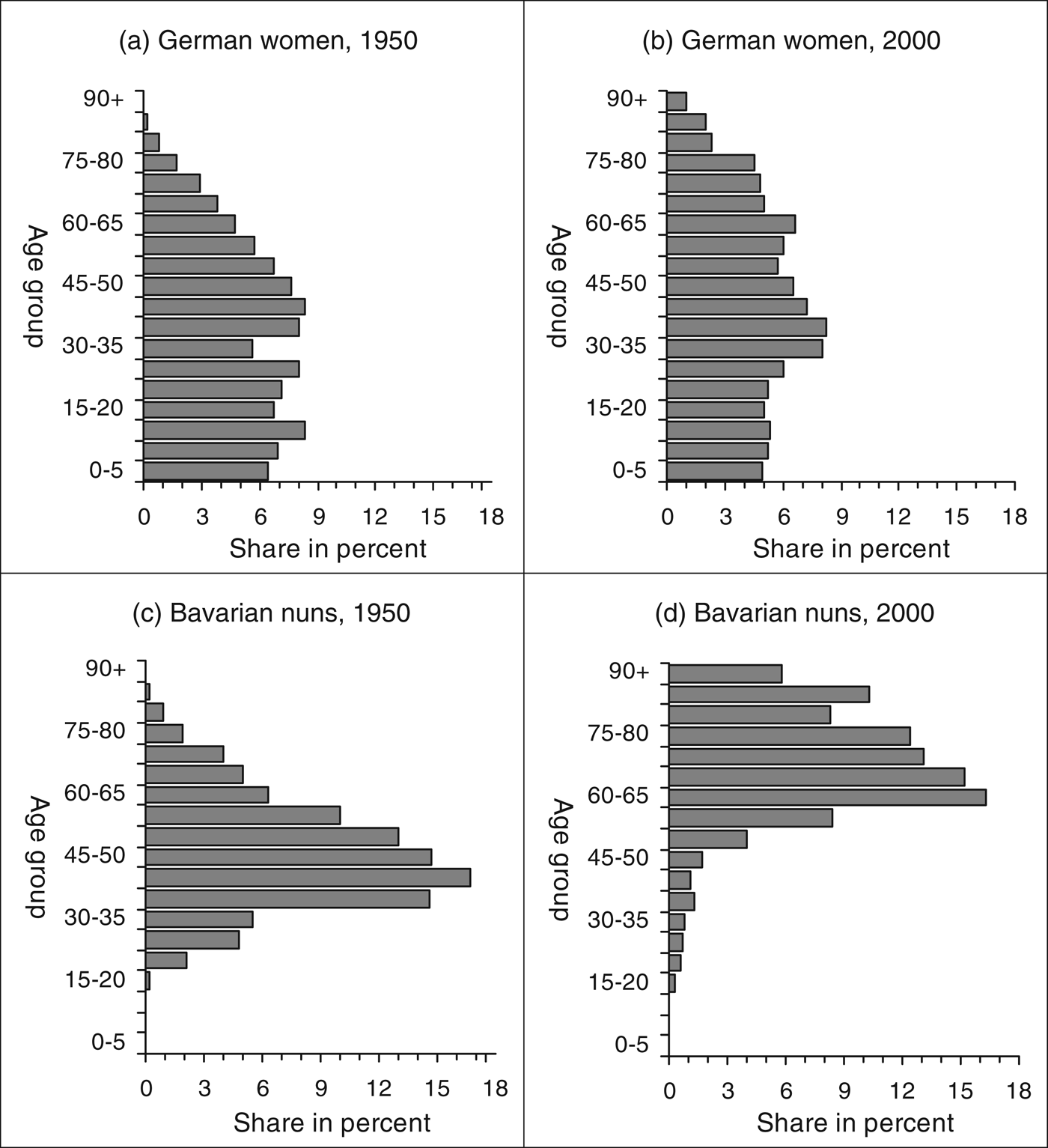
It is likely that the decline of vocations to Catholic orders during the last decades has been caused by a combination of all these reasons. We illustrate the ageing processes of the general and the monastic population in two ways. Figure 1 shows the age pyramids of German women and nuns from Bavarian communities in the years 1950 and 2000. The graphs display the relative number of people for five-year age groups from 0–5 to 90+. Figure 1a and 1b illustrate the ageing process of the German population which is mainly caused by the low fertility levels (and thus low birth numbers) prevalent since the 1970s. This trend causes the age group 0–34 in the year 2000 to be considerably smaller than in the year 1950. The future problems caused by this trend are increased by the cohorts of the ‘baby boom’ years during the 1960s. These cohorts comprise the age group 30–39 in the year 2000 which is bigger than all other age groups. Imagining this age pyramid in 30 years or later reveals that in the future the general society will be built up of a high number of older and retired people and at the same time of a lower number of younger and economically active people – a situation that virtually all European populations are confronted with.
Age distribution of West German women and Bavarian nuns in 1950 and 2000. Data source: Statistisches Bundesamt (Statistical Office of Germany); authors' own data; the data for Bavarian nuns refers to the members of seven religious communities from Bavaria (see text).

Figure 1c and 1d refer to seven Bavarian nunneries which are included in our earlier studies on the mortality of Catholic order members and from which the sample of this study is taken (Luy Reference Luy2002, Reference Luy2003). Since monastic life does not start before the age of 15–19 there are no order members in the younger age groups. Until World War II, the convents in Bavaria and other parts of Europe saw a more or less continuous increase in the numbers of new entries, which peaked during and shortly after the two world wars. The last ‘entry boom’ connected to World War II can be seen in the age range 35–50 in the age pyramid of 1950. Since then, however, the monasteries have experienced a dramatic decline in new entries, as described at the beginning of this section. The age structure of the year 2000 reveals that this trend has continued until today (see Figure 1d). As a consequence of the shorter time-span of monastic life and the tremendous drop in new entries, population ageing among nuns has accelerated much faster and to a higher extent than in the general population.
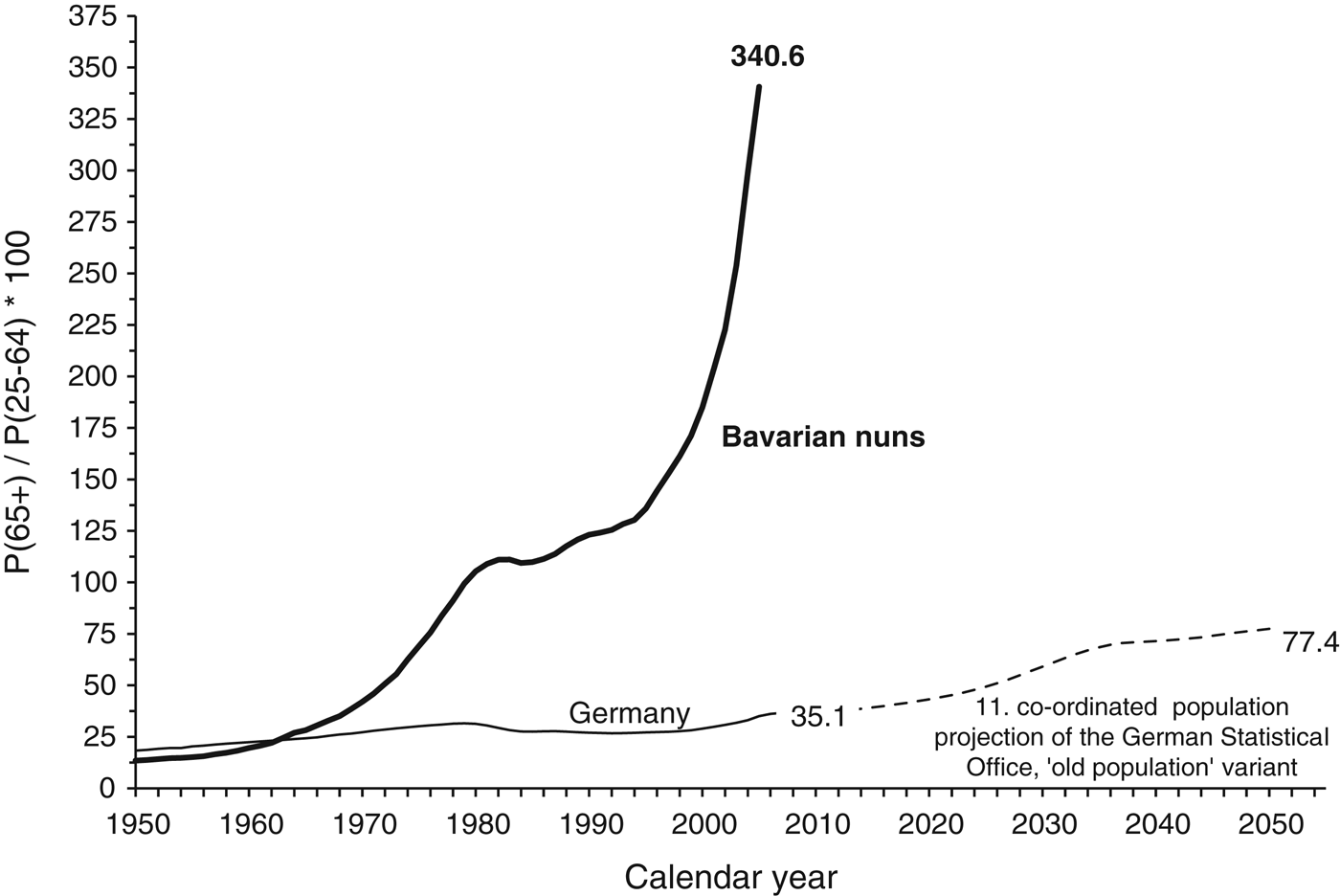
This is further illustrated in Figure 2. The graph displays the so-called ‘old-age dependency ratio’, defined as the number of persons aged 65 and older per 100 persons aged 25–64, for the nuns of the seven religious communities from Bavaria and for the German general population from 1950 to 2005. For the latter, the future trend from 2006 to 2050 is also shown as projected in the ‘old population variant’ by the Statistical Office of Germany in their 2006 population projection (Statistisches Bundesamt 2006; dashed lines in Figure 2). The graph visualises the immense ageing of the nun population with an almost exponentially rising trend of the old-age dependency ratio since the 1990s. In 2005, 100 nuns aged 25–64 were facing 340.6 nuns aged 65 and over. Thus, the nuns are already experiencing the process of population ageing to an extent much above the expected future level of the general population, which is projected to a relation of 77.4 people aged 65 and over per 100 people aged 25–64 in the year 2050 even according to the ‘worst-case’ scenario.
‘Old age dependency ratio’ (number of persons aged 65 and older per 100 persons aged 25–64) from 1950 to 2005 for Germany and Bavarian nuns and for Germany from 2006 to 2050 according to the official population projection of the year 2006. Data source: Statistisches Bundesamt (2006); authors' own data; the data for Bavarian nuns refers to the members of seven religious communities from Bavaria (see text).
Among male order members the actual level of population ageing is also higher than the expected future level of the general population, but still lower than in nuns' convents. In the years 2000–2005, the old-age dependency ratio of Bavarian monks included in the mortality study mentioned above (in total three religious communities) was 98.6 on average. Although the number of new entries went down in friaries as well, the trends are not as extreme as in nuns' convents. The reason for this difference might be that some of the men who become priests still want to spend all their life in a religious context and thus decide to live in a monastery. Hence, there are still professions for men that have remained directly connected to religious life, while the situation is different for women because many popular professions in the social area are no longer exclusively assigned to order members. Nevertheless, monks also experienced the process and the consequences of population ageing to a higher degree than the general population probably ever will.
Study sample and methods
This study is based on the structure, and partially on the data, of the PPAS which consists of two cross-sectional surveys in several European countries. The PPAS is built on a comparative survey of European attitudes and opinions concerning demographic changes, demographic behaviours and population-related policies in order to analyse values and attitudes affecting fertility decisions, the perception of advantages and disadvantages of having children, the meaning of family and parenthood, preferences and aspirations regarding gender roles, paid labour and family life, aspirations in life, opinions and attitudes towards seniors and population ageing, as well as the role of government in providing support to families and older persons. The first wave (PPAS 1) comprised nine countries and was carried out in conjunction with the Family and Fertility Survey (FFS) during the 1990s. The second wave (PPAS 2) was conducted between 2000 and 2003 in 13 countries with more than 34,000 interviewed persons. The results were published in four volumes edited by Palomba and Moors (Reference Palomba and Moors1998a, Reference Palomba and Moors1998b) for PPAS 1 and by Höhn, Avramov and Kotowska (Reference Höhn, Avramov and Kotowska2008a, Reference Höhn, Avramov and Kotowska2008b) for PPAS 2. Our main reference is the western German sample of the PPAS 2 study. The sample comprises 2,058 persons (1,042 women and 1,016 men) between 20 and 65 years who were interviewed between March and July 2003 by means of paper-and-pencil personal interviewing (PAPI) and are representative for the population of western Germany. We compare the PPAS data for western Germany with corresponding data collected among Catholic order members.
The data for order members stem from one male and two female religious communities from Bavaria (southern Germany), practising a monastic – in terms of Klassen (Reference Klassen2001) a ‘semicontemplative’Footnote 1 – way of life, among which we conducted a short survey based on the PPAS 2 questionnaire by means of self-administered questionnaires (SAQ) between December 2006 and June 2009.Footnote 2 In sum, 148 order members participated in the survey, reflecting a response rate of 36.4 per cent.Footnote 3 The sex ratio of surveyed order members was, with 132 nuns and 16 monks, very uneven. However, the results did not show any differences between nuns and monks regarding their attitudes towards population ageing and older people, as there were no differences between female and male PPAS participants of the western German general population as outlined in the introduction. The only exception concerned the order members' opinions with regard to ageing-related population policies, as will be described below.
As already outlined in the previous section, population ageing among order members is more pronounced in nuns' than in monks' communities. This holds for the three participating communities as well. On 31 December 2005, the average age of the living order members was 75.8 years (median 75.3 years) and 73.7 years (median 74.6 years) in the two female communities and 62.3 years (median 66.0 years) in the male community. With the aim to get insights into consequences of the demographic change in an already-aged society, we wanted to know how order members evaluate different aspects connected with the ageing of society compared to the corresponding points of view of women and men of the general population. Two questions of the PPAS 2 directly addressed the aspect of population ageing:
The proportion of young people (below 20) will drop sharply in the future. At the moment, 21 in every 100 inhabitants are young people; in fifty years time this will be 16 in every 100 inhabitants. How do you rate this development? (PPAS 2, question CI8)
and
The number and proportion of people aged 65 years and over is expected to rise sharply in the future. At the moment 16 in every 100 inhabitants in this country are elderly; in fifty years time this figure will be 30 in every 100 inhabitants. How do you rate this ‘ageing process’? (PPAS 2, question A1)
For both questions the possible answers were (1) ‘excellent’, (2) ‘good’, (3) ‘neither bad nor good’, (4) ‘bad’ and (5) ‘very bad’.Footnote 4 Two further questions addressed people's opinion how policy should act in order to finance the future burden for the pension system and how the transition from work to retirement should be regulated in the future:
Many people are worried that the government will not be able to finance the general old-age pension scheme by the time they retire. There are several ways in which the government could ensure that it will be possible to finance old-age benefits in the future. If you had to choose, which of the following ways would you most prefer? (Name no more than two choices)
(a) Raising the retirement age
(b) Raising the monthly taxes or social premiums on the income
(c) Lowering the monthly benefit payment to pensioners
(d) Forcing the children to support their aged parents financially
(e) Abolishing early retirement programmes
(f) Making old-age benefits dependent on the number of children: the more children one has, the higher the benefit
(g) None of these measures is reasonable. (PPAS 2, question A6)
and
Today, more and more people reach the age of 60 to 65 in relatively good health and therefore, they might not be happy with the standard retirement procedure as it now stands (abruptly, totally, compulsory). Do you think that the policy concerning the transition from work to retirement should be: (Only one answer, please)
(a) When reaching a certain age one must be forced to stop working altogether
(b) When reaching a certain age one must be forced to retire but with a possibility of combining retirement and work
(c) Flexible insofar as one gradually diminishes work over a certain number of years (for example from 60 to 65 or 70 years of age) as long as one is in good health. (PPAS 2, question A16)
Finally, PPAS 2 includes a question with nine statements about views on older people in society. For each of these statements the respondents had to express their opinion by indicating if they (1) ‘strongly agree’, (2) ‘agree’, (3) ‘neither agree nor disagree’, (4) ‘disagree’ or (5) ‘strongly disagree’. The question and the statements are put in the following way:
There are widely varying views on elderly persons in our society. Would you please indicate your own opinion on the following statements: (put a cross in each line)
(a) Thanks to their great experience they are still socially useful
(b) They guarantee the upholding of traditional values in society
(c) Subsequent generations can profit from their presence, knowledge and experience
(d) Society should take into consideration the rights of elderly persons
(e) Society should take into consideration the problems of elderly persons
(f) Elderly persons are no longer productive and take away economic resources from society
(g) Elderly persons are an obstacle to change
(h) Elderly persons are a burden for society
(i) Elderly persons are an important resource for emotional support. (PPAS 2, question A2)
As suggested by Schoenmaeckers et al. (Reference Schoenmaeckers, Callens, Vanderleden, Vidovicová, Höhn, Avramov and Kotowska2008), the statements (a), (b), (c), (g), (h) and (i) were used to construct an ‘old-age perception index’ (OAP) to measure the general attitude of the respondents towards older people.Footnote 5 The OAP was driven by the expectation that there should be considerable overlap between each of the statements and the idea that ‘the attitude of each respondent would not be measured on the basis of one single statement, but would reflect an overall attitude based on several statements’ (Schoenmaeckers et al. Reference Schoenmaeckers, Callens, Vanderleden, Vidovicová, Höhn, Avramov and Kotowska2008: 197). Because of the particular phrasing, the order of categories of statements (g) and (h) needs to be reversed to make them comparable with the categories of statements (a), (b), (c) and (i). The OAP is finally constructed in such a way that it receives a value of ‘6’ when the respondent has answered ‘strongly agree’ to all six statements (i.e. the most positive attitude towards older people) and a value of ‘30’ when he/she has answered ‘strongly disagree’ to all statements (most negative attitude towards older people).
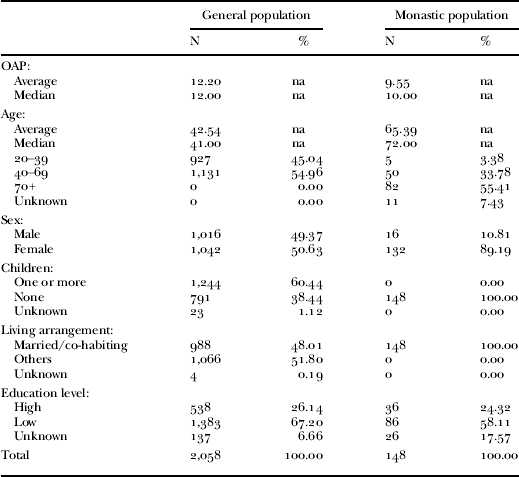
In order to identify factors influencing the OAP, Schoenmaeckers et al. (Reference Schoenmaeckers, Callens, Vanderleden, Vidovicová, Höhn, Avramov and Kotowska2008) used the statistical procedure of General Linear Modelling (GLM) including the covariates age, sex, marital status, children, education level and employment. In doing so, they computed a number of multiple regressions, with the dependent variable being continuous and some of the covariates being categorical. We replicated a similar regression analysis for which we matched the PPAS 2 western German sample with the sample of Bavarian order members. Our analysis includes the covariates population (monastic versus general population), age (in one regression as a linear term with single years of age and in an alternative regression with the three age groups 20–39, 40–69 and 70+ to account for the possibility of a non-linear relationship between age and the OAP), sex, children (childless individuals versus people with one or more children), living arrangement (married or co-habiting women and men versus all others) and education (tertiary education versus all lower education levels, keeping a separate category for unidentified information on education). Because the living environment of order members (i.e. living under the same roof, sharing goods, absence of loneliness, feeling secure and provided for in old age) and their self-perception of family status are more similar to those of married and co-habiting people than to people who live alone (see also Durà-Vilà et al. Reference Durà-Vilà, Dein, Littlewood and Leavey2010; Snowdon Reference Snowdon2001; Struck Reference Struck2000; Turcotte Reference Turcotte2001), and given the fact that this physical and emotional setting is likely to influence their attitude towards older persons, we assigned all order members to the living arrangement group ‘married/co-habiting’. On the other side, all order members belong – and were attributed – to the group of childless individuals. Because of the 65-years age limit of the PPAS sample, higher ages include only order members. To test whether the results are affected by these specific characteristics of the analysed samples, we performed some sensitivity analyses which will be summarised in the subsequent section. The education level of the order members was not asked in the survey but added afterwards from the data file for the original mortality study by matching the information through the birth date of the order members which was included in both data sources. In this way it was possible to identify the education level for 122 of all 148 participating nuns and monks. The descriptive characteristics of all covariates included in our analysis can be found in Table 1. The regression analyses were carried out using the Statistical Package STATA 11.
Characteristics of the covariates included in the regression analysis
Notes: OAP: old-age perception index. na: not applicable. See text for explanation of categories.
Data source: Second wave of the Population Policy Acceptance Study; authors' own data.
Results
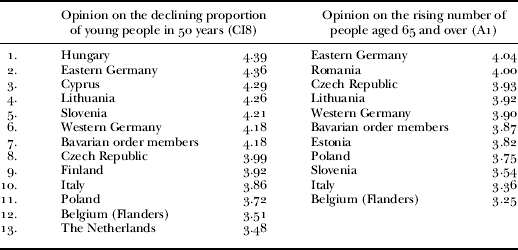
Table 2 summarises the average opinion towards population ageing in the PPAS 2 countries and among Bavarian order members according to the PPAS 2 questions CI8 and A1. The first question refers to the declining proportion of young people during the next 50 years and the second to the rising number of people aged 65 and over. The numbers show that the Bavarian order members evaluate the process of population ageing more or less identical to the women and men of the western German general population. According to the results of PPAS 2, central-eastern Europeans seem to have a more negative opinion towards the changing age composition of their populations than western Europeans. The concerns of Bavarian order members and western Germans lie in the middle of all populations participating in PPAS 2.
Average opinion regarding population ageing in the of the Population Policy Acceptance Study (second wave) countries and among Bavarian order members1
Note: 1. Opinion ranges from 1 = ‘excellent’ to 5 = ‘very bad’.
Data source: Second wave of the Population Policy Acceptance Study; authors' own data; authors' own calculations.
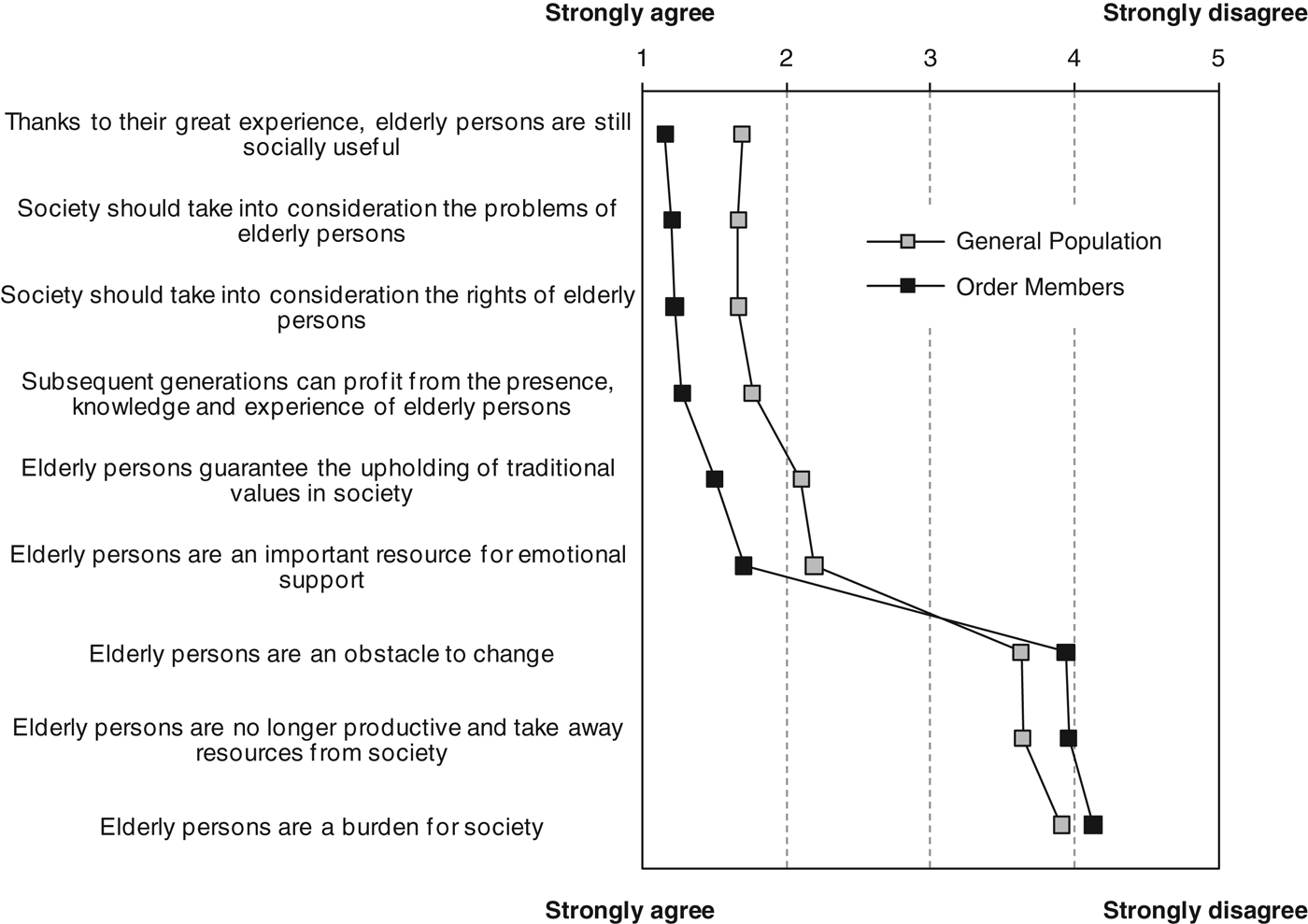
The different items of PPAS 2 question A2 offer the possibility to get deeper insights into how the respondents think about older people. The nine statements of this question cover essentially two domains. Statements (a), (b), (c), (e) and (i) would be associated with the social or emotional sphere, whereas statements (d), (f), (g) and (h) would be associated rather with the economic sphere (see Schoenmaeckers and Vanderleyden Reference Schoenmaeckers and Vanderleyden2005; Schoenmaeckers et al. Reference Schoenmaeckers, Callens, Vanderleden, Vidovicová, Höhn, Avramov and Kotowska2008). Figure 3 shows the means of answers given by the monastic and the general population to these nine statements. It becomes obvious that the order members evaluate each aspect connected with the social role of older people more positively than the women and men of the general population. Note that the three last items – referring to A2 questions (g), (h) and (i) – are formulated negatively, in contrast to the other positively phrased items. Thus, in these three items the attitude towards older people is more positive the higher the average value. Moreover, whereas in the western German general population only a minority seem to regard older people as an obstacle to change or as a burden, there is not even one order member following this point of view.
Opinions regarding characteristics and the societal role of the older population. Data source: Second wave of the Population Policy Acceptance Study; authors' own data; authors' own calculations.
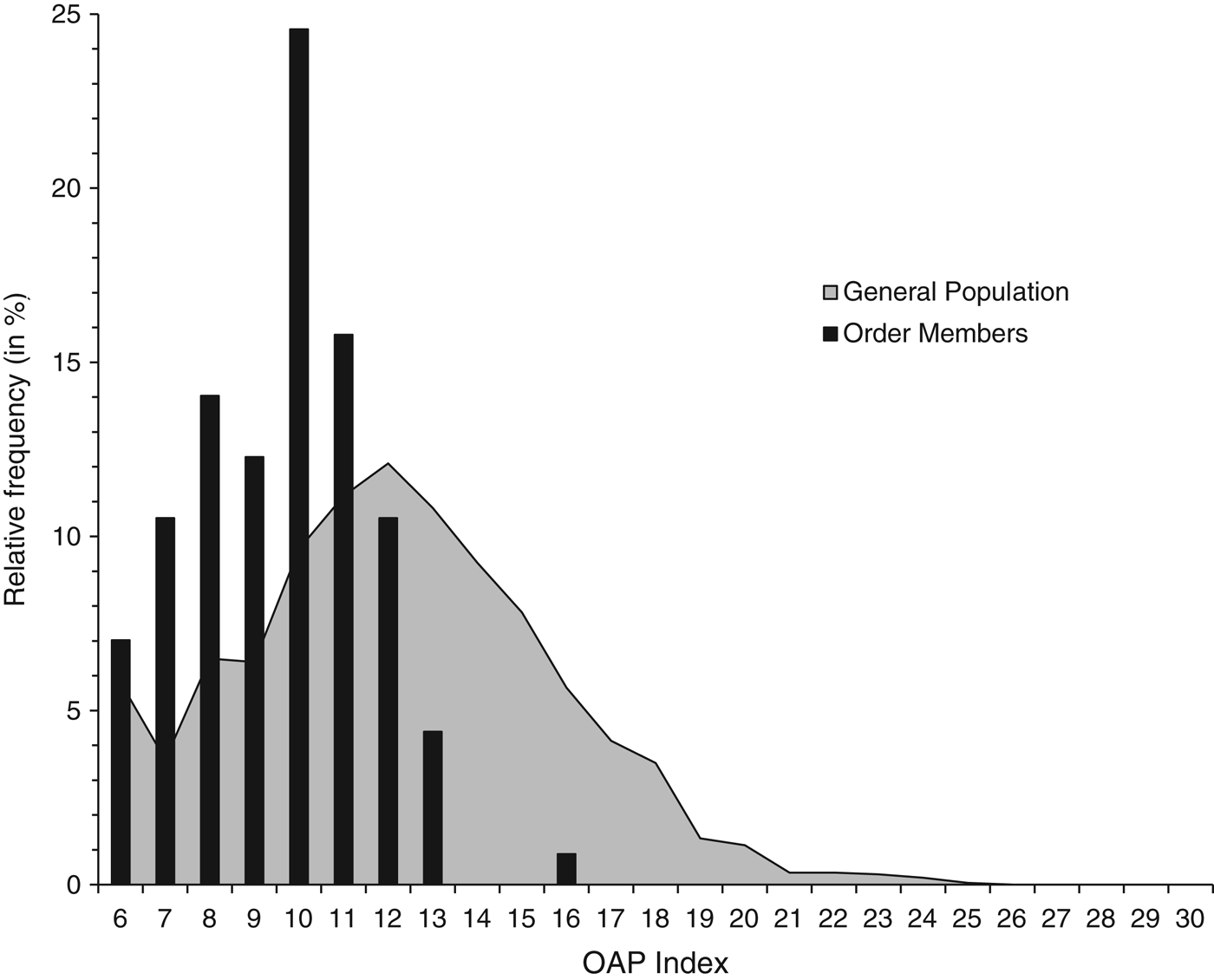
Figure 4 presents the frequency distribution of the OAP for the western German general population and for the Bavarian order members. According to the construction of this index (see previous section), lower OAP values indicate a more positive attitude towards older people, and higher OAP values a more negative attitude. The graph confirms the conclusions drawn from the single items of question A2 that order members have a more positive attitude towards older people than the general population. The average OAP of order members is with a value of 9.55 markedly more on the positive side than the average OAP of 12.20 of the western German women and men.Footnote 6 Moreover, the variance and the span of the OAP distribution are smaller among the order members despite the considerably lower case numbers (114 order members as compared to 2,034 women and men of the general population for whom the OAP could be calculated). The standard deviation of the OAP of the order members is 1.97 compared to 3.49 of the western German general population. The span of the OAP is 6–16 and 6–25, respectively. Also the modal value differs between the two analysed populations, being 10 among the order members and 12 among the western German general population.
Relative frequency distribution of the old-age perception index (OAP) for the West German general population and the Bavarian order members. Note: Smaller OAP values indicate a more positive attitude towards older persons as compared to the reference category. Data source: Second wave of the Population Policy Acceptance Study; authors' own data; authors' own calculations.
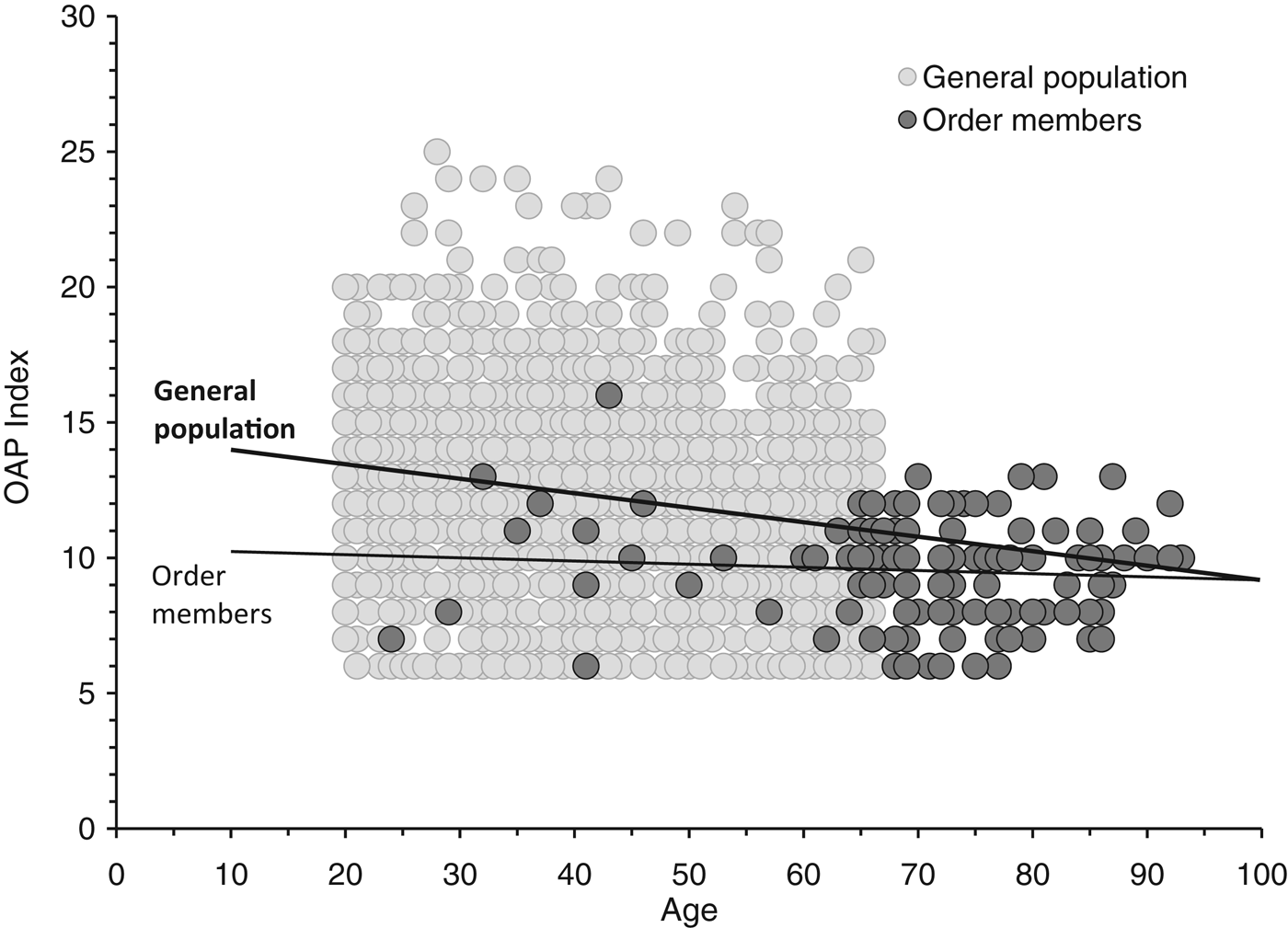
The more positive attitudes of order members towards older people might be connected to their specific socio-demographic characteristics. Figure 5 confirms the findings of Schoenmaeckers et al. (Reference Schoenmaeckers, Callens, Vanderleden, Vidovicová, Höhn, Avramov and Kotowska2008), showing that the OAP is related to age in the sense that in general people in higher ages have more positive attitudes towards older persons than younger individuals. The graph separates between the PPAS 2 sample of the western German general population and the sample of Bavarian order members, revealing that in both populations the relationship between age and the OAP exists in the same direction although it is weaker among order members. Thus, it might be that the more positive attitude of order members towards older people is an effect of their own old age rather than one of being part of an aged society. Similar confounding effects might be caused by order members' living arrangements and childlessness as well as by their education level.
Old-age perception index (OAP) by age for the general and the monastic population. Notes: Smaller OAP values indicate a more positive attitude towards older persons as compared to the reference category; linear trend lines refer to the Population Policy Acceptance Study (second wave) West German sample (thick line) and the sample of Bavarian order members (thin line). Data source: Second wave of the Population Policy Acceptance Study; authors' own data.
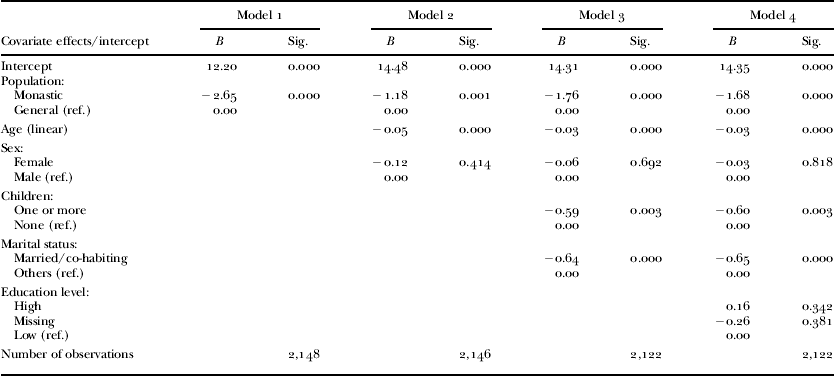
In order to test whether the differences between the monastic and the general population in attitudes towards older people remain significant when these potential influencing factors are controlled for, we performed a multiple regression analysis. The results for the regression variant with age as linear term are summarised in Table 3 (the alternative regression with age being defined in three age groups provided almost identical results, as will be shown below). Model 1 includes population as the only covariate. As could be expected from the previous analysis of the OAP distributions, the monastic population has a statistically significantly more positive attitude towards older persons than the general population (reference group) with a B coefficient of −2.65. The second model includes age and sex as additional covariates. Whereas sex has no significant impact on the OAP, age shows the expected effect with the OAP decreasing by 0.05 with each single year of age. The increase of the B coefficient for the monastic population from −2.65 to −1.18 reveals that a part of the more positive attitude of order members towards older people is in fact due to their higher ages. However, the B coefficient remains highly significant.
Results of the analysis on the old-age perception index (General Linear Modelling regression)
Notes: Sig.: significance. Negative B coefficients indicate a more positive attitude towards older persons as compared to the reference category (ref.).
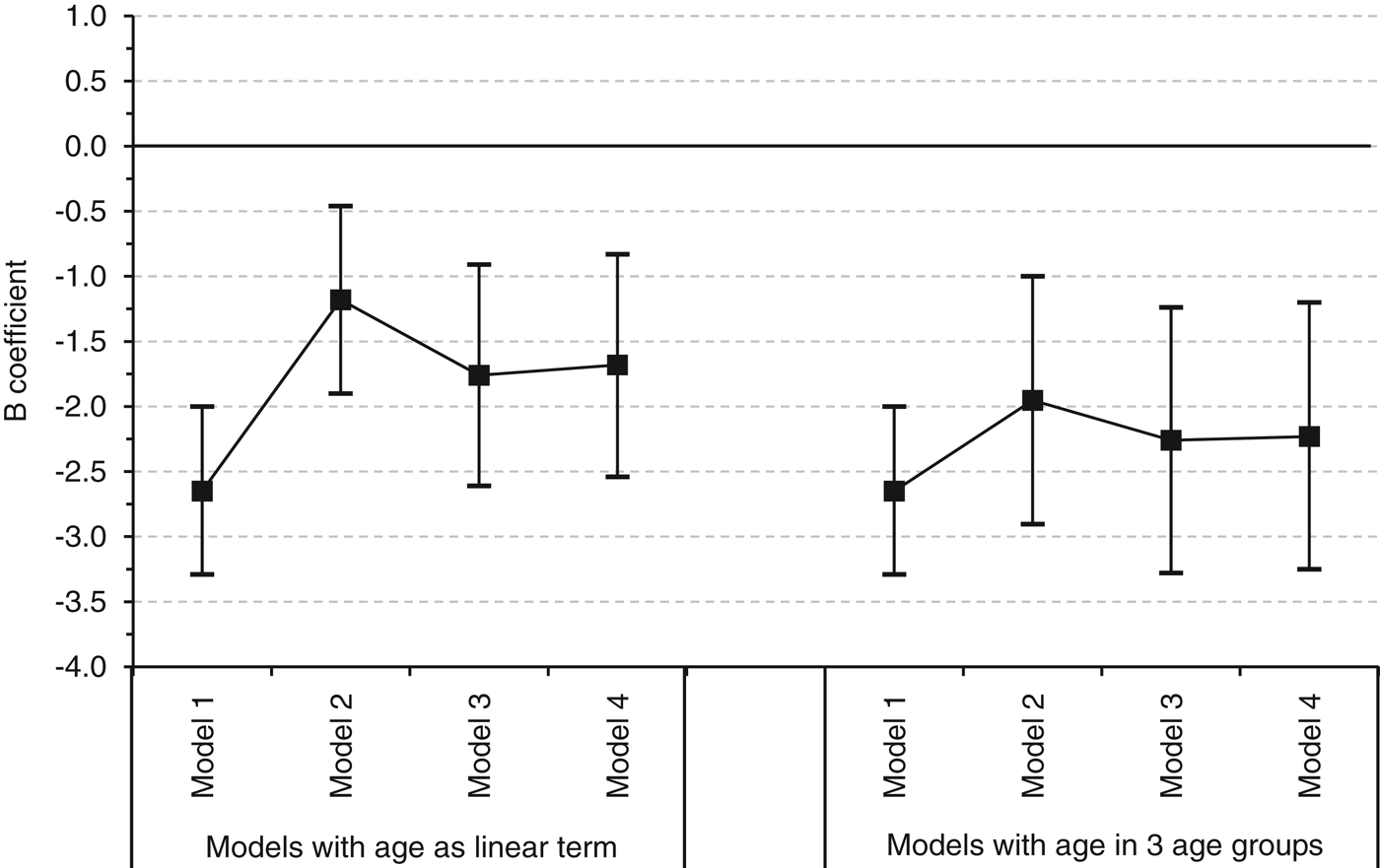
Model 3 additionally includes the covariates children and living arrangement. Both are highly statistically significant with similar reductions in the magnitude of the OAP among people with one or more children compared to childless individuals and among married or co-habiting people compared to all others.Footnote 7 The effect of age remains unchanged but the B coefficient for the monastic population decreases again to −1.76 and keeps its high statistical significance. The final Model 4 additionally includes education as a covariate which shows no significant effect on the OAP.Footnote 8 The effects of the covariates age, sex, children and marital status remain similar to Model 3 and the B coefficient for the monastic population rises slightly to −1.68 without losing its high statistical significance. Thus, our analysis shows that the more positive attitude of order members towards older persons compared to the general population is not explained by the included covariates and remains highly statistically significant in all four models (see Figure 6 showing the B coefficients for the monastic population with 95 per cent confidence intervals in the presented analysis on the left-hand side and in an alternative regression on the right-hand side where the covariate age was included with the three age groups 20–39, 40–69 and 70+). Moreover, the effect of belonging to the monastic population has a stronger impact (i.e. a more negative B coefficient) on the OAP than sex, parity, living arrangement and education.Footnote 9
B coefficients for the monastic population (with 95 per cent confidence intervals) in two regression analyses on the old-age perception index with alternative operationalisations of the covariate age. Note: Model 1 includes population as only covariate, model 2 controls additionally for age and sex, model 3 for age, sex, parity and living arrangement, and model 4 for age, sex, parity and living arrangement, and education (see Table 3). Data source: Second wave of the Population Policy Acceptance Study; authors' own data; authors' own calculations.
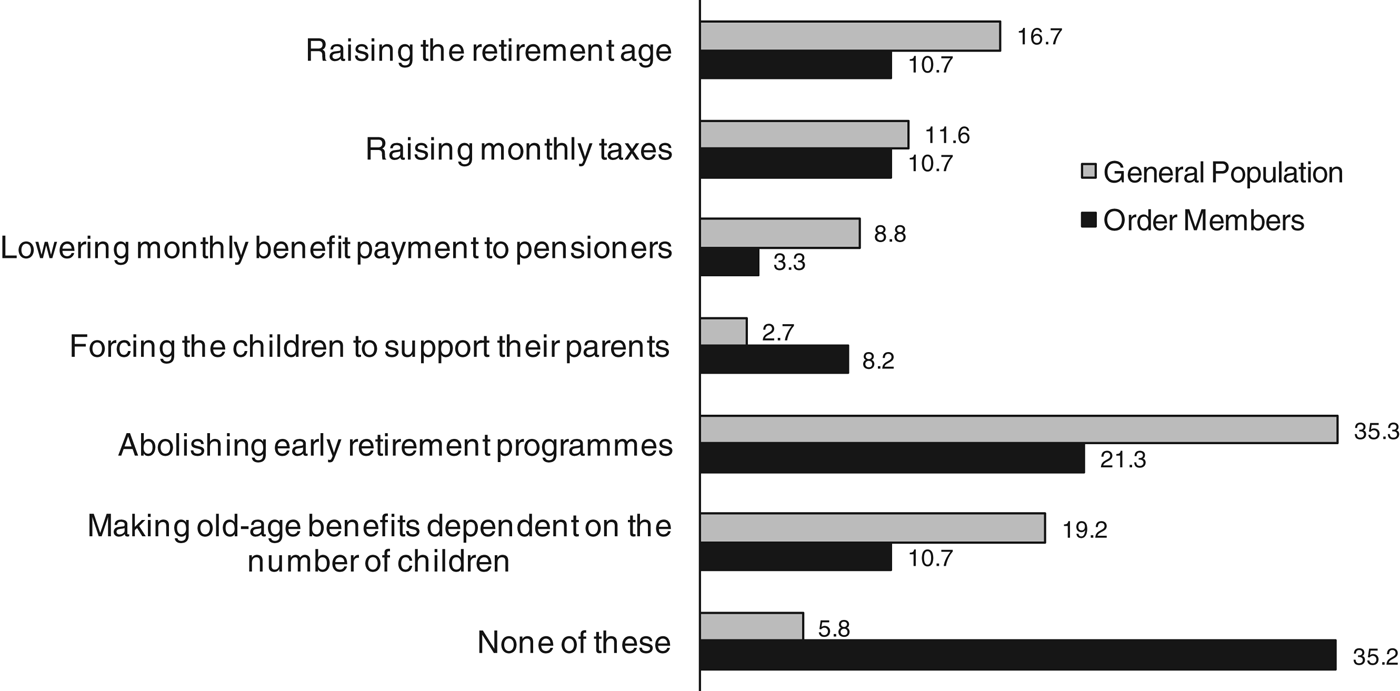
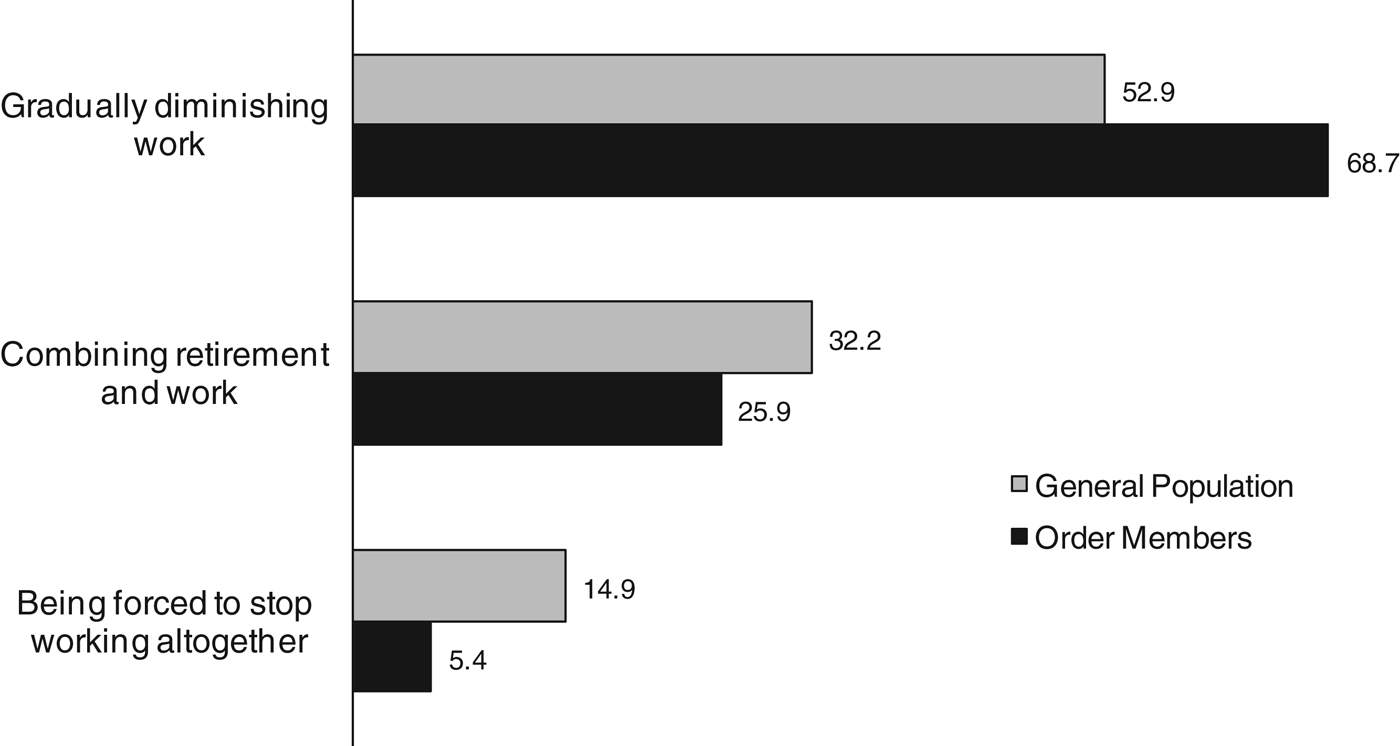
The low OAP values among order members indicate that demographic ageing might not be as problematic for the population with regard to the relationship between younger and older generations as some contemporary scholars suppose the future to be. On the one hand, this might be due to the fact that the members of an ageing society learn to adapt to the situation better than assumed by the pessimists. On the other hand, this might indicate that Catholic orders have developed successful strategies for dealing with the challenges of an ageing population. In order to get a hint if there might be specific monastic strategies that differ from the commonly discussed items in the general population, we also asked the order members PPAS 2 questions A6 and A16. These questions address people's opinion on how policy should act in order to finance the future burden for the pension system and how the transition from work to retirement should be regulated in the future. The results of the answers to these questions are presented in Figures 7 and 8.
First preference about government's way to ensure old-age benefits in the future (in percent). Data source: Second wave of the Population Policy Acceptance Study; authors' own data; authors' own calculations.
Opinion on the policy concerning the transition from work to retirement (in percent).Data source: Second wave of the Population Policy Acceptance Study; authors' own data; authors' own calculations.
An interesting result regarding the first preference about the government's way to ensure old-age benefits in the future is that – contrary to the general population – most order members think that none of the suggested policy measures would be adequate to deal with the burdens of population ageing (Figure 7). It is noteworthy, however, that this is the only item included in the entire study where nuns and monks show significant differences. In contrast, the assessments of women and men of the western German general population in the PPAS 2 are very similar. The order members' preferences depicted in Figure 7 reflect mainly the point of view of nuns. The majority of monks preferred the option to make old-age benefits dependent on the number of children (38.5 per cent), followed by a raise of monthly taxes (23.1 per cent). Only 15.4 per cent of the male order members declared none of the offered political possibilities to ensure old-age benefits in the future as first preference, compared to 37.6 per cent among the female order members.
The much advanced ageing process in the monastic population and the very positive attitudes towards older members of society raise the question which strategies order members follow or found to deal with the burdens of population ageing. One aspect of these strategies might be the transition from active working life to retirement. The opinions of order members with regard to the policy concerning the transition from work to retirement indicate that a sudden and strictly regulated exit from the workforce might be counterproductive for both society and the individuals themselves (see Figure 8). More than two-thirds of the order members (67.9 per cent of nuns and 75.0 per cent of monks) supported the option of gradually diminishing work, whereas only half of the general population is in favour of this way of transition from work to retirement.
Discussion
The main purpose of our study was to evaluate the findings of Schoenmaeckers et al. (Reference Schoenmaeckers, Callens, Vanderleden, Vidovicová, Höhn, Avramov and Kotowska2008) about the attitudes towards older people in an already aged society, that we interpret as indicators for ageism and intergenerational solidarity. Moreover, we tried to get an alternative view on the political strategies currently employed to tackle the consequences of population ageing. Before drawing corresponding conclusions, we have to note that this study has many limitations and can merely be considered illustrative and suggestive. The sample is small and probably comprises unknown characteristics of those who decided to participate. Thus, the results cannot be interpreted as general views of order members but have to be seen as the opinions of the 148 sisters and brothers who participated in our survey.
The basic idea behind our study is very simple: how do members of an already aged population evaluate the process of demographic ageing and what are their attitudes towards older people as compared to women and men who did not experience what life in an aged society looks like? At a first glance, it seems as if the experiences of the monastic population could be directly transferred to the worldly society because the order members' views might be expected to be primarily influenced by the consequences of the enormous demographic changes in their convents. Ageing has caused severe problems for the religious communities, including retirement funding, care for the older members, maintenance of buildings and even decisions about closing down monasteries and nunneries, along with problems of morale among the remaining, economically active members (Carey Reference Carey1997; Ebaugh, Lorence and Saltzman Chafetz Reference Ebaugh, Lorence and Saltzman Chafetz1996). As Keenan (Reference Keenan2002: 16) puts it, ‘[i]n the real world of pension plans, superannuation schemes, life assurance and other designs for minimising Life's uncertainties, monasticism, at least in its ideal self-image as “life dependent on Providence”, represents the quintessential risk society’.
An increasing number of orders try to deal with their financial problems and membership declines by hiring secular staff for various jobs (a strategy that might be seen similar to recruiting immigrants in worldly European societies), merging their provinces into larger units or unifying with other orders, usually with those funded under the same monastic rules. As outlined by Carey,
[w]hile this may sound like a practical solution to financial and personnel problems, it is not easy for sisters who have lived all their lives in one order to suddenly be faced with accepting an entirely new constitution, an entirely different experience of spirituality, and a whole batch of people they have never met but who are supposed to be their community members, their family. (1997: 296f)
Actually, some scholars assume that many religious orders will not survive the current crises (Turcotte Reference Turcotte2001) or expect the emergence of different and completely new forms of monastic life (Keenan Reference Keenan2002; Wittberg Reference Wittberg1994). Durà-Vilà et al. (Reference Durà-Vilà, Dein, Littlewood and Leavey2010) report that sisters do in fact fear such consequences for their communities as well as the complete extinction of contemplative life.
However, it is not clear whether order members' views on population ageing and older people are determined by these experiences in the first place. Besides average age, order members differ from the worldly society by several other factors, which are likely to influence their opinions about population ageing and attitudes towards older people. The latter comprise aspects of the specific organisation of society as well as the particular conditions, under which the individuals live and perceive the ageing of their fellow members and society as a whole. For instance, Klassen (Reference Klassen2001: 87) describes traditional monastic life as ‘ageless’ because it does not follow the prescribed course that dictates the lives of most laypersons and is determined by family obligations and lifecourse events such as entering working life, marriage, pregnancy, births and deaths of children, childrearing, divorce, retirement and widowhood. Although nuns and monks go through different life stages as well, we may assume that they do not define their lifecourse in the same way as women and men of the worldly society. Hence, in contrast to the worldly population, order members might be less or not at all aware of age as a natural indicator of difference between individuals or generations.
Nevertheless, there is also potential for generational conflicts within religious societies, although their generations are not based on age or birth cohort. Lange (Reference Lange2000) identifies three generations of nuns, which were built up in connection with Vatican II. Almost all members of the ‘old generation’ (comprising sisters aged around 80 and older now) entered the communities at a very young age and were often motivated by the wish to get a professional education. For most of them, joining religious orders governed by the strict rules before Vatican II meant to dissociate from their families, abandon certain privileges and lose their autonomy by strictly obeying the vows of leading a life in poverty, chastity and obedience (see also Turcotte Reference Turcotte2001: 177). The generation of ‘younger elderly’ nuns, i.e. sisters currently aged 60–80, is different because they already entered the communities with specific wishes about their career, which, however, mostly remained unmet. The sisters of the youngest generation were the first to accomplish their career wishes in accordance with the guidelines of Vatican II. This change was supported by their higher ages at entry, when they had already completed their professional training, which sometimes was also a prerequisite: i.e. they were ‘members taken in from the world of modernity’ (Turcotte Reference Turcotte2001: 185). Therefore the youngest generation of nuns experienced a process of individualisation and developed views and values similar to their peers in the worldly society (Lange Reference Lange2000). Differently to the older nuns, younger sisters are also better acquainted with such tasks as handling business matters and finances (Hickey and Kalish Reference Hickey and Kalish1969; Turcotte Reference Turcotte2001).Footnote 10 Despite the agelessness of order members referred to above, it might well be that the different characteristics of these monastic generations do cause differentiations and resentments between them in a similar way as there are dissonances between the older and younger generations in the worldly society (see also Hickey and Kalish Reference Hickey and Kalish1969). For instance, it is reported that older sisters of communities with strongly declining numbers ‘often feel betrayed and forgotten as they watch the institutes in which they spent their entire lives edge closer to extinction as their [younger] leaders seem unable or unwilling to reverse the process’ (Carey Reference Carey1997: 17).
Another important aspect to be considered when comparing order members and worldly individuals in the context of this study are their different concepts of retirement. While compulsory retirement is the norm for the latter, religious communities practise a form of voluntary or ‘natural retirement’ (Nix Reference Nix, Conference and Charities1968: 108) where health is the main determinant for the kind and amount of work they do (see also Hickey and Kalish Reference Hickey and Kalish1969). This difference is rooted in divergent perceptions of work as an integral part of lifetime. For women and men of the worldly society, working life is a well-structured and finite period, which they often perceive as being separated from private life. For order members, it is a steady and important component of their overall meaning of life, which makes them regard retirement as ‘a threat rather than an opportunity’ (Coralita Reference Coralita1968: 14). Adhering to the principle ‘ora et labora’, nuns and monks therefore continue to work even in old age although their activities and functions within the community become less demanding in terms of time and energy. Even order members who are employed outside the community and thus officially retire look for new functions and activities in the convent when they have reached the statutory retirement age (Lange Reference Lange2000). In general, order members not only consider this system of natural retirement relaxing and fulfilling (Coralita Reference Coralita1968) but also instrumental for their high life expectancy (Luy Reference Luy, Gruner and Kuhla2009). As Nix (Reference Nix, Conference and Charities1968: 113) puts it, ‘[s]enior sisters do not suffer the frustration of our citizens, of Social Security, of a life without personal accomplishment, a life awaiting death’.
Probably the most important difference to the worldly society is the nuns' and monks' acquaintance with sick and needy older members who can remain within the community instead of being transferred to external institutions. Providing care to older or ill members of the community is an integral part of monastic life. Orders take a communal approach to offering physical and spiritual care and to attending to their members until their very last moments (Durà-Vilà et al. Reference Durà-Vilà, Dein, Littlewood and Leavey2010). Thus, for order members the most feared consequences of becoming older – i.e. weakening physical and mental abilities – are not linked with the risks of social exclusion and loneliness (Lange Reference Lange2000). However, as the monastic population is subject to extreme ageing, younger order members cannot rely on receiving the same support. On the one hand, one might assume that this threat is likely to lead to negative attitudes towards older people. On the other hand, however, order members' attitudes and behaviours towards their older peers might rather be determined by their spiritual values. For instance, several studies observed positive correlations between religiousness and greater hope and optimism about the future (Idler Reference Idler, Smelser and Baltes2001; Koenig Reference Koenig2001; Koenig, King and Benner Carson Reference Koenig, King and Benner Carson2012; Koenig and Larson Reference Koenig and Larson2001; Levin and Chatters Reference Levin, Chatters and Koenig1998; Salsman et al. Reference Salsman, Brown, Brechting and Carlson2005). Moreover, the sisters' belief to have followed the path in life they were chosen for apparently has a positive influence on their life satisfaction. This seems particularly important in the current situation, a situation that gives rise to severe concerns for their future lives (Wolf Reference Wolf1990).
It is a common view that nuns are more affected by these conditions than monks whose roles and tasks have remained more similar to their traditional order life (see also Wittberg Reference Wittberg1994). We can, however, assume that all these developments also apply to the male order members whose communities undergo similar changes and re-organisations, albeit at a smaller scale. It is difficult to evaluate if and in which direction order members' attitudes towards older people and opinions about population ageing might be influenced by their experiences with life in an aged society. This complicates the comparison of order members' and worldly people's opinions about population ageing and the attempt to use the former's experiences to draw conclusions for the latter.
With these limitations and insecurities in mind, however, our study supported most findings and conclusions by Schoenmaeckers et al. (Reference Schoenmaeckers, Callens, Vanderleden, Vidovicová, Höhn, Avramov and Kotowska2008). As already mentioned in the introduction of this paper, the views of European women and men towards population ageing and older people, which are reported in the PPAS, are likely to be influenced by the fact that the increase in numbers of older people in society is presented by the press, by electronic mass media, by policy makers and – last but not least – by scientists as a bad evolution for our economies and hence for the sustainability of our welfare regimes (see e.g. Warnes Reference Warnes1993). As Schoenmaeckers et al. pointed out,
the main message which citizens receive is that their pension payments are at risk and that health care expenditures are reaching unacceptable levels as a result of ‘ageing’. At the same time, most solutions (extended participation in the labour force linked with a higher retirement age, the possibility of lower pensions, the prospect of higher individual expenses for medical treatment…) are against the citizens' self-interest. (2008: 206)
As further outlined by Schoenmaeckers et al. (2008: 196), it therefore ‘comes as no surprise that people regard population ageing as a threat’. Despite the significant differences between the two societies, our study indicates that people's negative expectations are justified because it shows that order members – whose views are probably based more on direct experience than on indirect external influences – evaluate the ageing of the population in an almost identical negative manner.
However, the low OAP values of both the PPAS 2 and our study sample reveal that the negative opinion which people show with respect to the rising number of older people cannot be interpreted as a negative attitude towards older persons as such. The fact that people generally continue to take a favourable view of the role which older people may play in society – in spite of their concerns related to population ageing – can also be seen from the results of all statements separately. Looking at the OAP as well as at each single statement, this holds for order members even more strongly than for women and men of the general population. Moreover, as all results point in the same direction, this implies that the low numbers of interviewed nuns and monks do not qualify the findings. The distributions of the OAP in the monastic and the general population and the results of our regression analysis suggest that attitudes towards older people are not more negative in an aged society. The fact that the maximum individual OAP (thus the least positive attitude towards older persons) among order members (16) lies distinctly below the maximum OAP among individuals of the general population (25) and the regression results indicate that this is not a mere consequence of the fact that order members are simply older than worldly women and men. There are still some nuns and monks aged below 50 whose attitudes towards older persons are obviously not negatively affected by being surrounded by a vast majority of old sisters and brothers since all OAP values are below the ‘neutral’ value of 18.
In our analyses of the total population sample (Table 3) and an additional analysis of the sample of Bavarian order members alone (data not shown), we found that sex does not play any role with regard to the attitudes towards older people and population ageing. This is equal to what Schoenmaeckers et al. (Reference Schoenmaeckers, Callens, Vanderleden, Vidovicová, Höhn, Avramov and Kotowska2008) found for the western German general population, but different to what they found for most other countries where a weak effect of sex exists in the way that women appear to have a less negative opinion than men about the rising number of older persons. The authors explain this difference by the fact that women (continue to) occupy different positions in society and within the family than men: women are considered and consider themselves as primary care-givers and thus much of their more positive attitude towards older people could emanate from the way in which they project their own future role as an older person. Therefore, it is not surprising that this effect is missing in the monastic population, where no such differences occur between the sexes. Consequently, our findings do not indicate that the differences between women and men diminish in an aged society. The fact that no sex differences in this respect can be found among order members is rather to be explained by the missing co-habitation of women and men in this specific subpopulation, i.e. nuns and monks have to distribute all societal tasks and roles among peers of the same sex.
As pointed out by Schoenmaeckers et al. (Reference Schoenmaeckers, Callens, Vanderleden, Vidovicová, Höhn, Avramov and Kotowska2008: 207f), ‘[p]olicy-makers appear to regard intergenerational solidarity as a prerequisite for the successful implementation of measures to counterbalance the negative socio-economic effects of “population ageing”’. The authors interpret their finding of an age effect in the attitudes towards older people in the way that ‘intergenerational solidarity cannot be taken for granted and that there is certainly need for improvement’ (Schoenmaeckers et al. Reference Schoenmaeckers, Callens, Vanderleden, Vidovicová, Höhn, Avramov and Kotowska2008: 208). Here, the results obtained from the nuns and monks point in a different direction because among them the positive attitudes towards older people and their role in society are less affected by age. Interestingly, a ‘study on retirement attitudes’ of sisters conducted in the mid-1960s – a time when the age structure of Catholic order members was completely different – failed to find any difference between younger and older sisters regarding their opinion on where and how senior and sick sisters should be taken care of (Coralita Reference Coralita1968). These observations speak either for the assumption that living in an aged society is not associated with tremendous changes for younger people as often expected, or against the conclusion drawn by Schoenmaeckers et al. (Reference Schoenmaeckers, Callens, Vanderleden, Vidovicová, Höhn, Avramov and Kotowska2008) that the attitudes towards older persons differ between younger and older people as a result of personal experience. However, as already stated by Schoenmaeckers et al. (Reference Schoenmaeckers, Callens, Vanderleden, Vidovicová, Höhn, Avramov and Kotowska2008: 208), intergenerational solidarity is a difficult concept to measure and one single instrument (such as an index of attitudes towards older people) is hardly sufficient to measure its presence in a specific society.
It is important to note that our study does not allow us to conclude that life in an aged society is in any sense better than life in a younger population. Although our regression analysis revealed that the more positive attitudes of order members towards older people are more than a consequence of their own high age and other specific socio-demographic characteristics, the results might as well be connected to the aforementioned specific beliefs and attitudes of nuns and monks and therefore rather reflect an effect of their altruism and charity. Nevertheless, what our study shows is that the effect of population ageing does not necessarily lead to negative perceptions of old age and older people.
Finally, we found that order members have very different opinions regarding the government's possibilities to secure old-age benefits in the future. West German women and men think that the most promising strategy is an abolishment of early retirement programmes. In contrast, the majority of nuns think that none of the policy measures suggested in the corresponding PPAS 2 question will be adequate to deal with the burdens of population ageing. Most monks see a dependency between old-age benefits and a retiree's number of children as the most promising policy measure.Footnote 11 Of course, the differing views of order members compared to the worldly women and men might be due to the described differences in retirement systems and care for older and needy individuals. Nevertheless, the distinct disagreement of nuns' and monks' preferences with ageing-related population policies indicates that the aged religious communities have not yet found an ‘ideal’ policy for handling the societal burdens of population ageing. However, their positive attitudes towards older persons suggest that members of an ageing society can find ways to adapt to the new situation. Maybe the strategy of gradually diminishing working time is more successful than a sudden and strictly regulated exit from the workforce as practised in modern societies. In the light of the current discussions about raising statutory retirement ages in European societies this is an interesting thought.
To conclude, although many relevant societal characteristics and – last but not least – the absolute values in the analysed items of the PPAS 2 questions differ between the general and the monastic population, they both show the same basic pattern of a positive attitude towards older people while at the same time considering population ageing as such to be a bad or even very bad development. This indicates that both aspects cover different issues, as already concluded by Schoenmaeckers et al. (2008: 206): ‘Negative views of the increasing number of older people do not mean that older persons are not respected, or that their qualities are ignored’. The results of our study imply that even in an aged population younger and older generations can build a well-functioning society in which older persons can play a useful and respected role. However, the fact that Bavarian nuns and monks – as individuals who actually experienced life in an aged society – rate population ageing as negatively as the western German general population indicates that the general worries are justified. Thus, our results, as well as those of Schoenmaeckers et al. (Reference Schoenmaeckers, Callens, Vanderleden, Vidovicová, Höhn, Avramov and Kotowska2008), show that the consequences of population ageing should neither be seen as exclusively positive nor as solely negative, which is the case, above all, in the German-speaking discussion of demographic change.
Acknowledgements
We are grateful to the Catholic Communities of Brothers and Sisters without whose co-operation and support it would not have been possible to do this study. We also thank Sylvia Trnka and Werner Richter for language editing. This research was supported by the European Research Council within the European Community's Seventh Framework Programme (FP7/2007–2013)/ERC grant agreement number 262663.