INTRODUCTION
The most critical aspect of assessing decisional capacity is provision of the necessary care for those lacking the ability to make decisions about what is the most appropriate treatment to suit their circumstances. As a central concept in healthcare law and ethics, decisional capacity can be defined as the ability of patients to make healthcare decisions that are in the own best interest. The laws of the United States presume that adults have the ability to make their own healthcare decisions (Cruzan v. Director, Missouri Department of Mental Health, 1990). According to the most commonly held beliefs, the concept of decisional capacity can be subdivided into four components: (1) understanding, (2) appreciation, (3) reasoning, and (4) choice (Appelbaum, Reference Appelbaum2007; Appelbaum & Grisso, Reference Appelbaum and Grisso1988).
Assessment of decisional capacity (DC) has been the topic of much ongoing research. The majority of studies focused on DC in the elderly and in those with cognitive disorders, primarily dementia (Etchells et al., Reference Etchells, Darzins and Silberfeld1999; Griffith et al., Reference Griffith, Dymek and Atchison2005; Hamann et al., Reference Hamann, Bronner and Margull2011; Karlawish, Reference Karlawish2008; Marson et al., Reference Marson, Schmitt and Ingram1994; Reference Marson, Cody and Ingram1995; Moye et al., Reference Moye, Karel and Gurrera2006; Raymont et al., Reference Raymont, Bingley and Buchanan2004; Rodin & Mohile, Reference Rodin and Mohile2008; Sessums et al., Reference Sessums, Zembrzuska and Jackson2011; Weiss et al., Reference Weiss, Berman and Howe2012), and those with schizophrenia (Candilis et al., Reference Candilis, Fletcher and Geppert2008; Okai et al., Reference Okai, Owen and McGuire2007). Among the elderly and cognitively impaired, validation studies of capacity assessment tools have shown that mild and moderate dementia do not exclude making informed treatment decisions, and patients with moderate dementia have demonstrated DC for certain aspects of medical care (Rodin & Mohile, Reference Rodin and Mohile2008).
Although in some patients certain aspects of DC are preserved, the rate of incapacitation remains high. In nursing homes, an inability to make medical decisions has been found in about half the residents (Karlawish, Reference Karlawish2008). Another factor that has been identified as contributing to incapacity is delirium (Rodin & Mohile, Reference Rodin and Mohile2008; Young & Inouye, Reference Young and Inouye2007). In a medical inpatient setting, cognitive impairment has been attributed to two thirds of those with decisional incapacity (DI). In contrast, psychotic disorders (14%), mood disorders (12%), and alcohol abuse disorders (9%) were much less associated with DI.. Overall, 88% of the patients in our study were deemed to not have DC (Kahn et al., Reference Kahn, Bourgeois and Klein2009).
To date, there are very few studies on DC assessment that document the associated medical and capacity questions in inpatient settings across a broad spectrum of psychiatric disorders. In order to further explore DC and DI in this milieu, we retrospectively reviewed more than 2,500 psychiatric referrals to the consultation–liaison (C–L) service at Bellevue Hospital Center (New York) in order to evaluate the prevalence of medical illness and psychiatric comorbidities and their impact on decisional capacity.
METHODS
Patients and Procedures
All cases of decisional capacity assessment were reviewed from psychiatric referrals to Bellevue Hospital Center between January 1, 2011 and March 31, 2012. Bellevue is a city hospital, a level one trauma center, and the major teaching site for the New York University School of Medicine, and it includes 450 medical and surgical beds. On average, 120,000 patients visit the adult emergency services each year, and 26,000 inpatients receive their medical care at Bellevue. More than 80% of their patients come from medically underserved populations. As part of the psychiatric service, the consultation–liaison service performs more than 2,000 initial consults on the medical, surgical, and emergency care services and about double that number of follow-up patient contacts annually.
The C–L service maintains a clinical database to record and track initial consults and manage re-consultations for acute events in already-followed patients. The reason for the consultation is also recorded in this database. More than 2,500 consults (2584) were screened and 336 cases (13%) of assessments of DC identified. All referrals for DC assessment (signing out against medical advice, refusing workup and treatment, as well as placement issues) were extracted, and records were individually reviewed in the computer-based patient record system (Misys CPR™, Misys Healthcare Systems, Raleigh, North Carolina).
We recorded such sociodemographic variables as age and gender, psychiatric diagnoses, medical diagnoses, reason for capacity assessment, primary treatment team assessment, and psychiatric assessment. All patients were assessed in person by residents and attending physicians. When patients were first assessed by residents, the attending physicians then assessed the patients as part of a supervisory process. When patients refused the initial assessment, the refusal was recorded and another assessment undertaken.
Assessments of decisional capacity were recorded as: DC existed (“YES”) and DC did not exist (“NO”). When patients agreed to treatment recommendations during the assessment process, this response was recorded as “not indicated.” In a few cases, assessment was not possible (as the patient had checked out, though safety precautions had been taken) or no documented record of the assessment process could be located. These cases were recorded as “not applicable.” When no record could be found, psychiatric and medical diagnoses were extracted from previous documentation during the same hospitalization.
All psychiatric diagnoses were determined according to the Diagnostic and Statistical Manual of Mental Disorders, 4th ed. (DSM–IV–TR) (American Psychiatric Association, 2000). Psychiatric diagnoses were classified as psychosis, mood and cognitive disorders, substance abuse disorders, mental retardation, other disorders, and none. Generally, when psychosis was diagnosed, patients were stable and on antipsychotic medication; a few patients had acute psychoses. The cognitive disorders included delirium and dementia, as well as instances when information or clinical impressions did not allow for a definite diagnosis of delirium and/or dementia. A diagnosis of substance abuse disorder included active substance abuse prior to hospitalization (mostly alcohol, opiates, and benzodiazepines), detoxification, and stable/dormant substance abuse, including methadone maintenance.
Medical diagnoses were recorded according to the system or service involved: cardiovascular, gastrointestinal, endocrine, neurological, pulmonary, genitourinary, gynecological, infectious, oncological, traumatological, dermatological, other, and none. Multiple recordings of the DC assessment in repeat cases were allowed, as well as multiple admissions and assessments during the review period. Recording of multiple psychiatric and medical diagnoses according to the patient profile was also possible, particularly in the cognitive disorder domain.
The primary team documented DC as present or absent. In a few cases, the primary treatment team was unsure or no DC assessment was performed (recorded as “not applicable”). The chart review was approved by the institutional review board (IRB, S-12-02375, status exempt on May 2, 2012) and the Bellevue Central Office for data collection and publication.
Statistical Analysis
Data analyses were performed with the Statistical Package for the Social Sciences (SPSS, v. 20) for Windows. Descriptive statistics were performed on the dataset to characterize the sample sociodemographically, psychiatrically, and medically. Separate datasets describing decisional capacity (“YES,” “NO,” “not indicated,” and “not applicable”) were created for our analysis of age, gender, and psychiatric/medical diagnoses. For analysis of gender distribution, “transgender” was defined as a missing variable in order to allow statistical analysis. For analysis of completed consults, a separate dataset reduced to “DC YES“ or “DC NO” was created. Within this dataset, the prevalence of psychiatric comorbidities in “DC YES”/“DC NO” was computed. Prevalence rates referred to the complete “YES/NO” sample.
A t test for independent samples was employed for variables on the interval scale (e.g., age) and Pearson's chi-square (χ2) test for contingency analyses of categorical variables. In order to assess the impact of psychiatric diagnosis on decision-making capacity, simple logistic regression analyses were also performed. After the fact, the value of alpha (α) for all implemented tests was adjusted using the Bonferroni method. The significance level (α) was set at p < 0.05.
RESULTS
Characteristics of Decisional Capacity Consults
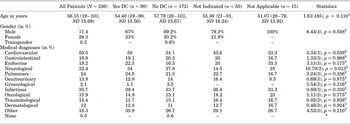
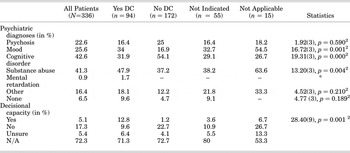
Patients assessed for decisional capacity were in their mid-fifties and predominantly male. Psychiatric and medical diagnoses were diverse; however, there were differences in the prevalence of neurological disorders and psychiatric comorbidities. Subjects with neurological disorders were more often found not to have DC than when DC assessment was not indicated. Most commonly, consults were called for in patients with cognitive and substance abuse disorders (42.6 and 41.3%), followed by mood disorders (25.6%, χ2 = 5.76(1), p = 0.019, OR = 0.48), and psychotic disorders (22.6%, χ2 = 9.62(1), p = 0.003, OR = 0.45). More than 50% of cases were diagnosed with more than one psychiatric disorder, and more than 20% were diagnosed with three and more.
The majority of patients were not deemed to be competent to make their own healthcare decisions. Out of 336 DC consults, 172 patients (51.2%) were deemed not to have decisional capacity and 94 patients (28%) were deemed to have DC. In 55 cases (16.4%), assessment of DC was not required after communicating the medical situation to the patient (n = 48, 87.3%), or after assessment of psychiatric comorbidities (n = 5, 9.1%), or when no decisional assessment was required (n = 2, 3.6%). In 15 patients (4.5%), an assessment could not be performed or was not adequately documented. With the focus on completed DC consults (N = 266), nearly two thirds of patients (64.7%) were deemed to not be able to make their own healthcare decisions.
The primary treatment team generally employed a different approach in the assessment of DC than that employed in the C–L psychiatry service. Decisional capacity was only documented in 23.8% of cases, while 18% of patients were deemed incompetent to make their own healthcare decisions and in 5.3% were considered competent. Though only one fourth of cases were assessed, the assessments by the primary medical team were often congruent with the psychiatric assessment. In 12.8% of cases, both the medical and psychiatric teams assessed functional DC, and in nearly a quarter (22.8%) both teams assessed DI. In contrast, the primary medical team deemed patients to have DC in only 1.2% of cases where the psychiatric team had assessed a lack of DC, and in 9.6% of cases where the psychiatric team had deemed the patient competent. Thus, the assessments of the primary team were correct in four of five cases; nevertheless, the primary team did not make DC assessments in 75% of all cases (see Table 1).
Sociodemographic and medical variables of decisional capacity assessments

1 t test. 2 Pearson's chi-square test. *Low cell count, statistical analysis not valid. DC = decisional capacity.
Psychiatric Comorbidities and Decisional Capacity
Cognitive disorders were most commonly associated with an inability to make healthcare decisions, while mood disorders were more often associated with having DC. Out of the sample in which DC was assessed, 54.1% of patients with cognitive disorders did not have DC, contrasted with 31.9% of patients with cognitive disorders who were able to make their own healthcare decisions (χ2 = 12.0 (1), p = 0.001, OR = 0.40). In mood disorders, decisional capacity existed in 34% of subjects compared to 19.1% without decisional capacity (χ2 = 10.2(1), p = 0.002, OR = 2.55). No differences in decision-making capacity existed in substance abuse (37.2 and 47.9%) and psychotic disorders (25 and 22.3%).
Psychiatric comorbidities influenced the ability to make appropriate healthcare decisions. Patients with a cognitive disorder were much less able to make their own decisions than patients with substance abuse or psychotic disorders (χ2 = 5.80(1), p = 0.018, OR = 0.46, and χ2 = 41.59(1), p = 0.000, OR = 0.061) (see Table 2).
Psychiatric and medical characteristics of decisional capacity assessments

N/A = not applicable; AMA = against medical advice; DC = decisional capacity.
2 Pearson's chi-square test.
*Low cell count, statistical analysis not valid.
DISCUSSION
Decisional capacity assessments were most commonly requested for patients with cognitive and substance disorders. The majority of assessments deemed patients to not be able to make their own healthcare decisions. Cognitive disorders constituted the most common cause for being incompetent and generally affected the ability to make healthcare decisions, whereas mood disorders did not. In addition, cognitive disorders were much more likely to impair the ability to make appropriate healthcare decisions than substance abuse disorders or psychosis.
These findings offer new insights into the assessment of decisional capacity in psychiatric comorbidities in addition to supporting previous results (Bial et al., Reference Bial, Schilsky and Sachs2006; Etchells et al., Reference Etchells, Darzins and Silberfeld1999; Fitten et al., Reference Fitten, Lusky and Hamann1990; Freedman et al., Reference Freedman, Stuss and Gordon1991; Griffith et al., Reference Griffith, Dymek and Atchison2005; Gurrera et al., Reference Gurrera, Moye and Karel2006; Kahn et al., Reference Kahn, Bourgeois and Klein2009; Karlawish, Reference Karlawish2008; Katz et al., Reference Katz, Abbey and Rydall1995; Kim & Caine, Reference Kim and Caine2002; Marson et al., Reference Marson, Schmitt and Ingram1994; Reference Marson, Cody and Ingram1995; Moye et al., Reference Moye, Karel and Gurrera2006; Rodin & Mohile, Reference Rodin and Mohile2008; Sessums et al., Reference Sessums, Zembrzuska and Jackson2011; Weiss et al., Reference Weiss, Berman and Howe2012; Young & Inouye, Reference Young and Inouye2007). Mood disorders less commonly interfered with DC; in fact, DC more often remained intact. Cognitive disorders interfered more often with the ability to make healthcare decisions than substance abuse disorders or psychosis..
Cognitive disorders are known to interfere with the ability to make healthcare decisions. In the elderly, in patients with dementia, in nursing home residents (Barton et al., Reference Barton, Mallik and Orr1996; Fitten et al., Reference Fitten, Lusky and Hamann1990), and in medical inpatients (Candilis et al., Reference Candilis, Fletcher and Geppert2008; Kahn et al., Reference Kahn, Bourgeois and Klein2009; Katz et al., Reference Katz, Abbey and Rydall1995; Kloezen et al., Reference Kloezen, Fitten and Steinberg1988; Raymont et al., Reference Raymont, Bingley and Buchanan2004), the capacity to make sound decisions remains impaired to a substantial degree. Although decision-making ability remains intact in some patients with cognitive disorders, the degree of incapacitation should not be underestimated in those with less severe cognitive impairment.
Mood disorders, psychoses, and substance abuse disorders in the general hospital setting have been much less well studied. Our findings suggested that decisional capacity was more preserved in this population. An inability to make healthcare decisions had previously been found to occur in 9 to 14% of patients (Kahn et al., Reference Kahn, Bourgeois and Klein2009). Our study found a 19.1% absence of DC in mood disorders, 37.2% in substance abuse disorders, and 25% in psychosis. This may be in part explained by a previous underestimation of decisional impairment or the fact that our sample was more impaired, representing the medically underserved population of Bellevue Hospital Center. Another factor influencing degree of DC impairment may be the indication for and acuity of the requested consultation. In psychiatric inpatient settings, on the other hand, impairment of DC has been documented at higher rates (Candilis et al., Reference Candilis, Fletcher and Geppert2008; Okai et al., Reference Okai, Owen and McGuire2007). Differences appeared to exist between acute psychiatric inpatients and those with psychiatric illness in a general hospital setting with a more stable course of illness.
Not surprisingly, neurological disorders contributed to decisional incapacity, particularly compared to those instances in which DC assessment was not indicated. One important aspect appeared to be communications between healthcare provider and patient. A DC consult was not required in 16.4% after informing patients of the medical situation and their available options. It has been shown that consults for DC often mask a variety of psychosocial issues (Umapathy et al., Reference Umapathy, Ramchandani and Lamdan1999). Communication between medical provider and patient continues to be problematic in certain cases, and communication skill continues to be an ongoing topic of importance in medical care (Coleman & Newton, Reference Coleman and Newton2005).
Documentation in the healthcare setting remains critical (Sweatman, Reference Sweatman2003). In a few cases, assessment of decisional capacity has not been adequately documented. In even fewer cases, an assessment could not be performed, as patients had checked out prior to assessment. Medical teams do not routinely document their DC assessments, and a structured approach is not always recognizable. The assessment of DC as a critical tool in providing appropriate care for patients not able to make their own healthcare decisions may require better physician training (Etchells et al., Reference Etchells, Darzins and Silberfeld1999; Umapathy et al., Reference Umapathy, Ramchandani and Lamdan1999). In contrast, our C–L psychiatry team routinely followed the method put forward by Appelbaum, thus allowing for reproducible and complete assessments in this critical area of medical care. On the whole, the primary team's assessment of DC was rather accurate and in most instances confirmed by the psychiatric service. However, in most cases, the primary team did not even document or assess DC.
Although our chart-review study has its strengths in consecutively recording all patients for DC assessments over a 15-month period, screening more than 2,500 consults and extracting more than 300 cases, a number of limitations have to be noted. Our design was not prospective, no capacity assessment rating scales were employed, and the severity of psychiatric illness was not recorded with standardized tools. The population at Bellevue Hospital Center is mostly medically underserved. The higher rates of psychiatric illness and social problems may have biased our results. Generalizability to other patient populations may thus be limited, something that requires further evaluation. Prospective studies with a more structured and standardized methodology are required to validate our results.
In summary, decisional capacity assessments were most commonly requested for patients with cognitive and substance abuse disorders. Medically, neurological disorders also contributed to decisional incapacity. Among psychiatric issues, cognitive disorders were the most common diagnosis in those with decisional incapacity and generally affected the ability to make healthcare decisions, whereas mood disorders did not. Furthermore, cognitive disorders were much more likely to impair the ability to make appropriate healthcare decisions than substance abuse and psychotic disorders. In the main, the primary team's assessment of decisional capacity was found to be correct.
CONFLICTS OF INTEREST
The authors state that they have no conflicts of interest to declare.
ACKNOWLEDGMENTS
The residents of the department of psychiatry at the New York University School of Medicine and attending physicians of the consultation–liaison psychiatry service at Bellevue Hospital Center in New York contributed to this review with their assessments of decisional capacity. Special thanks are owed to Christine Ruch for her continuing administrative support.