


1. Introduction
On 26 November 2022, at the Communication University of China in Nanjing, a group of students initiated a movement by holding blank sheets of paper as satirical posters in protest against the zero-COVID policy. This action was in response to a tragic building fire in Urumqi, Xinjiang, resulting in ten deaths, attributed to strict lockdown measures enforced by local governments in compliance with Beijing’s directives during the COVID-19 pandemic. The discontent quickly spread across the country, sparking the nationwide White Paper Movement against the Chinese central government’s persistent pursuit of zero-COVID cases. Subsequently, the central government gradually relaxed and revised stringent virus containment rules, eventually abandoning the zero-COVID policy. Given the Chinese Communist Party’s (CCP) strong coercive capacity and the perceived weakness of civil society since the suppression of the 1989 pro-democracy movement (Mason, Reference Mason1994; Mason and Clements, Reference Mason and Clements2002), the scale and targeting of these protests were widely viewed as unexpected.Footnote 1
Although nationwide protests remain rare, popular resistance at smaller scales is common in China. Official sources suggest that hundreds of thousands of protest events occur annually (Jay Chen and Cai, Reference Jay Chen and Cai2021). Most of these protests are localized, targeting township or municipal governments responsible for policy implementation and social stability. Such events are generally understood not as threats to regime survival but as manageable expressions of grievance that may even contribute to authoritarian governance by providing information to the state (Lorentzen, Reference Lorentzen2013; Yang, Reference Yang2023). Against this backdrop, the White Paper Movement raises a more specific and analytically tractable question: under what conditions do protests in authoritarian China target the central government rather than local authorities?
This question presents a puzzle. In authoritarian systems, directly targeting the central government is costly and risky. In China’s decentralized governance structure, local governments bear primary responsibility for policy implementation and stability maintenance, making them the typical targets of popular contention. The Chinese state has long sought to prevent grievances from bypassing local authorities through mechanisms such as restrictions on ‘skip-level petitions’ (越級上訪) (Jay Chen and Cai, Reference Jay Chen and Cai2021; Huhe and Chen, Reference Huhe and Chen2023). Since Xi Jinping’s rise to power, the CCP has further promoted the ‘Fengqiao experience’ (楓橋經驗), a Mao-era strategy of resolving conflicts at the grassroots level to prevent challenges from escalating upwards. These institutional arrangements reflect the regime’s strong aversion to protests that directly confront higher-level authority.
Yet, despite these constraints, protests targeting the central government do occur. This article seeks to explain why and when protesters choose to direct their grievances upwards, challenging the highest authority rather than local implementers. We theorize protest targeting as a strategic choice shaped by factors such as ideological framing, protest scale, urban context, political visibility, and perceived costs of repression. From this framework, we derive four testable hypotheses regarding the conditions under which protests are more likely to target the central government.
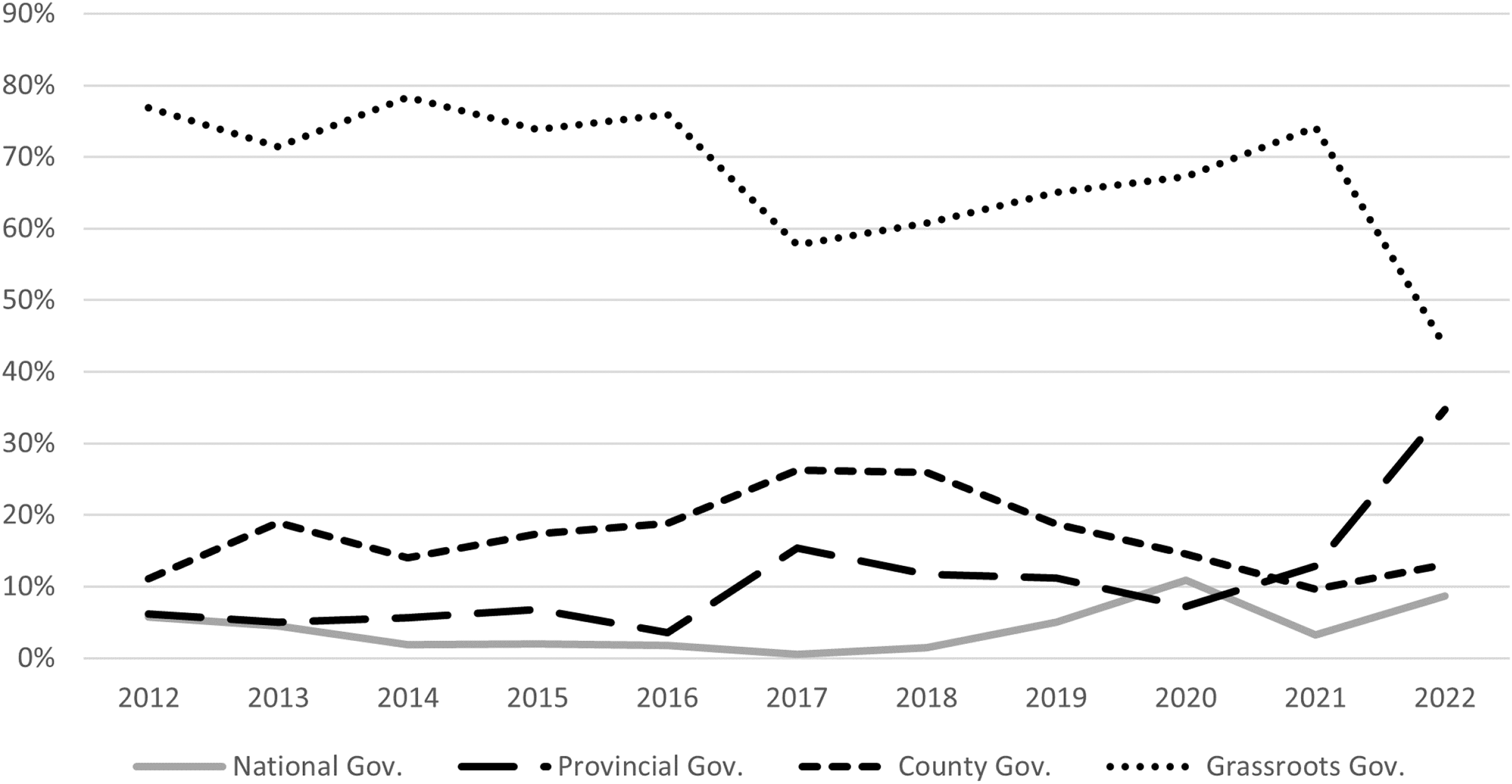
Using a unique protest-event dataset compiled from news reports between 2012 and 2022, this study analyses patterns of protest targeting during the Xi Jinping era. Although overall protest frequency declines over time, we observe a notable increase after 2019 in the proportion of protests targeting higher levels of government, including the central authority (see Figure 1). Statistical analyses show that protests with ideological demands, larger participant, higher visibility, and lower expected punishment costs are more likely to target the central government. These findings suggest that central authority-targeted protests represent a specific subset of contentious action rather than a general model of popular resistance.
Time trend of social protests and protest targeting in China (2012–2022).

By reframing central targeting as a strategic and conditional outcome, this study contributes to the literature on authoritarian contention and governance. While events such as the White Paper Movement attract attention for their potential political impact, our findings indicate that such protests remain exceptional and do not, in themselves, signal a fundamental erosion of regime resilience. Instead, they illuminate the conditions under which grievances are most likely to bypass local authorities and confront the centre directly.
The subsequent sections of this article are structured to provide a comprehensive understanding of the research at hand. Initially, a concise review of existing literature on social protest and protest targeting in China sets the contextual backdrop for our analysis. This review segues into an exploration of the theoretical framework guiding our inquiry, from which we derive hypotheses that underpin our argument. Following this theoretical exposition, we pivot to an examination of our research design, encompassing details on data collection methods, variable definitions, and methodological limitations that warrant consideration. Subsequently, we present and dissect the statistical results gleaned from our research, offering insights into the observed relationships and patterns. Building upon these analytical findings, we delve into a discussion on the broader implications our analysis holds for the sustainability of the Chinese regime. Finally, we conclude with remarks summarizing the key insights gleaned from our study and suggesting potential avenues for future research.
2. Literature review
The subject of social protest spans throughout history, reflecting its enduring relevance across time. Scholars in the social sciences have established a solid foundation for studying social protests (Olson, Reference Olson1971; Tarrow, Reference Tarrow1994; Davenport, Reference Davenport2007). Building upon this well-established tradition, recent literature has placed a focus on researching social protest in authoritarian countries. For authoritarian rulers, the consequences of social protest are unpredictable and often harmful to their power base. Therefore, prioritizing the avoidance of social unrest and the maintenance of social stability is usually paramount for authoritarian regimes (Geddes, Reference Geddes1999; Wright and Escribà-Folch, Reference Wright and Escribà-Folch2012). Among authoritarian regimes, one-party dominant regimes stand out in silencing social activism (Chen, Reference Chen2004; O’Brien and Li, Reference O’Brien and Li2006; Lee, Reference Lee2007; Cai, Reference Cai2010; Chen, Reference Chen2012; Lorentzen, Reference Lorentzen2013; Yang, Reference Yang2023). The political strength of the Chinese state has drawn scholars’ attention to how public confrontational behaviour exerts little pressure for political reform on the government despite rapid economic growth (Dickson, Reference Dickson2003; Nathan, Reference Nathan2003; Chen, Reference Chen2004; Wang, Reference Wang2006; Fewsmith, Reference Fewsmith2007). In addition to the high level of popular support for the CCP regime, another distinct fact is the lack of social protests directed towards the central government that could effectively pressure the government to change policies (Cai, Reference Cai2008; Tong and Lei, Reference Tong and Lei2010; Chien, Reference Chien2010; Lorentzen, Reference Lorentzen2013; Chan et al., Reference Chan, Backstrom and Mason2014; Wallace and Weiss, Reference Wallace and Weiss2015; Wong and Peng, Reference Wong and Peng2015; Ong and Han, Reference Ong and Han2019; Chen et al., Reference Chen, Paolino and Mason2021). However, there has been insufficient attention paid to examining protest targeting in China.
As an essential aspect of protest, protest targeting, although previously overlooked, has gradually become an important topic in the field of social movements. Existing literature has made efforts to explore the reasons why the public targets the state. By quantitatively analysing 4654 popular protest events in the United States between 1968 and 1975, Van Dyke et al. (Reference Van Dyke, Soule and Taylor2004) discovered variations in protest targets. They found that protests with different issues tended to choose different targets. For instance, environmental or human rights movements were more likely to target the government, whereas civil rights or women’s movements were more inclined to direct their appeals to non-state targets. Evidently, when the government was perceived as the main source of people’s discontent, the public was more likely to challenge the state. Using datasets of protest events in Latin America and Africa, Salehyan and Stewart (Reference Salehyan and Stewart2017) demonstrated this mechanism. They also found that popular targeting against the government depended on a country’s regime type, state responses, ethnic relations, and state capacity. Walker et al. (Reference Walker, Martin and McCarthy2008) categorized targets into three types: government, enterprises, and educational organizations. They observed that participants in protests were less likely to engage in violent activities when demonstrating against the government compared with when protesting against private firms or educational institutions such as schools. Although there is a growing interest in the choice of target, much of the work only distinguishes between government and non-government targets, leaving the relationship between hierarchical differences within government institutions and social protests underexplored.
The Chinese state has been characterized as ‘fragmented authoritarian’ due to its complex political system and the parallel institutions of the party-state (Lieberthal and Oksenberg, Reference Lieberthal and Oksenberg1988; Mertha, Reference Mertha2009). Vertically, the division of labour among different levels of government is clear, with each level responsible for its duties. Since the 1980s, to incentivize local governments to develop the local economy, the central leadership of the CCP adopted a financial decentralization measure that allows local authorities to receive a larger share of tax income and greater flexibility in implementing industrial policies (Montinola et al., Reference Montinola, Qian and Weingast1995; Huang, Reference Huang1999; O’Brien and Li, Reference O’Brien and Li1999; Zheng, Reference Zheng2007; Landry, Reference Landry2008). Even today, decentralization remains in effect, and ordinary people in China generally view national and local authorities separately. Studies have argued that the distinction in people’s views of government at different levels has important consequences for state–society relations in China (Li, Reference Li2011).
Protests targeting different levels of government provide valuable insights into society’s disposition towards the regime, especially in China under the CCP rule. Traditional wisdom has recognized the stratified system in which Chinese citizens, residing within an authoritarian regime, perceive political authority. Jay Chen and Cai (Reference Jay Chen and Cai2021) present the first and well-established work on this subject. They distinguish between two types of targets: one perceived as responsible for causing the protesters’ grievances and the other seen as obligated to address the grievances. Chen and Cai’s research reveals that certain groups – such as small groups, veterans, and petitioners – are more inclined to target higher-level authorities, such as the central government, compared with others. Chen (Reference Chen2012) examines Chinese citizens’ petition activities and finds that the decentralized party-state system provides an opportunity structure for ordinary people to strategically use petitions as a tool to pressure governments. Petitioners sometimes adopt a disruptive tactic of sending petitions to the central government to draw high-level attention, prompting the central authority to discipline local officials to address petitioners’ issues. Chen (Reference Chen2012) argues that rural petitions stem from the gap between the central government’s promises and local implementations, which activists can exploit to pursue their interests. Despite a handful of studies that explicitly or implicitly examine target choice by protest groups, the contentious behavior of the Chinese public against the central government remains undertheorized and underexplored. This article aims to fill this gap by exploring the correlation between levels of authority targeted for protest and the forms of collective resistance against the government.
3. Theory and hypotheses
Generally, for protesters, targeting the central government is risky and costly, particularly under authoritarian regimes. In this study, we conceptualize protest targeting not as a purely expressive act, but as a strategic choice shaped by institutional constraints, political risks, and protesters’ capacity to mobilize and articulate grievances. Protesting against the central government means confronting the highest authority in a country that possesses a variety of measures and police forces vastly superior to local counterparts. Under these circumstances, protesters must strategically select their targets based on the nature of their demands, as well as their available resources and ability. This is especially the case in China. In the Chinese decentralized system, local governments bear heavy responsibility for policy implementation, including maintaining social stability. As a result, grievances are more commonly directed towards local authorities, who are both more accessible to citizens and formally accountable for dispute resolution. From the perspective of protesters, targeting local governments typically entails lower political and personal risks than confronting the centre. Institutional arrangements further reinforce this local-first pattern of contention. The Chinese party-state has consistently sought to prevent grievances from escalating upwards by discouraging attempts to bypass local authorities. Such actions, often described as skip-level protest, involve redirecting grievances to higher-level authority rather than local implementers and therefore represent a distinct and strategically consequential form of contention.
Together, these features imply that protests directly targeting the central government should be relatively rare and structured by identifiable conditions. The following section builds on this implication to specify the circumstances under which protesters are more likely to redirect grievances upwards and challenge the central authority.
As mentioned above, Chinese political institutions have been identified as decentralized. Numerous studies have demonstrated that Chinese citizens can clearly distinguish between the central and local governments (Huhe and Chen, Reference Huhe and Chen2023). Since people can discern the vertical difference in political institutions, they do not protest against the central or local governments randomly, indicating that protesters’ choice of target is intentional. Drawing from this observation, we propose factors that facilitate protests in advocating for protesters’ interests against the central government.
3.1. The nature of the grievance: protests with ideological demands challenge the centre
Firstly, contentious collective actions involve grievances that protesters attribute to particular authorities, an attribution shaped by both perceived responsibility and strategic calculations (Tarrow, Reference Tarrow1994; Salehyan and Stewart, Reference Salehyan and Stewart2017). In China, a variety of issues arouse people’s anger. Although local governments are responsible for most problems, the central government must assume responsibility sometimes, especially when the issues are nationwide. The most obvious case is the White Paper Movement, where protesters on the street know that the zero-COVID policy is not just a decision of local officials but also involves the central leader, Xi Jinping. Similarly, in 1989, when students and citizens gathered in Tiananmen Square to demand further political reform, they knew that their suffering from high inflation was caused by the central government’s inability to control local corruption, which required political reform as a solution. Conversely, if an issue is parochial, the incentive for protesters to bring the problem to the centre weakens. After all, there is no reason to risk personal security by just asking for something that has nothing to do with the central government.
Ideological demands, such as calls for political reform or political freedoms, are therefore distinct from other types of protest claims. Because such demands concern the structure and authority of political institutions rather than the execution of specific policies, they fall squarely within the jurisdiction of the central government. Local governments exercise delegated authority to implement policies, but they do not possess the power to alter political institutions. As a result, protesters advancing ideological claims have strong incentives to direct their demands towards the national government rather than towards local authorities. The 2022 Sitong Bridge protest in Beijing exemplifies this logic, as its demands explicitly targeted national policies, political institutions, and the central leader himself.
This line of reasoning indicates that the nature of the grievance conditions protest targeting. When protest claims challenge political institutions or regime-level authority, upward targeting becomes more likely, despite the higher risks involved.
Hypothesis 1: Protests with ideological demands are more likely to target the central government than those involving other types of issues.
3.2. Protest size: larger crowds, lower costs in challenging the centre
The cost of participation in protests not only constitutes a key consideration for protesters joining collective actions (Davenport, Reference Davenport2007), but also a critical factor for individual decisions to target higher levels of authority in governments. This rationale stems from the escalation of conflicts. When costs are high, citizens’ calculations tend to weigh a higher payoff in pursuing conflict escalation. Because targeting higher levels risks their security, people would not be willing to target the central government unless they believe the probability of success is increasing. To ensure actions are successful, the most important aspect is ensuring that central leaders are informed. Therefore, the cost of protests in choosing a protest target lies in whether protesters can effectively convey a message to the central government through their collective actions.
With that said, the size of the protesters is proposed to be related to the cost of punishment regarding protest targeting. As theorists of collective action have argued, the larger the size of a protest group, the lower the punishment cost each individual expects (Tilly, Reference Tilly1978; Bueno De Mesquita, Reference Bueno De Mesquita2010; Chenoweth and Stephan, Reference Chenoweth and Stephan2011; Hager et al., Reference Hager, Hensel, Hermle and Roth2022). With lower expected punishment, large protest groups are thus encouraged to take riskier strategies. Moreover, a sizable group of protesters, due to the unpredictability and potential escalation of events, typically garners increased media coverage (Jennings and Saunders, Reference Jennings and Saunders2019), including attention from foreign outlets. This heightened exposure intensifies pressure on the government to resort to violent means in suppressing the protests. In 2011, a large-scale protest with over 20,000 villagers demanding the central government address local officials’ abuse of power in Guangdong shocked the central leadership, prompting the centre to send a work team to investigate the villagers’ grievances. In contrast, many small-scale rural conflicts over land grabbing occurred locally and were not heard by the central government. Clearly, as a protest scales up in size, it becomes increasingly likely to approach the centre.
Hypothesis 2: The larger the size of participants in a protest, the more likely the protest event is to target the central government.
3.3. Context of protest: modernity and political trust in the government
Studies of political development have established a correlation between economic development and the cultivation of democratic values (Lipset, Reference Lipset1959; Deutsch, Reference Deutsch1961; Przeworski and Limongi, Reference Przeworski and Limongi1997). This logic can also be applied to the division between the Chinese countryside and cities. Traditional society in the vast rural areas of China often holds the belief that the central authority represents the mandate of heaven and cannot be challenged. By contrast, local officials are viewed as ordinary actors who interact directly with villagers and are more readily blamed for everyday grievances. This pattern reflects what prior studies describe as hierarchical trust in government, whereby trust in political institutions varies systematically across levels of authority (Shi, Reference Shi2001; Li, Reference Li2004, Reference Li2008; Huhe and Chen, Reference Huhe and Chen2023).
Empirical research suggests that, in rural China, the central leadership is often regarded as a ‘benefactor’ expected to deliver protection or redress, whereas local governments are perceived as ‘adversaries’ responsible for extraction and abuse (Baum and Shevchenko, Reference Baum and Shevchenko1999; Tsui and Wang, Reference Tsui and Wang2004, Reference Tsui and Wang2008). As a result, when rural residents experience grievances, they tend to direct their claims towards local authorities rather than the centre. This pattern is reinforced by limited direct contact with central institutions and by the higher risks associated with challenging national-level authority.
Urban contexts differ in important ways. Studies have shown that political trust is unevenly distributed within countries and is often lower in more economically developed and urbanized areas (Hetherington, Reference Hetherington1998; Marien and Hooghe, Reference Marien and Hooghe2011). From the perspective of modernization theory, urbanization and economic development weaken traditional reverence for political authority and encourage more critical evaluations of government performance. In China, urban residents are more likely to encounter state institutions across multiple levels, to possess higher levels of education, and to be exposed to national political discourse. These factors contribute to a weaker distinction between the moral authority of the centre and the administrative failures of local governments.
This shift in political trust has implications for protest targeting. In urban settings, grievances are less likely to be confined to local implementation failures and more likely to be framed in terms of central policies or systemic problems. As a result, urban protesters have stronger incentives to direct their claims towards the central government rather than limiting blame to local authorities. This pattern is consistent with existing research showing that large cities are especially prone to contentious collective action (Chen, Reference Chen2012; Beissinger, Reference Beissinger2013). Recent events further illustrate this dynamic. During the 2022 anti–zero-COVID protests, demonstrations explicitly targeting central policies and leadership were concentrated overwhelmingly in major cities rather than in rural areas.
Hypothesis 3: Protests in urban areas are more inclined to target the central government compared with those in rural areas.
3.4. Visibility and protest locations: amplifying voices in the capital
Geography constitutes an important factor shaping protest targeting, particularly when protesters seek to confront higher-level authorities. Organizing collective action requires time, coordination, and resources, and these constraints become especially salient when protests aim to challenge the central government, which carries higher political and personal risks. Under such conditions, protesters have strong incentives to select locations that maximize the visibility and political salience of their actions rather than merely minimizing costs.
The capital city occupies a distinctive position in this regard. Beijing is the institutional and symbolic centre of political authority in China, hosting key party and state organs as well as national media and diplomatic presence. Protests that take place in the capital are therefore more legible as national-level challenges and more difficult for authorities to treat as purely local disturbances. Importantly, this does not imply that protesting in Beijing is less costly. On the contrary, many protesters who travel to the capital, particularly petitioners from other provinces, face substantial risks, including interception by local authorities and punishment upon return. Measures such as intercepting (jiefang, 截訪) are explicitly designed to prevent grievances from escalating upwards and impose significant costs on those attempting to protest in Beijing.
Precisely because of these risks, protests that do occur in Beijing are unlikely to be incidental or opportunistic. Instead, they tend to reflect deliberate efforts to direct claims towards the central government. Protesting in the capital creates highly visible public scenes that are difficult for central authorities to ignore and that signal an intention to challenge national policies or leadership rather than local implementation. In this sense, Beijing functions less as a low-cost venue than as a high-commitment signalling space, where protesters demonstrate both the seriousness of their grievances and their willingness to incur elevated risks to attract central attention.
This logic suggests that protest location conditions targeting strategies. When protests take place in Beijing, their visibility and symbolic proximity to central power make them more likely to be framed against the central government than protests occurring elsewhere.
Hypothesis 4: Protests in Beijing are more likely to target the central government than protests outside of Beijing.
It is worth noting that protest attributes such as demands, size, and location may be strategically interrelated, particularly if protesters select tactics after deciding to target higher-level authority. Given the observational nature of the data, this study does not attempt to identify the causal sequencing of these choices. Instead, it documents systematic associations between observed protest characteristics and targeting outcomes. Accordingly, the hypotheses and empirical results should be interpreted as descriptive patterns rather than causal estimates of strategic behaviour.Footnote 2
4. Research design
We are interested in examining the factors that influence the likelihood of protests in China, targeting the central government. To test the hypotheses outlined above, we draw on an original protest-event dataset compiled by the authors’ research team through systematic collection of contentious events in China. The dataset covers protest events reported between 2012 and 2022, and is the product of a long-term data collection effort initiated in 2016.
Protest events are identified through keyword-based searches (e.g., 抗議, 抗爭, 維權, 群體性事件) across a wide range of Chinese- and English-language media sources. These sources include mainland Chinese outlets, Hong Kong and Taiwanese media, overseas Chinese-language news platforms, and major international news organizations. To enhance reliability, identified events are cross-checked using multiple independent sources whenever possible. Additional repositories, such as 維權網 (Weiquanwang), 博訊網 (Boxun), and Freedom House, are also consulted to supplement coverage and verify reported events.
All protest events are coded using a standardized coding protocol by trained research assistants. Coded variables include protest location, protest size (measured using ordinal categories due to reporting constraints), issue type, participant characteristics, organizational involvement, and protest outcomes. Ambiguous cases are flagged for cross-coder verification and adjudicated by the project investigators to ensure consistency and accuracy. Detailed documentation of data sources, coding rules, and verification procedures is provided in the Appendix.
It should be noted that our sample is not randomly selected and relies on media sources, which may raise concerns about reliability and selection bias in our analysis. This is especially true when collecting data from media sources, as they typically report on events that are deemed newsworthy, many of which involve large-scale, violent uprisings. Because the Chinese government does not publicize information on collective incidents, the issue of selection bias is a concern for all studies attempting to quantitatively analyse protests in China using unofficial documents (Li, Reference Li2019). However, we believe our analysis will not be significantly compromised by this issue for two main reasons.
First, the information in our data set has been cross-checked. Many reports contain detailed information such as dates, times, individual names, locations, and photos or videos of the events, which helps us verify the accuracy of the materials. With a substantial sample size and comprehensive records of protest characteristics, we are confident that the accuracy of our dataset meets the requirements of this research.
Second, and more importantly, any selection bias in our data is likely to work against our core theoretical expectations rather than in their favour. Protests that explicitly target the central government are particularly sensitive and are therefore more likely to be censored or underreported in media coverage. As a result, our dataset likely underrepresents precisely those events that pose the greatest challenge to central authority. From a research design perspective, this places our analysis closer to a least-likely case test rather than a most-likely one. If protests targeting the central government are systematically underobserved, then identifying statistically significant associations between protest characteristics and central targeting constitutes a conservative test of our hypotheses. In this sense, the presence of consistent patterns despite potential underreporting strengthens, rather than weakens, the credibility of our findings.Footnote 3
4.1. Dependent variable
We aim to understand the correlation between the nature of protests and their targets. Therefore, our dependent variable is the level of government targeted by protesters. We measure this by creating a binary variable that distinguishes whether a protest event targets the central government or not. To generate this variable, we code information on the protest target for each event. If a protest includes any direct appeals to the central government at any point, the event is coded as 1; otherwise, it is coded as 0. This binary variable will be used to analyse the general pattern of protest targeting and test the theoretical hypotheses mentioned earlier.
In addition to the binary variable, in our coding process, we gather more details on the levels of government targeted by rioters. Based on the Chinese political system, we differentiate between four types of protest targets: the central government, provincial governments, prefectural- and county-level governments, and grassroots units (i.e., subcounty-level and other local entities). This results in a nominal variable with four categories. Using this categorical variable, we can conduct more sophisticated analyses to explore variations in protest patterns when comparing different types of protest targets.
Given that one dependent variable is binary and the other is categorical, we employ a logistic regression model for the binary variable and a multinomial logistic regression model for the categorical one (Long, Reference Long1997). In addition, before running the logistic regression models, we conducted a multicollinearity check, as its presence could lead to instability in regression estimates and inflation of standard errors for coefficients. Following a simple regression, we computed variable inflation factor (VIF) values. None of the independent or control variables exhibited a VIF value exceeding 2, well below the conventional cutoff of 10. Robust standard errors were employed in all models to address heteroskedasticity.Footnote 4
4.2. Independent variables
We propose four factors of protest that determine the level of the protest’s target. Following this argument, we test four hypotheses. The first hypothesis suggests that the targeting of either the central government or local government in a protest is related to the type of demands it advances. Ideological demands, such as calls for democracy or political system changes, are unrelated to local government, giving protesters no reason to hold local authorities responsible for solutions. We operationalize this by creating a dummy variable, coded as 1 if a protest event clearly demands a change in political institutions or political rights and freedom, and 0 otherwise.
In relation to the cost of targeting the central authority, our second hypothesis posits that as a protest grows in scale, the perceived threat to individuals from the government will decrease, thereby increasing the likelihood of targeting higher-level authorities. We utilize the size of a protest event to test this argument. The operationalization of protest size is as follows: if only one person is involved in the protest, it is coded as 1; if the number of participants ranges from 2 to 99, it is coded as 2; if the number ranges from 100 to 999, it is coded as 3; and if the number exceeds 1000, it is coded as 4.Footnote 5
The third hypothesis contends that protest targeting varies depending on the rural–urban divide. Traditional wisdom suggests that the higher the trust in the central government compared with local authorities, the lower the chance that protesters will direct their complaints to the central government. As rural residents tend to have stronger hierarchical trust in governments than their urban counterparts, the hypothesis posits that protests in rural areas would be less likely to target central authorities than those in cities. We therefore create a variable indicating whether a protest is located in rural or urban areas. If an event occurs in rural areas, it is coded as 1; otherwise, it is coded as 0.
Geography is also hypothesized to be a factor influencing protest targeting. We argue that protests occurring in political centres will gain high visibility, thus encouraging the targeting of central authority. To measure this effect, a variable is generated to indicate whether a protest occurred in Beijing. If a protest took place in Beijing, it is coded as 1; if not, it is coded as 0. It is expected that events in Beijing will be more likely to target the central government, as protesters in the capital would anticipate lower costs in airing their grievances to central leaders.
4.3. Control variables
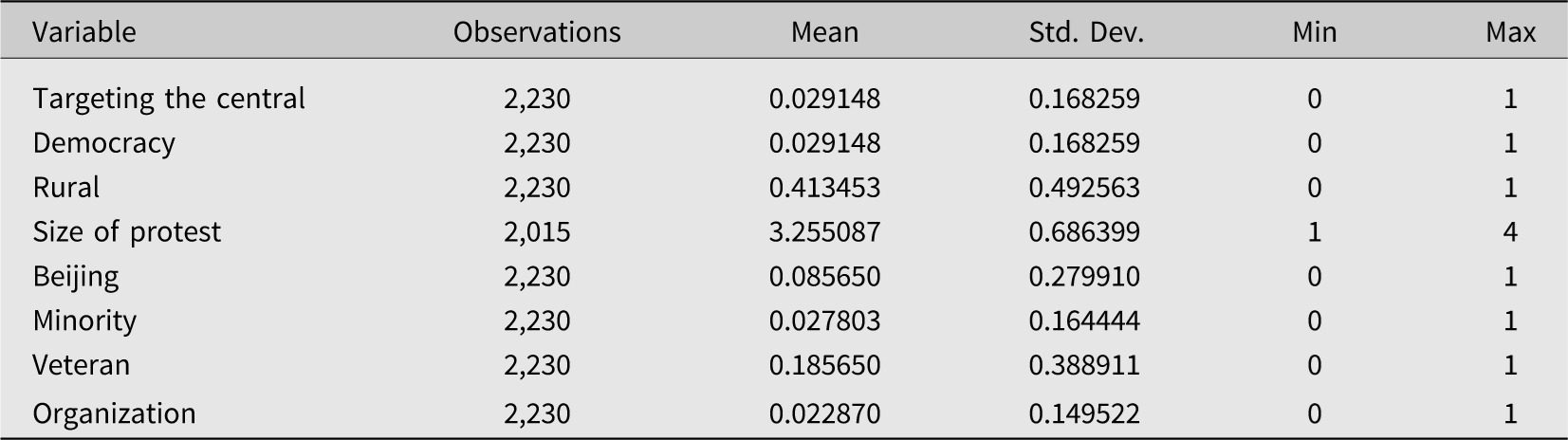
Several covariates are used as controls to mitigate confounding factors. First, veterans are considered a group with a higher likelihood of staging a protest against the central government (Jay Chen and Cai, Reference Jay Chen and Cai2021). Therefore, we include a variable where protests involving veterans are coded as 1, whereas others are coded as 0. Second, minority groups may be more inclined to advocate for rights that fall under the responsibility of the central government. Hence, a control variable for minority groups is also included. Third, the involvement of certain organizations in a protest may impact protesters’ capacity to escalate the conflict and target higher levels of authorities. Thus, a control variable indicating whether a protest was associated with any organized force is added to the regression model. If any organization or leadership is discernible from the report of the event, it is coded as 1; otherwise, it is coded as 0. Finally, scholars have argued that the strategy of social control has shifted in the Xi Jinping era as the CCP’s top leader aimed to create a more secure environment for power consolidation. To account for this trend, we add a dummy variable for Xi’s two terms as a control. If the event occurred during Xi’s second term (2018–2022), it is coded as 1; otherwise, it is coded as 0. Table 1 presents descriptive statistics for the variables used in the analysis.
Descriptive statistics of variables

Table 1. Long description
A table with 10 rows and 6 columns presenting descriptive statistics of variables related to protests. The columns are labeled Variable, Observations, Mean, Std. Dev., Min, and Max. The variables include Targeting the central, Democracy, Rural, Size of protest, Beijing, Minority, Veteran, and Organization. Each row provides the number of observations, mean, standard deviation, minimum, and maximum values for each variable. For example, the row for Targeting the central shows 2,230 observations, a mean of 0.029148, a standard deviation of 0.168259, a minimum of 0, and a maximum of 1.
Note: All variables except Size of Protest are binary indicators.
5. Analysis results
5.1. Results from the logit models
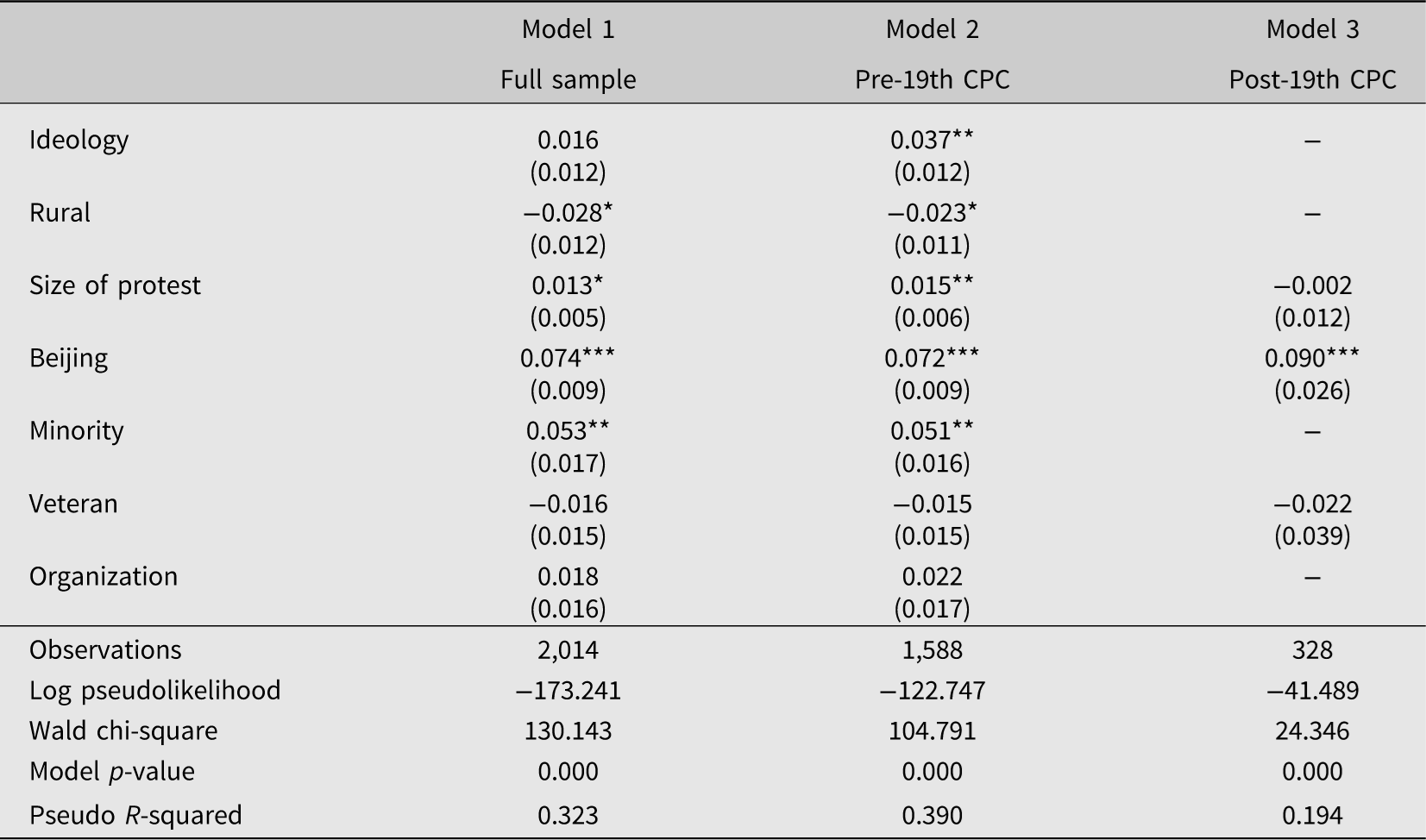
Table 2 presents the results of the logit regression models. Model 1 reports coefficients for the full sample, whereas Models 2 and 3 split the sample at November 2017. Model 2 presents results for the period corresponding to Xi Jinping’s first term as general secretary, and Model 3 reports regression estimates for his second term.
Average marginal effects from logistic regression on targeting the centre

Long description
A table comparing average marginal effects from logistic regression on targeting the center. The table has 11 rows and 3 columns. Column headers are Model 1, Model 2, and Model 3. Row labels include Ideology, Rural, Size of protest, Beijing, Minority, Veteran, Organization, Observations, Log pseudolikelihood, Wald chi-square, Model p-value, and Pseudo R-squared. Row 1: Ideology, 0.016 (0.012), 0.037** (0.012), -. Row 2: Rural, -0.028* (0.012), -0.023* (0.011), -. Row 3: Size of protest, 0.013* (0.005), 0.015** (0.006), -0.002 (0.012). Row 4: Beijing, 0.074*** (0.009), 0.072*** (0.009), 0.090*** (0.026). Row 5: Minority, 0.053** (0.017), 0.051** (0.016), -. Row 6: Veteran, -0.016 (0.015), -0.015 (0.015), -0.022 (0.039). Row 7: Organization, 0.018 (0.016), 0.022 (0.017), -. Row 8: Observations, 2014, 1588, 328. Row 9: Log pseudolikelihood, -173.241, -122.747, -41.489. Row 10: Wald chi-square, 130.143, 104.791, 24.346. Row 11: Model p-value, 0.000, 0.000, 0.000. Row 12: Pseudo R-squared, 0.323, 0.390, 0.194.
Note: Standard errors in parentheses. Entries are average marginal effects with robust standard errors in parentheses. The dependent variable is whether a protest targets the central government. Models 2 and 3 split the sample at 2017.11 to compare the pre- and post-19 Party Congress periods. *p < 0.05, **p < 0.01, ***p < 0.001.
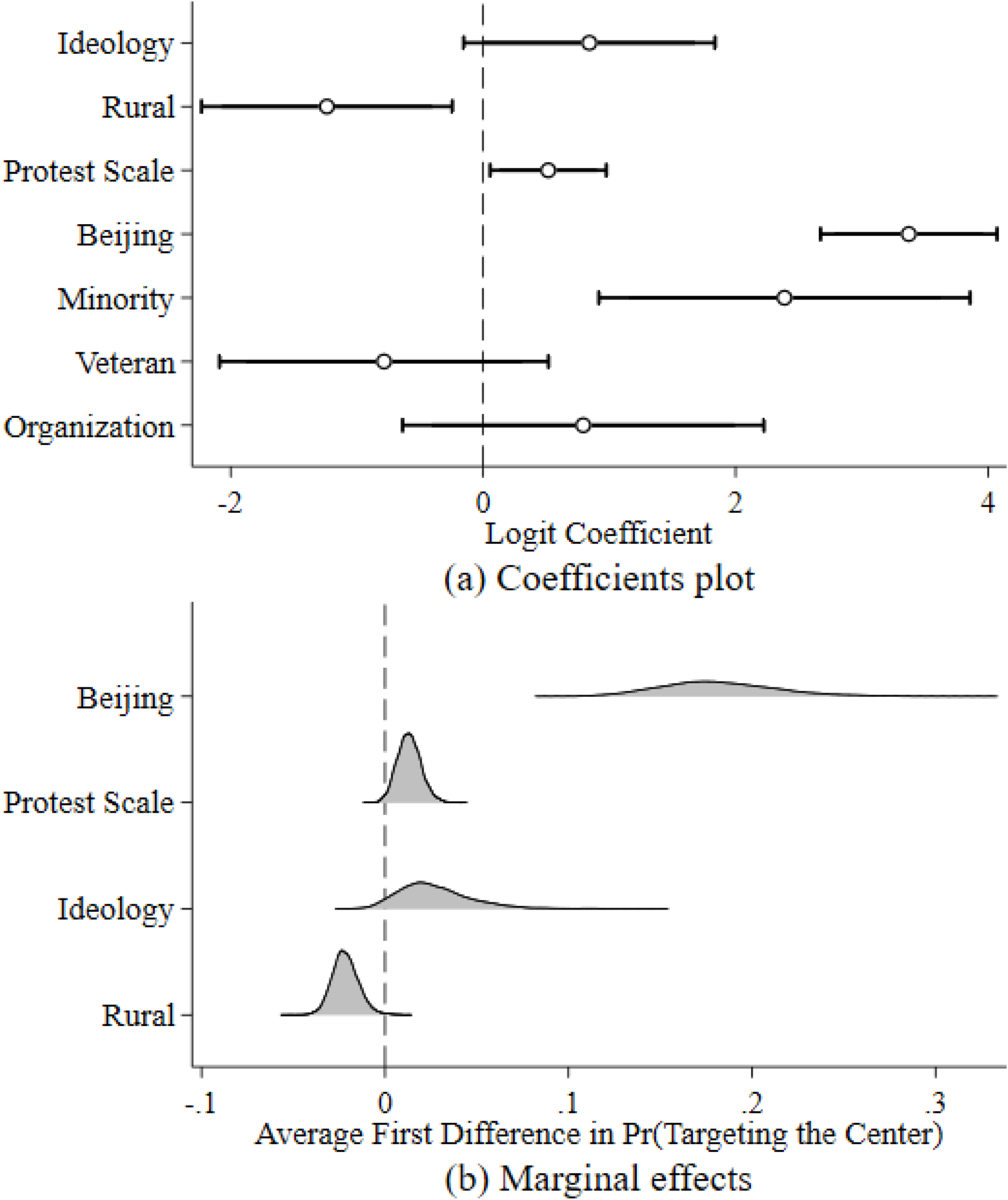
In addition, to assess the substantive importance of the estimated effects, we plot the first differences in predicted probabilities of central targeting for the key independent variables through the visualization of effects. Figure 2 presents the full-sample results graphically. Panel (a) plots the estimated logit coefficients from Model 1 with their 90% and 95% confidence intervals. Panel (b) translates the four substantively most important covariates, including Ideology, Rural, Size of Protest, and Beijing, onto the probability scale by reporting the simulated distributions of average first differences in the predicted probability of targeting the central government, based on 5,000 draws from the estimated coefficient vector and variance–covariance matrix.Footnote 6 Generally, the results from the regression analysis support our theoretical arguments and hypotheses. Below, we first examine the results of Model 1 and then discuss the differences between the two samples.
Logistic regression results for protests targeting the central government. Note: Panel (a) reports logit coefficients with 90% and 95% confidence intervals. Panel (b) presents simulated distributions of average first differences in the predicted probability of targeting the central government, based on 5,000 draws from the estimated coefficient vector and variance–covariance matrix. For binary covariates, the first difference compares values of 1 versus 0; for Protest Scale, it compares the 75th to the 25th percentile.

Figure 2. Long description
Panel A: A coefficients plot showing logit coefficients with 90% and 95% confidence intervals. The x-axis represents the Logit Coefficient ranging from -2 to 4, and the y-axis lists variables: Ideology, Rural, Protest Scale, Beijing, Minority, Veteran, and Organization. Each variable is represented by a dot with horizontal error bars indicating confidence intervals. Panel B: A marginal effects plot showing simulated distributions of average first differences in the predicted probability of targeting the central government. The x-axis represents the Average First Difference in Pr(Targeting the Center) ranging from -0.1 to 0.3, and the y-axis lists variables: Beijing, Protest Scale, Ideology, and Rural. Each variable is represented by a distribution curve, with the Rural variable highlighted in gray.
First, surprisingly, although the variable representing protests with ideological demands is positively correlated with the targeting of higher levels of government, this relationship failed to reach the 5% significance level and is thus not considered statistically significant. We believe this result may be due to the rarity of cases in the sample, especially during Xi Jinping’s second term when demonstrations or collective actions seeking political system change were suppressed (Yang, Reference Yang2023). As Model 2 shows, when we split the sample, the relationship becomes significant and positive in Xi’s first term, providing conditional support for the theory.
Our argument receives empirical support regarding the rural–urban divide. The rural variable is significantly and negatively associated with the levels of government being targeted by a protest, indicating that rural protests are less likely to target the central government. The marginal effect suggests that the probability of rural protests targeting the central government is 2.8% lower than that of urban ones. As we have argued, this is closely related to rural residents’ belief that the central leaders are helpers, whereas village cadres are viewed as enemies. This finding is consistent with previous research indicating that urban residents are more likely to target the central government or shift their target from local to central authorities (Jay Chen and Cai, Reference Jay Chen and Cai2021).
The argument that protest costs influence the direction of grievances towards central or local authorities received strong support. The size of the protest is significantly and positively correlated with the targeting of higher levels of government. When the number of protesters in an uprising increases by one unit, the likelihood of the protest targeting the central government increases by 1.3%. This indicates that the calculation of punishment costs by targeting higher-level authorities influences protesters’ strategies for escalating conflict. As the number of individuals engaging in a protest grows, each participant expects lower punishment and becomes more willing to air their grievances to the highest level of government. The White Paper Movement serves as a vivid illustration. When a large group of people gathered on the street to demand an end to harsh zero-COVID measures, more slogans targeting the central government emerged, such as ‘End the Communist Party’ or ‘Xi Jinping! Step down!’
According to the analysis, geographical location also proves to be influential in determining protest targeting. The model indicates that protest events occurring in Beijing are significantly positively associated with the targeting of higher levels of government. All else being equal, the likelihood that protesters targeted the central government in Beijing is 7.4% higher than those who did not engage in protests in the capital. This suggests that high visibility in Beijing is a key determinant in the targeting of the central authority, a pattern that is also strikingly visible in Figure 2(b), where the simulated first difference for Beijing is concentrated around 18 percentage points – an order of magnitude larger than the effects of any other covariate.
We now turn to differences across periods by comparing Models 2 and 3. While several coefficients lose statistical significance in Model 3, this pattern should be interpreted in the light of the substantially smaller sample size during Xi’s second term (N = 328) and the heightened constraints on collective action in this period. In Model 3, variables such as Rural, Ideology, and Organization drop out of the estimation due to limited variation, rather than indicating a substantive reversal of earlier patterns. By contrast, the Beijing variable remains positive and statistically significant, suggesting that the visibility logic of protest location persists even under intensified political control.
Regarding the control variables, we find some interesting results. First, there is no empirical support from the analysis indicating that protests initiated by veterans are more likely to target the central government. This finding contradicts the outcome of previous research (Jay Chen and Cai, Reference Jay Chen and Cai2021). However, this result is not surprising, as veterans take to the streets to air grievances about better treatment after their military service, which falls under the responsibility of local governments. Chen and Cai’s work focused on upward targeting; when veterans were dissatisfied with the solutions of local authorities, they adopted skip-level activities to target the central government. In other words, veterans may be more likely to shift their blame from local to central authorities, but they do not initially intend to hold the central government accountable. Because our analysis looks at the main protest target of the group, it is not surprising that the variable representing veterans is not significant in the model.
Interestingly, minority groups are found to have a higher likelihood of targeting the central government when engaging in protests. All else being equal, protests initiated by minority groups are 5% more likely to target the central government than those initiated by other groups.
Regarding the influence of organization, there is no significant association between whether a protest event involves any form of organization and the levels of government targeted by the protest. Similarly, the dummy variables representing Xi’s first and second terms also do not show statistical significance in the model.
5.2. Results from the multinomial logit model
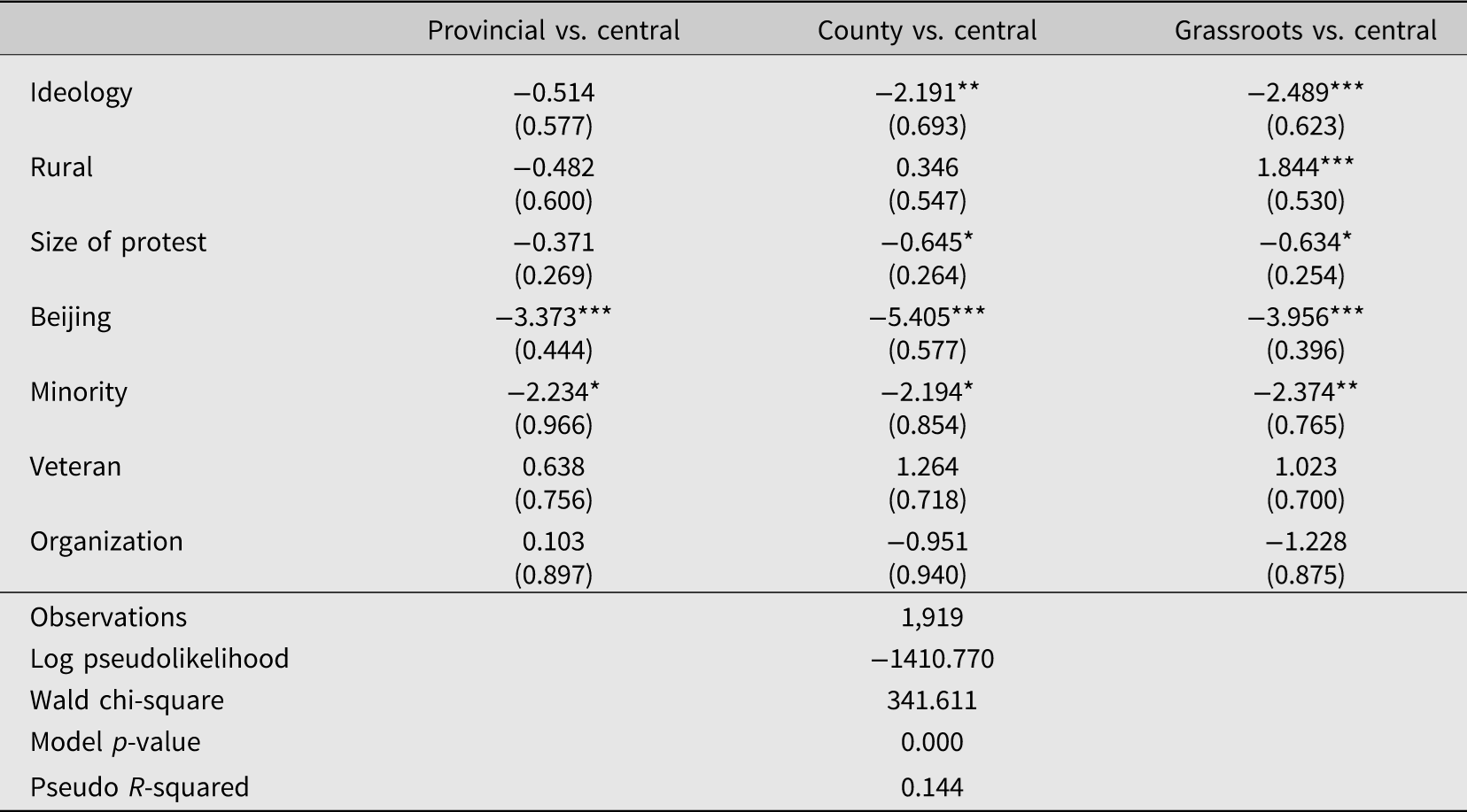
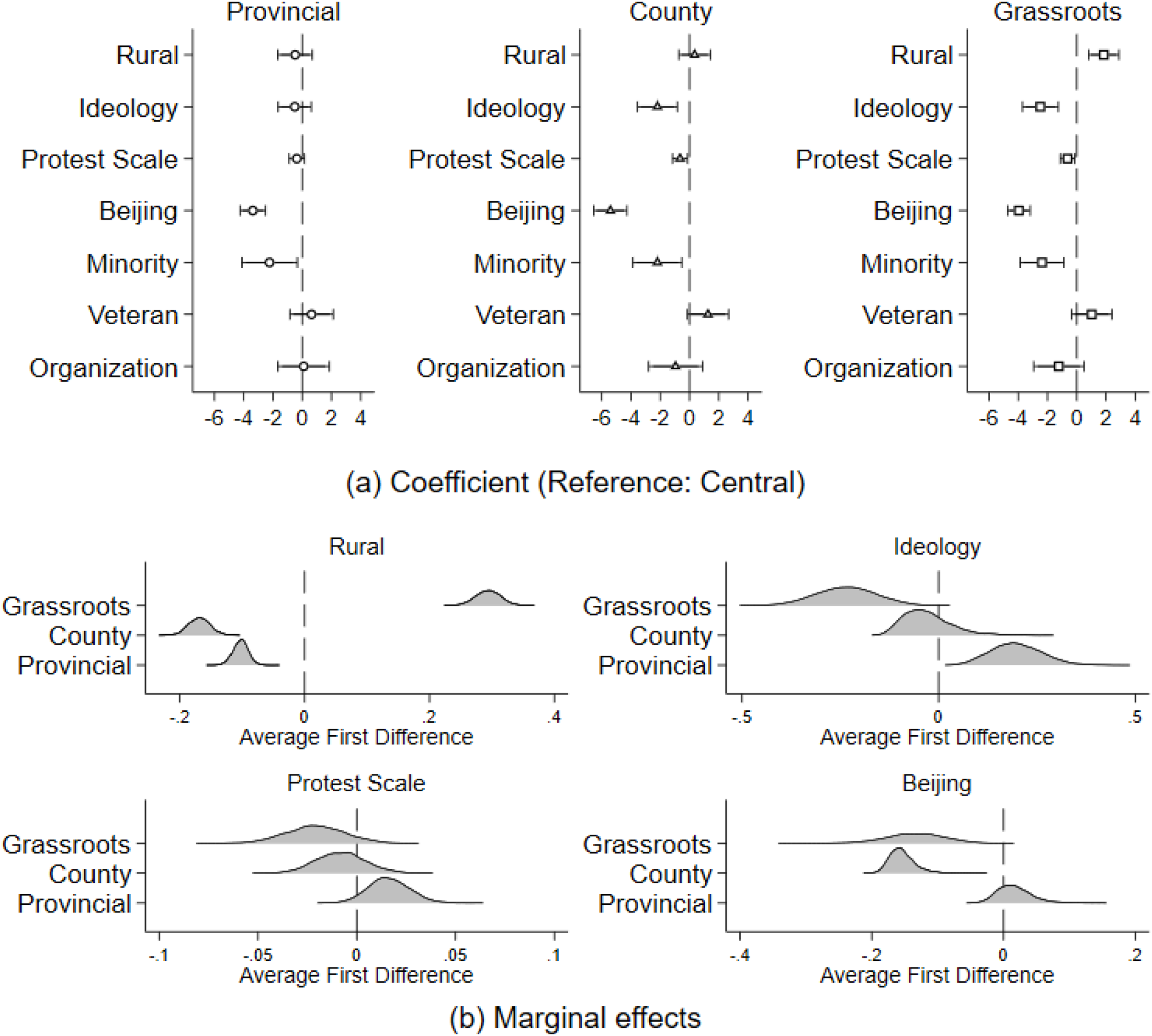
To scrutinize how protesters select targets across different levels of government, we estimate a multinomial logistic regression in which the dependent variable distinguishes four types of authorities: central, provincial, prefectural or county, and grassroots units. Table 3 reports the multinomial logit coefficients with central government as the reference outcome. Figure 3 visualizes the same model on the probability scale; Panel (a) plots the coefficients with 90% and 95% confidence intervals across the three outcome equations, and Panel (b) displays the simulated distributions of average changes in predicted probability associated with each of the four theoretically covariates. The results are discussed in detail next.
The determinants of targeted level of government (multinomial logit)

Long description
The table presents multinomial logit coefficients comparing different levels of government: provincial vs. central, county vs. central, and grassroots vs. central. It includes 10 rows and 4 columns. The columns are labeled as Provincial vs. central, County vs. central, and Grassroots vs. central. The rows are labeled with variables: Ideology, Rural, Size of protest, Beijing, Minority, Veteran, Organization, Observations, Log pseudolikelihood, Wald chi-square, Model p-value, and Pseudo R-squared. Each cell contains numerical values and standard errors in parentheses. Notable trends include significant negative coefficients for Beijing across all comparisons and significant positive coefficients for Rural in the Grassroots vs. central comparison.
Note: Entries are multinomial logit coefficients with robust standard errors in parentheses; The reference outcome is Central (targeting the central government); *p < 0.05, **p < 0.01, ***p < 0.001.
Change in probability of protests targeting the central government. Note: Panel (a) reports multinomial logit coefficients with 90% and 95% confidence intervals; the reference outcome is National (the central government). Panel (b) presents simulated distributions of average first differences in the predicted probability of targeting each non-reference level, based on 5,000 draws from the estimated coefficient vector and variance–covariance matrix. For binary covariates, the first difference compares values of 1 versus 0; for Protest Scale, it compares the 75th to the 25th percentile.

We begin with our four theoretically central variables, each of which tells a coherent story across the three outcome equations. Ideology is significantly negatively associated with targeting county and grassroots authorities rather than the central government. The provincial-versus-central comparison is also negative but does not reach conventional significance. Read together, the pattern indicates that ideologically framed protests are disproportionately directed at the central government rather than at any subnational tier. Figure 3, Panel (b), reinforces this interpretation; the simulated first-difference distributions for Ideology lie almost entirely below zero for the county and grassroots outcomes, with only the provincial distribution straddling zero. This is consistent with our theoretical expectation that ideological grievances – those concerned with political principles rather than implementation problems – seek the highest possible audience, and the central authority is the most natural target.
Rural displays the most striking pattern in the model. Rural protests are significantly more likely to target grassroots authorities rather than the central government, whereas the provincial- and county-versus-central comparisons are statistically insignificant. Panel (b) makes the substantive magnitude of this effect immediately visible; the grassroots distribution for Rural is shifted dramatically to the right, with most of its mass concentrated around a thirty-percentage-point increase in predicted probability, whereas the provincial and county distributions sit much closer to zero. This pattern provides strong empirical support for our argument about the rural–urban divide: rural residents direct their grievances towards local cadres they encounter directly, rather than towards the central authorities they regard as distant and well-intentioned helpers.
Protest scale behaves similarly across the three contrasts. The size of a protest is significantly negatively associated with both county-versus-central and grassroots-versus-central targeting, indicating that larger protests are more likely to confront the central government rather than middle- or lower-tier authorities. The provincial contrast is negative but does not reach conventional significance. Panel (b) shows that the simulated probability shifts for Size of Protest are modest in absolute magnitude across all three lower authorities, but consistently shifted to the left of zero, indicating an upward redirection of probability towards the central government. This is consistent with our theoretical argument that as the number of protesters grows, expected punishment costs per participant decline, and protesters become more willing to direct their grievances at the highest available level of authority.
Beijing exerts by far the largest effects in the model. Protests occurring in the capital are significantly less likely to target any of the three subnational governments rather than the central authority, with all three coefficients reaching the 0.1% significance level and ranging in magnitude from −3.37 (provincial) to −5.41 (county). The probability-scale simulations in Panel (b) confirm that these are not just statistically large but substantively dominant effects: protests in Beijing experience sharp downward shifts in the predicted probability of targeting any subnational level, with the largest shift occurring for county targeting. The visibility logic of protest location is unambiguous – when a protest unfolds in the political centre, both protesters and observers treat the central government as the natural addressee.
Turning to the control variables, the results show several additional patterns of interest. Minority participation is significantly negatively associated with targeting all three subnational governments rather than the central government, with the coefficients ranging from −2.19 (county) to −2.37 (grassroots). This indicates that minority-led protests systematically target the central government rather than lower-level authorities, consistent with the view that minority grievances often concern policies that are seen as ultimately attributable to central decision-making. Veteran participation, by contrast, shows no statistically significant association with any of the three contrasts; although the coefficients are positive (suggesting some tendency to target lower tiers), they do not reach conventional significance levels. Organizational involvement also shows no statistically significant association with any of the three contrasts. Taken together, the control variables suggest that protester characteristics and organizational capacity play a more modest role in shaping protest targeting than the theoretical variables foregrounded above.
Overall, the results point to a hierarchical logic of protest targeting in China that confirms our hypotheses. Ideology, protest scale, rural–urban context, and political location jointly structure how grievances are directed across levels of authority. Protests with broader claims, greater visibility, or higher mobilization capacity – those framed ideologically, those occurring in Beijing, and those drawing larger crowds – are more likely to confront the central government rather than lower-tier authorities. Localized and rural protests, by contrast, overwhelmingly direct their grievances towards grassroots institutions. The marginal-effect simulations in Figure 3 reinforce the substantive importance of these patterns; although the coefficient signs in Table 3 indicate the direction and statistical significance of each comparison, the probability-scale distributions in Panel (b) show that the rural effect on grassroots targeting and the Beijing effect on county targeting are the most consequential shifts in predicted probability, with other covariates producing more modest but theoretically consistent effects.
6. Discussion
Based on the theoretical analysis and empirical evidence, several factors should be considered when examining the rule of the authoritarian regime in China after the White Paper Movement. We anticipate that while the CCP will face increased social pressure, the likelihood of systemic upheaval through revolutions remains low. This expectation is grounded in the disappearance of issues directly involving holding the central government accountable and the society’s limited capacity to escalate protests.
First, one crucial factor influencing the selection of the central authority as a protest target is whether grievances or demands are attributed to the incompetence of the central government. The White Paper Movement serves as a pertinent illustration of this scenario. However, it appears to have been an exceptional case where a significant segment of the population blamed the central government for its failure to address societal concerns. Subsequent to the White Paper Movement and the cessation of the zero-covid policy, numerous issues emerged, leading to demonstrations and protests across various social groups. For example, victims of the financial crisis at rural banks staged protests in Zhengzhou, Henan, attributing their grievances to the local institution’s failure to regulate these banks effectively.Footnote 7 Similarly, in Wuhan, Hubei, thousands of retirees protested at the city hall, seeking accountability from the government for their financial losses due to healthcare system reforms. Notably, protesters did not direct their grievances to the central government, understanding that the issues stemmed from local financial constraints. Moreover, the Chinese central government has deflected responsibility for the strictness of the zero-covid policy, attributing it to excessive measures (層層加碼) taken by local governments. Consequently, local governments continue to serve as buffer zones shielding the central government from public discontent (Chu, Reference Chu2013; Tong and Lei, Reference Tong and Lei2013).
Additionally, the rising costs associated with protests have dissuaded ordinary citizens from participating in collective action. In recent years, the CCP has bolstered its control capacity at the grassroots level, establishing a robust social monitoring system using advanced information technology (Tsai et al., Reference Tsai, Wang and Lin2021; Lin et al., Reference Lin, Wang and Tsai2022; Tsai et al., Reference Tsai, Lin and Wang2023). The COVID-19 pandemic further enhanced the government’s control over society through measures such as health codes and lockdowns. Under Xi Jinping’s administration, the promotion of the Fengqiao experience as a model for social governance underscores the emphasis on resolving social issues at the local level. As part of the plan to reform the party and state institutions, the party established a new body – the Central Social Work Department – to extend its organizational reach and strengthen social control from the top down to the grassroots (Pieke, Reference Pieke2025). With these policy measures in place, initiating large-scale collective action entails substantial costs for ordinary Chinese citizens. Consequently, although numerous collective incidents continue to occur in China each year, protests targeting the central government remain rare.
In summary, the Chinese system has become less tolerant of targeting the central government, evident in the limited repercussions of the White Paper Movement. Although social pressure on the CCP may increase, systemic upheaval through protests remains unlikely, given the current state of social control and the societal perception of grievances and accountability.
7. Conclusion
This article examines protest targeting in China under Xi Jinping’s rule. Statistically analysing an original dataset, the study reveals that protests tend to target the central government more when grievances are directly related to the responsibilities of the central authority. Additionally, the findings indicate that rural protests are less inclined to target the central government compared with urban protests. Moreover, larger protest sizes increase the probability of selecting the central government as the target. Furthermore, protest events in Beijing are shown to be more likely to challenge the central government than protests occurring elsewhere.
This article contributes to our understanding of collective actions in authoritarian regimes. Although social movements are often considered threatening to authoritarian rulers and conducive to democratization, not all protests lead to regime change. China exemplifies a resilient dictatorship that can weather frequent social discontent and even utilize social uprisings to strengthen its legitimacy. However, the White Paper Movement in 2022 called into question whether the regime remains unchallenged by the public. This article uncovers the mechanisms through which ordinary Chinese can challenge central authority, suggesting that to hold the centre accountable and decrease punishment costs, popular discontent will be more directed at central leadership.
Additionally, this article provides substantial contributions to our understanding of Chinese politics and its state–society relations. As the state continues to strengthen its control over the media and establish social governing machinery at grassroots levels, the Chinese public will witness a declining capacity to challenge the centre, redirecting dissatisfaction towards local authorities.
With these findings in mind, several questions warrant further exploration. Although we analyse protest events as the unit of analysis, understanding the psychological patterns of Chinese citizens in selecting protest targets can provide additional robust evidence for this research. Are there additional factors influencing protest intentions and costs? Does the consolidation of control over society enhance the CCP rule, or does it exacerbate the relationship between public opinion and the government? What is the legacy of the short-lived White Paper Movement in terms of state–society relations in China? These questions are vital for comprehending social stability and the endurance of the CCP authoritarian rule and await answers from future research.
Supplementary material
The supplementary material for this article can be found at https://doi.org/10.1017/S1468109926100413
Data availability statement
All data used in this study are shared at Harvard Dataverse (https://dataverse.harvard.edu/dataset.xhtml?persistentId=doi:10.7910/DVN/LQGCFL).
Funding statement
The authors did not receive support from any organization for the submitted work.
Competing interests
No potential conflict of interest was reported by the authors.


 Open access

