Introduction
Despite the great ecological and economic importance of parasitic wasps (e.g. Godfray, Reference Godfray1994; Quicke, Reference Quicke1997), their mating and anti-predator behaviours in their natural habitats have received relatively little study. Quicke (Reference Quicke1997) noted that mating is normally a very brief and rarely seen event. He indicated that nearly all work on parasitic wasps' mating strategies, and the very limited research on defensive behaviour, has occurred in the laboratory. This observation certainly applies to the family Braconidae (Matthews, Reference Matthews1974; Shaw, Reference Shaw, Hanson and Gauld1995). Shaw (Reference Shaw1991) noted that braconids are generally minute and are thus challenging to observe in the field; thus, behavioural studies of them in the laboratory have focused almost entirely on the species of direct economic significance to humans.
Field studies on male mating aggregations among braconids have been few. Field aggregation of male braconids (and their likely release of a sex pheromone) was reported for one species in the subfamily Opiinae (Quimio and Walter, Reference Quimio and Walter2000). Antolin and Strand (Reference Antolin and Strand1992) reported aggregation of males of the braconid Habrobracon hebetor (Say), gathering on top of the corn piles infested by their Indian meal moth (Plodia interpunctella [Hubner]) hosts, to compete for mates. Shaw (Reference Shaw1991) observed chelonine braconid males aggregating on grass stems near ant mounds in apparent lekking behaviour.
While females of some Braconidae and other families in the Hymenoptera quite commonly produce sex attractant pheromones (Hanson and Gauld, Reference Hanson, Gauld, Hanson and Gauld1995; Ruther, Reference Ruther, Wajnberg and Colazza2013), males of only a few braconid species are known to produce sex pheromones (Quicke, Reference Quicke1997; Ayasse et al., Reference Ayasse, Paxton and Tengo2001; Ruther et al., Reference Ruther, Stahl, Steiner, Garbe and Tolasch2007; Cossé et al., Reference Cossé, Petroski, Zilkowski, Vermillion, Lelito, Cooperband and Gould2012). Ruther et al. (Reference Ruther, Stahl, Steiner, Garbe and Tolasch2007) demonstrated that a male sex pheromone was produced in the metasoma of the pteromalid wasp Nasonia vitripennis Walker. Ruther (Reference Ruther, Wajnberg and Colazza2013) also noted the metasoma as the source of male sex pheromones for three species in the eulophid wasp genus Melittobia. Sweet odours emanate from the metasomal glands of males of several braconid species, and these have been presumed to be important in courtship (Matthews, Reference Matthews1974). Reviewing possible pheromone sources, Buckingham and Sharkey (Reference Buckingham and Sharkey1988) reported a large variety of abdominal exocrine glands in braconids, with an assortment of functions; however, their survey did not include the Euphorinae, the subfamily including the wasp species that is the subject of this paper. Quicke (Reference Quicke1997) and Quicke et al. (Reference Quicke, Wharton and Sittertz-Bhatkar1997) noted that various parasitic wasps secrete volatile chemicals that deter potential predators, and specifically that members of several braconid subfamilies secrete defensive odours and are rejected by salticid spiders.
Of the mating and defensive habits of euphorine braconids, little has been reported. Shaw (Reference Shaw2009) observed, indoors, apparent pheromone-calling behaviour in apterous males of Cosmophorus laricio Shaw, and recommended field studies to determine whether these males form leks. Seitner and Nötzl (Reference Seitner and Nötzl1925) depicted spread-winged brachypterous males of Cosmophorus henscheli Ruschka in ‘ruhestellung’ or resting position, which may actually have been a mate-calling display.
The subject of our study, Napo townsendi Shaw (Hymenoptera: Braconidae: Euphorinae: Dinocampini), is a recently described genus and species in the Dinocampini, known only from the cloud forest of equatorial Ecuador on the eastern slopes of the Andes (Shaw, Reference Shaw2012). Almost nothing was known about its life history before we began behavioural studies in May 2012.
Shaw (Reference Shaw2012) reported finding small groups of male N. townsendi on the leaves of young Dendrophorbium lloense (Hieron) C. Jeffrey (Asteraceae) plants at Yanayacu Biological Station. He hypothesized that males were aggregating on this species, forming leks to attract unmated females, and that the unknown insect host of this parasitoid might be associated with D. lloense. Shaw also noted this peculiarity: male N. townsendi moved very little in response to disturbance, not flying as nearly all winged insects would, but simply turning to face an object such as a human finger or another insect landing on the leaves they occupied.
We first gathered evidence to test the hypothesis that males form leks. We predicted that true insect leks would be characterized by male aggregation and conspecific agonism, the approach of females, and courtship and mating behaviour (Shelly and Whittier, Reference Shelly, Whittier, Choe and Crespi1997; Benelli, et al., Reference Benelli, Giunti, Canale and Messing2014a ). After determining that males indeed formed leks, we branched into investigations of the wasps' copulatory behaviour, aggregated males' agonistic interactions, and their defensive behaviour against various predators and intruders.
Materials and methods
Study site
As part of the Caterpillars and Parasitoids of the Eastern Andes of Ecuador Project (Miller and Dyer, Reference Miller and Dyer2009), we conducted field research in May 2012 and May–June 2013 at the Yanayacu Biological Station, Napo Province, Ecuador (elevation ~1900–2400 metres above sea level; 00°36′S, 77°53′W). The station is home to tributaries to the Rio Napo, which is, in turn, a major tributary to the Amazon River. It occupies both primary- and secondary-growth tropical montane moist forest (Miller and Dyer, Reference Miller and Dyer2009). The plant community is diverse, with trees, shrubs, epiphytes and herbaceous species from ≥ 76 families (Rab Green et al., Reference Rab Green, Gentry, Greeney and Dyer2011). Annual precipitation is not recorded at the station; however, for the town of Baeza, ~20 km distant, it ranges from 1700 to 3500 mm (Greeney, Reference Greeney2010). During the periods of our study, rain was a commonplace occurrence. Night-time temperatures dropped as low as ~12 °C, and the daily ambient temperature in the shade of the forest normally rose to ~18°, but rarely exceeded 20 °C.
Methods
We daily hiked much of the ~10 km trail system at the Yanayacu Station, surveying for the small (~4 mm) N. townsendi wasps. We also surveyed other trail systems in the area, including limited work on a trail at the nearby San Isidro Lodge, and on a spur of the Inca Trail a few kilometres distant. No wasps were found at the latter two trail systems. Although the forest surrounding the trails was difficult to penetrate, we also conducted several brief surveys off the trail.
Over the two field seasons, we searched for wasps and observed their behaviour for a total of ~800 person-hours (~140 in 2012 and ~660 in 2013), divided ~80% and 20% between observing and searching, respectively. The 2012 season was largely devoted to gaining an elementary knowledge of the wasps. In 2013, more numerical data were gathered. Many observations were made with the naked eye from ~0.5 m; however, frequently, we studied the wasps using binocular headband magni-focusers (Edroy Products, Nyack, NY, USA) from a distance of 10–20 cm. To minimize possible visual and chemical disturbance of the wasps, we wore drab green and/or brown clothing and used no insect repellent.
To support and clarify field observations, we photographed and made digital video recordings of interactions such as male–male agonism, mating and defensive behaviours. These were recorded spontaneously as they occurred using Pentax K-5 DSLR cameras with 100 mm macro lenses. We sometimes employed digital voice recorders when events transpired too rapidly to record by writing. We timed various behaviours, both live and video-recorded, using stopwatches and the timers provided with the video software.
We scanned the foliage along the trails between the heights of 0 and ~2.5 m searching for male wasps. When found, we determined their perching heights with a tape measure. If males were within 5 m of each other, we considered them part of an assemblage or lek. Although our decision to use this 5 m distance was somewhat arbitrary, it was in keeping with distribution patterns encountered in the field, i.e. wasps were either within 5 m of each other or >10 m apart, and usually much further. We counted the total numbers of known sites with wasps, and number of wasps occupying each site, at the end of each day.
At the end of the 2012 season, a wasp specimen was sent to Donald L.J. Quicke, Imperial College, London, who dissected the metasoma, stained the metasomal glands with Chlorazol Black E and slide-mounted the preparation (Quicke, Reference Quicke1990; Quicke et al., Reference Quicke, Wharton and Sittertz-Bhatkar1996).
Numerical results are presented as mean ± 1 standard deviation, followed by n, sample size.
Voucher specimens
Specimens of male and female N. townsendi, including the holotype, are deposited in the University of Wyoming Insect Museum, Laramie, Wyoming, USA.
Results
Habitat preference of males
Most of the wasps at the station were found along an ~2 km portion of what is called the Ridge Trail. This trail was the most open, in terms of foliage density, of those at the station, with the canopy allowing considerable light penetration for much of its length while still providing some protection from direct sunlight and rain. Cattle had grazed portions of it. Understory growth was sparse compared with that along other trails. Wasps found on other trails, or off-trail, were in similar open situations, never in darkly shaded forest or direct sunlight. Occasional direct sunlight striking the wasps usually caused them to retreat to the undersides of the leaves.
Although wasps were frequently encountered on the leaves of D. lloense, as described by Shaw (Reference Shaw2012), there was no apparent preference for that species. Wasps occurred both singly and in aggregations on other asteraceous species (including Munnozia sp.), on pteridophyte fern species, on Xanthosoma spp. and Anthurium spp. of Araceae, on Miconia spp. of Melastomataceae, as well as on species of Rubiaceae, Piperaceae, Bromeliaceae, Bambuseae in the Poaceae, and several other unidentified families. There was, however, a preference to perch at a low height. Mean perching height for individuals was 73 ± 46 cm; median = 60 cm; range 6–200 cm (n= 39).
Identifying individual males
Marking the minute wasps without damaging or disrupting them was not possible. However, males had a strong tendency to hold steadfastly, day after day, to a particular leaf or leaves in a tightly circumscribed area. Along with that trait and the small size of aggregations, there was considerable variation in the colour patterns of male wasps that enabled us to be quite confident in many cases that we were observing known, named individuals from sighting to sighting and day to day. With little or no magnification, we could detect clear variations in the orange and black pigmentation of the thorax and head, specifically on the corona, genae, frons and clypeus of the head, and the thoracic tergites and pleurites. A few wasps even had mites clinging for days to particular body regions, making them especially easy to identify (Plate 1). The various images presented in this paper give a representative sampling of male colour variation. Although we were confident in many cases of our ability to recognize individuals, we were conservative in drawing conclusions in cases in which identification could not be virtually certain.
Mite attached to the cervical region of a calling Napo townsendi wasp. Mites clung to various parts of wasps, facilitating individual identification.

Female N. townsendi, which are comparatively rare and seldom encountered, are consistently mostly black, with visible ovipositors. Their antennae have bright white bands in the middle, which male wasps lack. Unlike males, they fly away when approached.
Lateral metasomal glands
Dissection and staining revealed four pairs of pronounced internal lateral glands along the pleural area of the metasoma that the wasps comb with their hind tibiae before mate calling, as described in the following section. A dissected metasoma and its stained glands appear in Plate 2.
Cleared metasoma of male wasp showing stained lateral glands. Slide preparation by D.L.J. Quicke, photo by Helmuth Aguirre.
Mate-calling behaviour
A typical male spent his days repeating a largely stereotypical, although nuanced, routine. At night (confirmed by night and early-morning observations) and until ~09.30 h, he rested immobile, usually on the underside of a leaf with wings folded against his body, in what we call the ‘prone’ position (Plate 3). Then he stirred and crawled to the top of the leaf. He combed his metasomal pleura for ~1 s with his hind tibiae, then in rapid succession preened his front wings 1–3 times with the same tibiae and raised them to a ~50° angle from his body, then preened his hind wings 1–3 times and raised them to an 85–90° angle (Plate 4). Next, he often rubbed his hind tibiae together, extending his preening to the length of the tarsi (Plate 5). Combing and preening activity was typically accomplished in 3–5 s (
 $$\bar {>x} $$
= 3.7 ± 0.9, n= 40 individuals measured at irregular intervals). He then raised and extended his hind legs, assuming a ‘4-point stance’ (Plate 6; Supplementary Video 1, available online). A wasp held this position for the duration of several seconds to several minutes (measured range = 4–305 s;
$$\bar {>x} $$
= 88.6 ± 66.6 s; median = 75 s; n= 81 individuals measured at irregular intervals) when it would lower its wings and repeat the metasoma-combing, wing-preening and wing-raising sequence.
Male wasp in the prone position, wings folded.
Image of a male wasp depicting the angles at which a calling wasp holds its wings.
Male wasp preening its hind tarsi after combing its metasoma with its hind tibiae, then preening its wings and raising them.
Calling male wasp standing on four legs, hind legs extended in a ‘4-point stance’.
We propose that this behaviour constitutes mate calling, during which the wasp is wafting sex-attractant pheromone gathered by the tibiae from its lateral metasomal glands. Both pairs of wings and the hind legs are raised to increase aerial exposure and release of the pheromone. This raised-wing posture is referred to as ‘calling’ for the remainder of this paper.
This behavioural sequence recurred throughout the day. Frequently, a wasp lowered his rear legs and assumed a 6-point stance, apparently to increase stability, to adjust position or to walk, or in reaction to disturbance, an intruder or a possible predator. Sometimes, the stance was adopted for no apparent reason. From the 6-point stance, he continued calling with wings elevated (Plate 7).
Male wasp calling while standing on six legs in a ‘6-point stance’.
Repeated combing, preening and calling were occasionally interrupted by cool weather or rainfall, the approach of another arthropod, a predation attempt, or a visit from a female seeking a mate. The wasps mostly remained on the same leaf hour after hour and sometimes day after day, shifting position slightly or walking a few centimetres at a time. At times, they flew a few centimetres, or even as far as 1–2 m to another leaf. However, they mostly held tightly to their positions despite such disturbances as arthropod visitors or human activity in their vicinity. Many times, we witnessed raindrops striking the wasps, momentarily soaking and staggering them but not dislodging them from their leaves (Plate 8).
Male wasp remaining in place on its leaf after being struck by a raindrop. The wasp quickly recovered and resumed calling.
Temperatures < ~16 °C, moderate-to-heavy rainfall, darkness from a cloud or the heat of direct sunlight often elicited a prone position from a wasp, its wings folded tightly against the body. Such conditions might also drive a male to the underside of the leaf. With the return of favourable conditions, he resumed his routine. This behaviour continued until ~16.30 h, when the wasp folded its wings into the prone posture, often retreating under its leaf for the night.
We witnessed two individuals engaged in this repetitive behaviour for as long as 15 days, which may indicate the approximate maximum lifespan of males. Although we saw no wasps fall victim to predators, we did see two completely intact males apparently dead from old age, still clinging to the underside or edge of their leaves (Plate 9).
Male wasp, dead of old age, still clinging to its leaf of Miconia sp.
Leks
The largest number of wasps of which we were aware on any day in 2013 was 33, distributed over 16 sites. In 2012, those numbers were 14 and eight, respectively. Aggregated males clustered to varying degrees. A frequently observed, persistent tight assembly pattern within a lek consisted of a ‘trinity’ of three males forming a triangle a few cm on a side, on 1–3 leaves. Formation of these triads often led to intense altercations among the wasps. At some leks, individuals were much more dispersed, with males >1 m apart.
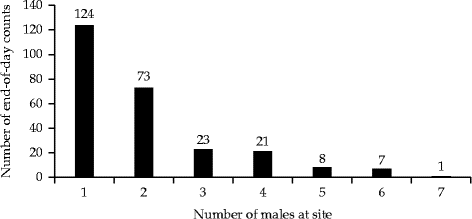
The largest single assemblage, seen in 2013, comprised seven males. In 2012, the largest assemblage seen was five males. Solitary males were frequently encountered. For example, totalling all end-of-day counts for 2013, 124 of 257 (48.2%) occupied sites had single males. Considering that the remaining 51.8% of the sites (n= 133) were occupied by ≥ 2 males, the mean size of an aggregation was 2.9 ± 1.3 individuals. Wasps thus aggregated about half the time, and when they were aggregating, there were normally 2–4 in a group. Solitary males occurred most commonly, with larger numbers in aggregations falling off rapidly until we saw the maximum number, seven, on only one occasion. A graph of the distribution of wasps at all sites from end-of-day tallies for 2013 appears in Fig. 1.
Bar graph showing the total numbers of male wasps witnessed in various aggregation patterns. Numbers are derived from end-of-day counts at all occupied sites, 2013.

Agonistic behaviour in lekking males
We witnessed numerous physical encounters between and among aggregated males. Over time, males at leks often became increasingly concentrated, until regularly 2–3 males were within a few centimetres of each other on the same leaf or neighbouring leaves. These tight groupings eventually led to physical confrontations. Neighbouring, interacting males displayed to one another with the same posture used in calling (Plate 10). Often they turned their backs on one another while keeping their wings raised. Usually, one male eventually turned to face the other and charged with vibrating wings held at a 60–70° angle. Sometimes, the charged male retreated or was shepherded away by the attacker. More often, it turned to face its attacker, and the two grappled together, wings fanning. They stood venter to venter on hind legs, engaging their front legs, apparently attempting to topple one another. When they fell they formed a tight ball and frequently rolled together off the leaf into the undergrowth. These struggles lasted 0.5–45.0 s; from those video-recorded and measured,
$$\bar {>x} $$
= 9.4 ± 9.4 s; median = 6 s; n= 37. Combatants only once showed signs that they were attempting to inflict harm on the other: by biting the other's legs with their mandibles.
Two neighbouring male wasps displaying from adjacent leaves of Dendrophorbium lloense.
Although these confrontations usually involved two males at a time, we documented three instances of all three members of a trinity simultaneously grappling with each other (Supplementary Video 2, available online).
After rolling together off a leaf, males always emerged, apparently unharmed, on leaves in the near vicinity. Sometimes, the aggressor returned to the ‘contested’ leaf; sometimes, the target of the aggression did. Occasionally, both did. However, they often returned to leaves other than the one on which the conflict had occurred. Occasionally, apparent victors ‘paraded’ around the leaf, calling and vibrating their wings as they made vigorous circuits from one leaf edge to another. However, especially when aggregated males displayed no distinct colour patterns to help us in identification, it was often not clear that there were winners and losers in these contests, or that the wasps were trying to claim a leaf or even an area.
Mating
We witnessed 11 copulations and three male–female encounters that were not consummated. On one occasion, a female approached a calling male; however, he lowered his wings to the prone position and retreated from her, and she flew off. Twice females landed within 10 cm of males, but elicited no response and departed. One of those flew away as a spider approached her.
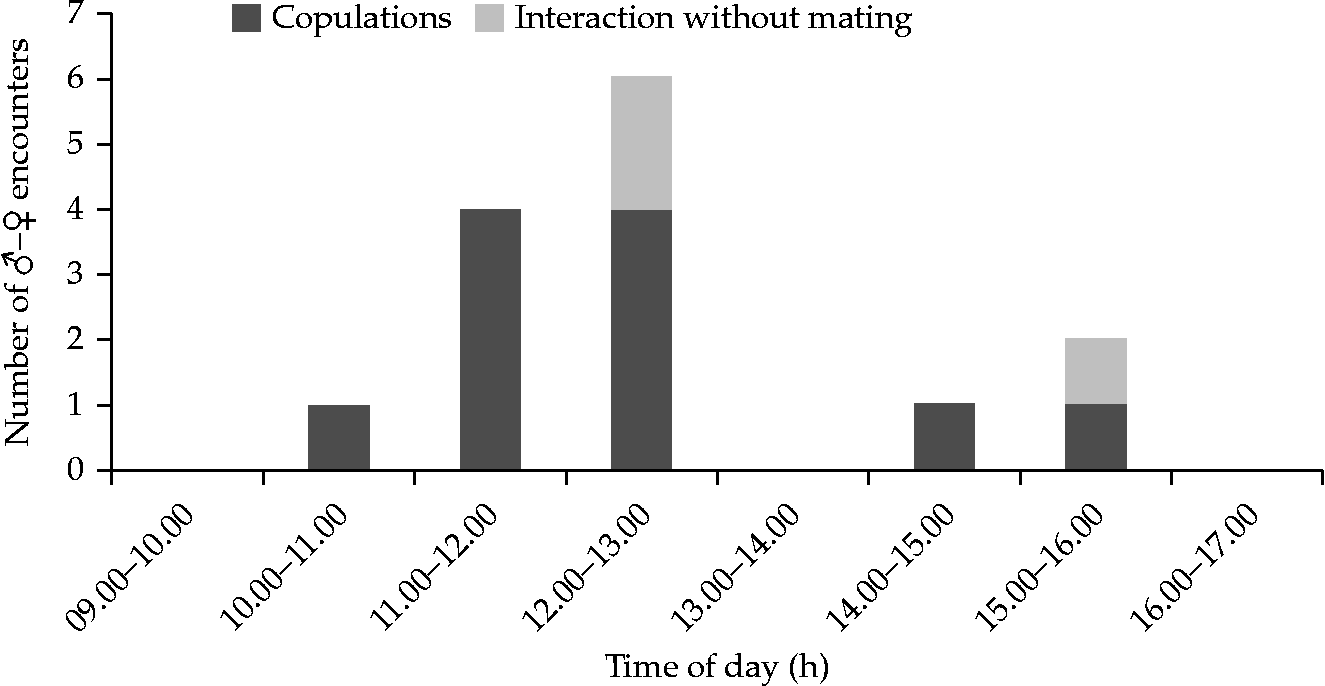
Mating occurred at various times of a day, from 10.30 to 15.25 h. However, eight of 11 copulations and 10 of 14 encounters occurred between 11.00 and 12.40 h, as depicted in Fig. 2.
Bar graph depicting the times of day of observed copulations and unconsummated male–female encounters.

Mating was always initiated with the arrival of a female on a leaf in the near vicinity of a calling male. The female approached a particular male, apparently indicating a clear choice when males were gathered together. In two cases, the female combed her metasomal pleura with her hind tibiae as she approached. Courtship display was so brief that it was barely noticeable. Generally, the female approached to within antennal contact and the male responded with a 1–2 s vibration of his wings, simultaneously circling into position to mount her. The female made no evident response other than acceptance of his mounting. In mounting, the male tucked his body into a C shape, his metasoma curled under that of the female. His head and thorax rode above her folded wings, and his front legs rested either on her wings or on her extended mesothoracic legs. His meso- and metathoracic legs remained on the leaf, his mesothoracic legs just behind the planted metathoracic legs of the female. The female braced herself with all six legs widespread (Plate 11).
Male and female wasps copulate, male fanning his wings.
Throughout copulation, the male steadily swung his antennae back and forth across the female's head. All four of his wings were held together at a ~60° angle above the body. As he copulated, his wings vibrated rapidly and periodically. Vibration pulses measured from video recordings lasted 2.8 ± 1.0 s (n= 48), followed by periods ranging from 2.0 to 26.0 s (
$$\bar {>x} $$
= 10.0 ± 5.6 s, n= 45) with wings at rest at the same ~60° angle. After a period (range 106–394 s;
$$\bar {>x} $$
= 192 ± 89 s; median = 175 s; n= 7) of stationary copulation, the female began to walk in an apparent attempt to dislodge the male. Nearly always, she dragged him to the leaf edge, frequently over the edge to the underside (Supplementary Video 3, available online) where they parted. The entire duration of timed copulations, from intromission until the aedeagus was withdrawn, ranged from 160 to 422 s (
$$\bar {>x} $$
= 232 ± 80 s; median = 212 s; n = 7).
Immediately after mating, males invariably resumed combing, preening and calling. Two individuals, in apparent post-copulatory courtship, briefly continued vibrating their wings at the females with which they had copulated, with intermittent calling. Female post-coital behaviour was quite variable. They sometimes stood still until departing the leaf; however, usually, they groomed various body parts at length, including antennae, legs and wings. Sometimes, they vigorously rolled their metasomata on the leaf surface. Usually, the ovipositor was visible, the metasoma flexed anteriorly beneath the body. After this resting and grooming period, ranging from 83 to 945 s in measured instances (
$$\bar {>x} $$
= 320 ± 293 s; median = 167 s; n= 7), they took flight.
We watched females fly after mating, hoping for an indication of the unknown host insect into which they would seek to oviposit. However, all females flew low into dense forest undergrowth and disappeared after at most a few metres.
Female mate choice
There was some evidence that females mating at leks were making active choices among males, as opposed to approaching and copulating with a random male, or the first male encountered. For example, at a site occupied by two calling males within 20 cm of each other, the same male was approached by (presumably different) females and mated twice within 50 min. The second copulation occurred while he was calling from the underside of a leaf, after being dragged there by his previous mate. The second female landed on top of the leaf he occupied and actively searched for him, ignoring the more visible male calling from the upper surface of a neighbouring leaf.
Twice females approached triads of males, all within 60 cm of each other, and selected males that had earlier successfully forced the other two members of their trinities off the leaves where mating occurred.
In contrast, another female approached a solitary male that had called consistently by itself, 6.5 m from a group of three that had been engaged in intense agonistic interactions for the previous ~2.5 days. However, 3 days later, a female selected as a mate the lone, consistently dominant male remaining on the plant that was the site of those triad battles. The other two males had left.
We watched a female approach a lek comprising six closely aggregated calling and fighting males, and fly close over the top of four of them to land near a fifth male. She then made several short flights around the lek, landing near various males before returning to approach and copulate with the one near which she had first landed.
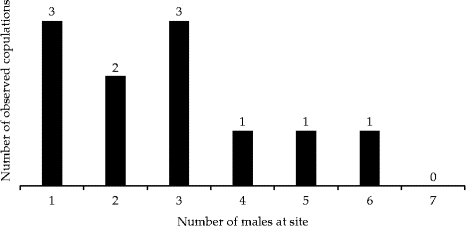
Of 11 matings observed, three occurred with solitary males, three with males aggregated in groups of three. Two copulations were seen in groups of two males, and one each in groups of four, five and six (Fig. 3). These numbers probably underestimate the proportion of successful copulations by solitary males because we tended to focus our observations on congregations.
Bar graph showing relationship between the numbers of copulations observed and the numbers of aggregated males present at the site where mating occurred.

Defensive behaviour
In ~640 person-hours of observation, we never witnessed successful predation, or evidence of successful predation, upon a N. townsendi wasp. Many potential arthropod predators visited leaves occupied by wasps. We saw encounters with three spider species, an opilionid (harvestman), a chrysopid larva, three vespid wasps and numerous stratiomyid and empidid flies. Always N. townsendi prevailed. With all but the spiders, the wasp simply turned and faced the intruder, often with spread and vibrating wings, until the trespasser departed.
Defence against spiders was more elaborate. We watched both male and female N. townsendi easily extracting themselves from spider webs. We witnessed nine attacks by spiders, eight of which were by two species of salticids (jumping spiders). These unsuccessful attacks were sufficiently remarkable that we present four case studies. In all these cases, the spiders were about the same length as a male wasp, but stouter (Plate 12). It is noteworthy that we watched individuals of the two salticid species unhesitatingly devour cicadellid leafhoppers approximately the size of N. townsendi and an ichneumonoid wasp somewhat larger than Napo.
Male wasp in calling position as a salticid spider approaches to within 1 cm.
Predation case study 1
A spider landed via its dragline on a leaf a wasp had occupied continuously for the past day, constantly preening and calling. The spider slowly approached the wasp, which turned to face it.
They confronted each other without touching, the spider slowly nearing, Napo backing and turning slightly, from ~1 cm, for ~2 min. Then the spider attacked. The two made face-to-face contact, the spider's pedipalps, chelicerae and front legs touching the wasp's antennae and front legs. The contact lasted < 1 s, as the spider backed away. The spider appeared disturbed, vigorously rubbing its chelicerae with its pedipalps. The spider approached again, and another face-to-face stand-off followed. The spider again attacked, with the same result as before. Similar physical attacks occurred four times in ~10 min. Three times in the midst of this prolonged confrontation, the wasp turned its back on the spider, preened and raised its four wings, displaying in apparent calling posture just as it would in the spider's absence. After each bout, the spider backed to 1–2 cm and energetically stroked its chelicerae with its pedipalps as if a noxious chemical had been deposited on its mouthparts.
Finally, the spider backed to ~3 cm, still grooming its chelicerae with its pedipalps. The wasp instantly reverted to its normal calling behaviour. The spider departed the leaf, via its axil and down the stem. It soon appeared on a nearby leaf.
Predation case study 2
A spider appeared at the base of a leaf occupied by a wasp ~10 cm away. The spider quickly approached to within 1 cm of the wasp. The wasp approached the spider, turned its back and assumed the calling posture. Then, he turned sideways to the spider, and the spider backed away. The wasp again turned its back and the two remained separated by only 1 cm for 2 min, the wasp displaying as the spider watched.
The spider approached and the wasp turned to face it. They stood still for 2–3 min. The wasp twitched its antennae, turned away slightly and the spider attacked. The wasp quickly jumped forward and away, avoiding contact. It then turned on the spider, contacted it fleetingly with a slash of a single antenna, and the spider backed away.
Then, the wasp approached its attacker, vibrating his wings while holding them at a 60° angle. It turned sideways to the spider, then turned its back from 1–2 cm away. The spider faced the wasp, then turned and walked back to its original resting spot 10 cm away at the leaf base. It rested ~1 min, then walked down the leaf petiole and away.
Although the spider moved its pedipalps after this encounter, it was not the vigorous, constant, agitated movement seen after the previous day's encounter.
Predation case study 3
After 5 days at the same lek, a spider suddenly appeared at the edge of a third wasp's leaf, 2 cm from the wasp. The wasp displayed in its calling position, its back to the spider, and the spider turned away. The spider then faced the wasp again, still from 2 cm, and the wasp backed towards the spider. The spider retreated to 4 cm. It then faced the wasp, which was still calling, then turned away as the wasp maintained calling posture. The wasp turned to face the spider from 4 cm. The spider crawled under the leaf edge as the wasp preened its metasoma and wings with its hind tibiae and called.
Moments later, the spider returned to the top of the leaf and approached to within 3 cm of the wasp. Next, it lowered itself below the leaf by its dragline, then ascended its dragline and positioned itself directly opposite the wasp on the underside edge of the leaf. At this point only the width of the leaf edge separated the two. Abruptly, the spider hurtled over the leaf edge and attacked. The wasp turned instantly to face it, and the spider turned away. The wasp then crawled to the centre of the leaf, calling. It soon took flight to a nearby leaf, but apparently not from direct provocation by the spider.
Predation case study 4
A different species of salticid appeared 3–4 cm from a calling wasp, which turned sideways to the spider and continued calling. The spider attacked, the wasp quickly turned to face it, and the spider backed away. The wasp then vibrated its wings, turned its back to the spider and called from ~2 cm away. As the wasp preened its wings, the spider approached from behind with front legs outstretched. The wasp turned to face the spider, and the spider turned away. Again it approached, and contacted the wasp's antennae with its front legs. Napo backed away ~1 cm. In a face-to-face stand-off, the wasp combed, preened and called. The spider jumped to attack, and the two grappled. The spider backed off. The wasp preened and called. The spider leapt to attack again, and the wasp backed, turned and walked away, preening twice and calling. The spider backed to 8 cm, then approached again to < 1 cm. Napo turned sideways to the spider, calling. The spider jumped onto the wasp's head as the wasp turned to face the attack, and the spider immediately backed away to 1 cm. The wasp preened and called for the next min, until the spider retreated to the leaf edge and underneath it, not to return. This entire confrontation lasted for ~15 min.
Discussion
Lateral glands and calling
The presence of lateral glands along the metasomal pleura supports our hypothesis that males are preening the metasoma and anointing the wings to gather and release a pheromone secreted from that region of the body. Although the presence of metasomal glands has been demonstrated in males of many Braconidae (Quicke, Reference Quicke1990; Quicke et al., Reference Quicke, Wharton and Sittertz-Bhatkar1997), the position and form of these newly discovered glands in N. townsendi are unique. D.L.J. Quicke (personal communication), upon examining the glands and hearing our description of the male wasps' behaviour, remarked that the glands “are almost certainly the source of the calling pheromone.”
Aggregation, leks and copulation
Given the broad range of plant families and species on which we observed calling wasps, we find little support for Shaw's (2012) hypothesis that D. lloense is a preferred perching site. Conveniently for researchers searching for the wasps, they are easily seen on the platform-like leaves of that species. However, without transect studies comparing the incidence of wasps to the relative proportion of different plant species, we cannot make firm conclusions about preferred plants for lekking. For now, it appears to us that open habitat, with relatively sparse foliage and moderate light penetration, is more important than particular plant species in attracting calling wasps.
Variability in pigmentation among individuals of a species occurs with some frequency in the Hymenoptera, e.g. among some Polistes wasps, where wasps can recognize individual conspecifics by facial patterns (Sheehan and Tibbetts, Reference Sheehan and Tibbetts2011). Recently, Abe et al. (Reference Abe, Nishimura and Maeto2013) reported individual pigment variation related to temperature during development in Meteorus, tribe Meteorini, close relatives of the Dinocampini.
Shelly and Whittier (Reference Shelly, Whittier, Choe and Crespi1997) distinguished between aerial and substrate-based insect leks. They noted that substrate-based male aggregations generally contain relatively small numbers of individuals, which matches our finding of leks comprising 2–7 males. They emphasized that at ‘classical’ leks, males must defend territories, wait for arriving females and perform courtship before mating. Our results show that N. townsendi's substrate-based aggregations, while spatially somewhat fluid, satisfy all those criteria and thus constitute true leks. A somewhat unusual aspect of our findings is that lekking appears to be facultative, in the sense that solitary males occurred commonly, at about half of occupied sites. Both singletons and aggregated males succeeded in mating. However, Thornhill and Alcock (Reference Thornhill, Alcock, Schuker and Simmons1983) pointed out that intraspecific variability is not uncommon in insect mating systems. They noted that typical intraspecific alternatives include one aggressive, territorial strategy and one non-aggressive, non-territorial strategy, precisely what we observed in N. townsendi.
Various alternate hypotheses could account for the aggregation patterns we found: (1) males make a choice, or are genetically programmed to choose, between calling singly or in a group, and stay with that choice; (2) males start as singletons and are gradually attracted by the calling pheromone to join leks; (3) males start calling in leks, but abandon them, perhaps as a result of losing aggressive encounters or from lack of mating opportunities. Our ability to identify individuals, and thus trace their possible movements between sites, was insufficient for us to feel confident in settling on one of these hypotheses.
Loose aggregations of males of the opiine braconid, Fopius arisanus (Sonan), were seen by Quimio and Walter (Reference Quimio and Walter2000), who reported a sequence of mating behaviours in that wasp similar in some ways to that of N. townsendi. They postulated that the gathered wasps were amplifying the effects of a likely sex pheromone. Facultative leks in N. townsendi may constitute a trade-off: augment the pheromone signal by joining a group, but face increased competition and possible interference from neighbouring males as a female chooses her mate and copulates. We never witnessed wasps feeding or drinking; aggregation and agonistic interaction may also thus represent a drain of irreplaceable energy and fluids that singletons are able to avoid. Our results give no indication that matings on leks increased on a per-male basis. Nor was there any evidence of group-defence benefits, which has been observed with many other kinds of insects forming groups (Vulinec, Reference Vulinec, Evans and Schmidt1990), as in this case both solitary and aggregated males defended themselves well and we saw no predation or parasitism on either singletons or aggregations.
Leks may also be female driven, if females prefer mating with males that present them a choice among males whose agonistic behaviour demonstrates tested competence. Our frequent inability to determine clear victors claiming a leaf or an area after a confrontation suggests that aggressive encounters may simply serve to maintain social distance as calling males become crowded. It is also of course possible that fighting males perceived nearby females that we did not detect, and that combat success was indeed a proxy for fitness and influenced female choice. Although the sample size is small, our observations of several singleton males mating argue against the female-driven hypothesis. Nor were there obvious size differences among males, which have, for example, been shown to influence mate choice in two species of Cotesia parasitoid wasps (Joyce et al., Reference Joyce, Bernal, Bradleigh Vinson and Lomeli-Flores2009).
It is difficult to see what draws males to their aggregation sites. Thornhill and Alcock (Reference Thornhill, Alcock, Schuker and Simmons1983) and Godfray and Cook (Reference Godfray, Cook, Choe and Crespi1997) noted that males tend to focus their mate-location efforts at sites where females emerge, where females forage, where females oviposit or at landmarks. Without knowing the host of N. townsendi, it is not possible to strictly apply these criteria. However, given the wide range of plants on which males occurred, none of these seem relevant to N. townsendi, with the possible exception of landmarks and the apparent preference for forest sites with relatively sparse foliage. More work is needed to quantify physical habitat characteristics such as light penetration and vegetation cover and composition at calling sites.
Matthews (Reference Matthews1974) described braconid courtship and mating as comprising “attraction, recognition, orientation, wing fanning or vibration, mounting, antennation, copulation, and post-copulatory grooming.” He noted that, “actual copulation is brief, normally lasting less than one minute.” Ruther (Reference Ruther, Wajnberg and Colazza2013) summarized three sequential roles of sex pheromones in parasitoid wasp mating behaviour: (1) volatile compounds attract potential mates; (2) less-volatile compounds enable mate recognition and elicit stereotypic courtship; (3) aphrodisiac compounds released by the male elicit female receptiveness. The general descriptions by both authors accurately encompass the behaviours we witnessed, with the exception that the duration of mating in N. townsendi is markedly longer than Matthews considered typical. Although we gathered no direct evidence of courtship chemicals or aphrodisiacs, the general behaviour of N. townsendi is in accord with the sequence Ruther described. The wing fanning we observed during both courtship and mating (and during conspecific and interspecific agonistic displays) has also been described for several parasitic wasp species (Joyce et al., Reference Joyce, Bernal, Bradleigh Vinson and Lomeli-Flores2009, Reference Joyce, White and Medina2014; Benelli et al., Reference Benelli, Bonsignori, Stefanini and Canale2012, Reference Benelli, Bonsignori, Stefanini, Dario and Canale2013; Bredlau et al., Reference Bredlau, Mohajer, Cameron, Kester and Fine2013; Canale et al., Reference Canale, Benelli, Lanzo, Gianotti, Mazzoni and Luchi2013; Benelli et al., Reference Benelli, Giunti, Canale and Messing2014a , Reference Benelli, Kavallieratos, Donati, Mencattelli, Bonsignori, Stefanini, Canale and Messing b , Reference Benelli, Kavallieratos, Donati, Mencattelli, Bonsignori, Stefanini, Canale and Messing c ). Copulatory behaviour in the braconid Psyttalia concolor Szépligeti (Benelli et al., Reference Benelli, Bonsignori, Stefanini and Canale2012) shares many features with Napo behaviour, including male wing fanning and antennal tapping of the female's head, and the female's dragging the mounted male as copulation ceases.
Defence
Noting the relative rarity among insects of male-released pheromones that attract females from a distance, Thornhill and Alcock (Reference Thornhill, Alcock, Schuker and Simmons1983) emphasized that such airborne chemicals pose a danger as attractants to predators and parasites. Napo townsendi exacerbates that danger by its steadfast, repeated calling from exposed leaf-tops, its refusal to move when faced with intruders, and its protracted average mating time of 3–4 min. To protect itself, it has no apparent physical weaponry.
However, the wasps are far from helpless. As our predator observations and case studies of spiders indicate, the wasps instantly turn to face and parry predatory attacks, and quite possibly employ a chemical defence coupled with aposematic behaviour and chemical(s). The calling display, persisting in the presence of predators, may be both a physical and a chemical advertisement of defensive abilities. The pheromone used in attracting mates may thus exemplify semiochemical parsimony (Blum, Reference Blum1996). It may also serve as an aggressive signal to competing males, and even as an aposematic warning if male wasps have chemical defences, as our observations of salticids vigorously palpating their chelicerae after confrontations may indicate. Byers and Levi-Zada (Reference Byers and Levi-Zada2010) described the release of a defensive chemical from the head in another euphorine braconid, Leiophron uniformis (Gahan).
Although the circumstantial evidence for postulated pheromones and/or allomones is strong, work is needed to employ bioassays to confirm their existence, and then to isolate and identify them, and demonstrate their action as semiochemicals. Field manipulations to determine whether lekking males are drawn to congregate around a particularly attractive male, or a particularly attractive location (‘hot shot vs. hot spot’; Bradbury and Gibson, Reference Bradbury, Gibson and Bateson1983) could be performed relatively easily. A large gap in our knowledge of the wasp is our ignorance of its host, whose discovery may elucidate many questions about its behaviour.
Conclusion
Male N. townsendi displayed facultative lekking, appearing both singly and in groups of 2–7 on the leaf-tops of various plant species. They employed a stereotypical, spread-winged mate-calling behaviour, apparently releasing a sex pheromone combed from lateral metasomal exocrine glands and applied to all wings and hind legs. Aggregated males also used this posture in conspecific agonistic displays, often leading to physical fighting. While female wasps were attracted to and mated with displaying singletons, they also chose among aggregated males. When females approached, males vibrated their wings in brief courtship and mounted. Mating duration averaged 3–4 min. Wasps warded off attacks by various predatory arthropods, particularly salticid spiders, and successful predation on wasps was never witnessed. We postulate that calling and release of sex pheromone may also serve as both an intrasexual agonistic display and a warning to predators that the wasps employ a chemical defence.
A salient feature of this study is its complete reliance on data gathered in the natural cloud forest habitat under challenging conditions. Although this was enabled to an extent by the tendency of N. townsendi males to remain in one place and tolerate disturbances, we hope this report demonstrates the value and validity of field research on parasitic wasps, particularly braconids, and encourages more field investigations.
Supplementary material
To view supplementary material for this article, please visit http://dx.doi.org/10.1017/S1742758415000107
Acknowledgements
This research was supported by the National Science Foundation (NSF) grants BSI-03-46729, BSI-07-17458, DEB-07-17034 and DEB-10-20751 (caterpillars and parasitoids in the Eastern Andes of Ecuador), two NSF Research Opportunity Awards (ROA): DEB-12-13089 and DEB-13-08789, and two NSF Research Experience for Undergraduates supplemental grants: DEB-12-12479 and DEB-13-14080. Any opinions, findings and conclusions expressed are those of the authors and do not necessarily reflect the views of the National Science Foundation. The authors would like to thank Michael Isaac Dority, Selena Hammer, Angela Ochsner and Rhiannan K. Rubino for their assistance with some wasp observations. They also thank Donald L.J. Quicke for dissection and preparation of the slide of exocrine glands presented in Plate 2, and Helmuth Aguirre for photographing the glands.
Appendix A: Supplementary Videos
Supplementary Video 1. A male Napo townsendi combs, preens and calls in its typical, constant behavioural sequence.
Supplementary Video 2. Three members of a trinity grapple in an agonistic contest among calling males.
Supplementary Video 3. Male and female wasps copulate on a leaf of Dendrophorbium lloense. Toward the end of the act she drags him to the underside of the leaf, and they part.