




No CrossRef data available.
THE EFFECT OF THE CONTEXT OF LEARNING ON THE USE OF COMMUNICATION STRATEGIES BY LEARNERS OF SPANISH AS A SECOND LANGUAGE
Published online by Cambridge University Press: 23 April 2004
Abstract
This study investigates the effect of the context of learning—“at home” (AH) classroom versus study abroad (SA)—on the number and types of communication strategies (CSs) used by learners of Spanish as a second language. Oral data from 46 learners—20 AH and 26 SA—were analyzed before and after the treatment period, to discern the effect of various factors on the learners' levels and choice of CS usage: type of CS category (L1 or L2 based, direct or interactional, and problem-orientedness [resource deficit, other performance, and self-performance]) and measures of language use. Posttest results showed a significant effect for context for CS categories and language use: Students in the SA context consistently used fewer CSs than their classroom counterparts, and their CS use correlated negatively with higher use of Spanish outside the classroom and with the host family. It is posited that the pragmatic exigencies of the AH and SA contexts may account for these findings.This research would not have been possible without the support of the Council on International Educational Exchange (CIEE), which sponsored this team project, headed by Barbara F. Freed and Norman Segalowitz, to study the effects of the SA experience on L2 learners. I am very grateful to the members of the CIEE project team: Joe Collentine, Barbara Freed, Norman Segalowitz, and Manuel Díaz-Campos, for their insightful commentary on earlier versions of this work. Special appreciation also goes to Nicole Lazar for her expert assistance with the methodology and data analysis sections of this paper. My sincere appreciation also goes to Julie Sykes, Rosalind Freeman, and Sharma Martineau, graduate students in Spanish SLA and applied linguistics at Arizona State University, for their assistance with the partial transcription and the coding of the CS data.
Information
- Type
- Research Article
- Information
- Copyright
- © 2004 Cambridge University Press
The role of context in the SLA process has been the focus of important research since the 1970s, after Hymes (1974) set the stage for recognizing the importance of contextual factors such as setting, participants, and end (purpose) on communicative interaction. In particular, the effects of a study abroad (SA) context on the acquisition of a second language (L2) have attracted the attention of SLA scholars in recent years.1
The term second language (L2) in this article incorporates the concept of a target language (vs. native language or L1) that is acquired in either a foreign language or second language setting.
Although the findings of studies that look at predictive factors or the sociocultural, sociolinguistic, and attitudinal aspects of the SA experience are interesting, many foreign language educators, SLA researchers, and university administrators (e.g., chairs of language departments or directors of international programs offices) are more interested in finding out the concrete effects of SA programs on the linguistic abilities of their students. Moreover, these educators, scholars, and institutional decision makers are especially interested in studies that compare and contrast the language abilities of students who study abroad with those who stay at home, to assess the effectiveness of the SA experience in students' overall language preparation. Studies that specifically compare and contrast the effects of SA versus AH contexts have, to date, concentrated on such topics as the acquisition of listening skills (Carroll, 1967), grammatical morphemes and lexical distinctions (DeKeyser, 1986, 1991; Guntermann, 1995), syntactic issues (Huebner, 1995), measures of fluency (Freed, 1995), and the use of communication strategies (DeKeyser, 1986, 1990, 1991; Lafford, 1995).
This study contributes to this literature by investigating the frequency and types of communication strategies (CSs) used by learners in AH and SA environments before and after a semester-long treatment period, and factors that might influence their CS use (e.g., type of CS category), the effects of prior formal experience with the language, time using Spanish outside the classroom—general (total time using Spanish) versus proportional (time using Spanish and time using Spanish and English)—and time spent speaking with the host family (SA group only). Moreover, this study adds to the current literature on what is known about the effects of the SA experience and whether the processes involved in the acquisition of L2 products in such a setting are significantly different from those used by learners acquiring the L2 in a foreign language classroom in their own country.
COMMUNICATION STRATEGIES
The importance of the study of the strategies used by L2 learners to convey meaning in the face of communication breakdowns was first noted in the early 1970s. The term communication strategy within an L2 context was introduced by Selinker (1972). Early definitions of CSs referred to learners' abilities to communicate their ideas in an L2 when faced with a communication gap (a breakdown in communication caused by the learners' inability to understand their interlocutors or to express their ideas in the L2). By the late 1970s and early 1980s, the traditional view of CSs as “problem-solving procedures” used by individuals to overcome linguistic inadequacies (Sharwood Smith, 1979, p. 349) had become established in the literature (Corder, 1983; Tarone, 1977).
Tarone (1980) expanded on her prior (1977) learner-focused definition of CSs by introducing an interactional perspective in which CSs “are seen as tools used in a joint negotiation of meaning where both interlocutors are attempting to agree as to a communicative goal” (p. 420). This perspective allowed Tarone to include as CSs those strategies that were used to clarify the meaning of both learner's and interlocutor's speech (e.g., clarification requests or comprehension checks) in addition to those used to correct forms. Dörnyei and Scott (1997) provided a classification system of strategies incorporating notions of both learner-centered and interactionist perspectives that are used as the basis of this analysis (see the Appendix for a repertoire of CSs analyzed in this study).
Definitions of Communication Strategies
Dörnyei and Scott (1997) proposed that problem-orientedness has become a “primary defining criterion for CSs” (p. 182). However, they went beyond this definition to characterize several types of problems that occur: (a) resource deficits—gaps in speakers' knowledge preventing them from verbalizing messages; (b) own performance problems—the realization that something one has said is incorrect or only partly correct, associated with various types of self-repair, self-rephrasing, and self-editing mechanisms; and (c) other performance problems—something perceived as problematic in the interlocutor's speech, either because it is thought to be incorrect (or highly unexpected) or because of a lack (or uncertainty) of understanding something fully, associated with various meaning negotiation strategies (p. 183).
Dörnyei and Scott stated that the notion of a strategy as “being a conscious technique used to achieve a goal” (1997, pp. 184–185) has made consciousness the second major defining criterion for CSs. That is, individuals using CSs are aware of the communication problem and intentionally use CSs to negotiate meaning and arrive at a mutual understanding with their interlocutor. They also categorized CSs as being direct or interactional. In direct CSs, speakers provide an alternative, manageable, and self-contained means of getting the (sometimes modified) meaning across, such as circumlocution to compensate for the lack of a word. Most traditionally identified CSs fall under this category (p. 198). In interactional CSs, participants carry out troubleshooting exchanges cooperatively (e.g., to appeal for and grant help or request for and provide clarification), and therefore mutual understanding is a function of the successful execution of both parts of the exchange (p. 199).
Taking into account the CS definitions discussed in this literature review, the working definition of communication strategy for the current study is the following:
Strategies used by L2 learners in a conscious attempt to bridge a perceived communication gap, either caused by the learner's lack of L2 knowledge (resource deficit), problems with his or her own performance or problems resulting from interaction with an interlocutor.
The concept of communication gap is operationalized in this study as an interruption in the normal flow of conversational interaction between the speaker and interlocutor owing to a breakdown in communication.
Empirical Research on Communication Strategies Used by L2 Learners
Empirical research on the use of CSs has shown the following: First, there is a relationship between the frequency of CS use and proficiency level. Although research has found that, as the proficiency level of a learner increases, the number of CSs used decreases (LaBarca & Khanji, 1986; Poulisse & Schils, 1989), Liskin-Gasparro (1996) suggested that CS use is not prevalent at either end of the ACTFL scale of proficiency; beginners do not have the linguistic resources to use many of the CSs, and high-proficiency learners do not need to use them. However, within that mid range of proficiency, CS use decreases with a rise in proficiency level. So, more advanced speakers make greater use of L2 (rather than native language [L1]) based CSs (Bialystok, 1983; Lafford, 1995; Liskin-Gasparro; Paribakht, 1985). Finally, the type of task affects the choice of CS type (DeKeyser, 1991; Poulisse & Schils).
To date, three empirical studies have appeared on the use of CSs by learners of Spanish: DeKeyser, 1991; Lafford, 1995; and Liskin-Gasparro, 1996. Liskin-Gasparro studied the use of CSs by 30 Spanish L2 learners (intermediate-high, n = 17; advanced, n = 13) in ACTFL Oral Proficiency Interviews (OPIs) in a domestic immersion environment and found an inverse relationship between the amount of CS use and proficiency level and more reliance on L2 over L1 strategies as proficiency level increased. However, the generalizations about CS use made by Liskin-Gasparro must be tempered by the fact that only 62 tokens and eight CS types were analyzed in this study.
DeKeyser's (1991) study of CSs compared oral data from learners studying in AH (n = 5) and SA contexts in Spain (n = 7). DeKeyser found that the type of task (interview vs. picture descriptions) influenced the relative use of certain types of CSs for both groups—that is, the SA group used more circumlocution than the AH group in the picture descriptions, and the AH group used more L1-based strategies than the SA group in the interviews. Although DeKeyser is the first systematic comparative study of CSs within two contexts (AH and SA) of learning Spanish as an L2, his findings are limited by the small number of subjects in the study.
Of these three studies, only Lafford (1995) systematically compared the use of CSs by students in an AH versus a SA environment. However, her data were drawn from only one role play per student in exit OPI interviews done with students at the end of the fourth domestic classroom semester of study by an AH group (n = 13) or at the end of semester-long beginning-level SA programs in Spain (n = 15) and Mexico (n = 13), which covered the equivalent of four college semesters in 4 months abroad. Although the data show that the AH group evidenced a broader repertoire of CSs (e.g., use of L1 word, paraphrase, overgeneralization, and direct and indirect appeal) than the SA groups (mostly restructuring and requests for feedback), all three groups used self-repairs more than any other CS. Because no pretest data were available for these beginning level AH and SA students for logistical reasons, these differences in CS use by the two groups cannot be attributed without reservation to the effect of context of learning.
Thus, to date, no large-scale study of the use of CSs by L2 students of Spanish in different contexts of learning (AH vs. SA) has been carried out with oral data collected both before and after the semester-long treatment period. The research design of the present study of the use of CSs by both AH and SA learners provides greater insights into the effect of the context of learning on the use of CSs.
Research Questions
- How does CS (and CS category) use vary between learners in the AH and SA contexts? For instance, (a) how does CS use vary for learners in the two contexts in the posttest? (b) how does the use of L1- and L2-based strategies vary for learners in the two contexts in the posttest? (c) how does the use of direct and interactional CSs vary for learners in the two contexts in the posttest? and (d) how does the orientation of the communication problem (resource deficit, other-performance, own-performance) vary for learners in the two contexts in the posttest?
- What external factors—such as prior formal experience with Spanish, time spent using Spanish outside of class (general and proportional), and time spent speaking with the host family (SA group only)—correlate significantly with CS use by learners in the AH and SA contexts before and after the treatment period?
METHOD
Participants
The 46 participants in this study consisted of two groups: an AH group (n = 20) studying at the University of Colorado at Boulder, and a group of learners on a SA program in Alicante, Spain (n = 26), sponsored by the Council on International Educational Exchange (CIEE). All participants in this study met the following criteria: They were born in the United States, English was their L1 (no Spanish heritage speakers were included), none spoke Spanish in their home, and they had at least two semesters of formal classroom instruction and no SA experience in a Spanish-speaking country.
AH Group.
This group of 20 learners consisted of 4 males and 16 females ranging in age from 17 to 60 years (M = 23, median = 20); all students had similar amounts of prior formal experience with Spanish.2
See Collentine and Freed (this issue) for more demographic details and prior formal preparation of the AH and SA learners.
SA Group.
This group consisted of 6 males and 20 females who participated in a CIEE-sponsored SA program in Alicante, Spain, during the fall 2001 semester; the 26 SA subjects ranged in age from 19 to 25 years (M = 21, median = 20). All SA students had similar amounts of prior formal exposure to Spanish; their prior formal exposure to the L2 was also comparable to that of the AH group. Although all the SA students were studying abroad together in Alicante, they studied at various home institutions in the United States. In fall 2001, the SA students were enrolled in three daily courses per week in grammar and syntax, reading and writing, and conversation in a special program for foreign students at the University of Alicante; 15 of the 26 SA students also took one or two elective monthlong daily content classes in Spanish on society and culture during the semester. All SA students lived with Spanish host families in Alicante during the treatment period.
Procedures and Task
During the week before the pretest at the beginning of the semester, students completed the entrance version of the Language Contact Profile (LCP) questionnaire (Freed, Dewey, Segalowitz, & Halter, this issue). The initial LCP contained the following type of information on external factors that was tested for correlations with CS use in this study: prior formal exposure to the L2 (in years) and time (hours per week) spent using Spanish outside the classroom (reading, writing, speaking, and listening). Students who met the language background criteria for the project were given a 20- to 30-minute tape-recorded ACTFL Oral Proficiency Interview in Spanish, administered by ACTFL-certified testers.3
Although the instrument used for the gathering of the spoken data for this analysis, the ACTFL-OPI interview, does not truly simulate natural conversation (Johnson, 2001), it does provide learners the opportunity to understand the speech of the NS interlocutor and to formulate his or her own messages in the L2.
Data Analysis
Corpus.
The corpus consisted of extracts and role plays taken from the OPI pretest and posttest interviews. The two 2-minute extracts were taken starting from the seventh and twelfth minutes of each pretest and posttest OPI. Several different role plays were used in the OPI interviews because learners were at differing levels of proficiency before and after the treatment period. The final data set included extracts from all 20 AH participants and role plays from only 18 students because exit role plays were missing from two AH interviews. Extract and role-play data were used from all 26 SA participants.
Although the length of the extracts (2 minutes) was fixed for all subjects, the length of the role plays ranged from 1:56 to 5:29 minutes in the pretest and from 1:48 to 4:01 minutes in the posttest. Additionally, the number of words used (extracts and role plays combined) by different subjects also displayed a wide range of values—AH: pretest = (93, 95) 167–457, posttest = (96, 98) 167–436; SA: pretest = 181–491, posttest = 270–543. (Numbers in parentheses were from two students without a final role play; only extract CS data were used for those students. In other words, these figures reflect only data from the pretest and posttest extracts for these students.) Thus, to be able to compare the use of CSs by the two groups, the absolute number of CSs used by a subject in each pretest and posttest was divided by the number of words used by that subject in the relevant interview and was then normalized over a baseline of 500 words.
Codification and Analysis of the Data.
The data from the OPIs were first transcribed by other CIEE project members. The CS data were then coded using a repertoire of 26 strategies (see Appendix) by the researcher and two research assistants. All three evaluators agreed on most of the CS classifications for the data; when there were discrepancies in the coding of CSs by these individuals, each case was discussed and a consensus was arrived at by all parties regarding the proper categorization of the example.
Once the particular CSs were identified, they were categorized as follows: direct versus interactional, and by problem-orientedness (resource deficit, own performance, and other performance). Another category of strategy analyzed in the study concerns the L1 or L2 base of the strategy. Those strategies that rely on the learner's knowledge of his or her own L1 (English in all cases) were categorized as L1 strategies (e.g., code switches or L1-based direct appeals). Strategies based on the learner's knowledge of the L2 (Spanish) were considered to be L2 strategies (e.g., word coinage or restructuring). Both L1- and L2-based strategies cut across the other categories defined previously (direct vs. interactional and orientation of the problem subtypes). All statistical analyses (ANCOVAS, ANOVAS, standard deviations, repeated measures, and correlations) were carried out using the Statistical Package for the Social Sciences.
RESULTS
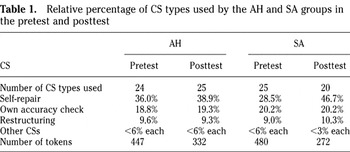
In response to the first research question—how CS (and CS category) use varies between learners in the AH and SA contexts—the participants in this study used a total of 26 CSs (see Appendix) on the pretest and posttest. However, most of the individual CSs used by both groups each constituted less than 6% of the total number of CSs used. This would indicate that, although both groups possessed a wide repertoire of CSs, most of the CSs were used quite infrequently.4
Although the SA group reduced its repertoire of CSs from the pretest (25) to the posttest (20), the AH group actually increased the type of CSs used from 24 to 25. The low number of tokens used for the majority of strategies makes it difficult to draw any definitive conclusions about the size of the repertoire or type of strategies used by both groups at the pretest and posttest.
Relative percentage of CS types used by the AH and SA groups in the pretest and posttest

Overall CS Use
The data show that the SA group employed significantly fewer CSs than the AH group in the posttest.
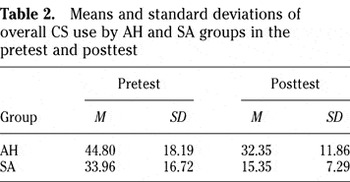
The data in Table 2 reveal that both groups decreased their mean use of CSs over time and that the AH group used over twice as many CSs (32.35) as the SA group (15.35) in the posttest. A repeated measures test showed that there was a significant effect for time, p = .000, but not for the interaction of group and time, p = .217, on overall CS use. Thus, the students in both learning contexts significantly reduced their use of CSs from the pretest to the posttest, but one group's amount of reduction was not significantly different from that of the other group.5
The results of repeated measures tests performed on other comparisons studied in this analysis (L1, L2, DS, IN, RD, OH, and SF categories of CSs) yielded identical results: a significant effect for time but not for time and group together.
ANOVA tests performed on the pretest data show that the AH and SA groups significantly differed before the treatment period began on the following measures: overall frequency of CS use, L2-based strategies, direct strategies, and self-performance-based strategies. Other ANOVA tests reveal no significant pretest differences between the AH and SA groups regarding their use of L1-based, interactional, resource-deficit, and other-performance-based communication strategies.
Greater homogeneity in posttest results (over pretest results) for both groups and in posttest results for the SA (over AH) group is also found in all analyses of CS categories to follow. The relationship between a lower mean amount of CS use and a reduced standard deviation also holds true for all further analyses of standard deviation scores in this study.
Means and standard deviations of overall CS use by AH and SA groups in the pretest and posttest

To understand more about the types of CSs used by the two groups in the posttests, other ANCOVA analyses were performed to investigate the use of various categories of CSs, such as L1- and L2-based CSs, direct and interactional strategies, and problem orientation of the strategy (resource deficit, own performance, other performance) by the AH and SA groups.
L1- and L2-based Strategies
The results indicate that the SA students relied significantly less on L1- and L2-based CSs than their classroom counterparts at the end of the treatment period.
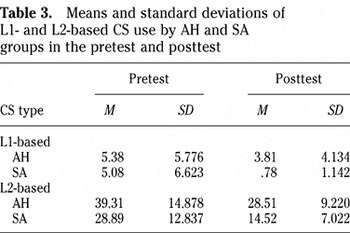
Table 3 shows that both groups decreased their mean use of L1- and L2-based strategies over time and used approximately the same mean number of L1-based CS in the pretest (diff. = 0.293). However, the SA group relied significantly less on these strategies than the AH group in the posttest, ANCOVA: F(1, 43) = 13.731, p = .001.8
DeKeyser (1991) also found more L1-based strategies in AH than in SA groups.
Means and standard deviations of L1- and L2-based CS use by AH and SA groups in the pretest and posttest

Direct and Interactional Strategies
The analysis of direct and interactional CSs indicates that the SA group used significantly fewer of both of these strategy types than the AH group in the posttest.
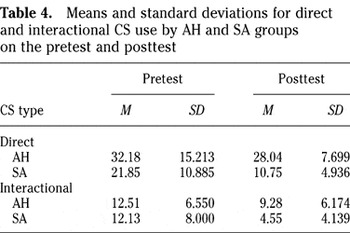
The data in Table 4 show that both groups decreased their mean use of direct and interactional CSs over time (see note 6). An ANCOVA test performed on the direct (DS) CS data shows that there is a significant difference between the mean scores of the AH and SA groups on the posttest, F(1, 43) = 30.296, p = .000. The results also show that although the use of interactional (IN) strategies was approximately the same for both groups before the treatment period (diff. = .386), an ANCOVA performed on the posttest data found a significant difference in the use of IN strategies by the two groups, diff. = 4.735, F(1, 43) = 9.906, p < .003.
Means and standard deviations for direct and interactional CS use by AH and SA groups on the pretest and posttest

Orientation of the Communication Problem
The results of the resource-deficit (RD), other-performance (OH), and own performance (SF) analyses show that the AH group used significantly more of these strategies than the SA group on the posttest.
The data in Table 5 reveal that both groups decreased their mean use of RD, OH, and SF CSs over time. The results of ANCOVA tests show that the SA group used significantly fewer RD, OH, and SF strategies in the posttest than the AH group—RD: F(1, 43) = 41.107, p = .000; OH: F(1, 43) = 7.433, p = .009; SF: F(1, 43) = 9.437, p = .004.
Means and standard deviations for RD, OH, and SF CS use by AH and SA groups on the pretest and posttest

The second research question asked what external factors—prior formal experience with Spanish, time spent using the L2 (Spanish) outside class (in general for AH and SA, and in proportion to use of English for SA only), and time spent speaking with the host family (SA group only)—correlate significantly with CS use by learners in the classroom and study abroad contexts before and after the treatment period.
The only significant correlations between any of the language use factors and CS usage by either group in the pretest or posttest is evidenced by two correlations for the SA group after the treatment period: The amount of time SA learners spent using Spanish outside the classroom, r = –.469, p = .016, and speaking with their host family, r = –.760, p = .000, on the posttest correlates negatively with their CS use.9
Although two questions from the LCP data measuring the “time spent speaking with the host family” (measured in hours per week) were included in the “time spent using Spanish” (hours per week) variable, numerous questions on the LCP were used to collect data for the “time spent using Spanish,” a factor that included a wide variety of activities (listening, reading, writing, and speaking Spanish with anyone—friends, strangers, and the host family). Therefore, it is unlikely that the significant correlation found between the “time spent using Spanish” variable and CS use unduly affected the outcome of the correlation (also significant) between CS use and “time speaking with the host family.”
DISCUSSION
The data show that both the AH and SA groups significantly reduced their reliance on CSs (overall and CS categories) from the pretest to the posttest in all the analyses carried out on overall CS use. This indicates that both contexts of learning facilitated to some degree those learners' abilities to carry out communicative interaction in the L2 with fewer communication gaps at the end of the treatment period than at the beginning of the semester.
However, the ANCOVA tests run on the posttest data for overall CSs and CS categories show a significant effect for the context of learning on the use of CSs by learners in this study. These data reveal that learners in a SA context used significantly fewer CSs than their classroom counterparts after the treatment period, when pretest scores are taken into account. To understand the effect of the learning context on the frequency of CS use in the posttest data, it is necessary to first posit what the implications are of greater or less use of CSs in this study.
CSs are conscious attempts to overcome communication gaps. The occurrence of these communication gaps (and the short time-out in the flow of communication that they create) provide opportunities for (and may have been precipitated by) learners' noticing of another kind of gap—that which exists between their level of L2 knowledge and the L2 system (L2 knowledge gap). Indeed, current SLA research (Gass, 1997; Swain & Lapkin, 1995) have pointed out the need for learners to notice this kind of (L2 knowledge) gap for the restructuring of their interlanguage systems to take place. Therefore, the use of CSs to bridge communication gaps may be seen as conscious strategic devices that learners use to confirm their own L2 knowledge and internalize new L2 structures.
We may, therefore, hypothesize that learners who use frequent CSs (a) possess sufficient L2 knowledge to produce CSs (speakers above the novice level; Liskin-Gasparro, 1996), (b) may lack the L2 resources necessary to express all their ideas, and (c) may be paying a good deal of attention to the forms being produced by both the learner and the interlocutor and concomitantly noticing more L2 knowledge gaps. On the other hand, those learners who use few CSs may (a) lack sufficient L2 knowledge to attempt bridging any noticeable communication gaps, characteristic of novice-level speakers (Liskin-Gasparro), (b) possess enough L2 resources that fewer communication gaps actually occur (which reduces the need for CSs), characteristic of more advanced learners, or (c) be so intent on getting their meaning across that they do not take the time to focus on the mismatch between the forms in their own interlanguage systems and those of the L2. The following discussion takes these possibilities into account when evaluating the results of the various data analyses carried out on the CS use by AH and SA learners in this study.
Given that most of the AH- and SA-group participants both began and ended their semester of study within the intermediate range of proficiency (see Collentine & Freed, this issue), with only the SA group significantly improving their proficiency, as measured with a scaled version of the OPI, during the treatment period (see Segalowitz & Freed, this issue), and because the research to date has shown that CS use decreases with proficiency level within the intermediate range (Liskin-Gasparro, 1996), it is hypothesized that the use of fewer CSs by the SA than the AH group in the posttest is not the result of a lack of sufficient L2 resources to create CSs (characteristic of novice speakers).
It is then necessary to consider whether fewer CSs were used by the SA group in the posttest as the result of superior learner resources (grammar and vocabulary) on their part, which would tend to lessen the number of communication gaps that occurred and the need for CSs to bridge them. Collentine's analyses (this issue) of the grammatical and lexical abilities of the learners in this study shed some light on this question.
Collentine's ANCOVA analysis of five broad categories—gender, number, person, mood, and tense—revealed that there were no significant differences in the accuracy of these forms by the two groups in the posttest, except for tense: The AH group was more accurate than the SA group.10
DeKeyser (1991, p. 105) discussed several studies that also show no significant grammatical gains in learners during a semester abroad.
Collentine proposes, however, that the SA context possibly causes growth in the learners' overall discursive abilities—relating narratives and generating more words per minute (a measure of fluency in Segalowitz & Freed, this issue)—that contain densely packed information, such as nouns and adjectives.
The analysis of scaled (normed over 1,000 words) lexical data by Collentine (this issue) shows that neither group significantly increased the “informational richness” (semantic density, measured in this study by nouns and adjectives combined) of their discourse from the pretest to the posttest.12
Biber (1988) proposed that informationally rich discourse contained the following: numerous nouns, attributive adjectives, prepositions, multisyllabic words (as measured by word length), and a high type-token ratio. An analysis of nonscaled lexical data shows that only the SA students as a whole produced more nonredundant unique informationally rich lexemes over time, but this was the result of the SA group's greater overall fluency—producing more words per segment (Segalowitz & Freed, this issue).
Given that the significantly lower use of CSs in the posttest by the SA group over the AH group does not appear to be the clear-cut result of any superiority in discrete linguistic abilities by the SA over the AH group, there may be a third explanation for the posttest results: The SA group was not as focused as the AH group on the mismatch of interlanguage and target L2 forms (L2 knowledge gaps) being produced in the dialogic interaction. The question then arises as to what would cause the SA group to be less focused on forms in comparison to the AH group after the treatment period. The answer may be found by investigating the pragmatic exigencies (formed by expectations) imposed on participants in dialogic interaction in both contexts of learning.
As learners acquire an L2 in the AH and SA contexts, they come to form “structures of expectations” (Ross, 1975), which then affect the way learners view their relationships with interlocutors in those environments. Tannen (1993, p. 15) characterized such structures as “organized knowledge about the world” (also called schema by Bartlett, 1932) that results from one's own experiences and is used “to predict interpretations and relationships regarding new information, events, and experiences” (Tannen, p. 16). It is proposed that these types of expectations about the various aspects of AH and SA settings may help explain the variance in CS use by learners in these two environments.
The first expectation concerns the role of the interlocutor in the dialogic interchanges that occur in the two environments. In the AH context, learners usually interact with L2 instructors who also understand and speak the learners' L1 (English in this case) and whose primary mission is to act as an L2 resource (e.g., for input and grammatical knowledge) and provide useful feedback to the learners on the L2 forms they produce. During these interactions, students expect the expert L2 (bilingual) speaker to provide help when they search for the proper way to express an idea and even to understand their message when it contains L1-based strategies. In turn, the instructors recognize their obligation to provide such feedback for the learner to adjust his or her interlanguage system. Because the classroom learners in this study had relatively few opportunities outside class to engage monolingual native speakers (NSs) of Spanish in conversations focused almost exclusively on meaningful interaction, their oral production of Spanish with expert L2 speakers was primarily limited to such classroom interactions with their instructors, in which a focus on form or forms accompanies a focus on meaning.
On the other hand, in the SA context, the type of L2 interaction that learners experience is quite different: Neither the native L2 instructors with whom they interact for only a few hours a day (in a classroom setting) nor the NSs of Spanish they encounter during the rest of their daily routine may have any significant command of English. Additionally, although the SA L2 instructors and some host families may feel an obligation to provide L2 assistance and feedback on the learners' production of L2 forms (Wilkinson, 2002), it is assumed that the majority of NSs the learners encounter in their daily lives in the target culture (e.g., servers in restaurants, store clerks, vendors, or other students) do not consider this to be their role. As a result, SA learners interacting with monolingual NSs soon realize that most of those interlocutors react to the message conveyed but do not focus on the forms used by the learner, unless communication completely breaks down. As a result, SA learners learn not to expect those interlocutors to confirm or reject the forms they produce and therefore do not bother to ask them for such feedback.
The differences in the expectations of interlocutor roles imposed by the two contexts may help explain the differential use of L1-based, OH, and IN strategies by the two groups of learners in this study. The ANCOVA tests revealed that the AH group used significantly more L1-based, OH, and IN strategies than the SA group in the posttest OPI with a NS bilingual interlocutor. Given that the AH learners had acquired their L2 knowledge in a learning environment characterized by their bilingual instructor's willingness to provide clarifications of his or her own messages or feedback on the forms learners produced, it is not altogether surprising that AH learners used significantly more L1-based, IN, and OH strategies than the SA group in the posttest with the bilingual OPI interviewer. Conversely, the lack of English-speaking L2 interlocutors that SA students encounter in a SA context would encourage them to adopt a default discourse strategy of relying less on L1-based strategies than their AH counterparts. The lack of expectation of help from the NS interlocutor also may also explain the SA group's relative lack of OH and IN strategies in the posttest, even during the exit OPI interview with a bilingual interviewer.
Another difference between the two contexts of learning concerns the expectations put on the learner in AH and SA settings. Regardless of the pedagogical approach taken (grammar or communication based), the expectations of most classroom contexts call for learners to attend to form and take risks—characteristics of Batstone's (2002) learning contexts—to improve their command of certain grammatical structures and vocabulary by the end of a given term, in addition to communicating their ideas effectively.
In a typical classroom context, oral production of the L2 is constantly evaluated by the instructor, not only for the effectiveness of the message it conveys but also for the preciseness of the vocabulary and the correctness of the grammatical forms it contains. This type of environment may encourage students to monitor and correct their own output and use CSs, both direct (self-contained) and interactional, to get their original meaning across in other ways or to try to understand their interlocutor if a gap in L2 knowledge exists. A focus on monitoring in this study is seen in the frequent use of SF strategies by the AH group; they preferred to use SR and AC over all other types of strategies.13
The data show that for the AH group 56.6% (253/447) of all pretest CSs and 60.8% (202/232) of all posttest CSs were those that focused on self-performance (SF). The use of these two strategies (SR and AC) by the AH group constituted 54.8% (245 /447) of all CSs used in the pretest (SR: 36% [161/447], AC: 18.8% [84/447]), and 58.2% (193/332) of the posttest strategies (SR: 38.9% [129/332], AC: 19.3% [64/332]). In turn, the combination of SR and AC strategies constituted 98.8% (245/253) of total pretest SF strategies and 95.5% (193/202) of all posttest SF strategies.
On the other hand, although SA learners also attend classes for a few hours a day during the week throughout their target culture immersion experience, for most learners the majority of the L2 production in a SA context is apt to take place with NSs (other than the instructors) in meaningful social situations in which the primary purpose of the interaction is the accomplishment of a communicative task, such as exchanging information or engaging in social or interpersonal functions, characteristics of Batstone's (2002) communicative contexts. Therefore, in the communicative context of a SA interaction with a NS of Spanish, the urgency learners feel to get their message across may cause them not to focus as much on the development of their L2 lexicon and structures as they would do in an AH context. Over time, this lack of focus on forms would then lead to less use of CSs (to adjust their L2 system and gain control over L2 forms) by the SA group than the AH group in the posttest.
Additionally, in real-world communicative interactions English-speaking learners may be sensitive to the pragmatic expectations that obtain for them in such a context—for example, those requiring that learners not intrude too heavily on the interlocutor's territory (Widdowson, 1984, p. 85) by taking risks and attempting more linguistically complex structures, which would entail holding the floor longer. For instance, Ortega (1999, p. 128) noted that one of her subjects felt inhibited about stopping to fix a mistake, so as not to inconvenience the person with whom he or she was speaking. These face-saving (Goffman, 1967) actions and deference to the interlocutor in communicative contexts also illustrate Grice's (1975) Maxim of Manner: Communication should be clear, brief, and orderly, and ambiguity and obscurity are to be avoided.
Thus, all of these contextual expectations may tend to discourage SA students from taking the time to monitor their speech and stop to focus on gaps between their own L2 knowledge and that of the L2 system, in order not to intrude on the interlocutor's time by delaying the production of the original message. It is possible that this effort to be polite and keep the conversation flowing by the SA group also helped to develop the superior fluency, as measured by speech rate, length of longest turn, and fluidity (number of words spoken on average with no dysfluent filled pauses) of this group over the AH learners (Segalowitz & Freed, this issue) and may explain the significantly fewer number of resource-deficit CSs by the SA group in the posttest.14
According to Segalowitz and Freed (this issue), a filled dysfluent pause was defined as an interruption in the speech flow by a non-Spanish filler item (e.g., ah, like, or I mean).
Even though strategies that focused on self-performance (SF: SR and AC15
The use of these two strategies (SR and AC) by the SA group constituted 48.7% (234 /480) of all CSs used in the pretest (SR: 28.5% [137/480], AC: 20.2% [97/480]) and 66.7% (182/272) of the posttest strategies (SR: 46.7% [127/272], AC: 20.2% [55/272]). In turn, the combination of SR and AC strategies constituted 93.2% (234/251) of total pretest SF strategies and 95.8% (182/190) of all posttest SF strategies.
The data show that for the SA group 52.3% (251/480) of all pretest CSs and 70% (190/272) of all posttest CSs were those that focused on SF. Lafford (1995) also found that self-repair was the preferred CS by both SA and AH groups. Because SF strategies also constitute the majority of direct and L2-based strategies, the data results for the ANOVA (pretest) and ANCOVA (posttest) analyses of SF use may have affected the results of those same tests applied to the use of CSs by the two groups in the DS and L2-based analyses. For the AH group the percentage of SF (L2) over the total L2-based CSs was 63.1% (250/396) in the pretest and 67.5% (199/295) in the posttest. The SA group's SF (L2) to Total L2-based CSs ratio was 59.9% (246/411) in the pretest and 73.6% (190/258) in the posttest.
Segalowitz and Freed (this issue) also note that what distinguishes the AH classroom and SA contexts the most is the opportunities that learners have to interact with NSs. Indeed, tests run on the relationship between pretest and posttest CS use scores by both groups and external factors, such as OPI score, time using Spanish outside the classroom (general and proportional), and time spent speaking with host family, yielded only two significant findings: There were significant negative correlations between the posttest CS use by the learners in the SA context and time spent (a) using Spanish outside the classroom and (b) talking to the host family. In other words, the more time that SA learners spent using Spanish outside the classroom and interacting on a consistent basis with the same NSs in everyday numerous communicative situations during the semester, the more likely it is that they became aware of the pragmatic exigencies of a communicative context. This awareness may have decreased the likelihood of occurrence of gaps in communication (and the CSs used to reconcile the L2 knowledge gap) in SA (vs. AH) posttest data.
Therefore, taking into account the results of the other studies in this issue (Collentine; Segalowitz & Freed), it is possible to tentatively attribute the use of fewer CSs by learners in a SA (vs. AH) context to the pragmatic constraints inherent in real-world discourse discussed previously, and perhaps to improved overall narrative and discursive abilities, proficiency, and fluency, rather than to discrete grammatical or lexical gains.
CONCLUSION
This study of the effect of the context of learning, AH classroom versus SA, has pointed out both similarities and differences between the uses of CSs by learners in these two environments. On one hand, both groups decrease their CS use over time and markedly favor the use of SRs and ACs over other CSs in both the pretest and posttest. However, this focus on one's own performance in the L2 by both groups in both tests may be due in part to the fact that the instrument used to collect the CS data both before and after the treatment period was an OPI with a NS of Spanish, and not a natural conversation between nonnative speaker (NNS)-NS or NNS-NNS dyads.
Despite these similarities, the AH and SA groups differed in their use of CSs in important ways. The data analyses show that the SA group used significantly fewer CSs (overall and all CS categories) than the AH group in the posttest. Thus, learners in the SA context were able to carry out dialogic interaction with a NS in an academic interview situation with fewer communication gaps (which need to be overcome with CSs), which may be the result of their increased narrative and discursive abilities, increased fluency, and less focus on forms than that evidenced by AH students. Moreover, it is interesting to note that the SA group was able to accomplish this without significantly sacrificing grammatical accuracy.
On the other hand, the AH group used a significantly greater number of CSs than SA students in the posttest and especially favored CSs that focused on their own production of the L2. This significantly greater focus on forms by the AH group (over the SA group) is consonant with Collentine's study (this issue), in which he found that the AH group either maintained or improved its grammatical (but not lexical) abilities during the treatment period. The interruption of the flow of speech by the use of CSs also made it difficult for AH learners to be fluent speakers (evidencing longer stretches of speech between pauses), which complements Segalowitz and Freed's (this issue) finding that the AH learners did not increase their fluency over time.
The only significant correlations with CS use and external factors were negative correlations between CS use and time using Spanish outside the classroom and time spent talking with the host family by the SA group. Thus, it can be posited that the characteristic features of a SA program (extensive amounts of L2 input and opportunities for interaction with NSs in meaningful real-world contexts) had the effect of setting up structures of expectations about interlocutor roles and appropriate pragmatic linguistic behavior in an L2 context that encouraged the SA learner to focus on meaning rather than interrupt the dialogic interaction to focus on the mismatch of L2 interlanguage and target L2 forms being produced.
One of the prime limitations of this study is the fact that the oral data on CS use was only gathered through the use of a fairly structured interview with a NS of Spanish (i.e., OPI exams), which discouraged the interviewers from assisting the learners through negotiation of meaning exchanges.17
The importance of the negotiation of meaning for L2 linguistic development has been treated extensively in SLA literature and will not be presented here (see Pica, 1994, for an overview of important works on this topic).
Although the findings of this study of CSs have shed some light on the role of context in the development of L2 abilities by AH and SA learners, it is only when these data are analyzed in conjunction with studies of other aspects of L2 development (e.g., grammatical ability, vocabulary acquisition, and fluency) that we can gain a more in-depth understanding of the effect of the context of learning on the developing interlanguage systems of L2 learners.
APPENDIX: COMMUNICATIVE STRATEGIES (BASED ON DÖRNYEI & SCOTT, 1997): EXAMPLES FROM THE CIEE PROJECT DATA
The coding of the data is as follows: an initial S indicates Spain, an initial C indicates Colorado; the second two letters represent the participant's disguised initials; the following two-digit number refers to the individual participant; for extracts taken from the pretest or posttest, the final initial and number indicate the following: A = pretest, B = posttest, 1 = the first extract, and 2 = the second extract. For extracts from the role play, the last letters are either PRE for the pretest or POST for the posttest.
Direct Strategies

Interactional Strategies

References
REFERENCES
Bartlett, F. C.
(1932).
Remembering: A study in experimental and social psychology.
New York:
Cambridge University Press.
Batstone, R.
(2002).
Contexts of engagement: A discourse perspective on
“intake” and “pushed output.”
System,
30,
1–14.Google Scholar
Bialystok, E.
(1983).
Some factors in the selection and implementation of communication
strategies. In
C. Faerch &
G. Kasper (Eds.),
Strategies in interlanguage communication (pp.
100–118).
London:
Longman.
Biber, D.
(1988).
Variation across speech and writing.
New York:
Cambridge University Press.
Brecht, R.,
Davidson, D., &
Ginsberg, R.
(1995).
Predictors of foreign language gain during study abroad. In
B. F. Freed (Ed.),
Second language acquisition in a study abroad context (pp.
37–66).
Amsterdam:
Benjamins.
Brecht, R., &
Robinson, J.
(1995).
On the value of formal instruction in study abroad: Student
reactions in context. In
B. F. Freed (Ed.),
Second language acquisition in a study abroad context (pp.
317–334).
Amsterdam:
Benjamins.
Carroll, J. B.
(1967).
Foreign language proficiency levels attained by language majors
near graduation from college.
Foreign Language Annals,
1,
131–151.Google Scholar
Corder, S. P.
(1983).
Strategies of communication. In
C. Faerch &
G. Kasper (Eds.),
Strategies in interlanguage communication (pp.
15–19).
London:
Longman.
DeKeyser, R. M.
(1986).
From learning to acquisition? Foreign language development in a
U.S. classroom and during a semester abroad.
Unpublished doctoral dissertation,
Stanford University,
CA.
DeKeyser, R. M.
(1990).
From learning to acquisition? Monitoring in the classroom and
abroad.
Hispania,
73,
238–247.Google Scholar
DeKeyser, R. M.
(1991).
Foreign language development during a semester abroad. In
B. F. Freed (Ed.),
Foreign language acquisition research and the classroom (pp.
104–119).
Lexington, MA:
D. C. Heath.
Dewey, D.
(2002).
The effects of study context and environment on the acquisition of
reading by students of Japanese as a second language during
study-abroad and intensive domestic immersion.
Unpublished doctoral dissertation,
Carnegie Mellon University,
Pittsburgh, PA.
Dörnyei, Z., &
Scott, M. L.
(1997).
Communication strategies in a second language: Definitions and
taxonomies.
Language Learning,
47,
173–210.Google Scholar
Freed, B. F.
(1995).
What makes us think that students who study abroad become fluent?
In
B. F. Freed (Ed.),
Second language acquisition in a study abroad context (pp.
123–148).
Amsterdam:
Benjamins.
Freed, B. F.
(1998).
An overview of issues and research in language learning in a study
abroad setting.
Frontiers,
4,
31–60.Google Scholar
Freed, B. F.,
Segalowitz, N., &
Dewey, D.
(2001, November).
Comparing L2 learning in study abroad, intensive immersion, regular
classroom contexts.
Paper presented at the annual meeting of the American Council on
the Teaching of Foreign Languages (ACTFL), Washington, DC.
Gass, S.
(1997).
Input, interaction, and the second language learner.
Mahwah, NJ:
Erlbaum.
Goffman, E.
(1967).
Interaction ritual: Essays on face-to-face behavior.
Garden City, NY:
Anchor Books.
Golonka, E.
(2000).
Identification of salient linguistic and metalinguistic variables
in the prediction of oral proficiency gain at the advanced level
threshold among adult learners of Russian.
Unpublished doctoral dissertation,
Bryn Mawr College,
PA.
Grice, H. P.
(1975).
Logic and conversation. In
P. Cole &
J. Morgan (Eds.),
Syntax and semantics 3: Speech acts (pp.
41–58).
San Diego, CA:
Academic Press.
Guntermann, G.
(1995).
The Peace Corps experience: Language learning in training and in
the field. In
B. F. Freed (Ed.),
Second language acquisition in a study abroad context (pp.
149–169).
Amsterdam:
Benjamins.
Hoffman-Hicks, S.
(1999).
The longitudinal development of French foreign language pragmatic
competence: Evidence from study abroad participants.
Unpublished doctoral dissertation,
Indiana University,
Bloomington.
Huebner, T.
(1995).
The effects of overseas language programs: Report on a case study
of an intensive Japanese course. In
B. F. Freed (Ed.),
Second language acquisition in a study abroad context (pp.
171–193).
Amsterdam:
Benjamins.
Huebner, T.
(1998).
Methodological considerations in data collection for language
learning in a study abroad context.
Frontiers,
4,
1–30.Google Scholar
Hymes, D.
(1974).
Foundations in sociolinguistics: An ethnographic approach.
Philadelphia:
University of Pennsylvania Press.
Johnson, M.
(2001).
The art of nonconversation: A re-examination of the validity of the
oral proficiency interview.
New Haven, CT:
Yale University Press.
LaBarca, A., &
Khanji, R.
(1986).
On communication strategies: Focus on interaction.
Studies in Second Language Acquisition,
8,
68–79.Google Scholar
Lafford, B. A.
(1995).
Getting into, through, and out of a survival situation: A
comparison of communicative strategies used by students studying
Spanish abroad and “at home.” In
B. F. Freed (Ed.),
Second language acquisition in a study abroad context (pp.
97–121).
Amsterdam:
Benjamins.
Lapkin, S.,
Hart, D., &
Swain, M.
(1995).
A Canadian interprovincial exchange: Evaluating the linguistic
impact of a three-month stay in Quebec. In
B. F. Freed (Ed.),
Second language acquisition in a study abroad context (pp.
67–94).
Amsterdam:
Benjamins.
Liskin-Gasparro, J.
(1996).
Circumlocution, communication strategies, and the ACTFL proficiency
guidelines: An analysis of student discourse.
Foreign Language Annals,
29,
317–330.Google Scholar
Marriot, H.
(1995).
Acquisition of politeness patterns by exchange students in Japan.
In
B. F. Freed (Ed.),
Second language acquisition in a study abroad context (pp.
197–224).
Amsterdam:
Benjamins.
Miller, L., &
Ginsberg, R.
(1995).
Folklinguistic theories of language learning. In
B. F. Freed (Ed.),
Second language acquisition in a study abroad context (pp.
293–316).
Amsterdam:
Benjamins.
Ortega, L.
(1999).
Planning and focus on form in L2 performance.
Studies in Second Language Acquisition,
21,
109–148.Google Scholar
Paribakht, T.
(1985).
Strategic competence and language proficiency.
Applied Linguistics,
6,
132–146.Google Scholar
Pellegrino, V. A.
(1998).
Student perspectives on language learning in a study abroad context.
Frontiers,
4,
91–120.Google Scholar
Pica, T.
(1994).
Research on negotiation: What does it reveal about second-language
learning conditions, processes, and outcomes?
Language Learning,
44,
493–527.Google Scholar
Polanyi, L.
(1995).
Language learning and living abroad: Stories from the field. In
B. F. Freed (Ed.),
Second language acquisition in a study abroad context (pp.
271–292).
Amsterdam:
Benjamins.
Poulisse, N., &
Schils, E.
(1989).
The influence of task-and proficiency-related factors on the use of
communication strategies: A quantitative analysis.
Language Learning,
39,
15–48.Google Scholar
Regan, V.
(1995).
The acquisition of sociolinguistic native speech norms: Effects of
a year abroad on second language learners of French. In
B. F. Freed (Ed.),
Second language acquisition in a study abroad context (pp.
245–267).
Amsterdam:
Benjamins.
Regan, V.
(1998).
Sociolinguistics and language learning in a study abroad context.
Frontiers,
4,
61–120.Google Scholar
Rodríguez, S.
(2001).
The perception of requests in Spanish by instructed learners of
Spanish in the second- and foreign-language contexts: A longitudinal
study of acquisition patterns.
Unpublished doctoral dissertation,
Indiana University,
Bloomington.
Ross, R.
(1975).
Ellipsis and the structure of expectation.
San Jose State Occasional Papers in Linguistics,
1,
183–191.Google Scholar
Sharwood Smith, M.
(1979).
Strategies, language transfer, and the simulation of the second
language learner's mental operations.
Language Learning,
29,
345–361.Google Scholar
Siegal, M.
(1995).
Individual differences and study abroad: Women learning Japanese
in Japan. In
B. F. Freed (Ed.),
Second language acquisition in a study abroad context (pp.
225–244).
Amsterdam:
Benjamins.
Swain, M., &
Lapkin, S.
(1995).
Problems in output and the cognitive processes they generate: A
step towards second language learning.
Applied Linguistics,
16,
371–391.Google Scholar
Tannen, D.
(1993).
Framing in discourse.
Oxford:
Oxford University Press.
Tarone, E.
(1977).
Conscious communication strategies in interlanguage: A progress
report. In
H. D. Brown,
C. A. Yorio, &
R. C. Crymes (Eds.),
On TESOL '77 (pp.
194–203).
Washington, DC:
TESOL.
Tarone, E.
(1980).
Communication strategies, foreigner talk, and repair in
interlanguage.
Language Learning,
30,
417–431.Google Scholar
Widdowson, H. G.
(1984).
Explorations in applied linguistics 2.
Oxford:
Oxford University Press.
Wilkinson, S.
(1998).
On the nature of immersion during study abroad: Some participant
perspectives.
Frontiers,
4,
121–138.Google Scholar
Wilkinson, S.
(2002).
The omnipresent classroom during summer study abroad: American
students in conversation with their French hosts.
Modern Language Journal,
86,
157–173.Google Scholar
Relative percentage of CS types used by the AH and SA groups in the pretest and posttest
Means and standard deviations of overall CS use by AH and SA groups in the pretest and posttest
Means and standard deviations of L1- and L2-based CS use by AH and SA groups in the pretest and posttest
Means and standard deviations for direct and interactional CS use by AH and SA groups on the pretest and posttest
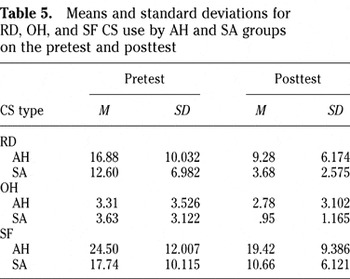
Means and standard deviations for RD, OH, and SF CS use by AH and SA groups on the pretest and posttest
 You have
Access
- 96
- Cited by