Introduction
A vocal process granuloma, first described by Chevalier Jackson in 1928, is a benign lesion of the posterior glottis that presents as an exophytic inflammatory mass, usually on the vocal process of the medial arytenoid tissue. Many aetiological factors have been proposed, including endotracheal intubation, surgical trauma, infection, vocal abuse and laryngopharyngeal reflux (LPR). Regardless of the cause, the histopathology is identical.Reference Mascarella and Young1 Treatment of vocal process granulomas is a frustrating clinical problem, as some patients do not respond to anti-reflux and voice therapies.Reference Mascarella and Young1–Reference Hamdan, Khalifee, Jaffal and Ghanem3
Surgical excision is typically reserved for patients in whom conservative strategies have failed, those with an airway obstruction, or cases in which there is evidence of an atypical presentation whereby a biopsy is required for diagnosis.Reference Hamdan, Khalifee, Jaffal and Ghanem3 However, surgical cold steel excision is associated with a high recurrence rate.Reference Rudman, McGee, Diaz and Rosow4,Reference Ylitalo and Lindestad5 Radiofrequency Coblation is a relatively new technique that is increasingly being used to treat laryngeal carcinomasReference Shuang, Li, Zhou, Huang and Zhang6 and oropharyngeal tumoursReference Hofauer, Knopf, Strassen, Wirth, Mollenhauer and Edenharter7 in the otolaryngology clinic. Although some scholars recommend potassium titanyl phosphate (KTP) ablation, which is associated with a high complete remission rate and a lower recurrence rate,Reference Mascarella and Young1,Reference Clyne, Halum, Koufman and Postma8 the KTP laser is expensive to purchase and maintain, limiting its availability.Reference Clyne, Halum, Koufman and Postma8 In comparison, radiofrequency Coblation expenses are minimised by the fact that the whole radiofrequency needle instrument can be sterilised.Reference Hoffmann, Schuler, Bankfalvi, Greve, Heusgen and Lang9
To our knowledge, however, little has been reported on the effect of radiofrequency Coblation for the removal of vocal process granulomas. Therefore, the primary aim of this study was to compare the effectiveness of radiofrequency Coblation assisted excision and cold steel excision in the treatment of idiopathic vocal process granulomas.
Materials and methods
Ethical considerations
Ethical approval for the present study was obtained from the Medical Ethical Committee of Yiwu Central Hospital. Informed consent was obtained from all participants.
Methodology
We retrospectively studied the clinical data and operative records of patients with vocal process granulomas who underwent surgical excision in the department of otolaryngology, for whom laryngoscopic images were available. The inclusion criteria were: no previous history of endotracheal intubation or vocal process granuloma surgery; the granuloma was grade II or above (based on size); the granuloma remained stable or increased in size after conservative treatment for three months; there was a requirement for prompt voice restoration or a demand for surgical excision (cold steel excision or Coblation-assisted excision) because of concerns of malignancy; the patients were followed up for six months after surgery; and vocal process granuloma was confirmed via histological examination. Patients with definite LPR, uneven vocal process height, or recurrent throat clearing (tics) or functional voice problems, were excluded from this study. Diagnosis of LPR was performed by 24-hour ambulatory double-probe pH monitoring.
The conservative treatment included oral methylprednisolone, inhaled steroids, amoxicillin and clavulanate potassium for two weeks, and twice-daily proton pump inhibitors (PPIs) for three months. In addition, all patients had worked with a speech and language pathologist once a week for three months to eliminate vocally abusive habits. Patients who failed to show any response to these therapies were offered surgical excision.
The radiofrequency device was initially introduced to perform tonsillectomy in our department in March 2011, while the Coblation-assisted technique was applied for vocal process granulomas from January 2018. The cold steel excision technique was used for the surgical excision of vocal process granulomas prior to radiofrequency Coblation.
Patients were divided into two groups according to the surgical technique utilised: cold steel excision alone or Coblation-assisted excision. The cold steel excision (control) group (n = 28) comprised patients who received cold steel excision alone between January 2013 and December 2017. The Coblation-assisted group (n = 19) consisted of patients who underwent Coblation-assisted removal between January 2018 and January 2020.
Sex, age, granuloma size, affected side, symptom duration, alcohol use history, smoking history and follow-up duration were recorded. The granuloma was graded as I–IV based on size: grade I, sessile, non-ulcerative granuloma limited to the vocal process; grade II, pedunculated or ulcerated granuloma limited to the vocal process; grade III, granuloma extending past the vocal process but not crossing the midline of the airway in a fully abducted position; and grade IV, granuloma extending past the vocal process and past the midline of the airway in a fully abducted position.Reference Farwell, Belafsky and Rees10 In the case of simultaneous bilateral granulomas, the granuloma was graded on the side of the bigger lesion. The treatment outcome was failure or remission. Remission was defined as disappearance of the original posterior glottic lesion on endoscopic viewing. Failure was defined as lesion recurrence or persistence.
The operation was performed under general anaesthesia with endotracheal intubation. An appropriately sized surgical laryngoscope was inserted into the larynx to expose the vocal process granuloma and suspended from the anterior chest wall. Video-assisted laryngoscopy was performed using a 0° rigid endoscope, connected to a high-resolution endoscopic video camera. The operative field was amplified for clarity.
In the cold steel excision (control) group, the granuloma was grasped with forceps close to its neck and drawn to the opposite side. This manoeuvre makes its base more visible. The granuloma was cut at its base, superficial to the perichondrium of the arytenoid cartilage, and totally removed.
In the Coblation-assisted group, a radiofrequency Coblation system was used; the Evac® 70 Plasma Wand was preferred. During the entire process, the Evac 70 Plasma Wand was set at an ablation power of 7 and a coagulation power of 3. Radiofrequency Coblation was used to ablate the wound and its margins, as appropriate. Careful manipulation created a smooth and flat (not rough) ablation zone. The ablation depth reached the perichondrium, but cartilage was not damaged.
No injection medialisation or injectable steroids were used at the lesion site during the operation, in either group. The excised granulomas were sent to the pathology department for histological confirmation of vocal process granuloma.
Voice assessment
The voice of all patients was assessed pre-operatively and at three months post-operatively. The assessment consisted of: videolaryngoscopy; perceptual evaluation using the grade of hoarseness, roughness, breathiness, asthenia and strain (‘GRBAS’) scale; patient self-assessment using the Voice Handicap Index; and calculation of maximum phonation time. The videostroboscopic images were evaluated in terms of glottal closure, mucosal wave and symmetry.
Follow up
Atomised inhaled budesonide suspension, oral amoxicillin and clavulanate potassium, and voice rest were prescribed for 7 days post-operatively. Patients were asked not to smoke or consume alcohol. No additional medical care (e.g. voice therapy or PPI treatment) was provided. Laryngoscopic follow up was scheduled in the out-patient clinic at two weeks, and at one, three and six months, post-operatively.
Statistical analysis
The SPSS version 14.0 statistical software was used for analysis of variance. Data are expressed as mean ± standard deviation. A p-value of less than 0.05 was considered statistically significant.
Results
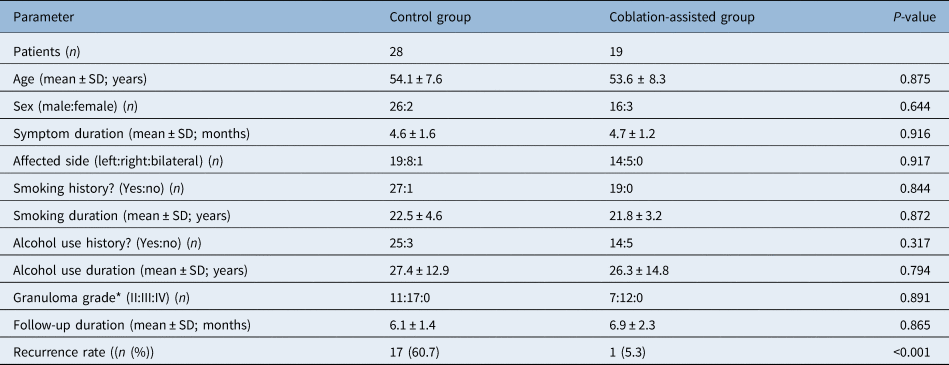
A total of 47 patients with vocal process granulomas were included in this study. Videolaryngoscopy did not show vocal fold insufficiency in any of the patients. All granulomas were histologically confirmed. All patients complained of a change in their voice and of feeling a lump in their throat. Of the 47 patients, 28 patients were in the cold steel excision (control) group and 19 were in the Coblation-assisted group. The sex, age, affected side, symptom duration, smoking history, PPI use and follow-up duration were matched in both groups (Table 1).
Demographic data and recurrence rate among the two groups

* Granuloma was graded as I–IV based on size: grade I, sessile, non-ulcerative granuloma limited to the vocal process; grade II, pedunculated or ulcerated granuloma limited to the vocal process; grade III, granuloma extending past the vocal process but not crossing the midline of the airway in a fully abducted position; and grade IV, granuloma extending past the vocal process and past the midline of the airway in a fully abducted position.Reference Farwell, Belafsky and Rees10 SD = standard deviation
No residual lesion was revealed by laryngoscopy in either group. The mean follow-up duration was 6.1 ± 1.4 months in the control group and 6.9 ± 2.3 months in the Coblation-assisted group; the difference was not significant (p = 0.865).
Recurrence and complications
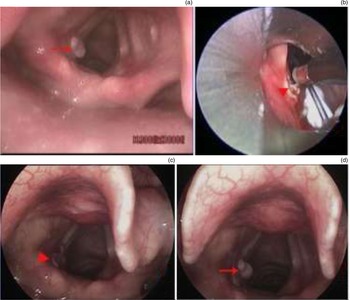
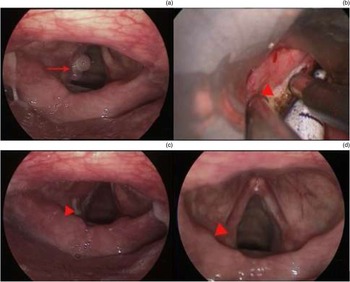
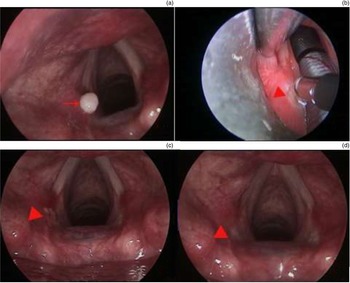
Of the 28 patients in the control group, 17 had granuloma recurrence, at two to three weeks post-operatively. Repeat cold steel excision was not considered, as the pathology report indicated that the lesions were benign, and given the high recurrence risk of surgery. Of the 19 patients in the Coblation-assisted group, 1 had granuloma recurrence, at 4 weeks post-operatively (Figure 1). The recurrence rate in the control group was significantly higher than that in the Coblation-assisted group (60.7 per cent vs 5.3 per cent respectively; p < 0.001). The complete remission rate was 39.3 per cent (11 out of 28) in the control group and 94.7 per cent (18 out of 19) in the Coblation-assisted group (Figures 2 and 3). Nevertheless, recurrent lesions disappeared in four patients (out of 17; 23.5 per cent) in the control group and in one patient (100.00 per cent) in the Coblation-assisted group during the follow-up period.
Endoscopic views of a 46-year-old man: (a) before radiofrequency Coblation; (b) during surgery; (c) 2 weeks after surgery; and (d) 4 weeks after surgery, showing recurrence of the vocal process granuloma. Red arrows indicate granuloma; arrowheads indicate ablation zone.

Endoscopic views of a 78-year-old man: (a) before radiofrequency Coblation; (b) during surgery; (c) 2 weeks after surgery; and (d) 10 months after surgery. Red arrow indicates granuloma; arrowheads indicate ablation zone.

Endoscopic views of a 29-year-old man: (a) before radiofrequency Coblation; (b) during surgery; (c) 2 weeks after surgery; and (d) 6 months after surgery. Red arrow indicates granuloma; arrowheads indicate ablation zone.

No radiofrequency ablation-related complications (i.e. vocal fold paralysis or arytenoid cartilage fixation) were noted during the six-month follow-up period.
Voice assessment
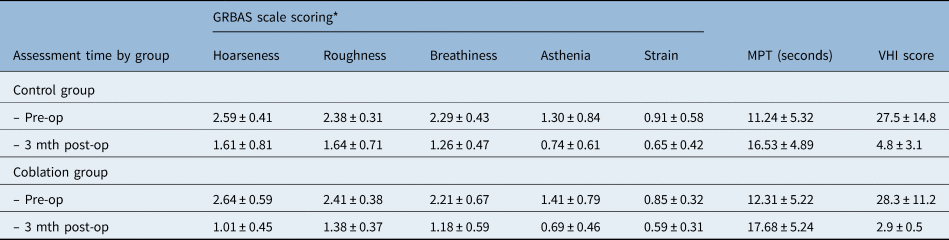
Voice function was evaluated at three months post-operatively in 28 patients in the control group and in 19 patients in the Coblation-assisted group (Table 2). The mean maximum phonation time in the control group was 11.24 ± 5.32 seconds pre-operatively and 16.53 ± 4.89 seconds post-operatively; in the Coblation-assisted group, mean maximum phonation time was 12.31 ± 5.22 seconds pre-operatively and 17.68 ± 5.24 seconds post-operatively. The mean grade of hoarseness, roughness, breathiness, asthenia and strain scores, maximum phonation time, and Voice Handicap Index scores all improved post-operatively (all p < 0.05) in both groups. However, voice recovery was significantly better in the Coblation-assisted group than in the control group (p < 0.05).
Voice assessment of the two groups

Data represent mean ± standard deviation values. *Grade of hoarseness, roughness, breathiness, asthenia and strain (‘GRBAS’) scale scoring: 0 = normal, 1 = mild degree, 2 = moderate degree and 3 = high degree. MPT = maximum phonation time; VHI = Voice Handicap Index; pre-op = pre-operation; mth = months; post-op = post-operation
In addition, in the control group, mucosal wave resolution was normal in 12 patients (42.9 per cent) and decreased in 16 patients (57.1 per cent). The regularity of the vocal fold recovered to acceptable levels in 17 patients (60.7 per cent). Glottal closure was incomplete in 9 patients (32.1 per cent) and complete in 19 patients (67.9 per cent).
In the Coblation-assisted group, vocal quality recovered one month after surgery. Stroboscopic video-recording showed that the mucosal wave was normal in 16 patients (84.2 per cent) and decreased in 4 patients (15.8 per cent). The regularity of the vocal fold recovered to acceptable levels in 18 patients (94.7 per cent). Glottal closure was complete in all patients.
Discussion
The recommended primary vocal process granuloma treatments are anti-reflux and voice therapies. However, PPIs are usually prescribed for two to four months;Reference Rudman, McGee, Diaz and Rosow4 more prolonged treatment may cause bone rarefaction.Reference Park, Lee, Yu, Jung, Han and Kim11 If these treatments fail or the patient requests additional treatment, surgical excision may be considered.Reference Mascarella and Young1–Reference Hamdan, Khalifee, Jaffal and Ghanem3 Alternatively, patients may see the mass on a video monitor and, because of fear of malignant tumours and mental stress, demand surgical excision.
Cold steel excision was previously the predominant treatment and is still used in some departments. Although it may yield complete remission rates of 8–67 per cent,Reference Hamdan, Khalifee, Jaffal and Ghanem3 the recurrence rates range from 25 per cent to 92 per cent.Reference Rudman, McGee, Diaz and Rosow4,Reference Ylitalo and Lindestad5,Reference Lee, Hong, Choi, Sun, Park and Lee12 Use of the KTP laser for vocal process granulomas has been recommended by some scholars, and lower recurrence rates have been obtained.Reference Mascarella and Young1,Reference Dominguez, Brown and Simpson2,Reference Park, Lee, Yu, Jung, Han and Kim11 Mascarella and YoungReference Mascarella and Young1 reported successful treatment of a patient with a large vocal process granuloma using the KTP laser; no recurrence developed during the six-month follow-up period. Dominguez et al.Reference Dominguez, Brown and Simpson2 performed 43 KTP laser treatments for 26 patients, and a complete remission rate of 73.1 per cent was achieved during a mean follow-up period of 9.5 months.
In recent years, granuloma treatment by radiofrequency Coblation has been reported, specifically for intubated patients with laryngeal granulomas and paediatric patients with suprastomal granulomas, and higher remission rates have been obtained.Reference Ding, Jiang and Lou13,Reference Brown, Ryan, Ramprasad, Karas and Raynor14 However, the granulomas in these studies resulted from a mechanical injury associated with the endotracheal tube.Reference Ding, Jiang and Lou13,Reference Brown, Ryan, Ramprasad, Karas and Raynor14
In this study, we used radiofrequency Coblation assisted surgical excision to treat idiopathic vocal process granulomas that did not respond to three months of PPI treatment and voice therapy. The recurrence rate in the radiofrequency Coblation assisted group was significantly lower compared with that in the cold steel excision group (5.3 per cent vs 60.7 per cent; p < 0.001). Our follow-up period (of six months) greatly exceeded the typical recurrence window of six weeks.Reference Mascarella and Young1
Although the sample size was small in both groups, the preliminarily results suggest that radiofrequency Coblation assisted excision was more effective for preventing granuloma recurrence. We speculate that, with cold steel excision, although the granuloma is removed, new mucosal trauma is formed. Bare perichondrium is difficult to epithelialise and may become infected, which is a predisposing factor for recurrence if the granuloma has not been totally eradicated, and may result in vocal process granuloma recurrence within a short time. Our study findings support this, as recurrent granuloma was observed in 17 patients at two to three weeks post-operatively in the cold steel excision group. In contrast, radiofrequency Coblation rapidly ends mucosal trauma and shortens perichondrium tissue exposure time; in addition, it triggers rapid re-epithelialisation, and promotes new collagen synthesis and deposition.Reference Swibel Rosenthal, Benninger, Stone and Zacharek15,Reference Yang, Zuo, Zhu, Zhong, Wu and Hou16
The complete remission rate in the radiofrequency Coblation assisted group in this study was comparable or superior to the results of KTP laser reported by other authors.Reference Mascarella and Young1,Reference Dominguez, Brown and Simpson2,Reference Clyne, Halum, Koufman and Postma8 Compared with the KTP laser, radiofrequency Coblation has simultaneous ablation, coagulation and suction functions within one instrument, which keep the operative field clear, enabling visible distinction of tissue layers. The lower temperature (40–60°C) of radiofrequency Coblation causes little surrounding tissue damage, minimises the inflammatory response and preserves the integrity of surrounding tissue. In contrast, the higher temperature of the KTP laser can cause severe damage to surrounding tissue and can char tissue, resulting in a foreign body reaction and granulation tissue, which is undesirable for wound healing.Reference Kass, Massaro, Komorowski and Toohill17,Reference von Glass and Hauerstein18 Coblation injury is associated with reparative changes, but no necrosis or infection.Reference Yang, Zuo, Zhu, Zhong, Wu and Hou16
• Cold steel excision had a higher recurrence rate than radiofrequency Coblation assisted excision for idiopathic vocal process granuloma
• Voice recovery of the Coblation-assisted group was significantly better than that of the cold steel excision group
• Radiofrequency Coblation is an effective, safe surgical treatment for vocal process granulomas that do not respond to conservative treatment
• Radiofrequency Coblation is an optimal method when approaching granulomas surgically
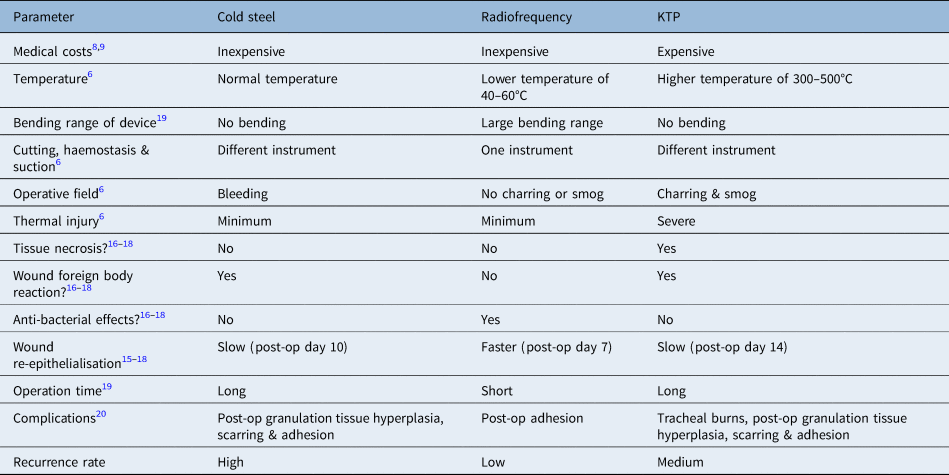
Importantly, radiofrequency Coblation is associated with more rapid epithelial healing compared with the KTP laser. Re-epithelialisation is crucial to prevent recurrence. Sinha and GallagherReference Sinha and Gallagher19 found that radiofrequency Coblation afforded faster complete wound re-epithelialisation of oral mucosa compared with the KTP laser. Brown et al.Reference Brown, Ryan, Ramprasad, Karas and Raynor14 reported two paediatric cases of recurrent suprastomal granuloma following removal with a carbon dioxide laser 12 months previously; these were removed with radiofrequency Coblation and the children showed no granuloma recurrence after 1 year of follow up. Another advantage of radiofrequency Coblation is that the plasma knife of radiofrequency ablation can bend in a larger range, allowing better angle adjustment during the operation, thereby aiding complete removal of the vocal process granuloma.Reference Hu, Cheng, Liu, Ming, Tian and Ma20 Thus, from a certain perspective, radiofrequency Coblation is more advantageous for treating vocal process granulomas compared with the KTP laser. Comparison of the pros and cons of cold steel, radiofrequency Coblation and KTP laser are shown in Table 3.
Comparing the pros and cons of cold steel, radiofrequency and KTP

KTP = potassium titanyl phosphate; post-op = post-operative
Operative images from the one patient who had recurrence in the Coblation-assisted group were re-reviewed. It was felt that the abnormal tissue may not have been ablated deeply enough – the operative bed remained rough, indicating possible persistence of granulation tissue, rather than becoming smooth. This may explain the recurrence. While further study is necessary, we encourage ablation to the depth of the perichondrium, with the goal of achieving a smooth operative field following treatment.
Our preliminary report suggests that radiofrequency Coblation is promising for the treatment of vocal process granulomas that do not respond to conservative treatment. Nevertheless, cold steel excision may serve as a precursor surgery when performing vocal process granuloma biopsy.
No radiofrequency Coblation related complications (i.e. vocal fold paralysis or arytenoid cartilage fixation) were observed during the six-month follow-up period. In addition, although voice function improved post-operatively in both groups, the voice recovery of the Coblation-assisted group was significantly better than that of the control group; vocal quality recovered one month after surgery in the Coblation-assisted group.
The limitations of this study include the retrospective study of a small sample rather than a prospective controlled study, and the absence of later post-operative voice assessment. A prospective controlled study should be considered in the future.
Conclusion
Radiofrequency Coblation is an effective and safe treatment option for the surgical management of vocal process granulomas that do not respond to conservative treatment. Radiofrequency Coblation should be considered the optimal method when approaching granulomas surgically.
Acknowledgement
This study was supported by the Technology Agency of Yiwu City, China (grant number: 2021-3-55).
Competing interests
None declared