





Highlights
-
• This is the first study on classifier congruency effects in Mandarin Chinese NP production by early Spanish–Chinese bilinguals and Mandarin Chinese speakers.
-
• It combines behavioral and EEG measures using a PWI paradigm.
-
• Both groups of participants showed longer naming latencies in classifier-incongruent and semantically related conditions.
-
• ERP results revealed N400-like effects for classifier incongruency in both groups; bilinguals showed N400-like negativity while Mandarin Chinese speakers exhibited P600-like positivity for semantic interference.
-
• Our results suggested that classifiers are activated and competitively selected in Mandarin Chinese NP production, reflecting robust classifier congruency effects in both groups.
1. Introduction
When producing a noun phrase (NP), speakers seem unaware of the multiple processing operations involved. According to the influential Levelt, Roelofs and Meyer (LRM) speech production model (Levelt et al., Reference Levelt, Roelofs and Meyer1999), speech production is a complex, multistaged process. First, a to-be-produced word is conceived or mentally visualized at the conceptualization stage; second, the concept is lexicalized, i.e., the grammatical properties (e.g., grammatical gender, classifiers, number, etc.), phonological and phonetic form of the word are activated and encoded at the formulation stage; finally, the to-be-produced word is articulated at the articulation stage.
Previous research has primarily examined this production process in determiner-NP constructions (e.g., Spanish: el gato [theMASC catMASC], ‘the cat’ in Wu & Schiller, Reference Wu and Schiller2023; also see Bürki et al., Reference Bürki, Sadat, Dubarry and Alario2016; Sá-Leite et al., Reference Sá-Leite, Luna, Tomaz, Fraga and Comesaña2022; Schiller & Caramazza, Reference Schiller and Caramazza2003; Schriefers & Teruel, Reference Schriefers and Teruel2000; Wang et al., Reference Wang, Witteman and Schiller2025; for reviews see Schiller & Sá-Leite, Reference Schiller, Sá-Leite, Schiller and Kupisch2026; Schiller & Alemán Bañón, Reference Schiller, Alemán Bañón, Schiller and Kupisch2026; Wang & Schiller, Reference Wang and Schiller2019) and has recently extended to classifier-NP constructions (e.g., Chinese: 一只猫 [one + classifier-zhi1 + cat], ‘a cat’, see Huang & Schiller, Reference Huang and Schiller2021; Wang et al., Reference Wang, Guo, Bi and Shu2006; Wang et al., Reference Wang, Witteman and Schiller2025; Wang & Schiller, Reference Wang and Schiller2025; for reviews see Qian, Reference Qian, Schiller and Kupisch2026; Wang & Schiller, Reference Wang, Schiller, Schiller and Kupisch2026), largely in monolingual speakers. In contrast, research on NP production in bilingual speakers is comparatively limited, with classifier-NP constructions remaining particularly understudied. In other words, the mechanisms underlying classifier-NP production in bilingual speakers remain less well understood.
For a bilingual speaker to successfully produce an NP, it is crucial that co-activation and lexical selection are resolved prior to articulation (Costa et al., Reference Costa, Miozzo and Caramazza1999; Costa & Santesteban, Reference Costa and Santesteban2004). From a psycholinguistic perspective, most models of bilingual lexical access suggest that bilingual production may involve a more complex, multistaged process than monolinguals, containing a general three-stage process, regardless of whether the lexical selection mechanism is assumed to be language-specific or nonspecific (e.g., Costa et al., Reference Costa, Miozzo and Caramazza1999; De Bot, Reference De Bot1992; De Bot & Schreuder, Reference De Bot and Schreuder1993; Dijkstra & Van Heuven, Reference Dijkstra, Van Heuven, Grainger and Jacobs1998; Green, Reference Green1986; Roelofs, Reference Roelofs1998; see review in Schiller & Alario, Reference Schiller, Alario, Santesteban, Duñabeitia and Baus2023). First, to-be-produced lexical entries from both the target and nontarget languages are activated in parallel. Second, a lexicon-external mechanism or production rule determines the intended language. Third, lexical entries in the target language receive the highest activation and are ultimately selected for production, while those in the nontarget language are suppressed.
A central assumption across these accounts is that bilinguals’ both lexicons are activated in parallel via a shared semantic system (e.g., Colomé, Reference Colomé2001; Costa et al., Reference Costa, Miozzo and Caramazza1999; Costa & Santesteban, Reference Costa and Santesteban2004; De Bot, Reference De Bot1992; De Bot & Schreuder, Reference De Bot and Schreuder1993; Dijkstra & Van Heuven, Reference Dijkstra, Van Heuven, Grainger and Jacobs1998; Green, Reference Green1986; Roelofs, Reference Roelofs1998). This parallel activation has been examined in bilingual word production using the Stroop paradigm (Stroop, Reference Stroop1935), where participants name ink colors while ignoring written words that denote different colors, and the picture-word interference (PWI) paradigm (Rosinski et al., Reference Rosinski, Golinkoff and Kukish1975), where participants name a picture while ignoring distractor words presented. Crucially, interference occurs irrespective of whether distractor words are in the target or nontarget language (e.g., Costa et al., Reference Costa, Miozzo and Caramazza1999; Ehri & Ryan, Reference Ehri and Ryan1980; Mägiste, Reference Mägiste1984; Smith & Kirsner, Reference Smith and Kirsner1982).
For example, Costa et al. (Reference Costa, Miozzo and Caramazza1999) observed semantic interference (i.e., longer naming latencies) for semantically related compared to unrelated distractors in Catalan–Spanish bilinguals, regardless of whether the distractor was in the same or a different language from the target. This interference effect may reflect a competitive process among lexical items during lexical selection (e.g., Costa et al., Reference Costa, Miozzo and Caramazza1999; Roelofs, Reference Roelofs1998; Starreveld & La Heij, Reference Starreveld and La Heij1995). In related conditions, the lexical representation of the distractor (e.g., chair) receives activation both directly from the written word and indirectly from the target picture (e.g., table) via semantic spreading activation, thereby becoming a strong lexical competitor. In contrast, in unrelated conditions, the lexical representation of the distractor (e.g., cat) is activated only by the written word and not by the target picture, resulting in a lower activation level and weaker competition during lexical selection (e.g., Levelt et al., Reference Levelt, Roelofs and Meyer1999; Starreveld & La Heij, Reference Starreveld and La Heij1995).
Building on the co-activation assumption of bilingual lexical access theories, bilingual word production is estimated to involve additional competition during lexical selection, thereby increasing processing complexity. Accordingly, word production may impose greater processing demands on bilinguals than on monolinguals (Pivneva et al., Reference Pivneva, Palmer and Titone2012; Runnqvist et al., Reference Runnqvist, Strijkers, Sadat and Costa2011). Consistent with this view, previous picture-naming studies have reported longer and more variable naming latencies in bilinguals than monolinguals (Gollan et al., Reference Gollan, Montoya, Fennema-Notestine and Morris2005; Hanulová et al., Reference Hanulová, Davidson and Indefrey2011; Ivanova & Costa, Reference Ivanova and Costa2008; Kroll et al., Reference Kroll, Bobb and Wodniecka2006). For instance, Ivanova and Costa (Reference Ivanova and Costa2008) examined Spanish monolinguals, Spanish–Catalan bilinguals (L1 Spanish) and Catalan–Spanish bilinguals (L1 Catalan). Monolinguals showed faster naming latencies than bilinguals, regardless of whether bilinguals responded in their first or weaker second language. However, these findings may not generalize to other bilingual populations, such as Spanish–Chinese bilinguals, or to more complex constructions like Chinese classifier-NPs. It therefore remains an open question whether similar prolonged naming latencies occur in Spanish–Chinese bilinguals producing Chinese classifier-NPs.
Previous research on classifier-NP production suggests that classifiers function similarly to grammatical gender, stored alongside lemmas in the mental lexicon and automatically activated during lemma retrieval (also see Huang & Schiller, Reference Huang and Schiller2021; Wang et al., Reference Wang, Witteman and Schiller2025; Wang & Schiller, Reference Wang and Schiller2025). Analogous to the mechanisms underlying grammatical gender processing (see Schiller & Sá-Leite, Reference Schiller, Sá-Leite, Schiller and Kupisch2026; Schiller & Alemán Bañón, Reference Schiller, Alemán Bañón, Schiller and Kupisch2026; Sá-Leite et al., Reference Sá-Leite, Luna, Tomaz, Fraga and Comesaña2022; Wang & Schiller, Reference Wang and Schiller2019), classifiers as lexico-syntactic features are assumed to be automatically activated during lemma retrieval and competitively selected for NP production. However, most evidence comes from monolingual speakers, and research on classifier processing in bilingual production remains scarce. This is particularly relevant for Spanish–Chinese bilinguals, who acquire Chinese primarily through family input and weekend schooling rather than sustained formal education in monolingual contexts. Although bilinguals possess knowledge of classifiers, it remains unclear whether their classifier proficiency and degree of automatized access to classifier representations during NP production are comparable to those of Mandarin Chinese speakers,Footnote 1 who typically acquire classifier-noun mappings by toddlerhood (Erbaugh, Reference Erbaugh and Craig1986). This raises a critical question: during classifier-NP production, do bilingual speakers engage in processing mechanisms comparable to those of Mandarin Chinese speakers? The present study addresses this question.
Electroencephalography (EEG) and event-related potentials (ERPs) are widely used to examine the neural correlates and time course of language production (e.g., Aristei et al., Reference Aristei, Melinger and Rahman2011; Bürki & Laganaro, Reference Bürki and Laganaro2014; Costa et al., Reference Costa, Strijkers, Martin and Thierry2009). Recent studies have employed EEG to examine time courses of NP production in monolingual speakers (e.g., Bürki & Laganaro, Reference Bürki and Laganaro2014; Lange et al., Reference Lange, Perret and Laganaro2015). For instance, Bürki and Laganaro (Reference Bürki and Laganaro2014) found that producing multiword NPs in French (i.e., le chat , ‘the cat’; le grand chat , ‘the big cat’) elicited stable EEG patterns between 190–300 ms and after 530 ms, lasting longer than for bare noun (chat , ‘cat’). They interpreted that this could reflect the longer retrieval of additional grammatical information (i.e., gender) or the generation of syntactic structure required for NP production. Building on this framework, the present study employs EEG to examine the temporal dynamics of classifier-NP production in Mandarin Chinese speakers and Spanish–Chinese bilinguals. This approach allows us to assess whether classifier processing engages comparable neural mechanisms across groups.
To lay the groundwork for classifiers-NP production in bilinguals, we first provide the fundamental background on classifiers, followed by a discussion of classifier-related effects and their corresponding electrophysiological correlates in language production.
1.1. The classifier feature and NPs in Chinese
Almost all languages incorporate some form of nominal classification in their grammar, with grammatical gender systems (e.g., in Spanish) and numeral classification systems (e.g., in Chinese) being the most common (Fedden & Corbett, Reference Fedden, Corbett, Schiller and Kupisch2026; Seifart, Reference Seifart2010). In Spanish, nouns inherently possess an identifiable grammatical gender, classified as either masculine or feminine (Harris, Reference Harris1991; Roca, Reference Roca1989). Determiners and adjectives within Spanish NPs, while not inherently gendered themselves, must obligatorily agree in gender with nouns they modify (Harris, Reference Harris1991). Thus, the grammatical gender choice within NPs primarily depends on the properties of nouns. Likewise, Chinese does not feature a grammatical gender classification system but instead employs a classifier system that is in some way comparable to gender division (Bisang, Reference Bisang, Schiller and Kupisch2026; Fedden & Corbett, Reference Fedden, Corbett, Schiller and Kupisch2026; Wang et al., Reference Wang, Chen and Schiller2019; Wang & Schiller, Reference Wang, Schiller, Schiller and Kupisch2026). Classifiers, as free morphemes, classify the category of nouns they accompany, with their selection determined by particular properties of nouns (Li & Thompson, Reference Li and Thompson1981). In Chinese NPs, determiners, numerals or quantifiers cannot directly modify nouns. Instead, a numeral classifier is obligatorily inserted as a mediating element (Li, Reference Li2013). Thus, a typical Chinese NP consists of demonstrative/numeral/quantifier + classifier + noun (e.g., 一只老虎 /yi1zhi1lao3hu3/Footnote 2 [one classifier-zhi1 tiger], ‘one tiger’) (Li & Thompson, Reference Li and Thompson1981). In general, classifiers function similarly to grammatical gender in nominal systems, as they represent inherent properties of nouns and cannot be omitted in NPs.
In Chinese, there are several dozen classifiers with approximately 150 commonly used (Erbaugh, Reference Erbaugh and Craig1986). According to Erbaugh (Reference Erbaugh, Bates, Tan, Tzeng and Li2006), these classifiers can be generally divided into five categories based on their lexical type and function: (1) measure classifiers, measuring weight or length (e.g., 公里 /gong1li3/ ‘kilometer’, 两 /liang3/ ‘ounce’); (2) kind classifiers that describe categories or types of entities (e.g., 种 /zhong3/ ‘type’, 类 /lei4/ ‘kind, category’); (3) collective classifiers, indicating arrangements of entities (e.g., 排 /pai2/ ‘row of’ or 捆 /kun3/ ‘bundle’); (4) event classifiers, used for events (e.g., 班 /ban1/ ‘run of a bus or train’, 场 /chang3/ ‘performance of a show’); (5) sortal classifiers, used for particular categories based on properties of entities (e.g., 棵 /ke1/ ‘classifier for plants’, 块 /kuai4/ ‘chunk or square’).
Mandarin Chinese has approximately 75 sortal classifiers, each typically used with 5 to 20 nouns (Erbaugh, Reference Erbaugh2002). Typically, classifier selection is determined by properties of nouns, such as animacy, shape, function and size (Myers & Tsay, Reference Myers and Tsay2000). It should be noted that the relationship between nouns and classifiers is, in many cases, opaque, with the noun itself exerting a dominant influence on classifier choice, although classifier choices in NPs depend to a great extent on semantic properties (Shao, Reference Shao1993; Tzeng et al., Reference Tzeng, Chen and Hung1991). Additionally, there is a special so-called ‘general’ or ‘default’ classifier ge (个 /ge4/), which is the most frequently used classifier (Li & Thompson, Reference Li and Thompson1981), with approximately 40% of Chinese nouns only taking this classifier, such as unique objects (e.g., ‘the sun’) and abstractions (e.g., ‘dream’, ‘idea’) (Erbaugh, Reference Erbaugh, Bates, Tan, Tzeng and Li2006). Furthermore, sortal classifiers are used more frequently than other classifier categories, particularly with countable nouns (Erbaugh, Reference Erbaugh, Bates, Tan, Tzeng and Li2006). Therefore, both general classifiers and sortal classifiers were considered as the primary target classifiers in this study.
1.2 The effects of processing lexico-syntactic features in language production
1.2.1. The gender congruency effect
Experimental research on speech production has mostly investigated lexico-syntactic features, such as grammatical gender and classifiers, using the PWI paradigm (Glaser, Reference Glaser1992; Schriefers, Reference Schriefers1993). In this paradigm, it has been found that the relationship between distractor words and target pictures significantly affects picture-naming latencies. For example, Schriefers (Reference Schriefers1993) initially used the PWI paradigm to investigate the selection of grammatical gender in NP production in Dutch (a language that features common and neuter gender). Faster naming latencies were obtained when the grammatical gender of the target (boekneuter, ‘book’) was congruent with the distractor word (dakneuter, ‘roof’) compared to the incongruent one (tafelcommon, ‘table’). These faster naming latencies in gender-congruent than gender-incongruent conditions were continuously observed in Germanic languages (e.g., German in Bürki et al., Reference Bürki, Sadat, Dubarry and Alario2016; Schiller & Caramazza, Reference Schiller and Caramazza2003 and Schriefers & Teruel, Reference Schriefers and Teruel2000; Dutch in Schiller, Reference Schiller and Corbett2013 and Schiller & Caramazza, Reference Schiller and Caramazza2006) and Romance languages (e.g., Portuguese in Sá-Leite et al., Reference Sá-Leite, Haro, Comesaña and Fraga2021; Spanish in Wu & Schiller, Reference Wu and Schiller2023), as well as other gendered languages (see Sá-Leite et al., Reference Sá-Leite, Luna, Tomaz, Fraga and Comesaña2022 Schiller & Sá-Leite, Reference Schiller, Sá-Leite, Schiller and Kupisch2026; Schiller & Alemán Bañón, Reference Schiller, Alemán Bañón, Schiller and Kupisch2026 and Wang & Schiller, Reference Wang and Schiller2019 for an overview). Overall, this faster and more accurate processing in gender-congruent conditions is known as the gender congruency effect. This effect was interpreted as arising from competition between the grammatical gender features of targets and distractors during NP production, whereby the grammatical gender information of both is assumed to be automatically activated during lemma retrieval (see Wang & Schiller, Reference Wang and Schiller2019 for an overview; but see Schiller & Caramazza, Reference Schiller and Caramazza2003 for an alternative interpretation in terms of determiner selection interference). In addition to research on monolingual speakers, this line of investigation has been extended to bilingual populations and suggested that bilingual speakers can also exhibit effects comparable to the gender congruency effect observed in monolinguals during bare noun or NP production, suggesting automatic activation of grammatical gender features of the noun they produce (see Wang et al., Reference Wang, Witteman and Schiller2026; Sá-Leite et al., Reference Sá-Leite, Fraga and Comesaña2019; also see Sá-Leite et al., Reference Sá-Leite, Luna, Fraga and Comesaña2020 for a meta-analysis).
1.2.2. The classifier congruency effect
More recently, classifiers, as another type of lexico-syntactic feature, have gained increasing attention. Building on research on grammatical gender, several studies have employed the PWI paradigm to examine whether classifiers are activated during Mandarin Chinese NP production in a manner analogous to grammatical gender (e.g., Huang & Schiller, Reference Huang and Schiller2021; Wang et al., Reference Wang, Guo, Bi and Shu2006; Wang et al., Reference Wang, Chen and Schiller2019). For example, Wang et al. (Reference Wang, Guo, Bi and Shu2006) examined the selection of classifiers in Chinese bare nouns and NP production using the PWI paradigm with Chinese monolingual speakers. Shorter naming latencies were observed when the classifier of target pictures was congruent with distractor words in NP production, but not in bare noun production. A similar effect in naming latencies was also observed in Chinese NP productions by Huang and Schiller (Reference Huang and Schiller2021), where the classifier congruency (congruent versus incongruent) and semantic relatedness (related versus unrelated) between target pictures and distractor words were manipulated. Monolingual Chinese speakers named pictures while ignoring distractor words, with their naming latencies and EEG activity being recorded simultaneously. Behavioral results showed that classifier-congruent distractors elicited faster naming latencies, while semantically related distractors increased naming latencies. EEG results showed significant N400 effects modulated by classifier incongruency and semantically unrelatedness. This finding aligns with Wang et al. (Reference Wang, Chen and Schiller2019) who observed comparable N400 effects in Chinese bare noun production using similar experimental designs. They interpreted this effect as evidence that classifier information is automatically activated during lemma access. Given the similar inherent properties, processing mechanisms and effects in naming latencies between grammatical gender and classifier features, researchers suggested the observed effects in Chinese bare noun and NP production as the classifier congruency effect.
1.3. The semantic interference effect
A well-established effect using the PWI paradigm is the semantic interference effect. Greater interference occurs when distractor words are semantically related to target pictures (e.g., PIG, lion), compared to unrelated distractors (e.g., PIG, cup) or nonsense trigrams (Rosinski, Reference Rosinski1977). This results in longer naming latencies in semantically related than unrelated conditions. According to the lexical selection by competition theory (Levelt et al., Reference Levelt, Roelofs and Meyer1999; Roelofs, Reference Roelofs1992, Reference Roelofs1993), when the target picture (e.g., pig) and the distractor (e.g., lion) are semantically related, the corresponding lemmas activate each other through the spreading of activation to representations in the lexical network. This semantically related distractor (unlike unrelated distractors) receives activation from the semantic category node activated by the target. This results in more competition during the lexical selection process and delays the selection of the target lexical node, producing longer naming latencies. In the unrelated condition, the target and the distractor are not activating each other, resulting in relatively less competition and faster naming latencies.
1.4. Electrophysiological correlates of classifier congruency and semantic interference effect
In previous studies, two ERP components seem to have been especially in focus, i.e., the N400 and the P600. The N400 is an ERP component characterized by a negative voltage amplitude peak around 400 ms post-stimulus onset, typically within the 250 ms and 600 ms time window over central and posterior electrode sites (Chwilla et al., Reference Chwilla, Brown and Hagoort1995; Kutas & Hillyard, Reference Kutas and Hillyard1980). It is typically associated with lexical-semantic integration and lexical co-activation processes (Chen et al., Reference Chen, Bobb, Hoshino and Marian2017; Kutas & Federmeier, Reference Kutas and Federmeier2011; Lau et al., Reference Lau, Phillips and Poeppel2008; Leckey & Federmeier, Reference Leckey, Federmeier, de Zubicaray and Schiller2019). Previous studies on the gender congruency effect and the classifier congruency effect have frequently reported modulations of the N400 (see an overview of gender congruency effects in Sá-Leite et al., Reference Sá-Leite, Luna, Tomaz, Fraga and Comesaña2022 and Wang & Schiller, Reference Wang and Schiller2019; classifier congruency effects in Huang & Schiller, Reference Huang and Schiller2021 and Wang et al., Reference Wang, Chen and Schiller2019). Specifically, more negative N400 amplitudes were mostly reported as elicited by gender- or classifier-incongruent trials compared to gender- or classifier-congruent trials. Additionally, the N400 was reported for picture-naming tasks in semantically unrelated conditions relative to related conditions, reflecting semantic integration processes (Blackford et al., Reference Blackford, Holcomb, Grainger and Kuperberg2012; Greenham et al., Reference Greenham, Stelmack and Campbell2000; Wang et al., Reference Wang, Chen and Schiller2019). It was concluded that the N400 effect is elicited by competition at the lemma level, triggered by strong activation at the conceptual level (Wang et al., Reference Wang, Chen and Schiller2019). In this study, we used the N400 to detect the co-activation of the classifier congruency effect and the lexico-semantic integration of the semantic interference effect. Crucially, previous research suggested that bilingual speakers may display a delayed N400 onset relative to monolingual speakers (Midgley et al., Reference Midgley, Holcomb and Grainger2009). Therefore, with respect to our group of Spanish–Chinese bilinguals, the N400 is likely to be delayed compared to Mandarin Chinese speakers in this study and that in Huang and Schiller (Reference Huang and Schiller2021).
The P600 is an ERP component defined by a positive-going deflection primarily localized in the centro–parietal regions, typically occurring between 500 and 800 ms post-stimulus onset and peaking around 600 ms (Osterhout & Holcomb, Reference Osterhout and Holcomb1992). Typically, the P600 is sensitive to syntactic violations in syntactic processing (Friederici et al., Reference Friederici, Pfeifer and Hahne1993; Hagoort et al., Reference Hagoort, Brown and Groothusen1993). However, the P600 was challenged in the view of an exclusively syntactic violation response, rather, Kim and Osterhout (Reference Kim and Osterhout2005) proposed a ‘semantic P600’ effect which typically distributed in the centro–parietal regions with a maximal difference occurring within 600–800 ms (see Bornkessel-Schlesewsky & Schlesewsky, Reference Bornkessel-Schlesewsky and Schlesewsky2008; Kuperberg et al., Reference Kuperberg, Sitnikova, Caplan and Holcomb2003; Van Herten et al., Reference Van Herten, Kolk and Chwilla2005 for review). This perspective redefines the P600 as an electrophysiological response to ‘integration difficulties’, reflecting the cognitive effort required to semantically, rather than syntactically, integrate an entity into the discourse context. Delogu et al. (Reference Delogu, Brouwer and Crocker2019) provided support for this account by reporting a P600-like effect when words, although semantically related to the context, were difficult to integrate into the syntactically correct discourses (i.e., implausible events).
Beyond language comprehension, similar effects have also been observed in language production. Wang and Schiller (Reference Wang and Schiller2026) reported a ‘semantic P600’ in Dutch speakers in picture-naming tasks, with semantically unrelated conditions eliciting enhanced P600 amplitudes. They interpreted this effect as a ‘semantic P600’, reflecting the processing of conflicting semantic information during lexical retrieval in Dutch production, although they suggested more explorations are needed. Taken together, the evidence from both comprehension and production studies suggests that the P600 is not exclusively associated with syntactic processing, but may also reflect difficulties in semantic integration or the resolution of conflicting semantic information. Building on this view, this study also considers the P600 as a potential neural correlate of semantic interference during classifier-NP production.
1.5. The current study
This study explores the processing of classifiers in Chinese NPs from behavioral and neural perspectives, focusing on Mandarin Chinese speakers and early Spanish–Chinese bilingual speakers in Spain. In this study, we manipulate classifier congruency (classifier-congruent versus classifier-incongruent) and semantic relatedness (semantically related versus semantically unrelated) between target objects and distractors. The main objective of this study is to examine the processing mechanisms underlying classifier-NP production in bilingual speakers and to determine whether classifier features are automatically activated and competitively selected during Chinese NP production in bilinguals, in a manner comparable to Mandarin Chinese speakers. Specifically, we aim to determine whether this activation is evident in specific ERP components (e.g., N400) and whether competitive selections influence naming latencies, thereby resulting in a classifier congruency effect in both behavioral and neural measures. This leads to our primary research question: Is there a classifier congruency effect in Chinese NP production by early Spanish–Chinese bilinguals?
1.5.1. Hypotheses
Behavioral hypotheses. We expect to observe both classifier congruency effects and semantic interference effects in Mandarin Chinese speakers and Spanish–Chinese bilinguals. According to previous studies on classifier-NP production (e.g., Huang & Schiller, Reference Huang and Schiller2021; Wang et al., Reference Wang, Guo, Bi and Shu2006; Wang et al., Reference Wang, Chen and Schiller2019), the associated classifier nodes are assumed to be automatically activated when the target and distractor are processed. In classifier-incongruent conditions, the activated classifiers for targets and distractors are assumed to be incongruent. This co-activation would lead to competition for selection and result in longer naming latencies. Accordingly, we predict longer naming latencies for classifier-incongruent than classifier-congruent conditions. Similarly, when naming a picture, conceptual nodes from the same semantic category as the target are co-activated. When the target picture is semantically related to distractors, the distractor is assumed to be one of these activated lexical candidates, which would compete with the target’s lemma for selection and thereby lead to longer naming latencies. Accordingly, we expect longer naming latencies for semantically related than unrelated conditions.
A meta-analysis study on bilingual language production has identified a robust gender congruency effect among bilingual speakers (see Sá-Leite et al., Reference Sá-Leite, Luna, Fraga and Comesaña2020). Given that previous studies have suggested comparable processing mechanisms underlying classifier- and grammatical gender-NP production (e.g., Huang & Schiller, Reference Huang and Schiller2021; Wang et al., Reference Wang, Guo, Bi and Shu2006; Wang et al., Reference Wang, Witteman and Schiller2025; Wang & Schiller, Reference Wang and Schiller2025), we predict the emergence of classifier congruency effects in Spanish–Chinese bilinguals. That is, if classifiers are processed in a manner similar to grammatical gender, a comparable classifier congruency effect should arise during bilingual classifier-NP production. Previous picture-naming studies have consistently observed longer naming latencies in bilinguals than monolinguals (Gollan et al., Reference Gollan, Montoya, Fennema-Notestine and Morris2005; Hanulová et al., Reference Hanulová, Davidson and Indefrey2011; Ivanova & Costa, Reference Ivanova and Costa2008; Kroll et al., Reference Kroll, Bobb and Wodniecka2006), reflecting cross-linguistic co-activation and lemma-level interactions of both languages in bilingual production (e.g., Comesaña et al., Reference Comesaña, Bertin, Oliveira, Soares, Hernández-Cabrera and Casalis2018; Costa & Caramazza, Reference Costa and Caramazza1999). Accordingly, we expect Spanish–Chinese bilinguals to show overall longer naming latencies than Mandarin speakers across both classifier and semantic conditions.
EEG hypotheses. Previous studies have consistently reported that the classifier congruency effect occurs within the N400 time window, with classifier-incongruent conditions eliciting more negative amplitudes than congruent conditions (e.g., Huang & Schiller, Reference Huang and Schiller2021; Wang et al., Reference Wang, Chen and Schiller2019; Wang et al., Reference Wang, Witteman and Schiller2025; Wang & Schiller, Reference Wang and Schiller2025). According to Levelt’s production model (Levelt et al., Reference Levelt, Roelofs and Meyer1999), lemma retrieval and selection are estimated to occur around 200 ms and 270–290 ms post-stimulus onset (Indefrey & Levelt, Reference Indefrey and Levelt2004). Based on this temporal framework, Wang et al. (Reference Wang, Chen and Schiller2019) postulated that classifier activation should not arise earlier than 300 ms post-stimulus onset. This prediction was supported by their finding that classifier incongruency elicited an N400 effect emerging around 350 ms post-stimulus onset in the PWI paradigm. They also observed more negative N400 amplitudes for semantically unrelated than related conditions. Accordingly, we expect N400 effects in both groups under classifier-incongruent and semantically unrelated conditions.
In line with the expectation for naming latencies, we predict a slightly delayed N400 effect in Spanish–Chinese bilinguals compared to Mandarin Chinese speakers. However, considering prior research on grammatical gender in Dutch observed a ‘semantic P600’ effect in picture-naming tasks and interpreted as reflecting ‘semantic integration difficulties’ (Wang & Schiller, Reference Wang and Schiller2026), it is plausible that semantically unrelated conditions may also elicit a ‘semantic P600’ effect, reflecting increased integration challenges when target pictures are semantically unrelated to distractors.
2. Methods
2.1. Participants
This study involved two groups of participants from Pompeu Fabra University in Barcelona: 30 Mandarin Chinese speakers (21 females, Mage = 24.36, SDage = 3.02) and 29 early Spanish–Chinese bilinguals (24 females, Mage = 21, SDage = 3). All were healthy, right-handed, with no language, psychological or visual impairments. Mandarin speakers completed the Language Experience and Proficiency Questionnaire (LEAP-Q; Marian et al., Reference Marian, Blumenfeld and Kaushanskaya2007) prior to the experiments to assess language experience and usage. Bilinguals completed a revised Bilingual Code-Switching Profile (BCSP) questionnaire (Olson, Reference Olson2024), a Chinese Elicited Imitation (EI) test (Yan et al., Reference Yan, Lei and Shih2020) and a short version of the Diplomas de Español como Lengua Extranjera (DELE; Instituto Cervantes, 2010) to evaluate proficiency and language use. All participants gave informed consent and were compensated. All relevant materials and task results are available on the Open Science Framework (OSF) at https://osf.io/qwe7p/?view_only=a232bf276df54febbb162b46d940790d.
2.1.1 LEAP-Q: Mandarin Chinese group
All Mandarin Chinese speakers were born and raised in monolingual Mandarin Chinese-speaking environments in China, ensuring native-level proficiency and natural exposure to Mandarin Chinese from birth. Of these, 22 participants were pursuing master’s degrees, while the remaining were enrolled in bachelor’s (n = 3) or doctoral programs (n = 5) in Barcelona, Spain. Although our initial efforts were to recruit monolingual Chinese speakers without any knowledge of other languages (e.g., English), 14 participants who had incipient Spanish proficiency (12 females; 11 out of 14 at A1/A2 level) were finally involved, with 13 of them having resided in Spain for less than one year (see Table 1A). Additionally, given the global prevalence of English and its integration into higher education, all participants inevitably learned English as a Foreign Language (EFL) for academic purposes in China. Crucially, participants reported using Chinese for 70.17% (SD = 0.17) of their daily language use.
Overview of the linguistic profiles for Mandarin Chinese and Spanish–Chinese bilingual groups

Table 1. Long description
The table is divided into two sections.
Section A: Overview of linguistic profile for the Mandarin Chinese group (N = 30) according to the LEAP Q.
- Number of female/male participants: 21/9.
- Mean age in years (S D; range): 24.36 (3.05; 22 to 30).
- Number of participants pursuing a Bachelor degree (B A): 3.
- Number of participants pursuing a Master degree (M A): 22.
- Number of participants pursuing a Doctoral degree (Ph D): 5.
- Number of participants with Spanish proficiency (A 1): 4.
- Number of participants with Spanish proficiency (A 2): 7.
- Number of participants with Spanish proficiency (B 1): 3.
- Daily use of Chinese (frequency): 70.17% (S D = 0.17).
- Daily use of English (frequency): 25.6% (S D = 0.16).
- Daily use of Spanish (frequency): 4.23% (S D = 0.13).
Section B: Overview of linguistic profile for the early Spanish minus Chinese bilingual group (N = 29) according to the revised BCS P.
- Number of female/male participants: 24/5.
- Mean age in years (S D; range): 21 (3.05; 18 to 29).
- Number of participants born in Spain: 25.
- Number of participants born in China: 4.
- Number of participants with a high school diploma: 3.
- Number of participants pursuing a Bachelor’s degree (B A): 22.
- Number of participants pursuing a Master’s degree (M A): 4.
- Daily use of Spanish (frequency): 44.86% (S D = 0.16).
- Daily use of Chinese (frequency): 32.56% (S D = 0.17).
- Daily use of Catalan (frequency): 12.17% (S D = 0.11).
- Daily use of English (frequency): 10.17% (S D = 0.09).
- Daily use of French (frequency): 0.21% (S D = 0.002).
- Daily use of German (frequency): 0.03% (S D = 0.0003).
- Number of participants with Catalan proficiency (C 1/B 2): 16/11.
- Number of participants with French proficiency (below B 1): 14.
- Number of participants with German proficiency (A 2): 1.
- Number of participants with Slovak proficiency (A 2): 1.
- Number of participants with Italian proficiency (A 1): 1.
2.1.2. Revised BCSP: early Spanish–Chinese bilingual group
All early Spanish–Chinese bilingual participants were either born in Spain (n = 25) or China (n = 4) and raised and currently reside in Barcelona. The four China-born participants moved to Spain at a mean age of 2.75 years (SD = 0.95) and were educated there from early toddlerhood. All grew up in Chinese-speaking households, acquiring Chinese as a heritage language, while Spanish is the dominant language in their social and educational environments. Chinese was mainly learned informally at home or in weekend/community schools with limited formal instruction (a few hours per week). Most participants were undergraduates (n = 22), with the remainder in master’s programs (n = 4) or recently graduated from high school (n = 3). They reported using Chinese for 32.56% (SD = 0.17) and Spanish for 44.87% (SD = 0.16) of their daily communication, and all identified Chinese and Spanish as native languages (see Table 1B). Sixteen also reported Catalan as native. Additionally, all participants learned EFL for academic purposes.
Although the two groups differed in mean age (24.36 versus 21 years) and educational background, strict demographic matching was not the primary goal. Rather, the critical contrast lies in speakers who have native Mandarin competence but differ in their linguistic environments (Mandarin-dominant versus bilingual immersion), thereby providing the necessary contextual contrast for testing our hypothesis.
2.2. Materials and design
The Mandarin Chinese group completed the picture-naming task only, while the early Spanish–Chinese bilingual group first completed the picture-naming task, then the DELE and EI tests to assess their proficiency in Spanish and Chinese.
2.2.1. Tasks and stimuli
Picture-naming task. Twenty-one black-and-white line drawings were obtained from Severens’ picture database (Severens et al., Reference Severens, Lommel, Ratinckx and Hartsuiker2005). The picture stimuli were selected based on two criteria: pictures should have easily recognizable features and represent concrete concepts with exact Chinese names. Specifically, pictures were selected based on recognizability, familiarity and visual simplicity, depicting everyday objects commonly encountered by Mandarin speakers without complex or ambiguous features. Mandarin target names were determined by translating the original picture labels and consulting ten PhD linguistics students, who independently provided first-intuition names. Full agreement among all consultants established the final target names for all pictures, comprising 42.8% monosyllabic, 52.4% bisyllabic and 4.8% trisyllabic names. A pilot study with 24 Mandarin speakers further confirmed that all pictures were highly recognizable and that their Mandarin names were consistent and easily agreed upon. Each picture was associated with four distractor words, manipulated according to their classifier congruency (classifier-congruent versus classifier-incongruent) and semantic relatedness (semantically related versus semantically unrelated) with target pictures. This yielded a total of 84 tokens, each consisting of one target picture and one distractor (see Appendix A). Of the 21 target pictures, only four (19%) used the general classifier ge, while the remaining 17 (81%) were associated with specific classifiers. Among the 84 distractor words, nine (10.7%) involved ge, primarily to create classifier-congruent conditions for the four targets that only take ge, and the remaining 75 (89.3%) corresponded to specific classifiers, distributed across conditions for the 17 targets with specific classifiers. The visual complexity of distractors (F(3,80) = 0.466, p = 0.707) and their stroke counts (F(3,80) = 0.695, p = 0.558) were balanced across four conditions. Additionally, the frequency of distractors, F(3,80) = 0.228, p = 0.877, based on the BCC corpus (Xun et al., Reference Xun, Rao, Xiao and Zang2016), was controlled to ensure uniformity across conditions. Distractors and target pictures were designed to avoid any phonological similarities.
The experiment followed a fully factorial within-subjects design with two primary factors: classifier congruency (C) and semantic relatedness (S), resulting in a 2 by 2 design. Classifier congruency was manipulated based on whether the classifiers of targets and distractors were congruent (C+) or incongruent (C−). Similarly, semantic relatedness distinguished between semantically related (S+) and semantically unrelated (S−) conditions, depending on whether or not targets and distractors belonged to the same semantic category. This design resulted in four experimental conditions for each target picture: C+ S+, C+ S−, C− S+ and C− S− (see Table 2).
A sample set of target pictures paired with distractors for the picture-naming task

Table 2. Long description
The table displays a sample set for the target picture B E D. The top row identifies the target word B E D followed by Chinese characters and the phonetic chuang 2. Below this, the table is divided into four experimental conditions: C plus S plus, C plus S minus, C minus S plus, and C minus S minus. Each condition contains a line drawing of a bed with Chinese characters superimposed on the center of the bedspread.
1. Condition C plus S plus: The distractor is table /zhuo 1 zi 0/ with the classifier zhang 1.
2. Condition C plus S minus: The distractor is photo /zhao 4 pian 4/ with the classifier zhang 1.
3. Condition C minus S plus: The distractor is chair /yi 3 zi 0/ with the classifier ba 3.
4. Condition C minus S minus: The distractor is bicycle /zi 4 xing 2 che 1/ with the classifier liang 4.
The target classifier for B E D is zhang 1. The images show how semantic and classifier congruency are manipulated across the distractors.
Chinese Elicited Imitation (EI) test. The EI test of Chinese was programmed in E-prime 2.0 (Schneider et al., Reference Schneider, Eschman and Zuccolotto2002), with identical instructions and stimuli used in Yan et al. (Reference Yan, Lei and Shih2020). This task aimed to assess Chinese as a second/foreign language (L2/FL) learners’ general language proficiency, vocabulary and grammatical knowledge (Yan et al., Reference Yan, Lei and Shih2020). It consists of three sets of stimulus sentences, with each set including 24 sentences (k = 24*3 = 72). These three sets are targeted as follows: the first targets the beginning level, and the second and third sets target the intermediate level and advanced level, respectively. Each sentence consists of key vocabulary and/or grammatical knowledge that can be used for diagnostic assessment (Yan et al., Reference Yan, Lei and Shih2020). For example, in (1), (2) and (3), the underlined words in the sentences are key vocabulary, and words in bold are target grammar. The scoring criteria are as follows. No points will be marked for minimal responses, such as complete silence, only function words or one-word repetition. One point will be awarded for inadequate answers that demonstrate some understanding of the stimulus, such as half-sentence repetition with major grammatical errors, or few content words repetition but changing the main idea of the stimulus. Two points will be marked for half repetition that includes more than half of the sentences with more than one phrase containing grammatical mistakes. Three points for repetition with minor deviation, repetitions with minor changes or errors only. Four points for exact repetition or appropriate paraphrased answers. The maximum total score is 288 points.
-
1. 你是老师还是学生? (beginning level)
Are you a teacher or a student?
-
2. 他去过上海很多次. (intermediate level)
He went (past tense) to Shanghai many times.
-
3. 那条裤子要多少钱? (advanced level)
How much do those pants cost?
2.3. Spanish DELE proficiency test (short version)
The short version of the Spanish DELE proficiency test was developed based on the reading test of the traditional Diplomas de Español como Lengua Extranjera (DELE, Diplomas of Spanish as a FL) proficiency test. The traditional test aimed to assess learners’ general language proficiency in Spanish as a FL (Instituto Cervantes, 2010). The short version is designed as a multiple-choice and cloze test with identical test targets. It comprises 30 multiple-choice questions and a long cloze test (20 questions), with each question carrying one point, resulting in a total score of 50. Three distinct levels were distinguished based on the scores: beginning level (0–29), intermediate level (30–39) and advanced level (40–50).
2.4. Procedure
2.4.1. Picture-naming task
All participants completed a picture-naming task programmed in E-prime 2.0 (Schneider et al., Reference Schneider, Eschman and Zuccolotto2002) with a by-subject order design. This design was achieved using the Windows program Mix (Van Casteren & Davis, Reference Van Casteren and Davis2006) to generate a pseudo-random trial order, counterbalancing the effect of order. Thus, trials from the same condition or featuring the same target picture were not allowed to be presented consecutively, and no more than two consecutive trials could involve the same target classifier. As a result, the order of trials was randomized across participants.
Both groups followed the same experimental procedure, consisting of familiarization, practice and the main experimental session. During familiarization, participants viewed 21 target pictures with their names underneath for 3,000 ms each. In the practice session, they named target pictures as bare nouns while a meaningless string (‘XX’) appeared simultaneously for 3,000 ms, with corrections provided after all pictures were presented. In the experimental session, each target picture randomly appeared four times with different distractors, totaling 84 trials. Each trial presented one or two identical pictures for 3,000 ms, and participants named targets quickly and accurately using Chinese NPs (e.g., 一只猫 /yi1zhi1mao1/ [one classifier-zhi1 cat], ‘one cat’) while ignoring distractors. Each trial included a 300 ms fixation cross, 300 ms blank, 3,000 ms target paired with distractor and a 500 ms blank screen (see Figure 1). Vocal responses and EEG were recorded throughout.
Illustration of the trial sequence in the experimental session.

2.4.2. EEG recordings
EEG data were collected with Ag/AgCl active electrodes via the BrainVision Recorder software by Brain Products GmbH. We used an actiCAP electrode cap (Easycap GmbH) with a BrainAmp standard amplifier (Brain Products GmbH) following a standard 32-electrode 10/20 montage (see Appendix B). Of these 32 electrodes, FT9 was placed below the left eye to monitor the horizontal eye movement (HEOG). Similarly, FT10 was placed at the outer canthus of the right eye to monitor vertical electrooculogram (VEOG). Additionally, TP9 and TP10 were placed on the left mastoid (M1) and right mastoid (M2), which were later reused as re-referencing channels. Thus, data were measured at 28 channel locations at a sampling rate of 500 Hz. In addition, two external electrodes were plugged into the cap to use as a ground electrode (GND) and an online reference electrode (FCz/REF; see Appendix B). The impedance was kept below 10 kΩ for all electrodes.
2.4.3. Chinese Elicited Imitation (EI) test
The second task was the Chinese EI test, which was only tested with the early Spanish–Chinese bilingual speakers to assess their Chinese proficiency. This task was programmed in E-prime with a by-participant design, with all sentences randomized across participants. Following instructions in Yan et al. (Reference Yan, Lei and Shih2020), procedures for each trial were as follows: first, each stimulus sentence was played to each participant only once; next, a blank screen with 2 seconds of silence was presented to avoid rote memory; third, a 0.5-second ringtone prompted the start of repetition, followed by participants’ repetition of the sentences in 20 seconds. The voice response was recorded automatically.
2.4.4. Spanish DELE proficiency test
The third task was the Spanish DELE proficiency test, which was only taken by the early Spanish–Chinese bilingual speakers. This was done to evaluate their Spanish language proficiency. This task was completed in printed form, and participants were requested to answer all questions in 10 minutes. All answer sheets were collected for further calculations.
3. Results
3.1. Behavioral results
Recordings from both groups were first preprocessed in Praat (Boersma & Weenink, Reference Boersma and Weenink2019), and naming latencies were extracted for analysis (see Figure 2). Trials with incorrect, missed, revised or hesitant responses were excluded. Behavioral data were analyzed separately for each group using a generalized linear mixed model (GLMM) with a gamma distribution via the glmer function in RStudio version 4.2.2 (Bates et al., Reference Bates, Mächler, Bolker and Walker2015; R Core Team, 2020). To avoid the risk of inflating the Type I error rate, a top-down model selection approach was applied, starting from the theoretical maximum model (Barr, Reference Barr2013). For both groups, the full model structure remained consistent, incorporating classifier congruency (congruent versus incongruent) and semantic relatedness (related versus unrelated) as dummy-coded (1 versus 0) fixed factors, random intercepts for participants and items, by-participant random slopes for classifier congruency and semantic relatedness, as well as their correlation within the participant factor.
Mean naming latencies (ms) for each condition in the Mandarin Chinese group and the early Spanish–Chinese bilingual group.

Figure 2. Long description
The Y-axis represents Naming Latencies in m s, ranging from 300 to 2700. The X-axis displays four conditions: C plus S plus (magenta), C plus S minus (light blue), C minus S plus (brown), and C minus S minus (light green).
Left Panel: Early Spanish-Chinese Bilingual Group.
* C plus S plus: Median is approximately 900 m s with a wide distribution and a long upper tail reaching 2500 m s.
* C plus S minus: Median is approximately 900 m s with a tail reaching 2100 m s.
* C minus S plus: Median is approximately 950 m s with a tail reaching 2000 m s.
* C minus S minus: Median is approximately 950 m s with a tail reaching 2200 m s.
Right Panel: Mandarin Chinese Group.
* C plus S plus: Median is approximately 850 m s with the longest upper tail reaching nearly 2700 m s.
* C plus S minus: Median is approximately 850 m s with a tail reaching 2300 m s.
* C minus S plus: Median is approximately 850 m s with a tail reaching 2100 m s.
* C minus S minus: Median is approximately 850 m s with a tail reaching 2500 m s.
In both groups, the distributions are positively skewed with similar median values across all conditions, though the Mandarin Chinese group shows slightly lower medians and more extreme outliers in the C plus S plus condition.
3.1.1. Mandarin Chinese group
In the Mandarin Chinese group, 2,520 trials were generated from the 21 picture stimuli. Of these, 8.01% were excluded during preprocessing and 0.79% were removed due to outliers (RTs > 3 SDs from each participant’s mean), leaving 2,298 trials for statistical analysis. Considering our experiment design and model fit checks by plotting the model residuals against predicted values, we confirmed the full model was the best-fit model. Results showed significantly shorter naming latencies in classifier-congruent than incongruent conditions (β = −13.99, SE = 6.43, t = −2.18, p = 0.03), and significantly longer naming latencies in semantically related than unrelated conditions (β = 22.71, SE = 6.09, t = 3.73, p < 0.001; see Table 3).
GLMM of best fit for naming latencies in the Mandarin Chinese group (n = 30), with classifier congruency and semantic relatedness as two predictors, including estimates, confidence intervals and p-values.

Table 3. Long description
The table begins with the formula: Naming latency tilde Classifier congruency (congruent versus incongruent) plus Semantic relatedness (related versus unrelated) plus (Classifier congruency plus Semantic relatedness | participant) plus (1 | item).
The data is organized into five columns: Predictors, Estimate, 95% C I, t-value, and P r (greater than |z|).
Fixed Effects:
* (Intercept): Estimate 933.484, C I 910.903 to 956.065, t-value 81.068, p-value less than 0.001.
* Classifier [Congruent]: Estimate minus 13.988, C I minus 26.596 to minus 1.380, t-value minus 2.176, p-value 0.030.
* Semantic [Related]: Estimate 22.713, C I 10.779 to 34.646, t-value 3.732, p-value less than 0.001.
Random Effects:
* sigma squared: 0.04.
* tau sub 00 Participant: 4845.50.
* tau sub 00 Item: 744.10.
* tau sub 11 participant. classifier-congruent: 305.89.
* tau sub 11 participant. semantic-related: 20.81.
* rho sub 01 participant. classifier-congruent: minus 0.19.
* rho sub 01 participant. semantic-related: minus 0.16.
* I C C: 1.00.
* N sub participant: 30.
* N sub Item: 21.
* Observations: 2298.
* Marginal R squared / Conditional R squared: 0.032 / 1.000.
Note. Asterisks indicate significance levels: * p < .05, ** p < .01, *** p < .001.
3.1.2. Early Spanish–Chinese bilingual group
In the bilingual group, 2,436 trials were obtained. Of these, 9.11% were removed during preprocessing and 0.49% as outliers, leaving 2,202 trials for subsequent analysis. The full model was first specified and simplified in cases of singular fit by removing the correlation between classifier congruency and semantic relatedness for participants. The final model included classifier congruency and semantic relatedness as fixed effects, random intercepts for participants and items and by-participant random slopes for both predictors. Results demonstrated significantly shorter naming latencies in classifier-congruent than incongruent trials (β = −24.42, SE = 8.37, t = −2.92, p = 0.004) and significantly longer naming latencies in semantically related than unrelated trials (β = 22.19, SE = 9.07, t = 2.45, p = 0.014; see Table 4). Mean naming latencies for both groups are reported in Table 5.
GLMM of best fit for naming latencies in the early Spanish–Chinese bilingual group (n = 29), with classifier congruency and semantic relatedness as two predictors, including estimates, confidence intervals and p-values.

Table 4. Long description
The table presents a G L M M of best fit for naming latencies.
Formula: Naming latency ~ Classifier congruency (congruent versus incongruent) + Semantic relatedness (related versus unrelated) + (Classifier congruency | participant) + (Semantic relatedness | participant) + (1 | item).
Fixed Effects Data:
- Intercept: Estimate 994.597, 95% C I 960.662 to 1028.533, t-value 57.476, p-value less than 0.001.
- Classifier [Congruent]: Estimate minus 24.418, 95% C I minus 40.836 to minus 8.000, t-value minus 2.917, p-value 0.004.
- Semantic [Related]: Estimate 22.185, 95% C I 4.407 to 39.963, t-value 2.447, p-value 0.014.
Random Effects and Model Fit:
- sigma squared: 0.05
- tau sub 00 Participant. semantic-related: 2901.42
- tau sub 00 Participant. classifier-congruent: 313.74
- tau sub 00 Item: 1319.24
- tau sub 11 participant. semantic-related: 886.43
- tau sub 11 participant. classifier-congruent: 825.88
- rho sub 01 participant. semantic-related: minus 0.09
- rho sub 01 participant. classifier-congruent: minus 0.78
- I C C: 1.00
- N participant: 29
- N Item: 21
- Observations: 2202
- Marginal R super 2 / Conditional R super 2: 0.057 / 1.000
Note. Asterisks indicate significance levels: * p < .05, ** p < .01, *** p < .001.
Mean naming latencies by conditions in Mandarin Chinese and early Spanish–Chinese bilingual groups

Table 5. Long description
The table is organized into five columns. The first column lists the Conditions, followed by two columns for the Mandarin Chinese group (Mean and S D) and two columns for the Spanish-Chinese group (Mean and S D). All latency values are in milliseconds (m s).
* Classifier-congruent/semantically related (C plus S plus): Mandarin Mean 911, S D 264; Spanish-Chinese Mean 978, S D 262.
* Classifier-congruent/semantically unrelated (C plus S minus): Mandarin Mean 888, S D 223; Spanish-Chinese Mean 945, S D 212.
* Classifier-incongruent/semantically related (C minus S plus): Mandarin Mean 925, S D 246; Spanish-Chinese Mean 992, S D 247.
* Classifier-incongruent/semantically unrelated (C minus S minus): Mandarin Mean 899, S D 252; Spanish-Chinese Mean 980, S D 235.
3.1.3. Between-group analysis
We reran the GLMM including Group (Mandarin speakers versus Spanish–Chinese bilinguals) as a third fixed factor, testing all interactions (Classifier × Semantic × Group) to examine whether classifier congruency effects differed across groups. The best-fitting model was RTs ~ Classifier * Semantic * Group + (1 + Classifier + Semantic || Participant) + (1 | item). Results revealed significant main effects of Classifier (β = −11.34, SE = 4.07, t = −2.79, p = 0.0053), Semantic (β = 26.27, SE = 5.71, t = 4.60, p < 0.001) and Group (β = 69.95, SE = 5.34, t = 13.09, p < 0.001). Significant interactions emerged for Classifier × Group (β = −25.19, SE = 4.77, t = −5.29, p < 0.001), Semantic × Group (β = −17.21, SE = 5.33, t = −3.23, p = 0.0012) and a three-way Classifier × Semantic × Group (β = 25.52, SE = 5.27, t = 4.84, p < 0.001), indicating that the magnitude of the effects differed between groups. Specifically, bilinguals exhibited a larger classifier congruency effect but a smaller semantic interference effect than Mandarin speakers.
3.2. Chinese Elicited Imitation (EI) test results
The Chinese EL scores were calculated following the original scoring criteria. Almost all participants in the early Spanish–Chinese bilingual group accurately repeated or paraphrased sentences without altering their meanings (Mscore = 283.41, SDscore = 3.01). Overall, all participants were classified as advanced proficiency level.
3.3. Spanish DELE proficiency test (short version) results
The Spanish DELE proficiency scores were calculated by summing the correct answers from participants’ answer sheets. Nearly all participants achieved scores within the advanced range (Mscore = 45.73, SDscore = 2.95), indicating advanced proficiency levels in Spanish. Note that scores of either the Chinese EL test or the Spanish DELE test were not considered an absolute measure but rather an indicator of language proficiency.
3.4. EEG data results
3.4.1. EEG data analysis
EEG data from two groups were preprocessed separately in BrainVision Analyzer 2.1 (Brain Products GmbH) following standardized procedures. First, signals were visually inspected and re-referenced to the average of mastoids (M1, M2). Second, a 0.1 Hz high-pass and 30 Hz low-pass filter were applied. Ocular artifacts were corrected using independent component analysis (ICA) based on VEOG and HEOG channels, followed by artifact rejection. Only correct trials were retained and segmented into epochs from −200 ms to 1200 ms relative to picture onset, based on average naming latencies. Baseline correction was applied using the −200 to 0 ms interval of picture onset. After exporting the data, we computed permutation tests using the permutes package (Voeten, Reference Voeten2019) for each group to tentatively detect the locus of the effect of classifier congruency and semantic relatedness on voltage amplitudes. F-values were computed across all electrodes within the −200 ms to 1200 ms window. Finally, single-trial linear mixed-effects models (LMM) were performed separately for each group using the lmer () function for statistical analysis.
3.4.2. Mandarin Chinese group (EEG results)
Results of classifier congruency. Based on the permutation test and previous literature, we defined topographic areas for our channels, including Pz, P8, P7, P4, P3, Oz, O2, O1, Fz, FC2, FC1, F8, F7, F4, F3, Cz, CP5, CP2 and CP1. Visual inspection of these channels revealed a negative-going wave elicited by classifier-incongruent conditions between 400 ms and 500 ms, consistent with the topographic distribution of N400 (Chwilla et al., Reference Chwilla, Brown and Hagoort1995; Kutas & Hillyard, Reference Kutas and Hillyard1980). Descriptively, we observe the smaller amplitude (in μV) for the classifier-incongruent condition with M = 4.61 (SD = 10.85) compared to the classifier-congruent condition with M = 5.40 (SD = 10.73) in the 400–500 ms time window. In the statistical analysis, we modeled modulating effects of classifier congruency (congruent versus incongruent) between 400–500 ms post-stimulus onset (see the left panel in Figure 3). For further amplitude analyses, we defined our data channels based on regions, including left fronto–central, left centro–parietal, right fronto–central, right centro–parietal and central regions. Furthermore, location of defined regions was included as a covariate for amplitude statistical analyses. Additionally, visual inspection suggests an N2 component around 200 ms for early visual processing (Cheng et al., Reference Cheng, Schafer and Akyürek2010; Misra et al., Reference Misra, Guo, Bobb and Kroll2012).
Results of the permutation test for classifier congruency (left panel) and semantic relatedness (right panel) across all electrodes from −200 ms to 1,200 ms, showing F-values and corresponding mean voltage amplitudes within regions of interest (ROIs) and time windows in the Mandarin Chinese group.

Figure 3. Long description
The figure consists of two columns. The left column focuses on Classifier Congruency, and the right column focuses on Semantic Relatedness.
Top-Left Panel: A heat map showing F-values across electrodes (y-axis) from minus 200 to 1,200 milliseconds (x-axis). Electrodes listed include T 8, T 7, P z, P 8, P 7, P 4, P 3, O z, O 2, O 1, F z, F p 2, F p 1, F C 6, F C 5, F C 2, F C 1, F 8, F 7, F 4, F 3, C z, C P 6, C P 5, C P 2, C P 1, C 4, and C 3. A color scale indicates F-values from 3 (yellow) to 12 (red). Significant activity is concentrated between 400 and 500 milliseconds.
Bottom-Left Panel: A line graph of Mean Amplitude within R O I for Classifier. The y-axis shows Voltage in microvolts from 6 to minus 1. The x-axis shows Time from minus 200 to 1,200 milliseconds. Two lines represent Congruent (red) and Incongruent (teal) conditions. A gray shaded region highlights the 400 to 500 millisecond window where both lines reach a peak negative deflection near 5 to 6 microvolts.
Top-Right Panel: A heat map for Semantic Relatedness using the same electrodes and time scale. The F-value scale ranges from 2.5 (yellow) to 7.5 (red). Significant activity is visible in a later window, primarily between 500 and 800 milliseconds.
Bottom-Right Panel: A line graph of Mean Amplitude within R O I for Semantic. The y-axis and x-axis are identical to the left panel. Two lines represent Related (red) and Unrelated (teal) conditions. A gray shaded region highlights the 500 to 800 millisecond window. The Related line shows a more positive voltage recovery compared to the Unrelated line after the 600 millisecond mark.
The best-fitting model for voltage amplitudes included classifier congruency (congruent versus incongruent) and semantic relatedness (related versus unrelated) as dummy-coded (0 versus 1) main effects, with location of grouped electrodes as a covariate. Participant and item were included as random effects, with a by-participant random slope for the effects of classifier congruency and semantic relatedness (see Table C1 in Appendix C). Voltage amplitudes were significantly more negative for classifier-incongruent compared to congruent conditions with β = − 0.74, SE = 0.241, t = − 3.064, p = 0.0046.Footnote 3
Results of semantic relatedness. Based on the output of the permutation test and previous literature, we defined topographic areas for our channels, including Pz, P8, P7, P4, P3, Oz, O2, O1, C3, CP5, CP1 and Cz. Visual inspection illustrated a positive-going wave elicited by semantically unrelated conditions between 500 ms and 800 ms, which is aligned with the topographic distribution of the typical P600 (Osterhout & Holcomb, Reference Osterhout and Holcomb1992) and may also align with the ‘semantic P600’ (see Bornkessel-Schlesewsky & Schlesewsky, Reference Bornkessel-Schlesewsky and Schlesewsky2008; Kuperberg et al., Reference Kuperberg, Sitnikova, Caplan and Holcomb2003 and Van Herten et al., Reference Van Herten, Kolk and Chwilla2005 for reviews). Accordingly, we modeled modulating effects of semantic relatedness (related versus unrelated) between 500–800 ms post-stimulus onset (see the right panel in Figure 3). Descriptively, the amplitude for semantically unrelated conditions (M = 4.51, SD = 11.08) is larger than related conditions with M = 3.89 (SD = 11.39) in the 500–800 ms time window. In the statistical analysis, our data channels were defined based on regions, including left centro–parietal, right centro–parietal and central regions. Further, location of defined regions was a covariate for amplitude statistical analyses. We found no indication of an N400 effect prior to the 600 ms based on the permutation test, visual inspections and statistical analysis.
The best-fit model for our data was with classifier congruency and semantic relatedness as fixed effects, and participant and item as random effects. Location was included as a covariate, with a by-participant random slope for the effects of classifier congruency and semantic relatedness (see Table C2 in Appendix C). Semantically unrelated conditions elicited a more positive amplitude than semantically related conditions with β = 0.68, SE = 0.24, t = 2.81, p = 0.0086.
3.4.3 Early Spanish–Chinese bilingual group (EEG results)
Results of classifier congruency. By following the same procedure as in the Mandarin Chinese group, we defined topographic areas for our channels with electrodes Pz, P8, P4, Fz, FC6, FC2, FC1, F8, F4, F3, Cz, CP6, CP2, CP1 and C4. Visual inspections showed a negative-going wave in classifier-incongruent condition in the 450–600 ms time window (see left panel in Figure 4), which was consistent with the potential N400 effect observed in the Mandarin Chinese group. Further, channels were defined into five regions, including left fronto–central, left centro–parietal, right fronto–central, right centro–parietal and central. Classifier-incongruent conditions (M = 4.99, SD = 12.2) showed smaller amplitudes than classifier-congruent conditions with M = 5.76 (SD = 12.0).
Results of the permutation test for classifier congruency (left panel) and semantic relatedness (right panel) across all electrodes from −200 ms to 1,200 ms, showing F-values and corresponding mean voltage amplitudes within regions of interest (ROIs) for time windows of interest in the early Spanish–Chinese bilingual group.

Figure 4. Long description
The figure consists of two columns. The left column focuses on Classifier Congruency and the right column on Semantic Relatedness.
Top-Left Panel: A heatmap showing F-values across 31 electrodes on the y-axis and time from minus 200 to 1,200 m s on the x-axis. A color scale indicates F-values from 2.5 (yellow) to 12.5 (red). Significant activity is concentrated between 450 and 600 m s across various electrodes including P z, P 8, P 4, F z, F C 6, F C 2, F C 1, F 8, F 4, F 3, C z, C P 6, C P 2, C P 1, and C 4.
Bottom-Left Panel: A line graph of Mean Amplitude within R O I s for Classifier. The y-axis shows voltage in microvolts from minus 1 to 8 (inverted scale). Two lines represent Congruent (red) and Incongruent (teal) conditions. Both lines show a positive-going deflection starting around 200 m s. A gray shaded area highlights the 450 to 600 m s window where the Incongruent condition shows a more positive voltage than the Congruent condition.
Top-Right Panel: A heatmap for Semantic Relatedness. The axes and scale are identical to the top-left panel. Significant activity is visible in a window from 430 to 550 m s across electrodes F z, F C 6, F C 5, F C 2, F C 1, F 8, F 7, F 4, F 3, C z, C P 5, C P 1, and C 3.
Bottom-Right Panel: A line graph of Mean Amplitude within R O I for Semantic. The y-axis shows voltage from minus 2 to 8. Two lines represent Related (red) and Unrelated (teal) conditions. A gray shaded area from 430 to 550 m s shows the Unrelated condition having a more positive voltage amplitude compared to the Related condition.
The best-fitting model incorporated classifier congruency and semantic relatedness as fixed effects, with participant and item as random effects. Location, referring to defined regions, was included as a covariate, and a by-participant random slope was specified for classifier congruency and semantic relatedness (see Table D1 in Appendix D). The result demonstrated that classifier-incongruent conditions elicited a more negative amplitude than classifier-congruent conditions with β = − 0.77, SE = 0.33, t = − 2.38, p = 0.0242.
Results of semantic relatedness. Following the same steps, we modeled modulation of semantic relatedness with electrodes Fz, FC6, FC5, FC2, FC1, F8, F7, F4, F3, Cz, CP5, CP1, C3 in the 430–550 ms time window (see the right panel in Figure 4), which also showed a negative-going wave in semantically unrelated conditions in visual inspections. This aligned with the topographic distribution of the N400 effect (Chwilla et al., Reference Chwilla, Brown and Hagoort1995; Kutas & Hillyard, Reference Kutas and Hillyard1980). Descriptive results showed smaller amplitudes in semantically unrelated conditions (M = 3.26, SD = 11.6) compared to those in related conditions (M = 4.06, SD = 12.2). In statistical analysis, channels were defined into four regions, including left fronto–central, right fronto–central, left centro–parietal and central regions. By fitting the classifier congruency and semantic relatedness as fixed factors, participant and item as random factors, location as a covariate, as well as by-participant random slopes for classifier congruency and semantic relatedness, the best model was generated. Results demonstrated that semantically unrelated conditions elicited a more negative amplitude than semantically related conditions with β = − 0.89, SE = 0.39, t = − 2.30, p = 0.0287 (see Table D2. in Appendix D).
4. Discussion
In this study, we explored the processing of classifier congruency and semantic relatedness in Chinese NPs production in early Spanish–Chinese bilinguals and Mandarin Chinese speakers using the PWI paradigm. We manipulated classifier congruency and semantic relatedness between targets and distractors by categorizing them as either classifier-congruent or classifier-incongruent and as either semantically related or unrelated. This allowed us to compare naming latencies between classifier-congruent and classifier-incongruent NPs to assess the behavioral representation of the classifier congruency effect. Meanwhile, we analyzed amplitude differences between these two conditions to detect potential ERP components (e.g., N400 or P600) and to determine whether a classifier congruency effect was present electrophysiologically. We made a similar comparison between semantically related and unrelated conditions to identify the semantic interference effect behaviorally and electrophysiologically.
4.1. Classifier congruency effect
As expected, both groups showed a significant behavioral classifier congruency effect, in which naming latencies were shorter in classifier-congruent than incongruent conditions, aligning with previous NP production studies (e.g., Huang & Schiller, Reference Huang and Schiller2021; Wang et al., Reference Wang, Guo, Bi and Shu2006; Wang et al., Reference Wang, Witteman and Schiller2025; Wang & Schiller, Reference Wang and Schiller2025). At the neural level, classifier-incongruent conditions elicited more negative amplitudes than congruent ones, observed at fronto–central, central and centro–parietal regions within 400–500 ms in Mandarin speakers and 450–600 ms in Spanish–Chinese bilinguals. This time window and scalp distribution closely align with the typical N400 effect (Chwilla et al., Reference Chwilla, Brown and Hagoort1995; Kutas & Hillyard, Reference Kutas and Hillyard1980) and prior findings on NP and bare noun production (Huang & Schiller, Reference Huang and Schiller2021; Wang et al., Reference Wang, Chen and Schiller2019), as well as other EEG studies on classifier congruency (Chou et al., Reference Chou, Huang, Lee and Lee2014; Zhang et al., Reference Zhang, Zhang and Min2012; Zhou et al., Reference Zhou, Jiang, Ye, Zhang, Lou and Zhan2010). Importantly, these studies proposed that classifier information is automatically activated even in bare noun naming and undergoes competitive selection during NP production (Huang & Schiller, Reference Huang and Schiller2021; Wang et al., Reference Wang, Chen and Schiller2019). The present convergence of behavioral and neural results in both groups provides further support for this account, indicating that classifiers are automatically activated and competitively selected during NP production in both groups, reflecting lexico-syntactic mechanisms comparable to those previously reported for monolingual Chinese speakers.
A key question concerns how classifier features are activated and selected in bilingual NP production. There are two possible accounts. Language-specific accounts of lexical access (e.g., Costa et al., Reference Costa, Miozzo and Caramazza1999; Costa & Caramazza, Reference Costa and Caramazza1999; Roelofs, Reference Roelofs1998) assume activation of to-be-produced words would only occur within the target language, while lexical representations in the nontarget language would be prevented. Under this account, bilingual lexical access should function similarly to that of monolinguals, with classifiers receiving activation only within the target language. Consequently, no differences in naming latencies or in the time course of the classifier congruency effect would be expected between the two groups. However, considering our finding of longer naming latencies and a delayed classifier congruency effect in bilinguals, a strictly language-specific account appears unlikely.
Alternatively, language-nonspecific accounts (e.g., De Bot, Reference De Bot1992; De Bot & Schreuder, Reference De Bot and Schreuder1993; Green, Reference Green1986; Poulisse, Reference Poulisse1999) propose that activation from the semantic system spreads automatically to lexical representations in both languages, which then compete for selection. Crucially, lexical selection is assumed to occur at the lemma level rather than at the sublexical (phonological) level because only lemma-level representations encode language-specific grammatical properties such as classifiers. For instance, when a Spanish–Chinese bilingual produces NPs in one of their languages (e.g., Chinese NP: 一把叉子 [one classifier-ba3 fork], ‘one fork’), selection must occur at the lexical level to access the language-specific feature (e.g., Chinese classifier 把 [classifier-ba3]), a property that may be absent or different (i.e., in the case of grammatical gender in two gender-marked languages) from the Spanish translation. In a PWI paradigm, this cross-language co-activation may be amplified by distractor processing (Kroll et al., Reference Kroll, Bobb and Wodniecka2006), increasing competition at the lemma level. Such additional cross-language competition provides a principled explanation for the longer naming latencies and delayed electrophysiological effects observed in bilinguals compared to Mandarin Chinese speakers in this study.
Consistent with prior research (e.g., Gollan et al., Reference Gollan, Montoya, Fennema-Notestine and Morris2005; Hanulová et al., Reference Hanulová, Davidson and Indefrey2011; Ivanova & Costa, Reference Ivanova and Costa2008; Kroll et al., 2006), bilinguals showed longer naming latencies. This is likely due to parallel activation of lexical representations in bilinguals’ both languages (Costa et al., Reference Costa, Miozzo and Caramazza1999; De Bot, Reference De Bot1992; Green, Reference Green1986; Roelofs, Reference Roelofs1998), which would cause cross-language interference. When bilinguals name a picture in only one of their languages, lexical representations of the target words from the nontarget language may nevertheless become co-activated (e.g., Colomé, Reference Colomé2001; Kroll et al., Reference Kroll, Bobb and Wodniecka2006). This parallel activation could give rise to competition for selection, thereby slowing the selection of the intended lexical item (e.g., Costa et al., Reference Costa, Miozzo and Caramazza1999; Costa et al., Reference Costa, Kroll, De Groot, Kroll and De Groot2005; Finkbeiner et al., Reference Finkbeiner, Gollan and Caramazza2006; Green, Reference Green1986).
An alternative explanation may stem from a disguised word frequency effect (e.g., Mägiste, Reference Mägiste1979), which could refer to the less frequent use of each language in bilingual speakers compared to monolingual speakers. For a given Chinese lexical item, bilinguals may use the word less often than Mandarin speakers, resulting in lower frequency values of the corresponding lexical representations and slower lexical access. Although the Mandarin participants in this study were not explicitly labeled as monolinguals, they reside in a predominantly monolingual Chinese environment and use Mandarin in daily communication. Their lexical representations are therefore likely to be more frequently activated and more strongly entrenched than those of Spanish–Chinese bilinguals. Differences in cumulative language use may thus affect the availability, giving Mandarin speakers a relative advantage in lexical retrieval and resulting in faster responses. Consistent with this behavioral pattern, the classifier-related EEG effect in bilinguals emerged later (450–600 ms) than in Mandarin speakers (400–500 ms), suggesting delayed neural processing in bilingual NP production.
Furthermore, we observed a larger classifier congruency effect in early Spanish–Chinese bilinguals than in Mandarin Chinese speakers in behavioral results. This pattern cannot be fully accounted for by a general slowing effect, but instead may suggest group differences in the engagement of morpho-syntactic information during lexical access. Specifically, bilingual speakers may rely more heavily on semantic-based cues to be aware of classifier values during lemma retrieval due to less entrenched lexical representations, making them more sensitive to congruency-unrelated competition, whereas classifier processing in Mandarin speakers may be more automatized and therefore less susceptible to such interference.
Notably, the classifier congruency effect was not observed in behavioral results during bare nouns production in Wang et al. (Reference Wang, Chen and Schiller2019) and Wang et al. (Reference Wang, Guo, Bi and Shu2006). The possible reason for the absence of such an effect in these studies is presumably that bare noun naming does not require the overt production of classifiers in bare noun naming. An alternative explanation for the null effect is that the PWI paradigm involves a complex intertwining of comprehension and production processes, which may lack sufficient sensitivity to capture small lexical access effects and may not be optimal for detecting behavioral effects such as the gender congruency effect or the classifier congruency effect, even if selection is indeed taking place (see Sá-Leite et al., Reference Sá-Leite, Luna, Tomaz, Fraga and Comesaña2022 for an overview). In this study, participants produce Chinese NPs with classifiers obligatorily selected. This structural requirement ensures that classifiers are not only automatically activated but must also be competitively selected during NP production. Thus, NP production may amplify potential classifier congruency effects that remain undetected in the simpler bare noun production, where explicit selection of the classifier is not required. As a result, the classifier congruency effect was observed in the classifier-NP production of both groups.
4.2. Semantic interference effect
Behaviorally, both groups showed longer naming latencies when naming targets with distractors from the same semantic category, aligned with the well-established semantic interference effect (e.g., Glaser, Reference Glaser1992; Huang & Schiller, Reference Huang and Schiller2021; La Heij, Reference La Heij1988; Rosinski, Reference Rosinski1977; Schriefers et al., Reference Schriefers, Meyer and Levelt1990; Wang et al., Reference Wang, Chen and Schiller2019). This pattern has been consistently reported in monolingual Chinese speakers and Mandarin L2 learners in both NP and bare noun production (e.g., Huang & Schiller, Reference Huang and Schiller2021; Wang et al., Reference Wang, Chen and Schiller2019; Wang et al., Reference Wang, Witteman and Schiller2025; Wang & Schiller, Reference Wang and Schiller2025). The plausible explanation is that semantically related distractors activate lemmas from the same category as the target, increasing competition at the lexical selection stage and thereby prolonging naming latencies (Levelt et al., Reference Levelt, Roelofs and Meyer1999; Roelofs, Reference Roelofs1992, Reference Roelofs1993; also see Belke et al., Reference Belke, Meyer and Damian2005; Bloem & La Heij, Reference Bloem and La Heij2003 and Roelofs, Reference Roelofs2003 for similarly explanations). For bilingual speakers, activation from the conceptual system triggered by distractors spreads to lexical representations in both languages before target selection (e.g., Costa et al., Reference Costa, Miozzo and Caramazza1999; De Bot, Reference De Bot1992; Dijkstra & Van Heuven, Reference Dijkstra, Van Heuven, Grainger and Jacobs1998; Green, Reference Green1986; Roelofs, Reference Roelofs1998). The activated representations then automatically spread activation to all linked lexical entries, activating target lexical nodes and their translations. This cross-linguistic co-activation likely increases competition at the lemma level, slowing lexical selection and thereby contributing to the longer naming latencies in Spanish–Chinese bilinguals compared to Mandarin speakers.
At the electrophysiological level, however, the two groups diverged. In the Mandarin Chinese group, semantically unrelated conditions elicited a centro–parietal positivity between 500–800 ms, consistent with a P600 effect, typically associated with syntactic integration (Friederici et al., Reference Friederici, Pfeifer and Hahne1993; Hagoort et al., Reference Hagoort, Brown and Groothusen1993), or with a ‘semantic P600’, reflecting semantic integration difficulty (see Bornkessel-Schlesewsky & Schlesewsky, Reference Bornkessel-Schlesewsky and Schlesewsky2008; Kuperberg et al., Reference Kuperberg, Sitnikova, Caplan and Holcomb2003 and Van Herten et al., Reference Van Herten, Kolk and Chwilla2005 for reviews). In contrast, the bilingual group showed a fronto–central and centro–parietal negativity between 430–550 ms for semantically unrelated conditions, largely aligning with a typical N400 effect (Chwilla et al., Reference Chwilla, Brown and Hagoort1995; Kutas & Hillyard, Reference Kutas and Hillyard1980) and previous findings in Huang and Schiller (Reference Huang and Schiller2021) and Wang et al. (Reference Wang, Chen and Schiller2019), which linked this effect to lexico-semantic integration difficulty. For Spanish–Chinese bilinguals, high proficiency in Chinese likely enables automatic semantic integration, triggering an N400-like effect as a marker of semantic processing difficulty in semantically unrelated conditions.
For Mandarin Chinese participants, the P600-like effect elicited by semantically unrelatedness may initially seem unexpected, as most PWI-based ERP studies in Chinese and other languages reported N400 effects under semantic interference (e.g., Dell’Acqua et al., Reference Dell’Acqua, Sessa, Peressotti, Mulatti, Navarrete and Grainger2010; Huang & Schiller, Reference Huang and Schiller2021; Wang et al., Reference Wang, Chen and Schiller2019; Wicha et al., Reference Wicha, Moreno and Kutas2003; Zhu et al., Reference Zhu, Damian and Zhang2015). However, when the lexico-syntactic features of Chinese classifier-NPs are considered, such effects become theoretically plausible. In classifier-NPs, nouns are assumed to have comparable lexico-syntactic features marked by classifiers, and their processing is thought to involve both semantic and syntactic information (Wang et al., Reference Wang, Chen and Schiller2019). Crucially, ERP evidence suggests that classifier-related features are automatically activated even during bare noun production.
For instance, Wang et al. (Reference Wang, Witteman and Schiller2025a) reported a P600 in PWI-based Chinese bare noun naming, interpreted as reflecting syntactically driven processing between nouns and their lexico-syntactic classifier feature, despite the absence of overt classifier production. This suggests that classifier specifications are intrinsically bound to nouns and are automatically activated and retrieved during lexical access, even in bare noun production. In the present study, participants produced classifier-NPs in a 2 × 2 design, manipulating semantic relatedness and classifier congruency. Even when only semantic relatedness was manipulated, classifier information was obligatorily activated due to the structural requirements of NP production. Therefore, semantic interference in classifier-NP production may extend beyond conceptual integration and engage structural integration processes. Accordingly, we would argue that the observed P600 in Mandarin NP production does not merely reflect a ‘semantic P600’ indexing integration difficulty (e.g., see Wang & Schiller, Reference Wang and Schiller2026), but more plausibly reflects syntactic reanalysis triggered by structural conflict between automatically activated classifier and noun representations.
Importantly, under semantic violation, Mandarin speakers showed a P600, whereas bilinguals exhibited an N400. One plausible explanation lies in differences in the strength and automatization of classifier knowledge across groups. In Mandarin, classifier-noun mappings are often opaque and cannot be reliably inferred from broad semantic categories (Shao, Reference Shao1993; Tzeng et al., Reference Tzeng, Chen and Hung1991). Instead, they are largely noun-specific and must be memorized as specific lexico-syntactic associations. Mandarin Chinese speakers acquire classifier-noun mappings by age four to five (Erbaugh, Reference Erbaugh and Craig1986), leading to highly entrenched and automatized connections between nouns and their associated classifier features. Such early acquisition likely promotes strong and automatized integration between lexical and syntactic representations during NP production. In contrast, bilinguals in this study were raised and educated in Spain, acquiring classifiers mainly through family input or informal instructions. Although classifiers are represented in their lexicon, the integration of classifier-related lexico-syntactic features into syntactic processing may be less automatized and less robust. Consequently, when semantic violations occur during NP production, bilingual speakers may primarily experience lexical-semantic integration difficulty, yielding an N400-like effect, without obligatorily engaging later syntactic reanalysis mechanisms. This interpretation aligns with accounts suggesting that bilingual or L2 speakers rely more on lexical-semantic cues than on detailed syntactic representations during processing (Clahsen & Felser, Reference Clahsen and Felser2006), which may explain the presence of an N400 rather than a P600 effect in the bilingual group.
Additionally, the divergence between the P600 observed in the Mandarin group and the N400 reported in previous studies may partly attribute to the relatively high proportion of animate nouns (19%) in the present study, compared to prior studies (12% in Huang & Schiller, Reference Huang and Schiller2021; 15% in Wang et al., Reference Wang, Chen and Schiller2019) (e.g., McRae et al., Reference McRae, Cree, Seidenberg and McNorgan2005; also see Wang et al., Reference Wang, Witteman and Schiller2025a for exploring the role of animacy in bare noun production). Neuroimaging evidence suggests that distinct neural systems are involved in processing living (animate) and nonliving (inanimate) categories (Chao et al., Reference Chao, Haxby and Martin1999). In classifier-NP processing, animacy information is not immediately used for semantic integration but rather plays a role at a later processing stage, potentially reflected in a P600 effect (Zhang et al., Reference Zhang, Zhang and Min2012). During NP production, both target and distractor automatically activate their associated classifier specifications. If they differ in animacy, this co-activation may introduce structural incompatibilities at the classifier-noun representation level. Crucially, such incompatibilities would go beyond conceptual mismatch and may engage morpho-syntactic reanalysis processes. Consequently, processing difficulty may shift from early lexical-semantic feature conflict (N400) to later syntactic-combinatorial integration (P600). Therefore, the P600-like effect observed in the present study likely reflects structural reanalysis triggered by conflicts in automatically activated classifier-related representations, rather than solely semantic integration difficulty.
It should be noted that Blackford et al. (Reference Blackford, Holcomb, Grainger and Kuperberg2012) dissociated the connection between behavioral semantic interference effects and the electrophysiological N400-like effects. Although N400-like effects may reflect semantic priming (Blackford et al., Reference Blackford, Holcomb, Grainger and Kuperberg2012; Kreher et al., Reference Kreher, Holcomb and Kuperberg2006), it remains unclear whether they directly correspond to the behavioral semantic interference. Similarly, Costa et al. (Reference Costa, Strijkers, Martin and Thierry2009) found no significant correlation between naming latencies and the ordinal position of pictures from the same categories within the 400 ms ERP time window. Together, these findings suggest that the electrophysiological mechanisms underlying semantic interference require further clarification.
5. Conclusion
This study examined the processing of Chinese classifiers in NP production in early Spanish–Chinese bilinguals and Mandarin Chinese speakers through overt picture-naming experiments. Behavioral results showed longer naming latencies in classifier-incongruent and semantically related conditions in both groups. Electrophysiological results revealed N400-like effects for classifier incongruency in both groups, while semantically unrelated conditions elicited N400-like negativity in bilinguals and P600-like positivity in Mandarin speakers. Bilinguals additionally showed overall longer naming latencies and a delayed N400-like effect in classifier-incongruent conditions. These findings provide the first combined behavioral and electrophysiological evidence that early Spanish–Chinese bilinguals exhibit robust classifier congruency effects in Chinese NP production, largely mirroring previous monolingual processing patterns. Future research should examine whether these effects generalize across different bilingual populations and morpho-syntactic domains.
Data availability statement
The data supporting the findings of this study are openly available in Open Science Framework at https://osf.io/qwe7p/?view_only=a232bf276df54febbb162b46d940790d (view-only link).
Acknowledgments
We sincerely thank all participants for their time and commitment to this study. We are also grateful to the research team at the Center for Brain and Cognition, Universitat Pompeu Fabra (UPF), for their valuable assistance throughout the project. Our deepest appreciation goes to Prof. Núria Sebastián Gallés, head of the Speech Acquisition and Perception (SAP) group at UPF, for her kind support and hospitality. We further acknowledge the technical guidance and logistical support provided by Francesc Xavier Mayoral Terron and Silvia Blanch Rabat from the Department of Technology at UPF, whose contributions were instrumental during the experimental setup and data collection phases. Finally, we sincerely thank the anonymous reviewers for their insightful comments and constructive suggestions, which have greatly improved the clarity and quality of this work.
Funding statement
This work was funded by the China Scholarship Council (CSC) NO. 202107720015. Niels O. Schiller is supported by CityUHK start-up grant no.9380177 from City University of Hong Kong. Maria del Carmen Parafita Couto is supported by grant no. ATR2024-154931, funded by MICIU/AEI/10.13039/501100011033.
Competing interests
The authors declare none.
Appendix A. Stimuli used in the picture-naming task.
Stimuli used in the Picture-naming task.

Table A1 Long description
The table is organized into six columns. The first column is Target picture, the second is Classifier, and the remaining four are grouped under Distractor type. The distractor types are subdivided into Classifier-congruent (Semantically related and Semantically unrelated) and Classifier-incongruent (Semantically related and Semantically unrelated).
Each row provides a target word in Chinese characters, Pinyin, and English, followed by its specific Chinese classifier. Examples include:
- Target: leg (tui 3), Classifier: tiao 2. Distractors: arm (related/congruent), towel (unrelated/congruent), foot (related/incongruent), stone (unrelated/incongruent).
- Target: horse (ma 3), Classifier: pi 3. Distractors: wolf (related/congruent), cloth (unrelated/congruent), cow (related/incongruent), knife (unrelated/incongruent).
- Target: tiger (lao 3 hu 3), Classifier: zhi 1. Distractors: monkey (related/congruent), boat (unrelated/congruent), lion (related/incongruent), bone (unrelated/incongruent).
- Target: bed (chuang 2), Classifier: zhang 1. Distractors: table (related/congruent), photo (unrelated/congruent), chair (related/incongruent), bicycle (unrelated/incongruent).
- Target: apple (ping 2 guo 3), Classifier: ge 4. Distractors: mandarin (related/congruent), cup (unrelated/congruent), banana (related/incongruent), bamboo (unrelated/incongruent).
- Target: pants (ku 4 zi 0), Classifier: tiao 2. Distractors: skirt (related/congruent), tail (unrelated/congruent), shirt (related/incongruent), sun (unrelated/incongruent).
- Target: cat (mao 1), Classifier: zhi 1. Distractors: dog (related/congruent), sock (unrelated/congruent), fish (related/incongruent), moon (unrelated/incongruent).
The table continues with similar linguistic mappings for items like ear, fork, scarf, peanut, pear, mouth, tomato, cake, tower, bun, duck, bridge, pig, and rabbit.
Appendix B. Illustration of 32-electrode locations following a standard 32-electrode 10/20 montage.
The BrainVision actiCAP 32-channel EEG electrode montage based on the international 10-20 system.

Figure B1. Long description
The diagram represents a standard E E G electrode montage within a circular outline of a head, with a small triangle at the top indicating the nose.
At the top center (anterior) is a black sensor labeled G N D. Flanking it are green sensors F p 1 (1) on the left and F p 2 (32) on the right.
Moving down to the frontal region, the next row contains F 7 (4), F 3 (3), F z (2), F 4 (30), and F 8 (31). Below this is a row with F T 9 (5) on the far left, F C 5 (6), F C 1 (7), a central blue sensor labeled F C z R E F, F C 2 (29), F C 6 (28), and F T 10 (27) on the far right.
The central horizontal line contains T 7 (9), C 3 (8), C z (24), C 4 (25), and T 8 (26).
Moving toward the back (posterior), the next row includes T P 9 (10) on the far left, C P 5 (11), C P 1 (12), P z (13), C P 2 (23), C P 6 (22), and T P 10 (21) on the far right.
The parietal row follows with P 7 (15), P 3 (14), P 4 (19), and P 8 (20).
At the bottom (occipital region), the final row contains O 1 (16), O z (17), and O 2 (18).
All sensors except the ground and reference are green with dashed outlines and contain both an anatomical label and a numerical identifier.
Appendix C.
LMM for Classifier congruency (N400) in the Mandarin Chinese group (n = 30).

Table C1. Long description
The table presents a Linear Mixed Model (L M M) for Classifier congruency.
Formula: Voltage amplitude is predicted by Classifier congruency (congruent versus incongruent) plus Semantic relatedness (related versus unrelated) plus Location (left frontal central, left central parietal, right frontal central, right central parietal, or central) plus random slopes for participant and random intercepts for item.
Fixed Effects (Predictor, Estimate, 95% C I, t-value, P-value):
- (Intercept): 5.621, 4.385 to 6.858, 8.913, P < 0.001.
- Classifier [Incongruent]: -0.739, -1.211 to -0.266, -3.064, P = 0.002.
- Semantic [Unrelated]: 0.161, -0.331 to 0.654, 0.643, P = 0.521.
- Location [left central parietal]: 0.930, 0.890 to 0.970, 45.392, P < 0.001.
- Location [left frontal central]: -2.136, -2.182 to -2.091, -91.567, P < 0.001.
- Location [right central parietal]: 0.356, 0.314 to 0.398, 16.480, P < 0.001.
- Location [right frontal central]: -2.029, -2.075 to -1.984, -86.981, P < 0.001.
Random Effects:
- Sigma-squared: 103.07.
- Tau sub 00 Participant: 10.70.
- Tau sub 00 Item: 0.86.
- Tau sub 11 participant. classifier-incongruent: 1.74.
- Tau sub 11 participant. semantic-unrelated: 1.89.
- Rho sub 01 participant. classifier-incongruent: 0.00.
- Rho sub 01 participant. semantic-unrelated: -0.24.
- I C C: 0.10.
- N participant: 30.
- N Item: 21.
- Observations: 2,098,474.
- Marginal R-squared / Conditional R-squared: 0.014 / 0.116.
Note. Asterisks indicate significance levels: * p < .05, ** p < .01, *** p < .001.
LMM for semantic relatedness (P600) in the Mandarin Chinese group (n = 30).

Table C2. Long description
The table presents a Linear Mixed Model L M M for voltage amplitude.
Header Formula: Voltage amplitude is modeled by Classifier congruency plus Semantic relatedness plus Location plus random effects for participant and item.
Fixed Effects Predictors:
- Intercept: Estimate 4.217, 95% C I 2.945 to 5.490, t-value 6.497, p-value less than 0.001.
- Classifier Incongruent: Estimate minus 0.474, 95% C I minus 0.932 to minus 0.015, t-value minus 2.024, p-value 0.043.
- Semantic Unrelated: Estimate 0.675, 95% C I 0.204 to 1.146, t-value 2.810, p-value 0.005.
- Location left central parietal: Estimate 0.779, 95% C I 0.753 to 0.804, t-value 59.663, p-value less than 0.001.
- Location right central parietal: Estimate minus 1.842, 95% C I minus 1.871 to minus 1.812, t-value minus 122.211, p-value less than 0.001.
Random Effects and Model Fit:
- sigma squared: 114.39.
- tau sub 00 Participant: 11.46.
- tau sub 00 Item: 0.83.
- tau sub 11 participant dot classifier-incongruent: 1.64.
- tau sub 11 participant dot semantic-unrelated: 1.73.
- rho sub 01 participant dot classifier-incongruent: minus 0.15.
- rho sub 01 participant dot semantic-unrelated: minus 0.48.
- I C C: 0.09.
- N participant: 30.
- N Item: 21.
- Observations: 4,030,152.
- Marginal R squared / Conditional R squared: 0.010 / 0.098.
Note: The classifier congruency is significant (p = 0.043) in the semantic model, however, it is not the classifier congruency effect here, as the voltage amplitude elicited by classifier-incongruent trials has a negative-going direction in these ROIs and time windows of 500–800 ms. Please see Appendix Figure C1 for classifier congruency in these ROIs and time windows of 500–800 ms.
Asterisks indicate significance levels: * p < .05, ** p < .01, *** p < .001.
Mean amplitude for Classifier in 500–800 ms within the same ROIs as in Semantic calculations.

Figure C1. Long description
The x-axis represents Time in m s, ranging from negative 200 to 1200. The y-axis represents Voltage in microvolts, with 0 at the top and 6 at the bottom, indicating a positive-down orientation. A vertical line marks the 0 m s stimulus onset. Two lines are plotted: a red line for Congruent and a light blue line for Incongruent.
* From negative 200 to 0 m s, both lines fluctuate near the 0 microvolt baseline.
* After 0 m s, both lines show a sharp downward trend (increasing positive voltage), peaking between 400 and 500 m s.
* The red Congruent line reaches a deeper peak of approximately 6.5 microvolts around 450 m s.
* The light blue Incongruent line reaches a shallower peak of approximately 5.5 microvolts around 400 m s.
* From 500 to 1200 m s, both lines gradually trend upward toward the baseline. Throughout this late window, the red Congruent line consistently maintains a higher positive voltage (lower on the graph) than the light blue Incongruent line.
Appendix D.
LMM for semantic relatedness (N400) in the early Spanish–Chinese bilingual group (n = 29).

Table D1. Long description
The table presents a Linear Mixed Model L M M for voltage amplitude.
Formula: Voltage amplitude is modeled by Classifier congruency plus Semantic relatedness plus Location plus random effects for participant and item.
Fixed Effects Predictors:
* Intercept: Estimate 3.877, 95 percent C I 2.194 to 5.560, t-value 4.515, p-value less than 0.001.
* Classifier Incongruent: Estimate minus 0.500, 95 percent C I minus 1.189 to 0.190, t-value minus 1.420, p-value 0.156.
* Semantic Unrelated: Estimate minus 0.888, 95 percent C I minus 1.643 to minus 0.132, t-value minus 2.303, p-value 0.021.
* Location left central parietal: Estimate 2.801, 95 percent C I 2.745 to 2.857, t-value 98.526, p-value less than 0.001.
* Location left frontal central: Estimate minus 0.759, 95 percent C I minus 0.812 to minus 0.706, t-value minus 28.134, p-value less than 0.001.
* Location right frontal central: Estimate 0.261, 95 percent C I 0.209 to 0.314, t-value 9.695, p-value less than 0.001.
Random Effects:
* sigma squared: 122.22.
* tau sub 00 Participant: 19.34.
* tau sub 00 Item: 1.47.
* tau sub 11 participant classifier-incongruent: 3.58.
* tau sub 11 participant semantic-unrelated: 4.30.
* rho sub 01 participant classifier-incongruent: minus 0.03.
* rho sub 01 participant semantic-unrelated: minus 0.70.
* I C C: 0.13.
* N participant: 29.
* N Item: 21.
* Observations: 1,638,312.
* Marginal R squared over Conditional R squared: 0.014 over 0.141.
Note. Asterisks indicate significance levels: * p < .05, ** p < .01, *** p < .001.
LMM for Classifier congruency (N400) in the early Spanish–Chinese bilingual group (n = 29).

Table D2. Long description
The table presents a Linear Mixed Model L M M for N 400 voltage amplitude.
Formula: Voltage amplitude is modeled by Classifier congruency plus Semantic relatedness plus Location plus random effects for participant and item.
Fixed Effects Predictors:
* (Intercept): Estimate 6.283, 95% C I 4.701 to 7.866, t-value 7.781, p < 0.001.
* Classifier [Incongruent]: Estimate -0.772, 95% C I -1.408 to -0.136, t-value -2.379, p = 0.017.
* Semantic [Related]: Estimate -0.656, 95% C I -1.336 to 0.023, t-value -1.893, p = 0.058.
* Location [left central parietal]: Estimate 2.130, 95% C I 2.066 to 2.195, t-value 64.725, p < 0.001.
* Location [left frontal central]: Estimate -2.501, 95% C I -2.552 to -2.450, t-value -96.108, p < 0.001.
* Location [right central parietal]: Estimate 1.290, 95% C I 1.249 to 1.331, t-value 61.970, p < 0.001.
* Location [right frontal central]: Estimate -1.405, 95% C I -1.447 to -1.362, t-value -64.528, p < 0.001.
Random Effects and Model Fit:
* sigma squared: 128.42.
* tau sub 00 Participant: 17.14.
* tau sub 00 Item: 1.27.
* tau sub 11 participant. classifier-incongruent: 3.05.
* tau sub 11 participant. semantic-unrelated: 3.48.
* rho sub 01 participant. classifier-incongruent: -0.03.
* rho sub 01 participant. semantic-unrelated: -0.65.
* I C C: 0.11.
* N participant: 29.
* N Item: 21.
* Observations: 2,370,960.
* Marginal R super 2 / Conditional R super 2: 0.017 / 0.128.
Note: The p-values presented in the tab_model output were derived from Wald tests, which may slightly differ from those reported in the main text, as the latter were computed using Satterthwaite’s method for better accuracy in mixed-effects models.
Asterisks indicate significance levels: * p < .05, ** p < .01, *** p < .001.


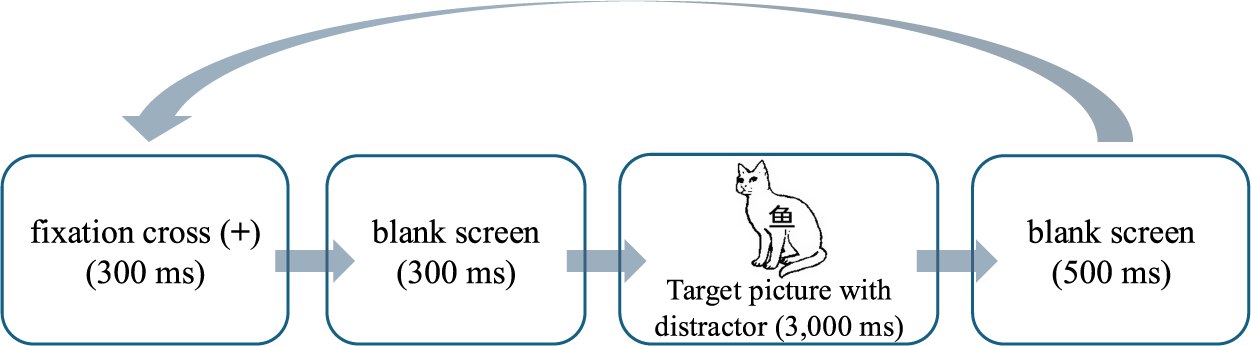
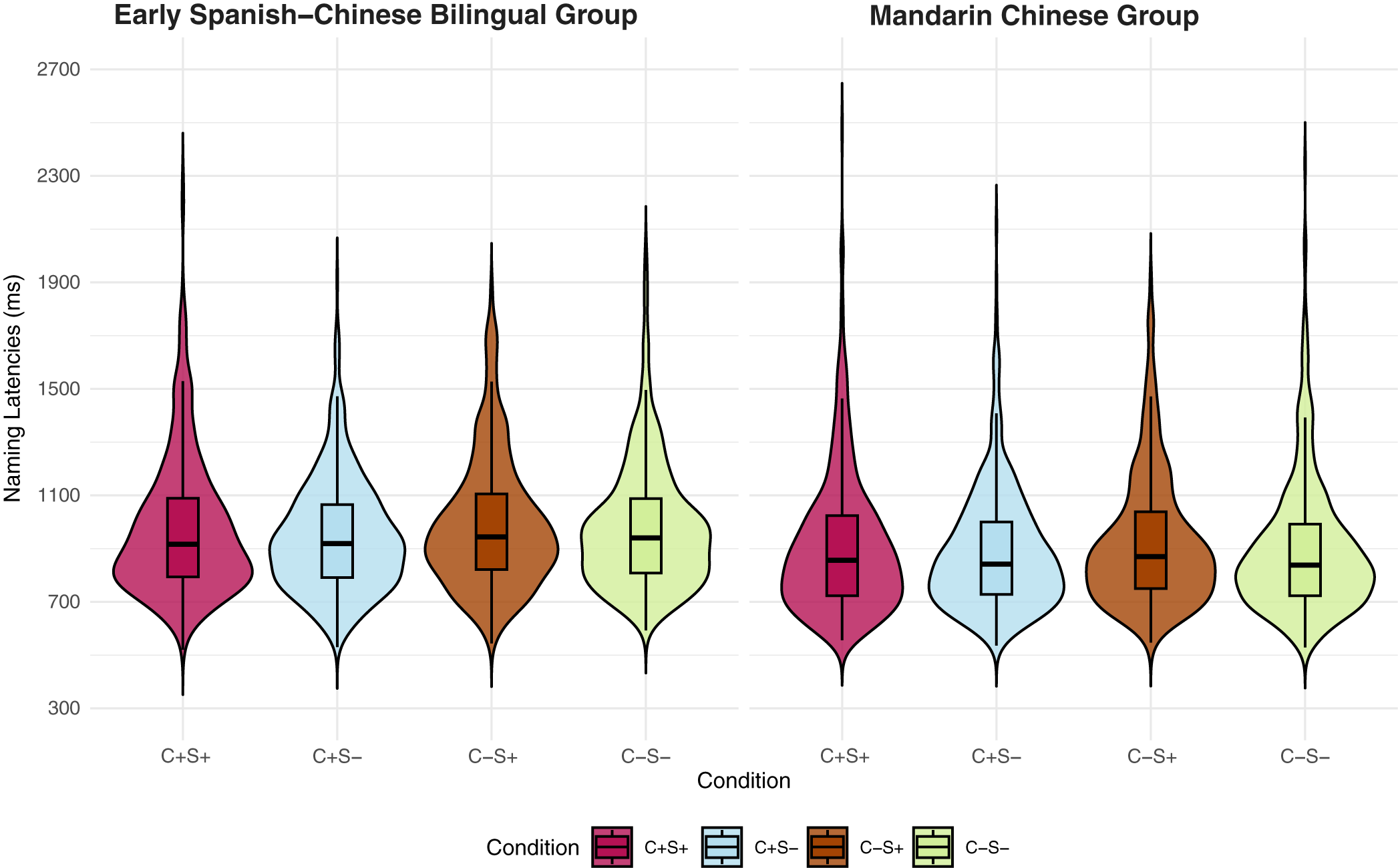


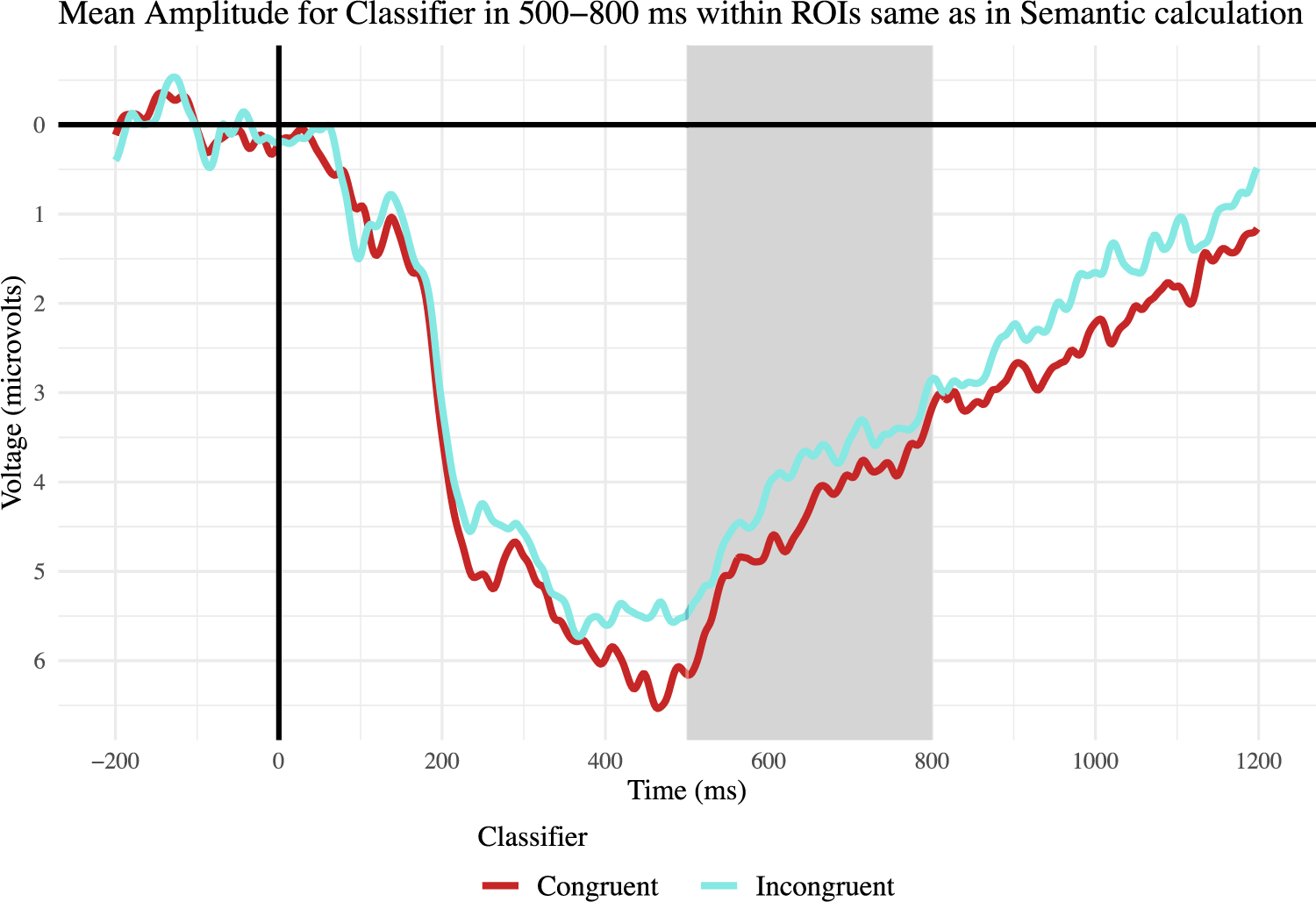


 Open access

