In a well-regarded speech delivered 7 decades ago, US Supreme Court justice Robert H. Jackson (Reference Jackson1951) offered many tips to lawyers preparing cases for his Court: “neither disparage yourself nor flatter the justices,” “forego oral argument of all but one or two of your claims,” “never dodge or delay” answering questions, and on and on. But Jackson, a seasoned appellate litigator,Footnote 1 readily admitted that there was no substitute for experience: “Experience before the Supreme Court is valuable, as is experience in any art. One who is at ease in its presence, familiar with its practice, and aware of its more recent decisions and divisions, holds some advantage over the stranger to such matters” (802). Jackson even suggested that those unfamiliar with the Court should “arrive a day or two” before their arguments to learn how the Court operates (804).
Jackson’s emphasis on experience fits comfortably with well-entrenched theories of human capital in economics and political science (see generally Mincer [Reference Mincer1962] and Becker [Reference Becker1964]). With regard to experience,Footnote 2 the basic hypothesis is that on-the-job-training primes people to be more successful and their workplaces to be more productive, ultimately generating beneficial aggregate-level effects on economic growth (Baum and Lake Reference Baum2003), national wealth (Manuelli and Seshadr Reference Manuelli2014), health (Becker Reference Becker2007), and even democratization and the rule of law (Lankina and Getachew Reference Lankina2012).
Empirical validations of human capital theory’s emphasis on experience are nearly uncountable and span across diverse occupations and employment settings, from art connoisseurs in auction houses to politicians in the White House (Ashenfelter and Graddy Reference Ashenfelter2003; Congleton and Zhang Reference Congleton2013). More limited, though, is evidence of human capital’s relevance to courtroom lawyering. To be sure, historical anecdotes (Lazarus Reference Lazarus2008) and experimental results (Thompson Reference Thompson1990; Abrams and Yoon Reference Abrams2007) underscore the value of experience in litigation. But the few observational-quantitative studies are mixed, with some showing strong associations between the lawyers’ experience and their success in court, and others producing weak to no effects (e.g., cf. Johnson, Wahlbeck, and Spriggs Reference Johnson2006 and Fisher Reference Fisher2013).
The mixed results could reflect differences in the studies’ design and methodology,Footnote 3 but also plausible is that human capital’s emphasis on experience is less relevant for courtroom lawyering, the success of which depends on an external audience—judges. The literature on lobbying, often analogized to litigating (Birkby and Murphy Reference Birkby1964; Epstein and Kobylka Reference Epstein1992; Johnson et al. Reference Johnson2006), suggests as much. Without denying a role for experience, or “what you know,” many studies demonstrate the importance of connections, or “whom you know” (Blanes i Vidal, Draca, and Fons-Rosen Reference Blanes i Vidal2012; Bertrand, Bombardini, and Trebbi Reference Bertrand2014). The literature on judging in apex courts also raises questions about the link between experience and success. Because researchers usually operate under the assumption that the judges’ partisan or ideological preferences drive their decisions (most famously, Segal and Spaeth [Reference Segal2002]), lawyers almost never make an appearance in their models (with the occasional exception of public-sector attorneys representing the central government).
Emerging from these lines of literature are several interesting puzzles. Does experience, found to be so valuable in many other occupations and workplaces, take a backseat to ideology when it comes to lawyering in court? Is lawyering more akin to lobbying, for which connections matter as much if not more than experience? Or is it simply the relative paucity of scientific evidence that explains the minimal role of human capital in accounts of the courtroom?
We grapple with solutions by asking whether the outcomes obtained by experienced attorneys are significantly better than the outcomes they would have obtained had they been novices, regardless of connections or ideology. To answer that question, we work to deploy a best-practices approach to data and design with the aim of estimating, as cleanly and credibly as possible, the causal effect of attorney experience (Ho et al. Reference Ho2007; Iacus, King, and Porro Reference Iacus2019). Following that approach, we restrict the sample of cases to those in which veteran and novice private-sector attorneys square off against a comparable opponent (federal attorneys), employ matching to ensure that the experienced and unexperienced lawyers are as similar as possible, and use standard statistical strategies to adjust for pretreatment variables suggested in previous studies. Although this approach could be applied to almost any peak court, our target is the US Supreme Court, where both experienced and novice attorneys have long litigated (McGuire Reference McGuire1993; Lazarus Reference Lazarus2008).
Applying the data and tools to the Court, the analysis shows that attorneys with experience, relative to first timers, are significantly and consistently more likely to win their cases and capture the votes of justices. Although proof positive of a causal link is always difficult to develop in observational studies, the magnitude, persistence, and convergence of our findings with experimental results may enhance their credibility (see generally Ho and Rubin Reference Ho2011).
With this caveat in mind, the central finding that experience matters carries implications for several literatures. Beginning with human capital theory, the study provides empirical validation of its core hypothesis, although in a novel context: just as constituents are better served by experienced politicians and auction houses by art connoisseurs, litigants represented by experienced Supreme Court lawyers are at an advantage relative to litigants who hire novices. The implication here, which awaits further testing, is that veteran attorneys are beneficial to their clients of course and perhaps to the Court itself.Footnote 4 With regard to the study of judicial behavior, it seems reasonable to hypothesize that the importance of human capital in the form of experience is not limited to attorneys but also extends to justices and judges. How experience affects their performance and the success of their court is, we believe, a potentially interesting and important line of inquiry.
I. Human Capital and the Role of Experience
Tracing to Adam Smith’s An Inquiry into the Nature and Causes of the Wealth of Nations (1776) and following most directly from Becker’s work (Reference Becker1962, Reference Becker1964), the theory of human capital emphasizes the importance of investing in people’s education (knowledge) and their acquisition of training (skills) through work experience. These investments are thought to generate long-term benefits not only to individuals but also to their workplaces and their societies. This basic insight has formed the centerpiece of large bodies of work in economics and political science in which the outcomes of interest—the possible benefits of investing in human capital—include individual prosperity as well as economic growth (Baum and Lake Reference Baum2003) and democratization (Lankina and Getachew Reference Lankina2012), among many others.
Although the analysis that follows attends to educational quality, the focus is more squarely on the effect of human capital in the form of work experience—a subject that is hardly a blank slate. Past studies report that patients who hire experienced surgeons are more likely to survive an operation than patients who hire novices (Maruthappu et al. Reference Maruthappu2015), students with experienced teachers tend to earn higher scores on standardized tests (Papay and Kraft Reference Papay2015), and companies that invest most heavily in “EX” (employee experience) outperform those that invest less (Morgan Reference Morgan2017). In the political realm, research shows that US presidents with training in high-level positions are superior economic stewards (Congleton and Zhang Reference Congleton2013) and that governors with federal work experience increase the growth rate of federal-to-state transfers (Pickard Reference Pickard2020). To be sure, the requisite amount of experience varies from job to job, but the general message from this large literature is straightforward: “Most jobs require learning, and … individuals perform better … as they develop expertise while completing their assigned tasks and while navigating their environment” (Abrams and Yoon Reference Abrams2007, 1158).
So it should go with lawyering—including, perhaps especially, lawyering in the US Supreme Court—for which on-the-job training entails the acquisition of highly specialized skills and knowledge. For Justice Jackson, that knowledge is about how the Court operates. Many scholars would agree (e.g., Wahlbeck Reference Wahlbeck1997; Lazarus Reference Lazarus2008; Feldman Reference Feldman2016), although they might add that the experienced attorney—just as the experienced lobbyist—is better able to convey information the justices need to reach the results they most desire (Epstein and Kobylka Reference Epstein1992; McGuire Reference McGuire1993; Johnson et al. Reference Johnson2006) and even to tailor arguments to particular justices (Lazarus Reference Lazarus2008).
Certainly, hints in the literature support the value of experience in the courtroom. One comes from (quasi-)experimental evidence implicating frontline lawyers. Abrams and Yoon (Reference Abrams2007), for example, exploit random assignment of cases to public defenders to establish a causal link between experience and outcomes, discovering that veteran attorneys, relative to novices, reduce the average sentence length of defendants by almost 20%. Likewise, lab experiments suggest that mutually beneficial outcomes in negotiations—a large part of the workaday world of lawyering—are more likely to result when the negotiators are practiced (Thompson Reference Thompson1990; Loewenstein and Thompson Reference Loewenstein2006).
Other hints about the importance of experience come from histories of the Supreme Court that show the existence and influence of a professionalized private-sector Supreme Court bar since the early days of the republic (McGuire Reference McGuire1993; Frederick Reference Frederick2005). Lazarus (Reference Lazarus2008), for example, highlights the role that a handful of veterans played in presenting—and ultimately winning—some of the 19th century’s most important cases.Footnote 5 These attorneys were flamboyant characters who took to wearing “amber-colored doeskin gloves” and even pausing their arguments when “admiring ladies entered the courtroom” (1489–90).
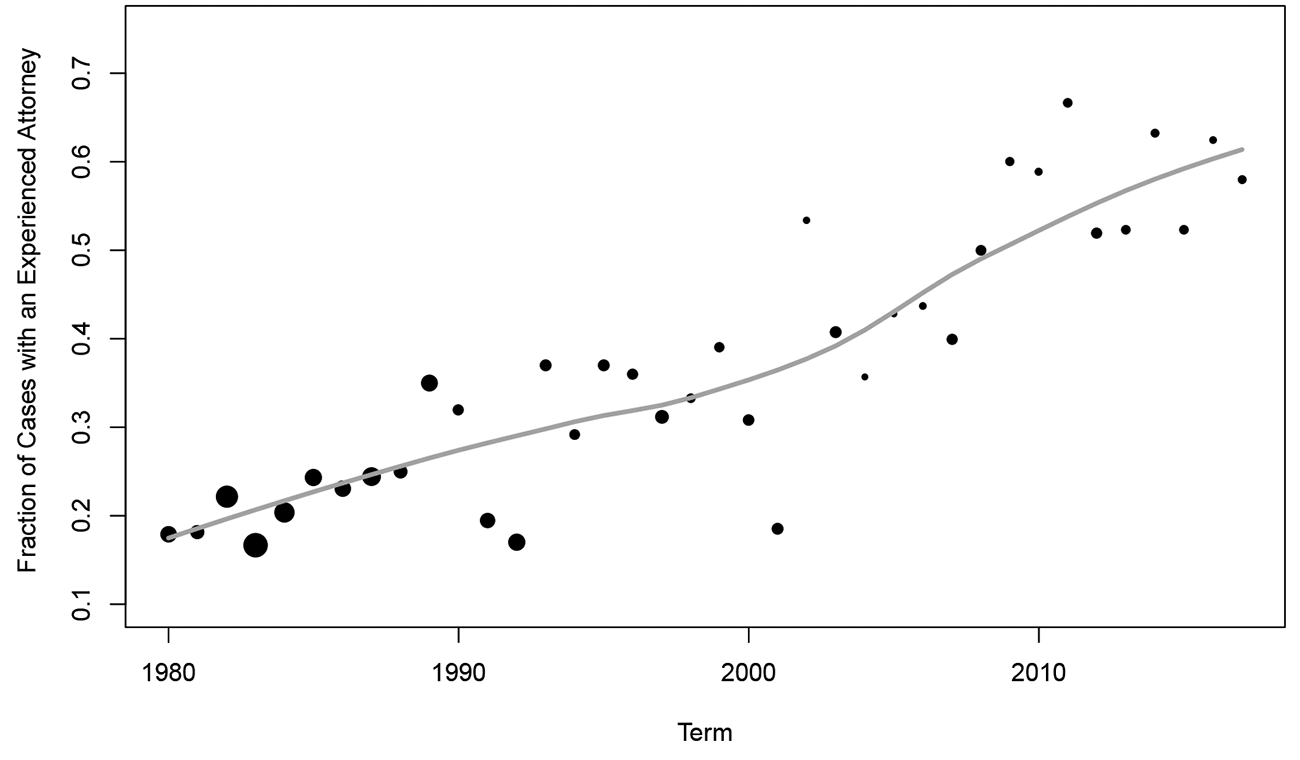
The modern-day Supreme Court bar is more reserved but no less part and parcel of the Court’s litigation environment. In fact, as figure 1 shows, experienced lawyers may be more prevalent than ever. In the 1980s, about a quarter of the private-sector attorneys appearing before the justices had argued at least one prior case, compared with a majority in the 2000s. These experienced lawyers are now so in demand that they earn an hourly wage 15 times higher than the average US lawyer (Weiss Reference Weiss2015).
Fraction of cases with an experienced attorney (one or more prior arguments), 1980–2017 terms. The line is a loess line of best fit, and the circles are weighted by the number of cases the Court decided each term. For details about the data, see Section II.A.

Not all Supreme Court litigants need to pay steep fees, however. Many attorneys, even veterans, are willing to take on cases pro bono if only to translate more oral-argument experience into even higher fees from paying clients such as corporations (Lazarus Reference Lazarus2008).Footnote 6 This is especially true in disputes that pit an “underdog” against the government, meaning cases that do not implicate the attorneys’ corporate clients (Morawetz Reference Morawetz2011). Because experience gained from litigating these cases is so valuable, irrespective of ultimate success, competition among attorneys to argue before the Court can be fierce (Fisher Reference Fisher2013).
These facts and stories, coupled with reasoned speculation (Roberts Reference Roberts2005), are consistent with a role for human capital in the courtroom. Observational-quantitative studies, though, are far more equivocal.Footnote 7 Johnson et al. (Reference Johnson2006), for example, show that while attorneys with litigation experience received higher “grades” from Justice Harry Blackmun, that experience did not translate into a higher likelihood of capturing the justices’ votes. McAtee and McGuire (Reference McAtee2007), in contrast, find that experienced lawyers increase the odds of a vote in the lawyer’s favor even after controlling for ideology (see also Fisher Reference Fisher2013), but the effect is relatively small in size.Footnote 8 In another study, McGuire (Reference McGuire1998) reports that the litigation experience of opposing counsel cancels out whatever advantage the federal government’s lawyers had been thought to enjoy. Then again, subsequent work questions that conclusion (Black and Owens Reference Black2012; see also Feldman Reference Feldman2016).
It is possible that these conflicting findings are the product of different design and data choices (see nn. 3 and 7). But equally plausible is that human capital in the form of experience plays a lesser role in courthouses than in other workplaces. In the literature on lobbying, which bears a family resemblance to litigating, debates rage over whether successful outcomes reflect the lobbyists’ experience and expertise (what they know) or their connections (whom they know). Although recent empirical work continues to show that experience matters, it demonstrates a more crucial role for ties to important players (Blanes i Vidal et al. Reference Blanes i Vidal2012; Bertrand et al. Reference Bertrand2014). Several studies of judicial behavior concur, proposing that connections to the Washington, DC, legal community may outweigh experience when it comes to winning cases (McGuire Reference McGuire2000; Johnson et al. Reference Johnson2006). Likewise, journalistic narratives point out that justices and attorneys appearing before them have long forged strong links, whether in law school, the workplace, or even during confirmation proceedings (Biskupic, Roberts, and Shiffman Reference Biskupic2014).Footnote 9
The literature on judicial behavior also raises questions about the value of experience in apex courts. Regardless of whether the work is grounded in attitudinal or rational choice theory (Epstein and Knight Reference Epstein1998; Segal and Spaeth Reference Segal2002), almost all studies in the field proceed from the premise that the justices’ overriding goal is to align the law with their ideological or partisan commitments. On this account, it may be efficient or otherwise beneficial for justices to borrow from attorneys’ briefs when crafting their opinions (Corley Reference Corley2008; Feldman Reference Feldman2016), but it is unlikely that attorneys, experienced or not, provide policy-maximizing justices with information that would cause them to vote in ways they otherwise would not.
This ideological account so dominates research in the field that it may well explain why empirical models of judicial decisions almost never incorporate attorneysFootnote 10—with but one notable exception: the Office of the Solicitor General (OSG), which represents the United States in the Supreme Court. Even the most hard-core attitudinalists submit that empirical evidence in support of the OSG’s success is more than “ample” and, in fact, provides the “one clear example” of judicial self-restraint (Segal and Spaeth Reference Segal2002, 411). For this reason, the very same studies that exclude private-sector lawyers almost always include a covariate for the OSG’s participation (e.g., Hume Reference Hume2017; Hall Reference Hall2018).
II. Drawing Causal Inferences about the Effect of Attorney Experience
To sort out the disjuncture between predictions from human capital theory and the mixed empirical evidence in neighboring literatures, we ask whether the outcomes obtained by experienced attorneys are significantly better than the outcomes they would have obtained had they been novices. In other words, the quantity of interest is the average treatment effect on the treated for the cases in the sample.
In a research environment without any constraints, estimating this quantity (i.e., the causal effect of experience) would be simple: create a world in which an experienced attorney presents a case and ask a justice to vote for or against the attorney’s client, then rerun history, holding everything constant except now the experienced attorney is a novice. If, in the experienced scenario, the justice voted for the attorney’s client but in the novice scenario voted against the client, it would be reasonable to conclude that experience had the expected causal effect on the justice’s vote.
But, of course, replaying history is not possible. Nor can we even conduct a proper experiment that would use random assignment to ensure balance across experienced and novice attorneys on all pretreatment covariates. In light of these and other challenges complicating the estimation task, two steps were necessary: the development of a data set that requires minimal assumptions (Sec. II.A) and the adaptation of theory and tools designed for causal inference with observational data (Sec. II.B).
A. Data, Treatment, and Outcomes of Interest
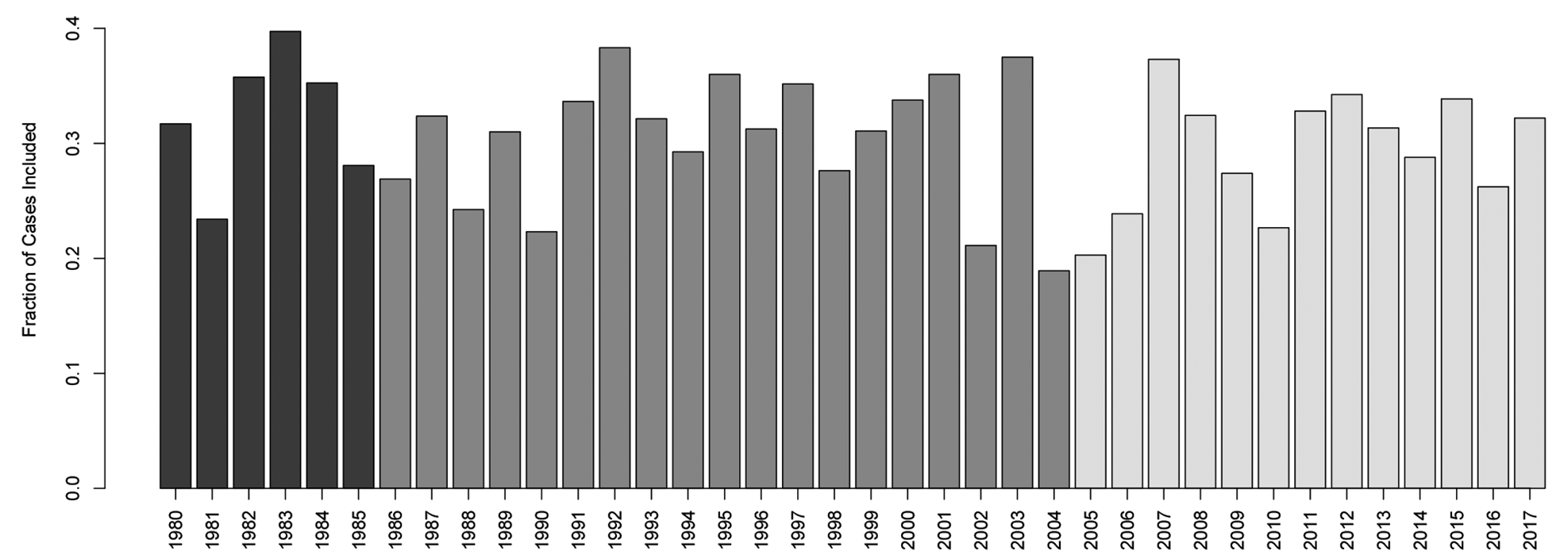
To estimate the effect of attorney experience on case outcomes and votes, we developed a data set of all orally argued US Supreme Court decisions, issued between the 1980 and 2017 terms, in which the OSG represented the petitioner (appellant) or respondent (appellee).Footnote 11 This amounts to nearly 30% of all argued cases (9,671 votes cast by 21 justices in 1,080 cases) across the 38 terms, as figure 2 shows.
Fraction of all orally argued cases in the data set, 1980–2017 terms. These are cases in which the Office of the Solicitor General represented the petitioner (or appellant) or respondent (or appellee). Black bars, Burger Court era (1969–85 terms); dark gray bars, Rehnquist Court era (1986–2004 terms); light gray bars, Roberts Court era (2005–17 terms).

A focus on US government cases has several advantages. First, it provides leverage on assessing attorney experience in light of the many studies that demonstrate the uniformly high quality of the government’s lawyers (Salokar Reference Salokar1992; Lazarus Reference Lazarus2008; Black and Owens Reference Black2012). Had we analyzed non-OSG cases, the problem of imbalances in quality and resources between the two attorneys in any given case would have emerged. Scholars have tried to solve this problem by weighting, categorizing, or otherwise accounting for the advantage of one side over the other—all solutions that require a host of assumptions.Footnote 12 Using OSG cases (i.e., holding constant the attorneys’ opposition) avoids the problem altogether because the comparison is not how novice and more experienced attorneys fare when they face each other; it is rather how both types of attorneys fare against a comparable opponent: the OSG.Footnote 13
A second advantage to the OSG approach is that free representation is readily available to litigants opposing the US government. As suggested earlier, experienced advocates are often willing to litigate pro bono cases “to maximize their presence before the Court” unless the suit implicates their high-paying clients, such as when a consumer sues a corporation (Lazarus Reference Lazarus2008, 1518). Because a focus on OSG litigation eliminates these suits, the resulting data set (coupled with the analytic strategy outlined below) mitigates concerns that cases represented by experienced attorneys are, on average, distinct from cases argued by novices.Footnote 14
For each case in the data set, the treatment (causal variable of interest) is whether the attorney opposing the OSG was “experienced.” There is no gold standard—or even widely accepted proxy—to measure this concept. Some scholars impose cutoffs (e.g., an experienced attorney argued two or more cases; Lazarus Reference Lazarus2008; Fisher Reference Fisher2013) or use the raw count (or log) of prior appearances (Haire, Lindquist, and Hartley Reference Haire1999; McAtee and McGuire Reference McAtee2007; Szmer, Johnson, and Sarver Reference Szmer2007; Wedeking Reference Wedeking2010; Feldman Reference Feldman2016). Both approaches are plausible, but neither is perfect. Tallies operate under the (unverified) assumption that experience accrues in a linear fashion with each passing case when attorneys and scholars alike suggest that just one prior appearance may supply sufficient experience (e.g., Jackson Reference Jackson1951; McGuire Reference McGuire1993). Cutoffs are subject to the same critique and to the additional problem that unjustified and untested grouping decisions can crucially affect any inferences reached (Fong, Hazlett, and Imai Reference Fong2018).
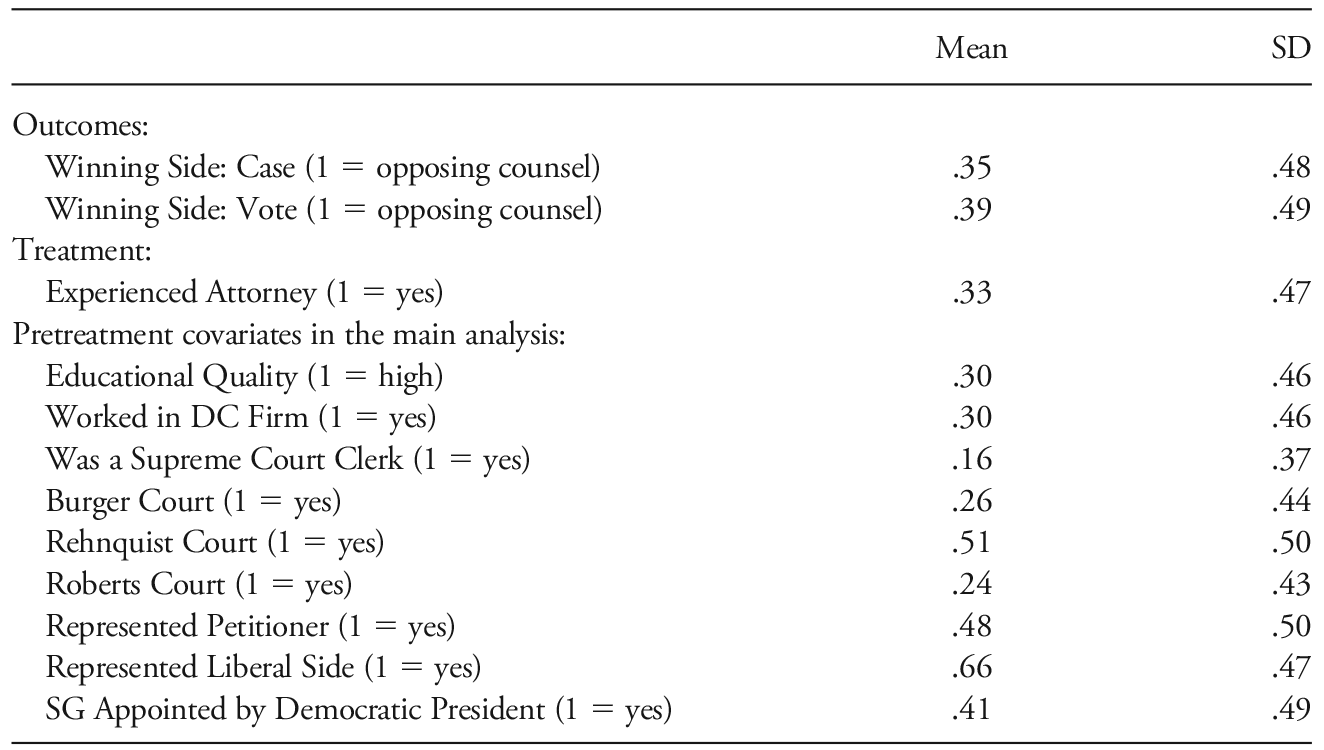
For these reasons (and with an eye toward determining convergence among the alternative measures), the analysis to follow assesses experience in several ways: (1) via a binary variable indicating whether counsel opposing the OSG argued one or more prior cases in the US Supreme Court Footnote 15 and (2) through various cutpoints and counts.Footnote 16 However measured, we created the variable by counting any argument prior to the case under analysis regardless of whether the prior case was in our data set and regardless of whether the litigation ended with an opinion of the Court.Footnote 17 Using this approach, counsel opposing the OSG had at least one prior argument under their belt in 33% of the cases, as table 1 (under “Treatment”) shows.
Descriptive Statistics for Outcome, Treatment, and Pretreatment Covariates

Note.—Except for Winning Side: Vote, all statistics are at the case level.
 for cases and 9,671 for votes. Listed here are only those pretreatment covariates used in the main analysis; for those in the robustness tests, see app. sec. 2.4.
As table 1 also shows, two outcomes are of interest. The first is who won the case, that is, did the Court hold for the side represented by the OSG or the side represented by counsel opposing the OSG (“opposing counsel”)? Of the 1,080 cases in the data set, opposing counsel won in 35% of cases and the OSG, in 65%—percentages in line with the existing literature on the OSG (e.g., Black and Owens Reference Black2012; Epstein and Posner Reference Epstein2016). The second outcome of interest moves from the court-case level to the justice-vote level, asking whether the justice voted for opposing counsel’s client or the OSG. Collectively, the justices cast
 of their votes for opposing counsel and
 in favor of the OSG.
B. Research Design and Empirical Strategy
Regressing case outcome on whether the attorney had argued at least once before shows that experience has a positive and significant effect on winning. Likewise, justices are significantly more likely to vote in favor of the side represented by a veteran attorney.Footnote 18
But these bivariate regressions prove little. Because cases are not randomly assigned to treatment, experienced and novice attorneys are likely to differ in ways related to outcomes. To provide but one example, in Johnson et al.’s (Reference Johnson2006) data, attorneys with litigation experience were significantly more likely to have worked in a Washington, DC, law firm, served as a US Supreme Court law clerk, and attended an elite law school—all pretreatment covariates correlated with the outcome of interest. The relationship between the covariates and treatment assignment in the Johnson et al. study (and, we daresay, in most observational studies of lawyering)Footnote 19 is sufficiently strong that any statistical method applied to the data could produce model-dependent estimates of the causal effect of lawyering, among other problems (see, e.g., Cochran and Rubin Reference Cochran1973; Ho et al. Reference Ho2007).
These hurdles yet again underscore the difficulty of making credible causal inferences about the effect of attorney experience, but they are not impossible to overcome. To make an apples-to-apples comparison between the outcomes of cases with novice versus experienced attorneys and then use the balanced data set to estimate the average treatment effect on the treated (ATT), we adapted the best-practices approach outlined in Ho et al. (Reference Ho2007), Ho and Rubin (Reference Ho2011), and Iacus et al. (Reference Iacus2019), which entails considerations of theory, data, and identification.
Beginning with theory, we accept the axiom of statistical inference formally advanced in Iacus et al. (Reference Iacus2019), namely, that the data in our sample were generated by a stratified random sampling framework (rather than via simple random sampling). Under this axiom, the strata and n for our sample and each (hypothetical) repeated sample are fixed, with the data for each stratum drawn using simple random sampling.
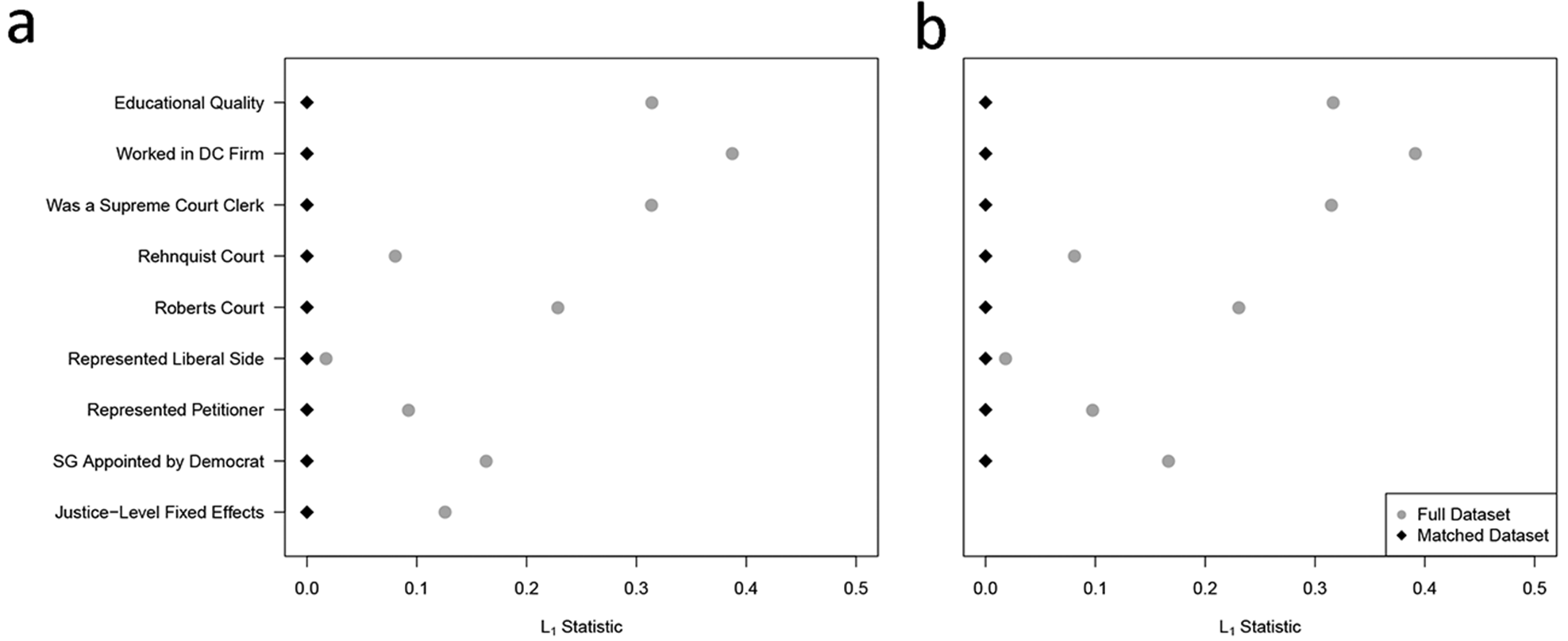
Next, following from this axiom, we nonparametrically processed the data using a stratification-based matching approach. Although any class of monotonic imbalance methods would be suitable, we employed coarsened exact matching to create matches on treatment assignment for the pretreatment covariates. Figure 3 shows the results of this exercise in the form of ℒ1 (balance) statistics for each pretreatment covariate suggested in previous studies (and listed in table 1), plus justice fixed effects for vote outcomes. Note that exact matches now supplant the large imbalances in the original data.Footnote 20
Comparison of balance in the full and matched data sets: a, justice-level data; b, court-level data. The points are the ℒ1 balance statistic for each covariate; these values have a theoretical range of 0 to 1, with higher values indicating more imbalance. The relatively high values associated with the circles (the full data set) highlight the imbalance in the unmatched data set. The number of observations and other details about the covariates are in appendix section 3.

Because the pretreatment covariates shown in figure 3 come from the existing literature, most require little elaboration.Footnote 21 The exceptions are those with a nexus to human capital theory, starting with Educational Quality. Recall that some studies of human capital emphasize investments not only in experience but also in superior education (e.g., Barro Reference Barro2001). Accordingly, research on lawyers almost always accounts for educational quality (Johnson et al. Reference Johnson2006; Abrams and Yoon Reference Abrams2007), although the specific measure varies from study to study. Our approach was to identify whether the attorney opposing the OSG graduated from one of the law schools consistently ranked in the top five by U.S. News & World Report during the terms in our data set (Areheart Reference Areheart2018).Footnote 22
Two other sets of covariates tap challenges to human capital theory posed in the literatures on lobbying (connections) and judging (political preferences). To assess whether connections—whom you know—increase the odds of successful outcomes in the courtroom, we incorporate two variables common in litigation studies: whether the lawyer was a Supreme Court clerk (Was a Supreme Court Clerk) and whether the lawyer worked in a DC firm (Worked in DC Firm) when the Court heard the case (McGuire Reference McGuire1993; Johnson et al. Reference Johnson2006; Lazarus Reference Lazarus2008; Feldman Reference Feldman2016). Another suite of covariates attends to the judicial behavior literature’s emphasis on ideology and partisanship: whether the attorney represented the liberal side (Represented Liberal Side), which captures to the Court’s tendency to rule in the conservative direction during the terms in our data set; and whether a Democratic president appointed the solicitor general (SG Appointed by Democratic President), which also accounts for ideological tendencies as well as any partisan loyalties. Incorporated too are fixed effects for each justice and chief justice era to adjust for any unobserved era- and justice-specific confounders, especially ideology.Footnote 23
With these covariates noted, one concern remains: the possibility that cases argued by experienced attorneys are, on average, somehow “better” cases than those presented by novices. If true, any observed advantage may be due to the strength of the underlying case rather than to the attorney’s experience. We address this concern in several ways. First, on the conceptual side, the fact that the Court decides so few cases each term implies, as we mentioned earlier, that ambitious attorneys must compete for cases, even those they believe are “losers” (e.g., Lazarus Reference Lazarus2008). This holds for all cases but perhaps especially for those in our data set—cases in which the attorneys knew, going in, that they would face a highly skilled and successful opponent: the OSG. Second, from an empirical standpoint, the matching model includes a covariate indicating whether the non-OSG attorney represented the petitioner or the respondent to account for the Supreme Court’s tendency to reverse. Incorporating this variable in the matching specification limits the possibility that the data are imbalanced such that experienced attorneys tend to represent the petitioner and novices, the respondent—a combination that could lead to misleading estimates.Footnote 24
Even though these conceptual and empirical particulars blunt concerns about a selection effect, we thought it prudent to run an additional check, asking whether the counsel of record on the petition for certiorari (cert) was different from the lawyer who argued the case. Red flags about a selection effect would be raised if switches in attorneys between cert and arguments were (1) related to the experience of the attorney and, in turn, (2) affected win rates. But the data supply no evidence of either.Footnote 25 In 21% of the cases we inspected, there was an attorney switch: 52.5% were eventually argued by a novice attorney and 47.5% were argued by an experienced attorney (
 ). Similarly, there was no relationship between winning the case and whether the case was argued by the cert petition’s counsel of record (
 ).
With concerns about a possible selection effect addressed and with the balanced sample in hand, we turned to the causal identification strategy, which was to use logistic regression to adjust for the set of pretreatment variables in table 1 so that we can credibly assume that the potential outcomes are conditionally independent of treatment status given the covariates (Gelman and Hill Reference Gelman2006; Ho et al. Reference Ho2007; Boyd, Epstein, and Martin Reference Boyd2010; Iacus et al. Reference Iacus2019). We also assume common support because coarsened exact matching automatically excludes observations outside the common support region and the two components of the Stable Unit Treatment Value Assumption (SUTVA) hold (Iacus et al. Reference Iacus2011).Footnote 26
III. Main Results
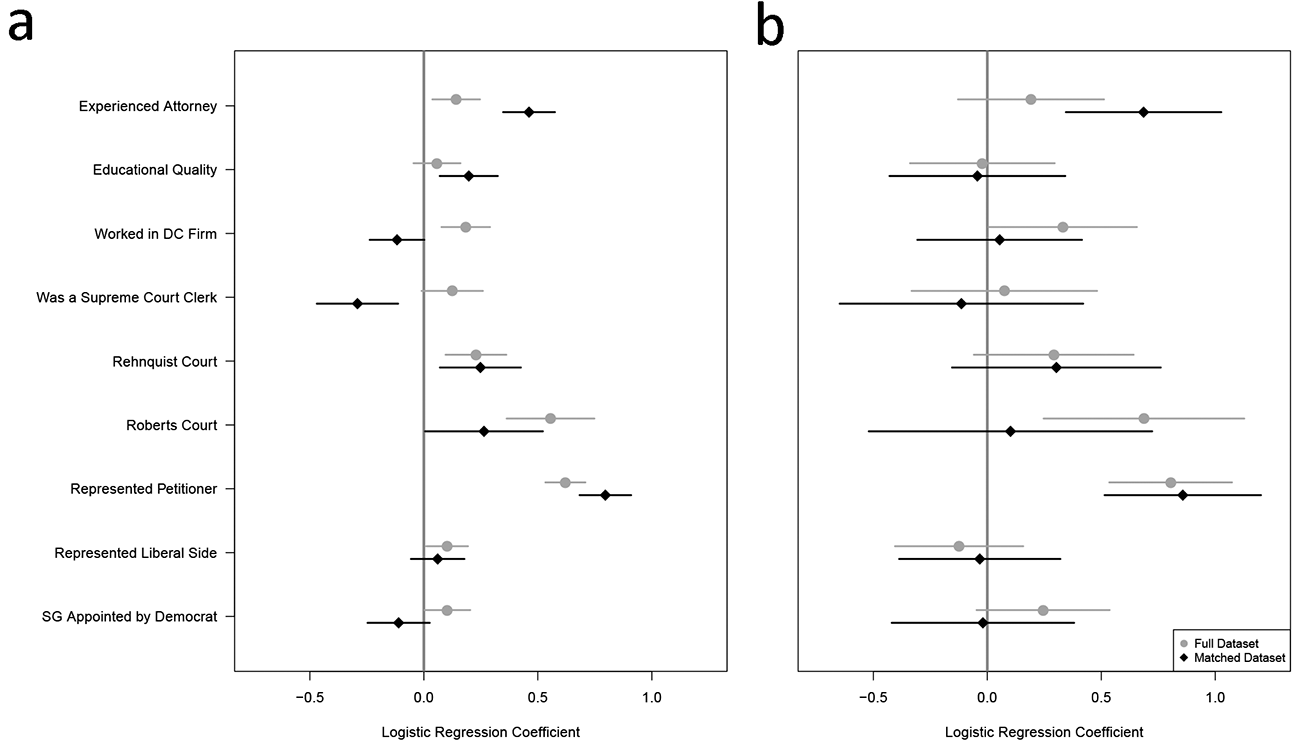
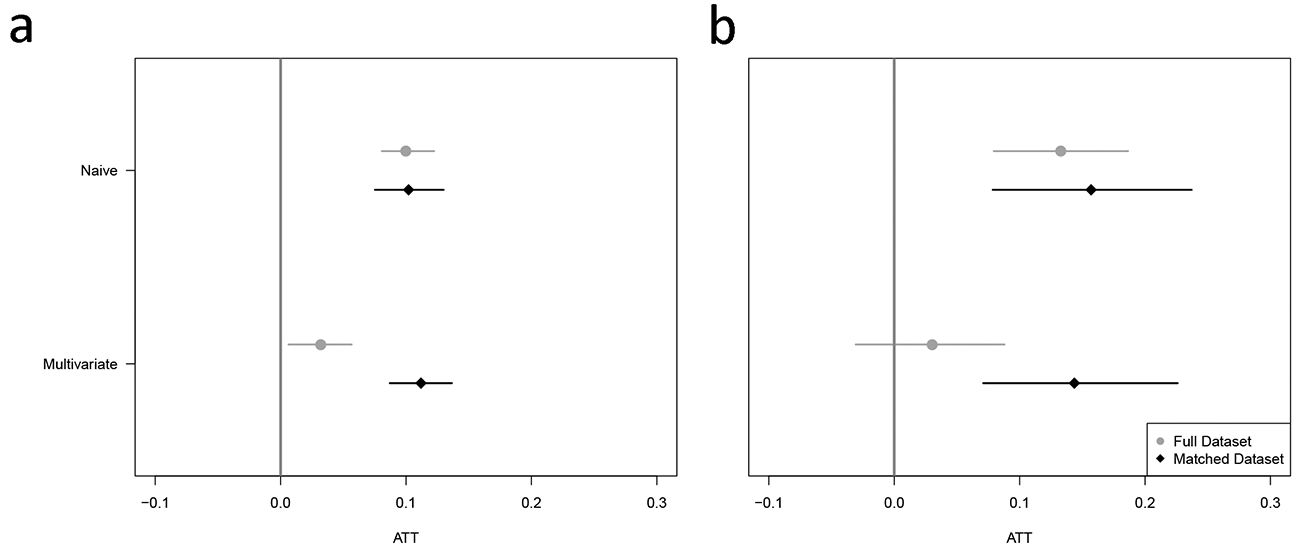
As a first step in the analysis, we estimated eight logistic regression models using the binary treatment: naive (bivariate) and multivariate specifications on the full and matched data sets at the justice and case levels of analysis. Figure 4 shows the regression estimates for the multivariate models,Footnote 27 and figure 5 translates those coefficients into average treatment effects.
Logistic regression estimates: a, justice-level data; b, case-level data. Horizontal lines, 95% confidence intervals for the coefficients estimated from multivariate regressions.

Estimates of the average treatment effect on the treated (ATT) for attorney experience: a, justice-level data; b, court-level data. Horizontal lines, 95% confidence intervals for the ATT. Naive models are binary regressions that include only the treatment (Experienced Attorney); multivariate models include the treatment plus the pretreatment covariates shown in figure 3.

As figures 4 and 5 indicate, the justices’ votes yield consistent results for the matched and unmatched data. The coefficient on Experienced Attorney is positive and significant in all models (including the bivariate specifications), and the effect size is nontrivial: an experienced attorney, relative to a novice, increases the likelihood of capturing a justice’s vote by 11 percentage points. Note, though, that at the Court level, no significant difference emerges between experienced and novice attorneys in the full data set. Only by matching were we able to unearth the fairly large experience-based advantage of a nearly 14-percentage-point increase in the odds of success.
Turning to the especially relevant pretreatment covariates, Educational Quality produces mixed results, as figure 4 shows. On the one hand, attorneys with high-quality legal education are more likely to attract the votes of justices, thereby increasing their margin of victory; on the other hand, graduating from Yale, Harvard, and the like is insufficient to generate a positive outcome. Yielding clearer results are variables designed to tap connections. Although whom you know plays an important role in lobbying, our analyses uncovered virtually no evidence of its effect in the courtroom. Neither working in a Washington, DC, law firm nor clerking at the Court increased the odds of winning cases or attracting votes after matching the data. Perhaps judicial norms are strong enough to offset the benefits of whatever connections exist between justices and the lawyers litigating before them (see n. 9).Footnote 28 Finally, the covariates emphasized in the judicial behavior literature exert significant effects on outcomes and votes. Even after controlling for them, though, Experienced Attorney remains a significant predictor of attorney success (see also fig. 7).
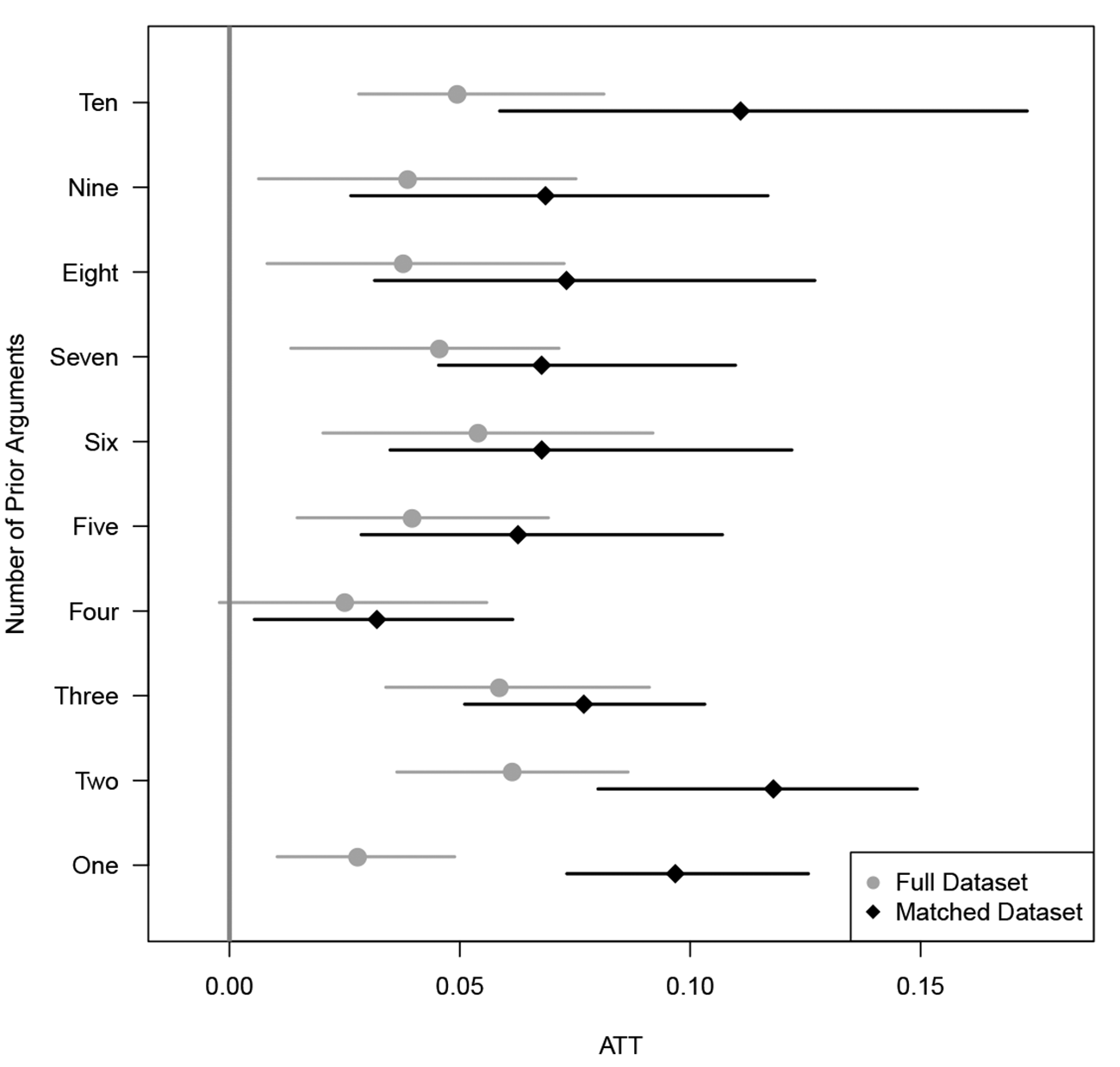
The results in figures 4 and 5 follow from models defining an attorney as “experienced” after one prior oral argument. To determine the extent of convergence between this and alternative measures of experience, we varied the cutoff for the number of prior arguments, from one (the binary treatment) to 10. Figure 6 displays the results.
Estimates of the average treatment effect on the treated (ATT) for attorney experience, varying the number of prior oral arguments used as treatment. Horizontal lines, 95% confidence intervals. The results are consistent with those depicted in figure 5.

Note that in the full data set, the effects of attorney experience are robust, with most of the ATTs larger than those presented in figure 5. For the matched data sets, all the estimated effects are positive and statistically significant, although more uncertainty surrounds them because each successive matched data set is smaller as the treatment cutoffs grow more stringent.Footnote 29
Varying the cutoffs was not the only alternative approach we took to measuring attorney experience. As indicated in appendix section 5.2, we also ran regressions using counts and logs. The results are consistent with those depicted in figures 4–6.
IV. Robustness Checks
In addition to interrogating various measures of attorney experience, we performed the following checks on the results: incorporating covariates to capture the ideological alignment of the justice and the attorney (with and without justice fixed effects), segregating out various issue areas, redefining existing covariates and adding new ones, and clustering the standard errors by justice. We also considered whether one or more of the justices drove the experience effect.Footnote 30 None of these tests did damage to the results presented in figures 4–6: the effect of attorney experience remains strong, positive, and substantial.
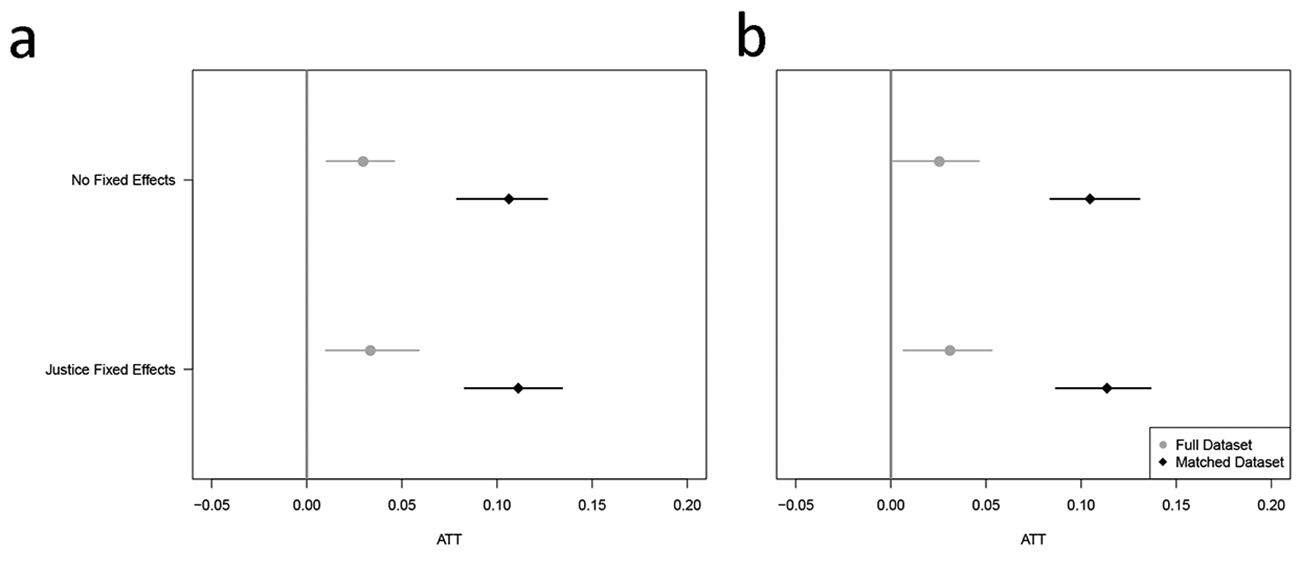
One of the more crucial inspections, regarding ideology, suffices to make the point. Although the ATTs in figure 5 include justice fixed effects, they do not explicitly account for ideological congruity between an attorney’s argument and a justice’s political preference. To ensure that the omission of this covariate did not confound the results, we incorporated one of two versions of it into the basic multivariate model. The first was a measure that takes on higher values as the justice is more ideologically predisposed to vote for the attorney’s client (Feldman Reference Feldman2016), constructed using the procedures detailed in, among others, Johnson et al. (Reference Johnson2006).Footnote 31 The second measure, pioneered by McAtee and McGuire (Reference McAtee2007), interacts the justice’s term-by-term Martin-Quinn score (Martin and Quinn Reference Martin2002) and the direction of the lower court decision.
Both measures of ideology yield significant coefficients; in other words, the results confirm the importance of political preferences in models of judicial behavior. Nonetheless, as figure 7 shows, even after including these “ideological” covariates and justice fixed effects, attorney experience is still positively and significantly linked to the justices’ votes and the case’s outcome.
Estimates of the average treatment effect on the treated (ATT) for attorney experience, accounting for the effect of ideology. Horizontal lines, 95% confidence intervals. a, Model accounts for ideological congruity between the non-OSG attorney and the justice; b, model accounts for ideology by allowing the effect of the justice’s attorney to vary by the ideological position represented by the non-OSG attorney. The results are consistent with those depicted in figure 5.

In short, this robustness check (along with myriad other assessments) suggests that the findings are not driven by a particular measurement choice or model specification. Rather, across the matched and unmatched data sets, a variety of model specifications, different samples of data, and different codings of the treatment variable, the basic result persists: more experienced attorneys tend to achieve better results in the Supreme Court.
V. Discussion
To restate the obvious, making credible causal inferences with observational data is no easy task. We therefore cannot claim to provide direct and conclusive evidence of a causal link between experience and outcomes. Nonetheless, the results supply some room for cautious optimism. Not only do they emerge from a design that hews as closely as possible to best practices for causal inference; they are also strong and robust, and they converge with experimental findings (see generally Ho and Rubin [Reference Ho2011]). For this reason, it seems reasonable to propose promising avenues for future research on human capital in the courtroom, whether on the subject of this article—attorneys—or on a wholly new target, judges.
Beginning with attorneys, three interesting possibilities for new research emerge. One follows from our conceptualization of attorney experience as highly specialized experience—prior experience in US Supreme Court litigation. To be sure, this approach mirrors all other studies on attorney experience: trial court studies consider experience in trial courts (Abrams and Yoon Reference Abrams2007), not in appellate courts, and research on lawyering in the US circuits counts only experience in the circuits (Szmer et al. Reference Szmer2016) or even in a particular circuit court (Haire et al. Reference Haire1999).Footnote 32 The “highly specialized” approach also follows from the theory of human capital, which emphasizes specific on-the-job training: a heart surgeon would not be considered experienced in corrective eye surgery, nor would an art connoisseur specializing in works by Warhol, Basquiat, and other 20th-century artists be deemed experienced in Renaissance art. And so it seems to go with lawyering. When Jackson wrote of the importance of experience, he referred explicitly to the US Supreme Court, not other apex, appellate, or trial courts.
Nonetheless, the possibility that experience generalizes across courts is worthy of consideration. Imagine an attorney who had represented scores of clients in federal and state courts but none in the US Supreme Court. Is that training “worth more” than one or two arguments before the justices? If so, why? Is lawyering different from other occupations in which highly specialized experience is especially valued? Answering these and related questions would contribute not only to our understanding of attorneys but also to human capital theory.
Similarly, research should consider how experience is developed. We focus on the very endpoint of litigation: appearance at Supreme Court oral argument. But even before that, attorneys might gain useful experience through the preparation of amicus briefs and cert petitions. Future research should embrace the multifaceted nature of legal practice to examine how attorney experience might accrue from different types of litigation activities, from the initial filing of the petition to argument in the Court. In other words, does the experience benefit we uncover accrue primarily through fluency with the give-and-take of oral argument, or would attorneys with significant experience in other types of Supreme Court practice perform as well as accomplished oral advocates were they given the chance to argue?
A second set of questions relating to attorney experience focuses on whether its effect can be mitigated. Hints in the medical literature, for example, suggest that the cumulative experience of a surgical team may be equally as important for success as an individual surgeon’s experience (e.g., Elbardissi et al. Reference Elbardissi2013). Translated to lawyering, to what extent can a novice attorney’s team (the attorney’s firm) compensate for that attorney’s lack of experience?
This question is worthy of sustained attention for several reasons, not the least of which is its potential implications for diversity and inclusion. Think about it this way: Because experienced attorneys are more likely to achieve favorable outcomes for their clients, US Supreme Court litigants should be reluctant to allow a novice to argue their case. This reluctancy, in turn, may reinforce the gender, race, and ethnicity biases that already exist in the makeup of the bar (e.g., in recent years, under 15% of the lawyers appearing before the Court were women [Walsh Reference Walsh2018], and that percentage may be in decline). The explanation, it seems, is that “it is hard to get a first argument, and without getting a first argument it is hard to get more arguments” (Karlan quoted in Walsh [Reference Walsh2018]). But if research shores up an important role for teams in buttressing novice attorneys, clients (and the firms themselves) may be more willing to provide that first argument.
These suggestions focus attention on the individual attorney. Awaiting further analysis too is the question of whether the increasingly experienced bar (see fig. 1) has had salutary effects at the macro level—that is, on the Supreme Court itself. Human capital theory anticipates as much, and bits and bobs in research on judicial behavior lend some tentative support. Corley (Reference Corley2008) and Feldman (Reference Feldman2016), for example, find that the justices are more likely to transplant language from the briefs into their opinions when the briefs are written by experienced attorneys, suggesting that higher-quality inputs lead to better outputs. There may be drawbacks, too. Experienced attorneys are more likely to use prevailing frames when making legal arguments, perhaps hindering the development of novel legal arguments before the Supreme Court (Wedeking Reference Wedeking2010). But more targeted research, drawing specific links between attorney experience and macrolevel outcomes, is needed.
While work along these lines is likely to bear fruit, so too are studies into possible connections between the judges’ experience, their individual performance, and the success of their workplace. Our analysis focused on attorneys, seemingly validating the basic hypotheses that on-the-job training acquired through work experience increases the odds of success for the individual worker. What remains to be seen, first, is whether human capital’s emphasis on experience extends to judges. A rather large literature on so-called freshman or acclimation effects suggests that novice justices are “indecisive,” “deferential,” “inconsistent,” and “unstable” in their voting (Howard Reference Howard1968; see generally Brenner [Reference Brenner1993]). These indicators, while suggestive, mostly relate to behavior rather than performance or success. With breakthroughs in the systematic analysis of text, new studies could assess whether experience improves the quality of judicial reasoning (Bencze and Ng Reference Bencze2018) or decreases the judges’ susceptibility to racial or other in-group biases (Shayo and Zussman Reference Shayo2011), among the many indicators of performance (Posner Reference Posner2005; Choi, Gulati, and Posner Reference Choi2013).
Next, if judges are themselves human capital, then questions about the judges’ effect on their workplace emerge. Do judiciaries with more experienced judges engender greater confidence among the public and investors alike (Levi and Gulati Reference Levi2008)? Are their decisions more frequently cited abroad (Sommer and Frishman Reference Sommer2016), and are they more efficient or effective (Staats, Bowler, and Hiskey Reference Staats2005) or even more legalistic in their decision making (Alarie and Green Reference Alarie2017)? Although developing answers to these and related questions brings about its share of measurement and data challenges, such questions are crucial to pursue because of their potential contributions to the literatures on human capital, law and legal institutions, and judicial behavior.