Introduction
Te kai a te rangatira he kōrero
Te tohu o te rangatira, he manaaki
Te mahi a te rangatira he whakatira i te iwi
The food of the rangatira is talk
The sign of a rangatira is being able to look after others, generosity
The work of the rangatira is binding the iwi
(Manuhuia Bennett – Te Pīhopa Kaumātua (the Bishop, Kaumātua) as cited in Diamond, Reference Diamond2003, p. 67).
Māori are tangata whenua, described here as people of the land in New Zealand, located in the South Pacific with a population predominantly of European descent. In relation to leadership rangatira is a Māori term used to denote chiefly status and it is often associated with the notion of leadership. Te Pīhopa's comments above he kōrero, he manaaki, he whakatira i te iwi draw us to the importance of communication, collaboration and connection as central features of the leadership role for rangatira in Māoridom. This is important to note because it suggests a unique system of leadership that is derived from cultural criteria that are bound to the norms, protocols, cultural traditions, kinship systems, economics, politics and social processes that still remain central features of life in Māori communities and organisations today (Durie, Reference Durie2005). This, we suggest, means that leadership from a Māori perspective is flexibly deployed and therefore pragmatic due to its process oriented and context dependent nature.
Alternative perspectives that shift focus from the purely econometric, rationalistic logics currently pervading management and organisation studies, have drawn increasing attention from scholars over the past decade. Tsoukas and Cummings (Reference Tsoukas and Cummings1997) argued that a recovery of marginalised traditions would offer new ways of thinking, enabling scholarship and practice to move beyond the mechanistic and rationalistic theories that have dominated organisational studies. More recently, Spiller, Erakovic, Henare, and Pio (Reference Spiller, Erakovic, Henare and Pio2011) advocate moving beyond conventional thinking as an avenue to rediscovering ‘old paradigms’ embedded in traditional wisdoms. This article is an investigation of one such new, but old, ‘paradigm’ that we suggest provides insight to pragmatic leadership. More specifically, this article presents the findings of a study on leadership with specific focus on the socio-cultural processes of interaction, derived from kaupapa Māori, accepted here as embodying action in Te Ao Māori, the Māori world, which has strong connection to ancient wisdom passed through the generations (Henare, Reference Henare2001; Marsden, Reference Marsden2003; Royal, Reference Royal1998; Spiller et al., Reference Spiller, Erakovic, Henare and Pio2011). The notion of ancient wisdoms, such as the Māori wisdom tradition (Spiller et al., Reference Spiller, Erakovic, Henare and Pio2011), has already been engaged with in modern organisation and leadership approaches under the cloak of spirituality (Ashar & Lane-Maher, Reference Ashar and Lane-Maher2004; Parameshwar, Reference Parameshwar2005; Verbos, Gladstone, & Kennedy, Reference Verbos, Gladstone and Kennedy2011). In addition, there has been increased attention given to the notion of practical wisdom in management and organisation studies, which draws from both the scientific and technical arenas of knowledge imbued with the relational dynamics of context, power, experience, common sense, and intuition (Clegg & Ross-Smith, Reference Clegg and Ross-Smith2003; Flyvbjerg, Reference Flyvbjerg2001; Roca, Reference Roca2007; Tsoukas & Cummings, Reference Tsoukas and Cummings1997).
Propelled by the intellectual efforts of scholars such as Knights & Willmott (Reference Knights and Willmott1992, p. 761) leadership theory development has continued to embrace ‘new frameworks of interpretation which yield new or deeper understanding of processes to which the term “leadership” is usually attributed’. The underlying premise of this article is to present a conceptualisation of leadership practice that gives weight to the contextualised processes and relations of social and cultural exchange that are specific to the wisdoms of non-Western worldviews. The inclusion of social and/or cultural dynamics in leadership is not a new phenomenon (Bradbury & Lichtenstein, Reference Bradbury and Lichtenstein2000; Hall, Reference Hall2011; Hosking, Dachler, & Gergen, Reference Hosking, Dachler and Gergen1995; Uhl-Bien, Reference Uhl-Bien2006). For example, much work has been done in the domains of ethical leadership (Knights & O'Leary, Reference Knights and O'Leary2006), discourse of leadership and post-structuralist feminist approaches (Ford, Reference Ford2006). In addition, there has been increasing attention on emerging patterns in cross-cultural leadership as described by the Global Leadership and Organisational Behaviour Effectiveness (GLOBE) research (Scandura & Dorfman, Reference Scandura and Dorfman2004). However, and without detracting from the projects such as the GLOBE as significant bodies of research and discussion, a key criticism is that they are often programmes designed and operationalised by researchers embedded within the Western perspectives of research theory and practice (Alves, Manz, & Butterfield, Reference Alves, Manz and Butterfield2005). A consequence of which is a ‘one size fits’ all platform against which it is expected that all of the nuances of culture in specific contexts can be identified, categorised and analysed (Fang, Reference Fang2003; Fiske, Reference Fiske2002), thus ignoring contextual specificity. More recently, the evolution of leadership debate has shifted to understanding leadership as a dynamic process occurring within culturally indigenous contexts (Hall, Reference Hall2011; Warner & Grint, Reference Warner and Grint2006; Zhang, Cone, Everett, & Elkin, Reference Zhang, Cone, Everett and Elkin2011). Our approach reflects this latest perspective and aims to capture the nuances of culture in specific contexts and taken-for-granted assumptions derived from an indigenous cultural context. We use the context of Te Ao Māori, where the value-rational logic of pragmatism is naturally occurring, to explore a richer understanding of pragmatic leadership.
This article aims to make two contributions in this direction. At the theoretical level, we suggest an epistemological approach derived from a value-rational pragmatism (Ruwhiu & Cone, Reference Ruwhiu and Cone2010; Zhang et al., Reference Zhang, Cone, Everett and Elkin2011), has equal legitimacy to mainstream perspectives (and vice versa) in leadership theory development. Importantly, we view this as a challenge to the dominant, positivist and intellectually oriented approaches to leadership that ‘hardly recognise’ or ignore the aesthetic and pragmatic aspects of leadership as social interaction (Ropo & Sauer, Reference Ropo and Sauer2008; Zhang et al., Reference Zhang, Cone, Everett and Elkin2011). This view is supported by the critical dialogue of indigenous scholarship, emerging in the domain of management and organisation (Denzin, Lincoln, & Smith, Reference Denzin, Lincoln and Smith2008; Henry & Pene, Reference Henry and Pene2001; Verbos et al., Reference Verbos, Gladstone and Kennedy2011). This has implications for the representation and application of leadership research and practice that responds to the contexualised/localised needs of communities in which it is practiced.
Empirically, we explore the characteristics of Māori leadership that illustrate how a culturally grounded knowledge framework informs notions of authenticity in practice by way of the shared experiences of Māori business practitioners. We highlight the use of the term ‘shared experiences’ to more accurately reflect the purpose of this article to illustrate an approach to leadership practice that is intrinsically pragmatic. We use the terminology of interview, not in the conventional understanding of as methods for gathering data, but rather we attend to the multiple layers of meaning in the narratives to find ‘theoretically informed interpretations about the interview situation and the various “logics” behind interview statements’ (Alvesson, Reference Alvesson2003, p. 31). The resulting narratives, illustrate key features of Māori leadership as pragmatic derived from social practice and systems of exchange distinctive to kaupapa Māori. This presents a processual view of leadership that is the pivot around which the field is constituted and yet is mutually determined by the field itself. In addition, it encourages investigation of the processes through which leadership relationships form and evolve (Bradbury & Lichtenstein, Reference Bradbury and Lichtenstein2000; Uhl-Bien, Reference Uhl-Bien2006), which is of particular relevance to the study of leadership in an international and increasingly multi-cultural context.
In accordance with the proposed contributions of this article, we present a discussion considering pragmatic thinking in leadership theory. Following this, we describe the processes involved in kaupapa Māori research and narrative. We then present narrative from Māori practitioners whose experiences range from individual entrepreneurial activities to tribally owned and controlled corporate endeavours in order to adopt an understanding of leadership that is congruent with the epistemological and ontological assumptions of Te Ao Māori. Next we discuss a pragmatic view of leadership that gives insight to relational and social dynamics in the context of Māori leadership. In the discussion we highlight how a pragmatic perspective to leadership is responding to the need for a more culturally conscious approach to leadership theory development. Finally, we offer some concluding remarks to the article. However to begin, we introduce Te Ao Māori, outlining the logics and cultural characteristics that influence the way Māori leaders operate.
Te Ao Māori: The Māori world
Our articulation of a Māori understanding of the world is guided by the pragmatic assumption that the whole world is an integrated system. We argue that this understanding of the world encapsulates the way in which people perceive and understand the world. To accept the existence of worldviews with their own philosophical orientation, logics, discourse and practices, means we accept that analysis requires a philosophic framework that is culturally informed and sensitive to the history and needs of indigenous communities. In that light, we situate the logic that guides practice as being defined by patterns of social interactions characteristic of a given culture (Markus & Kitayama, Reference Markus and Kitayama1991), which in this instance is kaupapa Māori. Kaupapa Māori is described as ‘the Māori way’ (Henry & Pene, Reference Henry and Pene2001, p. 235), a term used to describe traditional Māori ways of doing, being and thinking that is informed by collective and intergenerational wisdom embodied by Te Ao Māori.
Mātauranga Māori, or Māori epistemology, is at the core of Te Ao Māori and is described as knowledge that is created by Māori according to a set of key ideas that explains the human experience of the world (Royal, Reference Royal1998). It is a form of knowledge that revolves around the interconnectedness of humanity with the world (both visible and invisible). Thus, Te Ao Māori is the world made up of the sense of unity between the physical, spiritual and philosophical connection to the power of knowledge and learning, which is at the core of Māori wisdom. Mātauranga Māori operates as a space that connects the widely held ideas and cultural knowledge of Māori peoples concerning the everyday realities of living, shaping the community's relationship with their surrounding environments, and which informs Māori ontology and assumptions about human nature.
Whakawhanaungatanga, as social relationality originally genealogically based, is noted here as the culturally constituted embodiment of community (Bishop, Reference Bishop1996, Reference Bishop2008). Māori identity is located through connection to place and tribal configurations that provide a flexible social structure encouraging inter-action of different degrees between whānau (family), hapū (tribe), and iwi (confederation of tribes; Petrie, Reference Petrie2006). The notion of the Māori Self, therefore, is understood in relation to surrounding contextual factors, whose behaviour is determined by what that actor perceives to be the thoughts, feelings and actions of others, therefore recognising the fundamental connectedness of human beings (Markus & Kitayama, Reference Markus and Kitayama1991). Ontologically, it supports Māori peoples’ concerns with an historical and discursive Self-construal, which provides space for a diversity of opinions and representations to be heard in ‘a mutually interdependent harmony in which all have their unique voices in a chorus that is at once one and many’ (Ames, Reference Ames2002, p. 155). As a consequence, the Self is constituted by the logic of value rationality (concerned with avoiding simple ends-means rationality), emerges as a natural response.
In summary, the focus in this article is on Māori leadership as a socially and culturally constituted form of practice that arises from the context of Te Ao Māori. We argue that it is this that influences the characteristics, behaviours and traits drawn from the choice of ‘actions’ from which practice regarding Māori leadership emerges. Through the lens of mātauranga Māori, leadership taps into a pragmatic framework which focuses upon the way Māori interact with the social and physical characteristics of context and relations of power in everyday activities. In addition, when using the metaphor of whakawhanaungatanga, self-realisation is achieved through individuals experiencing and interacting with others to create meaning; the Self is therefore a social creation, emerging from specific social contexts. This asserts a cultural identity inclusive of the individual, and the subjective as simultaneously socially constituted, yet individuated (Bourdieu & Wacquant, Reference Bourdieu and Wacquant1992; Jabri, Reference Jabri2009), which when viewed from within a kaupapa Māori framework, illustrates the significance of interdependence as a powerful notion influencing action. Thus, we believe that the logic of Te Ao Māori provides an appreciation of the complex nature of leadership in a pragmatic way. Therefore, we intend to illustrate ‘how we know’ (epistemology) and ‘what exists’ (ontology), which is taken-for-granted when operating within the context of Māori business leaders’ practices in Māori organisations and society, revealing an interdependence within which collective action is primary (Ospina & Foldy, Reference Ospina and Foldy2010).
Pragmatic leadership: A philosophical perspective
Earlier approaches to leadership research were focussed on identifying behavioural patterns around what leaders actually do on the job, with an emphasis on the nature of their activity and the classifications of their roles (Yukl, Reference Yukl1989). Later research contributions to leadership theory shifted focus from leader attributes and behaviour to leadership as a means-making process, albeit a dynamic and complex one (Gronn, Reference Gronn2002). However, while these approaches introduced an appreciation of relational perspectives, they still largely explored characteristics and behaviours of leaders from the standpoint of individual leaders as independent agents (Foldy, Goldman, & Ospina, Reference Foldy, Goldman and Ospina2008; Uhl-Bien, Reference Uhl-Bien2006), offering only a subject-object understanding of relationships (Dachler & Hosking, Reference Dachler and Hosking1995).
Contemporary thinking that contributes to an understanding of leadership, as a domain of study and practice, requires more ‘openess’ so as to be more engaging of local context and cultural dimensions (Alvesson & Sveningsson, Reference Alvesson and Sveningsson2003). Emerging areas of ‘new leadership theory’ (Foldy et al., Reference Foldy, Goldman and Ospina2008) are particularly significant, for example, the aesthetic perspective in leadership is an area of considerable interest for those scholars that advocate alternative approaches and interpretations of leadership practice. In their study on leadership behaviours in Chinese organisations, Zhang et al. (Reference Zhang, Cone, Everett and Elkin2011) explored value rational pragmatism in order to develop a deeper understanding of normative aesthetic leadership in China and to contrast it to instrumental aesthetic leadership.
Pragmatic thinking in leadership theory is also relatively new, with a focus on leaders’ active search for solutions to problems (Mumford & Van Doorn, Reference Mumford and Van Doorn2001). Pragmatism allows us to challenge the subject-object perspective of leadership (Alvesson & Sveningsson, Reference Alvesson and Sveningsson2003; Hay & Hodgkinson, Reference Hay and Hodgkinson2006) and calls for a deeper contextual understanding of leadership than is presently found. We recognise that the term pragmatism is widely deployed to describe a whole family of meanings that are not necessarily coherently used to serve a common purpose (Shalin, Reference Shalin1986), we respect this caveat. Pragmatism directs us towards the practical consequences or real effects as vital components of both meaning and truth (Flyvbjerg, Reference Flyvbjerg2001; Wicks & Freeman, Reference Wicks and Freeman1998). In addition, pragmatism rejects the idea that truth corresponds to some non-experienced, pre-constituted reality. Rather truth is a set of relations within the human experience. In reference to a pragmatic perspective, relationality changes the focus from an individual to a processual dynamic, bringing to the fore an emphasis on contextualised connections and interdependencies that inform leadership practice. The pragmatist proposes to reorient the assessment of theories around a third criterion: The theory's capacity to solve human problems, which resonates strongly in current thinking of pragmatic leadership (Mumford & Van Doorn, Reference Mumford and Van Doorn2001).
We accept that pragmatic thinking situates itself in contrast to the dominant, and inherently transactional, logic guiding organisational analysis (Ruwhiu & Cone, Reference Ruwhiu and Cone2010). We further agree that pragmatic leadership has substantial potential, offering a richer set of possibilities with respect to understanding leadership and providing a deeper appreciation of the assumptions of practitioners and academics (Ligon, Hunter, & Mumford, Reference Ligon, Hunter and Mumford2008; Mumford, Antes, Caughron, & Friedrich, Reference Mumford, Antes, Caughron and Friedrich2008; Mumford & Van Doorn, Reference Mumford and Van Doorn2001). Mumford and his colleagues have undertaken a series of studies (Avers, Hunter, Angie, Eubanks, & Mumford, Reference Bedell-Avers, Hunter, Angie, Eubanks and Mumford2009; Mumford, Reference Mumford2006; Strange & Mumford, Reference Strange and Mumford2002), which have sought to provide some clarity around the characteristics constitutive of pragmatic leadership. Earlier work by Mumford and Van Doorn (Reference Mumford and Van Doorn2001, p. 302) identifies these characteristics as including ‘the exercise of influence through the use of elite social relationships, appeals to existing shared values, effective communication of the merits of a plan, persuasion and negotiation through demonstration projects, and entrepreneurial ability to tap both technical and social opportunities for innovation’.
The current understanding of pragmatic leadership therefore recognises the role of acquired knowledge in assisting leaders in their subsequent problem-based analysis efforts (Ligon et al., Reference Ligon, Hunter and Mumford2008). However, we argue that this perspective resides in an instrumental pragmatism, side-stepping questions regarding the political, economic, social, and cultural elements of context and power, which we assert are critical to the philosophy of pragmatism. In particular our attention is drawn to the value-rational pragmatism found in the multiple traditions of knowledge and knowing (wisdom), which are illustrative of indigenous systems of practice (Ruwhiu & Cone, Reference Ruwhiu and Cone2010; Zhang et al., Reference Zhang, Cone, Everett and Elkin2011). In this article, we offer an alternative understanding of pragmatic leadership with an ontological and epistemological space different from that of Western management theory, one that rests on the tradition of Māori wisdom as understood from a pragmatic perspective.
The appeal of pragmatism is its attention to contextualised knowledge that enables a discursive space within which multiple perspectives are valued and naturally include, spiritual, moral and ethical considerations (Deetz, Reference Deetz1996; Pratt, Reference Pratt2002; Ruwhiu & Cone, Reference Ruwhiu and Cone2010). We suggest that the philosophy of pragmatism offers a much deeper appreciation and productive approach to the study of leadership than is currently explored. It does so by reconceptualising experience in terms of processes in which relational dynamics of context, power, intuition and relational self are enacted as wisdom. Leadership is about neither an independent individual nor free of context. Rather it is an outcome of a process, wherein leadership and the context in which it is practiced are mutually constitutive (Knights & O'Leary, Reference Knights and O'Leary2006). A focus on a pragmatic perspective, offers an intellectual activity, or wisdom, most relevant to Māori leadership practice enabling the deployment of contextually constituted knowledge in a particular field of practice (Ruwhiu & Cone, Reference Ruwhiu and Cone2010).
Methodological considerations
Management and organisation studies, like many other disciplines in the social sciences, is undergoing a radical ‘rethinking’ of methodological assumptions guiding the process of research (Deetz, Reference Deetz1996; Tsoukas & Cummings, Reference Tsoukas and Cummings1997). These range from interpretivist approaches to discursivist and constructivist approaches that deny privileged access to the objective truth about the social world (Alvesson, Reference Alvesson2003; Steier, Reference Steier1991). In keeping with scholarships embrace of Aristotles virtue of phronesis, there has also been robust engagement of phronetic organisation research as a pragmatically governed interpretation of the studied organisational practices (Flyvbjerg, Reference Flyvbjerg2006). Research in indigenous contexts requires an orientation that simultaneously accounts for sociological, political, economical and philosophical evaluation and reflection, providing access to a value-rational logic of practice that assists researchers to view the world and organise their research differently from a Westernised approach (Smith, L. Reference Smith1999). Such a considered approach to engagement with indigenous communities can result in research and practice that conceptualises and constructs theories that value and recognise indigenous ways of knowing, acting and leading.
Kaupapa Māori research
The following discussion outlines kaupapa Māori research as a indigenous paradigm, drawn from a pragmatic epistemology (Ruwhiu & Cone, Reference Ruwhiu and Cone2010) capable of reflecting how Māori social processes and cultural values, their meaning and expression are operationalised in practice. Kaupapa Māori research, draws from a pragmatist epistemology, providing a platform for a culturally attuned response to organisational research that addresses the challenges associated with the normative models of organisation science (Ruwhiu & Cone, Reference Ruwhiu and Cone2010; Tsoukas & Cummings, Reference Tsoukas and Cummings1997). As such, we are drawn to different sets of ideas and issues framed as assumptions, practices and methods that locate Māori philosophy, values (ethics) and knowledge in a central role (Henry & Pene, Reference Henry and Pene2001; Walker, Eketone, & Gibb, Reference Walker, Eketone and Gibb2006). Importantly, in research of this nature, it is not the researcher's role to determine the parameters of the cultural field. It is here where the ‘doing of research’ in a traditional sense loses efficacy and where kaupapa Māori as a research strategy gains credence. The process of engaging with the research participants did not follow the clear cut approach where the aim is to ‘speculate, discover, and document, as well as provisionally order, explain, and predict (presumably), observable social processes and structures that characterise behaviour in and of organisations’ (Van Maanen, Sorensen, & Mitchell, Reference Van Maanen, Sorensen and Mitchell2007, p. 1145). In our efforts to ‘liberate thinking from empiricist straitjackets’ (Alvesson, Reference Alvesson2003, p. 29), we locate our approach squarely in a kaupapa Māori perspective, taking into account the esoteric qualities embodied by the spiritual, moral and ethical dimensions that are pre-eminent in Māori social order (Henare, Reference Henare2001). Therefore, the ‘doing of research’ emphasises an approach that is simultaneously empirical, as it confronts the world of observable phenomena, and theoretical (Bourdieu & Wacquant, Reference Bourdieu and Wacquant1992; Flyvbjerg, Reference Flyvbjerg2006).
Raranga Kōrerō: Narrative inquiry
Raranga Kōrero serves as a symbol for the following discussion on the process of research undertaken for this study. Raranga evokes strong feelings of unity and the weaving together of people and, spiritually, the weaving together of all of creation into a single cosmos. Kōrero refers to the spoken word, and kōrero paki means storytelling. Therefore, Raranga Kōrero, refers to the gradual weaving together of many narrative strands that depict the interactive discussion between ‘us’, incorporating conversational dialogue between researcher and participant. Reflecting the sense of researcher and participant's collaboratively offering rich insight into the Māori epistemological and ontological space in relation to the production of knowledge.
The strategy that was engaged with when approaching the ‘field’ was akin to the process of snowball sampling (Berg, Reference Berg2001) and theoretical sampling (Glaser & Strauss, Reference Glaser and Strauss1967). This was primarily because the research population in this project was not immediately identifiable due to the questions around how individuals identified as Māori. The study involved 22 personal interviews with individual participants, who are leaders, or rangatira, in the field of Māori business in New Zealand. Of these participants, 10 were business owner operators, 5 worked in Māori oriented corporations or government agencies, 2 for private sector corporations and 5 were in government mainstream agencies. Importantly, kaupapa Māori research enables culturally constituted conceptual, methodological, and interpretive control over research and allows for protocol to be followed during research processes (Henry & Pene, Reference Henry and Pene2001; Smith, Reference Smith1999).
Kaupapa Māori has a strong cultural preference for narrative forms such as story and metaphor to make sense of the world and for the oral communication of knowledge (Bishop, Reference Bishop1996; Roberts et al., Reference Roberts, Haami, Benton, Satterfield, Finucane, Henare and Henare2004). Narrative is a method that allows us to explore in the Māori context, social phenomena, taking into account the socio-cultural systems of relationships, historic circumstances and current practices to enhance both understanding and explanation (Clandinin & Connelly, Reference Clandinin and Connelly2000; Flyvbjerg, Reference Flyvbjerg2001). Narrative as a research strategy enables a local capacity for accruing stories of experience grounded in specific domains of knowledge and skill supported and organised by ‘cultural tool kits’ (Bruner, Reference Bruner1991; Swidler, Reference Swidler1986). Thus, narrative provides a forum for indigenous peoples to construct their own account of practice that incorporates historical events and exchanges. Alvesson's work on reflexive methodology and narrative is indicative of the increasing utility of this approach in leadership studies (Alvesson, Reference Alvesson1996; Alvesson & Sveningsson, Reference Alvesson and Sveningsson2003). Critically, the purpose of such a representational style is not to give ‘voice’ to Māori, rather it is to ‘listen’ to what Māori voices are saying about leadership and impart the sense of meaning and significance.
The process of composing narrative, from the sharing of multiple stories, experiences and opinions from the Māori research participants to actually writing up the story was difficult. Particularly so given narrative requirements for maintaining the authenticity of the experience being shared. Composition requires familiarity with the material with which one is working and the primary techniques were reading and listening. The ultimate aim in this process of reading and re-reading, listening and re-listening, was to portray the story beyond the words. Narrative material requires dialogic listening to three voices: The voice of the narrator as represented on the tape or in the text; theoretical framework, which provides the concepts and tools for interpretation; and a reflexive monitoring of the act of reading and interpretation (Bakhtin, Reference Bakhtin1981 cited in Lieblich, Tuval-Mashiach, & Zilber, Reference Lieblich, Tuval-Mashiach and Zilber1998). This process took a great deal of time. For each participant a narrative was constructed about their leadership experience in the field of Māori business. Each narrative was constructed as a self-contained whole to ensure the participants could affirm and add further commentary or change the narrative to reflect their thoughts more clearly, an opportunity many of them participated in.
Māori leadership: In our own words
In this section we describe the processes and practices of leadership embedded within a Te Ao Māori that draws from ancient wisdom passed through the generations. Pragmatism stresses continuous learning and experience, which represents ‘both the process and the product of interaction between the human organism and the social, natural, and cultural environments’ (Ames, Reference Ames2003, p. 407). Our aim is to represent how Te Ao Māori and its associated logic, influences the context, and therefore, practice of leadership. As the two quotes below illustrate, Māori leadership is an ongoing process of both embodiment and personalisation of knowledge, producing ‘an achieved, aggregating disposition, a sustained attitude, a defining posture, an identity in action’ (Ames, Reference Ames2002, p. 147). Therefore we locate leadership as a process of socialised experiences (instilling an innate sense of a special approach to leadership) and embedded relations (within iwi and whānau) that are important features that constitute leadership specific to Māori:
Our ability to help people get to that connection sooner rather than later. More organisations are trying to get that hearts and minds connection. I think those things are spiritual nature, in terms of the wairua [spirit] of people and where they come from. If you can get a respect for that, then you'll get people operating quite differently. (Senior Manager, Australasian Bank)
If you look at the way Western business operates. They'll come together, they'll do business together and getting the business done is the first thing. Developing the relationship comes after. In my view Māori is the opposite. You do business because you've got a relationship. The relationship leads to business. (Small Business Owner)
These comments suggest a dynamic and fluid conception of what constitutes Māori leadership through establishing and maintaining appropriate relations with others within a community. In this sense, pragmatic leadership can be regarded as a learnt pattern for individually and elegantly locating appropriate leadership into a given context. A pragmatic perspective positions all the social relationships ‘into vital, robust, and healthy participation in the human community’ (Ames, Reference Ames2003, p. 412), which draw us to what it is to be successful as a Māori leader:
We're looking at strategic positioning. Building a relationship on the basis that you know we're the tangata whenua [people of the land], we're long term committed to our region. (CEO of Māori Trust)
Your credibility and approach is understood by other Māori businesses and I guess they trust you and your involvement with them. So relationships become a very important part to develop my business. (Manager in Public Sector)
The first statement refers to the concept of tūrangawaewae toi taketake, noted here as a sense of belonging and connection to the land, language and cultural values, that create the sense of a shared community of practices. As evidenced in contexts that are grounded by a value rational pragmatic perspective. The second statement refers to those leaders in the field who are conscious of a dependence on community for their sense of meaning, identity and reality (Knights & Willmott, Reference Knights and Willmott1990). However, we look to the naturally occurring processes of leadership represented by the unique relational characteristics that constitute processes of balanced exchange and social relationality compatible with logic of mātauranga Māori (epistemology) and the conception of whakawhanaungatanga (ontology). In the following discussion, we offer these as important characteristics, because it is our view that it is in these categories of practice and belief that we find the constituent components of Māori leadership.
Mātauranga Māori: A pragmatic epistemology
Pragmatic knowledge enables leaders to flexibly adopt the most suitable behaviours in given situations, particularly because there is a direct link between the leaders’ pursuit of self-realisation and the realisation of an obligation to respond to the social situation in which they are placed (Ames, Reference Ames2003). The comments from the two managers below illustrate a culturally specific value orientation of practice within the parameters of Te Ao Māori, and explicitly guided by the cultural norms and beliefs of mātauranga Māori, or Māori epistemology:
We've got our culture and values and the way we do things. When we're in our place that's how it's done. Our tikanga [practice]. So we practice that within the context of our business which makes us quite different culturally from other business. (CEO of Māori Trust)
Values are critical, if you lose those, we're like anybody else. We could be a Pākehā [non-Māori] business and we don't want to be that. We want to be who we are. (Chairman of Māori Business Network).
The place of culture and importance of tikanga in the context of Māori leadership practice refers to those social principles, goals or standards held by a society to be desirable or useful (Tomlins-Jahnke, Reference Tomlins-Jahnke2005). In light of this, we locate mātauranga Māori as a vital philosophic thread of kaupapa Māori that guides and informs leadership practice, but is not something that can be subordinated by or imposed on other knowledge frameworks. In this sense, the ‘sacredness’ of mātauranga Māori is its embodiment of a pragmatic understanding about what is significant in Māori lives, serving to frame the common responses and routine ways of understanding the world and grounding ‘how we are known and how we know’ (Pratt, Reference Pratt2002, p. 18). Not all of what we know in interacting with the world lies in our knowledge; some also lies in our actions or practice, where our focus turns towards our intuition, which is associated with skills or ‘knowhow’ (Cook & Brown, Reference Cook and Brown1999), or wisdom (Spiller et al., Reference Spiller, Erakovic, Henare and Pio2011; Tsoukas & Cummings, Reference Tsoukas and Cummings1997). This draws us to the relationship between knowledge and wisdom (Flyvbjerg, Reference Flyvbjerg2001; Tsoukas & Cummings, Reference Tsoukas and Cummings1997). Thus wisdom is an important expression of mātauranga Māori, highlighting the historicity, continuity and connectivity between knowledge and knowing. As Marsden (Reference Marsden2003, p. 59) describes, ‘knowledge and wisdom are related but different in nature. Knowledge is a thing of the head, an accumulation of facts. Wisdom is a thing of the heart. It has its own thought processes. It is here that knowledge is integrated for this is the centre of one's being’, a point captured in the following comments:
In the tikanga that we have here the practice and the value that goes with it still exists. I'm carrying that here (pointing to heart) it's not something that is divorced from me. I'm carrying it, my own sense of accumulated knowledge. (Senior Manager, Iwi Corporation)
As I get older the less I find the need to draw into the technical or academic. I find more and more to draw from inside myself to find what needs to be presented. I'm talking about for want of a better term the cultural and social aspects of how I behave, as opposed to engaging my intellect. (Senior Manager, Iwi Corporation)
In this commentary, the manager in question recognises that he often draws from that part of himself which he ‘just knows’. It is naturally occurring thought and action. This reflects a pragmatic epistemology that enables the relationship between knowledge, which gives shape, meaning and discipline to our interactions with the social world (Cook & Brown, Reference Cook and Brown1999). We suggest that a pragmatic epistemology provides an avenue to practical wisdom (Ruwhiu & Cone, Reference Ruwhiu and Cone2010). Therefore, Māori leaders must be able to incorporate these dimensions of knowledge in their practice, maintaining the consciousness of experience as embodied by kaupapa Māori as a repository of collective wisdom about the world. This would suggest a social context for leadership emerging from the processual consultation within a given community united in its respect for the ‘sacredness’ of that consultative process. An outcome being the production and authorisation of practices derived from multiple spaces that engage both kaupapa Māori and dominant Western views. Thus, Māori leadership pragmatically integrates the bits that work, which raises the challenge of operating in constant ‘cultural exchange’ between worlds, in this instance, Māori and Pākehā, or non-Māori. A critical point, which stresses the need for collaboration and acknowledgement of the processes and systems grounded in different socio-cultural frames of reference:
Leadership has to operate where two worlds that worked in different ways exist and don't necessarily understand each other. (Manager, Government Agency)
Good leadership in a Māori context is when tikanga Māori [Māori practice] is not compromised and where economic development is realised. It is leadership being able to have a holistic approach to business … and people that are prepared to stay committed and not compromise their standards; their values; their culture. (Manager, Public Sector Agency)
These comments suggest that the role of leadership in Māori business has to include the recognition of different values and acknowledge that they themselves will be judged from different perspectives. In this context, we are drawn to pragmatic leadership qualities suited to addressing and optimising relationships, in terms of having to find a way to bring different realities together. This draws us to the pragmatic ontology or how the construction of a sense of Māori self influences the feelings of responsibility or actions required in specific situations.
Whakawhanaungatanga: A pragmatic ontology
In taking a Māori perspective, leadership embodies trust through the creation of relational linkages; leading to the kind of personal relationships people have developed with each other through their history of interaction (Wasserman & Faust, Reference Wasserman and Faust1994). These are key features of kaupapa Māori, which draw us to the principles of whānau, the embodiment of relationships and connectivity within and between communities, and whakawhanaugatanga which is noted by Bishop (Reference Bishop1996) as the process of establishing relationships and connectedness to other people.
Recognise strategically that for us to achieve … [culturally, socially and economically] … we need to find alliances that give us that skill, that capital or markets to round out the picture we are trying to achieve. (CEO, Māori Trust)
The quote above is evidence of Māori leaders’ consciousness of the need to develop relationships that ‘round out that picture’, which requires attention to cultural, social and economic networks of relations. This perspective provides the basis for recognising relationships between individuals as opposed to merely focussing on purely economic motivations to describe their activity and highlights the engagement or embeddedness between society and economy (Granovetter, Reference Granovetter1985; Polanyi, Reference Polanyi1945). As an example, one of the oldest forms of Māori organisation, the Marae, noted here as a focal meeting place, is an expression of belonging and connection to a community that is guided by a set of protocols, derived from kaupapa Māori that keep it together.
As in the understanding of pragmatism described earlier, individuals interact with others to create meaning; the self is therefore a social creation, emerging from a social context. This perspective stems from conceiving of individuality only within the context of a flourishing communal life and whereby ‘persons are constituted by their relationships, and because these relationships are valorised in the process of bringing their fields of experience into focus, the creative interactions among such persons disclose their feelings for one another, and for their environs’ (Ames, Reference Ames2003, p. 412). The comment below reflects this process for Māori leaders in gauging the necessary condition for meaningful action (Flyvbjerg, Reference Flyvbjerg2006), therefore directing human social practice both consciously and unconsciously.
Most non-Māori business people are more reserved with what they tell you. Whereas, Māori people will tell you the whole lot, their whakapapa (familial connections), who they don't like, who they do like and you have this great laugh with them… they really appreciate that personal touch and they really appreciate acknowledgement of who they are and where they are from. You end up talking about their whānau (family) half the time. It's a point of commonality and makes them feel they are not being talked down to or catered for. It's not necessarily in a Māori way but recognising that commonalities are addressed. You've got common ground. (Business Advisor, Government Agency)
This statement reflects a social consciousness, intrinsic to whakawhanaungatanga because for Māori ‘who you are’ and ‘where you come from’ are important facets of building a trusting relationship. At the forefront then is a taken-for-granted awareness of the need to take context into account and thus by extension personal identity. In its broadest sense Māori leadership is a conscious aestheticism concerned with ‘appreciating the world – adding value to it – through the cultivation of a meaningful, human community’ (Ames, Reference Ames2003, p. 405). Māori leadership conveys those expectations, which highlight specific leadership capabilities associated with the virtuoso social actor whose action is facilitated by embodied knowledge. Thus the pragmatic ontology of Māori leadership involves an elected engagement by consensus where the role of leader is bestowed by the community on the person anointed to the position. Therefore, leadership is not just a business transaction with a certain level of remuneration and legal-rational authority. Rather, the leadership role is contingent on a process of election to office by consensus emerging from the community. Legitimacy is earned by right action.
Māori leadership recognises that mana (power/status and potentiality for power) acknowledge and ritualise the necessary relatedness of all who interact (Bishop, Reference Bishop2008). Therefore, unlike Western organisations, which rely on the objectifying logic of the autonomous individual sanctioned by legal rational authority to lead with legitimacy, Māori leaders have different expectations placed upon them that can bring whakamana, or empowerment or can take it away. The power of the leader comes from the people they are providing leadership to. Therefore, leadership as expressed by one participant is about:
Bringing people with you. Acknowledge the mana [prestige]. Acknowledge that you are part of the system that gets you there. No-one is successful on their own. (Small Business Owner)
That is to say, we are considered to be constituted by our practice and there is no a priori self that subjects itself to the constraints of community life. Rather, individuality and the construction of self is realised in community, or as MacIntyre (Reference MacIntyre1981) contends it is community that gives purpose (telos). To adopt such thinking means Māori leaders necessarily locate the self as not innate, fixed, or essential, but taking into account the thoughts, feelings and actions of others, therefore recognising the fundamental connectedness of human beings:
It's not just a business, it's my life, it's my community, and it's my Marae [focal place]. (Manager in Public Sector)
Māori leadership in business has to take into account the expectations of the Māori community, which requires a comprehensive awareness of strategic intent beyond individuals and even iwi, tribal configuration. Thus, one or a few people can make a decision for the community because they work on the basis that they have the backing of everybody and they are in touch with their people. Māori leadership involves a series of values that influence practice, such as whakaiti (being humble or modest), which is contrasted with whakahihi (arrogant or conceited; Holmes, Reference Holmes2007). This means that Māori leaders are expected to act with humility and respect for the wairua, or spirit, of the community that supports the leadership role. In Māori society such a consensus has consequences for leaderships ability to generate meaning from and impose meaning upon their surroundings.
Culturally conscious leadership
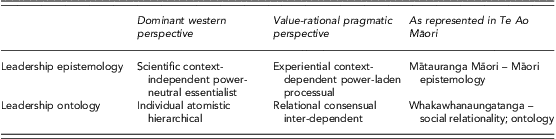
In this section, we discuss a pragmatic view of leadership that gives primacy to relational and social dynamics, as we have viewed them in the practice of Māori leadership described above. We argue that the current thinking of pragmatic leadership remains locked in an instrumental understanding of pragmatism, maintaining the context-independent, power-neutral and dichotomous framework of the subject-object divide, which is ‘widely challenged by non-Western groups’ (Deetz, Reference Deetz1996, p. 194). In particular, we highlight how a pragmatic perspective that involves a value rational ethic to leadership lends itself to a more culturally conscious approach to leadership research and practice.
Our articulation of Māori leadership challenges dominant leadership orthodoxies in terms of how we understand leaders lead. We suggest that Māori leadership represents a different mindset as to the role and responsibilities of leaders away from a linear objective/subject characterisation of a leader, positioned hierarchically above a team, with responsibility for the team's processes and outcomes (Carson, Tesluk, & Marrone, Reference Carson, Tesluk and Marrone2007; Drath et al., Reference Drath, McCauley, Palus, Van Velsor, O'Connor and McGuire2008). Instead the leadership paradigm presented here is processual, contingent and context dependent. It is the taken-for-granted experiences of ‘being’ Māori which influence the embedded structures, collective and individual dispositions, and systems of exchange which play a significant role in influencing leadership practice. A key feature is the context specificity of Māori leadership that provides a culturally contingent frame of reference that is grounded in a different logic to that of Western conceptions of leadership.
This highlights a vital aspect of our argument for an alternate philosophic orientation to that which is currently endorsed by dominant thought regarding leadership theory and practice. In keeping with our value-rational pragmatic approach, we suggest that understanding Māori leadership as being influenced by mātauranga Māori and whakawhanaungatanga, establishes a culturally constituted logic to their activity, which draws us to conceptions of leadership practice that are differently constituted (Table 1). Here, we suggest a value-rational pragmatic view of leadership that rests on a epistemological and ontological foundation of flexibly defined norms that are malleable to different cultural contexts and conceives of a relationship-centred value rational world (Zhang et al., Reference Zhang, Cone, Everett and Elkin2011).
Contrasting perspectives of leadership

Te Ao Māori maintains a processual repository of collective wisdom about the world that takes into account collective meanings; relations between objective structures and subjective constructions; and temporal dimensions such as how meanings and relationships can change over time. This representation of wisdom is, for the most part, historically and culturally consistent with traditions that are pragmatically oriented (Ames, Reference Ames2003; Zhang et al., Reference Zhang, Cone, Everett and Elkin2011). We suggest that a pragmatic perspective of leadership provides better access to the taken-for-granted social constructions, which are located in the varying practices, interests and motives which constitute different communities’ sense making (Bourdieu, Reference Bourdieu1991; Bourdieu & Wacquant, Reference Bourdieu and Wacquant1992). This perspective provides valuable insight when looking to alternative paradigms and contexts, such as a Te Ao Māori with its associated logics, to draw us into the complex and often messy realities of leadership practice.
At its core, and a critical distinction to current understanding of pragmatic leaders, Māori leadership locates the leader self as constituted by their relationships, where their leadership is engaged in the process of bringing their fields of experience into focus. In pragmatism, an ‘individual so construed is not a “thing” but a “patterned event”, describable in the language of uniqueness, integrity, social activity, relationality, and qualitative achievement’ (Ames, Reference Ames2003, p. 407). Importantly, this is a reflection of Aristotle's phronesis, which is an intellectual and moral virtue that develops out of experience and concerns values beyond ‘analytical, scientific knowledge (episteme) and technical knowledge or know how (techne) and it involves judgements and decisions made in the manner of a virtuoso social actor’ (Flyvbjerg, Reference Flyvbjerg2006, p. 370). The virtuoso does not rely on analytical reasoning but intuitively, based on experiential learning, knows the right actions to take in given situations (Flyvbjerg, Reference Flyvbjerg2001). Virtuosos have perfect command of their actions because they know the game so well that they can elaborate and improvise upon the strategies which it provides and in the light of their relations with others (Bourdieu, Reference Bourdieu1977). Leadership requires the ability to discern the significant aspects of a particular situation however complex and difficult it may be and to apply ones’ knowledge, experience and values to their decision making (Roca, Reference Roca2007). The virtuoso leader then is continually renegotiating and, therefore, subtly altering their social relations (Bourdieu, Reference Bourdieu1977).
Thus, at its core, a pragmatic perspective takes its cue from the assumption that social reality is constituted (and re-constituted) by the context of relations, therefore recognising that processes of social construction are temporally and socially constituted (Hosking & Bouwen, Reference Hosking and Bouwen2000; Uhl-Bien, Reference Uhl-Bien2006). Theorising leadership in this way leads us to recognise the interdependent nature of things, placing emphasis on the socialised processes and contexts by which leadership is produced and enabled (Uhl-Bien, Reference Uhl-Bien2006). The Māori perspective outlined here recognises that the construction (and maintenance) of social reality is not only an individual exercise but a collective one (Bourdieu, Reference Bourdieu1989). In the Māori cultural field construction of social reality is bound to a single discursive regime and its inherent power relations, as Bourdieu (Reference Bourdieu1989, Reference Bourdieu1991) has argued what we have are multiple fragmented and changing regimes of power. Therefore, we must attend to the multiple meanings and perspectives that continuously emerge throughout the leadership process.
Implications for organisational leaders
Our findings have practical implications for organisational leaders, providing insight that assist organisations to tailor leadership development opportunities to the competency requirements of the situation. This is particularly so given the increasing diversity of organisational workforces and therefore leaders within intercultural contexts, both domestically and abroad. Accordingly, leadership development should consider a value-rational pragmatic approach, especially when there is leadership responsibility for coordination of complex social interactions.
Pragmatic leaders, employ their personalised knowledge about their roles and relationships, positioning themselves within the changing environments of the organisation by adopting appropriate leadership styles in a specific context. Specifically where leadership is understood as a collective activity where the processes and targeted outcomes are continually negotiated (Ropo & Sauer, Reference Ropo and Sauer2008). The exercise of wisdom in this sense means that a leader is able to include all features of knowledge, experience and virtues to anticipate business situations and decisions in their moral, social and financial implications (Roca, Reference Roca2007). An implication will be to ensure that there is strong support for leaders and those who operate in their community of practice, to have a commitment to and understanding of the interdependent nature of the leadership role.
Limitations and opportunities
Our articulation of Māori leadership that emerged from participant discussion reflects the unique characteristics of Māori business practice and contributes to the performance of Māori businesses. However, despite its contribution to leadership theory and practice, this article is limited in the following aspects, which also draw us to some directions for future research. First, it is important to note that in this article we have focussed on the research participants’ discussion of various aspects of leadership practice in the context of Te Ao Māori. We do not suggest that this is necessarily the best or only way to understand Māori leadership given that Māori operate in both Māori and non-Māori organisations. However, it is important to note that the purpose here is not to produce the Māori leadership model. Rather it is to illustrate an approach to leadership practice that is drawn from the cultural context of Māori and is intrinsically pragmatic. Further investigation might explore practitioner understanding of leadership practice in wider cultural contexts.
Research in this area has identified that the way in which different cultural groups understand the notion of leadership may not necessarily be the same as in the West, but at times they may draw from similar views (Alves et al., Reference Alves, Manz and Butterfield2005). Alves et al. (Reference Alves, Manz and Butterfield2005) highlight the similarity between the relational way of Chinese thinking and transformational leadership which acknowledges the role of social relations. However, as they argue, the most important distinction is whether the notion of relation carries the same meaning in China as in the West. We would also add ‘how’ that notion of social relations is enacted in the different cultural contexts.
The basis of kaupapa Māori research shares common ground with the current movement in leadership scholarship that questions the dominant paradigmatic assumptions, methodologies and associated ideological commitments of leadership theory and practice (Alvesson & Sveningsson, Reference Alvesson and Sveningsson2003; Walker et al., Reference Walker, Eketone and Gibb2006), which offers many avenues of potential research. For example, research at an international level examining indigeneity as a distinctive market position and source of advantage. We suggest that highlighting the distinctiveness of the way Māori utilise relationships in business is one such valuable, but under recognised resource for Māori business primarily because New Zealand's business culture is so entrenched in the Western approach to business relationships. The potential is for Māori socio-cultural values and practices that resonate with other cultures globally to be recognised.
Conclusion
We argue that pragmatic leadership is an approach which is complementary to the ongoing reconstruction of leadership thought that responds to the essentialism/determinism debate. For researchers, it offers a useful alternative approach to the dominant logic that guides leadership research and practice by enabling a methodological approach that gives primacy to relationships and process (Bourdieu & Wacquant, Reference Bourdieu and Wacquant1992; Dachler & Hosking, Reference Dachler and Hosking1995; Ruwhiu & Cone, Reference Ruwhiu and Cone2010). In this paper we have located kaupapa Māori research as enabling researchers to explore leadership practices in localised contexts, particularly those that may be heavily influenced by culturally specific behaviours. At the level of pedagogical methods, we see similarities from attempts in management and organisation studies to incorporate practical wisdom, as interpreted from the Aristotelian view of phronesis, at the teaching/learning ‘interface’ (Clegg & Ross-Smith, Reference Clegg and Ross-Smith2003; Raelin, Reference Raelin2007; Roca, Reference Roca2007). We suggest that by doing so we can engage with the taken-for-granted pragmatism that is more closely oriented to the interdependent and contextual nature of indigenous wisdoms (Ruwhiu & Cone, Reference Ruwhiu and Cone2010; Verbos et al., Reference Verbos, Gladstone and Kennedy2011). In regards to practitioners, it provides a foundation for innovative leadership practices grounded on giving weight to more deeply contextualised processes and relations through cultural exchange.
Apart from contributing to leadership theory development, this article offers an alternative perspective that provides insight into the phenomena and practice of leadership. In the literature, pragmatic leadership is still at an early stage of leadership theory development, but remains a promising approach. This study, exploring pragmatic leadership in a Māori business context, based on our understanding of Te Ao Māori and its associated social norms and pragmatic cultural frame, extends the scope of pragmatic leadership theory into a deeper understanding. We argue that current discussion of pragmatic leadership remain locked in an instrumental understanding of pragmatism, and a key contribution of this study is a deeper understanding of the implicit ethics and underlying sense of responsibility associated with understanding people as embodied in process. That is to say, pragmatic leadership is never morally neutral or socially disconnected. Indeed, we argue that the language and practice of leadership must occur in ways that fit with the cognitive understandings and interpretations that constitute different communities’ sense making.
In this article, we have presented an example of pragmatic leadership, using the epistemological and ontological space of kaupapa Māori, a perspective that represents practice guided by the logic of Te Ao Māori, the Māoriworld. Our purpose in highlighting the culturally constituted features of Māori leadership is, in the first instance, to give sense and explanatory power to the worldviews of indigenous peoples; and in doing so we suggest an approach that offers richer scope and analysis to the content of leadership theory and practice in general. We present this paper as one thread of narrative emerging from the field of Māori business about leadership practice that make sense to Māori. Therefore, we are drawn naturally to features of pragmatism that reflect Te Ao Māori, the effectiveness of which lies in better understanding Māori leadership, operating as it does within a distinctive frame of socio-economic rationality. We offer our approach as a perspective that displaces traditional foundations of what constitutes leadership theory and practice, opening the field up to alternative models and understandings, which ultimately creates new avenues of understanding in the study of leadership. We argue that by opening ourselves to alternative perspectives, and in this instance one with strong connection to its ancient wisdoms, we enable a richer understanding of how leadership as social experience is created and given meaning within forms of organisation that are relevant to people and context.
GLOSSARY

Acknowledgement
This work was supported by a Doctoral stipend from Ngā Pae o te Māramatanga, a Māori Centre of Research Excellence. We are also sincerely grateful to the Māori leaders who shared their thoughts, experiences and vision for Māori development.