Women are descriptively under-represented in legislatures worldwide, but women’s representation varies dramatically across parliaments.Footnote 1 A large literature identifies electoral institutions, political party characteristics and socio-economic factors that appear to explain this variation.Footnote 2 This work usually relies on cross-national – and cross-parliament – data, or over-time examinations of single countries, and evaluates arguments using aggregate measures of women’s electoral success. While this literature identifies empirical regularities in women’s representation, it has been less successful in establishing the underlying mechanisms. In particular, while many theories about women’s electoral success are grounded in the logic of parties’ candidate nomination strategies, those strategies have not, to our knowledge, been examined directly in a comparative context.
Nowhere have the limitations of analyzing aggregate patterns been more apparent than when attempting to disentangle the mechanisms underlying gender disparities in candidate nomination. Prevailing theory attributes variation in women’s descriptive legislative representation – in particular, the tendency for representation to vary systematically with electoral, party and socio-economic characteristics – to gendered candidate recruitment and selection strategies. But it has heretofore been difficult to determine whether levels of women’s representation can be explained by explicitly gender-driven selection strategies or variation in favoritism towards seated incumbents (who are historically men). Given the divergent normative implications and policy prescriptions suggested by these potential determinants of women’s (under)representation, distinguishing between these two potential mechanisms is important. Simple gender quotas, for example, may have little impact on women’s descriptive representation if incumbency is the primary obstacle, while term limits are a cure for incumbency advantage, but not explicit gender bias.
Theoretically, we argue that both mechanisms can explain the aggregate empirical record, and highlight the potential for these two mechanisms to operate both independently and in concert. Empirically, we use disaggregated candidate-level data to conduct a critical test of competing explanations for established gender patterns in candidate selection. As such, our article represents a significant contribution to the gender representation literature, and cuts to the core of the questions of when, where and why women are under-represented in legislatures and the reason women’s representation tends to grow slowly over time. Our study is the first to comparatively and quantitatively assess the simultaneous – and potentially interactive – effects of incumbency and gender bias on parties’ candidate nomination decisions.
We use an extensive dataset of biographies of candidates in the 2009 European Parliament (EP) elections and build explicit structural models of how party leaders construct lists. EP elections display a staggering variety of party organizations and domestic political contexts; therefore our analysis leverages a unique opportunity to examine parties’ candidate nomination strategies with respect to women and incumbents comparatively, while holding the target legislature constant. Despite substantial turnover in the EP, our results highlight the crucial role incumbency plays in parties’ candidate nomination strategiesFootnote 3 and suggest that, given the historical over-representation of men among incumbents, a number of findings in the literature may be best explained by preference for incumbents, rather than explicit gender bias, by party leaderships.
Incumbency overwhelmingly explains list ranks in our data. Furthermore, party and country characteristics that are known to predict women’s representation modulate incumbency bias. To the extent that these factors drive descriptive representation, we find that they act primarily through the mechanism of incumbency advantage, even in party-centered elections. Yet while strong incumbency bias may prevent rapid change in the gender make-up of parliaments, we also find suggestive evidence that left-leaning parties and parties in countries with high levels of female labor force participation value novice women more than novice men, implying differences across parties in the pipeline through which women enter legislatures. Together, these finding suggest mechanisms that may explain cross-national, and cross-party, variation in women’s descriptive representation. Importantly, these findings do not imply that women are equally represented in the EP. Incumbency advantage has discriminatory consequences, and understanding how women are obstructed from public office is crucial to improving the balance in descriptive representation.
COMPETING THEORIES OF GENDER DISPARITIES IN NOMINATIONS
The purpose of our study is to pin down the mechanisms that determine women’s representation in proportional representation (PR) systems: gender-driven selection strategy, incumbency advantage or a combination of the two. Theoretically, it is valuable to describe and trace the empirical implications of the potential mechanisms that link party and country characteristics to gender disparities in legislative representation. Many studies emphasize how incumbency restricts women’s opportunities to run for, and obtain, office.Footnote 4 The current over-representation of men is potentially attributable to historical patterns because incumbents enjoy significant advantages in nomination and electoral contests. Since virtually all incumbents were men well into the post-war era, women struggled to break into the electoral picture. Even today, gender imbalances in parliaments mean that women are often challengers, rather than incumbents. But it is perhaps less well recognized, or at least underemphasized, that electoral features, party characteristics and even socio-economic factors may modulate gender representation by altering how parties weigh incumbency when nominating candidates.
Empirically, we know that electoral institutions, party characteristics and socio-economic factors co-vary with women’s descriptive representation, on aggregate.Footnote 5 But do these variables directly interact with gender to change the calculus of party selectors, or do they change the relative value of incumbents, thus indirectly affecting women’s representation? More broadly, do these aggregate correlations reflect individual candidate selection decisions? The few studies that examine both incumbency and gender in list systems use aggregate data on (re)nomination,Footnote 6 rather than candidate-level observations, potentially introducing problems of ecological inference, and providing no way to trace the mechanisms underlying variation in women’s representation.
Fundamentally, one cannot measure gender biases in candidate selection without accounting for incumbency. Incumbents possess resources that make them strong campaigners and legislators, including increased name recognition, policy expertise, legislative leadership experience and potent legislative networks. Naturally, we therefore expect incumbency to correlate with strong list placement for both men and women. While incumbency advantage is relatively underemphasized in the study of PR elections, it makes sense that parties would, on average, prefer to return experienced legislators to parliament whenever possible. The empirical evidence bears this out: in the 2009 EP election, our list data indicate that 38 per cent of viable candidates were incumbents, compared to 2 per cent of non-viable candidates.Footnote 7
Given the value that parties place on incumbents, the regularities identified in the literature on women’s representation are plausibly explained by incumbency advantage alone. Party leaders may be engaging in gender-discriminatory candidate selection without explicitly taking gender into account. Instead, by favoring incumbents, they continue to propagate historical gender bias within the system over time. If incumbency, rather than gender bias, is generating continued inequalities, we expect to see incumbent women favored just as heavily as incumbent men by party leaders; yet there should be no pattern of preference for men or women among incumbents, or novices. Note, crucially, that many of the known predictors of women’s representation are likely to modulate parties’ incentives to prioritize incumbents. For example, party leaders are likely to prize incumbents more as the number of seats drops because legislators’ name recognition decreases with district magnitude,Footnote 8 and incumbents should therefore enjoy greater marginal advantages over novices at both the nomination and election stages in lower-magnitude systems.Footnote 9 Women may experience higher levels of representation in high-district-magnitude systems simply because incumbency advantage – which has traditionally favored men – is weaker under such circumstances.
However, party leaders may explicitly weigh both gender and incumbency when developing nomination strategies. This relationship could be complementary or interactive. Again, consider district magnitude. Theory maintains that parties prefer incumbents, and men, in low-magnitude districts for roughly the same reason. Specifically, selecting well-known (incumbents) or conventional candidates (that is, men) reduces electoral risk. If both mechanisms are operating in a complementary fashion, then parties will favor incumbents more than novices and will prefer incumbent men to incumbent women, and novice men to novice women, in a roughly proportional fashion. But an interactive story is also plausible. For example, given that women incumbents have already proven their electoral worth, leaders might restrict their gender-specific decisions to novice candidates. So, following the standard story, parties might be reluctant to field women novices in small-magnitude districts because they perceive them to be risky. Less conventionally, parties that consider gender parity an important part of their electoral platforms might actually favor novice women while simultaneously guarding the positions of incumbents, regardless of gender. Under such circumstances, one would find no gender disparity among incumbents but gender would predict novice selection decisions.
Our disaggregated approach allows us to explore how district magnitude, party organization and other identified determinants of gendered candidate selection affect party leaders’ rankings of incumbents and novices. Therefore, we can explicitly examine the role of incumbency in gender bias during candidate selection processes, and disentangle those well-known aggregate patterns in women’s representation that stem purely from incumbency effects from those that potentially have an independent influence on when parties nominate women.
DETERMINANTS OF GENDER DISPARITY IN LEGISLATURES
The literature on women’s representation highlights a robust set of predictors of aggregate gender disparity in legislatures, which we categorize into three broad areas: electoral institutions, party ideology, and organization and socio-economic factors. Many of these predictors plausibly operate through selector bias, incumbency prioritization or both mechanisms.
Electoral Institutions
Researchers have extensively investigated the relationships between electoral institutions and women’s representation.Footnote 10 Perhaps most notably, PR systems featuring high district magnitudes seem to support women’s representation more effectively than systems that use single, or low, district magnitudes.Footnote 11 Even focusing solely on PR systems, there is a strong relationship between district magnitude and the nomination and election of women.Footnote 12 While multiple mechanisms may underpin this relationship, an oft-cited logic posits that high district magnitudes reduce the risk that parties perceive to be inherent in nominating women, because parties can better balance their candidate portfolios in high-district-magnitude systems. Thus existing theory leads us to expect that party leaders in large multi-member districts will strategically prioritize women on their candidate lists more than parties in lower-magnitude regions.
Another strand of the institutional literature explores the role that explicit country-level gender quotas play in representation. These quotas require parties to nominate a given percentage of women. Not surprisingly, researchers have found that quotas encourage parties to select more women, although this does not always smoothly translate into increased women’s representation in office.Footnote 13 Country-level quotas may generate binding, exogenous, pressure on parties to improve women’s nomination rates. Yet quotas will only improve women’s representation if women are in viable positions on party lists, which is rarely required by law.Footnote 14 We thus include country-level quotas in our analysis in order to examine their effects on gender bias and incumbency.
Party Organization and Ideology
Other authors maintain that party organization and ideology affect candidate nomination patterns and, by extension, women’s representation in parliament. Norris, Caul, and Matland and Studlar argue that the degree of centralization of candidate nomination procedures affects parties’ propensity to nominate women, while Hinojosa finds that centralized nominators with more exclusive party institutions sidestep related problems of gendered levels of self-nomination.Footnote 15 More centralized nomination procedures facilitate nominations of women because party leadership can be held directly accountable for disproportionately nominating men to their lists, and furthermore, the center also wields the power to enforce balance. Meanwhile, the gender of party officials may also affect nomination decisions: women in leadership positions should encourage the recruitment and nomination of women.Footnote 16
In addition, party ideology is often cited as another factor influencing candidate nominations. Broadly speaking, left-leaning parties favor the nomination and election of women.Footnote 17 Left parties often represent women better,Footnote 18 depend on women for votes, and ‘make more strenuous efforts to overcome social barriers and to promote female candidates’.Footnote 19 Thus left-leaning parties are thought to be more inclined than right-leaning parties to nominate women. Finally, because we are studying EP elections, we examine the relationship between parties’ attitudes towards Europe and their nomination behavior. Parties that support European institutions may value incumbents more than parties that do not. Therefore, attitudes towards Europe are an important control variable in our analysis.
Socio-economics
Country-level socio-economic conditions may affect parties’ propensity to nominate women. Many authors identify labor force participation as a key indicator of representation in politics.Footnote 20 As a result, we anticipate a positive relationship between female labor force participation and strong list placement for women. Similarly, the extent to which women hold elite positions within government and industry may determine parties’ tendencies to nominate women. We hypothesize that voters in countries where women have proven records as top-level professionals – as managers in private firms and public bureaucracies, and nationally elected office holders – are likely to exhibit limited bias against women.
Data
To evaluate the role that candidate nomination plays in shaping women’s representation, we focus on elections to the EP. Since 2002, all member states have elected candidates according to some form of PR system. Thus our examination focuses on how parties nominate women to PR lists.Footnote 21 While this approach limits the generality of our findings, it allows us to focus on situations in which parties have significant control over the allocation of viable electoral spots.
The sample includes 3,085 candidates from seventy-three national parties in twelve countries: Bulgaria, Czech Republic, France, Germany, Greece, Hungary, Ireland, Italy, the Netherlands, Romania, Spain and the United Kingdom.Footnote 22 Our dependent variable – Candidate Type, in terms of gender and incumbency – is drawn from an original dataset of EP candidate biographies for the 2009 election. Incumbents represent individuals seated in the EP at the end of the previous EP term. While EP incumbents comprise 12 per cent of candidates in our sample overall, when considering candidates in positions likely to win a seat, this figure jumps to 38 per cent.
Meanwhile, European candidates displayed an uneven split between men and women, favoring men: 41 per cent of candidates were women, and this imbalance was exacerbated among candidates likely to win EP seats, where only 36 per cent of candidates were women. In the Appendix, we display gender tallies across the countries in the sample; women range from around 20 to nearly 50 per cent of candidates within each set of country lists.
We supplemented our biographical data with party- and candidate-level information from a variety of sources. We made extensive use of the PIREDEU group’s 2009 European election study,Footnote 23 drawing our measure of support for European institutions from PIREDEU’s EP election manifesto study. We operationalized EU attitudes in terms of the proportion of sentence fragments in the party’s manifesto that the PIREDEU coders classified as pro-integration minus the proportion of sentence fragments that they coded as integration-skeptic.Footnote 24 We operationalize our left–right ideological position measure in an analogous way. We used a narrow operationalization of leadership by women, coding whether or not each party head was a woman at the time of the 2009 election.Footnote 25 We obtained country-level data on party leader gender percentages from the European Commission database on women and men in decision making.Footnote 26
In addition, we used PIREDEU’s candidate survey to measure intraparty candidate selection mechanisms. Specifically, we coded parties according to the average response of their candidates – on a scale from 1 to 5 – to the question: ‘In your party, how important are [National party officials] in the selection of candidates for the European Parliament?’ We coded district magnitude directly from the EP’s electoral returns and collected gender quota information from several sources.Footnote 27 Finally, we obtained female labor force participation rates and elite gender proportions (legislators, senior officials and managers) from the World Development Indicators.Footnote 28
MODELING LIST CONSTRUCTION
We model the list construction process explicitly, using a statistical model introduced by Pemstein, Meserve and Bernhard to examine how parties with varying characteristics, and operating in different contexts, weigh gender and incumbency when building their electoral lists.Footnote 29 This statistical ranking model, which we describe in greater detail in the Appendix, produces coefficient estimates that one can interpret like those from multinomial logit. Indeed, this model is a generalization of multinomial logit that assumes parties make iterative choices from a limited set of potential candidates. We use the model to ask who is near the top of the list, and why, given the menu of candidates on the entire list. Because it is essentially impossible to observe the universe of potential candidates that parties have available to them, we analyze how parties select and rank candidates who have a reasonable chance of election – those candidates we define as ‘viable’, as described in the Appendix – treating all listed candidates as potentially selectable. Thus we assume that the universe of possible nominees to high list positions is captured by each party’s full list. We assume that parties make choices iteratively, and that they consider only the pool of available candidates – those not yet allocated to a list position – at each stage in the selection process. We assume that choices are identically and independently distributed, in the sense that a set of non-varying parameters identically describes the choices at each step, conditional on the remaining list options. Finally, we treat list construction as a decision-theoretic problem, and leave game-theoretic questions to future work.Footnote 30
This approach has limitations because the total pool of candidates is not measurable and could exhibit non-random selection, it does not explicitly model potential list-balancing strategies, and because it ignores interparty contributions to selection strategies.Footnote 31 Nonetheless, while these are important issues requiring future research, we argue that this technique represents a substantial improvement over the standard approach of examining the aggregate characteristics of parties’ elected representatives. In particular, by examining how parties rank candidates, given the choices available to them, we can directly examine their list construction priorities and incorporate the characteristics – gender and incumbency – of individual candidates into our analysis. Crucially, our model leverages individual-level data, thus side-stepping concerns about ecological validity, and focuses specifically on candidate ranking, a key mechanism that theoretically underpins gendered explanations of disparities in descriptive representation in list systems.
RESULTS
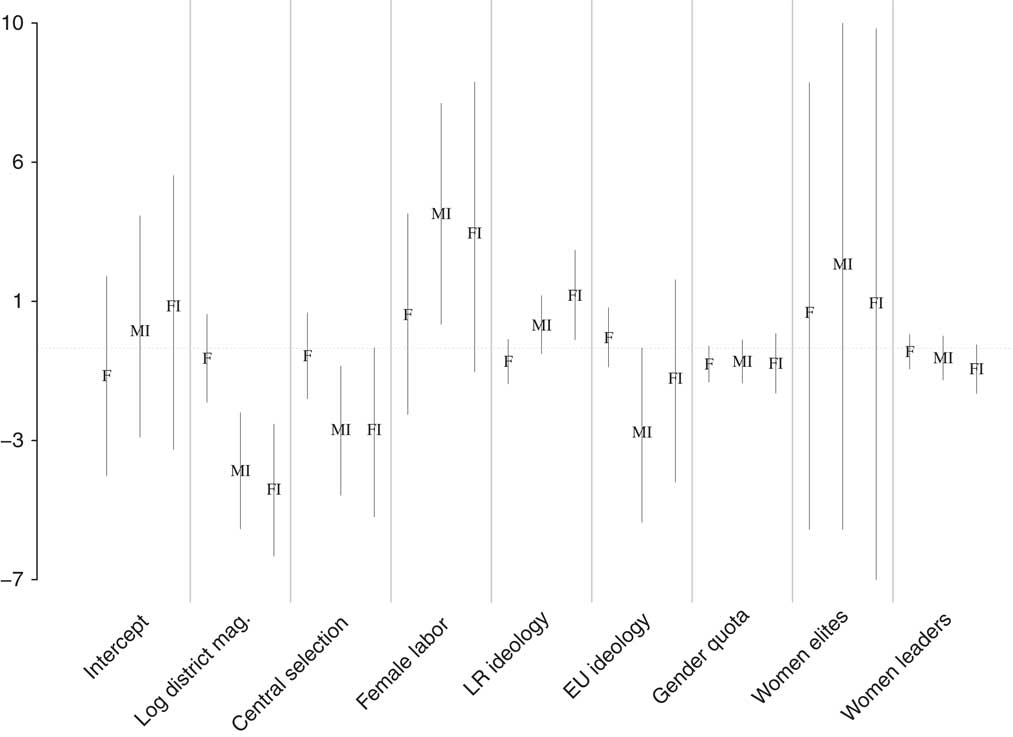
The model generates a set of coefficient estimates for each of the four groups of candidates. Figure 1, which is analogous to a multinomial logit regression plot, displays the model coefficient estimates, treating non-incumbent men as the reference category.Footnote 32 We mark coefficients corresponding to the effects for non-incumbent women, incumbent men and incumbent women with F, MI and FI, respectively, accompanied by 95 per cent credible intervals. These coefficients represent the marginal relative tendency for parties to choose members of one candidate group over another, given an idealized choice between representatives of each type. To help readers visualize all potential contrasts, we replicate Figure 1 for each potential reference category in the Appendix.
Regression coefficients Note: non-incumbent men are the reference category; plotted coefficients describe selection effects for non-incumbent women (F), incumbent men (MI) and incumbent women (FI), relative to novice men.

Figure 1 highlights the central role that incumbency plays in parties’ nomination decisions and provides results consistent with the idea that variations in how parties value incumbents, rather than direct gender bias, may help to explain many of the established results in the literature on women’s electoral representation. Consider, first, the well-known relationship between district magnitude and women’s descriptive representation in parliaments. One can see that parties value incumbents less as district magnitude increases, but that, given incumbency status, there is little difference in how parties prioritize men and women for nomination . Our results show that parties become less likely to nominate incumbents – both men and women – to top list positions as district magnitude grows. In the modern EP, at least, the aggregate relationship between district magnitude and legislator gender operates through incumbency bias.
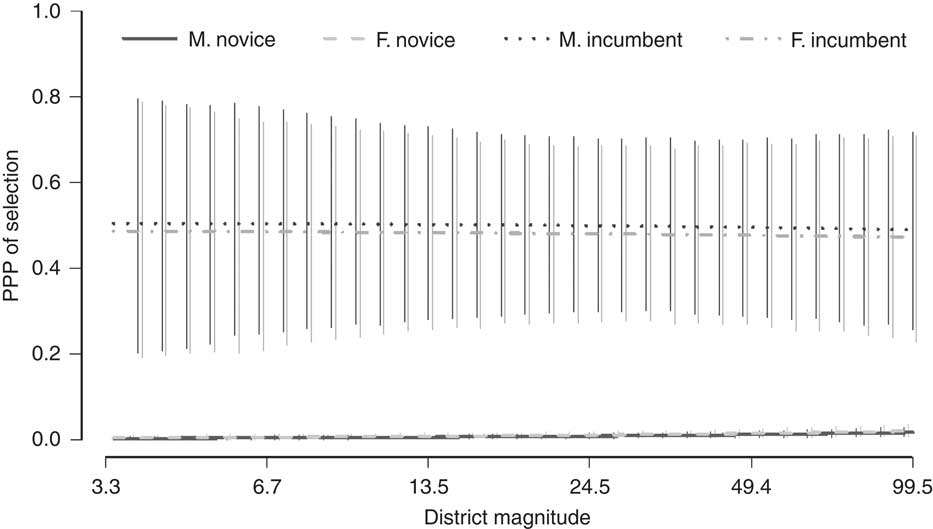
As Figure 2 makes plain, incumbency bias is also exceptionally strong. This result is striking because the EP has a high turnover, and low saliency, compared to national elections. Figure 2 plots posterior predicted probabilities of selecting a particular type of candidate – surrounded by 95 per cent highest posterior density regions (HPDs) – from a typical party,Footnote 33 which faces a choice between all four types of candidates. The predicted probabilities of selecting (non)incumbent men and women are statistically indistinguishable, regardless of district magnitude. But district magnitude does modulate incumbency bias. Parties operating in the highest-magnitude districts in our sample have just over an 8.9 per cent cumulative chance (95 per cent HPD interval=(4.3,14.1)) of prioritizing a novice – man or woman – over an incumbent. In the lowest-magnitude district in our sample, the corresponding predicted cumulative probability is just 0.6 per cent (HPD=(0.1, 1.3)).
The posterior predicted probability of choosing each candidate type, in a four-way contest, across observed district magnitudes

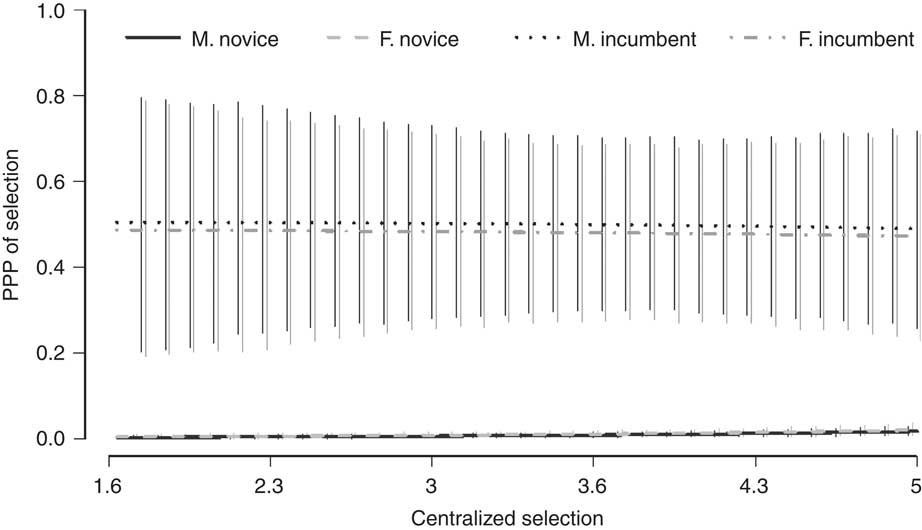
Next, while one might argue that centralized selection structures could help women directly by allowing party leaderships to implement party-wide list-balancing policies, our model finds little support for such a relationship. Rather, as is the case for district magnitude, Figure 1 shows that increased centralization of the nomination process is associated with a reduction in bias towards incumbents, although, as Figure 3 illustrates, this statistically significant marginal effect is, again, substantively small. One possible explanation for this pattern is that incumbents may hold more sway over local selectorates, especially when nominators hail from the same regions as those incumbents.
The posterior predicted probability of choosing each candidate type, in a four-way contest, across observed centralization of candidate selection

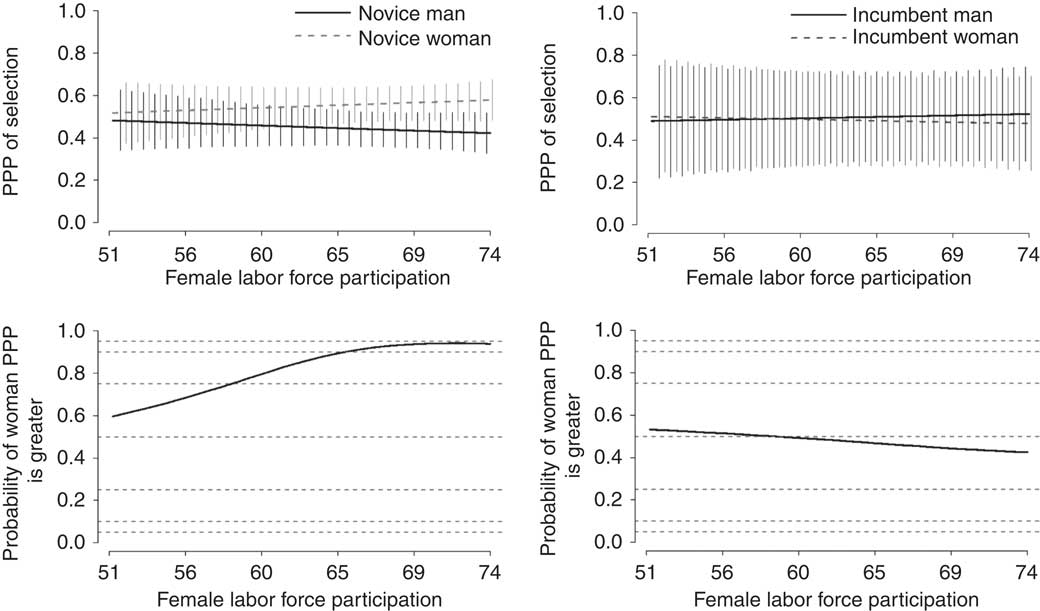
Next, Figure 1 shows that parties prioritize incumbent men over novice men more in countries with high female labor force participation, but this distinction is less clear for women. Figure 4 unpacks these relationships. The upper two panels of the figure plot the predicted posterior probabilities that an average party would choose a man over a woman, as a function of women’s labor force participation. The left-hand side considers a choice between two novice candidates, while the right-hand panels depict a decision between two incumbents. The bottom two panels show the posterior probability that the predicted probability of choosing a woman is higher than choosing a man; they plot the probability that the dashed line is greater than the solid line – taking estimation uncertainty into account – in the panels that they sit below. The dashed grey lines in the bottom panels mark 0.05, 0.1, 0.25, 0.5, 0.75, 0.9 and 0.95 probability levels. Here we see some evidence that female labor force participation predicts how parties rank candidates, based on gender, but incumbency modulates this relationship. In particular, in countries where many women work, we can be quite confident that, among novices, average parties tend to pick women over men. The same cannot be said for average parties in countries where relatively fewer women work.Footnote 34 Thus on average, while incumbency bias is high everywhere, parties in countries where many women work excel at placing novice women in viable positions, which may reflect the influence of public attitudes on party leader calculations. These results are consistent with an intuitive policy interpretation: parties in countries where women’s labor force participation is high have electoral incentives to address long-term gender imbalances in politics, noticeably favoring novice women over their similarly green counterparts. While our main results indicate that incumbency largely explains gender patterns, we show here that parties have differing incentives to ameliorate imbalance over time through the active use of nomination patterns. Indeed, this variance in support for novice women could help explain long-term trends in descriptive representation. Figure 4 also shows quite clearly that, in our data, there is virtually no relationship between female labor force participation and parties’ gender preferences among incumbents. These findings square nicely with standard arguments for why descriptive representation for women is higher in countries with high female labor force participation, and highlights that incumbency status modulates parties’ gender-based selection strategies.
The posterior predicted probability of choosing candidates of each gender, across observed levels of female labor force participation Note: the left panels examine contests between novices, while the right panels depict choices between incumbents. The upper panels depict posterior predicted probabilities, while the lower panels show the posterior probability that the woman is more likely to obtain the nomination.

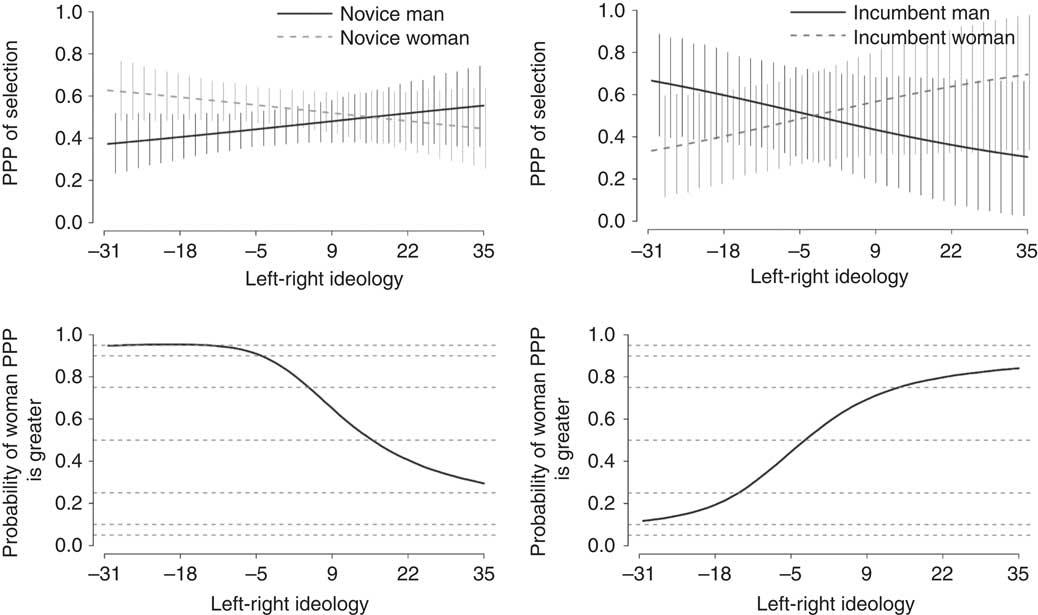
Figure 1 also provides evidence that right-leaning parties exhibit more incumbency bias than do parties on the left. But breaking these results down by incumbency status reveals some interesting patterns. First, the posterior probability that the F coefficient for left–right ideology in Figure 1 is less than zero is about 88 per cent, a finding that is nominally consistent with the argument that left-wing parties do a better job of recruiting novice women to viable list spots than do right-wing parties. The left panels in Figure 5 show that for an average case, the probability that a party chooses a woman over a man ranges from just over 0.6 on the far left to around 0.4 on the far right. Furthermore, on the left side of the scale, there is around a 95 per cent probability that the posterior probability of choosing a woman is actually higher than the probability of choosing a man, and this likelihood decreases substantially on the right side of the ideological scale. For incumbents, this relationship is reversed, although the model predictions reflect substantial estimation uncertainty. Nonetheless, the posterior predicted probability of choosing an incumbent woman instead of an incumbent man ranges from around 0.35 on the far left to 0.7 on the far right. Thus we find suggestive evidence that right-wing parties value their incumbent women – relative to incumbent men – more than parties on the left.
The posterior predicted probability of choosing candidates of each gender, across observed left–right ideology scores Note: the left panels examine contests between novices, while the right panels depict choices between incumbents. The upper panels depict posterior predicted probabilities, while the lower panels show the posterior probability that the woman is more likely to obtain the nomination.

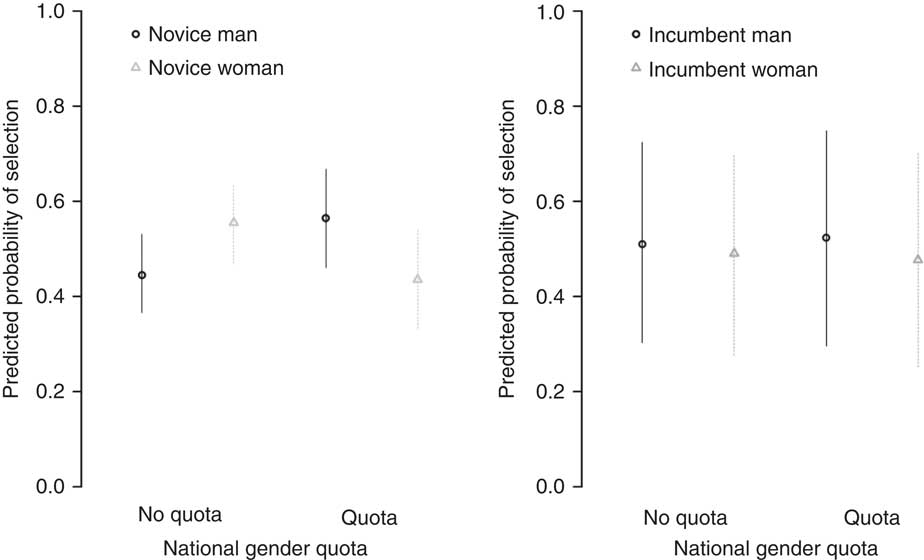
The relationship between gender quotas and candidate choice is somewhat counterintuitive. The posterior probability that the coefficient for novice women in Figure 1 is 0.96, indicating that, among novices, women receive relatively worse placements in countries with quotas. Figure 6 shows that parties in countries with quotas are about 11 per cent less likely to prioritize a woman over a man, in a choice between novices, than parties in countries without quotas. The quotas in our sample generally require parties to place a certain percentage of women on their lists. Unfortunately, we have reasonably strong evidence that parties in these countries do not respond by placing additional women in viable list positions – if they did, our models would find gendered differences in nominations between these quota/non-quota countries. Rather, they may be padding their lists with women who have little chance of winning. Note, crucially, that we find evidence for such behavior even after controlling for other party and country characteristics that should help predict party leaderships’ attitudes towards nominating women. We must temper this conclusion, however, by noting that our sample included no cases of strong quotas that dictate balanced list placement.
The posterior predicted probability of choosing candidates of each gender, by existence of a national gender quota Note: the left panel examines contests between novices, while the right panel depicts choices between incumbents.

Finally, we find little evidence that women’s penetration of elite government or management positions or the proportion of women in party leadership positions affect gendered nomination strategies in the EP.Footnote 35
CONCLUSION
While an extensive literature has examined how electoral, party-level and socio-economic factors help determine women’s descriptive representation in parliaments, the majority of the cross-national empirical work on this topic has examined the proportion of women in national legislators, rather than the nomination strategies of individual parties. Yet the theories that we commonly rely on to explain well-known empirical patterns tend to be firmly grounded in how parties nominate candidates for office. In this work, we have re-examined a number of hypothesized determinants of women’s representation that researchers believe operate through mechanisms based on party nomination strategy, directly modeling how parties rank candidates on lists for EP elections. Just as others have shown that there is little evidence of electoral bias against women after controlling for incumbency,Footnote 36 we find that parties’ nomination strategies appear to place substantially more emphasis on candidates’ incumbency status than on their gender. Across genders, incumbents dominate in their ability to secure list positions, and gender imbalance may be maintained in the system through historical trends favoring the re-election of men. Moreover, among incumbents, we find minimal evidence that parties treat women differently from men.Footnote 37 Therefore, how parties prioritize the nomination of incumbents in PR systems may go a long way towards explaining the relative lack of success of women in varying electoral, party-level and socio-economic contexts.
The substantial incumbency advantage in PR systems means that a key factor in ensuring the long-term expansion of women’s representation is the relative rate at which parties nominate novices to viable list positions. We find that, while oft-cited determinants of women’s descriptive representation in parliaments are largely unrelated to parties’ gender biases in nomination, district magnitude and the centrality of candidate selection do predict relative bias for incumbents. Indeed, even party ideology appears to be systematically related to incumbency bias. These determinants of variation in preference for incumbents could explain much of the over-time variation in the growth of women’s representation around the world. Some parties have strategic incentives that lead to higher candidate turnover than others; thus women have entered politics more quickly where parties have been willing to provide novices with viable candidacies. While our strongest results point towards incumbency bias as the main driver of variation in descriptive representation across genders, we do find some suggestive evidence that certain types of parties play favorites between men and women when faced with a choice between novices.
Clearly, our study is cross-sectional and cannot speak directly to temporal trends. Moreover, European parties may have once sported gender biases when nominating candidates that have attenuated over time. But, by directly probing the mechanism underlying well-established explanations for empirical regularities in women’s descriptive representation, our work provides a strong justification for developing a research agenda that teases out the distinctions between party leaderships’ incumbency and gender biases over space and time. Current results, based on representation rather than nomination behavior, simply cannot differentiate between these two mechanisms. Nor can aggregate patterns cleanly speak to individual nomination decisions. Furthermore, the policies that we should adopt to reduce disparities in descriptive representation depend on which mechanism best explains patterns in the data. In particular, strategies designed to reduce gender bias among party selectors are unlikely to bear fruit if differences in representation are driven largely by a preference for incumbents. Similarly, percentage-based gender quotas are unlikely to put women in office, even in the absence of actual gender bias among selectors, in contexts where incumbents are particularly valuable. While term limits would go a long way towards altering gender disparities in legislatures if incumbency bias is the primary culprit, the same would not be true if, contra our results, gender-specific considerations dominated parties’ nomination procedures. And only certain policies, like mandated list zippering, where parties are forced to alternate men and women in successive list positions, would be effective regardless of mechanism.