Language is an essential human ability for socio-cultural behavior: it enables collaboration and planning; it allows people to share knowledge; and written language regulates social behavior and stores knowledge over long periods. Consequently, language is a central functional element in humans’ cultural niche (Clark, Reference Clark2005). However, language is complex. Most languages have tens of thousands of words; the acoustic signal is variable and context-dependent; speech production requires sophisticated articulatory coordination; and sentences obey rules that are fundamentally hierarchical, but that must be processed linearly as the sentence unfolds over time. Consequently, it is not yet clear how people learn and use this function.
A mission of psycholinguistics is to understand the cognitive mechanisms that support language functions common to all individuals. This is largely a theoretical enterprise, carried out via experimental work on what we term the modal listenerFootnote 1 —typical hearing, healthy, neurotypical, monolingual, and young adults. This enterprise assumes a universal form of language that most people have to ask how this ideal form of language works. This nomothetic goal treats individual differences as error variance that, as Scarr (Reference Scarr1992) noted, derives from what Ernst Mayr called the typological (Platonic) approach in biology, that “abstract[s] typical patterns and ignore variations” (p. 1).
Psycholinguistics often takes a reverse-engineering stance to ask how people solve the computational problems posed by language. For example, in speech perception listeners must overcome variability in the signal to identify phonemes (McMurray & Jongman, Reference McMurray and Jongman2011); or in sentence processing, they must recover thematic roles from a temporally unfolding sentence (Altmann, Reference Altmann1998). It assumes most people solve such problems with similar mechanisms.
However, language is not a fixed target. It is a cultural achievement which varies geographically and socially (different languages, dialects, etc.), and over time (language change). Thus, the systems that support language must be flexible to adapt to changes in the cultural environment (the niche) and to developmental changes in cognitive functions that language draws on. This flexibility results in inherent variation in the way individuals acquire and use the language of their community, which results in variation in levels of functional performance (individual differences).
One consequence of these differences is that few qualify as a modal listener. As many as 12% of children can be diagnosed with developmental language disorder (DLD; Norbury et al., Reference Norbury, Gooch, Wray, Baird, Charman, Simonoff, Vamvakas and Pickles2016; Tomblin et al., Reference Tomblin, Records, Buckwalter, Zhang, Smith and O’Brien1997), characterized by poor language in the absence of other causes throughout the lifespan (Clegg et al., Reference Clegg, Hollis, Mawhood and Rutter2005). Similarly, high numbers of children struggle with reading (Catts et al., Reference Catts, Tomblin, Compton and Bridges2012). Multilingualism is increasingly the norm worldwide, and multilinguals often vary widely in proficiency and use of each language (Hoff, Reference Hoff2018). Moreover, everyone goes through a period of premature language (childhood) and cognitive decline (aging). And, there are other groups: children with hearing loss, people who use manual languages, autistic individuals, etc. The focus on the modal listener to the exclusion of these groups means that most language use falls outside the purview of psycholinguistics.
Applied psycholinguistics has often adopted a parallel mission: to understand how the mechanisms of psycholinguistics work in these more variable real-world contexts and to harness this understanding to improve outcomes. Applied psycholinguistics often adopts the implicit approach of characterizing a population or context in terms of its deviation from the modal case—what makes this group or context different? For example, language disorders are often framed in terms of a profile of skills that are impaired relative to the modal listener.
This manuscript challenges this framing. The modal listener is rare and represents a special case of language use within a limited cultural niche. Consequently, framing the mechanisms of language processing in terms of universals may be counterproductive. Instead, a more fruitful enterprise may be to ask how individuals from variable groups or contexts solve core language problems. That is, instead of asking how well a child with DLD perceives speech, we should ask how a child with DLD approaches the problem of acoustic variability, without treating these differences as defective. In this argument, we echo calls by Kidd, Donnelly and Christiansen (Reference Kidd, Donnelly and Christiansen2018) that “mapping [individual] variation in both candidate mechanisms and the target system is crucial to theory building and testing” (p. 156). However, we further argue that the “deviation from modal” approach does not capture the relevant dimensions and hampers scientific understanding of language mechanisms. Instead, this variation needs to be viewed as fundamentally important to the maintenance of adaptive flexibility, and mapping this variation provides a deeper understanding of language function than work focused on the modal listeners.
This goal can be obtained by joining a normative theory of health and medicine (that specifies how cultural values are applied to functional variance) with a mechanistic functional or emergentist framework for explaining cognition. We build this case in several steps. In contrast to traditional or naturalist approaches in the philosophy of medicine, a normative view argues that ill health or disorder is not an objective deviation from the norm, but the fit between a person’s function and socio-cultural expectations. Naturalism is coupled to a mechanistic functionalist view of cognitive science, which argues that the relationship between a function (e.g., language production) and a set of lower-level mechanisms (e.g., activation and inhibition) is inherently multi-determined, and thus, we cannot directly apply cultural value judgments about a function onto differences in mechanism.
This synthesis, what we term mechanistic functional normativism, calls for new research approaches in applied psycholinguistics. One barrier in achieving this view of language is an over-reliance on a particularly narrow construct of measurement. We propose an alternative processing-based approach that focuses on how variable listeners approach the problems of language. This harnesses the variability among language users and contexts of language use while embracing the culturally defined nature of disorders and the partial indeterminacy of the mapping between mechanism and function. It can help arrive at deeper principles that characterize this diversity, and we illustrate this with our own work on language and hearing disorders and development.
Positionality statements
Bob McMurray is a cisgender, monolingual, middle-class white male—a “modal” language user. He was trained as a cognitive scientist at private universities where the intellectual tradition stressed the universality of language processing, valued theoretical research, and downplayed real-world application and disorders. He is a tenured professor at a public university where exposure to research in speech and hearing science prompted him to embrace the diversity of language users and the need to address real-world problems.
Keith S. Baxelbaum is monolingual, neurotypical, and within the age range typically targeted as the modal listener. He has conducted work within the classic, naturalistic psycholinguistic tradition, including multiple studies that contrast groups against the modal—such as work on people with aphasia, cochlear implant (CI) users, and children.
Sarah Colby is a monolingual, neurotypical woman with normal hearing, also a modal listener. She completed her undergraduate and graduate training in predominantly bilingual institutions and cities in Canada. She is currently a postdoctoral scholar and has conducted studies that use young, normal hearing, monolingual adults as the baseline for comparison (to older adults and individuals with hearing loss).
J. Bruce Tomblin is a straight white male who grew up in Southern California in a community with a large Mexican culture. His mother was English–Spanish bilingual who taught first grade in a bilingual setting. He studied psychology as an undergraduate where he became interested in the communication challenges of children with autism. This led to a graduate education in speech-language pathology. During his 50-year career, his research has focused on the causes and consequences of DLD, leading him to investigate the philosophical foundations of the notion of “disorder.”
Language health and well-being: insights from philosophy
The naturalist tradition
Psycholinguistics typically focuses on what is considered “normal” language function. Exceptional cases may arise due to stage of life (prematurity or decline), but it is assumed that at some point, most people are at universal competency. Exceptional cases like brain damage or DLD reinforce the idea of a universal capacity. When exceptional cases arise due to context (e.g., deprivation from hearing loss, late exposure to a second language), they are viewed as differences imposed on the system, not core to language.
Language disorders illustrate how this approach shapes the scientific enterprise. The assumption is that language mechanisms are defective. Consequently, understanding language disorders depends upon a theory of normal, unimpaired mechanisms. While modal listeners exhibit differences, these are seen as benign noise and distinct from disordered language.
This standard view of language is consistent with a dominant family of views in the philosophy of medicine called naturalism. Boorse’s Biostatistical Theory of Health (BTH) (Boorse, Reference Boorse2014) holds that health and ill health can be established via culturally value-free scientific knowledge of the proper design of a biological system. For example, the heart has design principles that allow it to move blood through the body; when something impedes these functions, disease results. This echoes descriptions by Chomsky (Reference Chomsky1976) of a “language organ… a common human possession, varying little across the species… apart from very serious pathology.” A naturalist applied psycholinguistics suggests that by understanding how normal language works, we can determine the design principles of the language organ and define disorders in terms of how this organ can be broken. This has been a prominent assumption in speech-language pathology, which has sought to find defective language systems (Rice & Wexler, Reference Rice, Wexler and Rice1996; Van der Lely, Reference Van der Lely1998) and even defective language genes (Newbury et al., Reference Newbury, Cleak, Banfield, Marlow, Fisher and Monaco2004).
Critical to this enterprise is a definition of normal. In many physiological conditions, a disease state may be readily observable or qualitatively different from healthy. In contrast, language disorders offer few uncontroversial markers (Leonard, Reference Leonard1991; Tomblin & Zhang, Reference Tomblin, Zhang and Tager-Flusberg1999). However, according to Boorse, health can be defined in terms of normal fitness, as the statistical central tendency of the ability to survive and reproduce. Ill health occurs when statistically subnormal functional levels threaten that. This fits with common definitions of language disorders as the lower tail of the distribution of ability (Tomblin et al., Reference Tomblin, Records and Zhang1996).
The BTH view has been critiqued with examples of health conditions that violate this position such as hypertension or cognitive decline that affect large numbers of people. Some have noted (Thorell, Reference Thorell2021; Tresker, Reference Tresker2020) that BTH is intended to define health in an abstract idealized form, and thus, these counterexamples do not apply. This is analogous to Chomsky’s ideal language users who in principle can handle things like infinitely recursive syntax that few humans can in practice.
The naturalist account has responded to these critiques by expanding the notion of functional fitness beyond the ability to survive and reproduce to any traits selected by natural selection (Griffiths, Reference Griffiths1993). This allows health to be defined without the need for human values (but see Green et al., Reference Green, Levy and Bechtel2015). The evolutionary naturalist account is severely challenged by language, given the diversity of communication systems and how they evolve. For example, by this view, hearing was subjected to evolutionary selection, so hearing impairment is an illness. However, the Deaf community—which has undergone cultural evolution to develop manual languages—denies this (Lane, Reference Lane1995). Similarly, reading has a short history and cannot be the product of biological evolution. Yet, in many cultures children who struggle to learn to read are viewed as having a disorder. Moreover, diachronic language change may also respond to evolutionary selection, as languages change faster than biological organisms (Christiansen & Chater, Reference Christiansen and Chater2008), making evolution a poor basis for characterizing the ideal language user.
More broadly, traditional psycholinguistics was supported by the notion of universals across all human languages, which again seem to fit with a biostatistical version of naturalism. However, the diversity of languages may far exceed any similarities (Evans & Levinson, Reference Evans and Levinson2009). Beyond traditionally core areas of linguistics, domains like gesture, prosody, and reading show even greater diversity in these systems and their importance for success. This undermines the idea of a normative or ideal version of language with which to compare any individual.
Normativism
The naturalist attempts to define health free from human values may be uniquely poor for language. A promising alternative is the normativist view that argues that health is evaluated relative to cultural values, rather than on objective physical bases (Goosens, Reference Goosens1980; Margolis, Reference Margolis1976). While an extreme version argues that health states are entirely social constructs with no ties to natural science (Szasz, Reference Szasz1960), most normativist views emphasize a role for natural science and cultural processes.
A useful approach distinguishes between concepts of disease and illness (Engelhardt, Reference Engelhardt1975; Nordenfelt, Reference Nordenfelt2006). Illness is a disvalued state resulting in suffering or incapacitation by the individual. This judgment is grounded in the values and goals of specific cultures. Thus, illness is a limitation of desired function, but what is desired could differ in other times or cultures. In contrast, disease represents an explanatory account of how suboptimal function arises based on knowledge from natural science (biology and psychology).
Many differences in language that impair function (academic/professional achievement or social engagement) do so based on culturally defined expectations, not deficits in physical substrates. They are illness, not disease. For example, what constitutes poor reading in a highly literate society differs from in less literate societies. Moreover, thresholds change across time: mean reading scores of US 9-year-olds increased from 1971 to 2020 (National Center for Education Statistics, 2021), so an age-typical reader in 1971 would fall below age level in 2020. Although the substrate (reading ability) remained similar, the cultural context changed the functional ramifications of that ability level. In this context, differences in language ability may be seen as illnesses relative to the culture. In a highly literate culture, difficulties decoding multi-syllabic words may be an illness (dyslexia). However, that same failure may have a negligible cost in a culture with a logographic writing system, or in which oral abilities are more valued. In a highly bilingual society, an immigrant with more limited skills in their heritage language might be disadvantaged, but in society of predominantly heritage speakers, this may not be problematic.
Under this model, a claim that language skills are disordered (an illness) is not a claim of some fundamental difference from an ideal (biological or evolved) state; rather we are applying social values to that person’s performance, specifically that their abilities are not well suited to the demands of their cultural niche and their well-being may be compromised. This does not minimize the challenges people with language illnesses face: their skills are not aligned to their culture’s demands, and they may benefit from support. However, we are also not claiming that the mechanisms that contribute to this function violate some ideal design principles. A person with a particular constellation of language processes could be disordered in one niche, but not another.
The question, however, is how to apply this perspective. We see two opportunities. First, the difference between disease and illness is informative. Psycholinguistics has traditionally studied mechanisms that solve language problems such as learning words or parsing sentences. Differences among these mechanisms can be studied to understand the nature, range, and etiology of differences (analogous to the disease construct) without implying difference in cultural value (the illness construct). When cultural values are defined, we can relate differences in mechanism to these values, but in a narrow, culturally relative way.
Second, the diversity of language suggests there may not be one best way to solve the problems of language. In a system where language is changing and learners are adapting, there are likely multiple approaches to any given problem, and in different contexts, language users might adopt different solutions. In this way, it is of tremendous value to study language disorders and differences not through the lens of what makes a group different from modal, but rather to identify systematic variation in how language problems are solved.
However, this framework requires that we recognize that language functions arise from basic neural and cognitive mechanisms that can perform flexibly and variably. The operations of these mechanisms in an individual are not inherently healthy or diseased, but rather they take values by their role in causing disvalued function. Thus to flesh out this normative paradigm with regard to health, we must also ask what constitutes a mechanism and how we characterize it. This is the domain of functionalist perspectives from the philosophy of cognitive science.
Mechanistic functionalism
The normativist account adopts a looser relationship between mechanism, function, and disease state. This requires an explanatory theory of mental functions like language. An extensive literature in functionalist philosophy offers a start by treating mental states and processes as functions that are understood by what they accomplish.
Traditional functionalism (e.g., Cummins, Reference Cummins1975) argues that a given function can be explained in terms of smaller underlying—but related—functions. For example, blood circulation (a higher-level function) is explained by the heart pumping and arteries dilating (more basic function, but both relevant to circulation). Closer to home, Baddeley’s (Reference Baddeley1992) influential model suggests that the function of working memory is served by subfunctions like a phonological loop (for speech representations), which itself contains subfunctions for temporarily holding information and a rehearsal system for maintaining it. Each subcomponent supports the broader functional goal, and higher-level constructs like capacity are explained in part by the functional constraints on the subcomponents.
More recent cognitive science has sought explanations more closely rooted in the fundamentals of neuroscience (Rumelhart et al., Reference Rumelhart and McClelland1986; Westermann et al., Reference Westermann, Mareschal, Johnson, Sirois, Spratling and Thomas2007). Here, fundamental operations include activation, inhibition, and synaptic potentiation/depression (among others), and cognitive function is emergent on these simpler mechanisms. Critically, the constraints operating on these mechanisms may be independent of language function (e.g., biophysical constraints on the decay of activation); multiple mechanisms may simultaneously contribute to any given cognitive/language domain; and any given mechanism may be involved in multiple domains. In the cognitive science literature, this has been termed emergentism (McClelland, Reference McClelland2010; McClelland et al., Reference McClelland, Botvinick, Noelle, Plaut, Rogers, Seidenberg and Smith2010) and related to a form of functionalism termed mechanistic functionalism (Bechtel & Abrahamsen, Reference Bechtel and Abrahamsen2005; Bechtel & Richardson, Reference Bechtel, Richardson, Beckermann, Flohr and Kim1992; Craver, Reference Craver2001; Glennan, Reference Glennan1996). This approach accepts strong causal relationships between psychological processes and lower-level cognitive (and ultimately neural) mechanisms. Thus, it retains the notion of functions embedded in higher functions; however, each level is built on an array of mechanisms that may serve multiple functions and ultimately may be constrained less by the required overall function (language) than by physical structure. That is, there is not a one-to-one mapping between observed function and lower-level subfunctions and mechanisms.
A synthesis
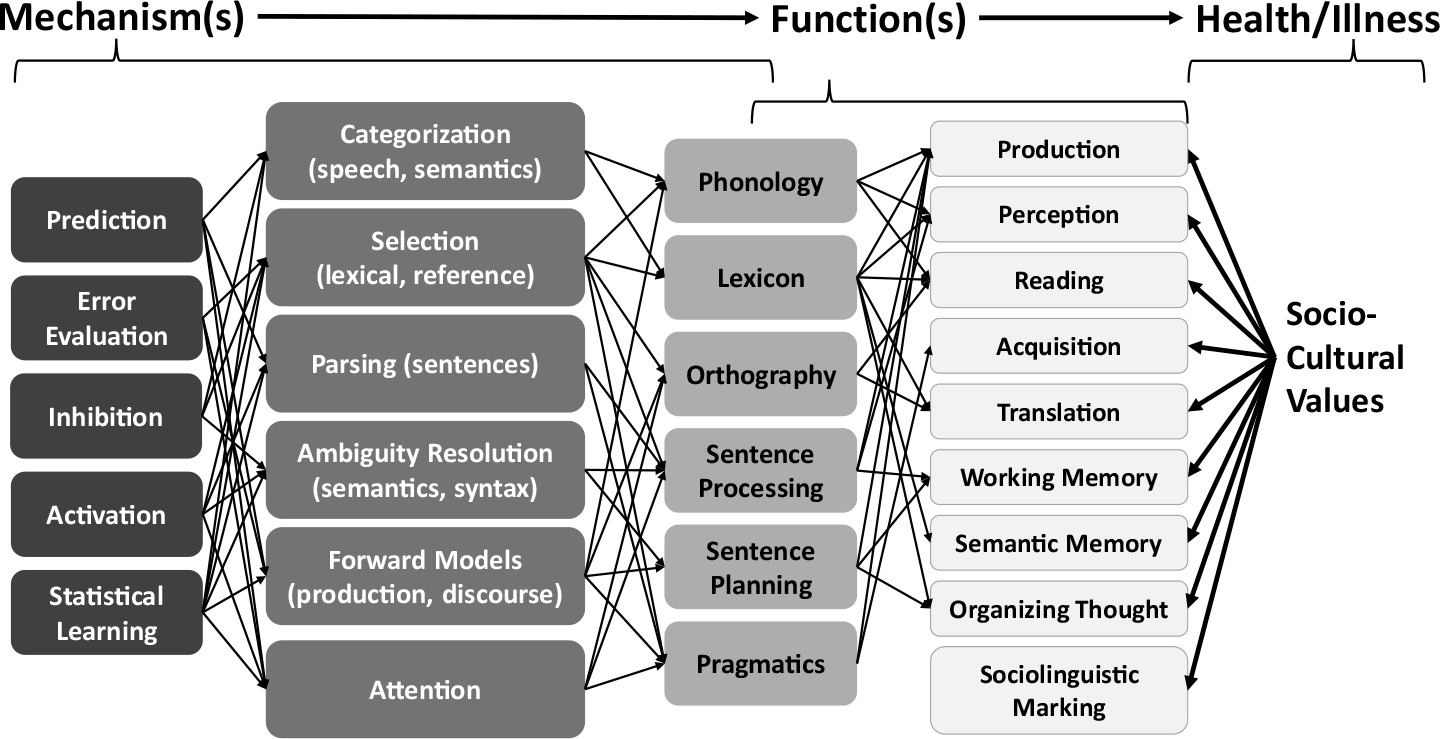
A synthesis of a normative approach to health and disease with a mechanistic functionalist account provides a useful model for explaining language health and illness. As shown in Figure 1, underlying mechanisms support a variety of language functions that are ultimately subjects of social evaluation. Variations in the operations of the basic neural and cognitive mechanisms result in variation in languge functions that are likely to influence the well-being of the language learner/user. However, it may be difficult to trace back an illness to a particular mechanism, and conversely, variation in a mechanism like activation or inhibition (which may vary for reasons completely independent of language) may not be directly classifiable as a disease state. This makes it challenging to think of a one-to-one mapping between mechanism (disease) and illness (social fit), suggesting the need for a normative model of health. We refer to this approach as a mechanistic functional normativist (MFN) model.
Mechanistic Functional Normativist (MFN) model of language disorder. Here, language is built on lower-level mechanisms (ultimately grounded in the brain) that are independent of language function. These give rise to traditional mechanisms of psycholinguistics, each of which in turn support multiple traditional subdivisions of language, traditional targets of measurement in applied psycholinguistics. Ultimately, these support a diversity of true language functions like perception, production, translation, and so forth. Socio-cultural needs can impose values on them, as a form of illness or health, but this cannot always be attributed in a one-to-one manner to specific subfunctions or mechanisms. Note that specific mechanisms and functions are not meant to be exhaustive and the particular arrows are not to imply a specific theory of language.

Applied psycholinguistics in an MFN framework
The psycholinguistic literature (including our work) often tacitly embraces a naturalist perspective, framing differences among people in terms of deviation from the modal listener. This falls naturally out of research questions about differences between populations: What aspects of language are weak in people with DLD? How does language degrade late in life? Applied work also often tacitly embraces traditional functionalism, assuming a one-to-one mapping between functions like syntax and mechanisms like universal grammar.
While an MFN approach to psycholinguistics is appealing, it is less obvious how to pursue the scientific enterprise in this framing. We emphasize three key issues that provide insight. First, an over-reliance on measurement as a metaphor is problematic. Second, a focus on process may be more fruitful. Third, we must embrace variability across diverse populations to arrive at deeper insights. Broadly, instead of focusing on impairments or differences from modal listeners, we should harness the conceptual and empirical tools of psycholinguistics to look afresh at a variety of types of listeners and ask how they solve the basic problems of language given their own cultural goals and capacities.
Traditional measurement models are limited and culturally bound
In language, psychometrics has traditionally been the primary tool of applied fields like speech pathology and education. Psychometric measures attempt to estimate a latent trait that is stable, and error is viewed as state effects (difference in the moment). As tests are designed to evaluate people relative to cultural norms, such instruments should ideally emulate the culturally important functions and language of the likely examinee. Psychometrics has focused typically on individual differences (an ideographic perspective) with less interest in the mechanisms of how a trait is realized at the moment of test (the goal of psycholinguistics).
In contrast, traditional psycholinguistics emphasizes experimental methods coupled to theory to explain the universal mechanisms of the modal language user (a nomothetic approach). It focuses on constructs or mechanisms assumed to be common across the people, and thus, variation among participants is viewed as measurement error. Such experiments employ highly controlled manipulation of independent variables to observe their effects. Thus, the methods are not required to emulate real-world tasks or functions and can be quite contrived.
This paradigmatic division is as old as psychology: Cronbach (Reference Cronbach1957) noted that at the time, research methods in psychology either employed experimental or correlational methods and that the problems and knowledge addressed by these paradigms were quite distinct. He argued for a need to merge these methods (Scarr, Reference Scarr1992); yet even now, these disciplines remain separate. Applied psycholinguistics has attempted to bridge this, using the tools of psychometrics alongside experimental work on mechanism. To establish membership in a group (e.g., language disorders) or capture variability, applied psycholinguistics must use psychometric approaches. But to make claims about mechanistic differences, it must relate these to experimental measures.
This appears to be exactly what is required by an MFN framework, which distinguishes between explanations concerned with how mechanistic operations yield functional products and how these products provide socially valued utility to the language learner/user. However, these two types of explanation must be linked, as we want to use the mechanistic accounts to explain the functional utility. Unfortunately, current research paradigms are not well suited to this because they often fail to acknowledge the indeterminacy between social value, function, and mechanism—the key insight of MFN. This can occur for two reasons.
Measurement creep
One source of this difficulty is when the measurement paradigm creeps. Within naturalist psycholinguistics, psychometric measures are pervasively reified as unambiguous indicators of latent constructs, and the ease and sense of rigor when talking about measures (rather than experiments) can lead researchers to think of everything as a measure, as opposed to thinking of tasks situated in a context. This can lead a conceptual framework rooted in psychometrics to talk about everything as a measure, even experimental tasks that lack that psychometric grounding. This “measurement approach” creates several problems.
First, the availability of a standardized instrument can reify the constructs the measure was intended to explore. For example, working memory is often seen as a separate “box” or function from language, even as modern psycholinguistics views it as an emergent property of language itself (Diachek et al., Reference Diachek, Blank, Siegelman, Affourtit and Fedorenko2020; MacDonald, Reference MacDonald2016).
Second, the measurement approach pushes us to conceptualize an underlying trait (language) in terms of scalar values along a dimension. This is not unreasonable for measures like vocabulary or reading where population norms are available. However, in an MFN framework we must remember that these are not truly objective—this scale is relative to cultural norms (which may yet be useful for identifying illness). It makes less sense when talking about something more theory-based like phonological organization or sentence parsing strategies.
Third, the appeal of a measurement framing often leads it to be used even when it makes no sense. We have described (and heard others describe) sophisticated experimental paradigms like the visual world paradigm (VWP) or categorical perception as “measures.” What are they measuring? What scales do they reflect? These are not measures in any real sense, but complex tasks intended to evoke an effect matched to an underlying mechanistic theory of processes like lexical access or speech categorization. These tasks are not direct measures of constructs but indirect operational tools that relate to underlying processes or mechanisms. Moreover, even if they can be conceptualized in this way, tasks are often designed to minimize individual differences (to capture experimental effects) making them psychometrically unsuited for measurement (Hedge et al., Reference Hedge, Powell and Sumner2018).
Psychometric measures of language are cultural products
Language is fundamentally a skill for navigating the broader culture, and consequently, attempts to measure it are culturally bound. Part of the issue is that language is large. We can’t assess vocabulary by quizzing a child on all words. Thus, we operationally define vocabulary size with a subset. Operational definitions are couched within a cultural milieu that affects their interpretation. For example, a British vocabulary test might show lower-than-expected scores for American children. However, this may be because the assessment is biased toward British English—words like lorry or biscuit are not used or are used differently in American English. Similarly, an assessment of sight-word reading used in our lab includes yacht. Poor reading of yacht could arise because some children (from low-SES backgrounds or landlocked places) are less likely to know what a yacht is.
The best tests overcome this with a large range of carefully selected items, with scoring metrics that count either truck or lorry as correct, or include dialect-specific pronunciation guides. Skilled assessors often know this implicitly, but too often assessments are used “off the shelf” and without much thought. The point of these examples is not that testing is futile, but that any measure is making culturally grounded judgment in what items best sample a given set of language skills. This is reasonable for diagnosing a culturally grounded illness, but less so for diagnosing cause (disease). These issues compound when comparing across populations (e.g., developmental disorders, many forms of multilingualism, and sensory impairments). It may never be possible to derive a common measure that is appropriate for everyone. However, a functionalist framework offers a path forward without just throwing away these tools: rather than thinking of measures as reflecting underlying mechanisms (disease), they represent the fit of that individual’s skills to the cultural values of the measure (illness). Thus, common measures may be useful, but their meaning differs from the usual interpretation—they have positionality.
For example, research with young Brazilian street vendors shows how traditional math assessments drastically underestimate these children’s math abilities (Carraher et al., Reference Carraher, Carraher and Schliemann1985; Saxe, Reference Saxe1988). These children had limited formal schooling but used math regularly in their daily lives. Standard measures assess performance in terms of computations from numerical notation (e.g., 42 + 36 = ___). The Brazilian street vendors struggled with such measures. However, when similar levels of math reasoning were embedded in word problems with familiar contexts, they performed better. The underlying difficulty these children faced was not a lack of ability, but a disconnect between that ability and the notation being tested. These highly skilled children would likely perform poorly in an American 4th grade classroom, and conversely, American 4th graders would likely perform poorly as street vendors. That is, an assessment may be valid as an indicator of the math skills relevant to a cultural context (American schools), even if it is a poor measure of competency.
Performance on a measure is a product of complex psychological processes
It is uncontroversial to argue that a measure reflects multiple constructs. We worry, for example, about whether tests of language ability are collinear with general intelligence (Dennis et al., Reference Dennis, Francis, Cirino, Schachar, Banres and Fletcher2009). Yet, once a measure is in use it tends to be reified as a construct.
For example, reading fluency assessments are common tools to quickly index overall reading ability in elementary school. Typical fluency assessments give a child a list of words or a passage. Fluency is how many words they correctly read aloud in a fixed time, and is treated as a measure of how well the child reads. However, fluency is a product of many skills: word recognition, decoding, and even skills that are indirectly related to reading (if at all), like articulation ability, speech rate, or oral language. Yet fluency has now been reified as one of the five “pillars” of reading (Cassidy et al., Reference Cassidy, Valadez and Garrett2010)—it is now being explicitly taught as an independent skill that can improve reading. Thus, the reification of a highly multi-dimensional outcome like fluency as a causal mechanism can lead people astray as to the underlying nature of any difficulties with real-world consequences. For example, a teacher may intervene to support fluency—hoping to improve reading as a whole—while neglecting other sources of difficulty (such as a need for language support) or the true cause.
This reification is clearly seen in assessments of speech-in-noise perception. In the last few decades, hearing science has increasingly moved to what are considered ecologically grounded tests of sentence recognition in noise (e.g., Spahr et al., Reference Spahr, Dorman, Litvak, Van Wie, Gifford, Loizou, Loiselle, Oakes and Cook2012) in which listeners hear a sentence in noise and repeat it back. Accuracy is treated as a measure of speech perception. This nicely resembles frequently encountered real-world situations. However, this task is identical to sentence repetition tasks widely seen as a gold-standard measure of high-level language in children with language difficulties but who have normal hearing (Klem et al., Reference Klem, Melby-Lervåg, Hagtvet, Lyster, Gustafsson and Hulme2015), a completely different construct.
What’s going on? Repeating a sentence requires many skills: speech perception, word recognition, sentence processing, sentence planning, lexical selection, production, and of course, hearing. For a middle-aged adult with hearing impairment, much of the variance might arise from speech perception. In contrast, for a developing child or a person with a language disorder, much of the variance might arise from vocabulary or grammatical skills.
This becomes problematic when these things covary. For example, many people with hearing loss are older. In the face of cognitive decline, what was thought of as a speech perception test starts to become more of a language measure (perhaps that’s why sentence-in-noise tests have better predictive validity). Similarly in a child with hearing loss, it is unclear how to attribute this variance. This problem is exacerbated in the literature on hearing loss by the fact that few measures are standardized against age or other factors, which could in principle help control for these relationships.
This points to a need to appreciate how complex processes interact to produce function (e.g., Figure 1). More concisely, we need to link patterns of behavior to possible sources, rather than treating measures as read-outs of these sources. Many of these concerns are often addressed within a measurement framework by measuring more constructs with more sophistication. This is often grounded in a traditional functionalist framework, where mechanism and function have a one-to-one mapping, and each mechanism is presumed to serve the greater function. Thus, the cause of a difference in a function like memory is just a difference in lower-level mechanisms with the same functional goal. However, an MFN approach argues that we cannot treat psychometric measures of function as indicators of mechanism or causes of differences. Rather, we may need less ecological tools that do not map directly to function to understand mechanism.
In an MFN framework, one reason that performance is linked to so many constructs may be that there is nothing static to measure. Performance on even a simple task like repeating a sentence is a product of dynamic comprehension and production processes at each moment. For example, vocabulary assessments operationally define vocabulary knowledge as a binary variable—the child knows the word or does not. But in real-world contexts, lexical knowledge requires real-time inferential processes. Some words might be recognized in context, but not well known enough to define; some words’ meanings might be known in a general sense but not exactly, and many words have subtle variations in meaning depending how they are used (e.g., “a cheetah runs” vs. “a refrigerator runs”) (Elman, Reference Elman2009). This complexity of lexical knowledge suggests word knowledge may not be something static that can be counted at all (McMurray et al., Reference McMurray, Horst, Toscano, Samuelson, Spencer, Thomas and McClelland2009). Instead, at best, a vocabulary assessment can provide relative rankings of the degree of lexical knowledge that a child might possess. This distinction arises because language is inherently dynamic; a word is not known in a static state but is recognized and interpreted in a context. These processes in turn likely arise out of lower-level processes like statistical learning, activation, or prediction that are not solely geared toward language function (Figure 1). This is not to say that vocabulary assessments (or other tools) are meaningless; rather, that they are not a true measure of vocabulary, but instead an index of how lexical knowledge is deployed in a particular task (a somewhat strange, context-free task).
Our focus as applied psycholinguists should change. Rather than thinking about static measures, we should start to think about how to examine smaller, more mechanistic contributors to these indices, such as studies of the automaticity of word recognition, rather than fluency (Roembke et al., Reference Roembke, Reed, Hazeltine and McMurray2019). We may need to go even lower to think about activation, decay, and inhibition processes (e.g., Figure 1; McMurray, Klein-Packard, et al., Reference McMurray, Klein-Packard and Tomblin2019; McMurray et al., Reference McMurray, Samelson, Lee and Tomblin2010). This suggests a more valuable approach may be to shift toward characterizing process.
Toward a focus on process
Typical everyday measurements assume a mostly static object. Bananas have weight, which a scale can detect; water has a temperature, which a thermometer can reveal. Language is more complex. However, it feels superficially easy to acknowledge the multi-faceted nature of indices like sentence repetition or reading fluency, while remaining committed to a measurement framework and a traditional functionalist approach: there are just more subskills to measure, and each subskill is geared toward the same functional goals as the whole. Under this view, a measure like reading fluency is the sum of things that can be measured separately, akin to population density, a product of the number of people and the area of land. This is consistent with a traditional functionalist approach. However, the fundamental many-to-many or emergentist mapping between fundamental mechanisms and language functions embraced by the mechanistic functionalist approach (and the MFN approach here) suggests this will not be sufficient.
Language does not fit the assumptions of a standard measurement model. Every time a child responds to a vocabulary item, reads a word, or repeats a sentence, they are engaging in a complex—and partially culturally determined—cognitive task. Unlike a banana or a cup of water, the subject of the measurement is an active generator of the measure. Crucially, subjects may arrive at the same measurement (e.g., the same accurate performance) via different processes. Consequently, if we want to know the mechanism (the disease) behind these indices (the illness), we must focus on process.
For example, in word recognition, the accuracy to repeat isolated words (Peterson & Lehiste, Reference Peterson and Lehiste1962) is often poorer for CI users than typical-hearing participants. However, even when groups do not differ, CI users may require more effort or be slower to reach the same accuracy (see Van Engen et al., Reference Van Engen, Dey, Runge, Spehar, Sommers and Peelle2020, for similar arguments in aging). Even so, effort and speed are still measurement constructs. They don’t explain why or how CI users differ; they just offer new dimensions on which they do. A more productive approach might ask how CI users solve the fundamental problems of word recognition. This is something that psycholinguists spent decades solving for modal listeners (Marslen-Wilson, Reference Marslen-Wilson1987); this same approach with CI users (or any other population) might offer deeper insight.
In word recognition, the fundamental problem is temporary ambiguity. Because words unfold over time, at any moment there is insufficient information to identify a word. At early points, the input is consistent with many words, and at late points, memory of prior input is needed. For example, when hearing wizard, at early moments (wi-) the word could be witch, window, or wimp, and later, lizard can only be ruled out if the system has accumulated information. There are multiple solutions available to listeners: one could immediately activate many competitors and winnow the list, or one could accumulate information before committing and only activate one. The question is which solutions CI users engage.
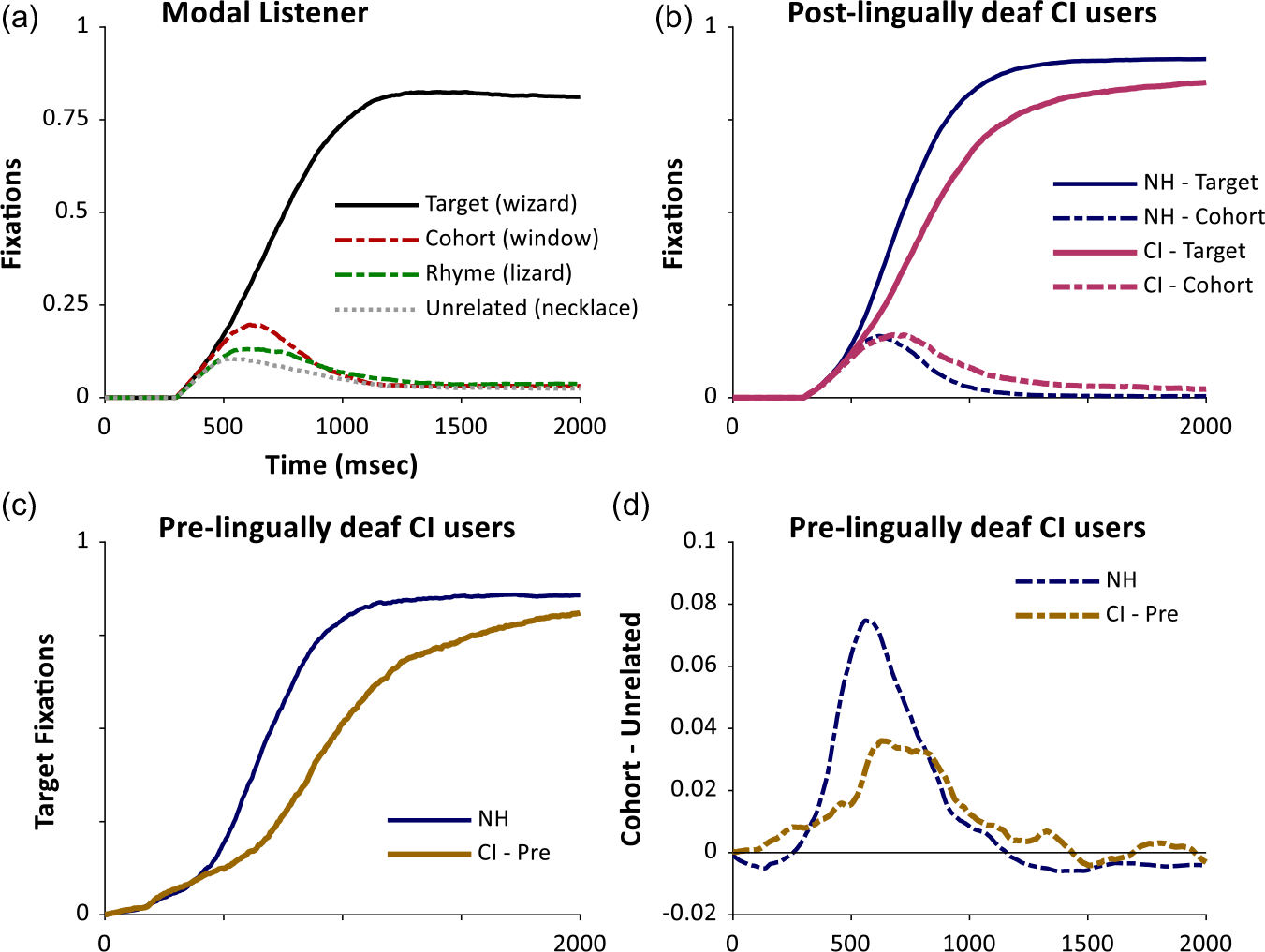
Our research group has used eye-tracking in the VWP to try to capture processing, rather than ability level (see Magnuson, Reference Magnuson2019, for a review of the VWP). In the VWP, participants view a display with a set of objects that relate to the auditory stimulus in specified ways (e.g., wizard and window, which share initial sounds). They then hear a word (e.g., wizard) and click on its image with a mouse while eye movements are monitored. Their fixations reveal which words are considered during processing, before the final decision. For example, after the onset of the target (wi-), modal listeners typically fixate phonologically consistent words like wizard and window, before suppressing competitors like window (Figure 2a). Thus, the VWP provides a complex picture of how the decision unfolds over time. Trials are only analyzed if the participant selects the target—analysis of fixations is conditioned on successful recognition. This separates absolute indices like accuracy from indices of the processes that got the participant to the correct word.
(a) Fixations to targets and competitors as a function of time for modal adult listeners. At each moment, the degree of fixations reflects the strength by which the listener is considering that class of word along the way to ultimately settling on the correct item (Farris-Trimble et al., Reference Farris-Trimble, McMurray, Cigrand and Tomblin2014). (b) Fixations to targets and cohort competitors over time in NH adults and in post-lingually deaf adults who use CIs (Farris-Trimble et al., Reference Farris-Trimble, McMurray, Cigrand and Tomblin2014). CI users are slower to fully commit to the target and rule out competitors, and they continue fixating competitors even when they’ve selected the target, suggesting a sustained activation profile. (c, d) Pre-lingually deaf adolescent CI users (Clark, Reference Clark2005; McMurray et al., Reference McMurray, Farris-Trimble and Rigler2017) show much larger delays in target fixations (c). Because lexical access is delayed, cohorts show less competition. (d)—By the time they begin lexical access for wizard, they have heard some information to rule out window, a wait-and-see profile.

VWP studies with CI users have revealed complex dynamics of word recognition—beyond differences in accuracy or speed—that vary as a function of language experience and ability. Many CI users who lost their hearing late in life exhibit a sustained activation profile: they immediately activate a range of words, but maintain activation of competing words even after they’ve settled on a decision (Figure 2b) (Farris-Trimble et al., Reference Farris-Trimble, McMurray, Cigrand and Tomblin2014). In contrast, pre-lingually deaf children, who face the added burden of developing language with degraded input, adopt a “wait-and-see” strategy (McMurray et al., Reference McMurray, Farris-Trimble and Rigler2017), where activation of words is delayed until more information arrives (Figure 2c, d). Both groups show slightly lower accuracy than typical-hearing participants, but the processes of word recognition reveal a more nuanced story. Processing can even dissociate from accuracy: children with moderate hearing loss who use hearing aids exhibit near-perfect accuracy and still show wait-and-see (Klein et al., Reference Klein, Walker and McMurray2022).
Wait-and-see violates the long-held view that word recognition is incremental: words are activated as soon as any input is available, and the timecourse of activation is tightly coupled to the temporally unfolding signal (Marslen-Wilson, Reference Marslen-Wilson1987). This departure from the standard view highlights the variability across different types of listeners who solve the problem of integrating information over time, and how work on so-called special populations can challenge and inform basic theory.
The VWP is not a “measure.” This task requires many cognitive skills, some relevant to word recognition (e.g., auditory skills, semantic processing) and others less so (visual search) (Apfelbaum et al., Reference Apfelbaum, Goodwin, Blomquist and McMurray2022). These in turn are built on lower-level mechanisms like activation and inhibition in both language and non-language domains. Moreover, the VWP is multi-dimensional—there’s no one scale and there are multiple ways it can vary. For example, participants could differ in the slope or the asymptotes of the fixation function (Figure 2). And even if we could scale it, it’s not clear which end is good. For example, sustained activation could reflect poorly resolved competition or, it could be a helpful adaptation—by avoiding a firm commitment, it may be easier for listeners to revise if they make a mistake (McMurray, Ellis, et al., Reference McMurray, Ellis and Apfelbaum2019). Similarly, is wait-and-see a mark of an extreme delay, or is it a useful strategy to minimize competition? These questions are essential to link this basic mechanism to the listener’s goals in their listening ecology.
This is a clear example of the complex link between disease and a culturally defined illness. The differences shown by these listeners suggest mechanisms that are different from a modal listener, yet they may also represent an adaptation to their own niche. By abandoning a measurement framework, the VWP provides a value-neutral picture of the underlying process. Although these studies included modal-listener control groups, their insight wasn’t obtained by asking whether CI users live up to that ideal; rather insight was reached by asking how each group solves the problem of temporary ambiguity and considering how that solution maps to their listening needs and challenges.
Language is inherently multi-dimensional. These dimensions are not just static latent traits to be measured, but active processes that people engage to solve problems. Measurement approaches suffer from a failure to deeply consider how the tasks inherent in any measure relate to underlying active processes. As a result, single-score indices can miss or misstate critical systematic differences between language users. In contrast, psycholinguistic experimental paradigms like the VWP—though not without concerns—are closely tied to theories of processing. They offer access to underlying processes and can ask how different types of people approach language processing, given their own goals, abilities, and contexts. This can move from a naturalist approach to a functional one grounded in how people solve language problems.
Variation in language processing is signal, not noise
Typical approaches in applied psycholinguistics often focus on one group, condition, or context (DLD, bilingualism, speech in noise). Such work is important but might also be limiting. There may be more insight from examining how the same processes vary across groups and contexts and from tracing the sources of such differences. Pooling across different types of listeners can highlight fundamental dimensions on which language processes vary. This approach recognizes variability among language users as informative even for basic theory. It can elucidate the flexibility of language systems and highlight sensitivity to cultural and environmental factors.
Again, we start with characterizing individuals and populations in terms of how they approach a fundamental problem. However, now by comparing these solutions across populations or situations we can achieve new insights. For example, our team has conducted VWP studies to identify the impact of development and other factors on the process of word recognition in various populations including typically developing (TD) children (Apfelbaum et al., Reference Apfelbaum, Goodwin, Blomquist and McMurray2022; Rigler et al., Reference Rigler, Farris-Trimble, Greiner, Walker, Tomblin and McMurray2015), individuals with DLD (McMurray, Klein-Packard, et al., Reference McMurray, Klein-Packard and Tomblin2019; McMurray et al., Reference McMurray, Samelson, Lee and Tomblin2010), second-language learners (Sarrett et al., Reference Sarrett, Shea and McMurrayin press), aging adults (Colby & McMurray, Reference Colby and McMurraysubmitted), and modal adults in challenging listening (Farris-Trimble et al., Reference Farris-Trimble, McMurray, Cigrand and Tomblin2014; McMurray et al., Reference McMurray, Farris-Trimble and Rigler2017). These use closely aligned (often identical) methods to enable a precise picture of the dimensionality of language processing. This has yielded several insights.
Variation in process despite equivalent end-state performance
Typical VWP studies only consider trials on which users correctly identify the named word; these are trials in which a single-metric (measurement) approach would signal identical performance. Despite this, we see constellations of differences in the speed of fixating items after they are named, the degree and timing of consideration of competing items, and the ultimate suppression of competition. These factors, in turn, vary between language users and contexts.
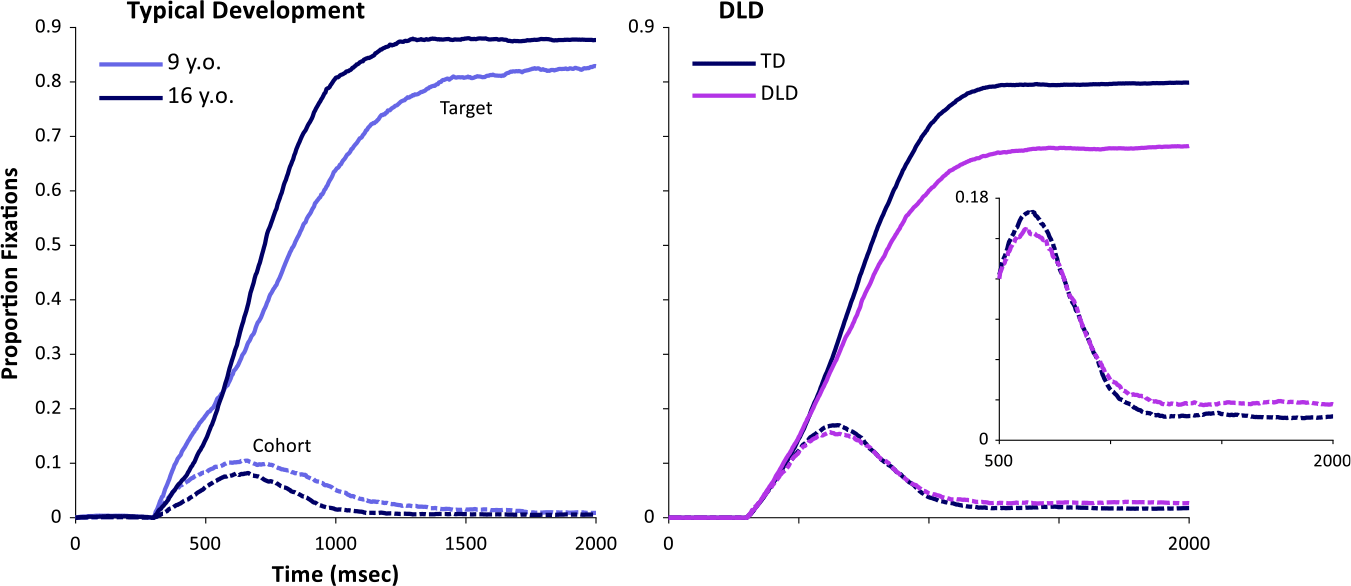
For example, younger TD children show slower word recognition than older children (Figure 3a, b; Apfelbaum et al., Reference Apfelbaum, Goodwin, Blomquist and McMurray2022; Rigler et al., Reference Rigler, Farris-Trimble, Greiner, Walker, Tomblin and McMurray2015): they begin fixating items that are phonologically consistent with the input more slowly than older children, and they take longer to eliminate competitors (a slower activation rate ). We see a different pattern for adolescents with DLD (Figure 3b); this group shows similar speed of word recognition to peers without DLD, but sustained consideration of competitors even late in trials (Figure 3b, inset), with continued looks to phonologically competing items even as they select the correct target (poorer competition resolution ) (McMurray, Klein-Packard, et al., Reference McMurray, Klein-Packard and Tomblin2019; McMurray et al., Reference McMurray, Munson and Tomblin2014; McMurray et al., Reference McMurray, Samelson, Lee and Tomblin2010). Children with DLD and younger TD children are both highly accurate; they differ in how they achieve it.
(a) Fixations to the target and cohort as a function of time in typically developing children (Rigler et al., Reference Rigler, Farris-Trimble, Greiner, Walker, Tomblin and McMurray2015). Younger children show slower activation to the target and take longer to fully suppress the competitor; however by the end of the timecourse of processing, they reach similar asymptotes. This is a pattern we describe as differences in activation rate. (b) Fixations to the target and cohort in 15- to 17-year-old adolescents with and without DLD (McMurray et al., Reference McMurray, Samelson, Lee and Tomblin2010). Adolescents with DLD show slight reductions in the rate, but large reductions in the asymptotic fixations to the target. Inset: They show smaller but reliable increases in asymptotic fixations to the competitor suggesting they have failed to completely resolve competition.

The functional demands of word recognition
This approach has revealed that word recognition is not one process with an optimal solution, but a set of trade-offs between speed, accuracy, and flexibility (McMurray et al., Reference McMurray, Apfelbaum and Tomblin2022). Each of these goals is valuable for word recognition. Words arrive quickly, so speed is necessary to keep up; yet inaccurate word recognition can cause garden paths in sentence processing or a failure to understand the utterance; flexibility allows a listener to gracefully cope with variability in the speech signal and recover from inaccuracies. These goals may work in opposition; a system that overprioritizes speed might commit to candidates too quickly, sacrificing later flexibility. In contrast, a system emphasizing accuracy might require listeners to wait until all information is heard, slowing recognition. Different listeners—younger children, CI users, people with DLD, but also modal individuals—are situated at different points in this multi-dimensional space.
The same process for different reasons?
These principles can trade off both for adaptive reasons and for challenges outside of a listener’s control. For example, post-lingually deaf CI users (Figure 2b) and adolescents with DLD (Figure 3b) show highly similar profiles of processing—both do not fully suppress competitors late in recognition. However, the reasons for this may differ. For DLD, our work has traced this to a failure of inhibition (McMurray, Klein-Packard, et al., Reference McMurray, Klein-Packard and Tomblin2019)—wizard does not inhibit window to the same degree. In this case, a failure to suppress competitors may be problematic for downstream language processing and derive from lower-level neurocognitive differences. Yet post-lingually deaf adults had a fully developed lexicon prior to their hearing loss—it is unlikely they lack inhibitory function. Rather, we’ve hypothesized that this is an adaption to support flexibility. That is, if they misperceive the initial phoneme of wizard and activate lizard, it may be easier to revise this decision when later context favors wizard. These hypotheses point to the idea that nature of the underlying process must be considered in light of its ecological value to the individual.
They also point to a deeper possibility. What is presumably a maladaptive form of processing for DLD listeners is potentially adaptive in post-lingually deaf CI users. Thus, these differences may be a sign that across language users, the language system is flexible to cope with new contexts (hearing loss, noise), languages, and situations. Supporting this, basic mechanisms like inhibition are plastic and can respond to training (Kapnoula & McMurray, Reference Kapnoula and McMurray2016). This is analogous to the role of mutations in evolutionary theory. The same mutation could be beneficial under some circumstances, but maladaptive in others. For example, sickle cell anemia evolved to help protect against malaria, but can also lead to illness (Elguero et al., Reference Elguero, Délicat-Loembet, Rougeron, Arnathau, Roche, Becquart, Gonzalez, Nkoghe, Sica, Leroy, Durand, Ayala, Ollomo, Renaud and Prugnolle2015).
Insights and extensions
This process-oriented approach yields principles that can be extended to new questions. For example, work with CI users has been paired with similar studies of Normal Hearing (NH) adults hearing a novel form of degradation (Farris-Trimble et al., Reference Farris-Trimble, McMurray, Cigrand and Tomblin2014; McMurray et al., Reference McMurray, Farris-Trimble and Rigler2017). This can reveal whether a particular profile of lexical processing is a response to long-term experience with poor input or is an immediate adaptation. While there is a tradition of using systematically degraded speech with NH listeners as a model for CI users, our goal is different. The problems faced by CI users and by NH people under challenging circumstances are each interesting and important in their own right. By first asking how lexical access proceeds in each, and then contrasting them we reach insights that could not be obtained otherwise.
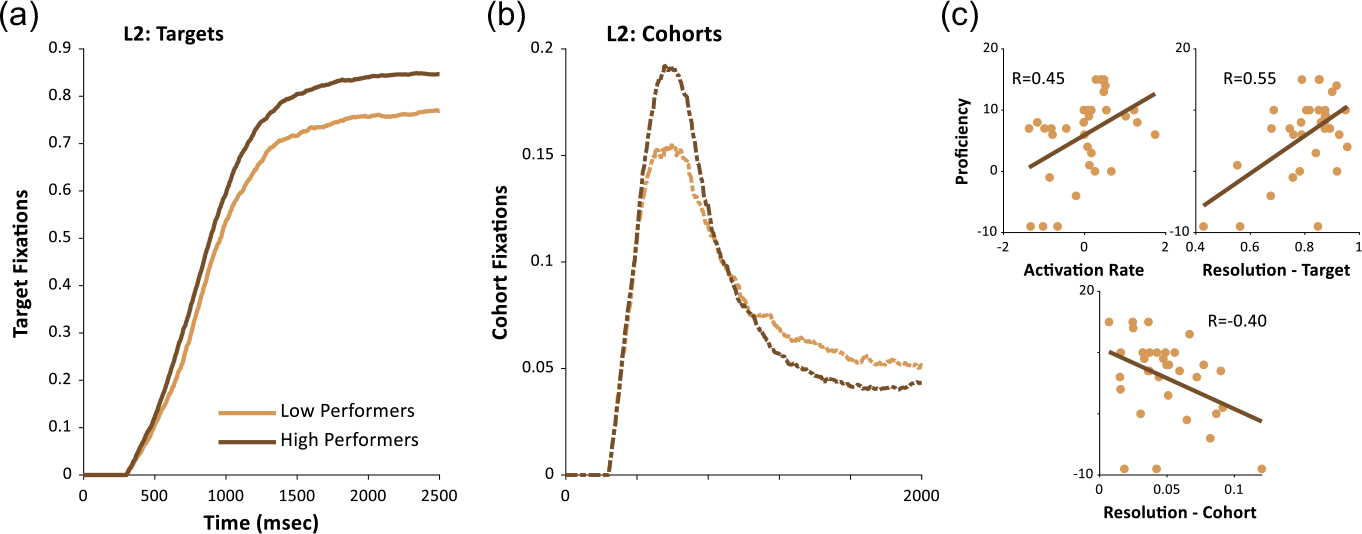
We’ve also applied this processing approach to new domains. For example, while many studies of word recognition in multilingualism stress activation of words across the lexicon (e.g., do Spanish/English bilinguals activate the English mason when hearing the Spanish mesa) (c.f., Blumenfeld & Marian, Reference Blumenfeld and Marian2011), equally important is how multilinguals manage competition in general. That is, typical studies focus on what makes bilinguals distinct, not on how they solve the basic problem of word recognition. We addressed this in the context of L2 Spanish learners (Sarrett et al., Reference Sarrett, McMurray and Kapnoula2020) in a VWP study. For within-language (cielo/ciencia) competition—the basic problem L2 learners face—proficiency was correlated with both efficiency of lexical activation and asymptotic resolution (Figure 4, scatterplots). By framing this in terms of trade-offs between principles, we see that in some ways L2 learning mimics L1—people achieve more efficiency with exposure. At the same time, managing competition within the weaker language may be more challenging (or perhaps they are guarding against misperception).
Results of VWP experiment on adult L2 learners in their second year of Spanish instruction (Sarrett et al., Reference Sarrett, Shea and McMurrayin press). Shown are results from trials with Spanish/Spanish target/competitor pairs (e.g., cielo/ciencia) assessing how they manage competition within the L2. (a) Fixations to the target showed changes in both activation rate (changes in slope, top scatter plot), mirroring changes in L1 acquisition, and in the ultimate asymptote (resolution, bottom scatterplot), mirroring the less stable word recognition of people with DLD. (b) Fixations to the cohort also reflect poorer resolution at the asymptote (inset scatterplot).

Finally, we’ve attempted to apply these same constructs to reading. Given concerns that standard outcomes like fluency are multiply determined, our goal has been to isolate processes related to word reading efficiency. At a practical level, an approach to assessing word reading speed may help diagnose the mechanism of poor fluency (a disease underlying an illness). We’ve adapted psycholinguistic tools—backward masking of visually presented words—to arrive at a clearer picture of children’s difficulties (in the context of an American education system that values rapid reading) (Roembke et al., Reference Roembke, Reed, Hazeltine and McMurray2019), and these are being integrated into computerized assessments. We’ve also adapted the VWP to written words and found strong similarities between the profiles of competition for spoken and written words (Apfelbaum et al., Reference Apfelbaum, Goodwin, Blomquist and McMurray2022; Hendrickson et al., Reference Hendrickson, Apfelbaum, Goodwin, Blomquist, Klein and McMurray2021). Work is underway to see if the same dimensions of activation rate and resolution characterize reading development and difficulties.
Is anyone truly normal?
Language users vary in many ways, and few fit the criteria of the modal participant. For example, much of developmental psycholinguistics treats adult language as the target and interprets children’s performance in terms of how closely it approximates adult performance. A measurement approach may thus miss most of the interesting variability by collapsing people along a good/bad scale: does a 15-year-old with DLD process language better than a 12-year-old without? It is unclear how to answer this using scalar measures alone. Many measurement approaches further constrain the situation to focus on ability relative to population norms (standardized measures). Under this approach, if one were to measure language development over the lifespan, one should see a flat function (the child tracks with their peers). But language doesn’t work this way. In a cultural context, knowing fewer words, recognizing sentences more slowly, and so forth can impede function no matter why. Use of “raw” scores for such studies (when possible) may help. But processing measures—which are rarely standardized—can give greater insight.
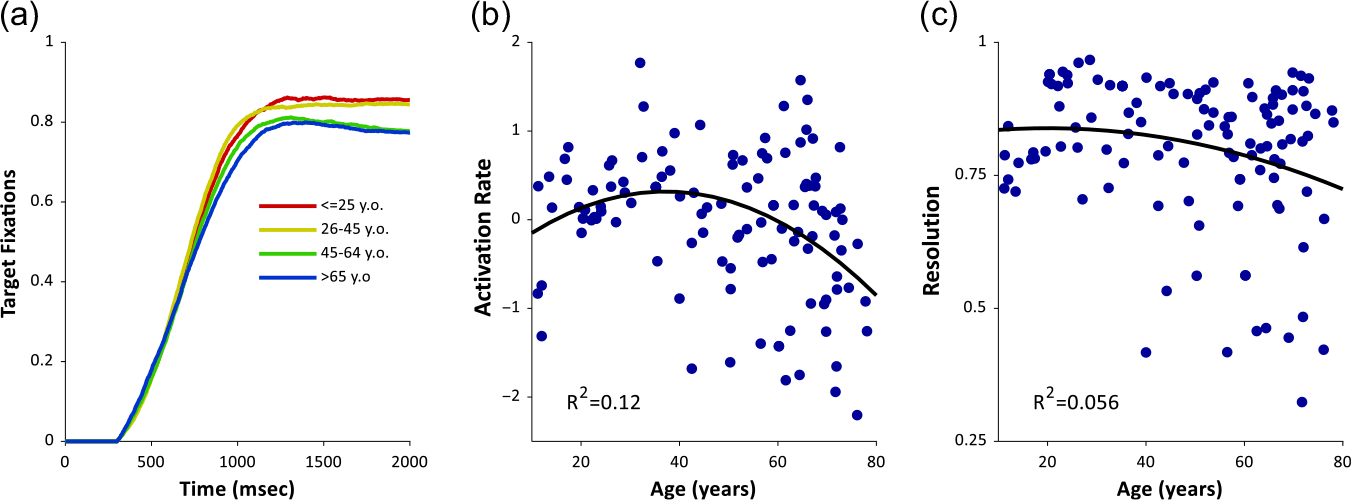
When we consider absolute ability along with more sensitive measures of processing, we see a shockingly different view of language. We recently completed a study which examined spoken word recognition in over 100 individuals, evenly sampled across the lifespan from 11 to 79 years of age, with age as a continuous variable (Figure 5; Colby & McMurray, Reference Colby and McMurraysubmitted). Our standard paradigms showed that activation rate continues to develop through 25 years (Figure 5a, b)—an even more protracted developmental period. However, it changes direction in the early 40s with decreasing efficiency with age (Figure 5b). At this point, there are also changes in resolution (Figure 5c) (not seen earlier in development). Thus, aging is associated with complex differences in multiple aspects of word recognition.
Results of Colby and McMurray (Reference Colby and McMurraysubmitted) study of lifespan development of processing. The study used a similar VWP task to our prior work (Figures 1 and 2), but sampled people from across the lifespan from 12 to 80. (a) Timecourse of target fixations—roughly binned in 20-year increments—shows subtle differences at all ages. (b) The relationship between age and activation rate (the slope of the target fixations) shows a robust quadratic effect, peaking at around 45. (c) Resolution—the difference between the target and cohort asymptotes—shows a small linear reduction over the lifespan.

More broadly, this suggests the window of “modal-level” language is brief, perhaps one-quarter of a person’s life. This is compounded by other sources of variability in language. Approximately 12% of children can be diagnosed with DLD (which persists through the lifespan) (Norbury et al., Reference Norbury, Gooch, Wray, Baird, Charman, Simonoff, Vamvakas and Pickles2016; Tomblin et al., Reference Tomblin, Records, Buckwalter, Zhang, Smith and O’Brien1997), and as many as 17% can be diagnosed with dyslexia (Shaywitz et al., Reference Shaywitz, Escobar, Shaywitz, Fletcher and Makuch1992) with about 50% co-morbidity (Pennington & Bishop, Reference Pennington and Bishop2009). Thus, about 22% children qualify as having at least one of these. Moreover, approximately 21% of Americans are multilingual (Bureau, Reference Bureau2022). This leaves a modal group in the US of about 62% (not even counting other language-influencing conditions such as autism, hearing loss, or brain damage). When we consider that a person only has the modal level of word recognition for about one-quarter of their life, we’re left with a small minority of language users who fit within the ideal of monolingual, adult, educated, typical-hearing language user with no language or reading deficits. And this is just within the US. Worldwide, bilingualism is the norm (∼60%), and we do not have population estimates of language and reading disorders in languages such as agglutinating languages, logographic reading systems, or languages with free word order (etc.).
The elevation of the small minority of modal language users to the gold standard leads to an unobtainable standard of language use that nearly everyone falls short of or will fall short of for much of their life. That is, most people are treated as noise (due to age, bilingualism, etc.) that should be ignored by core theories. In contrast, an MFN perspective sees an enormous variety of language users with different functional demands imposed by their cultural niche. To meet these demands, they must solve a similar (or overlapping) set of psycholinguistic problems using a variety of configurations of the language processing system, further undergirded by variation in lower-level mechanisms like prediction, activation, and inhibition.
What constitutes a group?
The forgoing discussion (and much of the research) rests on the construct of a group—CI users, children with DLD, L2 learners, and so forth. While such labels are useful, binary distinctions between heterogeneous groups hinder psycholinguistics. Studies routinely distinguish groups based on cut points or theoretical assumptions rather than true qualitative differences. This is particularly the case for disorders like DLD or dyslexia which are literally defined this way (Leonard, Reference Leonard1991; Shaywitz et al., Reference Shaywitz, Escobar, Shaywitz, Fletcher and Makuch1992; Tomblin & Zhang, Reference Tomblin, Zhang and Tager-Flusberg1999). However, the distribution of language scores does not suggest a bimodal distribution—the group labeled DLD varies from the typical group quantitatively, not qualitatively. This is broader than disorders; people are routinely categorized as bilingual or not by assuming a sort of modal or balanced bilingual. But real people show an incredible variety of forms of bilingualism: heritage language speakers, late L2 learners, and so forth. Similarly, an arbitrary cut point (e.g., 60 years old) is often used to distinguish between younger and older adults, but our work suggests continuous changes that start earlier and factors like hearing loss or education can impact the function of someone on this slope.
Cut points have clear value in some applications, like determining which children should receive remediation, or even just as a visualization tool (e.g., Figures 2–5). They are more problematic when applied to research on the nature of differences in language processes. A more continuous accounting of experience and ability offers better insight. Part of this is purely statistical: dichotomizing continuous variables weakens the ability to identify statistical patterns (Altman & Royston, Reference Altman and Royston2006), but this dichotomization has deeper interpretive issues, as it implies that a language score can diagnostically identify who has an illness (DLD), and who is healthy.
Artificial grouping also affects how psycholinguistic results are generalized. Psycholinguistic studies sample a subset of a population to extrapolate patterns. However, the scope of generalization often far exceeds what’s reasonable (for a radical form of this claim, see Yarkoni, Reference Yarkoni2022). The work contrasting pre- and post-lingually deafened CI users shows large differences in how language processing occurs within CI users. But what counts as pre-lingually deaf? We’d like to assume congenitally deaf, but what about a child who lost their hearing at 4 or 8? Given our new understanding of how slowly word recognition develops (Figures 3a, and 5), what about a child who lost their hearing at 12? Groups like CI users are not monolithic, and while no study can comprehensively approach such variation, we can at least be cautious about generalization and attempt to capture what variation we can.
Overgeneralization is also widespread in bilingualism research. Here, most studies investigate a specific bilingual population—such as Spanish-English bilinguals who speak Spanish at home and English at school. Results are often generalized to bilinguals broadly. Such generalizations may not be warranted given the diverse linguistic experiences of bilingual and multilingual people. For example, Hoff (Reference Hoff and Lockman2021) states that “it is not easy for children to acquire strong and comparable skill levels in two languages because environments tend not to provide high and comparable levels of support for two languages” (p. 130). But is this true of bilinguals in general or bilinguals in south Florida who are largely Latino/a and undergo schooling in English? A more reasonable conclusion is that these results speak to a particular cultural context; a different context (e.g., French-English bilinguals in Quebec) might exhibit different patterns.
This tendency to dichotomize groups is more readily avoided with an MFN approach. If questions focus on how experience or individual differences impact processes, this emphasizes continuous measures. Instead of questions of whether or how much CI users differ from typical-hearing comparisons, an MFN approach asks how language experience among CI users affects their approach to word recognition. This perspective then builds a psycholinguistics focused on the nature of variability and its sources, and a stronger knowledge base of how language operates outside the limited confines of modal listeners. Within an MFN approach, we can ask parallel questions across multiple traditional groups or circumstances to overcome some limits of generalization and arrive at deeper conclusions.
Conclusions
Psycholinguistics strives to understand the mechanisms of language processing. Historically, much of this work has adopted a naturalist approach, in which an optimal form of language processing is assumed, and so-called special populations are compared against this supposed ideal. This echoes a naturalist model in medicine, in which the supposed modal listener is assumed to have a healthy language substrate, and deviations from modal are treated as disordered. Applied psycholinguistics often attempts to understand these deviations in a measurement framework. This often takes a traditional functionalist assumption with a clear mapping to broader functions like language and subcomponents designed to share that function.
We have argued against this perspective and in favor of an MFN perspective that emphasizes language as a flexible tool that is deployed to solve real-world communication tasks grounded in socio-cultural goals and emergent on an array of lower-level mechanisms that are not solely “designed” for that function. We introduced several ways to adapt psycholinguistics to the MFN approach.
We started with the limits of measurement. Given the diversity of language users, it is difficult to identify a single measure that is suitable across all groups (or across all ages, see Petersen et al., Reference Petersen, Choe and LeBeau2020). Rather, the best-case scenario is that measures can be used as a general marker of how well fit an individual’s language skills are to the socio-cultural context in which the measure was developed. Measures may be suitable for diagnosing something analogous to illness, but not disease. Moreover, measures tend to become reified in ways that make it unclear whether they represent causes or outcomes and that minimize the variety of skills contributing to language functions they assess or assume that function is a simple product of these subskills. Given the many-to-many mapping between mechanisms and the functions that are the target of measurement, a measurement approach is not likely to be useful for understanding the basic mechanism (e.g., disease).
A process-based view can do better by leveraging more sophisticated paradigms of psycholinguistics. Using these tasks—not as measures, but in the context of the theoretical mechanisms that they were originally designed for—can characterize a given population in terms of how they approach the basic problems of language. Our work using the VWP has demonstrated how different listeners can reach the same outcome (successful word recognition) in a variety of ways. Language users’ approaches to word recognition vary systematically, but a given profile of processing is neither good nor bad: the same poor competition resolution that appears to be problematic in DLD may help ensure flexibility in CI users. This underscores the importance of considering language at both the level of the underlying process or mechanism, and its fit to the context and goals of the person (the ecology).
This approach has identified core computational principles of word recognition—a balance of accuracy, speed, and flexibility—that may not be apparent looking at any group alone (particularly modal listeners). It has also revealed that the modal listener may be an outlier. Critical to this enterprise is the examination of a variety of types of people, using common or similar experimental tasks, and a philosophy of not asking how groups differ from modal, but trying to characterize their language processing in its own right. That is, we should be asking how people in varied contexts solve the basic problems of language use given their own niche (much like so-called “core psycholinguistics” has done for the modal listener), rather than by reference to the modal listener.
Process models are not immune to the measurement issues raised above. The items and tasks in psycholinguistic measures vary in their cultural or functional relevance. A VWP task using lorry with US listeners is just as problematic as a vocabulary test. There are longstanding concerns about the fact that psycholinguistic measures are often decontextualized from discourse or prior context (Clark, Reference Clark1997). What a process approach—when sensitively constructed—does provide is a more value-free glimpse into basic mechanisms and an appreciation of the diversity of the ways that individuals solve the fundamental problems of language.
This has broader lessons. With an MFN perspective, variability between language users becomes a fruitful scientific environment in which to study the range of processes that support language function. We showed how this perspective better represents the range of language users and suggests how greater use of process-based methods, and an avoidance of dichotomous thinking strengthens psycholinguistics.
Much of our discussion emphasizes contexts in which there is no single “best” way to accomplish the linguistic goal—the relative weights of speed, accuracy, and flexibility shown by an L2 learner or a CI user might signal different ways to reach similar goals—without a need for value judgments about what the optimal setting is. We must move away from the modal listener and toward a view that embraces the broad scope of differences in language use as theoretically important information, rather than meaningless variation.
Despite the relativism of this approach, we must often make judgments between individuals. A child may be in a socio-cultural niche which places high demands on a specific language or skill (e.g., the American educational system). Consequently, it can be useful to predict whose language abilities offer a more adaptive fit for a particular cultural niche (illness). For example, measures of relative or absolute reading ability could be useful to identify students that are most likely to benefit from reading intervention, which could boost likely long-term academic and career success within a culture. Yet even here, this should be approached with careful consideration of the cultural lens of the measure (e.g., whether the words are relevant) and the processes and skills language users need to complete the assessment.
Most importantly, we must remember that latent traits need not exist in any formal sense (Figure 1). What we claim to measure as vocabulary is not the number of pages in a dictionary in the child’s head. Every time a child names a picture, reads a word, or processes a sentence, they engage a complex process that can be solved in many ways. We echo calls from Elman (Reference Elman2009) to reconceptualize forms of static knowledge, such as the lexicon, in terms of dynamic, contextually bound processes. Dimensions of differences amongst people—so-called latent traits—may be the same socio-culturally bound, emergent constructs. In this framing, we can better conceptualize the diversity of language function in terms of value-free characterizations of underlying process, which can be separated from the functional or ecological value to the language user.
Acknowledgements
The authors would like to thank Ethan Kutlu and Ben Munson for helpful discussions around individual differences and positionality, and Jerry Zimmermann for discussions of the five pillars of reading. This manuscript was supported by NIH grant DC008089 awarded to BM.
Conflicts of interest
The authors declare none.