

The battles that peasants waged during the Mexican Revolution translated into a series of agrarian and agricultural institutions, and one of these was the Banco Nacional de Crédito Ejidal, created in 1926. Histories deeply engrained in both the popular imagination of Mexico and scholarly historiography have offered a generic classic narrative of ejidal credit, beginning with Lázaro Cárdenas. He and his cabinet sought to transform the ejido into the engine of agricultural growth for the nation and carried out a sweeping and (in qualified ways) successful land reform, thereby bringing the revolution to the fullest fruition many Mexicans would ever know. It is assumed that ejidal credit peaked during Cárdenas's administration in two major ways: first, it was in this period that ejidal credit societies received the most loans from the Banco Nacional del Crédito Ejidal, and second, it was during the same period that the bank clearly and unanimously embraced social reform goals over orthodox banking goals.
During the administration of the next president, Manuel Ávila Camacho, the revolution is understood to have ended due to a major change in ideology and vision that translated into a major change in policies. As the members of the new presidential administration aligned themselves with bourgeois capitalists, the cardenista plans for social justice and a progressive redistribution of resources toward rural Mexico (especially the poor) sharply declined. Ejidal credit, bound up with all this, began to shrivel and with it the ejidos as well. The government decreased the proportion of money it channeled into the Banco Ejidal and offered loans only to those who it deemed likely to repay in a timely manner.Footnote 1 This is the classic narrative of ejidal credit that remains with us, and it is still dissatisfying.
Considering the importance of credit to the success or failure of the ejidal system and in ejidatarios’ lives, it is striking that the historiography has brought little nuance to the study of the high politics of the bank and why they mattered. Indeed, analyses of rural Mexico have made important advances in studying virtually every aspect of the countryside but have offered scant explications of credit and debt. Some have treated it, but only superficially.Footnote 2 Others have characterized ejidal credit during the period before the 1960s from a bird's-eye distance.Footnote 3 Some treatments of agricultural credit have placed smallholders at the center of their financial history.Footnote 4 Meticulous encyclopedic treatments of the economic and juridical dimensions of credit at the national level leave political, cultural, regional and local contexts out of the picture.Footnote 5 And there are scholars of political economy who have bypassed the topic altogether.Footnote 6
On one level, the reasons for the perpetuation of the narrative described at the beginning of this article is that it was strongly shaped by the Banco Ejidal itself during the Cárdenas administration. The bank publically emphasized its support of high-risk ejidal credit societies around Mexico to give the impression that it was a radically redistributive institution. This idea of a redistributionist ejidal bank, which circulated while Cárdenas was president, set the tone for many scholarly treatments. Another reason for the strength of the narrative is its staying power, which can be attributed to its simplicity, its apparently intuitive logic, and its historiographical flexibility. This easily digestible story has managed to intersect comfortably with the traditionalist, populist, revisionist, and neopopulist interpretations of cardenismo and of twentieth-century Mexican hegemonic nation-state formation.
It is time now to interrogate this classic narrative. By systematically analyzing the complexity of the high politics of the Banco Ejidal, this article aims to make several interrelated arguments. First, it aims to show that a major scholarly consensus about the revolution—that its Thermidor occurred in 1937–38—does not apply to one of Cárdenas's most important agricultural programs.Footnote 7 The article shows that in regard to ejidal credit he was moderate from the start.Footnote 8 While it is true that the bank gave loans to high-risk ejidal credit societies in the southern and central parts of the country during his administration, these credit societies did not comprise the majority of the bank's loan portfolio. Rather, the low-risk ejidal credit societies received the most loans. Seeking to balance social (redistributionist) motives with economic (market-oriented) ones demonstrates the pragmatism that characterized the high politics of the bank's overall approach during both the Cárdenas and Ávila Camacho administrations. In privileging low-risk credit societies, the bank sought to raise ejidatarios’ social welfare while trying to be prudent in its budgeting so that it could be a viable and potentially long-lived institution.Footnote 9 The prudence and cautiousness that characterized the high politics of the Banco Ejidal compelled it to be pragmatic in its approach to private partnerships, loan allocations, and loan repayments.
The bank's attempt at balance and its cautiousness forced its administration to make complex decisions about how it funded its operations and how it allocated resources. Thus, a secondary argument in this article discusses the little-known partnership that the Cárdenas administration made with the Anderson Clayton Company to channel funds into the Banco Ejidal. Indeed, the scholarly consensus remains that this partnership did not form until later, during the Ávila Camacho administration.Footnote 10 Expanding on Casey Walsh's work on the existence of this partnership, this article demonstrates that Cárdenas, and after him Ávila Camacho, hoped to reassure businessmen that the bank was run according to market-based principles in order to obtain funding from private sources.Footnote 11 Balancing development goals, budgetary limitations, and redistributionist aims compelled the bank to lend all around the country to high-risk and low-risk ejidos alike, but in fact it channeled much of its loans to low-risk ejidal credit societies predominantly in the north, such as the Comarca Lagunera (La Laguna).
These facts lead into another secondary argument made throughout this essay. Placing the Banco Ejidal at the center of this analysis will help to resolve one of the central paradoxes of modern Mexico, which, as Gillingham and Smith put it, is how a country that experienced a revolution, and even “experimented with collectivist modes of production gave way to so many layers of (and different kinds of) deep capitalist inequalities.”Footnote 12 This article explicates an important and overlooked way that resources were channeled to the north at the expense of the southern and central parts of Mexico from 1935 to 1946, as the Banco Ejidal tried to keep itself afloat by privileging low-risk ejidal credit societies in the north (like La Comarca Lagunera and a few exceptionally low-risk areas outside the north such as Mérida). As a result, the bank denied adequate support to many ejidal credit societies in the central and southern parts of the country.
Postrevolutionary Mexico has been the subject of several major historiographies. The New Cultural History has offered innovative ways of conceptualizing identities, gender, state/society relations, and transnationalism. Yet, in employing a framework that privileges cultural hegemony over all others, the New Cultural History has given little attention to economic bureaucracies, financial institutions and socioeconomic relations. Nonetheless, the dominance of New Cultural History has been waning, and new approaches to analyzing politics, violence, religion and culture (such as those featured in Paul Gillingham and Ben Smith's Dictablanda) have given us a more nuanced understanding of twentieth-century Mexico.Footnote 13 At the same time, there has been growing scholarly recognition of the importance of the 1940s.Footnote 14 In addition, the long-standing historiography on resources (which pre-dates the New Cultural History) has analyzed overlapping inequalities by examining transfers from farms and fields to factories and industrial cities, and from Mexico's south and center to its north.Footnote 15 Despite their many merits, all of these approaches have left the political consequences of the work of the Banco Ejidal and other financial institutions understudied. It is hoped that this essay, alongside a growing literature focused on Latin America and beyond, will reinvigorate analyzing Latin American financial institutions along matters of political economy.Footnote 16
Because analyzing financial policies invariably involves numbers, it is important to comment briefly on the various reasons for the slipperiness of the Banco Ejidal's figures, percentages, and statistics. On this front, the Banco Ejidal is far from unique. Data collection in Mexico during the 1930s and 1940s proved difficult and spotty, the topic of frequent complaints among agronomists at the time. Peasants, suspicious of agronomists’ motives and intentions, often did not cooperate.Footnote 17 Agronomists, for their part, compiled and recorded statistics with an eye toward organizing and increasing production, whether in reality or merely on paper. Furthermore, the Banco Ejidal did not organize its numbers systematically for the period under review. For example, its annual reports in some years included such data as the percentages of short-term loans allocated in a given year relative to other types of loans, or how much credit private capital channeled through the Banco Ejidal for key commodities throughout the nation; in other annual reports, the same data might appear—or might not.Footnote 18
Furthermore, as this article will illustrate, some of the bank's figures seem exaggerated. Such inaccuracies in the individual figures themselves, while certainly problematic, do not ultimately compromise the arguments laid out in this article. If this article were fundamentally concerned with financial questions, the problematic nature of the figures might have seriously compromised the conclusions. But this article takes up questions that revolve around political economy. That these numbers shed light on key trends and patterns in the high politics of political economy during a crucial period in Mexico's history ultimately affirms their explanatory value.
The Structure of the Banco Ejidal
The postrevolutionary government's first attempt to set up a system of agricultural credit involved the creation of two separate banks in the 1920s. The Banco Agrícola, opened on March 10, 1926, encouraged smallholding.Footnote 19 A few months later, four ejidal banks were opened in Durango, Hidalgo, Guanajuato, and Michoacán, respectively. Over the next few years, more ejidal banks opened across the country, but the lack of funds, combined with nonpayment of loans as they came due, brought several of them close to insolvency. All nine ejidal banks were closed in 1931, leaving only the Banco Agrícola to operate with small and medium holders and ejidatarios. For the next four years, ejidatarios in theory had access to government credit, but in fact ejidal loans comprised only a small department in the Banco Agrícola.Footnote 20
In 1935, under Cárdenas, a dedicated bureaucracy for ejidal credit returned. Once Cárdenas became president, the ejidos took on an unprecedented importance due to his commitment to making them flourish.Footnote 21 For Cárdenas, the ejido had become fundamental to Mexico's agricultural production and economic progress; in his eyes, creating a separate Banco Ejidal, organized under the auspices of the federal government, had become crucial to supporting the ejido.Footnote 22 Furthermore, a separate and theoretically more controlled institution would consolidate and unify ejidatarios as one of the president's corporatist constituencies.
During both the Cárdenas and Ávila Camacho administrations, the Banco Ejidal operated out of its home office in Mexico City. By the end of 1941, it had 32 regional agencies and 187 jefaturas (administrative offices), which put it in contact with almost all regions of Mexico.Footnote 23 Although ejidal credit societies indeed received cash advances from the bank, far more common were loans in kind comprised of seeds, fertilizers, animals, and irrigation equipment. These loans in kind were intended to prevent moral hazard in the use of the credit beyond the purposes designated by the Banco Ejidal, such as paying for clothing and wedding expenses or, far more damning in the eyes of bank officials, indulging in alcohol, gambling and patron saint parades.Footnote 24
Nonetheless, the bank could not escape ineptness in its own operations. Uncertain of how much it lent and took in, the bank never profited, let alone broke even, at the national level although it occasionally did in local branches. As just one example of the ineptness, the Banco Ejidal's records for an ejidal credit society in the Comarca Lagunera named Martha were kept in such disarray that the personnel could not verify whether ejidatarios were indebted to the bank for the 1936–37 and 1937–38 agricultural cycles or whether the bank owed them profits for that period.Footnote 25 Notwithstanding the decency and commitment of some local bank bureaucrats (such as Juan Fernando, a character in Malcolm Lowry's novel Garden of Etla likely based on his friend Fernando Atonalzin), corruption was a problem as well. Footnote 26 Bank bureaucrats who managed several of the credit societies in the San Felipe ejido in Coahuila forced ejidatarios to sell their irrigated lands to them at what was likely rock-bottom prices. Numerous local bank employees profited from selling ejidatarios’ cotton on the black market. There was a fair amount of professional neglect as well: some bank bureaucrats were known to spend most of their working hours boozing and playing pool in the cantina.Footnote 27
All of the bank's loans were at 8 percent, and until 1943 all societies charged their members an additional one percent for the administrative and operating expenses of the society. Short-term seasonal loans, called avíos, were used to finance the planting and cultivation of crops; credit was extended only until the harvest was over, with a maximum term of 18 months. These loans could not exceed 70 percent of the probable annual value of the crop of the ejidal credit society. The avío was the type of loan most frequently granted across Mexico, constituting 80.4 percent of all loans granted by the Banco Ejidal up to 1943. These loans were for seeds, fertilizers, and other short-term needs. In distant second place as to how often they were granted were intermediate-term loans, called refaccionarios. These amounted to 15.4 percent of all loans made up to 1943, and provided more expensive inputs like farm machines, major tools, livestock, and the cultivation of cyclical crops like maguey and henequen that required several years to mature. These loans could run for a term of up to five years and the amount lent could not exceed 50 percent of the income of the ejidal credit society during the loan period. The final category of loans, called inmobilarios had terms that could go up to 30 years; their value could not be greater than 30 percent of the income that the ejidatario expected to receive during the amortization period. These were for major undertakings like irrigation works, or for the purchase or construction of factories, storage facilities, mills, or the machinery and equipment these required. These long-term loans constituted only about 1.4 percent of all loans made up to 1943.Footnote 28
Ejidatarios rarely had much say in what sorts of seeds and other inputs they received, or when they received them, or how. This greatly irritated them and prompted them to continue financial relationships with other types of financial intermediaries (such as moneylenders) instead of relying solely on the Banco Ejidal.Footnote 29 And for its part, the Banco Ejidal did not rely on one source of funds either.
Private Sources of Credit through the Banco Ejidal
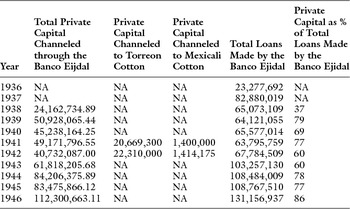
Under both Cárdenas and Ávila Camacho, financing for the Banco Ejidal's loans came not only from the federal government but also from private money. Both presidents, as well as their ministers of agriculture and upper-echelon Banco Ejidal personnel, worked to convince private investors to channel their money through the bank. According to the annual reports of the bank from the Cárdenas and Ávila Camacho years, as shown in Table 1, private sources of credit increasingly supplied funds—37 percent of the total loan amount allocated in 1938, increasing to 86 percent of the amount allocated in 1946.Footnote 30 This was not a gradual increase: private credit's presence in the bank's operations jumped during Cárdenas's administration from 37 percent in 1938 to 79 percent in 1939, and it never went below 60 percent under Ávila Camacho.
Private Capital Channeled through the Banco Ejidal in Pesos, 1936–1946

Sources: For 1938 and 1939, Informe (1939), 17; for 1941, Informe (1942), 17; for 1942, Informe (1943), 12, 13, 14; for 1940, 1943, 1944, and 1945, Informe (1946), 28; and for 1946, Informe (1947), 24.
These sources of credit came from US and Mexican banks and a variety of companies and individuals, all of whom worked out agreements with the Mexican government in which risk was absorbed through the Banco Ejidal. For example, the Banco de Comercio and Banco Mexicano, along with the Banco de México, drew up a plan to lend 5 million pesos at 7 percent annual interest to the Lagunero ejidal credit societies through the Banco Ejidal for all phases of cotton growing from August through November 1937. The Banco de México lent 4 million pesos and the Banco de Comercio and Banco Mexicano each offered half a million pesos.Footnote 31 In Jalisco, Eduardo Collingen, the owner of the Fábrica de Grasas Vegetales, lent 10,000 pesos to nearby ejidal credit societies through the Banco Ejidal during the 1930s and 1940s.Footnote 32
Despite the sizable loans the bank received from many different private sources, it was the Anderson Clayton Company that stood out, putting an enormous amount of money into northern Mexico's domestic and export cotton crops. By the early 1930s, the company was already financing the majority of the cotton crop in Mexicali, Comarca Lagunera, and Matamoros.Footnote 33 President Cárdenas and Luis Montes de Oca, the director of the Banco de México, negotiated a series of deals with Anderson Clayton in which it financed and commercialized Mexico's ejidal production through the bank in exchange for a guaranteed profit share.Footnote 34 Montes de Oca hoped that the government would be able to use the profit from cotton exports from Matamoros and Mexicali to pay back its loans to the Banco de México. For its part, Anderson Clayton, suffering production cutbacks imposed by President Franklin Roosevelt's legislation on cotton in the United States, sought to compensate by increasing its cotton production in foreign countries. Both representatives of the company and Mexican officials intended northern Mexico to become a “limitless expanse of cotton.”Footnote 35
Although Mexico's March 1938 oil expropriation provoked diplomatic friction with the United States and increased uncertainty among most foreign investors, the Anderson Clayton Company channeled even more money into Mexican cotton during Cárdenas's administration.Footnote 36 By the end of July, the company had signed a deal with the Banco Ejidal to finance Mexicali's ejidatarios through the rest of 1938. The Banco Ejidal furnished 25 percent of the loan and the Anderson Clayton Company picked up the remaining 75 percent. The company was advised to lend to the ejidatarios on the same basis that they used for loans to individual farmers, so the interest rate they charged was higher than that of the government-regulated Banco Ejidal. Cárdenas made it clear that Anderson Clayton would get priority on loan recovery.Footnote 37 The company also decided to increase its loans to Matamoros (to both ejidatarios and smallholders through the Banco Ejidal and Banco Agrícola) to between 2.5 and 3.5 million pesos for the next year. For his part, Cárdenas assured Will Clayton, co-owner of the company, that he would be given “any guarantees he would wish.”Footnote 38 By the end of Cárdenas's administration, Anderson Clayton had invested 10 million pesos in Mexican cotton.Footnote 39
Marte R. Gómez, the secretary of agriculture and president of the Banco Ejidal during Ávila Camacho's administration, continued his predecessor's relationship with Anderson Clayton. In the 1941 Banco Ejidal annual report, Gómez recorded that entities known as “Algodón Comarca Lagunera” and “Semilla Algodón Comarca Lagunera” had channeled a combined 20,669,300 pesos through the Banco Ejidal branch in Torreón, and an entity known as “Algodón Mexicali–(Jabonera)” had directed 1,400,000 pesos to the Banco Ejidal agency in Mexicali.Footnote 40 These names and the descriptions of the financial actions were all veiled references to Anderson Clayton. In late 1941, the company advanced one million dollars to the Banco Ejidal there, with the ejidal societies’ harvests as its guarantee.Footnote 41 And it was Lamar Fleming, one of Anderson Clayton's representatives in Mexico, who guided Marte Gómez's decisions on national policy for the entire nation's planting, production, and exports of cotton for 1941–42.Footnote 42 In 1946, the company offered to lend some of its machines to the Banco Ejidal for use in Matamoros.Footnote 43 The routine nature of the documents related to the meetings on cotton and credit between Gómez, representatives of the company, and Ávila Camacho suggests that these men met regularly throughout the Ávila Camacho administration.Footnote 44
For their part, the Anderson Clayton Company men appreciated that they needed to be discreet about their relationship with the Banco Ejidal in Mexico. After the 1938 oil expropriation, Joe Sharp, another company representative in Mexico, explained to Montes de Oca that the company wanted Cárdenas's assurance that something similar would not happen to the cotton industry. Sharp insisted that he would never “ask the President to put those promises in writing, as I can understand how it might be embarrassing to him.”Footnote 45
This discretion was not merely an attempt to avoid problems that might arise for Mexico's governing elite if details of their relationship with Anderson Clayton were made public. Will Clayton had reasons of his own to keep the company's interactions with Mexico out of the public eye. His decision to fund Mexican peasants through the Banco Ejidal was pragmatic: he saw it as the cost of doing business there. But privately he would have preferred to finance the cotton growers directly, without the mediation of any state.Footnote 46 He was known in the United States for being vehemently against government intervention in the economy, and details of his transactions with the Mexican government would compromise his reputation.Footnote 47
Despite the significance of the relationships between the federal government and the Anderson Clayton Company, both the cardenista and avilacamachista governments sought to underemphasize its importance in public. Government publications intended for the public made no mention of the Mexican government's relationship with Anderson Clayton or the company's role in financing Mexican cotton. In a pamphlet produced by Cárdenas in October 1937 to quell rumors about currency devaluation the president stated that the Banco de México had financed the cotton crop, deliberately omitting the roles Anderson Clayton and US banks had played.Footnote 48 The Banco Ejidal's annual reports were equally vague. The annual report for 1936 contained no information on private funds, and the report for 1937 touched on private financing only in general terms.Footnote 49 In the report for 1938, private capital was referred to as “private sources,” and it was implied that most, if not all of it, came from Mexico's Consorcio Bancario, a credit syndicate composed of large banks.Footnote 50
As might be expected, this pattern continued into the 1940s.Footnote 51 In the annual reports of the 1940s, Marte R. Gómez included specific amounts that “particulares” and “private credit institutions” channeled through the bank, but he never disclosed how these funds were used.Footnote 52 The Mexican government under both Cárdenas and Ávila Camacho kept the details of its interactions with other private sources of funds (beyond Anderson Clayton) out of newspapers as well. In periodicals such as El Universal and El Nacional, the private contributions were either ignored or were referred to in general terms such as “private capital” or “private initiative,” without mention of names, amounts, commodities, or regions.Footnote 53
The Politics of Loan Allocations
The Banco Ejidal employed radical and redistributionist rhetoric in the public sphere, but its allocations of loans to better-off societies was not evidence of hypocrisy. It was rather unsurprising, given the Cárdenas administration's need to balance prudence and cautiousness in the actions of the Banco Ejidal with its need to couch their policies in economically nationalist rhetoric. And just as the government's upper-echelon leaders sought to balance reputation and pragmatism in its sources of finance, they also needed to achieve the same balancing act with loan allocations.
In December 1935 the Banco Ejidal headquarters in Mexico City distributed its “Instructions for Forming Operation Plans for 1936” to all the agencies, jefaturas, and local branches of the Banco Ejidal in the country. The instructions focused on distributing and repaying loans and ended with the following orders to privilege highly productive, low-risk ejidal credit societies in its loan allocations. Among those to be given “preferential attention and compliance” were:
-
1. Those old societies that are still “in operation” and have made good on their loan payments.Footnote 54
-
2. Those recently created societies who have everything in order and who seem sure to succeed due to both the quality of the men, their production potential, their guarantee, and being located within the radius that our offices already effectively control. Footnote 55
From 1936 onward these instructions became formalized as bank bureaucrats began categorizing ejidal credit societies in order to allocate loans strategically. To do this, the jefes de zona (zone managers) first had to calculate the difference between the annual production values and the annual costs of ejidatarios' collective sustenance in each society, the society's loan repayment rates, and the proportion of the plots that were designated to growing crops the Banco Ejidal wanted. With that information, the jefe de zona could place a society in one of three categories. The first category was composed of “good societies [that] enjoyed normal operations with the Banco Ejidal.' Those placed in the second category were described as “middling” and “needing effective help.” Those in the third category were the “bad” societies, those in default. Footnote 56
This breakdown, however, was not shared publicly during Cárdenas's administration. While the bank certainly promoted the work it was doing in Mexico's best-known (and most profitable) agricultural centers, it took pains regularly to publicize the support it gave to credit societies in remote corners of Mexico.Footnote 57 In doing so, the bank officials sought to bolster its reputation as a social service organization interested in coming to ejidatarios’ aid. Reporting on the state of Nayarit, one newspaper boasted that one million pesos were to be lent to Santiago Ixcuintla, Tuxpan, Acaponeta, and Tecuala “so that [the ejidatarios] can enter into a stage of action and growth.”Footnote 58 Another headline boasted, “Those in the Valley of Juárez are going to receive yet another 130,000 pesos,” and the article went on to emphasize that the loans were for corn, beans, and potatoes, in addition to wheat.Footnote 59 Corn, beans, potatoes, and squash were the stuff of ejidatarios’ daily existence, but wheat cultivation was part of the federal government's plan to supply urbanites with domestically made bread and flour tortillas. Another article detailed the generous credit that would be put to work in the Soconusco region of Chiapas.Footnote 60
These articles followed a pattern. Most included assurances of the Banco Ejidal's focus on high-risk ejidos, the significance of the amounts it was giving them, and the importance of the ejidos' success. An article about San Luis Potosí stated that the local branch of the Banco Ejidal had been “intensifying the possibilities of credit to the maximum of its possibilities for the ejidatarios of the region, thereby resolving the agrarian problem and impressing upon its works a social sensibility that will reach the maximum possibilities.” The article was accompanied by photos of ejidatarios of the La Luz ejido in the municipality of Matchuala in San Luis Potosí, and it was pointed out that the gleaming modernized machines and luxurious fields of cotton shown in the photos were thanks to the Banco Ejidal.Footnote 61
These articles appeared in the national newspapers of Mexico: El Universal, La Prensa, Excelsior, El Nacional, and the like. Bankers and businessmen, politicians and intellectuals, agronomists and administrators read them, but they were not likely read by peasants. Poor rural people instead received their information through irregular correspondence with the bank, with the secretary of agriculture, with the president of Mexico at the time, and through the assemblies and conventions that Banco Ejidal personnel convened each year. These gatherings, while not entirely predictable or completely scripted, nevertheless reiterated the same key points year after year, in place after place. “The Banco Ejidal is a social service [and not a traditional bank]” ejidatarios around Mexico were reminded routinely, “created for the express purposes of improving ejidal agriculture and provoking social and moral progress of the ejidatarios.” Footnote 62
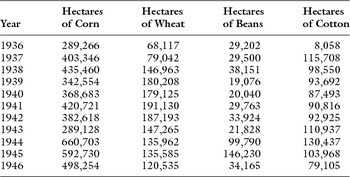
There was some truth to all this. Ejidal credit societies did receive a good number of loans designated to support corn cultivation. Indeed, as illustrated in Table 2, the most hectares under the Banco Ejidal's direction was comprised of corn harvests during both the Cárdenas and Ávila Camacho administrations. Later, during World War II, corn was part of the national production plan. The stresses of the war had provoked shortages in the middle of 1943, and the Banco Ejidal acted in response, pushing corn production in many of its ejidal societies. As indicated in Table 2, corn cultivation jumped from 289,128 hectares in 1943 to 660,703 hectares in 1944. But this is not the full story. In the Banco Ejidal's Annual Report for 1938, the writer admitted that the 435,460 hectares of corn under its care that appeared on paper included subsistence plots that members of the local credit societies financed on their own, without its support.Footnote 63 And given the complaints of ejidatarios in both presidential archives in the Archivo General de la Nación, it is possible this was a pattern under the entire Cárdenas and Ávila Camacho administrations.Footnote 64
Main Crops Harvested with Banco Ejidal Funds, in Hectares

Sources: For 1936 and 1937, Banco Ejidal Annual Report on 1937 (page 9); Banco Ejidal Annual Reports on each year from 1938–1946, with page numbers: 1938 (32); 1939 (20–21); 1940 (11); 1941 (29); 1942 (27); 1943 (22); 1944 (15); 1945 (32); and 1946 (26).
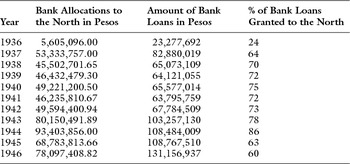
During both presidencies, the vast majority of societies the bank financed were in the “good societies” category. Most of the societies that had “everything in order and . . . seem sure to succeed” were located in the north. This pattern reflects the fact that upper-echelon decision makers in the Banco Ejidal had to be prudent in their allocation policies so that the bank could survive financially and, at the very least, attain some of its redistributionist goals while receiving funds from private sources. This decision, however, led to an inequity: the channeling of important resources to the north at the expense of the southern and central regions of Mexico. Table 3 shows (with the exception of 1936) that the amount of the Banco Ejidal's loans allocated to the north outweighed the amounts given to the other parts of the country during both administrations. Under Cárdenas, allocations to the north rose to 70 percent in 1938; by the time he left office, the percentage had reached 75 percent. It was during the Ávila Camacho administration, however, that the allocations to the north peaked at 86% (1944). Even when they declined in the last two years of his administration, the north still received 60% of the bank's loans.
Banco Ejidal Loan Allocations to the North

Sources: Banco Ejidal Annual Report on 1936–38; Banco Ejidal Annual Report for each year from 1939 through 1946.
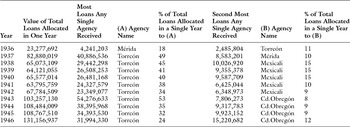
Furthermore, as demonstrated in Table 4, the two bank branches favored most consistently from 1936 to 1946 were in the northern cities of Torreón and Mexicali. In 1936, the Mérida Agency got the majority of the credit issued: 4,241,203 pesos out of a total of 23,277,692 pesos, which was 18 percent of the total loan allocation nationwide. The ejidos of the Laguna region came in at a distant second, with 2,485,804 pesos in loans, or 11 percent of the total. But they received all of those funds in just under three months, immediately after their creation in early October that year. As of 1937, allocations shifted to favor the Comarca Lagunera region, due to a prudent strategy initiated by Cárdenas. Before he took office, the region of La Laguna supplied almost half of the country's cotton and a third of the country's wheat production, making it one of Mexico's most important commercial agricultural centers of production. Clearly, Cárdenas wanted this success to continue through ejidal agriculture. Between 1937 and 1940, the Torreón branch received an average of 44 percent of total loans made by the Banco Ejidal each year to credit societies across Mexico—in spite of the fact that the Laguna region contained only 7.6 percent of all ejidos nationwide that had organized credit societies.Footnote 65 Mérida and Mexicali alternated in receiving the second largest percentage of loans (as well as the second highest amount of loans) from 1937 through 1940. They received anywhere from 10 to 15 percent of the bank's total allocation to societies each year. This means that during Cárdenas's presidency only 41 to 46 percent of the Banco Ejidal's total annual loans were allocated to those ejidatarios indicated as beneficiaries in its public statements. Indeed, President Cárdenas himself was adamant that La Comarca Lagunera receive the most attention and financing the Banco Ejidal could provide “so that the new system in La Laguna would not fail.”Footnote 66
Banco Ejidal Loan Allocations in Pesos

Sources:
1936–38: Banco Ejidal Annual Report on 1938, total loans: p. 21; Loans to (A) and (B): p. 66.
1939: Banco Ejidal Annual Report on 1939, total loans: p. 10; loans to (A) and (B): p. 61.
1940: Banco Ejidal Annual Report on 1940, total loans: p. 8; loans to (A) and (B): p. 36.
1941: Banco Ejidal Annual Report on 1941, total loans: p. 6; loans to (A) and (B): p. 54.
1942: Banco Ejidal Annual Report on 1942, total loans: p. 6; loans to (A) and (B): p. 53.
1943: Banco Ejidal Annual Report on 1943, total loans: p. 6; loans to (A) and (B): p. 10.
1944: Banco Ejidal Annual Report on 1944, total loans: p. 6; loans to (A) and (B): p. 10.
1945: Banco Ejidal Annual Report on 1945, total loans: p. 8: loans to (A) and (B): p. 71.
1946: Banco Ejidal Annual Report on 1946, total loans: p. 9: loans to (A) and (B): p. 57.
Percentages in cols. 5 and 8 are my calculation based on data in the rest of the table
Privileging Comarca Lagunera in loan allocations continued into the Ávila Camacho administration. As shown in Table 4, the percentage of total loans allocated to La Laguna peaked at 53 percent in 1943, due in large part to the quantity of loans earmarked for cotton that ejidal credit societies received to help the United States’ war effort. That year, with loans totaling 54,276,633 pesos, the Torreón agency in La Comarca Lagunera received more than double the loan funds it had received the year before. Although the Laguna region continued to be favored for the rest of Ávila Camacho's administration, in 1944 it began receiving a smaller percentage of the bank's total loans. During that year, it received 35 percent of all loans granted across Mexico, declining to 24 percent by 1946. Given that total loans were increasing, these figures suggest that the bank was channeling its funds to other ejidal credit societies in the attempt to create new constituencies or maintain old ones. Although it received nowhere near the percentage of loans it had received only a few years before, the Comarca Lagunera region continued to be favored over other credit societies and it still received the highest percentage of total loans from the bank.
As shown in Table 2, wheat was the second-largest harvested crop and cotton was the third. The majority of credit for cotton and wheat went to ejidal credit societies in the Torreón and Mexicali agencies during the cardenista period—the same agencies that needed the government's help the least due to the fact that they had access to other loan sources such as private banks, private companies, and individual investors. Thus, the funding they were able to draw on came at the expense of those ejidatarios who grew subsistence crops or cotton and wheat on less fertile ground.
The channeling of millions of pesos each year to the Comarca Lagunera and targeted credit societies in the north affected other ejidal credit societies around Mexico as well. For example, Marte R. Gómez denied the request made by Ing. Primo R. Armijo of the Agrarian Delegation chapter in Zacatecas to form a Banco Ejidal branch there. He explained: “Unfortunately, the Banco Ejidal already has committed itself to endeavors that absorb a good part of our resources: the Laguna, Mexicali, to cite only the most difficult cases, are sucking up the credit assignments the Banco Ejidal has available. We here at the bank don't think it would do much good to attend to many places poorly. The Revolution will benefit the most if it advances firmly from agency to agency, from region to region.”Footnote 67
Of course, the north itself experienced inequality. When the Presidente Cárdenas Ejidal Credit Society in Tamaulipas complained that the Banco Ejidal's decision to calculate their credit at six pesos per hectare would not cover their necessities, Gómez acknowledged that the amount of money was indeed insufficient. “But,” he countered, “this is only one kind of financing . . . Upon harvesting and selling your crops, naturally you'll be able to resolve many of your other problems—of feeding yourselves, dressing yourselves, and so on.” Perhaps influenced by an Arcadian ideal, Gómez also recommended that they supplement the insufficient loans with “a couple of chickens or cows, a vegetable garden or some fruit trees.”Footnote 68 These examples show that the Banco Ejidal's upper-echelon administrators chose prudence and moderately redistributionist goals when allocating loans; they also show that their decisions exacerbated regional inequalities that already existed across Mexico. This was also the case with the high-level politics of loan repayments, as detailed in the next section.
The Politics of Loan Repayments
When repayments were low, the authors of the Banco Ejidal's annual reports argued that the institution should not be held to orthodox banking standards.Footnote 69 For example, the authors of the report for 1936 argued that it was to be expected that ejidatarios would not pay off their loans, but that suspending their credit would “condemn them to staying in their economic and cultural backwardness indefinitely.”Footnote 70 In the reports for 1938, 1939, and 1940, there was little mention of repayment amounts, and the 1939 report included two paragraphs reminding the reader that, given the Banco Ejidal's “social character,” it should be judged by the degree to which it helped ejidatarios, something (the report writers insisted) that numbers alone could not demonstrate.Footnote 71
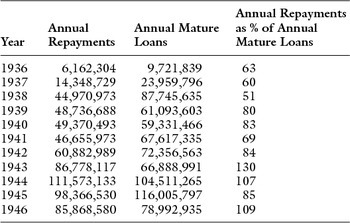
As reflected in Table 5, which shows repayments at the national level, only 63 percent of the loans that came due in 1936 were repaid. Similarly, out of the 23,959,795 pesos of the loans that matured in 1937, only 60 percent was repaid.Footnote 72
Repayments in Pesos at the National Level

Source: Banco Ejidal Annual Report on 1946, 16.
These repayment difficulties were due in part to factors outside of the bank's control. Weather was always a problem. For example, in 1937 aggressive fungi and excessive summer rains ravaged crops across central Mexico, negatively affecting ejidatarios’ repayments.Footnote 73 In La Laguna, many structural and political problems undermined the ejidos’ success. The Comarca Lagunera was certainly unique in the speed of its agrarian reform—447,516 hectares allotted to 34,743 ejidatarios gathered into 296 ejidal groups in 45 daysFootnote 74 However, the ejidatarios there experienced many of the same problems that plagued ejidos throughout Mexico.Footnote 75 Because land reform allowed the expropriated landowners to choose which among their holdings they would keep, the new land tenure arrangements had a patchwork-quilt pattern in which some ejidos were granted plots of land separated from each other by private properties.Footnote 76 Furthermore, the lands the hacendados kept usually included the buildings, storage accommodation, water pumps, and the lands that bordered the main irrigation ditches and roads.Footnote 77
Eyler Simpson in his 1937 classic The Ejido: Mexico's Way Out discussed many other ways that the viability of ejidos—and thus, ejidatarios’ capacity for repaying their loans—was undermined by personal and political influences. In his words, “plain and fancy politics and general ‘cussedness’” affected the ejidos, because the ejidatarios themselves—along with hacendados, mayors, and other non-ejidatario elites—exploited intra-ejido conflicts.Footnote 78 Another problem outside of the Banco Ejidal's direct purview was the new agrarian taxation legislation. Byzantine and vaguely written, it was at best ambiguously implemented and at worst completely ignored. In addition, there was the chronic underfunding of the bank, along with all other agrarian bureaucracies.Footnote 79
Certainly, all of these factors affected ejidal credit societies’ repayments. Some problems affected agriculture overall, but some plagued the bank in particular. Many local administrators were incompetent, ill-informed about local needs, corrupt, or sympathized too much with the ejidatarios. In the eyes of the bank, they were, therefore, wrongheaded. According to an internal report prepared at Banco Ejidal headquarters, Héctor M. Molinar, an agent in Chihuahua, was “very inept”; Salvador del Castillo was “a complete lazybones”; Ing. Jorge Martínez in Matamoros, Tamaulipas, was “very stupid but hard-working”; and César Burgette L., a jefe de zona in Arriaga, Chiapas, was “surely a terrible Jefe de Zona” and “famous for being an idiot.” Needless to say, none of these administrators obtained repayments to the satisfaction of the bank headquarters.Footnote 80 This problem continued into the Ávila Camacho administration. One official remarked that most jefes de zona could not complete the required forms correctly, and, due to their limited knowledge of the Mexican countryside, were “victims of economic hallucinations” about how to get ejidatarios to repay their loans.Footnote 81 Whether the cause was a lack of knowledge or incompetence (as the Banco Ejidal charged), or to local officials simulating stupidity to cover up corruption, or integrating themselves into the communities (like Mary Kay Vaughan's maestros rurales), their ineffectiveness was yet another reason for the low repayment levels.Footnote 82
Furthermore, local administrators who were not part of the Banco Ejidal regularly told ejidatarios that they did not need to pay off their loans. This infuriated bank officials, who felt their efforts to collect repayments were being undermined by other cardenista bureaucracies. In their eyes, bureaucracies at the local level, especially the Agrarian Department, were filled with what Ricardo Zevada called “enemies within the administration”—naive and foolish agraristas who defied the Banco Ejidal's attempts to obtain as large a percentage of repayments as possible. Zevada, who had been the director of the Treasury Department and had become director of the Banco Ejidal's credit department in 1938, was exasperated that Banco Ejidal bureaucrats were at times the only ones “who spoke to the ejidatarios about responsibility.” He fumed that members of other cardenista bureaucracies contradicted the message of the Banco Ejidal by foregoing talk of responsibility to focus on ejidatarios’ entitlement. In fact, it was common for bureaucrats outside the bank to insist that the loan was not a loan at all, but rather a “gift from the Revolution” that symbolized the government's everlasting support.Footnote 83 Not surprisingly, ejidatarios followed these agraristas’ instructions far more often than they did those of the bank officials (though whether the ejidatarios in truth believed the agraristas is, of course, a different matter).
The combination of increasing inflation, necessary financial constraints, the oil expropriation, and conservative opposition to cardenismo in late 1937 through early 1938 convinced Eduardo Suárez, the minister of finance, and Ricardo Zevada that the Banco Ejidal had to increase its repayments. It seems to have been successful in convincing the local officials of other cardenista bureaucracies to fall in line with the bank's approach, for there were far fewer complaints about their interference made by the jefes de zona and by Zevada from late 1938 onward.
Another reason for the reduction in complaints was likely the April 1938 meeting that Zevada convened with the main agents and jefes de zona of the Banco Ejidal. He reminded the attendees of their duties: “We are not a charity. Mind the credit. Guard it; and above all, get the repayments.” The debts and interest the agents and jefes could collect would eventually pay for the bank's operating costs and allow it to continue investing in ejidos across the country. Zevada distributed a written pact of honor to the jefes de zona that they and all other members of the bank bureaucracy were requested to sign. They had to vow, not as members of the Banco Ejidal but as “men, and as patriotic Mexicans” to serve the bank. They were to:
-
1. Make loans only for the foreseen objectives of the bank.
-
2. Make these investments and expenditures as economically as possible.
-
3. Get the best yields from the ejidatarios, for the highest return. [To this end, they were charged to watch the ejidatarios in order to get the most production out of them, and to do their own jobs effectively.]
-
4. Get as much repayment as possible and stay on the lookout for ways to increase it further.
-
5. Exercise strict discipline within the bank. [The bureaucrats were instructed to be obedient to supervisors and proactive about production standards. They were also advised not to be lenient].Footnote 84
Following the meeting and the signing of the pact, the amount of repayments increased. For example, as shown in Table 5, they increased from 14,348,729 pesos at the end of 1937 to 44,970,973 pesos at the end of 1938.Footnote 85 Although repayment amounts did increase from 1936 through 1938, there is more to reveal behind the table figures. The annual report did not mention a crucial qualifier underlying this repayment success story: the percentage of payments relative to matured loans actually decreased over this period compared with earlier years. In 1936 and in 1937 the repayment percentages were 63 and 60 respectively, but by the end of 1938 only 51 percent of the loans that had matured had been paid off.Footnote 86
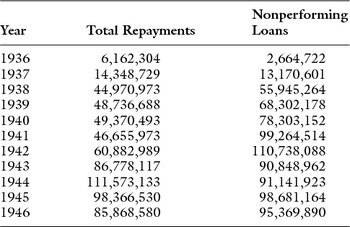
During Ávila Camacho's administration, the Banco Ejidal under Marte R. Gómez's direction intensified its focus on loan repayments. Gómez's early years as president of the Banco Ejidal were particularly trying ones, as is suggested by the data in Table 6.
Total Repayments and Nonperforming Loans in the Banco Ejidal, in Pesos

Sources: Repayment figures for 1936–1946 are from the Banco Ejidal Annual Report on 1946, 16. Nonperforming loan figures are from the following sources, with page numbers in parentheses: for 1936–1942, Banco Ejidal Annual Report on 1942 (10); for 1943, Banco Ejidal Annual Report on 1943 (8); for 1944, Banco Ejidal Annual Report on 1944 (8); for 1945, Banco Ejidal Annual Report on 1945 (12); and for 1946, Banco Ejidal Annual Report on 1946 (12).
The gap between the repayment amount and the amount tied up in nonperforming loans in 1940, 1941, and 1942 was at its widest yet. By 1942, the Banco Ejidal had over 110,000,000 pesos in past-due loans. Gómez sought to narrow that gap in a variety of ways. His measures appeared to have gotten results, especially from 1943 through 1946. As shown in Table 5, the Banco Ejidal achieved a 130 percent repayment rate in 1943.Footnote 87 In 1944, the bank got back 107 percent of its loans, and in 1946 it got back 109 percent of its loans. As shown in Table 6, the gap between repayments and nonperforming loans was smaller from 1943 through 1946.
It was possible to achieve more than a 100 percent repayment rate for many reasons. Some part of the total annual repayments in years 1943, 1944, and 1946 consisted of recoveries on loans that had been previously charged off by the bank, plus repayments made on loans that came due during the normal loan cycle. Furthermore, as shown on Table 7, the total production value of the bank's commodities increased markedly: for example from 125,819,616 pesos in 1942 to 190,816,499 pesos in 1943; and from 347,080,671 pesos in 1945 to 424,345,150 pesos in 1946 (Table 7).
Total Production Values of All Commodities under the Banco Ejidal's Control

Sources: For 1942–45, Banco Ejidal Annual Report on 1945 (34); for 1946, Banco Ejidal Annual Report on 1946 (28).
Higher production values likely translated into higher profits, which likely translated into more repayments to the bank. In addition, by 1942 Marte R. Gómez was intervening more frequently in the bank's local operations, rejecting those societies that did not fit the Banco Ejidal's strategy. Not surprisingly, many of these were in the southern or central parts of the country. He made his position clear to an ejidal credit society in default in Tesistán, Jalisco: “In no way can you consider the credits from the bank to be donations or subsidies.” Rather than “making up excuses” about their infertile land, he told the ejidatarios, “Pay your debts instead.” That, he said, would be the best way to persuade the bank to help them.Footnote 88 To another credit society in Huehuecalco, State of México, Gómez stated that until the ejidatarios paid their overdue principal and interest the bank would not lend to them.Footnote 89
When addressing bank bureaucrats, Gómez connected payments directly to supporting the revolution. In a circular about prudent loan allocation and expected repayment practices, Gómez insisted that “Banco Ejidal employees must put their hearts into their work, and think continuously that the success of the bank will represent the triumph of the Agrarian Revolution and the consolidation of a new social order in Mexican agriculture.” In regard to the question of which ejidal societies to finance and how much to give them, Gómez told the officers to “care for the investments with more zeal than if they were your own, given that it is the money of the Mexican people . . . you must obtain satisfactory repayments.”Footnote 90
Gómez also tried to increase loan repayments through Mexico's legal system. The Agricultural Credit Law of 1943 stipulated several changes to the Banco Ejidal, two of the most important being changes in repayment policy. First, ejidatarios no longer had to subscribe to Series “C” of the Banco Ejidal; they instead put that money into a reserve, which would be drawn upon automatically by the bank to help cover their debts. Second, members of the credit societies were freed from the obligation of paying an annual 5 percent of the value of their crops into the society's social fund; that money would also go toward paying off their debt.Footnote 91 Finally, if the inability to meet their obligations was due to reasons beyond the ejidatarios’ control (such as weather) and not from lack of effort, the following scale of reduced interest rates on their nonperforming loans would be put into place: for the first year, 6 percent; second year, 5 percent; third year, 4 percent; fourth year, 3 percent; fifth and all subsequent years, 2 percent.Footnote 92 Gómez hoped that this change would encourage ejidatarios to pay back their loans. He assumed that if interest payments were too daunting, ejidatarios would be too overwhelmed to make the payments. This, he feared, would jeopardize the entire Banco Ejidal system.Footnote 93 All of these factors contributed to the increase in repayments during Ávila Camacho's administration.
Despite the importance he placed on repayments, Gómez did not want the Banco Ejidal to call in all full loan amounts at all costs. When he learned that agents and jefes de zona were taking animals and work tools from ejidatarios who were behind on their payments, he informed the general director of the bank that these officials should take possession of ejidatarios’ animals only in exceptional cases. “When members of ejidal credit societies deliberately allow their accounts to go delinquent, and when they refuse to keep their promises, I'm not opposed to teaching them a painful lesson. But I do not want bank personnel acting like usurers.”Footnote 94
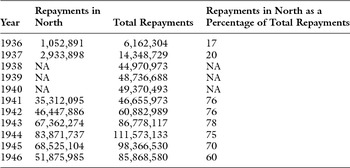
Data for analyzing loan repayments by region does not exist for the years of the Cárdenas administration, but there is data for the Ávila Camacho administration. The north had a good repayment record compared to the other two regions of Mexico that received Banco Ejidal loans. As shown in Table 8, repayments in the north under the Ávila Camacho administration tended to be at 70 percent or above, sinking to 60 percent only in 1946. This trajectory reflects that those ejidal societies in the north were both better positioned to repay their loans and more successful in continuing to receive loans. (Indeed, those ejidal credit societies that did not repay their overdue loans for several years in a row were classified into an “in recovery” category, where they were denied credit until they repaid their loans.) Thus, the pattern of allocating a larger loan percentage to the north was due in part to the region's repayment record.
Loan Repayments in the North

Sources: For 1936–38, Banco Ejidal Annual Report on 1938; for the years 1939 through 1946, the Banco Ejidal Annual Report on each year.
Tables 5 and 6 beg the question: were the increases in repayments as high in reality as they were on paper? Key here is the fact that in its annual reports, the bank did not always differentiate between payments on performing loans (that is, the regular payments from credit societies that were adhering to their amortization schedules in a timely fashion) and recoveries on non-performing or defaulted loans (that is, payments on loans that the bank had charged off that brought the bank no interest, and for which the bank did not expect to collect any past-due payments). In the annual report published in 1947, for example, mature loans (those that were due to be paid in full) were organized into one column for the loan cycles that spanned the period between 1936 and 1946. In another column, the bank noted the repayments it received. The 1947 annual report stated that repayments on mature loans surpassed 100 percent in the years 1943, 1944, and 1946, but admitted that these figures included “some amount” of recoveries on non-performing loans in addition to repayments on mature loans. But the authors gave no specifics, and none can be found in any other documentation. Footnote 95
Furthermore, a review of the complaints filed during the Ávila Camacho administration, found in the collection of the Archivo General de la Nación, did not unearth many letters from ejidatarios around Mexico complaining about stricter repayment policies.Footnote 96 Finally, during the 1940s, there is some anecdotal evidence that ejidatarios were still being told that they did not need to pay off their debts. This practice even reached state governments: one governor had been elected to office on the platform that he would make sure ejidatarios would not have to repay their loans (likely due more to fervent populism on his part than to fervent agrarianism).Footnote 97 Thus, while the increase in total production lends credence to claims of increasing repayments, the vagueness of the statistics (and, in several cases, the lack of explanation), combined with the Banco Ejidal's desire to appear more effective in collecting repayments, give reason to doubt the actual figures themselves.
Conclusion
Questionable or not, the figures that reflect the work of the Banco Ejidal are of less concern than the patterns they reveal. This article has suggested the necessity of systematically analyzing the decisions, relationships, and statistics of financial institutions like the Banco Ejidal, and the benefits to be gained as a result. After its refounding under Cárdenas, the bank mixed populist redistributive policies with market-based policies and used funding from private sources like Anderson Clayton. The article has also demonstrated that the moderate Banco Ejidal did not experience the Thermidor that other cardenista policies experienced in 1937–38. It has argued further that while ejidal credit societies across rural Mexico indeed received loans from the bank, the bank channeled significant resources to the north, particularly to La Comarca Lagunera (and Mexicali), to the detriment of the southern and central parts of the country. Equally important, the Banco Ejidal affected ejidatarios across the country, and analyzing its policies, programs, and day-to-day presence in the ejidos offers a glimpse into a world that we have only begun to understand: the financial cultures and the economic lives of ejidos and ejidatarios. Such analyses of financial institutions across Latin America— political as well as cultural and environmental—can tell us a great deal. It is time to give these institutions their due.