





Background
Type 2 diabetes mellitus (T2DM) remains a significant global health concern(Reference Ahmad, Lim and Lamptey1), with an increasing prevalence in sub-Saharan Africa. The International Diabetes Federation(2) reported 24 million people in Africa lived with diabetes in 2021 and expected to increase by 134 % by 2040. In Ghana, there was an estimated 329 200 adults (aged 20–79 years) diagnosed with diabetes in 2021 and 175 400 adults living with undiagnosed diabetes(2). As such, the management of diabetes has become quintessential to improve the quality of life and survivorship of persons living with T2DM (PLWD).
The literature demonstrates that effective management of diabetes necessitates strict adherence to Diabetes Self-Management Education and Support (DSMES), which emphasises self-efficacy, problem-solving skills and sustained behavioural change through ongoing support rather than one-time education(Reference Davis, Fischl and Beck3). This self-care includes dietary adherence, medication adherence, engagement in physical activities and proper foot care practices(Reference Opoku, Ackon and Kumah4,Reference Paudel, Vandelanotte and Dahal5) . DSMES extends beyond information provision to include emotional, behavioural and practical support delivered by healthcare professionals, family members and community actors. Within this framework of DSMES(Reference Davis, Fischl and Beck3), social support functions as a core mechanism through which dietary behaviours are initiated, reinforced and sustained. Peer and family support draw on principles of experiential knowledge, modelling and reciprocal accountability, which complement formal clinical guidance and enhance adherence to dietary recommendations.
Previous studies(Reference Liu, Li and Pan6,Reference Qu, Zhao and Lai7) report that diabetes dietary self-care encompasses practicing carbohydrate spacing, having a meal plan and consuming fruits and vegetables and this is necessary to improve glycaemic control and reduce the risk of complications such as CVD, neuropathy and nephropathy. Despite the importance of dietary adherence, non-adherence remains a challenge in Ghana. For example, Atuahene et al.(Reference Atuahene, Quarshie and Gorleku8) report that less than fifty percent of individuals living with diabetes in the Central region adhered to dietary recommendations. The authors(Reference Atuahene, Quarshie and Gorleku8) also revealed that thirty-nine percent of people living with diabetes stopped their dietary plans without informing their healthcare providers. Similarly, Dorvlo et al.(Reference Dorvlo, Kumah and Ofosu9) identified forgetfulness as a major factor influencing self-care adherence, including dietary adherence among people living with diabetes in Ghana. Other factors such as difficulty to change dietary habits, social stigma and intentional non-adherence have been cited as barriers to dietary adherence among people living with diabetes(Reference Mogre, Johnson and Tzelepis10). Amidst all of these barriers, the literature demonstrates that individuals who receive social support are more likely to have good dietary adherence(Reference Adu, Poku and Adu11–Reference Doglikuu, Abubakari and Yaseri13). In this study, social support is conceptualised as emotional, instrumental, informational and appraisal assistance provided through interpersonal relationships that influence health-related behaviours(Reference Underwood and Rice14).
In the Ghanaian context, dietary adherence is not only influenced by individual motivation but by the extent to which various stakeholders provide guidance, supervision and encouragement(Reference Botchway, Davis and Merchant15). While a substantial body of literature has examined structured peer support and peer coaching interventions in diabetes self-management(Reference Adu, Poku and Adu11–Reference Doglikuu, Abubakari and Yaseri13), less attention has been given to how informal, non-trained stakeholders such as family caregivers and health system actors collectively shape dietary self-care in routine clinical settings. This study therefore shifts the focus from formal peer programmes to naturally occurring support systems embedded within households and health institutions. It must be noted that these stakeholder roles are interdependent. Healthcare professionals provide biomedical and behavioural guidance, family caregivers operationalise dietary recommendations within everyday household practices and health directorates shape the institutional conditions that enable or constrain both groups. However, empirical evidence examining how these roles intersect in the context of dietary self-care remains limited, particularly in low-resource settings. Understanding these roles is essential for designing comprehensive interventions that enhance collaborative diabetes management efforts. Hence, this study seeks to address this gap by qualitatively exploring how key stakeholders contribute to dietary self-care support for adults with type 2 diabetes receiving outpatient care in diabetes clinics in the Ashanti Region of Ghana.
Methods
Study design
This qualitative study utilised a descriptive phenomenological design. The authors were interested in the lived experiences of family caregivers, healthcare professionals and health directorate officials in terms of their specific roles in advancing dietary self-care adherence among PLWD. As such, personal biases and preconceptions to view the role of these stakeholders from the participants’ perspectives were removed(Reference Jackson, Vaughan and Brown16).
Study sites
The study was conducted in the Ashanti region of Ghana (second most populous region out of the 16 administrative regions of Ghana). This region boasts of the Komfo Anokye Teaching Hospital (KATH), which serves as a major referral tertiary hospital for the Ashanti region and other adjoining regions including Bono, Bono East, Savannah, Upper East, North East, Northern and Upper West regions(Reference Duodu, Simkhada and Okyere17). Specifically, four health facilities with diabetes clinics were selected as study sites: KATH, Manhyia District Hospital, Ejisu Government Hospital and Juaben Government Hospital.
Target population
The study was interested in the experiences of key stakeholders in the dietary self-care adherence journey of PLWD. The stakeholders included family caregivers, healthcare professionals and policymakers. For this study, family caregivers were defined as informal, unpaid persons identified by a person living with type 2 diabetes as the primary individual providing practical and emotional support. Caregivers in our sample included spouses, adult children, siblings and other relatives. The policymakers in this context denote individuals who have the authority to influence healthcare delivery (and by extension, diabetes care) through leadership and managerial roles at the Kumasi Metropolitan Health Directorate (for both KATH and Manhyia District Hospital), Ejisu Municipal Health Directorate (for Ejisu Government Hospital) and Juaben Municipal Health Directorate (for Juaben Government Hospital), who are all employees of the Ministry of Health.
Inclusion and exclusion criteria
Family caregivers were eligible to participate in the study if: (a) they provided at least three months of care to PLWD; (b) had face-to-face contact with the PLWD for a minimum of once a week over the last three months of care and (c) be recognised by PLWD as their caregiver. In order for healthcare professionals to be eligible, they must be nurses, dieticians or medical doctors with a primary clinical role in diabetes care and at least six months’ experience in the diabetes clinic. Policymakers/directors were eligible if they had oversight, managerial or policy responsibilities at the district/municipal/metropolitan health directorates linked to the study facilities and employed in that role for at least 6 months. Policymakers and health directorate officials were purposively selected for their anticipated expertise in health service supervision, training coordination and implementation of diabetes-related policies. Their inclusion was intended to capture system-level perspectives on how institutional structures influence dietary self-care support within clinical settings. All stakeholders were expected to have been adults (i.e., 18 years or older). Participants were excluded if they were (a) younger than 18 years, (b) not fluent in English or Twi to the extent needed for meaningful participation or (c) temporary staff not engaged in diabetes services.
Sampling procedures
Purposive sampling was used to recruit the participants; as such they were intentionally selected. Screening for appropriate participants who met the inclusion criteria was undertaken within the diabetes clinics at each study. Family caregivers who accompanied their relatives to the diabetes clinic were approached and briefed about the study. Those who agreed to participate were recruited accordingly. The healthcare professionals and policymakers were visited and briefed about the study. They were also provided with a participant information sheet to review and make a decision. After 5 days, the individuals were contacted again to follow-up their response to the original invitation. The time for the interviews was decided in consultation with each participant. This approach was taken to avoid imposing our decisions on the participants.
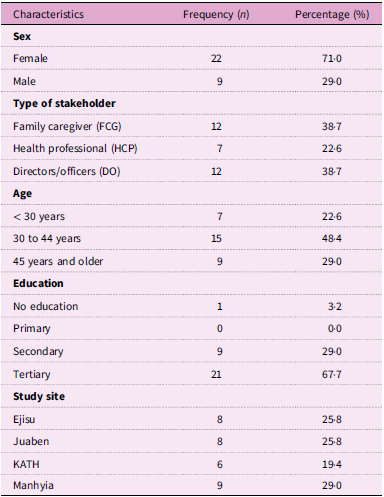
There was no predetermined sample size. However, data saturation was assessed concurrently with data collection and analysis. Interviews were analysed iteratively, and saturation was considered achieved when no new codes, concepts or thematic insights emerged across successive interviews. Following Francis et al.’s(Reference Francis, Johnston and Robertson18) stopping criterion, an additional three interviews were completed (one from each group of stakeholders) to confirm that the study had reached theoretical saturation. The three interviews affirmed that saturation had been achieved. As such, the sampling of participants was terminated after thirty-one interviews (see Table 1).
Characteristics of study participants

Table 1. Long description
The table presents the characteristics of study participants, detailing their sex, type of stakeholder, age, education, and study site. It consists of 6 rows and 3 columns, with the columns labeled Characteristics, Frequency (n), and Percentage (%). The table is divided into five main categories: Sex, Type of stakeholder, Age, Education, and Study site. Each category lists specific subcategories with corresponding frequencies and percentages. For Sex, there are 22 females (71.0 percent) and 9 males (29.0 percent). The Type of stakeholder category includes Family caregiver (12, 38.7 percent), Health professional (7, 22.6 percent), and Directors/officers (12, 38.7 percent). The Age category is divided into less than 30 years (7, 22.6 percent), 30 to 44 years (15, 48.4 percent), and 45 years and older (9, 29.0 percent). The Education category lists No education (1, 3.2 percent), Primary (0, 0.0 percent), Secondary (9, 29.0 percent), and Tertiary (21, 67.7 percent). The Study site category includes Ejisu (8, 25.8 percent), Juaben (8, 25.8 percent), KATH (6, 19.4 percent), and Manhyia (9, 29.0 percent).
FCG, family caregiver; HP: healthcare provider; DO: directors and officers.
Participants were drawn from four facilities across the Ashanti Region, with representation from Ejisu and Juaben at 25·8 percent each, Manhyia at 29 percent and KATH at 19·4 percent. Family caregivers were predominantly females (9 out of 12), aged between 21 and 72 years. The educational backgrounds of the participants varied, with some having tertiary education (n 22), secondary education (n 8) and no formal schooling (n 1). Healthcare providers were all females and included nurses (n 3), dieticians (n 3) and a medical doctor (n 1), all of whom had tertiary education. Directors and officers were drawn from various professional backgrounds, including disease control officers (n 3), public health officers (n 3), nutrition officers (n 3) and directors (n 3). Most directors and officers had tertiary education and were between the ages of 35 and 58.
Ethical considerations
The study conforms with the Declaration of Helsinki(19). All participants were provided with an information sheet that outlined the aim of the study and the procedures. This allowed the participants to provide their written and oral consent to participate. The participants were assured that their identities would be anonymised in any reports or publications. They were also informed that they could refuse to answer any question that they did not feel comfortable with. In addition, the participants had the right to withdraw from the study at any time with or without giving explanations. All these assurances were made to gain the trust of the participants and ensure that they entered the study voluntarily, having understood the terms of engagement.
Data collection procedures
A total of thirty-one in-depth interviews were conducted using a semi-structured interview guide. We selected individual in-depth interviews because they permit candid discussion of personal and potentially sensitive caregiving and professional experiences without social desirability pressure that can occur in group settings. Also, our sample included heterogeneous stakeholder groups (healthcare professionals, family caregivers and directorate officials) with unequal power and diverse roles; however, in-depth interviews avoid dominance of discussion by higher status participants and allow exploration of group-specific perspectives. It must also be noted that scheduling multi-stakeholder FGDs across four clinical sites proved logistically challenging and would likely have limited depth. As such, in-depth interview was a better approach to elicit detailed first-person accounts from each stakeholder category.
The interview guide used was part of a larger study that holistically explored diabetes dietary self-care in Ghana(Reference Duodu, Okyere and Akyirem20). It was developed based on literature and input from local diabetes clinicians through a series of Microsoft Teams meetings. The guide included sections on participant background, understanding of diabetes dietary recommendations, specific roles and tasks in supporting dietary adherence, examples of successful or challenging care practices, training and capacity needs and suggestions for strengthening support. Probes were used to elicit examples and clarify statements. The guide was pre-tested with two healthcare professionals and two family caregivers at a non-study site to assess clarity, cultural appropriateness and estimated interview length. Pre-test interviews informed minor wording changes to questions and probes.
The interviews were conducted by research assistants at the preferred time for the participants. Prior to the actual data collection, a three-day training programme was organised at the Kwame Nkrumah University of Science and Technology for the research assistants. During this training, the research assistants were introduced to the study and the rationale behind it. Additionally, they were taken through ethical principles as outlined in the Declaration of Helsinki and Belmont Declaration. The research assistants reviewed and role-played with the interview guide to gain familiarity before the data collection.
The data collection took place between 1 April and 30 June 2023. Participants chose their preferred interview language. Healthcare professionals and directorate officials were interviewed in English. Family caregiver interviews were conducted in Twi (n 8) or English (n 4). Interviews conducted in Twi were concurrently audio recorded and later transcribed verbatim in Twi by the trained research assistants who conducted the interview. Transcripts were then translated into English by the same research assistant and independently checked by a second bilingual researcher. All translated transcripts were compared against audio to ensure fidelity. On average, the interviews lasted between 45 and 60 min. None of the participants withdrew their consent after the interviews had commenced.
Rigour and trustworthiness
In qualitative research, the importance of establishing rigour and trustworthiness cannot be understated. To ensure credibility, the research methodology that was approved by the various ethical review boards was strictly adhered to. After each day of interviews, the research assistants met to discuss the day’s work and shared the challenges faced. Also, two transcripts were randomly selected from each block of stakeholders to perform member checking(Reference McKim21). A total of six-member checking was conducted to enhance credibility by returning summary interpretations of key themes to selected participants. Participants were asked to confirm whether these interpretations accurately reflected their experiences and meanings. Feedback was used to refine thematic interpretations rather than to validate individual transcripts or codes. A detailed description of the study methodology and context was provided to ensure the transferability of the findings. Specifically, we provided detailed contextual descriptions of the study sites, participant characteristics and sampling approach to enable other researchers to assess transferability to other settings. All transcripts and audio data were stored safely as an audit trail for any future developments. These transcripts and audio data were encrypted and will be stored for ten years. These audit trails of transcripts and audio data were implemented to enhance the dependability of our research process.
Research team and reflexivity
The core research team consisted two PhDs (CB and GW) and three PhD candidates (PAD, JO and RA). They were four males and one female. Each member of the research team had expertise in qualitative research methods and diabetes research. Three of the research team members (PAD, CB and GW) were faculty members in a UK university, while the remaining two were (JO and RA) were postgraduate researchers in the same UK university. The team had not established any relationship with the participants prior to the study. However, the participants were informed that this study forms part of the PhD work of the first author. Given that the first author was previously practicing nursing in diabetes clinics in Ghana, he had some assumptions regarding health professionals and their relationship with PLWD. These assumptions were discussed with the larger team prior to the development of the interview guide and data collection.
Data analysis
All interviews were audio recorded, transcribed verbatim and imported into NVivo 14 (QSR International Pty Ltd.) for management and analysis. Data analysis followed a reflexive thematic analysis approach informed by phenomenological principles(Reference Braun and Clarke22,Reference Braun and Clarke23) . The analytical process began with repeated reading of transcripts to achieve immersion and to attend closely to participants’ descriptions of their lived experiences. Initial codes were generated inductively across the dataset, capturing meaningful segments of text related to stakeholders’ roles in dietary self-care support. Two researchers independently coded a subset of transcripts and met to develop a shared codebook. Coding and thematic interpretations were discussed iteratively among the research team. Differences in coding were examined through discussion until conceptual agreement was reached, enhancing analytic reflexivity rather than aiming for statistical inter-coder reliability. Codes were collated into provisional themes, which were reviewed and revised to reflect patterned meaning both within and across participant categories. Analytic memos were used to document interpretive decisions, examine underlying meanings and link emerging ideas. The final themes were produced through an interpretive synthesis that considered the interaction between individual experiences, caregiving practices and organisational contexts. Finally, interpretations were verified with selected participants to confirm the accuracy of the findings and enhance the credibility of the study.
Findings
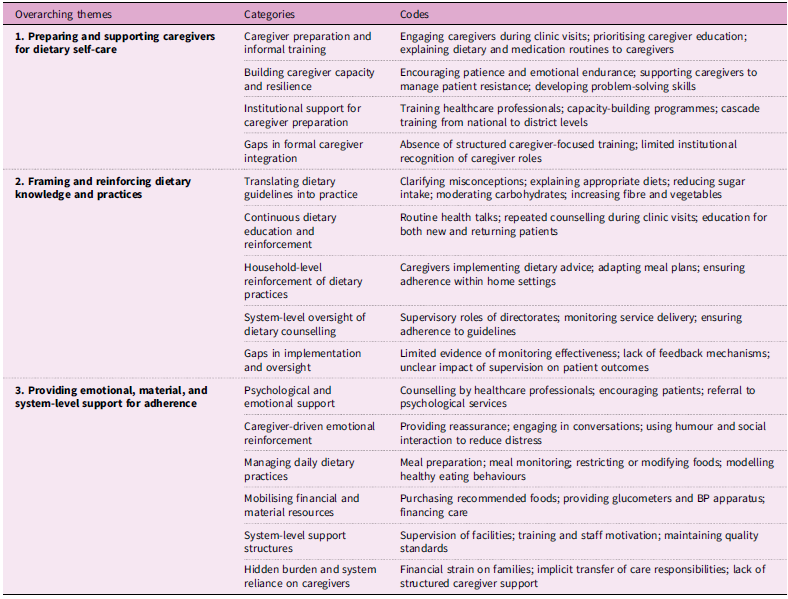
Three overarching thematic domains emerged from the analysis: (1) preparing and supporting caregivers for dietary self-care, (2) framing and reinforcing dietary knowledge and practices and (3) providing emotional, material and system-level support for adherence. Within each theme, the roles of healthcare professionals, family caregivers and health directorates are presented to illustrate how dietary self-care is co-produced across clinical, household and institutional contexts (Table 2).
Coding tree

Table 2. Long description
A table with three columns and multiple rows detailing overarching themes, categories, and codes related to dietary self-care and caregiver support. The first column lists three overarching themes: preparing and supporting caregivers for dietary self-care, framing and reinforcing dietary knowledge and practices, and providing emotional, material, and system-level support for adherence. The second column lists categories under each theme, such as caregiver preparation and informal training, translating dietary guidelines into practice, and psychological and emotional support. The third column lists specific codes or actions within each category, such as engaging caregivers during clinic visits, clarifying misconceptions, and counselling by healthcare professionals.
Theme 1: Preparing and supporting caregivers for dietary self-care
It must be noted that most PLWD in Ghana do not live alone, but with other relatives who take up the responsibility of caregiving. However, for the relatives to be effective caregivers, they must be knowledgeable and have the self-efficacy to deliver on this responsibility. As a result, healthcare professionals actively prioritised engaging with caregivers during clinic visits, sometimes more than the patients themselves, to ensure they understood key aspects of diabetes care, including dietary modifications and medication schedules. The healthcare professionals described their efforts to build caregivers’ confidence and resilience, particularly when patients resisted dietary changes. This informal capacity building focused on encouraging patience, emotional endurance and practical problem-solving, which participants framed as essential for sustaining caregiving over time. Beyond practical support, healthcare professionals also recognised the emotional toll of diabetes and stressed the importance of caregivers providing psychological support to mitigate risks such as depression, as one healthcare professional stated:
“We tell them [family caregivers] to remind the patients to take their medications, and to support them emotionally because the disease might lead to depression” (HP1).
Another participant shared a similar experience:
“We advise them [family caregivers] even more than the patient. Usually when patients come, we ask those who brought them [to the hospital/clinic] and we speak to them more because they are potentially the ones who cook and care for them. If the one who escorted them to the clinic is not the one who cares for them [as the primary family caregiver], we invite that person [primary caregiver] over, so we can educate that person on everything, from diet to medication. So, the caregivers are the ones we talk to the most” (HP3).
Family caregivers corroborated these experiences, indicating that they were routinely engaged during clinic visits and held accountable for patients’ adherence to dietary recommendations.
“Whenever we come to the clinic, the dietician and nurses will call me to educate me. They will ask me about how she [the patient] is doing and whether she is complying with their dietary changes. Because I know that they will ask me about that, I do my best to make sure she adheres” (FCG7).
At the system level, health directorates positioned themselves as facilitators of this process through training and capacity-building initiatives targeted at healthcare professionals.
“It is our role to ensure that health staff are trained to provide the necessary education and care to improve dietary adherence” (DO12).
Yet, there was limited evidence on how such training systematically incorporates caregiver-focused strategies. Their accounts reflected institutional mandates rather than detailed descriptions of how caregiver preparation is operationalised or evaluated in practice. This suggests a potential gap between formal training structures and the realities of caregiver involvement in dietary self-care.
Theme 2: Framing and reinforcing dietary knowledge and practices
Healthcare professionals were the primary actors responsible for framing and interpreting dietary knowledge for PLWD and their caregivers. They highlighted the importance of reducing refined sugar intake, increasing vegetable and fibre consumptions and moderating carbohydrate intake as part of diabetes management. Additionally, structured health talks were routinely conducted during clinic visits, ensuring that both newly diagnosed and returning patients received guidance on proper dietary practices to support their overall health. Dietary education was delivered through routine health talks and individual consultations during clinic visits, ensuring continuous reinforcement of dietary practices for both new and returning patients. This finding is illustrated in the extracted narratives from healthcare professionals:
“We talk to them about their diet, letting them know that they should reduce the refined sugar intake, increase their vegetable and fibre intakes, and decrease carbohydrates. So, we do talk to them about their self-care as often as possible when they come to the clinic” (HP5).
It is important to note that family caregivers played a complementary role by reinforcing this knowledge within the household. Specifically, they monitor food intake, restricting starchy and high-sugar foods to help regulate blood sugar levels. They also adapt meals based on medical advice, modifying portion sizes or incorporating alternative foods to balance nutrition while ensuring the patient feels satisfied. Additionally, some caregivers model healthy eating behaviours by consuming the same recommended meals alongside the patient, reinforcing adherence to dietary guidelines. One family caregiver shared this experience:
“The second thing is her diet. I make sure she does not eat starchy foods that will cause her to have a high blood sugar level, I make sure to help her so that most of the vitals will be managed well” (FCG12).
This was corroborated by another family caregiver:
“I do make those meals at home. I do not allow her to eat stuff that is not good for her; we always eat together at the same table, so she eats whatever I eat and I always make sure I eat meals that are recommended by the health professional” (FCG6).
Health directorates contributed indirectly through supervisory roles aimed at ensuring adherence to clinical standards and consistency in service delivery. However, similar to the previous theme, directorate narratives largely reflected formal responsibilities without detailed accounts of how supervision influences the quality or consistency of dietary counselling at the patient level. This indicates that while institutional structures for oversight exist, their direct impact on dietary self-care practices remains unclear.
“The directorate supervises and monitors the activities of the hospitals… to ensure they meet quality standards” (DO9).
Theme 3: Providing emotional, material and system-level support for adherence
Dietary adherence is an emotional and resource-dependent one, requiring coordinated support across stakeholders. Recognising this, healthcare professionals actively provided psychological support. This role extended beyond routine counselling to offering emotional encouragement, helping patients cope with the psychological burden of navigating through dietary self-care. When necessary, they referred patients to specialised psychological services for further support. This was epitomised in the following extracts:
“I think most people have been facing emotional and psychological challenges with their diet so we try as best as we can to help. Sometimes if it’s beyond our control, we refer to the psychology unit so that they can take it up from there” (HP2).
“We encourage them a lot; the dietician also encourages them emotionally and psychologically to calm them down and for them to really understand the disease and how to go about it” (HP3).
Caregivers also shaped adherence through conversations, reassurance and therapeutic interactions that help patients manage tension or discouragement. The study revealed that family caregivers actively engage their loved ones in conversations, offering reassurance and encouragement to uplift their spirits. They employ various strategies such as humour, storytelling and watching comedy films, to alleviate stress and create a positive emotional environment. Additionally, caregivers reinforce hope by reminding patients that recovery takes time and by sharing their unwavering commitment to their care. Their persistent emotional support, even during periods of severe illness, highlights the deep sense of responsibility and compassion that caregivers bring to diabetes management. However, this same compassion and responsibility exposes the health system has indirectly shifted self-care support to family caregivers. One of the family caregivers explained:
“When you restrict her from taking sweets and food that she has been cautioned not to eat, she gets agitated and emotionally down. I engage her in a conversation when she is emotionally down. All she needs is to be engaged in a conversation” (FCG1).
Another participant stated:
“When she is sad, I tell her that diseases are a part of life and that there would not be any doctor if there were no illnesses in life and that is why I have left my work to come and care for her. Sicknesses occur suddenly but it takes a while for one’s condition to improve, and this one does not kill. We make sure that we converse with her and laugh with her. When she is quiet and moody, we sometimes show some comedy movies that would make her laugh” (FCG10).
At the system level, health directorates contributed through supervision and capacity building, reinforcing the institutional framework within which care is delivered. Nonetheless, the findings revealed a limited formal recognition or structured support for this role within the health system. More specifically, the directorates’ accounts did not explicitly address the growing reliance on caregivers, indicating a potential disconnect between system-level functions and household-level care realities. This implicit transfer of responsibility raises concerns about sustainability and equity, particularly for individuals without access to strong family support systems.
Discussion
This study contributes to the existing body of knowledge by providing a nuanced understanding of the distinct roles played by key stakeholders (healthcare providers, family caregivers and health directorates) in promoting dietary self-care adherence among individuals with diabetes in Ghana. One of the key roles of healthcare professionals was providing dietary education, which includes guiding PLWD on appropriate meal planning, portion control and nutrient intake. This aligns with Alshammari et al.(Reference Alshammari, Windle and Bowskill24) who identified the provision of education as a major role of healthcare professionals in diabetes management. The finding reaffirms a systematic review that identifies healthcare professionals as educators in diabetes care(Reference Nikitara, Constantinou and Andreou25). A plausible explanation for this observation is that PLWD require dietary changes to improve their glycaemic control(Reference Liu, Li and Pan6). However, they may lack the technical know-how as to portion size, specific diets to avoid among others. Healthcare professionals in diabetes care have been trained to identify the unique dietary needs of each PLWD and help them to develop a healthy meal plan. Thus, validating their role as educators in the dietary self-care adherence.
It must be noted that the role of healthcare professionals as educators in dietary self-care adherence extended to the preparation of family caregivers to support PLWD. This finding was expected because the extant literature documents resilience as a necessary factor for family caregivers to effectively provide support to PLWD(Reference Gutierrez-Baena and Romero-Grimaldi26). Hence, healthcare professionals provide family caregiving preparedness education to build the capacity to caregivers to develop a high level of resilience. Such education motivates family caregivers to persevere and continue to assist even when their relatives with diabetes resist or default from dietary recommendations.
Existing literature shows that PLWD often face psychological distress and depression(Reference Agyekum, Gyamfi and Yeboah27–29). For instance, in Sunyani, Ghana, depression is prevalent in 31·5 % of PLWD, whereas the prevalence is 31·3 % among PLWD in Accra, Ghana(Reference Agyekum, Gyamfi and Yeboah27). Recognising this psychological distress, healthcare professionals provided psychological support and care to PLWD. This role was not exclusive to healthcare professionals; family caregivers supported in provision of psychological support by engaging in open discussions about dietary recommendations to alleviate distress, which is a known barrier to dietary adherence(Reference Sumlin, Garcia and Brown30,Reference Tovar, Rayens and Gokun31) .
The study also revealed that family caregivers played an active role in assisting with meal preparation for PLWD – a finding that aligns with an umbrella review that found assistance with meal preparation to be a major role by family caregivers(Reference Busebaia, Thompson and Fairbrother32). Similar findings have been reported in Ghana(Reference Opoku-Addai, Korsah and Mensah33), Peru(Reference Pesantes, Del Valle and Diez-Canseco34) and the USA(Reference Steinberg, Batchelor-Murphy and Young35). The implication is that when caregivers take an active role in meal planning and preparation, they can ensure that meals align with dietary recommendations, reducing the likelihood of consuming foods that worsens glycaemic control. While caregiver involvement was presented as supportive, this reliance also raises concerns about the potential burden placed on family members. The findings suggest an implicit expectation that relatives will assume responsibility for dietary management, which may not always be feasible or equitable. Within the DSMES framework(Reference Davis, Fischl and Beck3), support for caregivers themselves is essential to prevent role strain and ensure sustainable diabetes care. Our findings expose an implicit transfer of care responsibilities from formal health services to households. Participants did not describe systematic mechanisms for supporting caregivers themselves, raising concerns about sustainability and equity, particularly for individuals without available family support.
At policy level, the study revealed that health directorates supervised healthcare facilities and facilitated training programmes that equip healthcare professionals with updated knowledge on diabetes care, including dietary self-care adherence. This role aligns with the principle one of DSMES services that identifies leadership as the bedrock of effective self-management in diabetes context(Reference Davis, Fischl and Beck3). The supervisory role of the health directorates is essential in bridging the gap between national healthcare policies and local implementation, ensuring that clinical practices align with current evidence-based guidelines. This means that engendering an environment where healthcare professionals are continuously learning and adapting to new clinical evidence could help the health system to better respond to emerging challenges in diabetes dietary self-care adherence.
Strengths and limitations
As a study grounded in a qualitative design, it provides deeper insights into the specific roles of the various stakeholders in diabetes dietary self-care. Also, the consideration of multiple stakeholders provides a comprehensive outlook for the study. It must be noted that the implementation of member-checking also boosted the confirmability of our findings. Although the findings are not statistically generalisable, theoretical transferability is supported through rich contextual description and attainment of thematic saturation. Additionally, the use of a descriptive phenomenological design meant that, as authors, we had to set aside our preconceptions and biases to understand participants’ experiences authentically. However, there is no guarantee that preconceptions and biases did not influence the coding process; therefore, this must be taken into consideration when interpreting the findings. Also, the study did not examine whether and how health directorates actually fulfilled their responsibility. In future studies, we will interrogate that aspect of the discourse.
Conclusion
The study shows the significance of healthcare professionals, family caregivers and health directorates in facilitating dietary self-care adherence for PLWD. From a policy perspective, the findings highlight the need for health system reforms that move beyond informal clinician-led recognition of caregivers toward formal institutional mechanisms that integrate family caregivers into diabetes care frameworks. National and subnational diabetes policies should move beyond patient-centred models to household-inclusive approaches that acknowledge the central role caregivers play in daily dietary management. Strengthening institutional frameworks through routine supervision, standardised dietary counselling protocols and structured caregiver engagement can improve continuity and equity of care.
In terms of practice, the findings underscore the importance of continuous professional development for healthcare providers, particularly nurses, dieticians and medical doctors working in diabetes clinics. Training should extend beyond technical dietary guidance to include psychological support skills and strategies for preparing and supporting family caregivers. Healthcare facilities should adopt formal mechanisms for identifying, educating and engaging caregivers during clinic visits, rather than relying on informal or assumed involvement. Such practices can enhance adherence while also reducing misunderstandings, caregiver strain and fragmented care delivery. Additionally, future research should explore how health system reliance on informal caregiving influences health equity and sustainability of T2DM management in Ghana.
Data availability statement
All relevant data are within the paper. Any other data or material associated with this manuscript are available on request through the first author (PAD).
Acknowledgements
The authors would like to thank all the participants, including the family caregivers, study sites (healthcare facilities and professionals and officials of the health directorates) and data collectors, for making this study possible. Finally, we thank David Ameyaw and George Dennis Obeng, both of Syreon Research Africa, Accra, Ghana for their immense contributions during the training of the data collectors and the entire data collection process.
Authorship
PAD: Conceptualisation; Methodology; Formal analysis; Data curation; Software; Project administration; Validation; Writing – original draft; Writing – review & editing. JO: Methodology; Formal analysis; Data curation; Software; Validation; Writing – original draft; Writing – review & editing. RA: Methodology; Formal analysis; Data curation; Software; Validation; Writing – review & editing. CB: Conceptualisation; Methodology; Supervision; Writing – review & editing. GW: Methodology; Supervision; Writing – review & editing.
Financial support
The study received the Staff Development and Strategic Research Investment Funding from the School of Human and Health Sciences, University of Huddersfield, UK to support the data collection in Ghana (HHS013-01). However, the content of this work is solely the responsibility of the authors and does not necessarily represent the official views of the University of Huddersfield.
Competing interests
There is no conflict of interest.
Ethical standards
This study was conducted according to the guidelines laid down in the Declaration of Helsinki and all procedures involving research study participants were approved by the Ghana Health Service Ethics Review Committee (GHS-ERC) [ID: GHS-ERC: 004/02/23] and the School Research Integrity and Ethics Committee (SREIC) [ID: SREIC/2022/056] at the University of Huddersfield, United Kingdom (UK). Additional institutional approval was obtained from the Komfo Anokye Teaching Hospital Institutional Review Board (KATH IRB) [ID: KATH IRB/AP/157/22]. Written and verbal informed consent was obtained from all subjects/patients. Verbal consent was witnessed and formally recorded.

 Open access

