INTRODUCTION
Political parties have been the focus of extensive research in American political science, mostly with regard to their role in government (in Congress and in the relationship between presidents and their parties) and the role of partisanship in explaining voter behavior. Yet, the third domain of American political parties—the party-in-organizationFootnote 1—has received considerably less attention from political scientists. More notably, even those scholars who have studied the Democratic and Republican National Committees as independent political institutions conclude that the DNC and RNC lack relevance in the political system. Identifying the committees as “service providers,” these scholars have argued that they are subservient to the parties' candidates—relevant only by providing assistance in the form of campaign funding and expertise. However, since candidates receive these services in largely equal measure, and because the committees lack the power to make decisions on candidate selection, the dominant view of the party-in-organization has been that the DNC and RNC engage in (to use the title of the first major study of national committees) politics without power.Footnote 2
This perspective of the party-in-organization as being inherently powerless is pervasive not just in the traditional institutional literature, but it is also shared by political scientists in the so-called UCLA School. These scholars distinguish themselves from the traditional literature by arguing that parties are best studied as “coalitions of interest groups and activists seeking to capture and use government for their particular goals.”Footnote 3 This is a notable departure in that the UCLA School argues that interest groups control the political process by using the candidate selection process to select ideologically pure candidates. While this perspective sets the UCLA School apart from the traditional Congress- and president-centered view of parties, in terms of the party-in-organization, it comes to conclusions that are similar to those of the traditional literature. While Masket has argued that local party organizations play a role in selecting candidates,Footnote 4 and there is evidence that party leaders in the Senate attempt to influence the candidate selection process by encouraging (or discouraging) donations at the primary stage,Footnote 5 the DNC and RNC have no direct power over candidate selection. Thus, in the view of the UCLA School, national party organizations remain mere service providers. Indeed, David Karol has stressed “the limited importance of the formal leadership of national, state, and local party chairs”Footnote 6 in the American party system.
This consensus on the lack of relevance of (national) party organizations among both traditional and more recent studies of political parties may lead us to conclude that the DNC and RNC are bystanders in the American political system. Yet, research in the American political development (APD) tradition has represented an important outlier to this view. Indeed, in recent years a considerable literature in APD has begun to chart the institutional development of both parties' national committees. For example, Daniel Klinghard's research has provided crucial insight into how national committees took on the role of organizing national presidential election campaigns on behalf of their parties' candidates in the late nineteenth century.Footnote 7 Similarly, Daniel Galvin has focused on the twentieth-century development of the DNC and RNC into service providers and explained the differentiation that exists between the two parties in this process.Footnote 8 Importantly, in doing so, studies of American political parties from a historical institutionalist perspective have shown that a myriad of party actors—including presidents, other elected officials, and party activists—pay considerable attention to their national committees and frequently compete for control of these organizations.Footnote 9 For example, Brian M. Conley has shown that conservative activists in the 1960s worked hard to control Republican national party organizations to assist their attempts at gaining control of the party as a whole.Footnote 10
These findings raise an important puzzle with regard to the dominant view of the irrelevance of national party organizations: If national party organizations are powerless, why do politicians think they are important?
I argue that while the APD literature has done much to recognize the importance of party organizations in American politics, we can expand our understanding of the relevance of national committees in the eyes of party leaders by focusing in on a specific set of activities the DNC and RNC engage in: providing publicity of the party's policy positions. While these publicity activities can be considered another “service” to the party, party leaders believe them to be much more important than that: National committee publicity is of crucial importance to the party because its leaders believe that it helps shape a national party brand—that is, an understanding among voters as to what the party's positions are at a given moment in time. Such brands, or party images, are important to parties and candidates because they provide voters with information that lowers the cost of becoming informed about individual candidates. As a result, it is easier for parties to mobilize voters during election campaigns. The national committees—in the eyes of party leaders—therefore have a clear and important role in the political system: They not only assist candidates, they also provide voters with crucial informational cues on the party's positions.
Importantly, the extent to which party leaders rely on their national committees to provide these branding services is dependent upon the party's electoral performance. More precisely, it depends on whether parties perceive themselves to be in the minority or majority on a national level. I follow Goldman in defining national majority parties as having
majority status in at least four places simultaneously: (1) the electoral college, derived from pluralities in a sufficient number of states, that is, the party-in-the-electorate; (2) the presidency; (3) the Senate; and (4) the House of Representatives.Footnote 11
When not all of these conditions are met, I will—like Goldman—consider a party to be the national minority party. This means that whenever there is a divided federal government, there is no national majority party but instead two minority parties.Footnote 12
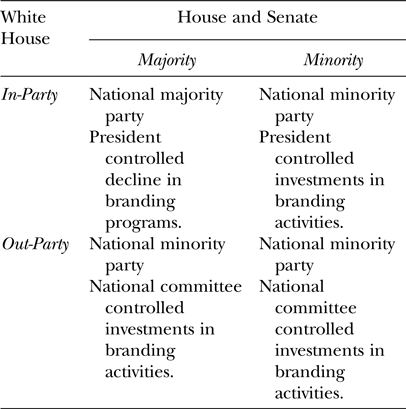
Thinking of party status in this way helps explain when we see national committees invest in party-branding activities. When a party is the national majority, it has managed to produce a winning coalition, and therefore party leaders are less reliant on the DNC or RNC and the committees' publicity programs shrink. This decline is the product of three connected reasons. First, presidents have personal incentives to want their party to be in the majority, and they invest in party-building activities to achieve this goal. When the party is already a national majority, presidents lack the incentive to make such investments.Footnote 13 Second, national majority parties can more easily produce a brand through other venues—most notably, through legislation and governance.Footnote 14 Finally, national publicity programs—as the following cases will show—can be disruptive to the party's coalition by explicitly taking sides in intraparty conflicts. Majority parties (and their presidents) may be hesitant to rely on committee publicity activities out of concern that they could disrupt their existing coalition. In contrast, when a party is a national minority party, leaders expect their committees to step up their publicity efforts in order to convince voting groups that rejected the party in the previous election to (re-)join their coalition in the future. The committees of national minority parties prioritize their branding role by investing considerable shares of their budgets in their publicity divisions, inaugurating new publicity programs, and creating new communication tools to reach out to voting groups (see Table 1).
National Committee Branding Activities by National Party Status

However, party brands are not consistent and are frequently contested: Parties face major internal debates regarding what policy positions to pursue and which groups to target to gain national majority status. Who within the national minority party decides what groups the committee targets is also a product of the party's electoral performance. The national committees as political institutions are made up of a set of individual committee members from each individual state, representing their local state party organization.Footnote 15 This body of representatives as a whole elects the chair of committee.Footnote 16 However, when a party holds the White House, the incumbent president has the power to nominate the committee chair of their liking—a choice national committee members subsequently ratify without controversy. When a party is out of the White House, competition for the chair position is open: No other party leaders—including the congressional leadership—can select a committee chair.
This difference in selection not only affects who is put in charge of the committee, but also affects committee chairs' term in office. Since presidents can also replace incumbent committee chairs if they are dissatisfied with the committee's performance, committee chairs of in-parties can be regarded as agents of the incumbent president. In contrast, chairs of out-parties can only be replaced by a vote of the full national committee—which meets infrequently and for which the chair sets the agenda—and therefore are considerably more independent.Footnote 17 Thus, when a party is in the minority in Congress but holds the White House, the president has de facto control over the national party organization and committees will engage in publicity activities but will follow presidential preferences with regard to what kind of image it promotes. But in cases where the party does not control the White House, national committee chairs have considerable leeway to decide exactly what image to project.Footnote 18 This means that national committee chairs of out-parties can take sides in intraparty conflicts and publicize a specific party brand that benefits one side of the party over others (see Table 1).
All of this means that national party organizations, in the eyes of party leaders, have considerably more relevance than the dominant view among political scientists of the committees being mere service providers would have us believe. By engaging in a variety of programs intended to inform and persuade voting groups, the national committees are participants in one of the fundamental elements of national party activity: creating a party brand. Additionally, when parties find themselves in the minority and out of the White House, national committee chairs have the freedom to prioritize promotion of a specific type of image. Therefore, while national committees do not have the power to select candidates, they can and do attempt to promote the party brand they prefer. As a result, the national committees have been in the center of major intraparty debates concerning questions of party ideology and issue positioning.
To test this argument, I present historical case studies of national committee branding activity in the period 1952–1976. I rely extensively on archival sources—including internal committee correspondence and transcripts of committee meetings—to show not just the type of publicity programs the committees produced but also the arguments party leaders used to explain the need for these programs. I show that in this period, losing presidential elections (for the Democrats, 1952–1960; for Republicans, 1960–1968) resulted in national committees inaugurating innovative publicity programs intended to promote the party to specific voting groups. Crucially, the national committees in these cases also sought to produce a brand that took a clear side in ongoing intraparty conflict. For example, under Chairman Paul Butler (1955–1960), the DNC aggressively promoted the Democratic Party as supporting civil rights and other liberal policy positions—to the frustration of Southern conservatives in the party. In the GOP, under the control of conservative chairs Bill Miller (1961–1964) and Dean Burch (1964–1965), the RNC focused its publicity activities on white voters in the South—against the wishes of Republican moderates.
Victories in presidential elections changed committee behavior to the extent that a party also had a majority in House and Senate. After Democrats regained the White House and national majority party status in 1960, the DNC eliminated many of the publicity programs it had created while the party was in the national minority. In contrast, under Nixon and Ford, Republicans remained in the minority in Congress and the RNC continued to invest in new publicity programs intended to help build the party into a national majority. However, the party image the RNC promoted in this period was strongly connected to the preferences of the party's presidents.
PARTY BRANDS AND EDUCATIONAL CAMPAIGNS
Rational choice theories of American political parties rely heavily on the importance of party brands.Footnote 19 The basic assumption underlying these theories is that candidates for public office join parties because they lower the costs of mobilizing voters. Candidates and elected officials want to get (re-)elected, but doing so requires voters to turn out and vote the “right” way. To do so, voters need information about the candidates' positions to identify which voting options best fit their own views or needs. Gathering such information is more costly for voters if candidates run solely on a personal image. Parties provide a solution by creating a “party brand”—best understood as the combination of positions the average voter understands the party to hold on policy issues at a given moment in time. By connecting themselves to a political party, candidates provide voters with a heuristic that lowers the amount of information they would otherwise need to collect to make an educated vote.
For this heuristic to be meaningful, however, a party brand must have predictive value. That is, if politicians simply identify as members of a political party, but that party does not have a brand that is consistent across its members, knowing that a politician is a Democrat rather than a Republican does not solve voters' information problem.Footnote 20 American political parties have very limited tools to force members to take on the same positions.Footnote 21 In cases where there is a natural consensus, this is not a problem. However, American parties are big-tent coalitions of voting groups that (historically) have frequently been strongly divided on issues. Therefore, parties can face substantial internal differences among members on policy. When members break from the modal party position—through voting, media appearances, and campaign activities—they dilute the national party brand. As a result, voters can end up confused about what the party's “true” brand is and may stay home on election day.
Congressional scholars have argued that individual members of Congress cede control over the legislative agenda to party leaders to ensure that the party's brand is as consistent as possible.Footnote 22 As such, the literature has also mostly assumed that legislative achievements in Congress create these party brands. This is true to a point, but I argue that congressional actions are not alone in shaping those brands. Other signals, such as party platforms, public statements by party leaders, actions by presidents, and publicity on behalf of the party are likely to influence voters' perceptions of the party's policy positions as well. The party's national committee is especially relevant in this regard because providing publicity for the party on a national level is among the most important services it provides.Footnote 23
As Klinghard and others have argued, it was the emerging need—produced by reforms of the Progressive Era in the late nineteenth century– within parties to educate voters on national policy positions that instigated a modernization of the national committees.Footnote 24 With the committees being the sole national body of the party, party leaders turned to the DNC and RNC to invest resources in producing national campaigns to instruct voters on their positions. This resulted in a fundamental reappraisal of the powers and responsibilities of the national committees within the parties: With the DNC and RNC now enabled “to shape national campaign strategy more effectively than ever before,”Footnote 25 they placed themselves in the center of the parties' activities related to funding, organizing, and publicizing election campaigns on the national level.Footnote 26 The national committees as modern “service providers” thus engage in a variety of activities to assist candidates, but “educational campaigns”—informing voters of the party's policy positions through communication tools like campaign ads, press release, and public statements by party officials—remain a fundamental subset of the committee's role within their parties.Footnote 27
ELECTORAL SUCCESS AND (THE LACK OF) PUBLICITY ACTIVITIES
While these publicity services are important to their parties, national committees do not produce these at an equal level across time. Additionally, who decides what these publicity activities look like is also not constant. Historical institutionalist studies of the national committees have found that the extent to which the DNC and RNC are active is correlated with the electoral success of the party.Footnote 28 Meanwhile, presidents—as leaders of their party and through their control of the chairmanship of the national committee—play a fundamental role in deciding what kind of publicity activities (if any) the committees engage in and what exact image they promulgate.
As studies by Philip Klinkner and Daniel Galvin have shown, there is considerable difference in national committee activity between different types of parties. Klinkner has shown that, all else equal, “out-parties” (i.e., parties that do not control the White House) are more active than “in-parties.” Galvin has shown that party organizations are also quite active under presidents of national minority parties in the realm of party building. Partly, this is the product of presidential preferences: National minority party presidents are willing to invest considerable time and resources in their party's organizations to help improve its electoral performance. But when their party is already the national majority, presidents lack incentives to do so, resulting in a decline in committee activities. Additionally, it appears likely that in the case of publicity programs, national majority parties may prefer to focus their attention on legislation and governance. Finally, publicity activities by the national committees can be disruptive to the party's coalition when it takes sides in intraparty conflict. National majority parties (and their presidents) may be hesitant to rely on such activities out of fear of disrupting their existing coalition—preferring instead to maintain the “winning team” that put them in a national majority position in the previous election.
Modern presidents' domination of national party organizations also affects decisions regarding the type of publicity programs the committees produce.Footnote 29 Given that the president has the power to select and replace national committee chairs, the DNC and RNC have come to reflect the president's preferences. This means that in situations when the party is the national minority but controls the White House, the committee will invest in new branding activities, but will promote the president's view of what the party's national image should be. In contrast, when a party is in the minority without holding the White House, national committee chairpersons have considerable freedom to chart their own course and decide what kind of programs the committee should invest in and what type of image the party organization should project.Footnote 30
Combined, a party's level of electoral success and whether it holds the White House or not produces a set of clear expectations as to what kind of branding activities the committees should engage in (see Table 1). If a party is the national minority, it should invest in new or existing publicity programs and use those programs to target specific voting groups to help it become the national majority party. However, when the party is the national majority, publicity programs will decrease, even if other party-building activities (such as fundraising) continue. Additionally, if a party holds the White House but does not control Congress, we should see committees engage in new publicity efforts that mimic the president's preferences. In contrast, if the party is in the minority but does not hold the White House, we should expect committees to engage in branding efforts but to have the freedom to act independently regarding the party image it projects.
CASE SELECTION
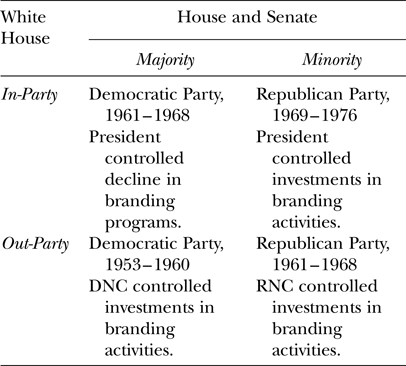
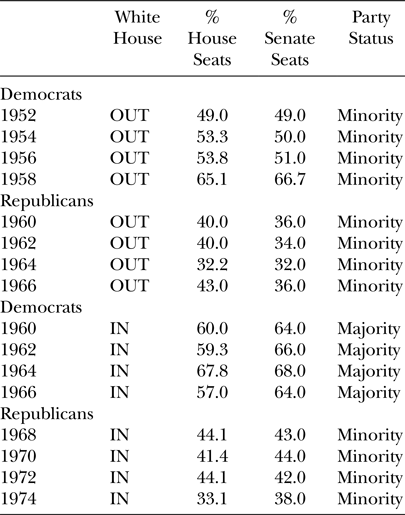
To test this theory I present four case studies from the period 1952–1976 (see Tables 2 and 3). In the first set I focus on parties that have lost presidential elections. The first case, centering on the Democrats under the Eisenhower administration, assesses a party that—with the exception of the 83rd Congress—had majorities in both the House and Senate but did not control the White House. In the second case, I look at the RNC's activities during the Kennedy and Johnson administrations, when Republicans were out of the White House and in the minority in Congress. The next set of case studies focuses on the period following presidential election victories for Democrats in 1960 and Republicans in 1968. Crucially, only the Democratic presidential victories resulted in a national majority party. The Democrats not only won the White House but also held majorities in the House and Senate throughout the period 1960–1968. In contrast, Republicans remained in the minority in Congress after the 1968 and 1972 presidential elections. Consequently, we should see a difference in national committee activity for these two in-party cases: While the DNC is expected to have decreased its publicity activities after the 1960 and 1964 elections, the RNC should have continued its branding programs throughout the Nixon and Ford presidencies. Crucially, however, the RNC's publicity activities should follow the party image preferred by its presidents.
Case Study Theory Predictions of National Committee Branding Activities, 1953–1976

Case Study National Minority and Majority Party Status

Source: Congressional Quarterly's Guide to U.S. Elections (Washington, DC: CQ Press, 2010).
A limitation of concentrating on party organizations in the same time period is that the external validity of any findings may be constrained. That is, committees may have behaved differently outside of this period. This is particularly relevant because, although the logic of the theory should apply to committee activities across the twentieth and twenty-first centuries, the institutional state of the committees and the broader context in which they function are certainly likely to have influenced the extent to which committees actually engage in publicity. That is, Galvin's findings regarding the development of the DNC and RNC as political institutions suggest that,Footnote 31 all else equal, we should expect the national committee of a minority party in the 1920s to engage in more publicity programs than a majority party at the same time, but less so than a national committee in a similar electoral position in the 1970s due to the expansion of committees over time. Focusing on a set of cases in roughly the same time period means that it is not possible to test both the developmental theory of national committees and this generalizable theory of party branding simultaneously.
However, there are also considerable benefits to the selection of these cases with regard to internal validity. First, assessing party activity in these decades allows for comparison of a case representing each party type, while simultaneously controlling for potential differences inherent to the parties themselves. Second, by comparing cases within the same time period, it is possible to control for potential confounding variables such as major changes in the media landscape and campaign finance rules.Footnote 32 Given the existing literature on the long-term development of national committees, this is particularly relevant because we would expect to see major differences between the size and extent of committee programs across time regardless of party status. Third, the period 1952–1976 covers the high point of a major ideological party realignment. Because different ideological and regional wings of both parties were in open conflict with each other during this period, it is possible to identify instances in which national committees took sides in these controversial debates and illustrate the kind of independence national committees can have to promulgate specific types of images. Finally, these cases are appealing because considerable archival resources from the national committees themselves are publicly available. It is therefore possible to assess not merely what national committees did but also to identify the reasoning political actors within the committee provided about why they believed such programs were necessary.Footnote 33
NATIONAL MINORITY PARTY COMMITTEES AND THE EXPANSION OF BRANDING ACTIVITIES
In the cases in this section I look at committees of parties that did not control the White House. The first case focuses on the DNC's activities during the Eisenhower administration. While Democrats—with the exception of the 83rd Congress—had majorities in the House and Senate in this period, Republican control of the White House meant that the Democratic Party was still a national minority party in this period. The second case concerns the RNC's activities during the Kennedy and Johnson administrations. During this period, the Republicans were also in the minority in House and Senate. In both cases, the DNC and RNC invested considerably in new publicity programs. Importantly, because neither committee was under presidential control, DNC and RNC chairmen in these periods had considerable power to decide what party image to promote, and they used this power accordingly. The DNC—in the second half of the 1950s—publicized the Democratic Party as a liberal, pro–Civil Rights party. The RNC switched back and forth between promoting the GOP as a conservative or moderate party, depending on which wing controlled the national committee.
DNC, 1952–1960: The Liberalization of the Democratic Party
In the eight years in which Democrats were locked out of the White House, the DNC focused (in the words of DNC chairman Stephen Mitchell [1952–1955]) on “broadening our Party and reviving it where necessary with new ideas and new leaders.”Footnote 34 In the wake of the 1952 election, Democratic leaders identified a lack of national party publicity as a key concern moving forward. For example, Stephen Spingarn (an aide to President Harry Truman), in a letter to defeated presidential candidate Adlai Stevenson, called for a “strong, resourceful and imaginative leadership at the Democratic National Committee,” as well as “a strong Research Division” and “an equally strong publicity division.”Footnote 35 Spingarn's assessment was broadly shared in the party, and in January 1953 Mitchell announced that the DNC would operate its “public affairs activities—publicity, research, speaker's bureau—at campaign tempo”Footnote 36 throughout the Eisenhower years. A newly organized Public Affairs division became particularly active and—aside from releasing a constant stream of press releases—introduced a variety of new approaches to inform voters on the Democratic Party's positions throughout the 1950s.
The most notable of these concerned a new monthly magazine: the Democratic Digest. While a publication with the same name had existed previously, the Digest introduced in May 1953 was fundamentally different from anything previously produced by a national committee of either party. With the new Digest available through subscription services and on newsstands at 25 cents per issue, the national committee now communicated directly—without interference of the media or even Democratic elected officials—with Democratic voters. The Digest was under the editorial control of the DNC, which meant it could engage any issue it believed was central to the party's national agenda. The Digest was thus presented as “the voice of the Democratic party,”Footnote 37 with its principle task identifying “the campaign issues for the party and [projecting] them in terms easy for the public to understand.”Footnote 38
In the assessment of political scientist Roger H. Marz, writing in 1957, the Digest was “an essentially new form of activity in the American party arena.”Footnote 39 The Digest had a successful early launch, with 20,000 subscribers before the first issue was published, and a run of 100,000 copies per issue.Footnote 40 Newspapers such as the New York Times, the Washington Post, the Los Angeles Times, and the Chicago Tribune regularly reported on articles published in the Digest.Footnote 41 Clayton Fritchey, who served as the Digest's first editor, in 1954 argued that the magazine was followed “by editors and publishers, by columnists and commentators, by political writers, educators, clergymen, civic leaders, lecturers, by the producers of radio and TV forums which have audiences in the millions.”Footnote 42 The DNC also actively pushed news organizations to cover what the Digest published: Fritchey, in April 1953, described how “when one of the news services failed to carry a story on the issue of the Democratic Digest a few days ago, when it came out, we got in touch with friendly publishers. They brought pressure to bear and we had the story out to 2,000 more papers than it would have gone out to otherwise.”Footnote 43
Throughout the 1950s, the division between Southern conservatives and Northern liberals within the Democratic Party provided crucial context to the strategic choices the DNC made. In the wake of the 1952 defeat, the DNC attempted to placate Southern Democrats by relying on a “unity” approach. This meant that the party image the DNC promoted during the first Eisenhower administration was designed to be nonoffensive to Southern Democrats. For example, in campaign materials for the 1954 midterm elections, the DNC attacked the Republican Party by focusing on the economic downturn and negative campaign tactics by “Old Guard” Republicans in Congress and Vice President Richard Nixon.Footnote 44 The DNC also countered Senator Joe McCarthy's (R-WI) ongoing attacks on (perceived) communist influences in the Democratic Party.Footnote 45 At the same time, the committee carefully avoided issues related to civil rights.Footnote 46
After the 1954 midterms, Mitchell resigned to focus on assisting Stevenson in winning the presidential nomination. Paul Butler, Mitchell's replacement, continued to invest in branding programs while maintaining the “unity” approach. During his acceptance speech, Butler pledged that he was “against any sectionalization of our Party by any issue, activity or any proceeding” and would “serve the Party and all members of the Party, all sections of our Country, with the same degree of understanding and appreciation of their problems in their local areas as they certainly are entitled to at all times.”Footnote 47
After the 1956 election, however, the DNC radically adjusted the party image it promoted. While Democrats managed to retain their slim majorities in Congress despite Stevenson's second landslide loss to Eisenhower, liberals in the party were concerned by the “large-scale defections of Negroes and laborers from the Democratic fold.”Footnote 48 More generally, liberals were frustrated that Southern Democrats had control over the congressional agenda due to the pro-Southern bias inherent in the seniority system.Footnote 49 The result was that conservatives managed to veto the creation of a liberal national Democratic brand in Congress.
In late November 1956, during a meeting of the DNC's executive committee, liberals voiced their dismay that Republicans could start outperforming Democrats on civil rights and their concern on how this would affect Democrats in future elections.Footnote 50 During this meeting the liberals also expressed their frustration at being unable to produce an alternative liberal Democratic brand to counter the conservative image outside of the South. DNC member and mayor of Pittsburgh David Lawrence argued that the dominance of Southerners in Congress had made it impossible for Democrats in the North to connect with black and union voters:
There isn't any question that in a great many areas in the north we lost a substantial colored vote and labor vote; and the arguments about [Senator James] Eastland [D-MS] on the one hand, and [Chairman of the House Committee on Education and Labor Graham A.] Barden [D-NC] on the other hand were just unanserable [sic], you couldn't answer them. … We could go into all the details of what Roosevelt did for the colored people, and what Truman did, and what we have done in cities and in states for them. But that was too long-drawn-out. They just say “Eastland”; they say “Barden”; and that answered all kinds of arguments.Footnote 51
To help solve this problem, the DNC voted to create a new party institution, the Democratic Advisory Council (DAC). The DAC consisted of party leaders inside and outside of Congress, chaired by Butler, and the DNC decided it would have the power to set policy positions for the Democratic Party as a national body. The DNC created the DAC with the purpose of countering the regional Southern congressional Democratic brand with a national liberal one to ensure that Democrats outside of the South could reconnect with black and union voters. Southern members of the executive committee abstained in protest.Footnote 52 In the press release announcing the DAC, the DNC stressed the importance of a national brand, describing the new party institution as being “a vehicle for rallying national support behind constructive programs and organizing and giving voice to opposition to unwise programs which ill-serve the national interest.”Footnote 53 The Washington Post’s assessment of the DAC was that “the National Committee in the past had seldom exercised such a voice”Footnote 54 and that the creation of the council represented a major expansion of DNC power.Footnote 55
In early December 1956, Butler announced a preliminary list of proposed DAC members: party elders such as Harry Truman, Stevenson, and Eleanor Roosevelt were joined on this list by congressional leaders such as Speaker of the House Sam Rayburn (D-TX), Senate Majority Leader Lyndon Johnson (D-TX), and House Majority Whip Carl Albert (D-OK). Additionally, liberals such as senators Hubert Humphrey (D-MN), Mike Mansfield (D-MT), and John F. Kennedy (D-MA), and governors Averell Harriman (D-NY) and G. Mennen Williams (D-MI) were included. However, all of the members of the Democratic congressional leadership rejected Butler's invitation—a protest move liberals in the DNC had expected.Footnote 56 In selecting the other members, Butler ensured that the DAC would be dominated by liberals, with even the Southern members identified as progressives.Footnote 57 The DAC's steering commission—consisting of five members involved in the day-to-day planning of the new commission—included only one Southerner, while the other members (Stevenson, Harriman, Williams, and California DNC member Paul Ziffren) were all outspoken liberals.Footnote 58
The DAC immediately came out in strong support of civil rights and called on Democrats in Congress to “redeem party pledges by supporting civil rights legislations” and for “legislation to end discrimination of all kinds.”Footnote 59 The DAC also criticized the Eisenhower administration for its failure to stand up to Arkansas Governor Orval Faubus (a Democrat) in the Little Rock school controversy and passed a resolution criticizing antilabor right-to-work legislation—a rebuke of Senator John L. McClellan (D-AR), who had attempted to include a right-to-work amendment as a poison pill to the 1957 civil rights bill.Footnote 60
Butler also became a vocal supporter of civil rights and an equally vocal critic of Southern Democrats. This represented a major departure for the chairman: Prior to the 1956 election, Butler had carefully avoided alienating the Southern Democrats and had argued that segregation should not be a core concern for the national Democratic Party.Footnote 61 Even the brutal murder of Emmett Till—a 14-year-old boy from Chicago lynched by a mob in Mississippi after allegedly flirting with a white woman while visiting his family—could not move Butler from this “party unity” position. Despite pleas by local Democratic organizations across the country, the NAACP, Rep. James Roosevelt (D-CA), and California DNC member Paul Ziffren for Butler to merely call for a fair trial of Till's murderers,Footnote 62 the DNC chair refused, stating that he could not interfere publicly because he was “Chairman of all Democrats, white and Negro, North and South.”Footnote 63
However, the 1956 election altered Butler's thinking in this regard. His own analysis of the election results stressed Eisenhower's success among black, Catholic, and union voters—all traditionally reliable Democratic voting groups that were now turning away from the party.Footnote 64 Butler thus began criticizing Southern Democrats for their lack of support for civil rights. In September 1958, Butler called out Governors Faubus, James Almond (D-VA), and Marvin Griffin (D-GA) for their failure to implement civil rights reforms, stating that these Southern Democrats did “not represent the position of the Democratic Party.”Footnote 65 During a TV interview a month before the 1958 midterms, Butler went even further, telling Southern Democrats that “if they did not like the party's official stand in favor of integration they could find asylum either with the Republicans or in a third political party.”Footnote 66
The 1958 midterm results strengthened the liberals' conviction that the party's move to the left was paying off. In both the House and Senate, the class of 1958 represented an important first wave of newly elected liberals. In the House, the “large influx of northern liberal Democrats”Footnote 67 inspired the creation of the Democratic Study Group, which would go on to push for increased power for the party leadership at the expense of the seniority system. In the Senate, the class of 1958 included liberals such as Edmund Muskie (D-ME), Philip Hart (D-MI), and Eugene McCarthy (D-MN). As Sinclair has noted, these “new Democratic senators differed from their senior party colleagues in region of origin, ideological proclivities, and electoral security” and were a “markedly liberal group.”Footnote 68
As Eric Schickler has shown, the DNC was not alone in calling for the liberalization of the national Democratic Party in this period. Indeed, many Democratic state party organizations embraced civil rights in the 1950s, and liberals in Congress began to organize to push for civil rights legislation after the 1956 election.Footnote 69 Still, Democratic congressional leaders—most notably Rayburn and Johnson—strongly opposed the DNC's actions. For example, Rayburn, speaking in February 1959, warned that he had “no patience with people who claim to be Democrats who say they want to run other people who claim to be Democrats out of the party.”Footnote 70 Other Southern Democrats also expressed their frustrations with the DNC's attempts at liberalizing the Democratic image. Senator Robert C. Byrd (D-WV) cautioned Butler in a personal letter that “if we hope to be victorious next year, we should and we must adopt unity as our watchword,” and reminded the chairman that if the Democrats would “[seek] to cast out all of the liberals, or, conversely, all of the conservatives, then it will cease to be the Democratic Party.”Footnote 71 Senator Spessard Holland (D-FL) advised Butler that “the great bulk of our members are distinctly out of sympathy with the pronouncements of the Advisory Council which seems to be running directly counter to the efforts of the leadership and the majority of the Democrats in both Senate and House.”Footnote 72 Other Southerners vowed to repeat their 1948 bolt during the 1960 convention and to free their presidential electors to vote against the Democratic ticket and turn a potentially close 1960 presidential election to the House of Representatives.Footnote 73
These protests of congressional leaders and Southern Democrats did little to slow down the DNC-DAC's attempts to rebrand the Democratic Party as a liberal national party. In 1960, the DAC introduced a new subcommittee on civil rights chaired by Eleanor Roosevelt to draft a civil rights plank for the 1960 convention. The subcommittee called for Democrats in Congress to go “squarely on record as opposed to racial segregation in public schools” and “to enact additional laws to protect … rights of American citizens to register and vote free of discrimination based on race, color, religion or national origin.”Footnote 74 Despite protests from Southern members of the DAC and Southern Democrats in Congress, the convention incorporated the DAC's civil rights proposal into the party platform. The DNC's push for a liberal brand, in James Sundquist's analysis, was therefore fundamental in signaling to voters that neither the “moderation” of Johnson and Rayburn, nor the “outright defiance” of Southern Democrats was the “Democratic party's position.”Footnote 75
Throughout the 1950s, the DNC invested in new publicity programs to help produce an image that could improve the party's electoral performance. However, with the committee lacking presidential control, the type of brand the party promoted depended upon who controlled the DNC. After the 1952 election, Mitchell believed the key to improving the party's performance was in presenting a “unity” image aimed at reincorporating Southern voters frustrated with the Democratic Party's early support for civil rights under Truman. This strategy, however, alienated other groups in the Democratic coalition—most notably blacks and union members. Thus, after the 1956 election, Butler and other liberals in the party changed their strategy: While still relying on (new) branding activities, the DNC now used its publicity division and the DAC to promote a liberal party brand.Footnote 76 The DNC's focus on publicity in this period continued despite Democratic successes in congressional elections in the 1954 midterms and beyond. That is, as long as Democrats did not control all branches of government, the national party organization continued to expand its publicity programs.
RNC, 1961–1968: Moderates versus Conservatives
Like Democrats after the 1952 elections, Republican Party leaders looked to their national committee after Nixon's 1960 loss. While the GOP was divided between moderates—predominantly Northeastern Republicans, such as Governor Nelson Rockefeller (R-NY)—and conservatives—such as Senator Barry Goldwater (R-AZ)—members of both wings of the GOP agreed that the RNC should be in charge of creating a new national image. Goldwater argued that the RNC should “re-establish itself to its rightful positon as the governing body of the Party.”Footnote 77 Similarly, Rockefeller argued that “the actual agency heading the Party in the next four years”Footnote 78 should be the national committee.
But such a consensus was missing when it came to identifying what image the RNC should promulgate and which voting groups it should target. Moderates believed the 1960 loss was a result of the party's dismal performance in major cities among black and ethnic voters. Senator Thruston Morton (R-KY), Richard Nixon's selection as RNC chair during the 1960 campaign, concluded that “when you lose in the cities by 1.8 [million votes] and you lose an election by 112,000 clearly we have a job in certain metropolitan areas.”Footnote 79 In contrast, conservatives contended the lack of a consistent conservative party brand and the strategic failure of not focusing on the South caused Nixon's defeat.Footnote 80 In particular, conservatives noted that the Republicans' poor performance in Congress was a direct result of Democratic domination of the South: Break the solid South, conservatives argued, and the GOP could win presidential elections and majorities in Congress.
With Morton as chairman, the RNC initially followed the moderates' prescription and created a fourteen-member committee to improve the Republican performance in big cities.Footnote 81 However, Morton announced his resignation in the spring of 1961 to focus on his own reelection in 1962. In the race to replace Morton, two main candidates competed: Ohio GOP chairman Ray Bliss—generally seen as a moderate—and Congressman William E. Miller (R-NY), who was also the chairman of the GOP national congressional committee.Footnote 82 While there were concerns from some Republicans that Miller's “views were too conservative and that the party needed a full-time chairman,”Footnote 83 Bliss withdrew his nomination days before the vote. This left no other candidate, and the RNC membership elected Miller unanimously.Footnote 84 Among Miller's first projects as chairman was to propose major investments in the RNC's public relations division. Speaking at an RNC meeting in January 1962, Miller argued:
In the area of publicity and promotions, I know you will agree with me that there is room for improvement, today, in the public image of the Republican Party. I propose that we go about creating more interest by effectively presenting these Republican leaders and Republican issues to the voters of the 50 states. The short-range public relations objective will be to use promotional techniques to aid us in the 1962 elections, but also to keep them consistent with the long-range public image that we must create in the general.Footnote 85
Miller connected the need for such publicity programs to the GOP's national status, noting that “we are a minority party. We do not have the White House. We are not in control of the House or Senate.”Footnote 86 Other party leaders and advisors agreed; in a presentation to the RNC in January 1962, advertising executive Duke Burgess advised the committee that “now is the time to create a public image of the word ‘Republican’. … Now is the time to sell the resurgent Republican Party. It will cost far less now; it is easier to sell now.”Footnote 87 The RNC followed this advice and dedicated a considerable part of its budget to publicity: In 1962, the divisions that made up the RNC's publicity arm received 33.3 percent of its monthly operating budget.Footnote 88 The RNC used these funds to produce a biweekly publication, Battle Line, sent to 100,000 subscribers; speech kits for Republican candidates; and Ratio, a weekly radio program broadcast via independent and small affiliate radio stations that lacked correspondents in Washington, DC.Footnote 89
However, the type of voting groups the committee targeted changed. To be sure, the RNC did not abandon black and ethnic voters in big cities entirely.Footnote 90 In January 1962, the RNC approved a six-point plan to recruit black leaders, increase organization activities in states with a large black population, and recruit black women to work for the party in their communities. Additionally, the RNC planned to reach out more regularly through black-owned media. Finally, the committee also produced more publicity materials aimed at foreign-language newspapers and radio stations.Footnote 91 Still, under Miller the committee downgraded expectations considerably. Miller believed a small improvement among black voters would be enough—noting in a 1963 press conference that “all we need to do is get a fair percentage of the votes. If we get 25 or 30 per cent of the vote in Philadelphia we can carry Pennsylvania.”Footnote 92
Miller was far more concerned that the party improve its performance in the South since, as Klinkner argues, he “knew that the Republicans' only chance to capture the House was to win seats in the South and that a big city strategy offered no such hope.”Footnote 93 Miller noted the surprise victory of Texas senatorial candidate John Tower in the race to win Lyndon Johnson's old Senate seat in 1961 and saw it as evidence that the GOP could indeed make the South competitive. While the Republican Party had largely abandoned the South to the Democratic Party after Reconstruction,Footnote 94 the Democratic Party's shift toward civil rights in the late 1940s and ’50s, combined with Eisenhower's successes there in the 1952 and 1956 presidential elections, presented the party with the potential of breaking up the solid South. In 1957, the RNC created its Southern Division—known as Operation Dixie—with the objective of “[laying] an organizational foundation”Footnote 95 for the GOP in the South. However, the Little Rock school integration crisis of September 1957 limited the GOP's ability to take advantage of the Democratic Party's initial moves to embracing civil rights. Still, conservatives in the GOP remained convinced that the path to both presidential and congressional majorities led through the South.Footnote 96
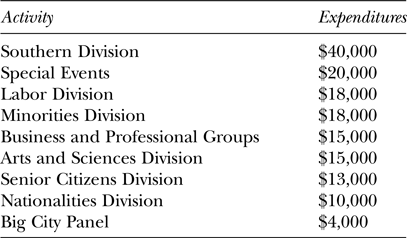
As a result, under Miller the RNC expanded its Southern strategy considerably. A large element of this expansion included using the committee's publicity division to target Southern white voters and push a conservative party brand aimed at convincing them to switch their allegiance. Operation Dixie was a crucial element in the RNC's strategy during the 1962 midterm campaign, and Southern expenditures represented a considerable part of the RNC's budget (see Table 4). In April 1962, the RNC began producing The Republican Southern Challenge, a newsletter aimed at Southern whites. By 1964, the newsletter had become a monthly publication with a distribution list of 39,000 people, which “emphasized ‘conservatism,’ and … pushed hard for a two-party system in the South.”Footnote 97 Additionally, the RNC ran ads in Southern newspapers and magazines criticizing the Democratic Party for neglecting Southern needs.Footnote 98
RNC Campaign Division Expenditures, 1962

Source: Philip A. Klinkner, The Losing Parties: Out-Party National Committees, 1956–1993 (New Haven, CT: Yale University Press, 1994), 59.
The RNC believed these investments paid off: During the 1962 midterms, Republicans performed well in the South—gaining five new House seats in the former Confederacy.Footnote 99 In its analysis of the midterm results, the RNC's research division concluded that “the most impressive aspect of the 1962 election was the sharp increase in Republican strength in the South,” noting a popular vote increase of 243.8 percent there in comparison to the 1958 midterms.Footnote 100 At the first RNC meeting following the 1962 midterms, Miller strongly defended all party-building elements of Operation Dixie, boasting that “we worked to find good candidates, and we provided the money—more than a quarter of a million dollars—to help them get started, as well as supporting them with tailor-made campaign materials. You have seen the results.”Footnote 101 Given these results, the RNC ramped up its Southern strategy and approved a “massive 1964 GOP assault on Democratic strongholds in the segregationist South.”Footnote 102
Still, Operation Dixie was controversial among moderates in the party because under Miller, it backed Republican candidates who supported segregation.Footnote 103 Former RNC chairman Meade Alcorn later recalled that the conservatives attempted to convert the RNC's Operation Dixie “into a lily-white Republican organization.”Footnote 104 At the time, Republican moderates openly criticized Miller and the RNC for their appeal to white Southern segregationists. Advance, the magazine of the Young Republican organization, criticized the GOP for supporting segregationist candidates in the South, and Senator Kenneth Keating (R-NY) warned that the Republicans would be “forever a minority party” if they were to adopt segregationist policies in their effort to win in the South.Footnote 105 Similarly, Senator Jacob Javits (R-NY) warned that the party faced “permanent minority status as the result of negativism” unless it embraced “its Lincolnian tradition.”Footnote 106
In contrast, conservatives in the party believed that—as the Washington Post summarized their views—“the Republicans are impractical fools to worry about the Northern Negro voters, because nothing will tempt the Negroes from their solid Democratic allegiance.”Footnote 107 Miller remained steadfast in his support of the Southern strategy, arguing that “our successes in the South need no apology. They are the product of hard and intelligent efforts on the part of people dedicated to the Republican principle of freedom and sound government.”Footnote 108 Thus, instead of prioritizing black voter outreach in major cities, the RNC continued to engage white voters in the South.
Goldwater's 1964 presidential campaign complemented the RNC's strategy well.Footnote 109 In June, days after narrowly defeating Rockefeller in the California primary, Goldwater was one of only six Republican senators to vote against the 1964 Civil Rights Act. While Republicans had been pivotal in the passage of the bill in both the House and Senate, Goldwater's opposition meant that “the credit—even the glory—that the Republican Party should have enjoyed” for supporting it “was effectively negated.”Footnote 110 Goldwater's stance carried over to the Republican convention and the general election campaign in an attempt to recruit Southern whites. During the convention, Goldwater successfully demanded that the party abandon a proposed plank confirming that the Civil Rights Act was constitutional and stated that no person “should violate the rights of some in order to further the rights of others.”Footnote 111 During the general election campaign, Goldwater and the RNC—now under the chairmanship of Goldwater's aide Dean BurchFootnote 112—embraced Dixiecrat Strom Thurmond, who switched his party identification to Republican.Footnote 113
The Southern strategy of the RNC and the Goldwater campaign resulted in one of the largest defeats in Republican Party history—with LBJ receiving slightly more than 61 percent of the popular vote.Footnote 114 Moderates saw in the 1964 defeat evidence that the Southern strategy as applied by Goldwater, Miller, and Burch, had backfired. Senate Minority Leader Everett Dirksen (R-IL) blamed the 1964 loss squarely on the RNC's publicity programs, arguing that “we failed to present a clear-cut image and sell it to the voters. … It was the fault of those whose business it was to project the true Republican image. It was the national committee's business and it flubbed the job.”Footnote 115
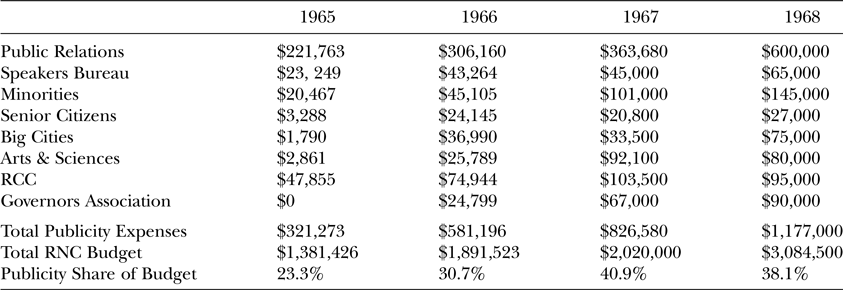
After the 1964 elections, moderates in the RNC used the defeat to force Burch to resign as chairman and replaced him with Ray Bliss, the chair of the Republican Party in Ohio. The change in leadership did not affect the broader committee publicity strategy. Bliss—like Miller and Burch before him—announced that the RNC would run “a 12-month a year, 24-hour a day” permanent election campaign.Footnote 116 The RNC requested a budget of $4.6 million for 1965, the bulk of which it spent on advertising ($3.5 million)—an extraordinary investment in party brand building for a nonelection year.Footnote 117 Additionally, the RNC created the Republican Coordinating Committee (RCC)—a new party institution inspired by the DAC.Footnote 118 Throughout the Bliss years, publicity spending not only continued to increase, but it also made up a larger part of the RNC's total budget, peaking at 41 percent of all RNC expenses in 1967 (see Table 5).
RNC Publicity Expenses, 1965–1968

Source: Ray C. Bliss Papers, Ohio Historical Society, series 2, subseries 2, box 79, folder 20; box 121, folder 8.
Under Bliss, the RNC initiated several major national publicity projects. Most notably, the radio program introduced under Miller was renamed Comment and was expanded from 170 radio stations in 1965 to 2,000 by 1968—one-third of all stations in the United States.Footnote 119 Comment consisted of a five-minute radio spot that stations could either play in its entirety or split up and use as separate clips in their news reporting. RNC Director of Public Relations Fred Morrison argued the format allowed the national party to “give the greatest possible impact to [issues] which the leaders of the party are attempting to drive home on a national scale.”Footnote 120 By 1968, based on the RNC's own figures, 1,600 stations that received the material used parts of it, and 400 played the entire program each week.Footnote 121 In 1967, the RNC also introduced a television version of Comment, and by February 1968, 42 percent of all TV stations received the weekly program.Footnote 122
While Bliss's image was one of an organizer interested in nuts and bolts politics rather than ideology, the new RNC chair fell on the moderate side of the party split. Within weeks of taking office, Bliss fired a number of Goldwater-era appointees and replaced them with moderates.Footnote 123 Similar hires occurred throughout Bliss's term in office, with (Southern) conservatives frequently passed over in favor of moderate Republicans.Footnote 124 Under Bliss's leadership, the RNC also began providing financial support to the Republican Governors Association, then the center of moderate Republican power, by paying for full-time national headquarters for the organization in Washington, DC, and providing moderate Republicans with more direct influence in the national party.Footnote 125
The RNC also refocused its attention on black voters in major cities. In February 1966, the committee announced a major new push for black votes, with Bliss appointing an advisory committee consisting of twelve black Republican leaders. The committee was to help Bliss “prepare a program to strengthen Republican support among Negroes.”Footnote 126 Bliss hired a special assistant—Clarence Lee Townes Jr.—and three additional black staff members to help “recruit Republican voters among the nation's Negro population.”Footnote 127 In December 1966, the RNC announced Junius Griffin, an aide to Martin Luther King, had joined the RNC to further assist it in connecting with black voters. As an RNC staffer, Griffin advised Republican candidates such as John L. Waner—the GOP candidate in the Chicago mayoral election of 1967.Footnote 128 With national black Republican support up in 1966 (19 percent of the vote compared with 13 percent in 1964), Townes and the RNC set their goal for 1968 at 30 percent.Footnote 129
The RCC, under Bliss's leadership, also attempted to “moderate the party's image.”Footnote 130 Like the DAC before it, the RCC produced a considerable number of policy papers supporting moderate policy issues on topics such as transportation, metropolitan planning, water pollution, poverty, aid for the elderly, and strengthening the United Nations. The positions the RCC took deviated from those taken in 1964. For example, the RCC embraced civil rights legislation and called on all Republicans to “reject membership in any radical or extremist organization.”Footnote 131 As Mary Brennan has noted, “eliminating the extremist blemish on the party was central to the new image Republicans tried to create.”Footnote 132 By having an RNC-controlled party organization signal to the broader electorate that the period of extreme conservative domination was over, Bliss and other moderates hoped to rebrand the GOP as a right-of-center party that could be trusted with control of government again. Bliss, speaking during a January 1967 RNC meeting, praised the RCC for helping the public understand “the general direction of movement of our party” and for producing “an image … around it. So we received tremendous publicity and more and more the papers are starting to pick up and review our papers and editorialize on them.”Footnote 133
Much like the DNC in the 1950s, the RNC thus responded to its minority status by engaging in a variety of publicity programs to expand the party's voting coalition. These programs saw major financial investments and were a priority to the party leadership. However, the groups that were targeted depended on the wing of the party in control of the committee. Under the leadership of conservatives Miller and Burch, the RNC focused on convincing white Southerners to join the GOP. After 1964, under control of moderate chairman Bliss, tactics changed, and the RNC instead targeted black voters in major cities. The RNC had the freedom to take positions in intraparty conflict: Depending on the wing of the party that held the chairmanship, the specific type of image it promoted shifted from conservative to moderate.
PRESIDENTIAL CONTROL OF NATIONAL MAJORITY AND MINORITY COMMITTEES
In the cases in this section I look at committees of parties which controlled the White House either as a national majority or national minority party. The first case focuses on the DNC's activities during the Kennedy and Johnson administrations. Given that Democrats also consistently had majorities in the House and Senate in this period, the party was the clear national majority party. The second case concerns the RNC's activities during the Nixon and Ford administrations. Despite winning presidential elections, the Republicans remained in the minority in House and Senate and thus were still the national minority party. This difference in party status had a major effect on the publicity activities that these president-dominated committees engaged in. The RNC continued to invest in new publicity programs, though it promoted a party image focused on supporting the president. In contrast, the DNC ended several prominent publicity programs—eliminating the Democratic Digest and the DAC—and cut its own budget.
DNC, 1960–1968: Committee Decline under Kennedy and Johnson
After the Kennedy-Johnson ticket won a tight victory in 1960, Kennedy named John M. Bailey chair of the DNC. Bailey remained chair throughout both the Kennedy and Johnson administrations. The DNC's role receded immediately upon the party's shift to national majority status. In the weeks after the election, the DNC began a process of “retrenchment,” in which staff members were fired and programs cut.Footnote 134 The DNC terminated the Digest as a party magazine in mid-November 1960. Attempts at continuing the magazine independently produced only a celebratory issue surrounding the Kennedy inauguration in January 1961.Footnote 135 The DNC also ended the DAC. Newspapers reported that JFK planned “a quiet death” for the institution that had “served to emphasize the deep liberal-conservative split within the party,”Footnote 136 and the DNC announced the official end of the DAC in March 1961. Bailey acknowledged that the DAC had “served a function” while the party was out of the White House, but now that the Democrats restored their national majority, he argued that “policy should be made at the White House and by the leadership of Congress.”Footnote 137
Of course, winning the presidential election did not end the intraparty conflict that had divided Democrats in the 1950s. With the committee under presidential control, the DNC now used its sparse remaining propaganda tools to promote the administration's policies—specifically through a new program called Operation Support. Active mostly in 1961 and 1962, Operation Support was built around assisting the Kennedy administration. For example, the DNC sent information on administration-supported bills in Congress to local party organizations in districts of members who opposed the plans.Footnote 138 Additionally, the DNC organized several conferences across the country at which Kennedy administration officials explained their policy positions to local Democrats. In 1963, the DNC used Operation Support to support Kennedy's proposed tax cut plan.Footnote 139 But the program was short lived: After JFK's death in 1963, Operation Support activities ended as well.
Beyond the restricted scope of Operation Support the DNC's ambitions were limited throughout the Kennedy and Johnson years. Early attempts by Bailey to reorganize the DNC fizzled out. Additionally, while the DNC provided some advice to black and Latino action groups, it did not actively organize voter registration drives. Contrary to Butler in the 1950s, Bailey was “careful not to antagonize southern Democratic politicians and state committees”Footnote 140 that remained supportive of Jim Crow.Footnote 141 Bailey and the DNC staff instead “tried their best to avoid favoring one faction or candidate over another in intraparty disputes within the states.”Footnote 142 This was hardly surprising. As Arthur Krock wrote in the New York Times immediately after the election, the 1960 results indicated that Kennedy “and the ‘liberal’ non-Southern party majority that nominated him on a platform repugnant to the South, are deeply in debt to the Southern leaders”Footnote 143 for providing enough Southern electoral votes to win the election.
The DNC did continue to provide other non-publicity-related services, most notably fundraising. Here, the national committee innovated and created a new set of programs. Under Butler, the DNC had attempted to combine fundraising and grassroots activism. Bailey and DNC treasurer Richard Maguire replaced this project with a more elite system based on membership programs. The approach was wildly successful: By 1963, the DNC had erased its debt from the 1960 campaign.Footnote 144 Still, the committee did not use its fundraising ability to create new (or revitalize old) publicity programs.
After taking office, Johnson further diminished the DNC's nonfundraising activities. While LBJ was successful in pushing through major pieces of legislation that had stalled under Kennedy—including the 1964 Civil Rights Act—he relied on a broad coalition of Democrats and Republicans to do so. At the same time, LBJ attempted to placate (conservative) Democrats on other policy issues. A publicity-centered DNC would not serve either purpose, since “LBJ perceived a strong, national party organization with regular publicity … activities emphasizing partisan differences to be a threat to the suprapartisan, centrist consensus that he wanted to develop for his presidency.”Footnote 145 After the massive Democratic success in the 1964 presidential and congressional elections, the DNC's activities were further limited. With a considerable campaign debt, LBJ ordered Bailey to fire 30 percent of the DNC's regular staff.Footnote 146
The cuts meant that the already limited services the DNC provided were “savagely reduced.”Footnote 147 For example, the DNC cut the number of telephone lines members of Congress used to record messages for radio stations in their district. As a result, “members with something timely to say find that their recorded statements, which the Committee is supposed to deliver to home-town radio stations, often can't be recorded until it's too late.”Footnote 148 Anonymous Democratic Party leaders and the media described the state of the DNC under Johnson as “absolutely disgusting,” “sharply curtailed,” and “a skeleton organization.”Footnote 149
In the wake of the 1966 midterm elections—in which Democrats lost forty-seven seats in the House and three in the Senate—and under pressure from Democratic governors and members of Congress, Johnson ordered Bailey to begin expanding the DNC's operations again. However, even then the DNC remained mostly invisible.Footnote 150 Not until 1968—when the combination of Vietnam, race riots, and challenges from, first, Eugene McCarthy and later Robert Kennedy in the 1968 presidential primaries began to scuttle the LBJ presidency—did the DNC take on a role publicizing issues again. At a set of regional meetings in early 1968, Johnson administration officials and other Democratic leaders (such as former DNC chair James Farley) deflected criticism on the Vietnam War and other issues. The DNC also produced a set of pamphlets defending the administration and distributed them among party activists.Footnote 151 However, after LBJ announced his intention not to run for reelection, the DNC ended all major fundraising efforts and public conferences until the national convention.Footnote 152
The DNC's limited activities during the Kennedy-Johnson presidencies follow the expectations outlined in the brand theory. There was a major decline in national committee activities after the 1960 election, and this decline persisted throughout both the Kennedy and Johnson presidencies. At the same time, though, the DNC did not go out of business entirely: Its fundraising apparatus was remodeled and effective. The Democrats also did not cease their campaign activities in the midterm elections of 1962 and 1966 or the presidential elections of 1964 and 1968. Yet, the type of publicity activities that the DNC had invested in during the Eisenhower administration mostly disappeared. Most notably, the Digest and DAC both ended around the time of Kennedy's inauguration, and the DNC largely remained out of intraparty debates about policy and did not engage in any major branding programs.
RNC, 1968–1976: Ongoing Activities under Minority Presidencies
The 1968 election produced a mixed result for the Republican Party: While Richard Nixon won a close presidential election against Democratic candidate Hubert Humphrey, Democrats maintained control of both the House and Senate. Four years later, Nixon won reelection in an unprecedented landslide, but Democrats again retained their majorities in Congress. Therefore, while Republicans controlled the White House between 1968 and 1976, they were not the national majority party. Thus, the RNC continued to invest in (new) publicity programs under Nixon. Immediately after the 1968 election, Nixon's advisor Herbert G. Klein appeared on Face the Nation and announced that Nixon intended to “develop the Republican Party into a stronger political entity.”Footnote 153 Part of this project was an active publicity role for the RNC, and Nixon decided to replace Bliss as chairman—preferring “an issue-oriented man” as the “chief Republican spokesman during a period when the party needs promotion rather than consolidation.”Footnote 154 Rogers Morton, Bliss's replacement, was acutely aware of the GOP's party status—noting that to shed its “role as a minority party” Republicans would have to become “massively involved with millions of young people, with millions of poor people, with American Indians, with national and ethnic groups, farmers, senior citizens, and city folk.”Footnote 155
With the committee under control of the White House, the image it promulgated was inherently linked to its president. During his 1968 campaign, Nixon had relied on a “Southern strategy.” However, in contrast to Goldwater, Miller, and Burch, Nixon repudiated segregation itself while trying to court Southerners by stressing “law and order, reform of the welfare state, and the promise of a secret plan to end the war in Vietnam.”Footnote 156 During the first years of the Nixon administration, the White House and RNC attempted to combine Nixon's personal Southern strategy with the RNC's outreach to black voters. For example, Nixon advisor Harry Dent asked the RNC to “intensify [its] efforts to enlist Negro leaders and, in fact, develop Negro leaders to work for our Party” by hiring “part-time workers all through the South.”Footnote 157 Under Morton, the committee attempted to bring in new voting groups by improving the party's campaign apparatus through the Mission ’70s Party Organization Program—intended to coordinate the campaign efforts of county, state, and national party organizations.Footnote 158 The RNC also used the president himself to promote the party. In 1970, the RNC produced a major new promotional film, Setting the Course, with behind-the-scenes footage of Nixon's first year in office.Footnote 159
Nixon replaced Morton after the disappointing midterm elections of 1970, believing the RNC needed a chairman who would attack Democrats more aggressively. For this purpose, Nixon selected Senator Bob Dole (R-KS). Newspapers interpreted the selection of Dole as an attempt by the administration to name a new “major spokesman for the party.”Footnote 160 Dole indeed became a much more visible chairman than Morton, attacking antiwar Democrats and the media for their criticism of Nixon's Vietnam policies.Footnote 161 After the 1970 election, the RNC aimed, in the assessment of RNC Vice Chairman Thomas Evans, to use its publicity tools to “provide Republican leaders … with ammunition with which to speak up for the President”Footnote 162 and to “get the story of Republican accomplishments out all over America.”Footnote 163 The core communication tool the RNC relied on in this regard was Monday, a weekly publication distributed to Republican Party members and reporters that produced headlines in part through its attacks on (potential) 1972 Democratic presidential candidates—including Edmund Muskie, George McGovern, Ted Kennedy, and Hubert Humphrey.Footnote 164 The publication was distributed to 285,000 recipients each week by the summer of 1973.Footnote 165 Additionally, the RNC produced and distributed over 3,000 video clips for use by television stations.Footnote 166
Nixon's president-centered approach to party building helped win his own major reelection victory in 1972, but produced limited success for the Republican Party as a whole. While Republicans won some House seats, they lost seats in the Senate. In Dole's view, the 1972 election was therefore “sort of a standoff” since “after you take the President's personal landslide, there wasn't any landslide at all.”Footnote 167 Dole consequently concluded that the RNC did not have the luxury to “go underground” and would have to “continue a full-time operation aimed at winning the support of disaffected Democrats, primarily blue-collar workers and ethnics who voted for President Nixon, and concentrate on the 1974 election.”Footnote 168 Nixon, now safely reelected, also refocused his attention on helping the Republican Party achieve national majority status, but he believed this required yet another new chairman and replaced Dole with George H. W. Bush, then ambassador to the United Nations.Footnote 169
Under Bush, the RNC began organizing “New Majority Workshops”—which were intended to train party activists to help ensure that the voters “who came over to us in such great numbers in support of President Nixon”Footnote 170 in 1972 would vote in congressional and gubernatorial races as well. During the workshops, the RNC shared “best practices” on how to work with “ethnic voters, Spanish speaking voters, senior citizens, youths, blacks, and the blue collar laborers”Footnote 171—all traditional Democratic voting blocs that Nixon and the RNC believed needed to be incorporated into the Republican Party for it to become the majority party. The logic behind this program was clear—as Mississippi RNC member Clarke Reed explained: “The Republican Party is the minority party. The President is the majority president. Let's bridge that gap. … I say let's sell what's popular. That's the President.”Footnote 172
However, the Nixon-centered New Majority program almost immediately stalled as Watergate began to consume the Nixon presidency and the party. Kenneth Reitz, a Nixon 1972 campaign aide hired by the RNC to run the New Majority campaign, resigned his position after he was implicated in a “spy corps” set up by the Nixon campaign to gather intelligence on Democrats.Footnote 173 Watergate also harmed the RNC by reducing donations: By the middle of 1973 the RNC was $1 million behind in fundraising, resulting in a 25 percent cut in staff.Footnote 174 The cuts also meant Monday was now limited to a monthly publication—as the committee was unable to afford the $25,000 weekly production cost.Footnote 175 Beyond financial limitations, the RNC found that the media's focus on Watergate made its publicity role for the broader party impossible. As Bush told RNC members in September 1973: “We have cranked out reams of really positive comments, information on programs, but for the last six months a lot of the press has been interested in only you know what.”Footnote 176 Despite these dire conditions, Bush did not abandon the RNC's image setting role. Most notably, Bush resurrected the RCC, which had been dormant since 1968. In announcing the return of the RCC, Bush explained that the organization could “help give us national party leadership on issues.”Footnote 177
After Nixon's resignation in 1974, but before that year's midterms, Bush resigned the RNC chairmanship to become the U.S. ambassador to China. On Bush's recommendation, incoming President Gerald Ford named RNC Co-chair Mary Louise Smith as his replacement. Smith, a self-described “Republican feminist,” was broadly perceived to be a moderate. However, Smith made it clear that she did not consider herself to be the leader of the party, arguing that “a President of your own party is certainly considered the leader of the party and plays the dominant role, and should.”Footnote 178 As such, Smith largely viewed her role as that of an administrator, running the party on behalf of its president.
Smith and the RNC anticipated the major losses the GOP would endure in the 1974 midterms and began planning a series of activities to rehabilitate the party even before the elections. This included a major program to reintroduce the Republican Party to American voters. The problem Smith identified before the 1974 elections was that “somewhere the Republican Party is doing something wrong, or else we are not doing enough things right. Either we are being outorganized or we are being outsold and I suspect it is some of both.”Footnote 179 After the midterm elections decimated the congressional GOP, Smith was even more convinced that the RNC would need to “reshape the image of the Republican Party and what it stands for in the minds of the American people.”Footnote 180 To help overcome this problem, the RNC proposed a $2 million advertising program aimed at improving the Republican Party's national image.Footnote 181 During a March 1975 RNC meeting, Smith explained the program would help give “voters a closer look at who we are and where we stand.”Footnote 182
The plan—which also included training programs and voter registration efforts—represented a considerable investment given that the Watergate scandal had turned off many prominent donors and the RNC was now nearly bankrupt. In fact, by the end of 1975, the RNC was so insolvent it closed down its office for the month of December to save money on heating and electricity.Footnote 183 While the publicity plan was controversial among a subset of RNC members and party leaders,Footnote 184 Smith pushed forward, and in the summer of 1975 three 30-minute television showsFootnote 185 were broadcast on CBS and NBC showing—among other things—“citizen testimonials to individualism, free enterprise, and local government” in an attempt to “combat the widely held misconception that Republicans are rich fat cats unconcerned with the problems of ordinary Americans.”Footnote 186
Unlike the DNC under the Kennedy and Johnson administrations, the RNC remained engaged in providing branding-related services during the Nixon and Ford administrations. Crucially, the party invested in several major new branding operations—most notably, under Smith's chairmanship. The fundamental difference between the DNC and RNC under these presidents was the presence or lack of a congressional majority: While Kennedy and Johnson saw no reason to rely on the DNC given their party's comfortable majority, Nixon and Ford faced a different calculation—understanding that the national committee would need to act to help expand the party.
CONCLUSION
Political scientists have traditionally—and, in the case of the UCLA School, more recently—dismissed national committees as mere service providers that lack power to influence intraparty politics and argued instead that political parties ought to be studied by focusing on their role in Congress or their relationship to presidents, or as coalitions of interest groups. I have argued that by focusing on a specific subset of services—publicity programs created by the national committees to educate voters on the party's positions in the hopes of shaping a party brand—we are able to conceive a more complex role national committees play in American politics. Instead of thinking of the national committees as general service providers, party leaders understand national committees to be crucial in communicating a party image to voting groups through their “educational campaigns.” This provides evidence that the national party-in-organization is more important than the dominant view in political science literature has argued thus far. Given that parties use their brands to try and mobilize voters, political actors think of the national committees as crucial elements in the party system.
A party's desire for such publicity programs depends upon its electoral performance. If a party is the national majority, the need for branding activities diminishes. However, when a party is a national minority, it seeks to incorporate new groups into the party coalition for the next election in part by having its national committees invest in (new) publicity programs. What image those committees promote depends upon whether the party controls the White House: If it does not, the committee is free to adopt a brand that it believes is most likely to help win the party future elections. In contrast, when the party controls the White House, the committee will promulgate the party image preferred by its president.
The cases confirm the logic behind both the relation between party brands and committee activities and the role of party electoral performance in predicting when committees invest in their publicity programs. In each of the three cases involving national minority party committees (the DNC in the period 1952–1960 and the RNC in 1960–1968 and 1968–1976), party leaders identified the lack of an appealing and coherent party brand as (one of) the problems their party would need to overcome to become the majority party. To solve this problem, these national committees invested in their publicity divisions (even at times when it was facing economic hardship), inaugurated new programs and party institutions (including the DAC and RCC), and created new communication tools (such as the Digest, Comment, and Monday) to reach out to voting groups in an attempt to (re)incorporate these groups into their party coalition. In contrast, in the case investigating a national majority party (the DNC in the period 1960–1968), we see a national committee that eliminated a series of publicity programs that it had previously invested in. While the majority Democratic Party could have continued the branding activities made possible through the Digest and DAC, party leaders instead ended each of these programs.
Crucially, these cases also show that national committees of presidential out-parties had the freedom to decide what party brand they wanted to promote. The choices these committees made were the product of both ideology and strategic choices. However, in making these choices, the committees took sides in the major intraparty conflicts of this era and, in doing so, sought to promote their preferred side in these conflicts. For example, the DNC's embrace of civil rights and other liberal policies in the 1950s was an attempt at rebranding the Democratic Party as a national liberal party, at the expense of Southern conservative Democrats. Similarly, the RNC's shift from a conservative, Southern strategy under chairmen Miller and Burch to an attempt at “moderating” the party brand under Bliss reflected different strategies aimed at furthering the goals of specific elements within the GOP.
As noted earlier, these specific cases limit the study's external validity. Although these cases illuminate much regarding the publicity role national committees play and how these specific services relate to the concept of party brands, more can be learned about the DNC and RNC in this regard. Three avenues may be particularly promising. First, future research projects can connect the APD literature on the development of the national committees as political institutions to this theory of publicity. In particular, this can produce a valuable test in terms of whether the party brand theory applies to previous cases and whether the extent of the committees' publicity has indeed expanded in line with the broader expansion of the national committees as identified by APD scholars.
Second, as both parties embraced a clear political ideology, it is possible that voters' ability to identify the Democratic and Republican parties as the liberal and conservative parties also decreased party leaders' valuation of their respective committee's publicity activities. Analysis of the ideological consistency of parties compared to publicity output by the national committees could clarify whether intraparty divisions prior to the completion of the process of ideological sorting drove these publicity activities or whether they remained a fundamental role in the eyes of party leaders.
Third, the development of mass communication tools in the 1990s and beyond could have affected the role of the committees in publicity provision. As shown in the cases discussed here, while committees invest in innovative communication tools, the introduction of talk radio, cable news, and internet communication may have lowered the cost for individual candidates and intraparty groups to build their own personal brands. Has this resulted in a decrease in committee publicity activities? Future research may be able to answer these questions and expand our understanding of the ongoing role that the DNC and RNC play in American party politics.
To reiterate, my goal has been to bridge the gap between the difference in value political actors and political scientists place in the parties' national committees. By contextualizing a specific subset of national party committee activities—that is, the promotion of a national party brand—I have argued that we can understand why leaders believe the DNC and RNC are such important institutions in their parties. Party leaders view their national brand as vital to mobilizing voters. Because they understand their national committees as being among the party institutions that create these brands, the committees are thus crucial. By going beyond the catch-all of “service provision,” we gain a clearer understanding of the role that the DNC and RNC play in American politics and how the different institutions that combined make up political parties create national party images, and a deeper valuation of the importance of studying the party-in-organization in American politics.