Introduction
The large-scale in vitro production (IVP) of bovine embryos is dependent on the optimization of several methodological processes, including in vitro maturation, fertilization and culture, as well as procedures that lead to improvements in embryo quality and cryotolerance (Rizos et al., Reference Rizos, Ward, Boland and Lonergan2001). IVP embryos are very susceptible to oxidative damage because their defence mechanisms are insufficient to protect their delicate cellular structure (Goto et al., Reference Goto, Noda, Mori and Nakano1993; Harvey et al., Reference Harvey, Arcellana-Panlilio, Zhang, Schultz and Watson1995). Indeed, as a result of the higher sensitivity of IVP bovine embryos to low temperatures, their survival after cryopreservation has lagged behind that of in vivo derived embryos (Imai et al., Reference Imai, Matoba, Dochi and Shimohira2002).
The course of in vitro embryonic development is primarily influenced by the quality of the oocytes aspirated from ovarian follicles (Lonergan et al., Reference Lonergan, Rizos, Gutierrez-Adan, Fair and Boland2003; Fukui & Oyamada, Reference Fukui and Oyamada2004) and by the culture system used for in vitro maturation (Mingoti et al., Reference Mingoti, Caiado Castro, Méo, Barreto and Garcia2009). Subsequently, the incubation conditions during embryo development, such as the medium composition, the macromolecular supplementation, the number of embryos cultured and the gaseous atmosphere (Corrêa et al., Reference Corrêa, Rumpf, Mundim, Franco and Dode2008), can affect the quality of IVP embryos (Takahashi et al., Reference Takahashi, Nagai, Okamura, Takahashi and Okano2002; Van Soom et al., Reference Van Soom, Yuan, Peelman, De Matos, Dewulf, Laevens and De Kruif2002; Corrêa et al., Reference Corrêa, Rumpf, Mundim, Franco and Dode2008).
Recent investigations have focused on the intracellular state of reduction–oxidation (redox); more specifically, the oxidative stress induced by high oxygen (O2) tension during the different stages of IVP (Fukui & Oyamada, Reference Fukui and Oyamada2004). Although the O2 tension in the female reproductive tract is lower than that found in atmospheric air (3–9% and ~20% O2, respectively), the atmospheric O2 tension has been routinely applied to in vitro systems of mammalian embryo culture (Thompson et al., Reference Thompson, Simpson, Pugh, Donnely and Tervit1990; Voelkel & Hu, Reference Voelkel and Hu1992). Supraphysiological O2 tension can induce an excessive generation of reactive oxygen species (ROS), especially hydrogen peroxide (H2O2), hydroxyl radical (HO·) and peroxyl radical (ROO·). As a consequence, high amounts of ROS adversely affect the success of the IVP of mammalian embryos (Corrêa et al., Reference Corrêa, Rumpf, Mundim, Franco and Dode2008).
However, ROS are also involved in many physiological processes related to ovarian activity and gametogenesis, in which they act as signalling molecules in various cellular reactions, such as proliferation, differentiation, energy supply and the elimination of unviable cells through apoptosis (Gonçalves et al., Reference Gonçalves, Barreto, Arruda, Perri and Mingoti2010; Ufer et al., Reference Ufer, Wang, Borchert, Heydeck and Kuhn2010). Thus, the balance between ROS production and antioxidant mechanisms is essential for favourable in vitro culture conditions.
To protect embryos from oxidative stress during in vitro culture, various antioxidants can be added to the culture medium to enhance development, and these have produced variable success (Goto et al., Reference Goto, Noda, Mori and Nakano1993). Low-molecular-weight thiol compounds, such as β-mercaptoethanol, cysteamine, cysteine and cystine, may be used as supplements to the culture medium (Takahashi et al., Reference Takahashi, Nagai, Hamano, Kuwayama, Okamura and Okano1993). These compounds are precursors for the synthesis of glutathione (GSH), which plays an important role in the maintenance and regulation of redox status, thus protecting the cell from oxidative damage (Deleuze & Goudet, Reference Deleuze and Goudet2010). Indeed, the concentration of GSH in bovine embryos is highly correlated to their early development and viability after cryopreservation (Guérin et al., Reference Guérin, Mouatassim and Ménézo2001). Thus, antioxidant supplementation during different steps of bovine embryo IVP can increase quality and, consequently, embryonic cryotolerance.
The culture medium can be a major source of ROS (Martín-Romero et al., Reference Martín-Romero, Miguel-Lasobras, Domínguez-Arroyo, González-Carrera and Álvarez2008). To modulate such extracellular ROS, medium can be supplemented with extracellular enzymatic antioxidants, such as catalase (Orsi & Leese, Reference Orsi and Leese2001). Although there have been conflicting reports regarding the effects of these antioxidants on ROS neutralization in IVP embryos (Ali et al., Reference Ali, Bilodeau and Sirard2003), it was recently demonstrated that the addition of catalase during IVP promoted reductions in intracellular ROS and apoptosis in bovine embryos. This result has stimulated further studies focusing on the modulation of extracellular ROS in IVP systems (Rocha et al., Reference Rocha, Leão, Nogueira and Mingoti2012a,Reference Rocha, Leão, Nogueira and Mingotib).
It is clear that oxidative stress cannot be avoided when dealing with assisted reproductive techniques. Excessive oxidative stress during IVP can be overcome by reducing the generation of ROS through the utilization of low O2 tension and/or antioxidant supplementation. However, during embryo development, it is unclear whether antioxidants are required at low O2 tension and whether the source of this protection must be extracellular or intracellular (Ali et al., Reference Ali, Bilodeau and Sirard2003). Furthermore, little attention has been paid to the contributing effects of antioxidants on the cryosurvival of vitrified/thawed embryos (Hosseini et al., Reference Hosseini, Forouzanfar, Hajian, Asgari, Abedi and Hosseini2009).
Therefore, this study aimed to determine the effects of supplementation with intracellular (cysteine, cysteine combined with cysteamine or β-mercaptoethanol) or extracellular antioxidants (catalase) for 72 (day 3) or 168 h (day 7) of IVC and under different O2 tensions (20% or 7%) on the development, quality and cryotolerance of IVP bovine embryos. More specifically, the following were evaluated: embryonic development to the blastocyst stage, intracellular ROS levels and embryonic survival rates post-vitrification/thawing.
Materials and methods
Reagents and media
Chemicals were purchased from Sigma Chemical Co. (St. Louis, MO, USA) unless otherwise stated. The in vitro maturation (IVM) medium consisted of TCM199 (Gibco®, Invitrogen Co., Grand Island, NY, USA) supplemented with 10% (v/v) fetal bovine serum (FBS; Gibco®, Invitrogen Co.), 0.2 mM sodium pyruvate, 25 mM sodium bicarbonate, 50 μg/ml amikacin, 0.5 μg/ml FSH (Pluset®; Hertape Calier, Juatuba, MG, Brazil) and 100 IU/ml hCG (Vetecor®, Hertape Calier). The IVF medium consisted of Tyrode's albumin lactate pyruvate (TALP), as described previously (Parrish et al., Reference Parrish, Susko-Parrish, Winer and First1988), supplemented with 0.2 mM Na-pyruvate, 6 mg/ml fatty acid-free bovine serum albumin (BSA), 25 mM sodium bicarbonate, 13 mM Na-lactate, 50 μg/ml amikacin, 40 μl/ml PHE solution (final concentrations of 20 μM penicillamine, 10 μM hypotaurine and 2 μM epinephrine) and 10 μg/ml heparin. The embryo culture (IVC) medium consisted of modified synthetic oviductal fluid (SOF), as described previously (Vajta et al., Reference Vajta, Rindom, Peura, Holm, Greve and Callesen1999), supplemented with 50 μg/ml amikacin, 5 mg/ml fraction fatty acid-free BSA and 2.5% (v/v) FBS.
Oocyte collection and maturation
Bovine oocytes from slaughtered cows were obtained from a local abattoir and were transported to the laboratory. Intact cumulus–oocyte complexes were aspirated from antral follicles (2–8 mm in diameter). Oocytes with at least four layers of cumulus cells were selected for the experiments. The oocytes were washed and cultured in 500 μl of IVM medium (50 oocytes per well) in a 24-well cell culture cluster (Costar® 3526, Corning Incorporated, NY, USA) covered with mineral oil. Oocytes were cultured for 22 h at 38.5°C under an atmosphere of 5% CO2 in air with maximum humidity.
Sperm separation and in vitro fertilization
Motile spermatozoa were obtained by centrifuging frozen–thawed semen on a Percoll (GE Healthcare, Uppsala, Uppsala County, Sweden) discontinuous density gradient (250 μl of 45% Percoll over 250 μl of 90% Percoll in a 1.5-ml microtube) for 5 min at 2500 g at room temperature. The supernatant was discarded, and the spermatozoa were counted on a hemocytometer and resuspended in IVF medium to obtain a final concentration of 2 × 10⁶ cells/ml. Finally, 4 μl of the sperm suspension was added to each 90-μl droplet. Oocytes (25 per droplet) and sperm were co-incubated for 18 h under the same temperature and atmospheric conditions used for IVM. The day of fertilization was defined as day 0.
Embryo culture
Following fertilization, the presumptive zygotes were stripped from the cumulus cells by vortexing and were assigned randomly to the different culture systems. The zygotes were transferred to 500 μl of IVC medium (50 zygotes per well) in a 24-well cell culture cluster (Costar®). Two culture systems were used, depending on the experimental design: (1) zygotes were co-cultured on a monolayer of cumulus cells in an incubator chamber (Forma, Thermo, USA) at 38.5°C and 5% CO2 in air, in a humidified atmosphere; or (2) zygotes were cultured inside a plastic bag (low-density polyethylene, LDPE) at 38.5°C in a gaseous mixture of 5% CO2, 7% O2 and 88% N2, in a humidified atmosphere without cumulus cells. Humidification in the plastic bag was achieved by filling a 10-cm plastic plate with 5 ml of sterile water, which was poured into the bag. The gassing procedure was performed by filling the plastic bag with the gaseous mixture and then closing the bag with heat sealing. All the culture systems were maintained inside a water-jacketed CO2 incubator during the entire culture period, except for during cleavage assessment.
The zygotes were incubated up to 72 h post-insemination (hpi) for the assessment of cleavage rates under stereoscopic microscopy (at a magnification of ×400). The blastocyst development rates were recorded on day 7 of IVC (168 hpi).
Vitrification, warming and subsequent embryo culture
All the materials used for the vitrification/thawing procedures were supplied by Ingámed Ltda (Perobal, PR, Brazil), including the vitrification solutions (VI-I and VI-II), the thawing solutions (DV-I, DV-II and DV-III) and the vitrification strips (Vitri-Ingá) and their plastic sheaths. A two-step technique was used for vitrifying blastocysts. Briefly, expanded blastocysts (grades 1 and 2) were washed twice in holding medium (SOF supplemented with 250 mM of HEPES and 20% FBS) and were transferred to VI-I for a 5-min incubation at 37.0°C. Then, the embryos were transferred to a 10-μl droplet of VI-II for 60 s at room temperature. Subsequently, the embryos were placed into the hole in the tip of a Vitri-Ingá strip in a minimum amount of vitrification solution, and then they were directly immersed in liquid nitrogen (N2). The plastic sheaths, which had previously been cooled in liquid N2 vapour for 1 min, were vertically immersed in liquid N2. The Vitri-Ingá strip was then inserted into a plastic sheath for storage.
For the thawing procedures, the Vitri-Ingá strips were withdrawn from the liquid N2 and were transferred to thawing solution DV-I for 1 min, at 37.0°C. After that, embryos were transferred to DV-II for a 3-min incubation at room temperature and were washed twice in DV-III for 5 min each. Then, the embryos were washed twice and cultured for 24 h in SOF supplemented with 2.5% FBS and 5 mg/ml of BSA in an atmosphere of 5% CO2 in air with saturated humidity. Thereafter, the re-expansion rates of the embryos were evaluated.
Quantification of intracellular ROS by dichlorofluorescein assay
The intracellular ROS (H2O2, HO· and ROO·) levels were quantified using the fluorescent probe 6-carboxy-2′,7′-dichlorodihydrofluorescein diacetate (H2DCFDA; Molecular Probes, Invitrogen, Oregon, USA), as described previously (Bain et al., Reference Bain, Madan and Betts2011). A stock solution of H2DCFDA dissolved in dimethylsulfoxide (DMSO) was diluted in phosphate-buffered saline (PBS) to a working concentration of 5 μM. The embryos were washed twice in PBS and placed into a 24-well cell culture cluster (Costar®) containing 500 μl of 5 μM H2DCFDA. The embryos were incubated at 38.5°C in a dark, humidified 5% CO2 atmosphere for 30 min and were then washed twice with fresh PBS. The stained embryos were immediately visualized with an Olympus, IX51 inverted microscope using QCapture Pro imaging software (version 5.0.1.26, Media Cybernetics, Inc.) at an excitation wavelength of 495 nm and an emission wavelength of 520 nm to quantify the fluorescence signal intensities (pixels). The background signal intensity was subtracted from the measured fluorescent signal intensity values. One experimental sample was chosen as a calibrator (control group), and each treatment value was divided by the mean calibrator value to generate the relative expression level (in arbitrary fluorescence units).
Experimental design
In all the experiments, the oocytes were matured in vitro for 22 h, as described above. The oocytes were then inseminated and the resulting presumptive zygotes were either cultured on a monolayer of cumulus cells inside an incubator chamber with 5% CO2 in air (~20% atmospheric O2) and a humidified atmosphere or were cultured without cumulus cells inside a plastic bag filled with a gaseous atmosphere of 5% CO2, 7% O2 and 88% N2. The culture medium was SOF with either no antioxidant supplementation (control) or supplemented with the three different types of antioxidants described above. Thus, a 2 × 4 factorial experimental design was used that included two gaseous atmospheres and four treatments during IVC. The experiments were replicated at least five times.
Experiment I. The effects of a gaseous atmosphere and antioxidant supplementation during the entire period of in vitro culture on the development and cryotolerance of IVP bovine embryos
In this experiment, the effects on embryo development and cryotolerance resulting from O2 tension and antioxidant addition to the culture media during the entire 7-day IVC period were evaluated. Following IVM and IVF, the presumptive zygotes were transferred to IVC medium that lacked antioxidant supplementation (control) or that had been supplemented with 0.6 mM cysteine (CYST), 0.6 mM cysteine combined with 100 μM cysteamine (C+C), or 100 IU of catalase (CAT). The zygotes were incubated under one of two O2 tensions: 20% O2 (5% CO2 in air) or 7% O2 (gaseous mixture). On day 7 of culture, the development of the embryos to the blastocyst stage was evaluated and the expanded blastocysts were vitrified. After thawing, the re-expansion rates of the blastocysts were evaluated following 24 h of IVC.
Experiment II. The effects of a gaseous atmosphere and antioxidant supplementation during the first 72 h of in vitro culture on the development, production of intracellular ROS and cryotolerance of IVP bovine embryos
In this experiment, the effects on embryo development, cryotolerance and the production of intracellular ROS resulting from O2 tension and antioxidant addition to the culture media during the first 3 days of IVC were assessed. Following IVM and IVF, the presumptive zygotes were transferred to IVC medium that lacked antioxidant supplementation (control) or that had been supplemented with 0.6 mM cysteine (CYST), 100 μM β-mercaptoethanol (β-ME), or 100 IU of catalase (CAT). The zygotes were incubated under one of two O2 tensions: 20% O2 (5% CO2 in air) or 7% O2 (gaseous mixture). In this experiment, β-ME was substituted for C+C due to the low blastocyst rates obtained during Experiment I. After 72 h, the embryos were washed and transferred to fresh SOF medium with no antioxidant supplementation. The embryos were then cultured until day 7, when their development to the blastocyst stage was evaluated and the expanded blastocysts were vitrified. After thawing, the re-expansion rates of the blastocysts were evaluated following 24 h of IVC. The intracellular ROS levels of the blastocysts and early blastocysts were quantified using the dichlorofluorescein assay.
Statistical analysis
A 1-cell culture well containing 50 oocytes was considered the experimental unit for each replicate of each group. The blastocyst production rates recovered on day 7 following insemination was based on the number of developed blastocysts per oocyte inseminated.
Data were analyzed using least squares general linear model analysis of variance (GLM ANOVA) procedures (SAS Inst. Inc., Carey, NC, USA) of arc-sin transformed data. The statistical model was a complete factorial including all possible interactions with all factors, including the effect of treatment (supplement of culture medium) and gaseous atmosphere (20% or 7% O2). If the ANOVA was significant, the means were compared by Tukey's test. In the absence of significant interactions, only the main effect means are presented. Data were reported as untransformed least-square means (LSM) ± standard error of the mean (SEM).
The comparative study between binomial variables was performed by a chi-squared test. The level of statistical significance was set at P < 0.05.
Results
Experiment I
There were no significant interactions between treatment type (control, CYST, C+C and CAT) and O2 tension (20 or 7% O2) in terms of embryo development (P > 0.05). Therefore, the results of the antioxidant supplementation and O2 tension factors are presented separately as independent variables (Tables 1 and 2).
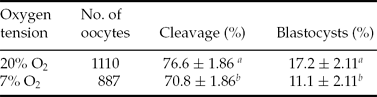
Main effects of oxygen tension during bovine embryo in vitro production (IVP) on cleavage rates and embryonic development to the blastocyst stage (LSM ± SEM)
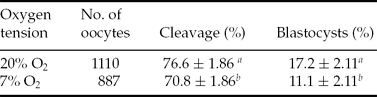
Cleavage (72 hpi) and embryonic development to the blastocyst stage (168 hpi) were examined in bovine embryos produced in vitro under 20% oxygen tension (5% CO2 in air) or in gaseous mixture (7% O2, 5% CO2 and 88% N2). a,bValues with different superscript letters within the same column are significantly different (P < 0.05).
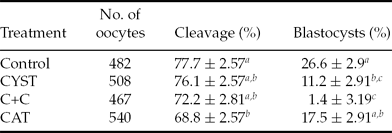
Main effects of antioxidant supplementation during the entire period of bovine embryo in vitro production (IVP) on cleavage rates and embryonic development to the blastocyst stage (LSM ± SEM)

Cleavage (72 hpi) and embryonic development to the blastocyst stage (168 hpi) were examined in bovine embryos produced in vitro in medium supplemented from day 1 to day 7 of IVC with cysteine (CYST; 0.6 mM), cysteine combined with cysteamine (C+C; 0.6 mM cysteine plus 100 μM cysteamine) or catalase (CAT; 100 IU) or in medium with no supplementation (control). a,bValues with different superscript letters within the same column are significantly different (P < 0.05).
There was an effect (P < 0.05) of O2 tension on embryo development (Table 1) and the effect was greater for 20% compared with 7% O2 tension (cleavage: 76.6% versus 70.8% and blastocyst rate: 17.2% versus 11.1%, respectively for 20% O2 and 7% O2).
The effects of antioxidant supplementation on embryonic development are shown in Table 2. The cleavage rates were similar (P > 0.05) among the treatments (range, 68.8–77.7%), with the exception of the control (77.7%) and CAT (68.8%) groups, which differed (P < 0.05). The rates of development of embryos to the blastocyst stage were similar (P > 0.05) between the control (26.6%) and CAT (17.5%) groups; however, the rates of the C+C (1.4%) and CYST (11.2%) groups were lower (P < 0.05) than that of the control group.
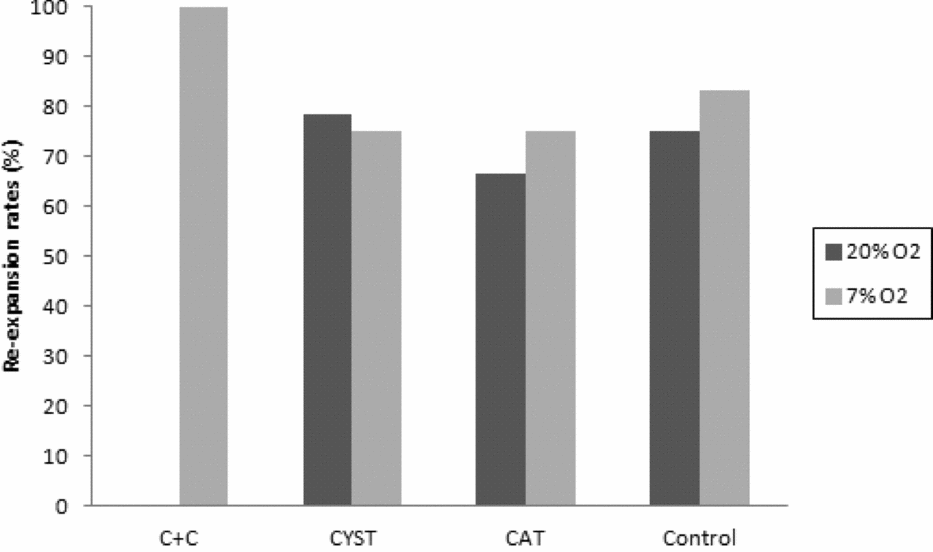
As shown in Fig. 1, antioxidant supplementation during IVC under different O2 tensions did not improve the survival of the vitrified/thawed embryos, as assessed by their re-expansion rates after 24 h of in vitro culture following warming (P > 0.05). The C+C experimental group under 20% O2 tension was not evaluated because the resulting embryos were not suitable for vitrification.
The effects of antioxidant supplementation and gaseous atmosphere during in vitro culture on the re-expansion rates of vitrified/thawed expanded blastocysts. The data represent the means. The total numbers of embryos in each treatment group were as follows: Control 20% O2: n = 40; Control 7% O2: n = 18; CYST 20% O2: n = 14; CYST 7% O2: n = 4; C+C 20% O2: n = 0; C+C 7% O2: n = 2; CAT 20% O2: n = 18; and CAT 7% O2: n = 12. Five replicates were performed. There was no difference between groups (p > 0.05).
Experiment II
There were no interactions (P > 0.05) between treatment type (control, CYST, β-ME and CAT) and O2 tension in terms of cleavage rates, blastocyst frequencies or intracellular ROS levels. Thus, the results of the antioxidant supplementation and O2 tension factors are presented separately as independent variables.
As shown in Table 3, higher rates (P < 0.05) of blastocyst production were obtained when the embryos were cultured under 20% compared with 7% O2 tension (52.1% versus 38.4% for 20% O2 and 7% O2 tension, respectively). However, there was no effect (P > 0.05) of O2 tension on the intracellular ROS levels of the embryos (Table 3).
Main effects of oxygen tension during bovine embryo in vitro production (IVP) on cleavage rates, embryonic development to the blastocyst stage, and intracellular reactive oxygen species (ROS) levels (LSM ± SEM)
Bovine embryos were produced in vitro under 20% oxygen tension (5% CO2 in air) or in gaseous mixture (7% O2, 5% CO2 and 88% N2). a,bValues with different superscript letters within the same column are significantly different (P < 0.05).
There were no effects (P > 0.05) of antioxidant supplementation on the cleavage rates (range, 79.4–84.7%), the rates of development to the blastocyst stage (range, 43.7% to 47.9%), or the intracellular ROS levels (range, 0.78–0.95) of the embryos (Table 4).
Main effects of antioxidant supplementation during the first 72 h of bovine embryo in vitro production (IVP) on cleavage rates, embryonic development to the blastocyst stage, and intracellular reactive oxygen species (ROS) levels (LSM ± SEM)
Bovine embryos were produced in vitro in medium supplemented during the first 72 h of in vitro culture (IVC) with cysteine (CYST; 0.6 mM), β-mercaptoethanol (β-ME; 100 μM) or catalase (CAT; 100 IU) or with no supplementation (control). aValues with different superscript letters within the same column are significantly different (P < 0.05).
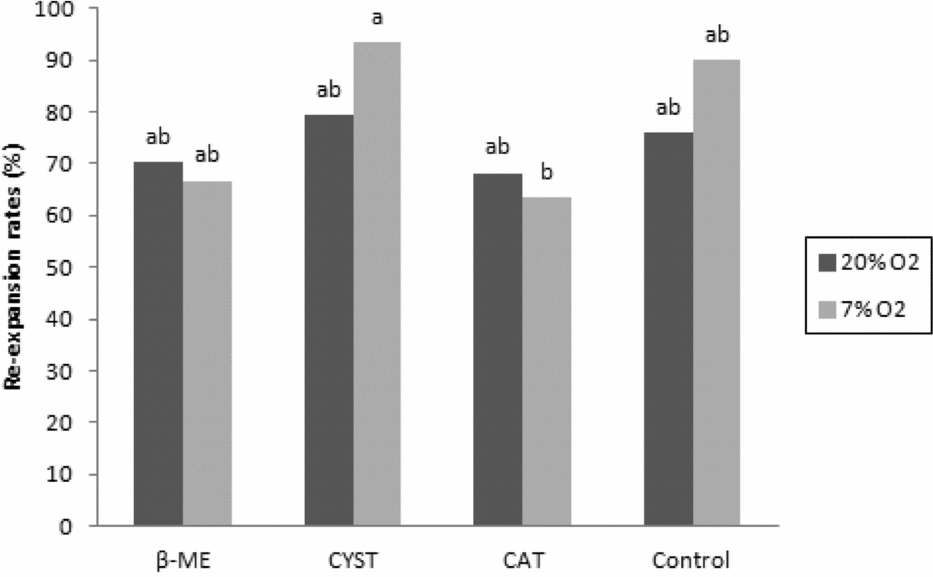
The re-expansion rates of the blastocysts following thawing and in vitro culture for 24 h are shown in Fig. 2. Comparisons among the groups cultured under 7% O2 tension revealed a difference (P < 0.05) between the CYST (93.3%) and CAT (63.6%) groups.
The effects of antioxidant supplementation and gaseous atmosphere during in vitro culture on the re-expansion rates of vitrified/thawed expanded blastocysts. The data represent the means. The total numbers of embryos used for each treatment group were as follows: control 20% O2: n = 46; control 7% O2: n = 20; cysteine (CYST) 20% O2: n = 39; CYST 7% O2: n = 15; β-mercaptoethanol (β-ME) 20% O2: n = 47; β-ME 7% O2: n = 21; catalase (CAT) 20% O2: n = 22; and CAT 7% O2: n = 22. Five replicates were performed. a,bDifferent letters above the bars indicate significantly different means (P < 0.05).
Discussion
To increase cellular protection against the deleterious effects of ROS, strategies that have been applied include the use of low O2 tension (5–7%) and antioxidant supplementation during the in vitro culture of bovine embryos (Noda et al., Reference Noda, Matsumoto, Maoka, Tatsumi, Kishi and Mori1991; Goto et al., Reference Goto, Noda, Mori and Nakano1993). However, it is unclear whether antioxidants are required during embryonic development under low O2 tension and whether this protection must be intra- or extracellular (Ali et al., Reference Ali, Bilodeau and Sirard2003).
Some studies have reported positive effects of low O2 tension (Takahashi et al., Reference Takahashi, Keisho, Takahashi, Ogawa, Schultz and Okano2000; Guérin et al., Reference Guérin, Mouatassim and Ménézo2001; Kitagawa et al., Reference Kitagawa, Suzukib, Yonedaa and Watanabea2004) on the development and quality of bovine embryos produced in vitro. However, in the present study, the use of 7% O2 caused a reduction in the rate of development to the blastocyst stage.
In accordance with the present work, other studies have reported undesirable effects of low O2 tension (Van Der Westerlaken et al., Reference Van Der Westerlaken, Van Der Vlugt, Dewit and Van Der Schans1992; Corrêa et al., Reference Corrêa, Rumpf, Mundim, Franco and Dode2008) or have demonstrated that low O2 tension does not affect the in vitro development of bovine embryos (Khurana & Niemann, Reference Khurana and Niemann2000; Corrêa et al., Reference Corrêa, Rumpf, Mundim, Franco and Dode2008; Somfai et al., Reference Somfai, Inaba, Aikawa, Ohtake, Kobayashi, Konishi, Nagai and Imai2010). An O2 tension of neither 7% nor 20% during the IVC of bovine embryos represents the dynamic changes in O2 concentration that are likely to be encountered by embryos developing in vivo (Harvey, Reference Harvey2007). Therefore, even the best improvements in IVP systems produce conditions that are far from the in vivo state.
Another drawback of embryo culture systems under low O2 tension is the absence of cumulus cells. It is widely known that these cells remove embryotoxic substances from the medium, secrete embryotrophic factors and reduce the O2 tension in the culture medium, thus creating a microenvironment of a gradual reduction in the O2 concentration from the outside (culture medium) into the embryo (Carolan et al., Reference Carolan, Lonergan, Van Langendonckt and Mermillod1995; Fugitani et al., Reference Fugitani, Kasai, Ohtani, Nishimura, Yamada and Utsumi1997; Khurana & Niemann, Reference Khurana and Niemann2000). Thus, the oxidative stress caused by high O2 tension during cultivation can be minimized by the use of cocultivation with cumulus cells, which makes the production of embryos equal in both systems. Another factor that can increase stress in embryos cultured under low O2 tension is the manipulation involved in the removal of the cumulus cells after IVF, which results in a greater exposure of the presumptive zygotes to environmental conditions and can consequently compromise their developmental potential (Corrêa et al., Reference Corrêa, Rumpf, Mundim, Franco and Dode2008). All of these factors may have masked the possible beneficial effects of low O2 tension in in vitro culture systems.
In the present study, there was no effect on the intracellular ROS levels produced by the level of O2 tension (20% or 7%) during IVC, which is in agreement with a recent study (Bain et al., Reference Bain, Madan and Betts2011). The use of plastic bags with low O2 tension during culture did not promote the reduction of intracellular ROS, and it negatively affected in vitro embryonic development.
Different culture systems, such as incubator chambers and plastic bags, have been developed with the goal of optimal environmental conditions and low O2 tension during embryonic cultivation. A previous study demonstrated that incubator chambers were superior to bags in terms of embryonic development and quality; the embryos produced in the bags displayed increased levels of intracellular ROS, an increased proportion of apoptotic cells and increased expression of oxidative stress genes (Arias et al., Reference Arias, Sanchez and Felmer2011). Indeed, subtle alterations in redox status can interfere with various cellular reactions, such as proliferation, differentiation, energy supply and apoptosis; consequently, they can lead to the failure of embryonic development (Ufer et al., Reference Ufer, Wang, Borchert, Heydeck and Kuhn2010). Thus, it appears that the use of plastic bags in this study's culture system may not have been suitable for promoting an adequate environment during IVC, as reflected by its negative effects on blastocyst frequencies.
To protect oocytes and embryos from oxidative stress during in vitro culture, various antioxidants have been added to culture media to enhance development, with variable success rates (Nars-Esfahani et al., Reference Nars-Esfahani, Aitken and Johnson1990; Iwata et al., Reference Iwata, Akamatsu, Minami and Yamada1998; Van Soom et al., Reference Van Soom, Yuan, Peelman, De Matos, Dewulf, Laevens and De Kruif2002). However, it appears that this procedure is beneficial only when the culture system itself is inadequate (Harvey, Reference Harvey2007). In the present study, supplementation with intracellular antioxidants (cysteine alone or combined with cysteamine) throughout the 7 days of IVC proved detrimental to embryonic development.
Likewise, it has been demonstrated that supplementation with 0.6 mM cysteine throughout IVC reduced the rates of development to the blastocyst stage (Van Soom et al., Reference Van Soom, Yuan, Peelman, De Matos, Dewulf, Laevens and De Kruif2002). In bovines, the de novo synthesis of GSH is initiated at the 8- to 16-cell stage, which coincides with genomic activation (Lim et al., Reference Lim, Reggio, Godke and Hansel1999). Thus, it may be hypothesized that antioxidant supplementation after this period is detrimental to embryonic development due to a possible imbalance between intracellular ROS levels and antioxidant mechanisms. Physiological concentrations of ROS, especially H2O2, are known to signal various cellular functions, such as energy production, cellular proliferation during early embryonic development, cellular differentiation and gene expression correlated with changes in the oxidative response. These reactions are modulated by transcriptional factors that are responsive to the redox status (Betts & Madan, Reference Betts and Madan2008; Lopes et al., Reference Lopes, Lane and Thompson2010), and fluctuations in ROS levels signal intrinsic mechanisms that regulate these cell functions, particularly in the preimplantation embryo (Harvey, Reference Harvey2007). For example, low concentrations of ROS mediate cellular proliferation and differentiation, and high concentrations of ROS lead to cell death (Ufer et al., Reference Ufer, Wang, Borchert, Heydeck and Kuhn2010).
Therefore, due to the detrimental effects of antioxidant supplementation throughout the entire IVC period, supplementation was performed during only the first 72 h of IVC (Experiment II) in the present work. This decision was based on previous reports demonstrating that increasing the intracellular concentration of GSH by the addition of thiol compounds up to the 8- to 16-cell stage (which coincides with genomic activation) promotes embryonic development to the blastocyst stage (De Matos et al., Reference De Matos, Herrera, Cortvrindt, Smitz, Van Soom, Nogueira and Pasqualini2002; Ali et al., Reference Ali, Bilodeau and Sirard2003). Furthermore, low intracytoplasmic GSH concentrations may be one reason for the arrest of in vitro bovine embryonic development at the 8-cell stage, which has been frequently reported (Takahashi et al., Reference Takahashi, Nagai, Hamano, Kuwayama, Okamura and Okano1993).
However, antioxidant supplementation during the first 72 h of IVC did not affect blastocyst frequencies in the present study, a result that differs from some studies (De Matos et al., Reference De Matos, Herrera, Cortvrindt, Smitz, Van Soom, Nogueira and Pasqualini2002; Ali et al., Reference Ali, Bilodeau and Sirard2003). It could be speculated that the incubation conditions, specifically the addition of FBS and BSA to the media and the co-culture with cumulus cells, may have masked the effects of the antioxidants, as previously suggested by Thompson et al. (Reference Thompson, Simpson, Pugh, Donnely and Tervit1990). Therefore, it is reasonable to assume that the production of ROS and the antioxidant mechanisms, both intra- and extracellular, were balanced and that oxidative stress was not caused by the experimental conditions presented here. Taken together, the results demonstrate that antioxidant supplementation throughout the entire IVC period may be toxic and detrimental to embryonic development because antioxidant supplementation during a shorter (72 h) period of IVC did not promote the same detrimental effects.
The extracellular enzymatic antioxidant catalase has an inability to cross the plasma membrane, so this antioxidant does not act by removing the H2O2 produced by the embryo (Kouridakis & Gardner, Reference Kouridakis and Gardner1995); rather, it acts by modulating the ROS produced by the culture medium. There are conflicting reports regarding the effects of ROS-neutralizing enzymes on the IVP of bovine embryos (Ali et al., Reference Ali, Bilodeau and Sirard2003). In the present study, catalase supplementation either throughout the entire IVC period or during only the first 72 h of IVC did not affect embryonic development. In contrast, improved blastocyst rates have been demonstrated following supplementation with 100 IU of catalase in KSOM media free of glutamine, under an atmosphere of 20% O2 (Orsi & Leese, Reference Orsi and Leese2001). Conflicting reports are to be expected because it is known that antioxidant action may be influenced by media composition and O2 tension. Because the SOF medium (Vajta et al. Reference Vajta, Rindom, Peura, Holm, Greve and Callesen1999) contains a variety of compounds with antioxidant capacity, such as pyruvate, citrate and cystine, the positive effects of catalase might be more pronounced by using TCM199 medium under an atmosphere of 20% O2 (Van Soom et al., Reference Van Soom, Yuan, Peelman, De Matos, Dewulf, Laevens and De Kruif2002).
The use of SOF (Vajta et al., Reference Vajta, Rindom, Peura, Holm, Greve and Callesen1999) and the antioxidant factors included in its formulation may prevent oxidative stress in culture systems; this could explain why supplementation with β-mercaptoethanol, cysteine and catalase did not promote additional reductions in the intracellular ROS levels of the embryos in the present study. The antioxidant compounds in SOF medium include methionine, hypotaurine, cystine, tyrosine, tryptophan, besides FBS, BSA, pyruvate and citrate (Guérin et al., Reference Guérin, Mouatassim and Ménézo2001; Leminska et al., Reference Leminska, Wnuk, Slota and Bartosz2007). Possibly, the similarity of the intracellular ROS levels in the embryos cultured under different O2 tensions and with different antioxidants may be due to the multiplicity of factors present in the culture media.
In vitro produced bovine embryos are more sensitive than in vivo derived embryos to damage from ROS and cryopreservation, which makes them extremely vulnerable to oxidative and osmotic stresses resulting from lipid peroxidation and spatial modifications of plasma membrane structures (Guérin et al., Reference Guérin, Mouatassim and Ménézo2001; Nedambale et al., Reference Nedambale, Du, Yang and Tian2006). However, the results of the present study indicated that antioxidant supplementation throughout the IVC period did not improve the embryo survival rates following vitrification/thawing and in vitro culture. Likewise, supplementation with β-mercaptoethanol during IVC did not affect the re-expansion rates after thawing (Hosseini et al., Reference Hosseini, Forouzanfar, Hajian, Asgari, Abedi and Hosseini2009).
However, the comparisons between the groups cultured under 7% O2 revealed that supplementation with cysteine during the first 72 h of IVC promoted higher embryo survival rates after thawing compared with supplementation with catalase. It is probable that the supplementation with cysteine, which is the precursor for the synthesis of GSH, increased the intracellular concentrations of GSH (Deleuze & Goudet, Reference Deleuze and Goudet2010). Consequently, this increase may have provided greater protection against the oxidative and osmotic damage caused by the process of vitrification/thawing compared with supplementation with catalase, which acts as an extracellular antioxidant (Orsi & Leese, Reference Orsi and Leese2001).
The combined use of low O2 tension and supplementation with intracellular antioxidants (cysteine or cysteine combined with cysteamine) throughout the entire IVC period in bovine embryos was found to adversely affect the rates of development to the blastocyst stage and to not affect the rates of embryo survival after thawing. However, antioxidant supplementation (cysteine or β-mercaptoethanol intracellularly and catalase extracellularly) during the first 72 h of IVC did not affect the blastocyst frequencies, intracellular ROS levels or re-expansion rates post-vitrification. Thus, antioxidant supplementation throughout the entire IVC period should be considered potentially harmful.
In conclusion, both the use of plastic bags with low O2 tension for embryo culture and supplementation with intracellular antioxidants throughout the entire IVC period were deleterious to embryonic development. Supplementation with intra- or extracellular antioxidants during the first 72 h of IVC did not affect the rate of development to the blastocyst stage, the rate of embryo survival post-vitrification or the intracellular ROS levels.
Acknowledgements
The present study was supported by FAPESP, Brazil (project number 2011/18257-2). NASRF was supported by an MS scholarship from CAPES, Brazil. The authors wish to thank Ingámed® for the donation of the vitrification kits and Alta Genetics Brazil Ltda for the donation of the straws of bull semen.