Since the origins of human beings, there has been a relationship with Nature in different historical and cultural contexts. As Kellert and Wilson (Reference Kellert and Wilson1993) point out, this relationship could be innate, showing even people have a biological need to keep in touch with Nature. The complexity of these relationships is reflected when trying to describe them, as individuals themselves find it difficult to express their experiences (Stålhammar & Pedersen, Reference Stålhammar and Pedersen2017). Thus, in diverse attempts to describe these subjective relationships, researchers have developed different constructs and measures. The aim of all these constructs and their corresponding measures is to describe the relationships between human beings and nature, focusing in some cases on the cognitive dimension and in others on the affective dimension (Amérigo et al., Reference Amérigo, Aragonés and García2012). Nonetheless, despite the differences between these constructs and measures, they are all expressions of the same construct: a subjective nature connectedness (Capaldi et al., Reference Capaldi, Dopko and Zelenski2014; Tam, Reference Tam2013a). Indeed, Tam (Reference Tam2013a), conducted a study whose aim was to determine whether there is a robust relationship between the different constructs, finding that they actually formed a single latent construct. However, comparison of the correlations of each measure with the different criterion variables traditionally associated with connectedness, mainly variables of personality and well-being, showed that the magnitudes of these correlations were not equal. In other words, it can be considered that all these constructs share a common part that measures the relationship between nature and human beings from the perspective of self. However, each of these constructs also has nuances that are difficult to pin down.
Among the particularities of each construct, a clear difference is observable between them: some emphasize the link with nature at cognitive level, while others concentrate on the emotional connection, or even a combination of both (Amérigo et al., Reference Amérigo, García, Pérez-López, Cassullo, Ramos, Venumbaka and Aragonés2020). Among the first, the most prominent is the construct of connectedness with nature and its corresponding measure, the Connectedness to Nature scale (CNS) developed by Mayer and Frantz (Reference Mayer and Frantz2004). Frequently used in environmental psychology, it has been the subject of exhaustive analysis at different levels: In terms of concept (Perrin & Benassi, Reference Perrin and Benassi2009), reliability (Pasca et al., Reference Pasca, Aragonés and Coello2017) and validity (Pasca et al., Reference Pasca, Coello, Aragonés and Frantz2018). Other construct and measures of the cognitive component are “Inclusion of Nature in Self” (Schultz, Reference Schultz2001), “Environmental Identity” (Clayton, Reference Clayton2003), Biospherism (Amérigo et al., Reference Amérigo, Aragonés, de Frutos, Sevillano and Cortés2007), “Connectivity with Nature” (Dutcher et al., Reference Dutcher, Finley, Luloff and Johnson2007) and “Commitment to the Environment” (Davis et al., Reference Davis, Green and Reed2009). Among the second, the emotional level, the literature is populated by terms such as: “Emotional Affinity toward Nature” (Kals et al., Reference Kals, Schumacher and Montada1999), “Love and Care for Nature” (Perkins, Reference Perkins2010) and “Dispositional Empathy with Nature” (Tam, Reference Tam2013b). Moreover, the approaches based on the emotional connection of people to nature have not been as exhaustively analyzed in psychometric terms as those related to cognition. Among these measures of the affective component, Perkins (Reference Perkins2010) proposed the construct of Love and Care for Nature (LCS), which she defined as a “deep love and caring for nature which includes a clear recognition of nature’s intrinsic value as well as a personal sense of responsibility to protect it from harm” (p. 456). The author proposes three dimensions, which she includes in her definition. The first one relates love to feelings of caring. The second dimension refers to love in terms of interconnection with nature. And the third, which refers to the commitment to protect nature. To measure these constructs, the author designed the LCS. This measure is comprised of 15 items which loaded in a single factor explaining 71.18% of the variance, and a value of Cronbach’s Alpha of .97 (Perkins, Reference Perkins2010).
Another approach to the love for nature, can be the one raised by Kals et al. (Reference Kals, Schumacher and Montada1999), who affirm that the term love for nature usually refers to a romantic conception, found in contexts of literary character. They point out that this term is related to others such as feelings of freedom or security, so they decide to group them together under the label of "emotional affinity toward nature". On the other hand, Lumber et al. (Reference Lumber, Richardson and Sheffield2017) define love of nature as “an affective state or sensation that occurs as a result of engaging with nature” (p. 19). In this definition there is a connection between the ideas of love and care analogous to those in the LCS (Perkins, Reference Perkins2010). Another work that advocates for this differentiation between love and care is recently carried out by Dong et al. (Reference Dong, Liu, Li, Yang, Liang and Deng2020), who refer to love based on the triangular theory of love of Sternberg (Reference Sternberg1986). That is, the authors conceptualize love by distinguishing three dimensions: Passion, intimacy and commitment. Passion is understood as the strong and romantic feelings towards nature. Intimacy is based on the closeness and connectedness caused by experiences with nature. And commitment implies the maintenance of these feelings of love. These three dimensions have been shown to be related, being love a latent factor of the first order (Merino & Privado, Reference Merino and Privado2020).
As can be seen from the above works, it can be expected that, although love is a precedent for care, they could well be differentiated empirically, so that a scale such as the LCS should contemplate both components. A detailed reading of the items seems to reflect both separately in an unbalanced way - more items about love than about care-. This leads us to ask to what extent the construct of love and care for nature, responds to two empirically different dimensions, as well as conducting a psychometric study of the scale to improve both its reliability and its validity.
To this end, we conducted three studies. First, we conducted a study to observe to what extent the components that lend their name to the scale - love and care - are recognized in the items used to define it. Second, another study was carried out to analyze the scale using item response theory models. Finally, we analyzed the convergent and discriminant evidences of validity in a third study.
STUDY 1
When developing the construct, Perkins (Reference Perkins2010) suggests three theoretical dimensions. The first of these refers to a sense of fascination with the natural world, a recognition of its intrinsic value. These feelings, according to the author, are those that trigger the feelings of care and responsibility towards nature, forming the second. The third dimension refers to feelings of interconnectedness and emotional closeness with nature, including a spiritual aspect. However, the author chooses to use two dimensions – love and care – when giving the scale a name, which leads one to wonder exactly which empirical dimensions underpin the instrument.
Method
Participants
A total of 51 undergraduates belonging to the Faculty of Psychology (UCM), of whom 90.20% were female, participated in this study. Their mean age was 20.37 (SD = 1.04).
Instrument and Procedure
Each of the 15 items comprising the LCS were printed on different cards of the same size (see Table 1). The participants were given the cards and asked to put them into groups, with no prior criteria or number of categories being indicated. Specifically, the instruction given to the participants was “You all have a set of cards, please, put them into different groups. You can group them as you consider”. No criteria were indicated to avoid introducing bias into the categorizations.
Descriptive Statistics of the 15 LCS Items

Note. aItems corresponding to “care for nature” eliminated from this analysis.
The participation of students was requested during the classes, encouraging them to attend the space provided for the task at a time established by the researchers.
Results
It was conducted a hierarchic cluster analysis using the between-groups linkage method, through SPSS 22. The data matrix was formed from the frequencies in which each item was associated with each of the others, resulting in a square matrix (15 x 15) symmetrical with respect to the main diagonal.
The results show three different clusters as can be seen in Figure 1. We named the first of these (N1) “connectedness” as it comprised items directly related to individuals’ bond with the natural world (e.g., “I often feel emotionally close to nature”). The second cluster (N2) included the largest number of items, which all refer to the sense of well-being triggered by contact with nature, a feeling of self-transcendence or spirituality (e.g., “When I spend time in unspoilt nature I feel that my day- to-day worries seem to dwindle away in the face of the wonder of nature”). At the same time, these two clusters are grouped at a higher level (N4). Finally, the third cluster (N3) was made up of just two items, both of which explicitly allude to a drive to protect or care for nature (e.g., “I often feel a strong sense of care towards the natural environment”).
Cluster Analysis of the 15 LCN Items.
Note. The item numbers are at the bottom of the diagram.

Conclusion
The results of this study show that despite the unidimensional nature of the LCS, when individuals are asked to categorize the scale’s items, three different dimensions emerge. The first category includes the items that refer to the sense of connectedness with nature, where the traditional bond between human beings and nature is reflected. The majority of items on the scale are included in a cluster that forms the second category alluding to a sense of welfare generated by being in the natural environment, involving an almost spiritual feeling of enjoyment. The third cluster is formed by only two items, which are directly associated with protecting and caring for nature. Thus, it might be said that the Love and Care for Nature Scale is a scale which contemplates two components, care and love of nature, understood as a construct with two components. One of these – connectedness – is understood as a benevolent attachment towards nature, while the second – well-being – refers to the pleasure that the presence of nature brings. These are two of the components included in the definition of love in the Oxford dictionary.
STUDY 2
In light of the findings of the first study, where 13 items were grouped into only one cluster (N4), we decided to conduct a psychometric analysis of these same items referring love. To evaluate the quality of the measure, two techniques were used: The quality of the items was assessed using item response theory (IRT) analysis and the structure of the scale was evaluated by means of factor analysis.
Method
Participants and Instrument
For the analyses, a sample of 1,071 participants was used. The sample comprised different general population sub-samples with an age range of 13 to 77 years. These had been obtained for previous studies (Aragonés et al., Reference Aragonés, Olivos, Pasca and Talayero2015; Aragonés & Pasca, Reference Aragonés and Pasca2017; Pasca, Reference Pasca2018; Pasca & Aragonés, Reference Pasca and Aragonés2018; Pasca et al., Reference Pasca, Aragonés and Coello2017; Pérez-López et al., Reference Pasca and Aragonés2018; Vigon, Reference Vigon2016), all conducted between 2015 and 2017. The database was composed of participants who answered the totality of the scale, with no missing values. Mean age was 26.42 years (SD = 14.58), and 56.70 % of the participants were female.
The LCS comprises 15 items rated on a 7-point Likert-type scale, where participants express their level of agreement or disagreement with the statements. Nonetheless, following the findings of the previous study, only the 13 items referring to love for nature were considered.
Data Analysis
The scale was analyzed using IRT models. These models provide estimators of the parameters characterizing the items that do not depend on the samples of participants to whom the test has been applied. Furthermore, the parameters that characterize a participant do not depend on the sample of items employed (Hambleton & Swaminathan, Reference Hambleton and Swaminathan1985; Lord, Reference Lord1980). To analyze items such as those of the LCS using IRT, polytomous models are required to represent the nonlinear relationship between the level of the variable and the probability of responding to a given category (Embretson & Reise, Reference Embretson and Reise2000). Samejima (Reference Samejima1969) proposed graded response models, because responses cannot always be categorized in terms of correctness or error, which is what IRT has traditionally analyzed. This model is especially suitable for items whose response categories are scored between 1 and the number of categories, so the choice of the highest category implies a higher level in the construct, as is the case with the LCS.
Unidimensionality
One of the fundamental assumptions of unidimensional parametric IRT models is that the measured construct is unidimensional—in other words, that the covariance between items can be explained by a single factor. To assess the factor dimensionality of the scale, a parallel analysis (PA) was conducted using the FACTOR 9.3 program (Lorenzo-Seva & Ferrando, Reference Lorenzo-Seva and Ferrando2006).
Calibration of the IRT Items
To ascertain the quality of each of the items that make up the love dimension of the scale, we estimated the discrimination and difficulty parameters, using Samejima's (Reference Samejima1969) Graded Response Model (GRM), which estimates individual slopes for each of the LCS items. We evaluated the fit of the model for each item. We carried out IRT analysis with the IRT.PRO program (Cai et al., 2012). Finally, we examined whether there were problems of local dependency. Items exhibiting local dependency will tend to present higher slopes than those shown by other items.
Confirmatory Factor Analysis (CFA)
Taking into account the theoretical dimensionality and the dimensionality proposed for the parallel analysis, two CFAs were performed to test the single or double factor structure of the scale, using robust maximum likelihood as the estimator. Error variances were not allowed to co-vary between items. Model fit was assessed using recommendations by Meyers et al. (Reference Meyers, Gamst and Guarino2013) with a non-significant chi-square value (χ2), a significant root mean square error of approximation (RMSEA ≤ .08), and a comparative fit index (CFI ≥ .95), all of which indicated a good fit. Chi-square was considered to be a secondary fit index given its sensitivity to large samples and the frequently resulting underestimation of model fit (Brown, Reference Brown2006). MPLUS 7.0 (Muthén & Muthen, Reference Muthén and Muthén2012) was used.
Following Calderón Garrido et al. (Reference Calderón Garrido, Navarro González, Lorenzo-Seva and Ferrando Piera2019) recommendations, the dimensionality analysis was completed assessing the closeness to unidimensionality and the added-value of multiple factor scores estimates, through the proportional reduction of mean squared error (PRMSE). There were carried out using FACTOR 10.10 (Ferrando & Lorenzo-Seva, Reference Ferrando and Lorenzo-Seva2017).
Results
We first present the descriptive statistics (Table 1), which show the means, standard deviations, skewness and kurtosis for each of the items, as well as their correlations with the total score on the scale.
Second, the dimensionality of the scale was analyzed by means of a parallel analysis, using the Unweighted Least Squares (ULS) method. A single factor was obtained in the Exploratory Factor Analysis, explaining 74.19% of the variance, meaning that unidimensionality was assumed.
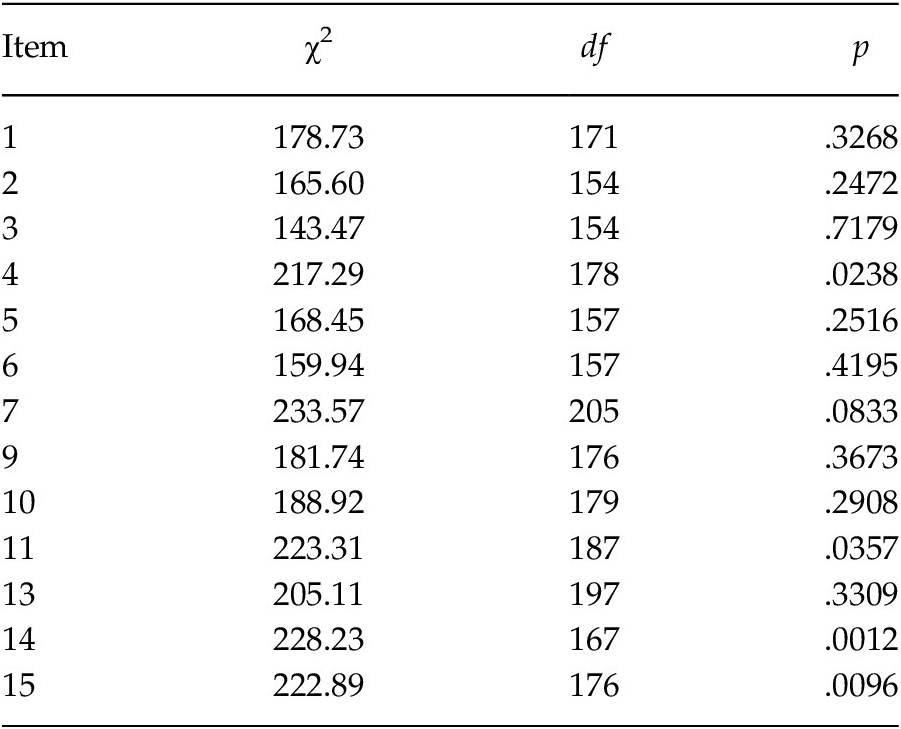
Next, the overall fit of the 13-item scale was analyzed, obtaining a value of –2LL = 37,794.46. At item level, the S - χ² statistic was used to assess fit. The results are shown in Table 2, where it can be seen that while most of the items present an acceptable fit, Items 14 and 15 do not present a suitable fit to the model (p < .01). For this reason, these items were eliminated from subsequent analysis.
S-χ2 Fit Statistics of the 15 LCS Items

To determine whether there is local independence (LI) - that is, if there is no additional systematic covariance to the covariance between the underlying construct and the item - LD χ² was calculated, with χ² = 42.8 being found for Items 9 and 10. This means that the presence of both items in the scale is redundant since they measure the same aspect of the construct. For this reason, we decided to remove Item 10 from the scale, as its fit was slightly lower.
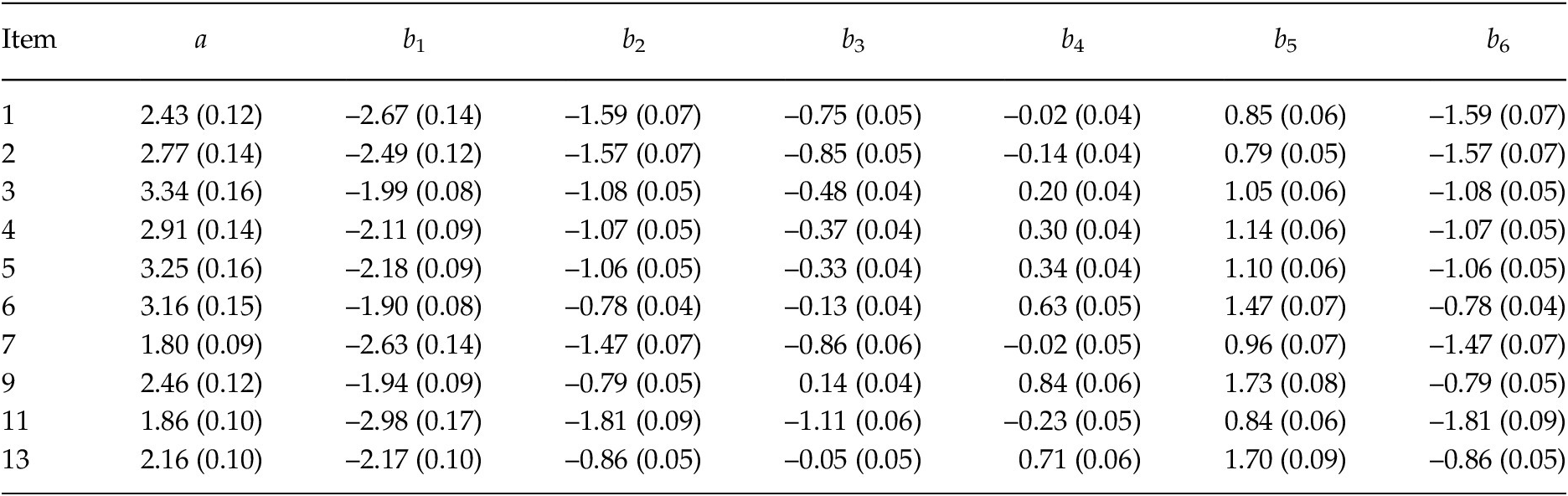
We then performed a second analysis, in which we included the remaining ten items, whose difficulty and discrimination parameters are shown in Table 3. This table shows that the remaining items have high discrimination indices, as well as difficulty indices that increase with the response categories.
Estimates of the Parameters of the Ten Items of the Graded Response Model and Standard Errors

After eliminating the three items (10, 14 and 15), the –2LL value of the scale was 29,587.67. We then calculated the coefficient of determination, which reports the proportion of reduction of variance relative to the original scale, obtaining a value of R 2 = .2171. In other words, eliminating these items from the scale would reduce the residual variance by 21.71%.
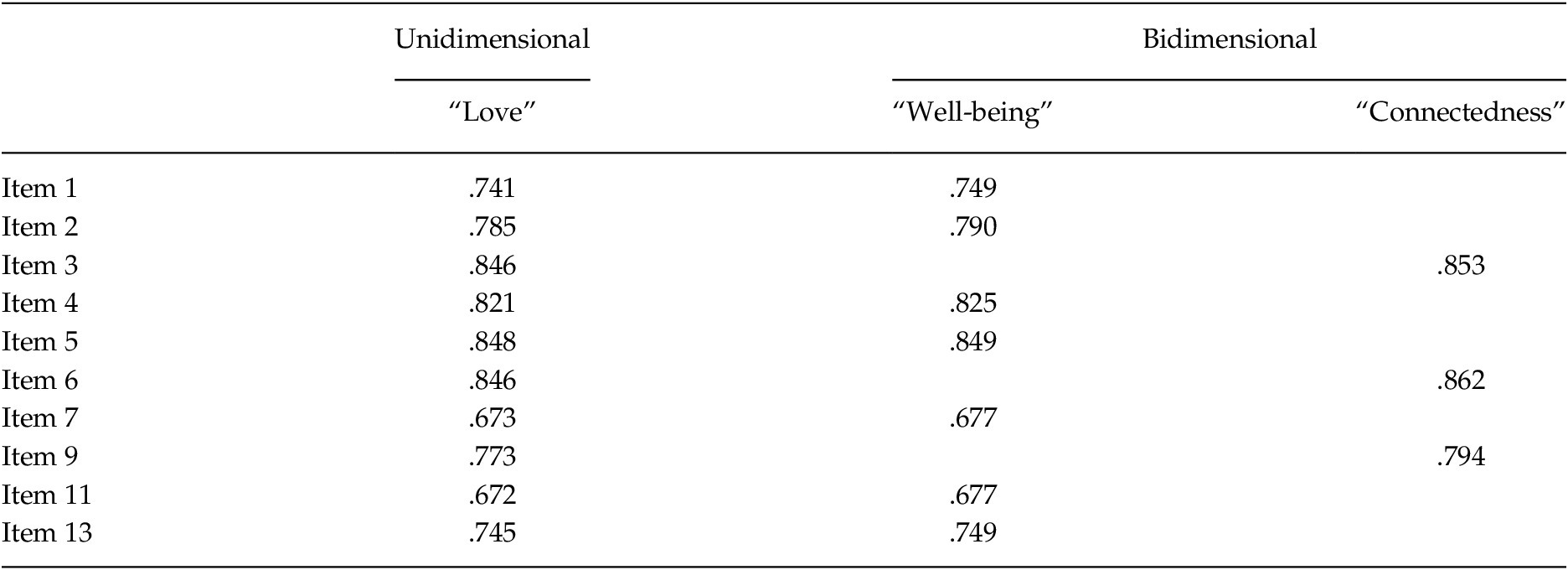
Taking into account the unidimensionality suggested by the parallel analysis and the theoretical two-dimensional nature of the scale proposed in the previous study, the fit indices (Table 4) and the item weights (Table 5) were compared in both models.
Goodness-of-Fit Indices for the 10 Items of Love for Nature (n = 1,071)

Note: M1 = Unidimensional model; M2 = Bidimensional model; χ2 = Chi-square fit statistic; df = degrees of freedom; Δχ2 = Satorra-Bentler scaled chi-square difference test; r = Factors Correlation; Ω = McDonald's Omega; GLB = Greatest lower bond to reliability.
** p < .01.
Comparison between the Factor Weights between the One- and Two-Dimensional Models of the 10-item of Love for Nature

Both models had adequate fit indices (CFI > .95 and RMSEA < .08). In the two-dimensional model, the correlation between the two factors was .96. With regard to reliability, the unidimensional model yielded indices of .90 (Cronbach's alpha), .91 (McDonald's Omega) and .93 (Greatest Lower Bound to reliability, GLB), while in the two-dimensional model, GLB was only higher than .90 in the first factor but .73 in the second. Following the criteria of Tabachnick et al. (2007), the weighting was excellent in the unidimensional model and excellent/very good in the two-dimensional model. Satorra-Bentler’s likelihood ratio (ΔSB-χ2) (Satorra & Bentler, Reference Satorra and Bentler2010) seemed to indicate that the two-dimensional model provides a better fit than the unidimensional model.
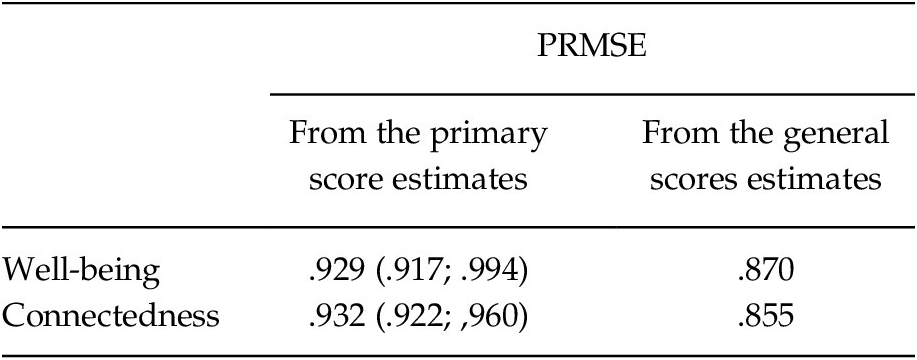
Regarding the closeness to unidimensionality, both the value of Unidimensional Congruence (.99) and Explained Common Variance (.94) and Mean of Item Residual Absolute Loadings (.16) suggest that data can be treated as essentially unidimensional. Finally, the PRMSEs show that when comparing a first order general factor versus a two factors model (Table 6), the scores estimates are more accurate if the two factors are used.
Added-value Assessment

Although Satorra-Bentler’s likelihood ratio and added-value assessment might suggest the two-dimensional model is more appropriate, given that (a) both models had adequate goodness of fit, (b) the correlation between the two factors is higher than .95, (c) the reliability indices and factor weights are higher in the unidimensional model, and (d) the closeness to unidimensionality assessment shows that the data can be treated as essentially unidimensional, we conclude that the unidimensional model is more adequate.
Furthermore, we can conclude that the love of nature dimension of the LCS comprises the above-mentioned 10 items with good psychometric properties.
Study 3
After the analyses conducted in Study 1 and Study 2, it was necessary to verify whether the new scale Love for Nature Scale (LNS) provides adequate reliability and validity evidences when interpreting scale scores as current level of the attribute. To this end, we conducted the following study.
Method
Participants
A total of 151 individuals from the general population of Madrid (Spain) participated in this study. Mean age was 40.96 years (SD = 12.50); 53.6% were female.
Instrument
All participants completed a self-administered questionnaire. This consisted of the LNS, in the first place. Secondly, the CNS 7 items version (Pasca et al., Reference Pasca, Aragonés and Coello2017) was included, as a measure of the cognitive relationship between self and nature. It is composed of 7 items, having a value of Cronbach’s Alpha of .94. Thirdly, the Environmental Apathy Scale (EAS) created by Amérigo et al. (Reference Amérigo, Aragonés and García2012) was included, as a measure of a lack of concern about nature. This is comprised of 5 items, having a value of Cronbach’s Alpha of .89. Finally, participants provided their sociodemographic data.
The sample was collected by Psychology students who applied the questionnaire to people who satisfied certain age and gender quotas, in order to make the sample as balanced as possible.
Results
In order to verify the reliability of the new version of the LNS, we conducted a reliability analysis, using Cronbach’s alpha, which yielded adequate reliability (α = .951). Furthermore, to analyze the convergent and discriminant validity, we calculated the correlations between the LNS and the CNS–7 (r = .676, p < .001, n = 151) and EAS (r = –.479, p < .001, n = 151). These results provide support for the convergent and discriminant validity of the new scale.
Discussion
Interest in the study of the relationship between humans and nature has led to the development of a number of measures, including the LCS designed by Perkins (Reference Perkins2010). This scale measures the emotional component of the connection between human beings and nature, with reference to two different terms: love and care for nature. These two terms have been differentiated in the literature (e. g., Lumber et al., Reference Lumber, Richardson and Sheffield2017) as well as the items on the LCS themselves. Therefore, it was considered necessary to study whether this differentiation was observed when the participants classified the items according to the content to which they referred. In addition, due to the importance of obtaining a reliable measure of the emotional relationship, an exhaustive conceptual and psychometric analysis of the scale was deemed necessary.
In the first study conducted for the present work, when the participants were asked to put the 15 items of the LCS into categories, they separated them into three different groups. The first of these contained five items referring to “connectedness with nature” a sense of oneness with the natural world. The second group comprised eight items related to the “well-being” that contact with nature generates. These two clusters are in turn part of a larger grouping. Finally, the participants grouped together two items alluding to “care” for nature. Due to the under-representation of this component, we decided to continue the following analyses taking only into consideration the “love” component.
The object of love, in our case, is nature, which can be understood as a construct with two components: connectedness, understood as an attachment to nature, and well-being, as the positive feelings it produces. Both are highly related, as seen in both Study 1 and Study 2. Consequently the resulting scale groups the two components into the same cluster.
The results of the IRT analysis showed that 10 items of the scale presented adequate overall psychometric properties. As for the remaining three, it is noted that the fit for two of them was not sufficiently good for them to be maintained in the scale. Furthermore, two of the items presented collinearity, meaning their presence in the scale was redundant, so one of them was removed. Consequently, these ten items compose the “Love for Nature Scale” (LNS).
Furthermore, following the parallel analysis, the scale was observed to be psychometrically unidimensional. However, a confirmatory factor analysis was conducted to determine whether the scale could comprise two factors as suggested in the first study, providing greater evidence of structure when analyzed cross-method (Clark & Watson, Reference Clark and Watson2019). The results show that the two factors are highly correlated, which reflects the relationship between the two variables – connectedness and well-being – evidenced in the literature (e.g., Mayer et al., Reference Mayer, Frantz, Bruehlman-Senecal and Dolliver2009; Pasca, Reference Pasca2018).
In light of the findings of the present work, we can conclude that the Love for Nature Scale (LNS) comprises the above-mentioned 10 items with good psychometric properties, as well as evidences of convergent and discriminant validity. This is configured by the dimensions of connectedness and well-being, which, despite their differentiation, are so closely related that they could well be treated as a whole.
Finally, we propose for future research some improvements in the scale. For instance, the use of expert samples in the case of Study 1, to confirm the structure proposed in the cluster analysis. Secondly, it would be interesting to analyze the mediational role of the construct in the study of well-being and environmental concern. Lastly, this research calls for a future study on invariance in the international context.