

Introduction
The relevance of intestinal microbiota of poultry is currently a topical issue because any factor that affects intestinal health can alter nutrient uptake and availability, as well as the immune system. The ultimate effect is seen in bird performance, especially when regulations do not allow the use of in-feed antibiotics. There is tremendous pressure on the poultry industry to look for alternatives for antibiotic growth promoters (AGP). It is less likely that a single economically viable replacement of AGP is possible, rather that a multifactorial approach is needed to maintain the stable ecology of microbiota in the gastrointestinal tract (Dibner and Richards, Reference Dibner and Richard2005). The gut is not only the major organ for nutrient digestion and absorption, it also works as the ‘first protective mechanism’ against pathogens, which, if uncontrolled, can colonise and then enter the cells and tissues, causing disease (Mathew, Reference Mathew, Lyons and Jacques2001). The gut is the largest immunological organ in the body.
A perusal of literature revealed that probiotics, prebiotics, enzyme supplementation and competitive exclusion products are amongst the nutritional strategies that are being used in the poultry industry to promote intestinal health and to increase the resistance to pathogens colonization (Yang et al., Reference Yang, Iji and Choct2009). More recently, dietary inclusion of whole cereals has been shown to influence the ecology of gastrointestinal tract of poultry (Santos et al., Reference Santos, Sheldon, Santos and Ferket2008; Singh et al., Reference Singh, Amerah and Ravindran2014a, Reference Singh, Ravindran, Wester, Molan and Ravindranb), mainly through their effects of the development and functionality of the gizzard.
Fluorescence in situ hybridisation (FISH) analysis has been employed in this current study to characterise the intestinal microbiota. This powerful molecular-based approach has previously been employed to provide a snapshot of this complex environment (Zhu and Joerger, Reference Zhu and Joerger2003). In the present work, the FISH technique was used to estimate the populations of five groups of bacteria in the caeca of chickens using group-specific probes. The aim was to evaluate the effect of feeding whole wheat on the caecal microbial community structure of broilers and to test the hypothesis that dietary inclusion of whole wheat can be a cost-effective strategy to discourage the enteric pathogen colonisation.
Materials and methods
Dietary treatments
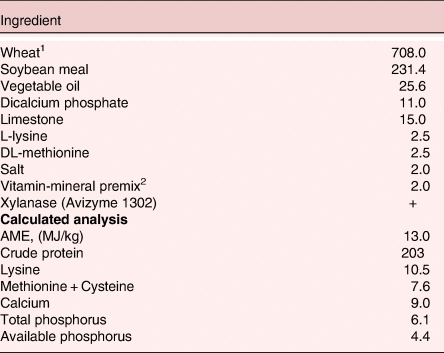
The experiment was designed as a completely randomised block with three diet forms, namely, ground wheat (GW), 200 g/kg whole wheat (WW) replacing GW before pelleting and 200 g/kg WW replacing GW after pelleting. Each diet was formulated to meet or exceed the current Ross 308 strain recommendations for broiler finishers. The ingredient composition and calculated analysis of diets are shown in Table 1. The GW and WW used in the experiment were from the same batch of wheat. The wheat was ground in a hammer mill (Bisley's Farm Machinery, Auckland, New Zealand) and passed through a 4.0 mm screen. Complete mash diets, without or with substitution of WW, were mixed and cold-pelleted at 65°C in a pellet mill (Richard Size Limited Engineers, Orbit, Kingston-upon Hull, UK) equipped with a 4.76-mm die. In the post-pelleting treatment group, the whole wheat was added on top of the pellets. All treatment diets were isocaloric and isonitrogenic, and differed only in the form of wheat.
The composition and calculated analysis of the diet (g/ kg as-fed basis)

1 In the treatment diets, ground wheat was replaced by 200k/kg whole wheat prior to pelleting or post pelting. 2 Supplied per kilogram of diet: antioxidant, 100 mg; biotin, 0.2 mg; calcium pantothenate, 12.8 mg; cholecalciferol, 60 µg; cyanocobalamin, 0.017 mg; folic acid, 5.2 mg; menadione, 4 mg; niacin, 35 mg; pyridoxine, 10 mg; trans-retinol, 3.33 mg; riboflavin, 12 mg; thiamine, 3.0 mg dl- α-tocopheryl acetate, 60 mg; choline chloride, 638 mg; Co, 0.3 mg; Cu, 3 mg; Fe, 25 mg; I, 1 mg; Mn, 125 mg; Mo, 0.5 mg; Se, 200 µg; Zn, 60 mg.
Bird management
Experimental procedures were approved by the Massey University Ethics Committee. One-day-old male broiler (Ross 308) chicks were obtained from a commercial hatchery and reared in electrically heated battery brooders housed in an environmentally controlled room. Birds were fed a standard broiler starter wheat-based crumbled diet until day 10 of age. On day 11, the birds were individually weighed, allocated to 18 groups having similar mean body weight (eight birds per group) and transferred to colony cages in an environmentally controlled room. Each treatment was randomly assigned to six cages. Room temperature was maintained at 32 ± 1°C during the first week and gradually reduced to 24°C by the end of the third week. Continuous fluorescent lighting was provided throughout the trial. Diets were offered ad libitum and water was available at all times up to 35 days post-hatch.
Performance data
Body weight and feed intake were recorded weekly. Mortality was recorded daily. Feed per gain values were corrected for the body weight of any bird that died or was culled during the course of the experiment.
Collection and preparation of caecal samples
On day 35 of age, two birds were selected from each replicate and killed by cervical dislocation. The gastrointestinal tracts were carefully excised out on a clean stainless-steel dissection tray at room temperature. Both caeca (left and right) were collected and the contents were pooled and representative samples of 1 g were used for the FISH analysis for bacterial species identification.
Fluorescence in situ hybridisation (FISH) analysis
The probes used in the study were Bif164, Bac303, Chis150, Cajej and Lab158, specific for Bifidobacteria, Bacteroides, Campylobacter, Clostridia (perfingens/histolyticum subgroup) and Lactobacilli/Enteroccocus spp., respectively. These were commercially synthesised and labelled with the fluorescent dye Cy3 (Gene-Works, Hindmarsh, Australia). The samples were prepared as described by Molan et al. (Reference Molan, Liu and Tiwari2010). In brief, caecal content samples were prepared by mixing 1 g of caecal contents with 9 ml of sterile-filtered phosphate buffer (PBS; pH 7.2). The mixture was homogenised by vortexing with a dozen glass beads for 3 min, the debris was removed by centrifugation at low speed (700 g), and the bacteria containing supernatant was fixed in 4% (w/v) paraformaldheyde in PBS (pH 7.2) overnight at 4°C. Fixed samples were washed in PBS and stored in a known volume of 50% (v/v) ethanol-PBS at -20°C until the hybridisation. Aliquots (5 µl) of fixed bacterial cells were applied to Teflon-coated microscopic slides (BIOLAB, North Shore City, New Zealand) and air dried. The bacterial cells were then dehydrated with a series of solutions containing 50, 80, and 99.5% ethanol. The bacterial cells were fixed on the glass slides and hybridised by addition of 8 µl of hybridisation buffer (0.9 M NaCl, 0.01% sodium dodecyl sulphate, 20 mM Tris–HCl, 20% deionised formamide; pH 7.2) with 0.5 µl of Cy3-labeled oligonucleotide specific probes (50 ng/μl). The slides were hybridised at 46°C for 2 h in a plastic box containing wet sponges soaked in the hybridisation buffer. After hybridisation, the slides were rinsed with warm hybridisation buffer at 48°C and washed in pre-warmed washing buffer (225 mM NaCl, 0.01% sodium dodecyl sulphate, 20 mM Tris–HCl; pH 7.2) for 20 min at 48°C. After washing, the slides were rinsed with ice-cold distilled water and thoroughly dried before being examined using a fluorescence scanning microscope (Olympus BX51 microscope, under 4009 magnification). The images were captured using an Optronics MagnaFIRE SS99802 digital camera with MagnaFIRE frame-grabbing software on a Pentium IV computer. Fluorescent cells were counted automatically in five randomly selected fields/slide using ImageJ.
Measurement of pH of digesta in gastrointestinal tract
On day 36, nine birds, randomly selected per treatment (at least one from each replicate), were killed by cervical dislocation and immediately eviscerated. The digestive tracts were placed on a stainless-steel dissection tray at room temperature and gently uncoiled without tearing or stretching. The pH of the digestive tract was measured with calibrated digital pH meter (model IQ120, 2075-E Corte Del Nogal, Carlsbad, CA). In a sequential manner, the segments from crop to caecum were opened around the mid-section by incision and pH was recorded immediately by inserting digital pH meter directly into digesta.
Measurement of gas production
Quantitative excreta collection was carried out for four days from 31 to 34 d of age from each replicate cage for the determination of gas production ex vivo. The excreta from each cage were pooled and mixed well. Representative samples were mixed thoroughly with 8 ml of sterile distilled water and the mixture was incubated anaerobically for 48 hours in Hungate tubes at 37°C followed by quantification of carbon dioxide and methane as evolved in the head-space. The amount of gas produced in each tube was measured in ml per g of excreta.
Gizzard weight measurements
The digestive tracts were carefully removed from the birds (two per cage) used for caecal sample production. Adherent mesentery and fat were removed. Empty weights of gizzard were recorded and expressed as relative gizzard weights (g/kg body weight).
Statistical analysis
All data were analysed using the general linear model procedure of SAS (SAS, 2004). Differences were considered significant at P<0.05.
Results
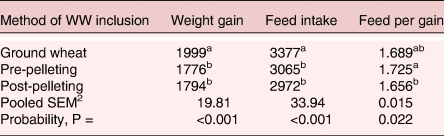
Only two birds out of 144 died during the experiment and the deaths were not related to any dietary treatment. The influence of dietary treatments on performance of the broilers is summarised in Table 2.
Influence of method of whole wheat inclusion on the weight gain (g/bird), feed intake (g/bird), feed per gain (g feed/g gain) of broilers (11–35 days post-hatch)1.

a,b Means in column not sharing a common superscript are significantly different (P < 0.05).
1 Each value represents the mean of six replicates (8 birds per replicate).
2 pooled standard error of the mean.
Weight gain and feed intake of broilers was lower (P < 0.05) in birds fed diets with WW, regardless of the method of inclusion, compared to those fed the GW diet. However, no significant difference (P > 0.05) in weight gain and feed intake was observed between pre-pelleting and post-pelleting WW diets. Regardless of the method of inclusion, WW feeding showed no significant (P > 0.05) effect on the feed per gain compared to those fed the GW diet. However, feed per gain was lower (P < 0.05) in the treatment group fed WW-post-pelleting compared to those fed WW- pre-pelleting.
The influence of WW inclusion on caecal bacterial counts is presented Table 3.
Influence of method of whole wheat inclusion on bacterial species count (log10 cells/g of caecal material) for broilers (11–35 days post-hatch)1

a,b Means in column not sharing a common superscript are significantly different (P < 0.05).
1 Each value represents the mean of six observations (Three replicates per treatment and 2 samples per replicate).
2 Pooled standard error of the mean.
Diets containing WW, regardless of method of inclusion, had no effect (P > 0.05) on the populations of Lactobacillus spp. compared with the diet containing GW. The Bifidobacterium spp. population was higher (P < 0.05) in birds fed the GW diet compared with WW diets, regardless of the method of inclusion and no difference (P > 0.05) was observed between the groups fed diets containing WW incorporated either pre-pelleting or post-pelleting. Birds fed diets containing WW had lower (P < 0.05) populations of Clostridium and Campylobacter spp. than those fed the diet containing GW. Moreover, birds fed diets containing WW incorporated post-pelleting had lower (P < 0.05) populations of Clostridium spp. than those fed the same amount of WW but incorporated pre-pelleting. No significant (P > 0.05) difference was observed between these two WW treatment groups for Campylobacter spp. No treatment effects (P > 0.05) were observed for the population size of Bacteroides spp.
The influence of method of WW inclusion on gas production, relative gizzard weight and pH of different segments of the gastrointestinal tract is summarised in Table 4.
Influence of method of whole wheat inclusion on gas production1, gizzard weight2 and pH3 of different segments of the gastrointestinal tract of broilers (11–35 days post-hatch)1.

a,b Means in column not sharing a common superscript are significantly different (P < 0.05).
1 Each value represents the mean of six observations (one observation per replicate).
2,3 Each value represents the mean of twelve observations (two birds per replicate)
4 Pooled standard error of the mean.
The method of the WW inclusion had no significant (P > 0.05) effect on the pH of digesta of different segments, except in the gizzard. Broilers fed WW diets, regardless to the method of inclusion, had lower (P < 0.05) gizzard pH than those fed the GW diet. Method of WW inclusion had no effect (P > 0.05) on the gizzard pH. The relative gizzard weight in birds fed WW diets, regardless to the method of inclusion, was heavier (P < 0.05) than those fed the GW diet. The birds fed diets in which the WW incorporated post-pelleting showed heavier (P < 0.001) gizzards than their counterparts fed pre-pelleting WW diet.
Anaerobic incubation of excreta from broilers fed WW diets, whether pre- or post-pelleting, resulted in less (P < 0.05) gas production than those fed the GW diet, and was similar for both WW diets (P > 0.05). The gas produced within the incubation period (48 hours) was predominantly carbon dioxide and no methane was detected (data not shown).
Discussion
In the present study, WW inclusion, regardless of the method, resulted in poorer weight gain and reduced feed intake compared to birds fed the GW diet. The observed reductions in weight gain paralleled lower feed intake, which may, in part, be attributed to lower pellet durability index (83.3 vs. 90.6%) compared to the GW pellet. It is known that poor pellet quality results in reduced growth rate through its limiting effect on feed intake (Proudfoot and Sefton, Reference Proudfoot and Sefton1978; Abdollahi et al., Reference Abdollahi, Zaefarian and Ravindran2018). Moreover, WW increases the coarseness of the diet. Coarser particles are retained longer than finer particles in the gizzard and need to be ground to a certain critical size before they can leave the gizzard (Moore, Reference Moore1999). The need for more grinding could expected to slow passage rate, which in turn may limit feed intake (Svihus et al., Reference Svihus, Hetland, Choct and Sundby2002). Furthermore, satiety signals originating from a more developed gizzard due to increased frequency of contraction to grind the WW are relayed from the brainstem to the hypothalamus to activate neural pathways that may modulate reduced feed intake in the short-term on a meal-to-meal basis (Richards, Reference Richards2003). Similar depressions in feed intake and weight gain with WW feeding have been reported in previous studies (Ravindran et al., Reference Ravindran, Wu, Thomas and Morel2006; Truong et al., Reference Truong, Moss, Liu and Selle2017). No significant effect was seen on the feed per gain in birds fed either GW or WW, regardless to the method of inclusion, which is a finding consistent with previous studies (Rose et al., Reference Rose, Fielden, Foote and Gardin1995; Svihus et al., Reference Svihus, Juvik, Hetland and Krogdahl2004; Amerah and Ravindran, Reference Amerah and Ravindran2008).
The adoption of whole gain feeding included the rationale that gut integrity in broilers may be maintained through gizzard development and its improved functionality, which are linked to improvements in nutrient digestibility (Hetland and Svihus, Reference Hetland and Svihus2001; Hetland et al., Reference Hetland, Svihus and Krogdahl2003) and plays a positive role in the control of intestinal bacterial populations (Gabriel et al., Reference Gabriel, Mallet and Leconte2003; Singh et al., Reference Singh, Amerah and Ravindran2014a). It is well documented that a well-balanced gut microbiota is important and essential to the health of animals and humans (Hooper, Reference Hooper2004; Willing et al., Reference Willing, Russell and Finlay2011) and, that interactions between microorganisms and the host affect the immune system locally and systemically (Clarke et al., Reference Clarke, Davis, Lysenko, Zhou, Yu and Weiser2010). In addition to the environmental factors and diseases that can influence the microbial composition (Owens et al., Reference Owens, Tucker, Collins and McCracken2008; Geier et al., Reference Geier, Torok, Allison, Ophel-Keller and Hughes2009), dietary factors such as composition, processing, digestibility and feeding method, may all disturb the balance in the microbial ecosystem (Choct et al., Reference Choct, Hughes, Wang, Bedford, Morgan and Annison1996; Langhout et al., Reference Langhout, Schutte, Van Leeuw, Wiebenga and Tamminga1999, Reference Langhout, Schutte, De Jong, Sloetjes, Verstegen and Tamminga2000; Apajalahti et al., Reference Apajalahti, Kuttunen and Graham2004).
Dietary inclusion of whole grains has been shown to influence microbial ecology of the gastrointestinal tract of poultry. Santos et al. (Reference Santos, Sheldon, Santos, Ferket, Lee, Petroso and Smith2007) conducted an experiment with broilers raised either on litter floor or cages and fed either a finely ground or whole triticale-based diet from 0–42 days. These researchers reported that the intestinal tract of birds fed the finely ground treatment had lower microbial diversity and higher Salmonella spp. prevalence than those fed the whole triticale treatment. It was suggested that the combination of high dietary fibre content and increased diet coarseness in the whole triticale diets was responsible for observed beneficial effects, possibly through a competitive exclusion type mechanism. Similarly, significant reductions in the numbers of pathogenic bacteria, such as Clostridium and Campylobacter spp., in the caeca of birds fed diets containing WW, regardless of method of inclusion, was an important finding of the present study. Intestinal pathogenic bacteria such as E. coli, Clostridium, Campylobacter, and Bacteroides spp. can contaminate poultry carcasses during processing at slaughterhouses, representing a major cause of foodborne illnesses in humans (Ooesteom, Reference Oosterom1991; Rasschaert et al., Reference Rasschaert, Houf, Godard, Wildernauwe, Pastuszczak- Frak and De Zutter2008). These results suggested that WW feeding has the potential to be used in AGP programmes, and can have practical implications as a useful dietary strategy to improve the safety of poultry products.
Although gas production from fresh manure is not a serious problem in modern poultry houses, storing them for longer periods can lead to the production of obnoxious gases, mainly by anaerobic bacteria. Four gases; hydrogen sulphide, carbon dioxide, ammonia and methane, are the most hazardous. Accordingly, strategies are needed to reduce emissions of volatile organic compounds from poultry manure that cause odour and to reduce the risk of releasing disease-transmitting vectors and airborne pathogens (Laubach, Reference Laubach2006). Hence the reduction in carbon dioxide from the droppings from birds fed WW diets in the current experiment could be of some importance. Furthermore, gas production followed a trend almost similar the effect on the population size of Clostridium spp., which may be related to the fact that these bacteria are hydrogen producers (Skillman et al., Reference Skillman, Bajsa, Ho, Santhanam, Kumar and Ho2009). It has been noted that, in birds infected with C. perfringens, the intestine is friable and distended with gas and gross lesions caused by toxins (Van Immerseel et al., Reference Van Immerseel, Buck, Pasmans, Huyghebaert, Haesebrouck and Ducatelle2004).
Interestingly, the WW dietary effects on gas production and the population size of the pathogenic bacterial species showed almost similar trends as that of gizzard weights. This was consistent with previous studies with WW feeding (Engberg et al., Reference Engberg, Hedemann, Steenfeldt and Jensen2004; Wu and Ravindran, Reference Wu and Ravindran2004; Ravindran et al., Reference Ravindran, Wu, Thomas and Morel2006; Amerah and Ravindran, Reference Amerah and Ravindran2008; Singh et al., Reference Singh, Ravindran, Wester, Molan and Ravindran2014). Studies have shown that the enhanced gizzard functionality may play a positive role in the control of bacterial populations in the gut (Gabriel et al., Reference Gabriel, Mallet and Leconte2003; Engberg et al., Reference Engberg, Hedemann, Steenfeldt and Jensen2004)
In the present study, the pH of gizzard contents was lower in broilers fed diets containing WW compared to those fed the GW diet. This reduction coincided with reductions in the population of pathogenic bacteria determined, especially Clostridium and Campylobacter spp., which require optimum pH for growth in the range of 5.6 to 7.5 (Doyle and Roman, Reference Doyle and Roman1981; Briozzo et al., Reference Briozzo, de Lagarde, Chirife and Parada1986). Gabriel et al. (Reference Gabriel, Mallet and Leconte2003) reported that the weight of the gizzard was higher in WW-fed birds and its contents had a lower pH than the control birds fed a complete ground or pelleted diet. Similarly, Bjerrum et al. (Reference Bjerrum, Pedersen and Engberg2005) found that the pH in the contents of the gizzard decreases as the amount of the WW in the diet increased over time following infection with Salmonella typhimurium. They found lower numbers of this pathogen in the gizzard and ileum of birds receiving WW compared to pellet-fed birds. Moreover, Engberg et al. (Reference Engberg, Hedemann, Steenfeldt and Jensen2004) found that adding WW increased the gizzard weight and reduced the pH in gizzard contents compared to pellet-fed birds. These authors reported that the addition of WW resulted in lower intestinal numbers of lactose-negative enterobacteria and C. perfringens and suggested that feeding WW prevented pathogenic bacteria from entering the gut by stimulating gastric functions such as hydrochloric acid secretion and grinding processes in the gizzard. Singh et al. (Reference Singh, Amerah and Ravindran2014a) reported linear decreases in the populations of harmful bacteria, namely Clostridium, Campylobacter and Bacteroides spp., with progressive increases in whole maize inclusion levels in broiler diets. In birds fed WW, the feed remains longer in the gizzard because of the need for grinding and exposed longer to the low pH and proteolytic enzymes. This may lead to reductions in pathogens entering the gizzard with the feed. This led to the conclusion that the gizzard has important function as a barrier organ that prevents pathogenic bacteria from entering the distal digestive tract (Bjerrum et al., Reference Bjerrum, Pedersen and Engberg2005). Thus, a well-developed gut is essential for the ability of poultry to resist colonisation by disease-causing organisms
Conclusions
In conclusion, WW feeding was associated with gizzard development and a reduction in the numbers of pathogenic bacteria, specially Clostridium and Campylobacter spp., suggesting that the gizzard has an important function as a barrier organ that prevents pathogenic bacteria from entering the distal digestive tract. The present data demonstrated that the WW feeding strategy, both pre- and post-pelleting, can have practical implications in antibiotic-free production systems and food safety.
Declaration of Interest
None.