Introduction
Merkel cell carcinoma is an aggressive neurocutaneous malignancy, first described by C Toker in 1972.Reference Toker1 This disease typically manifests in sun-exposed areas of the skin, and it tends to grow quickly and metastasise at an early stage.Reference Albores-Saavedra, Batich, Chable-Montero, Sagy, Schwartz and Henson2 Merkel cell carcinoma occurs more frequently in elderly, light-skinned and immunosuppressed patients.
Recognition of this predilection for immunosuppressed patients led to the discovery of an infectious agent implicated in the pathogenesis of Merkel cell carcinoma, namely the Merkel cell polyomavirus.Reference Feng, Shuda, Chang and Moore3 This virus is thought to play a major role in the oncogenic pathogenesis of Merkel cell carcinomaReference Feng, Shuda, Chang and Moore3–Reference Sastre-Garau, Peter, Avril, Laude, Couturier and Rozenberg5 and gives rise to a characteristic tumour (T) antigen molecular signature.Reference Shuda, Feng, Kwun, Rosen, Gjoerup and Moore6, Reference Becker, Houben, Ugurel, Trefzer, Pfohler and Schrama7 Histologically, Merkel cell carcinoma stains positively for cytokeratin 20 (CK20), which enables differentiation from other neuroendocrine tumours.Reference Bobos, Hytiroglou, Kostopoulos, Karkavelas and Papadimitriou8
The current recommended treatment for Merkel cell carcinoma depends on clinical stage, but therapeutic options include: wide surgical excision of the primary lesion, sentinel lymph node biopsy, lymph node dissection and radiation therapy.Reference Lewis, Weinstock, Weaver and Otley9–Reference Huber12 The five-year relative survival rates for Merkel cell carcinoma patients with local disease, and regional and distant metastases are 75 per cent, 50 per cent and 20 per cent, respectively.Reference Reichgelt and Visser13
Approximately 50 per cent of cases of Merkel cell carcinoma arise in the head and neck.Reference Smith, Camp and Lentsch14 The management of head and neck Merkel cell carcinoma presents unique challenges for diagnosis and treatment. Head and neck anatomy makes the oncological treatment of choice more difficult.
A few studies have compared the prognostic and predictive features of head and neck Merkel cell carcinoma with those of Merkel cell carcinoma arising from other anatomical sites. The results of the studies are inconsistent.Reference Albores-Saavedra, Batich, Chable-Montero, Sagy, Schwartz and Henson2, Reference Reichgelt and Visser13, Reference Kokoska, Kokoska, Collins, Stapleton and Wade15, Reference Allen, Bowne, Jaques, Brennan, Busam and Coit16 A retrospective analysis of a 20-year period was conducted at our institution, in which the behaviour of head and neck Merkel cell carcinoma was compared to that of non-head and neck Merkel cell carcinoma.
Materials and methods
Study population
This retrospective study was approved by the Research Ethics Committee of the Sir Mortimer B Davis Jewish General Hospital of Montréal, Québec, Canada. Ethical guidelines were followed. Samples and clinicopathological data were handled in a coded fashion. Eligibility criteria included previously untreated patients, without a second primary tumour, treated at the Jewish General Hospital.
The medical records of all patients between 1993 and 2013 were examined to obtain detailed data on the following: demographics (age, gender, race and immune status), clinical stage, primary and adjuvant treatment, disease-free survival, disease-specific survival, and follow up. Disease-free survival was measured from the date of treatment to the date when local, regional or distant failure was diagnosed. Disease-specific survival was defined from the date of treatment to death due to the disease. Patients were staged according to the American Joint Committee on Cancer classification system.Reference Edge, Byrd, Compton, Fritz, Greene and Trotti17
Statistical analysis
For continuous variables, mean and standard error values were determined. Associations between binary variables were examined in contingency tables using the two-sided Fisher's exact test. Relative risk and 95 per cent confidence intervals (CIs) were calculated using two-by-two tables, according to the Mantel–Haenszel method. For the comparison of continuous variables, the Mann–Whitney U test was used. Survival probabilities were estimated according to the Kaplan–Meier method. The log-rank test was applied to assess the significance of differences among actuarial survival curves with a 95 per cent CI. Statistical analyses were performed using SPSS software, version 21.0.0 (IBM, Armonk, New York, USA). A p value lower than 0.05 was considered to indicate statistical significance.
Results
Baseline characteristics
The study population consisted of 27 patients, with a mean age of 72.3 years. All patients were of Caucasian origin. Ten patients were female and 17 were male. Nineteen patients had early stage disease (T1 or T2) and five patients had advanced local disease (T3 or T4) at presentation. The remaining three patients had a metastatic carcinoma of unknown primary. Ten patients presented initially with regional metastasis, while distant metastasis was present at diagnosis in one patient.
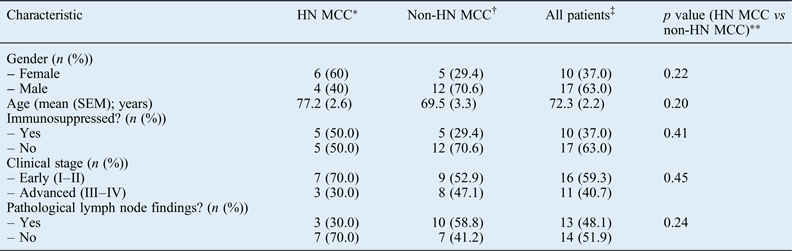
Ten patients had Merkel cell carcinoma arising from the head and neck, while 17 patients had a primary tumour located elsewhere. Importantly, the baseline characteristics did not differ significantly between the head and neck Merkel cell carcinoma group and the non-head and neck Merkel cell carcinoma group (p > 0.05). The distributions and relative percentages for each study group are shown in Table I.
Clinicopathological characteristics of merkel cell carcinoma patients

*n = 10; †n = 17; ‡n = 27. **Two-sided Fisher's exact test for binary variables, Mann–Whitney U test for continuous variables. HN MCC = head and neck Merkel cell carcinoma; SEM = standard error of the mean
Immunohistochemical staining for CK20 (Figure 1) was positive in 21 out of 22 of the reported cases, and did not differ between the head and neck Merkel cell carcinoma group and the non-head and neck Merkel cell carcinoma group (p > 0.05).
Immunohistochemical staining of: (a) a typical round blue cell tumour invading the dermis (H&E; ×100), and (b) the same tumour showing typical positivity for cytokeratin 20 (×100).
Therapeutic management
Twenty-four patients underwent wide local excision of the primary tumour. Three cases were inoperable and the patients received primary radiation. In the surgical group, clear margins were obtained in 12 of the 21 documented cases. Patients with head and neck Merkel cell carcinoma were more likely to have positive margins than those with non-head and neck Merkel cell carcinoma, although this did not reach statistical significance (relative risk = 2.0, 95 per cent CI = 0.8–4.98, p = 0.13). Adjuvant radiotherapy was given in 92.3 per cent of the documented surgical cases, with a mean dose of 45 Gy. The proportion of patients receiving adjuvant radiotherapy did not differ between the head and neck Merkel cell carcinoma group and the non-head and neck Merkel cell carcinoma group (p > 0.05).
Recurrence
Eight patients suffered locoregional recurrence, at a mean time of 8.7 months. Of those, one patient suffered local recurrence, five patients had regional recurrence, while two patients had recurrence both locally and regionally. Patients with head and neck Merkel cell carcinoma had a poorer disease-free survival rate than those with non-head and neck Merkel cell carcinoma (p = 0.043, Figure 2a). Gender, age, race, clinical stage at diagnosis, tumour size and presence of lymph node metastasis were not predictors of recurrence (p > 0.05, data not shown).
(a) Disease-free and (b) disease-specific survival rates according to anatomical tumour origin. MCC = Merkel cell carcinoma
Survival analysis
The mean follow-up duration of the cohort was 36.9 months. At the end of the follow-up period, 19 patients were alive and 8 were dead. Of the eight deaths, seven were due to distant metastatic disease. A significantly lower disease-specific survival rate was observed in head and neck Merkel cell carcinoma patients compared to non-head and neck Merkel cell carcinoma patients (p = 0.001, Figure 2b). Patients older than 75 years had poorer survival probability (p = 0.038, data not shown). Immunosuppression, gender, race, clinical stage at diagnosis and presence of lymph node metastasis were not predictors of disease-specific survival (p > 0.05, data not shown).
Discussion
Merkel cell carcinoma is an aggressive cancer, with a high tendency for locoregional recurrence and distant spread. This retrospective study analysed the experience of a single institution in Canada. Although this study has several limitations associated with its retrospective nature and limited sample size, we believe that some lessons can be learned from the findings. We showed that patients with Merkel cell carcinoma arising from the head and neck had poorer disease-free and disease-specific survival rates than their non-head and neck Merkel cell carcinoma counterparts (both groups had similar baseline characteristics).
The prognostic relevance of Merkel cell carcinoma in the head and neck is inconsistent in the literature.Reference Albores-Saavedra, Batich, Chable-Montero, Sagy, Schwartz and Henson2, Reference Reichgelt and Visser13, Reference Kokoska, Kokoska, Collins, Stapleton and Wade15, Reference Allen, Bowne, Jaques, Brennan, Busam and Coit16 A study analysing the Surveillance, Epidemiology and End Results (‘SEER’) database showed distinct overall survival rates of Merkel cell carcinoma patients according to localisation of the primary tumour. The best prognosis was associated with localisation in the upper limb (60.7 per cent 10-year survival rate); this was followed by the head and neck, the lower limb, and the trunk (rates of 57.1 per cent, 56.7 per cent and 53.7 per cent, respectively).Reference Albores-Saavedra, Batich, Chable-Montero, Sagy, Schwartz and Henson2 In another population-based study from the Netherlands, a primary in the head and neck tended to predict poorer survival.Reference Reichgelt and Visser13 Further single-institution studies comparing the prognostic features of Merkel cell carcinoma showed higher locoregional recurrence ratesReference Kokoska, Kokoska, Collins, Stapleton and Wade15 and poorer disease-specific survival rates for head and neck Merkel cell carcinoma compared to non-head and neck Merkel cell carcinoma.Reference Allen, Bowne, Jaques, Brennan, Busam and Coit16
The poor prognosis associated with head and neck Merkel cell carcinoma in our study and in other reports in the literature could be explained by several factors. Historically, head and neck surgeons have been limited in terms of surgical margins by anatomical, functional and cosmetic factors specific to the head and neck. The excision of Merkel cell carcinoma primary tumours in the head and neck is often complex and limited by critical structures. This can lead to incomplete excision, with positive pathological margins and increased locoregional recurrence rates.Reference Sullivan, Scott, Cole, Chi, Anaya and Byrd18–Reference Haerle, Shiau, Goldstein, Qiu, Erovic and Ghazarian20 Several studies have shown that positive surgical margins are a common event for head and neck Merkel cell carcinoma.Reference Morand, Vital, Pezier, Holzmann, Roessle and Cozzio11, Reference Kukko, Bohling, Koljonen, Tukiainen, Haglund and Pokhrel19 In this setting, post-operative radiotherapy is essential to enhance locoregional control.Reference Lewis, Weinstock, Weaver and Otley9
• Merkel cell carcinoma is a rare, aggressive neurocutaneous malignancy, commonly arising from the head and neck
• Tumour localisation may be an important independent prognostic factor
• This single-institution study compared head and neck versus non-head and neck Merkel cell carcinoma outcomes
• Baseline characteristics were comparable; however, head and neck Merkel cell carcinoma patients had a poorer prognosis
• This poor prognosis may result from close surgical margins, a less predictable metastatic pattern and/or intrinsic tumour factors related to the head and neck
A second factor leading to the poor prognosis of head and neck Merkel cell carcinoma patients may be a less predictable and somewhat erratic metastatic pattern seen in tumours arising from the head and neck. Two independent studies have shown a lack of predictive value of sentinel lymph node status in the head and neck, while there was prognostic significance for primaries located elsewhere.Reference Fields, Busam, Chou, Panageas, Pulitzer and Kraus21, Reference Fritsch, Camp and Lentsch22 Similarly, a recent systematic review of melanoma reported lower accuracy of sentinel node biopsy when performed in the head and neck.Reference de Rosa, Lyman, Silbermins, Valsecchi, Pruitt and Tyler23
Intrinsic tumour factors may further explain the poorer prognosis for head and neck primaries. A recent experimental study has demonstrated that solar irradiation can stimulate Merkel cell polyomavirus transcriptional activity in a dose- and time-dependent manner.Reference Mogha, Fautrel, Mouchet, Guo, Corre and Adamski24 This led to increased amounts of small T antigen, which promoted oncogenesis in in vitro and in vivo experiments.Reference Mogha, Fautrel, Mouchet, Guo, Corre and Adamski24 Primary tumours located in the head and neck are obviously more likely to ‘benefit’ from such a stimulus. Moreover, a recent study has shown that the oncogene TP53, whose overexpression is associated with poorer survival in cases of Merkel cell carcinoma and many other cancers,Reference Waltari, Sihto, Kukko, Koljonen, Sankila and Bohling25, Reference Milner and Medcalf26 was mutated in some Merkel cell carcinoma cases. The type of mutation (C to T substitution) seen in those mutated Merkel cell carcinoma cases was suggestive of ultraviolet B exposure, and may result in aberrant protein p53 activation.Reference Van Gele, Kaghad, Leonard, Van Roy, Naeyaert and Geerts27 Although the authors of the study did not specify the origin of the analysed tumours, one can expect this mutation to occur more frequently in head and neck Merkel cell carcinoma.
Conclusion
In our study, patients with Merkel cell carcinoma arising from the head and neck had a poorer survival rate than those with primary tumours located elsewhere. The tendency to obtain close margins, a less predictable metastatic pattern and/or intrinsic tumour factors related to the head and neck may explain this discrepancy. Future studies should investigate the respective roles of anatomy and tumour biology in Merkel cell carcinoma of the head and neck.
Acknowledgements
We would like to thank Dr L Rochon, from the Pathology Department of the Jewish General Hospital, for providing the microscopic images for this study. GBM would like to thank Réjane Morand and Isabel Cardona for proofreading the manuscript. GBM is supported by the Swiss Cancer League (BIL KFS-3002-08-2012).