The impact of early deprivation has received renewed attention with the recent increase in international adoption of children reared in institutions. Since 1990, there has been a threefold increase in international adoptions in the United States, combined with a shift in preadoption living arrangements from predominantly foster to institutional care (http://travel.state.gov/orphan_numbers.html; Johnson, 2000). Nearly 23,000 children were adopted internationally in the United States in 2003, and it is estimated that perhaps as many as 85% of these children had spent some time in an institutional setting prior to adoption, including hospitals, baby homes, and orphanages (Johnson, 2000). Given their increasing numbers, it is important to determine the likelihood that preadoption institutional care increases risk of behavior problems. Because it is difficult even in the best of institutions to provide infants and young children with individualized attention and adequate social and physical stimulation (see Rutter, 1981), children adopted from institutions provide a window on the impact of early privation on the development of behavioral and emotional problems.
Recent studies of postinstitutionalized (PI) children have focused on children adopted from Romania in the early 1990s. These children experienced some of the most global privation imaginable (Ames, 1990). During this era in Romanian institutions, although conditions varied across institutions and even within the same institution, for many children the ratio of child to caregiver was high, sometimes as high as 20 to 1, the children spent most of their time in cribs surrounded by blank walls, they were rarely held, and rigidly scheduled. At adoption, most were severely physically, behaviorally, and cognitively delayed (Johnson, 2001; Maclean, 2003; Rutter, 1998). Many of these effects were likely due to postnatal deprivation; however, the role of prematurity, low birth weight, and prenatal alcohol exposure cannot be ruled out. Throughout Russia and Eastern Europe, alcohol consumption in pregnancy was and is common among women whose children are placed in institutions (Johnson, 2000).
Despite their early privation, all of the studies of PI Romanian children concur that many do remarkably well once placed in families (for review, see Maclean, 2003). Similar positive outcomes have been noted from studies of internationally adopted children from other regions of the world (e.g., Verhulst, Althaus, & Versluis-Den Bieman, 1990a; Westhues & Cohen, 1997). Nonetheless, increased rates of behavior problems have been noted, particularly with prolonged periods of institutionalization (Maclean, 2003; Rutter, Kreppner, & O'Connor, 2001). What is not clear is whether increases in behavior problems are seen across many domains, or whether institutional care early in life is associated with a limited and more specific set of problem behaviors. Recently, Rutter and colleagues (2001) have argued for specificity, noting that institutional privation increases rates of inattention/overactivity, attachment problems, and autistic-like features. In addition, they concluded that institutional privation is not associated with increased rates of emotional, peer, or conduct problems. Although they based this conclusion on their sample of Romanian-adopted children, the argument was not restricted to children from Romania.
Support for the Rutter et al. argument is mixed. Consistent with their conclusions, some authors argue that there is little evidence of elevated rates of internalizing problems in studies of domestically adopted children in the United States with histories of early neglect and privation (see reviews, Ingersoll, 1997; Peters, Atkins, & McKay, 1999); although the results of some studies do reveal increased internalizing problems among special needs adoptees and children who are older at adoption (e.g., Groza & Ryan, 2002). However, previous studies of internationally adopted children, even those from adverse backgrounds, have also generally failed to find elevated rates of internalizing behavior problems (see Verhulst, Althaus, & Versluis-den Bieman, 1992). A recent report from this research group, however, examined the children in adulthood using a standardized psychiatric interview (Tieman, van der Ende, & Verhulst, 2005). By adulthood, the international adoptees compared to nonadoptees were at elevated risk for anxiety disorders, substance abuse disorders, and among the men, for mood disorders, raising questions about the absence of evidence for internalizing problems earlier in their development. In addition, the literature on PI Romanian children has not been consistent with regard to internalizing problems. Marcovitch and colleagues (1997) reported higher scores on internalizing behavior problems among PI Romanian preschoolers. Fisher and colleagues (Fisher, Ames, Chisholm, & Savoie, 1997) found that at 11 months postadoption, PI Romanian children adopted after 8 months or more of institutional care scored higher on internalizing problems than did children reared in their families of origin. However, this difference was not observed later when these same children were 4 years of age (Ames, 1997). Groza and Ryan (2002) observed increased rates of internalizing problems when PI Romanian children were compared to Romanian children adopted from families. In addition, a recent meta-analysis of studies of internationally adopted children reported higher scores on internalizing problems for children adopted internationally from adverse background relative to internationally adopted children from less adverse preadoption care (Juffer & van Ijzendoorn, 2005). Thus, it is not clear whether early institutional care, as a form of neglect and privation, does or does not influence rates of emotional or internalizing problems among children.
Similar confusion surrounds peer and externalizing problems. Again, Marcovitch and colleagues (1997) reported an increase in externalizing problems among preschoolers adopted from Romanian institutions. Ames (1997, Fisher et al., 1997; Maclean, 2003) also found that their PI Romanian children had elevated levels of externalizing problems and difficulty in peer relationships. Groza and Ileana (1996) noted peer problems for PI Romanian children, but argued that these were largely due to the increased rates of aggression among Romanian adoptees. However, in research on domestically adopted children in the United States, increased rates of externalizing problems have been attributed to a small percentage of children who score in the clinical range (e.g., Brand & Brinich, 1999). When these children are removed from the analyses, mean increases in externalizing problem scores have not typically been observed unless the sample included children adopted postinfancy following prolonged periods of preadoption adversity (e.g., Berry & Barth, 1989; Simmel, Brooks, Barth, & Hinshaw, 2001; Verhulst, Althaus, & Versluis-Den Bieman, 1990b). Indeed, being older at adoption often has been associated with increased risk of behavior problems due, most likely, to a positive association between adoption age and preadoption exposure to greater turmoil and abuse (Berry & Barth, 1989; Verhulst et al., 1990b). In their recent meta-analysis of internationally adopted children, Juffer and van Ijzendoorn (2005) reached a similar conclusion. They noted increased rates of externalizing problems among internationally adopted children with adverse preadoption histories relative to those with less adverse histories, but overall noted that behavior problems among internationally adopted children were lower than those noted among domestically adopted children.
Age at adoption varies in studies of PI children. Although in some studies the majority of the children were adopted in infancy (e.g., Rutter et al., 2001), others include a greater percentage of children who were 2 years or older at adoption (Groza & Ryan, 2002). In domestic adoption, increased rates of behavior problems have been noted for children adopted postinfancy (e.g., Berry & Barth, 1989; Simmel et al., 2001). However, age at adoption was not a factor affecting behavior problems in the Juffer and van Ijzendoorn (2005) meta-analysis, although the number of studies of internationally adopted children with adverse background (typically institutionalization) was relatively small (9 of 26 studies), with only five studies including children adopted beyond 24 months of age. If, as in other adoption samples, living without a stable family beyond the infancy period increases the risk of externalizing and peer problems, then we might expect that elevated rates of these problems would be reported for samples composed of more children adopted postinfancy. However, their rates of externalizing problems might not differ from those of noninstitutionalized children adopted beyond infancy (see Groza & Ryan, 2002). If so, then as argued by Rutter and colleagues (2001), peer and externalizing problems still might not be associated with institutional privation, per se. One of the challenges of studying PI children has been finding appropriate comparison groups. Although some researchers have controlled for adoption (e.g., Ames, 1997; Rutter et al., 2001), few have used noninstitutionalized adopted children who were comparable in age at adoption to the PI children (however, see Groza & Ryan, 2002).
Finally, elevated levels of inattention/overactivity has been consistently reported in studies of PI children from the early studies by Tizard (Hodges & Tizard, 1989; Tizard & Hodges, 1978) to recent studies of Romanian-adopted children (e.g., see review, Maclean, 2003) and children living in residential care in the United Kingdom (Roy, Rutter, & Pickles, 2000, 2004). Thus, it seems that attention problems may be increased among PI children. Nonetheless, because comparison subjects have rarely been of the same age at adoption as the PI children, it is not clear whether attention problems are specific to early institutional experience or prolonged periods of early adverse care that might occur outside as well as within institutional settings. Roy and colleagues (2000, 2004) did use such a comparison group. They compared children reared in residential nurseries to children reared for comparable periods and at comparable ages in foster care. Their foster care group, however, was unusual in that the children lived in only one foster family for their entire early history. These children, therefore, did not experience the kind of relationship disruption and turmoil typical of children who are placed in foster care. The question thus remains whether inattention/overactivity is an outcome specific to institutional privation or whether other types of preadoption care arrangements might also increase the risk of attention problems.
Identifying the types of behavior problems that are and are not specific to institutional privation has both practical and theoretical importance. Practically, identifying a set of behavior problems that are more specific to early institutional care may help both parents and practitioners plan supports for children adopted from institutional settings. Theoretically, identifying a more limited set of problems associated with institutional privation should also help guide work on understanding the impact of early deprivation on brain and behavioral development.
Another issue in research on PI children deals with whether improvements in functioning are observed the longer the child is in the adoptive home. If living in a family is therapeutic, then one would expect a reduction in behavior problems with longer exposure to family care. Juffer and van Ijzendoorn's (2005) meta-analysis did reveal such a decrease for internationally adopted children when adolescents were compared to early- and middle-childhood children. Nonetheless, studies that have addressed this question longitudinally provide conflicting results. Some studies have noted that elevated rates of behavior problems emerge and then wane with age and/or time in the adoptive home (e.g., Bohman & Sigvardsson, 1980; von Knorring, Bohman, & Sigvardsson, 1982). Other studies have reported only increases in rates of problem behaviors with time in the family (e.g., Verhulst et al., 1990b), while still other studies have found improvement only in the initial years postadoption (e.g., Rutter, O'Connor, & ERA team, 2004). In some studies (e.g., Verhulst et al., 1992), the behavior problems for boys seem to emerge with time in the adoptive home, while in others this is not the case. Indeed, there is mixed evidence on whether, in international adoption samples boys are more likely than girls to exhibit behavior problems (e.g., Groza & Ryan, 2002; Verhulst et al., 1990a; Maclean, 2003). Because time in the family is typically confounded with child age, differences in results could reflect how old the children were at testing. Notably, adolescence may pose a particular challenge for internationally adopted children, especially those who are racial minorities in their adoptive countries (Lindblad, Hjern, & Vinnerljung, 2003).
The purpose of this study was to examine behavior problems in PI children using a sample of children who were adopted internationally into Minnesota over a 9-year period. Comparison children were also adopted internationally, but following very limited or no exposure to institutional care. Parents completed the Child Behavior Checklist (CBCL), which yields scores on eight narrow-band and two broadband Symptom Scales. Because of our wide age range, we used T scores, which are adjusted for differences in levels of behavior problems during childhood versus adolescence. To compare our results to previous reports, we first examined the percentage of PI and comparison children who were problem free, defined as not scoring in the clinical range on any of the eight narrow-band CBCL scales. We then examined the percentage with pervasive problems, defined as scoring in the clinical range across five or more of these scales. Based on the literature reviewed above, we expected that most children, regardless of institutional status, would be problem free and few would exhibit pervasive problems. Next, we examined specific problem scales. Based on work by Rutter and colleagues (2001), we predicted that institutional privation would be associated with increased rates of attention problems, but would not be associated with increased rates of internalizing, externalizing, or peer problems.
We also examined the association between age at adoption and problem behaviors. Based on studies of both domestic and international adoption, we hypothesized that being older at adoption would be associated with behavior problems across many domains, including internalizing, externalizing, and peer problems. We chose 24 months or older as our definition of being older at adoption based on evidence discussed above that adoption postinfancy is associated with increased rates of problem behavior. In particular, we were interested in whether age at adoption would moderate the relationship between prior institutional history and behavior problems. Particular patterns of interactions, if they were obtained, would be strong evidence that the behavior problems of PI children were limited to specific domains. Thus, if institutionalization does not increase the risk of externalizing problems, but these problems do increase with age for children adopted from foster care settings, then for children adopted postinfancy one would actually find that a history of institutional care was associated with a decreased risk of externalizing problems relative to children adopted from foster care. Conversely, if attention problems are specific to experiences in institutional settings and increase in likelihood with time in those settings, then as age at adoption increases, these problems should be even more likely among the PI than the comparison children. Thus, we viewed these tests for interactions between age at adoption and institutional history as strong tests of the specificity hypothesis.
Finally, we examined our predictions in regression models that included a factor for adoption from Russia/Eastern Europe. We did this to explore whether the rates of problem behavior for children from this region of the world, the region that has figured so prominently in recent research, are consistent with the rates observed for children from other regions of the world. By including Russia/Eastern Europe as a factor, this allowed us to account for potential differences in problem rates and thus increase confidence in the generalizability of our findings.
Methods
Sample description
This study describes results from the International Adoption Project Survey (http://education.umn.edu/ICD/IAP/). All children whose adoptions were decreed in Minnesota from January 1, 1990, through December 31, 1998, who were adopted by nonrelatives, and were born outside the United States were selected from the Minnesota Department of Human Services (DHS) adoption records. The children in this report were all 4 through 18 years old at the time of testing. Of the 3,270 children identified in this age range, current addresses were obtained for 2,969 (90.8%). Parents returned completed surveys that included the CBCL for 1,948 of these children (65.6%). The children lived in 1,563 families. Of the families, 1,312 reported on only 1 child, 269 reported on 2 children, 23 reported on 3 children, 6 reported on 4 children, and 1 reported on 5 children. To address the issue of nonindependence or clustering, which violates a major assumption of most statistical analyses (Kish, 1965), all statistical analyses were conducted in the statistical software package STATA (StataCorp, 1997) using family as a cluster variable. Thus, standard errors were corrected for the clustered nature of the data.
Response rates
The DHS records contained information on child's gender, country of origin, date of placement, parent's marital status, education, and income at the time of adoption. Only date of placement influenced whether a current address could be identified. Children adopted before 1995 were harder to find than those adopted after 1995, χ2 (1) = 24.8, p < .001. It was also harder to get a completed survey for children adopted before versus after 1995, χ2 (2) = 18.0, p < .01. This meant the response rate was better for children from countries represented more in the Minnesota adoption records after 1995 (e.g., Russia, 68%; China, 75%; and Guatemala, 75%) than from countries accounting for more of the pre-1995 adoptions (e.g., Colombia, 59%; India, 57%; Korea, 55%). Examined by area of the world, the greater rate of survey return for adoptions after, compared to before, 1995 was statistically significant for Latin and South America (70 vs. 57%), χ2 (1) = 13.1, p < .001, Asia (66 vs. 56%), χ2 (1) = 21.5, p < .001, but not for Russia/Eastern Europe (68 vs. 66%), χ2 (1) = 0.41, ns. Parents with at least a 4-year college degree (65%) were more likely to return surveys than those with less education (52%), χ2 (2) = 49.38, p < .0001.
PI children (n = 899) were defined as those who had spent 75% of their lives in institutions prior to adoption. These children were all in institutions for 4 or more months. Comparison children (CO, n = 1,038) had spent less than 4 months in institutional care. Some institutional care was allowed in the comparison group because it is common for children placed in foster care prior to adoption to spend a brief period in institutional care while a foster family is sought. The majority (75% or n = 808) of CO children had spent less than 1 month in institutional care. Some of the CO children had spent time in their parents' care (18%, median time 3 months), some had spent time with relatives (2.5%, median time 8 months), and most (84%) had been in foster care (median time 5 months or 86% of their lives prior to adoption).
Missing histories
Eleven of the 1,948 children with CBCL reports had to be dropped from the analyses because their preadoption history was largely unknown. Thus, the total number for the regression analyses described herein was 1,937. Whenever possible, however, data are shown for all children available for a particular analysis.
Survey description
To allow a period of adjustment to the adoptive home, the surveys were mailed to parents in February 2001, 2 years or more after the adoption was decreed.
CBCL
The CBCL/6–18 published in 2004 (http://www.aseba.org/products/cbcl6-18.html) was used to compute eight narrow-band and two broadband Symptoms Scales. Because the Symptom Scale items differed little from the CBCL/4–18 (Achenbach, 1991), we used it to assess children 4 through 18 years (T. M. Achenbach, personal communication, April 2000). Although it would be preferable to have information from both teachers and parents, this was not practicable for this large sample. Instead, to provide cross-informant information, both parents were asked to complete the CBCL separately. CBCL data based on two informants were available for 60% of the cases. Parent agreement (intraclass r) for the eight narrow-band Symptom Scale ranged from .54 to .80 (median = .72). These results were comparable to those reported by Achenbach (1991). As suggested by Achenbach (1991, p. 58; personal communication, April 2000), we designated T ≥ 61 as the categorical cutoff for differentiating nondeviant from deviant groups. This cutoff included borderline clinical cases. If either parent's report was above the cutoff, the child was scored as in the clinical range for that scale. If only one report was available, classification was based on that report. In addition to examining each scale, we also created two summary scores for descriptive purposes. Problem free was defined as not being in the clinical range on any of the eight narrow-band scales. Pervasive problems were defined as being in the clinical range on more than half (i.e., 5+) of these eight scales. In addition, to more directly compare our results to those of Rutter and colleagues (2001), we computed a peer problems score using only items on the Social Problems Scale that were clearly related to peers (i.e., does not get along with other kids, gets teased a lot, not liked by other kids, prefers being with younger kids). Because we could not compute a T score for this reduced scale, the raw peer problems scores were analyzed.
Preadoption history
Parents reported on the different living arrangements for their child prior to adoption (birth parents, relative care, foster care, hospital, baby home/orphanage, and unknown) and how long the child had spent in each arrangement. Institutional care was the sum of hospital, baby home, orphanage, or other institution. In 4.5% of cases, parents were uncertain about how long institutional care had lasted, but based on other information about the country and region, sufficient information was available to determine whether the child should be placed in the PI or CO groups. Age at adoption was defined as the age at which the child came into the parents' fulltime care. The children were then grouped into those who were <24 months or ≥24 months at adoption (adopted at ≥24 months). Birth countries (47 represented) were grouped as follows: Russia/Eastern Europe (n = 317) included all the countries of the former Soviet Union and Eastern Bloc as well as four children from Greece; Asia (n = 1,062) included countries in southeast Asia, the Philippines, and Japan, and the Indian subcontinent; and Latin America/Caribbean (n = 557) included countries in South and Central America, the Caribbean, and Mexico. Twelve children were from other areas of the world. For the logistic regression analyses, children from Russia/Eastern Europe were compared with all other children to determine whether problem rates for these children differed.
Postadoption history and demographics
Parents reported on the child's age at testing. To obtain a measure of time in the adoptive home, age at adoption in months was subtracted from age at testing in months. This measure was then used in the logistic regressions. Note that age at testing was the sum of age at adoption and time in the adoptive home. This meant that we could not include all three measures in the regression analyses. We chose to include time in the adoptive home rather than age at testing for the following reasons. First, we were interested in whether behavior problems decreased the longer children had to recover from their preadoption experiences. Second, age at testing was highly correlated with time in the adoptive home (r = .72, df = 1, 946, p < .001), thus precluding the use of both of these measures in the same analyses. Third, time in the adoptive home was not highly correlated with age at adoption (r = −.17, df = 1, 946, p < .001), thus allowing both measures to be included in regression equations without concern for problems of multicolinearity. The pattern of associations among these age and duration measures indicated that although older children had been with their families longer, they were not necessarily adopted earlier. Most of the children were adopted before 24 months of age, and because the sampling frame covered 9 years (between 1990 and 1998), children adopted at the same age could be 9 years different in age at the time of the survey.
Parent education was reported as the highest level of education completed: (a) less than high school degree; (b) high school or GED; (c) some college but no degree or associate degree (or other 2-year degree); (d) bachelor's degree (BA, AB, BS); (e) master's degree (MA, MS, MEng, MEd, MSW, MBA); or (f) professional school and/or doctorate degree (PhD, MD, DDS, DVM, LLB, JD, minister). These responses were dichotomized to distinguish families in which the parent(s) had 4-year college degree or more from those with less education. Family income prior to taxes in the year prior to completion of the survey was reported in $25,000 increments up to $201,000+. Each income increment was assigned a numeric values from 1 for ≤$25,000 to 8 for ≥$201,000. Approximately 5% of the respondents did not complete income information. Parent race/ethnicity was scored as European American (1) or not (0). Parents also reported on the composition of the family, including whether there were two parents (or parenting figures) in the home (0 = no, 1 = yes), the presence of other children (0 = yes, 1 = only child), whether or not other children in the home had been adopted (0 = no, 1 = presence of other adopted children), and the parents' marital status (married, partnered (<2% of sample), separated, single never married, other; scored as 0 = not married, 1 = married, including partnered) to reflect children with two adults in the home serving in the parenting role. They also reported on the presence or absence of the following life stressors in the family postadoption: divorce, separation, or death of a family member (scored as 0 = none, 1 = any occurred), and whether the child was a child of color in the United States (0 = no, 1 = yes). Finally, parents reported whether their child had received mental health services either privately and/or through the schools (scored as 0 = no, 1 = yes).
Results
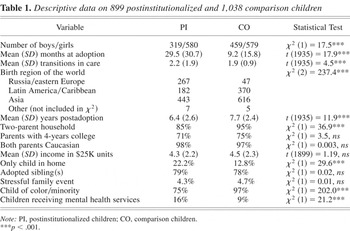
Table 1 provides descriptive data for the PI and CO groups. In both groups there were more girls than boys; however, the PI group had proportionately more girls than boys compared to the CO group, χ2 (1) = 17.5, p < .001. Children in the PI group were older at adoption than children in the CO group, t (1, 935) = 17.9, p < .001. Indeed, 38% (n = 346) of the PI, but only 6% (n = 64) of the CO children were ≥24 months at adoption. PI children experienced significantly more transitions in care than CO children, t (1, 935) = 4.5, p < .001. This difference, however, was due to differences in the age at adoption for PI and CO children. The distribution of PI status varied by where the child was born, χ2 (2) = 237.4, p < .001. Most of the children from Russia/Eastern Europe were in the PI group (85%), while children from other regions were more evenly distributed between the PI and CO groups. Nonetheless, Russian/Eastern European children accounted for only 29.6% of the PI sample. PI children averaged about 1 year less time in their adoptive homes than CO children, t (1, 935) = 11.9, p < .001; however, the mean for both groups was over 6 years, and in no cases was the time in the adoptive home less than 2 years.
Descriptive data on 899 postinstitutionalized and 1,038 comparison children

Most of both the PI and CO children lived in households with two parent figures; however, the percentage was greater for CO than PI children, χ2 (1) = 36.9, p < .001. Most of the parents in both groups had completed a 4-year college degree, χ2 (1) = 3.5, ns. Mean income also did not differ for PI versus CO children, t (1, 838)= 1.9, ns. For the total sample, the average income was over $76,000. Nearly all of the parents in both groups were European American, χ2 (1) = .003, ns. Most of the children lived in homes with at least one other child; however, there were more PI than CO who in homes without other children, χ2 (1) = 29.6, p < .001. When another child lived in the home, that child typically was also adopted for both PI and CO children, χ2 (1) = .02, ns. Not shown, it was extremely rare to have two or more adopted biological siblings in the home. Since adoption, the experience of major family stressors was rare in both the PI and CO groups, χ2 (1) = .01, ns. Most of the children, particularly in the CO group, were children of color, χ2 (1) = 202, p < .001. Also, more of the PI than CO children had seen a mental health professional, χ2 (1) = 21.2, p < .001.
Behavior problem rates
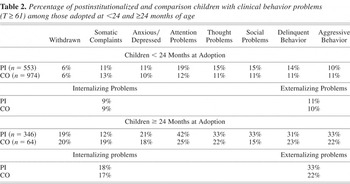
Table 2 displays the percentage of children scoring in the clinical (including borderline clinical) range on each of the narrow-band and broadband CBCL Symptom Scales arranged by PI status and adoption at <24 months or ≥24 months. As shown in Table 2, most children were not exhibiting any type of behavior problems. Attention problems were the most prevalent, yet even for PI children who were 24 months old or older at adoption, less than half exhibited attention problems. Summed across the eight narrow-band CBCL scales, more of the CO (65%) than PI (51%) were problem free, not scoring in the clinical range on any scale, χ2 (1) = 35.6, p < .001; whereas more of the PI (11%) than CO (5%) exhibited pervasive problems (clinical range on five or more narrow-band scales), χ2 (1) = 26.8, p < .001. Nonetheless, most of the children in both groups were problem free whereas few were exhibiting pervasive problems.
Percentage of postinstitutionalized and comparison children with clinical behavior problems (T ≥ 61) among those adopted at <24 and ≥24 months of age

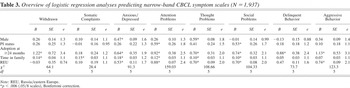
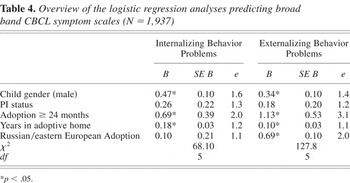
Binomial logistic regression analyses were conducted to examine the factors associated with increased rates of behavior problems on each of the narrow-band and broadband scales. For the analyses of the eight narrow-band scales, Bonferroni corrections were used to control for type I error (see Table 3). Because the two broadband scales (see Table 4) were computed from the narrow-band scales, the reader should not view the results in Table 4 as independent from those in Table 3. These broadband data were provided to aid comparison with other studies that focused on the broadband scales in their analyses. In addition to PI status (0 = CO, 1 = PI) and adoption age (0 = <24 months, 1 = ≥24 months), the model tested in the regression analyses included gender (0 = girls, 1 = boys), time in adoptive home (in years), and adoption from Russia/Eastern Europe (0 = other, 1 = Russia/Eastern Europe).
Overview of logistic regression analyses predicting narrow-band CBCL symptom scales (N = 1,937)

Overview of the logistic regression analyses predicting broad band CBCL symptom scales (N = 1,937)

Internalizing
PI status did not predict an increase in the rates of internalizing problems (i.e., narrow-band withdrawn, somatic complaints, and anxious/depressed; broadband Internalizing Scale). Boys were more likely than girls to score in the clinical range on the Anxious/Depressed Scale (odds ratio [OR] = 1.6) and on the broadband Internalizing (OR = 1.6) Scale. Children adopted at 24 months or more also exhibited elevated rates of internalizing problems (OR = 2.0), expressed specifically for withdrawn (OR = 3.4) and anxious/depressed (OR = 1.9). Overall, time in the adoptive home was positively associated with Internalizing Problems. This was true for all three narrow-band Internalizing Scales as well as for the broadband Internalizing Scale (OR range = 1.1–1.2). Thus, with each year in the adoptive home, children were 1.1 to 1.2 times as likely to be scored in the clinical range on internalizing problems. Being adopted from Russia/Eastern Europe versus other areas of the world was only associated with higher rates of anxious/depressed problems (OR = 1.7).
Externalizing
PI status did not predict increased rates of externalizing problems (i.e., narrow-band delinquent problems and aggressive problems, and broadband externalizing problems). Adoption at ≥24 months was a significant predictor on all Externalizing Scales (aggressive behavior, OR = 3.1; delinquent behavior, OR = 2.4; externalizing, OR = 3.1). Time in the adoptive home was positively associated with externalizing problems (OR = 1.1), but after correcting for the number of tests, was not associated significantly with either the narrow-band Aggression or Delinquent Problems Scales. Thus, with each year in the adoptive home, the children were 1.1 times as likely to be scored in the clinical range on externalizing. Being from Russia/Eastern Europe was also positively associated with problems on aggressive behavior (OR = 2.1) and broadband externalizing problems (OR = 2.0).
Attention, thought problems, and social problems
Adoption at ≥24 months (OR range = 2.0–2.5) was associated with increased risk of social, thought, and attention problems. In addition, PI status was associated with increased risk of attention problems (OR = 1.8) and social problems (OR = 1.7) and boys were more likely than girls to exhibit thought problems (OR = 1.8). Time in the adoptive family was positively associated with attention, thought, and social problems (OR = 1.1). Finally, adoption from Russia/Eastern Europe was a significant predictor of increased rates of problems on all three scales (OR range = 2.0–2.4).
To be certain that the elevated rates of social problems reflected problems with peers we analyzed the peer problems score created by summing only the peer items from the Social Problems Scale. Recall that we could not compute a T score for this subscale. Instead, we used the raw scores in a generalized linear model in which PI status, gender of child, and adoption from Russia/Eastern Europe served as between-subject factors, and age at adoption and time in the family were covariates. After considering the impact of the variables on Peer Problems, PI status was still a statistically significant predictor (p < .01) Twelve percent of the PI and 4% of the CO children scored in the top 10% of the distribution on this peer problems measure.
Interaction of PI status and adoption at 24 months
As a strong test of the specificity hypothesis, we included the interaction of PI status and adoption at ≥24 months in the multivariate logistic regression equation for each variable. Of the 10 analyses, none approached statistical significance. To be certain that we did not miss a statistically significant interaction with age at adoption, we also grouped the children by adoption at ≥12 months and recomputed the interaction analyses. After correcting for the number of statistical tests, none of the interactions reached statistical significance.
Discussion
The results of the present study support the argument that early institutional history is associated with a limited set of behavior problems. However, they do not indicate that these problems are specific, as similar problems were also observed among children who were older at adoption regardless of whether they had experienced prolonged periods of institutional care. As in other studies, the majority of PI children were free of the problems assessed by the CBCL and relatively few had pervasive problems across five or more of the eight narrow-band symptom domains. Thus, consistent with other research in this area (e.g., Ames, 1997; Rutter et al., 2001), institutional privation appears to have probabilistic, rather than deterministic influences on emotional and behavioral problems.
It is striking that the risks associated with institutional privation seemed to pale in comparison to those associated with being older at adoption. Adoption at ≥24 months was associated with higher odds ratios than those for PI status for nearly all of the problem scales assessed on the CBCL. Although neither internalizing nor externalizing behavior problems were associated with institutional rearing during infancy, problems in both internalizing and externalizing domains were positively correlated with adoption beyond 2 years of age. Several other findings were of note. First, when a gender difference was observed, boys had higher rates of behavior problems than girls. Second, time in the adoptive home, if anything, was associated with increasing rates of behavior problems. Third, children from Russia/Eastern Europe had higher rates of many problem behaviors than did children adopted from other areas of the world. Each of these findings will be discussed in turn, along with the limitations of the present design. First we will turn to the limited number of problems that were associated with institutional privation: attention, thought, and social problems.
As predicted by Rutter and colleagues (Rutter et al., 2001; Roy et al., 2000, 2004), children adopted from institutions were at increased risk of attention problems. This was the case both for children adopted in infancy (19% in clinical range) and those adopted at 24 months or older (42% in clinical range). The consistency of evidence that institutional care adversely affects the development of attention systems is striking. Nonetheless, the present results challenge any conclusion that attention problems are specific to institutional care in early childhood. CO children adopted at ≥24 months were more likely to exhibit attention problems (25% in clinical range) than were CO children adopted in infancy (12% in clinical range). Unlike the children in the study by Roy and colleagues, these CO children had experienced more than one placement during their preadoption lives. Thus, these data do not necessarily contradict their earlier findings. Furthermore, we found no evidence for a significant interaction between PI status and adoption at ≥24 months. This was also true when we modified the age split to 12 months, which provided more comparison children (151 vs. 64) in the older age group, and therefore a statistically stronger test. Thus, these two factors produced additive, rather than interactive effects.
The present results cannot be used to identify the facets of attention that were negatively affected by early deprivation and disruptions in care. The neural systems involved in attention are complex (e.g., Posner & Petersen, 1990). Adequate analysis of the facets of the attention affected in children who have experienced different types of adverse early care arrangements requires measures that are more specific than can be obtained through parent or teacher report. Rapid advances in developmental cognitive neuroscience offer the opportunity to better understand the specific neural circuits contributing to attention problems in PI children, and other children with adverse early care histories (e.g., Durston et al., 2003). Research using the tools of neuroscience is needed in this population.
Thought problems were not associated with institutional privation but were associated with being older at adoption. Rutter and colleagues (e.g., 2001) have argued that autistic-like features are sequelae of institutional privation for some children. However, in their analysis, increased rates of autistic-like features were noted particularly among children adopted beyond infancy. Because the CBCL Thought Problems Scale is not specific to thought problems exhibited by autistic children, we cannot conclude that the present results provide evidence of increased autistic-like features for children who are beyond infancy at adoption. The results, however, are not inconsistent with evidence obtained using instruments specific to autism spectrum disorders. Using a cutoff that included children in the borderline range, Achenbach (1991, p. 102) reported that only 4% of nonclinic referred children were described as having thought problems. The present results suggest that parents in both the PI and CO groups, particularly with children adopted at or beyond 24 months of age, were reporting more problems in the thought domain than would be expected in community samples. Clearly, we need to better understand the specific nature, breadth, and predictors of these thought disturbances.
Social problems did not conform to our predictions. We expected that social problems might be increased among children who were older at adoption, but we did not expect to see an association with institutional privation. We ruled out one obvious explanation for the difference between our findings and those of Rutter and colleagues (2001). Specifically, although the CBCL Social Problem Scale includes items not related to peer relations (e.g., clings, acts young), we also noted an association of institutional care with the Social Scale that we computed using only the peer items. Differences among instruments and informants (Rutter and colleagues included teacher reports) might explain why our results differed from Rutter et al. (2001). However, as others have also reported that PI children have problems in peer relationships (e.g., Hodges & Tizard, 1989), it seems likely that such problems do exist and need to be better understood.
Problems with aggression are known to disrupt peer relationships (e.g., DeRosier & Thomas, 2003). However, as we did not find an association between aggressive problems and institutional privation, the present results do not indicate that aggression is the reason for poorer peer relationships among PI children. Rutter and colleagues (e.g., Rutter, Anderson-Wood, et al., 1999) have argued that institutional privation is associated with poor social boundaries, a deficit that could reduce peer acceptance. Other studies have revealed deficits or delays in the development of certain aspects of social cognition (e.g., theory of mind; Tarullo, Bruce, & Gunnar, in press). Finally, early studies by Tizard and colleagues (Hodges & Tizard, 1989) indicated that PI children were less likely to share intimacies with peers, something that would hinder peer acceptance particularly as children get older. These and other building blocks of social competence need to be examined more closely in PI children. However, it is also possible that it is not deficits in social cognition, but behaviors children learn in institutions that negatively influence their peer relationships. For example, selfish behaviors may be adaptive in institutions, but maladaptive in establishing and maintaining good relationships with peers. However, as with attention problems, being adopted at older ages was associated with more social problems among the children adopted from foster and other family-care arrangements. Thus, social problems, while associated with institutionalization, were not specific to institutionalized care.
Institutional conditions
Institutional environments are complex, and confront children with both the absence of stimulation that is potentially needed to foster typical development as well as the presence of stimulation that may adversely affect emotional and behavioral health. The fact that attention and social behavior problems were all associated with early institutional privation begs the question whether common or disparate elements of institutional experience contributed to these problems. Roy and colleagues (2004) suggested that inattention/overactivity problems might be prevalent among institutionally reared children because of deficits in individualized care. Frequent changes in caregivers and routinized caregiving practices would result in few institutionalized children receiving care that is sensitive and responsive to their individual stage of development and current needs. This, in turn, would reduce the extent to which the child could experience response-contingent feedback.
Response-contingent stimulation may be an important basic ingredient in postnatal brain development, affecting the development of all three of the types of behavior problems associated with institutional privation in this study. Brain regions that develop rapidly over the first few years of life may be particularly disturbed by the lack of such stimulation. These regions include areas in the prefrontal cortex that may be important for attention and the processing of social information (see review, Gunnar, 2001). Lack of individualized care, along with exposure to pathogens, malnutrition due to inadequate diet and/or intestinal parasites, and abusive treatment may also activate stress-sensitive neural and endocrine systems, and through this route contribute to atypical maturation of rapidly developing neural systems (Gunnar, 2000).
Of course, deficits in individualized care and in control over the environment may also characterize noninstitutional care arrangements for children who are wards of the state. The fact that being older at adoption for the comparison children was associated with increased risk of problems in the thought, attention, and social domains raises the possibility that they were also exposed to the same risk factors as the institutionalized children, but perhaps less pervasively so that it took longer exposures for the effects to be observed.
It is also not clear whether the same or different facets of preadoption care were associated with attention and social problems. One indication of commonality in preadoption conditions would be an overlap in the children expressing these problems. Roy and colleagues (2004) noted that problems in attention and problems with social boundaries were correlated in PI children. Isolating the aspects of institutional care that contribute to social and attention problems in PI children may be difficult given problems in both measuring and manipulating institutional conditions. Such manipulations, however, are being attempted by some research groups and may prove informative (e.g., improving the ratio of children to caregivers; Smyke, Dumitrescu, & Zeanah, 2002).
Internalizing and externalizing behavior problems
Next, we turn to problems that were not associated with institutional privation, but were instead ones exhibited in greater frequency by children adopted when they were at or over 24 months of age. These problems were ones in the externalizing and internalizing domains. As discussed earlier, studies of PI children vary markedly in whether they report increased rates of internalizing and externalizing problems. Some of the discrepancies in the studies may depend on the comparison group. When PI children are compared to children adopted early in infancy, both age at adoption and prior institutional experience are confounded. As the present results demonstrate, this confound is highly problematic, as age at adoption rather than institutional privation appears to be the relevant factor. However, a larger problem should be noted. Many of the studies examining the impact of institutional history on children's behavior problems have used either measures of total behavior problems that are strongly influenced by internalizing and externalizing measures, or have focused on internalizing and externalizing problems specifically (e.g., see meta-analysis; Juffer & van Ijzendoorn, 2005). If these problems are not associated with institutional rearing, but other behavior problems are, then conclusions based on examination of these types of problems may not adequately reflect the behavioral issues of children adopted from institutions. As suggested by Rutter and colleagues (2001), we need to focus on the correct phenotypes when examining the sequelae of early institutional privation, and these do not appear to be problems in the internalizing and externalizing spectrum, at least not when children are adopted during infancy from institutional settings.
Internalizing and externalizing problems were, however, predicted by being older at adoption. The present results do not allow us to determine why children adopted at or beyond 24 months are at greater risk for these types of behavior problems than are children adopted earlier in life. Other researchers have had equal difficulty. Age at adoption serves, in some ways, as a proxy for the presence of greater turmoil and adversity in the child's preadoption history. For example, Verhulst and colleagues (1992) were unable in their analyses to separate the effects of adoption age from preadoption exposure to a variety of adverse events (e.g., physical and sexual abuse, multiple transitions in care with associated loss of relationships). Because the precise nature of the child's preadoption experiences are often not known or poorly/inaccurately transmitted to adoptive parents, sorting out the impact of age at adoption and exposure to adversity was not possible in the present study, and is difficult or impossible to do with any accuracy in other studies of internationally adopted children.
Time in the family
Previous studies of PI children have noted marked improvements in functioning in the first year or so following adoption (e.g., Rutter, 1998). The present findings do not contradict this evidence. Our study was designed to capture the behavior problems of children who had been with their families for at least 2 years. As in other studies, we did not find that children who had been with their families longer were less likely to exhibit behavior problems (e.g., Groza & Ryan, 2002; O'Connor & Rutter, 2000; Verhulst et al., 1990a; note, however, Juffer & van Ijzendoorn, 2005). Indeed, we noted the opposite for many of the problem domains examined by the CBCL, although the odds ratios were generally quite small.
There are a number of possible reasons for these findings that cannot be determined from the present study. One reason, however, can be ruled out. Although children who had been with their families longer were older at the time of testing, the effect was not likely due to age per se. We used the CBCL T scores, which are computed separately for pre- and postadolescent children. This should have reduced any age effects. Of course, within the age bands used to compute the T scores, if the raw scores change with age, then one would still expect age effects to be evidence when T scores are used for children within those age ranges. However, an examination of the CBCL manual (also T. M. Achenbach, personal communication, June 2005), reveals that for nonclinic referred children both internalizing and externalizing tend to exhibit similar raw score means across age. However, for clinic-referred girls, but not boys, internalizing raw score means do tend to increase. These patterns for large samples of children tested in the United States also fit with data reported from large epidemiological studies in The Netherlands (Reijneveld, Brugman, Verhulst, & Verloove-Vanhorick, 2005) and Sweden (Bohlin & Janols, 2004). Thus, the fact that we had a large age range and age at testing was correlated with time in the family cannot explain why behavior problems tended to increase the longer the children were in their adoptive homes.
Nevertheless, age might be a particularly relevant factor for children adopted from adverse early life circumstances. As these children get older, if they do have difficulty with social perception and attention regulation, it is possible that they find it more difficult to negotiate peer and academic contexts that do become increasingly more complex with development. For internationally adopted children, being a minority might also result in increasing adversity with the transition from childhood to adolescence. Certainly, these children may experience more racial discrimination (see, e.g., Lindblad et al., 2003). This might contribute to increased rates of behavior problems.
It is also possible that the longer adopted children are with their families, the less their parents are willing to discount their problematic behavior. That is, in the first years after adoption when the child is still young, parents may be more willing to attribute problematic behaviors to the ways that young children behave (aggression is fairly common among preschoolers) or to issues that will continue to improve as the child recovers from their preadoption experiences. Indeed, anecdotally, we have heard such explanations from parents of internationally adopted preschoolers whose children display problematic behaviors but are not scored that way by their parents on the CBCL. Clearly, because parents' expectations of improvement in functioning may change the longer the child is in the family, longitudinal studies that involve direct observations of behaviors are needed to adequately trace developmental changes in social and emotional functioning.
Although we cannot disentangle changing parent expectations from age changes in behavior problems for internationally adopted children, at the very least, the present results suggest that behavior problems are not likely to dissipate with time. Families who adopt children are known for being more likely than birth families to seek professional help (Miller et al., 2000; Warren, 1992). In the present study, 16% of the PI families and 9% of the CO families reported that they had sought professional help for their children's behavior problems. Whether interventions will be helpful, however, depends on whether we know enough about the nature of the impairments suffered by these children to intervene effectively. Adoption professionals working with these families anecdotally report that they are prey to groups advocating a wide range of therapies that are not evidence based. Although some of these therapies might be effective, evidence that problem behaviors persist and may increase with time postadoption argues that we need to identify and develop more effective means of intervening to improve outcomes for these children and their families.
Finally, it is also possible that the family environment is not therapeutic, but rather contributes to the behavior problems that we observed to be positively correlated with time in the adoptive home. We cannot rule out this possibility. We can only note that family characteristics often associated with behavior problems, such as poverty and marital divorce or separation, were present in very few of the adoptive families in the survey. In addition, a longitudinal study involving observations of parent–child interaction among families who adopted children from Romania in 1990–1991, showed that parent sensitivity and responsiveness improved the longer the child was in the family (Croft, O'Connor, Keaveney, Groothues, & Rutter, 2001). In the Croft et al. study, improvements in parenting behavior were associated with improvements in the children's functioning, and it was the child's behavior that appeared to be producing changes in parenting, rather than the other way around. Furthermore, as noted earlier, children adopted from institutional settings show marked improvements in physical and behavioral development after being placed in their adoptive homes (e.g., Johnson, 2001). Of course, parents who adopt children internationally likely vary in their ability to manage the physical and behavioral challenges their children present. Ames (1997) noted poorer outcomes for PI Romanian children when their parents were less well educated and had lower incomes. Groza and Ryan (2002) reported that parents who described less positive relationships with their adopted children also described the children as having more behavior problems. Thus, we cannot rule out the possibility that, over time, parent–child relationships became more problematic for at least some of the children, and this stimulated an increase in parent-reported behavior problems. Studies are needed of the parenting practices that support or impede the behavioral and emotional development of PI children, along with studies that help differentiate the role of parents and children in the organization of family processes that influence the children's behavioral and emotional adjustment.
Russia/Eastern Europe
Adoption from Russia/Eastern Europe was positively associated with a variety of behavior disorders. These children accounted for only 29% of the PI sample, and the variance related to adoption from this area of the world was accounted for in the regression model. Accordingly, the effects discussed above were not likely due to the inclusion of these children in the sample. However, the fact that children adopted from Russia/Eastern Europe were more likely to exhibit a range of behavior problems than were children from other regions of the world needs to be considered in designing studies to examine the effects of institutional privation on children's development. Whenever possible, research should be conducted that allows generalization beyond the Russia/Eastern European case. This is particularly important because of the expected high rate of prenatal alcohol exposure for children adopted from countries of the former Soviet Union and Eastern bloc and the possibility, therefore, that prenatal exposure to alcohol rather than postnatal experience may be the basis for alterations in behavior and brain development observed among PI children from this region of the world.
Although prenatal exposure to alcohol and other toxins might explain why the Russia/Eastern European children were at greater risk for behavioral and emotional problems, other factors should also be considered. These reasons may include why the child was placed for adoption, the quality of institutional care, and expectations of the parents. Notably, Tessler, Adams, Houlihan, and Groza (2004) reported that some of these factors helped explain differences they noted in mother–daughter relationships in a comparison of Chinese- and Romanian-adopted children. However, it is also possible that, because there has been a good deal of information about behavior and emotional problems of children adopted from Russia and Eastern Europe in both the academic and popular press, parents of these children may have been more willing to acknowledge their children's behavior problems.
Limitations
There are a number of limitations in this study that should be acknowledged in interpreting the results. First, the findings were based on parent report with all the resultant criticisms that accompany the use of parents as informants. Although we were able to include the perspectives of two parents for over half the children, because the parents likely communicated to one another about the child's behavior problems, their reports cannot be considered independent. The use of parent report was the compromise we made in exchange for obtaining a large, epidemiological sample. Future studies, however, not only need to move beyond parent report measures, but need to employ tools that allow more fine-grained and objective assessments of behavioral problems in this population.
Second, another limitation was that, although we attempted to collect data from all of the children whose adoptions were decreed over our sampling period, we were only able to collect CBCL data on 65% of the children whose addresses we could locate. Notably, this response rate compares favorably with response rates of other studies of this sort (e.g., Sharma, McGue, & Benson, 1998; Verhulst et al., 1990a). Furthermore, because we had access to information about the families who did and did not respond, unlike any other study of this nature, we were able to identify some of the sources of potential bias in our sample. Thus, we know that our sample was less representative of children adopted earlier in our sampling period (before 1995) than later in our sampling period. This, in turn, means that we need to be very cautious in interpreting associations with measures like time in the family as children who had been with their adoptive parents longer were less well represented than children who had been with their parents for shorter periods of time. The fact that a larger percentage of parents who adopted more recently took part in the survey than did parents who adopted less recently also means that we had a better representation of children adopted from countries like China and Russia (who currently account for a high percentage of internationally adopted children in Minnesota) than children adopted from countries like Korea (who accounted for more of the internationally adopted children in the early 1990s). Notably, we obtained responses from 61% of the families who adopted children from Romania in the early 1990s, and thus we probably did get a reasonable representation of the CBCL-measured behavior problems of these children. However, as the percentage of children adopted from institutions versus foster care settings has increased over this time period, we probably also had a somewhat better representation of PI than CO children. We also noted better representation among better educated parents than less well-educated parents, although it is not clear whether this would increase or decrease the number of children described as exhibiting behavior problems (see Ingersoll, 1997).
Third, the design was cross-sectional rather than longitudinal. This means that we need to be cautious in concluding that the likelihood of behavior problems increases with child age and/or time in the family. The positive correlation between behavior problems and time in the family could also reflect cohort effects, including the possibility that family support systems are more available to families adopting now from various countries than they were for families adopting earlier in our sampling frame. Furthermore, as the number of internationally adopted children has been increasing over time, children adopted more recently may be less likely than those adopted earlier to be oddities in their neighborhoods or schools. Longitudinal studies are the only way truly to tease apart cohort effects from those involving processes related to time and/or development.
Fourth and finally, and obviously, the present study was limited to an examination of behavior problems assessed by the CBCL. These do not reflect all of the types of behavior problems noted for children adopted from institutions. Indeed, despite their widespread use in studies of internationally adopted children, we should question the utility of measures like the CBCL to be sensitive to the issues of children who have experienced institutional privation given that this instrument was not devised to assess the impact of early privation and neglect.
Conclusions
Despite these limitations, the present study provides fairly compelling evidence that institutional privation, per se, is not associated with an increase in all types of behavioral and emotional problems. Rather, the types of problems associated with institutional privation appear to be relatively circumscribed. On the CBCL, these domains appear to be limited to attention, thought, and social problems. This is not to say that PI children are not at risk for elevated rates of problems in the externalizing range. However, the present results suggest that age at adoption, rather than prior institutional history is the relevant risk factor. PI children adopted at or above 24 months of age did exhibit elevated rates of problems in the externalizing domain, but then so did children adopted from foster or other types of preadoption care arrangements. Both theoretically and practically, what is needed now is a better understanding or description of the social, thought, and attention problems associated with institutional privation and research on the neural systems underlying these problems. This work may inform not only our understanding of the effects of institutional privation, but may also contribute to our basic understanding about the role of experience in human brain and behavioral development.