Introduction
The International Psychogeriatric Association (Finkel et al., Reference Finkel, Costa e Silva, Cohen, Miller and Sartorius1996) have used the term “behavioral and psychological symptoms of dementia” (BPSD) to describe a range of mood (depression, anxiety) and behavioral problems experienced by people with dementia. The prevalence of these symptoms is particularly high among people with dementia living in care homes. They are thought to affect at least 79% of care home residents (Margallo-Lana et al., Reference Margallo-Lana2001). These symptoms were traditionally treated with antipsychotic medication. However, a review by Banerjee (Reference Banerjee2009) estimated that only 20% of patients derived some clinical benefit from taking these medications, yet they were estimated to be responsible for 1,800 additional deaths per year due to cerebrovascular events. He concluded that their use was compromising patient safety without sufficient evidence for effectiveness. A recent trial has also demonstrated the lack of effectiveness of antidepressants in dementia (Banerjee et al., Reference Banerjee2011). A range of non-pharmacological therapies have been developed as an alternative treatment. A number of interventions have been found to be effective, although there have been few high-quality studies (Olazarán et al., Reference Olazarán2010).
There is evidence that training care staff to respond appropriately to residents with BPSD may be a promising psychosocial intervention (McCabe et al., Reference McCabe, Davison and George2007), although further research is required in this area. There is a need to replicate successful training programs and evaluate their efficacy in randomized controlled trials (RCTs). However, this process is challenging because there are logistical barriers to conducting research in care homes and the success of training programs is often dependent on complex organizational factors, such as management style (McCabe et al., Reference McCabe, Davison and George2007). Staff training programs are also classified as a type of complex intervention, defined as interventions with many components and many possible outcomes (Medical Research Council, 2008).
In the UK, there are estimated to be over 380,000 people with dementia living in residential or nursing homes (Luengo-Fernandez et al., Reference Luengo-Fernandez, Leal and Gray2010). The National Dementia Strategy (Department of Health, 2009) recommended that all care staff should receive access to specialist dementia care training in order to meet their needs. However, the UK evidence base in this area is particularly limited. A number of training programs were reviewed which could potentially be implemented in the UK. The Staff Training in Assisted Living Residences (STAR) program was found to be one of the few training programs to have been published as a manual. STAR taught staff to understand and modify their interactions with residents by identifying activators, behaviors, and consequences (ABCs). The program also included information about dementia, taught communication skills, and encouraged staff to implement pleasant events with people with dementia.
The STAR program was specifically developed for staff working in assisted living residences in the USA, where residents live in their own room or apartment, eat meals together, and participate in social and recreational activities. Residents receive support with activities of daily living, but not nursing care. The STAR program was evaluated in a small cluster RCT (Teri et al., Reference Teri, Huda, Gibbons, Young and van Leynseele2005) involving 25 staff and 31 residents. Four assisted living residences were randomly assigned to receive either the STAR training program or usual on-site training. Residents whose carers received the STAR training improved significantly on measures of behavioral problems, depression, and anxiety in comparison to the control group. A subsequent study revealed that the program could also be implemented by novice trainers (Teri et al., Reference Teri2009). Prior to this study, STAR had not been evaluated outside the context of assisted living residences or beyond the USA.
The aim of this study was to evaluate the feasibility of delivering the STAR program in the UK, examining the benefits for reducing BPSD in residents with dementia and secondary effects on care staff. It was hypothesized that the program would (1) reduce BPSD and increase quality of life for residents with dementia, (2) improve the attitude of care staff, and (3) increase sense of competency among care staff. The complex organizational factors influencing this type of intervention and the cultural differences between the UK and the USA (influencing factors such as management style and the culture of care) made this stage of research very important. The study was classified as a Phase II exploratory trial, which is required in the evaluation of complex interventions before conducting a RCT (Medical Research Council, 2008).
Method
Design
An experimental group pre/post design was used to examine the feasibility of implementing the STAR staff training program in UK care homes and the impact on the mood and behavior of residents with dementia.
Setting
The majority (70%) of care homes in the UK are owned by private care organizations, with a small proportion owned by voluntary organizations, local authorities, and the National Health Service. Many care homes (54%) provide nursing as well as residential care (Care Quality Commission, 2011). Two care homes were recruited to take part in this pilot study. A search of the Care Quality Commission (2010) care directory identified 74 care homes within 15 London boroughs, of a suitable size (accommodating at least 40 residents with dementia) and quality (rated as good or excellent by the Care Quality Commission) to run the training program. All care home managers were sent an initial invitation letter. A response was received from seven care homes and the managers were contacted to discuss the study. Five managers chose not to take part at this point due to a lack of approval from the managing organization (three), a lack of resources to release staff for training (one), and the manager being unavailable during the research timescale (one). Managers who did not respond were not contacted again. The two remaining care homes took part in the study. Care homes A and B were both located in London, UK, and were owned by two different private care organizations. They both provided care to 93 residents and had an overall staff/resident ratio of 1:4.
Procedure for recruiting participants
The registered nurse who had clinical responsibility for the care of residents within the unit was asked to identify residents who had displayed symptoms of depression, anxiety, or behavioral problems in the preceding fortnight. After following the consent procedures outlined above, residents were assessed using the Diagnostic and Statistical Manual of Mental Disorders IV (DSM-IV; American Psychiatric Association, 1994) criteria for dementia. All residents who met the DSM-IV criteria were then given a baseline assessment (see Instruments below). Residents who scored below the clinical cut-off on both the Cornell Scale for Depression in Dementia (CSDD) and the Rating Anxiety in Dementia Scale (RAID) were excluded from the study at this point. Residents who scored above the clinical cut-off on at least one instrument were included and were assessed using the Quality of Life – Alzheimer's Disease Scale (QOL-AD). Staff were invited to join the study on a first come, first served basis. Care staff were required to answer the Approaches to Dementia Questionnaire (ADQ) and the Sense of Competence in Dementia care Staff (SCIDS) at baseline and eight-week follow-up. They were also required to answer the STAR Staff Feedback Form (SSFF) at follow-up. Care staff provided their informed consent to be included in the study and were given a gift voucher to thank them for participating. Registered nurses were invited to join the management training sessions.
Power analysis
Estimating an effect size of 0.66 (obtained by Teri et al., Reference Teri, Huda, Gibbons, Young and van Leynseele2005) and specifying α = 5% and desired power = 80%, the minimal desired resident sample size was 27. Non-qualified care staff were included if they worked at least four day shifts per week, were planning to still be working at the care home at the time of follow-up, and were available on the training dates. The impact of staff outcomes was an exploratory hypothesis. There were no previous studies to inform a power analysis but a staff sample size of at least 22 was estimated to be sufficient based on Teri et al.'s (Reference Teri, Huda, Gibbons, Young and van Leynseele2005) staff sample size of 25.
Ethics and consent
Ethical approval was received from the North West London NHS Research Ethics Committee, a flagged committee for approving research carried out under the Mental Capacity Act 2005 (HMSO, 2005). All prospective participants were assessed for their capacity to consent to take part in the research. Residents who were able to: (1) understand the general principles of the study, (2) weigh up the risks and benefits of participating, (3) retain the information for long enough to make a decision about participating, and (4) communicate this decision, were deemed to have the capacity to provide informed consent. If prospective participants lacked the capacity to provide informed consent, a personal consultee or a nominated consultee was identified to provide advice on their participation.
Instruments
The choice of outcome variables was based on the RCT conducted by Teri et al. (Reference Teri, Huda, Gibbons, Young and van Leynseele2005). Quality of life was additionally chosen because it has become a valued construct in dementia care (Hoe et al., Reference Hoe, Katona, Roch and Livingston2005). All instruments were administered at baseline and eight-week follow-up. Three of the instruments used to assess resident symptoms relied on staff report. Each resident was allocated a staff member who was asked to report on the resident's symptoms at both baseline and follow-up.
Cornell Scale for Depression in Dementia (CSDD)
The CSDD (Alexopoulos et al., Reference Alexopoulos, Abrams, Young and Shamoian1988) was used to measure frequency and severity of depressive symptoms. The scale is completed on the basis of interviewing a carer and/or the person with dementia. It rates five broad categories of symptoms (mood-related signs, behavioral disturbance, physical signs, biological functions, and ideational disturbance) using a four-point scale from absent (0) to severe (3). A score of 8 or more indicates significant depressive symptoms. The scale has good inter-rater reliability, internal consistency, and has also been found to have good validity in institutional settings
Rating Anxiety in Dementia Scale (RAID)
The RAID (Shankar et al., Reference Shankar, Walker, Frost and Orrell1999) was used to assess symptoms related to anxiety. It uses a similar format to the CSDD, rating symptoms across five categories (worry, apprehension, vigilance, motor tension, and autonomic hypersensitivity), using a four-point scale from absent (0) to severe (3). A score of 11 and above indicates significant clinical anxiety. It has good inter-rater and test-retest reliability and it has been found to correlate with other anxiety rating scales.
Revised Memory and Behavioral Problem Checklist (RMBPC)
The depression and disruptive behavior frequency scales of the RMBPC (Teri et al., Reference Teri, Truax, Logsdon, Uomoto, Zarit and Vitaliano1992) were used to measure the frequency of behavioral disturbance. It is a self-administered caregiver questionnaire. The frequency of behaviors is rated using a five-point scale from never occurred (0) to daily (4). It has good internal validity and reliability. There is no clinical cut-off on the RMBC but symptom ratings of moderate (2) or more were deemed to be clinically significant.
The Quality of Life – Alzheimer's Disease Scale (QOL-AD)
The QOL-AD (Logsdon et al., Reference Logsdon, Gibbons, McCurry and Teri2002) was used to assess quality of life. It uses a simple questionnaire format, which is answered by the person with dementia with the assistance of the researcher. Thirteen items are rated using a four-point scale. To reduce the number of measures to be completed by care staff, only the resident version was utilized in this study. It has good internal consistency, acceptable test-retest reliability, and good construct validity.
Mini-Mental State Examination (MMSE)
The MMSE (Folstein et al., Reference Folstein, Folstein and McHugh1975) was used to assess cognitive function. It has good criterion and concurrent validity, and inter-rater and test-retest reliability. The maximum score is 30, with 0–10 indicating severe impairment, 11–20 indicating moderate impairment, and 21–24 indicating mild impairment.
Approaches to Dementia Questionnaire (ADQ)
The ADQ (Lintern et al., Reference Lintern, Woods and Phair2000) was used to measure staff attitudes towards people with dementia. Respondents rate the extent to which they agree with 19 different statements about dementia. The statements are rated on a five-point scale from “strongly agree” to “strongly disagree.” It yields a total attitudes score, a subscale measuring “hopefulness,” and a subscale measuring the extent to which a carer's attitude is “person-centered.”
Sense of Competence in Dementia care Staff (SCIDS)
The SCIDS (Schepers et al., in press) was used to measure the staff's sense of competence. The scale yields a total score and four subscale scores (professionalism, care challenges, maintaining personhood, and building relationships). This contains 17 statements, rated on a four-point scale. Internal consistency and inter-rater reliability were found to be good for the full scales and above adequate for each of the subscales. The measure was also found to have both predictive and convergent validity.
STAR Staff Feedback Questionnaire (SSFQ)
The SSFQ was developed for the purpose of this study. Using a five-point Likert scale, staff were asked to rate: (1) the usefulness of the different training modules, and (2) the extent to which the program had impacted on factors such as knowledge, job satisfaction, and sense of confidence. In a qualitative comments section, they were also asked to (3) describe the aspect of the program which they found most helpful, (4) note the elements of the program which could be improved, and (5) comment on their overall experience of attending the training.
Intervention
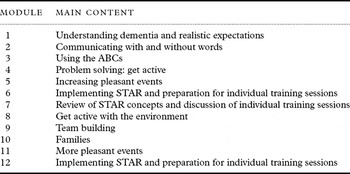
The STAR program was delivered over an eight-week period in the form of two workshop sessions (see Table 1) with a three-week interval between the workshops. The STAR DVD was an integral part of the training. It contained eight scenes, played by actors, showing interactions between staff and residents. Each scene was presented twice, with the first scene showing a problem behavior and the second scene showing how the problem was successfully managed by the staff member. The workshops were supplemented by four individual staff supervision sessions for each trainee. The program was adapted and delivered by a Trainee Clinical Psychologist (JG) under the supervision of an experienced Clinical Psychologist working in dementia care (AS), with the assistance of an Occupational Therapist experienced in providing dementia training to staff teams (JW). The workshops were primarily delivered by the researcher with the assistance of a co-facilitator at the majority of the sessions. Due to the small-scale nature of this study, the same researcher carried out the staff interviews (to complete the CSDD and the RAID) and delivered the training intervention.
Overview of STAR program

The workshops were delivered on the care home site to groups of 11–14 care staff. Staff attended the workshops during their normal working hours, or were paid for their attendance outside of these hours. The content of the workshops adhered closely to the original manual. Some of the language was adapted slightly from American English to British English, some of the facts about dementia were updated, and the material was presented using PowerPoint rather than the overhead projector slides used in the original manual. In addition, the criterion for the number of individual sessions was adapted slightly to enable the flexibility needed in UK care homes. Rather than always receiving four 30-minute sessions, staff participants would receive the equivalent 120 minutes of additional training, but this could be delivered in either three or four sessions.
Data analysis
Data were entered and analyzed using the Statistical Package for the Social Sciences version 17.0. Data missing at follow-up were handled using the “last observation carried forward” method with baseline scores carried through to follow-up. Data from the RAID, the RMBPC, QOL-AD, and SCIDS were all found to be normally distributed. Data from the CSDD violated normality assumptions and were transformed using a square root transformation. A series of paired sample t-tests were then carried out to evaluate the changes in scores over time. Results from the ADQ were also found to violate normality assumptions due to outliers. It was not possible to transform these data but the non-parametric Wilcoxen Matched Pairs Test was used as an alternative to the t-test. Effect sizes were calculated using Cohen's d. The number of residents moving from the clinically significant range to the non-clinically significant range was calculated for the CSDD and the RAID data. This was then analyzed for statistical significance using the Mantel Haenszel procedure. The qualitative comments on the SSFQ were analyzed using a simple form of thematic analysis (Braun and Clarke, Reference Braun and Clarke2006). First, the main themes were extracted, and then the number of participants expressing each theme was calculated.
Results
Residents and staff characteristics
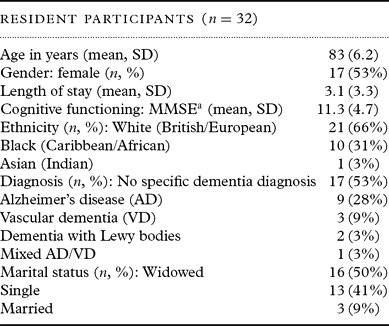
Thirty-two residents were included in the study; 15 residents from care home A and 17 residents from care home B. Follow-up data were not collected for one resident who was admitted to hospital before the end of the study. Meanwhile, it was not possible to complete the QOL-AD with three residents because of the extent of their language or sensory problems. The majority of participants had moderate to severe dementia (MMSE = 11.3, SD = 4.7). Table 2 displays the demographic and clinical characteristics of residents.
Demographic and clinical characteristics of resident participants
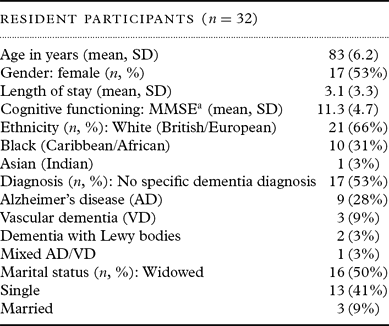
a Mini-Mental State Examination, score range 0–30 (<9 = severe, 10–20 = moderate, 21–24 = mild).
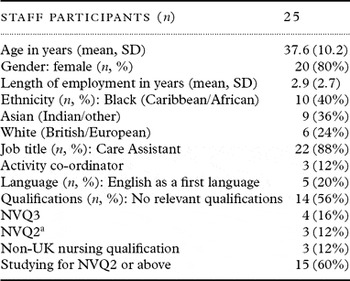
The training program was delivered to 25 care staff working in non-qualified roles. The majority of staff were female (80%), spoke English as a second language (80%), and were from countries other than the UK (92%). Table 3 displays the demographic characteristics of staff participants. Two staff participants did not complete the STAR training program due to one person taking urgent leave and one person being dismissed.
Demographic characteristics of staff participants

a National Vocational Qualification in Health and Social Care (a UK work-related qualification based on national occupational standards. Ranging from Level 1 to Level 5 (highest)).
Staff were interviewed about the mood and behavior of residents at baseline and follow-up (in order to complete the CDDS, RAID, and RMBPC). The same group of 25 staff who took part in the training completed these interviews. Seven additional staff members were also interviewed. It was planned that the same staff member would be interviewed at both baseline and follow-up. However, for six residents a different staff member was interviewed at follow-up due to staff taking annual leave, staff sickness, and one person being dismissed.
Changes in resident symptoms and staff outcomes
Depression
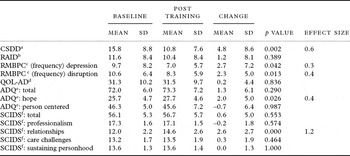
There was a statistically significant decrease in depression scores on the CSDD between baseline and follow-up, t (31) = 3.403, p = 0.002, with a medium effect size (d = 0.6; Table 4). There was also a significant decrease in depression scores on the RMBPC, t (31) = –2.12, p = 0.042, with a small effect size (d = 0.4). At baseline, 30 residents obtained scores in the clinical range for depression. Scores reduced and moved into the non-clinical range for 14 residents (46%). The number of residents falling within the clinical range at follow-up was found to be significantly reduced (χ 2 = 12.460, p = 0.001). Overall, scores improved (decreasing by one point or more on the CSDD) for 20 (65%) residents, deteriorated (increasing by at least one point) for seven (23%), residents and remained stable for four (13%) residents.
Outcome data for residents (n = 32) and staff (n = 25)

a Cornell Scale for Depression in Dementia.
b Rating Anxiety in Dementia Scale.
c Revised Memory and Behavioral Problem Checklist.
d Quality of Life – Alzheimer's Disease Scale (data for only 29 residents were analyzed).
e Attitudes to Dementia Questionnaire.
f Sense of Competence in Dementia care Staff.
Anxiety
There was a small decrease in scores on the RAID, which was not found to be statistically significant (t (31) = 0.874, p = 0.389). At baseline, 13 residents obtained scores in the clinical range. These scores moved into the non-clinical range for nine (69%) residents. The number of residents falling within the clinical range was significantly reduced at follow-up (χ 2 = 4.13, p = 0.042). Overall, scores improved (decreasing by at least one point) for 20 (65%) residents, deteriorated (increasing by at least one point) for eight (26%) residents, and remained stable for four (13%) residents.
Behavioral problems
Staff ratings of disruptive behavior on the RMBPC decreased significantly between baseline and follow-up (t (31) = 4.15, p = 0.013) with a small effect size (d = 0.3). Disruptive behavior reduced (decreasing by at least one point) for 19 (61%) residents, deteriorated (increasing by at least one point) for eight (26%) residents, and stayed the same for four (13%) residents.
Quality of life
Resident quality of life scores did not improve significantly after the training intervention (t (28) = –2.09, p = 0.836). Scores improved (by one point or more) for ten (32%) residents, remained stable for five (16%) residents, and deteriorated (by one point or more) for 13 (42%) residents.
Attitude to dementia
There was a small improvement in overall attitudes on the ADQ, although this reduction was not found to be statistically significant (t (24) = –1.082, p = 0.290). Scores on the “hopefulness” subscale increased significantly (z = –2.23, p = 0.026) with a small effect size (d = 0.4). However, scores on the “person-centered” scale did not change significantly (z = –0.016, p = 0.987).
Sense of competence
Overall, competency scores on the SCIDS did not increase significantly between baseline and follow-up, t (24) = –0.602, p = 0.553. There was a significant improvement in sense of competency on the “building relationships” subscale, t (24) = –0.477, p = 0.000, with a large effect size (d = 1.2). There were no significant improvements on the other subscales.
Acceptability of STAR
The SSFQ was answered by 23 staff participants. Twenty-two staff answered the first open question (which asked “what part of the training did you find most helpful?”), with many staff listing more than one part of the program as helpful. Only 17 staff answered the second question (which asked “what aspect of the training do you think needs to be improved?”). Seventeen staff included additional comments about their experience of attending the STAR program, which are summarized in Table 5.
Qualitative feedback from 17 care staff: experience of attending STAR training
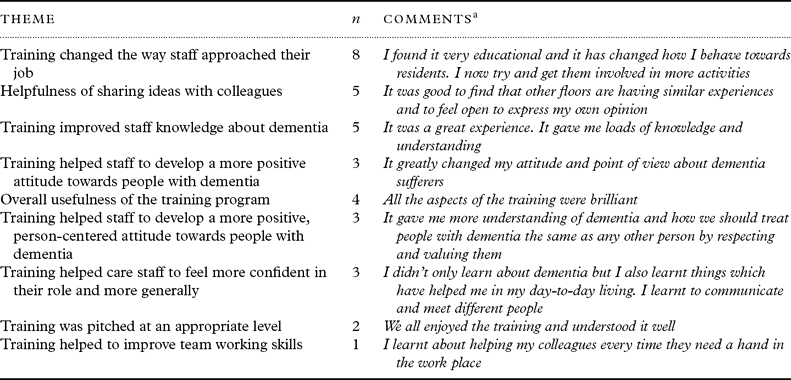
a Comments expressed by more than one staff member.
Overall, 96% staff rated the workshop sessions as useful, 91% rated the individual sessions as useful, and 87% stated that they would recommend the program to a colleague. The DVD and the module covering ABCs were reported to have been the most helpful aspects of the course. A number of staff reported that the training had improved their relationships with both residents (82%) and colleagues (83%). Staff also reported that the training increased their knowledge about dementia (86%) and their knowledge about depression and anxiety (87%). Some staff also stated that they felt more confident in their role (83%) and had developed a higher sense of job satisfaction after attending the training (78%). Ten staff stated that they could not suggest any aspects of the program that needed to be improved, while three staff suggested that more DVD clips would have been a useful addition to the training and three staff suggested the training should have been longer.
Feasibility of delivering STAR in UK care homes
Overall, there was an 88% attendance rate at the first workshop (n = 22) and an 84% attendance rate at the second workshop (n = 21). Absences occurred due to sickness, difficulties attending outside of work hours, and staff shortages. Staff who missed workshop sessions were offered additional individual teaching to provide them with an overview of the material. It proved logistically challenging to implement the full number of individual sessions, mainly due to work pressures. The average duration of individual sessions attended was 86 minutes.
Discussion
Summary of results
This pilot study aimed to investigate the feasibility of delivering the STAR program (Teri et al., Reference Teri, Huda, Gibbons, Young and van Leynseele2005) to staff groups in UK care homes, investigating whether the program could be generalized to a new care context. As hypothesized, the results indicate that training care staff using this approach can be beneficial for reducing depression and behavioral problems in residents with dementia. Contrary to the hypothesis, the program was not found to improve resident-rated quality of life or anxiety. As a result of attending the training, care staff developed more hopeful attitudes towards people with dementia and rated themselves as significantly more competent in building relationships with people who have dementia.
Strengths and limitations
This pilot study is unique because it is the first time an evidence-based dementia training program has been replicated within the UK. The study has examined the acceptability of the program to care staff in considerable depth, which was not previously explored by Teri et al. (Reference Teri, Huda, Gibbons, Young and van Leynseele2005; Reference Teri2009), and provides a solid foundation for implementing a future RCT in accordance with the Medical Research Council guidelines. The study was also well powered, with an equivalent sample size to Teri and colleagues’ small RCT.
Although the study did not intend to investigate effectiveness, there were several factors that compromised its internal validity. Because there was no control group, there is a risk the results may have occurred due to regression to the mean. However, while symptoms of depression can fluctuate over time in people with dementia, studies have found that symptoms are unlikely to reduce in less than three months (Ballard et al., Reference Ballard, Patel, Solis, Lowe and Wilcock1996). Meanwhile, intervening events, such as medication changes, may have influenced the symptoms of residents. It was beyond the scope of the study to record all other interventions received by residents in this study. There were no blind assessors, with the same researcher interviewing staff and delivering the training intervention. Many of the staff who completed resident outcome measures also took part in the training program and may have been biased to report positive changes. Further, staff may have observed behavior differently following their participation in a training program (McCabe et al., Reference McCabe, Davison and George2007).
Interpretation of findings
The results correspond closely with the original finding of Teri et al. (Reference Teri, Huda, Gibbons, Young and van Leynseele2005), in which the STAR training reduced depression, anxiety, and behavior problems in residents and was well received by staff. Teri and colleagues did not investigate quality of life in their study and it was incorporated as an exploratory hypothesis as part of this pilot trial. The lack of improvement in quality of life in this study was surprising because BPSD has often been found to correlate with quality of life (Samus et al., Reference Samus2005). However, quality of life is a multifaceted construct with a range of contributing factors, many of which may not have been influenced by the STAR program. The finding may also reflect the challenge of measuring quality of life in a group of people with moderate to severe dementia, who may find it difficult to report their internal state accurately. Although the QOL-AD has been found to be valid when used with people with more severe dementia in a cross-sectional study (Hoe et al., Reference Hoe, Katona, Roch and Livingston2005), the scale may lack sensitivity for measuring changes over time with this group. Given the use of staff-rated outcome measures, it is also possible that the STAR program did not directly influence residents’ symptoms per se; it may instead have influenced the way care staff observed and interpreted the mood and behavior of residents, perhaps because of the changing nature of their relationships. This will need to be assessed using a randomized design in the future.
It is interesting that staff developed more hopeful attitudes towards people with dementia and rated themselves as more competent in forming relationships with residents after participating in the program. A similar finding was obtained by Lintern et al. (Reference Lintern, Woods and Phair2000), who found that staff behavior was predicted by the extent to which they held hopeful attitudes towards people with dementia. The STAR program was designed to provide staff with behavioral strategies and communication skills. The application of these strategies by care staff may have directly reduced BPSD. In addition, staff were taught to observe the behavior of residents using an ABC framework and modify their own approach as an intervention. This gave staff the chance to reflect on their own behavior and allowed them to view their work from a new perspective. It is likely that these processes helped to develop relationships between staff and residents by fostering empathy in care staff. The ability of staff to form meaningful relationships with people with dementia is crucial for the provision of person-centered care (Kitwood, Reference Kitwood1997).
In addition to teaching staff new skills and increasing their reflective capacity, the STAR program may have also been important in building staff empowerment. Both care homes had a hierarchical management structure in which qualified nurses took responsibility for all the decisions made on the unit and assigned care tasks to staff. Alfredson and Annerstedt (Reference Alfredson and Annerstedt1994) have suggested that these environments may prevent staff from using their own initiative, which can often prevent them from working to their full potential. However, the STAR program emphasized the personal strengths of care staff and provided them with some autonomy to change their working practice in order to meet the psychological needs of residents.
Implications for future research and practice
This study indicates that the STAR program can be feasibly implemented in UK care homes, is acceptable to staff, and is beneficial for residents with dementia. The effectiveness of the program should now be evaluated in a high quality cluster RCT. It was recently recommended by the Ministerial Advisory Group on Dementia Research (2011) that research into the effective management of BPSD is a current priority in dementia research. A future study should ideally incorporate a qualitative component to provide more detailed information about the processes of change and the acceptability of the intervention (Lewin et al., Reference Lewin, Glenton and Oxman2009). Future researchers will need to consider how to measure quality of life accurately in this group, as well as how to minimize the confounds introduced by using staff-rated outcome measures. A cost-effectiveness analysis could also be conducted to consider if the program could be implemented more widely, for example as part of a National Health Service treatment program in the UK. The program could potentially be cost-effective if it were to result in a reduction in medication use, GP visits, and referrals to mental health professionals.
The results indicate that the STAR program is potentially a very valuable training program for staff working in care homes, both in the UK and elsewhere. Care homes would benefit from incorporating this program into their existing staff training packages. One potentially simple intervention would be to show the STAR DVD to new care staff as part of existing induction programs. Residents with dementia will gain the maximum benefit from this staff training program if care organizations also review their management policies to consider how programs such as STAR can be incorporated as part of an overall shift to a more “person-centered” model of care. This culture shift and investment in workforce development appears to be very important for reducing the distress associated with BPSD for people with dementia.
Conclusions
Overall, the STAR program is a promising training intervention, reflecting its strong theoretical roots and systematic development over a number of years (Teri et al., Reference Teri, Huda, Gibbons, Young and van Leynseele2005). It has been found to benefit residents with dementia living in UK care homes and its effectiveness should be evaluated in future research. It provides a promising alternative to pharmacological treatments for treating BPSD, which is essential for ensuring the safety and well-being of people with dementia.
Conflict of interest
None.
Description of authors' roles
Judith Goyder was the main researcher responsible for all aspects of the study, including design, training implementation, data collection, and write-up. Aimee Spector and Martin Orrell provided expert advice on design, data collection, and data analysis. Jennifer Wenborn provided expert advice on adapting the training program and practical support with delivering the workshop sessions. All authors contributed to the paper.
Acknowledgments
We thank the care staff, managers, and residents who took part in this study and devoted so much time and energy to the project. We are also very grateful to Susan Sadek for her invaluable help with delivering the training workshops.