1. Introduction
The Shyok Suture extends across the Nubra region in Ladakh, northwestern India, and into northern Pakistan where it is called either the Northern or Shyok Suture (e.g. Coward et al. Reference Coward, Jan, Rex, Tarney, Thirlwall and Windley1982; Robertson & Collins, Reference Robertson and Collins2002) and contains cryptic remnants of ancient oceanic crust known as the Shyok ophiolite. The Shyok Suture has received less attention than the Indus–Yarlung–Tsangpo Suture located to the south, which is thought to mark the final continent–continent collision between India and Eurasia (e.g. Searle et al. Reference Searle, Cooper and Rex1988). However, an alternative geodynamic interpretation shifts the focus of the terminal collision to the Shyok Suture, as the final step in the India–Eurasia continental collision (Khan et al. Reference Khan, Walker, Hall, Burke, Shah and Stockli2009; Burg, Reference Burg, Brown and Ryan2011; Bouilhol et al. Reference Bouilhol, Jagoutz, Hanchar and Dudas2013). The Shyok Suture represents an important remnant of the Mesotethys Ocean (the Bangong or Shyok Ocean) but has been an unresolved aspect of intra-Tethys geodynamics at an early stage of the development of the Himalaya. The timing of ocean closure to form the Shyok Suture has been interpreted to occur either during: (1) the Late Cretaceous Period as a result of the collision between the Kohistan–Ladakh intra-oceanic arc and Karakoram terrane of southern Eurasia (Petterson & Windley, Reference Petterson and Windley1985; Coward et al. Reference Coward, Butler, Khan and Knipe1987; Treloar et al. Reference Treloar, Rex, Guise, Coward, Searle, Windley, Petterson, Jan and Luff1989; Rolland et al. Reference Rolland, Pêcher and Picard2000; Clift et al. Reference Clift, Hannigan, Blusztajn and Draut2002; Robertson & Collins, Reference Robertson and Collins2002; Borneman et al. Reference Borneman, Hodges, van Soest, Bohon, Wartho, Cronk and Ahmad2015); or (2) possibly as late as the Eocene Epoch when India collided with Eurasia (Khan et al. Reference Khan, Walker, Hall, Burke, Shah and Stockli2009; Burg, Reference Burg, Brown and Ryan2011; Bouilhol et al. Reference Bouilhol, Jagoutz, Hanchar and Dudas2013).
A key to understanding the tectonic evolution of any plate suture is the age and nature of the intervening crust and the timing of ocean basin closure (Dewey, Reference Dewey2005; Stern et al. Reference Stern, Reagan, Ishizuka, Ohara and Whattam2012; Draut & Clift, Reference Draut and Clift2013). The identification and documentation of cryptic rock suites of intra-oceanic origin, that are often difficult to date, are critical to developing accurate tectonic reconstructions that best explain the mechanisms of ocean opening, closure and accretion of intra-oceanic terranes onto continental margins. To date, there are no geochronological data for the formation of the Shyok ophiolite that represents the basement rocks into which the Cretaceous–Eocene Ladakh Arc intrudes and overlies. Voluminous magmatic rocks of the Ladakh Arc (the Ladakh Batholith, Fig. 1) are predominantly of age 75–45 Ma (Honegger et al. Reference Honegger, Dietrich, Frank, Gansser, Thöni and Trommsdorff1982; Trivedi et al. Reference Trivedi, Gopalan, Kisharma, Gupta and Choubey1982; Schärer et al. Reference Schärer, Hamet and Allègre1984; Weinberg & Dunlap, Reference Weinberg and Dunlap2000; Singh et al. Reference Singh, Kumar, Barley and Jain2007; Upadhyay et al. Reference Upadhyay, Frisch and Siebel2008; Ravikant et al. Reference Ravikant, Wu and Ji2009; Thanh et al. Reference Thanh, Itaya, Ahmad, Kojima, Ohtani and Ehiro2010; St-Onge et al. Reference St-Onge, Rayner and Searle2010; White et al. Reference White, Ahmad, Ireland, Lister and Forster2011; Bouilhol et al. Reference Bouilhol, Jagoutz, Hanchar and Dudas2013; Sen & Collins, Reference Sen and Collins2013; Kumar et al. Reference Kumar, Bora, Sharma, Yi and Kim2017). These granitoids intrude rocks of the Shyok Suture and obscure earlier stages of the Shyok ophiolite and island-arc formation.
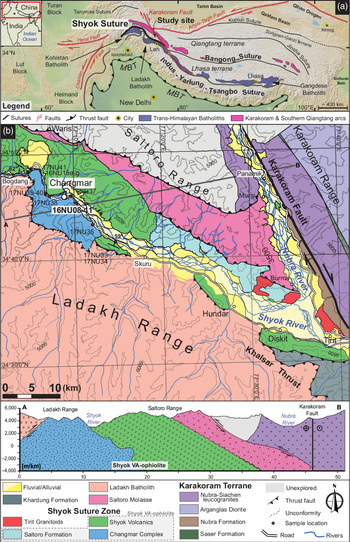
(a) Tectonic overview of the Himalaya and Tibet showing major sutures, faults and tectonic blocks, as well as an extent of the Trans-Himalayan, Karakoram and Qiangtang plutonic rocks. Basemap sourced from GeoMapApp® software (Ryan et al. Reference Ryan, Carbotte, Coplan, O’Hara, Melkonian, Arko, Weissel, Ferrini, Goodwillie, Nitsche and Bonczkowski2009). (b) Geological map of the Shyok and Nubra river confluence, modified after Phillips (Reference Phillips2008) and Borneman et al. (Reference Borneman, Hodges, van Soest, Bohon, Wartho, Cronk and Ahmad2015), with addition of the Changmar Complex. Map datum: WGS84 UTM Zone 43N; elevation contour interval 500 m. The co-ordinates for each sample location are provided in Table 1.

In this paper, we report the first Jurassic U–Pb zircon ages and Hf isotope data for newly documented gabbronorite and plagiogranite rock suite (here named the Changmar Complex) collected from the Shyok Suture along the Shyok Valley in NW India, near the India–Pakistan Line of Control (Fig. 1). The Jurassic rocks of the Changmar Complex are interpreted to represent the remnants of a mature island arc that developed within the Shyok ophiolite, together referred to as the Shyok volcanic-arc ophiolite (VA-ophiolite). New data presented here are compared with rocks of similar age and composition reported from the Kohistan, Karakoram and Tibet regions, to evaluate the feasibility of a divergent double subduction zone as a potential mechanism for the closure of the Shyok and Bangong sutures.
2. Geological background
The geological elements involved in the tectonic collision along the Shyok and Bangong sutures, from north to south, are: (1) the active continental margin of Eurasia, composed of the Karakoram and Southern Qiangtang terranes (Fig. 2; e.g. Searle et al. Reference Searle, Parrish, Tirrul and Rex1990; Ravikant et al. Reference Ravikant, Wu and Ji2009; Groppo et al. Reference Groppo, Rolfo, McClelland and Coble2019); (2) the Mesotethys Ocean, represented by ophiolites, ophiolitic mélanges and intra-oceanic arc system (the Shyok VA-ophiolite and Kohistan Arc) along the Shyok Suture in the western Himalaya (e.g. Rolland et al. Reference Rolland, Pêcher and Picard2000; Clift et al. Reference Clift, Hannigan, Blusztajn and Draut2002; Robertson & Collins, Reference Robertson and Collins2002; Thanh et al. Reference Thanh, Rajesh, Itaya, Windley, Kwon and Park2012; Borneman et al. Reference Borneman, Hodges, van Soest, Bohon, Wartho, Cronk and Ahmad2015), and a series of ophiolites and ophiolitic mélanges along the Bangong Suture in Tibet (e.g. Baxter et al. Reference Baxter, Aitchison and Zyabrev2009; Fan et al. Reference Fan, Li, Xie, Wang and Chen2015 b); and (3) the Lhasa microcontinent (e.g. Zhu et al. Reference Zhu, Zhao, Niu, Mo, Chung, Hou, Wang and Wu2011, Reference Zhu, Zhao, Niu, Dilek, Hou and Mo2013). The terranes involved in the collision along the Shyok–Bangong Suture are summarized on the tectonostratigraphic columns on Figure 2, and major terranes are discussed below.
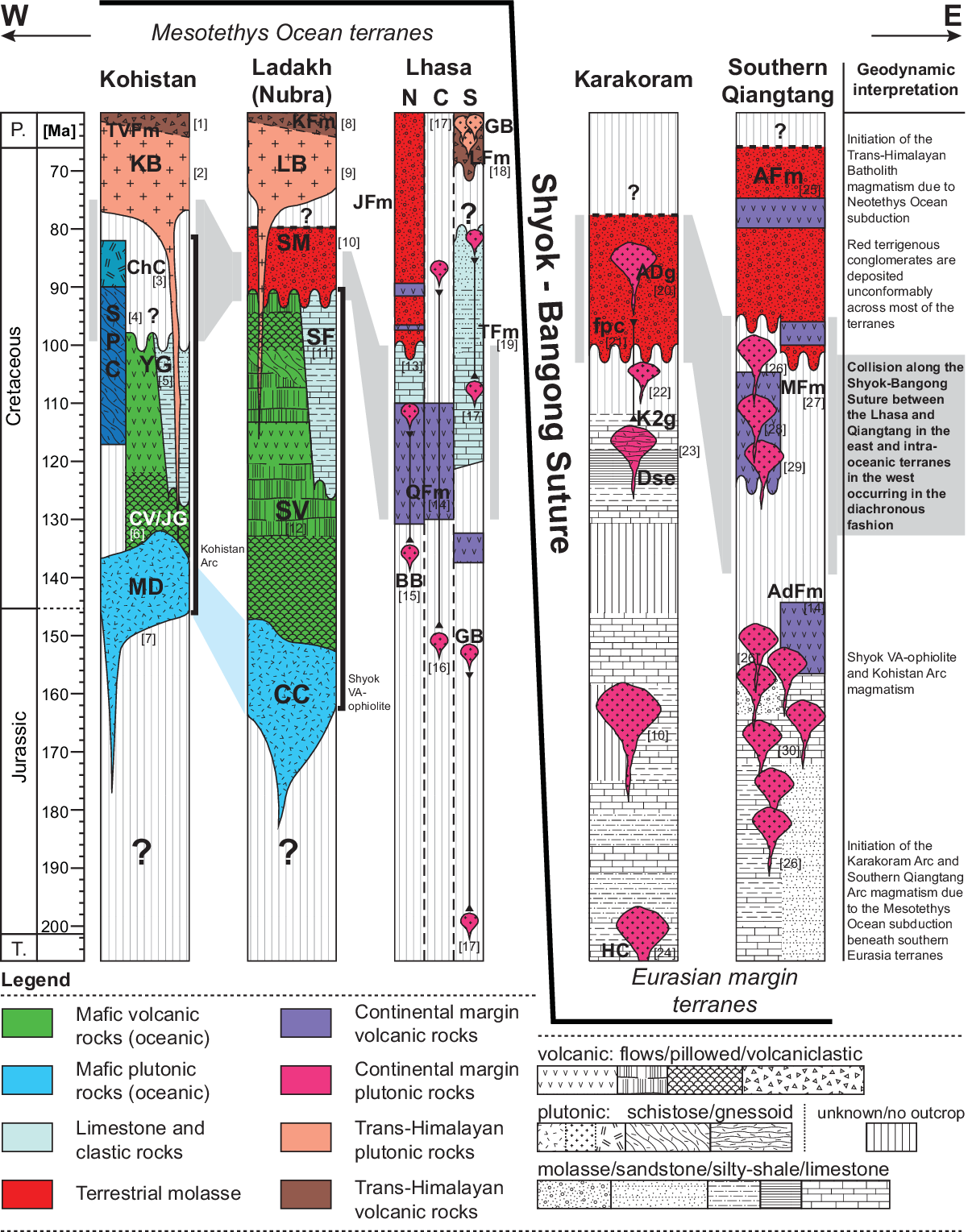
Generalized tectonostratigraphic columns for the regions discussed. The depicted sedimentary sequences for the Karakoram terrane shown without colour represent country rocks and do not correspond to the geological timescale. Stratigraphic columns are shown from west (left) to east (right). The along-strike (E–W) variation in rock types is also captured within each column for the Lhasa, Karakoram and Southern Qiangtang terranes and follows the same west (left) to east (right) direction. AdFm – Amdo Formation; ADg – Aghil Dara granodiorite; AFm – Abushan Formation; BB – Baingoin Batholith; C – Central Lhasa; CC – Changmar Complex; ChC – Chilas Complex; CV/JG – Chalt Volcanics and Jalgot Group; Dse – Doksam sequence; fpc – fluvial polygenic conglomerate; GB – Gangdese Batholith; HC – Hushe Complex; JFm – Jingzhushan Formation; K2g – K2 gneiss; KB – Kohistan Batholith; KFm – Khardung Formation; LB – Ladakh Batholith; LFm – Linzizong Formation; MD – Matum Das tonalite and equivalent Jurassic plutonic rocks; MFm – Meiriqiecuo Formation; N – North Lhasa; QFm – Qushenla Formation; S – Southern Lhasa; SF – Saltoro Formation; SM – Saltoro Molasse; SPC – Southern Plutonic Complex; SV – Shyok Volcanics; TFm – Takena Formation; TVFm – Teru Volcanic Formation (Shamran Volcanics); YG – Yasin Group. Sources of the geological and geochronological data: [1] Khan et al. (Reference Khan, Stern, Manton, Copeland, Kimura and Khan2004); [2] Bouilhol et al. (Reference Bouilhol, Jagoutz, Hanchar and Dudas2013); [3] Schaltegger et al. (Reference Schaltegger, Zeilinger, Frank and Burg2002); [4] Dhuime et al. (Reference Dhuime, Bosch, Bodinier, Garrido, Bruguier, Hussain and Dawood2007); [5] Pudsey (Reference Pudsey1986); [6] Khan et al. (Reference Khan, Murata, Karim, Zafar, Ozawa and Hafeez ur2007); [7] Jagoutz et al. (Reference Jagoutz, Bouilhol, Schaltegger, Müntener, Treolar and Searle2018); [8] Dunlap & Wysoczanski (Reference Dunlap and Wysoczanski2002); [9] Honegger et al. (Reference Honegger, Dietrich, Frank, Gansser, Thöni and Trommsdorff1982); [10] Borneman et al. (Reference Borneman, Hodges, van Soest, Bohon, Wartho, Cronk and Ahmad2015); [11] Juyal (Reference Juyal2006); Upadhyay (Reference Upadhyay2014); [12] Rolland et al. (Reference Rolland, Pêcher and Picard2000); Dunlap & Wysoczanski (Reference Dunlap and Wysoczanski2002); Thanh et al. (Reference Thanh, Rajesh, Itaya, Windley, Kwon and Park2012); [13] Wang et al. (Reference Wang, Pan, Ding and Yao2013); [14] Zhu et al. (Reference Zhu, Li, Cawood, Wang, Zhao, Liu and Wang2016); [15] Haider et al. (Reference Haider, Dunkl, Eynatten, Ding, Frei and Zhang2013); [16] Zhu et al. (Reference Zhu, Zhao, Niu, Mo, Chung, Hou, Wang and Wu2011); [17] Ji et al. (Reference Ji, Wu, Chung, Li and Liu2009); [18] Zhou et al. (Reference Zhou, Mo, Dong, Zhao, Qiu, Guo and Wang2004); [19] Leier et al. (Reference Leier, Decelles, Kapp and Ding2007); [20] Groppo et al. (Reference Groppo, Rolfo, McClelland and Coble2019); [21] Gaetani (Reference Gaetani2016); [22] Ravikant et al. (Reference Ravikant, Wu and Ji2009); Thanh et al. (Reference Thanh, Itaya, Ahmad, Kojima, Ohtani and Ehiro2010); Kumar et al. (Reference Kumar, Bora, Sharma, Yi and Kim2017); Pundir et al. (Reference Pundir, Adlakha, Kumar and Singhal2020); [23] Searle et al. (Reference Searle, Parrish, Tirrul and Rex1990); [24] Rex et al. (Reference Rex, Searle, Tirrul, Crawford, Prior, Rex and Barnicoat1988); [25] Li et al. (Reference Li, He, Wang, Santosh, Dai, Zhang, Wei and Wang2013); [26] Li et al. (Reference Li, Ding, Guilmette, Fu, Xu, Yue and Henrique-Pinto2017 b); [27] Fan et al. (Reference Fan, Li, Xie, Wang and Chen2015 a); [28] Li et al. (Reference Li, Qin, Li, Evans, Zhao, Cao and Zhang2017 a); [29] Li et al. (Reference Li, Li, Sun and Wang2017 c); [30] Li et al. (Reference Li, Zhu, Wang, Zhao, Sui, Liu, Liu and Mo2014).

2.a. Karakoram Arc
An Andean-type convergent-margin magmatism occurred along the southern Eurasian continent throughout Jurassic–Cretaceous time, giving rise to the Karakoram Arc (e.g. Rex et al. Reference Rex, Searle, Tirrul, Crawford, Prior, Rex and Barnicoat1988; Groppo et al. Reference Groppo, Rolfo, McClelland and Coble2019). The preserved part of this continental arc is c. 700 km long and 30 km wide, and consists of an intermediate to felsic calc-alkaline plutonic complex in the northwestern Himalaya (e.g. Searle & Hacker, Reference Searle, Hacker, Treolar and Searle2018) that intrudes the Palaeozoic–Mesozoic sedimentary rocks of the Karakoram terrane (Gaetani, Reference Gaetani1997). The Karakoram Arc was active from Late Jurassic – Late Cretaceous time (162–83 Ma, see Fig. 2; Borneman et al. Reference Borneman, Hodges, van Soest, Bohon, Wartho, Cronk and Ahmad2015; Groppo et al. Reference Groppo, Rolfo, McClelland and Coble2019; Pundir et al. Reference Pundir, Adlakha, Kumar and Singhal2020) as the oceanic slab of the Mesotethys was subducting to the north beneath Eurasia, until the Kohistan Arc and Shyok VA-ophiolite collided with Eurasia and shut off slab-driven magmatism (e.g. Borneman et al. Reference Borneman, Hodges, van Soest, Bohon, Wartho, Cronk and Ahmad2015; Groppo et al. Reference Groppo, Rolfo, McClelland and Coble2019). The intrusive rocks of the Karakoram Arc are characterized by negative εHf values of −4 to −2 (Ravikant et al. Reference Ravikant, Wu and Ji2009), reflecting the assimilation of old and evolved continental crust (e.g. Amelin et al. Reference Amelin, Lee, Halliday and Pidgeon1999). Calc-alkaline rocks younger than c. 83 Ma have not been documented within the Karakoram Block, but intrusions of the extensive post-collisional Nubra-Siachen leucogranites (Fig. 1) occurred between 21 and 13 Ma (e.g. Searle & Hacker, Reference Searle, Hacker, Treolar and Searle2018).
2.b. Tethyan oceans
In the Tethyan realm the Palaeotethys and Neotethys oceans are well-defined geographically with well-established tectonic relationships with their bounding terranes (e.g. Şengör, Reference Şengör and Sengör1984; Dilek & Furnes, Reference Dilek and Furnes2019), but this is not so clear for the Mesotethys Ocean. The Palaeotethys and Neotethys oceans were associated with the beginning of the Tethyan realm (Palaeotethys) during Early Devonian time and its demise (Neotethys) in the Palaeogene Period (Searle et al. Reference Searle, Windley, Coward, Cooper, Rex, Rex, Tingdong, Xuchang, Jan, Thakur and Kumar1987; Aitchison et al. Reference Aitchison, Xia, Baxter and Ali2011; Metcalfe, Reference Metcalfe2013). In the Tethyan tectonic framework, the Mesotethys Ocean existed at the transition between the Palaeotethys and the Neotethys (Permian? – Late Cretaceous; Metcalfe, Reference Metcalfe2013). The Mesotethys is regarded as having formed during the rift and drift of the Cimmerian continent from Gondwana during Late Palaeozoic – Mesozoic time (e.g. Metcalfe, Reference Metcalfe1996). Northwards drift of the Cimmerian continent consumed the Palaeotethys in the north, while opening the Mesotethys to the south (Metcalfe, Reference Metcalfe1996, Reference Metcalfe2013). Closure of the main Palaeotethys Ocean basin occurred from the west in the Pamirs to the east in the Malay Peninsula along the following sutures: Jinsha (Tanymas), Changning-Menglian, Chiang Mai/Inthanon, Chanthaburi and Bentong-Raub (Metcalfe, Reference Metcalfe2013; Zanchetta et al. Reference Zanchetta, Worthington, Angiolini, Leven, Villa and Zanchi2018).
The Mesotethys Ocean has also been called the Bangong–Nujiang Tethyan Ocean (e.g. Zhu et al. Reference Zhu, Zhao, Niu, Dilek, Hou and Mo2013), the Bangong Ocean (Pullen et al. Reference Pullen, Kapp, Gehrels, Ding and Zhang2011) or the Shyok Ocean/Sea/Basin (Searle et al. Reference Searle, Khan, Fraser, Gough and Jan1999; Thanh et al. Reference Thanh, Rajesh, Itaya, Windley, Kwon and Park2012; Chapman et al. Reference Chapman, Scoggin, Kapp, Carrapa, Ducea, Worthington, Oimahmadov and Gadoev2018), and its oceanic crust referred to as the Kshiroda Plate (Jagoutz et al. Reference Jagoutz, Royden, Holt and Becker2015). Two mechanisms were proposed for the closure of the Mesotethys: (1) northwards subduction beneath Eurasia (e.g. Allègre et al. Reference Allègre, Courtillot, Tapponnier, Hirn, Mattauer, Coulon, Jaeger, Achache, Scharer, Marcoux, Burg, Girardeau, Armijo, Gariepy, Gopel, Tindong, Xuchang, Chenfa, Guangqin, Baoyu, Jiwen, Naiwen, Guoming, Tonglin, Xibin, Wanming, Huaibin, Yougong, Ji, Hongrong, Peisheng, Songchan, Bixiang, Yaoxiu and Xu1984); and (2) northwards subduction beneath Eurasia and concurrent southwards subduction beneath Gondwana (Metcalfe, Reference Metcalfe2013; Zhu et al. Reference Zhu, Zhao, Niu, Dilek, Hou and Mo2013, Reference Zhu, Li, Cawood, Wang, Zhao, Liu and Wang2016), that led to rifting of the micro-continental Lhasa terrane from northern Gondwana during the Late Triassic – Early Jurassic period (e.g. Zhu et al. Reference Zhu, Zhao, Niu, Mo, Chung, Hou, Wang and Wu2011). To the north, the Mesotethys Ocean was bound from west to east by the Karakoram terrane, the Southern Qiangtang and the Sibumasu terrane (Metcalfe, Reference Metcalfe2013; Groppo et al. Reference Groppo, Rolfo, McClelland and Coble2019). To the south, the Mesotethys was bound by the intra-oceanic Kohistan–Shyok island-arc system, which was located to the west of the micro-continental ribbon of the Lhasa terrane (e.g. Groppo et al. Reference Groppo, Rolfo, McClelland and Coble2019). The Eurasian margin and southern Mesotethys terranes are now separated by the Shyok Suture in Pakistan (e.g. Petterson & Treloar, Reference Petterson and Treloar2004) and Ladakh (e.g. Borneman et al. Reference Borneman, Hodges, van Soest, Bohon, Wartho, Cronk and Ahmad2015) and the Bangong Suture in Tibet (e.g. Baxter et al. Reference Baxter, Aitchison and Zyabrev2009) and possibly the Myitkyina Suture and Shan Boundary in SE Asia (Liu et al. Reference Liu, Sun-Lin, Fu-Yuan, Chang, Yang, Jian-Gang, Yi and Shun2016). Ophiolitic and island complexes along these sutures mark the extant Mesotethys Ocean (Baxter et al. Reference Baxter, Aitchison and Zyabrev2009; Liu et al. Reference Liu, Sun-Lin, Fu-Yuan, Chang, Yang, Jian-Gang, Yi and Shun2016).
Rifting of the Lhasa terrane from Gondwana during Late Triassic – Early Jurassic time opened the Neotethys Ocean (Zhu et al. Reference Zhu, Zhao, Niu, Mo, Chung, Hou, Wang and Wu2011). This ocean basin was further separated from the Mesotethys by the initiation of the Kohistan–Shyok intra-oceanic arc system during Late Jurassic time (Jagoutz et al. Reference Jagoutz, Royden, Holt and Becker2015, Reference Jagoutz, Bouilhol, Schaltegger, Müntener, Treolar and Searle2018). The closure of the Neotethys Ocean along the Indus–Yarlung–Tsangpo Suture marks the final stage of the Himalayan orogeny, and has been extensively covered in the literature (e.g. Searle et al. Reference Searle, Windley, Coward, Cooper, Rex, Rex, Tingdong, Xuchang, Jan, Thakur and Kumar1987; Gibbons et al. Reference Gibbons, Zahirovic, Müller, Whittaker and Yatheesh2015; Aitchison et al. Reference Aitchison, Ali and Davis2007; Searle & Treloar, Reference Searle, Treloar, Treolar and Searle2019). The Indus–Yarlung–Tsangpo Suture marks the boundary between Eurasia and India in Ladakh, and Lhasa and India in Tibet, with intra-oceanic-arc terranes and ophiolites of the Neoethys preserved along the suture (Aitchison et al. Reference Aitchison, Ali and Davis2007; Hébert et al. Reference Hébert, Bezard, Guilmette, Dostal, Wang and Liu2012; Metcalfe, Reference Metcalfe2013; Buckman et al. Reference Buckman, Aitchison, Nutman, Bennett, Saktura, Walsh, Kachovich and Hidaka2018; Walsh et al. Reference Walsh, Buckman, Nutman and Zhou2019).
2.c. Tethyan intra-oceanic-arc system
There is an ongoing debate over whether the Tethyan intra-oceanic arc that consists of the Kohistan Arc and Shyok VA-ophiolite first collided with Eurasia or India. In the first hypothesis, the arc accreted to Eurasia between c. 85 and 75 Ma along the Shyok Suture and the final continent–continent collision between India and Eurasia took place later along the Indus–Yarlung–Tsangpo Suture (Petterson & Windley, Reference Petterson and Windley1985; Treloar et al. Reference Treloar, Rex, Guise, Coward, Searle, Windley, Petterson, Jan and Luff1989; Robertson & Degnan, Reference Robertson and Degnan1994; Clift et al. Reference Clift, Hannigan, Blusztajn and Draut2002; Robertson & Collins, Reference Robertson and Collins2002; Borneman et al. Reference Borneman, Hodges, van Soest, Bohon, Wartho, Cronk and Ahmad2015). In the second hypothesis, the arc collided first with India at c. 50 Ma and the final continental collision occurred at c. 40 Ma along the Shyok Suture (Khan et al. Reference Khan, Walker, Hall, Burke, Shah and Stockli2009; Burg, Reference Burg, Brown and Ryan2011; Bouilhol et al. Reference Bouilhol, Jagoutz, Hanchar and Dudas2013). Both models have merit; however, more data on the early development stages of the magmatic arcs within the Tethyan realm are needed to understand geodynamic evolution of this intra-oceanic system.
2.c.1. Shyok VA-ophiolite
The Shyok VA-ophiolite within the Shyok Suture is a relic of an ocean basin and is strongly dismembered in comparison to the other Tethyan ophiolites such as the Spongtang (Pedersen et al. Reference Pedersen, Searle and Corfield2001; Buckman et al. Reference Buckman, Aitchison, Nutman, Bennett, Saktura, Walsh, Kachovich and Hidaka2018) or Semail (Coleman, Reference Coleman1981; Searle & Cox, Reference Searle and Cox1999). VA-ophiolitic rocks crop out along the NW–SE-trending Shyok Suture of the Shyok Valley and were described as ‘Ophiolitic Mélange’ (Gansser, Reference Gansser1974; Frank et al. Reference Frank, Gansser and Trommsdorff1977). These rocks are tectonically dismembered, but are not enveloped in schistose mud or serpentinite matrix as observed in the Northern Suture, Pakistan (e.g. Pudsey, Reference Pudsey1986). This suggests the Shyok VA-ophiolite was emplaced via obduction rather than in the form of a diapiric mélange. Pervasive deformation of the rock units has resulted in poor preservation of the original ophiolitic stratigraphy and outcrops of the Shyok VA-ophiolite occur as a disrupted ophiolitic sequence (e.g. Dunlap & Wysoczanski, Reference Dunlap and Wysoczanski2002; Thanh et al. Reference Thanh, Rajesh, Itaya, Windley, Kwon and Park2012).
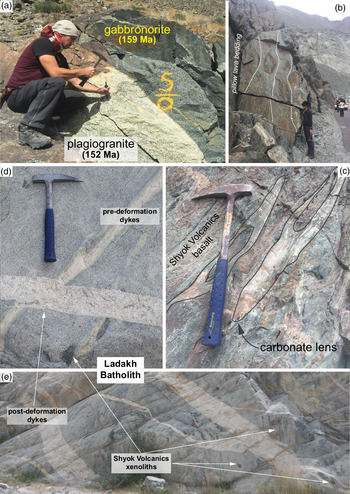
The most abundant ophiolitic element present within the Shyok Suture are the Shyok Volcanics (Fig. 1), which along with the Changmar Complex compose the Shyok VA-ophiolite. The Shyok Volcanics display pillow basalt structures with minor carbonate lenses (Fig. 3b,c). This formation has been deformed and metamorphosed to greenschist facies (Dunlap & Wysoczanski, Reference Dunlap and Wysoczanski2002; Thanh et al. Reference Thanh, Rajesh, Itaya, Windley, Kwon and Park2012). There is an ambiguity in nomenclature for the mafic volcanic rocks that are distributed along the Shyok River (Fig. 1). These are commonly referred to as the Shyok Volcanics by Frank et al. (Reference Frank, Gansser and Trommsdorff1977), Sharma et al. (Reference Sharma, Sinha, Bagdasarian and Gukasian1978), Rai (Reference Rai, Thakur and Sharma1983), Bhutani et al. (Reference Bhutani, Pande and Venkatesan2009) and Borneman et al. (Reference Borneman, Hodges, van Soest, Bohon, Wartho, Cronk and Ahmad2015) or the Shyok Formation by Thakur et al. (Reference Thakur, Virdi, Rai and Gupta1981), Weinberg et al. (Reference Weinberg, Dunlap and Whitehouse1999) and Dunlap & Wysoczanski (Reference Dunlap and Wysoczanski2002). However, these rocks were also called the Shyok volcanite by Upadhyay et al. (Reference Upadhyay, Sinha, Chandra and Rai1999), mélange unit by Rolland et al. (Reference Rolland, Pêcher and Picard2000), metavolcanics by Thanh et al. (Reference Thanh, Rajesh, Itaya, Windley, Kwon and Park2012) or the Shyok Volcanic Formation by Ravikant et al. (Reference Ravikant, Wu and Ji2009). The originally named Shyok Volcanics most frequently refer to the greenschist mafic volcanic rocks that include pillow basalts with minor chert or limestone that are interpreted to be the volcanic portion of an ophiolite sequence. They form part of the Saltoro Range and crop out near Diskit and along the length of the Shyok Valley in the northern Nubra region up to Bogdang village (Fig. 1; Frank et al. Reference Frank, Gansser and Trommsdorff1977; Thakur et al. Reference Thakur, Virdi, Rai and Gupta1981; Thanh et al. Reference Thanh, Rajesh, Itaya, Windley, Kwon and Park2012). However, the name Shyok Formation is used for a greenschist facies rocks that are predominantly sedimentary and occur in the southern Nubra region, and consist of marbles, slates, andesites and andesitic volcaniclastic rocks (Dunlap & Wysoczanski, Reference Dunlap and Wysoczanski2002; Ehiro et al. Reference Ehiro, Kojima, Sato, Ahmad and Ohtani2007; Kumar et al. Reference Kumar, Bora and Sharma2016). The Shyok Formation possibly overlies the basaltic volcanic pile of the Shyok Volcanics (Shyok VA-ophiolite), representing a stratigraphical continuation; however, field relationships have not been established.
(a) Gabbronorite (16NU08) and plagiogranite (16NU09) exposure from the Changmar Complex along the Diskit–Turtuk highway; (b) exposure of the pillow basalts of the Shyok Volcanics (16NU15) in the northwestern part of the Shyok Valley (34.80667° N, 77.07969° E); (c) carbonate lenses (outlined) within the Shyok Volcanics (34.80667° N, 77.07969° E); (d) close-up of a foliated granodiorite of the Ladakh Batholith which contains abundant mafic xenoliths from the Shyok Volcanics and is intruded by pre- and post-deformation dykes (34.822086° N, 76.928657° E); (e) outcrop where close-up (d) was taken, showing more xenoliths.

Rolland et al. (Reference Rolland, Pêcher and Picard2000) suggested that the Shyok Volcanics are of middle Cretaceous age (108–92 Ma) based on the presence of Orbitolina foraminifera in limestones interbedded with the volcanic rocks. This supports the interpretation that the Shyok Volcanics are related to the Shyok Formation, which also contains Orbitolina fossils. The Orbitolina fossils in the Shyok Formation were found in the Changthang area near the village of Tsoltak, c. 90 km SE from the area on Figure 1, and were dated as of early–middle Albian age (Reuber, Reference Reuber1990; Matsumaru et al. Reference Matsumaru, Ehiro and Kojima2006). This age conflicts with the fossil ages of Rolland et al. (Reference Rolland, Pêcher and Picard2000); however, the exact stratigraphic relationships between these formations are unknown.
The Saltoro Formation (Fig. 1) consists of siltstones, turbidite sandstones, slates, phyllites, shallow-water limestones and marbles containing Aptian–Albian Horiopleura, Orbitolina, Radiolitidae and Rudist fossils (Upadhyay, Reference Upadhyay2001, Reference Upadhyay2014; Juyal, Reference Juyal2006), as well as Cheilostomata bryozoans of possible Jurassic age (Upadhyay et al. Reference Upadhyay, Sinha, Chandra and Rai1999). The Saltoro Formation unconformably overlies the Shyok Volcanics (Upadhyay, Reference Upadhyay2001, Reference Upadhyay2014; Juyal, Reference Juyal2006), and the formations are similar in age, which suggests that the Saltoro Formation likely represents a sedimentary cover of the Shyok VA-ophiolite. There is no direct contact between the Saltoro Formation and the Shyok Formation from the southern Nubra region, but there is an overlap in Aptian–Albian age between these two formations. Based on the composition of each formation, it is possible that the Saltoro and Shyok formations formed the uppermost sedimentary section of the Shyok VA-ophiolite, where the Shyok Formation was deposited close to the volcanic centre and the Saltoro Formation away from it. Upadhyay (Reference Upadhyay2014) noted similarities between Rudist fauna and microfaunal assemblages of the Saltoro Formation and those of the Yasin Group in northern Kohistan, which unconformably overlies volcanic rocks of the Kohistan Arc (e.g. Bard, Reference Bard1983; Fig. 2), just as the Saltoro Formation unconformably overlies the Shyok Volcanics of the Shyok VA-ophiolite. The broad range in the biostratigraphic ages from the Saltoro Formation suggests that the Shyok VA-ophiolite obduction did not occur until after early–middle Cretaceous time.
Due to the lack of a well-defined plateau in an 40Ar–39Ar age, the radiometric dating of the Shyok Volcanics resulted in only a minimum formation age of c. 125 Ma (Dunlap & Wysoczanski, Reference Dunlap and Wysoczanski2002; Borneman et al. Reference Borneman, Hodges, van Soest, Bohon, Wartho, Cronk and Ahmad2015). Thanh et al. (Reference Thanh, Rajesh, Itaya, Windley, Kwon and Park2012) used the K–Ar method to date metamorphic albite in boninite and obtained an age of 104.4 ± 5.6 Ma for the metamorphism of the Shyok Volcanics, which they interpreted as a minimum age for the exhumation of the ophiolitic rocks. The crystallization age for these rocks is yet to be established, but must be older than the middle Cretaceous metamorphic ages.
Red conglomerates and sandstones of the Saltoro Molasse unconformably overlay the Shyok Volcanics and Saltoro Formation (Fig. 2; Upadhyay et al. Reference Upadhyay, Sinha, Chandra and Rai1999). The Saltoro Molasse was interpreted as deposited in a syn- to post-collisional environment, on top of the Shyok Suture rocks; it therefore post-dates the collision along the Shyok Suture (Upadhyay et al. Reference Upadhyay, Sinha, Chandra and Rai1999; Borneman et al. Reference Borneman, Hodges, van Soest, Bohon, Wartho, Cronk and Ahmad2015). The youngest detrital zircon age population of c. 92 Ma from this molasse indicates when the collision between the Shyok VA-ophiolite and Karakoram terrane was completed (Borneman et al. Reference Borneman, Hodges, van Soest, Bohon, Wartho, Cronk and Ahmad2015). A granitic dyke with an age of c. 85 Ma intrudes the unconformity between the Saltoro Molasse and Shyok Volcanics, and provides another control on the depositional age of this molasse (92–85 Ma; Borneman et al. Reference Borneman, Hodges, van Soest, Bohon, Wartho, Cronk and Ahmad2015).
2.c.2. Field relationship similarities along the Shyok Suture
The Shyok Volcanics in the Ladakh region could be related to the Chalt Volcanics in Kohistan as suggested by Thanh et al. (Reference Thanh, Rajesh, Itaya, Windley, Kwon and Park2012); this is based on their basic composition, presence of boninites and comparable minimum ages of c. 104 Ma for the Shyok Volcanics and c. 134 Ma for Chalt Volcanics (Fig. 2; Khan et al. Reference Khan, Murata, Karim, Zafar, Ozawa and Hafeez ur2007; Thanh et al. Reference Thanh, Rajesh, Itaya, Windley, Kwon and Park2012). The volcanic pile of the Southern Group described by Rolland et al. (Reference Rolland, Pêcher and Picard2000) is similar to the Shyok Volcanics and was investigated in the area of Thalle and Muchilu, c. 100 km NW along the Shyok Suture from our study area. These basalt-basaltic andesite lava flows, tuffs and pillowed units of the Southern Group were intruded by the Ladakh Batholith and unconformably overlain by conglomeritic molasse (Rolland et al. Reference Rolland, Pêcher and Picard2000). These rock relationships match those of the Shyok Valley and Saltoro Range (Fig. 1), where the ophiolitic Shyok Volcanics (basalts-basaltic trachyandesites, Table 1) are intruded by the Ladakh Batholith (Fig. 3d, e) and are unconformably overlain by the Saltoro Molasse (Upadhyay et al. Reference Upadhyay, Sinha, Chandra and Rai1999; Borneman et al. Reference Borneman, Hodges, van Soest, Bohon, Wartho, Cronk and Ahmad2015). Further west from Thalle, Shyok VA-ophiolite-related rocks within the Shyok Suture were documented by Robertson & Collins (Reference Robertson and Collins2002) where, in addition to pillow basalts and ultramafic rocks, the radiolarian cherts and volcaniclastic sandstones were found in the Tectonic Mélange near Shigar in Pakistan, c. 130 km NW from our study area. These lithological descriptions from Pakistan are consistent with those along the Shyok Valley, and probably represent different elements of the same volcanic-arc ophiolite that was dismembered along the Shyok Suture.
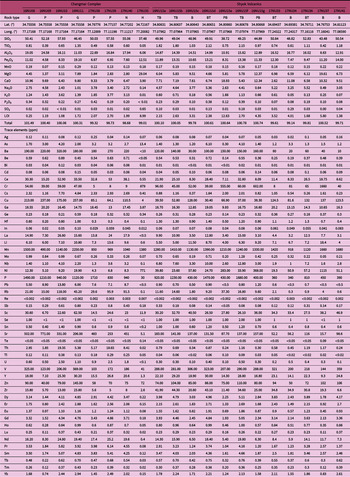
Whole-rock major and trace element geochemistry for the Changmar Complex and Shyok Volcanics from this study with the corresponding sample locations (WGS84 UTM Zone 43N). B – basalt; BT – basaltic trachyandesite; G – gabbronorite; H – harzburgite; Lat. – latitude; Long. – longitude; N – norite; P – plagiogranite; PB – pillow basalt; TB – trachybasalt.

A further c. 300 km W–NW from our study area near Gilgit, the Matum Das tonalite along the Shyok Suture in Pakistan is the oldest intrusive rock found within the Kohistan Arc (Schaltegger et al. Reference Schaltegger, Frank and Burg2003; Jagoutz et al. Reference Jagoutz, Bouilhol, Schaltegger, Müntener, Treolar and Searle2018). The Matum Das tonalite could be related to the Changmar Complex rocks from the Nubra region (Fig. 2). In the Kohistan region, the basaltic Chalt Volcanics are intruded by the Matum Das, and both formations are stitched by the Kohistan Batholith (Fig. 2; Petterson & Windley, Reference Petterson and Windley1985). Similarly, in the Nubra region, the Shyok Volcanics, which are considered to be related to the Chalt Volcanics (Thanh et al. Reference Thanh, Rajesh, Itaya, Windley, Kwon and Park2012), are intruded by the Changmar Complex; both formations are stitched by the Ladakh Batholith, which has many basaltic xenoliths of the Shyok Volcanics or Changmar Complex (Figs 2, 3). The Matum Das tonalite is deformed and cross-cut by the basic and undeformed Jutal dykes (Coward et al. Reference Coward, Jan, Rex, Tarney, Thirlwall and Windley1982; Petterson & Windley, Reference Petterson and Windley1985). The Rb–Sr isochron dating of the Matum Das yielded an age of c. 102 Ma and 40Ar–39Ar dating of the Jutal dykes an age of c. 75 Ma. This original geochronology and field relationships are used to bracket the collision of the Kohistan Arc with Eurasia (Petterson & Windley, Reference Petterson and Windley1985), but the age of the tonalite has been extended to Late Jurassic (Schaltegger et al. Reference Schaltegger, Frank and Burg2003; Jagoutz et al. Reference Jagoutz, Bouilhol, Schaltegger, Müntener, Treolar and Searle2018).
3. Field relationships
We investigated outcrops of the Shyok VA-ophiolite rocks along the Shyok Suture in the Nubra region along the Diskit–Turtuk Highway from Hundar to Turtuk. We named the newly discovered intrusive suite the Changmar Complex, after the nearby village of Changmar that lies in the middle of this unit (Fig. 1). The Changmar Complex is composed of norites, gabbronorites, plagiogranites, harzburgites and serpentinites. These units are intrusive amongst each other; for example, a plagiogranite intrudes the surrounding gabbronorite (Fig. 3a). This complex extends between Bogdang and Skuru villages, measuring c. 15 km along NW–SE strike (Fig. 1). Its width is approximately 12 km in an E–W direction, where its eastern exposure extent is marked by the Shyok River and the Shyok Volcanics are exposed on the opposite riverbank (Fig. 1). The original contact between the Changmar Complex and Shyok Volcanics is not exposed as the alluvial fans are covering the contact. The contact is now faulted, but the original relationship was probably intrusive into the volcanic pile or part of the original VA-ophiolite sequence. The western boundary is marked by the Ladakh Batholith, which intrudes the Changmar Complex and Shyok Volcanics, where the granodiorite plutons of the Ladakh Batholith contain mafic xenoliths of these formations (Figs 2, 3d, e). This contact was later modified by the Khalsar Thrust (Fig. 1). The Khalsar Thrust disrupts all contacts in the northern part of the Shyok Valley, where the Changmar Complex and Shyok Volcanics are always in fault contact, and in turn both are a footwall to the Ladakh Batholith (Fig. 1).
Depicted in Figure 3 are the sampled outcrops from the northern part of the Shyok Valley; their global positioning system locations are provided in Table 1. Gabbronorite and plagiogranite samples 16NU08 and 16NU09 were collected from a large slab on the side of the road that broke off the adjacent cliff face just 10 m away (Fig. 3a) at the road sign indicating 6 km to Changmar. This outcrop reveals an intrusive relationship between the dominant coarse-grained gabbronorite and younger plagiogranite. The plagiogranite displays a minor chilled margin, and a small amount of chalcopyrite mineralization in the gabbronorite is present along the contact. Field mapping of the ranges above the Diskit–Turtuk Highway established the presence of the harzburgite bodies (Table 1). The contact is interpreted to be intrusive (gabbronorites-plagiogranites intruding the harzburgite); however, the exact nature of the contact could not be established at this locality due to minimal exposure caused by an extensive alluvial sediment cover. The contact between the gabbroic rocks and harzburgite shows signs of serpentinization.
The outcrop of the Shyok Volcanics shown in Figure 3b, c was found in the northern Shyok Valley near the village of Bogdang (Fig. 1), and is the location of samples 16NU15a–g (co-ordinates provided in Table 1 and Fig. 3). In this part of the valley the Shyok Volcanics are less deformed in comparison to the schistose outcrops near Diskit and Hundar (Fig. 1). Pillow basalts are common (Fig. 3b), and other basalts are massive with minor limestone lenses (Fig. 3c). Other than thin carbonate lenses within the basalts, no other sedimentary or volcaniclastic rocks were found among exposures between Skuru and Bogdang villages (Fig. 1).
4. Analytical methods
4.a. Major and trace elements
Weathered surfaces or fracture-affected material was cut off from the collected samples in order to obtain unaltered rock interior. Approximately 100 g of the fresh rock was crushed using Tungsten Carbide ring grinder (TEMA). For trace-element analysis, 5 g of rock powder was mixed with polyvinyl acetate (PVA) and fused into buttons in aluminium cups, dried for at least 12 hours in an oven at a temperature of 60°C, and then analysed using SPECTRO XEPOS X-ray fluorescence (XRF) spectrometer at University of Wollongong. The same instrument was used to conduct major-element analysis, for which rock powders were fused with 12% tetraborate and 22% metaborate flux to produce glass buttons used in the analysis.
Rare earth elements (REEs) and other trace elements were analysed using inductively coupled plasma mass spectrometry (ICP-MS) at ALS Minerals Division, Brisbane (geochemical procedure ME-MS61r). A pulverized sample was added to lithium metaborate/lithium tetraborate flux and fused in a furnace to form beads. Each bead is cooled and dissolved in an acid mixture containing nitric, hydrochloric and hydrofluoric acids. The resulting solution is neutralized and diluted before being analysed by ICP-MS. Standards used were OREAS 120 and STSD-1, and results are within a 10% error tolerance. Trace-element data reported in this study are based on ICP-MS results, not the XRF.
Standardized characterization and discrimination of whole-rock geochemical data was carried out using the software GDCKit (Janousek et al. Reference Janousek, Farrow and Erban2006).
4.b. U–Pb zircon dating
Zircon grains were extracted by conventional density and isodynamic methods from 3 kg of rock sample. Zircon grain concentrates were handpicked, avoiding grains with abundant mineral inclusions, and c. 150 grains from each sample, as well as 20 grains of the standards TEMORA-2 (Black et al. Reference Black, Kamo, Allen, Davis, Aleinikoff, Valley, Mundil, Campbell, Korsch, Williams and Foudoulis2004) and 10 grains of OG1 (Stern et al. Reference Stern, Bodorkos, Kamo, Hickman and Corfu2009), were cast into an epoxy resin mount. The encapsulated grains were ground to expose a middle section through the majority of the grains, and then polished with 1 µm diamond paste. The mount was mapped using reflected light and cathodoluminescence (CL) imaging. The U–Pb zircon dating was carried out at the Australian National University (ANU) in Canberra using the SHRIMP RG instrument. Analytical procedures followed those described by Williams (Reference Williams1998). The analytical spot size was c. 20 μm. Raw data were reduced using the ANU new data reduction software ‘POXI-SC’. The 206Pb/238U ratio of unknowns was calibrated using measurements of TEMORA-2 (U–Pb ages concordant at 417 Ma; Black et al. Reference Black, Kamo, Allen, Davis, Aleinikoff, Valley, Mundil, Campbell, Korsch, Williams and Foudoulis2004) undertaken after every third analyses of unknowns; standard results are reported in online Supplementary Table S1 (available at http://journals.cambridge.org/geo). U and Th abundance was calibrated using measurement of the reference zircon SL13 (U = 238 ppm) located in a set-up mount. The reduced and calibrated data were assessed and plotted using the ISOPLOT Excel™ software add-in of Ludwig (Reference Ludwig2008), and finalized results are presented in Table 2.
4.c. Lu–Hf isotopic analysis
Zircon Lu–Hf isotopic measurements were conducted on the Research School of Earth Sciences, ANU ThermoFinnigan Neptune multi-collector (MC) ICP-MS coupled to a 193 nm ArF excimer laser fitted with a HelEx He atmosphere ablation cell using methods as described in Hiess et al. (Reference Hiess, Bennett, Nutman and Williams2009). The laser pulsed at 5 Hz with an energy density of 10 J cm–2, and the samples were ablated using a 42 × 42 μm square spot. A gas blank and a suite of five reference zircons with varying REE contents (Monastery, Mud Tank, FC1, Plesovice and QGNG) were analysed after every 10–15 unknown sample spots throughout the session as quality control monitors. The mass spectrometer intensity and peaks were tuned with NIST SRM 610 glass, which has c. 450 ppm of Hf. Typical 178Hf signal intensity at the start of ablation on the zircons was 4 V. An array of nine Faraday cups was set up in a static collection scheme. Complete Lu–Hf isotopic analyses for the samples are presented in Table 3 and results for the reference zircons analysed in the same session can be viewed in online Supplementary Table S2 (available at http://journals.cambridge.org/geo). Details of instrument set-up for the session are also given in Table S2.
5. Results
5.a. Petrography
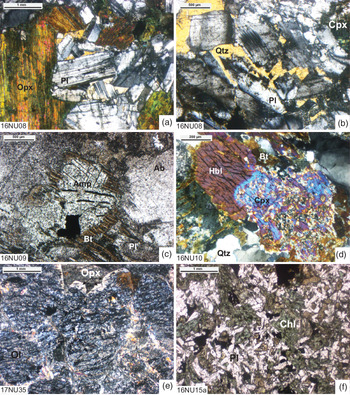
The gabbronorite sampled for dating (16NU08) displays slight grain alignment in outcrop which can also be seen under the microscope. It consists of plagioclase (60%), clinopyroxene (22%), orthopyroxene (15%), trace quartz and accessory ilmenite, magnetite and apatite (Fig. 4a, b). It is holocrystalline, with equigranular medium grain texture. A hypidiomorphic crystal texture is observed, where Fe-rich phases (clinopyroxene and orthopyroxene) show signs of disequilibrium/re-absorption with later felsic phases (plagioclase and quartz) as evident by the rounded crystal shape, reaction/alteration coronas and embayments. In contrast, plagioclase is euhedral with characteristic lamellar multiple-twinning textures, with some crystals showing zonation. Quartz is rare and occurs interstitially between other silicates; it is almost exclusively associated with plagioclase (Fig. 4a, b). Zircon crystals are observed within these quartz intergranular fillings. Evidence of minor alteration is observed along grain boundaries and microfractures in the form of sericitization of plagioclase and chloritization of pyroxenes.
Petrographic microphotographs of thin-sections from samples investigated in this study. Abbreviation nomenclature is from Kretz (Reference Kretz1983). (a, b) Gabbronorite 16NU08 showing coarse grain composition, defined by euhedral plagioclase and pyroxenes. Interstitial quartz can be seen on both photographs, but it is not common. (c) Plagiogranite 16NU09 showing strong alteration, evident by dusty texture and breakdown of amphibole into biotite; (d) Plagiogranite 16NU10 showing breakdown of clinopyroxene to hornblende. Quartz content is higher than in 16NU09. (e) Harzburgite 17NU35 preserving olivine morphology, but has completely been converted into secondary products, mainly chlorite. (f) Basalt of the Shyok Volcanics (16NU15a) showing high plagioclase content, whereas rest of the Fe-rich phases have altered into chlorite.

A plagiogranite sample (16NU09) from the rock intruding the gabbronorite (Fig. 3c) displays clear crystal alignment. This plagiogranite consists of plagioclase (80%), biotite (5%), amphibole (4%), muscovite (3%), chlorite (2%), quartz (2%) and accessory ilmenite, magnetite and apatite. It displays a holocrystalline porphyritic texture, dominated by plagioclase which is subhedral to euhedral. This sample shows signs of hydrothermal alteration with pyroxenes and amphiboles being extensively replaced and broken down to biotite and chlorite, as well as accessory second-generation iron oxide (Fig. 4c). Plagioclase shows signs of alteration in the form of dusty texture and sericitization. Quartz exists in interstitial form, filling intergranular space between other silicates. Another plagiogranite sample (16NU10) shows very similar composition and textures to 16NU09, but with higher quartz content and lesser alteration (Fig. 4d).
Harzburgite sample (17NU35) is altered to serpentinite and no unaltered primary minerals remain. However, thin-section petrography reveals that serpentine and chlorite has pseudomorphed olivine, which dominated the primary mineralogy (Fig. 4e). Small altered phenocrysts of orthopyroxene are observed and minor tremolite occurs as a high-temperature alteration phase. The olivine pseudomorphs are studded with small grains of opaque minerals (magnetite) within the crystals and along the fractures, a by-product of the serpentinization reaction.
Sample 16NU15a is representative of the massive basalts that make up the bulk of the Shyok Volcanics (Fig. 4f). It is aphanitic and green in appearance as a result of chlorite alteration associated with greenschist facies metamorphism. In thin-section, randomly orientated microcrysts of plagioclase are the only primary mineral left unaltered from the original protolith. Other primary minerals and glass matrix have been altered to chlorite and sericite (Fig. 4f).
5.b. Whole-rock major- and trace-element geochemistry
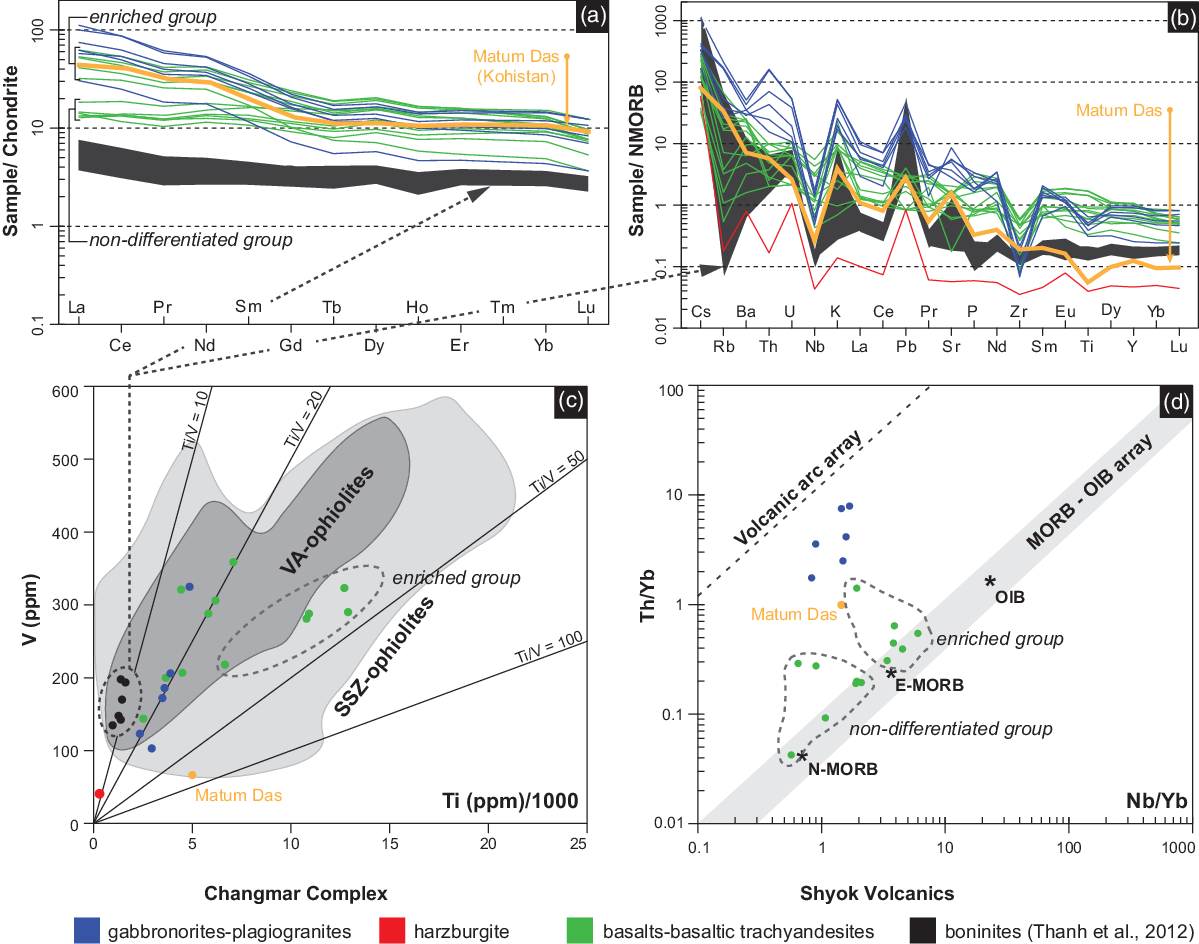
Geochemical results are presented in Table 1. The intrusive Changmar Complex is composed of gabbronorites and plagiogranites with SiO2 values ranging between 50 and 57%, with relatively low MgO (1.4–4.5%), variable Fe2O3 (4.6–11%), low–moderate CaO (3.8–11%) and low TiO2 (0.4–0.8%) values. The K2O content varies between 1.2 and 3.7%, and Na2O between 2.4 and 4.6%. The observed major-element variation is attributed to evolving magma composition. Light REEs (LREEs) are enriched relative to heavy REEs (HREEs) (3.2 < CeN/YbN < 6.3; Fig. 5a). On the normal mid-ocean-ridge basalt (N-MORB) normalized plots the Changmar Complex rocks display well-defined Nb- and Ti-negative anomalies and strong Pb- and Sr-positive anomalies, suggesting an origin in a supra-subduction zone (SSZ) setting (e.g. Pearce, Reference Pearce and Thorpe1982). The geochemistry data for the Matum Das tonalite (Jagoutz et al. Reference Jagoutz, Bouilhol, Schaltegger, Müntener, Treolar and Searle2018) from the Kohistan Arc has been plotted for comparison with the Changmar Complex rocks (Fig. 5). Both rock formations are of Late Jurassic age and have similar subduction-zone-related geochemistry patterns; they are therefore suggested to be related in terms of their tectonic setting. However, the degree of LREE and large-ion lithophile element (LILE) enrichment is higher for the Changmar Complex. On the Ti/V plot of Shervais (Reference Shervais1982) the Changmar Complex samples plot between Ti/V 10 to 20 ratios and within the array for typical volcanic-arc ophiolites in the subduction-related ophiolite compilation of Dilek & Furnes (Reference Dilek and Furnes2011). The harzburgite sample from the Changmar Complex displays a slight positive Eu anomaly and Lu-depletion on an N-MORB-normalized plot (Fig. 5b). The N-MORB-normalized trace-element plot shows distinctly parallel patterns between the gabbroic rocks and harzburgite, suggesting that the latter represents an early cumulate phase rather than the residual mantle peridotite from which melts were extracted. On the Nb/Yb–Th/Yb plot of Pearce (Reference Pearce2008), the Changmar Complex intrusive rocks plot as a cluster within the volcanic-arc array (Fig. 5d).
Whole-rock geochemical plots for the Changmar Complex and Shyok Volcanics, as well as boninites from the Shyok Volcanics shown as the black fields on plot (a) and (b), adopted from Thanh et al. (Reference Thanh, Rajesh, Itaya, Windley, Kwon and Park2012). Data for the Matum Das tonalite from Jagoutz et al. (Reference Jagoutz, Bouilhol, Schaltegger, Müntener, Treolar and Searle2018). (a) REE concentrations for the Shyok VA-ophiolite samples normalized to chondrite after Sun & McDonough (Reference Sun and McDonough1989). (b) Trace-element distribution, data normalized to N-MORB after Sun & McDonough (Reference Sun and McDonough1989). (c) Ti/V plot of Shervais (Reference Shervais1982) showing samples analysed in this study and boninites from the study of Thanh et al. (Reference Thanh, Rajesh, Itaya, Windley, Kwon and Park2012). The encircled are the Shyok Volcanics samples from the enriched group (see Results), whereas the remaining samples belong to non-differentiated group (except 17NU37, which plots next to the boninite group. The VA-ophiolites and SSZ-ophiolites shaded fields represent data distribution for corresponding ophiolite types from the global ophiolite survey of Dilek & Furnes (Reference Dilek and Furnes2011). Note that the SSZ-ophiolites field includes back-arc, fore-arc and oceanic back-arc subtype ophiolites. (d) Nb/Yb v. Th/Yb plot of Pearce (Reference Pearce2008) showing results for the Changmar Complex and Shyok Volcanics. The samples from the latter are circled based on the subgrouping in plot (a) (see Section 5.b).

The Shyok Volcanics are predominantly basaltic, with SiO2 values ranging between 44 and 51%, with highly variable MgO (4.7–19%), variable Fe2O3 (7.5–14%), highly variable CaO (2.6–12.4%) and moderate TiO2 (0.4–2.1%) values. The K2O content varies between 0.05 and 1.1%, and Na2O between 0.5 and 5.5%. Sample 16NU15e was excluded from major-element data interpretation due to observed calcite veining within it. Our petrographic examination has revealed that the Shyok Volcanics have been affected by sericitization and chloritization and, for this reason, we characterize these rocks using only the trace elements that are immobile and remain unaffected by these processes (e.g. Ward et al. Reference Ward, McArthur and Walsh1992). On the chondrite-normalized plot (Fig. 5a) the Shyok Volcanics split into two subgroups: the LREE/HREE non-differentiated (0.9 < CeN/YbN < 1.6) and LREE/HREE enriched (3.1 < CeN/YbN < 6.3; median = 3.8). The non-differentiated group consists of the following samples: 16NU15c,16NU15e, 16NU15g, 17NU33, 17NU34 and 17NU41; the enriched group consists of samples of 16NU15a, 16NU15b, 16NU15d, 16NU15f, 17NU36 and 17NU37. On the Ti/V plot of Shervais (Reference Shervais1982) the non-differentiated group plots between 10 and 20 ratios along with the Changmar Complex. The enriched group (except 17NU37) plots between 20 and 50 ratios and within the SSZ ophiolite field, out of the volcanic-arc ophiolite array (Fig. 5c). Both groups contain 16NU15a–g samples which were sampled along a 50-m stratigraphically coherent and continuous outcrop; the array of samples from this outcrop therefore points to the magma heterogeneity rather than long-term ophiolite evolution. Normalized to N-MORB, the Shyok Volcanics display negative Nb and Zr anomalies, and slightly positive Pb and Sr anomalies. Such characteristics along with the LREE and LILE enrichments are consistent with the supra-subduction zone basalts (Fig. 5b; Pearce, Reference Pearce and Thorpe1982). The Shyok Volcanics spread across the N-MORB and E-MORB fields on the Nb/Yb–Th/Yb plot of Pearce (Reference Pearce2008) and display a Th-enrichment-driven shift into the volcanic-arc array (Fig. 5d), which is consistent with a subduction-zone-related environment.
5.c. U–Pb–Hf zircon geochronology
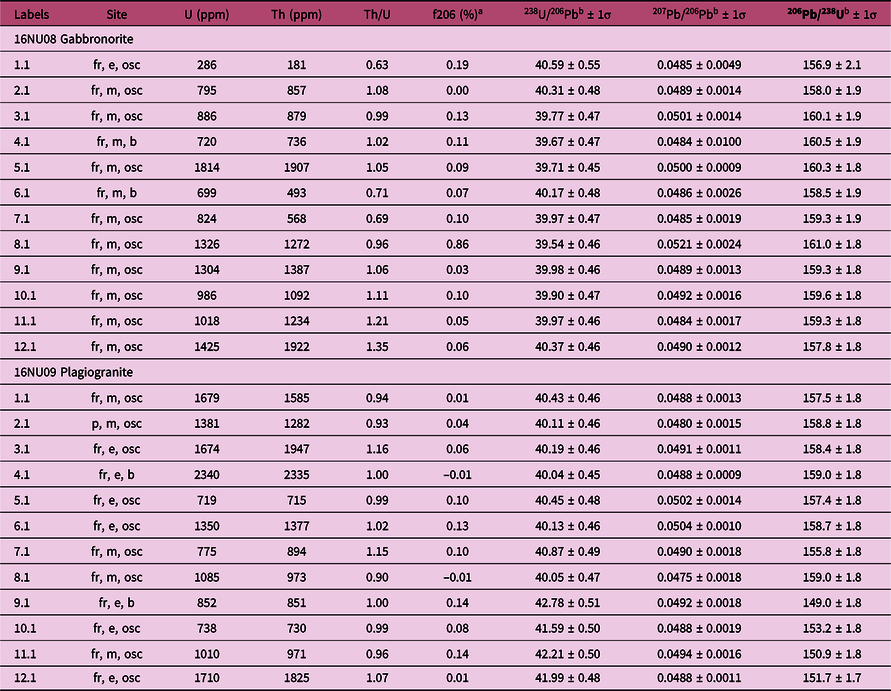
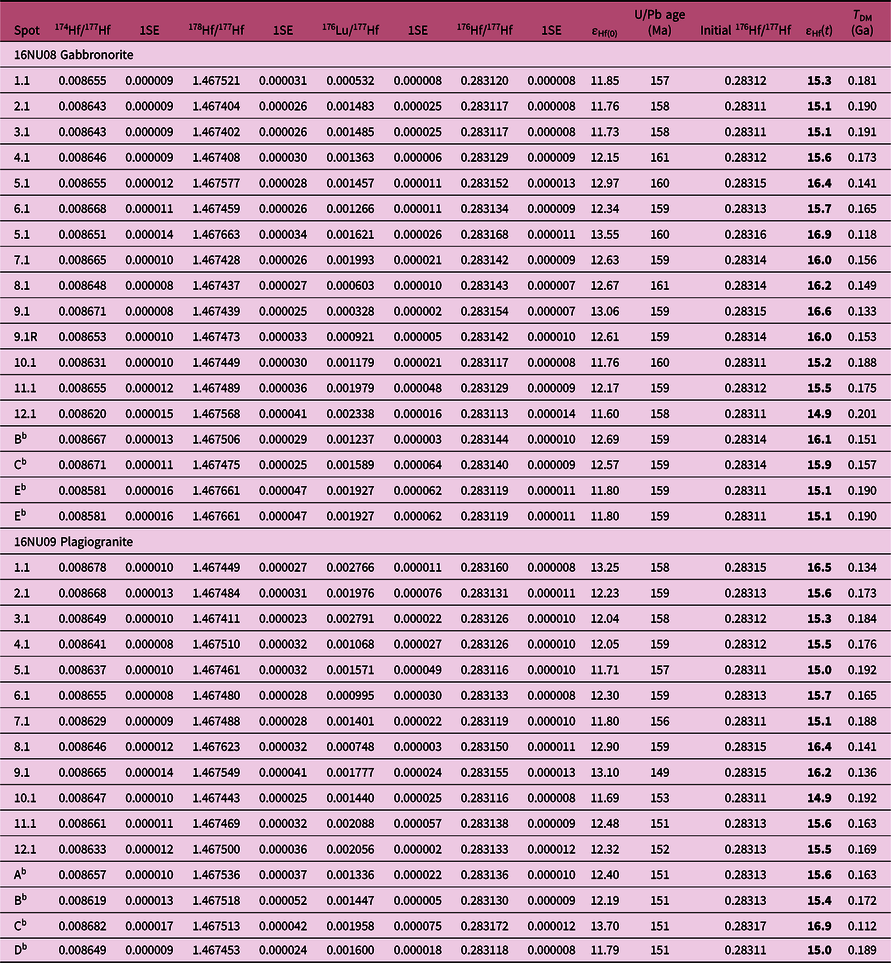
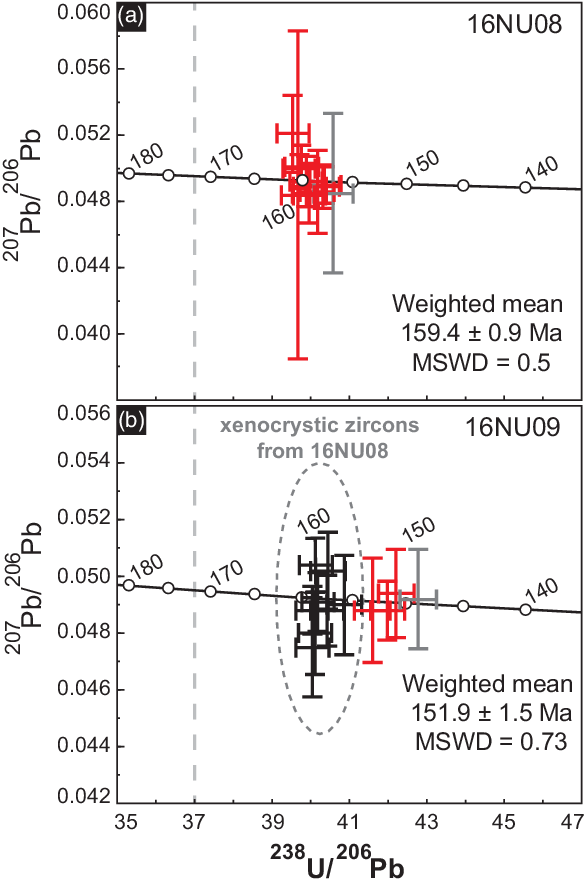
SHRIMP U–Pb zircon dating results for the gabbronorite (16NU08) and plagiogranite (16NU09) are reported in Table 2. The 204Pb-corrected ratios are plotted on Tera-Wasserburg concordia diagrams (Fig. 6). Zircon grains from both the gabbronorite and plagiogranite samples were analysed using laser ablation (LA) -MC-ICP-MS to determine their initial εHf values which are presented in Table 3. The Lu–Hf analyses were conducted directly over all the U–Pb dating sites with four additional sites on non-dated zircons, producing 16 analyses per sample.
Summary of SHRIMP U–Pb ages (Ma) of zircons from the gabbronorite and plagiogranite of the Changmar Complex. Abbreviations: b – broad zoned; e – end; fr – fragment; h – homogeneous; hd – homogeneous dark, low luminescence; m – middle; osc – oscillatory zoned; p – prism; r – rounded by abrasion.

a f206 (%) is the amount of 206Pb modelled as non-radiogenic, based on measured 204Pb.
b Corrected for common Pb using measured 204Pb and Cumming & Richards (Reference Cumming and Richards1975) common Pb composition for likely age of rock.
Lu–Hf isotopic results summary for SHRIMP-dated zircons from gabbronorite and plagiogranite a of the Changmar Complex. SE – standard error.

a Reference materials used: FC-1, QGNG, Monastery, Mud Tank (Woodhead & Hergt, Reference Woodhead and Hergt2005) and Plešovice (Sláma et al. Reference Sláma, Košler, Condon, Crowley, Gerdes, Hanchar, Horstwood, Morris, Nasdala, Norberg, Schaltegger, Schoene, Tubrett and Whitehouse2008); see online Supplementary Table S2.
b Analysis conducted on zircons which do not have U–Pb age, MSWD age of the rock sample was used to determine initial εHf(t) values for these zircons; εHf calculated using CHUR values from Bouvier et al. (Reference Bouvier, Vervoort and Patchett2008); depleted mantle model ages calculated using estimates of 176Hf/177Hf = 0.283251 and 176Lu/177Hf = 0.0389 for the modern upper mantle.
Tera-Wasserburg concordia diagrams for U–Pb ratios of SHRIMP analysed zircons from (a) gabbronorite and (b) plagiogranite. Red crosses refer to the analysis spots used in age determination, grey to those that were excluded and black to those that are xenocrystic.

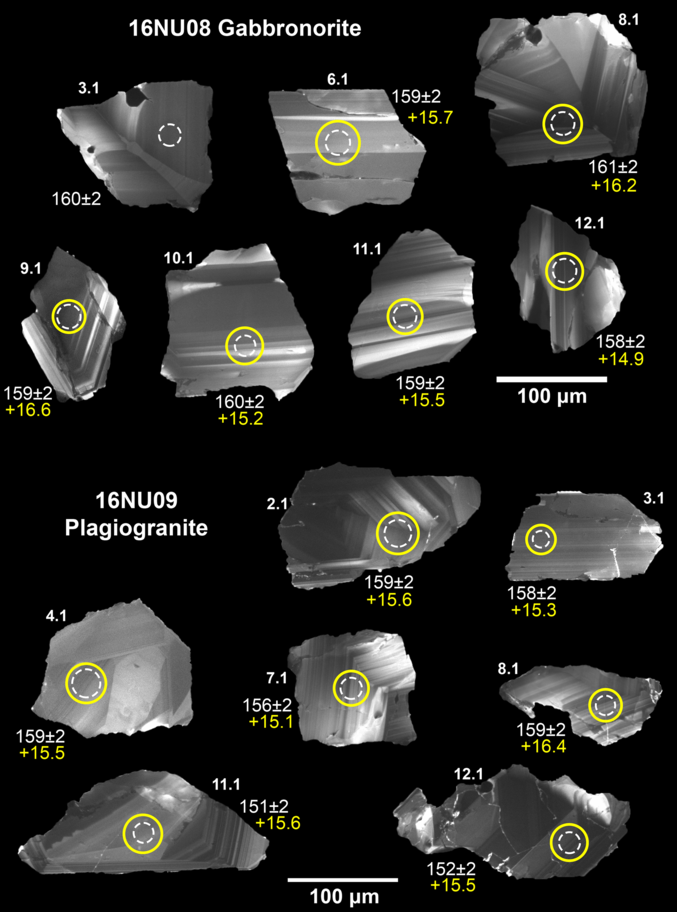
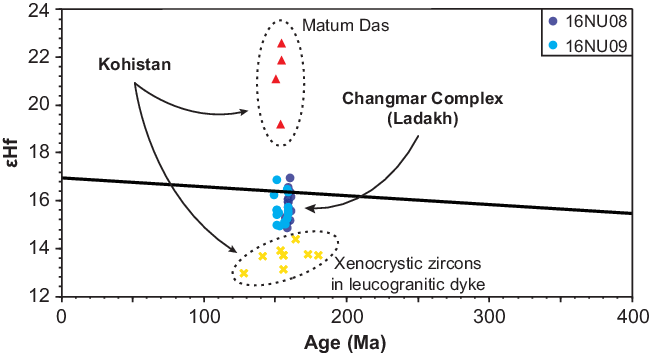
Zircons from the gabbronorite (16NU08) show clear oscillatory and broad zoning (Fig. 7), with a Th/U ratio range of 0.63–1.35. All analyses yielded a weighted mean 206Pb/238U age of 159.3 ± 0.8 Ma (MSWD = 1.6; n = 12) without rejection of any data (Fig. 6a). If the spread beyond analytical error was modelled as to the result of a small amount of radiogenic Pb loss, a single grain (spot 4.1) was excluded and the remaining 11 analyses agreeing within error yield a weighted mean age of 159.4 ± 0.9 Ma (MSWD = 0.5; n = 11), which we interpret as the crystallization age for the gabbronorite. The gabbronorite zircons show highly depleted εHf(t) signatures ranging from +14.9 to +16.9 (Fig. 8; Table 3), in accordance with estimated depleted mantle compositions and indicating a juvenile mantle as the sole magma source.
Zircon plate showing cathodoluminescence images of seven representative zircons from gabbronorite and plagiogranite analysed in this study. White circles indicate SHRIMP analytical spots; yellow circles indicate LA-ICP-MS analytical spots.

U–Pb zircon age v. εHf(t) display of data for the Changmar Complex analysed in this study, and Matum Das tonalite from the Kohistan Arc sourced from Jagoutz et al. (Reference Jagoutz, Bouilhol, Schaltegger, Müntener, Treolar and Searle2018). Sample 16NU08 is the gabbronorite and 16NU09 is the plagiogranite from the outcrop shown in Figure 3a.

Zircons from the plagiogranite (16NU09) show similar characteristics to the gabbronorite zircons, but oscillatory zoning is more common (Fig. 7) and their Th/U ratio range is 0.9–1.16. The zircons yielded a distinctly bimodal 206Pb/238U age distribution (Fig. 6b). Eight grains within the older population yielded a weighted mean 206Pb/238U age of 158.1 ± 0.9 Ma (MSWD = 1.5). The large MSWD is caused by analysis spot 7.1 with the youngest apparent age of 155.8 ± 1.8 Ma. If this is attributed to minor loss of radiogenic Pb, then the remaining seven analyses yield a weighted mean 206Pb/238U age of 158.4 ± 1.1 Ma (MSWD = 0.23). This age is indistinguishable from the 159.4 ± 0.9 Ma age of the gabbronorite host. All four analyses from the younger group of grains, still of magmatic character, yielded a weighted mean 206Pb/238U age of 151.2 ± 2.8 Ma (MSWD = 3.9; n = 4). The large MSWD is caused by analysis 9.1 with the youngest apparent age of 149.0 ± 1.8 Ma. If this is attributed to minor loss of radiogenic Pb, then the remaining three sites yield a weighted mean 206Pb/238U age of 151.9 ± 1.5 Ma (MSWD = 0.73), which we interpret as the crystallization age for the plagiogranite. The older population is interpreted as xenocrystic grains. Zircons from the plagiogranite also show highly depleted εHf(t) signatures ranging from +14.9 to +16.9, indicating that the sources of the gabbronorite and plagiogranite, in terms of Hf isotopic composition, are indistinguishable (Fig. 8; Table 3).
6. Discussion
6.a. Shyok VA-ophiolite
The Late Jurassic Changmar Complex (159–152 Ma) represents the oldest recorded magmatic activity within the Shyok Suture in Ladakh. This robust age, coupled with the highly juvenile initial Hf isotopic signature (εHf = +14.9 to +16.9) provides a new and important age for the onset of intra-oceanic island-arc magmatism within the Mesotethys Ocean. The Changmar Complex displays geochemical signatures typical of a mature island-arc setting with high LREE and LILE enrichments (Fig. 5a, b) that are driven by a hydrous melting of a depleted mantle wedge, with the sediment or fluid input from a subducting slab into the generated melt (e.g. Dilek et al. Reference Dilek, Furnes and Shallo2008). The Changmar Complex therefore does not represent a crystalline gabbroic suite of MORB-like oceanic crust, but rather an intrusive complex within a mature intra-oceanic island arc that developed within a supra-subduction zone ophiolitic crust which formed prior to 159 Ma (Late Jurassic).
The Shyok Volcanics from this study display significant LREE and LILE enrichments with negative Nb and Zr anomalies and slightly positive Pb and Sr anomalies, characteristic of supra-subduction zone magmas (Fig. 5a, b) where sediments or fluids from a subducting slab have contributed to hydrous melt generation (e.g. Pearce, Reference Pearce and Thorpe1982; Dilek et al. Reference Dilek, Furnes and Shallo2008). The same patterns were observed for the Changmar Complex; however, the degree of LREE and LILE enrichment is lower and more variable in the Shyok Volcanics. Slightly different degrees of the LREE enrichment between the volcanic and intrusive rocks suggest that, while they belong to the same supra-subduction zone arc, they formed during different stages of arc evolution. The lower degree of enrichment in the non-differentiated group of the Shyok Volcanics (Fig. 5a; Section 5.b) suggests less sediment or fluid input into the melt, which could mean these basalts formed during earlier stages of the ophiolite development. These differ from the fore-arc basalts and depleted-fore-arc basalts from recent International Ocean Discovery Program (IODP) Expedition 352 drilling (Reagan et al. Reference Reagan, Pearce, Petronotis, Almeev, Avery, Carvallo, Chapman, Christeson, Ferré, Godard, Heaton, Kirchenbaur, Kurz, Kutterolf, Li, Li, Michibayashi, Morgan, Nelson, Prytulak, Python, Robertson, Ryan, Sager, Sakuyama, Shervais, Shimizu and Whattam2017), which are related to the subduction initiation. The Shyok Volcanics are therefore likely to have formed during the later stages of the ophiolite formation. The enriched group of the Shyok Volcanics and, to a greater degree, the Changmar Complex (Fig. 5a, c; Section 5.b) are likely to represent even later stages of island-arc development, when magmatism progressed into advanced stages of hydrous melt generation above the subduction zone with significant sediment or fluid influences on the melt (e.g. Dilek et al. Reference Dilek, Furnes and Shallo2008). When plotted on Ti/V discrimination diagram (Shervais, Reference Shervais1982) and compared with the SSZ and VA ophiolites from the global ophiolite survey of Dilek & Furnes (Reference Dilek and Furnes2011), samples from the Shyok Volcanics and Changmar Complex, as well as the boninites from the Shyok Volcanics of Thanh et al. (Reference Thanh, Rajesh, Itaya, Windley, Kwon and Park2012), show affinity with the VA ophiolites (Fig. 5c). Together, the Shyok Volcanics and Changmar Complex are interpreted to be discrete elements of a volcanic-arc ophiolite, as defined by Dilek & Furnes (Reference Dilek and Furnes2011), here referred to as the Shyok VA-ophiolite. The Shyok Volcanics have similar geochemical trends and composition to those of the Southern Group from the Skardu area as described by Rolland et al. (Reference Rolland, Pêcher and Picard2000), which also show LREE and LILE enrichments and negative Nb anomalies. These are likely to be part of the same volcanic-arc ophiolite that was dismembered along the Shyok Suture; however, some elements are not present in the Nubra region. The other rock types expected to be found in typical VA ophiolite such as the sub-aerial more felsic volcaniclastic cover were not identified in this study; however, the Northern Group described by Rolland et al. (Reference Rolland, Pêcher and Picard2000) from the Shyok Suture near Skardu are more evolved and could represent the upper crustal part of the VA ophiolite not identified in the Nubra region.
The Changmar Complex pre-dates all previous formation ages for the Shyok VA-ophiolite and the Kohistan Arc; the new age of 159 Ma therefore provides an older minimum age for the formation of the Shyok VA-ophiolite. The intrusive rocks of this complex represent a well-developed island arc, which means the initiation of this arc system must have occurred prior to this date. The highly positive initial zircon εHf values of +14.9 to +16.9 from the Changmar Complex (Table 3; Fig. 8) reveal that the magma was juvenile and purely mantle-derived without continental crust contribution. The Changmar Complex from the Shyok VA-ophiolite therefore formed in an intra-oceanic island-arc setting prior to Late Jurassic time, and was remote from the continental crust influences of Eurasia or Lhasa terrane.
6.b. Jurassic intra-oceanic arc system
In northern Pakistan, the deformed Matum Das pluton and basic cross-cutting Jutal dykes were originally used to bracket the collision of the Kohistan Arc with Eurasia (102–75 Ma; Petterson & Windley, Reference Petterson and Windley1985). However, its isochron Rb–Sr age of c. 102 Ma was recently supplemented by a c. 154 Ma age with U–Pb zircon re-dating of the Matum Das (Schaltegger et al. Reference Schaltegger, Frank and Burg2003; Jagoutz et al. Reference Jagoutz, Bouilhol, Schaltegger, Müntener, Treolar and Searle2018). This 154 Ma age provides evidence for an earlier initiation of the Kohistan Arc magmatism (Jagoutz et al. Reference Jagoutz, Bouilhol, Schaltegger, Müntener, Treolar and Searle2018), and therefore the initiation of a new Jurassic subduction system within the Tethys Ocean. The U–Pb zircon ages and Hf signatures from the Changmar Complex (159–152 Ma; εHf = +15 to +17) are similar to those from the Kohistan Arc (180–128 Ma; εHf = +13 to +23), which includes the Matum Das tonalite and xenocrystic zircons in the post-collisional dyke from that region (Fig. 8). The Changmar Complex and the Matum Das tonalite share similar geochemical trends (Fig. 5a, b), that is, a similar degree of LREE to HREE enrichment, a lesser degree but comparable LILE enrichment, negative Nb and Ti anomalies and positive Pb and Sr anomalies (Fig. 5). Both the Changmar Complex and the Matum Das also share comparable field context, as both intruded basaltic volcanic formations, the Shyok Volcanics in Ladakh and the Chalt Volcanics in Kohistan (Fig. 2; Petterson & Windley, Reference Petterson and Windley1985). These similarities compel us to suggest that the Changmar Complex and the Matum Das tonalite were part of the same subduction system that formed the Shyok VA-ophiolite and the Kohistan Arc of the Shyok Suture (Fig. 9).
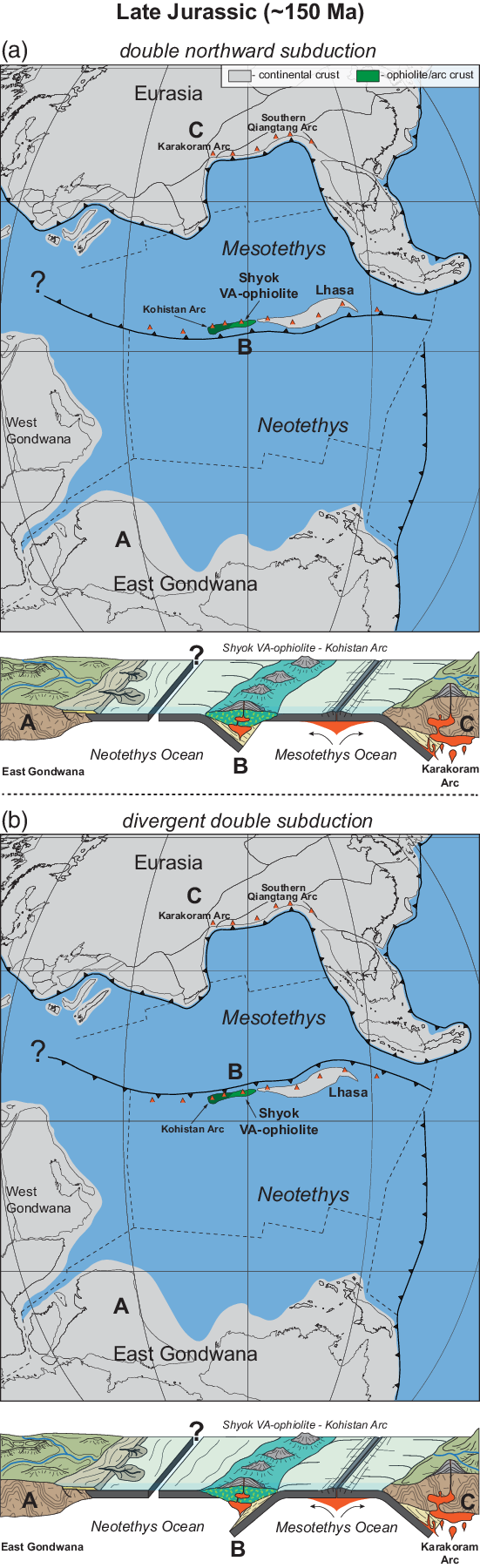
Schematic diagrams depicting two possible tectonic models for the closure of the Mesotethys Ocean. Plate reconstruction in Mollweide projection is derived and modified from the GPlates model of Seton et al. (Reference Seton, Müller, Zahirovic, Gaina, Torsvik, Shephard, Talsma, Gurnis, Turner, Maus and Chandler2012). The labels A–B–C on the planar view match the tectonic elements depicted in cross-sectional view. (a) Traditional double northwards subduction model (e.g. Tahirkheli et al. Reference Tahirkheli, Mattauer, Proust, Tapponnier, Farah and De Jong1979; Bard, Reference Bard1983; Coward et al. Reference Coward, Butler, Khan and Knipe1987; Robertson & Degnan, Reference Robertson and Degnan1994; Bignold & Treloar, Reference Bignold and Treloar2003; Jagoutz et al. Reference Jagoutz, Royden, Holt and Becker2015); and (b) divergent double subduction model (e.g. Soesoo et al. Reference Soesoo, Bons, Gray and Foster1997), where southwards subduction occurs from west to east beneath the Kohistan Arc and Shyok VA-ophiolite (Jan & Asif, Reference Jan and Asif1981; Andrews-Speed & Brookfield, Reference Andrews-Speed and Brookfield1982; Khan et al. Reference Khan, Stern, Gribble and Windley1997) and Lhasa (e.g. Zhu et al. Reference Zhu, Zhao, Niu, Dilek, Hou and Mo2013, Reference Zhu, Li, Cawood, Wang, Zhao, Liu and Wang2016) and where concurrently northwards subduction occurs beneath Eurasia, giving rise to the Karakoram Arc (e.g. Searle et al. Reference Searle, Khan, Fraser, Gough and Jan1999) and Southern Qiangtang Arc (Zhu et al. Reference Zhu, Li, Cawood, Wang, Zhao, Liu and Wang2016). Palaeolatitude of the Lhasa terrane was adjusted for 150 Ma timeframe using palaeolatitude data from Li et al. (Reference Li, Ding, Lippert, Song, Yue and van Hinsbergen2016). Positioning of the mid-ocean ridges and transform faults is hypothetical.

6.c. Subduction polarity, Mesotethys and Shyok–Bangong Suture
One issue that our results cannot reconcile is the polarity of the subduction zone above which the Shyok VA-ophiolite and Kohistan Arc were formed. The original view depicts the northwards subduction of the Neotethys Ocean underneath the oceanic crust of the Mesotethys (the Bangong or Shyok Ocean) forming the intra-oceanic Kohistan Arc while, further to the north, the same overriding oceanic plate was also subducting northwards but beneath southern Eurasia, giving rise to the Karakoram Arc (Fig. 9a; Tahirkheli et al. Reference Tahirkheli, Mattauer, Proust, Tapponnier, Farah and De Jong1979; Bard, Reference Bard1983; Pudsey, Reference Pudsey1986; Coward et al. Reference Coward, Butler, Khan and Knipe1987; Robertson & Degnan, Reference Robertson and Degnan1994; Treloar et al. Reference Treloar, Petterson, Jan and Sullivan1996; Searle et al. Reference Searle, Khan, Fraser, Gough and Jan1999; Jagoutz et al. Reference Jagoutz, Bouilhol, Schaltegger, Müntener, Treolar and Searle2018). The original model is valid; however, the same geodynamic realm can be explained by an alternative model.
Coeval magmatism of the Shyok VA-ophiolite, Kohistan Arc and Karakoram Arc can be driven by the divergent double subduction of the Mesotethys oceanic plate (Fig. 9b). This mechanism was postulated in this region by Jan & Asif (Reference Jan and Asif1981), Andrews-Speed & Brookfield (Reference Andrews-Speed and Brookfield1982) and Khan et al. (Reference Khan, Stern, Gribble and Windley1997), and opposed by Collins et al. (Reference Collins, Khan, Stern, Gribble and Windley1998) and Bignold & Treloar (Reference Bignold and Treloar2003). Khan et al. (Reference Khan, Stern, Gribble and Windley1997) supported southwards subduction beneath the Kohistan Arc with the progressive increase in high-field-strength element (HFSE) enrichment from north to south, from the Chalt Volcanics to Kamila Amphibolites, a pattern that was found consistent with a modern arc example such as the Izu–Bonin–Marianna Arc (Khan et al. Reference Khan, Stern, Gribble and Windley1997). The presence of boninites in the Chalt Volcanics found in the northern part of the Kohistan Arc was further used by Khan et al. (Reference Khan, Stern, Gribble and Windley1997) to support southwards subduction polarity as a result of their common occurence in the fore-arc regions. The boninites should not be solely used to infer tectonic setting (Bignold & Treloar, Reference Bignold and Treloar2003), as they are not entirely limited to fore-arc regions (e.g. Cooper et al. Reference Cooper, Plank, Arculus, Hauri, Hall and Parman2010). However, a fore-arc origin for the Shyok VA-ophiolite was also inferred from the boninites found within the Shyok Volcanics by Thanh et al. (Reference Thanh, Rajesh, Itaya, Windley, Kwon and Park2012), but this fore-arc ophiolitic crust was attributed to the Karakoram Arc. We find this interpretation unlikely because of the strong juvenile mantle signatutre (εHf = +15 to +17) in the ophiolitic rocks that contrasts the Andean-type Karakoram Arc that has an evolved signature (εHf = –4 to +2; Ravikant et al. Reference Ravikant, Wu and Ji2009). The fore-arc ophiolite to contiental arc, even evolved, is expected to have some characteristics of a continental-margin-type ophiolite still preserved (see Dilek & Furnes, Reference Dilek and Furnes2011). These could include subcontinetal mantle lhezorite fragments or widespread N-MORBs as a remanant of the continental rifting. Such rocks are not found in the Shyok Suture. It is likely that the Shyok Volcanics represent a fore-arc crust that belonged to an intra-oceanic-arc system (i.e. Shyok VA-ophiolite), rather than a continental arc as clearly demonstrated by the juvenile Hf isotope signatures. In such a tectonic arrangement, the fore-arc rocks of the Shyok Volcanics are better matched with the Chalt Volcanics in Pakistan as suggested by Thanh et al. (Reference Thanh, Rajesh, Itaya, Windley, Kwon and Park2012), which are interpreted to be a part of the fore-arc sequence of the Kohistan Arc (e.g. Petterson & Windley, Reference Petterson and Windley1991; Khan et al. Reference Khan, Stern, Gribble and Windley1997). This correlation favours southwards subduction to form the Shyok VA-ophiolite; however, it does not exclude formation by the northwards subduction as boninites are not restricted to fore-arcs. The mafic rocks from the Shyok Suture were interpreted to originate in arc (e.g. Borneman et al. Reference Borneman, Hodges, van Soest, Bohon, Wartho, Cronk and Ahmad2015), fore-arc (e.g. Thanh et al. Reference Thanh, Rajesh, Itaya, Windley, Kwon and Park2012) and back-arc environments (e.g. Robertson & Collins, Reference Robertson and Collins2002), which highlights the complexity of this suture along-strike. Unfortunately, our results alone cannot reconcile the subduction polarity issue in this geopuzzle; both possibilities are therefore considered feasible (Fig. 9).
A divergent double subduction model is also used to explain the closure of the Mesotethys Ocean and eventual collision between the Qiangtang and Lhasa terranes along the Bangong Suture in Tibet (e.g. Yin & Harrison, Reference Yin and Harrison2000; Metcalfe, Reference Metcalfe2013; Zhu et al. Reference Zhu, Zhao, Niu, Dilek, Hou and Mo2013, Reference Zhu, Li, Cawood, Wang, Zhao, Liu and Wang2016; Kapp & DeCelles, Reference Kapp and DeCelles2019; Li et al. Reference Li, Wang, Zhu, Cawood, Stern, Weinberg, Zhao and Mo2020). The southwards subduction beneath the Lhasa terrane and coeval northwards subduction beneath the Southern Qiangtang Arc in Tibet (e.g. Zhu et al. Reference Zhu, Zhao, Niu, Dilek, Hou and Mo2013, Reference Zhu, Li, Cawood, Wang, Zhao, Liu and Wang2016) is likely to correspond to the southwards subduction beneath the Shyok VA-ophiolite and northwards subduction beneath the Karakoram Arc in Ladakh region. This deductive inference of the south-facing subduction for the formation of the Shyok VA-ophiolite is consistent with previous models that propose a lateral continuation between the Shyok and Bangong sutures, prior to disruption by the Karakoram Fault (Phillips et al. Reference Phillips, Parrish and Searle2004; Baxter et al. Reference Baxter, Aitchison and Zyabrev2009; Robinson, Reference Robinson2009; Borneman et al. Reference Borneman, Hodges, van Soest, Bohon, Wartho, Cronk and Ahmad2015).
In this geotectonic arrangement, the Mesotethyan terranes such as the Shyok VA-ophiolite, Kohistan Arc and Lhasa were linked by the same Trans-Tethyan subduction system. During the Jurassic Period, these terranes would mark the southern boundary of the seaway tract (Mesotethys Ocean) that is represented by the matched Shyok and Bangong sutures (e.g. Phillips et al. Reference Phillips, Parrish and Searle2004; Baxter et al. Reference Baxter, Aitchison and Zyabrev2009; Robinson, Reference Robinson2009; Liu et al. Reference Liu, Xia, Zhong, Cai, Li, Liu, Cai and Sun2014; Borneman et al. Reference Borneman, Hodges, van Soest, Bohon, Wartho, Cronk and Ahmad2015) rather than matching the Shyok and Yarlung–Tsangpo sutures (cf. Jagoutz et al. Reference Jagoutz, Royden, Holt and Becker2015). This Mesotethyan subduction system might have been responsible for the rifting of the Lhasa terrane from Gondwana during Triassic–Jurassic time and the northwards drift of these terranes to eventually collide with Eurasia (Zhu et al. Reference Zhu, Zhao, Niu, Mo, Chung, Hou, Wang and Wu2011; Li et al. Reference Li, Ding, Lippert, Song, Yue and van Hinsbergen2016). This interpretation is consistent with the timing of the rift and drift of the Lhasa terrane (Li et al. Reference Li, Ding, Lippert, Song, Yue and van Hinsbergen2016), coeval continental-arc magmatism within the Karakoram Arc (162–83 Ma; Heuberger et al. Reference Heuberger, Schaltegger, Burg, Villa, Frank, Dawood, Hussain and Zanchi2007; Borneman et al. Reference Borneman, Hodges, van Soest, Bohon, Wartho, Cronk and Ahmad2015; Groppo et al. Reference Groppo, Rolfo, McClelland and Coble2019) and Southern Qiangtang Arc (185–100 Ma; Li et al. Reference Li, Ding, Guilmette, Fu, Xu, Yue and Henrique-Pinto2017 b; Liu et al. Reference Liu, Shi, Ding, Huang, Zhang, Yue and Zhang2017) until the collision along the Shyok and Bangong sutures (Li et al. Reference Li, Wang, Zhu, Cawood, Stern, Weinberg, Zhao and Mo2020). It is also consistent with the diachronous nature of the collision between the Lhasa and Qiangtang terranes (Yan et al. Reference Zhu, Li, Cawood, Wang, Zhao, Liu and Wang2016; Liu et al. Reference Liu, Shi, Ding, Huang, Zhang, Yue and Zhang2017). Initiating in the east, this collision would progress westwards along the Bangong suture (125–105 Ma; Yan et al. Reference Yan, Zhang, Fang, Ren, Zhang, Zan, Song and Zhang2016; Li et al. Reference Li, Wang, Zhu, Cawood, Stern, Weinberg, Zhao and Mo2020) and into the Ladakh region where the Shyok Suture closed at c. 92–85 Ma (Borneman et al. Reference Borneman, Hodges, van Soest, Bohon, Wartho, Cronk and Ahmad2015). It then progress into the Kohistan region, where structural patterns support the diachronous collision (Robertson & Collins, Reference Robertson and Collins2002) between the Kohistan Arc and Eurasia along the Shyok Suture at c. 90–75 Ma (Petterson & Windley, Reference Petterson and Windley1985; Robertson & Collins, Reference Robertson and Collins2002).
The Kohistan–Ladakh–Tibet bridging model with the divergent double subduction is favoured because it explains (1) a presence of Jurassic–Cretaceous continental-arc magmatism along the southern boundary of the Karakoram and Qiangtang terranes (Fig. 9b) and (2) coeval magmatic activity within the intra-oceanic Shyok VA-ophiolite and Kohistan Arc and a continental magmatism within the Lhasa terrane (e.g. Zhu et al. Reference Zhu, Li, Cawood, Wang, Zhao, Liu and Wang2016). Further, (3) it accounts for magmatic shut-off within the Karakoram Arc and Southern Qiangtang Arc during middle–late Cretaceous time due to the Shyok VA-ophiolite and Lhasa terrane collision along the Shyok and Bangong sutures.
The southwards Jurassic Trans-Tethyan subduction system provides a mechanism for the northwards drift of the Lhasa terrane (Zhu et al. Reference Zhu, Zhao, Niu, Mo, Chung, Hou, Wang and Wu2011; Li et al. Reference Li, Ding, Lippert, Song, Yue and van Hinsbergen2016) and, at the same time, it explains the formation of the Shyok VA-ophiolite in Ladakh. The Shyok VA-ophiolite, an intra-oceanic terrane, would have formed in lateral continuity with the Lhasa’s northern boundary along the same subduction system (Fig. 9b), but it would be distant and in a different tectonic setting. This was indicated by the Hf isotopic signatures of the Shyok VA-ophiolite (Fig. 8) where, during the Jurassic Period, there was no contribution from an evolved continental crust of the Lhasa terrane to the purely juvenile mantle magmatism underneath the VA-ophiolite (Fig. 8). The collision of the Shyok VA-ophiolite with Eurasia during the Cretaceous Period would have been followed by the reactivation of a new subduction zone along its southern boundary with the northwards dip to initiate the Ladakh Arc, as suggested by Khan et al. (Reference Khan, Stern, Gribble and Windley1997). This is consistent with the field observations in the Nubra region, where the Late Cretaceous–Eocene Ladakh Batholith intruded into the Shyok Volcanics of the Shyok VA-ophiolite (Fig. 3d, e).
Our geochronological and isotopic data can equally be fitted with a double northwards subduction model (Fig. 9a), and either the Cretaceous or Eocene collision models for the closure of the Shyok Suture. However, issues arise in the case of the latter. There is no documented magmatism within the Karakoram Arc between 83 and 40 Ma, suggesting that northwards subduction of the Mesotethys beneath Eurasia had ceased by Late Cretaceous time. If the Mesotethys closed after the closure of the Neotethys, as suggested by Bouilhol et al., (Reference Bouilhol, Jagoutz, Hanchar and Dudas2013), then continental-arc magmatism within the Karakoram Arc would be expected to have continued until the final collision during late Eocene time; however, a calc-alkaline magmatism was not recorded within the Karakoram Arc after c. 83 Ma (e.g. Groppo et al. Reference Groppo, Rolfo, McClelland and Coble2019).
7. Conclusions
The Changmar Complex in the Nubra region of Ladakh formed during Late Jurassic time and has juvenile initial zircon εHf isotope signatures. It displays geochemical trends characteristic of supra-subduction zone magmatism. The Changmar Complex represents an intrusive suite of a volcanic-arc ophiolite within the Mesotethys Ocean. Upon collision with Eurasia, along the Shyok Suture, this complex formed a basement into which the Cretaceous–Eocene Ladakh Arc has subsequently intruded. Igneous rocks of the Shyok VA-ophiolite in Ladakh show similar field relationships, geochemistry, ages and isotopic characteristics to those from the Jurassic Matum Das tonalite within the Kohistan Arc in Pakistan. We suggest that the Shyok VA-ophiolite and Kohistan Arc were part of the same juvenile, intra-oceanic subduction system, which initiated prior to c. 159 Ma. The model presented is consistent with previous models for the amalgamation of Tibet along the Bangong Suture, and it adds a new Jurassic element which allows for correlations to the west. A link between the tectonic developments in the Ladakh and Kohistan regions, and with those in Tibet, maintains the established diachronous E-to-W closure pattern for the Mesotethys Ocean along the Shyok–Bangong Suture.
Supplementary material
To view supplementary material for this article, please visit https://doi.org/10.1017/S0016756820000400
Acknowledgments
We thank Jigmet Punchok for field support. Tom McMahon assisted with CL imaging at the UOW Electron Microscopy Centre, Australian Institute for Innovative Materials. José Abrantes and Paul Carr assisted with XRF analysis. We thank Yildirim Dilek and Alastair Robertson for detailed and insightful reviews which helped to improve this manuscript. We also thank Peter Clift, Oliver Jagoutz and Jonathan Aitchison for their constructive comments on earlier versions of this manuscript. Kathryn Goodenough is thanked for editorial handling efforts and helpful comments that helped to improve this manuscript. Rosaria Saktura is thanked for language editing. Funding was provided by the University of Wollongong small grants scheme and supported by an Australian Government Research Training Program Scholarship.
Declaration of interest
None.