The disruption brought by the new labor platform economy has been both welcomed as a process of creative destruction and resisted as trampling on well-established regulations that protect the interests of workers and the public. Platform companies increase efficiency in the provision of services. They may also disrupt the economic sectors they enter and existing regulatory regimes. Regulators must classify and create rules for the new phenomenon of platform companies. We examine Uber as a case of this disruption to analyze the politics of regulatory response. We argue that the main extant models of the politics of regulation do not fit the Uber case, which we analyze instead as a case of challenger capture—a form of “disrupted regulation” in which the new entrant largely prevails.
Uber is one of the most successful high-tech companies and is the dominant player in the ride-hailing sector. Within three years of its launch in 2012, UberX, Uber’s most popular service, grew remarkably, reaching nearly half a million active drivers in 150 cities in the United States.Footnote 1 It disrupted a century-old taxi industry, resulting in a sharp decline in medallion values, taxi driver income, and taxi ridership in U.S. cities.Footnote 2 Uber entered urban markets claiming to be a “technology company” and operated in disregard of taxi regulations. It thereby disrupted the ride-hailing market and challenged regulations that both controlled entry and fares and imposed consumer protection and safety requirements. How, then, did government respond?
Existing analyses of regulation generally conform to what we may call the industrial capture, public interest regulation, and deregulation models. The industrial capture model, pioneered by Stigler, puts in opposition the private versus public (or producer versus consumer) interests.Footnote 3 It argues that concentrated private actors with high stakes use a variety of strategies to influence policy and to thwart regulation in the public interest. Trumbull, to the contrary, argues that state regulation can serve the public interest when diffuse interests are represented by advocacy groups or activists, such as consumer rights organizations, that form alliances with the state.Footnote 4 The third model responds in part to the deregulatory turn since the 1980s. Carpenter and Moss present a model of “corrosive capture,” in which regulated “firms push the regulatory process in a ‘weaker’ direction” through reduced “formulation, application, or enforcement” of existing regulations.Footnote 5
Each of these models has proposed answers to a number of questions: what are the main interest cleavages; which interests tend to be served; and how. The Uber model of disruptive regulation presents a different combination of answers than is suggested by any one of these models. Far from a unitary actor, the private interest must be disaggregated. One intra-private interest cleavage pits pro-regulation incumbents against anti-regulation challengers, as noted by Vogel.Footnote 6 A second is the classic intra-challenger cleavage between labor and capital. In addition, the relationship of private and public interests is characterized by neither their opposition, prominent in the capture literature, nor their congruity, as in the pro-consumer, free-market approach that underlies some anti-rent-seeking deregulation assumptions. The pattern is similar to what Carpenter and Moss call “weak capture,” in that “firms render regulation less robust than . . . what the public interest would recommend,” but “the public is still served.”Footnote 7 However, Uber regulation differs from their model of “corrosive capture” in that the regulated industry (taxis) does not favor deregulation. Instead, the anti-regulation disrupter is a competitor that defines itself as a different industry and not subject to the extant regulatory regime. Further, to the extent the overall ride-hailing sector can be considered deregulated, the politics is quite different: the state does not act primarily through administrative agencies nor through the other channels Carpenter and Moss discuss.Footnote 8 Finally, contra Trumbull, though the public interest is served by providing a desired service, social activists and public interest advocacy organizations play almost no part, and the industry-consumer coalition (or the mobilization of consumers by and on behalf of Uber) is activated to oppose a pro-consumer regulation that Uber argues would cause it to leave the market.
We analyze Uber as a model of disruptive regulation, which has two phases. In the first, an existing regulatory regime, in this case for taxis, was not deregulated but disregarded by the challenger, Uber, who flouted entry and price controls, often triggering cease and desist orders from city regulators. A subsequent phase involves regulation and has occurred at both city and state levels—in legislative and sometimes regulatory bodies—and also in judicial venues. It conforms to an elite-dominated model of contending incumbent versus challenger interests, in which the latter has largely prevailed. In this model of challenger capture, Uber has been able to defend its core interests of low prices, high driver supply (with no labor regulation), and consumer trust. While Uber initially rejected all regulation, it has most vigorously opposed those central to its business model of low-cost service with dynamic pricing, frictionless entry of drivers, and no vehicle caps.
Uber regulation follows a pattern of elite-driven politics in which dispersed actors (consumers and drivers) are weak and are represented primarily by surrogates. It is a model of challenger capture, with the following traits:
• Rather than deregulation per se, the high-tech disrupter disregards existing regulations, including barriers to entry and price controls.
• Concentrated interests dominate the subsequent politics of regulation, in which the disrupter has both substantial structural power and novel—as well as conventional—forms of instrumental power and defended its core interests.
• Dispersed consumers depend on shifting alignments with concentrated interests. Consumers are aligned with challengers on high supply and low cost of service—on which Uber acts as a surrogate and mobilizes their support. They are also aligned with taxi incumbents, who fight for consumer protection and safety regulations. Consumer interests have been addressed in legislative venues in a pattern of elite-driven politics.
• Dispersed drivers are aligned with Uber on issues concerning Uber’s on-going presence in a city, but, given any further lack of alignment with concentrated actors, labor issues have been addressed primarily by surrogate actors in courts.
• A dual regulatory regime has emerged, which preserves extensive regulations for the incumbent taxi industry while creating much weaker regulations for the challenger, Uber.
Uber is a particularly good case for analysis. To date, along with Airbnb it has been subject to the most regulatory attention in the platform economy and thus provides a good basis for empirical examination. Also, Uber is a “most likely” case for high regulation in at least two ways. First, it enters a sector with a strong regulatory regime and one that is defended by entrenched rent-seeking interests. Second, Uber exercises a high degree of control over work conditions, a defining condition of employee status, and it is thereby most susceptible to labor regulation and misclassification lawsuits and rulings.Footnote 9 To the extent regulations are limited in the Uber case, they are unlikely to be enacted for other labor platforms. Strikingly, we find that this “most likely” case has experienced only weak regulation.
The primarily qualitative analysis that follows uses several sources of data, including news coverage and interviews with taxi interests, Uber drivers, Uber employees, plaintiffs’ attorneys, defense attorneys, labor advocates, legislators, and legislative aides.Footnote 10 We use case studies to examine the politics of city-level regulation. We then turn to regulation by the states, analyzing an original database of all regulations passed between 2014 and 2016 and a case study of California, the first site of UberX as well as the first state to regulate it and a particularly influential case of regulation.Footnote 11 Finally, we examine judicial regulation using a database of court dockets from 2012–2016 in federal and state courts in California, Texas, and New York, and focus our discussion on the key “test” cases filed against Uber. It should be noted that regulations generally refer to TNCs, or transportation network companies, as platform-based ride-hailing companies have come to be called.
Regulatory Agenda
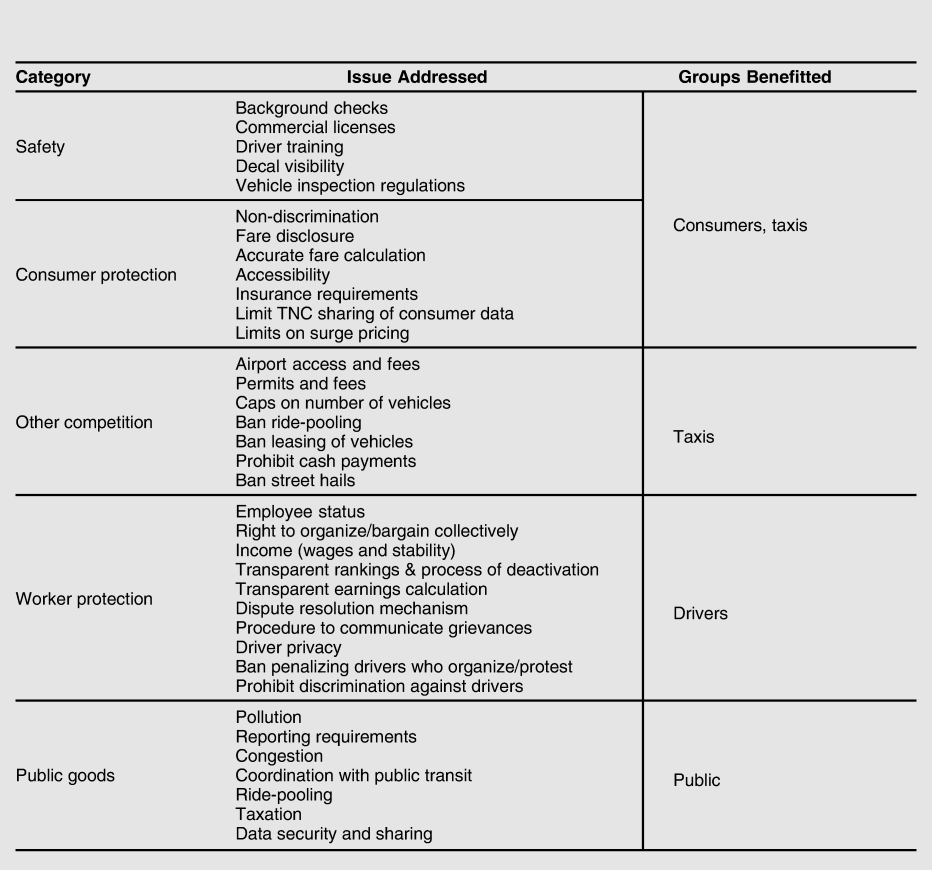
With the advent of Uber, a number of regulatory issues have been raised by stakeholders and policy advocates, including taxi companies, foundations, NGOs, bloggers, and scholars. Public officials have taken action on only a subset of these issues. Regulatory inaction occurs either because of a failure to pass a proposed law or to obtain a ruling in court, or because issues have not even made it to the agenda in legislatures or brought to trial. To assess the areas in which public officials have and have not acted, we compile a “regulatory agenda” of the issues that have been raised or addressed. We group them into five categories (table 1).
Regulatory agenda
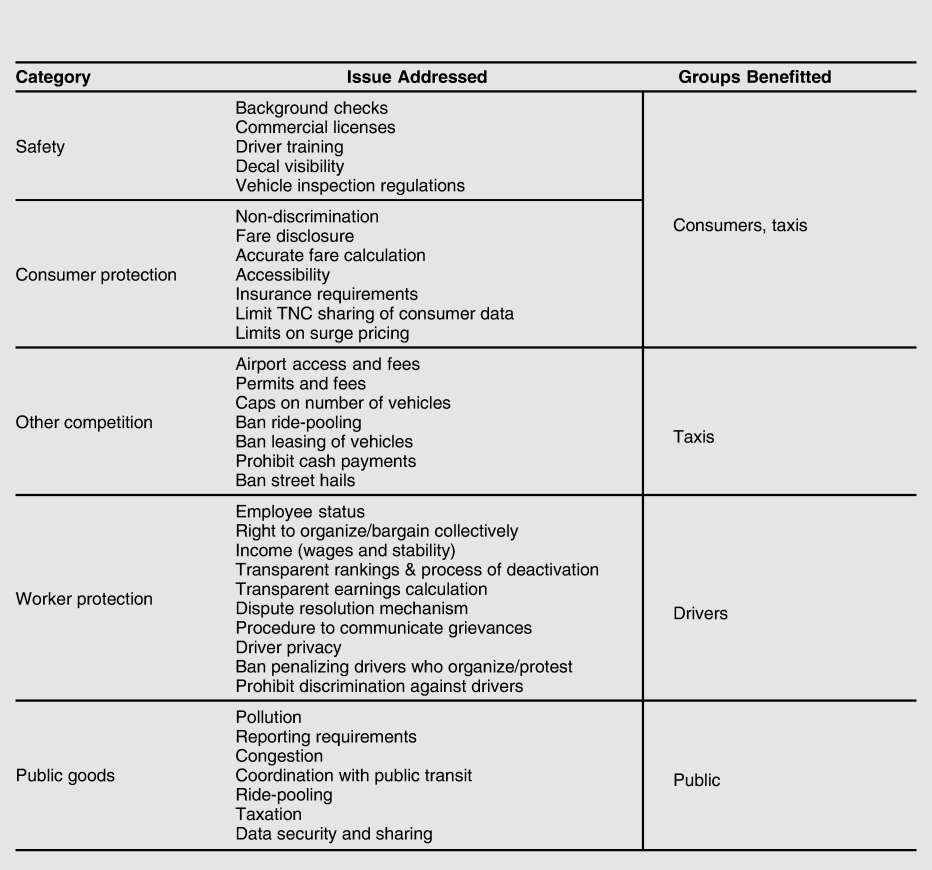
The first two categories reflect their labels: “safety” and “consumer protection.” These regulations aim to protect Uber’s customers and the general public. Because Uber’s business model depends on customer trust, the company has always provided its own driver training, required background checks, and insisted on minimum vehicle standards. However, these items remain on the regulatory agenda because regulators consider the self-imposed practices inadequate.
In addition to their stated purpose, consumer protection and safety regulations also reflect competitive issues in that they “level the playing field” between Uber and taxis. Indeed, taxi interests often demand such regulations on competitive grounds. Uber vigorously opposes some of these regulations, most notably fingerprint-based background checks, as a rigidity in easy driver entry. Other issues are uniquely related to competition between Uber and the taxi sector. We include these regulations as “other competition.”
Labor issues are also contentious, most saliently drivers’ legal classification as independent contractors rather than employees who are protected by work laws, such as the minimum wage, social security, right to unionize, and overtime pay. Those advocating employee status point to Uber’s significant control over conditions of work, the legal condition for employee status. Opposing reclassification and other labor regulation, Uber argues that it is not an employer or even a transportation company, but a technology company that simply offers the software that matches riders with drivers. Importantly, some labor issues can be addressed without reclassification. Finally, we include a category of regulations that address public goods, like congestion and public transit.
In the analysis that follows, we analyze the politics of regulating these categories in different policy-making venues.
Regulation by City Governments
After taxis replaced for-hire horse carriages at the end of the nineteenth century, city governments took primary responsibility for regulating the industry.Footnote 12 A century later, when Uber and other TNCs were launched in cities across the country, city officials debated the best way to address these entrants, which were structured differently from the taxi sector and yet provided the same service. In this section, we examine the way Uber enters markets using an “act first, apologize later” strategy that flouts existing regulations. We then turn to a number of hypotheses that relate city “types” to the regulatory response to this disruption. Finally, we examine the strategies that Uber has employed to achieve its preferred regulatory outcomes.
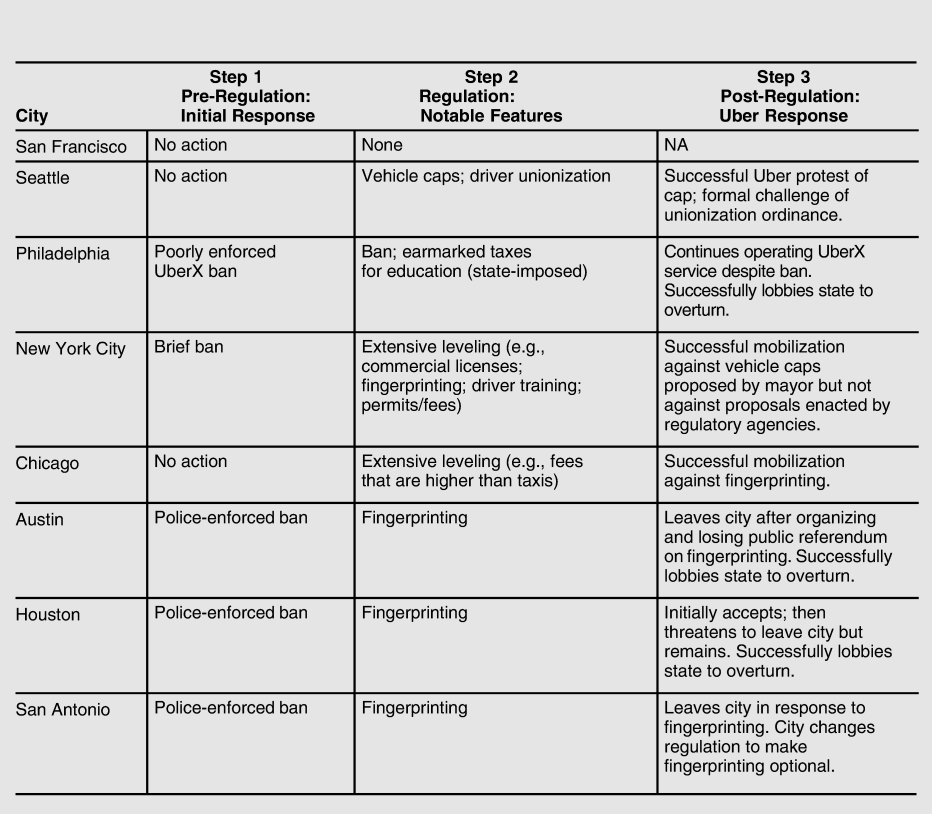
We examine eight cities using data gathered from an exhaustive review of online sources for each city.Footnote 13 Rather than a representative sample of cities, we select three types of cities to explore hypotheses about city characteristics. We examine three steps: initial response to Uber’s entry, subsequent regulations, and Uber’s response.
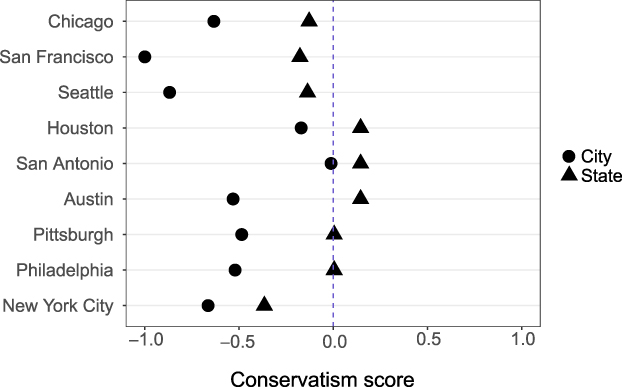
The first city type includes San Francisco, Seattle, and Austin: politically progressive cities that are innovation hubs (figure 1). These two traits (i.e., progressive and high-tech) give rise to two contradictory hypotheses. Such cities might be friendly to high-tech interests, given that high-tech firms hold influence and account for a significant part of local economic activity. Alternatively, as progressive cities, they may be more likely to regulate, especially with respect to consumer protection, safety, and worker protection issues as well as public goods.
City and state ideology (public references)
Source: Tausanovich and Warshaw 2013
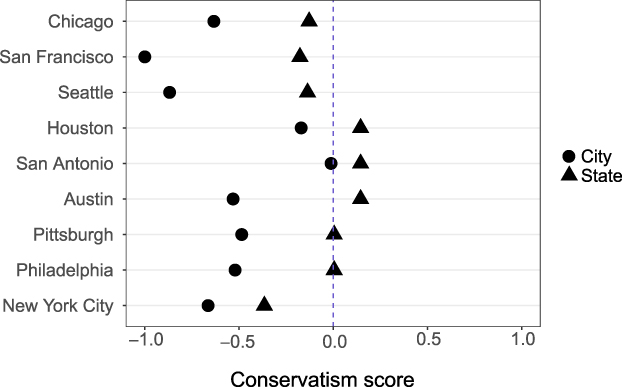
The second group of cities—New York City, Chicago, and Philadelphia—have historically strong regulatory agencies and incumbent taxi sectors. They are also older, large, industrial cities with dense urban cores and captured regulatory regimes for the ride-hailing industry.Footnote 14 Therefore, they might be expected to do more to prevent Uber’s initial entry and to enact regulations that level the playing field, restrict supply, and inhibit driver entry.
Finally, Houston and San Antonio are Sunbelt cities in the conservative state of Texas, a category in which we can again consider Austin. Given their relatively recent growth and lower density, we might expect them to have a less entrenched taxi sector and do less to halt Uber’s initial entry, restrict car and driver supply, or pursue leveling with taxis.
Step 1: Disrupting Regulation
Uber enters urban markets extra-legally, ignoring an extensive regulatory regime, which includes, among other provisions, barriers to entry and price controls; driver registration, licensing, and insurance requirements; and consumer protection and safety regulations. Uber’s entry thereby forces local or state governments to respond reactively to a fait accompli, after Uber has established a base of customers and drivers.Footnote 15 City officials are thus confronted with two options: allow Uber to operate or ban it—through cease and desist orders and law enforcement—until regulations are enacted.
The first issue for regulators is whether TNCs are technology companies, as TNCs insist, or transportation companies, as the taxi sector insists. As tech companies, TNCs provide software to match riders with private drivers. As transportation companies, they challenge the incumbent taxi sector, which has benefited from the classic regulations of entry barriers and price controls, thereby restricting supply, maintaining “high” prices, and supporting driver income. How, then, do cities respond, when Uber introduces its app, allowing drivers in their own cars to be algorithmically matched with a rider?
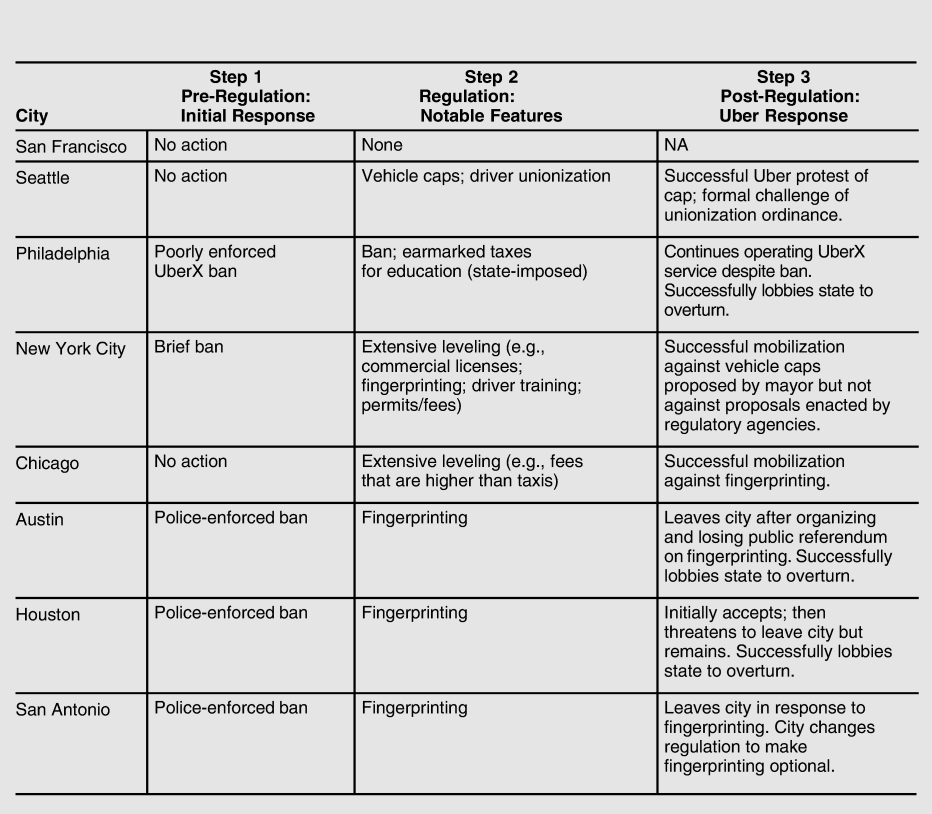
We find that timing, more than city traits, seems to be the stronger predictor of responses to Uber entry (table 2). Where Uber launched in 2012 or 2013—San Francisco, Seattle, New York, and Chicago—cities did little to prevent Uber’s operation upon entry. In the three Texas cities and Philadelphia, Uber launched later—in 2014—after other cities and states had begun to regulate; there, Uber’s entry was met with a ban. In Austin and Philadelphia, Uber nevertheless continued to operate, aided by software that produced a fake version of the Uber app to thwart regulators and law enforcement.Footnote 16
Regulatory steps by cities
Step 2: Regulating Disruption
Cities must next decide how they will regulate Uber. As discussed earlier, we expect high-tech progressive cities to face counter-pressures; old, industrial cities to do more to harmonize TNC regulations with those on taxis; and Texas cities to be Uber friendly. We focus on regulations that have been particularly contentious for Uber.
Consistent with the contradictory predictions of high-tech, progressive cities, the three cities differ. For the first five years of Uber’s existence, San Francisco embraced a laissez-faire, tech-friendly approach with virtually no regulation.Footnote 17 Seattle has attempted two regulations that are central to Uber’s business model. First, it imposed vehicle caps. However, it quickly backtracked following a strong lobbying effort by Uber.Footnote 18 Second, alone among U.S. cities, it enacted labor regulations, specifically the right of drivers to bargain collectively. This ordinance remains unimplemented, as its legality is contested in court.Footnote 19 Austin has adopted relatively high levels of consumer protection regulation including fingerprinting, in a pattern that conforms to the other Texan cities.
As hypothesized, regulatory agencies play a strong role in the old industrial cities, particularly New York and Philadelphia. By contrast, regulatory attempts by elected officials have been mostly unsuccessful. In New York, Mayor De Blasio was unable to impose regulations (e.g., vehicle caps) that went beyond the extensive leveling rules passed by the Taxi and Limousine Commission (TLC).Footnote 20 Elected officials in Philadelphia also had a difficult time contesting the authority of the Philadelphia Parking Authority (PPA), a longstanding agency that has regulated taxis. The PPA was constrained only when the state legislature intervened in 2016 to end the ban and preempt further city-level regulation.Footnote 21 In Chicago, ride-hailing is regulated by the Department of Business Affairs and Consumer Protection, an agency with a broader mandate than New York’s TLC or Philadelphia’s PPA. This Chicago agency has played a lesser role and the elected city council and mayor, a greater regulatory role.
Also as hypothesized, regulations in the industrial cities have done the most to level the playing field with taxis. New York went furthest, with TNCs facing many of the same requirements as taxicabs, including driver training, fingerprint-based background checks, and commercial licenses for drivers.Footnote 22 Chicago adopted some regulations for TNCs that exceeded those of taxicabs, such as higher city taxes on pick-ups and drop-offs at popular tourist destinations.Footnote 23 As mentioned, TNCs were banned in Philadelphia—albeit ineffectively—until late 2016.Footnote 24
Finally, the Texas Sunbelt cities were predicted to be the least likely to regulate. Yet San Antonio, Austin, and Houston all implemented fingerprint-based background checks, which Uber vehemently opposed.Footnote 25 We will later discuss the oppositional tactics of Uber, but note here that in San Antonio, Uber’s extensive mobilization was effective, and the regulation was overturned (as it later was in the other two Texas cities when state legislation was passed to preempt local regulations).Footnote 26
City regulation of Uber thus varies substantially. These cases mostly support our hypotheses: the “cross-pressured” high-tech, progressive cities did not follow a consistent pattern. The old, industrial cities did not extend the taxi regulatory regime to TNCs, but they did implement the most extensive leveling regulations, with specialized regulatory agencies leading the way. The Texas cities departed from the hypothesized pattern in passing one of the most contentious regulations—fingerprinting.
Uber has accepted certain consumer protection and safety regulations that are consistent with its need to build customer trust. All the cities examined, with the notable exception of San Francisco, have implemented such basic regulations. However, other regulations have been more contentious, and Uber has vigorously opposed those it fears will restrict the easy entry of drivers and the supply of cars on the road, like fingerprint-based background checks, vehicle caps, and, in the most extreme case, full bans. Each of the cities, except San Francisco,Footnote 27 implemented at least one of these contentious regulations; however, in almost every case these regulations have been subsequently overturned following Uber opposition at the city or state level. Also contentious are labor regulations, which only Seattle has addressed through legislation. Like labor issues, public goods regulations have also been largely ignored.
More recently, some change may be gathering momentum, as labor and public goods are beginning to receive attention in a few cities. Most notably, in 2018 the New York City Council passed two of the regulations Uber most opposes: caps and a minimum pay rate.Footnote 28 In 2017, San Francisco’s mayor reached a deal with Uber and Lyft to create designated pick-up points to decrease congestion.Footnote 29 The following year, the city attorney subpoenaed both companies to seek information on the potential misclassification of drivers under California law, and the Board of Supervisors encouraged the state legislature to pass a public goods-related law, taxing Uber for the wear and tear impact on public roads.Footnote 30 The same year, Chicago imposed an additional tax on Uber to fund public transit.Footnote 31
Step 3: Uber Strategies to Influence City-Level Regulation
Uber has tried to influence or change regulatory outcomes through a combination of insider (i.e., directly lobbying elected officials) and outsider (i.e., mobilizing drivers, customers, and the public) strategies. The outsider strategies are particularly novel, taking advantage of technological features of the platform economy.
The app provides both a contact list of drivers and customers and an efficient way of communicating with them. It has been a powerful tool in mobilizing customers and drivers to advocate for Uber’s position on regulatory matters by merely clicking a link. For instance, in New York and Austin, Uber presented a new “view” of its app, designed to target officials who had proposed vehicle caps and fingerprinting, respectively.Footnote 32 When customers opened the app, a pop-up message appeared, asserting that New York City Mayor Bill De Blasio and Austin Councilwoman Ann Kitchen were proposing regulations that would make it impossible for Uber to operate. Customers were then provided a link to register their opposition to the regulations.
In addition to this “clicktivism,” Uber has made extensive use of online petitions, which it has publicized to drivers and customers. For example, to oppose the Philadelphia ban, Uber organized a petition, which garnered 127,000 signatures.Footnote 33 Uber also used the contact information from petition signatories to automatically generate e-mails that opposed regulations and that were sent to policymakers.Footnote 34 The company has even initiated public referenda, a strategy that resulted in the suspension of vehicle caps in Seattle but failed to overturn fingerprint-based background checks, a consumer protection issue, in Austin. These strategies have been enhanced by Uber’s extensive use of media. The company has taken out ads in newspapers and on television to target public officials, like Councilwoman Kitchen and Mayor De Blasio, and to publicize its referenda and online petitions.Footnote 35 Finally, outside of traditional mobilizing efforts, Uber has directly—and deceptively—manipulated public opinion data available to local regulators. In some cities, the company has asked its employees to devise computer programs that automatically respond to city-administered surveys in a way favorable to the company.Footnote 36
Uber’s strategies have been employed primarily against elected officials and have mostly been successful. While the direct effects of these efforts cannot be meaningfully measured, Uber’s goals were ultimately accomplished in defeating vehicle caps in Seattle and New York City, in legalizing UberX in Philadelphia, and in eliminating fingerprint-based background checks in the Texas cities.
Uber calculates strategically, and in its largest markets, it has ultimately accepted even the regulations it most opposes. In the largest ride-hailing city, New York, Uber has accepted fingerprinting and other regulations that are substantially equivalent to those on taxis—with the important exceptions of vehicle caps and fare control. Similarly, the company remained in Houston, a large market, despite its threat to leave in response to a fingerprinting requirement, but in the smaller market of Austin, Uber followed through on its threat and left. Footnote 37
In other cities, Uber’s structural power, which is exercised through threats to leave a market, has been an effective tool of overturning regulations. Officials in San Antonio retracted a fingerprinting ordinance after Uber left the city in protest, and in 2016, Chicago pulled a proposed fingerprinting ordinance following Uber’s threat to leave the city.Footnote 38 Regulatory agencies comprised of appointed officials, like the TLC in New York and the PPA in Philadelphia, have been less affected by pressure brought by Uber and more prone to adopt and maintain regulations that Uber opposes.
Thus, Uber succeeded everywhere in disrupting city ride-hailing regulatory regimes of entry and price controls. In the subsequent process of regulating this disruption, cities have varied with respect to consumer protection, safety, and other competition regulations, which were also initially violated. These have been less contentious because Uber depends on consumer trust, which these regulations enhance. The high-priority issues for Uber have been those that challenge its business model of high and flexible supply, particularly vehicle caps, fingerprint-based background checks, and drivers’ rights as workers. As a powerful player with significant instrumental and structural power, Uber has prevented or defeated almost all of these regulations.
Regulation by State Governments
States, which have historically played a limited role in regulating the taxi sector, have often intervened to regulate TNCs. In fact, many states, having been lobbied by Uber, have wrested control from cities, preempting municipal regulation.Footnote 39 By December 2016, 38 states had passed TNC legislation. We analyze an original database of all state-level legislation passed between 2014 and 2016, drawn from the Open States website. We test several hypotheses about state-level characteristics and regulatory outcomes. We then turn to a case study of California.
Like cities, states have generally acted in only three categories of the regulatory agenda—consumer protection, safety, and other competition. States have not diverged significantly in the emphasis given to each of these categories, with a high correlation in regulations passed across categories (table 3).
Correlation of percent of regulations passed by category

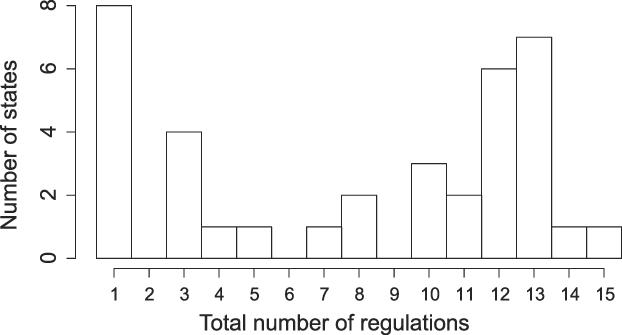
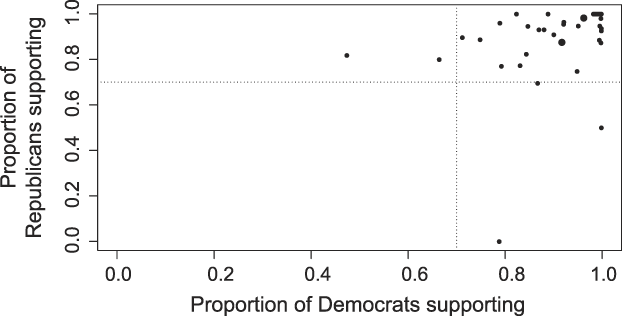
States tend to cluster into groups of “high” and “low” regulators (figure 2). A number of “usual suspects” might explain this variation. A first pair of hypotheses is that ideology and partisanship may influence regulatory outcomes, with liberal, democratic states expected to regulate more. A third hypothesis is that more urban states will regulate more. Measures of ideology, partisanship, and urbanization are not associated with level of regulation (see the online appendix). Notably, regulations pass as bipartisan processes, with most bills garnering over 70% support from both parties (figure 3).
Histogram of total number of regulations (states that have regulated)

Bipartisan support of TNC regulation

An examination of the content of regulations indicates that even “high” regulators are quite moderate in the regulations they enact. Fingerprint-based background checks have been passed in only one state, Kansas, which subsequently repealed the requirement. No state has mandated vehicle caps, imposed a ban, or reclassified drivers as employees. Sometimes, these regulations simply institutionalize practices Uber already follows (e.g., no cash payment). As in cities, states primarily legislate on those consumer protection and safety requirements that Uber finds acceptable because they may increase consumer trust at a minimal cost.
California: The First State to Regulate
To illustrate the politics of Uber regulation, we examine the particularly contentious initial regulation of TNCs in California, the first state to regulate. This instance of TNC regulation demonstrates many of the political dynamics that have characterized subsequent regulatory efforts, particularly the strength of concentrated private interests, the weakness of drivers and customers as autonomous actors, and the strategies Uber uses to fight regulation.
The California Public Utilities Commission (CPUC) took the first step in 2013 by passing insurance requirements for drivers with passengers, among other minimal consumer protection and safety regulations.Footnote 40 Regulation then moved to the state legislature following the highly publicized death of six-year-old Sophia Liu, who was struck and killed by an Uber driver in January 2014.Footnote 41 The driver was logged into the app but not engaged in a ride and thus not required by the CPUC to be covered by Uber’s commercial insurance policy. Since the driver was using his car for commercial purposes, his personal insurance policy would not cover the accident. In response to this “gap” in insurance coverage, the chair of the Business and Consumer Protection Committee in the California State Assembly, Susan Bonilla, proposed a law requiring commercial insurance whenever drivers were logged onto the app.Footnote 42
Private interests were active participants in the policy process. Taxi companies weighed in, issuing written statements and lobbying legislators to regulate TNCs as they regulate taxi companies on issues of consumer protection, safety, and public goods.Footnote 43 However, they were unable to achieve any leveling regulations beyond insurance requirements, an issue on which they were aligned with insurance companies, which organized a coalition with consumer advocates and personal injury lawyers in support of Bonilla’s bill and participated in its drafting.Footnote 44 Although influential, insurance companies are essentially a one-issue actor.
Uber was extremely active in opposing the Bonilla bill. It argued that personal insurance should cover drivers when they have the app on but are not engaged in a ride. Uber opposed the requirement of commercial insurance either as a cost to itself or one to drivers that would pose a barrier to their entry.
Uber employed the dual insider-outsider strategy outlined earlier. It used its vast financial resources to hire 14 of the top 15 lobbying firms in Sacramento, and it hired former Obama campaign manager David Plouffe “to make sure . . . the right outcomes happen.”Footnote 45 Uber enlisted the support of nonprofit public interest groups, most notably Mothers Against Drunk Driving (MADD), to which Uber has donated a percentage of fares on major holidays.Footnote 46 MADD sent letters to the governor and legislature opposing the Bonilla bill, arguing that TNCs decrease drunk driving and that the proposed regulations would inhibit the operation of this service.Footnote 47 Uber also successfully sought lobbying assistance from high-profile Silicon Valley investors, like Ron Burkle and John Doerr, as well as celebrities, like Ashton Kutcher, who bombarded Assembly members with phone calls.Footnote 48
Uber’s outsider strategy to shape and mobilize public opinion was also multi-pronged. The company hired nearly all of Sacramento’s public relations firms to improve its image and sent pro-Uber material to newspapers throughout California.Footnote 49 As part of this public-oriented strategy, Uber also targeted legislators who supported or were undecided about the bill. In one of the clearest instances of such a strategy, Uber targeted the bill’s sponsor and launched a public campaign in the district where she planned to run for state Senate in 2015, claiming that she was anti-technology and a stooge of the insurance industry.Footnote 50
As in cities, Uber used app-enabled clicktivism to mobilize consumers and drivers in a campaign of pressure politics. Just before the vote on the California bill, Uber used its app to tell customers that the proposed regulations threatened its operation in the state and initiated a petition through the app.Footnote 51 The company then contacted local news outlets to film boxes of petitions being delivered to Assemblywoman Bonilla’s office.Footnote 52
The California case illustrates the elite-driven policymaking pattern typical of Uber regulation. Concentrated private interests were influential, particularly incumbents and challengers, but also in this case, the insurance companies. Although a more comprehensive bill was initially proposed, the final legislation included only weakened insurance coverage requirements that correspond to a compromise amenable to both Uber and the insurance industry. Customers and drivers, dispersed and unorganized, did not have autonomous input into the policy process. To the extent they were participants, they were mobilized by Uber on the basis of maintaining service and work. But they were mobilized against regulations that may have benefited both groups: more extensive consumer protection for consumers and Uber-provided commercial insurance for drivers.Footnote 53
The case of California also illustrates Uber’s structural power. Policymakers value Uber’s presence as a source of service and work, and fear disinvestment or withdrawal from the market. Many also see regulatory policy as signaling either their welcoming or hostile attitude toward innovation and high-tech companies more generally. The fear of appearing “anti-tech” and possibly losing future opportunities to attract and spur post-industrial economic activity, a charge wielded by Uber against Bonilla, may be observed in the CPUC’s explicit initial regulatory language: “The purpose of this Rulemaking is not to stifle innovation and the provision of new services that consumers want.”Footnote 54
Comparison of City and State Regulation
In general, states have become new regulators of for-hire transportation operating at the municipal level. Typically more conservative than cities, states have regulated Uber more lightly than cities have. A large number have preempted municipal regulation, and many have introduced model legislation advocated by Uber.Footnote 55 Only a few state legislatures have passed regulations that explicitly allow cities to regulate TNCs.
That said, while cities have been somewhat bolder, disruptive regulation has been generally Uber friendly in both cities and states. With the exception of insurance regulation in California and a short-lived fingerprinting ordinance in Kansas, states, more than cities, have avoided regulations that Uber most opposes. We find that cities have implemented a number of these regulations, although most have been overturned in cities or states following extensive mobilization by Uber.
State action conforms to Uber’s preference for uniform regulation rather than a “patchwork of local regulations that [are] in conflict to [sic] each other.”Footnote 56 Our database of state-level regulation revealed that through 2016, twenty state laws had explicitly preempted municipalities from implementing regulations on TNCs, both as a way to prevent cities from implementing regulations that go further than the state and to overturn city-level regulations.Footnote 57 For example, as discussed earlier, the Texas legislation used preemption to override fingerprinting ordinances adopted in Austin and Houston. Other states, like Pennsylvania, while not precluding all city-level regulations, passed laws to invalidate specific city laws. Notably, while neither states nor cities have generally considered labor regulation, a few states, including North Carolina, Arkansas, Michigan, Indiana, West Virginia, Florida, and Ohio, have codified the status of TNC drivers as independent contractors. Generally, then, preemption of city-level regulation by state legislatures has resulted in regulatory outcomes that align with Uber’s preferences.
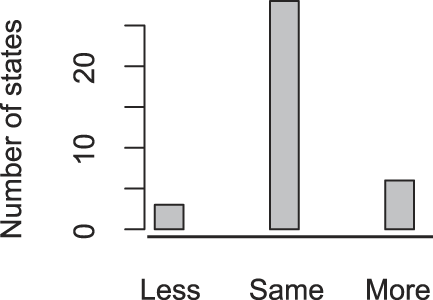
Finally, the states have often passed model legislation advocated by Uber. The first example pertains to insurance. After opposing one another in the 2014 regulatory process in California, the major insurance companies and the TNCs privately negotiated a compromise bill as model legislation for other states.Footnote 58 The insurance companies sought to prevent drivers from using their personal insurance policy while driving and to take advantage of a new market of TNC commercial drivers. After initial opposition in California, Uber and Lyft saw a benefit in standard insurance requirements across states. The negotiated model legislation advocated differential insurance requirements during the three stages of the drivers’ work (i.e., before the rider is assigned, on the way to pick up a rider, and when a rider is in the vehicle) with TNCs sharing responsibility for coverage with drivers. Of the 38 states that had regulated TNCs by 2016, over 75% have implemented the exact model (figure 4). More generally, model legislation addressing other issues has been proposed and circulated by TNC lobbyists and the American Legislative Exchange Council (ALEC).Footnote 59 In several states, including Ohio, Texas, and Florida, public records unearthed by the National Employment Law Program indicate that Uber wrote or co-wrote the state legislation.Footnote 60
Histogram of state insurance regulation relative to the model

Uber Strategies
We have seen that Uber has been successful in entering markets and disrupting the ride-hailing regulatory regime and has also been influential in shaping the subsequent regulation of platform-based ride-hailing. It has done this by deploying a vast array of strategies, which are enabled by Uber’s significant material resources, unique mobilizational capacity through the app, and structural power as a source of jobs and high-tech reputation.
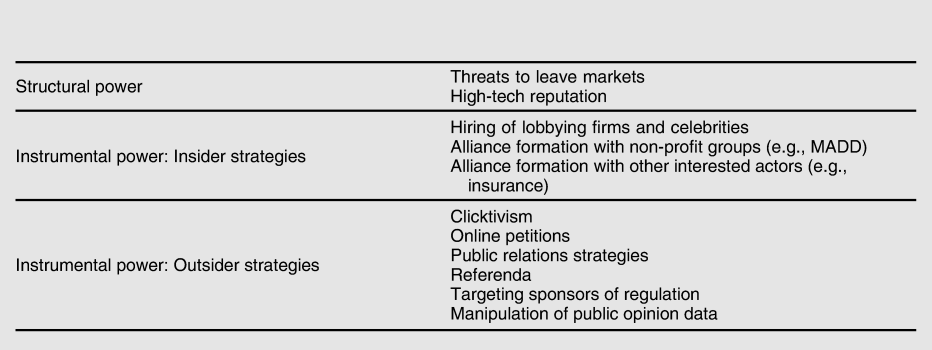
Table 4 summarizes these strategies. Some strategies are associated with Uber’s instrumental power while others are associated with its structural power. Instrumental power can be used to influence legislators directly through insider strategies or indirectly through outsider strategies. Insider strategies have been most prominent in models of regulatory capture, and indeed they are key in Uber’s arsenal. Uber deploys significant financial resources to undertake intense lobbying, particularly at the state level.
Uber strategies

In both cities and states, Uber employs a number of outsider strategies, through which the company influences policymakers through popular mobilization. Uber has mobilized its drivers and customers to oppose regulations. While analysts like Walker have examined such mobilizational efforts by firms, the technology of the app allows Uber to go even further.Footnote 61 The Uber app is itself a novel resource for mobilization of drivers and customers. Further, Uber has mobilized the broader public through media campaigns and referenda.
Uber’s structural power is also notable and derives from its threats to disinvest and its perceived economic benefits. Uber provides “flexible” work that accommodates many in the twenty-first century job market. Government decision-makers also see regulation in terms of the city’s or state’s reputation as tech friendly, affecting future growth. The divestment threat is a real one, as Uber has indeed left markets in response to the imposition of specific regulations. Furthermore, Uber actively wields this threat, as it explicitly threatens that it will leave a market.
Judicial Venues
As noted, regulation in cities and states, played out among regulators, incumbents, and challengers, has been virtually silent on labor regulation. Yet the labor-capital cleavage within the challenger interest is a prominent one in the politics of TNC regulation. Online driver forums indicate the many grievances that drivers have against Uber. Drivers complain of fare cuts, lack of transparency in pay calculation, high expenses associated with driving, fear of termination associated with Uber’s rating system, and lack of training and driver support.Footnote 62 The neglect in cities and states of worker protection issues reflects imbalance of political influence and the collective action problems of dispersed drivers.
Legal analysts have suggested that politically weak groups “are almost always compelled to resort to litigation,” and that litigation is “a technique to be employed when goals are clearly unattainable in other political forums.”Footnote 63 The Uber case comports with this theory of political disadvantage. As atomized, dispersed actors, drivers are unable to bring effective claims in legislative venues. Even in courts, worker protection issues are rarely brought through the initiative of groups of drivers. Instead, most cases are brought by surrogates, both plaintiffs’ attorneys who bring lawsuits against Uber on behalf of drivers and government agencies that investigate the company for violation of laws that would protect drivers.
As a venue of regulation, judicial processes have a distinct logic. Unlike legislative venues, where lawmakers can break new ground by passing laws, courts and administrative agencies judge compliance with existing statutes, regulations, and previous judicial decisions. A key source of worker protection is embedded in classification as employee rather than independent contractor.
We focus here on lawsuits alleging violations of worker protections and misclassification. These have been a strikingly frequent form of litigation against Uber, constituting approximately one-third of all lawsuits against the company, as opposed to 2–5% of cases against large multi-national tech companies.Footnote 64 These cases reflect an intra-producer cleavage, the classic struggle between labor and capital, which is an important component of the Uber model of disrupted regulation.
We analyze a database of dockets across federal and three state courts (California, Texas, and New York) from 2012–2016.Footnote 65 These three states were chosen because they include multiple cities with large Uber markets; because key test cases were filed in both California and New York; and because they each represent different political and legal regimes with regard to worker protections. California is a progressive state with an expansive, employee-friendly labor code; New York is also a progressive state but our review of state labor codes indicates that it has fewer state worker protections; and Texas is a conservative state with limited state labor protections. Unsurprisingly, California houses the largest number of lawsuits against Uber alleging worker protection violations.
Reflecting the fact that drivers are an unorganized and atomized workforce, most cases are not brought by groups of drivers but by surrogates, who typically conceive of the litigation and then recruit worker plaintiffs (not vice versa).Footnote 66 Prominent among these surrogates are plaintiffs’ attorneys, who have brought class actions. Like all surrogates, class-action attorneys act simultaneously “on behalf of” drivers but also in their own interests, resulting in a biasing that has affected what issues have been litigated and how the litigation proceeds.Footnote 67 Because private plaintiffs’ attorneys work on contingency, they have an incentive to bring cases that may yield significant damages or large settlement sums.Footnote 68 We find that as a result, income-related claims are most commonly litigated against Uber, and most cases have been settled or dismissed without resolving drivers’ employment status.Footnote 69 These settlements are enabled by Uber’s significant material resources, and they undermine any efforts to regulate Uber through courts. Other surrogate actors representing drivers’ interests in courts include government bodies and an NGO.
We focus on the most important “test” cases that were brought primarily in courts but also in administrative and regulatory agencies.Footnote 70 The majority of these test cases involve the misclassification of Uber drivers as independent contractors, a status that denies them the labor and employment rights available only to employees.Footnote 71 These cases attempt to apply existing employee laws to the new case of Uber.Footnote 72 We group these cases by the types of rights litigated.
Income-Related Claims
The vast majority of worker protection cases involve income-related claims. The most important, O’Connor v. Uber, is a misclassification case filed in 2013 by Shannon Liss-Riordan in the Federal District of Northern California. Alleging misclassification of drivers, the case certified a large class of drivers and, if successful, would have challenged Uber’s independent-contractor business model.Footnote 73 Many understood O’Connor as a test case for the gig economy more generally.Footnote 74 However, rather than take the case to trial, in 2016 Liss-Riordan attempted to settle on unfavorable terms.Footnote 75 Indeed, the court subsequently rejected the settlement as “unfair” to drivers.Footnote 76 The case was then stymied by a Ninth Circuit ruling, which decertified a portion of the class, greatly diminishing its size and the potential impact of this case.Footnote 77 O’Connor has yet to be resolved.
NYTWA v. Uber was filed in federal court in New York in June 2016.Footnote 78 The New York Taxi Workers Alliance (NYTWA) is a 20-year-old NGO advocating for taxi drivers’ interests. A majority of the NYTWA's members are now Uber drivers.Footnote 79 However, in many of its actions, it continues to see Uber as a central threat. After having lost the regulatory battle to extend vehicle caps and fare controls to Uber when it first entered New York, the NYTWA turned to the judicial process. On behalf of a class of Uber drivers, it alleged minimum wage and overtime violations (as well as unlawful equipment and tools deductions, and unlawful tax and surcharge deductions). Like O’Connor, these claims challenge the status of Uber drivers as independent contractors. The NYTWA maintains that in the absence of city and state regulations that limit the number of TNC vehicles and control fares, employee status is the only way to lift and stabilize the earnings of TNC and taxi drivers.Footnote 80 The NYTWA had never previously sought to establish employee rights for taxi drivers, who are also independent workers, but rather worked through city and state regulatory bodies to advance drivers’ interests, avoiding the issue of worker status.Footnote 81 By making themselves a plaintiff in this case alongside their Uber driver members, the NYTWA sought a settlement or trial adjudication that would undercut Uber’s business model and favor taxis. However, the district court dismissed the NYTWA as co-plaintiffs, claiming the organization lacked standing. The case remains undecided.
Meyer v. Kalanick, a federal anti-trust action against Uber’s co-founder Travis Kalanick, alleged that Uber’s mobile app amounts to a price-fixing conspiracy because it coordinates a uniform price among Uber drivers. The impact of this lawsuit, which ultimately put to question the classification of Uber drivers as independent contractors, was also stymied by an appellate court ruling that sent the case to private arbitration.Footnote 82
Finally, in three contexts not involving a legal challenge to drivers’ status as independent contractors, Uber voluntarily agreed to pay drivers for overcharges or underpayment. One was the result of a legal investigation into their leasing program by the Massachusetts Attorney General.Footnote 83 Another was prompted by revelations of improper earnings deductions made public by the NYTWA.Footnote 84 Yet another, in which Uber agreed to pay $20 million to drivers misled by Uber’s exaggerated claims about earnings and vehicle financing, was resolved after an investigation by the Federal Trade Commission.Footnote 85 While drivers won monetary gains in all three, none shifted the legal regulatory landscape with regard to workers’ rights.
Job Security and Collective Action Claims
Two legal claims against Uber involve the rights of drivers to engage in collective action. In February 2016, the National Labor Relations Board Region 20 began a national investigation of Uber’s labor practices to assess whether Uber misclassifies its workers as independent contractors under the National Labor Relations Act.Footnote 86 This investigation remains unresolved. Also, the NYTWA filed a claim with the NLRB alleging that Uber’s arbitration provision for workers is an unfair labor practice because it prevents class action lawsuits.Footnote 87
Other Claims
Across the three states in this analysis, two cases against Uber allege discrimination. One was dismissed. The other was filed as an individual Equal Employment Opportunity Commission (EEOC) complaint, alleging that Uber’s ratings system—which can result in termination—has a racially discriminatory impact on minorities because of passengers’ biases.Footnote 88 The resulting EEOC investigation has not been concluded or made public.
Individual Uber drivers in states across the country have filed individual claims in administrative bodies alleging their own misclassification for purposes of unemployment insurance, workers’ compensation, and unpaid wages. Individual claim-making is at most a grievance procedure without larger impact.Footnote 89 Under res judicata, administrative decisions from these claims do not form precedent and have no consequences for other drivers. To leverage these individual claims for broader regulatory purposes, in 2016 the NYTWA sued the New York State Labor Department on behalf of three drivers who had filed individual unemployment insurance claims but did not receive a timely response. As a remedy, the NYTWA asked the Labor Department to audit Uber to determine whether drivers are employees under New York state laws. The case was dismissed.Footnote 90 In July 2018, however, the New York State Unemployment Insurance Appeals Board issued the first ever precedential decision on behalf of three unemployed Uber drivers represented by the NYTWA. The Board found the drivers to be employees under state laws. Because the decision was made on appeal, all other “similarly situated” Uber drivers in New York have access to unemployment insurance.Footnote 91
Thus, important test cases have been brought on workers’ rights issues in judicial venues, often by surrogate actors, including plaintiffs’ attorneys and an NGO, who bias representation with their own interests. Government agencies, whose pro- or anti-labor perspective varies across administrations, have also brought cases. Despite the high level of control Uber exercises over work conditions, to date, these judicial processes have only rarely resulted in regulatory constraint on Uber’s labor practices. Most have been settled without resolution, stymied by arbitration provisions, or remain mired in long processes.
Conclusion: Elite Politics of Disrupted Regulation and Challenger Capture
Uber’s brash “act first, apologize later” entry into urban markets disrupted a highly regulated ride-hailing sector that displayed the classic rent-seeking traits described in the Stigler model of regulatory capture. Prior to Uber, private taxi interests enjoyed anti-competitive barriers to entry and price controls. The taxi regulatory regime, however, also included provisions in the form of customer and labor protections, safety, regulations aimed at stabilizing driver income (including fare regulations, vehicle caps, and lease caps), and, occasionally, public goods. Its disruption following Uber’s entry raised key questions for regulators about if and how to regulate Uber.
Uber has played an active role in achieving regulatory outcomes compatible with its business model. Uber has enjoyed both structural and instrumental power and has had the resources to deploy a stunning array of insider and outsider strategies. Its political strength has made it especially influential in the legislative arena. In city councils and state legislatures, it has succeeded in limiting consumer and safety regulations to those that conform to its business model of growth, supply and price flexibility, and low-cost service provision. In general, Uber has been able to influence regulations and, in those cases where it initially failed, often to get them reversed. Worker protections, vigorously opposed by Uber, have rarely made it to the agenda in legislative arenas. Drivers’ issues have instead been taken up as legal issues in judicial venues and have not resulted in broad regulatory change.
The Uber model of disruptive regulation is an elite-driven politics of challenger capture. The major regulatory models in the literature are not good fits for this model. Most feature only two interests—private versus public, or equivalently, producer versus consumer. Interest alignment is more complex in the Uber case. The private interest is often divided, and the private and public interests are not always opposed. Intra-producer conflict occurs along an incumbent-challenger cleavage, which is primarily played out in the legislative arena, as well as along a labor-capital cleavage, which is most often played out in judicial venues. Atomized customers and drivers do not have autonomous power. They have benefited from their alignment with private interests and have participated in the politics of regulation primarily when mobilized by elite actors. Consumers and drivers are aligned with, and mobilized by, Uber in the initial disruption or “deregulatory” step on issues of entry and price controls, which ensure Uber’s continued presence in the market as a provider of a service and jobs. In the subsequent TNC regulatory step, consumers are aligned with taxis on some leveling issues, which has contributed to regulations addressing consumer protection and safety. Drivers lack alignment with concentrated interests in legislative arenas. As a result of this political disadvantage, labor issues are taken up in judicial venues primarily by surrogates but, to date, without success.
Disruptive regulation has given rise to a dual regulatory regime of the ride-hailing sector in cities across the country. Uber’s entry undermined the taxi regulatory regime not by the adoption of deregulatory policy or non-implementation through “corrosion,” but by disruption. The subsequent regulation bifurcated the ride-hailing sector by creating an alternative classification of “TNC” thus exempting Uber from taxi regulations. The regulatory regime on taxi incumbents remains intact but no longer operates to their advantage. On the contrary it puts taxis at a competitive disadvantage relative to the regulations (or lack thereof) for TNCs. The politics of regulating the new entrants has thus been one of challenger capture.
Supplementary Materials
Figure A1. Ideology and State-Level Regulation
Figure A2. Urban Character and State-Level Regulation
Figure A3. Partisanship and State-Level Regulation