INTRODUCTION
The large law firm has long been established as the core of power and prestige in the legal profession. Careers in this setting have long been the most sought after by new law graduates, while recruitment into these positions has been tightly controlled. And while the prestige of the large law firm has remained a constant over the past half century or more, both the structure and meaning of a career in a large law firm have changed in fundamental ways.
At the time of the so-called golden age of corporate law in the 1950s and 60s, most graduates of elite schools sought the coveted position of partner in an elite corporate law firm. They were attracted by the prestige and high pay of corporate partners (Garth Reference Garth2017) and vied for partnership status. Those unable to attain that rare position were considered failures; they were losers in the tournament of lawyers (Galanter and Palay Reference Galanter and Palay1991). Today, there have been significant shifts in the legal profession that have implications for the once coveted corporate law careers. The market for legal services has become much more competitive. Law firms have grown enormously, resulting in a broader recruitment strategy that includes a much larger array of law schools and seemingly welcomes the women and the racial, ethnic, and religious minorities who were formerly excluded. Significantly, the corporate law firm today continues to attract top talent, but not because of the coveted partnership position. Instead, the model that has been established for at least the past two decades is one in which an entry-level position in a corporate law firm provides access to a kind of finishing school, a place to embellish one’s credentials for a career in another practice setting, such as in-house or in a boutique firm (Wilkins and Gulati Reference Wilkins and Gulati1998; Dinovitzer and Garth Reference Dinovitzer and Garth2007; Garth and Sterling Reference Garth and Sterling2009). The transition out of the corporate law firm has been redefined from being a point of failure to a source of capital, and it is changes in the upper hemisphere of the bar that have allowed for this transformation. Most notably, the rise in prestige of corporate counsel (Rosen Reference Rosen1989; Wilkins Reference Wilkins2016) and positions in the federal government (Weiser Reference Weiser2009; Feldman Reference Feldman2017) have accompanied and supported this transformation.
Yet we do not know who, from among the select group of individuals that begin their careers in the corporate law firm, chooses to vie for partnership positions, who earns them, who moves on to where, and ultimately whether the corporate law firms provide an equally valuable starting point for all those who begin there. The career trajectories of lawyers who begin their careers in the corporate law firm thus provide an ideal case study of the sorting of elites. The goal of this article is to understand both the individual attributes and contextual circumstances that surround elite careers in law. Not only will this allow us to gain traction on the sorting of elites at the individual level, but by understanding which individuals attain partnership, which move on, and where they move to, we will be able to build a better understanding of the nature of careers in corporate law firms and ultimately of the legal field (Bourdieu and Wacquant Reference Bourdieu and Wacquant1992).
This article begins by discussing the nature of careers in large law firms as described by researchers in the 1950s and 60s through to the present day. In the so-called golden age of the legal profession, the career in the large law firm was fairly rigid, following an up-or-out system that rewarded the few who made it, while those who did not were conceived of as failures. As we describe below, changes in the profession and in the economy began to restructure these once rigid careers, opening up new opportunities and closing off others, and changing the language and ambitions of those working in this once rarefied setting. We then turn to an empirical examination of lawyer careers in order to provide insight into how careers in corporate law firms unfold in the modern legal profession. We draw on data from the After the JD project (AJD), a national longitudinal survey of lawyers who began to practice in the year 2000, focusing on the trajectories of those who began their careers in the large law firm. Relying on a statistical technique called sequence analysis, we provide an updated perspective from which to understand the sorting of elites in modern legal careers. We then conclude with a discussion of the implications of our findings and draw on the sociology of Bourdieu to provide some theoretical insights about the modern legal field. In particular, we suggest that the legal field as structured in the 1950s and 1960s faced a number of challenges, including increased growth and competition, the pressure to provide women and minorities access to corporate positions, and the decline in the attractiveness of corporate partnerships even for most elite lawyers. Consistent with Bourdieu, as detailed in the article, the field changed by absorbing the challenge in a way consistent with refurbishing and maintaining the status of corporate partners while preserving the basic hierarchies of law positions, law schools, and the ability of white males with wives at home to occupy most of the positions of power in the firms.
THE GOLDEN AGE OF THE CORPORATE LAW FIRM
During the so-called golden age of corporate law firms, the corporate law firm was unquestionably at the pinnacle. The law firms also succeeded in persuading businesses run by people like themselves that only this elite level of law could provide high-quality legal services (Gordon Reference Gordon, Grossberg and Tomlins2008). Corporate partners were also considered naturals for governmental service and held board positions in corporations and nonprofits. At the national level, they dominated leading positions in the government, moving back and forth between corporate law firms and positions such as Secretary of State (Kronman Reference Kronman1995).
Law graduates competing for positions on Wall Street were overwhelmingly elite law graduates, but the elite credential alone was not sufficient (Ladinsky Reference Ladinsky1963; Abel Reference Abel1963; Smigel Reference Smigel1964b, 39; Swaine Reference Swaine2007, 748). Smigel (Reference Smigel1964b, 72) explained that the large law firm selected new recruits based on three criteria: “lineage, ability, and personality.” Lineage related to both ethnic and religious background, with very few Jewish, Catholic, or Black lawyers working on Wall Street (see also Note 1964; Spector Reference Spector1972). Lineage was also very much reflected by ties to elite families, with 30 percent of the partners of Wall Street’s largest firms listed in the Social Register (Smigel Reference Smigel1964a, 22), an exclusive listing of the nation’s most prominent families. Ability was marked by law school pedigree, grades, and law review membership. Smigel (Reference Smigel1964a) found that 71 percent of the partners in his sample had a law degree from Harvard, Yale, or Columbia, while almost half of the law review editors from Harvard Law School took jobs on Wall Street. This exclusivity has been documented by many others: Before 1950, 90 percent of Cravath’s partners attended Harvard, Yale, Columbia, or Chicago and were on law review (Swaine Reference Swaine2007), while two studies from Chicago show that well over half of partners in Chicago law firms before the 1970s graduated from an elite law school (Heinz and Laumann Reference Heinz and Laumann1982; Nelson Reference Nelson1988). Finally, partners exhibited, as Smigel (Reference Smigel1964a, 21) put it: “pleasing personalities and ‘clean-cut’ appearances … experience in the affairs of the world, and … tremendous stamina.” It went without saying that only men could possess these qualities, with firms refusing to even consider female candidates for an associate position (Smigel Reference Smigel1964a, 23).
The legal field in the golden age thus rewarded the merit of elite degrees but also had a place for social and family capital (Smigel Reference Smigel1964b). Graduates of nonelite law schools such as the Catholic schools had no access to careers in large law firms, which undergirded the two very separate hemispheres of the legal profession (Carlin Reference Carlin1962; Ladinsky Reference Ladinsky1963; Smigel Reference Smigel1964b; Heinz and Laumann Reference Heinz and Laumann1982). The law firm was not chosen by recent graduates as a resume builder or stepping stone. Smigel suggested that the key decision that law students made before graduating is “whether or not to practice in a large law firm” (Reference Smigel1964a, 24). Those who did not want the career did not begin in corporate law firms because, in the words of those he interviewed:
“I don’t want to get lost in those law factories.” “They make you specialize too soon.” “I don’t care for that kind of impersonal practice.” “I want to help people with their problems.” “The work is too routine.” “You’re not your own boss.” “You don’t get enough responsibility.” “The work is too hard.” “You have to wait too long to become a partner—you can move up faster in a small firm.” “I want to have some time with my family.” “You don’t see clients or learn how to get them.” (Smigel Reference Smigel1964a, 24)
The quotes provide two important insights: First, Smigel’s informants did not assert the view that large law firms were good starting points for all legal careers. They either chose the law factories or decided against them. Second, they highlight the various ambitions that were expressed by those who opted out of the large firm: a lack of interest in long work hours or a strenuous work environment, valuing family over work, and an ambition (or impatience) for advancement that did not fit within the confines of the structured career path of the large firm.
The overwhelming proportion of those who started in the corporate law firms aspired to be partner (Smigel Reference Smigel1964a, 91), even though the odds were remote that they would attain that position. Smigel also noted the special efforts that were made to disguise the failures to make partner so that those who left the law firm could save face (77). They went on to acceptable careers, mostly through placement with one of the regular clients of the firm into positions of inside counsel (44). The capital of experience and relationships with the corporate law firm thus brought respectable returns after leaving the firm, but the in-house positions at the time were considered relatively low status—indeed thought of mainly as places of refuge for those who did not make partner (Gordon Reference Gordon, Grossberg and Tomlins2008). Inside counsel were the “second class citizens” of the corporate bar, considered to have “sold their professional souls” in order to become “tame” and “kept” lawyers (Rosen Reference Rosen1989, 479).
THE TRANSFORMATION OF THE LEGAL PROFESSION AND THE CORPORATE LAW FIRM
Well-documented challenges to the relatively stable world of the large law firm accelerated in the 1970s and 1980s, and then again in the late 1990s, with implications for the sorting of elites (e.g., Nelson Reference Nelson1988; Galanter and Henderson Reference Galanter and Henderson2008; Burk and McGowan Reference Burk and McGowan2011). The first transformation of the large law firm followed the expansion of education after World War II, and, coupled with the civil rights and feminist movements, it brought a new pool of individuals seeking equal access to the most prestigious positions—including large law firms (Abel Reference Abel, Abel and Lewis1988). These movements brought pressure to open up the corporate law firms beyond the WASP (White Anglo Saxon Protestant) male graduates of elite law schools. Today, 45 percent of associates at large law firms (with more than 700 lawyers firm-wide) are women and 25 percent are a member of a minority group (NALP 2018). Notably, however, these strides in diversity are largely limited to entry-level positions, with women accounting for only 23 percent of large law firm partners, and minorities 8 percent (NALP 2018). As we will discuss below, the changes in the legal field, including the proliferation of nonequity positions and the rise of inside counsel, provided a sort of relief valve for the large firms, making it easier to accept the women and minorities (as well as other traditional outsiders) who might have sought partnerships but suspected—or were told—that they would lack what the dominant white male partners deemed “the right stuff for partnership.”
Alongside the expansion of education, transformations in the economy and the legal environment fueled the growth of the large law firm. Beginning in the 1970s there was simply more “law” as government regulation increased, the service economy outpaced manufacturing, corporate mergers and acquisitions and leveraged buyouts proliferated, and complex litigation flourished (Galanter and Henderson Reference Galanter and Henderson2008; Burk and McGowan Reference Burk and McGowan2011). Globalization of the economy spurred international trade and financial services and, coupled with the “big bang” of the 1980s that opened the lucrative legal markets of London to foreign firms (Faulconbridge and Muzio Reference Faulconbridge and Muzio2009), large firms flourished and grew exponentially both in the United States and abroad (Faulconbridge et al. Reference Faulconbridge, Beaverstock, Muzio and Taylor2008).
The growth of the large law firm was impressive: In 1980, only 7 percent of all privately practicing lawyers worked in firms with 100 or more lawyers; that rose to 23 percent in 1991 and 33 percent in 2005 (Carson Reference Carson2012). Not only was there a proliferation of large law firms, the definition of large itself expanded. In 1968 the largest firm had 169 lawyers, yet by 2008 the average size of the 250 largest American law firms was 535 lawyers, with many boasting over 1,000 lawyers (Burk and McGowan Reference Burk and McGowan2011; Leipold and Collins Reference Leipold and Collins2016). At their peak in 2008, the large law firms collectively hired 10,000 entry-level associates in one year. It is no wonder that entry-level positions could no longer be reserved for WASP elite graduates alone.
As the large firms expanded, they experienced a number of significant changes that fundamentally impacted their economic model and ultimately the careers of the lawyers that worked in this sector (e.g., Galanter and Henderson Reference Galanter and Henderson2008; Burk and McGowan Reference Burk and McGowan2011). These changes are described by Galanter and Henderson (Reference Galanter and Henderson2008) as the “second transformation” of the large law firm and include increased competition among corporations, reflected also in merger and acquisition activity, which undermined the stable relationships between companies and law firms. This competition brought unprecedented business to the corporate law firms, leading to huge growth in numbers of lawyers and in partner profits. Competition among law firms grew as they vied for lateral hires, especially partners with a large “book of business” (Galanter and Henderson Reference Galanter and Henderson2008), and it was exacerbated by the rise of high-status inside counsel able to shop among law firms and put pressure on the fees charged by law firms.
The competition to keep profits high and the sheer number of starting associates within any given corporate law firm (Gilson and Mnookin Reference Gilson and Mnookin1989) led to a significant restructuring of the up-or-out career model for corporate law firm associates. While the pure up-or-out model was likely never strictly adhered to (even Galanter and Palay’s (Reference Galanter and Palay1991) description of the original tournament model noted that some of the associates who did not make partner were kept on under various titles), the enshrinement of nonequity positions as a career track is a fairly recent development. Henderson (Reference Henderson2006) finds that between 1994 and 2003, 51 percent of firms in the AmLaw 100 switched from a single-tier partnership model (equity only) to a multi-tier partnership model (equity and nonequity).
This new modified tournament is characterized by a proliferation of lawyers in positions other than associate or equity partner—including nonequity partner, of counsel, and contract attorney (Galanter and Henderson Reference Galanter and Henderson2008). It also includes a lengthening of the time to partnership, increasing hours, increasing profits, increasing salaries for new associates, and, with the rise of technology, a pressure and ability to serve clients 24/7. Another significant change is that equity partners no longer have a guaranteed lifetime status. Partners who do not deliver clients and keep associates busy could be de-equitized. Between 2009 and 2011, it is estimated that large firms in the AmLaw 100 de-equitized nearly one out of every fifty partners (Herrmann Reference Herrmann2011); hence the characterization by Galanter and Henderson (Reference Galanter and Henderson2008) as a “tournament without end” rather than a “tournament for partnership” (Galanter and Palay Reference Galanter and Palay1991). Taken together, these developments in the legal profession shifted the calculus of the choices and range of opportunities available to elite law graduates.
LAW SCHOOLS, CORPORATE LAW FIRMS, AND STRATIFICATION IN LEGAL CAREERS: EVIDENCE FROM AFTER THE JD
In today’s world there are two key features of continuity with the golden age of large law firms: the pull of the large law firm for recent graduates and the strong connection between equity partnership and elite credentials. Today, law graduates who have access to large law firms via entry-level positions tend to take them: Since 1999, law firms of over 250 hired between 10 percent and 15 percent of all graduating law students (Leipold and Collins Reference Leipold and Collins2016), with over half of the graduates of the country’s top-ten law schools taking a position in one of these firms (National Law Journal 2017). Yet, while many continue to flock to the large law firm, these positions are increasingly conceived of as an apprenticeships or finishing schools, with associates, especially elite law graduates, eschewing a commitment to the partnership track (Wilkins and Gulati Reference Wilkins and Gulati1998; Garth and Sterling Reference Garth and Sterling2009).
The contrast with the golden age, which is revealed in the AJD data, is that lawyers who do not make partner are no longer conceived of as failures. They do not hide the experience but rather make it a leading feature of their resumes. An excerpt from a qualitative interview from the AJD emphasizes this point:
I’ve always wanted to work for a big firm you know that was my … that’s what I’ve always wanted to do, because it just sounds so cool, right? And it just sounds really cool, because you go into a room and you’re like hey what firm did you used to work for? Everybody’s announcing … and I really wanted to work for somewhere where people immediately recognize you. So once I got into [the well-known corporate firm] I just felt like it was like the Holy Grail. Like I did what I wanted to do… . I just felt like complete, you know?
As a result, the experience of a position in a corporate law firm appears to be a new form of capital that is translated into positions later in one’s career. It is no longer a question of failing to make partner. It is about membership in an elite club of persons defined in great part by their affiliation with large law firms. This shift aligns with broader patterns of interorganizational mobility in careers (Bidwell and Briscoe Reference Bidwell and Briscoe2010) and with research that identifies the symbolic benefits that accrue to employees and to firms from lateral mobility. Indeed, based on a study of law firms in the AmLaw 200, Tan and Rider (Reference Tan and Rider2017) find that the exit of associates to high-status competitors sends a signal to other junior lawyers that this firm is prestigious enough to act as a stepping stone, thus increasing the firm’s prestige.
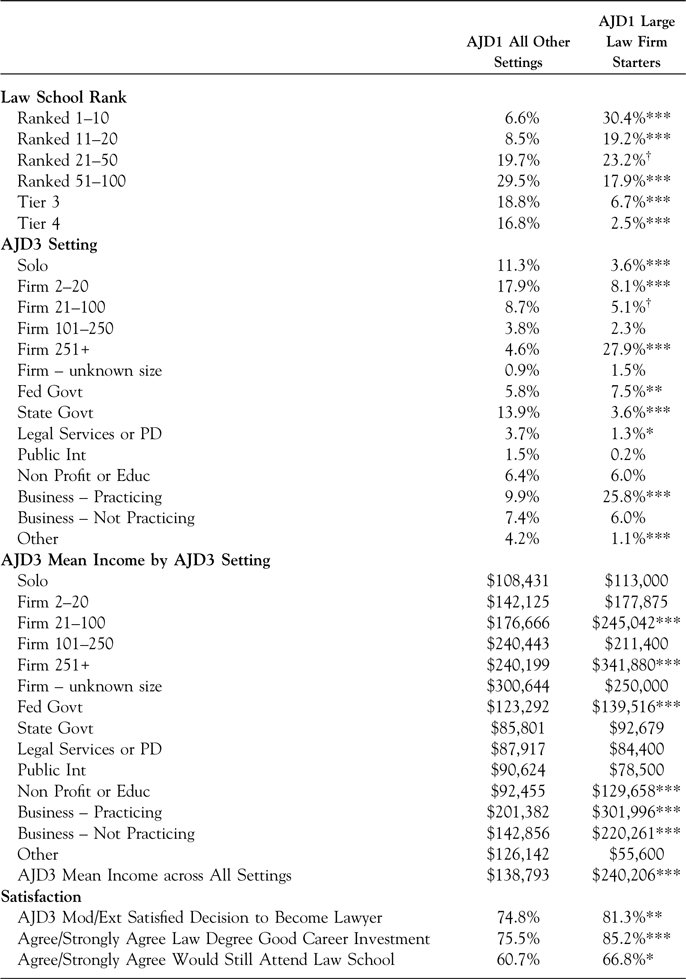
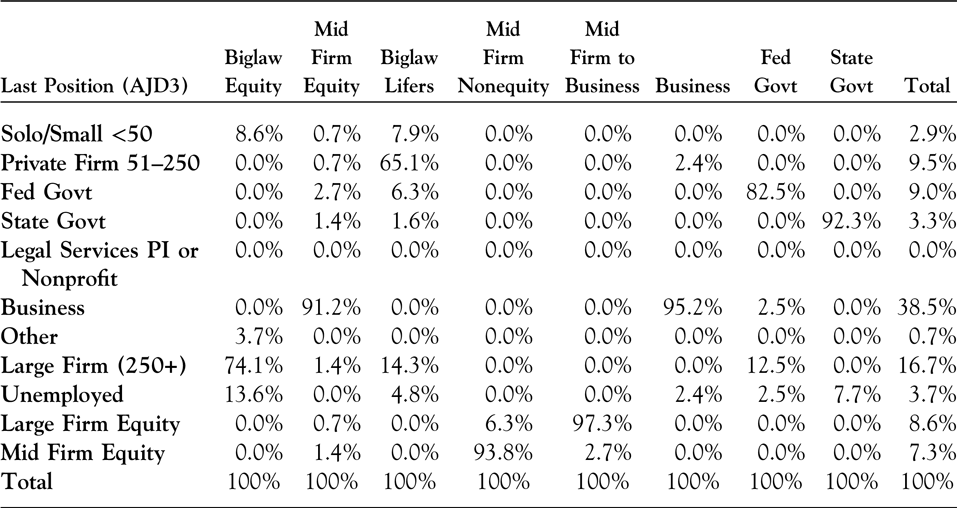
The value of starting in a large law firm has also been amplified by changes in the upper hemisphere of the bar. In parallel with the transformation of the large law firm in the 1970s and 80s was the rise in power and prestige of inside counsel. This is an important part of the story because it allowed the lawyers who left the large firm for positions as inside counsel to maintain—and sometimes even elevate—their status (Rosen Reference Rosen1989; Wilkins Reference Wilkins2016). The prominence of inside counsel as a destination is evident in the AJD data: One-quarter of those who began their careers in a large law firm are working as inside counsel by wave 3, significantly more than the 10 percent who did not begin their careers in the large law firm (p < .001, Table 1). Not only are they more likely to be working as inside counsel, but their salaries in these positions are 50 percent higher (p < .001) compared to those who began their careers elsewhere, indicating more prestigious positions.
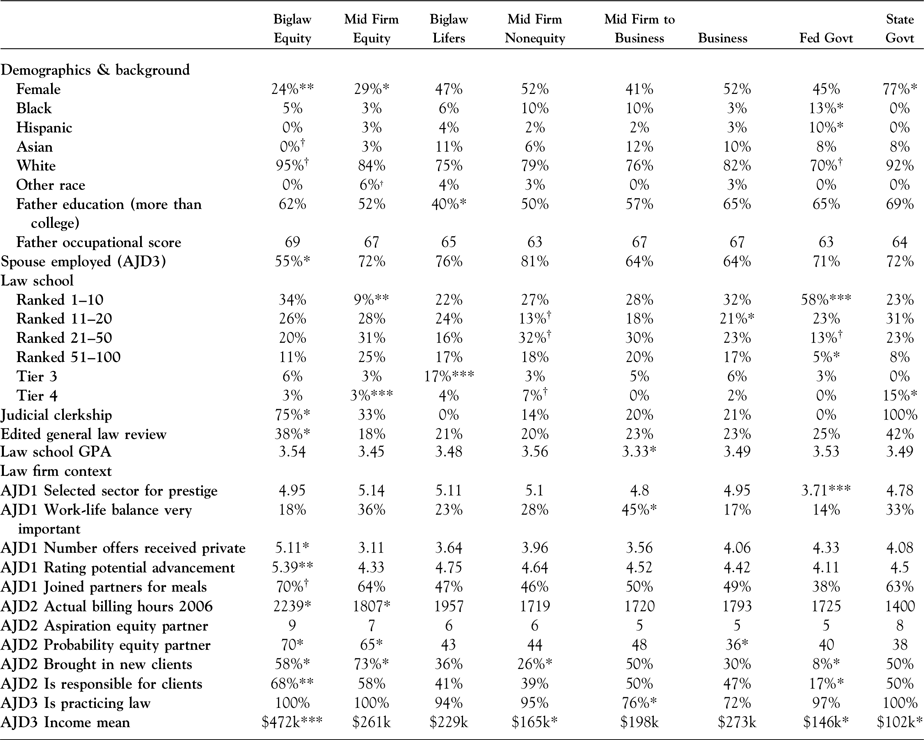
Cluster characteristics (column percentages)

†p < .10, *p < .05, **p < .01, ***p < .001
Also integral to the prestige of starting a career in a large law firm has been the phenomenal rise in starting salaries since 2000 (Collins Reference Collins2012), with the media continually feeding excitement and anticipation over the next “Biglaw pay raise” (Lat Reference Lat2016). The value of the large law first start is evidenced not only by higher starting salaries but by the enduring effect of this prestigious start on lawyers’ lifetime earnings. Data from AJD show that thirteen years after their first position, the median earnings of respondents who began in the large law firm—irrespective of where they are working—are 74 percent higher than those who did not start in this setting (p < .001, Appendix Table 1). And not only are they earning more and working in more prestigious settings, they are also significantly more satisfied with their decision to become a lawyer, they are more likely to consider their law degree a good career investment, and they are more likely to believe that given a choice, they would still attend law school (p < .05 or better, Appendix Table 1).
A second finding, which we document below, is that a critical mass of elite law graduates begin their careers in large firms and become equity partner. Our data demonstrate that the law graduates able to earn an equity partnership are overwhelmingly those with elite credentials, who also happen to be white men—despite the opening up of the large law firm to women, minorities, and to those with nonelite credentials. Just as Smigel (Reference Smigel1964a) found that law school eliteness served as a proxy for family background and cultural capital in the 1960s, our data show that law school eliteness continues to be a necessary condition for an equity partnership in a large law firm. Elite credentials of course also translate into comfort around elite lawyers and businesspeople, and research suggests that such reproduction persists in the modern legal profession (Granfield Reference Granfield1992; Ashley and Empson Reference Ashley and Empson2013; Rivera and Tilcsik Reference Rivera and Tilcsik2016).
In order to map out the career trajectories of lawyers who begin in large law firm today, we rely on two methodologies. First, we draw on a quantitative tool that in effect builds career patterns into collective biographies. Sequence analysis, which we describe below, distills the major career trajectories and allows us to find commonalities among them so that we can construct groupings of the typical career paths. Second, we use qualitative interviews to highlight the personal stories—including experiences and ambitions—that underwrite the careers in each of the career groupings that we have identified.
DATA
This article relies on three waves of data from the After the JD study (AJD), a national longitudinal survey of law graduates (Dinovitzer et al. Reference Dinovitzer2004). The study is based on a sample representative of the national population of lawyers who were admitted to the bar in 2000 and graduated from law school between June 1998 and July 2000. The sampling design used a two-stage process. In the first stage, the nation was divided into eighteen strata by region and size of the new lawyer population. Each stratum was then divided into primary sampling units (PSU), comprising a metropolitan area, portion of a state outside large metropolitan areas, or entire state, and one PSU was chosen within each stratum. The PSUs included all four “major” markets, those with more than 2,000 new lawyers (Chicago, Los Angeles, New York, and Washington, DC); five of the nine “large” markets, those with between 750 and 2,000 new lawyers (Boston, Atlanta, Houston, Minneapolis, San Francisco); and nine of the remaining, smaller markets (CT, NJ remainder, FL remainder, TN, OK, IN, St. Louis, UT, OR). In the second stage, individuals were sampled from each of the PSUs at rates that would, combined, generalize to the national population.
The AJD study was designed as a longitudinal study that started with a sample of 9,192 lawyers. In addition, the study included an oversample of 1,465 new lawyers from minority groups (Black, Hispanic, and Asian-American). In total, 4,538 eligible sample members responded to wave 1 (fielded in 2003–04) for a 57 percent response rate. In wave 2 (fielded in 2007–08), the initial sample was adjusted to 8,225 after excluding ineligible sample members. An overall response rate of 50.6 percent yielded 4,160 respondents. In wave 3 (fielded in 2012), which was restricted to prior respondents, the response rate was 53 percent, yielding 2,984 respondents (Dinovitzer et al. Reference Dinovitzer2004; Dinovitzer et al. Reference Dinovitzer2009). Analyses of potential nonresponse bias due to panel attrition reveal that there are no substantial differences between respondents and nonrespondents on characteristics such as race, gender, or type of employment.
In addition to the AJD quantitative data, we will draw on qualitative interview data to highlight some of the patterns we see in the quantitative data. The shifting perceptions and satisfactions from three time periods are especially important for identifying the ambitions and attitudes of lawyers as they build their careers. Project PIsFootnote 1 conducted 219 interviews with survey respondents who were selected purposefully to overrepresent public interest lawyers, minorities, and small firm and solo lawyers. A key feature of the interviews is that of the 146 individual respondents, 47 were interviewed more than once and 26 were interviewed three times; only 32 of the respondents interviewed began their careers in a large law firm. Once our clusters were defined in the sequence analysis, we selected interviews that we believed to be most illustrative, sometimes selecting more than one in order to highlight different aspects of each sequence. The interviews that were selected are representative of those within the full universe of interviews sharing a similar career trajectory.
METHODOLOGY
Since our primary goal is to uncover the patterns underlying elite sorting, we analyze the career trajectories of lawyers who began their careers in a large law firm, tracking their job transitions over a thirteen-year period. There is significant attrition from this starting position. Of those who began in a large law firm, 28 percent remained in large law firms thirteen years later, with only a handful of these (13 percent) in a large firm equity partner position. Just over one-quarter (26 percent) were working in business practicing law (primarily in positions as general counsel), and the remaining lawyers were fairly equally distributed across small firms (those with 2–20 lawyers), federal government, nonprofits or education, and in business not practicing law.
Focusing solely on the final position in a career path gives only a partial picture of the careers that began in a large law firm. In fact, the ordering of positions, number of positions, and sectoral representation within each lawyer’s career trajectory between their first job in a large law firm and their final job thirteen years later is distinct. As we will see below, there are 139 unique career patterns among those who began in a large law firm. Some lawyers held only one other position after their first job, while others held up to seven positions. Some lawyers changed sectors, moving from a large law firm to the federal government; some moved laterally to another large law firm before becoming general counsel in a corporation; and others went into business following some time in a smaller law firm setting. This sequencing of events is important for two reasons. First, it highlights the fact that for some lawyers, the experience of working in a large law firm on its own does not offer sufficient expertise or capital to ensconce them in their final position. For example, it may be that working in a smaller firm after a position in a large firm provides some lawyers with the skills that facilitate their move into business or that a position in the federal government allows one to leverage specific expertise and trial experience into a large law firm as an equity partner—a position the lawyer might not have been able to attain had they remained in a large law firm for their entire career. Second, by examining career sequences holistically, we can discern larger-scale patterns that offer insight into the structure of legal careers and into the relative value of experiences in particular work settings. For example, one of our findings is that the career path to equity partnership is short and direct, and never does a nonequity position precede an equity position; similarly, equity partnership in a mid-sized or smaller firm is never preceded by a nonequity position in one of these smaller-sized firms. A lateral move must lead directly into an equity position, otherwise it does not turn into one.
In order to analyze the ordering of positions in a career trajectory, we draw on a technique that is well suited for finding patterns, similarities, and differences among a complex group of events such as career histories (Blair-Loy Reference Blair-Loy1999). Sequence analysis was initially used by biologists to compare DNA sequences in order to find out to what extent two DNA strands are homologous to each other. The established degree of similarity then allows for conclusions about a common ancestor of two DNA strands.
The sequences we have constructed in this project are based on a chronology of the types of organizations (e.g., large law firm, federal government) in which respondents worked over a thirteen-year time window. In addition to organization, we also include whether respondents hold an equity partnership in large and mid-sized firms; we also included spells of unemployment. We defined eleven types of organizations and positions: equity partner in a large law firm (251+ lawyersFootnote 2); large law firm (251+ lawyers), not equity partner; equity partner in a mid-sized firm (51–250+ lawyers); private law firm (51–250+ lawyers), nonequity partner; business (practicing and not practicing law); solo or small firm lawyer (less than 50 lawyers); federal government; state government; and unemployed. Another key variable in our analysis is law school attended, which relies on respondents’ self-report and is grouped based on the U.S. News rankings for 2003, which is the year most respondents began their first jobs. To create the sequences, we rely on TraMineR and the optimal matching package seqdist2 (using seqdistOO) in R, which provides dissimilarity measures between state sequences.Footnote 3
PLAN OF ANALYSIS
Our analysis focuses on the subset of 455 respondents who began their careers in the large law firm. There are 139 unique sequences in this subset, with a maximum of seven possible positions. In cases where individuals reported more than seven positions, middle positions were truncated, while preserving first and final positions. Once the data were sequenced, we clustered them by relying on the combined algorithms of Partitioning Around Medoids (PAM) with Ward clustering (Ritschard Reference Ritschard2019).Footnote 4 The best fit for the data is an eight-cluster solution, which was selected based on examining a number of alternative scenarios and their related fit statistics. Our descriptions of each cluster below reference the Average Silhouette Width (ASW), a fit statistic that ranges from –1 to 1 and that reflects the homogeneity of the cluster. Higher values reflect more homogeneous clusters, indicating the extent to which the sequences in the cluster are similar to each other.
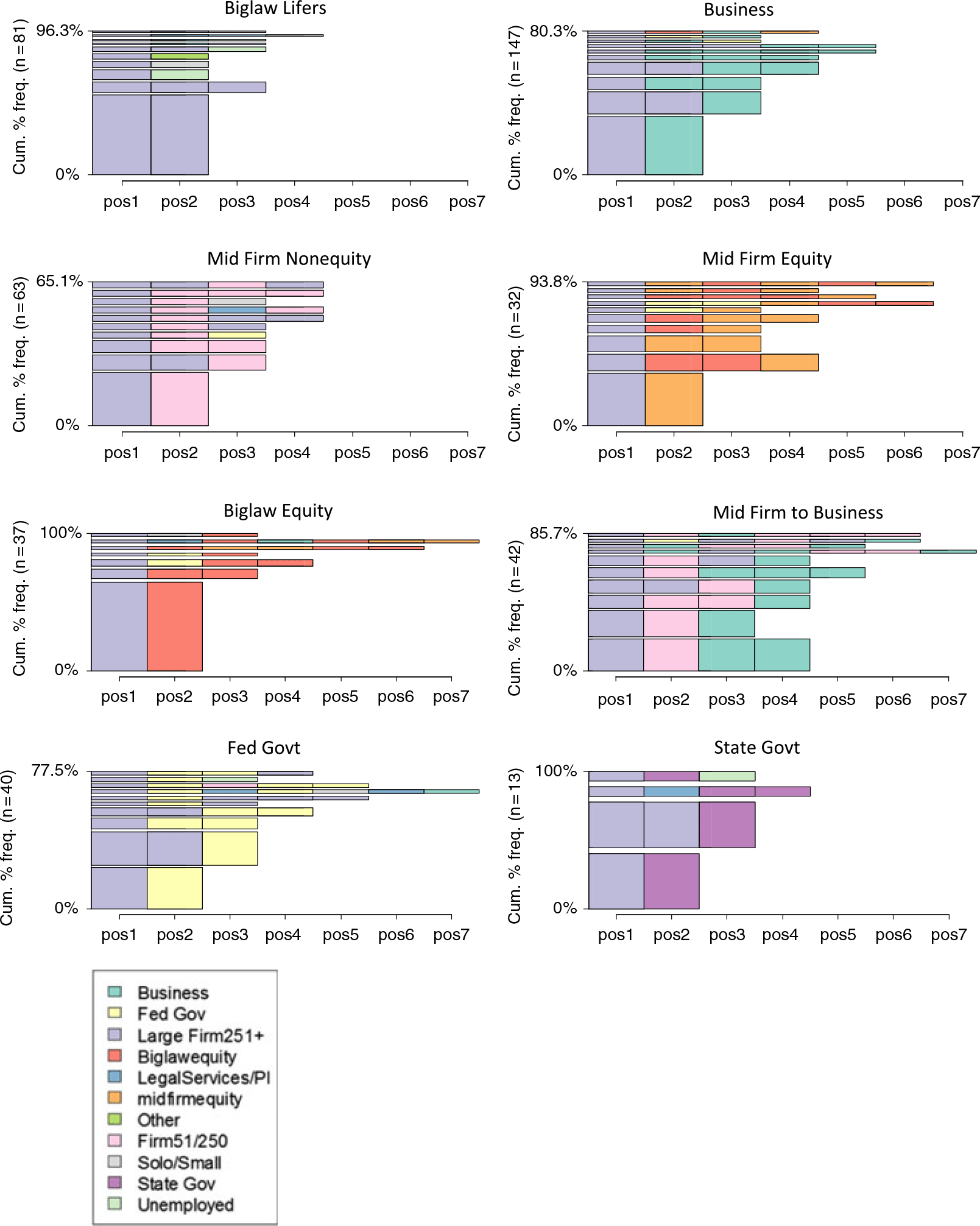
The sequences and interview data show that career paths are a complex process with issues of individual agency, fortuity, gender, ethnicity, and race all implicated. The largest cluster (n = 147) features respondents who went directly from a large law firm to a business setting. The second largest cluster (n = 81) we characterize as the biglaw lifers—those individuals who remained within the large law firm, but not as equity partners. The third represents lawyers who moved to a smaller law firm of 51–250 lawyers, but who are not equity partners (n = 63); the fourth comprises those who first transitioned to a smaller firm (51–250 lawyers) and then moved into business (n = 42); the fifth represents lawyers who moved from large law firms to positions in the federal government (n = 40); the sixth comprises lawyers who are equity partners in mid-sized firms, a number of whom were previously equity partners in larger firms (n = 32); the seventh is the small group of lawyers who are equity partners in large law firms (n = 37); and the eighth is the smallest group, those who moved from a large firm to a position in state government (n = 13) (Figure 1).
Eight cluster solution, career sequences for large law firm starters.

FINDINGS
The discussion below draws equally on quantitative and qualitative data. The descriptive quantitative data are limited because of some very small cell sizes; thus we report the patterns in the data even when they do not reach standard levels of significance (all data are reported in Tables 1 and 2 unless noted otherwise).
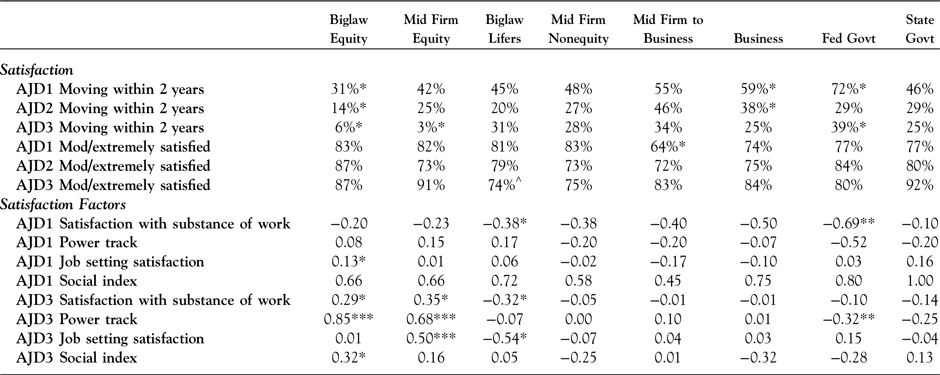
Satisfaction by clusters

*p < .05, **p < .01, ***p < .001
^p < .10
Biglaw Equity. The biglaw equity cluster comprises 8 percent of the sample (37 lawyers). With 97 percent of the lawyers in this cluster reporting equity partnership in a large law firm as their final position (Appendix Table 2), this handful of lawyers is among the wealthiest and most elite in the sample. 60 percent of the lawyers in this cluster graduated from an elite law school, with about one-third graduating from a top-ten law school and another quarter from a top-twenty law school (nonsignificant); they also report the highest occupational scores for their fathers (nonsignificant). Mean earnings ($471,500) are by far the highest of all the clusters (p < .001), yet the hours worked are no different than the average. Only 24 percent of lawyers in this cluster are women, the worst gender imbalance of all the clusters (p < .001). It is also 94 percent white, making it the whitest cluster in the sample (p = .05). Lawyers in this cluster are also most likely to have a spouse who is not working in the paid labor force (p < .05); only 55 percent of their spouses are employed, compared to 75 percent for the rest of the sample (p < .05).
Prior research has found that elite students in large law firms express the least satisfaction when they begin their careers, and the highest intentions to leave that setting within two years (Dinovitzer and Garth Reference Dinovitzer and Garth2007). However, the findings for this cluster are surprising because they indicate the opposite trend. In wave 1 of the After the JD study, when the lawyers in this cluster were starting their careers, they expressed significantly lower mobility intentions than their peers: 31 percent expressed that they expected to look for a new position within two years, compared to 51 percent of all other respondents, all of whom were working in large law firms at the time (p < .01). This pattern suggests an early level of commitment and focus that differentiated lawyers in the large firm equity cluster from their peers working in the same setting. Moreover, as our qualitative data reveal, this privileged group of lawyers was also embraced by the firm and its lawyers, with their lower mobility intentions likely reflecting their degree of integration and acceptance within the firm. As Garth and Sterling (Reference Garth and Sterling2009) have noted, they were both “doing the time” and “finding the love.”
A few other features of their early careers stand out: Lawyers in this cluster were more likely than others to have been an editor on their law school’s general law review (p < .05), as many as three-quarters of them completed a judicial clerkship (p < .05),Footnote 5 and they received the highest number of job offers in their initial job search (p < .05). They were significantly more likely than lawyers in other clusters—all of whom began in a large law firm—to say that they selected their job because of the opportunities for advancement (p < .001), but they were least likely to say that they chose this sector because work-life balance was important to them (nonsignificant). Their initial experience in the law firm was fundamentally different, with 70 percent reporting that they joined partners for meals (p < .10), the highest of any cluster. When we surveyed respondents at wave 2, lawyers in this cluster reported the strongest aspirations (nonsignificant) and expected probability (p < .05) of making equity partner among all large firm starters, they billed the highest number of hours (p < .05), and a higher proportion of respondents than in any other cluster reported that they were the primary responsible attorney for some of the firm’s preexisting clients (p < .01). At wave 3, lawyers in this cluster report an above-average level of satisfaction with the substance of their work (an index comprising satisfaction with the intellectual challenge of the work, the substantive area, the tasks performed, the skill-building opportunities, the level of responsibility, and the value of the work to society), the power track (an index comprising satisfaction with compensation and the method of compensation, opportunities for advancement, recognition received for the work, and performance evaluation) and the social index (an index comprising satisfaction with opportunities to do pro bono work and diversity of the workplace) (all p < .05 or better).
The most common sequence in this cluster is characterized by a mere two positions: the first position in a large law firm followed by equity partnership. The cluster has a high average silhouette width (ASW) of 0.73. This high degree of homogeneity demonstrates that the pathway to equity partnership is very narrowly defined; in other words, deviations from the mold will not lead to an equity partnership in a large law firm. There are a handful of interesting departures that demonstrate which deviations are indeed valued, such as a number of individuals who held positions in federal government before becoming equity partner, and a few who also held equity positions in medium-sized firms; there is only one sequence in which a lawyer moved back to being an equity partner from a position in business. There are also notable absences. There are no sequences that indicate a position in another large firm without an equity position; there are also no sequences that include a position in state government, and no spells of unemployment. In other words, experiences outside of the narrow tournament to partnership are indicators that a lawyer’s career is not on track to an equity partnership in a large firm.
Taken together, the lawyers in this cluster are indeed very reminiscent of those who made partnership a half century ago: They are demographically white, male, and elite, typically with wives at home, and their trajectories are narrow and precise, ticking off all the boxes of achievement and never straying from their commitment or their paths to partnership. The homogeneity in this cluster shows that they follow essentially the same path and represent the same forms of capital that led to partnership in the golden age—before the opening of corporate law firms to women and minorities and to graduates of nonelite law schools.
Our interview with John,Footnote 6 who is a white male lawyer, illustrates many of the features we identified in the data. John attended an elite undergraduate college and a top-ten law school, but he was the first in his family to attend college, even though his father had a solid middle-class occupation. Following law school, he clerked for a judge and expected to work for the government, but on the recommendation of a friend, he interviewed with just one firm and decided he liked it. He made equity partner at this same firm at the first opportunity. He is married to a lawyer whom he met when they were associates at this same firm and who is now a stay at home mother. There are a few features of John’s trajectory that are worth emphasizing. He did not have a substantial (or even any) book of business before he made partner; the firm’s clients were sufficient for him. His billables were always high, around 2,200 hours. From his very first interview he expressed that he was satisfied and was not planning on leaving his firm, a fact that remained constant over three interviews. At the same time, he never said that he was gunning for partnership.
With his drive, credentials, and background, he found a fit at the law firm. In his words, “I really like the people here and I think that they’re very welcoming and you feel like you’re a part of the team from the beginning and, you know, at the time, I was a young associate but more senior people on teams would care about what I thought and would solicit my thoughts … so I felt that it was a very welcoming, supportive, team-type place. I think that, over time, my sense has been and a gradual one but just that I am … I am more of this place.”
This perfect fit is consistent with a story of continuity amid considerable change in the legal field. Stories such as John’s are consistent with the maintenance of a critical mass of equity partners from elite law schools despite the fact that most elite law graduates joined large law firms with no expectation or even desire to become a partner.
Business. As we documented above, the rise of legal careers in business is one of the most significant transformations in the modern legal profession. Given the ubiquity of careers in business, there are two clusters that represent these sequences. In both clusters, almost all the careers culminate in a position in business, but the sequences in this cluster are characterized by a direct path to this endpoint: Three-quarters of careers in this cluster include only positions in large firms and in business, with one-third exiting the large law firm for a position in business after their first job in the large firm. In short, the sequences in this cluster exhibit very little cross-sectoral movement, a homogeneity that is confirmed by the high ASW of 0.63, which is particularly striking given that this is the largest of all the clusters (n = 147). As with the biglaw equity cluster, the lack of heterogeneity demonstrates a strong differentiation among the practice settings.
The data point to the eliteness of this cluster, with prestigious law school credentials and family social background well represented: 32 percent graduated from a top-ten law school (nonsignificant), and a higher-than-average percentage reported that their father completed graduate education (65.4 percent, p < .05). Individuals in this cluster knew or decided that they were not on the partnership track early in their career: they expressed higher-than-average mobility intentions at waves 1 and 2 and had a lower-than-average expectation of making partner at wave 2 of the survey (all p < .05). This helps in part to explain the direct move from law to business. The gender balance in this group tips toward female (p = .09), and there is no pattern by race or law school tier.
Angela’s story is instructive. Angela is an Asian-American woman who attended an elite public institution for college and after graduating from a top-ten law school began working in a large firm in Silicon Valley. She worked long hours without complaint but expected that once she had children she would want to move in-house because “I couldn’t envision myself being partner because I looked at every woman there and either the husband didn’t work or they had a nanny and they never saw their kids … .” Moreover, she said that making partner was never a goal so “I knew I needed to get out at some point.” At the same time, the firm never gave her any indication that she could make partner.
Angela knew that in order to move in-house she needed broader experience, so she moved laterally to another large law firm where she knew some associates and soon began interviewing for inside counsel positions. An avid networker—almost exclusively within the Asian-American community—Angela knew someone who had also moved in-house who offered her a position. She reported that in this position her hours were very flexible, like her husband’s, who is also an in-house lawyer. She has two children, and at the time of the interview was pregnant with her third.
With the business cluster representing a fairly prestigious and elite grouping, it is not surprising that her story is characterized by ambition, commitment, effort, and, ultimately, success. Yet at the same time, because of the rigidity of the large law firm model, she knew her skills could not be rewarded within that setting. The in-house position at a major corporation valued both her elite credentials and her law firm experience, but it also did not penalize her for an unwillingness to conform to the time demands of the large law firm. It also provided a nicer fit perhaps for an Asian lawyer at a time when Asian partnerships were still quite rare. This career trajectory both helps to recruit individuals such as Angela into large law firms and allows them to recognize their lack or fit, move on, and still validate the law firm experience.
Mid Firm Equity. The typical career in this small cluster (n = 32) is that of a lateral move from a large firm to an equity position in a mid-sized firm. While 94 percent of the sequences in this cluster end with an equity partnership in a mid-sized firm, the careers in this cluster show more varied job mobility, which is reflected in the mid-ranged ASW of 0.39. Sequences in this cluster show a higher degree of lateral mobility: in a number of cases mid-firm equity positions come after equity positions in large law firms, and in a few cases they follow careers in federal government, suggesting that having established one’s career elsewhere is necessary for success on this path. Again, the cross-sectoral mobility is very selective, with no positions in business, small firms, or state government appearing in this cluster, and no other positions in a large law firm with a nonequity status.
While undoubtedly a coveted set of job sequences, there is a meaningful differentiation in the profiles of individuals in this cluster compared to those in the biglaw equity cluster. It is less elite, with a significantly lower proportion of top-ten law graduates (p < .01). Earnings are substantially lower than in the biglaw equity cluster and are not significantly different than the subsample’s average. Equity partnerships continue to be the privilege of white men, however, with women representing only 29 percent of the lawyers in this cluster (p < .05), while 84 percent are white (nonsignificant). Lawyers in this cluster received fewer than the average number of job offers when they graduated from law school (nonsignificant), and a lower proportion than average were editors on the general law review (nonsignificant).
On the other hand, that lawyers in this cluster have largely remained in the law firm setting, and that they have succeeded along a very difficult track of becoming equity partner, is partly due to their ambitions: They expressed a higher-than-average estimation that they would make equity partner when they were interviewed at wave 2 (p < .05). Data from wave 3 further suggest that lawyers in this cluster feel good about their careers and their work. They report higher-than-average levels of satisfaction with almost all aspects of their work: the substance, power track, and job setting (p < .05). Given that most did not come from as privileged a social position as those working in larger firms, yet they have still obtained coveted equity partnerships, they feel their hard work has paid off and they are satisfied with where they are.
Since most lawyers who begin in large law firms end up leaving, many white men are in this category. Dan’s story illustrates one such case. With an Ivy League undergraduate degree and a law degree from a top-twenty school, Dan worked for eleven years as a litigator at a major law firm in Washington, DC, billing very long hours. He was told he was on track for partnership, but the recession changed the firm’s attitude and he was instead made a senior attorney off the partnership track, a position he rejected. In his words, “I have a reputation here of being a real company guy, team player, but, you know … for the first time I’m, you know, looking for other jobs. I could stay here indefinitely and make a very nice salary, but, you know … . I was really, really angry at how it worked out … .”
Ultimately, he left the firm, left DC, and found a position back in the state where he came from, and now he is a partner at a small but prominent litigation law firm there. What distinguishes Dan’s story is that he was promised partnership and he felt betrayed by his firm for being misled. He was not valued in the way that John, the equity partner from an elite law school, was. Yet he was able to convert the capital accumulated from his first position in a large law firm into a respectable and locally prestigious position. He did not settle for the of counsel position.
One other instructive example is a Mexican-American lawyer from a modest background, named David, who graduated from a top-ten law school and began at an elite law firm. He described the elite firm practice as follows:
It’s great people at [the firm]. It’s great people, really smart people, committed people, but I was there … for almost three years, and I did three depositions … and the rest of the time was just … doing those document reviews … . But, again, you have to remember where I started from, the first person from my family to graduate from college, the first person from my family to be a lawyer … . It was a shock going into [the elite law school], and then it was an even bigger shock ending up at [the law firm].
When he started, he thought about becoming partner and initially had good mentors, but within a couple of years they left, and, unfortunately, “you have to find somebody to be a mentor.” David moved to a small litigation-focused firm, becoming partner during that time. After ten years he formed a new firm with a friend, taking several key clients from the prior practice. Given its location in a major legal market, we would define this as a boutique firm, one that also emphasizes its diversity and has been very successful.
David’s story resonates with those of other outsiders, who begin their careers in large law firms but experience a lack of fit and mentorship despite their elite credential, and yet they can draw on that experience and the value of the big firm symbolic capital (see, e.g., Payne-Pikus, Hagan, and Nelson Reference Payne-Pikus, Hagan and Nelson2010). Boutiques such as David’s depend on the large corporate law firms for their hiring and for much of their business (referrals from smaller matters and stemming from the conflicts of interest that require the large firms to refer clients elsewhere), and they provide specialized services that big firms may require (Southworth and Fisk Reference Southworth and Fisk2014). They also are a place of refuge for lawyers who do not fit in large law firms or have lifestyle reasons for leaving. Like the corporate counsel positions, they help to promote careers beginning at large law firms and leaving after a few years—helping to sustain the large law firm at the top of the hierarchy.
Federal Government. The federal government cluster represents a smaller (n = 40) set of career paths that diverge from what was available in the golden age, with 83 percent of careers in this cluster ending in the federal government. It is a uniquely elite grouping, with the highest proportion of top-ten graduates of all the clusters (p < .01). At the same time, the ambitions expressed by lawyers in this sequence diverge dramatically from those in the biglaw equity group. Lawyers in this cluster expressed early on that the large law firm was not the right fit for them, with 72 percent expecting to leave their large firm position within two years (p < .01) and experiencing lower-than-average levels of satisfaction with the substance of their work at wave 1 (p < .05). Respondents in this cluster also gave the lowest value to prestige in their choice of sector for their first job (p < .001). While this is an elite group, they are earning significantly less than their peers in other clusters, with average earnings of $145,917 (p < .05). It is perhaps not surprising that lawyers in this cluster report lower levels of satisfaction with the power track (p < .05)—a composite measure reflecting satisfaction with earnings and satisfaction with prospects to advance. This cluster is also the most demographically diverse, with 30 percent reporting that they are nonwhite (p < .05).
With an ASW of 0.47, there is more heterogeneity than the average in this cluster, which suggests that careers in this cluster include a wider array of career paths. There are more job changes than average, with a number of moves between the federal government and large firms and some back and forth between these two sectors. It is notable that none of the large firm positions include an equity partnership, there is only one instance of a position in business, and there are no sequences with a position in state government.
Our interview with an African-American lawyer provides some insight into this career path. John completed his undergraduate and law school education at top-ten universities. He is not a child of advantage, however, with both his parents working blue-collar jobs. His first job was at a large prestigious law firm in DC, the same firm at which he summered, but he quickly moved laterally to another DC firm because he wanted to do litigation. He was promoted to senior associate, but when asked about partnership, he was ambivalent, saying “I value my family, I have a son and a daughter and I don’t know … .” When asked where he would be in four years he said, “At this point my cynical nature tells me that I’ll be surprised if in four years if you find me in this type of private practice. You might find me in a smaller firm, you might find me working for the government … I don’t know—all I can tell you is I’m almost 100% certain I won’t be in this environment.”
Four years later, at the time of the economic crisis, he was still at the firm, but he said, “I don’t expect to last the year here.” He noted that he had very little work, and he also reflected on his fit within the firm: “I’ve had a few people that … were very nice to me, gave me great advice,” but explains that they couldn’t help him maneuver because they themselves were not well grounded in the firm. Ultimately, he secured a position in the federal government.
John’s career, much like David’s, illustrates the lack of investment and integration reported by many minority lawyers in large law firms (Payne-Pikus, Hagan, and Nelson Reference Payne-Pikus, Hagan and Nelson2010), leaving him not only without a source of work within the firm, but also without the strategic career advice and support that is required to make partner in this setting. It also illustrates how the federal government provides another safety net available to those who are undervalued despite their elite law degrees.
Biglaw Lifers. As the modern law firm has grown, the traditional up-or-out model has been abandoned (Galanter and Henderson Reference Galanter and Henderson2008). Long-term careers in large law firms are now no longer restricted to equity partners, and this reconfiguration has shifted the composition and status of individuals within these firms. The lawyers in the biglaw lifers cluster embody this new dynamic, and the size of this cluster (n = 81) is a testament to the ubiquity of these “new” careers. Three-quarters of the careers in this cluster report a final position in a large law firm with no equity stake, in positions as nonequity partner or of counsel, with a small number working as associates (Appendix Table 2). Another 14 percent report that they are unemployed, with 9 percent reporting a final position in solo or small practice. The ASW of 0.57 reflects a fair cohesion because the majority of the careers in this cluster are restricted to a small handful of positions. There are no sequences that include positions in the government sector and none of the respondents ever had a promotion to equity partnership (the lawyers in this sample are not yet senior enough to have experienced being de-equitized).
This cluster has heavier representation from the relatively less elite law schools: 21 percent graduated from a tier-three or tier-four law school, compared to 10 percent in the overall large firm starter sample (p < .001). They also report a less elite social class background: Only 40 percent had a father with graduate education compared to 57 percent in the sample (p < .001). This pattern helps round out the story of the second transformation of the large law firm: as law firms grew and thrived, they needed to recruit ever more associates, which necessitated hiring law graduates from less elite law schools. Unfortunately, as these data demonstrate, these graduates were relegated primarily to the less lucrative and prestigious nonequity track.
Despite (or perhaps because of) their elite start in the large law firm, there is a sense of disappointment with how their careers unfolded. Lawyers in this cluster report the lowest level of satisfaction with their decision to become a lawyer in wave 3 (p < .10). They also report lower-than-average levels of satisfaction with the substance of their work (p < .05) and with their job setting (p < .05), suggesting that the large law firm track without the equity partnership results in disappointment. As we argued above, nonequity positions have been key to the diversification of the legal profession, and we find that about half of this cluster is female (nonsignificant), with almost 20 percent of the lawyers in this cluster reporting that they are nonwhite (nonsignificant).
The experience of Emily, an Asian-American woman who graduated from a top-twenty law school, is illustrative. Emily began in a large law firm in DC, where she had also summered. Emily had two children, taking maternity leave and returning to work on reduced hours after each child. Throughout, she continued to express her desire to remain on the partnership track, even after her firm delayed her partnership consideration, although she recognized that “I’m just kind of on a slower track generally.” Her discomfort at work was also evident. At both her interviews, when asked where she would be in five years, she said she expected to be elsewhere, but, notably, had no concrete plans about where she might be.
By her third interview in 2014, she was still with the same firm, having been promoted to of counsel in a nonequity position. Reflecting on her career, Emily expresses that she likes the work she is doing and the people she is working with, and that her work situation “works” for her family. She is surprised that she is still at the firm after all these years and comments that it suits her personality, but that she is thinking about more meaning in life and would consider a position in-house or government. Emily’s interview again highlights the impact of gendered roles in her interactions with the law firm, with the of counsel position providing a secure location for someone who is pushed or pulled off the partner track but stays in biglaw. Again, as an Asian-American woman with children, her lack of fit in comparison with the typical white male equity partner is consistent with leaving the equity partnership track. But here, too, the of counsel position provides a landing place that pays well, offers a more manageable work schedule, and of course validates the experience in the large law firm.
Albert is an Asian-American male who graduated from both a leading state university and a top-forty law school. He began his career in a large firm in intellectual property under the tutelage of a partner who generated considerable business. He hoped to rise to partnership through that connection. That partner left the firm, however, and Albert had to generate his own business in a recessionary period. He was still hoping for partnership at his second interview, but eventually he moved to another large law firm, taking a position as “Special Counsel.”
Neither Albert nor Emily fit the ideal typical white male model of an equity partner, and while they provide different accounts for the lack of embrace by their firm, both ultimately found positions within corporate law, though not as equity partners. Albert’s story in particular highlights the importance of personal networks—and the pitfalls of hinging one’s career prospects on one person or within too small a niche.
Mid Firm Nonequity. As large law firms have transformed their partnership tracks and created a multiplicity of nonpartnership track positions, mid-sized law firms have done the same. While the majority of the sixty-three individuals in this cluster are working in mid-sized firms in nonequity positions, such as associate, nonequity partner, and of counsel, there is more heterogeneity in the final position among these careers (Appendix Table 2), which is reflected by the low ASW (0.30). Some of the sequences suggest a fluidity between the mid-sized and large firms, with an almost back-and-forth pattern—though never as equity partner in the large firm.
The data again point to nonequity positions as a less elite outcome, with the lawyers in this cluster graduating from middle-ranked law schools: almost one-third graduated from schools ranked 21–50 (p < .10). Their mean earnings of $165,098 are significantly lower than those of the sample as a whole (p < .05), with more than half of this cluster comprising women (nonsignificant) and about 21 percent nonwhite (nonsignificant).
The early experiences and ambitions of this group also suggest a downward mobility from their elite start. Only 46 percent (nonsignificant) of lawyers in this cluster joined partners for meals at the start of their careers, one of the lowest rates in the sample. Only a quarter (p < .05) ever brought in new clients at wave 2, and almost half expected to be leaving their position within two years (nonsignificant). Their current level of satisfaction is among the lowest (nonsignificant), and three of the four indicators of satisfaction at wave 1 were below average (nonsignificant).
A qualitative embodiment of the rocky road from a large firm to a small-to-mid-sized firm is Adam. Adam went to a liberal arts college in the Midwest and then to a top-forty law school, where he excelled; he was an editor of the law review and secured an associate position at a well-known, Midwest-based national corporate law firm. He worked there for two years and then moved to another large firm in the same city. At that point the partner who had brought him in, and who was the source of 90 percent of his work, left the firm. To get more work he switched to a branch office in California, leading to a divorce and a period of personal instability, which included termination from his job. Ultimately, he found a position in Massachusetts through a contact, stayed for two years, and then found another position back in California, where he had begun a new relationship. He did not make partner at that firm, and now he is in practice by himself.
Lori, a woman who graduated from a top-ten law school, worked for two elite law firms in environmental law, hated the work, and then moved to a permanent position as a law clerk for an appellate court. She stayed in that position for almost five years. Her husband, also a lawyer, then took a position in-house in a city in a relatively small legal market. She moved with her husband and eventually secured an of counsel position in environmental law at a leading regional firm. Adam and Lori’s stories bring to light the range of events that take people off the singular path to equity partnership in a large firm—be it family constraints, geographic mobility, or the recurring theme of a connection to the wrong individuals. Any deviation from the norm is enough to derail the path to equity partnership. But we can also see in each case that the large law firm experience helped keep them afloat as a valuable resume asset.
Mid Firm then Business. This is the second cluster to represent the transition from private law firms into business. This cluster is the smaller of the two (n = 42), and the typical sequence in this cluster is characterized by three positions: the first in a large firm, the second in a mid-sized firm (nonequity partner), and the final in business. Almost all the sequences in this cluster include positions only in these three settings, hence the fairly high ASW of 0.59. None of the positions indicate any time as equity partner.
This is the less elite of the business groupings, with 50 percent of lawyers having graduated from schools ranked 21–100 (nonsignificant) and with earnings lower than average (nonsignificant). At the start of their careers, lawyers in this cluster reported a significantly lower-than-average level of career satisfaction at wave 1 (p < .05), and 45 percent reported that work-life balance was a very important consideration for them in their job choice, far higher than any other group (p < .05). While most are working as senior or general counsel for a corporation, a small number report that they are business owners, such that only 76 percent report that they are practicing law (p < .05). This cluster is somewhat more male (nonsignificant) and somewhat more diverse than the average (nonsignificant).
Claire is a Chicago woman who attended a local college, attended a tier-four law school, and began her career in an insurance defense firm. She sought partnership in the law firm at which she began but was denied by one vote because of what in retrospect she describes as gender discrimination. She was systematically undervalued at the law firm by some of the partners but used that as an incentive to work harder on her skills. When she left the firm in 2010, her prospects appeared bleak: “It was very tough and … there was not a lot of openings at all.” While she pursued a potential lead to open up a new office for a firm from another city, it did not work out. She then obtained a position in the general counsel’s office of an international bank and recounts that she believes her range of skills secured her the position. During her third interview, Claire was thriving and advancing at the bank, although working very long hours—she was also single, with no children. Claire’s experience illustrates both the push out of the large firm and the difficulty that some encounter in translating their law firm experience into a new position. At the same time, however, her law firm credential helped her find an in-house position where she could thrive and be recognized rather than discounted.
State Government. Positions in state government, after a start in a large law firm, are a rare sequence (n = 13). By wave 3, 92 percent of positions in this cluster are in state government, with the remainder of respondents reporting they are unemployed.
Given its size, most of the significance tests show a null effect. Lawyers working in state government were among the least likely to have attended a top-ten law school. The lack of fit in the large law firm is apparent: over one-third of lawyers in this cluster report that work-life balance is very important to them (among the highest in the sample), and they report some of the lower levels of satisfaction at wave 1 when they were working in the large firm. Earnings in this cluster are the lowest in the sample (p < .05), and three-quarters of the lawyers are women (p < .05). At the same time, lawyers in this cluster express the highest levels of satisfaction in the sample (92 percent versus 81 percent), which suggests that there is a fit between where they are currently working and their expectations for their careers.
One example from the qualitative interviews is somewhat unique but nevertheless instructive. Julie graduated from an elite public university and top-ten law school and began working in a large law firm in San Francisco. She described her time at the firm by saying, “I actually liked working there. I mean it was a little bit of a grind on the hours, but it’s just not compatible with family life I don’t think in my opinion anyway.” She stayed at that firm for two years, then changed jobs because she married and relocated to a smaller city. No longer at the firm during her second interview, she explained that when she had her first child, the firm was closed to any possibility of offering a part-time position. She left the paid labor force, had two more children, and started doing some hourly contract work for smaller local firms. Eventually she began a job search for settings other than a law firm, landing a position as general counsel for a state university. She enjoys her work, she finds it challenging, the organization’s mission fits with her own values, and she is happy. When asked whether she expects to still be in this position in five years she answered, “Definitely, yeah.”
The group going into state government is very small, demonstrating that the prestige gap between a career in a large law firm and in state government is very large. As Julie’s career path demonstrates, state government can offer a way out for some who did not find a fit in the large firm setting—both in terms of work-life balance and values. It is a path that is largely outside of the legal careers that have grown up and evolved along with the transformation of the position of large law firms in lawyer careers.
THE TRANSFORMATION OF THE LEGAL FIELD
Partners at corporate law firms have long been at the top of the hierarchy of the legal profession. In the golden age their position was assured by recruitment of WASP graduates of elite law schools supported by wives at home. A relative few became partner, but those who joined the firms aspired to the coveted position and were considered failures if they did not succeed. The desirability and prestige of the corporate law firm partnership fueled the genteel tournament. To be sure, a number of partners went back and forth between their firms and the federal government or the federal judiciary. But the platform was the law firm. The prestige of the firms was cemented by the close ties they had to the elite law schools.
Today, the large corporate law firms remain at the top, yet the legal field has changed in important ways as a result of, among other changes, growth in the large law firms, dramatically increased competition among law firms, and a much more open recruitment process. The law schools and law firms have opened up to new groups from outside the WASP male core. There are many women and a much larger number of minorities in the elite schools and in the many other law schools that also now feed the corporate law firms at the entry level—even if not in the same numbers as the elite law schools. The question is how the legal field has absorbed these groups that, in a number of ways, challenge the traditional hierarchy. The combination of the sequence analyses and the qualitative interviews shows that by tracing the sorting of elites, we can begin to understand the structure of the modern legal profession and the ways in which the dueling pressures of elitism and diversity that characterize this new era have been resolved.
We find that, consistent with the long-standing hierarchies of the legal field, the so-called upper hemisphere represented by the corporate law firm remains dominated by white male graduates of elite law schools with wives at home. The sequence analysis of equity partners shows a group that touched all the bases to fit the institutionalized hierarchies of the large law firm, including both the capital (law review, high grades, elite schools, and judicial clerkships) and the ambitions and fit required. They also continue the white male dominance within the equity partnership track. Because of this story of continuity, we term them “the inheritors” from the golden age of corporate law firms. It is almost surprising how happy they are with their lot even in the era of the tournament without end—and it is counter to the popular narrative that elites are no longer interested in this prize.
Instead we find a reconfiguration in which the corporate law firm sits at the apex of a set of new careers that almost seem tailor-made for those who are not seeking or cannot attain the equity partnership position. The new careers, all of which began in the once-exclusive corporate law firm, hover in its orbit and provide a sort of release valve for those who were “let in” but who are not meant to stay. The careers are not themselves completely new, but they are redesigned for the new era.
The numerically most important career pattern, which is slightly skewed toward women, is the business in-house counsel position. It accommodates those who seek a somewhat better lifestyle, especially rewards those with elite credentials, pays very well, and now provides a relatively high level of prestige and prospects for further upward mobility. The career is a far cry from the in-house position that housed the failures of the golden age of corporate law firms. The large corporations validate the corporate law firms by hiring those who move out of the firms, cementing reciprocal relationships that are different than they were in the golden age, and as Schleef (Reference Schleef and McDonald2013, 409) concludes, this results not in “a severing of ties or an indication of bad blood, but a continuous moving back and forth that fosters and maintains elite class dominance, and more specifically, the professionalism projects of elites.” The networks are much more complex than they were in the era of stable relationships between law firms and clients, but they continue to support the new structure of eliteness in the legal profession.
Positions in the federal government provide another cluster that is symbiotic in many respects with the large corporate law firms, attracting and selecting a more elite segment. At the same time, this group is the most diverse in terms of ethnicity and race. There are also still suggestions of potential mobility to and from the federal government at the time of wave 3, which may provide paths back into corporate positions with power for some minorities among other relatively elite lawyers.
The second most numerical sequence is the biglaw lifer, and the most common pattern is two positions—partnership track and then off the partnership track. Not only does this cluster represent a radical departure from the original up-or-out Cravath model, the size of this cluster suggests the importance of this new career track to the sustenance of the large law firm. It is not surprising that these sequences accommodate many of those from nonelite schools who began their careers in large law firms. We also find that women occupy the majority of these positions, in part because of lifestyle and in part because they do not fit into the equity partnership mold. While a large body of scholarship has investigated the career pathways of women in law firms (Epstein Reference Epstein1983; Kay and Gorman Reference Kay and Gorman2008), Gorman and Kmec’s (Reference Gorman and Kmec2009, 1465) explanation for women’s lack of upward mobility in large law firms is particularly apt: “[R]eliance on gender as a proxy for competence, use of sex-labeled roles and gender stereotypes as heuristics to assess candidate suitability for particular roles, and in-group favoritism … lead decision makers to prefer men over women in selection decisions at all levels. The high status, work uncertainty, and traditional male domination of upper-level positions intensify these decision-maker gender biases.”
The remaining clusters show movement of both associates and partners of large law firms into positions in smaller firms, suggesting the importance of lifestyle and the impact of less-than-elite credentials. The potential lack of fit is evident in the greater presence of lower-ranked law schools attended by those in this sequence and by the overoptimism of a substantial number who thought they would make equity partner in the large law firm. This also includes the small grouping of lawyers in state government, who again hail from less elite law schools.
The story of the sorting of lawyers suggests that the legal field has absorbed the influx of lower-tier law graduates seeking places in large law firms by offering mainly entry-level positions and then channeling them into second-tier corporate counsel positions, smaller firms of which some will be more prestigious boutiques or regional firms, and above all nonequity positions within the large law firms. This is reminiscent of the seeding and tracking system described by Wilkins and Gulati (Reference Wilkins and Gulati1998), in which elite law graduates are seeded from their start at the firm to the partnership training track rather than to the paperwork (or “flatlining”) track.
Finally, we also observe a stark separation in the sequences that lead to positions at small firms versus large firms and business. Echoing Heinz and Laumann’s (Reference Heinz and Laumann1982) observation about the two hemispheres of the profession, then, we continue to see a strong differentiation among the settings in which lawyers work. The most elite careers never include spells in state government or small practice, for example. What is new compared to the profession observed by Heinz and Laumann is that the starting point for all these careers was the large firm. Thus, the growth and transformation of the large firm meant that it absorbed those who were previously relegated to the lower hemisphere of the bar, yet those lawyers were not able to maintain this newfound eliteness over the course of their careers.
CONCLUSION
The process of elite sorting remains significant in the modern legal profession. The legal profession is far more open to graduates of lower-ranked law schools than was depicted by Smigel in the 1960s and by Heinz and Laumann in the 1970s. Even the most prestigious corporate law firms have opened their doors to a broader range of law schools and a much more diverse population. The legal field is therefore in many respects very different from what it was in the golden age of law firms. The structure of the legal field is much more complex, with much more mobility and exchange. The top positions in law firms, in-house, and in the federal government are now open to and sometimes occupied by women, minorities, and graduates of nonelite law schools. The sequence analyses and qualitative interviews show the accommodation of the new relative openness and the change in the role of the large law firm from a career choice to primarily an apprenticeship or finishing school.
More theoretically, we note how this story of elite legal career pathways can be examined instructively from the point of view of Bourdieusian field sociology. From this perspective, we can examine the legal field as a semiautonomous space in which actors compete according to the rules of the game for the rewards—wealth, status, power. Those who possess the assets valued in the field obtain the positions at the top of the hierarchy (Bourdieu and Wacquant Reference Bourdieu and Wacquant1992). In the golden age of corporate lawyers, then, the valued capital assets were elite law degrees, some family capital, merit in the form of law review and high grades from the elite law schools, and WASP status with wives at home. A good portion of those who had these assets elected to join the corporate law firm partnership tournament. Of those only a few had the drive, sponsorship from clients and partners, and perhaps social sophistication to make partner. Those who “failed” gained much lower-prestige careers mainly in the shadow of the large firms—for example, they were placed in-house with one of the firm’s clients.
The expansion of the field, competition, and social changes brought challenges to the insular and inbred world of elite corporate law. The partners had to open up to nonelite law schools, minorities, and women, whose identities now had value in the legal field that corporate law firms needed to recognize (because of external social pressures, ratings, client demands, and changes in the pool of elite and nonelite law graduates, among other things). The lengthening of the partnership track and the move to a “tournament without end” made the corporate partnership track much less desirable than in the past to the elite law graduates that are central to elite law firm identity.
The law firms contained this challenge by opening up their recruiting dramatically and by redefining what it means to work in a large law firm. In this new model, a position in a law firm is treated as an apprenticeship that is recognized and valued in all practice settings (because the hierarchy of the legal field puts corporate law on top) as a great place to begin one’s career. This transformation meant that nearly all who could get corporate jobs took them nevertheless. Furthermore, while the partnership ranks opened up, partners were overwhelmingly white (not necessarily WASP) males, graduating with membership on law review, with high grades, from elite law schools, and with wives at home. The firms changed, becoming more open and legitimate, and yet those lawyers with the characteristics of the partners of the golden age still reaped the rewards. The legitimacy of the large firm was further maintained by the desirability of all the “choices” available to those leaving law firms and the fact that each one granted especially high value to those with corporate law service on their resumes. In short, large law firms retained their legitimacy and their place at the top of the hierarchy, did not change much in equity partner composition despite the dramatic changes in hiring at the entry level, and could pick from a pool of potential partners that for various reasons “fit” the law firms. Consistent with Bourdieu, the field changed by absorbing the challenge in a way consistent with refurbishing and maintaining the basic hierarchies of law positions, law schools, and the ability of white males with wives at home to occupy most of the positions of power in the firms.
Appendix
Descriptive statistics for large law firm starters

†p < .10, *p < .05, **p < .01, ***p < .001
Clusters by final position