Introduction
Exposure to surgical fields and faculty, particularly for smaller specialties such as otolaryngology, is crucial to foster interest among medical students and for teaching content that is often not covered in classroom learning. The coronavirus disease 2019 (Covid-19) pandemic has caused significant disruptions in medical education by limiting the hands-on clinical and surgical experiences of students.Reference Dedeilia, Sotiropoulos, Hanrahan, Janga, Dedeilias and Sideris1 Many institutions have addressed this disruption with virtual rotations composed of lectures, skills workshops, live-streamed surgical procedures and so on.Reference Bernstein, Ball, Nardone and Watson2–Reference Byrnes, Luu, Frost, Chao, Brody and Cannady4 Implementation of these virtual surgical rotations is challenging – it takes a great deal of co-ordination between faculty members, operating theatre staff and trainees, and requires technological innovations to provide meaningful, high-quality education without disrupting patient care in the operating theatre.
Optimal technological equipment is paramount for showcasing the variety of procedures in comprehensive otolaryngology and across the subspecialties, including the following: endoscopic procedures in rhinology and laryngology, microscopy in otology, and open procedures in head and neck resection and reconstruction.
Chao et al. had operating surgeons wear a head-mounted GoPro® action camera with a modified lens to capture the surgical field of view, which was streamed to a mobile device and then screen-shared on a video-conferencing platform.Reference Chao, Frost, Brody, Byrnes, Cannady and Luu5 The operating surgeons also wore Bluetooth® earphones that were wirelessly connected to the video call with medical students.Reference Chao, Frost, Brody, Byrnes, Cannady and Luu5 The GoPro camera is not always able to provide optimal views for procedures such as rhinoplasties during which the operating surgeon's viewpoint is not directly downwards. Furthermore, having the operating surgeon wear this additional equipment can be cumbersome or even disruptive to the surgery.
We describe the utility of the following devices for optimally live-streaming a variety of endoscopy, microscopy and open otolaryngology surgical procedures: (1) a video-assisted telescope operating monitor (‘VITOM’) – an exoscope that integrates high-definition 4K views (display resolution of approximately 4000 pixels) and three-dimensional technology; and (2) a mobile audiovisual cart consisting of a computer mounted with a webcam. The live-stream sessions were further enhanced by the presence of a faculty commentator, who would guide students on the video call while the operating surgeon performed the procedure.
Technical description
Equipment
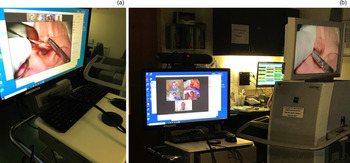
The video-assisted telescope operating monitor system from Karl Storz (Tuttlingen, Germany) comprises a 90° exoscope, a holding arm, a tower containing a light source, and a 32 inch (81 cm), 4K monitor. A mobile audiovisual cart containing a desktop computer, microphone/speaker and webcam (Logitech, Lausanne, Switzerland) provides views of the operating theatre and its team, the latter of which includes surgeons, anaesthesiologists and operating theatre staff. The computer on the audiovisual cart was directly connected to the video-assisted telescope operating monitor tower (although one can also use the endoscopy tower), and to the microscope (Zeiss, Jena, Germany), using a single digital visual interface (‘DVI’) to high-definition multimedia interface (‘HDMI’) cable (Figure 1). The microscope and endoscopy tower with screen outputs are crucial, and are available at operating theatre facilities that routinely support otolaryngology surgical procedures.
(a & b) Mobile audiovisual computer with microphone/speaker, connected to microscope for tympanomastoidectomy live-stream.

Live-stream set-up
Surgical cases were live-streamed daily for two weeks for three visiting medical students from different institutions. Two separate sessions of the virtual rotation were held for a total of six students. Prior to beginning the live-stream, a meeting was set up via Zoom (a video-conferencing platform), and shared with students and faculty. These individuals would join the meeting from their office space to comment and teach throughout the surgical case. The operating team and operating theatre staff were notified in advance. Consent to live-stream was obtained from patients. The webcam and microphone/speaker on the audiovisual cart enabled students to meet the operating theatre team and view preparations for the procedure.
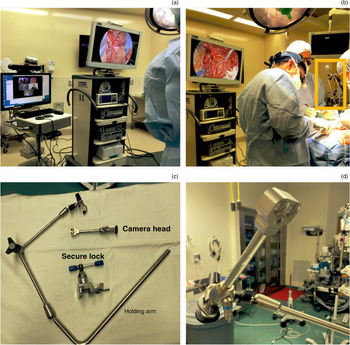
Once the patient was draped, a sterile exoscope and the mobile holding arm were mounted on the side of the operating table, above the sterile drape, to capture the surgical field. Set-up of the exoscope took 5–10 minutes. The exoscope and endoscopes were connected to a tower, which was connected to the audiovisual cart computer to allow live-streaming of surgical procedures via Zoom (Figure 2). The mobile audiovisual cart can be stationed or moved around the operating theatre. The exoscope was used to live-stream cochlear implant placement, neck dissections, parotidectomies, open reduction and internal fixation of mandibular fractures, and free flap reconstructive surgical procedures, among others.
(a–d) Video-assisted telescope operating monitor (‘VITOM’) exoscope (outlined by a yellow rectangle (b)) used to live-stream a parotidectomy. Mobile audiovisual computer connected to exoscope tower to live-stream to students on Zoom (video-conferencing platform) (a). Exoscope parts, including camera head (close-up view in frame (d)), holding arm, and lock to secure onto operating theatre table (c), are displayed.

Sialendoscopy, carbon dioxide laser excision of subglottic stenosis, balloon dilatation, and septoplasty were among the endoscopic procedures that were streamed. The microscope was connected directly to the audiovisual cart computer to showcase tympanomastoidectomy, stapedectomy, laryngeal cleft repair and so on. High-resolution views were provided to both the virtually participating students and to those present in the operating theatre. The microphone/speaker on the audiovisual cart could be moved around the operating theatre and placed near the operating table, allowing students to hear conversations among the surgical team, in addition to learning from the commenting faculty member. Students provided feedback throughout the rotation. In addition, the students were surveyed at the end of the rotation about their experience. Institutional review board approval was obtained for this survey.
Discussion
The challenges in medical education due to the Covid-19 pandemic have expedited the development of virtual learning modalities. We present a virtual rotation that used a mobile audiovisual computer cart to successfully live-stream a wide range of exoscopic, endoscopic and microscopic otolaryngology surgical procedures. Recently, the video-assisted telescope operating monitor exoscope has gained attention in otolaryngology; it has been trialled for transoral surgery and as an alternative to microscopic surgery.Reference Crosetti, Arrigoni, Manca, Caracciolo, Bertotto and Succo6,Reference Ally, Kullar, Mochloulis and Vijendren7 However, its utility for virtually teaching and engaging medical students has not been previously reported.
From a technical standpoint, the video-assisted telescope operating monitor exoscope and mobile audiovisual cart provide high-resolution views. The sterile mount and camera of the exoscope can be adjusted intra-operatively to ensure unobstructed visualisation of key procedural steps. The views were anecdotally described by participating students as better than what they had seen during their in-person otolaryngology rotations. This enhanced virtual surgical view has also been reported by students in published literature.Reference Asaad, Glassman and Allam8 Students reported experiencing technical difficulties with the virtual platform less than 20 per cent of the time. Additionally, the exoscope and audiovisual cart, with a separate movable microphone/speaker, lessened the burden on the operating surgeon compared to having the surgeon wear a head-camera and earphones.Reference Chao, Frost, Brody, Byrnes, Cannady and Luu5
This technology, in conjunction with a dedicated faculty member to provide teaching and commentary on the surgical procedure, minimised disruption to the surgical case, and enhanced students’ understanding of the anatomy, surgical instrumentation and procedural steps involved. In their survey responses, all students (5 out of 5) indicated that the live-stream operating theatre sessions with a commenting physician were ‘significantly better’ than those without a commentator. Assessed using a five-point Likert scale, all students (5 out of 5) ‘strongly agreed’ that having a commenting physician in addition to the surgeon performing the procedure added to their educational experience. Having different commentators also enabled students to meet more faculty members than they might have during an in-person rotation and to have more in-depth discussions with these faculty members.
One limitation of the exoscope is that it cannot be used for consecutive procedures because it needs to be sterilised for each case. However, the capability of connecting the audiovisual cart computer to endoscopic towers and microscopes allowed live-streaming of several procedures in 1 day, just as students would see on an in-person rotation.
Another consideration is the initial financial investment required to obtain the exoscope. The video-assisted telescope operating monitor 90° exoscope utilised during this virtual rotation has a list price of $25 000–30 000; however, hospitals often receive sizeable pricing discounts. Furthermore, as the exoscope connects to endoscopy towers and microscopes that are often already present in operating theatres, the main cost incurred for this set-up is the exoscope. While this cost may be high initially, the versatility of the exoscope for different operative procedures in otolaryngology, and its ability to engage and teach students virtually, can make the investment worthwhile.Reference Crosetti, Arrigoni, Manca, Caracciolo, Bertotto and Succo6,Reference Ally, Kullar, Mochloulis and Vijendren7 Colleagues from the oral and maxillofacial surgery department, as well as the gastrointestinal department, were able to participate in the live-streaming session during rotations, and they plan to implement this technology to teach their own trainees.
Virtual rotations with technology that creates an interactive learning environment can serve to increase students’ knowledge of otolaryngology, and can improve access to mentorship and networking opportunities. This access and exposure can be particularly useful for: students from underrepresented minorities, those without otolaryngology programmes at their home institutions, and international medical graduates.Reference Asaad, Glassman and Allam8 Given these benefits, expansion and continued refinement of these virtual learning innovations can support trainees in otolaryngology and other surgical specialties.
Conclusion
Live-streaming surgical procedures using a mobile audiovisual computer that connects to the video-assisted telescope operating monitor exoscope, microscope and endoscopy towers provides high-resolution views of surgical procedures. This set-up is useful for showcasing the breadth of surgical procedures in otolaryngology. This virtual learning environment can foster students’ interest in otolaryngology and aid understanding of the field.
Competing interests
None declared