In the past 30 years, different authors have presented what is known as Dynamic Assessment methodology (Feuerstein, Feuerstein, Falik, & Rand, Reference Feuerstein, Feuerstein, Falik and Rand2002; Haywood & Lidz, Reference Haywood and Lidz2007; Sternberg & Grigorenko, Reference Sternberg and Grigorenko2002). This methodology makes it possible to gather information about the subject’s learning process, non-intellectual variables that influence his or her performance, and – even more important for groups that show deficits – the causes that lead to error, and possibilities for cognitive modification.
In general terms, the Dynamic Assessment methodology (also called in Spain Learning Potential Assessment) is based on a structured assessment procedure, following a pretest – mediation – posttest format. In other words, between its two phases of standard assessment, there is an assessor/assessee interaction phase for the purpose of optimizing task performance and facilitating the assessor’s observation of cognitive and metacognitive strategies that the children pursue as they interact with a concrete task. A large number of studies have shown the construct and predictive validity of this methodology; in general, subjects evaluated have made significant improvement in their performance on the test situation, and this improvement has proved to have predictive validity, more so than predictions based on static assessment tests (Caffrey, Fuchs, & Fuchs, Reference Caffrey, Fuchs and Fuchs2008; Swanson & Lussier, Reference Swanson and Lussier2001).
Dynamic Assessment is applicable in different spheres and at different ages, although several authors defend its value in prognosis and prevention when working with children whose skills are still developing (Tzuriel, Reference Tzuriel2001; van der Aalsvoort & Lidz, Reference van der Aalsvoort and Lidz2007). Early childhood is a developmental period when basic cognitive and metacognitive skills are being developed, in addition to regulation of behavior, all of which serve to support learning throughout the child’s lifetime (Veenman, van Hout-Wolters, & Afflerbach, Reference Veenman, van Hout-Wolters and Afflerbach2006). A traditional error has been to consider that these types of basic skills spontaneously develop without any type of aid, not taking into consideration that some children may have difficulty in developing, consolidating and generalizing such cognitive and metacognitive skills (Lidz & Gindis, Reference Lidz, Gindis, Kozulin, Gindis, Ageyev and Miller2003). On the contrary, it is quite helpful to have assessment instruments that let us observe how small children undertake learning and their potential for appropriating external help. Such observations show us how to direct the educational process, in addition to identifying those children that, despite having initial difficulties, present adequate learning potential for them to benefit from interventions. Thus, this assessment methodology helps prevent possible problems when children progress to stages of education where the demands are greater, as when passing to Primary Education and the development of literacy and numeracy (Howell & Kemp, Reference Howell and Kemp2010; Murray & Harrison, Reference Murray and Harrison2011; Prior, Bavin, & Ong, Reference Prior, Bavin and Ong2011).
One of the dynamic tests for preschoolers is the Application of Cognitive Functions Scale (ACFS), developed by Lidz and Jepsen (Reference Lidz and Jepsen2003). It has been adapted to Spanish (Evaluación de Habilidades y Potencial de Aprendizaje para Preescolares -EHPAP) by Calero, Robles, Márquez, and De la Osa (Reference Calero, Robles, Márquez and De la Osa2009). This Dynamic Assessment instrument is designed specifically for children between the ages of 3 and 5, or older children with similar intellectual levels. The scale explores basic cognitive functions and learning strategies that are related to the preschool curriculum and are involved in a large variety of tasks, being identified by most authors as basic or primary, namely: classification, auditory memory, visual memory, pattern sequence, perspective taking, and verbal planning. Administering the scale provides a score that indicates to what degree the child has mastered each of the tasks (pretest score), and indications of the child’s responsiveness to the mediation and his or her ability to learn (posttest score and transfer score) (Lidz & Jepsen, Reference Lidz and Jepsen2003).
Various studies have been carried out to determine the validity of this scale. Specifically, several authors have demonstrated the construct validity by documenting significant changes in test performance between the pretest and the posttest in different groups of children. These results have been observed in studies with preschoolers with normal development (Lidz, Reference Lidz, Lidz and Elliott2000), with deaf children (Lidz, Reference Lidz2004) and in a study with immigrant children (Calero et al., Reference Calero, Parra, López-Rubio, Carles, Mata, Vives-Montero and Márquez2013).
Discriminant validity was established in the study by Calero, Robles, and García-Martín (Reference Calero, Robles and García-Martín2010) with respect to the differential diagnosis between Spanish preschoolers with Down syndrome versus healthy preschoolers, and in Levy (Reference Levy1999), who compared the performance of preschoolers with and without developmental problems.
van der Aalsvoort and Lidz (Reference van der Aalsvoort and Lidz2007) applied the ACFS to Dutch children, observing significant gains from the pretest to the posttest, after mediation, on three of the six subtests. This study also showed its concurrent validity with academic performance, with correlations between the transfer scores of the scale and tests of language (from .05 to .30) and mathematics (from .10 to .35).
Calero et al. (Reference Calero, Robles, Márquez and De la Osa2009) also found evidences of concurrent validity for some ACFS subtests. Specifically classification and pattern sequence ACFS subtests correlated significantly with K-BIT matrices. Furthermore, auditory memory subtest correlated with a digit task and with a working memory task, and visual memory correlated with an iconic memory task.
In conclusion, there are data that support several evidences of ACFS validity following transversal designs with groups of preschoolers. Therefore, the general objective of this study was to establish the criterion validity of the learning potential measure assessed by the Spanish version of the ACFS applying a longitudinal design. The main purpose was to obtain evidence of predictive validity of progression in intelligence and metacognition instruments, showed two years after the initial assessment, and concurrent validity with respect to the performance achieved in a scholastic aptitude battery.
Specific objectives were:
-
• To determine to what extent the children classified as a function of their learning potential (assessed by the transfer score of the ACFS in the initial assessment) differ in their progression on K-BIT and metacognition scores (difference of scores between the first assessment and follow-up two years later using the same instruments).
-
• To observe if the transfer scores of the ACFS add incremental validity, over traditional measures, to the prediction of the observed progression of raw scores in K-BIT and metacognition two years later.
-
• To explore if the children classified as a function of their learning potential differ in performance achieved in the follow-up on an scholastic aptitude battery.
-
• To check if the transfer scores of the ACFS add incremental validity, over traditional measures, to the prediction of the performance achieved on an scholastic aptitude battery.
Method
Participants
A total of 87 children participated in this study. During the first phase, the children were enrolled in the second year of Early Childhood Education. The children were 4- or 5-year-olds (ages between 48 and 63 months) (M months = 55.38, SD = 3.78). During the follow-up assessment (2 years later), the children were first graders, 6- or 7-year-olds, with ages falling between 78 and 91 months (M months = 80, SD = 4.64). Of the total group, 60.9% were girls and 39.1% boys.
The mean age of parents was 32.8 years for mothers and 36.5 years for fathers. As for parents’ level of education, most parents had completed studies as far as primary education (55%), or secondary education (20%). Before participation in the study, students were controlled for additional psychological or behavioral problems through an interview with parents and teachers.
Instruments
Application of Cognitive Functions Scale (ACFS)
(Lidz, Reference Lidz, Tan and Seok-Hoon Seng2005; Lidz & Jepsen, Reference Lidz and Jepsen2003), Spanish adaptation: Evaluación de Habilidades y Potencial de Aprendizaje para Preescolares (EHPAP) by Calero et al. (Reference Calero, Robles, Márquez and De la Osa2009). This dynamic assessment procedure measures the application of learning strategies and cognitive processes in tasks typical to the Early Childhood curriculum. Its application range is from 3 to 5 years of age. There are six subtests: four core tests, on classification, auditory memory with and without delayed recall, visual memory, and pattern sequence; and two supplementary tests, on perspective taking and verbal planning. The application format is pretest-mediation-posttest. Therefore, on each subtest there is a pretest phase where the child must perform the required activity independently, in order to determine how well he or she masters each of the proposed tasks autonomously. Next, in the mediation phase, the child works in interaction with the assessor, who offers performance feedback and structured help on the different steps needed to successfully execute the task. The focus of the mediation is on helping to concentrate on attributes that serve as a basis for grouping (classification), on using visual imagery to facilitate recall (auditory memory), on stimulating memory strategies like chunking, rehearsal and verbal mediation (visual memory), on sensing the rhythm of pattern (pattern sequence), on putting oneself in the place of another person (perspective taking), and on respecting the different sequences that comprise the action (verbal planning).
Finally, there is a posttest phase where the child must again perform the task independently, so that his or her responsiveness to the mediation may be established, or in other words, learning potential. This scale provides three scores for each subtest and for the total (sum of single subtest scores): pretest, posttest and transfer scores. The difference between the pretest score and the posttest score (transfer score) is an indication of the child’s ability to profit from the mediation phase. As indicated above, there are several studies that establish the validity of the ACFS.
The Spanish adaptation was reviewed by different experts in child psychology. This process was done with the permission of the author of the ACFS (Carol Lidz). The Spanish version was adapted with a sample of 278 children. Reliability of the scale was .79 for the total pretest score.
Kaufman Brief Intelligence Test (K-BIT)
(Kaufman & Kauffman, Reference Kaufman and Kaufman1994). This screening test offers a quick overview of the child’s general intelligence through two subtests: matrices and vocabulary. The test provides a non-verbal IQ, a verbal IQ and a composite IQ that summarizes performance on both scales. Reliability of the Spanish adaptation of this test was. 74 for matrices, .88 for the vocabulary subtest, and .83 for the total IQ for the sample of five-year-olds, and .77 for the matrices and vocabulary and .83 for the total IQ for the sample of seven-year-olds. Furthermore, this version showed moderate construct validity when compared with the WISC-R: it showed correlations of .80 for total IQ, .50 between matrices and the WISC-R Perceptual Reasoning Index and .78 between vocabulary and the WISC-R Verbal Comprehension Index (Cordero & Calonge, Reference Cordero, Calonge, Kaufman and Kaufman2000).
Metacognition Questionnaire
Metacognition skills were evaluated through analysis of verbal information provided by the children as they carried out the task, through the use of a questionnaire designed for this purpose. In view of the difficulties of using introspection with children of this age a series of direct questions were compiled to gain insight into the metacognitive skills of the child and her/his understanding of the demands in each task, together with her/his abilities and manner of execution. This format has been used frequently in educational research on reading comprehension tasks and mathematical problem solving (Desoete, Roeyers, & Buysse, Reference Desoete, Roeyers and Buysse2001; Manzo, Manzo, & McKenna, Reference Manzo, Manzo and McKenna1995). The questionnaire is composed of 10 questions which are directed to the child while he or she performs the ACFS classification task (pretest); the assessor assigns a score (1 or 0) for each item based on the child’s response, for a maximum score of 10 points. The instrument is based on behaviors which, according to previous studies, demonstrate metacognition at these ages (Annervita & Vauras, Reference Annervita and Vauras2006; Garrett, Mazzocco, & Baker, Reference Garrett, Mazzocco and Baker2006; Veenman et al., Reference Veenman, van Hout-Wolters and Afflerbach2006). Thus, this instrument assesses three basic components: planning (e.g. ‘Tell me what you have to do in this task; what are you going to do first?’), self-regulation (e.g. ‘Why are you putting these pieces together? Can you put others together?’) and evaluation (e.g. ‘Did you get done what you wanted to do?’). A study of the psychometric requirements has shown high internal consistency (α = .74) and the existence of three independent factors (planning, assessed by 4 items, and evaluation and self-regulation, each assessed by three items).
Batería de Aptitudes para el Aprendizaje Escolar I
(BAPAE-I) [Battery of Aptitudes for School Learning I] (De la Cruz, Reference De la Cruz1982). This aptitude battery assesses verbal comprehension, numerical aptitude, and perceptive-visual aptitude in schoolchildren between 6 and 7 years of age. The child must be enrolled in school, and the optimal application period is first grade. The instrument yields a reliability index of .94 as a whole, and between .45 and .89 according to the scale.
Procedure
First, permission was obtained from the University of Granada Ethics Committee for Human Research. Next, consent was obtained from the participating schools, teachers and parents.
In the first assessment, during the second year of Early Childhood Education, 104 children were assessed on an individual basis, in a separate room, by a psychologist trained in dynamic assessment techniques. Testing (ACFS, K-BIT and metacognition questionnaire) was completed over two sessions lasting 40 to 50 minutes each. The time intervening between the two sessions was 2 to 3 days.
Two years later, when the children were attending first grade, the follow-up assessment was performed. At this time, 87 children participated in the follow-up. It was confirmed that there were no differences in IQ between the group of students who participated in the follow-up and the students who did not participate in the second assessment due to a change of school or city, or because of parents’ withdrawal. In the follow-up phase, scholastic learning aptitudes (BAPAE) were assessed in a single session. Assessments were held in an independent room, in small groups of 3 to 6 children. In the same session, the children were also assessed individually with the K-BIT and the metacognition questionnaire (using the same task as in the first assessment: ACFS classification pretest).
After concluding the data collection, the 87 participants were grouped as a function of their total transfer score on the ACFS. To establish this typological classification of the children, and to control the regression to the mean effect, a difference of 1.5 standard deviations from the total pretest score was established as a significant criterion of transference for each child. This validated clinical significance criteria (Waldorf, Wiedl, & Schöttke, Reference Waldorf, Wiedl and Schöttke2009) can establish three different groups: high scorers, learners and non-learners, which is an useful research strategy for establishing the clinical significance of change obtained in the Dynamic Assessment tests. Nevertheless, it is important to precise that this kind of distributions are not appropriate for clinical contexts.
In this case, two groups were differentiated: learners (30% of the participants) and non-learners (70%), having verified that there were no differences in total IQ between the two groups (t(85) = –.568, p = .57). There were no high scorers in this sample of participants.
Data Analysis
We used a predictive longitudinal design. The SPSS statistical package, version 18.0, was used for data analysis, namely: repeated measures general linear model, ANOVA and linear regression analysis. For the repeated measures general linear model two factors were taken into account: time (age 4/age 6) and group (learners/non-learners). Dependent variables were: matrices and vocabulary subtests of K-BIT; planning, self-regulation and evaluation scores of metacognition questionnaire. ANOVA between groups (learners/non-learners) with verbal comprehension, numerical aptitude and visual-perceptive aptitude of BAPAE as dependent variables was also performed. Raw scores from all the traditional measures were used because they determine the performance achieved - number of correct items – independently of the children’s age.
In order to predict the progression showed in the instruments applied in the two assessments phases, several stepwise linear regressions were calculated. Thus, the criterion variables were the difference observed between the first assessment and the follow-up in raw scores from the K-BIT matrices and vocabulary and from the metacognition scores, namely, planning, self-regulation and evaluation. Predictive variables were: K-BIT matrices and vocabulary initial raw scores and transfer scores from each ACFS subtest, also obtained at age 4.
To predict the BAPAE performance, others stepwise linear regressions were run. In these cases the criterion variables were raw score from the BAPAE verbal comprehension, numerical aptitude and visual-perceptive aptitude. Predictive variables were also: K-BIT matrices and vocabulary initial raw scores and transfer scores from each ACFS subtest.
Results
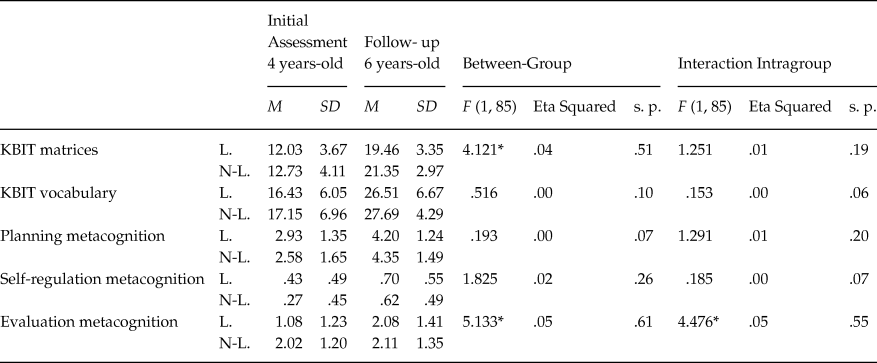
Regarding the first objective results from the repeated measures general linear model, using the Greenhouse-Geisser correction, showed a significant effect of time for the whole sample (initial application vs. two years later) on the two K-BIT raw scores: matrices, F(1, 85) = 227.717, p = .0001, η2 = .72, s.p. = 1 and vocabulary, F(1, 85) = 312.400, p = .0001, η2 = .78, s.p. = 1. As for the metacognition questionnaire, results showed a significant effect of time on all its scores: planning, F(1, 85) = 46.173, p = .0001, η2 = .35, s.p. = 1; self-regulation, F(1, 85) = 15.859, p = .0001, η2 = .15, s.p. = .97 and evaluation, F(1, 85) = 6.643, p = .01, η2 = .07, s.p. = .72.
Results also showed significant between-group differences in performance from the first assessment to the second, on the matrices, F(1, 85) = 4.121, p =.04, η2 = .04, s.p. = .51, in favor of the learners group. Between-group differences are not found on the vocabulary subtest. In metacognition, significant group differences were observed only on the evaluation score, F(1, 85) = 5.133; p =.02, η2 = .05, s.p. = .61, in favor of the learners. No significant group differences were found for the rest of the metacognition scores (see Table 1).
General Linear Model of Repeated Measures with Two Factors: Time (Initial Assessment: Age 4 and Follow-up: Age 6) and Group (Learners/Non-learners)

Note: L. = Learners; N-L. = Non-learners; *p < .05.
No significant effects were observed for the interaction Time x Group on either of the K-BIT scores. Results showed a significant effect of the interaction Time x Group only on the evaluation score from the metacognition questionnaire F(1, 85) = 4.476, p = .03, η2 = .05, s.p. = .55 (see Table 1).
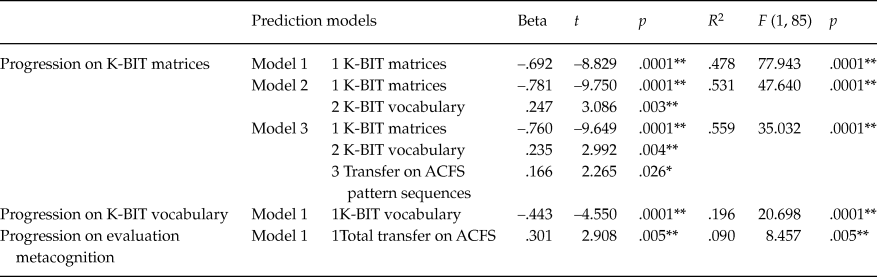
The second objective of the study was to observe if the transfer scores of the ACFS add incremental validity, over traditional tests, to the prediction of the observed progression of raw scores in K-BIT and metacognition two years later. In this respect, results from the correlations of the stepwise linear regression showed that the progression in K-BIT matrices was predicted by the K-BIT initial raw matrices score (age 4) (first model: R 2 = .47, adjusted R 2 = .47, p =.0001), followed by the K-BIT initial raw vocabulary score (age 4) (second model: R 2 = .53, adjusted R 2 = .52, p = .0001) and by the transfer score on the pattern sequences subtest obtained in the initial assessment (age 4) (R 2 = .55, adjusted R 2 = .54, p = .0001). The progression in K-BIT vocabulary was predicted only by the K-BIT initial raw vocabulary score (age 4) (R 2 = .19, adjusted R 2 = .18, p = .0001). For metacognition, progression on evaluation score was the only variable predicted, being the total transfer score of the ACFS obtained in the initial assessment (age 4) the sole predictor in the model (R 2 = .09, adjusted R 2 = .08, p =.005) (see Table 2).
Linear Regression Analysis. Criterion Variables: Progression on the Matrices and Vocabulary K-BIT-Raw Scores, and progression on Evaluation Metacognition Questionnaire (Follow-up-Initial Assessment). Predicting Variables: Matrices and Vocabulary K-BIT Initial Raw Scores and Initial Transfer Scores of each ACFS Subtest

* p < .05; **p < .01.
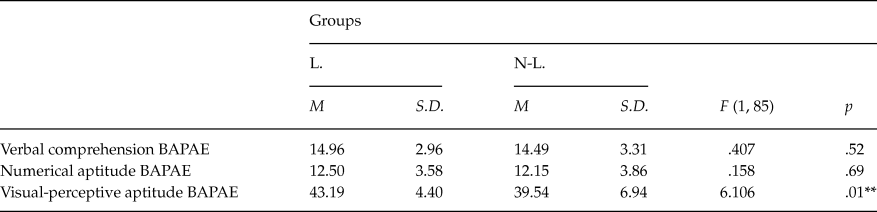
Regarding the third objective aimed to explore if the children classified as a function of their learning potential differ in performance achieved in the follow-up on an scholastic aptitude battery, ANOVA results show significant differences on the visual-perceptive aptitude subtest of the BAPAE, F(1, 85) = 6.106, p = .01, in favor of the learners (see Table 3). Significant differences were not found for verbal comprehension or numerical aptitude.
Difference of Means between Groups of Learners and Non-learners on the BAPAE Scores Applied at Age 6 (Follow- up)

Note: L. = Learners; N-L. = Non-learners; **p < .01.
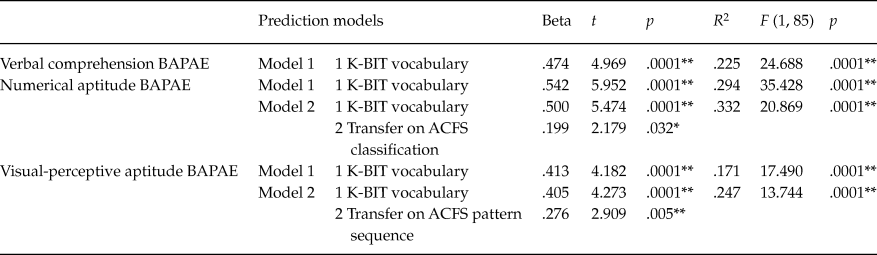
The final objective meant to check whether the transfer scores of the ACFS add incremental validity, over traditional tests, to the prediction of the performance achieved in the scholastic aptitude battery. In this case, results from the stepwise linear regression show that the performance on raw score from the verbal comprehension was predicted only by the K-BIT initial raw score for vocabulary (age 4) (R 2 = .22, adjusted R 2 = .21, p = .0001); numerical aptitude raw score was predicted by K-BIT initial raw score for vocabulary (age 4) (first model: R 2 = .29, adjusted R 2 = .28, p = .0001) followed by the transfer score on the classification subtest (second model: R 2 = .33, adjusted R 2 = .31, p = .0001); finally, visual-perceptive aptitude raw score was predicted by K-BIT raw score for vocabulary (age 4) followed by the transfer score on the pattern sequence subtest (first model: R 2 = .17, adjusted R 2 = .16, p = .0001; second model: R 2 = .24, adjusted R 2 = .22, p = .0001) (see Table 4).
Linear Regression Analysis. Criterion Variables: Verbal Comprehension, Numerical Aptitude and Visual-perceptive Aptitude BAPAE Raw Scores. Predicting Variables: Matrices and Vocabulary K-BIT Initial Raw Scores and Initial Transfer Scores of each ACFS Subtest

* p < .05; **p < .01.
Discussion
The general objective of this study was to explore the criterion validity of the Spanish version of the ACFS, for predicting the progression show by a group of preschoolers on tests of intelligence, metacognition (predictive validity) and for show relations with scholastic aptitudes two years after initial assessment (concurrent validity).
Firstly, a development-based progression was observed on intelligence and metacognition measures in the set of children evaluated from the initial assessment until the two-year follow-up. Although this information only demonstrates that the development is reflected by the measures used, it is interesting to observe that the data show evidence of some relations between learning potential and this progression. Thus, significant differences have appeared between the groups that were established according to their learning potential as assessed by the ACFS in preschool. Specifically, significant differences were found on the progression showed on K-BIT matrices subtest and on the evaluation subtest of the metacognition questionnaire. Results have also showed that K-BIT scores were strong predictors of the progression showed on matrices subtest, as could be expected. However, it is also interesting that the transfer score on ACFS pattern sequences is included in the model, contributing to the explained variance (increasing it from 53.1% to 55.9%). It is important to note that, even though the variance explained by this variable is low, it increases the value of the prediction, result that is consistent with previous studies (Caffrey et al., Reference Caffrey, Fuchs and Fuchs2008). These results are probably due to the similarity between tasks (K-BIT matrices and pattern sequences) but show that the Dynamic Assessment measures may add relevant information to the traditional evaluation.
In the same line, progression on evaluation score of the metacognition questionnaire was only predicted by the total transfer score assessed by ACFS, overcoming to the traditional measures as the K-BIT scores. These results concur with prior research carried out with other groups and with other dynamic tests, where dynamic scores seemed to contribute toward greater validity in performance predictions (Caffrey et al., Reference Caffrey, Fuchs and Fuchs2008; Swanson & Lussier, Reference Swanson and Lussier2001). For example, Meijer and Elshout (Reference Meijer and Elshout2001), with secondary students, observed that Dynamic Assessment increased the explained variance by 13% for performance in mathematics. Likewise, Resing (Reference Resing, Hamers, Sijtsma and Ruijssenaars1993) determined that the combination of two Dynamic Assessment scores added 13% to the variance explained in predicting verbal performance, 18% in mathematics, and 14% for academic grades awarded by teachers, in a sample of primary school students with disabilities.
In turn, the learning potential established by ACFS was partially related to performance on BAPAE, specifically with the visual-perceptive aptitude subtest, in favor of the children who were classified in the group of learners, showing concurrent validity in the same line of Calero et al. (Reference Calero, Robles, Márquez and De la Osa2009). ACFS transfer scores seemed to be related with performance on this scholastic aptitude battery. Specifically, classification and pattern sequence transfer scores appeared in the predictive models of performance for numerical and visual-perceptive aptitudes respectively, increasing the variance explained from 29.4% to 33.2% for numerical aptitude and from 17.1% to 24.7% for visual-perceptive aptitude.
Thus, it was possible to observe partial between-group differences in all the instruments used; these differences are related in part to reasoning abilities or to tasks that are less influenced by cultural background (Horn & Noll, Reference Horn, Noll and Determan1994). However, the results presented here have not shown a significant relation between learning potential assessed by ACFS and tasks which are associated with high verbal content, such as the progression on vocabulary subtest of the K-BIT or performance on verbal comprehension on the BAPAE, which were both predicted only by K-BIT vocabulary initial raw scores. These results are consistent with the hypothesis held by some researchers of Dynamic Assessment according to which verbal ability is more independent than general skills and, therefore, gets a lower correlation with no linguistic indices (Budoff, Reference Budoff and Lidz1987; Fernández-Ballesteros, Juan-Espinosa, Colom, & Calero, Reference Fernández-Ballesteros, Juan-Espinosa, Colom, Calero, Carlson, Kingma and Tomic1997).
These results may suggest that ACFS transfer scores are indicative of learning potential, and therefore, it is reasonable to think that the children who are most able to benefit from a short intervention of mediated training, as part of this assessment methodology, are those that obtain more benefit from learning resources. Nevertheless, we are far from concluding that learning potential assessed with the ACFS at age four can predict the cognitive progression and the performance on scholar aptitudes showed two years later. We may affirm that these results are hopeful, suggesting that the Spanish version of the ACFS can add enriched information in the realm of assessment. Other studies have found stronger data related to an increase in predictive validity by using Dynamic Assessment methodology in addition to traditional static measures (Caffrey et al., Reference Caffrey, Fuchs and Fuchs2008; Swanson & Lussier, Reference Swanson and Lussier2001).
We also note that results presented here have been obtained through a longitudinal design, which adds value to the conclusions presented, nevertheless, the effect sizes are low in the differences between-group. It might be due to the type of criterion instruments employed and to the variability of the transfer scores profiles, which makes difficult to establish the typological classification of the participants as a function of their learning potential. However, this variability responds to the real context, in which each child tends to show an individual profile of execution and transference, or learning potential, in the different subtests of the scale, fact that gives a lot of information in clinical and educational contexts in order to plan individual interventions. Nevertheless, these results should be replicated with broader samples.
Conclusions could have been strengthened by using more powerful intelligence and metacognition measures. It would also be valuable to select different measures of learning outcome, for example academic performance, due to its proximity to learning potential.
To conclude, this study has offered evidence about the usefulness of the Spanish version of the ACFS although more research in Dynamic Assessment is needed, including development of longitudinal studies, especially with preschool children.
This research was supported by a “Proyecto de Excelencia de la Junta de Andalucía” (Research project no. 07-HUM-02535). We thank the “Delegación Provincial de Granada de la Consejería de Educación de la Junta de Andalucía” for facilitating access to children and teachers at public preschools. Also, we thank the program “Formación del profesorado universitario –FPU- del Ministerio de Educación del Gobierno de España” (Program for training university teachers).