




No CrossRef data available.
Article contents
Parkinsonian signs and cognitive function in old age
Published online by Cambridge University Press: 26 August 2005
Abstract
Studies have shown that parkinsonian signs are related to cognitive function in aging. What remains unclear is whether this association is stronger for some cognitive domains than it is for others, and precisely how much variability in global and specific cognitive functions is explained by the motor signs. We examined the associations between four parkinsonian signs (gait, rigidity, bradykinesia, tremor) and five cognitive domains (episodic memory, semantic memory, working memory, perceptual speed, visuospatial ability) in a large cohort of older persons who were free of Parkinson's disease and dementia and were participating in the Rush Memory and Aging Project. In a series of regression equations that controlled for age, sex, and education, higher levels of three signs (gait, rigidity, and bradykinesia) were related to lower levels of cognitive function, but they accounted for less than 5% of the variance in most measures. The results did not change when the presence of depressive symptoms, diabetes, and hypertension were added to the models. The cross-sectional association between parkinsonian signs and cognitive function did not vary substantially across specific cognitive domains or specific cognitive tests. The results suggest that parkinsonian signs have a modest, but statistically reliable, association with level of cognitive function in old age. (JINS, 2005, 11, 591–597.)
Information
- Type
- Research Article
- Information
- Journal of the International Neuropsychological Society , Volume 11 , Issue 5 , September 2005 , pp. 591 - 597
- Copyright
- © 2005 The International Neuropsychological Society
INTRODUCTION
Parkinsonian signs are common in older persons (e.g., Bennett et al., 1996; Kaye et al., 1994; Wilson et al., 2003a, 2003b) and have been associated with level of cognitive function in cross-sectional studies (e.g., Richards et al., 1993a, 1993b), and with an increased risk of incident dementia (Richards et al., 1993a, 1993b), Alzheimer's disease (AD) (Wilson et al., 2003a, 2003b), and death (Bennett et al., 1996; Mitchell & Rockwood, 2000; Wilson et al., 2002a, 2002b) in longitudinal studies.
Cross-sectional studies of older persons with (Richards et al., 1995) and without (Richards et al., 1993a, 1993b) AD, suggest that the presence of parkinsonian signs in older persons is related to selective impairments on tests of attention, calculation, and language in a pattern suggestive of frontostriatal dysfunction. More recently, longitudinal studies of older persons, with (Wilson et al., 2000a, 2000b) and without (Wilson et al., 2003a, 2003b) AD, found that levels of parkinsonian signs at baseline, and progression of the signs over time, were associated with cognitive decline, and that these associations did not vary appreciably across different forms of cognitive function. Thus, the extent to which individual parkinsonian signs are associated with global cognitive function rather than specific types of cognitive ability remains controversial.
Although a cross-sectional association between parkinsonian signs and cognitive function in old age has been documented in a number of studies, little is known regarding the degree to which the individual motor signs contribute to variability in different areas of cognitive function. In the baseline phase of two longitudinal studies, parkinsonian motor signs accounted for less than 10% of the variance in cognitive function in older persons with (Wilson et al., 2000a, 2000b) and without (Wilson et al., 2003a, 2003b) AD. However, these studies were undertaken in a sample of highly educated religious orders members, which is not fully representative of the general aged population. There is need, therefore, for further examination of the relation between parkinsonian signs and level of cognitive function in different cognitive systems in older persons.
We used data from the baseline evaluation of the Rush Memory and Aging Project, a large longitudinal clinicopathologic investigation of aging and AD, to examine the cross-sectional associations between global and specific parkinsonian signs (gait, rigidity, bradykinesia, tremor) and global and specific cognitive functions (episodic memory, semantic memory, working memory, perceptual speed, visuospatial ability), in old persons who were free of dementia and Parkinson's disease.
METHOD
Research Participants
Participants were recruited primarily from continuous care retirement communities and subsidized housing facilities in and around Cook county in northeastern Illinois, as part of the Rush Memory and Aging Project, a longitudinal clinicopathologic study of aging and Alzheimer's disease (AD). The study was approved by the Institutional Review Board of Rush University Medical Center.
At the time of this investigation, 739 participants had completed a baseline evaluation. Based on a structured clinical evaluation, we excluded 27 persons with dementia and eight persons with Parkinson's disease, resulting in a final group of 704 participants. The mean age was 80.8 years (SD = 6.5 years); mean education was 14.5 years (SD = 3.0 years); and the mean score on the Mini-Mental State Examination (Folstein et al., 1975) was 27.7 (SD = 2.4). There were 503 women and 201 men; 679 were white and non-Hispanic, 16 were black and non-Hispanic, and nine were Hispanic or belonged to another racial or ethnic group.
Clinical Evaluation
Each participant underwent a structured, uniform evaluation that included a medical history, neurological examination, cognitive function testing, and review of a brain scan when available. Participants were evaluated in person by a board-certified or board-eligible neurologist or geriatrician with expertise in the evaluation of older persons with and without dementia. Cognitive performance tests were reviewed by a board-certified neuropsychologist. Participants were classified with respect to dementia, Parkinson's disease, and other common age-related neurologic conditions. The diagnosis of dementia was made by the examining physician based on the criteria of the joint working group of the National Institute of Neurological and Communicative Disorders and Stroke and the AD and Related Disorders Association (McKhann et al., 1984), which require a history of cognitive decline and evidence of impairment in at least two cognitive domains. Details of the diagnostic evaluation have been described previously (Wilson et al., 2003a, 2003b).
Three potential confounders of the association between parkinsonism and cognition were selected for secondary analyses. Depressive symptomatology was measured using the 10-item version (Kohout et al., 1993) of the Center for Epidemiological Studies–Depression symptoms index (CES-D, Radloff, 1977). Diabetes and hypertension were considered present if the participant reported a diagnosis made by a medical professional.
Motor Evaluation
A modified version (Bennett et al., 1997, 1999) of the motor portion of the Unified Parkinson's Disease Rating Scale (UPDRS; Fahn & Elton, 1987) was administered by trained nurse clinicians who were blind to the results of cognitive testing. Nurses completed an intensive, structured training program, which included a two-hour didactic session with an expert neurologist on the rationale and administration of the UPDRS, review of a UPDRS teaching tape and teaching manual, practice sessions between nurse clinicians, administration of the UPDRS to elderly participants (with and without Parkinson's disease and/or cognitive impairment) under the supervision of the expert neurologist, and final testing requiring 90% agreement between the trained nurse-clinician and the expert neurologist on four cases presented via a UPDRS certification tape. Nurse-clinicians are recertified annually.
The modifications to the motor portion of the UPDRS were minor and meant to make it more applicable to persons without Parkinson's disease and easier to administer and score by nonphysicians. Four previously established UPDRS sign scores were derived: gait disorder—postural reflex impairment (based on six UPDRS items), rigidity (based on five items), bradykinesia (based on four items), and tremor (based on two items). Scores on each measure range from 0 to 100 and denote the percentage of the total possible item score obtained. In previous research, these measures have been shown to have high interrater reliability and short-term temporal stability (Bennett et al., 1997).
Assessment of Cognitive Function
Cognitive function was assessed with a set of 18 tests (Wilson et al., 2003a, 2003b). The Mini-Mental State Examination was used for descriptive purposes only. The remaining 17 tests were selected to assess five cognitive domains (Wilson et al., 2002a, 2002b). There were seven episodic memory measures: Word List Memory, Recall, and Recognition (Morris et al., 1989), immediate and delayed recall of the East Boston Story (Albert et al., 1991), and Story A from Logical Memory (Wechsler, 1987). Semantic memory was assessed with three tests: a 15-item version (Morris et al., 1989) of the Boston Naming Test (Kaplan et al., 1983); Verbal Fluency (Morris et al., 1989), which involved generating exemplars from two semantic categories (animals; fruits and vegetables) in separate 1-minute trials; and a 15-item reading test (Wilson et al., 2002a, 2002b), which requires reading aloud words with atypical spelling–sound correspondence (e.g., “impugn”). Working memory was assessed with Digit Span Forward and Digit Span Backward (Wechsler, 1987) and with Digit Ordering (Cooper & Sagar, 1993) administered in a span format (Wilson et al., 2002a, 2002b). Two tests of perceptual speed were given: the oral version of the Symbol Digit Modalities Test (Smith, 1982) and Number Comparison (Ekstrom et al., 1976), which involved rapidly classifying pairs of 3- to 10-digit numbers as same or different. Visuospatial ability was assessed with a 15-item version of Judgment of Line Orientation (Benton et al., 1994) and a 16-item version of Standard Progressive Matrices (Raven et al., 1992).
We formed summary measures of the five cognitive domains, based in part on a principal-components factor analysis, as previously described (Wilson et al., 2003a, 2003b). Raw scores on each test were converted to z scores (mean of 0, standard deviation of 1) and then the average z score among tests in a given domain was computed. At least half of the tests in each domain had to have a valid score or the summary measure was treated as missing. A global cognitive score was formed by averaging z scores of all 17 tests.
Data Analysis
We constructed a series of linear regression models to examine the association of each parkinsonian measure (global UPDRS, gait, rigidity, bradykinesia, tremor) with each of the six summary measures of cognitive function (global cognition, episodic memory, semantic memory, working memory, perceptual speed, visuospatial ability), and with the individual tests. In separate models, each measure of cognitive function was first regressed on age, sex, and education. Then a term for a given parkinsonian sign was added to the model to determine the additional variance explained in the cognitive measure by the parkinsonian sign measure. Secondary analyses were performed to control for the presence of depressive symptoms, diabetes, and hypertension. Finally, all models were repeated, excluding persons taking antipsychotic medication. Linear regression models were validated graphically and analytically (e.g., by examining plots of residuals, etc.). All analyses were carried out using SAS statistical software (SAS Institute, 2000).
RESULTS
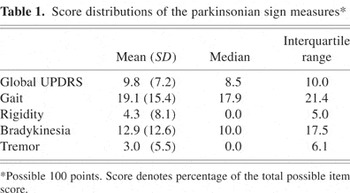
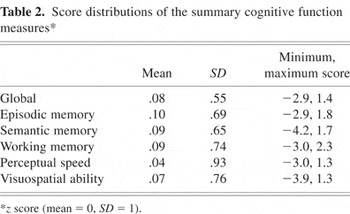
The global UPDRS score ranged from 0–49, with higher scores indicating higher levels of parkinsonian signs (Table 1); 50% had scores less than 10, 45% had scores from 10 to 20, and 5% had scores of 20 or more. The specific parkinsonian sign measures had similar positively skewed distributions. The cognitive measures had more symmetric distributions, with higher scores indicating better cognitive function (Table 2).
Score distributions of the parkinsonian sign measures*

Score distributions of the summary cognitive function measures*

We first examined the associations of global UPDRS and global cognitive function in linear regression models that controlled for age, sex, and education (Table 3). Higher global UPDRS level was related to lower global cognitive function, accounting for 4% of the variance (based on the adjusted R2 measure) in the global cognitive function measure. To test for the possibility of a nonlinear association between parkinsonian signs and cognitive function, we repeated the model adding a quadratic term for Global UPDRS. There was no evidence of a nonlinear association (p = .297).
Association of parkinsonian signs with summary cognitive function measures

Three additional covariates were selected based on studies demonstrating an association with parkinsonism and cognitive function in aging. Depressive symptomatology has been related in this study (ps < .0001) and in previous research (e.g., Richards et al., 2002; Yaffe et al., 1999) to both parkinsonian signs and cognitive function; diabetes has been related to both parkinsonian signs and cognitive function in previous research (e.g., Arvanitakis et al., 2004a, 2004b; Gregg et al., 2000); and hypertension has been related to cognitive function in previous research (e.g., Elias et al., 1993; Farmer et al., 1990; Swan et al., 1998). Although hypertension was related to parkinsonism in this study (p = .003), no other studies to our knowledge have reported this association. We repeated the core model with terms added for depressive symptoms, diabetes, and hypertension, first separately and then with all three variables in the same model, and the association of parkinsonism with cognitive function was not substantially changed.
Because use of antipsychotic medication can cause parkinsonism, we repeated the previous model after excluding four participants who were currently taking this class of medication. Excluding these persons did not change the results.
We next examined associations between global UPDRS and each of the specific cognitive function domains (Table 3). Global UPDRS was inversely associated with each cognitive function domain, with global UPDRS level accounting for between 1% and 5% of the variance.
Finally, we examined the associations of specific parkinsonian sign measures and global and specific cognitive function (Table 3). Higher levels of three of the specific parkinsonian sign measures, gait, rigidity, and bradykinesia, were related to a lower level of global cognitive function, accounting for between 2% to 5% of the variance in the global cognitive function measure. The association between tremor and global cognitive function approached significance.
Most individual parkinsonian signs were related to most specific cognitive functions. There were three exceptions. First, rigidity was not related to working memory. Second, bradykinesia was not related to visuospatial ability. Third, tremor was not related to any cognitive domain, although the association with working memory approached significance. Gait accounted for the largest amount of variance in domain-specific cognitive function—between 2% and 5%. Rigidity and bradykinesia accounted for less variance in domain-specific cognitive function, ranging from about 1% to 3%.
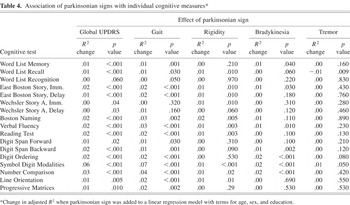
Because the use of summary cognitive measures could have obscured possible patterns of associations between parkinsonian signs and performance on specific cognitive tests, we examined associations of global UPDRS and each parkinsonian sign measure with function on each of the 17 individual cognitive tests, in linear regression models that controlled for age, sex, and education (Table 4). The results were similar to the results using the domain-specific cognitive measures in that parkinsonian signs accounted for a limited amount of variance in the individual cognitive measures (most often between 0 and 4%). The sole exception occurred for one parkinsonian sign, gait, which accounted for 7% of the variance on one perceptual speed measure, the Symbol Digit Modalities Test.
Association of parkinsonian signs with individual cognitive measures*

To gain further insight into the effect of parkinsonian signs on cognitive function, we conducted secondary analyses stratifying the sample by high versus low levels of the parkinsonian sign. For global UPDRS, gait, and bradykinesia, we compared the highest quartile versus the lowest quartile in linear regression equations that controlled for age, sex, and education. We found that a high level of global UPDRS was associated with a lower level of global cognitive function (estimate = −0.316, SE = .053, p < .001), such that the effect was equivalent to 12 years of additional age on cognitive function. A high level of global UPDRS was also associated with lower levels of cognitive function in each of the specific cognitive domains (all ps < .001). A high level of gait dysfunction was associated with a lower level of global cognitive function (estimate = −0.347, SE = .059, p < .001), the effect being equivalent to an additional 17 years of age on cognitive function. A high level of gait dysfunction was also associated with lower levels of cognitive function in all specific cognitive domains (all ps < .001). Finally, we found that a high level of bradykinesia was associated with a lower level of global cognitive function (estimate = −0.179, SE = .053, p < .001), with the effect on cognition equivalent to that of eight more years of age. A high level of bradykinesia was also associated with lower levels of cognitive function in all specific domains (ps ranged from <.001 to .03) with the exception of visuospatial ability (p = .24).
Because many of the participants in this sample had no rigidity or tremor, we stratified these measures by presence versus absence of the sign (zero versus nonzero scores). We found that having some evidence of rigidity was associated with lower global cognitive function (estimate = −0.144, SE = .039, p < .001), with the effect being equivalent to an additional six years of age on cognitive function. The presence of rigidity was associated with lower function in all specific cognitive domains (ps ranged from <.001 to .02), with the exception of working memory (p = .34). Likewise, having some evidence of tremor was associated with lower global cognitive function (estimate = −0.111, SE = .039, p < .005), the effect on cognitive function being equivalent to about five additional years of age. The presence of tremor was associated with lower levels of cognitive function in most cognitive domains (ps ranged from <.001 to .05), with the exception of semantic memory (p = .15) and working memory (p = .18).
DISCUSSION
In this community-based cohort of more than 700 older persons who were free of dementia and Parkinson's disease, we found that (1) higher levels of gait, rigidity, and bradykinesia, but not tremor, were related to lower levels of global cognitive function, (2) higher levels of gait, rigidity, and bradykinesia were associated with lower levels of cognitive function in most specific domains, and (3) parkinsonian signs accounted for a limited amount of variance in global and domain-specific cognitive function, ranging between 0 and 6%, after controlling for age, sex, and education. The results suggest that, when measured at a single point in time, parkinsonian signs account for a modest amount of the variability in cognitive function in persons without frank dementia or Parkinson's disease, and that this influence is global and not indicative of a specific profile of cognitive impairment.
Our results are consistent with previous studies that have reported a significant association between parkinsonian signs and cognitive function in persons with and without dementia (e.g., Richards et al., 1995; Richards et al., 1993a, 1993b; Wilson et al., 2000a, 2000b; Wilson et al., 2003a, 2003b). We found the association between parkinsonian motor signs and cognitive function to be strongest for gait and weakest for tremor, a pattern that has been previously reported (e.g., Richards et al., 1993b; Wilson et al., 2000a, 2000b; Wilson et al., 2003a, 2003b).
Cross-sectional studies have suggested that the presence of parkinsonian signs is related to specific cognitive functions in a manner suggestive of frontostriatal dysfunction (Richards et al., 1993a; Richards et al., 1995). We extended this line of inquiry by mapping specific parkinsonian signs to specific cognitive functions, using both summary measures of cognitive function and 17 individual cognitive tests. We found no evidence of any specific pattern of cognitive impairment related to either a global measure of parkinsonian signs, or to any particular parkinsonian sign, consistent with prior longitudinal studies (Wilson et al., 2000a, 2000b; Wilson et al., 2003a, 2003b).
Parkinsonian signs accounted for a modest degree of variability in cognitive function in this study. This finding, which we have previously reported in the baseline phase of a longitudinal study performed in an independent cohort of religious orders members (Wilson et al., 2003a, 2003b), begs the question why these motor signs, which have such a limited cross-sectional influence on cognitive function, appear to be reliable and robust predictors of incident dementia. The likely answer is that although the rates at which worsening are strongly correlated (Wilson et al., 2000a, 2000b; Wilson et al., 2003a, 2003b), these rates vary greatly from person to person. As a result, the association between these phenomena at a single point in time underestimates their linkage over an extended period of time. Analysis of data from longitudinal follow-up, currently in progress, will be required to confirm this hypothesis in this cohort.
Little is known about the neural basis of the association between parkinsonian signs and cognitive impairment in old age. This association may reflect AD pathology (e.g., neurofibrillary tangles) in the substantia nigra, as observed in AD (Liu et al., 1997), and perhaps in other brain regions, given the association of parkinsonian signs with AD incidence (Wilson et al., 2003a, 2003b) and rate of progression (Wilson et al., 2000a, 2000b). In addition, lewy bodies in the substantia nigra, a defining pathologic feature of Parkinson's disease, have been associated with parkinsonianlike signs in AD (Ditter & Mirra, 1987), raising the possibility of a similar association in persons without dementia. The association between parkinsonian signs and cognitive impairment may also be mediated by other forms of neuropathology, such as cerebral vascular disease (Winikates & Jankovic, 1999). Clinicopathologic, clinicoradiologic, and prospective longitudinal studies that examine these complex associations in older persons are needed.
This study had important strengths and weaknesses. Strengths include the use of a large, well-characterized cohort of persons who were free of dementia and Parkinson's disease based on a detailed uniform clinical evaluation, and the use of previously established composite measures of parkinsonian signs and cognitive function. The main weaknesses are that the sample was selected, and that the association between parkinsonian signs and cognitive function was examined cross-sectionally. It will be important to replicate these findings in longitudinal, population-based studies.
ACKNOWLEDGMENTS
This research was supported by National Institute on Aging grants R01AG17917 and R01AG17133. We are indebted to the altruism and support of the many Illinois residents from the following facilities participating in the Memory and Aging Project: Fairview Village, Downers Grove; The Holmstead, Batavia; Covenant Village, Northbrook; Wyndemere, Wheaton; Francis Manor, Des Plaines; Friendship Village, Schaumberg; Peace Village, Palos Park; Washington Jane Smith, Chicago; Garden House Apartments, Calumet City; Victorian Village, Homer Glen; King Bruwaert, Burr Ridge, The Breakers of Edgewater; The Imperial, Chicago; Victory Lakes, Lindenhurst; Windsor Park Manor, Carol Stream; Fanciscan Village, Lemont; Rennaissance, Chicago; Alden of Waterford, Aurora; Elgin Housing Authority; The Oaks, Oak Park; Bethlehem Woods, LaGrange Park; Luther Village, Arlington Heights; St. Paul's Home, Chicago; Marion Village, Home Glen; Holland Home, South Holland; Village Woods, Crete; Laurence Manor, Matteson; Trinity, Chicago. We also thank Traci Colvin, M.P.H., and Tracy Hagman for study coordination, Pam Smith, Barbara Eubeler, and Karen Lowe Graham for study recruitment, George Dombrowski, M.S., and Greg Klein for data management, Liping Gu, M.S., for statistical programming, Kuheli Mukherjee for manuscript support, and the entire staff of the Rush Alzheimer's Disease Center and Memory and Aging Project.
References
REFERENCES
Albert, M.,
Smith, L.,
Scherr, P.,
Taylor, J.,
Evans, D., &
Funkenstein, H.
(1991).
Use of brief cognitive tests to identify individuals in the
community with clinically diagnosed Alzheimer's disease.
International Journal of Neurosciences,
57,
167–178.Google Scholar
Arvanitakis, Z.,
Wilson, R.S.,
Bienias, J.L.,
Evans, D.A., &
Bennett, D.A.
(2004a).
Diabetes mellitus and risk of Alzheimer's disease and decline
in cognitive function.
Archives of Neurology,
61,
661–666.Google Scholar
Arvanitakis, Z.,
Wilson, R.S.,
Schneider, J.A.,
Bienias, J.L.,
Evans, D.A., &
Bennett, D.A.
(2004b).
Diabetes mellitus and progression of rigidity and gait disturbance
in older persons.
Neurology,
63,
996–1001.Google Scholar
Bennett, D.A.,
Beckett, L.A.,
Murray, A.M.,
Shannon, K.M.,
Goetz, C.G.,
Pilgrim, D.M., &
Evans, D.A.
(1996).
Prevalence of parkinsonian signs and associated mortality in a
community population of older people.
New England Journal of Medicine,
334,
71–76.Google Scholar
Bennett, D.A.,
Shannon, K.M.,
Beckett, L.A., &
Wilson, R.S.
(1999).
Dimensionality of parkinsonian signs in aging and Alzheimer's
disease.
Journal of Gerontology: Aging, Biological Sciences, and Medical
Sciences,
54A,
M191–M196.Google Scholar
Bennett, D.A.,
Shannon, K.M.,
Beckett, L.A.,
Goetz, C.G., &
Wilson, R.S.
(1997).
Metric properties of nurses' ratings of parkinsonian signs with
a modified Unified Parkinson's Disease Rating Scale.
Neurology,
49,
1580–1586.Google Scholar
Benton, A.L.,
Sivan, A.B.,
Hamsher, K.DeS.,
Varney, N.R., &
Spreen, O.
(1994).
Contributions to neuropsychological assessment (2nd ed).
New York:
Oxford University Press.
Cooper, J.A. &
Sagar, H.J.
(1993).
Incidental and intentional recall in Parkinson's disease: An
account based on diminished attentional resources.
Journal of Clincal and Experimental Neuropsychology,
15,
713–731.Google Scholar
Ditter, S. &
Mirra, S.
(1987).
Neuropathologic and clinical features of Parkinson's disease in
Alzheimer's disease.
Neurology,
37,
754–760.Google Scholar
Ekstrom, R.B.,
French, J.W.,
Harman, H.H., &
Kermen, D.
(1976).
Manual for kit of factor-referenced cognitive tests.
Princeton, NJ:
Educational Testing Service.
Elias, M.F.,
Wolf, P.A.,
D'Agostino, R.B.,
Cobb, J., &
White, L.R.
(1993).
Untreated blood pressure level is inversely related to cognitive
functioning: The Framingham Study.
American Journal of Epidemiology,
138,
353–364.Google Scholar
Fahn, S. &
Elton, R.
(1987).
Unified Parkinson's Disease Rating Scale. In
S. Fahn,
C. Marsden,
M. Goldstein, &
D. Calne (Eds.),
Recent developments in Parkinson's Disease
(Vol. 12, pp.
153–163).
Florham Park, NJ:
MacMillan Healthcare Information.
Farmer, M.E.,
Kittner, S.J.,
Abbott, R.D.,
Wolz, M.M.,
Wolf, P.A., &
White, L.R.
(1990).
Longitudinally measured blood pressure, antihypertensive medication
use, and cognitive performance: The Framingham Study.
Journal of Clinical Epidemiology,
43,
475–480.Google Scholar
Folstein, M.,
Folstein, S., &
McHugh, P.
(1975).
Mini-Mental State: A practical method for grading the mental state
of patients for the clinician.
Journal of Psychiatric Research,
12,
189–198.Google Scholar
Gregg, E.W.,
Yaffe, K.,
Cauley, J.A.,
Rolka, D.B.,
Blackwell, T.L.,
Venkat Narayan, K.M., &
Cummings, S.R.
(2000).
Is diabetes associated with cognitive impairment and cognitive
decline among older women?
Archives of Internal Medicine,
160,
174–180.Google Scholar
Kaplan, E.F.,
Goodglass, H., &
Weintraub, S.
(1983).
The Boston Naming Test.
Philadelphia:
Lea & Febiger.
Kaye, J.A.,
Oken, B.S.,
Howieson, D.B.,
Howieson, J.,
Holm, L.A., &
Dennison, K.
(1994).
Neurologic evaluation of the optimally healthy oldest old.
Archives of Neurology,
51,
1205–1211.Google Scholar
Kohout, F.J.,
Berkman, L.F.,
Evans, D.A., &
Cornoni-Huntley, J.
(1993).
Two shorter forms of the CES-D depression symptoms index.
Journal of Aging and Health,
5,
179–193.Google Scholar
Liu, Y.,
Stern, Y.,
Chun, M.,
Jacobs, D.,
Yau, P., &
Goldman, J.
(1997).
Pathological correlates of extrapyramidal signs in Alzheimer's
disease.
Annals of Neurology,
41,
368–374.Google Scholar
McKhann, G.,
Drachman, D.,
Folstein, M.,
Katzman, R.,
Price, D., &
Standlan, E.
(1984).
Clinical diagnosis of Alzheimer's disease: Report of the
NINCDS/ADRDA Work Group under the auspices of the Department of Health
and Human Services Task Force on Alzheimer's Disease.
Neurology,
34,
939–944.Google Scholar
Mitchell, S.L. &
Rockwood, K.
(2000).
The association between parkinsonism, Alzheimer's disease, and
mortality: A comprehensive approach.
Journal of the American Geriatric Society,
48,
422–425.Google Scholar
Morris, J.,
Heyman, A.,
Mohs, R.,
Hughes, J.,
van Belle, G.,
Fillenbaum, G.,
Mellits, E.,
Clark, C., &
Investigators, C.
(1989).
The consortium to establish a registry for Alzheimer' s disease
(CERAD). Part I. Clinical and neuropsychological assessment of
Alzheimer's disease.
Neurology,
39,
1159–1165.Google Scholar
Radloff, L.S.
(1977).
The CES-D scale: A self-report depression scale for research in the
general population.
Applied Psychological Measurement,
1,
385–401.Google Scholar
Raven, J.C.,
Court, J.H., &
Raven, J.
(1992).
Manual for Raven's progressive matrices and vocabulary:
Standard Progressive Matrices.
Oxford:
Oxford Psychologists Press.
Richards, M.,
McLoughlin, D., &
Levy, R.
(1995).
The relationship between extrapyramidal signs and cognitive function
in patients with moderate to severe Alzheimer's Disease.
International Journal of Geriatric Psychiatry,
10,
395–399.Google Scholar
Richards, M.,
Stern, Y.,
Marder, K.,
Cote, L., &
Mayeux, R.
(1993a).
Relationships between extrapyramidal signs and cognitive function in
a community-dwelling cohort of patients with Parkinson's disease and
normal elderly individuals.
Annals of Neurology,
33,
267–274.Google Scholar
Richards, M.,
Stern, Y., &
Mayeux, R.
(1993b).
Subtle extrapyramidal signs can predict the development of dementia
in elderly individuals.
Neurology,
43,
2184–2188.Google Scholar
Richards, M.,
Touchon, J.,
Ledesert, B., &
Ritchie, K.
(2002).
Mild extrapyramidal signs and functional impairment in
ageing.
International Journal of Geriatric Psychiatry,
17,
150–153.Google Scholar
SAS Institute Inc.
(2000).
SAS/STAT User's Guide, Version 8.
Cary, NC:
Author.
Smith, A.
(1982).
Symbol Digit Modalities Test manual–Revised.
Los Angeles:
Western Psychological Services.
Swan, G.E.,
DeCarli, C.,
Miller, B.L.,
Reed, T.,
Wolf, P.A.,
Jack, L.M., &
Carmelli, D.
(1998).
Association of midlife blood pressure to late-life cognitive decline
and brain morphology.
Neurology,
51,
986–993.Google Scholar
Wechsler, D.
(1987).
Wechsler Memory Scale–Revised manual.
San Antonio, TX:
Psychological Corporation.
Wilson, R.S.,
Barnes, L.L., &
Bennett, D.A.
(2003a).
Assessment of lifetime participation in cognitively stimulating
activities.
Journal of Clinical and Experimental Psychology,
25,
634–642.Google Scholar
Wilson, R.S.,
Beckett, L.A.,
Barnes, L.L.,
Schneider, J.A.,
Bach, J.,
Evans, D.A., &
Bennett, D.A.
(2002a).
Individual differences in rates of change in cognitive abilities of
older persons.
Psychology and Aging,
17,
179–193.Google Scholar
Wilson, R.S.,
Bennett, D.A.,
Gilley, D.W.,
Beckett, L.A.,
Schneider, J.A., &
Evans, D.A.
(2000a).
Progression of parkinsonian signs in Alzheimer's
disease.
Neurology,
54,
1284–1289.Google Scholar
Wilson, R.S.,
Bennett, D.A.,
Gilley, D.W.,
Beckett, L.A.,
Schneider, J.A., &
Evans, D.A.
(2000b).
Progression of parkinsonism and loss of cognitive function in
Alzheimer's disease.
Archives of Neurology,
57,
855–860.Google Scholar
Wilson, R.S.,
Schneider, J.A.,
Beckett, L.A.,
Evans, D.A., &
Bennett, D.A.
(2002b).
Progression of gait disorder and rigidity and risk of death in older
persons.
Neurology,
58,
1815–1819.Google Scholar
Wilson, R.S.,
Schneider, J.A.,
Bienias, J.L.,
Evans, D.A., &
Bennett, D.A.
(2003b).
Parkinsonianlike signs and risk of incident Alzheimer's disease
in older persons.
Archives of Neurology,
60,
539–544.Google Scholar
Winikates, J. &
Jankovic, J.
(1999).
Clinical correlates of vascular parkinsonism.
Archives of Neurology,
56,
98–102.Google Scholar
Yaffe, K.,
Blackwell, T.,
Gore, R.,
Sands, L.,
Reus, V., &
Browner, W.S.
(1999).
Depressive symptoms and cognitive decline in nondemented elderly
women.
Archives of General Psychiatry,
56,
425–430.Google Scholar
Score distributions of the parkinsonian sign measures*
Score distributions of the summary cognitive function measures*

Association of parkinsonian signs with summary cognitive function measures
Association of parkinsonian signs with individual cognitive measures*
 You have
Access
- 13
- Cited by