OSTEORADIONECROSIS
Osteoradionecrosis (ORN) is a known complication to radiation therapy for head and neck cancer with a prevalence of 5–7 percent among radiated patients (Reference Brennan, Elting and Spijkervet1–Reference Spiegelberg, van Neck, Wolvius and van der Wal4). Radiation of tissue impairs blood circulation in the exposed area constituting a lifelong risk of dysfunction and necrosis of the tissue. Necrosis may occur spontaneously or due to a trauma, such as dental extraction, months or years after radiation and causing exposing of bone and pain in the jaw. ORN may range from small bone exposures to comprehensive necrosis involving large parts of the jaw. The potential consequences are debilitating, leading to reduced ability of food intake, severe cosmetic problems, and foul odor, thus leading to social deprivation. In Denmark, 30–50 patients are diagnosed yearly with ORN. Treatment might include surgery and hyperbaric oxygen treatment (Reference Peterson, Doerr and Hovan3).
HYPERBARIC OXYGEN TREATMENT
Hyperbaric oxygen treatment (HBOT) takes place in a closed compartment where patients are breathing 100 percent oxygen under pressure for 90 minutes once a day every weekday for 6 weeks.
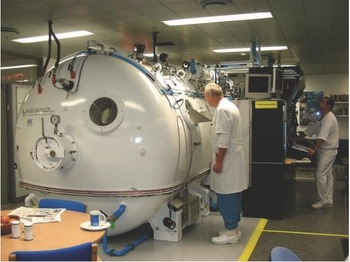
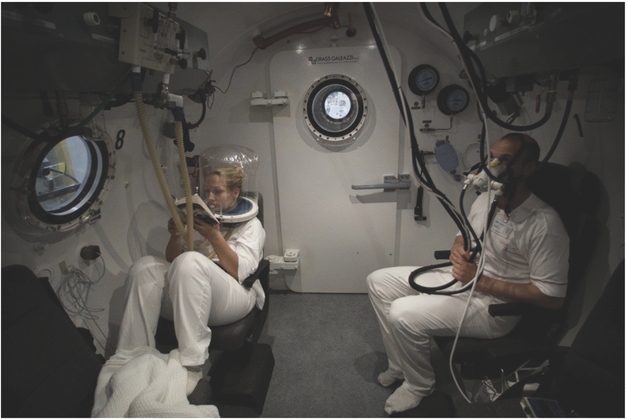
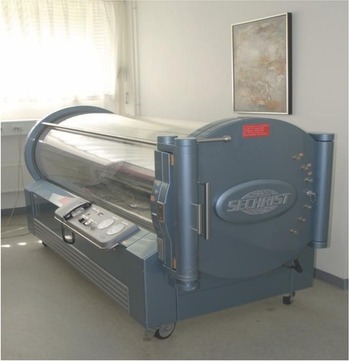
In Denmark, HBOT is available at two facilities. One facility, located in the eastern part of the country is equipped with a multi-chamber seating up to seven persons and managed by physicians, nurses, and diving instructors (Figures 1 and 2). One facility located in the western part of the country is equipped with a chamber for one person only. The facility is managed by a physician (on call) and a small group of specially trained medical students (Figure 3).
Multi-chamber at the larger HBO facility.

Inside the multi-chamber where a patient and a diving instructor are breathing 100% oxygen on a helmet or mask.

Mono-chamber at the small HBO facility.

The pressure during treatment may cause barotraumas to ears, sinuses, and lungs while a seldom but severe toxic effect of oxygen may damage lung tissue and cause oxygen seizures. A more common side effect is a transient change in visual acuity. Several security procedures are suggested and patients are observed during treatment. If any problem occurs, it is possible to lower the pressure and for the patient to leave the chamber in less than a minute.
HBOT is widely used for a range of acute and chronic conditions including diabetic ulcers and late radiation injuries. Breathing 100 percent oxygen under a pressure of 2 ATA or more is assumed to support healing of the injured tissue due to high oxygen content in hypoxic tissue and formation of new blood vessels. However, at present, there is no clear evidence for a clinical effect of HBOT on ORN (Reference Spiegelberg, van Neck, Wolvius and van der Wal4). So far, HBOT is the only known treatment option for sequelae to radiotherapy. A health technology assessment (HTA) was initiated in 2007 simultaneously with a multicenter randomized controlled study (RCT). This article draws on the results of the HTA (Reference Forner, Lee, Kruse, Jansen and Sørensen5).
Objectives
The objective of the present study is to elaborate on the experiences of patients suffering from ORN in relation to how the HBOT is organized, including information and contact to the staff, the type of chamber, the long days or periods of time away from home, and the meaning of fellow patients. In specific, to answer the question, What influences patients acceptance of a demanding treatment with an uncertain effect?
Methods
A structured search was performed in 2007 and updated in 2011 and 2013 by the second author. The search terms “Hyperbaric oxygen AND Osteoradionecrosis” were used in the databases PubMed, NLM, and Embase. The search term “Hyperbaric oxygen” was used in the HTA databases (DARE, HTA, NHS, EED). The search was limited to English and Scandinavian languages.
The literature review was supplemented with a primary study including the two HBOT facilities with the objective of expanding the understanding of patient's experiences with the treatment. The primary study being explorative included ethnographic field observations (Reference Spradley6) and interviews.
Each of the HBOT facilities was observed for 1 full day by the first author following treatments and conducting informal interviews with patients and health professionals.
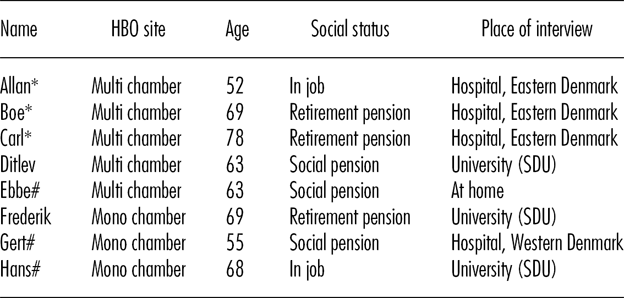
Subsequently formal, semi-structured interviews were conducted by the first author using a semi-structured interview-guide based on the insights from the literature and the observational study. Between December 2008 and February 2011, eight men were interviewed within 2 weeks of finalizing their HBOT series (Table 1). The informants were initially identified among patients included in the RCT. This procedure was, due to the extracted inclusion of patients in the RCT, extended to include all patients receiving HBOT at the planned time of finalizing the interviews.
Informants Included in the Interviews

Note. Eight men, mean age = 64.6. The names have been changed in order to preserve anonymity. Three participated in a group interview (*), five in individual interviews. A relative participated in three of the interviews (#).
The first interview was carried out as a focus-group interview while the following five interviews were individual due to a small number of eligible participants, living and being treated geographically far apart. Interviews took place at the choice of the informant (Table 1).
The focus group interview lasted 150 minutes and the individual interviews 45–65 minutes. They were all audio-taped and transcribed ad verbum.
The text was analyzed by the first author based on the method “Interpretative Phenomenological Analysis” (IPA) (Reference Smith, Flowers and Larkin7), a method including a double hermeneutic multi-stage interpretation process suggesting both inductive and deductive methods and thereby the inclusion of a first order perspective (patient's making sense of their experiences) as well a second order perspective (researcher making sense of patient's experiences). The last being an interpretation guided by theory and attempting to extend the results beyond the actual study (Reference Smith, Flowers and Larkin7).
In practice, the analysis is an iterative process including several repeated steps: first, each interview text was read in full while noticing themes (e.g., “patients helping each other”). Themes from across the interviews were arranged in categories and subcategories (e.g., “Interaction between patients” with subcategories as “being a team”). Then the interviews were coded using the qualitative data analysis software Nvivo (8), a procedure where the text bit by bit is clustered into the developed categories and subcategories. In the next step, the bits of text under each subcategory was read and a common meaning described, first for each theme and then across themes. This interpretation includes looking for patterns as well as contradictions and paradoxes.
During the analyzing process, it became evident that a feeling of being part of “something” was of great importance and experienced differently by the patients in the two HBO facilities.
According to a theory developed by Bowlby (Reference Bowlby9), attachment behavior is a fundamental human function that can be observed not just in childhood but throughout life and especially in times of distress and insecurity (Reference Bowlby9). Based on Bowlby's theory, the second stage (Reference Smith, Flowers and Larkin7) of the analysis was conducted: First, one interview was re-read looking for signs of attachment. After developing new categories and subcategories on “attachment,” the rest of the interviews were re-read and recoded into the new categories.
Citations are presented in cursive while an eventual explanatory word inserted by the author is put in [].
Ethical Considerations
Before the observation days, patients and professionals were informed of the study, and as the opportunity unfolded during the day, informants were asked permission for an informal interview. Patients eligible for a formal interview were informed in writing and orally by the principal investigator or physician in charge and signed a consent form. In the presentation of the results, informants are presented by pseudo names to preserve anonymity (Table 1). According to Danish law, qualitative inquiries are not to be approved by the Ethics Committee.
FINDINGS
Suffering from Osteoradionecrosis
While ORN in a societal perspective is a modest burden, the burden is substantial for the individual patient. During interviews, the informants described problems with dry mouth, viscous mucus, bleeding, pain, decreased appetite, and weight loss. They had problems with chewing and tasting and not being able to eat the food they were used to eating. Several informants had at times lived on liquid diets and one had a permanent stomach tube. Food became a critical topic in their everyday life, and for the family. Their eating habits, which they themselves referred to as special or even bizarre, made it difficult to participate in sociability that included eating, or eating in public spaces.
Organizational Differences in the Two Danish HBO facilities
The patients are referred to two HBO facilities and are offered a stay at a patient hotel at the premises of the hospital. The physical environment is quite different at the two sites. At the larger facility, patients arrive to a department with a small permanent team of staff. They arrive well before treatment to change into hospital garments and use the waiting facilities for a dialogue with the staff and fellow patients. At the small facility, there are no waiting facilities. Patients arrive just before treatment, changing clothes in the room of the chamber and leaving immediately after treatment.
Information before Treatment
In both facilities, patients were informed in writing before starting treatment and encouraged to invite relatives to see the facilities. All informants or their relatives had sought information on the Internet before the start of treatment, and it appeared from the interviews that it was important for the family to know about the treatment, both for their own peace of mind and to support the patient in the best way. The treatment was seen as strange and having seen it “with one's own eyes” took the heat out.
Treatment Discomfort
Long distances and daily treatments for several weeks hampered everyday life. For those living at the patient hotel, everyday-life was, as one informant put it, “on hold” during the week, waiting to go home at weekends.
For most informants, the time in the chamber seemed endless. Although there were other patients in the multi-chamber, the noise and oxygen hood prevented them from talking during treatment. They might pass the time by reading while seated on uncomfortable chairs in a noisy and, at times, too hot or too cold environment while the oxygen hood made breathing difficult. In comparison, the mono-chamber was described as comfortable; patients were lying down listening to music or watching TV. Having regular eye and telephone contact with the staff and a possibility of leaving the chamber in case of problems was reassuring. One informant described how he handled a looming claustrophobia through strict compliance with self-invented daily routines and rituals.
Accepting and Accomplishing a Strenuous Treatment
Hoping that the treatment would relieve their comprehensive discomforts made the informants accept what they expected to be a lengthy, time consuming, and for some transgressed treatment: “You have to try, if not, you don't know if it would have helped . . . it can't get any worse” (Ebbe).
Current problems and expectations of relief as well as previous health-related experiences seemed to influence the acceptance of HBOT. The informants had all previously been diagnosed with cancer, a life-threatening disease for which they had been cured after a treatment described as: “wild,” “violent,” and “tough.”
Hans described his cancer treatment as: “a pretty rough treatment, I have to admit” (Hans). Several years had passed when problems with his teeth and jaw occurred. “The dentist found that it was about to go all wrong . . . [while] tissue sample showed that it was not serious.” Compared with his previous experience, ORN was not a life-threatening disease and the HBO treatment was a milder treatment: “it's not uncomfortable in any way.”
Although not life-threatening; ORN does cause significant discomfort and willingness to accept yet another long course of treatment. An acceptance substantiated if recommended by an authority. For Ebbe, there was no doubt after the treating surgeon had recommended HBOT “so, when one like that says, ‘I think it helps’ then you do it.”
Before starting treatment, the informants were tense or nervous, but gradually treatment became something familiar. At the larger facility, they spoke of being “co-workers,” “colleagues,” and “a team.” The staff seemed important for creating a sense of belonging and being appreciated and were described as: “present,” “professional,” “accommodating,” and “creating a good atmosphere.” The diving instructors created a relaxed atmosphere and a sense of community through their use of jokes and funny comments.
At the small facility, Frederik did not feel any attachment or at ease during treatment. While being admitted to a surgical ward, he stayed at the Patient Hotel and went for his daily treatments at the HBOT facility. He said: “that's what I think was most strange, that I just had myself. They [staff at the surgical ward] had no idea of how I looked, although I was hospitalized for five weeks.” At the HBO, he spoke briefly with the students but failed to make contact with other patients, there or at the Patient Hotel. He felt abandoned and disappointed and was not sure whether it had been worthwhile.
Hoping and Looking for an Effect
Even though the informants had decided for the treatment, they were not quite sure what effects they might expect. They knew that HBOT was useful for “different things,” but unsure if this included the problems they experienced.
They were all looking for any sign of an effect and as a perceived effect, if any, was slight, gradual, and slow to come, they strove to be confirmed as they talked of how they could feel some undefinable change. “I can feel something is changing, but how I don't know” (Bo). “I can't explain” (Ditlev). When Allan after 15 days of treatment experienced some improvement, he gained a renewed courage to carry on the treatment.
Experiences of effects among fellow patients were projected to themselves regardless of the disease for which the fellow patient's was treated. As Carl put it: “they talked about having been there several times and of having a sense of it helping, that makes an impression on you - if it helps her, and her, and her, it's not pure bluff. So there is hope that it will help.”
While the larger facility provided opportunities for confirmation from both staff and other patients did the informants treated at the small facility lack this opportunity of confirmation. As they just saw the physician in charge of the HBOT before and at the end of the course of treatment, their contact was in the meantime limited to a daily but short contact with a student performing the treatment.
Hans had read about the treatment and was convinced of its effect. Yet he was looking for confirmation from the fellow patients that he briefly met: “but we didn't get to talk about whether it helped or whether it did not help.”
Also Frederik was striving for some confirmation of a possible effect: “That was what I was most disappointed about; they did not ask me if I thought it had helped . . . so they could have explained to me that it works, but in the long-term.”
Fellow Patients
Informants treated at the larger facility saw themselves as being part of a community. Allan described it as: “It was a really, really good team,” while Bo added “we have something in common . . . it's not a matter of just me having that [ORN].”
Some arrived in good time before treatment or stayed a little after to talk. They experienced being able to support each other both during the stay in the pressure chamber and in anticipating an effect of the treatment.
Being in the chamber with other patients was reassuring. The patients knew one another and gave little signs: a little nod or a thumb up. Bo explained: “It would be very lonely alone . . . you have to be with others. We support each other, I have noticed there are some being more nervous than others.” It was as Carl put it: “a community with a destiny.”
It was a community requiring mutual consideration. Ditlev put into words how they supported each other “also trying to help those who find it difficult,” but also how fellow patients being negative and anxious could ruin the confidence “they can scare one to death” or how patients being anxious could prolong a treatment session by leaving the chamber during treatment. Also, it was a community limited to the period of treatment: “There is some kind of unity . . . It may well be that 14 days after treatment you don't remember their names, but as long as you are in it you keep an eye out and asks how they are doing” (Ebbe).
Possibilities of meeting fellow patients were limited at the small facility: “There were not any. There was no one when I came. . . just one who was on his way out of the door when I was entering. Or vice versa . . . We greeted each other, and that was it” (Frederik). At the time of Hans’ treatment a small waiting room had been established making a brief contact with fellow patients possible. Hans said: “I had two colleagues.” What he knew about them was their job, where they were from and what condition they were treated for. However, his desire to talk with them about the treatment and an eventual effect was not met: “It is by coincidence that you get to know them, the staff does not tell who are treated and for what . . . In my opinion you could do that, then you could talk about how you experience the treatment, if you could talk to other [patients] about it, that I would prefer” (Hans).
DISCUSSION
Eight studies including patient experiences with HBOT were identified, of which three included patients with ORN (Reference Gerlach, Barkhuysen, Kaanders, Janssens and Sterk10–Reference London, Park, Gampper and Hoard12), one patients with diabetic ulcers (Reference Hjelm, Löndahl, Katzman and Apelqvist13), while the remaining four studies included a diversity of diagnoses (Reference Chalmers, Mitchell, Rosenthal and Elliott14–Reference Allen, Danforth and Drabman17).
There are indications that HBOT has a positive effect on ORN-specific aspects of health related quality of life, such as mucus, dry mouth and swallowing (Reference Gerlach, Barkhuysen, Kaanders, Janssens and Sterk10), pain (Reference Harding, Hodder, Courtney and Bryson11), teeth, opening of mouth, and social eating (Reference Harding, Courtney, Hodder and Bryson18).
Also HBOT imposes significant constraints on patients exposed to a lengthy treatment often far from home (Reference Hjelm, Löndahl, Katzman and Apelqvist13). Being in the chamber is experienced as boring and uncomfortable (Reference Hjelm, Löndahl, Katzman and Apelqvist13;Reference Chalmers, Mitchell, Rosenthal and Elliott14).
Treatment in an unknown and high technology environment might lead to insecurity and anxiety (Reference Hjelm, Löndahl, Katzman and Apelqvist13;Reference Chalmers, Mitchell, Rosenthal and Elliott14;Reference Clark and Rock16). One study found that 3.4 percent of the patients undergoing HBOT experienced confinement anxiety (Reference Plafki, Peters, Weslau and Busch15). Another study found that seven of seventeen patients needed sedative treatment in relation to HBOT while an (unknown) number of patients stopped treatment due to social circumstances (Reference London, Park, Gampper and Hoard12).
A small randomized study showed less anxiety in a group watching a film informing about the HBOT before treatment and having the opportunity for watching a movie during treatment, compared with a control group receiving usual information (Reference Allen, Danforth and Drabman17).
Other studies have highlighted the importance of thorough information pretreatment and good contact with the staff as well as fellow patients for the acceptance of the HBO treatment (Reference Hjelm, Löndahl, Katzman and Apelqvist13;Reference Clark and Rock16;Reference Harding, Courtney, Hodder and Bryson18).
The uniqueness of the present study was a possibility of observing two HBO facilities with a very different organization. Observations, in-depth interviews and a double hermeneutic analysis involving psychological theory gave an opportunity of discovering the importance of creating a feeling of attachment for the satisfaction with and acceptance of the treatment.
Going through the treatment, not knowing if it would alleviate their problems made patients look for any small signs of effect experienced by them or by fellow patients as well as reassurance from the staff. This quest for confirmation can be seen as an attempt to reinforce their confidence in the treatment, a confirmation hard to obtain at the small facility where the access to specialist staff as well as fellow patients were missing, or sporadic at best.
For the patients in the larger facility; the daily access to a limited number of staff with specialist knowledge and fellow patients going through the same treatment created a feeling of togetherness and belonging. Patients met before treatment, entered the chamber and sat during the time of treatment together with other patients they had met before and for whom they for the time being felt some responsibility. A feeling supported by the diver's articulation of diving together that gave a sense of being part of something, of being a team.
During the study, a waiting room was established at the small HBO facility and the physician started to see the patients here during their period of treatment. This might be a reason for the two informants interviewed late during the period of the study not being as disappointed and lost as the informant interviewed before the organizational change.
That only eight men were interviewed might be seen as a limitation of the study, although the informants reflects the patient population of ORN, being mainly middle-aged to elderly men (Reference Forner, Lee, Kruse, Jansen and Sørensen5).
Offering a treatment with limited scientific evidence is controversial. A French study published in 2004 (Reference Annane, Depondt and Aubert19) demonstrated a lack of effect of HBOT on ORN, and although the study design had numerous flaws and its quality has been widely questioned, several countries no longer offer governmental funding of HBOT. As the HBOT of ORN is still investigational, we initiated a randomized clinical trial parallel to the HTA. At the same time, a Dutch research group initiated a similar study. At the time of completion of those two RCTs, the basis for a scientifically sound decision on HBOT should be provided. Meanwhile, at least the countries participating in the ongoing RCT should continue offering HBOT to provide evidence, as the evidence is essential because there are no alternative treatments and because sequelae to radiotherapy has serious implications.
CONCLUSIONS
The burden of ORN is substantial for the individual patient. The severe handicaps are strong motivating factors for accepting HBOT. The completion of and satisfaction with a lengthy and demanding treatment seems to be supported by daily access to specialized staff and fellow patients and thereby an opportunity for maintaining confidence in the treatment.
While the organizational conditions appear to be crucial for patient satisfaction, the importance of the type of pressure chamber is less certain. The comfort seems better in the mono-chamber, while the contact to fellow patients in the multi-chamber seem to be of great importance. As the joint stay in a multi-chamber supports patients’ experience of being part of a community and thus of attachment, this issue may be addressed in the mono-chamber through interaction with fellow patients and staff outside the chamber.
CONTACT INFORMATION
Anne Lee, MSc. (Health), RN (ale@cast.sdu.dk), Centre for Applied Health Services Research and Technology Assessment, University of Southern Denmark, Odense, Denmark
Lone Forner, DDS, PhD Departments of Anaesthesia and Oral and Maxillofacial Surgery, Centre of Head and Orthopedics, Copenhagen University Hospital, Copenhagen, Denmark
Erik C. Jansen, DM, DMSc, Chief Physician, Department of Anaesthesia, Centre of Head and Orthopedics, Copenhagen University Hospital, Copenhagen, Denmark
CONFLICTS OF INTEREST
The authors report a grant to institution from the National Board of Health.