Introduction
The World Health Organization (2008) estimated that about 65 million people use wheelchairs (powered or manual), which represents about 1 per cent of the world population. Powered wheelchairs are wheelchairs commonly using electric power to support mobility and activities of daily living, for individuals who have severe mobility impairment or struggle to propel a manual wheelchair (Frank et al., Reference Frank, Neophytou, Frank and de Souza2010). In 2002, it was estimated there were approximately 810,000 powered wheelchair or scooter users in the United States of America, of whom around 15 per cent were older adults (Flagg, Reference Flagg, Bauer and Bunning2009). Based on data from 2012, there were approximately 42,360 powered wheelchair users in Canada, 30 per cent of whom were older than 65 years (Smith et al., Reference Smith, Giesbrecht, Mortenson and Miller2016). The number of older powered wheelchair users is expected to increase consequent to the ageing of the population worldwide (LaPlante and Kaye, Reference LaPlante and Kaye2010). Moreover, a growing proportion of adults with early onset disabilities are now part of the ageing population, who have a different experience that needs to be studied (Moll et al., Reference Moll, Cott, Nixon, Olson, Young and Schultz2016). For instance, they may experience conditions associated with ageing earlier in their lives (Verbrugge and Yang, Reference Verbrugge and Yang2002; Jensen et al., Reference Jensen, Truitt, Schomer, Yorkston, Baylor and Molton2013).
Quantitative and qualitative cross-sectional studies have suggested that powered wheelchair use is associated with improved mobility, activity participation and independence (Edwards and McCluskey, Reference Edwards and McCluskey2010; Blach Rossen et al., Reference Blach, Sørensen, Würtz and Wind2012; Pettersson et al., Reference Pettersson, Iwarsson, Brandt, Norin and Månsson Lexell2014; Martins et al., Reference Martins, Pinheiro, Farias and Jutai2016; Stenberg et al., Reference Stenberg, Henje, Levi and Lindström2016). For instance, it was identified that older adults used their powered wheelchair to accomplish their meaningful activities, which consequently increased their confidence and self-esteem (Edwards and McCluskey, Reference Edwards and McCluskey2010). Moreover, those psycho-social impacts were found to be greater for older powered wheelchair users than other mobility device users (Martins et al., Reference Martins, Pinheiro, Farias and Jutai2016). Few studies have also explored powered wheelchair users’ experiences. Recent quantitative and qualitative research with adult users described powered wheelchairs as a mixed blessing in terms of usability, safety, cost, accessibility and stigma (Blach Rossen et al., Reference Blach, Sørensen, Würtz and Wind2012; Pettersson et al., Reference Pettersson, Brandt, Lexell and Iwarsson2015; Torkia et al., Reference Torkia, Reid, Korner-Bitensky, Kairy, Rushton, Demers and Archambault2015; Salatino et al., Reference Salatino, Andrich, Converti and Saruggia2016).
Some research has examined the impact of powered wheelchairs over time, but only with new powered wheelchair users. These quantitative studies have evaluated changes in mobility and participation after four months (Löfqvist et al., Reference Löfqvist, Pettersson, Iwarsson and Brandt2012; Samuelsson and Wressle, Reference Samuelsson and Wressle2014), six months (Ward et al., Reference Ward, Hammond, Holsten, Bravver and Brooks2015) or one year (Löfqvist et al., Reference Löfqvist, Pettersson, Iwarsson and Brandt2012; Sund et al., Reference Sund, Iwarsson, Anttila and Brandt2015). These studies found that powered wheelchairs improved the ease with which activities were performed, but did not lead to an increase in the frequency of participation. Powered wheelchair use was also associated with decreased pain and discomfort, and less dependence on other people to move around outside the house (Löfqvist et al., Reference Löfqvist, Pettersson, Iwarsson and Brandt2012; Samuelsson and Wressle, Reference Samuelsson and Wressle2014; Ward et al., Reference Ward, Hammond, Holsten, Bravver and Brooks2015). However, with the exception of two studies (Mortenson et al., Reference Mortenson, Hammell, Luts, Soles and Miller2015a; Ward et al., Reference Ward, Hammond, Holsten, Bravver and Brooks2015), little is known about the changes in the subjective experiences of users over time, especially among experienced users who have greater cumulative experiences.
A lifecourse perspective has been recommended as a way to study the longitudinal benefits and challenges that are experienced by people ageing with disability (Jeppsson Grassman et al., Reference Jeppsson Grassman, Holme, Taghizadeh Larsson and Whitaker2012). We are using this perspective to help us better understand how the powered wheelchair experiences of older users’ evolved over time, including how their previous life experiences helped them to make sense of current perceptions of their powered wheelchair use and its impact on mobility and participation.
The lifecourse perspective
The lifecourse perspective has been developed and used in multiple disciplines, to study different psycho-social issues in people's lives over time (Elder and Giele, Reference Elder, Giele, Elder and Giele2009). It posits that a person's experience at a certain moment has been influenced and is informed by the context of his or her entire biography (Jeppsson Grassman and Whitaker, Reference Jeppsson Grassman, Whitaker, Jeppsson and Whitaker2013). Lifecourse perspective can be used prospectively, in which case researchers study change through repeated data collection over time, ranging from one year to many years (Jeppsson Grassman and Whitaker, Reference Jeppsson Grassman, Whitaker, Jeppsson and Whitaker2013), or retrospectively, in which interviews are used to understand the past experiences of participants (Elder and Giele, Reference Elder, Giele, Elder and Giele2009). Qualitative studies using lifecourse perspective can be a useful tool for understanding fluctuations in experience, which includes periods of change and stability (Berger, Reference Berger, Berger and Lorenz2016).
The lifecourse perspective has been helpful in understanding the subjective experiences of those ageing with disabilities by considering the totality of a person's life dynamics (Jeppsson Grassman et al., Reference Jeppsson Grassman, Holme, Taghizadeh Larsson and Whitaker2012), but has not been used specifically among powered wheelchair users. The life-long perspective offers ways to explore the diverse experiences of disability in different contexts, including micro- and macro-level dimensions (Moll et al., Reference Moll, Cott, Nixon, Olson, Young and Schultz2016). For instance, two individuals living with the same physical impairment will have different life experiences and consequently different perceptions of their powered wheelchairs. On a macro-level, the historical context for the instance of the disability onset would impact the perceptions of the powered wheelchair later on. In their systematic review of qualitative studies on ageing with a chronic or disabling condition, Moll et al. (Reference Moll, Cott, Nixon, Olson, Young and Schultz2016) reported that residual symptoms and age-related changes affected physical ability, identity and self-perception. To the best of our knowledge, the lifecourse perspective has never been used to study the experiences of powered wheelchair users. However, as having a disability has been described as a dynamic process (Jeppsson Grassman et al., Reference Jeppsson Grassman, Holme, Taghizadeh Larsson and Whitaker2012), we believe that the impact of powered wheelchair use changes over time and is influenced by previous experiences. Thus, the aim of this study was to explore the experiences of ageing powered wheelchair users over time, using a combined retrospective/prospective lifecourse perspective. Specifically, we wanted to understand how users perceived their powered wheelchair experience and how their mobility and social participation evolved and transformed over time.
Method
Study design
This two-year longitudinal study was conducted in Vancouver, Montreal and Quebec City (Canada), as part of a larger multi-site mixed-methods study on powered wheelchair use (Mortenson et al., Reference Mortenson, Demers, Rushton, Auger, Routhier and Miller2015b). Qualitative interviews were the primary method of data collection. The study was approved by the local research ethics boards.
Recruitment
Participants were recruited via the study website and through posters placed in rehabilitation and long-term care facilities, hospitals, community care organisations and equipment vendors. Newsletter notices were also sent through disease organisations such as the Multiple Sclerosis Society. To be included in the study, participants needed to be 50 years of age or older, proficient in English or French, able to use a powered wheelchair independently, able to respond to the invitation to participate, able to provide their own consent and be living in a community dwelling. Individuals who fit the criteria were also invited to participate by third-party recruiters including occupational therapists, physical therapists and wheelchair equipment vendors. The goal was to recruit a balance of new powered wheelchair users (i.e. using a powered wheelchair for one month or less) and experienced users (i.e. using the powered wheelchair for at least two years).
Data collection
Interviews were scheduled to occur at enrolment, four months, 13 months and 25 months. Six participants were interviewed two or three times only due to health issues; however, their data were included in the study in light of our retrospective analysis. Interviews were based on an evolving semi-structured interview guide. Topics for the first round of interviews included wheelchair use and features, participation in different activities, mobility challenges, and changes in the wheelchair and user over time. Examples of questions included: ‘How do you use your powered wheelchair on a daily basis?’ and ‘What difficulties do you encounter when using your powered wheelchair?’ The interview guide for the follow-up interviews included questions about changes that occurred between interviews and novel topics that emerged during the previous interview. Socio-demographic information was collected as part of the larger study.
Interviews were audio recorded and ranged from 45 minutes to two hours in length. They took place at a location of the participants’ choice. A total of 70 interviews were conducted either at the participants’ homes, at the research facilities or over the phone. Interviews were conducted by the second author (an occupational therapist with experience in the wheelchair prescription process and qualitative researcher) and two masters of occupational therapy students trained to conduct qualitative interviews. All interviews were transcribed verbatim. French interviews were translated into English by bilingual members of the research team. Quotes provided in this paper by French-speaking participants were translated from French into English.
Data analyses
Analyses were ongoing throughout the data collection process, following the inductive approach of interpretive description (Thorne, Reference Thorne2016). The goal of interpretive description is to create a conceptually coherent explanation that highlights thematic patterns and commonalities characterising the phenomenon being studied. The themes are then organised into a story, in order to make sense of the most important ideas to be conveyed (Thorne, Reference Thorne2016). By integrating a combined retrospective–prospective lifecourse approach with interpretive description, we were able to examine participants’ narratives for reference to their past life experiences and context to understand their current experiences with and future perspectives of powered wheelchair use. Interviewers recorded reflective notes pertaining to ideas regarding the codes and their relationships. The first and second authors and the two masters students independently reviewed half of the transcripts to identify preliminary codes. The first author has a PhD in community psychology and is an experienced qualitative researcher. They subsequently met to develop the coding guide in collaboration, which was altered as new codes were identified. The research team then discussed how to assemble the codes into sub-themes, and sub-themes into main themes.
We used a variety of trustworthiness strategies throughout the research process such as personal diaries, interview notes and team meetings (Shenton, Reference Shenton2004). Interview notes denoting the interview's context and the interviewer's initial impressions were taken to reflect on the potential power dynamics and to help the interviewers become aware of their own bias. The research team had regular debriefing sessions to discuss any issues regarding data collection and the interpretation of findings. The triangulation of different researcher perspectives (occupational therapy, gerontology, psychology) during the content analysis also helped to ensure credibility.
Findings and discussion
Participants description
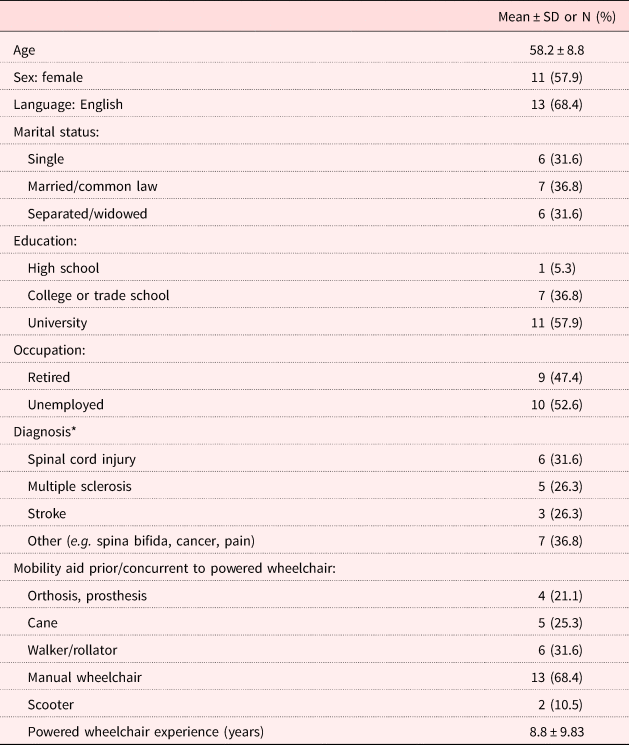
Participants included eight men and 11 women ranging in ages from 50 to 85 years old. Their years of experience with a powered wheelchair ranged from one month to 30 years. All participants were community-dwelling Caucasians who lived in the greater area of Vancouver, Montreal or Quebec City, Canada. Participants funded their powered wheelchairs through a variety of sources: private insurance, provincial programmes or personal funding. Almost all participants controlled their powered wheelchair with a joystick, except for one who used a head activated switch. Participants’ information is provided in Table 1.
Participants’ demographics

Notes: N = 19. SD: standard deviation.
*Some participants had more than one diagnosis.
Themes
We identified three main themes in our analysis: (a) ‘It's my legs’ emphasised how powered wheelchairs were a form of mobility that enabled users to have the freedom to take part in activities and also impacted on their identities and self-perceptions; (b) ‘wheels of change’ explored the dynamic nature of powered wheelchair use and changes in physical capabilities related to ageing; and (c) ‘getting around’ illustrated how users’ mobility was affected by the interface between the person–wheelchair unit and their physical and social environments. These themes emphasised how powered wheelchair use represented a dynamic rather than a static process, which shifts depending on changing abilities, learning experiences and different environments. All participant names are pseudonyms given by the research team.
‘It's my legs’
Participants’ perceptions of their powered wheelchair changed over time. Initially, many participants believed that the powered wheelchair would impede their independence, when they first received it. Over time, most participants began to perceive it as a source of freedom allowing them to extend their boundaries and feel less confined. As Harold, a 52-year-old experienced user living with tetraplegia said, ‘I felt bad about that [using a powered wheelchair], but, after a while, I kind of realised it was good because it gave me more independence.’ This evolving perception was also identified in a recent qualitative study, which suggested a transition from initial resistance against use of a powered wheelchair to a certain level of acceptance and integration (Stenberg et al., Reference Stenberg, Henje, Levi and Lindström2016).
Despite these gains, some participants expressed ambiguity about the powered wheelchair. As Juliet, a 69-year-old experienced user with neurological conditions stated: ‘In a sense, it was a relief, but at the same time, I had a sense of diminished capacity. I was forced to accept that I could not go any further [on my own], but at the same time I got some more independence.’ Participants referred to their childhood or past life events to explain their difficulty in accepting the changes in their independence that necessitated using a powered wheelchair. For instance, Susan, a 60-year-old experienced user with spina bifida explained:
In an era where a lot of the kids like me were put into mental institutions, or kept at home and home-schooled, my mother and my father instead made sure that I was going to public primary and high schools … and they made sure that I was with kids my own age and that I was involved in school functions.
Our results highlight the perceived importance of independence, which has its roots in participants’ past familial relations and expectations. This finding is in keeping with studies which emphasise how family relations and generational influences shape an individual's lifecourse (Jeppsson Grassman et al., Reference Jeppsson Grassman, Holme, Taghizadeh Larsson and Whitaker2012). Many Western societies remain structured so that people with disabilities need help from others to carry out their daily lives. Given societal norms, this forced dependency could be interpreted as a threat to identity and a source of stigma (Portacolone, Reference Portacolone2011). Further, given the way autonomy has been valued throughout the participants’ lives, being dependent for mobility may be frustrating and disempowering (Mortenson et al., Reference Mortenson, Oliffe, Miller and Backman2012), especially given all of the resources that those with able bodies receive, which are considered entitlements.
For most participants, the powered wheelchair enabled them to pursue lifelong activities, while a few perceived it to have interrupted their previous life. Powered wheelchairs provided them with the mobility to take part in meaningful activities such as leisure (e.g. going to the library, fishing), volunteering, travelling and social activities (e.g. having lunch with friends). Charlie, a 63-year-old new user said, ‘It allows me the independence to get out of the apartment and have some social contact with people … just to go out and have coffee, meet some people, and have a conversation.’ In contrast, Valery, a 52-year-old experienced user living with a neurological impairment, reported feelings of disruption:
I had become handicapped, sentenced to an electric chair … it really changed my life completely. It's like having a new life, as if I've retired, and I now need to find new activities … and develop new ways of meeting people … You're a lot more isolated when you're in a powered wheelchair.
This result suggests that adopting the powered wheelchair could introduce a temporary biographical disruption (Hinojosa et al., Reference Hinojosa, Boylstein, Rittman, Hinojosa and Faircloth2008). Individuals may feel that they need to construct a new vision of their future lives and of themselves (Roger et al., Reference Roger, Wetzel, Hutchinson, Packer and Versnel2014). As new meanings or new habits are created using the powered wheelchair, they may then be able to integrate this new experience into their lifecourse. However, the results suggest that for most people, the powered wheelchair contributes to continuity in their lives, connecting their past to their present. It became a part of their life stories by allowing them to carry on with meaningful activities throughout their lifecourse or return to activities they could not perform without their powered wheelchairs. As suggested by studies with older stroke survivors (Hinojosa et al., Reference Hinojosa, Boylstein, Rittman, Hinojosa and Faircloth2008; Roger et al., Reference Roger, Wetzel, Hutchinson, Packer and Versnel2014), making sense of the event and the changes in physical conditions may help people to achieve this feeling of continuity.
The powered wheelchair became an intrinsic part of their identity for most participants. Ann, a 53-year-old experienced user with multiple sclerosis (MS), stated: ‘[The] wheelchair is really a part of who you are, almost like an extension of yourself.’ The powered wheelchair even became a part of their physical body as they compared it to their legs or used expressions such as ‘going for a walk’ or ‘running’. This sense of embodiment was a feeling that seemed to develop over time. For instance, Grant, a 56-year-old experienced user with MS, indicated that it took him two years before ‘becoming one’ with his chair. The perception that the device was part of their body made it problematic for some participants to replace their current powered wheelchair when it started to wear out. As Harold explained:
It's part of your sense of who you are. And that's what sometimes, they [the people that make chairs] don't take into consideration and then can't understand why people reject chairs. It's not the mechanics of the chair, it's how you perceive that piece of machinery as being part of you.
When powered wheelchair use was limited because of a mechanical problem or discomfort, this embodiment was even more noticeable. As Angela, a 66-year-old experienced user who had a stroke said, ‘I'm so lost when it's broken … It's like not having legs … you just can't get anywhere.’ The results emphasise how participants’ identities as power wheelchair users evolved over time (i.e. prior to and during the two years of study). Two previous studies among long-term powered wheelchair users have identified similar findings (Blach Rossen et al., Reference Blach, Sørensen, Würtz and Wind2012; Stenberg et al., Reference Stenberg, Henje, Levi and Lindström2016). When a powered wheelchair is integrated into self-perception, the projection of the body into the device modifies the interaction between corporeality and the outside world (Bloomfield et al., Reference Bloomfield, Latham and Vurdubakis2010). This bodily perception contributes to self-construction (Hinojosa et al., Reference Hinojosa, Boylstein, Rittman, Hinojosa and Faircloth2008), which, as an evolving process, may bring back a sense of continuity in the person's identity after an initial biographical disruption. Stenberg et al. (Reference Stenberg, Henje, Levi and Lindström2016) emphasised that time was needed to accept the embodiment of the powered wheelchair, to restore continuity in self-identity.
The participants compared the powered wheelchair with the manual wheelchair and the scooter in terms of the image it conveys to others. Being in a powered wheelchair, instead of a manual wheelchair, meant they needed more care or presented as ‘really’ disabled. In fact, the powered wheelchair was seen as an outward symbol of the increasing severity of disability and of ageing. ‘The powered chair is probably worse because with the manual chair, they know you're able-bodied in some way that you've got some mobility’, reported Fred, a 54-year-old new user with paraplegia. Those who previously used a scooter said that it made them feel less different from people without disabilities than when they used a powered wheelchair. Passive safety devices, such as an orange flag, were also perceived as challenging some participants’ image. For them, the flag attracted too much ‘bad’ attention to the person. As Nadia, a 54-year-old experienced user with neurological issues said, ‘When I see people with flags, I think old. It just brings more attention. I don't want to draw any more attention to myself. I want to draw attention to me as a human being, as a person.’ In contrast, participants, such as Trevor, were proud of their flags and horns. Trevor's pride came from the fact that he did all of the installation and electrical work by himself. It allowed him to experience continuity in his identity, as he was able to apply skills he learned previously in his life. Nevertheless, powered wheelchairs and features like the flags are mainly seen as explicit symbols of disability, more than other devices such as canes (Green et al., Reference Green, Davis, Karshmer, Marsh and Straight2005; Stenberg et al., Reference Stenberg, Henje, Levi and Lindström2016). The people who use them are perceived as more disabled by the public (Green et al., Reference Green, Davis, Karshmer, Marsh and Straight2005), especially given the normative expectations of being active and contributing to the society that is related to the lifestage of the participants (still working age or recently retired) (Moll et al., Reference Moll, Cott, Nixon, Olson, Young and Schultz2016). The users may also internalise societal norms and attitudes that a ‘dis'abled body, which requires an assistive device such as a powered wheelchair, has less value than an able-body (Edwards and Imrie, Reference Edwards and Imrie2003). These values and habits of thought are often instilled over a lifetime (Bourdieu, Reference Bourdieu1984) and, thus, could be difficult to change. Darling and Heckert (Reference Darling and Heckert2010) suggested that older adults who grew up with the medical model of disability identify less with their disability, compared with younger adults who have a stronger sense of ‘disability pride’ through their exposure to the social model that has become more dominant in North America in the last 30 years.
‘Wheels of change’
This second theme, ‘wheels of change’, focuses on the dynamic nature of the device and its use. Among the participants, there were different paths leading to powered wheelchair use. Some participants received their powered wheelchair from the onset of their disability, and, thus, their usage was more stable across time. However, most of the participants started using their powered wheelchair later in their life with a disability.
Those living with a progressive disease often first used other mobility devices such as a walker, manual wheelchair or a scooter, and then started using the powered wheelchair more regularly following the evolution of their health condition. For instance, Genevieve, 53-year-old new user with back problems, started taking medication over the course of the interviews, which caused dizziness, reducing her ability to walk and, thus, increasing her powered wheelchair use. Others increased their use of their powered wheelchair because their previous use of the manual wheelchair for many years caused overuse injuries. As Trevor indicated, ‘You're not just pushing a wheelchair, you're pushing the weight of your whole body and anything you've packed on … your arms and your shoulders, wrists, everything has to do extra work that they're not designed to do.’ According to the participants, in the past, rehabilitation professionals did not give advice on how to prevent deterioration or injuries; such as alternating between the powered and the manual wheelchair or respecting the body's limit.
Similarly, Moll et al. (Reference Moll, Cott, Nixon, Olson, Young and Schultz2016) reported that the wear and tear on the body of people with polio, spinal cord injury or cerebral palsy in later life was directly related to the way they had treated it during their more active years. Given changes in rehabilitation care, such as the adoption of the ‘preserve to conserve’ approach (Farbu et al., Reference Farbu, Gilhus, Barnes, Borg, De Visser, Driessen and Stalberg2006), it could be expected that those who have been through rehabilitation in recent years may consider their use of mobility devices through a long-term perspective. This approach may be a more effective strategy for ageing with a disability in better physical health (Moll et al., Reference Moll, Cott, Nixon, Olson, Young and Schultz2016).
When participants acquired their powered wheelchairs, they had to choose between different features such as the tilt and recline mechanism or types of control that affected their driving experience and comfort. Participants commented on the challenges in choosing among these features and how the prescription procedure was a learning process. The participants who had owned a series of powered wheelchairs over the years felt they knew better what they needed or wanted. Those with no previous experience felt uncertain about the types of features they required for their powered wheelchairs. As expressed by Susan:
And even buying an electric chair … You're only given one control to test. I had no idea if some of the other controls might be better, right? And might be worth the extra 50 dollars? So, it's the same with cushions … You just take your chances.
This illustrates a conundrum. Experience is helpful to know what one needs, but one does not possess experience from the beginning. Further, choices made years before have consequences on use and comfort later on. This issue raises concerns as some features are expensive, and many funding programmes only allow devices to be replaced every five years. As suggested by Williams et al. (Reference Williams, Hurwitz, Obaga, Onguti, Rivera, Sy, Lee, Noon, Tanuku and Gichangi2017), other powered wheelchair users, especially long-term users, could be a source of knowledge that may help new users anticipate potential future changes in their needs and physical health.
A learning process was associated with the use of a specific powered wheelchair. Driving skills and confidence with the powered wheelchair evolved over time for most participants who initially saw driving their wheelchair as difficult and frightening, but once they felt more confident, it became something natural and positive. Maria, a 56-year-old new user living with MS, explained her learning process, ‘it's gone from absolute terror to feeling pretty good. I'm now slowing down where I should and not so much where it's OK’. In contrast, a few participants were not confident and expressed doubts about their ability to master it in the future. Other participants worried they would have to start their learning process over again with the provision of a new chair. Participants frequently drew on previous life experiences to explain their ability to learn to drive their powered wheelchairs. Some participants perceived they were good car drivers all their lives and took great pride in it. Some also referred to their working experience and knowledge in mechanics or in health care to explain their present ability to handle the issues they encountered with their mobility device. Responding to a question about transition from manual to powered wheelchairs, Trevor explained, ‘No problems at all. I've been a mechanic and worked with equipment from cranes to trucks, and this chair is the same fit … everything is a joystick, on all those heavy industrial cranes.’ This ability to use their previous experience seems to give them a great sense of accomplishment and provide them with a sense of continuity in their identity. It allowed the participants to connect their life before and after the powered wheelchair and incorporate that experience into their life biography. Participants’ reference to their previous work experience seems like a way for them to reinforce their contributions to the society. The pride experienced by users reflects the assertion that one's value in the society is still highly determined by the work and contributions made to their community in the current historical context (Bourdieu, Reference Bourdieu1984; Edwards and Imrie, Reference Edwards and Imrie2003).
Due to changes in their physical health and abilities, the participants reflected on the process of ageing with a disability in relation to the powered wheelchair. They either perceived it as part of or different from the ‘normal’ process of ageing. For instance, Tom, a 55-year-old experienced user with paraplegia, stated: ‘I mean ageing in general, there's a lot of common things, disability or not.’ In contrast, Denis thought that having been disabled for a certain part of his life prepared him for the changes associated with getting old. Some were also concerned with anticipating the future of ageing with a disability, with respect to what will differ in terms of both the powered wheelchair needs and their care. As Susan reported:
Right now everything is fine but I can see when I'm going to need someone to cook for me, and all that sort of stuff … like right now my mum is with me so that helps but she's not going to be around forever. So after the chair, the next stage is full care.
Some older adults normalise their physical abilities by aligning their experiences with bodily expectations associated with ageing, to maintain a sense of biographical continuity (Clarke and Bennett, Reference Clarke and Bennett2013). However, in a study with older people with disabilities, Larsson and Grassman (Reference Larsson and Grassman2012) reported that the physical changes and illnesses associated with ageing were still disruptive to some people with disability but, perhaps, less unexpected than for able-bodied people because of their previous life experience. Unfortunately, the rehabilitation services and other health promotion resources are not always available to support older people living with a disability in their ageing process (Moll et al., Reference Moll, Cott, Nixon, Olson, Young and Schultz2016).
‘Getting around’
The third theme focused on how users’ mobility and participation were affected by their interactions with their physical (e.g. housing, public buildings and spaces, transport) and social (e.g. attitudes and interactions) environments over time. Because of their disability, people often need to change their environment to fit with their evolving needs. For instance, following an acute injury, a person may have to move to a new adapted house and, thus, establish a new sense of home.
The powered wheelchair modified one's interaction with the immediate environments where the person lives (i.e. their house). Housing modifications to accommodate the chair or having access to accessible housing were perceived as positive changes that allowed the participants to continue previous habits and practices. As Maria indicated, ‘Our kitchen just went through a remodelling, and now the new island has a space cut out so I can just wheel underneath and raise my chair so I'm sitting like a normal person having dinner.’ Not everyone was able, often for economic reasons, to adapt their home environment to fit their mobility needs. In those cases, the participants were not able to use their powered wheelchair inside and, thus, had to rely on their manual wheelchair for a longer period of time for their in-home mobility. These results suggest that the introduction of powered wheelchairs affects the interaction with the environment of the users that goes beyond basic mobility. An accessible and usable house environment is a critical factor to enable mobility device users to live independently and participate in work and civic life (Gibson et al., Reference Gibson, Secker, Rolfe, Wagner, Parke and Bhavnit2012). Adapted housing could also help to prevent overuse injuries by enabling people to use their powered wheelchair instead of continuing to use their manual wheelchair for a longer period due to environmental barriers. However, with fluctuations in the political will to sustain accessible housing programmes, those opportunities to have access to supportive environments could change over the lifecourse of a person.
Some participants felt that the accessibility of public built environments had improved for mobility device users since they were young. For instance, Beatrice, a new user with bilateral lower amputations, stated: ‘I'm 86 years of age and seeing what has happened over these years for people who have handicaps, I mean it's phenomenal what's happening now, being able to get up to curbs, all the different things.’ Despite these improvements, almost all participants still reported encountering environmental barriers when using their powered wheelchairs. They identified mostly issues with entrances and toilets in stores, restaurants and public buildings, and the inadequate conditions of the pavements. Participants commented on how this inaccessibility limited their ability to contribute to their community. Phillip, a 50-year-old experienced user living with tetraplegia said:
Sometimes we go to places and they [the owners] say: ‘Oh well, nobody [with disabilities] comes.’ We reply, ‘It's normal, if it's [the store/restaurant] not accessible. Make it accessible and you will see people.’ It's like a vicious circle.
Despite growing pressure to create building codes and regulations to create barrier-free environments (Heitor et al., Reference Heitor, Medeiros, Nascimento, Tomé, Langdon, Lazar, Heylighen and Dong2014), the accessibility issues in public spaces continue to exacerbate the stigma that powered wheelchair users experience. It emphasises the separation between the users’ needs and their environment, making them feel like they do not belong (Edwards and Imrie, Reference Edwards and Imrie2003). Over the lifecourse of a person, there are many opportunities for individuals with disability to contribute to society that are denied, and, for the society, it means the loss of important economic and social benefits, such as growth in the retail sector (Kemper et al., Reference Kemper, Stolarick, Milway and Treviranus2010). We could expect that if barrier-free designs continue to be implemented, a powered wheelchair could introduce less disruption in the users’ experience and allow for a smoother transition in their mobility path and social participation.
Transportation also emerged as particularly important in the participants’ experiences. Having an adapted van or car was seen as a useful resource. As Phillip reported, ‘If I don't have my car, sorry, but I can't do it. I go out every evening, it's really important for my mental health. So it's the only place I don't feel handicapped, same as everybody.’ The private car represented the participants’ freedom and even played a role in conveying a positive image of them to society. Using a personal car or van is likely more convenient than using public transit, but adapting a private vehicle can be extremely expensive (Disabled World, 2017). This likely excludes many powered wheelchair users who are usually less wealthy than their able-bodied peers (Arim, Reference Arim2015). Moreover, throughout the years, for those changing devices (e.g. shifting from manual to powered wheelchair), it could mean having to adapt the vehicle on a few occasions, leading some people to give up driving altogether.
In terms of public transport, the perceptions were different depending on the study site. In Vancouver, public transit, which was primarily used by participants, was perceived as efficient, easy to use and allowed users to go wherever they wanted. A training programme for mobility device users to learn how to use the public transit was greatly appreciated as it increased participants’ confidence. In Quebec City, Paratransit was mainly used. It provoked mixed reactions: it was perceived as either increasing access to the community or as having many issues that impeded access. Genevieve shared a story that happened to her, ‘I was forgotten by the Paratransit this month. That was a big event because it prevents me from going out any more. I am so afraid now that I ask myself if I would ever go back.’ Despite providing opportunities to access the community, Paratransit represents a dividing practice (Foucault, Reference Foucault1982) that continues to segregate mobility device users from the ‘able’ population. Providing access to all to the public transport would be a more inclusive policy for all ages. Indeed, public transportation policies are one of the core strategies for the creation of age-friendly cities (World Health Organization, 2007). Ensuring that public transportation is accessible represents a critical requirement for those using powered wheelchairs.
Climate had an important impact on users’ mobility. During the winter, in Quebec City, the participants would change the type and range of activities they were doing and would almost stop going out completely. One of the reasons being that the snow removal services were not always adequate. As Juliet explained:
I kind of resigned myself about not being able to go to the store because of the snow … I have to wait till the snow truck passes … on a small street, we are the last to be shovelled. And the wheelchair is not made for snow at all.
Although snow was less frequent in Vancouver, it still limited participants’ ability to take part in their daily activities. One possible reason is that the participants relied more on the Paratransit transport system when there was snow, which prioritises medical appointments over other types of activities. These findings resonate with other studies that highlight how policies for snow removal represent an important barrier for participation for mobility device users (Mortenson et al., Reference Mortenson, Oliffe, Miller and Backman2012; Ripat et al., Reference Ripat, Brown and Ethans2015). It may be even more crucial in the current context of climate change and increased extreme weather events, as they have greater impacts on vulnerable populations, such as people with disabilities or the elderly, with respect to transportation, buildings and land use (Younger et al., Reference Younger, Morrow-Almeida, Vindigni and Dannenberg2008).
Despite improvements in physical accessibility, challenges appeared to remain within the social environment. The participants had mixed perceptions. In the general public, some individuals were perceived as helpful and tolerant, and families, friends and neighbours were identified as a great source of support. However, people's negative attitudes, mostly on the streets, in public elevators or in transport, was identified as a barrier to social participation. The intolerance and discrimination raised an issue that participants labelled in terms of bad visibility and bad invisibility. In Angela's words, ‘Sometimes, [we] feel invisible because [we] have a disability. But sometimes, [we] feel too visible because [we] have a powered chair.’ The participants also felt patronised by the public in general and also some health professionals. Philip expressed this point of view: ‘we're able to make our own decisions. Stop thinking of us as children. Some people still associate physical and mental handicaps’.
In this case, the condition or appearance of the body determines the person's value as a human being, including their mental abilities, adding to the exclusion created by environmental barriers (Edwards and Imrie, Reference Edwards and Imrie2003). When the public has a negative view about disability, or a privileged view of ability, they exclude people living with disabilities from public spaces. In turn, people with disabilities become redefined as the ‘others’ and exclude themselves for not belonging to the community. Similarly, in her meta-analysis, Hall (Reference Hall2009) reported that exclusion for people with disabilities still largely comes from others’ ways of communicating and their values, despite the changes seen since the disability rights movement (Darling and Heckert, Reference Darling and Heckert2010). The study findings emphasise how we need to be more accepting of diversity and broaden our understanding of what is normal to avoid replicating previous divisive practices (Foucault, Reference Foucault1982) in the future. Indeed, in society, there is still a tendency to try to change people with disabilities to be more like ‘able’ people (e.g. using mobility devices). It has been suggested that this may contribute to creating future difficulties for people with disabilities in older age because the societies focus on normalisation instead of enabling them to manage their disabilities across the lifecourse (Moll and Cott, Reference Moll and Cott2013) and continue improving accessibility in public spaces (Heitor et al., Reference Heitor, Medeiros, Nascimento, Tomé, Langdon, Lazar, Heylighen and Dong2014).
Conclusion
The novelty of this study lies in the emphasis on the dynamic nature of powered wheelchair use and the fluctuation over time in the mobility, disability and social participation experiences. Using a combined retrospective and prospective approach to the lifecourse allowed us to understand how the experiences of powered wheelchair users are influenced by evolving factors including personal (e.g. abilities, past experiences), historical (e.g. childhood experience and era) or environmental (e.g. built or social). The findings highlight the continuity and temporary disruption in the identity and lifelong habits associated with powered wheelchair use. Using the triangulation of researchers as a trustworthiness strategy provided plural perspectives that deepened the understanding of the participants’ discourse and the emerging themes. Moreover, repeated interviews with participants in different Canadian geopolitical regions provided depth and richness to our understanding of the ageing process of powered wheelchair users. The study results may be useful for rehabilitation practitioners. For instance, when prescribing a powered wheelchair, they could offer a client-centred approach that builds on the previous skills and life experience of the users to support them in their ageing process with a disability.
In terms of limitations, the study findings represent the perspectives of a relatively small number of users from Canada. The experiences may be comparable to other countries but not all, due to different geographical accessibility conditions or assistive technology provision systems. With the small number of participants, it was not possible to differentiate conclusively between the new and experienced powered wheelchair users, which could have provided different insights on their experience. Using a retrospective approach is another limitation, as it is more subject to recall errors or inflating the importance of some memories to make sense of the present experience (Elder and Giele, Reference Elder, Giele, Elder and Giele2009). However, the retrospective approach was supplemented by a two-year prospective approach that helped to reduce that limitation.
Despite the fact that community integration and housing policies have helped to increase inclusion of people with disabilities in the last few decades (Gibson et al., Reference Gibson, Secker, Rolfe, Wagner, Parke and Bhavnit2012), more needs to be accomplished to provide mobility device users with equal opportunities to participate and age well in their community. Future research is warranted about how policy changes in urban planning that considers life-long goals of powered wheelchair users could increase their social participation.
Acknowledgements
The authors would like to thank Chelsea Soles, Anneli Luts, Shelly Zonneveld and Annie-Pier Landry for their help with interviews.
Author contributions
All authors contributed to this paper.
Financial support
This work was supported by the Canadian Institutes of Health Research (CIHR) (Emerging Team Grant, grant number AMG-100925).
Conflict of interest
The authors declare no conflicts of interest.
Ethical standards
The ethics approval for this study was provided by the Behavioural Research Ethics Board of the University of British Columbia (reference number H09-03358).