Introduction
The Diagnostic and Statistical Manual of Mental Disorders 4th edition (DSM-IV-TR; APA, 2000) specified only two types of eating disorders (EDs): anorexia nervosa (AN) and bulimia nervosa (BN), and a residual category ED not otherwise specified (EDNOS), which included binge-eating disorder (BED) for which in DSM-IV a criteria set has been proposed for further study. In the DSM-5 (APA, 2013), BED has been added as an official new diagnostic category and besides for BED the EDNOS category also made way for two new residual categories: (1) other specified feeding or ED, including for instance sub-threshold BN and (2) unspecified feeding or ED. The lifetime prevalence of eating disorders according to DSM-5 criteria is estimated to be up to 4% for AN, 2% for BN, and 2% for BED (Smink et al. Reference Smink, Van Hoeken and Hoek2013).
EDs are associated with co-morbidity of other mental disorders, high mortality rates and high costs of treatment (Fairburn & Harrison, Reference Fairburn and Harrison2003; Arcelus et al. Reference Arcelus, Mitchell, Wales and Nielsen2011; Mischoulon et al. Reference Mischoulon, Eddy, Keshaviah, Dinescu, Ross, Kass, Franko and Herzog2011; Mitchell et al. Reference Mitchell, Mazzeo, Schlesinger, Brewerton and Smith2012; Smink et al. Reference Smink, Van Hoeken and Hoek2013; Yao et al. Reference Yao, Kuja-Halkola, Thorton, Runfola, D'Onofrio, Almqvist, Lichtenstein, Sjölander, Larsson and Bulik2016). Their etiology is complex. Heritability estimates for EDs vary between 40% and 60% (Trace et al. Reference Trace, Baker, Peñas-Lledó and Bulik2013). Non-shared environmental risk factors such as childhood maltreatment (CM) also contribute to the risk of developing an ED, according to some, an estimated 17–46% (Klump et al. Reference Klump, Wonderlich, Lehoux, Lilenfeld and Bulik2002).
Dozens of studies have been published on the association between CM, usually defined as self-reported exposure to emotional abuse or neglect and physical and/or sexual abuse before the age of 18 years, and ED pathology. Among these studies are four meta-analyses (Rind et al. Reference Rind, Tromovitch and Bauserman1998; Smolak & Murnen, Reference Smolak and Murnen2002; Chen et al. Reference Chen, Murad, Paras, Colbenson, Sattler, Goranson, Elamin, Seime, Shinozaki, Prokop and Zirakzadeh2010; Caslini et al. Reference Caslini, Bartoli, Crocamo, Dakanalis, Clerici and Carrà2016) and some narrative reviews (Kent & Waller, Reference Kent and Waller2000; Brewerton Reference Brewerton2007; Röhr et al. Reference Röhr, Dölemeyer, Klinitzke, Steinig, Wagner and Kersting2015). The data pooled in the meta-analyses, the highest level of evidence available (Haidich, Reference Haidich2010), clearly shows a relationship between CM and the presence of an ED diagnosis, although heterogeneity in the magnitude of effect-size estimates is apparent (Smolak & Murnen, Reference Smolak and Murnen2002).
However, the meta-analytical results published so far are rather specific, as they pertain to college samples only (Chen et al. Reference Chen, Murad, Paras, Colbenson, Sattler, Goranson, Elamin, Seime, Shinozaki, Prokop and Zirakzadeh2010) or sexual abuse only (Smolak & Murnen, Reference Smolak and Murnen2002; Chen et al. Reference Chen, Murad, Paras, Colbenson, Sattler, Goranson, Elamin, Seime, Shinozaki, Prokop and Zirakzadeh2010). The most recent meta-analysis summarized the associations between all CM types and all ED types up to January 2014, but did not include a psychiatric control group nor assessed the effect of CM on psychiatric co-morbidity or other severity parameters (Caslini et al. Reference Caslini, Bartoli, Crocamo, Dakanalis, Clerici and Carrà2016). What is lacking is an in-depth overview that summarizes all CM types and all ED types and compares the prevalence not only with a healthy control group, but also with a control group with other mental disorders than EDs. Moreover, from a clinical perspective it is highly relevant to elucidate to what extent CM affects the defining features of EDs, such as its severity or age at onset since these define disease to a large extent (Fairburn & Harrison, Reference Fairburn and Harrison2003; Smink et al. Reference Smink, Van Hoeken and Hoek2013), beyond only the presence of a diagnostic entity. To date, this has not been subjected to systematic review.
The aim of this study hence is to provide a systematic overview on the associations between exposure to CM (i.e. emotional, physical and sexual abuse) on the occurrence of all types of EDs and some of its defining features such as severity and age at onset.
Method
The methodology that we used adhered to the guidelines that are recommended by the preferred reporting items for systematic reviews and meta-analyses statement (Moher et al. Reference Moher, Liberati, Tetzlaff and Altman2009).
Search strategy
The electronic databases PUBMED, PsycINFO, and EMBASE were searched, up to 4 June 2016, to identify relevant articles. The broad set of search terms can be found in section A of the Supplementary material. Additionally, we checked the references that were made to the two seminal papers on the association of interest (Oppenheimer et al. Reference Oppenheimer, Howells, Palmer and Chaloner1985; Root & Fallon, Reference Root and Fallon1988) and reviewed the reference lists of the identified articles. All searches, from identification to decision on inclusion, were performed by at least two independent reviewers (M.L.M., M.vS., M.O., V.K.). Inconsistencies between reviewers were resolved through consensus.
Inclusion and exclusion criteri
This review included human studies (all age groups) that assessed the presence of a current or lifetime ED as defined by the DSM (APA, 1980, 2000, 2013) or the International Classification of Diseases (ICD; WHO, 2016a ) and CM (before the age of 18 years). We largely followed the definition and categorization of the WHO in what we considered as exposure to CM. The WHO (2016b ) distinguishes five subtypes of CM: physical CM, sexual CM, neglect, emotional CM and exploitation. However, given that neglect and emotional abuse are often reported as one entity we decided to pool these categories as ‘emotional CM’. Furthermore, since exploitation is hardly a topic in the ED literature, we decided to not include this category in our meta-analysis. A general exclusion criterion was the use of non-diagnostic, quantitative assessment of eating behavior (e.g. disordered eating assessed through a questionnaire). Studies had to be published in English, French, German, Spanish or Dutch in order to be included.
Data extraction
Data that were extracted included: demographic and methodological characteristics (e.g. mean age of the samples that were used and study design), CM prevalence by diagnostic group, i.e. AN, BN, BED, EDNOS, healthy controls (HCs) and psychiatric controls (PCs) and type of CM (i.e. reported emotional, physical, and sexual abuse), CM characteristics (i.e. type, mean age, assessment method), and ED characteristics (i.e. type, mean age at onset, the number of self-reported binge and purge episodes per week/month, the severity of the ED, assessed for instance by means of the eating attitudes test (Mintz & O'Halloran, Reference Mintz and O'halloran2000), the eating disorder examination (Luce et al. Reference Luce, Crowther and Pole2008), or the eating disorder inventory (Wear & Pratz, Reference Wear and Pratz1987), the self-reported mean severity of depressive/anxiety symptoms, psychiatric co-morbidity, suicidal behavior or self-harm, and inpatient v. outpatient status) when provided. We contacted by email the corresponding authors of papers who we expected to have data that would fit our purposes, but who did not provide the data in their paper, and requested them to provide us with the necessary data. Data extraction was performed independently by at least two of us (M.L.M., M.vS., M.O., V.K.). Inconsistencies were resolved in consensus meetings.
Quality assessment
Based on the Newcastle-Ottawa scale (Wells et al. Reference Wells, Shea and O'Connell2016) the methodological quality of the included studies was assessed. This scale is recommended by the Cochrane collaboration (Cochrane Community Handbook, 2016). Detailed information on quality assessment is provided in Supplementary Tables S1 and S2.
Data analyses
Data analyses were performed in Stata version 13 (StataCorp, 2013). All associations were tested for statistical significance at a confidence interval (CI).
First, the prevalence rates and 95% CI of CM (by type) for all EDs and for HCs and PCs were summarized over studies, regardless whether they included a HC and/or PC reference group. Next, pooled effect-size estimates were calculated on the association between CM (coded as yes v. no exposure) and the presence of an ED using data from studies that contained an ED sample and a HC and/or PC reference group. Within ED samples pooled effect-size estimates were calculated on the association between reported CM exposure and age at onset and severity of the ED, self-reported number of binge or purge episodes per week/month, severity of depressive and anxiety symptoms, psychiatric co-morbidity, suicidal behavior, and inpatient v. outpatient status.
The random-effects model, a model that includes both sampling- and study-level error (Borenstein et al. Reference Borenstein, Hedges and Higgins2009) was adopted in all instances. As effect-size measures we chose to use odds ratios (ORs) for dichotomous outcome variables and Hedges’ g for continuous outcome variables (Hedges & Olkin, Reference Hedges and Olkin1985).
To assess the sensitivity of our results, all analyses were repeated with the data split-up as a function of type of childhood maltreatment (i.e. sexual, physical, and emotional maltreatment) and type of eating disorders [i.e. AN (subdivided by restricted [AN-R] and binge-and-purge subtype [AN-BP]), BN, EDNOS, and mixed samples].
The I 2 measure (Higgins & Thompson, Reference Higgins and Thompson2002) was used to quantify the amount of between-study heterogeneity in outcomes. Statistical significance of this measure was assessed using the χ2 statistic. Meta-regression analyses were performed in case of significant between-study heterogeneity in outcomes. Predictors in these analyses were: mean age in years and gender distribution of the sample, inpatient v. outpatient status, country in which the study was performed (coded as Western v. non-Western) and the methodological quality score of the study.
Publication-bias was assessed by means of Egger's test (Egger et al. Reference Egger, Davey Smith, Schneider and Minder1997). Where publication bias was evident, trim-and-fill procedures were applied to estimate pooled effect sizes while taking bias into account (Duval & Tweedie, Reference Duval and Tweedie2000).
Results
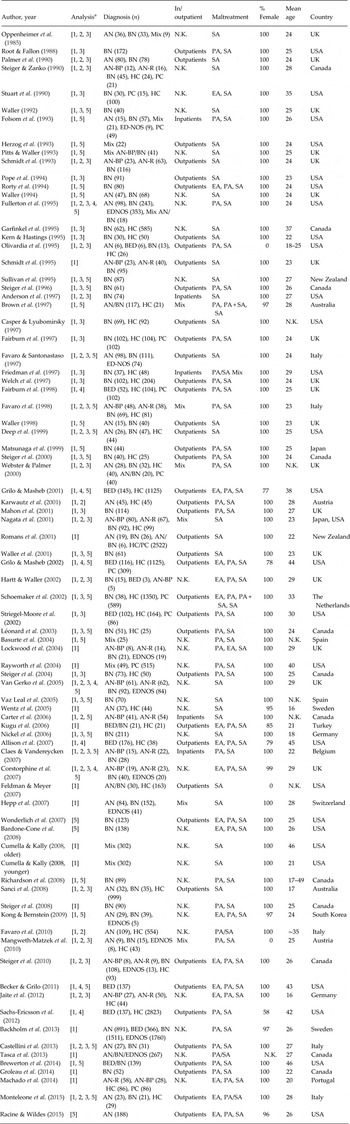
The electronic searches yielded 3938 publications after duplicates were removed and 22 additional records through backward searches and reference lists. Of these, 3878 were excluded leaving a number of 82 studies that reported on at least one effect size that met our inclusion criteria. Study selection, from search to inclusion, is presented in the flowchart in Supplementary Fig. S1. Table 1 and Supplementary Table S3 list the papers that were included for analyses and provide information on the general characteristics of them. Full references to the included papers also are presented in the Supplementary reference list (pp. 14–18).
Basic characteristics of the included studies

AN, Anorexia nervosa; AN-BP, anorexia nervosa binge-purge subtype, AN-R, anorexia nervosa restrictive subtype; BED; binge-eating disorder, BN, bulimia nervosa; EA, emotional abuse (including emotional abuse and neglect and psychological abuse); HC, healthy controls; N.K. not known, PA, physical abuse; PC, psychiatric controls; SA, sexual abuse.
a This column indicates in which meta-analysis the study in the corresponding row is included:
[1] Childhood maltreatment (CM) exposure in patients with an ED.
[2] CM exposure in patients with AN v. that in HCs.
[3] CM exposure in patients with BN v. that in HCs.
[4] CM exposure in patients with BED/EDNOS v. that in HCs.
[5] CM exposure and characteristics of EDs such as age at onset or psychiatric co-morbidity (for more information we refer to the Method section of the main text).
Prevalence rates of CM in EDs and healthy and psychiatric reference samples
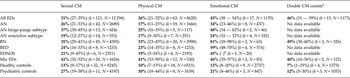
Table 2 provides the prevalence rates (in percentage and 95% CIs) of self-reported CM exposure (by type) for all the EDs [total number of estimates (k) = 214, N = 13 059 unique individuals], for healthy and psychiatric reference samples (k = 50, N = 15 092 and k = 26, N = 7736, respectively). In general, prevalence rates of all types of CM appeared to be two- to fourfold higher in ED samples as HC samples. However, in patients with AN of the restrictive subtype the prevalence rates of reported CM exposure were less pronounced (see Table 2) and for some ED subtypes there was overlap in 95% CIs when compared to HCs (e.g. in the case of sexual, physical, and emotional maltreatment in samples of patients with AN of the restrictive subtype). Prevalence rates of emotional CM and exposure to >1 type of CM was at least twofold higher in ED samples as compared to those reported in PC samples. ED samples did not differ significantly from PC samples regarding the prevalence of physical and sexual CM.
Prevalence (in bold) of Child maltreatment (CM) exposure (by type) and estimated 95% CI and diagnostic status (by type)

AN, Anorexia nervosa; BN, bulimia nervosa; BED, binge-eating disorder; ED, Eeating disorder; EDNOS, eating disorder not otherwise specified.
a Double maltreatment counts entails exposure to >1 type of CM (regardless of the exact CM type).
b No confidence interval could be calculated because only one estimate was available.
The number of studies and individuals given here in this table are not ‘unique’. Individuals may appear in various cells (e.g. subjects on which data is presented in an ‘emotional CM cell’ may also appear in a ‘sexual CM cell’. N’s thus do not add up to the unique N, just as the number of effect sizes does not add up to the number of studies.
CM in EDs v. healthy reference samples: direct comparisons
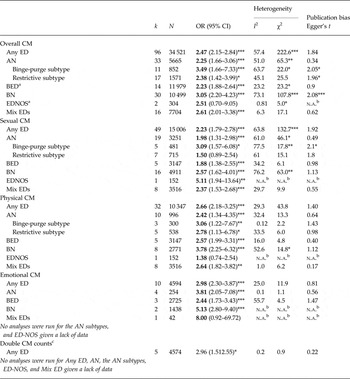
The data presented in Table 2 are derived from studies that reported CM prevalence rates in ED samples only, excluding the possibility for between-group comparisons. In a next step, we excluded studies that lacked a reference group and ran meta-analyses on the difference in prevalence rates of CM in ED samples v. healthy reference groups. Analyses were run stratified by type of CM and type of ED. From the data it appeared that in ED samples (any type), a history of CM (any type) is much more often reported compared to HC reference groups (ORs in most cases >2). In some specific instances there were no significant differences in CM exposure between ED and HC samples (e.g. in sexual, and physical maltreatment in samples of patients with AN of the restrictive subtype and ED-NOS, respectively). However, in all these instances that were based on a limited number of studies, the effect-size pointed in the direction of higher reported CM in ED samples. Table 3 provides an overview of the results of these analyses together with data on between-study heterogeneity and publication bias. Forest plots, by type of ED, are provided in Supplementary Figs S2–S5. For most pooled effect-size estimates there was little evidence for between-study heterogeneity or publication bias (see Table 3).
Child maltreatment (CM) exposure (overall and by type) and the odds (in bold) on ED (by type) v. healthy controls by type

AN, Anorexia nervosa; BN, bulimia nervosa; BED, binge-eating disorder; ED, eating disorder; EDNOS, eating disorder not otherwise specified; n.a., not available; OR, odds ratio; CI, confidence interval.
a Although BED was subsumed in the EDNOS category in DSM-IV we decided to report data separately for these illnesses where possible because EDNOS is not necessarily BED.
b This could not be calculated because only 1 or 2 estimates were available.
c Double maltreatment counts entails exposure to >1 type of CM (regardless of the exact CM type).
*Statistically significant at p < 0.05; **statistically significant at p < 0.01; ***statistically significant at p < 0.001.
CM in EDs v. psychiatric reference samples: direct comparisons
Direct comparisons of CM prevalence rates in ED samples (N = 1809) v. psychiatric reference samples (k = 36, N = 13 186; composed mostly of depressed and substance-dependent persons) showed that a history of CM was more often reported in the EDs as relative to other psychiatric illnesses (OR 1.31, 95% CI 1.08–1.58, p < 0.001). There were no marked differences for type of CM or for type of ED. A forest plot is provided (Supplementary Fig. S6) by type of ED. There was evidence for between-study heterogeneity in outcome (I 2 = 55.7, χ2 = 76.8, p < 0.001) and publication bias (Egger's t = 3.22, p < 0.01). When we accounted for publication bias by means of trim-and-fill estimates, the difference in CM exposure was no longer significant.
Association between psychiatric co-morbidity and CM severity within ED patients
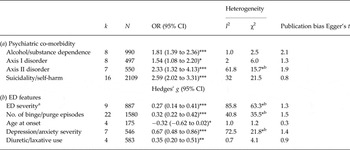
Within ED patients we assessed whether CM exposure was associated with the presence of psychiatric co-morbidity and suicidal/self-harm behavior. We found CM to be associated with a statistically significant increase in the odds on psychiatric co-morbidity and suicidal/self-harm behavior. Results by type of co-morbidity are provided in Table 4a and in the Supplementary material as a forest plot by type of ED (Supplementary Fig. S7). These associations were not due to a particular CM or ED type although statistical power to show differences may have been too low due to a relatively limited number of studies (range k = 7–16, range N = 497–2109). We did not detect evidence for between-study heterogeneity (p = 0.38), but publication bias was observed (Egger's t = 2.4, p = 0.02). Effect-size estimates were not markedly different after we applied trim-and-fill estimates (data not shown).
Child maltreatment exposure, co-morbidity (part a), and eating disorder (ED) characteristics (part b) in ED patients

OR, Odds ratio; CI, confidence interval.
a ED severity was measured eight times with the EAT (Mintz & O'Halloran, Reference Mintz and O'halloran2000), four times with the EDE (Luce & Crowther, 1999); three times with the EDI (Wear & Pratz, Reference Wear and Pratz1987) and one time with the BITE (Henderson & Freeman, Reference Henderson and Freeman1987).
b In case there was between-study heterogeneity in outcomes, we tested whether this could be explained by the pooling together of several related but distinct constructs (e.g. different Axis II disorders or different questionnaires to measure ED severity with). Heterogeneity in outcomes, however, were in all cases independent of pooling constructs.
Association between ED psychopathology and CM exposure within ED patients
We aggregated the reported associations between CM exposure and (i) severity of ED pathology measured on continuous scales such as the EAT, (ii) frequency of binge-purge episodes per week/month, (iii) age at ED onset, (iv) continuous scores on depression/anxiety severity within patients with an ED, and (v) the use of diuretics and laxatives. In general CM exposure was associated with higher severity of ED pathology, a larger number of binge/purge episodes, an earlier age at ED onset, higher symptom level of depression/anxiety, and a higher frequency of use of diuretics and laxatives (see Table 4b and forest plots; Supplementary Figs S8 and S9). In line with the idea that a history of CM is related with a more severe ED pathology was that prevalence rates of CM were in general higher in inpatients as compared to outpatients (prevalence rates of 0.45 v. 0.29 respectively, p for the difference <0.01).
Association between psychiatric co-morbidity and severity measures of CM exposure within ED patients
Forty-one effect-size estimates (N = 4683) used a continuous CM exposure measure (e.g. the sum score on the childhood trauma questionnaire) to predict general psychopathology (e.g. depression severity) and ED severity features (e.g. EAT score) within ED patients. Pooling these estimates showed that the severity of CM was positively correlated with continuous indices for depression and anxiety (weighted Pearson's r = 0.27, 95% CI 0.10–0.53, k = 19, N = 2197) but not with ED severity features (r = 0.26, 95% CI −0.11 to 0.67, k = 13, N = 1067).
Given the limited amount of studies, we were not able to formally test whether the above-reported dose-response associations were particularly due to one type of CM or ED.
Predictors of CM prevalence rates and between-study heterogeneity in outcomes
By means of meta-regression analyses we identified sources of between-study heterogeneity in prevalence rates of CM. We found that a small part of the heterogeneity could be explained by (1) the methodological quality of a study; studies of higher quality reported somewhat lower prevalence rates (R 2 = 0.05, p < 0.01); (2) sample size; studies that used a larger sample size reported somewhat lower prevalence rates (R 2 = 0.07, p < 0.01), (3) a lower age threshold for maltreatment to count as CM; studies that applied a lower age threshold (e.g. 16 v. 18 years age) reported somewhat lower prevalence rates (R 2 = 0.03, p < 0.01), and (4) year of publication; studies that were published more recently also yielded somewhat lower prevalence rates (R 2 = 0.04, p < 0.01). Besides, prevalence rates of CM were in general somewhat lower when they were acquired by means of an interview v. self-report questionnaire (prevalence rates of CM of 0.28 v. 0.34 respectively, p < 0.05). Mean age of the sample at assessment, gender distribution of a particular study, and whether the data was gathered in a Western v. a non-Western culture were not related to between-study heterogeneity in prevalence rates.
There were no statistically significant associations between the pre-specified moderators and between-study variation in OR estimates on the association between CM in ED samples v. HC and PC reference samples.
Discussion
The purpose of this study was to provide a quantitative overview of studies that report on the association between CM exposure (including type and severity) and a lifetime diagnosis of an ED (including type and severity parameters). Eighty-two studies, reporting on 13 059 individuals with an ED, 15 092 HC and 7736 PC subjects were pooled. This pool of data, the largest of its kind to date, indicated that reported CM, regardless of type (emotional, physical, or sexual), was strongly associated with the presence of all types of EDs. Overall, the lifetime prevalence rates of CM ranged from 1–35% in HCs, 5–46% in PCs, and 21–59% in individuals with any ED. The difference in prevalence rates of CM between patients with an ED and HCs is largely in line with the findings of previous meta-analyses (Rind et al. Reference Rind, Tromovitch and Bauserman1998; Smolak & Murnen, Reference Smolak and Murnen2002; Chen et al. Reference Chen, Murad, Paras, Colbenson, Sattler, Goranson, Elamin, Seime, Shinozaki, Prokop and Zirakzadeh2010; Caslini et al. Reference Caslini, Bartoli, Crocamo, Dakanalis, Clerici and Carrà2016). Some discrepancies were found when considering the specific types of CM. Caslini et al. (Reference Caslini, Bartoli, Crocamo, Dakanalis, Clerici and Carrà2016) for instance did not find a significant difference with respect to the prevalence of emotional CM among ED patients v. HCs whereas we do. The reason for this discrepancy probably is statistical power; we report on 10 studies that assessed this effect and Caslini et al. (Reference Caslini, Bartoli, Crocamo, Dakanalis, Clerici and Carrà2016) reported on six. Besides, their estimated point estimate on the association between emotional CM and EDs (OR range 2.13–4.15) lies within the CI that we estimate on this association (i.e. 2.05–7.08). In addition, we found that the associations between CM and ED were particularly strong for BN, BED and for AN of the binge-purge subtype, whereas this seemed to be less the case for AN of the restrictive subtype. This is in line with the finding that ED patients with CM reported more binging and purging. Our findings that ED patients reporting CM had an earlier age at ED onset, suffered a more severe form of the illness, and binge-purged more often as compared to their non-maltreated counterparts is new. Also new is the finding that individuals with an ED reporting CM were more likely to be diagnosed with a co-morbid psychiatric disorder and to be suicidal relative to ED patients who did not report exposure to CM is new. The finding of higher psychiatric co-morbidity in CM exposed patients with EDs is remarkable because this kind of co-morbidity tends to be the rule rather than the exception in individuals with EDs (Ulfvebrand et al. Reference Ulfvebrand, Birgegård, Norring, Högdahl and Hausswolff-Juhlin2015; Keski-Rahkonen & Mustelin, Reference Keski-Rahkonen and Mustelin2016). The fact that both CM exposed and non-exposed groups allegedly have similar co-morbidities makes a potential difference between the two less likely to be detected.
We found some evidence suggesting higher prevalence rates of CM in patients with an ED compared to PCs. This finding, however, did not remain statistically significant when we corrected for the likely presence of publication bias. So, the difference in CM exposure between patients with an ED as compared to PCs may reflect the effect of some small-scale studies reporting overly large effect-size estimates (and hence are more likely to get published). In general, these new findings should be considered with some caution because with each further breakdown of variables (i.e. subtypes of eating disorder, trauma type, or severity measure) analyses were run on smaller number of studies, and results become less reliable (Cochrane Community Handbook, 2016).
The consistency of our findings across most types of EDs and forms of maltreatment (see the forest plots), the strength and dose-response nature of the association, and the likely temporal precedence suggests a causal link of CM exposure on ED pathology. Nevertheless, in the absence of longitudinal and experimental data we cannot proof this here (Hill, Reference Hill1965). Furthermore, a large part of between-study heterogeneity in outcome could not be explained.
The mechanisms that may underlie the observed associations remain elusive. Moreover, the current meta-analytical approach cannot shed much light on the underlying processes. Yet, the outcomes do underline the importance of further elucidating the processes linking CM and EDs, with a particular focus on the associations with binging and purging behavior in the context of the enhanced negative affect (i.e. depression, suicidality and anxiety) and co-morbidity in EDs patients with reported CM. Clinically, it is important to elucidate whether similar or specific processes are at stake in patients with a history of CM compared to patients who do not report this (i.e. maladaptive emotion regulation styles (i.e. distorted cognitive schemas of self and body dissatisfaction, and dissociation), and whether this is further dependent on the type of CM a patient has been exposed to. Body dissatisfaction and dissociation may, for example, be specifically at stake in patients with histories of sexual CM (Dunkley et al. Reference Dunkley, Masheb and Grilo2010; Muehlenkamp et al. Reference Muehlenkamp, Claes, Smits, Peat and Vandereycken2011; Duarte et al. Reference Duarte, Ferreira and Pint-Gouveia2016; Preti et al. Reference Preti, Incani, Camboni, Petretto and Masala2016), while emotion dysregulation in general may be a process that is particularly prominent in individuals with a history of emotional CM (Michopoulos et al. Reference Michopoulos, Powers, Moore, Villarreal, Ressler and Bradley2015; Moulton et al. Reference Moulton, Newman, Power, Swanson and Day2015; Racine & Wildes, Reference Racine and Wildes2015). In addition, research on dysregulations in stress-sensitive neurobiological systems, including the HPA-axis and serotonin and dopamine systems is also needed to further elucidate the key neurobiological processes underlying the link between CM and EDs (Kaye et al. Reference Kaye, Wierenga, Bailer, Simmons and Bischoff-Grethe2013a , Reference Kaye, Wierenga, Bailer, Simmons, Wagner and Bischoff-Grethe b ; Nemeroff, Reference Nemeroff2016).
Strengths and limitations
In addition to the use of meta-analytic techniques, this study has as strength that it is based on large sample sizes of diagnosed ED subjects and controls and the identification of the type and severity of CM. In addition, unlike previous meta-analyses, rates of CM were also examined in a non-ED psychiatric comparison groups and dose-response associations were assessed at the predictor and outcome level.
A limitation of our work is that prospective studies were not available and mediators of the associations of interest could not be assessed by means of meta-analysis. Moreover, counting as limitation is that we were not able to model the effect of CM exposure on ED course (e.g. duration of illness). A factor that might limit the generalizability of our findings is that most studies solely included women. Hence our results may not generalize to men with EDs. Furthermore, our findings may not generalize to the child and adolescent ED population.
Clinical implications
Our results may have clinical implications. CM exposure obviously conveys important information on who is at risk for developing ED although between-study and between-subject variability in risk-estimates exist. Public health efforts will do well by prioritizing a reduction of CM prevalence and as such decrease the burden caused by the EDs (Fairburn & Harrison, Reference Fairburn and Harrison2003; Arcelus et al. Reference Arcelus, Mitchell, Wales and Nielsen2011; Mischoulon et al. Reference Mischoulon, Eddy, Keshaviah, Dinescu, Ross, Kass, Franko and Herzog2011; Mitchell et al. Reference Mitchell, Mazzeo, Schlesinger, Brewerton and Smith2012; Smink et al. Reference Smink, Van Hoeken and Hoek2013; Yao et al. 2016) by depression (Nanni et al. Reference Nanni, Uher and Danese2012), substance abuse, suicide, and anxiety (Norman et al. Reference Norman, Byambaa, De, Butchart, Scott and Vos2012; Mason et al. 2014; Yao et al. 2016). Moreover, the importance of CM exposure should also be addressed in the clinical setting. As shown above, reported CM is indicative of a more severe clinical profile. Moreover, one study that we know of accounted for the impact of CM on ED treatment outcome and found that ED patients exposed to CM improve less as compared to those who were not exposed (Vrabel et al. Reference Vrabel, Hoffart, Rø, Martinsen and Rosenvinge2010; Norman et al. Reference Norman, Byambaa, De, Butchart, Scott and Vos2012), a phenomenon that is well-documented in the treatment of depression (Nanni et al. Reference Nanni, Uher and Danese2012). Standard assessment of CM exposure and additional treatment interventions for those reporting CM, such as enhancing emotion regulation strategies and/or focused trauma treatment may increase the rather low treatment responses in ED patients.
Conclusions
We performed the most comprehensive meta-analysis of the association between CM exposure and EDs to date. We found that CM, regardless of whether it is emotional, sexual and/or physical in nature, was strongly associated with the presence of all types EDs and severity parameters that characterize these illnesses, often in a dose dependent manner. Notwithstanding strong and consistent associations, unexplained between-study heterogeneity in outcomes remained for most of the associations that we observed. This implies between-study and probably between-subject variability in risk estimates that need to be explained in future work on this important topic.
Supplementary material
The supplementary material for this article can be found at https://doi.org/10.1017/S0033291716003561.
Acknowledgements
This work is supported by Leiden University, The Netherlands (Molendijk). The funder had no role in the design and conduct of the study, the interpretation of the data, approval of the manuscript, and the decision to submit the manuscript for publication. We thank Majorie van Seggelen, Marit Oosterom, and Vera Kempen for their assistance with data collection.
Declaration of Interest
None.