Under successive administrations of the Democratic Party of Japan (DPJ) in 2009–12, Japan remained largely on the sidelines of the Trans-Pacific Strategic Economic Partnership (TPP) negotiations, a regional free trade agreement (FTA) encompassing a growing list of Asia-Pacific states such as the United States, Chile, Singapore, Vietnam, Malaysia and Australia. The TPP has been dubbed a ‘21st century trade agreement’ by US trade officials and as the ‘opening up of Japan in the 21st century’ by former prime minister Kan Naoto. To its detractors, the TPP represents an ‘extreme’ FTA because it aims to abolish all import tariffs within ten years. Its ‘ambitious and wide-ranging agenda’ also covers regulatory and other non-tariff barriers to trade in goods and services in areas such as foreign investment, government procurement, intellectual property and so on.
Japan's absence from the formal TPP negotiations in 2010–12 was largely attributable to the government's inability to make a political decision to commit to the talks in the face of fierce domestic resistance. Some of the strongest opposition came from domestic agricultural producers and their supporters in the Japanese Diet, including politicians in the ruling party.
The questions addressed here are how the prospects for agricultural trade reform in Japan were influenced by changes in the institutional structure of trade policy-making and how these changes worked first to promote and then to reduce the possibility of agricultural trade liberalization. The DPJ implemented a major structural reform of the policy-making process in 2009, followed by a series of incremental reversals in 2010–11. The initial changes excluded the parliamentary arm of the ruling party from policy-making, which facilitated centralized government decision-making on trade policy and blocked the transmission of pressures from protectionist forces directly into the policy-making process. However, as this institutional reform was wound back in stages, pro-agriculture backbenchers once more asserted their voice and influence in the trade policy-making process. As a result, the potential for a breakthrough on agricultural trade liberalization substantially diminished. ‘Bringing the party back in’ was a major factor in preventing Japan from joining the TPP negotiations, despite the strong pro-TPP sentiments of DPJ prime ministers, key ministers and ruling party executives.
The influence of institutional structures on trade policy outcomes in Japan is already well established. Divided government (executives versus backbenchers, a vertically segmented policy-making system, inter-ministerial conflict and poor inter-ministerial coordination) has been shown to limit the possibilities for Japan to accede to international trade agreements (Choi and Sejin Oh, Reference Choi and Oh2011; George Mulgan, Reference George Mulgan2008; Yoshimatsu, Reference Yoshimatsu, Pangestu and Song2007). The comparative political economy literature shows that a reduction in the major institutional divisions within government can facilitate the domestic ratification of trade agreements (Mansfield et al., Reference Mansfield, Milner and Rosendorff2000; Milner, Reference Milner1997; Milner and Rosendorff, Reference Milner and Rosendorff1997). Conversely, as the number of veto players increases, the less likely states are to enter preferential trade agreements (Mansfield and Milner, Reference Mansfield and Milner2010). The nature and role of lawmakers can also be important. Where individual legislators enjoy a greater degree of policy autonomy, executive–legislative bargaining over trade policy is more complex, costly and unpredictable than in political systems subjecting lawmakers to a greater degree of party discipline, where the likelihood of successful, executive-initiated trade reform is greater (Kingstone, Reference Kingstone1999).Footnote 1 The degree of independence enjoyed by the executive may also have a determining influence on trade policy outcomes. An autonomous executive free of party and legislative oversight has greater leeway in crafting trade reforms (Thacker, Reference Thacker2000).
This paper examines how structural changes in Japanese policy-making processes initially encouraged then increasingly held back Japan's progress towards freer trade in agriculture. It shows how decentralizing the policy-making process and creating autonomous party policy-making structures helped to shape trade policy outcomes. By providing party backbenchers with an institutional context in which to operate legitimately, government executives constrained their own policy-making capacities by empowering partisan veto players.
The study is in three main parts. The first part reviews the initial changes to policy-making institutions consequent upon the DPJ's accession to power in 2009. It discusses how the administration of Prime Minister Hatoyama reformed the existing power relationship between the prime minister-led cabinet executive and the ruling party. It assesses how these institutional reforms potentially facilitated the exercise of greater executive leadership on policy matters, including on trade, and specifically how they provided the prime minister and cabinet with a greater ability to initiate and impose reforms impacting on vested interests, including those in the agricultural sector. In particular, it examines the degree to which the new DPJ government challenged informal policy-making conventions such as ‘prior examination and approval’ (jizen shinsa ・ shōnin), which bestowed veto power on ruling party bodies and gave rise to so-called ‘tribe Diet members’ (zoku giin) who wielded influence in specific ministerial domains (Miura, Reference Miura2012; Krauss and Pekkanen, Reference Krauss and Pekkanen2011; Tatebayashi, Reference Tatebayashi2004; Schoppa, Reference Schoppa1991; Inoguchi and Iwai, Reference Inoguchi and Iwai1987). The paper investigates the implications of these changes for agricultural ‘tribe’ politicians (nōrin zoku), who had traditionally acted as a ‘veto point’ in agricultural trade policy-making in previous Liberal Democratic Party (LDP) administrations (George Mulgan, Reference George Mulgan2006, Reference George Mulgan, Inoguchi and Jain2011).
The second part tracks the process whereby the party was gradually allowed back into policy-making through a series of institutional adjustments. These began under the Hatoyama administration but were advanced more dramatically by the administrations of prime ministers Kan and Noda. The paper analyses the step-by-step process whereby the initial Hatoyama reforms were reversed and examines the nature of the newly reconstituted party policy units. It identifies their powers and functions, both formally designated and informally appropriated, which effectively permitted the party once more to exert direct influence over trade policy outcomes.
The third part uses process tracing methodologyFootnote 2 to examine how DPJ backbenchers in the party's policy apparatus influenced a sequence of key TPP policy decisions and hence how ‘bringing the party back in’ undermined prospects for Japanese agricultural trade liberalization. The empirical data support the key argument of the paper that pro-agriculture backbenchers in the DPJ directly influenced the government's stance on the TPP issue.
The DPJ's initial policy-making reforms
When the DPJ came to power in September 2009, it embarked on a major structural reform of Japan's system of government. Its fundamental objective was ‘to restore decision-making power to the prime minister and cabinet’ (Funabashi, Reference Funabashi2009: 116). It sought to eliminate the principal institutional blockages preventing the government executive from being able to implement its agreed policy programme. It thus set out to reform the structure of government along Westminster lines,Footnote 3 eliminating party intervention in policy-making and dual party–government policy-making.
In Japan, the ruling party's policy infrastructure had traditionally been a fully fledged element of the policy-making process. The party participated in policy-making on an equal footing with the government, producing a dual policy-making structure of government and ruling party (seifu・yotō). All major policy proposals and draft legislation had first to undergo ‘prior examination and approval’ by the LDP's policy-making machinery, the Policy Affairs Research Council, or PARC (Seimu Chōsakai), and within the PARC by its divisions, committees and subcommittees, in which LDP politicians, segregated into informal policy tribes, represented special interests. Effectively this meant that the ruling party had a veto over government policies and worked to modify them in the light of collective party and individual backbenchers’ political and electoral interests. The existence of an extensive party policy-making apparatus and the powers that it informally appropriated over the long years of LDP rule enabled backbenchers to play a disproportionately large role in the making of government legislation, budgets and policies, acting like a parallel government. The party limited the power of the government executive, which, as a result, often failed to get its major policy initiatives enacted.
The DPJ's 2009 policy manifesto pledged to shift ‘from a two-track system in which policy-making proceeds in parallel in government and in the ruling party, to a unitary system of Cabinet-centered policy-making’ (Democratic Party of Japan, 2009: 4). The DPJ excluded any potential for the party to act autonomously in policy-making by abolishing its Policy Research Council, or PRC (Seisaku Chōsakai, or Seichōkai). DPJ Secretary-General Ozawa Ichirō saw the destruction of the PRC as necessary to eliminate the party as a separate policy-making institution, since this undermined the principle of cabinet centralism. He inserted into the DPJ's 2009 manifesto a proposal to install a hundred or more Diet members from the DPJ into the ministries and agencies as ministers, senior vice-ministers, parliamentary secretaries and ministerial assistants. This would enable individual backbenchers to exercise policy influence through their inclusion in the government, thus strengthening the policy-making capacities of ministers and bypassing backbenchers in the ruling party. Under this set-up, there was no party policy-making mechanism and DPJ backbenchers could only participate in policy-making through the ministries.
With the abolition of the PRC and unification of the ruling party and cabinet, the policy research functions of the ruling party as well as its informal powers of ‘prior examination and approval’ were extinguished. The abolition of the PRC also removed the locus in which zoku giin could wield power. In particular, it eliminated the potential for nōrin zoku, who had previously dominated the agriculture-related committees of the LDP's PARC, to develop within the DPJ. Policy decisions would henceforth be made by the cabinet without the party imposing its veto power (Takayasu, Reference Takayasu2009).
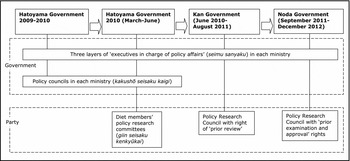
When the administration of Prime Minister Hatoyama (with Ozawa as DPJ secretary-general) was formed in September 2009, it immediately put in place a system whereby each ministry was allocated a team consisting of three layers of ‘executives in charge of policy affairs’ (seimu sanyaku) consisting of the minister, senior vice-ministers and parliamentary secretaries, who would play a central role in policy-making, policy coordination and decision-making (see Figure 1).
Principal changes in policy-related institutional structures under the DPJ government

Replacing the PRC were ‘policy councils in each ministry’ (kakushō seisaku kaigi), which comprised senior vice-ministers and parliamentary secretaries as well as ruling party members from the Upper and Lower House standing committees corresponding to each ministry (see Figure 1). Other DPJ members of the Diet could also participate. During council sessions, the government would explain its policy plans while members could exchange opinions and make policy proposals. However, the councils had no policy-making power (Ishikawa, Reference Ishikawa2009). They provided non-cabinet parliamentary members of the ruling party with a venue in which to develop their policy skills and understanding in lieu of the normal training ground in the PRC, but importantly, within the ministries, not in the party. The councils were the only way in which DPJ politicians could become involved in the policy process (Ishikawa, Reference Ishikawa2009). As Secretary-General Ozawa explained in a directive to backbenchers shortly after the DPJ came to power, ‘Policy decisions relating to general administration will be made by the government whilst listening to everyone's opinions in the ministry policy councils . . . This [system] is only natural considering the essence of the parliamentary cabinet system’ (Minshutō, 2009).
With the party effectively silenced as a fully fledged actor on the policy stage, the new system potentially paved the way for the Hatoyama administration to implement the trade policy initiatives enunciated in the DPJ's policy manifesto for the 2009 election: playing a pro-active role in liberalizing trade and investment, promoting free trade agreements with other Asia-Pacific countries, and in particular, promoting negotiations for the conclusion of an FTA with the United States (Sugawara, Reference Sugawara2010).
In the early months after its inauguration, the administration announced a series of pro-trade positions and initiatives. It agreed to work closely with the United States on resuscitating the stalled World Trade Organization trade talks, as well as starting vigorous discussions to promote economic partnership agreements (EPAs) aimed at liberalizing trade with other major countries and regions.Footnote 4 In October 2009, Foreign Minister Okada Katsuya proposed the establishment of a ministerial committee consisting of the Minister of Foreign Affairs, the Minister of Economy, Trade and Industry, the Minister of Agriculture, Forestry and Fisheries, and the Minister of Finance to look into ways to promote EPAs. The committee met in November and December and discussed how to advance the government's trade policy goals by exercising political leadership. The Hatoyama administration then announced a ‘new development strategy’, which contained a commitment to establishing a Free Trade Area of the Asia Pacific (FTAAP) with a view to abolishing all barriers to economic relations between countries. In February 2010, Prime Minister Hatoyama announced that his government would ‘push ahead with its policy on international negotiations, including FTAs’ (Japan Press Weekly, 5 April 2010). In April 2010, bilateral negotiations with Australia on an FTA were resumed. The Hatoyama government's stance on promoting agricultural trade liberalization was so committed that the Japan Communist Party accused it being ‘enthusiastic about creating trade rules to promote the further liberalization of agricultural imports’ (Japan Press Weekly, 5 April 2010).
Reversing institutional reform
A majority of DPJ backbenchers found the new policy-making set-up unsatisfactory and pressed strongly for a revival of the PRC. Prime Minister Hatoyama and Secretary-General Ozawa met at DPJ headquarters in March 2010 and agreed to establish Diet members’ policy research committees (giin seisaku kenkyūkai) where DPJ members of the Diet could discuss government-sponsored bills and other matters (47 News, 8 March 2010) (see Figure 1). Hatoyama and Ozawa aimed to use the new bodies to ease the frustration in the party that members ‘could not get involved in policy decisions’ (Yomiuri Online, 9 March 2010). Hatoyama said, ‘I want to have a system that reflects the party members’ wish to be actively involved in policies. This is a step towards achieving that’ (Yomiuri Online, 9 March 2010). However, he emphasized, ‘If we leave the PRC in the party, which is separate from the government, we will return to the dual-structured (LDP) administration of the past. We must not repeat that’ (Yomiuri Online, 9 March 2010). The plan was for the policy research committees to gather opinions from experts and requests from relevant organizations in relation to the drafting of policies and allow Diet members to express their opinions to the government.
Diet members’ policy research committees were then formed for each Diet standing committee and were chaired by the chief director of the standing committee. All party members were able to attend meetings, which could also examine private members’ bills. DPJ executives confirmed that ‘decision-making authority was still to be held by ministers, senior vice-ministers and parliamentary secretaries, and that the research committees would not possess ‘“prior examination functions” for bills in order to maintain the “centralization [of policy decisions] in the Cabinet”’ (Yomiuri Online, 9 March 2010). Nevertheless, while the new committees were not authorized to undertake ‘prior examination’ or ‘prior approval’, they were certainly positioned as an institutional setting for DPJ members of the Diet to scrutinize proposed government policies and legislation, enabling their views – as members of the party rather than as members of the government – to be reflected in these policies and bills. Opinions that arose in the committees would serve as a reference for government decision-making on policies and legislation (Nittere News 24, 8 March 2010). In this respect, although they had limited policy-making powers, the committees facilitated backbencher input into government decision-making in lieu of the PRC, and therefore represented an adjustment in the balance of power between the government and party in policy-making. The Hatoyama government had ‘virtually revised its policy of “centralizing policy decisions in the cabinet”’ (47 News, 8 March 2010).
The Agriculture, Forestry and Fisheries (AFF) Diet Members’ Policy Research Committee (Nōrinsuisan Giin Seisaku Kenkyūkai) was one of the most active committees, scrutinizing government legislation and other major policies. Its 18 subcommittees (study groups, or benkyōkai) held as many as four or five meetings a day. One of these subcommittees was the Project Screening Subcommittee looking at potential spending cuts in the agricultural, forestry and fisheries sector, and another was the Individual Farm Household Income Compensation Subcommittee. The directors of the Diet AFF Standing Committees acted as the main members of the AFF Policy Research Committee, crafting policies, having ‘core member meetings’ with the parliamentary secretaries of the Ministry of Agriculture, Forestry and Fisheries (MAFF) and strengthening cooperation between the government and party.Footnote 5
The Kan government went even further than the Hatoyama administration in formally committing to the re-establishment of the DPJ's Policy Research Council in June 2010 (see Figure 1). Immediately on becoming prime minister, Kan Naoto decided on the need for a PRC, partly to prevent Ozawa from unilaterally asserting power over government policies as he had done during the Hatoyama administration, but also because of the continuing discontent in the ranks of DPJ backbenchers at the lack of their own policy organization. The recreation of the DPJ's PRC moved the primary locus of backbencher participation in policy-making out of the ministries and assisting the minister back into the party.
Initially the Kan government envisaged a limited role for the PRC, formally restricting it to gathering opinions (J-cast News, 12 September 2011). Its function was to ‘gather the “people's voices” regarding policies and, drawing on the wisdom of Diet members, make proposals to the government’ (Minshutō, 2010a). As a further constraint, the party's opinion in the policy-making process would be reflected in the membership of the PRC chairman in the cabinet, which he joined as Minister of State for National Policy (J-cast News, 12 September 2011). Party opinion would, therefore, be channelled through a minister, theoretically preserving the power of the cabinet executive over the party. As the new PRC chairman, Genba Kōichirō, explained, ‘It will not be a revival of the same old policy research body. We're going to create a new policy panel under the government-led centralized system . . . I will serve as coordinator between the government and the DPJ’ (Nihon Keizai Shinbun, 8 June 2010). Under this system, the government would take responsibility for policy decisions (Minshutō, 2010a). Genba offered an assurance that ‘centralizing the policy process in the government and having the PRC, where individual Diet members can freely work on policy activities, open discussions take place, and knowledge on mid- to long-term themes can be accumulated, are mutually compatible’ (Press Minshu, 16 August 2010).
The PRC's primary working units were divisional councils (bumon kaigi) corresponding to the standing committees of the Diet (and therefore the ministries). Their main function was to act as fora for policy discussions. They replaced the policy councils in each ministry and the party's policy research committees (Minshutō, 2010a). The meetings of the divisional councils were managed by joint discussion chairmen (zachō), one representing the party side and a senior vice-minister representing the government side, which partially subjected them to government influence. The work of the councils was to ‘receive explanations on bills scheduled for submission to the Diet and policies that were planned as well as other administrative information from the government’ (Minshutō, 2010a). According to official DPJ documents, the councils ‘would strive to form a consensus based on exchanges of opinions between the party and ministers, senior vice-ministers and parliamentary secretaries’ (Minshutō, 2010a).
In addition to the divisional councils, other working units of the PRC included investigation committees (chōsakai) set up to deal with permanent as well as mid- to long-term policy issues. Project teams (PTs) dealt with policy themes that cut across divisional councils, such as the Project Team for Examining How to Deal with APEC (Asia-Pacific Economic Cooperation), EPAs and FTAs (APEC・EPA・FTA Taiō Kentō PT), which examined the option of Japan joining the TPP talks, along with how its trade relations should be advanced through the formation of the FTAAP and EPAs. Working teams (WTs) were formed within the divisional councils to work on specific policy issues, such as the working team to examine the direct income compensation system for farm households set up by the AFF Divisional Council. The WTs, which were also jointly chaired by the party and government sides, replaced the subcommittees of the policy research committees (Kajiwara, Reference Kajiwara2010).
The PRC's lack of ‘prior approval’ rights over policy meant that none of the PRC's working units could act as veto points in the policy-making process. However, even the formally restricted powers and functions of the new committees enabled the party to exert influence on government decision-making. The divisional councils, for example, exercised de facto power of review over government legislation and policies, given their assigned role to ‘receive explanations on bills scheduled for submission to the Diet and planned policies as well as other administrative information from the government’ (Minshutō, 2010a). Indeed, it quickly became unclear whether the PRC would keep to its designated functions of ‘gathering opinions and making proposals to government’. The chairman of the AFF Divisional Council stated emphatically, ‘I do not intend to limit our actions simply to making proposals. If the government does something strange we will stop them’ (Jiji Press, 25 July 2010). Another said, ‘All party members can participate in the PRC's discussions. If the government opposes what we say, they will not be able to pass a single bill’ (Jiji Press, 25 July 2010). Of particular note was the fact that the AFF Divisional Council and the Land, Infrastructure, Transport and Tourism Divisional Council, both areas of pork-barrel spending, carefully examined their corresponding ministry's budget requests for fiscal 2011 (Jiji Press, 25 July 2010). Some divisional council members started behaving like zoku giin – developing close relationships with bureaucrats and industry organizations, and working to increase the budget for their area of interest (Jiji Press, 25 July 2010). These developments gave rise to concern that the PRC would once again become a hotbed of zoku giin, which would lead to a bloating of the budget and, depending on the PRC's actions, work against the prime minister (Jiji Press, 25 July 2010).
New PRC Chairman Genba, looking back on his role as the newly constituted PRC's first chairman, said,
I made every effort to allow as many Diet members as possible to be involved in policy debates, and made sure they could convey the opinions they heard in their hometowns to the government. Most people have said that it is much better than when we did not have the PRC. I think that we were able to achieve some results. However, since we have not adopted the prior approval system like the LDP where the government cannot make a decision unless the party or PRC gives approval, we have had complaints that the PRC did not hear about bills submitted by the government and that the work done by the working teams ended up as mere proposals made by the PRC Chairman. (Minshutō, 2011a)
Despite these apparent shortcomings, the Noda administration went even further in strengthening the PRC and completing the shift from centralized cabinet decision-making to dual party–government policy-making. Most critically, it formally restored to the party both conventions of ‘prior examination and approval’. The PRC was given the power to review all important policies and legislation in advance and to give prior approval in principle (see Figure 1).Footnote 6
Newly appointed DPJ PRC chairman, Maehara Seiji, who was the prime mover behind the shift in policy power back to the party, announced on 13 September 2011 how the new policy-making system would work. He talked about the expanded role of the PRC and how DPJ backbenchers could participate in government policy-making. In his view, ‘Although the PRC chairman will undertake “prior approval”, ultimately the government and the ruling party will together have responsibility’ (Mainichi Shinbun, 2011). He added that the new policy-making system aimed for careful discussions in which everybody participated:
Under the Noda administration the functions of the DPJ's Policy Research Council have been strengthened and in principle the Policy Research Council has become an organ that gives prior approval. All party members can offer their opinions on the government's [policy] plans, and [the Policy Research Council] can put these opinions together and propose them to the government. Furthermore, the Policy Research Council can now also propose policies that are not included in the government's plans. (Minshutō, 2011e)
To those critics who argued that the DPJ's new PRC system would be similar to the LDP's prior approval system, Maehara explained:
the final decision will be made in the ‘government–DPJ three executives’ meeting’ that Prime Minister Noda, Chief Cabinet Secretary Fujimura, Secretary-General Koshiishi, Acting Secretary-General Tarutoko, Diet Affairs Committee Chairman Hirano and myself will attend. The new structure guarantees our system where the government and ruling party together take on the final responsibility for policy-making. (Minshutō, 2011e)
The system of joint chairmen was continued for the PRC's divisional councils etc., with one senior vice-minister or parliamentary secretary from the government side and one PRC vice-chairman (a Diet standing committee director) from the party side (Minshutō, 2011d).Footnote 7 In this way, the government remained inserted into the leadership ranks of key units in the party's policy-making apparatus, thus retaining a modicum of centralized government control.
Maehara addressed the concern that party members would turn into zoku giin, reaffirming that only the PRC chairman had the authority to give prior approval, so that even if the zoku giin ran rampant in the divisional councils, if he judged that their opinions were too biased towards industries’ opinions, he would make a different decision (Minshutō, 2011e). The reality was, however, that regardless of Maehara's assurances, the revival of the PRC potentially allowed zoku to redevelop. In fact, both the Kan and Noda administrations provided a key institutional precondition for the existence of zoku, namely a formal policy setting in which individual Diet members could specialize in representing specific interests and influence policies impacting on those interests. Like the LDP's nōrin zoku, a number of DPJ farm politicians assumed leadership roles in the PRC.
The upshot of the additional institutional adjustments was that ‘coordination’ (namely ‘agreement’) within the party and ‘coordination’ between government and the party became necessary steps in the policy-making process. Furthermore, the very existence of the PRC and its policy committees allowed opposition to mobilize from within the party to the government's policy initiatives, delaying the process of decision-making and giving the impression not only of policy stasis but also of the emergence of an ‘opposition party within the party’ (tōnai yatō).
It also became possible for informal policy groups to establish themselves around particular issues and to participate as discrete lobbies in the formal deliberations of PRC committees. On the TPP, a large cohort of DPJ members of the Diet (around 100) belonged to an informal anti-TPP lobby called the ‘group to think cautiously about the TPP’ (TPP o shinchō ni kangaeru kai), informally known as the ‘cautious faction’ (shinchōha), which was chaired by the former MAFF minister in Kan's first cabinet, Yamada Masahiko. Yamada also served as an executive of the Economic Partnership Project Team (Keizai Renkei PT) set up by the Noda government to examine the TPP issue. Gunji Akira, a Diet member directly representing the agricultural cooperative organization (JA) and MAFF Minister in Noda's third cabinet, was former vice-chairman of the ‘group to think cautiously about the TPP’, which wielded influence both inside and outside the PRC's project teams charged with examining the TPP issue. Most ‘cautious’ members of the project teams also attended the ‘group to think cautiously about the TPP’ (Nōsei Undō Jyānaru, 2011a).
The effect of the additional changes to the policy-making process under the Noda government was further to undermine the earlier structural reforms of the policy-making system and bring back direct intervention by the ruling party, thus resuscitating the bifurcated or dual policy-making structure of ‘government and ruling party’ (seifu・yotō) policy-making. The new system was ‘as close it could get’ to what had prevailed under the LDP administration (J-cast News, 12 September 2011). At a minimum, the reconstituted party policy groupings exerted ‘delaying’ power and, given high levels of internal party dissent on some issues, blocked the formation of a party–government consensus. Even PRC Chairman Maehara acknowledged that with the participation of the party, the policy-making process would become slower (Minshutō, 2011d).
Giving voice and influence to the party on trade policy
Tracing the process of how TPP decision-making was handled by the Kan and Noda governments shows that at key junctures the PRC project teams put the brakes on prime ministerial trade initiatives. Prime Minister Kan set the ball rolling with a major policy speech on 1 October 2010, declaring that the government would consider participating in the TPP negotiations. On his instructions, the Project Team for Examining How to Deal with APEC, EPAs and FTAs was established. It conducted a thorough examination of the issue, holding many discussions among members on the basis of opinions given by organizations representing agriculture and fisheries, consumers, labour, medical services and economic circles, as well as opinions given by specialists in hearings (Keizai Renkei PT, 2011). The vice-chairman of JA-Zenchū, the peak organization of agricultural cooperatives, told the committee: ‘We want you to shelve participating in the TPP. If you do decide to participate in the TPP, there will be people who will commit suicide’ (NHK News 7, 21 October 2010). The managing director of JF Zengyōren, the national federation of fisheries cooperatives, asked, ‘is the national interest greater than the sacrifices made by farmers, foresters and fishers? There's a need for a thorough discussion that involves the whole nation’ (NHK News 7, 21 October 2010). A meeting of PT executives took the decision to add more executives, mainly from the ‘cautious faction’.
The PT is laying claim to the fact that they represent the party (i.e. the DPJ) in making their proposal to government regarding the promotion of economic partnerships. As Miura observes,
voices asking for consideration to be given to domestic agriculture strengthened every time the PT met, which led to the PT's proposal having to show consideration to such opinions . . . The first draft of the PT's proposal suggested ‘[starting] prior consultations for participation . . .’, but this was changed to ‘conduct consultations to gather information and judge whether or not to participate in the negotiations’. The premise of advocating TPP participation crumbled at this point. (2012: 245)
Deputy PRC Chairman Jōjima Kōriki recounted: ‘We held 16 meetings in which wide-ranging and heated debates took place.’ He then explained,
Just like the problem we had in the past regarding rice in the GATT Uruguay Round in 1986, both supporting and opposing members gave their thoughts to the formation of Japan's shape in the future and had heated debates, although it was only for a short period of time. It is highly significant that the party was able to put together a proposal amidst this debate.
He then reported that after the PT put together the proposal, he submitted it to the Minister of State for National Strategy, Genba Kōichirō, and the government was now going to deal with the issue. (Minshutō, 2010b)
PT Chairman Yamaguchi Tsuyoshi presented the key points of the PT's proposal, which advocated that the government adopt a three-stage process: ‘(1) Consultations for gathering information should be held, after which the judgement on whether or not to participate should be made; (2) Full-scale negotiations to decide conditions for participating should be held; and then (3) The agreement is to be ratified in the Diet’ (Minshutō, 2010b). He added that ‘the government is going to respect the proposal and to consult on their plans for economic partnerships’ (Minshutō, 2010b). The proposal also ‘cited concerns about the sweeping impact on existing protection of domestic industries. The TPP would “not only hit Japan's agriculture, forestry and fisheries sectors, but also heavily affect nontariff measures”’ (Nikkei Weekly, 8 November 2010). These comments gave voice to the qualms among many DPJ backbenchers ‘about the government jumping into full fledged negotiations toward joining the free trade pact’ (Nikkei Weekly, 8 November 2010).
The government's ‘Basic Policy on Comprehensive Economic Partnerships’ decided by cabinet on 9 November directly reflected the PT's standpoint. It stated: Concerning the Trans-Pacific Partnership (TPP) Agreement . . . it is necessary to act through gathering further information, and Japan, while moving expeditiously to improve domestic environment [sic.], will commence consultations with the TPP member countries [emph. added] (Ministerial Committee on Comprehensive Economic Partnerships, 6 November 2010).
The content of the statement was significant insofar as it almost matched the PT's proposal word for word and stopped ‘short of declaring Japan's intention to participate in the TPP negotiations’ (Asahi.com, 8 November 2010), thus postponing the actual decision on participation (Miura, Reference Miura2012). It captured the sentiments and caution of the PT's position. As Miura notes, ‘The PT was established for the purpose of announcing Japan's participation in the TPP before the APEC meeting was held, but instead it became a stage to assert cautious and opposing opinions and the PT was unable to fulfil its original function’ (2012: 245). It meant that at the APEC summit meeting in Yokohama on 13–14 November, for which the basic policy was developed, the prime minister was unable to make a formal commitment to join the TPP negotiations, restricting the government merely to beginning ‘“consultations” with other nations on joining the trade pact’ (Hayashi, Reference Hayashi2010). The DPJ had sanctioned only a partial step towards participating in the TPP trade talks. Securing the agreement of the party had suddenly been formalized as a required step for government policy initiatives to proceed further. Even PRC Chairman Genba, in reviewing his role a year later, admitted that ‘as PRC Chairman, we conducted thorough debates on the promotion of high-level economic partnerships and put together a proposal as a party . . . We could say that, in reality, we adopted the prior approval system’ (Minshutō, 2011a) (see Figure 1).
Prime Minister Noda continued the pro-TPP policy of his predecessor. He promised President Obama at a summit meeting held on 22 September 2011 that Japan would make a decision as soon as possible on joining the TPP. On the same day, newly appointed PRC Chairman Maehara announced the creation of the Economic Partnership Project Team (Economic Partnership PT). As its chairman, Hachiro Yoshio, explained, ‘it was decided that examination [of economic partnerships] should be restarted in the face of the APEC meeting that was scheduled to be held from 12 November’ (Minshutō, 2011b).
The Economic Partnership PT was established on 4 October. It served two main political purposes. First, it was set up to avoid ‘differences in opinion surfacing in the cabinet’ because of the presence of MAFF Minister Kano Michihiko, who was cautious about the TPP (Nōsei Undō Jyānaru, 2011b). Secondly, and more importantly, it was designed as a mechanism for building a consensus within the party, particularly among backbenchers, in favour of Japan's joining the TPP negotiations prior to the prime minister's departure for the APEC summit meeting in Hawaii on 12–13 November. At the G-20 summit in France in early November, Noda told the press, ‘I want to determine my stance after the party reaches a consensus through discussion’ (Nōsei Undō Jyānaru, 2011b). He later acknowledged in the Diet, ‘we are currently trying to reach a consensus in the party’ (NHK News 7, 8 November 2011). He remained adamant about attaching importance to party discussions (Sankei Shimbun, 5 November 2011).
In reality, the Economic Partnership PT became the centre of political conflict within the DPJ on the Noda administration's trade policy, preventing the government executive from exercising leadership on the issue. TPP opponents used the PT's activities to try and block the prime minister's TPP initiative and as a means to expand political opposition to the TPP within the party and more broadly across affected groups and the national electorate. In fact, the PT became the ‘main battlefield’ of the debate regarding the question of whether or not Japan should participate in the negotiations (Nōsei Undō Jyānaru, 2011a). Its debate on the TPP ‘became the most watched party debate’ (Nōsei Undō Jyānaru, 2011a).
The PT held its first meeting on 14 October with about 70 DPJ members of the Diet attending. It discussed a detailed 78-page government report on the pros and cons of Japan's joining the TPP. The basic stance of the report towards the TPP was positive, finding that Japan would benefit in 18 out of the 21 areas being discussed by potential members, with agriculture being a notable exception. Despite the government's explanations in favour of joining, TPP opponents resisted its arguments. They were the most vocal among backbenchers attending the meeting. The strongest opposition was expressed to the likely impact of trade liberalization on agriculture because of the influence on farmers’ votes. There were also complaints that ‘the government's case is biased’ (Uetake and Sueyoshi, Reference Uetake and Sueyoshi2011). Those members and executives who supported the TPP were generally quiet, one explaining, ‘If we don't allow those DPJ members suspicious of the TPP to let off steam, the party may collapse’ (Uetake and Sueyoshi, Reference Uetake and Sueyoshi2011). PRC Chairman Maehara declared that he would put all his effort into persuading the ‘cautious faction’, saying, ‘I hope we can align ourselves and hold discussions on how the party should formulate policies in line with Prime Minister Noda's intention. Making a final decision after reaching a conclusion is the responsibility of politics’ (Yomiuri Shinbun, 28 October 2011, p. 4).
The PT finished hearings from organizations opposed to the TPP on 25 October. It then held a plenary meeting with about 400 lawmakers in attendance. Despite Chairman Hachiro's intention to present a draft final report to the meeting and then deliver it to PRC Chairman Maehara on 4 November after obtaining the agreement of the PT, the ‘cautious faction’ led the discussions in the PT contrary to expectations. One objection highlighted the ‘ill effects’ of the TPP not only on agriculture but also on sectors such as medical services, insurance and postal services (Nōsei Undō Jyānaru, 2011b). As Miura observes, ‘This structure was such that JA-Zenchū used various means to assert opposition to the TPP, which were then introduced into the political stage by agricultural protection advocates in the PT’ (2012: 247).
Other activities included submitting to the Prime Minister's Office a petition opposing Japan's participation in the TPP signed by more than 200 DPJ members (Nōsei Undō Jyānaru, 2011b). In the light of these developments, Chairman Hachiro and other PT members decided to continue to debate the issue until 4 November, delaying the presentation of a draft summary of PT views. Supporters and opponents of the TPP clashed fiercely at the plenary session on 2 November.
On 8 November, the PT executive drafted a recommendation on the TPP. In the face of strong opposition from DPJ backbenchers in the PT's 22 general meetings, the proposal did not endorse participation by the government in the talks, effectively leaving the final decision in Noda's hands. It called on the government to continue gathering information and stressed the need for a national debate, stating explicitly that many PT members were against participation in the TPP negotiations.
The general meeting of the PT held the following day endorsed the recommendation. One of the cautious Diet members said, ‘there are many cautious opinions so the prime minister can't possibly announce his intention to participate’ (NHK News 7, 9 November 2011). Noda was planning to make a political judgement which took the party's proposal into consideration. He told the media, ‘we need to come up with a definite conclusion once the discussion has matured’ (NHK News 7, 9 November 2011).
The PRC's executive committee in a meeting on 10 November approved the final ‘Economic Partnership PT proposal – in preparation for APEC’ compiled by the PT (Minshutō, 2011c). Chairman Hachiro described its contents: ‘The government should give sufficient consideration to the fact that many [PT members] commented that making an announcement on participating in the TPP negotiations at the APEC meeting would be “premature or should not be done” and make a judgement with caution’ (Minshutō, 2011b). One TPP opponent observed that ‘there is nothing in the document about joining the talks and the wording is also acceptable to the TPP opponents’ (Asahi Shinbun, 9 November 2011, p. 4).
In total, 23 PT Diet member-level general meetings and 12 executive meetings had been held, amounting to more than 50 hours of discussions. More than 500 people had spoken at the 23 meetings, many of them expressing opposition to Japan joining the TPP, outstripping the advocates in the PT's debates, which made it difficult to build a consensus in the party in favour of participation (Asahi Shinbun, 9 November 2011). The PT's failure to adopt a clear stance on whether Japan should join the talks was attributed directly to ‘strong pressure from opponents on the team’ (Nikkei.com, 9 November 2011). Noda's hope of proceeding with the endorsement of his own party was thus crushed, leaving him with the reality of insufficient domestic party backing for his trade policy initiative. Although his ‘aides stressed that “the cabinet is in charge of policy” and that he is making the right decision, one cabinet minister lamented that “although Prime Minister Noda can decide to join the talks, he will have very weak backing”’ (Asahi Shinbun, 9 November 2011, p. 4).
Immediately on receiving the PT's recommendation, the prime minister put off the declaration of his TPP policy, which he had scheduled for the evening of 10 November, just prior to his departure for APEC (Nōsei Undō Jyānaru, 2011b). He explained, ‘I want to receive the party's proposal seriously . . . so I'd like to think over the matter for another day’ (NHK News 7, 10 November 2011). He reportedly took into account what the proposal had said about there being ‘many opponents and the government should make a decision cautiously’ (Tsusaka, Reference Tsusaka2012: 4).
On 11 November, Noda held a government–DPJ leadership meeting and discussed how to respond to the PT's proposal. The meeting decided that, given the opposition to the TPP in the party, rather than immediately expressing an intention to participate, they would announce that they would commence deliberations with related countries towards participating in the negotiations. Effectively the prime minister had added another step to the process of joining the TPP negotiations, stating:
I have decided to enter into consultations toward participating in the TPP negotiations with the countries concerned, on the occasion of the Asia-Pacific Economic Cooperation (APEC) Economic Leaders' Meeting in Honolulu, Hawaii which I will be attending from tomorrow. To be sure, I am fully aware that while the TPP offers significant benefits, numerous concerns have also been spelled out. (Prime Minister of Japan and His Cabinet, 2011)
In reality, his statement was little more than a reiteration of the status quo. In JA's view, ‘The project team can be said to have accomplished a certain mission at this point’ (Nōsei Undō Jyānaru, 2011a).
In January 2012, after the Noda administration had initiated preliminary consultations with the nine TPP countries, the PT held a meeting in which there was a chorus of complaints about the government's lack of effort to obtain a domestic consensus (Asahi Shimbun, 8 March 2012). Later, at a debate hosted by JA in Tokyo, the PT's deputy chairman, Sakurai Mitsuru, who was also deputy chairman of the PRC, declared, ‘The party is yet to make a judgement on whether or not to participate in the negotiation. We are strongly urging the government not to make any comments that go beyond that framework’ (Nōsei Undō Jyānaru, 2012b).
On 22 March, the government revealed to a PT meeting the state of progress in discussions on the 21 areas that were at the centre of TPP negotiations, noting that talks on tariff elimination, which were of concern to Japan given the importance of rice, had fallen behind schedule. However, Noda was planning to convey to Obama Japan's intention to join the TPP negotiations during his trip to the United States for another summit meeting in late April. This was part of a schedule in which, with the consent of the US Congress, Japan would be allowed to participate in the TPP talks at the APEC summit in September. The PT was due to unify the opinions of its members before the end of April in spite of anticipated difficulties after Deputy Chairman Sakurai and others who had held talks in early April with senior officials of the Office of the US Trade Representative in Washington had returned to Japan (Nihon Keizai Shinbun, 12 April 2012).
Noda's plan to announce Japan's participation in the TPP negotiations crumbled, however, because of the continuing failure to build a consensus inside the DPJ. At a PT executive meeting on 19 April, proponents and opponents of the TPP clashed fiercely (Maruyama and Ogura, Reference Maruyama and Ogura2012). Sakurai reported to the meeting the contents of his conversation with Assistant Secretary of State Kurt Campbell, who had said that Japan's announcement of its participation in the TPP was ‘the main focus of interest at the [Noda–Obama] summit meeting’ (Maruyama and Ogura, Reference Maruyama and Ogura2012: 6). This provoked a strong reaction from TPP opponents, who declared, ‘We have not reached a consensus in the party. No announcement should be made’ (Maruyama and Ogura, Reference Maruyama and Ogura2012: 6). Another said, ‘I don't want to see the government enter into negotiations with the countries concerned while discussions are ongoing in the party’ (Tsusaka, Reference Tsusaka2012: 4). Given that ‘domestic coordination’ could not make real progress, Noda put off making a formal announcement on Japan's participation in the TPP at the summit meeting with Obama.
Moreover, there were diametrically opposing views between PRC Chairman Maehara and TPP opponents in the party about the party's role and powers in reaching a decision on the TPP. Maehara indicated that the party's consent was unnecessary, saying, ‘Even if a consensus is reached in the party, that will not bind the government’ (Tsusaka, Reference Tsusaka2012: 4). In the view of the internal party opposition, however, ‘This is different from pre-negotiations; the government must obtain the party's consent before announcing its decision to participate [in TPP talks]’ (Tsusaka, Reference Tsusaka2012: 4).
The G-20 scheduled for 18–19 June then emerged as the next opportunity for Prime Minister Noda to make an announcement on Japan's participation in the TPP negotiations. In the end, this option was also rejected in the light of the continuing, deep-seated opposition in the DPJ. The PT held a plenary meeting on 17 May with about 50 DPJ members in attendance. When the chairperson tried to summarize the advantages of taking part in the negotiations, a number of participants voiced opposition and so the consolidation of views was put off until the 18th. Nevertheless, opinions of party members remained still diverged widely (Nihon Keizai Shinbun, 18 May 2012). Prospects for a resolution appeared to be poor in light of the relentless war of words in the PT over the advantages and disadvantages of economic partnerships such as the TPP. The June deadline for the PT to build a consensus came and went with no agreement emerging.
Yet other opportunities for a government announcement on the TPP were the September APEC meeting in Vladivostok, or a speech at the United Nations General Assembly. In order to head off these possibilities, the anti-TPP members of the Diet redoubled their efforts in the PT. At a meeting on 5 July, one opponent after another expressed their opposition. When Noda was asked what he intended to do about the issue of Japan's entry into the TPP talks, he declared that he had ‘no intention of recklessly making a decision and rushing ahead’ (Nihon Keizai Shimbun, 25 July 2012, p. 4).
In early August, the government's decision on the TPP was indefinitely postponed. JA declared that ‘it is widely believed that Prime Minister Noda will not make any decisive announcements since the debates held by the DPJ's Project Team . . . are nowhere near reaching a conclusion' (Nōsei Undō Jyānaru, 2012a). In September, PT Deputy Chairman Sakurai put together points of concern and the party's opinion regarding participation in the TPP negotiations and submitted the report to the government. The section on the party's opinion included references to the adverse effects of the TPP on agriculture, and outlined a clear policy for dealing with the issue. Based on the report and on the PT's proposal submitted in November 2011, the PT asked the government to judge whether or not to participate in the negotiations cautiously, which represented no change in its position. The report also said that careful analysis of the impact of the TPP, and examining agricultural policies and possibilities for obtaining the necessary funding sources ‘are the premises for judging whether or not to participate in the TPP negotiations’ (Nōsei Undō Jyānaru, 2012c). One pro-agriculture PT member claimed: ‘The debate within the party . . . that has been going on for two years finally bore fruit’ (Nōsei Undō Jyānaru, 2012c).
Conclusion
This paper has explored changes to the institutional structure of trade policy-making implemented by a succession of DPJ governments. Institutional reform initially freed the government executive from the constraints of pro-protectionist backbenchers, potentially paving the way for the Hatoyama government to pursue a range of free trade initiatives. However, the Kan and Noda governments wound back the process of institutional reform, with the Noda administration going even further than its predecessor. While the Kan administration brought back some elements of the old LDP system of ‘prior examination’ and de facto ‘prior approval’ through its newly reconstituted PRC, the Noda administration fully restored these powers to the party. The changes to the institutions of policy-making thus created a venue in which DPJ members of the Diet representing special interests could influence trade policy directly, creating the spectre of a zoku giin revival.
The practical reality of policy-making under both the Kan and Noda administrations was that the old LDP system of veto power by the ruling party over government policy was effectively resuscitated. At key points in the policy-making process on the TPP, the PTs clearly prevented prime ministers Kan and Noda from announcing that Japan would participate in the talks. The PTs had a real impact on a sequence of TPP trade policy decisions, practically scripting government policy at crucial junctures. Securing party agreement became a necessary condition for proceeding further.
Both the Kan and Noda governments thus empowered pro-agriculture politicians within the party opposed to their trade policy, severely constraining their leadership on trade issues, including prime ministerial ambitions for Japan to join the TPP negotiations. Using empirical data, the paper traces the impact of the reconstituted party policy apparatus on a sequence of TPP trade policy decisions, illustrating the effective ability of the party to block a major trade policy initiative by the government executive. ‘Bringing the party back in’ substantially diminished prospects for agricultural trade liberalization under the TPP. It restored a system of divided government where ruling party backbenchers confronted the government executive, constraining their policy-making power. The longer-term significance of this development was the regression of the DPJ to the LDP-driven norm of agricultural trade policy-making.
Institutional factors therefore remain an important part of the explanation for Japan's continuing high levels of agricultural protection and the political obstacles that it faces in acceding to international free trade agreements. The Kan and Noda governments recreated an institutional structure with a key veto point, limiting their trade policy choices. Allowing partisan veto players an institutional context in which to operate legitimately can, therefore, severely circumscribe the policy-making capacities of government executives.
About the author
Aurelia George Mulgan is Professor of Japanese politics at the University of New South Wales, Australian Defence Force Academy. She is the author of The Politics of Agriculture in Japan (2000), Japan's Failed Revolution: Koizumi and the Politics of Economic Reform (2002), Japan's Interventionist State: MAFF and the Agricultural Policy Regime (2005), Japan's Agricultural Policy Regime (2006) and Power and Pork: A Japanese Political Life (2006). Her articles have appeared in journals such as Japanese Journal of Political Science, Foreign Affairs, World Policy Journal, The Washington Quarterly, Government and Opposition, Political Studies, Australian Journal of Political Science, The Pacific Review, Asian Survey, Pacific Affairs, Journal of Japanese Studies, Asia-Pacific Review, Journal of Northeast Asian Studies, and Australian Journal of International Affairs. In 2001 she was awarded an Ohira Memorial Prize and in 2010 the Toshiba Prize.