Introduction
Although a recent uptick of potentially toxic exposures (anti-riot gear, weapons of mass destruction) to health care workers, few have routine experience in dealing with these agents. Reference Ekzayez, Flecknoe, Lillywhite, Patel, Papamichail and Elbahtimy1 Hazardous material (HAZMAT) protocols require health care providers to wear personal protective equipment (PPE) when caring for potentially contaminated patients, yet many providers still question whether or not to delay resuscitative efforts. Reference Watson, Barnett and Thompson2 While the importance of donning PPE is clear in principle, in the heat of resuscitation, it is not always so apparent. Providers have already proven to be cavalier about their own safety, often unwilling to don PPE during influenza outbreaks due to an amalgamation of factors such as the cumbersome nature and availability of PPE, and perception of risk to their own health. 3 These fears are confirmed by studies which have shown that intensive care medical procedures, such as endotracheal intubation (ETI), nasogastric tube placement, and central venous catheter insertion, are found to be more complicated, stressful, and less comfortable while wearing higher forms of PPE. Reference Grillet, Marjanovic, Diverrez, Tattevin, Tadie and L’Her4 The confluence of these fears is perhaps greatest during chemical events and exposures when emergency physicians must don PPE prior to resuscitating contaminated patients.
Previous studies have evaluated the time to tracheal intubation in and out of HAZMAT PPE. Flaishon, et al Reference Flaishon, Sotman, Ben-Abraham, Rudick, Varssano and Weinbroum5 and Scott, et al Reference Scott Taylor, Pitzer, Goldman, Czysz, Simunich and Ashurst6 have demonstrated that HAZMAT PPE hindered both first-pass success rate and time to successful intubation in Anesthesia residents Reference Flaishon, Sotman, Ben-Abraham, Rudick, Varssano and Weinbroum5 and amongst emergency medical technicians (EMTs) and Emergency Medicine (EM) residents. Reference Scott Taylor, Pitzer, Goldman, Czysz, Simunich and Ashurst6 Although sound in execution, these prospective cross-over studies evaluated time to tracheal intubation in varying ranges of providers, but never included both residents and attending physicians from different specialties. The current study evaluated the time to successful tracheal intubation, procedural complications, and perceived ease of use amongst a broad range of providers including Anesthesiology residents, EM residents, and EM attendings in universal precautions (UP), partial level C (PC) anti-chemical HAZMAT PPE, and complete level C (CC) anti-chemical HAZMAT PPE utilizing a standardized intubation mannequin.
Methods
Design and Setting
This randomized, controlled, crossover trial assessed the time to ETI with differing levels of PPE. All participants were to wear each of the three levels of PPE based on a pre-selected order. The study was designed so that each level of PPE was used with the same frequency at each order in rotation. For example, if the three levels of PPE were labeled “A,” “B,” and “C,” then each group would have three providers that intubate in order “A → B → C,” three providers in order “B → C → A,” and three providers in the order “C → A→ B.” The study was exempt by the Institutional Review Board of State University of New York Downstate Medical Center (Brooklyn, New York USA; Institutional Review Board number 1336594-5).
Participants
Participants were made up of volunteers which included 18 senior year US EM residents and attendings and nine US senior year Anesthesiology residents (Table 1). Although all providers are expected to intubate during emergent situations, only the emergency physicians had prior training in HAZMAT PPE.
Study Demographics

Interventions
Each individual performed ETI via direct laryngoscopy (DL) on a high-fidelity simulator (Laerdal SimMan Essential; Stavanger, Sweden) wearing the following levels of PPE: (1) UP control, only nitrile gloves and facemask with shield; (2) CC with rubber gloves (Honeywell North Butyl; Charlotte, North Carolina USA), a passive air-purifying respirator (APR; FR 7800, 3M; Saint Paul, Minnesota USA), and an anti-chemical suit (Tyvek 400, DuPont; Wilmington, Delaware USA); and (3) PC with rubber gloves and an APR. Many systems are looking at using partial PPE for the first stage of immediate HAZMAT incident management, balancing provider protection with expediency. A common combination is a respirator, gloves, and an impermeable single use apron. This combination provides acceptable protection, yet is quick to don (Pinchas Halpern, MD – personal communication).
Outcomes
Successful endotracheal tube (ETT) placement and balloon infusion was determined by visual inspection of the mannequin’s airway. Primary outcome measures were times in seconds (s) to successful intubation where Time 1 (T1) = inflation of the ETT balloon and Time 2 (T2) = first ventilation. Study participants were randomized to PPE type in a round-robin fashion, where each level of PPE was worn the same number of times first, second, or third by different study participants.
Time was recorded using the video recording app on an iPhone SE (Apple Corp.; Cupertino, California USA) so that intubation attempts were time-stamped for review. Successful intubation was confirmed by video laryngoscopy (aView, Ambu; Ballerup, Denmark), as was the complication of the right mainstem and esophageal intubation.
Data Analysis
Data were reported as medians with Interquartile Ranges (IQR, 25%-75%) or percentages with 95% Confidence Intervals (95%, CI). Group comparisons were analyzed by Fisher’s Exact Test or Kruskal-Wallis, as appropriate (alpha = 0.017 [Bonferroni correction of 0.05 for three groups], two-tails). Sample size estimate based upon the power of 80% to detect a difference of 10 seconds (as defined as clinically significant by Lee, et al Reference Lee, Kim, Kang, Kwak, Lee and Lee7 ) between groups at a P = .017, 27 subjects would be needed. IBM SPSS Statistics for Windows was used (Version 22.0, IBM Corp.; Armonk, New York USA).
Results
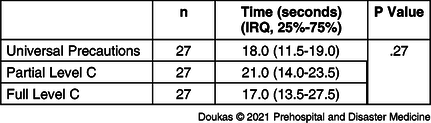
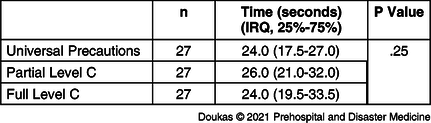
All 27 participants completed the study with success at first-pass intubation of the trachea. At T1, balloon inflation (Table 2a), there was no statistically (P = .27) significant difference among UP 18.0s (11.5s-19.0s), PC PPE 21.0s (14.0s-23.5s), or CC PPE 17.0s (13.5s-27.5s). For T2, first ventilation (Table 2b), there was also no significant (P = .25) differences among UP 24.0s (17.5s-27.0s), PC PPE 26.0s (21.0s-32.0s), or CC PPE 24.0s (19.5s-33.5s). The incidence of right mainstem bronchus intubation was not statistically significantly (P = .27) different among UP 3.7%, PC PPE 18.5%, and CC PPE 11.1%.
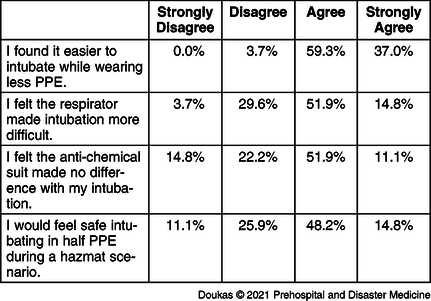
When polled participants at the end of the study, subjectively, 96.3% either Agreed or Strongly Agreed that it was “easier to intubate while wearing less PPE.” Two out of every three participants also felt that the respirator made intubation more difficult. When questioned about the effect of the anti-chemical suit, however, 63.0% of participants felt that it did not make a difference in their ability to intubate (Agree or Strongly Agree). When asked about their perceived safety in a HAZMAT scenario, 63.0% of participants felt favorable about intubating in PC isolation, compared to 37.0% who did not feel it was safe (Table 3; Figure 1).
Time to Balloon Inflation

Time to Ventilation

Post-Intubation Questionnaire Results

Abbreviation: PPE, personal protective equipment.
Post-Intubation Questionnaire.
Abbreviation: PPE, personal protective equipment.

Discussion
This study found no difference in the time to intubation/first ventilation among three levels of PPE. All subjects were successful on their first attempt at intubation, and there was no difference in right mainstem intubation. The majority of participants felt there was no difference with their intubation skills or level of comfort in the respirator and anti-chemical suit; however, all but one person felt it was easier to intubate while wearing less PPE.
The study was designed to build upon the results of prior studies and to eliminate potential confounding factors when evaluating time to intubation. Flaishon, et al Reference Flaishon, Sotman, Ben-Abraham, Rudick, Varssano and Weinbroum5 , comparing CC PPE to routine surgical attire, found no difference in first-pass success rate; but unlike this study, found a statistically significant (P <.01) longer time to ETT intubation (31.0s [SD = 7.0s] versus 54.0s [SD = 24.0s]), respectively. Reference Flaishon, Sotman, Ben-Abraham, Rudick, Varssano and Weinbroum5 The difference between the Flaishon, et al Reference Flaishon, Sotman, Ben-Abraham, Rudick, Varssano and Weinbroum5 study and this study, which found no difference, was likely the result of different models (live patients) and providers (only Anesthesiology residents) compared to this study which used mannequins and a mix of Anesthesiology residents, EM residents, and EM attendings.
Scott, et al Reference Scott Taylor, Pitzer, Goldman, Czysz, Simunich and Ashurst6 evaluated time to ETT intubation with or without CC PPE in a cadaveric model. This study found a statistically significant difference (P = .012) in time to intubation while wearing CC PPE (35.0s) compared to not (22.2s), as well as a statistically significant difference (P ≤.001) in first-pass success rate, with a 96.0% first-pass success rate out of level C PPE and 58.0% while wearing level C PPE. There was a difference in models between Scott, et al Reference Scott Taylor, Pitzer, Goldman, Czysz, Simunich and Ashurst6 (cadavers) and this study (simulation mannequin); however, the ability to perform the procedure on the same model repeatedly should eliminate that as a potential confounding factor. It is more likely that the type of providers used (prehospital EMTs and EM residents) by Scott, et al Reference Scott Taylor, Pitzer, Goldman, Czysz, Simunich and Ashurst6 is responsible for the difference in time to intubation.
While this study and the one done by Flashion, et al Reference Flaishon, Sotman, Ben-Abraham, Rudick, Varssano and Weinbroum5 did not show a statistically significant difference in the first-pass success rate, it is important to note that Scott, et al Reference Scott Taylor, Pitzer, Goldman, Czysz, Simunich and Ashurst6 did find that higher levels of PPE did have instances of lower first-pass success rate. Scott, et al Reference Scott Taylor, Pitzer, Goldman, Czysz, Simunich and Ashurst6 had excluded anesthesiologists, and instead used EM residents and prehospital EMTs, and used several different intubation techniques on cadaveric models. It is unclear if the type and number of years of training are responsible for the difference in the first-pass success rate, but this should be considered whenever a HAZMAT exposure occurs. It is likely best that the most experienced provider should be establishing the airway during such scenarios.
Four studies were found that evaluated time to intubation while wearing HAZMAT gear on mannequins or during the simulation. Weaver, et al Reference Weaver, Barr and Long8 evaluated time to ETI in 37 EM residents, in and out of HAZMAT PPE, using DL, GlideScope (Verathon; Bothell, Washington USA), and laryngeal mask ventilation on Laerdal airway heads. Their results found that time to intubation was 27 seconds longer using DL in HAZMAT PPE than out of it (P = .001). Similarly, Aleksandrowicz and Madziala Reference Aleksandrowicz and Madziala9 evaluated time to intubation through a laryngeal mask airway using 25 paramedics in street clothes versus HAZMAT PPE on Laerdal Airway Management trainers. They found a statistically significant difference in time to intubation, 42.3s versus 51.5s (P = .32), but no statistically significant difference in first-pass success rate. Although similar models were used between this study and the ones by Weaver, et al Reference Weaver, Barr and Long8 and Aleksandrowicz and Madziala, Reference Aleksandrowicz and Madziala9 it is likely the fact that using subjects of varying specialties and attending providers with a greater experience led to the difference in the outcome during this study.
Of the two remaining studies that evaluated time to intubation in HAZMAT PPE using a mannequin, both Garner, et al Reference Garner, Laurence and Lee10 and Castle, et al Reference Castle, Owen, Clark, Hann, Reeces and Gurney11 used a variety of subjects to evaluate time to intubation. Garner, et al Reference Garner, Laurence and Lee10 evaluated the completion of four medical procedures, including ETI, in all levels of HAZMAT PPE from level A to level D. Participants included three paramedics, three emergency physicians, and two anesthesiologists. All participants in Garner, et al’s Reference Garner, Laurence and Lee10 trial performed the tasks in the same order (intubation occurring third), and all participants had been trained to don HAZMAT PPE but never performed any procedures in them. Results from their study found a statistically significant difference in time to task completion, including ETI with higher levels of PPE. However, they found no difference between the time to intubation between level B (anti-chemical suit with positive pressure APR) and level C (anti-chemical suit with negative pressure APR). Although the trial suffers from only having eight subjects, it did find a statistically significant difference in time to intubation between level D, or UP, and higher levels of PPE. It is interesting that once higher levels of PPE were donned, there was little difference in time to ETI, compared to this study between CC and PC PPE. One possible explanation is that it is the rubber gloves that make the greatest difference in time to intubation, and that the other components of HAZMAT PPE have less effect on time to intubation.
Castle, et al Reference Castle, Owen, Clark, Hann, Reeces and Gurney11 performed a trial that was unimpeachable in its design: 64 clinicians, made up of emergency physicians, prehospital resuscitationist, anesthesiologists, and paramedics, performed complex tasks, including laryngeal mask airway insertion, ETI, IO insertion, and IV insertion, in level C PPE. One-half of the subjects had prior experience in HAZMAT PPE while the other-half did not. The order of skills was randomized, and each subject had two attempts to perform the procedure in PPE, one-half of them with an attempt out of PPE first, the other-half of them with an attempt out of PPE after already having completed the task. Castle, et al Reference Castle, Owen, Clark, Hann, Reeces and Gurney11 found a greater time to intubation and lower first-pass success rate in level C PPE.
The study only evaluated time to intubation once PPE was already donned. There is little argument that the amount of time it takes to appropriately don CC PPE does lead to delays in patient care. In 2011, Watson, et al demonstrated that the simple task of donning a gown, gloves, and face shield can delay response time in a pediatric code by up to two minutes. Reference Watson, Duval-Arnould and McCrory12
During this trial, there were several noticeable factors that would limit one’s ability to intubate in HAZMAT PPE. One intubator who suffers from claustrophobia was able to complete the study, but stated they were extremely uncomfortable and would not be able to wear the APR for an extended period of time. Some subjects noticed that their corrective lenses would not fit appropriately within the passive APR. They performed the intubations each time without their corrective lenses, however, this needs to be addressed in HAZMAT protocols. Providers need to be able to either perform tasks successfully without lenses, wear contacts, or have gear that allows for corrective lenses to remain in place, such as a positive pressure APR.
Although this trial did not evaluate the safety of PC PPE, taking into account recently tenuous supplies of PPE during the COVID-19 pandemic, and based on provider responses about their level of comfort in PC PPE (done pre-COVID-19) and the delays inherent to donning HAZMAT PPE, it could be reasonable to incorporate PC PPE into HAZMAT protocols. By keeping the easily donnable APR and durable rubber gloves readily available in airway carts and resuscitation bays, physicians leading the resuscitation of patients with a potential HAZMAT exposure can rapidly improve their level of protection without delaying patient care. During this time, other members of the team can don CC PPE in order to relieve the provider in PC PPE, who can then go and decontaminate prior to returning to the clinical area.
Limitations
Although powered appropriately to determine the statistically significant difference in time to intubation, there was no known accepted rate of ETI, therefore it was not powered appropriately to a difference in complication rate. Also, zero providers performed esophageal intubation, which seemed unlikely; however, it is likely the result of the near-perfect anatomy of the simulation mannequin, as well as provider familiarity with the mannequin.
With 27 total subjects, each person had to intubate three times sequentially, which creates a potential bias where subsequent attempts have lower time to intubation completion as the task becomes learned.
This study did not assess the safety of PC PPE; however, it operated under the assumption that an APR was safer than a full mask and that rubber gloves provided better coverage than nitrile gloves.
Conclusions
There were no statistically significant differences in time to balloon inflation or ventilation with full or partial PPE. Higher levels of PPE do not appear to prolong time to intubation when measured after PPE is already in place on the health care provider. To improve provider safety, it may be prudent to update HAZMAT protocols to have components of higher levels of PPE, such as an APR and rubber gloves, in the clinical setting to resolve the dilemma between donning higher levels of PPE at the expense of more immediate patient care.
Conflicts of interest/funding
This research was done through the Department of Emergency Medicine in cooperation with SUNY Downstate Medical Center and was approved by their institutional review board. The authors have no conflicts of interest to disclose and had no writing assistance.
Author Contributions
All authors on this manuscript have made substantial contributions to either the study design or acquisition of data, have written on the article, have taken part in critical revision, and have approved the version being submitted.