Candida auris (CA) is an emerging multidrug-resistant fungus associated with increased mortality.Reference Vallabhanen, Kallen and Tsay 1 – Reference Satoh, Makimura, Hasumi, Nishiyama, Uchida and Yamaguchi 5 As of July 14, 2017, 89 cases of CA have occurred in 9 states in the United States, and most (n=68) occurred in New York City and the surrounding area. Candida auris forms biofilms, contaminates environmental surfaces, resists disinfection with quaternary ammonium compounds and ultraviolet light, and spreads within healthcare settings.Reference Vallabhanen, Kallen and Tsay 1 , Reference Schelenz, Hagen and Rhodes 6 – Reference Piedrahita, Cadnum, Jencson, Shaikh, Ghannoum and Donskey 9 The environment may play a role in dissemination, but few published data exist to clarify this issue. Further hampering early detection and containment efforts is the fact that the 3 most widely used automated identification and susceptibility testing platforms cannot yet reliably identify CA to the species level nor can mass-spectroscopy platforms that use existing FDA nonresearch databases.Reference Vallabhanen, Kallen and Tsay 1 , Reference Morales-López, Parra-Giraldo and Ceballos-Garzón 3 , Reference Mizusawa, Miller and Green 10 , Reference Clancy and Nguyen 11 Although the genomic epidemiology of CA has been described at the global level, transmission dynamics of CA within individual hospitals remain poorly understood.Reference Lockhart, Etienne and Vallabhaneni 2 , Reference Chowdhary, Voss and Meis 12 When a CA bloodstream infection was confirmed in a patient admitted 6 days previously to a 24-bed oncology ward, and who shared a room with another patient, we sought to limit and determine the extent of CA contamination of the involved ward with the limited amount of immediately available resources and by engaging interagency partners.
METHODS
Setting
Rochester General Hospital (RGH) is a 528-bed teaching hospital in Rochester, New York. It has 20 medical and 20 surgical adult intensive care unit beds, 14 special nursery/neonatal ICU beds, and the tenth busiest emergency department in the United States. The average daily occupancy rate for 2017 was 96%. Furthermore, 42% of the rooms have 2 beds, and 59% of patients are in shared rooms. The average length of stay on the 24-bed oncology ward, where the index case patient was located, is 7 days (range, 2–112 days). The nurse-to-patient ratio on the unit is ~1:6, and 10 of the 24 beds are in private rooms. This hospital uses peracetic acid with hydrogen peroxide (PA-HP), freshly mixed at each cleaning shift, for all routine daily and terminal cleaning and disinfection. In rooms that have housed patients on contact precautions for Clostridium difficile or carbapenem-resistant Enterobacteriaceae, terminal cleaning is supplemented with ultraviolet (UV) light units. The average monthly hand hygiene compliance on the involved ward was 90% for the previous quarter (as measured and independently verified by trained secret observers. The RGH microbiology laboratory began sending all potential CA isolates that could not be definitively identified to the state public health laboratory for identification in June 2016. 13
The Index Case
A 59-year-old female, who recently moved to Rochester after completing chemotherapy for metastatic colon cancer at a hospital in the New York City metropolitan area, was admitted for small bowel obstruction and fever. On hospital day 2 (HD-2), all 4 of her blood cultures became positive with a yeast. On HD-3, it was identified as Candida haemulonii; caspofungin was started, and on HD-7, CA was confirmed. Her preexisting central line was removed and also grew CA, as did several urine cultures throughout her admission. Upon arrival, she had a colostomy bag and spent 24 hours in the emergency department (on the ground floor). During the admission, she was never incontinent of stool but had several episodes of vomiting, productive coughs, and 1 episode of urine incontinence on her room floor and mattress. She became bed-bound, requiring higher levels of care. She went to 1 operating room (on the second floor) for 2.5 hours for venting gastrostomy tube placement, to the interventional radiology suite for nephrostomy tube placement, and to the radiation oncology suite (both on ground floor) for 2 treatments. Her candidemia cleared by day 3 of antifungal therapy, but she remained colonized until her death on HD-21, after receiving 17 days of caspofungin.
Mitigation and Detection Strategy
Timely feedbackReference McGann, Bunin and Snesrud 14 from both referral laboratories and immediate communication between environmental services and infection prevention (Supplemental Figure 1) resulted in the following measures: (1) the index case patient and roommate were immediately placed on enhanced contact precautions and moved to private rooms; (2) their former room was terminally cleaned with PA-HP and UV-C. Nursing staff were briefed on the nature of the pathogen and engaged in the surveillance and mitigation efforts; and (3) a ‘clean sweep’ of the ward was conducted, which involved sequentially moving patients from their existing rooms into vacated rooms that were terminally cleaned with PA-HP and UV-light, until all patients were relocated to freshly terminally cleaned rooms.
A nares swab and a composite axillae-groin swab were taken from the index case patient, her roommate. All 17 other patients concurrently located the oncology ward were taken weekly until negative or discharge. Due to limited resources, patients other than the index case patient, her roommate, and any positive patients could only be sampled once. Ten high-touch environmental surfaces in the new rooms of the index case patient and roommate, and the 2 sinks directly outside those 2 rooms, were sampled between daily cleaning (~4:00–5:00 pm) and immediately before and after daily cleaning (~8:00–9:00 am). Using a ‘ring’ strategy, limited surveillance resources were prioritized to typical high-touch near-patient surfaces and to those in communal areas throughout the ward most likely contaminated, as deemed by unit nurses and supervisors most familiar with daily traffic patterns. These included high-touch surfaces at the nursing stations, refrigerators in break rooms, staff restrooms, entry–exit door handles, copiers, phones, sinks, and mobile computer work stations. These surfaces were sampled between daily cleanings and were resampled 1 month later between daily cleanings.
Sampling Procedure and Specimen Processing
As described previously, 2-cm × 2-cm sponge sticks (3M, Maplewood, MN) and premoistened rayon-tipped swabs (Copan Diagnostics, Murietta, CA) were used for environmental sampling in a standardized fashion.Reference Lesho, Carling and Hosford 15 , Reference Clifford, Sparks and Hosford 16 Samples were immediately plated on selective agar (sabouraud with gentamycin and chloramphenicol) and incubated for 5 days. Identification was performed using a Vitek matrix-assisted laser desorption/ionization time-of-flight mass spectroscopy (MALDI-TOF MS; FDA database), a Bruker MALDI-TOF (RUO database), and sequencing. All samples were initially processed at the RGH laboratory then were sent to 2 referral laboratories for confirmatory testing: the Wadsworth Center NY State Public Health Laboratory and the Department of Defense (DoD) Multidrug-Resistant Organism Repository and Surveillance Network (Silver Spring, MD), who also provided swabs, culture media, mass spectroscopy, and rapid-turnaround whole-genome sequencing.Reference McGann, Bunin and Snesrud 14 , Reference Lesho, Waterman and Chukwuma 17
RESULTS
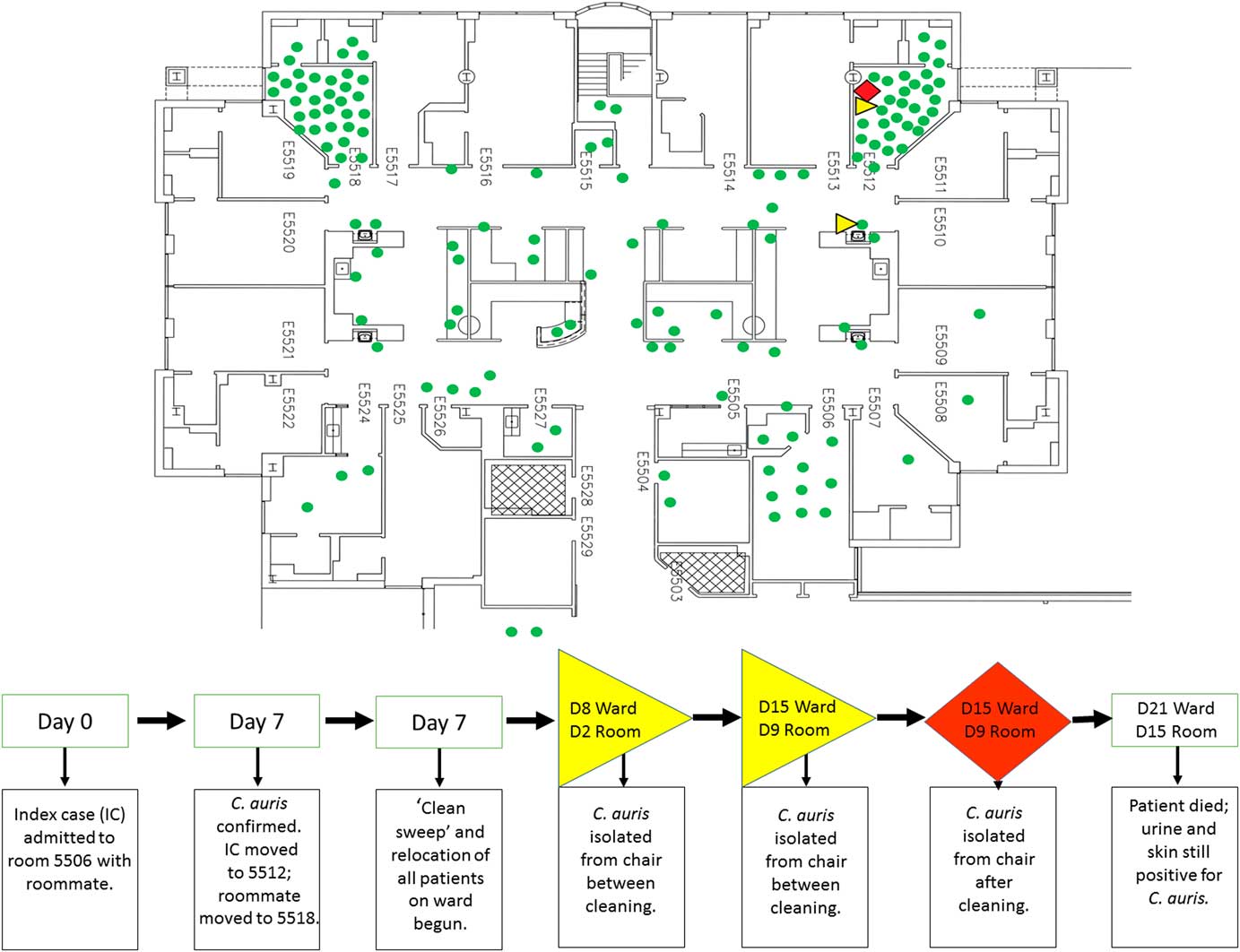
In total, 180 samples (48 from 18 different patients, and 132 from 32 different environmental surfaces) were collected throughout the ward (Figure 1). Candida auris was not isolated in the initial room where the index patient spent the first 6 days on the ward (ie, room 5506). Candida auris was isolated from the reclining chair in the second (or permanent) room (ie, room 5512) of the index patient. This sampling occurred between daily cleanings on day 2 of room occupancy, which was day 8 of ward occupancy. On day 9 of occupancy in room 5512 (the day 15 of ward occupancy), CA was isolated again from the reclining chair immediately after routine daily cleaning, but not immediately before that cleaning. Candida auris was also isolated from 1 surface directly outside room 5512, a sink (handwashing station) between daily cleanings on day 9 of ward occupancy (Figure 1). No CA was isolated from any another surface, including those in the former roommate’s room (ie, room 5518), nor from the roommate or from concurrent ward patients. Each time the infection prevention team received notice from the laboratories that a surface was positive, the environmental services division was immediately notified, and the equipment or surfaces were immediately recleaned (Supplemental Figure 1).
Locations of environmental sampling in the ward during the observation period and the timeline of events. Surfaces sampled with individual swabs/sponge included call box/remote, bed rails, mattress, telephone, sink, toilets, light switch, room chair, over-bed table, door handle, and staff telephones. Surfaces sampled with composite swab/sponge included nurses’ station desk, printer/copier, refrigerator, staff bathroom. Green dot, no CA isolated on surface; yellow dot, CA isolated from surface between daily cleaning; red dot, CA isolated from surface immediately after daily cleaning; day N, day of occupancy of room and ward.

Molecular Characteristics Genomic Epidemiology
In total, 4 isolates were available for sequencing: 1 environmental (the chair), and 3 from the urine and blood of the index patient. All were genetically identical, differing by 4–8 single-nucleotide polymorphisms (SNPs), and all were most closely related to the 2013 Indian CA-6684 strain, differing by ~200 SNPs (Supplemental Figure 2). All RGH isolates acquired the K143R mutation not seen in the CA-6684 strain but found in the Indian 2105 VPCI strain. CA-VPCI differs from the RGH isolates by ~1,000 SNPs. The RGH isolates are separated from the Pakistan B8441 strain by 3,000 SNPs, from the Japan strain B11220 and South Africa strain B11230 by 10,000–20,000 SNPs, and from the Venezuela strain B11247 by >100,000 SPNs (Supplemental Figure 2). The K143R mutation is likely contributing to the high-level fluconazole resistance (minimum inhibitory concentration, >256 µg/mL; provisional breakpoint >32 µg/mL) seen in the RGH isolates.Reference Lockhart, Etienne and Vallabhaneni 2 , Reference Flowers, Colon, Whaley, Schuler and Rogers 18 It is probably not the only factor at play because Candida isolates with a single K143R mutation had fluconazole MICs of 64 µg/mLReference Flowers, Colon, Whaley, Schuler and Rogers 18 and the RGH isolates do not contain the K1434+Y132F double mutation, which has been shown to increase the fluconazole MIC to the >256 µg/mL range seen in the RGH isolates.Reference Flowers, Colon, Whaley, Schuler and Rogers 18
DISCUSSION
Whether cleaning with PA-HP and UV, the high hand hygiene compliance, or support from the Wadsworth Laboratories and the DoD limited the spread of CA could not be determined by this quasi-experimental intervention. Nonetheless, our report is noteworthy for the multifaceted interagency approach taken and for the extensive attempt at environmental assessment. Unlike prior reports, CA was isolated from few surfaces and from no patients other than the index case patient.
An added challenge for investigating within-hospital or local-regional outbreaks is the fact that C. auris has exceptionally low genetic diversity within the major clades (South Asia, South America, South Africa, Japan), making it difficult to establish a relevant cutoff number of SNPs for defining relatedness and determining transmission within facilities and local regions.Reference Lockhart, Etienne and Vallabhaneni 2 Another challenge for intensified or targeted cleaning is that some furniture (eg, the recliner) is shared and moved throughout the ward, for example, out of the rooms where a patient is completely bed-bound and into the room as an occupant’s activity level increases. Here, the reclining chair was sampled 3 times and was positive twice. It could have been that a different recliner was sampled; however, once it was determined that the patient harbored CA, all shared equipment and furniture was restricted to that room. Notably, in a feedback-based study involving an intervention to improve cleaning outcomes, the only surface (of 15 high-touch surfaces sampled) with a statistically significant adverse cleaning outcome (less frequently cleaned thoroughly) was the room chair.Reference Clifford, Sparks and Hosford 16
Although the US Centers for Disease Control and Prevention (CDC) and the Association for Professionals in Infection Control and Epidemiology (APIC) have provided guidance regarding CA, 19 – Reference Tsay, Welsh and Adams 22 we could not locate answers to the following unresolved and recurring issues this case raised. (1) When a patient who had healthcare contact at a hospital where CA has been reported is admitted, should they be placed on preemptive contact precautions until surveillance swabs are negative? (2) When a Candida species such as C. haemulonii that could be later confirmed to be C. auris is isolated from a patient, should the patient be placed on preemptive contact precautions? (3) Should the external ear canals be included, or replace groin/axilla/nares samples in surveillance protocols? In one report, the ear was the most common anatomic location where a novel species (likely CA) was isolated (n=15).Reference Kim, Shin and Sung 23 And (4) should patients with C. auris undergo decolonization efforts with chlorhexidine washes and topical antifungals?
Limitations of this report include the fact that the isolate from the hand-washing station outside the index patient’s room, and isolates from other New York hospitals were not available for whole-genome sequencing, but the sink isolate most likely belongs to the same strain as the chair and index case isolates. All other New York isolates that were sequenced belonged to the South Asian clade,Reference Vallabhanen, Kallen and Tsay 1 , Reference Lockhart, Etienne and Vallabhaneni 2 so the index case isolate most likely also belongs to that clade. Resources did not permit a larger number of environmental surfaces, longer observation period, or the sampling of healthcare workers. However, the number of samples we collected fits the recently coined definition of “deep hospital sampling” (at least 35 samples per hospital).Reference David, Afshar and Mentasti 24 , Reference Beatson and Bartley 25 We could have missed other CA cases, but this is unlikely because a retrospective review of laboratory logs from June 2016 through September 2017 revealed that 3 potential CA specimens (2 unidentifiable non-albicans Candida spp., and 1 Saccharomyces were identified and sent to the Wadsworth laboratory for confirmation. None were identified as CA. Despite these limitations, this report adds insight into this emerging pathogen.
ACKNOWLEDGMENTS
We wish to thank Jillian Karr, MPH, and Gale Liddell, BS, of the New York Department of Public Health, Rochester Region, for assistance with surveillance and laboratory identification. We also thank Lynne Tseng and David Weed, Rochester Regional Health, for assistance with illustrations and graphics and Robert Mayo, MD, Rochester Regional Health, for critical review of the manuscript. The material has been reviewed by the Walter Reed Army Institute of Research. There is no objection to its presentation. The views expressed in this article are those of the authors and do not reflect the official policy of the Department of Army/Navy/Air Force, Department of Defense, or the US Government.
Financial support: No financial support was provided relevant to this article.
Potential conflicts of interest: All authors report no conflicts of interest relevant to this article.
SUPPLEMENTARY MATERIAL
To view supplementary material for this article, please visit https://doi.org/10.1017/ice.2017.231