Introduction
Almost every Taiwanese university has some form of an English Department, some with straightforward names (e.g., Department of English) and some with ambiguous names (e.g., Department of Applied Languages). The so-called ‘Applied Courses’ are in fact English for Specific Purposes (ESP) courses covering a range of Business and Tourism topics. While pursuing my doctorate I taught these courses as an adjunct lecturer in several universities. This experience continuously reaffirmed suspicions that one particular aspect of English language education was being neglected in Taiwanese secondary and tertiary education, that is, how to translate the names of the foods and dishes that make up the culturally laden Taiwanese cuisine.
Teaching a ‘Tour Guide English Practice’ course required me to provide future English tour guides with the wherewithal to translate the names of famous Taiwanese dishes for foreign visitors. The goal of this course was more than to provide appropriate translations for specific Taiwanese foods but to instill into these students the qualities of a culturally informed translator. Translation is communication across cultures and students needed to gain an understanding of their future role: a mediator between foreign visitors and their native dishes. This investigation was born out of a personal need to understand the cultural backgrounds of dishes in order to provide students with the most accurate and understandable English translations and by doing so help them gain an understanding of the intricate process involved when making decisions on how to translate the names of foods and dishes that constitute a particular cuisine. Moreover, it was hoped that future teachers, individuals in the tourism industry, and publishers of local ESP textbooks could use the study's outcomes to help ensure the quality of the English translations of Taiwanese food culture provided to foreign tourists.
Literature review
Food is a major part of Taiwanese culture and locals take pride in this aspect of their culture. This near obsession with food led to CNN naming Taipei, Taiwan as the most gluttonous city in the world (CNNGo, 2011). Instead of taking offense, many Taiwanese took pride in the convenience and multitude of affordable tasty food that CNN reported on, enjoying the fact that Taipei was finally getting recognition on a global scale. The CNN logo is often proudly displayed on advertisements for food that has received news coverage. Figure 1 is an example of a smoothie house advertisement emphasizing Taiwanese pride in being recognized by CNN; the ad displays the CNN logo along with explanation of the report in Mandarin Chinese, English, Japanese, and Korean. Still, there were a number of lawmakers that slammed the news agency for choosing ‘gluttony’ to describe the local eating habits and culture (Shih, Reference Shih2011). CNN continued to draw the world's attention to Taiwanese cuisine in an article naming Taiwan's top 45 foods (Wong, Reference Wong2014). However, when CNN named the world's top 50 foods, many Taiwanese netizens were angered by the list failing to include a single Taiwanese dish (Taipei Times, 2011). CNN added fuel to the fire by naming one Taiwanese delicacy as one of the world's most revolting foods (CNN, 2011).
An advertisement taken from Dongmen MRT station in Taipei, Taiwan

Combined, these vignettes show that food culture is very important to local Taiwanese and they are very excited about sharing this love of food with people from other cultures. It has come to such a point that some of the textbooks approved by the Taiwanese Ministry of Education (MOE) include many English translations of these dishes, although at times these differ from the translations provided in the many popular English learning magazines available in Taiwan. With all of the attention being given to food culture, it is surprising that there have not been any standard translations agreed upon for many of these dishes. Accurate English translations are needed. So why do so many different translations and mistranslations persist? Looking further at the role translation plays in Taiwanese secondary and tertiary classrooms may help to answer this question.
If we look at the most common English language assessment Taiwanese take, the General English Proficiency Test (GEPT), it is clear that translation is still considered a necessary skill, at least for Intermediate and High-Intermediate levels (LTTC, 2014: 21–2). However, it is not a part of the Elementary, Advanced, and Superior levels. This gives the impression that translation may be too difficult for beginners and is not necessary at more advanced levels. Placing the importance of translation at certain levels of language acquisition will have a washback effect in terms of the time and importance that translation is given by junior and senior high school teachers. Translation does occur in classrooms but the translation tasks mostly mimic those that are found in the GEPT. Secondary teachers assume these tasks to be simple and deem the explanation and understanding of relevant theories unnecessary. Students in these classrooms rarely encounter food or cuisine translation because the only vocabulary items that are permitted to appear in their classroom are those that have been preapproved and appear in the vocabulary reference materials published by the Taiwanese College Entrance Examination Center (High School English Reference Glossary, 2015). This ensures that students have adequate exposure to lexical items that will appear on assessments encountered in class and university entrance exams. As with many countries, the actual teaching of translation has largely been taken out of the language classroom (Cook, Reference Cook2010; House, Reference House2009). This is one reason for the lack of translation skills and the reason why different translations exist for the same dish. The MOE is not taking an active role in recommending one translation over another for the dishes and students may pick up different translations depending on whether they attend cram school or reference other materials.
On the other hand, if students enter university and pursue foreign language degrees, they may have the opportunity to take some courses on translation theory and practice. Even within such programs, emphasis on food translation is virtually nonexistent. A teacher of translation in Taiwan has several choices when providing students with guidance on how to translate the names of dishes from the source language (SL) Chinese to the target language (TL) English. These can be determined by examining existing translations of dishes to determine what steps were taken or how translators decided to translate the SL. Some of these choices unintentionally cause misunderstandings of the TL translations. Huang and Wang (Reference Huang and Wang2006) describe six translation methods that can be used, including literal translation (e.g., 咕咾肉, ‘Ancient Meat’), transliteration (e.g., 咕咾肉, ‘Gǔlǎo Ròu’ contrasting with ‘Ancient Meat’), meaning translation (e.g., 咕咾肉, ‘Sweet and Sour Pork’ contrasting with ‘Ancient Meat’ and ‘Gǔlǎo Ròu’), and each of the previous with the addition of an annotation. Besides, Wang (Reference Wang2008) claims that many Chinese dish names are translated into English with analogies intact (e.g., 獅子頭, ‘Lion's Head’ instead of ‘meatballs’), possibly making the translations impossible to be understood by individuals unfamiliar with the SL culture, especially when the name of the dish signifies an auspicious meaning. Lastly, the names of certain Chinese dishes are based on the origin of the dish or a historical figure (e.g., 總統魚, ‘President Fish’), which could cause problems in communicating the ingredients of the dish (Li, Reference Li2011).
Although it is helpful in knowing how translators have gone about the process of translating the names into English, determining how TL translations can be improved to aid communication should be the focus of food translation research and teaching. Working with a similar view, Lu (Reference Lu2008) suggests incorporating only the cooking method and the main ingredient into the English translation (e.g., 總統魚, ‘Stewed Carp’ contrasting with ‘President Fish’). Lu (Reference Lu2008) considers this as a better solution than transliteration with annotation. Li (Reference Li2011) suggests translating SL dish names into the TL based on the cooking method and both the primary and secondary ingredients (e.g., 總統魚, ‘Stewed Carp Topped with Shredded Ginger and Green Onion’ contrasting with ‘President Fish’ or ‘Stewed Carp’). Wang (Reference Wang2008) suggests either the use of annotation or simplification (i.e., analogy avoidance) to aid TL readers in comprehending the dish names (e.g., 全家福, ‘Stewed Assorted Meat’ instead of ‘Happy Family’). Qiu (Reference Qiu2009) also suggests the removal of any descriptive imagery (i.e., analogy) from the names of translated SL names to prevent cultural miscommunication. Hu and Liang (Reference Hu and Liang2008) claim that ‘proper translations’ will encourage international communication. They suggest translators keep three goals in mind when translating dish names from the SL to the TL: accuracy, conciseness, and flexibility. They further suggest the use of prepositions can add a descriptive element to the dish, further promoting successful communication. The use of prepositions also allows for the translator to provide information regarding the secondary ingredients of the dish (e.g., 咕咾肉, ‘Spare Ribs in Sweet and Sour Sauce’ contrasts with ‘Ancient Meat,’ ‘Gǔlǎo Ròu,’ and ‘Sweet and Sour Pork’).
Although translation researchers have methods and theories at their disposal, students may not always be aware of them. Usually students who are seeking a translation for a particular food or dish will ask a professor or consult a reference source. However, how accurate are the translations that these students are able to secure through such means and what are students to do when different sources provide different translations for the same dish? When wanting to offer a foreign visitor a local dish, should the student refer to the dish as ‘Lion's Head,’ ‘pork balls,’ or ‘meatballs’? These names reference the same dish: braised meatballs with a dark savory sauce served over rice. This is an example of one of the concerns that surfaced during the discussions I had with the students enrolled in my course. These problems and the debates with my students helped in formulating the guiding research questions for this investigation. Specifically, they are:
1. Do local professors, foreign professors, and local students diverge or converge in their opinions of English translations of Taiwanese foods/dishes given by the three reference sources most commonly consulted by Taiwanese university students?
2. Out of the three reference sources most commonly consulted by Taiwanese university students, which are the most reliable?
Methods and materials
Subjects
This study included three groups of participants: 1) local Taiwanese professors with experience in teaching translation and/or interpretation at a public university in Taiwan; 2) foreign professors teaching English language courses at a public university in Taiwan; and 3) Taiwanese university students enrolled in a ‘Tour Guide English Practice’ course from an Applied Foreign Language department at a public university in Taiwan. These three groups will be referred to as Local Professors (LP), Foreign Professors (FP), and University Students (US).
The three groups were selected in the following manner. In March 2014 the list of public universities available on the MOE website was downloaded and then each public university website found on the list was visited to search for an English, Foreign Language, or related department/graduate institute. Out of the 53 public universities found, 38 had a suitable department/graduate institute. Out of the 38, three did not have LP with experience in teaching translation/interpretation or FP. Therefore, this left a total of 35 departments/graduate institutes from which to draw LP and FP participants for this research. The department/graduate institute websites were then searched for 1) LP; 2) FP. Only those listed on the official university department/graduate institute websites were contacted. If e-mail addresses were not provided on the website, then it was assumed that these professors could not be contacted.
A total of 123 LP were contacted via e-mail asking for their voluntary anonymous participation in the study. Out of the total, nine responses were received but only seven agreed to participate, constituting the first participant group. Two professors stated that they did not feel comfortable participating because food translation was not their expertise. This yielded a response rate of about 6%. All LP reported that they taught translation and they had been doing so for M = 5.57 years.
A total of 92 FP were contacted via e-mail asking for their voluntary anonymous participation in the research. Out of the total, thirteen responses were received but only nine agreed to participate, constituting the FP participant group. Two professors stated that they could not participate because they could not read Chinese. Two professors stated that they felt the provided translations were too poor and refused to participate in a study that required them to select from ‘bad translations.’ This yielded a response rate of about 10%. The FP had resided in Taiwan for M = 18.89 years and studied Mandarin Chinese for M = 10.22 years; their Chinese language ability varied (CEF A2 = 2; B1 = 3; B2 = 2; C1 = 2).
The third participant group was comprised of an intact class of twelve US enrolled in a ‘Tour Guide English Practice’ course at a national public university in Taiwan. Ten of the participants grew up in Taiwan while two other students grew up abroad but are of Taiwanese descent and claim to be native speakers of Mandarin Chinese. They were made aware of the research project and asked whether they would be willing to participate. They all agreed, yielding a response rate of 100%.
Questionnaire
A set of steps was followed during the construction of the questionnaire. First, unstructured interviews were independently conducted in Chinese with ten Taiwanese students not involved in the formal research. The general purpose of the interviews was to understand how Taiwanese US deal with the translation of Taiwanese foods into English. It was found that they relied on three main sources for assistance: textbooks, Yahoo! On-line dictionary (https://tw.dictionary.yahoo.com), and Google Translate (https://translate.google.com).
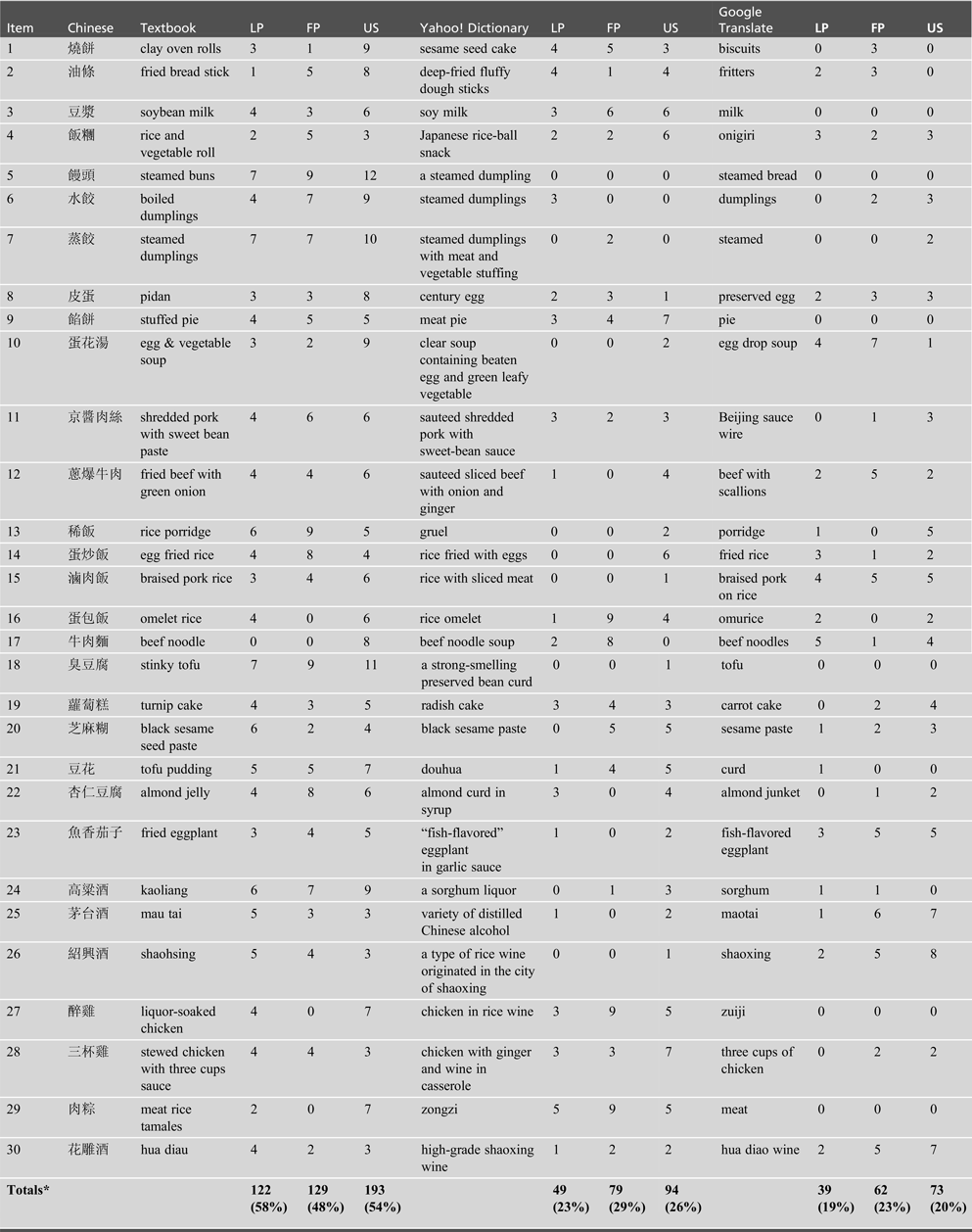
Developing a questionnaire based on the responses gained during an open-ended interview is an acceptable practice (Dörnyei, Reference Dörnyei2003) and can provide data that is qualitative and exploratory in nature to aid in questionnaire construction (Yabukoshi & Takeuchi, Reference Yabukoshi and Takeuchi2006). In other words, the questionnaire was developed based on the actual opinions of a sample from the US recruited for this study. Following this discovery, the Taiwanese Tour Guide English Practice textbook (Wen et al., Reference Wen, Wu, Yi, Huang, Shan and Huang2010) used by the US participant group was searched for any translation of Taiwanese food items into English. A total of 125 translated Taiwanese food items were found in the textbook. Next, the Chinese terms were looked up in the Yahoo! Dictionary and also translated from Chinese to English with Google Translate. The three translations were compared. The 30 items in which there was no agreement (i.e., the three translations from the three sources were different) were used to form a multiple-choice questionnaire. Only items without agreement in translation were selected because it was assumed these would be more controversial and may cause US the most difficulty. Table 1 shows the 30 items in the original Chinese and the three corresponding English translations.
Taiwanese dish names in Mandarin Chinese with English translations taken from Textbook, Yahoo! Dictionary, and Google Translate
Note. LP = Local Professors; FP = Foreign Professors; US = University Students; * % in parentheses
The questionnaire was given to the FP, LP and US groups. The instructions of the questionnaire (in English for FP and in Chinese for LP and US) were: ‘Please choose the option you think represents the best English translation of the Taiwanese food/dish.’ There was no indication on the questionnaire that the translations were from different sources; neither did the questionnaire indicate any difference among the individual translations. In addition to answers for the 30 items, some biographical data was collected from FP, including: 1) their length of time in Taiwan; 2) their length of study of Chinese; and 3) their self-rated Chinese language ability. The LP were also asked: 1) did they teach translation courses; and 2) how long have they taught translation courses. The US were not asked any additional questions because the teacher took anecdotal notes throughout the school semester regarding reactions to the translations that appeared in their textbooks.
Data analysis and results
The frequency counts for items by source and participant group are given in Table 1. Descriptive statistics for the Textbook source were: LP M = 16.570, SD = 2.370, n = 7; FP M = 14.33, SD = 2.646, n = 9, and US M = 16.08, SD = 2.353, n = 12. Descriptive statistics for the Yahoo! Dictionary source were: LP M = 7.430, SD = 1.397, n = 7; FP M = 8.78, SD = 0.667, n = 9, and US M = 7.83, SD = 2.691, n = 12. Descriptive statistics for the Google Translate source were: LP M = 6.00, SD = 2.944, n = 7; FP M = 6.89, SD = 2.667, n = 9, and US M = 6.08, SD = 2.610, n = 12. To determine whether these differences were statistical, planned comparisons were made among the three groups using three one-way ANOVAs. No significant difference was found between the three groups in terms of selection of Textbook translations (F 2,25 = 1.975, p = .160), Yahoo! Dictionary translations (F 2,25 = 1.057, p = .363), or Google Translate (F 2, 25 = 0.293, p = .749).
Discussion and conclusions
This study has brought to attention the neglect in both the Taiwanese EFL secondary and tertiary classrooms of teaching the skills needed to translate English into Chinese. In addition, the study has pointed out that unless Taiwanese students major in Applied Foreign Languages, they have few opportunities to learn the techniques available when translating from Chinese to English. Furthermore, even for those students that are given the opportunity to enroll in university-level translation courses, Taiwanese cuisine seems to receive little if any attention. Instead, Applied Foreign Language majors take notice of the problem of food translation in ESP courses that are often taught by foreign professors, who may not necessarily have an educational background in translation.
Appropriate and accurate English translations for Taiwanese foods are needed. Usage of inappropriate translations will at best result in miscommunication and at worst cause unintentional messages. So-called ‘bad translations’ can even result in angering and alienating those intended to be brought closer to the SL culture. As shown by some of the refusal responses that local and foreign professors gave in response to the call for participation in the current research, many educators are not only concerned by the translations but are in fact angered by their continued use. This in itself is indicative of a need for some change to improve the current state of how English is used to translate the local Taiwanese cuisine. It is unfortunate that a small number of professors were willing to take part in the study. Future studies may wish to expand upon this one by seeking input from students and professors from private universities in Taiwan.
The statistical analyses indicate that the three groups of participants tended to agree in regards to which translations were the most appropriate. This seems to suggest that Taiwanese applied language majors are capable of selecting appropriate translations, as judged by their foreign and local professors, if they are given the opportunity to do so. During the interviews with the ten Taiwanese students prior to the questionnaire construction and during the class discussions with my students, I found that students usually stick to a single source for many of their translations, which may be limiting their translation accuracy. It is therefore suggested that not only translation and applied languages teachers but also teachers of general education university English courses make it clear to students that referencing one source may not be the most appropriate method of determining an appropriate translation of a culturally laden food. Instead, multiple sources should be consulted to determine whether one translation is more appropriate than the others. In addition, if possible, teachers of General English or Hospitality English should reinforce the options previously summarized in the literature review that translators have when translating names of foods from Chinese into English.
Looking at the descriptive statistics shows that all three groups tended to select the textbook translations over the Yahoo! Dictionary translations that were in turn selected over those from Google Translate. Intuitively this makes sense. It should be the case that textbook authors have taken the time to research terminology before supplying translations that should be used to prepare English tour guides. However, it must be acknowledged that there is a limitation in that only those translated items that appeared in the textbook and only those which varied in translation in all three sources were investigated. In fact, throughout the semester students made complaints about the quality of the translations in the textbook, often questioning its reliability. This leaves me questioning how many below par translations for Taiwanese dishes are being circulated and reinforced due to the ESP textbooks being used in Taiwanese classrooms. For example, one Chinese dessert in particular, ‘豆花,’ received much discussion by the students. The textbook translated this dish as ‘tofu pudding’. However, students in the class suggested ‘soybean pudding’ and ‘soft tofu’ as alternatives. One student argued that ‘pudding’ is ‘布丁’ because it came from a foreign culture so the characters in Chinese represent the English sounds for ‘pudding’ (i.e., Bùdīng) and therefore ‘豆花’ should be translated into English as ‘douhua,’ keeping the sound intact since this dessert dish came from Chinese culture. This student was making the point that sometimes dishes come from other cultures and there is no equivalent and it would be best to use transliteration in such cases. Of course, such debates should probably be best settled with experts in the field.
Local professors write the majority of the textbooks used in Tourism English, Tour Guide English, and Hospitality English courses offered by Applied Foreign Language Departments in Taiwan. This was the case for the book used in my course. Dong (Reference Dong2005) called for native speakers of English to assist native Chinese speakers with the development of better dictionaries, ones that provide more appropriate translations of Chinese terms in English. I would like to echo this suggestion, but in addition to writing better dictionaries to call for the writing of up-to-date ESP textbooks targeting the Tourism and Hospitality industries in Taiwan. These books should be coauthored by both local and native English-speaking professors so that collaboration can help ensure the most acceptable translations of the local cuisine is made available to students. In addition, reference materials for teachers in secondary schools as well as general university English courses are needed to begin reinforcing good translation skills and standard translations from an early age.
Acknowledgements
The author acknowledges the assistance with data collection provided by Ms. Jing Yi Lin.
This research is based upon work supported by the Ministry of Science and Technology, Taiwan, R.O.C. under Grant No. MOST 103-2410-H-010-015-.
BARRY LEE REYNOLDS, Ph.D. is Assistant Professor of English in the Education Center for Humanities and Social Sciences at National Yang-Ming University, Taiwan. He has taught ESL/EFL in public/private institutes in the USA and Taiwan for 13 years. His research interests include incidental and intentional vocabulary acquisition, second language writing instruction, game-based language learning, and vocabulary translation. His recent published work appears in Applied Linguistics Review, Computers & Education, RELC Journal, Reading Research Quarterly, TESOL Quarterly, and others. Email barry@ym.edu.tw