- TBGAS
Transactions of the Bristol and Gloucestershire Archaeological Society
It is accepted that both the abbey of St Augustine at Bristol, now the cathedral, and the adjacent church of St Augustine the Less, now demolished, were dedicated to the Roman missionary St Augustine, Apostle of the English, first archbishop of Canterbury (d. c. 604). But uncertainty on the matter is frequently entertained when it is known that, before the Reformation, the religious of the abbey and of its dependent church were regular Augustinian (‘Austin’) canons of the Victorine order of the rule of St Augustine, bishop of Hippo, doctor of the Latin Church (d. 430). When, in his essay of 1976 on the origins and naming of the abbey, Canon J. C. Dickinson asked the very pertinent question ‘which St Augustine?’, he gave a scholar's factual answer but did not take cognisance of a potential division of loyalties in the abbey's life associated with the two saints or consider the possibility of clerical exploitation of the confusion in the minds of Bristol's populace.Footnote 1 Beneath the superficial history of the abbey's dedication to the ‘English’ Augustine there are documentary traces of a restrained but persistent démarche on the part of the regular canons to promote the cause and prominence of their own Augustine at the expense of the founder's, a monastic partisanship that only subsides at the Reformation. The records of the abbey of St Augustine, of the church of St Augustine the Less and other pertinent sources may be used to shed light on this ‘Augustinian’ controversy.
St Augustine's abbey: the saint of the dedication
Even the name of Bristol, a late Saxon town, reflects its early religious associations. Place-name scholarship proposes its derivation from Brycg stow, attested thus in the eleventh century, i.e. ‘bridge (brycg) in the vicinity of a religious site (stow)’. In the second element stow (Early English ‘place’), its specialised sense indicates a location of religious veneration or even a place of pilgrimage: this is common in the place-names of the west country such as Stow on the Wold, formerly [St] Eduuardsstou (Gloucestershire); Marystow, formerly Sancte Marie Stou (Devon); Instow, formerly [St] Johannesto (Devon), Jacobstow ‘Holy place of St James’ (Cornwall) and so forth. Indeed, a persistent Bristol legend, dating from before the Reformation, proposed that College Green, upon which the abbey was founded in 1140, was the location of St Augustine of Canterbury's conference with the leadership of the British Churches in ad 603, a distinction that some modern toponomists have attributed instead to nearby Aust on the Severn estuary, recorded in the twelfth century, perhaps apocryphally, as Augusta.Footnote 2 Leland also, in his Itinerary of the 1540s, picked up the oral tradition concerning Bristol's distinguished religious past, when he commented on the ancient chapel (now demolished), near the abbey on the Green, which was dedicated to the little known saint, St Jordan, reputed to have been St Augustine's discipulus at the ‘Oak’ conference.Footnote 3 Documentary proof of the intentions of the abbey's founder regarding its patron saint, hitherto elusive, has now come to light in the new edition of the surviving cartulary of the abbey, much of which had been scattered or otherwise destroyed in the Bristol riots of 1832. The evidence arises, randomly, in a charter that records the gift of the founder, Robert fitzHarding, of funds for making good the lighting of the abbey (‘ad emendum luminare’), so that it might burn perpetually ‘before God, Saint Mary and the blessed Augustine Apostle of the English’: ‘Sciant tam presentes quam future quod ego Robertus filius Hardingi … concessi et dedi in liberam et perpetuam elemosinam ecclesie Sancti Augustini de Bristo’ x solidos … Ad emendum luminare predicte ecclesie. Quod luminare … ardeat coram deo et Sancta Maria et Beato Augustino Anglorum Apostolo et in presentia omnium sanctorum.'Footnote 4
David Walker, editor of the abbey's cartulary, finds no reason to doubt what this document implies, that ‘English’ Augustine, third of the trio of the beneficiaries of the renewed lighting, was the abbey's patron saint, noting also that the attestation was early, drawn up between 1148 (the year of the induction of the first abbot into the abbey) and, at the latest, a time when Robert fitzHarding was still alive to endorse the deed of gift (before Michaelmas 1171).Footnote 5 In the search elsewhere for confirmation of the abbey's dedication, it seemed not unreasonable to seek it in the calendar of the abbey's festivals. No such document survives in the abbey's muniments but when a reconstruction of the calendar was undertaken not only was endorsement of Augustine of Canterbury as patron saint found, but the exercise also afforded an unexpected glimpse of a protracted ‘Augustinian’ controversy in the life of the chapter.
St Augustine's abbey: reconstructing the liturgical calendar
Whereas the ceremony of induction of the first abbot, Richard of Warwick, a regular canon of the Augustinian order of St Victor of Paris, was recorded precisely by Abbot Newland as having taken place on Easter Day, 11 April 1148, even the year dates of the other major events of the abbey's life are approximations, including that of the abbey's dedication.Footnote 6 In the wake of Dickinson, modern scholarly opinion is content with the formula ‘c. 1170’ for this event. The one surviving missal of the old abbey of Bristol (now deposited in the Bristol Reference Library) has lost its calendar, in which the anniversary-day of the dedication and of other key events would have been noted as a matter of course. However, certain elements of the missal's calendar can be retrieved from two other sources: the first is the thirteenth-century ‘Křivoklát’ Psalter (also known as the ‘English’ Psalter), an important study of which, by Josef Krása, appeared in 1972 and was brought to the attention of British scholarship in 1991 by Michael Smith. The psalter, an illuminated manuscript from the Fürstenberg collection in the castle of Křivoklát near Prague, also includes a partial Sanctorale (Proper of the saints). From this Krása was able to show that the psalter originated at St Augustine's abbey in Bristol and it was so confirmed by Smith. It is significant that the psalter provides precious information on the calendrical dates of certain of the abbey's major festivals, including that of the dedication. The second source of information is the abbey's compotus (record of accounts) for 1491–2 and 1511–12, which notes in sequence, but without calendar dates, the abbey's major feast-days with their costs.Footnote 7
It is known that more than fifteen leaves of Bristol's illuminated missal are missing.Footnote 8 However, from the 153 leaves which survive of this fine manuscript of c. 1420, it can be deduced that the feast of the dedication was regarded as sufficiently important a solemnity to merit what is now termed a ‘common’ octave (further celebrations concluding on the eighth day). The sanctorale of the missal also survives, as does the litany of the saints for Holy Saturday (Easter Even). The litany includes, amongst the confessor saints, the names (untitled) of both Augustine of Canterbury and Augustine of Hippo, the former the saint in whose honour, as the cartulary indicates, the abbey had been dedicated. To both of these saints was accorded a so-called ‘double feast’ (i.e. with octave), the highest-ranked feast amongst the solemnities celebrated by the Church before the reforms of Pope Pius v (1566–72).
From the Bristol missal and these two additional sources, the abbey's liturgical calendar, with the dates and precise title of the relevant feast days can be ascertained.Footnote 9
May/June (movable feast): Holy Trinity:
Missal (fo. 101b); compotus: sancte Trinitatis.
26 MaySt Augustine [of Canterbury] Apostle of the English:
Psalter and compotus: sancti augustini Anglorum apostoli.
Missal (litany for Holy Saturday, fo. 72a):
ste augustine ste augustine [sic]
May/June (movable feast): Corpus Christi:
All sources: Corporis Christi.
28 AugustSt Augustine [of Hippo] the Great, Doctor of the Church:
Psalter: sancti augustini magni.
Missal (litany for Holy Saturday, fo. 72a):
ste augustine ste augustine [sic]
Compotus: sancti augustini Doctoris.
4 SeptemberOctave of St Augustine [of Hippo] the Great [Doctor]:
Psalter: recorded; Latin title not transcribed by Krása.
Missal: not recorded (folio lacking).
Compotus: not recorded.
6 SeptemberDedication of the [abbey] church of St Augustine [of Canterbury, Apostle of the English]:
Psalter: dedicatio ecclesie sancti augustini.
Missal (fo. 141b): in dedicatione ecclesie.
Compotus: dedicacionis ecclesie.
8 SeptemberNativity of the Blessed [Virgin] Mary:
Psalter: not recorded.
Missal: not recorded (folio lacking).
Compotus: Natiuitatis beate Marie.
13 SeptemberTranslation of St Augustine [of Canterbury], Apostle of the English:
Psalter: Translatio sancti augustini Anglorum apostoli.
Missal: not recorded (folio lacking).
Compotus: Translacionis sancti augustini.
14 SeptemberOctave of the Dedication:
Psalter and compotus: not recorded
Missal (fo. 142b): oct[ava] dedicationis ecclesie.
St Augustine's abbey: the dedication and issues of transparency
The public dedication of a large abbatial church destined, as at Bristol, to become the chief house in England of the Victorine order of the international rule of regular Augustinian canons, would have been of more than local significance.Footnote 10 Equally, the feast-day in commemoration of the event would normally occupy a prominent position in the monastic calendar. At Bristol the case is ambiguous and even doubtful since, amongst other considerations, the context of the feast of the dedication could easily have led to confusion in the minds of the devoted populace, as the sequence of dates shows. The feast was tightly wedged within a block of eleven days in the relatively insignificant position between the great feast-day with octave of the founding saint of the Augustinian canons' own rule, Augustine the Great of Hippo, Doctor of the Latin Church (here sancti augustini magni or doctoris) from 28 August to 4 September, and one of the major festivals of the Virgin Mary (the Nativity), a saint for whom the Augustinian canons professed a special devotion, on 8 September.
The juxtaposition of such high feast-days around the dedication therefore sends a message that could easily be misunderstood, even linking the ‘wrong’ saint with fitzHarding's abbey. It might have been judged more appropriate, on the part of the abbey's authorities, to have located and celebrated the dedication three months earlier on, or nearer to, the feast-day of the patron saint himself on 26 May, in the not unworthy context of Trinity and Corpus Christi, as the Bristol Psalter and the Compotus have it: ‘Trinitatis. sancti augustini anglorum apostoli. Corporis Christi (fo. v, 82).’Footnote 11 Nor does it appear explicitly in the compotus that an octave was celebrated for the patron saint.
One other instance of what might be termed an evolving sub rosa prejudice in the abbey's treatment of Robert fitzHarding's ‘English’ St Augustine, is identifiable in the case of the feast of the saint's translation. While this appears openly and fully in the thirteenth-century Bristol Psalter as ‘Translatio sancti augustini Anglorum apostoli’ (13 September), the same feast in the compotus, two centuries later, is noted as simply ‘Translacionis sancti augustini’, without the benefit of a distinguishing title. This feast-day is also located in misleading proximity to the entry, nine days earlier on 4 September, for the octave-day of St Augustine of Hippo, who might be thought the titular saint of the feast – and all is at a confusing distance from the feast of St Augustine of Canterbury on 26 May, whose translation it really was. The brevity of the entry in the compotus might be blamed of course on clerical ‘economy of effort’. On the other hand the note might reproduce the actual wording of the calendar, with its hint of institutional reluctance, ingrained after two centuries, to honour the abbey's true patron saint, Augustine of Canterbury. The abbreviation of the entry in the compotus would not have confused the regular canons, since it would have been known to them that the Church had never ordained any feast for the translation of the bishop of Hippo. However, even a modestly educated Bristolian of pre-Reformation times was unlikely to have known this.
The Austin canons' response would doubtless have been to refute the charge of manipulating the titles of the two Augustines to confuse their identities. They would have pointed out that Augustine of Hippo was identifiable by his title of ‘Doctor’ or, as the Bristol Psalter preferred, ‘the Great’ (‘magnus’), while the Augustine of the dedication feast (he of Canterbury) was the untitled ‘St Augustine’ as in the abbey's name, in the litany for Holy Saturday (‘ste augustine ste augustine’) and in his translation feast as noted in the compotus – unless he was denominated ‘St Augustine Apostle of the English’, as found in the psalter. The regular canons certainly had a grasp on the logic of the matter, but did their congregations or the people at large?
Neither in the office of the abbey's feast of the dedication recorded in the missal (fo. 141b) nor in its octave (fo. 142b) is the saint identified in whose honour the church was dedicated. On the other hand, the Bristol Psalter shows that the patron of the regular canons' own rule, to whom they owed special devotion, ‘Augustinus magnus’, although not the titular saint of the abbey, was accorded a double feast with octave on 28 August and 4 September respectively.Footnote 12 The impact of this double liturgical dosage during the last week of August and the first week of September, rounded off triumphantly by the Nativity of the Blessed Virgin Mary on 8 September, would have been overwhelming, a climax hardly disturbed by the feast of the Translation of St Augustine Apostle of the English on 13 September and, on the following day, by the octave of the dedication, the text of which, in the Bristol Missal (fo. 142b), fails altogether to mention the name of the saint to whom the abbey was dedicated. Conclusions unfavourable for the primacy, in the abbey's history, of Robert fitzHarding's Augustine, Apostle of the English, would have been unavoidable. Even respectable Bristolians of the period, with their ‘little Latin and less Greek’, may not easily have learned from the organisation of the abbey's routine calendar which Augustine the abbot and his canons had in mind at any one time – but the bias of understanding in their minds, acquainted as they were with the cardinal role played by the Austin canons in the day-to-day religious life of the abbey and its associated church, may well have favoured the misconception that the patron of their rule, Augustine of Hippo, was the historical figure for whom the abbey was named.
St Augustine's abbey: the abbey's dedication and the chapel of St Jordan
In the years before the dissolution of the abbey in 1539, it might be argued that circumstances favourable to the survival of the memory of St Augustine of Canterbury were not only provided by the local legend of Bristol's hosting St Augustine's conference on College Green (the abbey's ‘Sanctuary’ or graveyard) but also by the continuing existence there of the Anglo-Saxon mausoleum chapel of St Jordan and by the services which from time to time were held within it.Footnote 13 With its evocative hymn to St Jordan, the chapel's illuminated Horae, one copy of which survives, unequivocally links Jordan with St Augustine of Canterbury in his role as ‘Apostle of the English’:
[To the honour of God and of Saint Jordan: O Jordan, blessed confessor of Christ and citizen of Heaven, intercede for us by virtue of the faith we of the English profess, whom Augustine [first] baptised and you perfected in that holy faith, whose colleague you were in his preaching to the English. Be our Patron [saint] in this holy place where you lie entombed].
For the attentive and Latinate amongst the chapel's congregation, the hymn to the saint provided a hint as to which Augustine the adjacent abbey was dedicated. Yet few Bristolians may have been so highly educated as to catch the precise implications of the hymn and it is disingenuous to suppose that the Austin canons were reluctant to allow the rival saint in their establishment to slip into obscurity. Even before the dissolution, St Jordan's chapel appears to have ceased to function as an oratory. The compotus for 1491–2 refers to donations ‘from the pyx within St Jordan's chapel on the green’ (‘proueniente de pixide …. infra Capellam sancti Iordani in viridi placea’: fo. xi, 25–6), but in the accounts for 1511–12 offerings appear no longer to have been made in the chapel itself but within the abbey church, possibly in a side chapel that contained both St Clement's and St Jordan's statues or likenesses in fresco (‘coram …. imaginibus infra ecclesiam Monasterii …. Sanctorum Clementis et Iordani’: fo. xi, 24–5). This small detail might mark the success of one of the practices of the Austin canons to diminish the stature and role of Augustine of Canterbury in the life of the abbey. The chapel's final function, once deconsecrated, was to house the abbey's grammar school; a not unworthy end but, with it, one of the three institutional links with St Augustine of Canterbury (abbey, parish church and St Jordan's chapel) was broken in the public life and religious discourse of Bristol.
The church of St Augustine the Less: the dedication
The history of the consecration of the parish church of St Augustine the Less is chequered and so far has not been satisfactorily studied. Earliest evidence of its name is found in the abbey's cartulary in the last half of the twelfth century, when it is already a parish church:
totam terram quam apud Bristoll' habuimus super aquam de Frome in parochia ecclesie Sancti Augustini minoris [church].Footnote 15
It has to be borne in mind that the title ‘St Augustine the Less’ was of precise use in the early Church. An early reference in England, perhaps the earliest, is recorded in the Latin text of the Chronicon Aethelweardi (The chronicle of Aethelweard) of c. 980:
Reuolutione scilicet in eadem obit et rex Eadmund in solennia [sic] Augustini minoris, qui e[s]t apostolus Anglorum (IV.6).
[King Edmund also died in the same year on the festival of St Augustine the Less, who is also the Apostle of the English].Footnote 16
On the other hand, from the earliest times, Bristol's abbey of St Augustine, although dedicated to the same saint, was never granted the suffixed title of ‘the Less’ from the time of the first recorded use of its name (‘in usus et sustentationem canonicorum Sancti Augustini’: charter no. 43, of 1147×1183). Nor, upon closer examination, was it perhaps in the Augustinian canons' biased interests to do so.
The church of Saint Augustine the Less: the dedication and issues of transparency
From the evidence of the abbey's reconstructed calendar, the canons do not appear to have taken any substantial steps to clarify the complementary roles of the two Augustines; a certain confusion seems to have been allowed to rule. The suggestion of a low-key but deliberate obfuscation or suppression of the truth on the part of the abbey's chapter, what decretalists would have termed ‘subreptio’, cannot be ruled out. Events also contributed unplanned opportunities: for example, even by the time of the first recorded use of the parish church's full name in the second half of the twelfth century, ‘[ecclesia] sancti augustini minoris’, the suffixed title was probably already losing its ecclesiastical meaning, shifting in sense from the abstract of the hagiographic tradition to the concrete sense, in the vernacular of the populace, of ‘less’ or ‘smaller’, as the abbey's construction reached completion on the Green nearby. The ‘lesser’ pile of the church of St Augustine the Less, with respect to the ‘greater’ pile of the abbey, was plain to the senses: the church was now clearly smaller than the abbey. There was diminishing need, therefore, for the Austin canons to instruct their flock as to the proper historical sense of ‘the Less’ in the title of their parish church. The way was open for the more distinguished founder of their Augustinian Rule to occupy the vacuum of meaning in the consecrations of both abbey and parish church.
A further glimpse of the effects of ecclesiastical misrepresentation (or uncritical and arguably disingenuous ecclesiastical tolerance of ambiguity) is afforded by the abbey's cartulary in the mid-thirteenth century:
per vicariam Sancti Augustini minoris [church] fugentur … Et herbam
spergere in ecclesiis suis Sancti Augustini majoris [abbey] et minoris [church]Footnote 17
Here, in 1259, in reference to the right of cutting and distributing the hay from the abbey's sanctuary (College Green), St Augustine the Less is properly designated on two occasions ‘[ecclesia] Sancti Augustini minoris’ while the abbey is designated ‘[ecclesia] Sancti Augustini maioris’. To note is the fact that the title ‘minor’, attached to the parish church, appears twice in different contexts. In its first use, the term indicates ‘the Less’ of the Canterbury saint's traditional title. In its second use ‘minor’ has two possible senses: of ecclesiastical rank and of physical size (of the church's building). Both senses are true. Potential subreption lies in the designation of the abbey as ‘sanctus Augustinus maior’ where a three-fold sense of the title is in play: the greater size of the abbey, its greater dignity and (falsely) its identification of Augustine of Hippo as the saint of the abbey's dedication.
The Augustinian quaestio and the Reformation
The apparent triumph of the Austin canons' founding saint in the battle of the consecrations was short-lived and, apart from the interlude of Queen Mary Tudor's Catholic restoration (1553–8), did not survive the crushing events of the Reformation: the legal suppression of the abbey by Henry viii in 1539, the disbanding of the chapter and the renaming of the abbey by letters patent in 1542.Footnote 18 The royal choice for the abbey's new dedication was, in accordance with royal policy for the new cathedral foundations, ‘the Holy and Undivided Trinity’, thus dispensing abruptly with what had arguably become, at best, the ambiguity of the old dedication to ‘St Augustine’. From the point of view of medieval symbology, it is interesting that the feast-day of St Augustine Apostle of the English had been closely associated, in the old abbey's calendar, with that of the Holy and Undivided Trinity and the highly popular festival of Corpus Christi, celebrated annually and extravagantly, with civic processions, on Bristol's College Green:Footnote 19
Trinitatis . sancti augustini anglorum apostoli . Corporis Christi
This article has tried to bring into its arguments the perceptions of the common man and woman of Bristol regarding the religious life and practices of their abbey. To the eye of the more reflective amongst the abbey's congregation at the time, in which there lingered the late medieval notion (for some a superstition) that contingency, in all circumstances, was mysteriously but ineluctably subject to the divine order of providence, the sequence here of the old abbey's festivals must have appeared significant. It was as if the Apostle of the English, the abbey's true patron saint, was supported heraldically and protectively, on each side, in the abbey's calendar and therefore its life, by the triune God and his incarnate Son. This sequence, to the eye of faith, was not accidental. If, as allowed by providence, the Austin canons throughout their history at Bristol had brought about the diminishment of ‘English’ Augustine in the abbey's liturgical life, by the same infallible and even-handed justice providence had also brought about, at the Dissolution, the expulsion of the Austin canons who had attempted the deed. The hand of providence, therefore, could be seen at work in the entire run of events, providing a sort of belated vindication of fitzHarding's and the people's Apostle of the English.
Finally, a further symptom of the new thought and reformed faith sweeping Bristol and the country can be found in the vicissitudes of the naming of the parish church. Already in the Certificate of Henry viii's Commissioners at the Dissolution in 1539, the church's ecclesiastically precise name ‘St Augustine the Less’ had become concretely ‘Little St Augustine's’, until climactically, in the post-Dissolution parish register for 1577, in the light of the revised name of the abbey, ‘Little’ is struck through by pen as logically redundant.Footnote 20 In the England of the English Protestant Church it seems that an undifferentiated ‘St Augustine’, free of the chains of subordination that connected ‘English’ Augustine to his ‘Latin’ namesake, should from now onwards, politically and correctly, mean only Augustine of Canterbury, Apostle of the English.
APPENDIX
The gestation of St Augustine's Abbey at Bristol and its associated scholarship
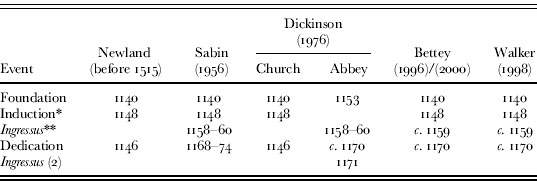
The dates of major events in the early life of the abbey, from foundation to dedication, have been a subject of debate over the centuries. From his limited manuscript sources, Newland, the abbey's twentieth abbot, was misled into dating the dedication of the abbey two years after the induction of the first abbot and the first six Austin canons. Otherwise his roll contains a wealth of irreplaceable early historical reference.Footnote 1 No advances on Newland's early chronology of the abbey were attempted until Arthur Sabin's investigations of the abbey's available cartulary, mostly unedited, in the 1950s, which set more scrupulous standards for further assessment of the main events in the abbey's history.Footnote 2 Canon Dickinson, historian of the Rule of St Augustine, attempted to reconcile different traditions in the dating of the parish church of St Augustine the Less and the abbey of St Augustine. His solution was to share the often ambiguous evidence between church and abbey, positing, for example, a first ingressus of canons into the church of St Augustine the Less in 1148 whilst the abbey was being built, and a second ingressus into the completed abbey church after its dedication: the latter a ‘reinforcement’ by six Victorine canons from Wigmore abbey. He also appropriated Abbot Newland's date of the abbey's dedication (1146) for the benefit of the church of St Augustine the Less, adopting the formula ‘c. 1170’ (which stands) for that of the abbey. Further conclusive work on the manuscript evidence by succeeding scholars has found Dickinson's binary solution wanting. However, his remaining work on the early origins of both the abbey and the church, and on the general history of the Austin canons in England, including those of the abbey's Victorine order, is authoritative.Footnote 3 Walker's work on the abbey's charters and Bettey's recent edition of the cathedral's records, including his important excursus on the transition from abbey to cathedral at the Reformation, have provided invaluable resources for further research into both of these historic institutions of the Church in Bristol.Footnote 4
Major events in the early life of the St Augustine's abbey, Bristol
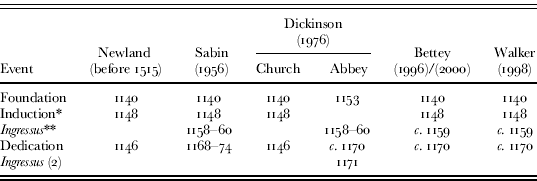
* The term induction denotes here the formal assumption by the abbot of his duties and responsibilities in the leadership and management of his abbey.
** The Latin term ingressus (lit. ‘entrance’) indicates here the formal entry of the Augustinian (Victorine) canons into their abbey church.