INTRODUCTION
Recent international effort to map and survey burial sites of ancient nomadic cultures in Inner Asia, supported by UNESCO and other intergovernmental organizations, has fundamentally improved our knowledge about the spatial distribution and the size of the Siberian Scythian burial occurrences in the Altai-Sayan Mountains (Bourgeois and Gheyle Reference Bourgeois and Gheyle2008), a region of common borders of Kazakhstan, Russia, Mongolia, and China. However, the uncertainties arising from the ambiguities of the Siberian Scythian chronology prevent the chronological assignment of most prominent assemblages of archaeological sites. This considerably obviates our understanding of Inner Asia prehistory during the Iron Age and Scythian Antiquity in particular. Radiocarbon is the main dating method for estimation of absolute age of the scattered burials numbering in the many thousands, but the calibration of 14C dates for 800–400 BC lying on the Hallstatt plateau of the 14C calibration curve is exceedingly challenging (van der Plicht Reference van der Plicht2004).
The chronology of Siberian Scythian antiquity has been indisputably advanced over the last 2 decades by merging floating tree-ring records of burials with14C tree-ring wiggle-matching. Archaeological timbers are often well preserved in the frozen tombs (or kurgans) of Siberian Scythians. With the availability of tree rings, the precision of calibrated dates and the age relationship with the kurgan improves significantly (Zaitseva et al. Reference Zaitseva, Bokovenko, Alekseev, Chugunov and Scott2005; Stark et al. Reference Stark, Rubinson, Samashev and Chi2012; Panyushkina et al. Reference Panyushkina, Grigoriev, Lange and Alimbay2013). The most significant breakthrough in the absolute dating of Siberian Scythian kurgans occurred a few years ago in the Russian and Mongolian parts of Altai-Sayan region. Multinational efforts over the last 2 decades to bridge tree rings of archaeological and remnant wood resulted in an overlap of a 2367-yr tree-ring record of remnant larch from the Tuva (360 BC–AD 2007) with Siberian Scythian tree-ring records of the Pazyryk culture from Mongolia and the Russian Altai (Myglan et al. Reference Myglan, Slyuserenko and Heußner2012). This unprecedented dating success not only established the first absolute calendar dates of 35 kurgans from 11 burial fields, but most importantly demonstrated only a 1-yr deviation between the calendar dates derived from the tree-ring dating and from tree-ring 14C wiggle-matching conducted on the same tree-ring materials.
Nevertheless, absolute dating of Asian Scythian burial sites in the Chinese and Kazakh sectors of the Altai Mountains, which still employs single 14C dates, is presently lagging. Even for excavations reporting an abundant amount of kurgan timbers, it is extremely difficult to access these wooden artifacts. The first and only published case study of Saka tree rings in Kazakhstan presents successfully explored archaeological timbers of the Bes Shatyr necropolis (Panyushkina et al. Reference Panyushkina, Grigoriev, Lange and Alimbay2013). In order to accurately define spatial-temporal correspondence of the Siberian, Asian, and European Scythians and to connect the Scythian archaeology to literary narratives of Eurasian history, a more energetic effort to obtain and analyze the Saka tree rings for absolute dating is needed.
In this study, we explore tree rings of Saka timbers from the Kazakh Altai in order to (1) determine calendar age of the Baigetobe kurgan at the Shilikty burial site using tree-ring dating and 14C wiggle-matching, and (2) resolve chronological uncertainties of this prominent Saka site pending since 1965, when 14C dating was applied to the Shilikty wood for the first time.
Archaeological Site
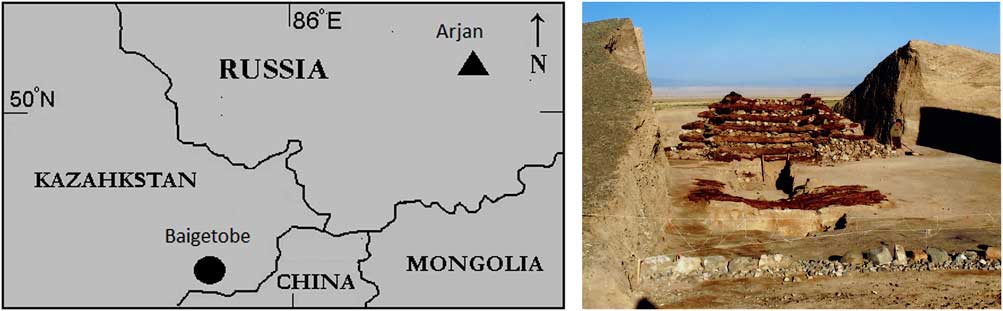
The Shilikty burial site, referred to in Russian literature as the Shilikty Valley with coordinates of 43°33′N and 78°17′E, is located on floodplains of the Chilik River draining the Tarbagatay Range at the junction of state borders between China (Xinjiang) and Kazakhstan (Figure 1). The Tarbagatay Range is the origin of the headwaters of the Irtysh River—the main tributary of the Ob River flowing from south to north in western Siberia. This is one of the most important burial sites of Saka tribes, comparable to key burial assemblages of the Siberian Scythians from the Pazyryk Valley in the Russian Altai, the Uyuk Valley in Tuva, and the Salbyk Valley in Khakasia.
Location of the Shilikty burial site in the Altai Mountains of southeastern Kazakhstan (left map) and view of the Baigetobe kurgan during excavation with wooden chamber in the middle of kurgan (right photo).

The Shilikty Valley has an enduring history of exploration that can be traced back to 1869 when Siberian newspapers reported to the public about monumental human-made “pyramids” scattered along the Chilik River. In 1902–1903, the Shilikty Valley was surveyed and 72 clusters of large kurgans recorded. The first excavation endeavor at the Shilikty site took place in 1909–1910 (Chernikov Reference Chernikov1965) but was not successful. Much later, in 1949, the East Kazakhstan Expedition (EKE) of Saint Petersburg’s Institute of Archaeology (Leningrad at the time) launched the first research program directed by S S Chernikov to study the burial valley scientifically (Chernikov Reference Chernikov1951).
Archaeological surveys of Shilikty Valley carried out by the EKE documented over 200 early nomadic burials organized in five large cemeteries comprising mostly large and mid-size kurgans. The largest kurgans are ~100 m in diameter and 8–10 m in height. A total of 45 large kurgans, designated as elite kurgans, were located in the central part of the Shilikty Valley. Along with 75 other kurgans associated with the Saka culture, these burial assemblages form the core of the site. The most common size of kurgans is 20–60 m in diameter and 2–5 m height. It is interesting that the Shilikty Valley has no small kurgans, which are usually categorized by diameters of 10–15 m and recognized as the typical kurgan size of burial sites in the Tarbagatay Range and adjacent areas, including the Semirechye (or Jitasu), which is another significant burial location of the ancient nomadic landscape. The largest Shilikty burial, cemetery-1, encompasses 57 kurgans organized within an 8-km-long and 1-km-wide zone. Other cemeteries comprise 30–40 kurgans. Such a high density of elite kurgans is a very rare phenomenon, not only for Inner Asia but the entire Scythian world.
Kurgan excavations at the Shilikty Valley between 1949 and 1971 represent the fundamental research of this site (Chernikov Reference Chernikov1951, Reference Chernikov1964, Reference Chernikov1965). It is during this time that the typological chronology of Saka burials was established and the burial rites of early Saka nomads were defined, which is now considered the classical description of the Saka tradition in Central Asia. In some respect, the most striking feature of the nomadic burial rite at the Shilikty site is that there were no horses and ceramics inside the kurgans. The large kurgans had no grave pit, but rather the human bodies were placed in a roughly made two-log-high wooden chamber standing at ground-level surface and covered with crushed rocks and clay. Numerous additional logs were used to shape and enforce the pyramid-like profile above the chamber, which was finally covered with regolith and rocks and shaped in a rounded kurgan (Figure 1). With regard to dating, the Saka archaeological chronology relies on the typology of Animal Style gold and bronze arrowheads (Chernikov Reference Chernikov1965). The first sensational finding of golden art at the Shilikty Valley occurred in 1960 during excavations of kurgan #5 (cemetery-1), which comprised 524 golden pieces with a total mass of 100 g. The archaeological age of the Shilikty Valley of 700–600 BC proposed by Chernikov (Reference Chernikov1964) has yet to be challenged.
Baigetobe Kurgan
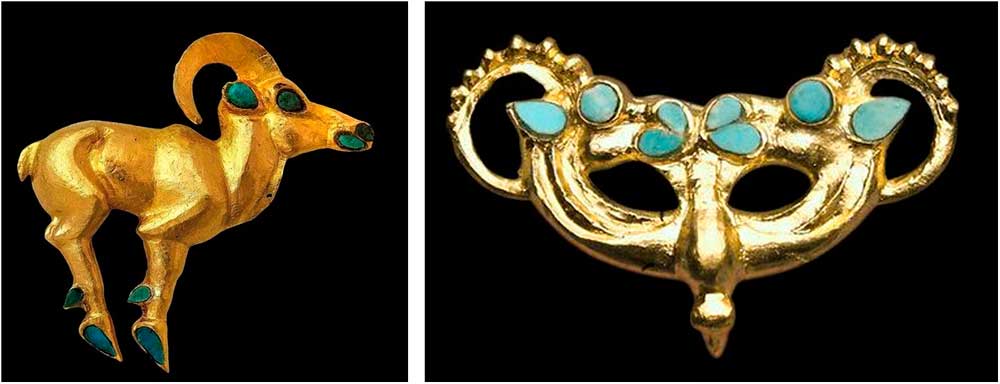
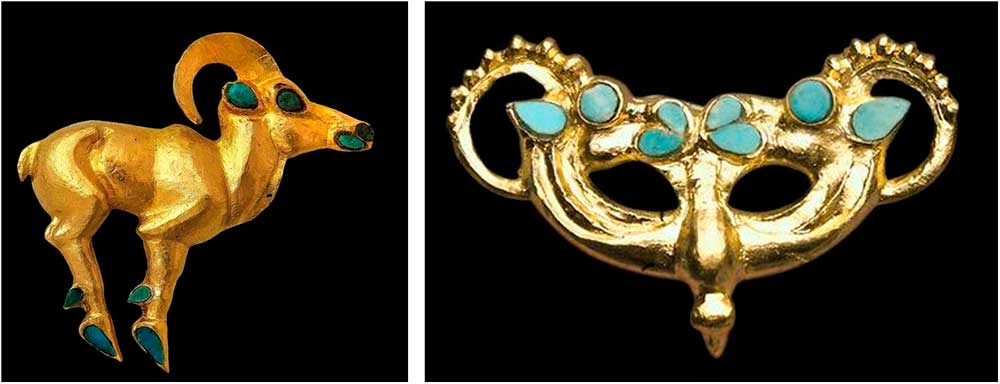
The second extraordinary discovery of Scythian golden art in the Shilikty Valley was made more recently. In 2003, the Shilikty Expedition of Al Faraby Kazakh National University directed by A T Toleubayev excavated 4303 golden pieces decorating a postmortem costume of a buried body from kurgan #1 of the Shilikty-3 cemetery (Toleubayev Reference Toleubayev2013). This was the largest elite kurgan of Shilikty-3 cemetery, with dimensions of 99 m in diameter and 7.9 m high (equivalent to a 3-story building). Back then, the kurgan was called Chilikta #1 but was later renamed after its local name, the Baigetobe, which translates from the Kazakh language as the Hill of Horse Racing. Additionally, the spelling of the cemetery and site has been changed from Chilikta to the now widely accepted spelling Shilikty. The content of the burial mound was robbed in antiquity as were many other elite and large kurgans in the valley. But even the scant remaining contents demonstrate the exquisite artistry of Saka culture and far-reaching value of the burial goods (Figure 2). The Baigetobe gold collection stands out for its high gold purity (fineness of 93–97%) and cast metal, which differed from the golden foil mounted over carved wood or bone common in the Pazyryk culture (Siberian Scythians) (Toleubayev Reference Toleubayev2011). In part, the designs of Animal Style gold from the Baigetobe have no equivalents in the Saka-Scythian realm, highlighting the early state of this nomadic culture and some degree of its segregation. Most archaeologists agree that the golden pieces found decorating a dress were likely worn during the owner’s life and added for the burial function (Toleubayev Reference Toleubayev2011), and it is very unusual. In contrast to gold relics, the kurgan architecture and construction materials are found to be identical to other elite kurgans of the Shilikty Valley and other parts of Kazakhstan. The importance of the Baigetobe kurgan is currently unmatched in the Saka archaeology and its burial characteristics have no local and Central Asian prototypes, but rather are more closely linked to the rest of the Scythian world.
Example of gold and turquoise plaques decorating a Saka funeral costume from the Baigetobe kurgan. Left: a standing argali, mountain goat. Right: two mirrored heads of argali holding a bird.
METHODS AND MATERIALS
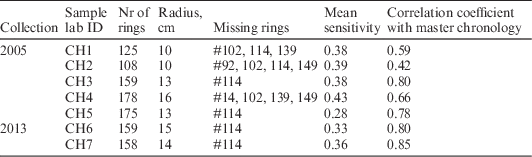
Burial construction timbers from the Baigetobe kurgan (Shilikty-3 cemetery, kurgan #1) were collected in 2003 from ongoing excavations led by A Toleubayev. Later, in 2013, more samples of the kurgan timbers were cut from logs archived at the Al Farabi Kazakh National University in Almaty. In this study, we used a total of seven cross-sections cut from long logs 25–35 cm in diameter (Table 1). The timber logs were part of inner-wall structure of the barrow supporting a pyramid-like mound of crushed rocks and clay (Figure 1).
Summary of archaeological wood samples used in the tree-ring study of the Baigetobe kurgan.

Wood samples were prepared and analyzed at the Laboratory of Tree-Ring Research (LTRR) and 14C measured at the NSF-AMS Facility of the University of Arizona. Tree-ring widths from sanded cross-sections were measured on a LINTAB measurement system (0.01 mm precision) and crossdated visually with TSAP software (Rinn Reference Rinn2003). Crossdating results were checked with correlation analysis using the COFECHA program (Holmes Reference Holmes1983). Ten-year groups of crossdated tree rings from two cross-sections were subsampled for 14C dating. The wood samples were ground and cleaned using conventional methods to remove possible contamination, and α-cellulose was extracted by sodium chlorite bleaching at pH 3 at the LTRR (Leavitt and Danzer Reference Leavitt and Danzer1993). Combustion of the cellulose to CO2 and production of graphite powder were done using standard procedures routinely applied at the University of Arizona AMS laboratory (Jull et al. Reference Jull, Burr, Beck, Hodgins, Biddulph, McHargue and Lange2008). 14C/13C ratios were measured with a standard deviation of ~0.5% on an IONEX 2.5MV AMS machine. The OxCal v 4.2 program (Bronk Ramsey Reference Bronk Ramsey2009) and IntCal13 calibration curve (Reimer et al. Reference Reimer, Bard, Bayliss, Beck, Blackwell, Bronk Ramsey, Buck, Cheng, Edwards, Friedrich, Grootes, Guilderson, Haflidason, Hajdas, Hatté, Heaton, Hoffmann, Hogg, Hughen, Kaiser, Kromer, Manning, Niu, Reimer, Richards, Scott, Southon, Staff, Turney and van der Plicht2013) were used for modeling the calendar ages of 14C measurements from the tree rings.
RESULTS
Tree-Ring Dating of Baigetobe Timbers
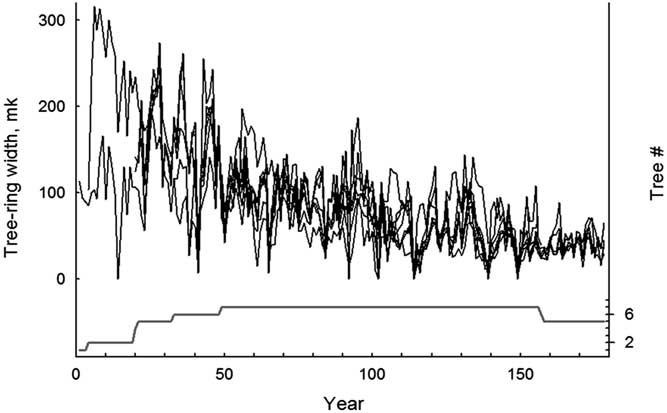
Wood anatomy analysis indicates that burial timbers are larch (Larix sibirica). The preservation of archaeological wood varies greatly. Although each sample has pith and sapwood, inner rings were decayed in many places (so-called “cheese wood”). Some samples have completely lost the outer rings but others retain them. Seven tree-ring width series were developed from seven cross-sections with lengths ranging from 108 to 178 yr (Table 1). The series overlap into a 178-yr tree-ring floating chronology with an intercorrelation coefficient of 0.7 (Figure 3). The wood tree-ring dating is not easy even though the tree-ring width variance is high and average sensitivity is above 0.3. The series have a few missing rings, which are partly the result of wood decay. The chronology has 15 absent rings, which is 1.4% of the total number of crossdated rings. Ring #114 was found in only one tree sample (CH4), and the rest of the missing rings are present in at least four samples (about 60%).
Cross-dated tree-ring width series (top) and number of tree samples (bottom) developed from the Baigetobe kurgan timers.

The crossdating results suggest that the studied timbers were most likely harvested in a single year but over the course of the entire growing season. Five out of seven trees have the same cutting dates. The cutting dates of the other two trees are missing because of wood rot and weathering, and their outer rings date 21 and 22 yr prior the date of the five other trees. The outermost rings associated with the cutting date have earlywood only, or either incomplete latewood or complete rings, which suggests wood harvesting throughout the larch growth season (May–September). Overall, the developed 178-yr chronology could be used for crossdating of other larch timbers from the burial site, although we would recommend collecting as much wood as possible for tree-ring dating.
Radiocarbon Dating of Baigetobe Timbers
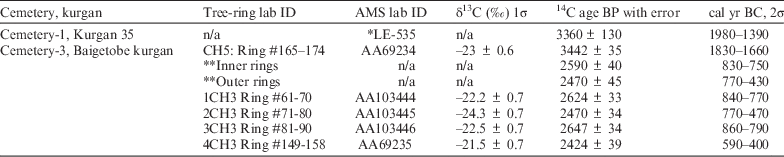
We measured five 14C ages of crossdated tree rings from two tree samples: CH3 and CH5 (Table 2). The 14C date of outer rings from sample CH5 calibrates between 1830 and 1660 cal BC (95.4%), which appears to be too old. Surprisingly, this date falls near the same interval of the Bronze Age as the anomalous Chernikov 14C date run on wood of Saka kurgan #35 from the same cemetery back in 1965 (Dolukhanov et al. Reference Dolukhanov, Romanova and Semyontsov1970). This date is very baffling because the correlation coefficient between the tree-ring width series CH3 and CH5 is significant and very high (R 159=0.85). It is unlikely that the much older 14C age of sample CH5 could be attributed to contamination rather than to the reservoir effect.
Summary of 14C measurements on the Shilikty timbers. * Date published in Dolukhanov et al. (Reference Dolukhanov, Romanova and Semyontsov1970) from excavations of Chernikov (Reference Chernikov1965). **Date published in Toleubayev (Reference Toleubayev2011) and measured in the Radiocarbon Laboratory of Kiev State University, Ukraine.

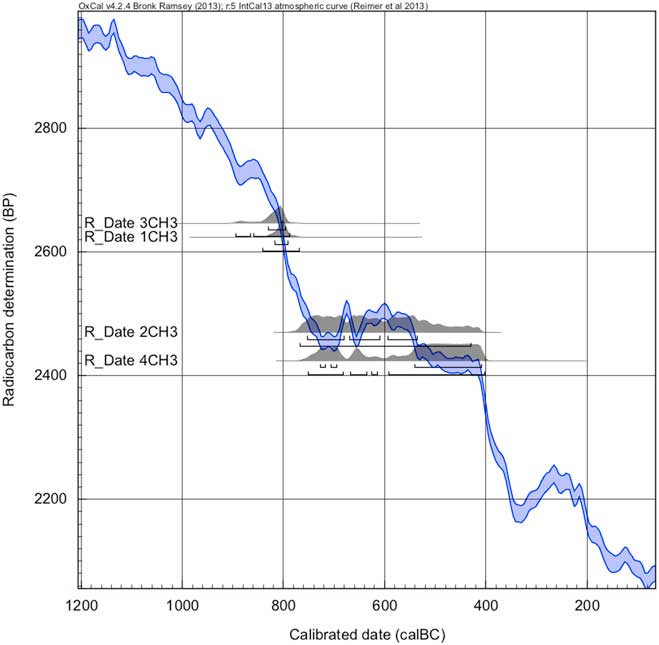
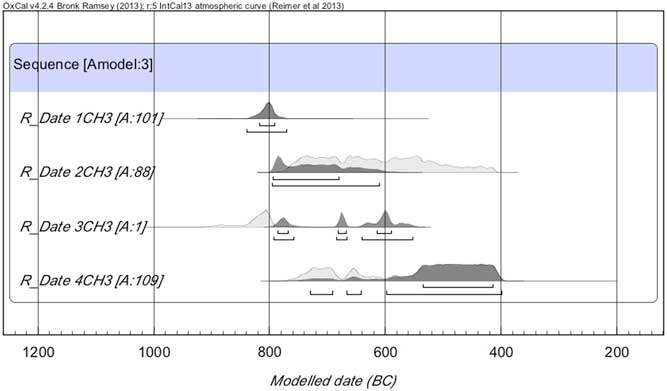
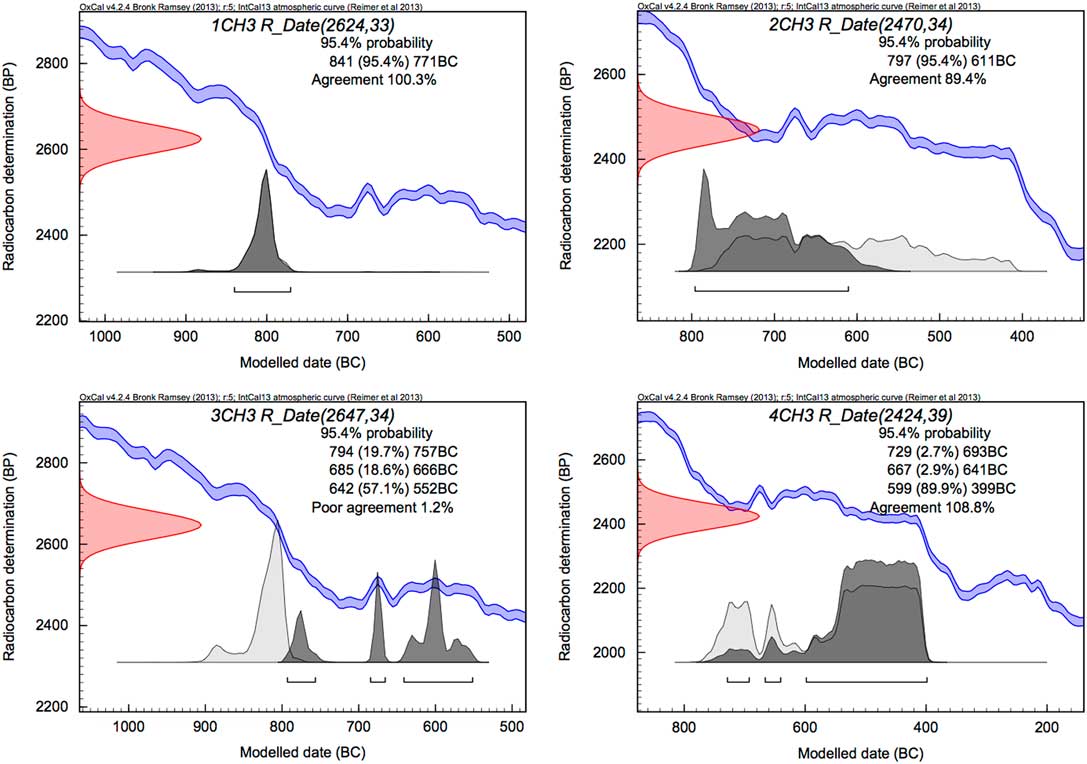
Four other 14C dates of sample CH3 calibrated individually between 860 and 400 cal BC (95.4%) regardless of the precision of 14C measurements and tree-ring crossdated position, which make the kurgan age estimation problematic (Figure 4). Once again, the Hallstatt plateau of the calibration curve confounds the 14C dates during the 1st millennium BC and obscures the 14C dating of Saka kurgans in the Altai Mountains (van der Plicht Reference van der Plicht2004; Panyushkina et al. Reference Panyushkina, Grigoriev, Lange and Alimbay2013). Nevertheless, because these four dates are from sequential crossdated tree rings over a ~90-yr interval (Table 2), we employ Bayesian modeling to improve the interpretation of the calibration results. 14C wiggle-matching (Bronk Ramsey et al. Reference Bronk Ramsey, van der Plicht and Weninger2001) of the four CH3 dates yields high agreement indexes (>89–110%) for most of the dates (Figure 5). Only one date (3CH3) has poor correspondence with the sequenced group (agreement index 1.2%), but elimination of this one does not change the calibration results much. The Bayesian modeling estimates the calibrated age of sample CH3 between 840–770 cal BC (95.4%) and 730–690 cal BC (2.7%) or 840–770 cal BC (95.4%) and 600–400 cal BC (89.9%). Careful consideration of the 90-yr tree-ring range of 14C wiggles and the range of 14C measurements with the highest agreement index (1CH3 and 4CH3) suggests the most probable age of Baigetobe kurgan is about 730–690 cal BC (Figure 6). This calibration result convincingly demonstrates that a single 14C date from a piece of Saka archaeological wood is not reliable for estimating the calendar age of the Asian Scythian monuments.
Results of individual calibrated 14C dates measured on the tree rings of tree CH3. Probability distribution (shaded area) is plotted against the IntCal13 calibration curve (Reimer et al. Reference Reimer, Bard, Bayliss, Beck, Blackwell, Bronk Ramsey, Buck, Cheng, Edwards, Friedrich, Grootes, Guilderson, Haflidason, Hajdas, Hatté, Heaton, Hoffmann, Hogg, Hughen, Kaiser, Kromer, Manning, Niu, Reimer, Richards, Scott, Southon, Staff, Turney and van der Plicht2013). The bars under the probability distribution show the ranges at 68.2% and 95.4%.

Calibration results of 14C wiggle-matching of four-point sequence from the CH3 tree rings. The gray-shaded probability distributions represent individual calibrated dates and the black-shaded probability distributions show the modeled calibrated dates using the Bayesian method. The bars under the probability distribution show 95.4% range. “A” is the agreement index.

Modeled probability distributions of individual dates from the tree-ring sample CH3, which are about 90 yr apart (Table 2), suggesting the most probable date of the CH3 outer rings is ~730–690 cal BC (see light-gray shaded area 4CH3 plot).

DISCUSSION
Chronology of the Shilikty Valley
Archaeological dating assigns the age of the Baigetobe kurgan between the early 8th and mid-7th centuries BC based on the typology of grave goods (Toleubayev Reference Toleubayev2011). Earlier 14C dating of the Baigetobe wood dates the kurgan to the interval 770–430 cal BC (Toleubayev Reference Toleubayev2011; Table 2). Our 14C dating results refine and focus the suggested date to ~730–690 BC. At the Shilikty Valley, there is no other reasonable radiometric dating result to suggest the relative span of the burial site construction. The only other 14C date for the Shilikty Valley chronology comes from kurgan #5 cemetery-1 excavated by Chernikov (in Dolukhanov et al. Reference Dolukhanov, Romanova and Semyontsov1970). The date was rejected and the kurgan age is estimated between the 7th and 6th centuries due to the arrowhead and Animal Style art typology (Chernikov Reference Chernikov1965). Middle-sized kurgan #7 from Chernikov’s excavations at cemetery-1 is dated to the late 5th century BC from the burial goods (Chernikov Reference Chernikov1951). The rest of the excavated kurgans have a much lower number of diagnostic burial goods, but the funeral tradition certainly resembles the Early Saka. Currently, there are no archaeological data to determine the age of four other cemeteries (2, 4–6) or the final age of the cemetery’s construction. Seemingly, the age of excavated kurgans at the Shilikty Valley ranges between 730 and 500 BC, bracketing the Early Saka in the region. Possibly, our dating results establish the onset of cemetery-3 or the entire Shilikty Valley development because the Baigetobe is one of the largest and most important kurgans in the group and so far at the site. Cemetery-1 could be a century younger or contemporaneous.
Age Correspondence of the Baigetobe Kurgan with other Scythian Monuments
The Asian Scythian sites scattered across Central Asia belong to various chronological and cultural phases of the Iron Age. With the current state of absolute Scythian chronology, the temporal-spatial patterns of the ethno-cultural landscape in the Scythian Antiquity are far from being clear. The regional radiometric chronology of Saka kurgans in southern Kazakhstan published by Dolukhanov et al. (Reference Dolukhanov, Romanova and Semyontsov1970) and later updated by Zaitzeva et al. (2005) indicates an extremely low number of 14C dates in comparison with the number of 14C dates for the European and Siberian Scythians. Material dating is the most common means of age estimation for thousands of burial occurrences in Central Asia. As mentioned earlier, the gold collection of Shilikty is quite unique; the closest analogue of the Animal Style designs emanates from the European Scythian kurgans including the Kelermes, the Kostromskoy, the Tomakovskiy and other early Iron Age kurgans dated to the 7th–6th centuries BC in the North Caucasus region (Chernikov Reference Chernikov1964; Meyer Reference Meyer2013). Additionally, some technical characteristics and few stylistic images of the Shilikty gold (e.g. boar and fish) are similar to gold collection of the Arjan-2 kurgan, the legendary intact kurgan of Early Siberian Scythians to the northeast of the Altai-Sayan region in Tuva, Russia (Čugunov et al. Reference Čugunov, Parzinger and Nagler2010).
The architecture and construction technology of the Baigetobe kurgan appear more comparable at the local (Shilikty Valley) and regional (Central Asia) scales. Large kurgans from the Shilikty Valley (cemetery-1; Chernikov Reference Chernikov1965), the Ili River Valley at the Semirachye (Bes Shatyr site; Akishev and Kushaev Reference Akishev and Kushaev1963), and the Syr Darya Delta near the Aral Sea (Tagisken kurgan; Tolstov Reference Tolstov1962) have a number of principal similarities in the kurgan construction, including the dimensions of outer and inner surface elements of burial mound, funeral chamber, east-facing underground moat (called in Russian literature a dromos), and building materials. The age of this kurgan sequence ranges from about 700 to 500 BC. Based on our dating results of the Baigetobe kurgan implemented with 14C wiggle-matching and tree-ring analysis, it is likely that this kurgan was one of the earliest kurgans from known Saka elite kurgans and the predecessor of the majority of burial occurrences in Central Asia. Moreover, the correlation of burial rites and absolute ages between the Baigetobe kurgan and the early European and Early Siberian Scythians suggests the importance and impact of this kurgan to the onset of Saka nomadic culture in Central Asia.
CONCLUSIONS
The Bayesian modeling probability distribution of sequenced 14C dates has resolved the calibration uncertainties caused by the Hallstatt plateau of the calibration curve and estimated the absolute age of the Baigetobe kurgan (kurgan#1 of Shilikty cemetery-3) at ~730–690 BC. This derived age is close to the archaeological dating designated by the burial typology of Early Saka between the early 8th and mid-7th century BC.
Our dating results indicate that the Baigetobe kurgan was nearly contemporaneous to the Arjan-2 kurgan (Tuva) and could be one of the earliest kurgans of the Saka-Scythian elite in Central Asia, but very few of the hundreds of large kurgans have been excavated and dated. More dating results will help to build a more complete picture and add to the chronology of the region.
ACKNOWLEDGMENTS
This work was funded through NSF BCS #0207654 and #1122398 awards to I Panyushkina and RFFI #14-50-00036 to I Slyusarenko. We thank Dr Alex Wiedenhoeft at the USDA Forest Product Lab (Madison, WI, USA) for wood identification.