Much of contemporary discourse surrounding family support obligations has long centered on parents’ financial contributions to their minor children. “Deadbeat Dads” who failed to meet parental support obligations, and whose children required public assistance, were central targets in the 1996 welfare reforms. Largely absent in these debates was the responsibility of other family members—adult children, grandparents, siblings, and grandchildren—to support family members in need. In 2005, thirty states still had laws requiring adult children to support needy parents, although enforcement of such obligations had waned a generation earlier.Footnote 1
In the face of rising health-care costs, third-party providers, such as nursing homes, are using laws requiring support to recover unpaid bills. Elnora Thomas of Florida and her sister were sued by her mother’s nursing home for unpaid bills totaling $50,000 in 2007. The suit threatened to place a lien on Thomas’s home, her only major asset. Attorneys helped her mother qualify for Medicaid to pay for the nursing home and the suit was dropped.Footnote 2 Two years later, fifty lawsuits were filed by long-term-care facilities in Pennsylvania seeking payment from adult children for parents’ medical bills. John Pittas was the target of one such lawsuit. In 2012, Pittas’s mother was seriously injured in a car accident and received nursing home care for six months while she recovered. When able, she returned to Greece, and the nursing home sued her son for the $92,000 she owed for care. The Pennsylvania Superior Court ruled that, under the state’s filial responsibility laws, Pittas was legally responsible for the unpaid balance.Footnote 3
Pennsylvania, South Dakota, and California are among the states turning to filial responsibility laws to address the high medical costs the elderly often face in their later years. Escalating costs of nursing home care are prompting providers to use the laws to enforce the legal obligation of adult children to contribute to their parents’ medical care. The Pennsylvania legislature revitalized its law in 2005, and one outcome was to enable nursing homes to sue family members for unpaid bills under filial responsibility statutes.Footnote 4 One legal scholar calls these laws “America’s best kept secret,” and some argue that enforcing such responsibility will lessen the burden of medical costs on Medicaid and encourage individuals to better plan for health care costs with long-term care insurance.Footnote 5
Historically, policies aimed at requiring or encouraging the support of aging parents by adult children and other relatives were designed to alleviate poverty among the aged and to limit dependence on public funds. I define dependent parents as aged Americans who had too few financial resources to meet their needs and thus relied not only on public benefits but also on the willingness of family, often adult children, to contribute to their support. Adult children were defined as individuals over the age of eighteen who had the financial means to provide support. Parent dependency policies, as I term them, initially prioritized support by family members before needy parents turned to public assistance, but the scope of these policies expanded to include survivor benefits under the Social Security Act (SSA) federal tax incentives by the mid-twentieth century. Parent dependency policies transcended the different tracks of the American welfare state—means-tested, contributory, and tax expenditures. Contemporary applications of these laws seek to ensure that adult children who have the means, or who are the beneficiaries of their parents’ estate, compensate private and public medical care facilities for the unmet bills for their parents’ medical care.
This article focuses on responsible relative laws in the Old Age Assistance (OAA) program as a means to address aging parents’ financial needs. Although a federal program, OAA was funded by state, federal, and in some cases, local funds. States had some administrative discretion within the regulations of the SSA, and many states opted to enforce family support obligations as a condition of eligibility for assistance. Adult children were the primary targets of these laws in the OAA program. The Social Security Administration did not encourage such laws, and by the 1940s recommended that states remove such requirements from their public assistance programs. Many states ignored the suggestions, in part due to resistance to federal authority under the Social Security Administration. In addition, states and local governments, because they funded half the cost of OAA, used eligibility rules, including family support obligations, to control those costs. Monetary contributions by family members, even if only partial support, reduced the public funds needed to provide for aging parents’ needs, thus reducing the demands on state and local dollars. Bound with this were beliefs regarding who should support those in need: the family or the government, whether it was local, state, or federal. Responsible relative laws were an arena of public assistance that remained under state discretion, and many states used them to control costs and contest federal efforts to modernize relief programs and limit state and local authority.
Old Age Assistance and Old Age and Survivors Insurance
The relationship between Old Age Assistance and Old Age Insurance (later Old Age and Survivors Insurance) under the Social Security Act of 1935 is critical in the analysis of parent dependency; the two programs developed in tandem and the expansion of OAI directly affected the numbers of elderly receiving OAA.Footnote 6 The two programs were intended to address the spectrum of old-age dependency via both public assistance and social insurance, and represent two tracks of the Social Security Act: contributory and means-tested or need-based.Footnote 7 OAA was one of three means-tested programs in the SSA (in addition to Aid to Blind and Aid to Dependent Children); OAA targeted Americans over sixty-five who did not qualify for OASI and did not have sufficient income to meet their basic needs. Old Age Insurance was a contributory program funded by payroll taxes from both employees and employers; the goal was to provide retired workers, at the age of sixty-five, with a monthly benefit based on their earnings and contributions. Under the 1939 amendments to the Social Security Act, widows, children, and dependent parents were eligible for survivor benefits based on the earnings of the deceased worker, and the program was renamed Old Age and Survivors Insurance (OASI).Footnote 8
The three public assistance programs under the SSA were financial partnerships between the states and federal government; the federal government provided matching funds to a specific limit in each program. Grants were matched on a 50–50 basis under OAA and AB, but federal funds covered just one-third of the maximum grants on ADC; states and local governments were responsible for the remaining two-thirds. Both states and the federal government funded the programs via general tax revenues. Eligibility centered on financial need, and, as noted, states had some latitude in what criteria they employed to determine eligibility, including responsible relative laws. The latitude granted created space for states to resist federal authority, and to reduce public assistance costs by limiting eligibility or discouraging applicants at the outset. Responsible relative laws mandated support by family members, particularly adult children; if family members were able to provide financial help, the application was either rejected or the grant awarded was reduced. Property lien laws and recovery laws enabled state and county governments to recoup the cost of OAA from a recipient’s estate or property. States resisted federal confidentiality requirements in the public assistance programs in part because proponents argued that publicizing the names of recipients would “shame” family members into supporting their parents. All of these policies sought to ensure that family members provided support before public funds did, and to prevent family members who did not provide support from benefiting from the recipient’s estate. General relief, or general assistance, programs, or aid to those individuals who did not fit one of the categorical aid programs of the Social Security Act, remained under state and local control, with no federal guidelines or funding. State responsible relative laws also applied to general relief programs, but those programs were independent of federal authority and entirely under state and local control.
OAA was the major program addressing the elderly poor under the Social Security Act, and the number of OAA recipients outpaced OASI beneficiaries until the 1950s. OAI benefits did not begin until 1940, even with the 1939 amendments creating survivor benefits under the renamed OASI. Occupational exclusions also limited access; scholars estimate that initial coverage provided benefits for about half of all workers, or 26 million people. Domestic and agricultural workers were excluded, as well as public employees and those employed by nonprofits.Footnote 9 Because of the limited benefits under OASI, some elderly received both OAA and OASI, speaking further to the interconnected nature of the two programs. In 1949, the average OASI benefit was $25, while the average OAA grant was $42.Footnote 10 Recipients of OAA numbered 1.738 million in September 1938, or about 21.6 percent of all Americans over sixty-five.Footnote 11 In 1949, OASI beneficiaries numbered 1.67 million, while 2.49 million elderly relied on OAA.Footnote 12 In 1954, more than half of all elderly were not eligible for OASI, and most relied at least in part on OAA.Footnote 13 Amendments in 1950, 1954, and 1956 greatly expanded coverage of OASI, but did not eliminate the need for OAA. By 1960, OASI recipients outnumbered OAA recipients four to one, but 2.4 million aged still relied on OAA for support.Footnote 14
Scholars argue that the Social Security Act of 1935, which brought public assistance and social insurance programs into federal American social policy, profoundly affected family relations and responsibility. In this view, the SSA was part of an ongoing trend of shifting responsibilities once held by the family to the state. It reshaped the role of the federal government and families in promoting the security of Americans by instituting a national social insurance program, albeit on a limited scale in the first decades, and brought federal funds into the categorical public assistance programs, including OAA, Aid to Dependent Children (ADC) and Aid to the Blind (AB). OAI, and subsequently OASI, required citizens to save for their retirement, provided the elderly with income that enabled many to live independently, and reduced the burden of care on their children. Carole Haber and Brian Gratton argue that social insurance reshaped the economic relationships within families and “made the aged the children of the state.”Footnote 15 Andrew Achenbaum argues that the public assistance and social insurance programs provided more resources for the middle-aged by reducing the need to support their aging parents: OAA and OASI “were thus inspired by a genuine (and imaginative) concern for addressing the vicissitudes of old age in the context of the family and the passage of generations.”Footnote 16 Other scholars assert that programs such as social insurance and Medicare (enacted in 1965) were critical for aging Americans, but “their adult children benefit almost as much. The financial burden of parent-care has been lifted from their backs.”Footnote 17 In this view, the SSA enabled adult children to shift resources from supporting elderly parents to addressing the economic needs of their own children.
Consideration of parent dependency policies complicates this assessment. These policies were predicated on specific notions of family obligations, and demonstrate how policymakers and those administering the programs viewed family as a means to secure specific policy goals—such as financial support for an aging parent.Footnote 18 Policies either regulating or rewarding family support sought to gain economic resources for elderly in need by tapping into the resources of adult children. State-level responsible relative laws sought to enforce support obligations on children whose parents applied for public assistance programs, particularly OAA. The process investigated the need of the parent and then the resources available through their adult children. Proponents of responsible relative laws believed that the first line of support for people in need should be family. Survivor benefits (OASI) in the 1939 amendments to the SSA were conceptualized as a return on adult children’s contributions; the deceased adult child left neither a wife nor children, and thus dependent parents could receive survivor benefits in the interests of equity for their adult son or daughter. Providing benefits for surviving dependent parents ensured that the contributions paid by the worker were not wasted. Adult children remained a key part of support expectations for elderly parents, even after the 1935 Social Security Act.
Responsible Relative Laws
The implementation of the public assistance programs of the SSA prompted significant revision of state and local relief programs. States received matching funds for the grants they provided to public assistance recipients, including OAA, but also had to meet federal guidelines to be eligible for the federal funds. Under OAA, federal dollars would match half the grant’s amount to a specific limit, which began at $30 in 1935 and reached $70 in 1962.Footnote 19 Thus states that spent more on OAA received more federal funds.Footnote 20 The SSA, building on regulations enacted via the Federal Emergency Relief Administration in 1933, required that programs be available across the state and administered uniformly under state supervision via a central agency. Agencies were to be staffed by trained social workers selected under a merit system. The goal was to reshape public relief programs.
Conflict between state and county governments, as well as state and federal officials, occurred under FERA, and continued under the public assistance programs of the SSA. FERA was a temporary program designed to address the emergency of the depression; the SSA was intended to provide long-term security to needy Americans. Implementation of the public assistance programs in the SSA encroached on state and local authority and asked states and local governments to fundamentally rethink their approach to relief on a much more permanent basis. States did retain some autonomy in specific eligibility questions, including residence, citizenship, and support obligations, but their plans had to conform to other federal guidelines. Karen Tani argues that a key result of this reconfiguration of relief was to create a right to relief; absent eligibility exclusions, anyone who qualified for a public assistance program was entitled to aid. States not only resisted federal authority over state and local relief administrations, but some also rejected the belief that all eligible individuals should qualify for public assistance.Footnote 21 The persistence of responsible relative laws was a manifestation of state resistance to federal authority and the subsequent increase in public assistance caseloads. The resurgence in responsible relative provisions in the 1940s and 1950s, including property lien and recovery laws, was in part due to state legislative action intended to stem the “rights” language and authority of state welfare agencies and caseworkers, as well as to contain costs.
The millions of Americans who relied on OAA for support had to prove and continue to demonstrate need to receive benefits. A critical part of the investigation of need was relatives’ support, also known as “responsible relative laws” or filial responsibility laws (the term used today). In the enforcement of responsible relative laws, states specified appropriate family behavior and obligations. The goal of responsible relative laws in most states was twofold: to strengthen families by enforcing the moral obligation to aid one another and to reduce the financial burden on the public for the support of the needy.Footnote 22 State responsible relative laws sought to enforce specific types of “ideal” family behavior. This speaks to Patricia Strach and Kathleen Sullivan’s argument about deploying the institution of the family to achieve public policy goals: “what authority can [the government] muster over a family to ensure compliance?”Footnote 23 Exerting that authority resulted in conflicts between federal and state officials who disagreed on the boundaries of governmental authority and between caseworkers and family members asked to provide support. Enforcement also could generate discord between family members over the state’s demand that an adult son or daughter provide support for a parent applying for or receiving OAA. In public assistance, the contest was over whether the state or family had the primary obligation to support the needy, and if the family member could in fact provide financial support.
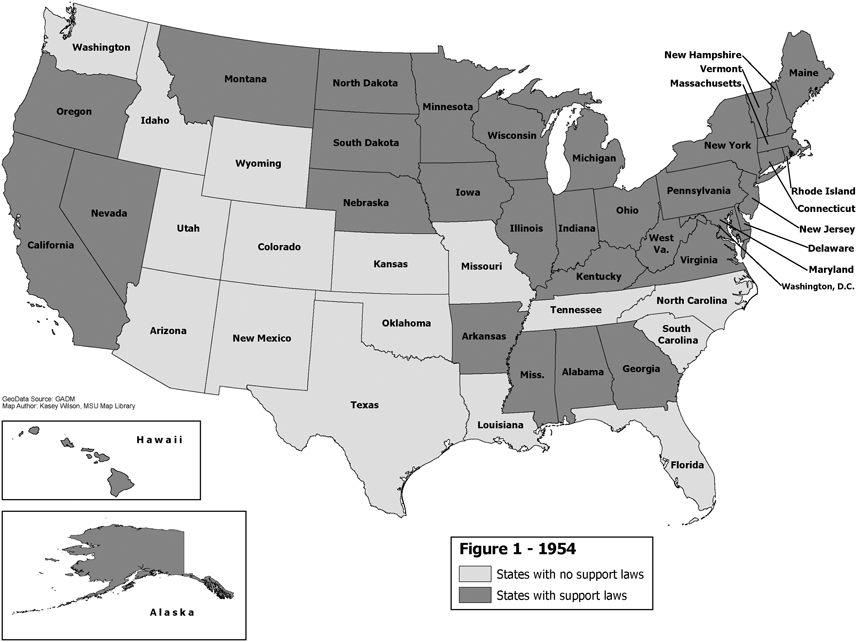
Responsible relative laws have a long history in poor relief and represent a continuity in many public assistance programs before and after the 1935 Social Security Act. Many states retained and strengthened their enforcement of the responsibility of relatives, particularly adult children, in the first decades of the SSA’s implementation. These laws date to the earliest poor laws in the country and included the responsibility of parents to support their children and for adult children to support parents.Footnote 24 States began to criminalize desertion and nonsupport of wives and children in the early twentieth century, but the obligation for other family members to provide support remained in welfare laws.Footnote 25 By 1935, nine states defined legal responsible relatives as parents, grandparents, siblings, children, and grandchildren in their general relief laws. Another nine states did not include siblings, and most others mandated parents and children. Just nine states had no legal requirement for relatives to support family.Footnote 26 In 1952, thirty-five states had laws specifically addressing the responsibility of children to support parents (Fig. 1).Footnote 27 That number remained constant as late as 1967, as did the responsibility of adult children to support parents; twenty-eight states still had some form of responsible relative law in 1988, although enforcement had waned considerably.Footnote 28 Most states retained the legal responsibility of families to support one another, particularly regarding child and parent dependency, although their methods and attention to enforcing such support varied.Footnote 29
Support laws by state in 1954.

The Social Security Act neither prohibited nor encouraged responsible relative laws, and whether to enforce such support was left largely to state discretion. The SSA included only the requirement that all income and resources available to the applicant be considered in the granting of public assistance and made no specific reference to responsible relatives, leaving it to states to determine need. Determination of needs was to be based on objective standards used throughout the state. Amendments in 1941 sought to clarify the determination of need, and the Social Security Board advised that “the purpose of these amendments is to assure that the State agency shall give consideration to all relevant facts necessary to an equitable determination of need and amount of assistance.”Footnote 30 Thus states could mandate that relatives provide support if able, although this was not required under the Social Security Act, but they also could not ignore such income if it was provided.Footnote 31 By 1946, the Social Security Board recommended that states repeal responsible relative laws and instead use general support laws to enforce support.Footnote 32 Absent an outright prohibition of such requirements, most states included the legal responsibility of relatives to provide support in their laws in the early years of the Social Security Act.
The belief that OAA was a pension, a benefit earned through either a lifetime of paying taxes on the part of the aged parent or by children who were contributing to the OASI program through payroll taxes, emerged in the enforcement of responsible relative laws. Some recipients and their children believed the payroll taxes collected for OASI funded OAA; they rejected the idea that eligibility for OAA required proof of need. OAA was consistently referred to as an “old age pension,” causing further confusion. As noted earlier, far more people received OAA benefits rather than OASI, contributing to the confusion over what was assistance and what was an earned benefit. Michigan officials reported that many complaints from children about the responsible relative requirements reflected misconceptions about OAA: “To many children, as to many recipients, old age assistance is a ‘pension’ and is considered a reward for having paid taxes and having been a good citizen.” In their minds, OAA was not a means-tested program funded by general tax revenues but was paid for through “the deductions from their pay checks for old age and survivors’ insurance.”Footnote 33 Federal officials sought to reshape the poor relief system into a more modern welfare program, but they emphasized that such aid was based on need.Footnote 34 California officials had similar experiences, sending information on the program to children upset at intrusive investigations into their finances. One daughter inquired about the requirement to support in 1943; in a reply, public assistance officials noted that “since Social Security taxes are being paid, you do not understand why it is necessary for aged persons to depend on their children for support.” The daughter assumed that payroll taxes were funding the old age assistance program. Officials enclosed information explaining the difference between the social insurance program and the public assistance program.Footnote 35 Members of the California social welfare board noted in 1941 that even legislators referred to Old Age Security (California’s OAA program) as a pension, contributing to the confusion.Footnote 36 An article published in 1940 in Public Welfare in Indiana sought to clarify the difference between the public assistance programs and other contributory programs: “Let us look at a definition of the misunderstood term in order to justify the flat statement that the word ‘pensions’, as used in this instance, is a misnomer.”Footnote 37 In a more extreme example, in the 1940s, Maryland caseworkers rejected an application outright if an individual requested “a ‘pension’ rather than . . . public assistance.”Footnote 38
The numerous pension movements across the country in the 1930s and 1940s also fostered the idea that OAA was—or should be—a pension. In the 1930s and 1940s, the movements in various forms argued for a flat pension for all senior citizens, and California was the site of several drives to create a uniform pension for all aging Americans. The Townsend Plan was perhaps the most well known, and spread nationally, but others fueled the idea of a pension as an earned right of the aged.Footnote 39 Rejection of the means test in the OAA was a consistent theme in the many organizations that developed in the state. Pressure from a proposed initiative by the Fraternal Order of Eagles, a pension organization, prompted the Nevada legislature to amend its OAA law in 1943, including eliminating responsible relative requirements and raising the minimum OAA grant from $30 to $40.Footnote 40 Another success for the pension movement was the passage of a constitutional amendment in California in 1948 that guaranteed OAA and Aid to the Blind recipients a grant of $75 and $85, respectively, up from $60 and $75, and also removed the responsible relative provisions, “eliminat[ing] the harassing of recipients whose children cannot or will not contribute to their support.”Footnote 41 The Washington Pension Union sponsored Initiative 172 in 1948 seeking to repeal restrictive legislation passed the previous year; that law had reduced minimum grants and instituted a property lien provision. The Initiative, which called for a $60 minimum monthly grant and elimination of both responsible relative support laws and the property lien provision, passed with 54 percent of votes cast on the initiative.Footnote 42 The Indiana Chamber of Commerce identified the lack of an organized pension movement in the state as a key reason for the state’s legislative record in enforcing support obligations, particularly for recovery laws: “The Indiana experience also has demonstrated that the unpopularity and political onus supposedly accompanying this type of legislation are almost entirely the creation of professional pension promoters. The absence of a highly-organized ‘pension group’ in this state appears to indicate acceptance of the fairness of the Indiana law by the aged persons receiving assistance under its provisions.”Footnote 43
Responsible relative laws in their various forms (support obligations, lien and recovery laws, and confidentiality provisions) saw a resurgence in the post–WWII era, despite the position of the Social Security Board or efforts by pension organizations.Footnote 44 A 1945 Social Security state letter optimistically—and prematurely—noted that many states were heeding federal officials’ advice by removing support obligations from their laws; the letter noted that just eleven states had responsible relative provisions in 1944.Footnote 45 As caseloads and public assistance costs increased in the next decade, states sought to limit eligibility to reduce costs and to push back on federal authority by either strengthening or creating responsible relative provisions.Footnote 46 The resurgence of responsible relative expectations was part of both the backlash against welfare costs in the post–WWII era as well as the resistance of states to what they saw as intrusive federal authority and the concept of a right to relief.
Advocates of responsible relative laws—legislators, business advocates, social welfare administrators, and local officials—often invoked fiscal concerns and a defense of taxpayers’ interests in these debates. Because taxpayers funded public assistance, supporters of responsible relative laws believed that families should provide for their parents before taxpayers were asked to pay for their care. In the late 1940s, South Dakota’s state legislators strengthened responsible relative laws due to rising caseloads and “the feeling that children were shirking their responsibilities.”Footnote 47 The legislature adopted a resolution affirming the state law requiring support of aging parents by adult children if financially able, and explicitly linked it to the need to contain public assistance costs. In Indiana, stakeholders often invoked the image of the taxpayer in efforts to limit those costs. A 1938 resolution adopted by eight counties and sent to the state Board of Public Welfare called for more stringent enforcement of responsible relative laws; the lack of enforcement “result[s] in unfairness to the taxpayer when taxes are required to furnish the assistance which such responsible relatives should.”Footnote 48 After California voters eliminated the responsible relative requirements in the state’s Old Age Security law via constitutional amendment in 1948, caseloads increased about 19 percent during the year the change was in effect (the amendment was repealed in 1949), with additional costs of $71 million.Footnote 49 A 1951 state senate report investigating the state’s social welfare legislation recommended ensuring that those eligible received needed assistance but “with due consideration to the safeguarding of expenditures of public funds.”Footnote 50 Containing the costs of OAA was a key motivation behind responsible relative laws.
Defending state authority against federal encroachment was a subtext of debates over responsible relative laws and intersected with rejecting the concept of a right to public assistance. In some states, a belief that the state welfare agency took the rights language too far, resulting in rising caseloads and the “pension” idea, prompted legislators to strengthen laws in response. These debates culminated in Indiana in a 1943 call for a Welfare Investigation Commission to study public welfare administration, resulting in a 1944 report harshly critical of the department’s programs and calling for more local control.Footnote 51
One manifestation of the goal to ensure state and local authority was via the responsible relative laws, which the commission clearly saw as an important part of efficient and fiscally responsible welfare administration. The commission’s fourth recommendation was to strengthen enforcement of responsible relative laws when welfare departments grew too “passive” in their investigation of relatives. The commission sought the right of local boards of public welfare to bring court action against relatives who did not provide support. A key premise favored local control over federal authority in public assistance: “Further, the entire program should be so administered as to conform as much as possible to the desires and wishes of local county boards, and their degree of willingness to accept the program.”Footnote 52 This directly contradicted the criticisms of the federal officials who sought to establish uniform administrative practices throughout the state.Footnote 53
The state Department of Public Welfare’s response to the call for power to initiate enforcement action reveals the fundamental difference in philosophy in public assistance administration. While the commission sought to use enforcement powers of the courts to compel support, the DPW argued that such efforts, already available to county agencies, rarely lead to convictions and support. Instead, they tended to further harm already weak family relationships: “[Such efforts] usually cause relatives to break off all social relationships with the recipient. The department believes that it is desirable to maintain and to strengthen family relationships whenever possible, and that this can best be done by working co-operatively with the relatives and the recipient.”Footnote 54 The department argued that its purpose was to provide assistance to those in need, and not to enforce family relations.
State legislators and the governor disagreed. The report’s criticisms generated legislative change in several areas, including the enforcement of responsible relative laws, although it did not occur immediately.Footnote 55 A new state board of public welfare was appointed, and Otto Walls, a vocal proponent of state and local control, was named director in 1945. Walls called for local and state administration of the SSA, with an end to federal government regulation.Footnote 56 A 1947 law clearly outlined the responsibility of children to support aging parents in need, provided the parents supported the child until he or she was sixteen. It allowed county agencies, as well as parents, to use the law to enforce support, which Public Welfare in Indiana termed “helpful.”Footnote 57 An Indiana welfare official applauded the stricter laws, arguing that “laws have educational value. They stand as sign posts of reality and stem from man’s recognition of moral values.”Footnote 58 The goal was to enhance the enforcement provisions of the responsible relative laws to ensure that ordered support was received.
In Maine, a legislative review of welfare policies in the early 1940s found that caseworkers minimized the idea of legal responsibility and seldom pushed the responsibility of relatives’ support. Federal officials commented on the significant criticism targeting the state’s social welfare agency and conflicts between the state board and legislators.Footnote 59 The legislature responded with new laws in 1947 that required investigation of all adult children and spouses in old-age assistance cases, including “an individual sworn statement of inability to support.” Applications without these statements were denied. Once the ability to support was determined, the willingness of relatives to support was assumed, and the refusal of able relatives to provide financially for their family members resulted in the denial or closure of the case in 1948.Footnote 60 South Dakota legislators expressed repeated concern with what they perceived to be lax enforcement of the responsibility of relatives in OAA and the belief that children were not supporting parents when they could. A review in early 1947 specifically investigated all OAA cases to ensure that relatives were not able to provide support.Footnote 61 County directors felt it yielded minimal results, but legislators again criticized the state welfare agency that fall, arguing that it did not use its funds well, and needed to “tighten up the administration of the programs.” The department responded with a series of resolutions, one of which reiterated the agency’s commitment to enforcing support of relatives more stringently.Footnote 62 Even before public assistance caseloads began to explode in the 1950s, states sought to retain the responsibility of relatives to contribute to family members’ support.
Property Liens
Indiana was one of many states that deployed property liens or recovery laws to discourage applications and to encourage family support as part of its enforcement of responsible relative laws. The practice speaks to present-day efforts via the courts by nursing homes to force children who were beneficiaries of their parents’ estate to pay unpaid medical bills. Indiana offers an illustrative example as the state legislature eliminated its property lien law in 1941, and then reinstated it six years later. Indiana’s 1936 Welfare Act required applicants to sign a property lien on any real property in order to be eligible for OAA. Liens and recovery laws enabled county governments to make a claim against the recipient’s estate for any public assistance paid; any funds recovered were shared with the state and federal government. The legislature, in efforts to liberalize the law and ensure that those in need were eligible, repealed the law in 1941.Footnote 63 In effect, this changed the program, according to Public Welfare in Indiana, “from a ‘need-loan’ basis to a ‘need-grant’ basis.”Footnote 64 Caseloads increased in the next two years, including 7,420 cases in the first year.Footnote 65
The Indiana legislature reinstated the property lien law in 1947 despite opposition from the state welfare board, and the target was adult children who shirked their responsibility to support aging parents.Footnote 66 Restoring the lien was one of the recommendations of Indiana’s 1943 Welfare Investigation Commission, which called the law’s repeal an error in need of remedy; county boards also urged reinstatement of the law, as did the county welfare directors’ association and the state Chamber of Commerce.Footnote 67 The commission report noted that the only group that benefited from this change were the heirs of OAA recipients and argued that “no other feature of the present welfare program has caused such wide dissatisfaction.”Footnote 68 In its analysis of the lien law after its reinstatement, the Indiana Chamber of Commerce argued that the restoration of the law was “good government, good politics, good case work, and does not deprive a single aged person of assistance to which he is entitled legally. It merely prevents the heirs who did not support their aged relative from receiving a ‘bonus’ at the expense of the taxpayers.”Footnote 69 One state senator echoed that point in debates over restoring the lien in 1947, arguing that “the whole point of this lien provision is to prevent leaving estates of these elderly people to someone who does not deserve them.”Footnote 70 Public Welfare in Indiana, in bold print, wrote that “the greatest value of the 1947 lien and recovery amendment of The Welfare Act is the deterrent effect upon persons who are not actually in need. . . . Children who are financially able to support their needy aged parent or parents make a real effort to meet their legal obligation when they realized that any amount paid from public funds comes out of any property left by the deceased recipient.”Footnote 71 For those who wished to inherit the parents’ property, keeping the property free from debt encouraged support.Footnote 72 South Dakota’s Department of Social Security recognized that some children did not support their parents “maybe through no fault of their own,” but then “desire what little property there may be remaining” after the death of the parent. But ultimately recovered funds “when turned back to the State [are] again used to care for some other needy aged person.”Footnote 73
California’s state senators shared such sentiments, arguing in a 1953 report that “the taxpayer should not be expected to help provide these benefits to the aged recipient whose estate at his death will go to relatives who did not assume the responsibility for furnishing the necessities of life to the recipient.”Footnote 74 The same report found that states with recovery and lien provisions in their public assistance laws had the lowest number of recipients (according to population) when compared to states that had either recovery or lien laws, or none at all.Footnote 75 California voters eliminated the property lien law in 1940 via a constitutional amendment and legislators attempted more than once to reinstate the law, with no success.Footnote 76
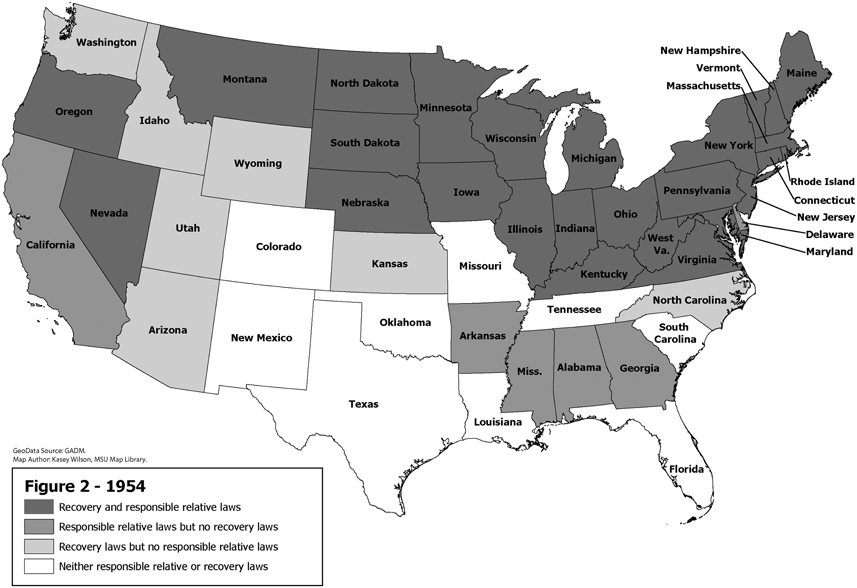
Indiana was part of a larger trend to employ recovery and lien provisions to reduce costs in its public assistance programs. Like responsible relative laws, the Social Security Administration discouraged such provisions as a condition of eligibility. In 1935, twenty-six states allowed recovery of general relief funds from recipients’ estates, and all but five states had some type of recovery law (either recovery from the deceased estate, property liens, or recovery from property acquired) for recipients of Old Age Assistance.Footnote 77 Thirty-three states had recovery laws by 1946.Footnote 78 Washington reinstated its recovery law in 1950, reversing the initiative eliminating the lien law two years earlier.Footnote 79 Utah enacted a lien law in 1948, and Tennessee passed its first recovery law in 1949.Footnote 80 Just nine states had neither responsible relative nor recovery laws, while seven states had a recovery law but no responsible relative law in 1953 (Fig. 2). State laws varied on the prioritization of the state’s claim against the property in comparison to other creditors, but most required reimbursement for any assistance paid.Footnote 81
Recovery and responsible relative laws by state in 1954.

Deterring applications, while also encouraging support from children, were key goals of such laws. According to Indiana officials, reinstating the property law not only generated funds via recovery from estates for assistance paid (totaling nearly $14,000 in December 1947) but also significantly reduced the caseload: officials attributed the 10 percent decline in the caseload to the reinstatement of the lien law. The decline remained steady in the following months, saving $115,000 in funds in one month.Footnote 82 The Indiana Chamber of Commerce estimated that the total savings in 1948–49 would be more than $4 million as a result of recipients who would withdraw from the program, applicants who refuse to sign a property lien, and recoveries from estates.Footnote 83 Other states saw similar declines in caseloads. Michigan’s legislature passed its Recovery Act in 1947. By 1948, closures of OAA cases doubled, and welfare officials attributed the decline in caseloads (about 3 percent, or nearly 3,000 cases) to the 1947 law.Footnote 84
Confidentiality
A less obvious part of the spectrum of responsible relative laws were confidentiality requirements, specifically efforts by states to relax federal standards regarding privacy for recipients of the categorical aid programs under the SSA, including OAA. Indiana led the charge to eliminate federal requirements regarding confidentiality, allowing states and local governments to publicize the names of recipients of public assistance. Karen Tani argues that this effort, which culminated in a reversal of the federal policy in 1951, was part of states’ resistance not only to federal authority, but also to the language of rights around public assistance. She also connects this trend to business opposition to “the perceived excesses of the New Deal,” including the rising costs of public assistance.Footnote 85 Critics sought to reverse federal policy to change what they perceived as a culture of secrecy in state welfare administration, and to encourage, if not embarrass, adult children into supporting their aging parents. Enforcing support was a less obvious, but important, component of the campaign to reverse confidentiality laws.
Preserving the confidentiality of public assistance records was a central part of the Social Security Act, and was reemphasized in the 1939 amendments: “As of July 1, 1941, a State plan must ‘provide safeguards which restrict the use of disclosure information concerning applicants and recipients to purposes directly connected with the administration of’ old age assistance, aid to the blind, and aid to dependent children.”Footnote 86 The goal was to protect the recipient from “exploitation and embarrassment,” as well as other persons or agencies providing information in the case investigation. Confidentiality laws were part of efforts to modernize public relief by eliminating the use of public assistance lists for political gain.Footnote 87 Even the recipient was limited in what information he or she could obtain, in order to protect the confidentiality of people or agencies consulted in the case.Footnote 88 Only specific people who had administrative or professional reasons to review public assistance records were permitted access, including legislative committees, administrative boards with public assistance oversight, law enforcement officials, auditors, public welfare boards, and administrative staff.
Restrictions on access were a continued source of disagreement between federal officials and officials in some states. Because states could lose federal aid for the public assistance programs, most complied. Some states allowed county agencies to publish lists of aid recipients in general relief programs; general relief or assistance was not funded by federal dollars, and thus was not subject to the requirements of the SSA. Often local units of government, including counties and cities, authorized the publication of these lists as a way to control costs by discouraging people from applying at all. Deterrence was a key reason some states advocated to end the confidentiality requirements of the SSA; proponents of open access of this information argued that it would also expose those trying to cheat the system, and would encourage relatives to provide support rather than face the publication of family members’ names.Footnote 89 The issue again highlighted conflicting views of the lines of authority for states and the federal government, and states, including Indiana, increasingly resisted federal mandates to protect the confidentiality of recipients.
Indiana was one of several states that sought to expand its right to provide access to recipient information, primarily names and addresses. When the state passed its confidentiality law in 1941 to conform to federal requirements, criticism appeared both from state officials and legislators, as well as newspaper editorials.Footnote 90 In 1943, the state legislature passed a law granting grand juries and prosecutors access to public assistance files.Footnote 91 That same year, the seventh recommendation of the Welfare Investigation Commission was to open access to recipients’ names and grant amounts. They did not advocate the publication of names, or opening full records, except for administrative purposes, but did argue that “all the records so stupidly held secret be made available for checking by all the official boards and agencies.” The recommendation noted that “recipients are, of course, entitled to some decent sort of protection but the rest of it is public business and the public is entitled to know about it.”Footnote 92 The Indiana Board of Public Welfare opposed the opening of records, noting in particular that lists of recipients should not be publicly available as “the way is paved for political and other pressures to be exerted upon the recipient group.”Footnote 93 According to the Indiana board, some counties had attempted to do so. Little could be changed in state law without jeopardizing federal funds for public assistance programs.
Conflict over federal authority to limit states’ determination of access reached a critical threshold in 1951, when six state legislatures asked that the confidentiality requirement be eliminated from the program requirements, with no success.Footnote 94 Indiana’s legislature acted the most decisively, passing a law opening federal assistance records to public access in March 1951. Indiana’s law directed the county auditor to prepare lists of recipients and the grant amounts they received, and to make those available as a public record. Indiana Governor Henry Schricker vetoed the bill, stating that while he shared the goal of “achiev[ing] economy in government,” the cost was too high: “The passage of this Bill . . . is not a matter of life and death to the Indiana taxpayers, but it could well become a matter of life and death for the aged, the blind, and needy children of our state.” He closed his message by arguing that his veto was “dictated solely by my concern for the State’s financial integrity and the welfare of the less fortunate, yet deserving, citizens of Indiana.”Footnote 95 The legislature overrode his veto that very day.Footnote 96 The Florida legislature passed a similar law but was unable to overcome the governor’s veto. Alabama, Illinois, Oklahoma, and Tennessee also passed similar laws, but only if they would not jeopardize federal funding.Footnote 97 The Social Security Board warned Schricker and the legislature before the law passed that it would jeopardize federal matching funds, but the state legislature’s persistence demonstrated its commitment to the state’s right to determine access.Footnote 98 The resulting controversy received national attention and fueled the debate over whether such records should be accessible to the wider public or that lists of recipients could be published.
Federal officials ruled that the Indiana law did not conform to the program’s requirements, and suspended federal funds for the categorical aid programs beginning July 20, 1951, when the law was to take effect; Indiana stood to lose $18 million in federal matching funds if the law opening records remained in place.Footnote 99 Indiana challenged the decision in court but lost when a federal judge upheld the ruling.Footnote 100 The state department reported it would need to spend an additional $1.75 million monthly to make up for the lost funds, with $1 million from state funds and the remainder from the counties.Footnote 101 The Indiana Chamber of Commerce reported that losing federal funds would cost the state $12.7 million and counties $8.3 million annually.Footnote 102 The department argued that Indiana was already conservative in its expenditures and noted the responsible relative provisions and recovery laws intended to limit public costs. Such an increase in state and county funds was not realistic.Footnote 103 Grants would likely be cut in half, from an average award of $35.37 to $17.68, and would likely result in increased demand on other relief funds.Footnote 104
Indiana Senator William Jenner, a Republican, resolved the problem for Indiana by inserting a rider in the Internal Revenue Act of 1951 allowing open access of public records, although state laws had to “prohibit the use of any list of names obtained through such access to such records for commercial or political purposes.”Footnote 105 Jenner and Illinois Senator Everett Dirksen, also a Republican, cosponsored the bill before the final ruling by the SSB.Footnote 106 The American Public Welfare Association (APWA) was among several social work organizations opposing the measure, although some state welfare administrators were in favor of it. Robert Bahannan Jr. from the Arizona Department of Public Welfare wrote the APWA in June that he was “amazed” at their position on “this very desirable amendment.” He urged them to reconsider their position.Footnote 107 The Internal Revenue Act passed on October 20, 1951, allowing states to pass their own laws regulating access to the case records and lists of recipients.Footnote 108 The Social Security Board encouraged repeal, arguing that the public access of such information would only harm recipients, and the only way to address misuse of such access was after the damage was already done.Footnote 109 In advice to states, the SSB emphasized that the amendment enabled states to pass more liberal access laws, but did not open the records; thus states had to amend their laws to change the confidential nature of the public assistance records.Footnote 110 States took action; by 1955, thirty-one states had laws allowing some access to public assistance records.Footnote 111
Most of these laws “direct[ed] local welfare departments to prepare . . . a list of recipients, with their addresses and the amount of the assistance.” Some also included publishing the salaries of welfare department staff. The lists were then available for public scrutiny. All also included the prohibition against the use of the information for political or commercial purposes.Footnote 112 The effect on reducing or limiting caseloads was unconvincing, despite the claims of proponents. A study conducted just a year after the first laws were implemented found that either the decline in caseloads began before the records were open or that other provisions, either legal or administrative, likely contributed to the decline in caseloads. Economic growth and better employment opportunities also were credited with the decline in caseloads.Footnote 113 Indiana welfare director Maurice Hunt reported that the law had minimal effect in Indiana, and that few people were seeking access to the information made public.Footnote 114 The Social Security Administration argued that the limited effects of the law were yet another reason for its repeal.Footnote 115
Despite the limited effects of the law, the passage of the state laws rejected federal guidelines, and the willingness of the Indiana legislature to jeopardize, and lose, millions of dollars in federal matching funds speaks to the powerful opposition to federal mandates in relief administration. The significance of the confidentiality debates is not only in the belief that administrative practices should discourage applicants from seeking aid, and also encourage family members to support one another to avoid the public stigma, but also to ensure that those who did receive public assistance did not cheat the system. It speaks as well to debates about the boundaries of federal and state authority, and how much states were willing to sacrifice their own principles in order to receive much-needed federal funding.
Parent dependency policies are an important part of the American social welfare system designed to address elderly poverty via family support. As in the past, present-day efforts to recoup medical costs from adult children are a way to ensure that family resources are exhausted before other resources are spent. Responsible relative laws persisted throughout the twentieth century, although states’ enforcement of support laws diminished in the late 1960s. The passage of Medicaid in 1965 expressly prohibited the investigation of family members’ support to determine eligibility for medical assistance. A 1983 Health and Human Services ruling offered states the possibility of securing support from adult children for medical care, despite its clear contradiction with the Medicaid prohibition. States have not renewed enforcement of relative responsibility in Medicaid, but as the introduction shows, contemporary applications of these laws persist by other medical providers.Footnote 116
The implementation of Supplemental Security Income (SSI) in 1974 also contributed to the waning of responsible relative provisions. SSI replaced OAA, Aid to the Blind, and Aid to the Permanently and Totally Disabled and created a national system of income support. As with OAA, SSI continued to be a supplementary income program for OASI beneficiaries whose benefits fall below the income threshold for SSI. The program’s design required states to provide equal benefits to those received under OAA, but also offered states strong incentives to supplement federal benefits. States could apply relative support requirements to state supplemental funds, but few enforced those provisions.Footnote 117 The funding formula for supplementation encouraged states to provide additional funds and also prevented state costs from increasing beyond spending levels under OAA; thus states had less financial incentive to use support obligations to control costs, and the transfer of administration to the federal government lessened conflicts over governing authority. The result was a further decline in the use of responsible relative support.Footnote 118
Some scholars call for a renewed commitment to responsible relative laws, given the increasing costs of health care in particular. Medicaid expenditures totaled $545 billion in 2015, a 9.7 percent increase from the previous year; spending on Medicare was $646.2 billion, a 4.5 percent increase. Together the two programs accounted for 37 percent of health-care expenditures that year.Footnote 119 In a 2006 article, Matthew Pakula argues, “Though the legal duty to support one’s parents has been abrogated, it is time to re-establish a federal filial responsibility statute to create uniformity of enforcement and fair notice to adult children that they cannot rely on government assistance to support their indigent elderly parents.”Footnote 120 Similarly, Sharon Edelstone believes that existing laws should be enforced: “Filial responsibility statutes and their enforcement may be the key to upholding the primary moral obligation to support one’s parents, as well as to saving Medicaid and Social Security. Until the federal government steps in to create enforcement mechanisms and gives the states guidance as to the legal status of filial responsibility statutes currently on the books, the statutes will continue to be unenforced.”Footnote 121 Currently, third-party providers are the main groups using such laws to recover unpaid medical costs from adult children, and it is difficult to imagine that the political will exists to push for more federal enforcement of such policies in either Medicare or Medicaid.